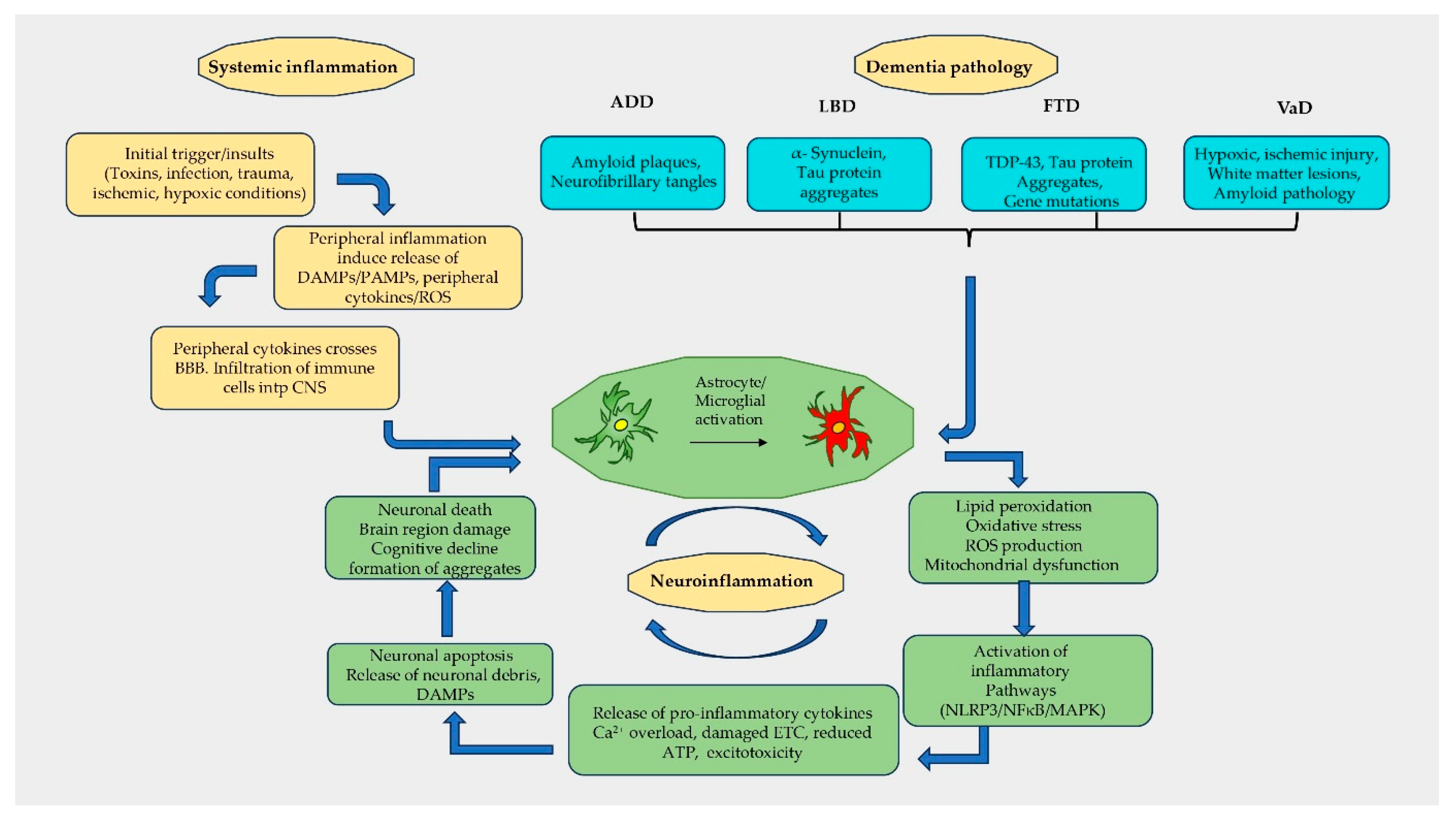
Shared Neuroinflammatory Mechanisms Across Dementia Types: An Integrative Review




Abstract
1. Introduction
2. Literature Search
3. Dementia and Its Subtypes
3.1. Alzheimer’s Disease Dementia (ADD)
Pathophysiology of ADD
3.2. Vascular Dementia (VaD)
Pathophysiology of VaD
3.3. Lewy Body Dementia (LBD)
Pathophysiology of LBD
3.4. Frontotemporal Dementia (FTD)
Pathophysiology of FTD
4. Neuroinflammation in Dementia
4.1. Neuroinflammation in Alzheimer’s Disease
4.2. Neuroinflammation in Vascular Dementia
4.3. Neuroinflammation in Lewy Body Dementia
4.4. Neuroinflammation in Frontotemporal Dementia
5. Shared Pathophysiological Mechanism of Dementias
6. Biomarkers of Neuroinflammation
6.1. Neuroimaging
6.2. Fluid Markers
7. Future Directions and Therapeutic Relevance in Dementia Research
7.1. Cytokine Modulation
7.2. Overcoming the Blood–Brain Barrier
7.3. The Gut–Brain Axis
7.4. Digital and Biomarker Technologies
7.5. Pharmacological Interventions
7.6. Monoclonal Antibodies
7.7. Natural Compounds and Nanotechnology Approaches
8. Challenges and Future Directions
9. Conclusions
Funding
Institutional Review Board Statement
Informed Consent Statement
Data Availability Statement
Acknowledgments
Conflicts of Interest
Abbreviations
| AD | Alzheimer’s disease |
| ALS | Amyotrophic lateral sclerosis |
| APOE | Apolipoprotein E |
| APP | Amyloid precursor protein |
| Aβ | Amyloid β |
| BBB | Blood–brain barrier |
| BDNF | Brain-derived neurotrophic factor |
| bvFTD | Behavioral variant frontotemporal dementia |
| CADASIL | Cerebral autosomal dominant arteriopathy with subcortical infarcts and leukoencephalopathy |
| CCL | Chemokine C-C motif ligand |
| CCR | C-C chemokine receptor |
| CNS | Central nervous system |
| COX1,2 | Cyclooxygenase 1,2 |
| CREB | Cyclic response element binding protein |
| CSF | Cerebrospinal fluid |
| CXCL | chemokine (C-X-C motif) ligand |
| DAMP | Damage-associated molecular patterns |
| EOAD | Early-onset Alzheimer’s disease |
| FTD | Frontotemporal dementia |
| GFAP | Glial fibrillary acidic protein |
| GRN | Progranulin |
| GSK3 β | Glycogen synthase kinase-3β |
| GWAS | Genome-wide association studies |
| iBMEC | Induced brain microvascular endothelial cells |
| IDE | Insulin-degrading enzyme |
| IL | Interleukin |
| JaK | Janus kinase |
| LB | Lewy body |
| LBD | Lewy body dementia |
| LOAD | Late-onset Alzheimer’s disease |
| LPS | Lipopolysaccharide |
| LRRK2 | Leucine-rich repeat kinase 2 |
| MAP | Microtubule-associated protein |
| MAPK | Mitogen associated protein kinase |
| MAPT | Microtubule-associated protein tau |
| MCI | Mild cognitive impairment |
| MHC | Major histocompatibility complex |
| MMP | Matrix metalloproteinase |
| mAb | Monoclonal antibodies |
| MyD88 | Myeloid differentiation factor 88 |
| NFT | Neurofibrillary tangles |
| nfvPPA | Non-fluent variant primary progressive aphasia |
| NF-κB | Nuclear factor κappa B |
| NLRs | NOD-like receptors |
| NLRP3 | NOD-like receptor family, pyrin domain containing 3 |
| NSAIDs | Non-steroidal Anti-Inflammatory Drugs |
| PAMP | Pathogen-associated molecular patterns |
| PD | Parkinson’s disease |
| PDD | Parkinson’s disease dementia |
| PET | Positron emission tomography |
| PNS | Peripheral nervous system |
| PSEN | presenilin |
| SCNA | Synuclein A |
| STAT | Signal transducer and activator of transcription |
| svPPA | Semantic variant primary progressive aphasia |
| TDP43 | TAR-DNA binding protein 43 |
| TGF-β | Tumor growth factor β |
| TLRs | Toll-like receptors |
| TNF-α | Tumor necrosis factor α |
| TREM2 | Triggering Receptor Expressed on Myeloid Cells 2 |
| TSPO | Translocator protein |
| VaD | Vascular dementia |
| VCI | Vascular cognitive impairment |
| VCID | Vascular cognitive impairment and dementia |
| VEGF | Vascular endothelial growth factor |
| WHO | World Health Organization |
References
- McCarron, R.M. The DSM-5 and the art of medicine: Certainly uncertain. Ann. Intern. Med. 2013, 159, 360–361. [Google Scholar] [CrossRef] [PubMed]
- Dementia. Available online: https://www.who.int/news-room/fact-sheets/detail/dementia (accessed on 19 September 2024).
- Xia, X.; Jiang, Q.; McDermott, J.; Han, J.J. Aging and Alzheimer’s disease: Comparison and associations from molecular to system level. Aging Cell 2018, 17, e12802. [Google Scholar] [CrossRef]
- Alzheimer’s Association. 2025 Alzheimer’s disease facts and figures. Alzheimer’s Dement. 2025, 21, e70235. [Google Scholar] [CrossRef]
- Kuźma, E.; Lourida, I.; Moore, S.F.; Levine, D.A.; Ukoumunne, O.C.; Llewellyn, D.J. Stroke and dementia risk: A systematic review and meta-analysis. Alzheimer’s Dement. J. Alzheimer’s Assoc. 2018, 14, 1416–1426. [Google Scholar] [CrossRef]
- Samieri, C.; Perier, M.C.; Gaye, B.; Proust-Lima, C.; Helmer, C.; Dartigues, J.F.; Berr, C.; Tzourio, C.; Empana, J.P. Association of Cardiovascular Health Level in Older Age with Cognitive Decline and Incident Dementia. JAMA 2018, 320, 657–664. [Google Scholar] [CrossRef] [PubMed]
- WHO. Global Action Plan on the Public Health Response to Dementia 2017–2025; Mental Health, Brain Health and Substance Use (MSD), World Health Organisation: Geneva, Switzerland, 2017. [Google Scholar]
- Huang, L.; Aronow, W.S. Association of hypertension with different cognitive disorders. J. Clin. Med. 2024, 13, 6029. [Google Scholar] [CrossRef] [PubMed]
- Albert, M.S.; DeKosky, S.T.; Dickson, D.; Dubois, B.; Feldman, H.H.; Fox, N.C.; Gamst, A.; Holtzman, D.M.; Jagust, W.J.; Petersen, R.C.; et al. The diagnosis of mild cognitive impairment due to Alzheimer’s disease: Recommendations from the National Institute on Aging-Alzheimer’s Association workgroups on diagnostic guidelines for Alzheimer’s disease. Alzheimer’s Dement. J. Alzheimer’s Assoc. 2011, 7, 270–279. [Google Scholar] [CrossRef]
- Arvanitakis, Z.; Shah, R.C.; Bennett, D.A. Diagnosis and Management of Dementia: Review. JAMA 2019, 322, 1589–1599. [Google Scholar] [CrossRef]
- Sperling, R.A.; Aisen, P.S.; Beckett, L.A.; Bennett, D.A.; Craft, S.; Fagan, A.M.; Iwatsubo, T.; Jack, C.R., Jr.; Kaye, J.; Montine, T.J.; et al. Toward defining the preclinical stages of Alzheimer’s disease: Recommendations from the National Institute on Aging-Alzheimer’s Association workgroups on diagnostic guidelines for Alzheimer’s disease. Alzheimer’s Dement. J. Alzheimer’s Assoc. 2011, 7, 280–292. [Google Scholar] [CrossRef]
- Wright, A.L.; Zinn, R.; Hohensinn, B.; Konen, L.M.; Beynon, S.B.; Tan, R.P.; Clark, I.A.; Abdipranoto, A.; Vissel, B. Neuroinflammation and neuronal loss precede Aβ plaque deposition in the hAPP-J20 mouse model of Alzheimer’s disease. PLoS ONE 2013, 8, e59586. [Google Scholar] [CrossRef] [PubMed]
- Heneka, M.T.; Carson, M.J.; El Khoury, J.; Landreth, G.E.; Brosseron, F.; Feinstein, D.L.; Jacobs, A.H.; Wyss-Coray, T.; Vitorica, J.; Ransohoff, R.M.; et al. Neuroinflammation in Alzheimer’s disease. Lancet Neurol. 2015, 14, 388–405. [Google Scholar] [CrossRef]
- Bianchi, M.E. DAMPs, PAMPs and alarmins: All we need to know about danger. J. Leukoc. Biol. 2007, 81, 1–5. [Google Scholar] [CrossRef] [PubMed]
- Rubartelli, A.; Lotze, M.T. Inside, outside, upside down: Damage-associated molecular-pattern molecules (DAMPs) and redox. Trends Immunol. 2007, 28, 429–436. [Google Scholar] [CrossRef] [PubMed]
- Carrano, A.; Hoozemans, J.J.; van der Vies, S.M.; van Horssen, J.; de Vries, H.E.; Rozemuller, A.J. Neuroinflammation and blood-brain barrier changes in capillary amyloid angiopathy. Neuro-Degener. Dis. 2012, 10, 329–331. [Google Scholar] [CrossRef]
- Ramesh, G.; MacLean, A.G.; Philipp, M.T. Cytokines and chemokines at the crossroads of neuroinflammation, neurodegeneration, and neuropathic pain. Mediat. Inflamm. 2013, 2013, 480739. [Google Scholar] [CrossRef]
- González, H.; Elgueta, D.; Montoya, A.; Pacheco, R. Neuroimmune regulation of microglial activity involved in neuroinflammation and neurodegenerative diseases. J. Neuroimmunol. 2014, 274, 1–13. [Google Scholar] [CrossRef]
- Pákáski, M.; Kálmán, J. Interactions between the amyloid and cholinergic mechanisms in Alzheimer’s disease. Neurochem. Int. 2008, 53, 103–111. [Google Scholar] [CrossRef] [PubMed]
- Hampel, H.; Mesulam, M.M.; Cuello, A.C.; Khachaturian, A.S.; Vergallo, A.; Farlow, M.R.; Snyder, P.J.; Giacobini, E.; Khachaturian, Z.S. Revisiting the Cholinergic Hypothesis in Alzheimer’s Disease: Emerging Evidence from Translational and Clinical Research. J. Prev. Alzheimer’s Dis. 2019, 6, 2–15. [Google Scholar] [CrossRef]
- Opris, I.; Nestianu, V.S.; Nestianu, A.; Bilteanu, L.; Ciurea, J. George Marinesco in the Constellation of Modern Neuroscience. Front. Neurosci. 2017, 11, 726. [Google Scholar] [CrossRef]
- Bondi, M.W.; Edmonds, E.C.; Jak, A.J.; Clark, L.R.; Delano-Wood, L.; McDonald, C.R.; Nation, D.A.; Libon, D.J.; Au, R.; Galasko, D.; et al. Neuropsychological criteria for mild cognitive impairment improves diagnostic precision, biomarker associations, and progression rates. J. Alzheimer’s Dis. 2014, 42, 275–289. [Google Scholar] [CrossRef]
- Ciurea, V.A.; Covache-Busuioc, R.A.; Mohan, A.G.; Costin, H.P.; Voicu, V. Alzheimer’s disease: 120 years of research and progress. J. Med. Life 2023, 16, 173–177. [Google Scholar] [CrossRef]
- Wang, H.; Yang, F.; Zhang, S.; Xin, R.; Sun, Y. Genetic and environmental factors in Alzheimer’s and Parkinson’s diseases and promising therapeutic intervention via fecal microbiota transplantation. npj Park. Dis. 2021, 7, 70. [Google Scholar] [CrossRef]
- Breijyeh, Z.; Karaman, R. Comprehensive Review on Alzheimer’s Disease: Causes and Treatment. Molecules 2020, 25, 5789. [Google Scholar] [CrossRef]
- De-Paula, V.J.; Radanovic, M.; Diniz, B.S.; Forlenza, O.V. Alzheimer’s disease. Sub-Cell. Biochem. 2012, 65, 329–352. [Google Scholar] [CrossRef]
- Spires-Jones, T.L.; Hyman, B.T. The intersection of amyloid beta and tau at synapses in Alzheimer’s disease. Neuron 2014, 82, 756–771. [Google Scholar] [CrossRef]
- Recuero, M.; Serrano, E.; Bullido, M.J.; Valdivieso, F. Abeta production as consequence of cellular death of a human neuroblastoma overexpressing APP. FEBS Lett. 2004, 3, 114–118. [Google Scholar] [CrossRef]
- Knopman, D.S.; Amieva, H.; Petersen, R.C.; Chételat, G.; Holtzman, D.M.; Hyman, B.T.; Nixon, R.A.; Jones, D.T. Alzheimer disease. Nat. Rev. Dis. Primers 2021, 7, 33. [Google Scholar] [CrossRef]
- Schmitt, H. Protein ubiquitination, degradation and the proteasome in neuro-degenerative disorders: No clear evidence for a significant pathogenetic role of proteasome failure in Alzheimer disease and related disorders. Med. Hypotheses 2006, 67, 311–317. [Google Scholar] [CrossRef]
- Barbier, P.; Zejneli, O.; Martinho, M.; Lasorsa, A.; Belle, V.; Smet-Nocca, C.; Tsvetkov, P.O.; Devred, F.; Landrieu, I. Role of Tau as a Microtubule-Associated Protein: Structural and Functional Aspects. Front. Aging Neurosci. 2019, 11, 204. [Google Scholar] [CrossRef] [PubMed]
- Spillantini, M.G.; Goedert, M. Tau pathology and neurodegeneration. Lancet. Neurol. 2013, 12, 609–622. [Google Scholar] [CrossRef] [PubMed]
- Bekris, L.M.; Yu, C.E.; Bird, T.D.; Tsuang, D.W. Genetics of Alzheimer disease. J. Geriatr. Psychiatry Neurol. 2010, 23, 213–227. [Google Scholar] [CrossRef]
- Brickell, K.L.; Steinbart, E.J.; Rumbaugh, M.; Payami, H.; Schellenberg, G.D.; Van Deerlin, V.; Yuan, W.; Bird, T.D. Early-onset Alzheimer disease in families with late-onset Alzheimer disease: A potential important subtype of familial Alzheimer disease. Arch. Neurol. 2006, 63, 1307–1311. [Google Scholar] [CrossRef]
- Koch, P.; Tamboli, I.Y.; Mertens, J.; Wunderlich, P.; Ladewig, J.; Stüber, K.; Esselmann, H.; Wiltfang, J.; Brüstle, O.; Walter, J. Presenilin-1 L166P mutant human pluripotent stem cell-derived neurons exhibit partial loss of γ-secretase activity in endogenous amyloid-β generation. Am. J. Pathol. 2012, 180, 2404–2416. [Google Scholar] [CrossRef]
- Jay, T.R.; Miller, C.M.; Cheng, P.J.; Graham, L.C.; Bemiller, S.; Broihier, M.L.; Xu, G.; Margevicius, D.; Karlo, J.C.; Sousa, G.L.; et al. TREM2 deficiency eliminates TREM2+ inflammatory macrophages and ameliorates pathology in Alzheimer’s disease mouse models. J. Exp. Med. 2015, 212, 287–295. [Google Scholar] [CrossRef]
- Iemolo, F.; Duro, G.; Rizzo, C.; Castiglia, L.; Hachinski, V.; Caruso, C. Pathophysiology of vascular dementia. Immun. Ageing 2009, 6, 13. [Google Scholar] [CrossRef] [PubMed]
- Kalaria, R.N.; Akinyemi, R.; Ihara, M. Stroke injury, cognitive impairment and vascular dementia. Biochim. Biophys. Acta 2016, 1862, 915–925. [Google Scholar] [CrossRef]
- Yang, H.M. Vascular Dementia: From Pathophysiology to Therapeutic Frontiers. J. Clin. Med. 2025, 14, 6611. [Google Scholar] [CrossRef] [PubMed]
- El Husseini, N.; Katzan, I.L.; Rost, N.S.; Blake, M.L.; Byun, E.; Pendlebury, S.T.; Aparicio, H.J.; Marquine, M.J.; Gottesman, R.F.; Smith, E.E.; et al. Cognitive Impairment After Ischemic and Hemorrhagic Stroke: A Scientific Statement from the American Heart Association/American Stroke Association. Stroke 2023, 54, e272–e291. [Google Scholar] [CrossRef] [PubMed]
- Morgan, A.E.; Mc Auley, M.T. Vascular dementia: From pathobiology to emerging perspectives. Ageing Res. Rev. 2024, 96, 102278. [Google Scholar] [CrossRef]
- Tatemichi, T.K.; Desmond, D.W.; Mayeux, R.; Paik, M.; Stern, Y.; Sano, M.; Remien, R.H.; Williams, J.B.; Mohr, J.P.; Hauser, W.A. Dementia after stroke: Baseline frequency, risks, and clinical features in a hospitalized cohort. Neurology 1992, 42, 1185–1193. [Google Scholar] [CrossRef]
- Rundek, T.; Tolea, M.; Ariko, T.; Fagerli, E.A.; Camargo, C.J. Vascular Cognitive Impairment (VCI). Neurother. J. Am. Soc. Exp. Neurother. 2022, 19, 68–88. [Google Scholar] [CrossRef]
- Albu, C.V.; Pădureanu, V.; Boldeanu, M.V.; Bumbea, A.M.; Enescu, A.Ş.; Albulescu, D.M.; Siloși, C.A.; Enescu, A. Vascular Neurocognitive Disorders and the Vascular Risk Factors. J. Mind Med. Sci. 2018, 5, 7–15. [Google Scholar] [CrossRef]
- Iadecola, C. The pathobiology of vascular dementia. Neuron 2013, 80, 844–866. [Google Scholar] [CrossRef] [PubMed]
- Bangen, K.J.; Nation, D.A.; Delano-Wood, L.; Weissberger, G.H.; Hansen, L.A.; Galasko, D.; Salmon, D.P.; Bondi, M.W. Aggregate effects of vascular risk factors on cerebrovascular changes in autopsy-confirmed alzheimer’s disease. Alzheimer’s Dement. 2014, 11, 394. [Google Scholar] [CrossRef] [PubMed]
- Fongang, B.; Weinstein, G.; Guðjónsson, A.; Mishra, A.; Bis, J.C.; Yang, Q.; Winsvold, B.; Sargurupremraj, M.; Fan, K.H.; Kamboh, M.I.; et al. A meta-analysis of genome-wide association studies identifies new genetic loci associated with all-cause and vascular dementia. Alzheimer’s Dement. 2022, 17, e056081. [Google Scholar] [CrossRef]
- Chabriat, H.; Joutel, A.; Dichgans, M.; Tournier-Lasserve, E.; Bousser, M.G. Cadasil. Lancet Neurol. 2009, 8, 643–653. [Google Scholar] [CrossRef]
- Tikka, S.; Ng, Y.P.; Maio, G.D.; Mykkänen, K.; Siitonen, M.; Lepikhova, T.; Pöyhönen, M.; Viitanen, M.; Virtanen, I.; Kalimo, H.; et al. Cadasil mutations and shrna silencing of notch3 affect actin organization in cultured vascular smooth muscle cells. J. Cereb. Blood Flow Metab. 2012, 32, 2171–2180. [Google Scholar] [CrossRef]
- Natté, R.; Maat-Schieman, M.L.C.; Haan, J.; Bornebroek, M.; Roos, R.A.; Duinen, S.G.V. Dementia in hereditary cerebral hemorrhage with amyloidosis-dutch type is associated with cerebral amyloid angiopathy but is independent of plaques and neurofibrillary tangles. Ann. Neurol. 2001, 50, 765–772. [Google Scholar] [CrossRef]
- Biffi, A. Main features of hereditary cerebral amyloid angiopathies: A systematic review. Cereb. Circ.—Cogn. Behav. 2022, 3, 100124. [Google Scholar] [CrossRef]
- Lanfranconi, S.; Markus, H.S. COL4A1 mutations as a monogenic cause of cerebral small vessel disease: A systematic review. Stroke 2010, 41, e513–e518. [Google Scholar] [CrossRef]
- Nozaki, H.; Sekine, Y.; Fukutake, T.; Nishimoto, Y.; Shimoe, Y.; Shirata, A.; Yanagawa, S.; Hirayama, M.; Tamura, M.; Nishizawa, M.; et al. Characteristic features and progression of abnormalities on MRI for CARASIL. Neurology 2015, 85, 459–463. [Google Scholar] [CrossRef]
- Shi, Q.; Chen, J.; Pongmoragot, J.; Lanthier, S.; Saposnik, G. Prevalence of Fabry disease in stroke patients—A systematic review and meta-analysis. J. Stroke Cerebrovasc. Dis. 2014, 23, 985–992. [Google Scholar] [CrossRef] [PubMed]
- Kim, Y.; Nam, Y.J.; Lee, C. Analysis of the srebf2 gene as a genetic risk factor for vascular dementia. Am. J. Med. Genet. Part B Neuropsychiatr. Genet. 2005, 139B, 19–22. [Google Scholar] [CrossRef]
- Achariyar, T.M.; Li, B.; Peng, W.; Verghese, P.B.; Shi, Y.; McConnell, E.; Benraiss, A.; Kasper, T.; Song, W.; Takano, T.; et al. Glymphatic distribution of CSF-derived apoE is isoform specific and suppressed during sleep deprivation. Mol. Neurodegener. 2016, 11, 74, Erratum in Mol. Neurodegener. 2017, 12, 3. [Google Scholar] [CrossRef] [PubMed]
- Schilling, S.; DeStefano, A.L.; Sachdev, P.S.; Choi, S.H.; Mather, K.A.; DeCarli, C.D.; Wen, W.; Hogh, P.; Raz, N.; Au, R.; et al. APOE genotype and MRI markers of cerebrovascular disease: Systematic review and meta-analysis. Neurology 2013, 81, 292–300. [Google Scholar] [CrossRef]
- Montagne, A.; Nation, D.A.; Sagare, A.P.; Barisano, G.; Sweeney, M.D.; Chakhoyan, A.; Pachicano, M.; Joe, E.; Nelson, A.R.; D’Orazio, L.M.; et al. APOE4 leads to blood-brain barrier dysfunction predicting cognitive decline. Nature 2020, 581, 71–76. [Google Scholar] [CrossRef]
- Liu, H.; Yang, M.; Li, G.M.; Qiu, Y.; Zheng, J.; Du, X.; Wang, J.L.; Liu, R.W. The MTHFR C677T polymorphism contributes to an increased risk for vascular dementia: A meta-analysis. J. Neurol. Sci. 2010, 294, 74–80. [Google Scholar] [CrossRef]
- Swardfager, W.; Lanctôt, K.; Rothenburg, L.; Wong, A.; Cappell, J.; Herrmann, N. A meta-analysis of cytokines in Alzheimer’s disease. Biol. Psychiatry 2010, 68, 930–941. [Google Scholar] [CrossRef]
- Zlokovic, B.V.; Gottesman, R.F.; Bernstein, K.E.; Seshadri, S.; McKee, A.; Snyder, H.; Greenberg, S.M.; Yaffe, K.; Schaffer, C.B.; Iadecola, C.; et al. Vascular contributions to cognitive impairment and dementia (VCID): A report from the 2018 National Heart, Lung, and Blood Institute and National Institute of Neurological Disorders and Stroke Workshop. Alzheimer’s Dement. 2020, 16, 1714–1733. [Google Scholar] [CrossRef] [PubMed]
- Prins, N.D.; Scheltens, P. White matter hyperintensities, cognitive impairment and dementia: An update. Nat. Rev. Neurol. 2015, 11, 157–165. [Google Scholar] [CrossRef]
- Jayaraj, R.L.; Azimullah, S.; Beiram, R.; Jalal, F.Y.; Rosenberg, G.A. Neuroinflammation: Friend and foe for ischemic stroke. J. Neuroinflamm. 2019, 16, 142. [Google Scholar] [CrossRef]
- Faraco, G.; Iadecola, C. Hypertension: A harbinger of stroke and dementia. Hypertension 2013, 62, 810–817. [Google Scholar] [CrossRef]
- Habes, M.; Erus, G.; Toledo, J.B.; Zhang, T.; Bryan, N.; Launer, L.J.; Rosseel, Y.; Janowitz, D.; Doshi, J.; Van der Auwera, S.; et al. White matter hyperintensities and imaging patterns of brain ageing in the general population. Brain 2016, 139 Pt 4, 1164–1179. [Google Scholar] [CrossRef]
- Charidimou, A.; Boulouis, G.; Frosch, M.P.; Baron, J.C.; Pasi, M.; Albucher, J.F.; Banerjee, G.; Barbato, C.; Bonneville, F.; Brandner, S.; et al. The Boston criteria version 2.0 for cerebral amyloid angiopathy: A multicentre, retrospective, MRIneuropathology diagnostic accuracy study. Lancet Neurol. 2022, 21, 714–725. [Google Scholar] [CrossRef]
- Pober, J.S.; Sessa, W.C. Inflammation and the blood microvascular system. Cold Spring Harb. Perspect. Biol. 2014, 7, a016345. [Google Scholar] [CrossRef]
- Yang, Y.; Estrada, E.Y.; Thompson, J.F.; Liu, W.; Rosenberg, G.A. Matrix metalloproteinase-mediated disruption of tight junction proteins in cerebral vessels is reversed by synthetic matrix metalloproteinase inhibitor in focal ischemia in rat. J. Cereb. Blood Flow Metab. 2007, 27, 697–709. [Google Scholar] [CrossRef]
- Jo, S.; Nam, S.J.; Park, K.W.; Lee, J.H.; Lee, C.S. An Autopsy-Proven Case of Lewy Body Disease Presenting with Severe Dysphagia. J. Mov. Disord. 2021, 14, 242–244. [Google Scholar] [CrossRef]
- Colom-Cadena, M.; Grau-Rivera, O.; Planellas, L.; Cerquera, C.; Morenas, E.; Helgueta, S.; Muñoz, L.; Kulisevsky, J.; Martí, M.J.; Tolosa, E.; et al. Regional Overlap of Pathologies in Lewy Body Disorders. J. Neuropathol. Exp. Neurol. 2017, 76, 216–224. [Google Scholar] [CrossRef] [PubMed]
- Hely, M.A.; Reid, W.G.; Adena, M.A.; Halliday, G.M.; Morris, J.G. The Sydney multicenter study of Parkinson’s disease: The inevitability of dementia at 20 years. Mov. Disord. 2008, 23, 837–844. [Google Scholar] [CrossRef] [PubMed]
- Haider, A.; Spurling, B.C.; Sánchez-Manso, J.C. Lewy Body Dementia. In StatPearls; StatPearls Publishing: Treasure Island, FL, USA, 2023. [Google Scholar]
- Prasad, S.; Katta, M.R.; Abhishek, S.; Sridhar, R.; Valisekka, S.S.; Hameed, M.; Kaur, J.; Walia, N. Recent advances in Lewy body dementia: A comprehensive review. Dis.-A-Mon 2023, 69, 101441. [Google Scholar] [CrossRef] [PubMed]
- Vann Jones, S.A.; O’Brien, J.T. The prevalence and incidence of dementia with Lewy bodies: A systematic review of population and clinical studies. Psychol. Med. 2014, 44, 673–683, Erratum in Psychol Med. 2014, 44, 684.. [Google Scholar] [CrossRef]
- Sanford, A.M. Lewy Body Dementia. Clin. Geriatr. Med. 2018, 34, 603–615. [Google Scholar] [CrossRef] [PubMed]
- McKeith, I.; Mintzer, J.; Aarsland, D.; Burn, D.; Chiu, H.; Cohen-Mansfield, J.; Dickson, D.; Dubois, B.; Duda, J.E.; Feldman, H.; et al. Dementia with Lewy bodies. Lancet Neurol. 2004, 3, 19–28. [Google Scholar] [CrossRef]
- Kotzbauer, P.T.; Trojanowsk, J.Q.; Lee, V.M. Lewy body pathology in Alzheimer’s disease. J. Mol. Neurosci. 2001, 17, 225–232. [Google Scholar] [CrossRef]
- Outeiro, T.F.; Koss, D.J.; Erskine, D.; Walker, L.; Kurzawa-Akanbi, M.; Burn, D.; Donaghy, P.; Morris, C.; Taylor, J.P.; Thomas, A.; et al. Dementia with Lewy bodies: An update and outlook. Mol. Neurodegener. 2019, 14, 5. [Google Scholar] [CrossRef]
- Uemura, N.; Marotta, N.; Ara, J.; Meymand, E.; Zhang, B.; Kameda, H.; Koike, M.; Luk, K.; Trojanowski, J.; Lee, V. Distinct biological activity of Lewy body α-Synuclein strain in mice. Res. Sq. 2023, rs.3.rs–2579805. [Google Scholar] [CrossRef]
- Benskey, M.J.; Perez, R.G.; Manfredsson, F.P. The contribution of alpha synuclein to neuronal survival and function—Implications for Parkinson’s disease. J. Neurochem. 2016, 137, 331–359. [Google Scholar] [CrossRef]
- Siderowf, A.; Aarsland, D.; Mollenhauer, B.; Goldman, J.G.; Ravina, B. Biomarkers for cognitive impairment in Lewy body disorders: Status and relevance for clinical trials. Mov. Disord. 2018, 33, 528–536. [Google Scholar] [CrossRef]
- Uversky, V.N. Alpha-synuclein misfolding and neurodegenerative diseases. Curr. Protein Pept. Sci. 2008, 9, 507–540. [Google Scholar] [CrossRef] [PubMed]
- Guerreiro, R.; Ross, O.; Kun-Rodrigues, C.; Hernández, D.; Orme, T.; Eicher, J.; Shepherd, C.E.; Parkkinen, L.; Darwent, L.; Heckman, M.G.; et al. Investigating the genetic architecture of dementia with lewy bodies: A two-stage genome-wide association study. Lancet Neurol. 2018, 17, 64–74. [Google Scholar] [CrossRef] [PubMed]
- Spencer, B.; Jennings, R.; Fan, C.; Brewer, J. Assessment of genetic risk for improved clinical-neuropathological correlations. Acta Neuropathol. Commun. 2020, 8, 160. [Google Scholar] [CrossRef]
- Wu, L.; Real, R.; Martínez-Carrasco, A.; Chia, R.; Lawton, M.; Shoai, M.; Bresner, C.; Blauwendraat, C.; Singleton, A.B.; Ryten, M.; et al. Investigation of the genetic aetiology of lewy body diseases with and without dementia. Brain Commun. 2023, 6, fcae190. [Google Scholar] [CrossRef]
- 86; Hansen, D.; Ling, H.; Lashley, T.; Holton, J.; Warner, T. Review: Clinical, neuropathological and genetic features of lewy body dementias. Neuropathol. Appl. Neurobiol. 2019, 45, 635–654. [Google Scholar] [CrossRef]
- Geiger, J.; Ding, J.; Crain, B.; Pletniková, O.; Letson, C.; Dawson, T.; Rosenthal, L.S.; Pantelyat, A.; Gibbs, J.R.; Albert, M.S.; et al. Next-generation sequencing reveals substantial genetic contribution to dementia with lewy bodies. Neurobiol. Dis. 2016, 94, 55–62. [Google Scholar] [CrossRef]
- Keogh, M.; Kurzawa-Akanbi, M.; Griffin, H.; Douroudis, K.; Ayers, K.; Hussein, R.; Hudson, G.; Pyle, A.; Cordell, H.J.; Attems, J.; et al. Exome sequencing in dementia with lewy bodies. Transl. Psychiatry 2016, 6, e728. [Google Scholar] [CrossRef] [PubMed]
- Ahmad, M.A.; Kareem, O.; Khushtar, M.; Akbar, M.; Haque, M.R.; Iqubal, A.; Haider, M.F.; Pottoo, F.H.; Abdulla, F.S.; Al-Haidar, M.B.; et al. Neuroinflammation: A Potential Risk for Dementia. Int. J. Mol. Sci. 2022, 23, 616. [Google Scholar] [CrossRef] [PubMed]
- Gorlovoy, P.; Larionov, S.; Pham, T.T.; Neumann, H. Accumulation of tau induced in neurites by microglial proinflammatory mediators. FASEB J. 2009, 23, 2502–2513. [Google Scholar] [CrossRef] [PubMed]
- Calabresi, P.; Mechelli, A.; Natale, G.; Volpicelli-Daley, L.; Di Lazzaro, G.; Ghiglieri, V. Alpha-synuclein in Parkinson’s disease and other synucleinopathies: From overt neurodegeneration back to early synaptic dysfunction. Cell Death Dis. 2023, 14, 176. [Google Scholar] [CrossRef] [PubMed]
- Taylor, J.; Firbank, M.; Barnett, N.; Pearce, S.; Livingstone, A.; Mosimann, U.; Eyre, J.; McKeith, I.G.; O’Brien, J. Visual hallucinations in dementia with lewy bodies: Transcranial magnetic stimulation study. Br. J. Psychiatry 2011, 199, 492–500. [Google Scholar] [CrossRef]
- Burrell, J.R.; Halliday, G.M.; Kril, J.J.; Ittner, L.M.; Götz, J.; Kiernan, M.C.; Hodges, J.R. The frontotemporal dementia-motor neuron disease continuum. Lancet 2016, 388, 919–931. [Google Scholar] [CrossRef]
- Olney, N.T.; Spina, S.; Miller, B.L. Frontotemporal Dementia. Neurol. Clin. 2017, 35, 339–374. [Google Scholar] [CrossRef]
- Chan, D.K.; Reutens, S.; Liu, D.K.; Chan, R.O. Frontotemporal dementia—Features, diagnosis and management. Aust. Fam. Physician 2011, 40, 968–972. [Google Scholar]
- Borroni, B.; Benussi, A.; Premi, E.; Alberici, A.; Marcello, E.; Gardoni, F.; Di Luca, M.; Padovani, A. Biological, Neuroimaging, and Neurophysiological Markers in Frontotemporal Dementia: Three Faces of the Same Coin. J. Alzheimer’s Dis. 2018, 62, 1113–1123. [Google Scholar] [CrossRef] [PubMed]
- Rowe, J.B. Parkinsonism in frontotemporal dementias. Int. Rev. Neurobiol. 2019, 149, 249–275. [Google Scholar] [CrossRef]
- Gorno-Tempini, M.L.; Hillis, A.E.; Weintraub, S.; Kertesz, A.; Mendez, M.; Cappa, S.F.; Ogar, J.M.; Rohrer, J.D.; Black, S.; Boeve, B.F.; et al. Classification of primary progressive aphasia and its variants. Neurology 2011, 76, 1006–1014. [Google Scholar] [CrossRef]
- Rascovsky, K.; Hodges, J.R.; Knopman, D.; Mendez, M.F.; Kramer, J.H.; Neuhaus, J.; van Swieten, J.C.; Seelaar, H.; Dopper, E.G.; Onyike, C.U.; et al. Sensitivity of revised diagnostic criteria for the behavioural variant of frontotemporal dementia. Brain 2011, 134 Pt 9, 2456–2477. [Google Scholar] [CrossRef]
- Johnen, A.; Bertoux, M. Psychological and Cognitive Markers of Behavioral Variant Frontotemporal Dementia-A Clinical Neuropsychologist’s View on Diagnostic Criteria and Beyond. Front. Neurol. 2019, 10, 594. [Google Scholar] [CrossRef] [PubMed]
- Snowden, J.S.; Rollinson, S.; Thompson, J.C.; Harris, J.M.; Stopford, C.L.; Richardson, A.M.; Jones, M.; Gerhard, A.; Davidson, Y.S.; Robinson, A.; et al. Distinct clinical and pathological characteristics of frontotemporal dementia associated with C9ORF72 mutations. Brain 2012, 135 Pt 3, 693–708. [Google Scholar] [CrossRef]
- Shinagawa, S.; Nakajima, S.; Plitman, E.; Graff-Guerrero, A.; Mimura, M.; Nakayama, K.; Miller, B.L. Psychosis in frontotemporal dementia. J. Alzheimer’s Dis. 2014, 42, 485–499. [Google Scholar] [CrossRef]
- W.a.l.d.ö, M.L.; Gustafson, L.; Passant, U.; Englund, E. Psychotic symptoms in frontotemporal dementia: A diagnostic dilemma? Int. Psychogeriatr. 2015, 27, 531–539. [Google Scholar] [CrossRef] [PubMed]
- Hodges, J.R.; Patterson, K. Semantic dementia: A unique clinicopathological syndrome. Lancet Neurol. 2007, 6, 1004–1014. [Google Scholar] [CrossRef] [PubMed]
- Rossi, G.; Salvi, E.; Mehmeti, E.; Ricci, M.; Villa, C.; Prioni, S.; Moda, F.; Di Fede, G.; Tiraboschi, P.; Redaelli, V.; et al. Semantic and right temporal variant of FTD: Next generation sequencing genetic analysis on a single-center cohort. Front. Aging Neurosci. 2022, 14, 1085406. [Google Scholar] [CrossRef]
- Rohrer, J.D.; Rossor, M.N.; Warren, J.D. Syndromes of nonfluent primary progressive aphasia: A clinical and neurolinguistic analysis. Neurology 2010, 75, 603–610. [Google Scholar] [CrossRef] [PubMed]
- Harris, J.M.; Gall, C.; Thompson, J.C.; Richardson, A.M.; Neary, D.; du Plessis, D.; Pal, P.; Mann, D.M.; Snowden, J.S.; Jones, M. Classification and pathology of primary progressive aphasia. Neurology 2013, 81, 1832–1839. [Google Scholar] [CrossRef]
- Mann, D.M.A.; Snowden, J.S. Frontotemporal lobar degeneration: Pathogenesis, pathology and pathways to phenotype. Brain Pathol. 2017, 27, 723–736. [Google Scholar] [CrossRef]
- Lomen-Hoerth, C.; Anderson, T.; Miller, B. The overlap of amyotrophic lateral sclerosis and frontotemporal dementia. Neurology 2002, 59, 1077–1079. [Google Scholar] [CrossRef]
- Padovani, A.; Agosti, C.; Premi, E.; Bellelli, G.; Borroni, B. Extrapyramidal symptoms in Frontotemporal Dementia: Prevalence and clinical correlations. Neurosci. Lett. 2007, 422, 39–42. [Google Scholar] [CrossRef]
- Rademakers, R.; Neumann, M.; Mackenzie, I.R. Advances in understanding the molecular basis of frontotemporal dementia. Nat. Rev. Neurol. 2012, 8, 423–434. [Google Scholar] [CrossRef] [PubMed]
- Khan, I.; De Jesus, O. Frontotemporal Lobe Dementia. In StatPearls; StatPearls Publishing: Treasure Island, FL, USA, 2023. [Google Scholar]
- Strang, K.; Golde, T.; Giasson, B. Mapt mutations, tauopathy, and mechanisms of neurodegeneration. Lab. Investig. 2019, 99, 912–928. [Google Scholar] [CrossRef]
- Shi, Y.; Zhang, W.; Yang, Y.; Murzin, A.; Falcon, B.; Kotecha, A.; van Beers, M.; Tarutani, A.; Kametani, F.; Garringer, H.J.; et al. Structure-based classification of tauopathies. Nature 2021, 598, 359–363. [Google Scholar] [CrossRef]
- Dickson, D.; Kouri, N.; Murray, M.; Josephs, K. Neuropathology of frontotemporal lobar degeneration-tau (ftld-tau). J. Mol. Neurosci. 2011, 45, 384–389. [Google Scholar] [CrossRef]
- Savica, R.; Grossardt, B.R.; Bower, J.H.; Ahlskog, J.E.; Rocca, W.A. Incidence and pathology of synucleinopathies and tauopathies related to parkinsonism. JAMA Neurol. 2013, 70, 859–866. [Google Scholar] [CrossRef]
- Whitwell, J.L.; Weigand, S.D.; Boeve, B.F.; Senjem, M.L.; Gunter, J.L.; DeJesus-Hernandez, M.; Rutherford, N.J.; Baker, M.; Knopman, D.S.; Wszolek, Z.K.; et al. Neuroimaging signatures of frontotemporal dementia genetics: C9ORF72, tau, progranulin and sporadics. Brain 2012, 135 Pt 3, 794–806. [Google Scholar] [CrossRef] [PubMed]
- Malpetti, M.; Rittman, T.; Jones, P.; Cope, T.; Passamonti, L.; Bevan-Jones, W.; Patterson, K.; Fryer, T.D.; Hong, Y.T.; I Aigbirhio, F.; et al. In vivo pet imaging of neuroinflammation in familial frontotemporal dementia. J. Neurol. Neurosurg. Psychiatry 2020, 92, 319–322. [Google Scholar] [CrossRef] [PubMed]
- Hinderer, C.; Miller, R.; Dyer, C.; Johansson, J.; Bell, P.; Buza, E.; Wilson, J.M. Adeno-associated virus serotype 1-based gene therapy for FTD caused by GRN mutations. Ann. Clin. Transl. Neurol. 2020, 7, 1843–1853. [Google Scholar] [CrossRef] [PubMed]
- Arrant, A.; Filiano, A.; Unger, D.; Young, A.; Roberson, E. Restoring neuronal progranulin reverses deficits in a mouse model of frontotemporal dementia. Brain 2017, 140, 1447–1465. [Google Scholar] [CrossRef] [PubMed]
- Irwin, D.J.; Cairns, N.J.; Grossman, M.; McMillan, C.T.; Lee, E.B.; Deerlin, V.M.V.; Lee, V.M.-Y.; Trojanowski, J.Q. Frontotemporal lobar degeneration: Defining phenotypic diversity through personalized medicine. Acta Neuropathol. 2014, 129, 469–491. [Google Scholar] [CrossRef] [PubMed]
- Cash, D.; Bocchetta, M.; Thomas, D.; Dick, K.; Swieten, J.; Borroni, B.; Galimberti, D.; Masellis, M.; Tartaglia, M.C.; Rowe, J.B.; et al. Patterns of gray matter atrophy in genetic frontotemporal dementia: Results from the genfi study. Neurobiol. Aging 2018, 62, 191–196. [Google Scholar] [CrossRef] [PubMed]
- Finger, E.; Malik, R.; Bocchetta, M.; Coleman, K.; Graff, C.; Borroni, B.; Masellis, M.; Laforce, R.; Greaves, C.V.; Russell, L.L.; et al. Neurodevelopmental effects of genetic frontotemporal dementia in young adult mutation carriers. Brain 2022, 146, 2120–2131. [Google Scholar] [CrossRef]
- Gazzina, S.; Archetti, S.; Alberici, A.; Bonomi, E.; Cosseddu, M.; Lorenzo, D.; Padovani, A.; Borroni, B. Frontotemporal dementia due to the novel grn arg161glyfsx36 mutation. J. Alzheimer’s Dis. 2017, 57, 1185–1189. [Google Scholar] [CrossRef] [PubMed]
- Raulin, A.C.; Doss, S.V.; Trottier, Z.A.; Ikezu, T.C.; Bu, G.; Liu, C.C. ApoE in Alzheimer’s disease: Pathophysiology and therapeutic strategies. Mol. Neurodegener. 2022, 17, 72. [Google Scholar] [CrossRef]
- Chen, J.; Chen, J.S.; Li, S.; Zhang, F.; Deng, J.; Zeng, L.H.; Tan, J. Amyloid Precursor Protein: A Regulatory Hub in Alzheimer’s Disease. Aging Dis. 2024, 15, 201–225. [Google Scholar] [CrossRef]
- Huang, W.; Huang, J.; Huang, N.; Luo, Y. The role of TREM2 in Alzheimer’s disease: From the perspective of Tau. Front. Cell Dev. Biol. 2023, 11, 1280257. [Google Scholar] [CrossRef]
- Nygaard, H.B.; Lippa, C.F.; Mehdi, D.; Baehring, J.M. A Novel Presenilin 1 Mutation in Early-Onset Alzheimer’s Disease with Prominent Frontal Features. Am. J. Alzheimer’s Dis. Other Dement. 2014, 29, 433–435. [Google Scholar] [CrossRef]
- Robbins, J.P.; Perfect, L.; Ribe, E.M.; Maresca, M.; Dangla-Valls, A.; Foster, E.M.; Killick, R.; Nowosiad, P.; Reid, M.J.; Polit, L.D.; et al. Clusterin Is Required for β-Amyloid Toxicity in Human iPSC-Derived Neurons. Front. Neurosci. 2018, 12, 504. [Google Scholar] [CrossRef]
- Daskoulidou, N.; Shaw, B.; Torvell, M.; Watkins, L.; Cope, E.L.; Carpanini, S.M.; Allen, N.D.; Morgan, B.P. Complement receptor 1 is expressed on brain cells and in the human brain. Glia 2023, 71, 1522–1535. [Google Scholar] [CrossRef] [PubMed]
- Harold, D.; Abraham, R.; Hollingworth, P.; Sims, R.; Gerrish, A.; Hamshere, M.L.; Pahwa, J.S.; Moskvina, V.; Dowzell, K.; Williams, A.; et al. Genome-wide association study identifies variants at CLU and PICALM associated with Alzheimer’s disease. Nat. Genet. 2009, 41, 1088–1093. [Google Scholar] [CrossRef] [PubMed]
- Ando, K.; Tomimura, K.; Sazdovitch, V.; Suain, V.; Yilmaz, Z.; Authelet, M.; Ndjim, M.; Vergara, C.; Belkouch, M.; Potier, M.; et al. Clathrin adaptor CALM/PICALM is involved in tau pathology in Alzheimer and other tauopathies. In Proceedings of the Conference Abstract: 6th Belgian Brain Congress, Mons, Belgium, 8 October 2016; Volume 17. [Google Scholar] [CrossRef]
- Fazeli, E.; Child, D.D.; Bucks, S.A.; Stovarsky, M.; Edwards, G.; Rose, S.E.; Yu, C.E.; Latimer, C.; Kitago, Y.; Bird, T.; et al. A familial missense variant in the Alzheimer’s disease gene SORL1 impairs its maturation and endosomal sorting. Acta Neuropathol. 2024, 147, 20. [Google Scholar] [CrossRef]
- Duong, M.T.; Nasrallah, I.M.; Wolk, D.A.; Chang, C.C.Y.; Chang, T.Y. Cholesterol, Atherosclerosis, and APOE in Vascular Contributions to Cognitive Impairment and Dementia (VCID): Potential Mechanisms and Therapy. Front. Aging Neurosci. 2021, 13, 647990. [Google Scholar] [CrossRef]
- Romay, M.C.; Toro, C.; Iruela-Arispe, M.L. Emerging molecular mechanisms of vascular dementia. Curr. Opin. Hematol. 2019, 26, 199–206. [Google Scholar] [CrossRef] [PubMed]
- Xu, L.Z.; Li, F.Y.; Xu, J.; Li, B.Q.; Li, Y.; Jia, J.P. Vascular endothelial growth factor is an effective biomarker for vascular dementia, not for Alzheimer’s disease: A meta-analysis. Alzheimer’s Dement. 2024, 16, e12612. [Google Scholar] [CrossRef] [PubMed]
- Liu, S.; Li, X.; Fan, P.; Gu, Y.; Yang, A.; Wang, W.; Zhou, L.; Chen, H.; Zheng, F.; Lin, J.; et al. The potential role of transcription factor sterol regulatory element binding proteins (SREBPs) in Alzheimer’s disease. Biomed. Pharmacother. 2024, 180, 117575. [Google Scholar] [CrossRef]
- Bregendahl, M.; Kaya, Z.B.; Singer, W.; McLean, P.J. Alpha-synuclein seeding amplification assays in Lewy body dementia: A brief review. Mol. Neurodegener. 2025, 20, 77. [Google Scholar] [CrossRef]
- Winslow, A.R.; Moussaud, S.; Zhu, L.; Post, K.L.; Dickson, D.W.; Berezovska, O.; McLean, P.J. Convergence of pathology in dementia with Lewy bodies and Alzheimer’s disease: A role for the novel interaction of alpha-synuclein and presenilin 1 in disease. Brain 2014, 137 Pt 7, 1958–1970. [Google Scholar] [CrossRef][Green Version]
- Cai, Y.; An, S.S.; Kim, S. Mutations in presenilin 2 and its implications in Alzheimer’s disease and other dementia-associated disorders. Clin. Interv. Aging 2015, 10, 1163–1172. [Google Scholar] [CrossRef]
- Scholz, S.W.; Okubadejo, N.U.; Prakash, P.; Liddelow, S.A.; Ryten, M.; Halliday, G.M. Advances in the genetics and pathology of Lewy body dementia. Lancet. Neurol. 2025, 24, 1026–1037. [Google Scholar] [CrossRef]
- Salzano, S.; Bertasini, C.; Tavakolian Haghighi, S.; Lundkvist, J.; Wahlberg, L.U.; Chiamulera, C.; Vattemi, G.N.; Gardoni, F.; Paolone, G. Frontotemporal dementia as a consequence of GRN mutations: From disease cause to models to therapies. Pharmacol. Res. 2025, 221, 107957. [Google Scholar] [CrossRef]
- Vinceti, G.; Gallingani, C.; Zucchi, E.; Martinelli, I.; Gianferrari, G.; Simonini, C.; Bedin, R.; Chiari, A.; Zamboni, G.; Mandrioli, J. Young Onset Alzheimer’s Disease Associated with C9ORF72 Hexanucleotide Expansion: Further Evidence for a Still Unsolved Association. Genes 2023, 14, 930. [Google Scholar] [CrossRef]
- Huang, W.; Zeng, J.; Jia, L.; Zhu, D.; O’Brien, J.; Ritchie, C.; Shu, N.; Su, L. Genetic risks of Alzheimer’s by APOE and MAPT on cortical morphology in young healthy adults. Brain Commun. 2023, 5, fcad234. [Google Scholar] [CrossRef] [PubMed]
- Clayton, E.L.; Mizielinska, S.; Edgar, J.R.; Nielsen, T.T.; Marshall, S.; Norona, F.E.; Robbins, M.; Damirji, H.; Holm, I.E.; Johannsen, P.; et al. Frontotemporal dementia caused by CHMP2B mutation is characterised by neuronal lysosomal storage pathology. Acta Neuropathol. 2015, 130, 511–523. [Google Scholar] [CrossRef] [PubMed]
- Li, W.; Gao, H.; Dong, X.; Zheng, D. SQSTM1 variant in disorders of the frontotemporal dementia–amyotrophic lateral sclerosis spectrum: Identification of a novel heterozygous variant and a review of the literature. J. Neurol. 2021, 268, 1351–1357. [Google Scholar] [CrossRef] [PubMed]
- Shao, F.; Wang, X.; Wu, H.; Wu, Q.; Zhang, J. Microglia and Neuroinflammation: Crucial Pathological Mechanisms in Traumatic Brain Injury-Induced Neurodegeneration. Front. Aging Neurosci. 2022, 14, 825086. [Google Scholar] [CrossRef]
- Lee, S.H.; Bae, E.J.; Park, S.J.; Lee, S.J. Microglia-driven inflammation induces progressive tauopathies and synucleinopathies. Exp. Mol. Med. 2025, 57, 1017–1031. [Google Scholar] [CrossRef]
- Morales, I.; Farías, G.A.; Cortes, N.; Maccioni, R.B. Neuroinflammation and Neurodegeneration. In Update on Dementia; IntechOpen: London, UK, 2016. [Google Scholar] [CrossRef]
- Lima Giacobbo, B.; Doorduin, J.; Klein, H.C.; Dierckx, R.A.J.O.; Bromberg, E.; de Vries, E.F.J. Brain-Derived Neurotrophic Factor in Brain Disorders: Focus on Neuroinflammation. Mol. Neurobiol. 2019, 56, 3295–3312. [Google Scholar] [CrossRef] [PubMed]
- Colton, C.; Wilcock, D.M. Assessing activation states in microglia. CNS Neurol. Disord. Drug Targets 2010, 9, 174–191. [Google Scholar] [CrossRef]
- Ha, S.K.; Moon, E.; Lee, P.; Ryu, J.H.; Oh, M.S.; Kim, S.Y. Acacetin attenuates neuroinflammation via regulation the response to LPS stimuli in vitro and in vivo. Neurochem. Res. 2012, 37, 1560–1567. [Google Scholar] [CrossRef]
- Wong, D.; Dorovini-Zis, K.; Vincent, S.R. Cytokines, nitric oxide, and cGMP modulate the permeability of an in vitro model of the human blood-brain barrier. Exp. Neurol. 2004, 190, 446–455. [Google Scholar] [CrossRef]
- Hickman, S.E.; Allison, E.K.; El Khoury, J. Microglial dysfunction and defective beta-amyloid clearance pathways in aging Alzheimer’s disease mice. J. Neurosci. 2008, 28, 8354–8360. [Google Scholar] [CrossRef]
- Cagnin, A.; Brooks, D.J.; Kennedy, A.M.; Gunn, R.N.; Myers, R.; Turkheimer, F.E.; Jones, T.; Banati, R.B. In-vivo measurement of activated microglia in dementia. Lancet 2001, 358, 461–467. [Google Scholar] [CrossRef] [PubMed]
- Mrak, R.E.; Griffin, W.S. Common inflammatory mechanisms in Lewy body disease and Alzheimer disease. J. Neuropathol. Exp. Neurol. 2007, 66, 683–686. [Google Scholar] [CrossRef]
- Ghosh, S.; Wu, M.D.; Shaftel, S.S.; Kyrkanides, S.; LaFerla, F.M.; Olschowka, J.A.; O’Banion, M.K. Sustained interleukin-1β overexpression exacerbates tau pathology despite reduced amyloid burden in an Alzheimer’s mouse model. J. Neurosci. 2013, 33, 5053–5064. [Google Scholar] [CrossRef]
- Detrait, E.R.; Danis, B.; Lamberty, Y.; Foerch, P. Peripheral administration of an anti-TNF-α receptor fusion protein counteracts the amyloid induced elevation of hippocampal TNF-α levels and memory deficits in mice. Neurochem. Int. 2014, 72, 10–13. [Google Scholar] [CrossRef]
- Sun, Q.; Hampel, H.; Blennow, K.; Lista, S.; Levey, A.; Tang, B.; Li, R.; Shen, Y. Increased plasma TACE activity in subjects with mild cognitive impairment and patients with Alzheimer’s disease. J. Alzheimer’s Dis. 2014, 41, 877–886. [Google Scholar] [CrossRef]
- Chang, R.; Yee, K.L.; Sumbria, R.K. Tumor necrosis factor α Inhibition for Alzheimer’s Disease. J. Cent. Nerv. Syst. Dis. 2017, 9, 1179573517709278. [Google Scholar] [CrossRef]
- Buchhave, P.; Zetterberg, H.; Blennow, K.; Minthon, L.; Janciauskiene, S.; Hansson, O. Soluble TNF receptors are associated with Aβ metabolism and conversion to dementia in subjects with mild cognitive impairment. Neurobiol. Aging 2010, 31, 1877–1884. [Google Scholar] [CrossRef] [PubMed]
- Yamamoto, M.; Kiyota, T.; Horiba, M.; Buescher, J.L.; Walsh, S.M.; Gendelman, H.E.; Ikezu, T. Interferon-gamma and tumor necrosis factor-alpha regulate amyloid-beta plaque deposition and beta-secretase expression in Swedish mutant APP transgenic mice. Am. J. Pathol. 2007, 170, 680–692. [Google Scholar] [CrossRef]
- Liao, Y.F.; Wang, B.J.; Cheng, H.T.; Kuo, L.H.; Wolfe, M.S. Tumor necrosis factor-alpha, interleukin-1beta, and interferon-gamma stimulate gamma-secretase-mediated cleavage of amyloid precursor protein through a JNK-dependent MAPK pathway. J. Biol. Chem. 2004, 279, 49523–49532. [Google Scholar] [CrossRef] [PubMed]
- Scheller, J.; Chalaris, A.; Schmidt-Arras, D.; Rose-John, S. The pro- and anti-inflammatory properties of the cytokine interleukin-6. Biochim. Biophys. Acta 2011, 1813, 878–888. [Google Scholar] [CrossRef]
- D’Anna, L.; Abu-Rumeileh, S.; Fabris, M.; Pistis, C.; Baldi, A.; Sanvilli, N.; Curcio, F.; Gigli, G.L.; D’Anna, S.; Valente, M. Serum Interleukin-10 Levels Correlate with Cerebrospinal Fluid Amyloid Beta Deposition in Alzheimer Disease Patients. Neuro-Degener. Dis. 2017, 17, 227–234. [Google Scholar] [CrossRef]
- Caraci, F.; Spampinato, S.; Sortino, M.A.; Bosco, P.; Battaglia, G.; Bruno, V.; Drago, F.; Nicoletti, F.; Copani, A. Dysfunction of TGF-β1 signaling in Alzheimer’s disease: Perspectives for neuroprotection. Cell Tissue Res. 2012, 347, 291–301. [Google Scholar] [CrossRef] [PubMed]
- Zhou, Y.; Song, W.M.; Andhey, P.S.; Swain, A.; Levy, T.; Miller, K.R.; Poliani, P.L.; Cominelli, M.; Grover, S.; Gilfillan, S.; et al. Human and mouse single-nucleus transcriptomics reveal TREM2-dependent and TREM2-independent cellular responses in Alzheimer’s disease. Nat. Med. 2020, 26, 131–142. [Google Scholar] [CrossRef] [PubMed]
- Singh, A.; Kukreti, R.; Saso, L.; Kukreti, S. Oxidative Stress: A Key Modulator in Neurodegenerative Diseases. Molecules 2019, 24, 1583. [Google Scholar] [CrossRef]
- Ionescu-Tucker, A.; Cotman, C.W. Emerging roles of oxidative stress in brain aging and Alzheimer’s disease. Neurobiol. Aging 2021, 107, 86–95. [Google Scholar] [CrossRef]
- Tian, Z.; Ji, X.; Liu, J. Neuroinflammation in Vascular Cognitive Impairment and Dementia: Current Evidence, Advances, and Prospects. Int. J. Mol. Sci. 2022, 23, 6224. [Google Scholar] [CrossRef]
- Sha, S.; Tan, J.; Miao, Y.; Zhang, Q. The Role of Autophagy in Hypoxia-Induced Neuroinflammation. DNA Cell Biol. 2021, 40, 733–739. [Google Scholar] [CrossRef]
- Lyman, M.; Lloyd, D.G.; Ji, X.; Vizcaychipi, M.P.; Ma, D. Neuroinflammation: The role and consequences. Neurosci. Res. 2014, 79, 1–12. [Google Scholar] [CrossRef]
- Hou, X.; Liang, X.; Chen, J.F.; Zheng, J. Ecto-5′-nucleotidase (CD73) is involved in chronic cerebral hypoperfusion-induced white matter lesions and cognitive impairment by regulating glial cell activation and pro-inflammatory cytokines. Neuroscience 2015, 297, 118–126. [Google Scholar] [CrossRef]
- Simons, M.; Nave, K.A. Oligodendrocytes: Myelination and Axonal Support. Cold Spring Harb. Perspect. Biol. 2015, 8, a020479. [Google Scholar] [CrossRef]
- Zhang, L.Y.; Pan, J.; Mamtilahun, M.; Zhu, Y.; Wang, L.; Venkatesh, A.; Shi, R.; Tu, X.; Jin, K.; Wang, Y.; et al. Microglia exacerbate white matter injury via complement C3/C3aR pathway after hypoperfusion. Theranostics 2020, 10, 74–90. [Google Scholar] [CrossRef] [PubMed]
- Narantuya, D.; Nagai, A.; Sheikh, A.M.; Wakabayashi, K.; Shiota, Y.; Watanabe, T.; Masuda, J.; Kobayashi, S.; Kim, S.U.; Yamaguchi, S. Microglia transplantation attenuates white matter injury in rat chronic ischemia model via matrix metalloproteinase-2 inhibition. Brain Res. 2010, 1316, 145–152. [Google Scholar] [CrossRef] [PubMed]
- Zenaro, E.; Pietronigro, E.; Della Bianca, V.; Piacentino, G.; Marongiu, L.; Budui, S.; Turano, E.; Rossi, B.; Angiari, S.; Dusi, S.; et al. Neutrophils promote Alzheimer’s disease-like pathology and cognitive decline via LFA-1 integrin. Nat. Med. 2015, 21, 880–886. [Google Scholar] [CrossRef]
- Mast, H.; Tatemichi, T.K.; Mohr, J.P. Chronic brain ischemia: The contributions of Otto Binswanger and Alois Alzheimer to the mechanisms of vascular dementia. J. Neurol. Sci. 1995, 132, 4–10. [Google Scholar] [CrossRef]
- Duan, W.; Gui, L.; Zhou, Z.; Liu, Y.; Tian, H.; Chen, J.F.; Zheng, J. Adenosine A2A receptor deficiency exacerbates white matter lesions and cognitive deficits induced by chronic cerebral hypoperfusion in mice. J. Neurol. Sci. 2009, 285, 39–45. [Google Scholar] [CrossRef] [PubMed]
- Taoka, T.; Masutani, Y.; Kawai, H.; Nakane, T.; Matsuoka, K.; Yasuno, F.; Kishimoto, T.; Naganawa, S. Evaluation of glymphatic system activity with the diffusion MR technique: Diffusion tensor image analysis along the perivascular space (DTI-ALPS) in Alzheimer’s disease cases. Jpn. J. Radiol. 2015, 35, 172–178. [Google Scholar] [CrossRef]
- Daniele, S.G.; Béraud, D.; Davenport, C.; Cheng, K.; Yin, H.; Maguire-Zeiss, K.A. Activation of MyD88-dependent TLR1/2 signaling by misfolded α-synuclein, a protein linked to neurodegenerative disorders. Sci. Signal. 2015, 8, ra45. [Google Scholar] [CrossRef]
- Fellner, L.; Irschick, R.; Schanda, K.; Reindl, M.; Klimaschewski, L.; Poewe, W.; Wenning, G.K.; Stefanova, N. Toll-like receptor 4 is required for α-synuclein dependent activation of microglia and astroglia. Glia 2013, 61, 349–360. [Google Scholar] [CrossRef]
- Kim, C.; Ho, D.H.; Suk, J.E.; You, S.; Michael, S.; Kang, J.; Lee, S.; Masliah, E.; Hwang, D.; Lee, H.J.; et al. Neuron-released oligomeric a-synuclein is an endogenous agonist of TLR2 for paracrine activation of microglia. Nat. Commun. 2013, 4, 1562. [Google Scholar] [CrossRef]
- Harms, A.S.; Cao, S.; Rowse, A.L.; Thome, A.D.; Li, X.; Mangieri, L.R.; Cron, R.Q.; Shacka, J.J.; Raman, C.; Standaert, D.G. MHCII is required for α-synuclein-induced activation of microglia, CD4 T cell proliferation, and dopaminergic neurodegeneration. J. Neurosci. 2013, 33, 9592–9600. [Google Scholar] [CrossRef]
- Bevan-Jones, W.R.; Cope, T.E.; Jones, P.S.; Kaalund, S.S.; Passamonti, L.; Allinson, K.; Green, O.; Hong, Y.T.; Fryer, T.D.; Arnold, R.; et al. Neuroinflammation and protein aggregation co-localize across the frontotemporal dementia spectrum. Brain 2020, 143, 1010–1026. [Google Scholar] [CrossRef] [PubMed]
- Stefaniak, J.; O’Brien, J. Imaging of neuroinflammation in dementia: A review. J. Neurol. Neurosurg. Psychiatry 2015, 87, 21–28. [Google Scholar] [CrossRef] [PubMed]
- Broce, I.; Karch, C.M.; Wen, N.; Fan, C.C.; Wang, Y.; Tan, C.H.; Kouri, N.; Ross, O.A.; Höglinger, G.U.; Muller, U.; et al. Immune-related genetic enrichment in frontotemporal dementia: An analysis of genome-wide association studies. PLoS Med. 2018, 15, e1002487, Correction in PLoS Med. 2018, 15, e1002504.. [Google Scholar]
- Woollacott, I.O.C.; Nicholas, J.M.; Heslegrave, A.; Heller, C.; Foiani, M.S.; Dick, K.M.; Russell, L.L.; Paterson, R.W.; Keshavan, A.; Fox, N.C.; et al. Cerebrospinal fluid soluble TREM2 levels in frontotemporal dementia differ by genetic and pathological subgroup. Alzheimer’s Res. Ther. 2018, 10, 79. [Google Scholar] [CrossRef]
- Henry, M.L.; Wilson, S.M.; Ogar, J.M.; Sidhu, M.S.; Rankin, K.P.; Cattaruzza, T.; Miller, B.L.; Gorno-Tempini, M.L.; Seeley, W.W. Neuropsychological, behavioral, and anatomical evolution in right temporal variant frontotemporal dementia: A longitudinal and post-mortem single case analysis. Neurocase 2014, 20, 100–109. [Google Scholar] [CrossRef]
- Lant, S.B.; Robinson, A.C.; Thompson, J.C.; Rollinson, S.; Pickering-Brown, S.; Snowden, J.S.; Davidson, Y.S.; Gerhard, A.; Mann, D.M. Patterns of microglial cell activation in frontotemporal lobar degeneration. Neuropathol. Appl. Neurobiol. 2014, 40, 686–696. [Google Scholar] [CrossRef]
- Wyss-Coray, T.; Mucke, L. Inflammation in neurodegenerative disease--a double-edged sword. Neuron 2002, 35, 419–432. [Google Scholar] [CrossRef]
- Bright, F.; Werry, E.L.; Dobson-Stone, C.; Piguet, O.; Ittner, L.M.; Halliday, G.M.; Hodges, J.R.; Kiernan, M.C.; Loy, C.T.; Kassiou, M.; et al. Neuroinflammation in frontotemporal dementia. Nat. Rev. Neurol. 2019, 15, 540–555. [Google Scholar] [CrossRef]
- van der Ende, E.L.; Heller, C.; Sogorb-Esteve, A.; Swift, I.J.; McFall, D.; Peakman, G.; Bouzigues, A.; Poos, J.M.; Jiskoot, L.C.; Panman, J.L.; et al. Elevated CSF and plasma complement proteins in genetic frontotemporal dementia: Results from the GENFI study. J. Neuroinflamm. 2022, 19, 217. [Google Scholar] [CrossRef] [PubMed]
- Miller, Z.A.; Rankin, K.P.; Graff-Radford, N.R.; Takada, L.T.; Sturm, V.E.; Cleveland, C.M.; Criswell, L.A.; Jaeger, P.A.; Stan, T.; Heggeli, K.A.; et al. TDP-43 frontotemporal lobar degeneration and autoimmune disease. J. Neurol. Neurosurg. Psychiatry 2013, 84, 956–962. [Google Scholar] [CrossRef] [PubMed]
- Bellucci, A.; Bugiani, O.; Ghetti, B.; Spillantini, M.G. Presence of reactive microglia and neuroinflammatory mediators in a case of frontotemporal dementia with P301S mutation. Neuro-Degener. Dis. 2011, 8, 221–229. [Google Scholar] [CrossRef]
- Götzl, J.K.; Lang, C.M.; Haass, C.; Capell, A. Impaired protein degradation in FTLD and related disorders. Ageing Res. Rev. 2016, 32, 122–139. [Google Scholar] [CrossRef]
- Noori, A.; Mezlini, A.M.; Hyman, B.T.; Serrano-Pozo, A.; Das, S. Systematic review and meta-analysis of human transcriptomics reveals neuroinflammation, deficient energy metabolism, and proteostasis failure across neurodegeneration. Neurobiol. Dis. 2021, 149, 105225. [Google Scholar] [CrossRef]
- Varley, J.; Brooks, D.J.; Edison, P. Imaging neuroinflammation in Alzheimer’s disease and other dementias: Recent advances and future directions. Alzheimer’s Dement. 2015, 11, 1110–1120. [Google Scholar] [CrossRef] [PubMed]
- Pasqualetti, G.; Brooks, D.J.; Edison, P. The role of neuroinflammation in dementias. Curr. Neurol. Neurosci. Rep. 2015, 15, 17. [Google Scholar] [CrossRef] [PubMed]
- McGeer, P.L.; Itagaki, S.; Boyes, B.E.; McGeer, E.G. Reactive microglia are positive for HLA-DR in the substantia nigra of Parkinson’s and Alzheimer’s disease brains. Neurology 1988, 38, 1285–1291. [Google Scholar] [CrossRef]
- Zhou, R.; Yazdi, A.S.; Menu, P.; Tschopp, J. A role for mitochondria in NLRP3 inflammasome activation. Nature 2011, 469, 221–225. [Google Scholar] [CrossRef] [PubMed]
- Perry, V.; Nicoll, J.; Holmes, C. Microglia in neurodegenerative disease. Nat. Rev. Neurol. 2010, 6, 193–201. [Google Scholar] [CrossRef]
- Leng, F.; Edison, P. Neuroinflammation and microglial activation in Alzheimer disease: Where do we go from here? Nat. Rev. Neurol. 2021, 17, 157–172. [Google Scholar] [CrossRef]
- Takatori, S.; Kondo, M.; Tomita, T. Unraveling the complex role of microglia in Alzheimer’s disease: Amyloid β metabolism and plaque formation. Inflamm. Regen. 2025, 45, 16. [Google Scholar] [CrossRef]
- McGeer, P.L.; McGeer, E.G. The alpha-synuclein burden hypothesis of Parkinson disease and its relationship to Alzheimer disease. Exp. Neurol. 2008, 212, 235–238. [Google Scholar] [CrossRef]
- Yoshiyama, Y.; Higuchi, M.; Zhang, B.; Huang, S.M.; Iwata, N.; Saido, T.C.; Maeda, J.; Suhara, T.; Trojanowski, J.Q.; Lee, V.M. Synapse loss and microglial activation precede tangles in a P301S tauopathy mouse model. Neuron 2007, 53, 337–351. [Google Scholar] [CrossRef]
- Elia, L.; Herting, B.; Alijagic, A.; Buselli, C.; Wong, L.; Morrison, G.; Prado, M.A.; Paulo, J.A.; Gygi, S.P.; Finley, D.; et al. Frontotemporal Dementia Patient Neurons with Progranulin Deficiency Display Protein Dyshomeostasis. bioRxiv 2023. bioRxiv:2023.01.18.524611. [Google Scholar] [CrossRef]
- Ventriglia, M.; Zanardini, R.; Bonomini, C.; Zanetti, O.; Volpe, D.; Pasqualetti, P.; Gennarelli, M.; Bocchio-Chiavetto, L. Serum brain-derived neurotrophic factor levels in different neurological diseases. BioMed Res. Int. 2013, 2013, 901082. [Google Scholar] [CrossRef]
- de Pablos, R.M.; Herrera, A.J.; Espinosa-Oliva, A.M.; Sarmiento, M.; Muñoz, M.F.; Machado, A.; Venero, J.L. Chronic stress enhances microglia activation and exacerbates death of nigral dopaminergic neurons under conditions of inflammation. J. Neuroinflamm. 2014, 11, 34. [Google Scholar] [CrossRef]
- Garland, E.F.; Antony, H.; Kulagowska, L.; Scott, T.; Rogien, C.; Bottlaender, M.; Nicoll, J.A.R.; Boche, D. The microglial translocator protein (TSPO) in Alzheimer’s disease reflects a phagocytic phenotype. Acta Neuropathol. 2024, 148, 62. [Google Scholar] [CrossRef] [PubMed]
- Root, J.; Merino, P.; Nuckols, A.; Johnson, M.; Kukar, T. Lysosome dysfunction as a cause of neurodegenerative diseases: Lessons from frontotemporal dementia and amyotrophic lateral sclerosis. Neurobiol. Dis. 2021, 154, 105360. [Google Scholar] [CrossRef] [PubMed]
- Hopfner, F.; Mueller, S.H.; Szymczak, S.; Junge, O.; Tittmann, L.; May, S.; Lohmann, K.; Grallert, H.; Lieb, W.; Strauch, K.; et al. Rare Variants in Specific Lysosomal Genes Are Associated with Parkinson’s Disease. Mov. Disord. 2020, 35, 1245–1248. [Google Scholar] [CrossRef] [PubMed]
- Rhinn, H.; Tatton, N.; McCaughey, S.; Kurnellas, M.; Rosenthal, A. Progranulin as a therapeutic target in neurodegenerative diseases. Trends Pharmacol. Sci. 2022, 43, 641–652. [Google Scholar] [CrossRef]
- Kleinberger, G.; Yamanishi, Y.; Suárez-Calvet, M.; Czirr, E.; Lohmann, E.; Cuyvers, E.; Struyfs, H.; Pettkus, N.; Wenninger-Weinzierl, A.; Mazaheri, F.; et al. TREM2 mutations implicated in neurodegeneration impair cell surface transport and phagocytosis. Sci. Transl. Med. 2014, 6, 243ra86. [Google Scholar] [CrossRef]
- Peng, G.; Qiu, J.; Liu, H.; Zhou, M.; Huang, S.; Guo, W.; Lin, Y.; Chen, X.; Li, Z.; Li, G.; et al. Analysis of Cerebrospinal Fluid Soluble TREM2 and Polymorphisms in Sporadic Parkinson’s Disease in a Chinese Population. J. Mol. Neurosci. 2020, 70, 294–301. [Google Scholar] [CrossRef]
- Neel, D.V.; Basu, H.; Gunner, G.; Bergstresser, M.D.; Giadone, R.M.; Chung, H.; Miao, R.; Chou, V.; Brody, E.; Jiang, X.; et al. Gasdermin-E mediates mitochondrial damage in axons and neurodegeneration. Neuron 2023, 111, 1222–1240.e9. [Google Scholar] [CrossRef]
- Rosen, H.J.; Narvaez, J.M.; Hallam, B.; Kramer, J.H.; Wyss-Coray, C.; Gearhart, R.; Johnson, J.K.; Miller, B.L. Neuropsychological and functional measures of severity in Alzheimer disease, frontotemporal dementia, and semantic dementia. Alzheimer Dis. Assoc. Disord. 2004, 18, 202–207. [Google Scholar]
- Taylor, K.I.; Probst, A.; Miserez, A.R.; Monsch, A.U.; Tolnay, M. Clinical course of neuropathologically confirmed frontal-variant Alzheimer’s disease. Nat. Clin. practice. Neurol. 2008, 4, 226–232. [Google Scholar] [CrossRef]
- Rankin, K.P.; Mayo, M.C.; Seeley, W.W.; Lee, S.; Rabinovici, G.; Gorno-Tempini, M.L.; Boxer, A.L.; Weiner, M.W.; Trojanowski, J.Q.; DeArmond, S.J.; et al. Behavioral variant frontotemporal dementia with corticobasal degeneration pathology: Phenotypic comparison to bvFTD with Pick’s disease. J. Mol. Neurosci. 2011, 45, 594–608. [Google Scholar] [CrossRef] [PubMed][Green Version]
- Duignan, J.A.; Haughey, A.; Kinsella, J.A.; Killeen, R.P. Molecular and Anatomical Imaging of Dementia with Lewy Bodies and Frontotemporal Lobar Degeneration. Semin. Nucl. Med. 2021, 51, 264–274. [Google Scholar] [CrossRef] [PubMed]
- Amin, J.; Holmes, C.; Dorey, R.B.; Tommasino, E.; Casal, Y.R.; Williams, D.M.; Dupuy, C.; Nicoll, J.A.R.; Boche, D. Neuroinflammation in dementia with Lewy bodies: A human post-mortem study. Transl. Psychiatry 2020, 10, 267. [Google Scholar] [CrossRef] [PubMed]
- Surendranathan, A.; Rowe, J.B.; O’Brien, J.T. Neuroinflammation in Lewy body dementia. Park. Relat. Disord. 2015, 21, 1398–1406. [Google Scholar] [CrossRef]
- Wetering, J.V.; Geut, H.; Bol, J.J.; Galis, Y.; Timmermans, E.; Twisk, J.W.R.; Hepp, D.H.; Morella, M.L.; Pihlstrom, L.; Lemstra, A.W.; et al. Neuroinflammation is associated with Alzheimer’s disease co-pathology in dementia with Lewy bodies. Acta Neuropathol. Commun. 2024, 12, 73. [Google Scholar] [CrossRef]
- Jacobs, A.H.; Tavitian, B.; INMiND Consortium. Noninvasive molecular imaging of neuroinflammation. J. Cereb. Blood Flow Metab. 2012, 32, 1393–1415. [Google Scholar] [CrossRef]
- Corica, F.; De Feo, M.S.; Gorica, J.; Sidrak, M.M.A.; Conte, M.; Filippi, L.; Schillaci, O.; De Vincentis, G.; Frantellizzi, V. PET Imaging of Neuro-Inflammation with Tracers Targeting the Translocator Protein (TSPO), a Systematic Review: From Bench to Bedside. Diagnostics 2023, 13, 1029. [Google Scholar] [CrossRef]
- Wohleb, E.S. Neuron-Microglia Interactions in Mental Health Disorders: “For Better, and For Worse”. Front. Immunol. 2016, 7, 544. [Google Scholar] [CrossRef]
- Villa, A.; Klein, B.; Janssen, B.; Pedragosa, J.; Pepe, G.; Zinnhardt, B.; Vugts, D.J.; Gelosa, P.; Sironi, L.; Beaino, W.; et al. Identification of new molecular targets for PET imaging of the microglial anti-inflammatory activation state. Theranostics 2018, 8, 5400–5418. [Google Scholar] [CrossRef]
- Kreisl, W.C.; Lyoo, C.H.; McGwier, M.; Snow, J.; Jenko, K.J.; Kimura, N.; Corona, W.; Morse, C.L.; Zoghbi, S.S.; Pike, V.W.; et al. In vivo radioligand binding to translocator protein correlates with severity of Alzheimer’s disease. Brain 2013, 136 Pt 7, 2228–2238. [Google Scholar] [CrossRef] [PubMed]
- Blennow, K.; Galasko, D.; Perneczky, R.; Quevenco, F.C.; van der Flier, W.M.; Akinwonmi, A.; Carboni, M.; Jethwa, A.; Suridjan, I.; Zetterberg, H. The potential clinical value of plasma biomarkers in Alzheimer’s disease. Alzheimer’s Dement. 2023, 19, 5805–5816. [Google Scholar] [CrossRef]
- Craig-Schapiro, R.; Perrin, R.J.; Roe, C.M.; Xiong, C.; Carter, D.; Cairns, N.J.; Mintun, M.A.; Peskind, E.R.; Li, G.; Galasko, D.R.; et al. YKL-40: A novel prognostic fluid biomarker for preclinical Alzheimer’s disease. Biol. Psychiatry 2010, 68, 903–912. [Google Scholar] [CrossRef] [PubMed]
- Heslegrave, A.; Heywood, W.; Paterson, R.; Magdalinou, N.; Svensson, J.; Johansson, P.; Öhrfelt, A.; Blennow, K.; Hardy, J.; Schott, J.; et al. Increased cerebrospinal fluid soluble TREM2 concentration in Alzheimer’s disease. Mol. Neurodegener. 2016, 11, 3. [Google Scholar] [CrossRef] [PubMed]
- Anderson, F.L.; von Herrmann, K.M.; Andrew, A.S.; Kuras, Y.I.; Young, A.L.; Scherzer, C.R.; Hickey, W.F.; Lee, S.L.; Havrda, M.C. Plasma-borne indicators of inflammasome activity in Parkinson’s disease patients. npj Park. Dis. 2021, 7, 2. [Google Scholar] [CrossRef]
- Scott, X.O.; Stephens, M.E.; Desir, M.C.; Dietrich, W.D.; Keane, R.W.; de Rivero Vaccari, J.P. The Inflammasome Adaptor Protein ASC in Mild Cognitive Impairment and Alzheimer’s Disease. Int. J. Mol. Sci. 2020, 21, 4674. [Google Scholar] [CrossRef]
- Eckerström, C.; Olsson, E.; Bjerke, M.; Malmgren, H.; Edman, A.; Wallin, A.; Nordlund, A. A combination of neuropsychological, neuroimaging, and cerebrospinal fluid markers predicts conversion from mild cognitive impairment to dementia. J. Alzheimer’s Dis. 2013, 36, 421–431. [Google Scholar] [CrossRef]
- Frisoni, G.B.; Fox, N.C.; Jack, C.R.; Scheltens, P., Jr.; Thompson, P.M. The clinical use of structural MRI in Alzheimer disease. Nat. Rev. Neurol. 2010, 6, 67–77. [Google Scholar] [CrossRef]
- Kim, G.H.; Lee, J.H.; Seo, S.W.; Kim, J.H.; Seong, J.K.; Ye, B.S.; Cho, H.; Noh, Y.; Kim, H.J.; Yoon, C.W.; et al. Hippocampal volume and shape in pure subcortical vascular dementia. Neurobiol. Aging 2015, 36, 485–491. [Google Scholar] [CrossRef]
- van Maurik, I.S.; Rhodius-Meester, H.F.M.; Teunissen, C.E.; Scheltens, P.; Barkhof, F.; Palmqvist, S.; Hansson, O.; van der Flier, W.M.; Berkhof, J. Biomarker testing in MCI patients-deciding who to test. Alzheimer’s Res. Ther. 2021, 13, 14. [Google Scholar] [CrossRef] [PubMed]
- Voet, S.; Srinivasan, S.; Lamkanfi, M.; van Loo, G. Inflammasomes in neuroinflammatory and neurodegenerative diseases. EMBO Mol. Med. 2019, 11, e10248. [Google Scholar] [CrossRef] [PubMed]
- Szabo, G.; Petrasek, J. Inflammasome activation and function in liver disease. Nat. Rev. Gastroenterol. Hepatol. 2015, 12, 387–400. [Google Scholar] [CrossRef]
- Liang, T.; Zhang, Y.; Wu, S.; Chen, Q.; Wang, L. The Role of NLRP3 Inflammasome in Alzheimer’s Disease and Potential Therapeutic Targets. Front. Pharmacol. 2022, 13, 845185. [Google Scholar] [CrossRef]
- Dempsey, C.; Rubio Araiz, A.; Bryson, K.J.; Finucane, O.; Larkin, C.; Mills, E.L.; Robertson, A.A.B.; Cooper, M.A.; O’Neill, L.A.J.; Lynch, M.A. Inhibiting the NLRP3 inflammasome with MCC950 promotes non-phlogistic clearance of amyloid-β and cognitive function in APP/PS1 mice. Brain Behav. Immun. 2017, 61, 306–316. [Google Scholar] [CrossRef]
- Demirtaş, N.; Mazlumoğlu, B.Ş.; Palabıyık Yücelik, Ş.S. Role of NLRP3 Inflammasomes in Neurodegenerative Diseases. Eurasian J. Med. 2023, 55, 98–105. [Google Scholar] [CrossRef]
- von Herrmann, K.M.; Salas, L.A.; Martinez, E.M.; Young, A.L.; Howard, J.M.; Feldman, M.S.; Christensen, B.C.; Wilkins, O.M.; Lee, S.L.; Hickey, W.F.; et al. NLRP3 expression in mesencephalic neurons and characterization of a rare NLRP3 polymorphism associated with decreased risk of Parkinson’s disease. npj Park. Dis. 2018, 4, 24. [Google Scholar] [CrossRef]
- Körtvelyessy, P.; Heinze, H.J.; Prudlo, J.; Bittner, D. CSF Biomarkers of Neurodegeneration in Progressive Non-fluent Aphasia and Other Forms of Frontotemporal Dementia: Clues for Pathomechanisms? Front. Neurol. 2018, 9, 504. [Google Scholar] [CrossRef] [PubMed]
- Woollacott, I.O.C.; Bocchetta, M.; Sudre, C.H.; Ridha, B.H.; Strand, C.; Courtney, R.; Ourselin, S.; Cardoso, M.J.; Warren, J.D.; Rossor, M.N.; et al. Pathological correlates of white matter hyperintensities in a case of progranulin mutation associated frontotemporal dementia. Neurocase 2018, 24, 166–174. [Google Scholar] [CrossRef]
- Khalil, M.; Teunissen, C.E.; Lehmann, S.; Otto, M.; Piehl, F.; Ziemssen, T.; Bittner, S.; Sormani, M.P.; Gattringer, T.; Abu-Rumeileh, S.; et al. Neurofilaments as biomarkers in neurological disorders—Towards clinical application. Nat. Rev. Neurol. 2024, 20, 269–287. [Google Scholar] [CrossRef]
- Low, A.; Mak, E.; Rowe, J.B.; Markus, H.S.; O’Brien, J.T. Inflammation and cerebral small vessel disease: A systematic review. Ageing Res. Rev. 2019, 53, 100916. [Google Scholar] [CrossRef] [PubMed]
- O’Brien, J.T.; Thomas, A. Vascular dementia. Lancet 2015, 386, 1698–1706. [Google Scholar] [CrossRef] [PubMed]
- Janelidze, S.; Mattsson, N.; Palmqvist, S.; Smith, R.; Beach, T.G.; Serrano, G.E.; Chai, X.; Proctor, N.K.; Eichenlaub, U.; Zetterberg, H.; et al. Plasma P-tau181 in Alzheimer’s disease: Relationship to other biomarkers, differential diagnosis, neuropathology and longitudinal progression to Alzheimer’s dementia. Nat. Med. 2020, 26, 379–386. [Google Scholar] [CrossRef]
- Ashton, N.J.; Janelidze, S.; Al Khleifat, A.; Leuzy, A.; van der Ende, E.L.; Karikari, T.K.; Benedet, A.L.; Pascoal, T.A.; Lleó, A.; Parnetti, L.; et al. A multicentre validation study of the diagnostic value of plasma neurofilament light. Nat. Commun. 2021, 12, 3400. [Google Scholar] [CrossRef]
- Benedet, A.L.; Milà-Alomà, M.; Vrillon, A.; Ashton, N.J.; Pascoal, T.A.; Lussier, F.; Karikari, T.K.; Hourregue, C.; Cognat, E.; Dumurgier, J.; et al. Differences Between Plasma and Cerebrospinal Fluid Glial Fibrillary Acidic Protein Levels Across the Alzheimer Disease Continuum. JAMA Neurol. 2021, 78, 1471–1483. [Google Scholar] [CrossRef] [PubMed]
- Piggott, M.A. Neurochemical pathology of dementia. In Oxford Medicine Online; Oxford University Press (OUP): Oxford, UK, 2013. [Google Scholar] [CrossRef]


| Genes | Effect of Gene Mutation | References |
|---|---|---|
| Alzheimer’s disease dementia | ||
| APOE | APOE encodes the glycoprotein apolipoprotein, which acts as a major lipid carrier in the brain and the periphery. The APOE4 allele is a major genetic risk factor for AD and other dementias. Human APOE4 homozygotes show an approximately 15-fold increased risk of AD, while APOE4 carriers exhibit earlier Aβ deposition, greater overall aggregation, wider cortical distribution, and reduced dendritic spine density. | [125] |
| APP | Although APP plays an important function in neuronal development, synapse formation, and repair, mutations in APP are pathogenic. APP mutation is implicated in familial AD. Such mutations cause increased production of Aβ and promote excessive endocytosis of APP. Alternatively spliced forms of APP produce APP695, APP751 which undergo α- and β-secretase cleavage, thereby influencing Aβ production. | [126] |
| TREM2 | Mutations and polymorphisms in TREM2 increase the risk of AD. The normal function of TREM2 involves limiting tau-mediated damage. Pathogenic variants of TREM2, such as R47H, R62H, or H157Y, are associated with an increased risk of AD. The R47H variant can reduce the proliferation of microglia around senile plaques and promote the spread of Tau. Reduced TREM2 activity can reduce microglial response to tau. In different stages of AD, TREM2 appears to have stage-dependent effects on Tau pathology. | [127] |
| PSEN 1/PSEN 2 | Autosomal dominant mutations in PSEN1 and PSEN2 cause familial AD. Mutations of PSEN 1 and PSEN2 cause early-onset Alzheimer’s disease by disrupting gamma-secretase activity, thereby altering APP cleavage to favor the production of toxic Aβ42 peptide. Mutant presenilins can increase overall Aβ production. | [128] |
| CLU | Mutations in CLU are a genetic risk factor of AD. CLU is involved in Aβ processing, deposition, clearance, tau protein pathology, neuroinflammation, and lipid metabolism. CLU is an apolipoprotein that regulates the complement pathway, participates in microglial activation, and binds to the TREM2 receptor in microglia. As a glycoprotein, CLU, along with chaperones bind to Aβ and helps in clearing Aβ fibrils and peptides. Mutations in CLU disturb Aβ clearance and exacerbate pathology. | [129] |
| CR1 | CR1 is a membrane receptor for C3b, which controls complement activation. In AD, complement activation is associated with inflammation and glial cell activation. C3b is a complement factor that colocalizes with amyloid plaques and tangles. Mutations in CR1 impair its ability to bind C3b and propagate the complement pathway. | [130] |
| PICALM | PICALM is a phosphatidylinositol-binding clathrin-adaptor protein that plays a critical role in clathrin-mediated endocytosis, autophagy, and Tau pathology. The PICALM gene is a genetic susceptibility locus for late-onset Alzheimer’s disease. Genetic changes in PICALM disrupt the synapse vesicle cycling and increase the risk of AD. PICALM can influence APP processing through endocytotic pathways and change levels of Aβ. | [131,132] |
| SORL1 | The neuronal sortilin-related receptor SORL1 is known to be involved in the trafficking and processing of APP. Rare loss-of-function SORL1 alleles have been linked to late-onset Alzheimer’s disease (AD), primarily through their effects on Aβ homeostasis and impaired APP trafficking. | [133] |
| Vascular dementia | ||
| NOTCH3 | NOTCH receptors are predominantly present in vascular smooth muscle cells of small arteries. The NOTCH3 gene mutation causes CADASIL. CADASIL is characterized by VaD or VCID. A mutation in the NOTCH3 gene affects the extracellular domain of the receptor, leading to protein misfolding and receptor aggregation. | |
| APOE | APOE carriers exhibit greater cognitive impairment compared to other APOE alleles. APOE4 allele causes cholesterol dysfunction, inflammation, metabolic dyshomeostasis, BBB breakdown, and induces cerebrovascular damage and increase risk of VCID. Both APOE2 and APOE4 alleles contribute to amyloid accumulation in the parenchymal and meningeal cerebrovascular system. | [125,134] |
| COL4A1 | COL4A1 encodes the type IV collagen alpha protein associated with ischemic and hemorrhagic stroke. Mutations in the COL4A1 gene cause cerebral small vessel arteriopathy and cerebral hemorrhage. | [135] |
| VEGF | The VEGF gene encodes a heparin-binding protein, VEGF are important signaling protein involved in the blood vessel growth, permeability, and maintenance of both vascular and neural cells. Reduced VEGF levels have harmful consequences for both vascular health and cognitive wellbeing. VaD and MCI patients showed changes in VEGF levels in blood and CSF. VEGF may serve as a predictive marker for identifying VaD | [136] |
| SREBF-2 | SREBP-2 plays a key role in cholesterol synthesis and is associated with the regulation of certain genes that contribute to amyloid and tau proteins. Lowering SREBP levels reduces amyloid production, hypercholesterolemia, and associated cognitive impairment. | [137] |
| Lewy body dementia | ||
| SNCA | Mutations in SCNA are the specific cause of LBD. SNCA mutations exacerbate α-Syn aggregation and disease severity. Aggregates disrupt neuronal functions. A mutation in SCNA A53T, E46K can alter the properties of the α-synuclein protein, promote its aggregation, and fibril formation. | [138] |
| PSEN 1/PSEN 2 | The PSEN 2 A85V mutation is associated with LBD. Other mutations of PSEN2—R71W and R62H—were identified in LBD patients. PSEN1 mutation is associated with increased accumulation of α-synuclein. LB pathology in the amygdala showed a higher frequency of PSEN1 mutations than of PSEN2 mutations. | [139,140] |
| APOE | APOE4 allele carriers are more likely to increase in LB pathology. APOE4 regulates α-synuclein pathology and exacerbates its toxic effects. APOE4 regulates α-synuclein pathology, independently of amyloid deposition. | [141] |
| GBA | GBA1 encodes the lysosomal enzyme glucocerebrosidase responsible for the breakdown of glucocerebroside into glucose and ceramide. GBA1 mutations reduce the enzyme glucocerebrosidase activity, resulting in glucocerebroside accumulation inside the lysosome. This accumulation alters lysosomal pH, impairs hydrolase activities, and affects α-synuclein metabolism. | [141] |
| Frontotemporal dementia | ||
| GRN | The GRN gene encodes the progranulin protein, which is the common cause of FTD. Progranulin helps regulate lysosomal homeostasis, inflammatory processes, neural function, and differentiation under normal and pathological conditions. Mutations in GRN reduce progranulin levels and hinder its cellular functions. In FTD cases, 5 to 10% are caused by mutations in the GRN gene. | [141,142] |
| C9ORF72 | Approximately 25% of familial FTD cases are attributed to hexanucleotide repeat expansion mutations in the chromosome 9 open reading frame 72 (C9ORF72) gene. C9ORF72 pathology is often associated with TDP-43 pathology. Loss of function of C9ORF72 induces neurodegeneration. FTD cases frequently exhibit expanded repeats in C9ORF72, with more than 30 repeats considered pathogenic. | [143] |
| MAPT | Mutations in MAPT lead to FTD by altering tau splicing, impairing microtubule binding, promoting hyperphosphorylation, and driving misfolding and aggregation of tau. | [144] |
| CHMP2B | CHMP2B is essential for membrane deformation and endosomal maturation. Mutations in CHMP2B reduce the number of endolysosomes and significantly impair their trafficking within neuronal dendrites, leading to lysosomal storage pathology and ultimately contributing to the development of FTD. | [145] |
| SQSTM1 | The SQSTM1 gene, located on chromosome 5, encodes p62, a protein involved in autophagy, protein degradation, and NF-κB activation. Mutations in SQSTM1 alter the SQSTM1 protein (p62) aggregation resultant pathogenesis of FTD. | [146] |
| Features | Alzheimer’s Dementia | Lewy Body Dementia | Frontotemporal Dementia | Vascular Dementia |
|---|---|---|---|---|
| Initiating factor | Aβ aggregation, Tau pathology, Gene mutations | α-aggregates as LB, gene mutations | TDP-43 aggregates, Tau pathology | Cerebral hypoperfusion, ischemia, microinfarct, blood vessel damage, stroke |
| Neuroinflammatory Pathways | Activation of NF-κB, NLRP3 inflammasome, TLR2, TLR4, NLR, MAPK, JAK/STAT, MAPK, cGAS–STING pathways | Activation of TLR, NF-κB, NLRP3 inflammasome, JAK/STAT, MAPK, MyD88, and complement system-mediated pathways | Activation of NF-κB, NLRP3 inflammasome, and TLR4 pathways | Activation of NF-κB, NLRP3 inflammasome, JAK/STAT, HIF-1α Pathway |
| Microglial activation | Highly activated by Aβ plaques and tau protein aggregates, oxidative Stress. | Activated by oxidative Stress, α-synuclein protein aggregates | Activated by Gene mutations, TDP-43, and Tau protein aggregates | Activated by hypoxic, ischemic injury, oxidative Stress, white matter injury, myelin damage, and Amyloid co-pathology |
| Astrocytes | Reactive astrocytosis, cytokine release | Astrocytosis reacts but less than AD | High astrocytosis in tau-mediated FTD | Reactive astrocytes are found near infarct sites and scars |
| Peripheral immune response | Compromised BBB in the later stage | Less BBB damage than AD and VaD | BBB damage | Massive BBB breakdown |
| Pro-inflammatory mediators | Increased TNF-α, IL-1β, IL-6, IL-8, IL-18, chemokines CCL2, CCL3, CXCL8, NF-κB transcription factors | Increased TNF-α, IL-1β, IL-6; IL-10, MHCII | Upregulated TNF-α, IL-6, IFN-γ, complement activation | Elevated IL-1β, TNF-α, MMP2, ROS, RNS, HIF-1α |
| Spatial distribution | Hippocampus, entorhinal cortex | Midbrain, Brainstem, limbic system, cingulate cortex, cholinergic basal brain | Frontal and temporal lobes | Subcortical white matter, basal ganglia, watershed zones. |
| Neuronal loss | Glutamatergic Cholinergic, hippocampal neurons | Dopaminergic, cholinergic, noradrenergic neurons | GABAergic neurons, Frontal/temporal pyramidal neurons | White matter axons, oligodendrocytes, and cortical neurons |
| Ex Vivo (Fluid Markers) | In Vivo | Post-Mortem (Tissue-Based Examination) | |
|---|---|---|---|
| Blood | CSF | Neuroimaging | |
| Plasma p-tau (181,217,231) Plasma Aβ42/40 ratio Plasma NfL Plasma GFAP Inflammatory cytokines Inflammatory Chemokines Serum progranulin | CSF Aβ42/40 CSF p-tau (181,217) CSF total tau CSF NfL CSF TREM2 CSF albumin ratio CSF GFAP, YKL-40 | PET (Aβ-PET, Tau-PET, TSPO-PET) MRI DTI fMRI SPECT | Histopathology of Aβ plaques Staging of NFTs Lewy body pathology Microglial morphology changes Mitochondrial abnormalities Lysosomal pathology |
Disclaimer/Publisher’s Note: The statements, opinions and data contained in all publications are solely those of the individual author(s) and contributor(s) and not of MDPI and/or the editor(s). MDPI and/or the editor(s) disclaim responsibility for any injury to people or property resulting from any ideas, methods, instructions or products referred to in the content. |
© 2025 by the authors. Licensee MDPI, Basel, Switzerland. This article is an open access article distributed under the terms and conditions of the Creative Commons Attribution (CC BY) license.
Share and Cite
Thangaleela, S.; Ali, A.; Tandoro, Y.; Wang, C.-K. Shared Neuroinflammatory Mechanisms Across Dementia Types: An Integrative Review. Int. J. Mol. Sci. 2026, 27, 179. https://doi.org/10.3390/ijms27010179
Thangaleela S, Ali A, Tandoro Y, Wang C-K. Shared Neuroinflammatory Mechanisms Across Dementia Types: An Integrative Review. International Journal of Molecular Sciences. 2026; 27(1):179. https://doi.org/10.3390/ijms27010179
Chicago/Turabian StyleThangaleela, Subramanian, Asif Ali, Yohanes Tandoro, and Chin-Kun Wang. 2026. "Shared Neuroinflammatory Mechanisms Across Dementia Types: An Integrative Review" International Journal of Molecular Sciences 27, no. 1: 179. https://doi.org/10.3390/ijms27010179
APA StyleThangaleela, S., Ali, A., Tandoro, Y., & Wang, C.-K. (2026). Shared Neuroinflammatory Mechanisms Across Dementia Types: An Integrative Review. International Journal of Molecular Sciences, 27(1), 179. https://doi.org/10.3390/ijms27010179