



Advances in Targeted Therapy for Non-Small-Cell Lung Cancer: Current Progress and Future Directions
 , ,
, ,
Abstract
1. Introduction
2. Discussion
2.1. Molecular Testing and Diagnostic Strategies
2.2. EGFR
2.3. ALK
2.4. ROS1
2.5. BRAF V600E
2.6. KRAS

| Trial Name | Phase | Drugs | Median Progression Free Survival (mPFS) | Overall Response Rate (ORR) | Median Overall Survival (mOS) |
|---|---|---|---|---|---|
| CodeBreaK 100 [162] | I/II | Sotorasib [163] | 6.8 months | 37.1% | 12.5 months |
| CodeBreaK 200 [164] | III | Sotorasib vs. Docetaxel [31] | 5.6 months vs. 4.5 months | 28.1% vs. 13.2% | 10.6 months vs. 11.3 months |
| Kyrstal-1 [165] | I/II | Adagrasib [28] | 6.5 months | 43% | 12.6 months |
| Krystal-12 [166] | III | Adagrasib vs. Docetaxel [32] | 5.5 months vs. 3.8 months | 32% vs. 9% | - |
| Divarasib trial [167] | I | Divarasib [34] | 13.1 months | 53% | - |
| Krascendo-1 [168] | III | Divarasib vs. Sotorasib or Adagrasib [169] | - | - | - |
| KontRASt-02 [170] | III | JDQ443 (Opunarasib) vs. Docetaxel [36] | - | - | - |
| KontRASt-03 [171] | I/II | JDQ443 (Opunarasib) monotherapy or with Trametinib, Ribociclib, or Cetuximab [172] | - | - | |
| MRTX1133 trial [173] (Terminated) | I | MRTX1133 [46] | - | - | - |
| HRS-4642 trial [78] | I | HRS-4642 [48] | - | - | - |
| MOONRAY-01 [174] | I | LY3962673 [50] | - | - | - |
| QTX3046 trial [175] | I | QTX3046 or with Cetuximab [51] | - | - | - |
| INCB161734 trial [176] | I | INCB161734 monotherapy or with Cetuximab, Retifanlimab, GEMNabP, or mFOLFIRINOX [52] | - | - | - |
| RMC-9805 trial [177] | I | RMC-9805 (Zoldonrasib) [54] | - | 30% | - |
| ASP3082 trial [178] | I | ASP3082 monotherapy or with Cetuximab, Leucovorin, Oxaplatin, Fluorouracil, Irinotecan, Nanoparticle albumin-bound-paclitaxel, Gemcitabine, Docetaxel, Pembrolizumab, Cisplatin, Carboplatin, or Pemetrexed [60] | - | 23.1% | - |
| QTX3034 trial [179] | I | QTX3034 monotherapy or with Cetuximab [93] | - | - | - |
| TNO155 trial [180] (Terminated) | I | TNO155 (Batoprotafib) with Spartalizumab or Ribociclib [164] | - | - | - |
| RMC-4630 trial [181] | II | RMC-4630 (Vociprotafib) with Sotorasib [100] | - | - | - |
| RLY-1971 trial [182] | I | Migoprotafib [165] | - | - | - |
| JAB-3068 trial [183] | I/II | JAB-3068 [94] | - | - | - |
2.7. HER2
2.8. MET
2.9. RET
2.10. FGFR
2.11. TROP-2
- TROPION-Lung04 (NCT04612751): A phase 1b study evaluating Dato-DXd with various immunotherapies (durvalumab, anti–PD-1/TIGIT, anti–PD-1/CTLA-4) in newly diagnosed NSCLC patients without targetable mutations, stratified by PD-L1 expression [258].
- TROPION-Lung05 (NCT04484142): A phase II study assessing Dato-DXd in patients with actionable genomic alterations who progressed on prior targeted or platinum therapies, with an ORR of 35.8% [169].
2.12. Emerging Therapies
| Clinical Trial Number | Antigen Targets | Delivery Platforms | Phase | Status |
|---|---|---|---|---|
| NCT00004604 [265] | CEA | Dendritic cells | I | Completed |
| NCT00923312 [266] | NY-ESO-1, MAGE-C1/C2, survivin, and trophoblast glycoprotein | Protamine | I/II | Completed |
| NCT01915524 [267] | MUC1, survivin, NY-ESO-1, 5T4, MAGE-C2, and MAGE-C1 | Protamine | I | Terminated |
| NCT03164772 [268] | MUC1, survivin, NY-ESO-1, 5T4, MAGE-C2, and MAGE-C1 | N/A | I/II | Completed |
| NCT02688686 [269] | SOCS 1, MUC1, and Survivin | DC, CIK | I/II | Unknown |
| NCT03948763 [270] | KRAS | LNP | I | Terminated |
| NCT05202561 [271] | KRAS | N/A | I | Recruiting |
| NCT03908671 [272] | N/A | N/A | N/A | Recruiting |
3. Conclusions
Author Contributions
Funding
Institutional Review Board Statement
Informed Consent Statement
Data Availability Statement
Acknowledgments
Conflicts of Interest
References
- Bray, F.; Laversanne, M.; Sung, H.; Ferlay, J.; Siegel, R.L.; Soerjomataram, I.; Jemal, A. Global Cancer Statistics 2022: GLOBOCAN Estimates of Incidence and Mortality Worldwide for 36 Cancers in 185 Countries. CA Cancer J. Clin. 2024, 74, 229–263. [Google Scholar] [CrossRef]
- Tan, A.C.; Tan, D.S.W. Targeted Therapies for Lung Cancer Patients with Oncogenic Driver Molecular Alterations. J. Clin. Oncol. 2022, 40, 611–625. [Google Scholar] [CrossRef]
- Soria, J.C.; Ohe, Y.; Vansteenkiste, J.; Reungwetwattana, T.; Chewaskulyong, B.; Lee, K.H.; Dechaphunkul, A.; Imamura, F.; Nogami, N.; Kurata, T.; et al. Osimertinib in Untreated EGFR-Mutated Advanced Non-Small-Cell Lung Cancer. N. Engl. J. Med. 2018, 378, 113–125. [Google Scholar] [CrossRef]
- Hida, T.; Nokihara, H.; Kondo, M.; Kim, Y.H.; Azuma, K.; Seto, T.; Takiguchi, Y.; Nishio, M.; Yoshioka, H.; Imamura, F.; et al. Alectinib versus crizotinib in patients with ALK-positive non-small-cell lung cancer (J-ALEX): An open-label, randomised phase 3 trial. Lancet 2017, 390, 29–39. [Google Scholar] [CrossRef] [PubMed]
- Ahn, B.C.; Kim, Y.J.; Kim, D.-W.; Lee, K.H.; Lee, Y.; Han, J.-Y. Lorlatinib in TKI naïve, advanced ROS1-positive non-small-cell lung cancer: A multicenter, open-label, single-arm, phase 2 trial. J. Clin. Oncol. 2024, 42 (Suppl. S16), 8519. [Google Scholar] [CrossRef]
- Araghi, M.; Mannani, R.; Maleki, A.H.; Hamidi, A.; Rostami, S.; Safa, S.H.; Faramarzi, F.; Khorasani, S.; Alimohammadi, M.; Tahmasebi, S.; et al. Recent advances in non-small cell lung cancer targeted therapy; an update review. Cancer Cell Int. 2023, 23, 162. [Google Scholar] [CrossRef] [PubMed]
- Garg, P.; Singhal, S.; Kulkarni, P.; Horne, D.; Malhotra, J.; Salgia, R.; Singhal, S.S. Advances in Non-Small Cell Lung Cancer: Current Insights and Future Directions. J. Clin. Med. 2024, 13, 4189. [Google Scholar] [CrossRef] [PubMed]
- Huang, Q.; Li, Y.; Huang, Y.; Wu, J.; Bao, W.; Xue, C.; Li, X.; Dong, S.; Dong, Z.; Hu, S. Advances in molecular pathology and therapy of non-small cell lung cancer. Signal Transduct. Target Ther. 2025, 10, 186. [Google Scholar] [CrossRef]
- Tavernari, D.; Borgeaud, M.; Liu, X.; Kaushal, P.; Le, X.; Ciriello, G.; Addeo, A. Decoding the Clinical and Molecular Signatures of EGFR Common, Compound, and Uncommon Mutations in Non-Small Cell Lung Cancer. J. Thorac. Oncol. 2025, 20, 500–506. [Google Scholar] [CrossRef]
- Chuang, C.H.; Chen, H.L.; Chang, H.M.; Tsai, Y.C.; Wu, K.L.; Chen, I.H.; Chen, K.C.; Lee, J.Y.; Chang, Y.C.; Chen, C.L.; et al. Systematic Review and Network Meta-Analysis of Anaplastic Lymphoma Kinase (ALK) Inhibitors for Treatment-Naïve ALK-Positive Lung Cancer. Cancers 2021, 13, 1966. [Google Scholar] [CrossRef]
- Roskoski, R., Jr. ROS1 protein-tyrosine kinase inhibitors in the treatment of ROS1 fusion protein-driven non-small cell lung cancers. Pharmacol. Res. 2017, 121, 202–212. [Google Scholar] [CrossRef] [PubMed]
- Frehner, L.; Haefliger, S.; Cerciello, F.; Grob, T.; Schmid, S. Complete Response on Larotrectinib in NTRK2 Fusion-Positive Non-Small Cell Lung Cancer. Case Rep. Oncol. 2023, 16, 1317–1323. [Google Scholar] [CrossRef]
- Sbrana, A.; Cappelli, S.; Petrini, I.; Bernardini, L.; Massa, V.; Carrozzi, L.; Chella, A. Dabrafenib-trametinib in BRAF V600-mutated non-small-cell lung cancer: A single center real world experience. Future Oncol. 2024, 20, 1745–1751. [Google Scholar] [CrossRef]
- Yang, R.; Wang, D.; Li, X.; Mao, K.; Wang, J.; Li, P.; Shi, X.; Zhang, S.; Wang, Y. An advanced non-small cell lung cancer patient with EGFR and KRAS mutations, and PD-L1 positive, benefited from immunotherapy: A case report. Front. Immunol. 2022, 13, 843348. [Google Scholar] [CrossRef]
- Mazieres, J.; Lafitte, C.; Ricordel, C.; Greillier, L.; Negre, E.; Zalcman, G.; Domblides, C.; Madelaine, J.; Bennouna, J.; Mascaux, C.; et al. Combination of Trastuzumab, Pertuzumab, and Docetaxel in Patients with Advanced Non–Small-Cell Lung Cancer Harboring HER2 Mutations: Results From the IFCT-1703 R2D2 Trial. J. Clin. Oncol. 2022, 40, 719–728. [Google Scholar] [CrossRef]
- Recondo, G.; Che, J.; Jänne, P.A.; Awad, M.M. Targeting MET Dysregulation in Cancer. Cancer Discov. 2020, 10, 922–934. [Google Scholar] [CrossRef]
- Li, A.Y.; McCusker, M.G.; Russo, A.; Scilla, K.A.; Gittens, A.; Arensmeyer, K.; Mehra, R.; Adamo, V.; Rolfo, C. RET fusions in solid tumors. Cancer Treat. Rev. 2019, 81, 101911. [Google Scholar] [CrossRef]
- Lee, J.S.; Hirsh, V.; Park, K.; Qin, S.; Blajman, C.R.; Perng, R.-P.; Chen, Y.-M.; Emerson, L.; Langmuir, P.; Manegold, C. Vandetanib versus placebo in patients with advanced non–small-cell lung cancer after prior therapy with an epidermal growth factor receptor tyrosine kinase inhibitor: A randomized, double-blind phase III trial (ZEPHYR). J. Clin. Oncol. 2012, 30, 1114–1121. [Google Scholar] [CrossRef]
- Chae, Y.K.; Ranganath, K.; Hammerman, P.S.; Vaklavas, C.; Mohindra, N.; Kalyan, A.; Matsangou, M.; Costa, R.; Carneiro, B.; Villaflor, V.M. Inhibition of the fibroblast growth factor receptor (FGFR) pathway: The current landscape and barriers to clinical application. Oncotarget 2017, 8, 16052. [Google Scholar] [CrossRef] [PubMed]
- Patel, J.D.; Cho, B.C.; Cobo, M.; Cabanillas, R.R.; Vicente, D.; Pradera, J.F.; Garon, E.B.; Mok, T.S.K.; Cappuzzo, F.; Neal, J.W.; et al. Sacituzumab govitecan (SG) + pembrolizumab (pembro) in first-line (1L) metastatic non-small cell lung cancer (mNSCLC) with PD-L1 ≥ 50%: Cohort A of EVOKE-02. J. Clin. Oncol. 2024, 42 (Suppl. S16), 8592. [Google Scholar] [CrossRef]
- Lindeman, N.I.; Cagle, P.T.; Aisner, D.L.; Arcila, M.E.; Beasley, M.B.; Bernicker, E.H.; Colasacco, C.; Dacic, S.; Hirsch, F.R.; Kerr, K.M.; et al. Updated Molecular Testing Guideline for the Selection of Lung Cancer Patients for Treatment with Targeted Tyrosine Kinase Inhibitors: Guideline from the College of American Pathologists, the International Association for the Study of Lung Cancer, and the Association for Molecular Pathology. J. Thorac. Oncol. 2018, 13, 323–358. [Google Scholar] [PubMed]
- Sposito, M.; Belluomini, L.; Nocini, R.; Insolda, J.; Scaglione, I.M.; Menis, J.; Simbolo, M.; Lugini, A.; Buzzacchino, F.; Verderame, F.; et al. Tissue- and liquid-biopsy based NGS profiling in advanced non-small-cell lung cancer in a real-world setting: The IMMINENT study. Front. Oncol. 2024, 14, 1436588. [Google Scholar] [CrossRef]
- Fukuda, A.; Mizuno, T.; Yoshida, T.; Sunami, K.; Kubo, T.; Koyama, T.; Yonemori, K.; Okusaka, T.; Kato, K.; Ohe, Y.; et al. Upfront Liquid Biopsy in Patients with Advanced Solid Tumors Who Were Not Feasible for Tissue-Based next-Generation Sequencing. Jpn. J. Clin. Oncol. 2025, 55, 720–728. [Google Scholar] [CrossRef]
- Raez, L.E.; Brice, K.; Dumais, K.; Lopez-Cohen, A.; Wietecha, D.; Izquierdo, P.A.; Santos, E.S.; Powery, H.W. Liquid Biopsy Versus Tissue Biopsy to Determine Front Line Therapy in Metastatic Non-Small Cell Lung Cancer (NSCLC). Clin. Lung Cancer 2023, 24, 120–129. [Google Scholar] [CrossRef]
- Park, S.; Olsen, S.; Ku, B.M.; Lee, M.-S.; Jung, H.-A.; Sun, J.-M.; Lee, S.-H.; Ahn, J.S.; Park, K.; Choi, Y.-L.; et al. High Concordance of Actionable Genomic Alterations Identified between Circulating Tumor DNA–Based and Tissue-Based next-Generation Sequencing Testing in Advanced Non–Small Cell Lung Cancer: The Korean Lung Liquid Versus Invasive Biopsy Program. Cancer 2021, 127, 3019–3028. [Google Scholar] [CrossRef]
- Doro, L.; Ozcan, G.; Vredenburgh, J.J.; Collier, E.F. Clinical utility of upfront liquid biopsy in non-small-cell lung cancer in the community setting. JCO Oncol. Pract. 2024, 20 (Suppl. S10), 316. [Google Scholar] [CrossRef]
- Mendelsohn, J.; Baselga, J. The EGF receptor family as targets for cancer therapy. Oncogene 2000, 19, 6550–6565. [Google Scholar] [CrossRef] [PubMed]
- Martinez-Marti, A.; Navarro, A.; Felip, E. Epidermal growth factor receptor first generation tyrosine-kinase inhibitors. Transl. Lung Cancer Res. 2019, 8 (Suppl. S3), S235–S246. [Google Scholar] [CrossRef]
- Zhang, H. Three generations of epidermal growth factor receptor tyrosine kinase inhibitors developed to revolutionize the therapy of lung cancer. Drug Des. Dev. Ther. 2016, 10, 3867–3872. [Google Scholar] [CrossRef]
- Mok, T.S.; Wu, Y.-L.; Ahn, M.-J.; Garassino, M.C.; Kim, H.R.; Ramalingam, S.S.; Shepherd, F.A.; He, Y.; Akamatsu, H.; Theelen, W.S.M.E.; et al. Osimertinib or Platinum—Pemetrexed in EGFR T790M—Positive Lung Cancer. N. Engl. J. Med. 2017, 376, 629–640. [Google Scholar] [CrossRef]
- Ramalingam, S.S.; Vansteenkiste, J.; Planchard, D.; Cho, B.C.; Gray, J.E.; Ohe, Y.; Zhou, C.; Reungwetwattana, T.; Cheng, Y.; Chewaskulyong, B.; et al. Overall Survival with Osimertinib in Untreated, EGFR-Mutated Advanced NSCLC. N. Engl. J. Med. 2020, 382, 41–50. [Google Scholar] [CrossRef]
- Planchard, D.; Jänne, P.A.; Cheng, Y.; Yang, J.C.; Yanagitani, N.; Kim, S.W.; Sugawara, S.; Yu, Y.; Fan, Y.; Geater, S.L.; et al. Osimertinib with or without Chemotherapy in EGFR-Mutated Advanced NSCLC. N. Engl. J. Med. 2023, 389, 1935–1948. [Google Scholar] [CrossRef]
- Jänne, P.A.; Planchard, D.; Kobayashi, K.; Cheng, Y.; Lee, C.K.; Valdiviezo, N.; Laktionov, K.; Yang, T.Y.; Yu, Y.; Kato, T.; et al. CNS Efficacy of Osimertinib with or Without Chemotherapy in Epidermal Growth Factor Receptor-Mutated Advanced Non-Small-Cell Lung Cancer. J. Clin. Oncol. 2024, 42, 808–820. [Google Scholar] [CrossRef]
- Zhong, C.; Wang, J.; Chen, J.; Zhou, T. Current status and breakthroughs in treating advanced non-small cell lung cancer with EGFR exon 20 insertion mutations. Front. Immunol. 2024, 15, 1399975. [Google Scholar] [CrossRef]
- Yang, J.C.-H.; Doucet, L.; Wang, M.; Fan, Y.; Sun, M.; Greillier, L.; Planchard, D.; Mazieres, J.; Felip, E.; Pellini, B.; et al. A multinational pivotal study of sunvozertinib in platinum pretreated non-small cell lung cancer with EGFR exon 20 insertion mutations: Primary analysis of WU-KONG1 study. J. Clin. Oncol. 2024, 42 (Suppl. S16), 8513. [Google Scholar] [CrossRef]
- Cho, B.C.; Lu, S.; Felip, E.; Spira, A.I.; Girard, N.; Lee, J.-S.; Lee, S.-H.; Ostapenko, Y.; Danchaivijitr, P.; Liu, B.; et al. Amivantamab plus Lazertinib in Previously Untreated EGFR-Mutated Advanced NSCLC. N. Engl. J. Med. 2024, 391, 1486–1498. [Google Scholar] [CrossRef]
- Moik, F.; Riedl, J.M.; Ay, C. Correspondence to: Amivantamab plus chemotherapy with and without lazertinib in EGFR-mutant advanced NSCLC after disease progression on osimertinib: Primary results from the phase III MARIPOSA-2 study. Ann. Oncol. 2024, 35, 327. [Google Scholar] [CrossRef]
- Falanga, A.; Ay, C.; Di Nisio, M.; Gerotziafas, G.; Jara-Palomares, L.; Langer, F.; Lecumberri, R.; Mandala, M.; Maraveyas, A.; Pabinger, I.; et al. Venous thromboembolism in cancer patients: ESMO Clinical Practice Guideline. Ann. Oncol. 2023, 34, 452–467. [Google Scholar] [CrossRef]
- Leighl, N.B.; Akamatsu, H.; Lim, S.M.; Cheng, Y.; Minchom, A.R.; Marmarelis, M.E.; Sanborn, R.E.; Yang, J.C.-H.; Liu, B.; John, T.; et al. Subcutaneous Versus Intravenous Amivantamab, Both in Combination with Lazertinib, in Refractory Epidermal Growth Factor Receptor—Mutated Non—Small Cell Lung Cancer: Primary Results From the Phase III PALOMA-3 Study. J. Clin. Oncol. 2024, 42, 3593–3605. [Google Scholar] [CrossRef] [PubMed]
- Passaro, A.; Wang, J.; Wang, Y.; Lee, S.H.; Melosky, B.; Shih, J.Y.; Wang, J.; Azuma, K.; Juan-Vidal, O.; Cobo, M.; et al. Amivantamab plus chemotherapy with and without lazertinib in EGFR-mutant advanced NSCLC after disease progression on osimertinib: Primary results from the phase III MARIPOSA-2 study. Ann. Oncol. 2024, 35, 77–90. [Google Scholar] [CrossRef] [PubMed]
- Zhou, C.; Tang, K.-J.; Cho, B.C.; Liu, B.; Paz-Ares, L.; Cheng, S.; Kitazono, S.; Thiagarajan, M.; Goldman, J.W.; Sabari, J.K.; et al. Amivantamab plus Chemotherapy in NSCLC with EGFR Exon 20 Insertions. N. Engl. J. Med. 2023, 389, 2039–2051. [Google Scholar] [CrossRef]
- Felip, E.; Cho, B.C.; Gutiérrez, V.; Alip, A.; Besse, B.; Lu, S.; Spira, A.I.; Girard, N.; Califano, R.; Gadgeel, S.M.; et al. Amivantamab plus lazertinib versus osimertinib in first-line EGFR-mutant advanced non-small-cell lung cancer with biomarkers of high-risk disease: A secondary analysis from MARIPOSA. Ann. Oncol. 2024, 35, 805–816. [Google Scholar] [CrossRef] [PubMed]
- Brazel, D.; Nagasaka, M. MARIPOSA: Can Amivantamab and Lazertinib Replace Osimertinib in the Front-Line Setting? Lung Cancer 2024, 15, 41–47. [Google Scholar] [CrossRef] [PubMed]
- Johnson, J. RYBREVANT® (Amivantamab-Vmjw) Plus LAZCLUZE™ (Lazertinib) Shows Statistically Significant and Clinically Meaningful Improvement in Overall Survival Versus Osimertinib. Available online: https://www.jnj.com/media-center/press-releases/rybrevant-amivantamab-vmjw-plus-lazcluze-lazertinib-shows-statistically-significant-and-clinically-meaningful-improvement-in-overall-survival-versus-osimertinib (accessed on 7 January 2025).
- Besse, B.; Lee, S.H.; Lu, S.; Stroyakovskiy, D.; Yazici, O.; Cid, J.R.R.; Hayashi, H.; Nguyen, D.; Yang, J.C.H.; Gottfried, M.; et al. LBA55 Mechanisms of acquired resistance to first-line amivantamab plus lazertinib versus osimertinib in patients with EGFR-mutant advanced non-small cell lung cancer: An early analysis from the phase III MARIPOSA study. Ann. Oncol. 2024, 35, S1245–S1246. [Google Scholar] [CrossRef]
- Wang, M.; Yang, J.C.-H.; Mitchell, P.L.; Fang, J.; Camidge, D.R.; Nian, W.; Chiu, C.-H.; Zhou, J.; Zhao, Y.; Su, W.-C.; et al. Sunvozertinib, a Selective EGFR Inhibitor for Previously Treated Non–Small Cell Lung Cancer with EGFR Exon 20 Insertion Mutations. Cancer Discov. 2022, 12, 1676–1689. [Google Scholar] [CrossRef]
- Shi, Y.; Chen, G.; Wang, X.; Liu, Y.; Wu, L.; Hao, Y.; Liu, C.; Zhu, S.; Zhang, X.; Li, Y.; et al. Furmonertinib (AST2818) versus gefitinib as first-line therapy for Chinese patients with locally advanced or metastatic EGFR mutation-positive non-small-cell lung cancer (FURLONG): A multicentre, double-blind, randomised phase 3 study. Lancet Respir. Med. 2022, 10, 1019–1028. [Google Scholar] [CrossRef]
- Han, B.; Zhou, C.; Zheng, W.; Wu, L.; Ma, Z.; Wang, H.; Yu, X.; Ding, G.; Ma, D.; Nie, L.; et al. OA03.04 A Phase 1b Study of Furmonertinib, an Oral, Brain Penetrant, Selective EGFR Inhibitor, in Patients with Advanced NSCLC with EGFR Exon 20 Insertions. J. Thorac. Oncol. 2023, 18, S49. [Google Scholar] [CrossRef]
- Scharpenseel, H.; Hanssen, A.; Loges, S.; Mohme, M.; Bernreuther, C.; Peine, S.; Lamszus, K.; Goy, Y.; Petersen, C.; Westphal, M.; et al. EGFR and HER3 expression in circulating tumor cells and tumor tissue from non-small cell lung cancer patients. Sci. Rep. 2019, 9, 7406. [Google Scholar] [CrossRef]
- Yonesaka, H.; Tanizaki, J.; Maenishi, O.; Haratani, K.; Kawakami, H.; Tanaka, K.; Hayashi, H.; Sakai, K.; Chiba, Y.; Tsuya, A.; et al. HER3 Augmentation via Blockade of EGFR/AKT Signaling Enhances Anticancer Activity of HER3-Targeting Patritumab Deruxtecan in EGFR-Mutated Non-Small Cell Lung Cancer. Clin. Cancer Res. 2022, 28, 390–403. [Google Scholar] [CrossRef]
- Yu, H.A.; Baik, C.; Kim, D.W.; Johnson, M.L.; Hayashi, H.; Nishio, M.; Yang, J.C.; Su, W.C.; Gold, K.A.; Koczywas, M.; et al. Translational insights and overall survival in the U31402-A-U102 study of patritumab deruxtecan (HER3-DXd) in EGFR-mutated NSCLC. Ann. Oncol. 2024, 35, 437–447. [Google Scholar] [CrossRef]
- Yu, H.A.; Goto, Y.; Hayashi, H.; Felip, E.; Yang, J.C.-H.; Reck, M.; Yoh, K.; Lee, S.-H.; Paz-Ares, L.; Besse, B.; et al. HERTHENA-Lung01, a Phase II Trial of Patritumab Deruxtecan (HER3-DXd) in Epidermal Growth Factor Receptor–Mutated Non–Small-Cell Lung Cancer After Epidermal Growth Factor Receptor Tyrosine Kinase Inhibitor Therapy and Platinum-Based Chemotherapy. J. Clin. Oncol. 2023, 41, 5363–5375. [Google Scholar] [CrossRef]
- Ma, Y.; Huang, Y.; Zhao, Y.; Zhao, S.; Xue, J.; Yang, Y.; Fang, W.; Guo, Y.; Han, Y.; Yang, K.; et al. BL-B01D1, a first-in-class EGFR–HER3 bispecific antibody–drug conjugate, in patients with locally advanced or metastatic solid tumours: A first-in-human, open-label, multicentre, phase 1 study. Lancet Oncol. 2024, 25, 901–911. [Google Scholar] [CrossRef]
- Gristina, V.; Malapelle, U.; Galvano, A.; Pisapia, P.; Pepe, F.; Rolfo, C.; Tortorici, S.; Bazan, V.; Troncone, G.; Russo, A. The significance of epidermal growth factor receptor uncommon mutations in non-small cell lung cancer: A systematic review and critical appraisal. Cancer Treat. Rev. 2020, 85, 101994. [Google Scholar] [CrossRef]
- John, T.; Taylor, A.; Wang, H.; Eichinger, C.; Freeman, C.; Ahn, M.-J. Uncommon EGFR Mutations in Non-Small-Cell Lung Cancer: A Systematic Literature Review of Prevalence and Clinical Outcomes. Cancer Epidemiol. 2022, 76, 102080. [Google Scholar] [CrossRef]
- Yang, J.C.-H.; Schuler, M.; Popat, S.; Miura, S.; Park, K.; Passaro, A.; De Marinis, F.; Solca, F.; Märten, A.; Kim, E.S. Afatinib for the Treatment of Non-Small Cell Lung Cancer Harboring Uncommon EGFR Mutations: An Updated Database of 1023 Cases Brief Report. Front. Oncol. 2022, 12, 834704. [Google Scholar] [CrossRef]
- Wei, Y.; Cui, Y.; Guo, Y.; Li, L.; Zeng, L. A Lung Adenocarcinoma Patient with a Rare EGFR E709_T710delinsD Mutation Showed a Good Response to Afatinib Treatment: A Case Report and Literature Review. Front. Oncol. 2021, 11, 700345. [Google Scholar] [CrossRef] [PubMed]
- Robichaux, J.P.; Le, X.; Vijayan, R.S.K.; Hicks, J.K.; Heeke, S.; Elamin, Y.Y.; Lin, H.Y.; Udagawa, H.; Skoulidis, F.; Tran, H.; et al. Structure-based classification predicts drug response in EGFR-mutant NSCLC. Nature 2021, 597, 732–737. [Google Scholar] [CrossRef] [PubMed]
- Li, K.; Yang, M.; Liang, N.; Li, S. Determining EGFR-TKI Sensitivity of G719X and Other Uncommon EGFR Mutations in Non-Small Cell Lung Cancer: Perplexity and Solution (Review); Spandidos Publications: London, UK, 2017. [Google Scholar]
- Yang, J.C.; Sequist, L.V.; Geater, S.L.; Tsai, C.M.; Mok, T.S.; Schuler, M.; Yamamoto, N.; Yu, C.J.; Ou, S.H.; Zhou, C.; et al. Clinical activity of afatinib in patients with advanced non-small-cell lung cancer harbouring uncommon EGFR mutations: A combined post-hoc analysis of LUX-Lung 2, LUX-Lung 3, and LUX-Lung 6. Lancet Oncol. 2015, 16, 830–838. [Google Scholar] [CrossRef] [PubMed]
- Miura, S.; Yamanaka, T.; Kato, T.; Ikeda, S.; Horinouchi, H.; Ichihara, E.; Kanazu, M.; Takiguchi, Y.; Tanaka, K.; Goto, Y.; et al. Treatment Rationale and Design of a Phase III Study of Afatinib or Chemotherapy in Patients with Non-small-cell Lung Cancer Harboring Sensitizing Uncommon Epidermal Growth Factor Receptor Mutations (ACHILLES/TORG1834). Clin. Lung Cancer 2020, 21, e592–e596. [Google Scholar] [CrossRef]
- Junttila, M.R.; Warne, R.C.E.; Long, R.; Sambucetti, J.; Andreatta, A.; Baik, G.; Salaniwal, J.; Colas, S.; Ni, A.; Patel, L.; et al. ORIC-114, a highly selective, brain penetrant EGFRand HER2 inhibitor, demonstrates best-in-class properties against exon20 insertions and other atypical EGFR mutations. In Proceedings of the EORTC-NCI-AACR Symposium on Molecular Targets and Cancer Therapeutics, Barcelona, Spain, 23–25 October 2024. [Google Scholar]
- ClinicalTrials.gov. A Global Study to Assess the Effects of Osimertinib Following Chemoradiation in Patients with Stage III Unresectable Non-Small Cell Lung Cancer (LAURA); ClinicalTrials.gov: Bethesda, MD, USA, 2025. [Google Scholar]
- Lin, J.J.; Horan, J.C.; Tangpeerachaikul, A.; Swalduz, A.; Valdivia, A.; Johnson, M.L.; Besse, B.; Camidge, D.R.; Fujino, T.; Yoda, S.; et al. NVL-655 Is a Selective and Brain-Penetrant Inhibitor of Diverse ALK-Mutant Oncoproteins, Including Lorlatinib-Resistant Compound Mutations. Cancer Discov. 2024, 14, OF1–OF20. [Google Scholar] [CrossRef]
- ClinicalTrials.gov. A Study of Osimertinib with or Without Chemotherapy as 1st Line Treatment in Patients with Mutated Epidermal Growth Factor Receptor Non-Small Cell Lung Cancer (FLAURA2); ClinicalTrials.gov: Bethesda, MD, USA, 2025. [Google Scholar]
- Drilon, A.E.; Lin, J.J.; Johnson, M.L.; Baik, C.S.; Paz-Ares, L.G.; Besse, B.; Mazieres, J.; Swalduz, A.; Minchom, A.R.; Reuss, J.; et al. 1253O Phase I/II ALKOVE-1 study of NVL-655 in ALK-positive (ALK+) solid tumours. Ann. Oncol. 2024, 35, S802–S803. [Google Scholar] [CrossRef]
- ClinicalTrials.gov. A Study of Amivantamab and Lazertinib Combination Therapy Versus Osimertinib in Locally Advanced or Metastatic Non-Small Cell Lung Cancer (MARIPOSA); ClinicalTrials.gov: Bethesda, MD, USA, 2025. [Google Scholar]
- Drilon, A.; Chiu, C.-H.; Fan, Y.; Cho, B.C.; Lu, S.; Ahn, M.-J.; Krebs, M.G.; Liu, S.V.; John, T.; Otterson, G.A.; et al. Long-Term Efficacy and Safety of Entrectinib in ROS1 Fusion-Positive NSCLC. JTO Clin. Res. Rep. 2022, 3, 100332. [Google Scholar] [CrossRef] [PubMed]
- ClinicalTrials.gov. A Study of Amivantamab and Lazertinib in Combination with Platinum-Based Chemotherapy Compared with Platinum-Based Chemotherapy in Patients with Epidermal Growth Factor Receptor (EGFR)-Mutated Locally Advanced or Metastatic Non-Small Cell Lung Cancer After Osimertinib Failure (MARIPOSA-2); ClinicalTrials.gov: Bethesda, MD, USA, 2025. [Google Scholar]
- Shaw, A.T.; Ou, S.H.; Bang, Y.J.; Camidge, D.R.; Solomon, B.J.; Salgia, R.; Riely, G.J.; Varella-Garcia, M.; Shapiro, G.I.; Costa, D.B.; et al. Crizotinib in ROS1-rearranged non-small-cell lung cancer. N. Engl. J. Med. 2014, 371, 1963–1971. [Google Scholar] [CrossRef]
- ClinicalTrials.gov. A Study of Lazertinib with Subcutaneous Amivantamab Compared with Intravenous Amivantamab in Participants with Epidermal Growth Factor Receptor (EGFR)-Mutated Advanced or Metastatic Non-small Cell Lung Cancer (PALOMA-3); ClinicalTrials.gov: Bethesda, MD, USA, 2025. [Google Scholar]
- Patil, T.; Smith, D.E.; Bunn, P.A.; Aisner, D.L.; Le, A.T.; Hancock, M.; Purcell, W.T.; Bowles, D.W.; Camidge, D.R.; Doebele, R.C. The Incidence of Brain Metastases in Stage IV ROS1-Rearranged Non-Small Cell Lung Cancer and Rate of Central Nervous System Progression on Crizotinib. J. Thorac. Oncol. 2018, 13, 1717–1726. [Google Scholar] [CrossRef]
- ClinicalTrials.gov. A Study of Combination Amivantamab and Carboplatin-Pemetrexed Therapy, Compared with Carboplatin-Pemetrexed, in Participants with Advanced or Metastatic Non-Small Cell Lung Cancer Characterized by Epidermal Growth Factor Receptor (EGFR) Exon 20 Insertions (PAPILLON); ClinicalTrials.gov: Bethesda, MD, USA, 2025. [Google Scholar]
- Morris, T.A.; Khoo, C.; Solomon, B.J. Targeting ROS1 Rearrangements in Non-small Cell Lung Cancer: Crizotinib and Newer Generation Tyrosine Kinase Inhibitors. Drugs 2019, 79, 1277–1286. [Google Scholar] [CrossRef]
- ClinicalTrials. gov. Assessing an Oral EGFR Inhibitor, Sunvozertinib in Patients Who Have Advanced Non-Small Cell Lung Cancer with EGFR or HER2 Mutation (WU-KONG1); ClinicalTrials.gov: Bethesda, MD, USA, 2025. [Google Scholar]
- U.S. Food and Drug Administration Accepts for Priority Review Nuvation Bio’s New Drug Application for Taletrectinib for the Treatment of Advanced ROS1-Positive Non-Small Cell Lung Cancer. News Release. Nuvation Bio. Available online: https://investors.nuvationbio.com/news/news-details/2024/U.S.-Food-and-Drug-Administration-Accepts-for-Priority-Review-Nuvation-Bios-New-Drug-Application-for-Taletrectinib-for-the-Treatment-of-Advanced-ROS1-positive-Non-Small-Cell-Lung-Cancer/default.aspx (accessed on 23 December 2024).
- ClinicalTrials.gov. A Study of DZD9008 Versus Platinum-Based Doublet Chemotherapy in Local Advanced or Metastatic Non-Small Cell Lung Cancer (WU-KONG28); ClinicalTrials.gov: Bethesda, MD, USA, 2025. [Google Scholar]
- ClinicalTrials.gov. Phase I Study of HRS-4642 in Patients with Advanced Solid Tumors Harboring KRAS G12D Mutation; ClinicalTrials.gov: Bethesda, MD, USA, 2025. [Google Scholar]
- ClinicalTrials.gov. Alflutinib Mesylate Versus Gefitinib in Patients with Locally Advanced or Metastatic Non-Small Cell Lung Cancer (FLAG); ClinicalTrials.gov: Bethesda, MD, USA, 2025. [Google Scholar]
- Pérol, C.; Li, W.; Pennell, N.A.; Liu, G.; Ohe, Y.; De Braud, F.G.M.; Nagasaka, M.; Felip, E.; Xiong, A.; Zhang, Y.; et al. 1289P Pooled efficacy and safety from 2 pivotal phase II trials of taletrectinib in patients (Pts) with advanced or metastatic ROS1+ non-small cell lung cancer (NSCLC). Ann. Oncol. 2024, 35, S821. [Google Scholar] [CrossRef]
- ClinicalTrials.gov. Study to Compare Furmonertinib to Platinum-Based Chemotherapy for Patients with Locally Advanced or Metastatic Non-Small Cell Lung Cancer (NSCLC) with Epidermal Growth Factor Receptor (EGFR) Exon 20 Insertion Mutations (FURVENT); ClinicalTrials.gov: Bethesda, MD, USA, 2025. [Google Scholar]
- Davies, K.D.; Mahale, S.; Astling, D.P.; Aisner, D.L.; Le, A.T.; Hinz, T.K.; Vaishnavi, A.; Bunn, P.A., Jr.; Heasley, L.E.; Tan, A.C.; et al. Resistance to ROS1 inhibition mediated by EGFR pathway activation in non-small cell lung cancer. PLoS ONE 2013, 8, e82236. [Google Scholar] [CrossRef]
- ClinicalTrials.gov. HERTHENA-Lung01: Patritumab Deruxtecan in Subjects with Metastatic or Locally Advanced EGFR-Mutated Non-Small Cell Lung Cancer; ClinicalTrials.gov: Bethesda, MD, USA, 2025. [Google Scholar]
- ClinicalTrials.gov. HERTHENA-Lung02: A Study of Patritumab Deruxtecan Versus Platinum-based Chemotherapy in Metastatic or Locally Advanced EGFRm NSCLC After Failure of EGFR TKI Therapy; ClinicalTrials.gov: Bethesda, MD, USA, 2025. [Google Scholar]
- Kim, H.J.; Lee, H.N.; Jeong, M.S.; Jang, S.B. Oncogenic KRAS: Signaling and Drug Resistance. Cancers 2021, 13, 5599. [Google Scholar] [CrossRef] [PubMed]
- ClinicalTrials.gov. Beamion Lung-1: A Study to Test Different Doses of Zongertinib in People with Different Types of Advanced Cancer (Solid Tumors with Changes in the HER2 Gene); ClinicalTrials.gov: Bethesda, MD, USA, 2025. [Google Scholar]
- Negrao, M.V.; Spira, A.I.; Heist, R.S.; Jänne, P.A.; Pacheco, J.M.; Weiss, J.; Gadgeel, S.M.; Velastegui, K.; Yang, W.; Der-Torossian, H.; et al. Intracranial Efficacy of Adagrasib in Patients From the KRYSTAL-1 Trial with KRAS(G12C)-Mutated Non-Small-Cell Lung Cancer Who Have Untreated CNS Metastases. J. Clin. Oncol. 2023, 41, 4472–4477. [Google Scholar] [CrossRef] [PubMed]
- Miura, S.; Tanaka, H.; Misumi, T.; Yoshioka, H.; Tokito, T.; Fukuhara, T.; Sato, Y.; Shiraishi, Y.; Naoki, K.; Akamatsu, H.; et al. Pragmatic Randomized Study of Afatinib Versus Chemotherapy for Patients with Non–Small Cell Lung Cancer with Uncommon Epidermal Growth Factor Receptor Mutations: ACHILLES/TORG1834. J. Clin. Oncol. 2025, 43, 2049–2058. [Google Scholar] [CrossRef]
- Finn, S.P.; Addeo, A.; Dafni, U.; Thunnissen, E.; Bubendorf, L.; Madsen, L.B.; Biernat, W.; Verbeken, E.; Hernandez-Losa, J.; Marchetti, A.; et al. Prognostic Impact of KRAS G12C Mutation in Patients with NSCLC: Results from the European Thoracic Oncology Platform Lungscape Project. J. Thorac. Oncol. 2021, 16, 990–1002. [Google Scholar] [CrossRef]
- ClinicalTrials.gov. Study of ORIC-114 in Patients with Advanced Solid Tumors Harboring an EGFR or HER2 Alteration; ClinicalTrials.gov: Bethesda, MD, USA, 2025. [Google Scholar]
- Torralvo, J.; Friedlaender, A.; Achard, V.; Addeo, A. The Activity of Immune Checkpoint Inhibition in KRAS Mutated Non-small Cell Lung Cancer: A Single Centre Experience. Cancer Genom. Proteom. 2019, 16, 577–582. [Google Scholar] [CrossRef] [PubMed]
- Soda, M.; Choi, Y.L.; Enomoto, M.; Takada, S.; Yamashita, Y.; Ishikawa, S.; Fujiwara, S.-I.; Watanabe, H.; Kurashina, K.; Hatanaka, H.; et al. Identification of the transforming EML4–ALK fusion gene in non-small-cell lung cancer. Nature 2007, 448, 561–566. [Google Scholar] [CrossRef] [PubMed]
- Morris, S.W.; Kirstein, M.N.; Valentine, M.B.; Dittmer, K.G.; Shapiro, D.N.; Saltman, D.L.; Look, A.T. Fusion of a Kinase Gene, ALK, to a Nucleolar Protein Gene, NPM, in Non-Hodgkin’s Lymphoma. Science 1994, 263, 1281–1284. [Google Scholar] [CrossRef]
- Shackelford, R.E.; Ansari, J.M.; Wei, E.X.; Alexander, J.S.; Cotelingam, J. Anaplastic Lymphoma Kinase Rearrangements in Non-Small-Cell Lung Cancer: Novel Applications in Diagnostics and Treatment. Pharmacogenomics 2017, 18, 1179–1192. [Google Scholar] [CrossRef]
- Solomon, B.J.; Mok, T.; Kim, D.-W.; Wu, Y.-L.; Nakagawa, K.; Mekhail, T.; Felip, E.; Cappuzzo, F.; Paolini, J.; Usari, T.; et al. First-Line Crizotinib versus Chemotherapy in ALK-Positive Lung Cancer. N. Engl. J. Med. 2014, 371, 2167–2177. [Google Scholar] [CrossRef] [PubMed]
- Peters, S.; Camidge, D.R.; Alice, T.S.; Gadgeel, S.; Jin, S.A.; Kim, D.-W.; Sai-Hong, I.O.; Pérol, M.; Dziadziuszko, R.; Rosell, R.; et al. Alectinib versus Crizotinib in Untreated ALK-Positive Non–Small-Cell Lung Cancer. N. Engl. J. Med. 2017, 377, 829–838. [Google Scholar] [CrossRef]
- Yang, J.C.-H.; Liu, G.; Lu, S.; He, J.; Burotto, M.; Ahn, M.-J.; Kim, D.-W.; Liu, X.; Zhao, Y.; Vincent, S.; et al. Brigatinib Versus Alectinib in ALK-Positive NSCLC After Disease Progression on Crizotinib: Results of Phase 3 ALTA-3 Trial. J. Thorac. Oncol. 2023, 18, 1743–1755. [Google Scholar] [CrossRef]
- Shaw, A.T.; Kim, T.M.; Crinò, L.; Gridelli, C.; Kiura, K.; Liu, G.; Novello, S.; Bearz, A.; Gautschi, O.; Mok, T.; et al. Ceritinib versus chemotherapy in patients with ALK-rearranged non-small-cell lung cancer previously given chemotherapy and crizotinib (ASCEND-5): A randomised, controlled, open-label, phase 3 trial. Lancet Oncol. 2017, 18, 874–886. [Google Scholar] [CrossRef]
- Shaw, A.T.; Solomon, B.J.; Besse, B.; Bauer, T.M.; Lin, C.-C.; Soo, R.A.; Riely, G.J.; Ou, S.-H.I.; Clancy, J.S.; Li, S.; et al. ALK Resistance Mutations and Efficacy of Lorlatinib in Advanced Anaplastic Lymphoma Kinase-Positive Non—Small-Cell Lung Cancer. J. Clin. Oncol. 2019, 37, 1370–1379. [Google Scholar] [CrossRef]
- Shaw Alice, T.; Bauer Todd, M.; de Marinis, F.; Felip, E.; Goto, Y.; Liu, G.; Mazieres, J.; Kim, D.-W.; Mok, T.; Polli, A.; et al. First-Line Lorlatinib or Crizotinib in Advanced ALK-Positive Lung Cancer. N. Engl. J. Med. 2020, 383, 2018–2029. [Google Scholar] [CrossRef]
- Solomon, B.J.; Liu, G.; Felip, E.; Mok, T.S.K.; Soo, R.A.; Mazieres, J.; Shaw, A.T.; de Marinis, F.; Goto, Y.; Wu, Y.-L.; et al. Lorlatinib Versus Crizotinib in Patients with Advanced ALK-Positive Non–Small Cell Lung Cancer: 5-Year Outcomes from the Phase III CROWN Study. J. Clin. Oncol. 2024, 42, 3400–3409. [Google Scholar] [CrossRef]
- Parikh, K.; Dimou, A.; Leventakos, K.; Mansfield, A.S.; Shanshal, M.; Wan, Y.; Lin, H.M.; Vincent, S.; Elliott, J.; Bonta, I.R. Impact of EML4-ALK Variants and Co-Occurring TP53 Mutations on Duration of First-Line ALK Tyrosine Kinase Inhibitor Treatment and Overall Survival in ALK Fusion-Positive NSCLC: Real-World Outcomes from the GuardantINFORM database. J. Thorac. Oncol. 2024, 19, 1539–1549. [Google Scholar] [CrossRef]
- Liu, D.; Flory, J.; Lin, A.; Offin, M.; Falcon, C.J.; Murciano-Goroff, Y.R.; Rosen, E.; Guo, R.; Basu, E.; Li, B.T.; et al. Characterization of on-target adverse events caused by TRK inhibitor therapy. Ann. Oncol. 2020, 31, 1207–1215. [Google Scholar] [CrossRef] [PubMed]
- Zhao, S.; Zhou, H.; Yang, N.; Wang, Z.; Jin, W.; Ma, Y.; Xue, J.; Li, X.; Liu, Y.; Meng, R.; et al. Safety, Efficacy, and Biomarker Analysis of Deulorlatinib (TGRX-326) in Anaplastic Lymphoma Kinase-Positive NSCLC: A Multicenter, Open-Label, Phase 1/1b Trial. J. Thorac. Oncol. 2024, 20, 750–762. [Google Scholar] [CrossRef]
- Rimkunas, V.M.; Crosby, K.E.; Li, D.; Hu, Y.; Kelly, M.E.; Gu, T.L.; Mack, J.S.; Silver, M.R.; Zhou, X.; Haack, H. Analysis of receptor tyrosine kinase ROS1-positive tumors in non-small cell lung cancer: Identification of a FIG-ROS1 fusion. Clin. Cancer Res. 2012, 18, 4449–4457. [Google Scholar] [CrossRef] [PubMed]
- Davies, K.D.; Le, A.T.; Theodoro, M.F.; Skokan, M.C.; Aisner, D.L.; Berge, E.M.; Terracciano, L.M.; Cappuzzo, F.; Incarbone, M.; Roncalli, M.; et al. Identifying and targeting ROS1 gene fusions in non-small cell lung cancer. Clin. Cancer Res. 2012, 18, 4570–4579. [Google Scholar] [CrossRef]
- Gainor, J.F.; Tseng, D.; Yoda, S.; Dagogo-Jack, I.; Friboulet, L.; Lin, J.J.; Hubbeling, H.G.; Dardaei, L.; Farago, A.F.; Schultz, K.R.; et al. Patterns of Metastatic Spread and Mechanisms of Resistance to Crizotinib in ROS1-Positive Non-Small-Cell Lung Cancer. JCO Precis. Oncol. 2017, 1, 1–13. [Google Scholar] [CrossRef] [PubMed]
- McCoach, C.E.; Le, A.T.; Gowan, K.; Jones, K.; Schubert, L.; Doak, A.; Estrada-Bernal, A.; Davies, K.D.; Merrick, D.T.; Bunn, P.A., Jr.; et al. Resistance Mechanisms to Targeted Therapies in ROS1(+) and ALK(+) Non-small Cell Lung Cancer. Clin. Cancer Res. 2018, 24, 3334–3347. [Google Scholar] [CrossRef]
- Drilon, A.; Camidge, D.R.; Lin, J.J.; Kim, S.-W.; Solomon, B.J.; Dziadziuszko, R.; Besse, B.; Goto, K.; Langen, A.J.D.; Wolf, J.; et al. Repotrectinib in ROS1 Fusion—Positive Non—Small-Cell Lung Cancer. N. Engl. J. Med. 2024, 390, 118–131. [Google Scholar] [CrossRef]
- Keddy, C.; Shinde, P.; Jones, K.; Kaech, S.; Somwar, R.; Shinde, U.; Davare, M.A. Resistance Profile and Structural Modeling of Next-Generation ROS1 Tyrosine Kinase Inhibitors. Mol. Cancer Ther. 2022, 21, 336–346. [Google Scholar] [CrossRef]
- Coleman, N.; Hong, L.; Zhang, J.; Heymach, J.; Hong, D.; Le, X. Beyond epidermal growth factor receptor: MET amplification as a general resistance driver to targeted therapy in oncogene-driven non-small-cell lung cancer. ESMO Open 2021, 6, 100319. [Google Scholar] [CrossRef] [PubMed]
- Gujarathi, R.; Peshin, S.; Zhang, X.; Bachini, M.; Meeks, M.N.; Shroff, R.T.; Pillai, A. Intrahepatic cholangiocarcinoma: Insights on molecular testing, targeted therapies, and future directions from a multidisciplinary panel. Hepatol. Commun. 2025, 9, e0743. [Google Scholar] [CrossRef] [PubMed]
- Hancock, J.F. Ras proteins: Different signals from different locations. Nat. Rev. Mol. Cell Biol. 2003, 4, 373–385. [Google Scholar] [CrossRef] [PubMed]
- Friedlaender, A.; Perol, M.; Banna, G.L.; Parikh, K.; Addeo, A. Oncogenic Alterations in Advanced NSCLC: A Molecular Super-Highway. Biomark. Res. 2024, 12, 20. [Google Scholar] [CrossRef] [PubMed]
- Wang, D.; Liu, G.; Meng, Y.; Chen, H.; Ye, Z.; Jing, J. The Configuration of GRB2 in Protein Interaction and Signal Transduction. Biomolecules 2024, 14, 259. [Google Scholar] [CrossRef]
- Dance, M.; Montagner, A.; Salles, J.P.; Yart, A.; Raynal, P. The molecular functions of Shp2 in the Ras/Mitogen-activated protein kinase (ERK1/2) pathway. Cell Signal. 2008, 20, 453–459. [Google Scholar] [CrossRef]
- Hayashi, T.; Desmeules, P.; Smith, R.S.; Drilon, A.; Somwar, R.; Ladanyi, M. RASA1 and NF1 are Preferentially Co-Mutated and Define A Distinct Genetic Subset of Smoking-Associated Non–Small Cell Lung Carcinomas Sensitive to MEK Inhibition. Clin. Cancer Res. 2018, 24, 1436–1447. [Google Scholar] [CrossRef]
- O’Byrne, K.J.; Gatzemeier, U.; Bondarenko, I.; Barrios, C.; Eschbach, C.; Martens, U.M.; Hotko, Y.; Kortsik, C.; Paz-Ares, L.; Pereira, J.R.; et al. Molecular biomarkers in non-small-cell lung cancer: A retrospective analysis of data from the phase 3 FLEX study. Lancet Oncol. 2011, 12, 795–805. [Google Scholar] [CrossRef]
- Timar, J.; Kashofer, K. Molecular epidemiology and diagnostics of KRAS mutations in human cancer. Cancer Metastasis Rev. 2020, 39, 1029–1038. [Google Scholar] [CrossRef]
- Ostrem, J.M.; Shokat, K.M. Direct small-molecule inhibitors of KRAS: From structural insights to mechanism-based design. Nat. Rev. Drug Discov. 2016, 15, 771–785. [Google Scholar] [CrossRef]
- Skoulidis, F.; Li, B.T.; Dy, G.K.; Price, T.J.; Falchook, G.S.; Wolf, J.; Italiano, A.; Schuler, M.; Borghaei, H.; Barlesi, F.; et al. Sotorasib for Lung Cancers with KRAS p.G12C Mutation. N. Engl. J. Med. 2021, 384, 2371–2381. [Google Scholar] [CrossRef]
- Jänne, P.A.; Riely, G.J.; Gadgeel, S.M.; Heist, R.S.; Ou, S.I.; Pacheco, J.M.; Johnson, M.L.; Sabari, J.K.; Leventakos, K.; Yau, E.; et al. Adagrasib in Non-Small-Cell Lung Cancer Harboring a KRAS(G12C) Mutation. N. Engl. J. Med. 2022, 387, 120–131. [Google Scholar] [CrossRef] [PubMed]
- Spira, A.I.; Riely, G.J.; Gadgeel, S.M.; Heist, R.S.; Ou, S.-H.I.; Pacheco, J.M.; Johnson, M.L.; Sabari, J.K.; Leventakos, K.; Yau, E. KRYSTAL-1: Activity and safety of adagrasib (MRTX849) in patients with advanced/metastatic non–small cell lung cancer (NSCLC) harboring a KRASG12C mutation. J. Clin. Oncol. 2022, 40, 9002. [Google Scholar] [CrossRef]
- de Langen, A.J.; Johnson, M.L.; Mazieres, J.; Dingemans, A.C.; Mountzios, G.; Pless, M.; Wolf, J.; Schuler, M.; Lena, H.; Skoulidis, F.; et al. Sotorasib versus docetaxel for previously treated non-small-cell lung cancer with KRAS(G12C) mutation: A randomised, open-label, phase 3 trial. Lancet 2023, 401, 733–746. [Google Scholar] [CrossRef]
- Mok, T.S.K.; Yao, W.; Duruisseaux, M.; Doucet, L.; Martínez, A.A.; Gregorc, V.; Juan-Vidal, O.; Lu, S.; Bondt, C.D.; Marinis, F.D.; et al. KRYSTAL-12: Phase 3 study of adagrasib versus docetaxel in patients with previously treated advanced/metastatic non-small cell lung cancer (NSCLC) harboring a KRASG12C mutation. J. Clin. Oncol. 2024, 42 (Suppl. S17), LBA8509. [Google Scholar] [CrossRef]
- Purkey, H. Abstract ND11: Discovery of GDC-6036, a clinical stage treatment for KRAS G12C-positive cancers. Cancer Res. 2022, 82 (Suppl. S12), ND11. [Google Scholar] [CrossRef]
- Sacher, A.; LoRusso, P.; Patel, M.R.; Miller, W.H.; Garralda, E.; Forster, M.D.; Santoro, A.; Falcon, A.; Kim, T.W.; Paz-Ares, L.; et al. Single-Agent Divarasib (GDC-6036) in Solid Tumors with a KRAS G12C Mutation. N. Engl. J. Med. 2023, 389, 710–721. [Google Scholar] [CrossRef] [PubMed]
- Weiss, A.; Lorthiois, E.; Barys, L.; Beyer, K.S.; Bomio-Confaglia, C.; Burks, H.; Chen, X.; Cui, X.; de Kanter, R.; Dharmarajan, L.; et al. Discovery, Preclinical Characterization, and Early Clinical Activity of JDQ443, a Structurally Novel, Potent, and Selective Covalent Oral Inhibitor of KRASG12C. Cancer Discov. 2022, 12, 1500–1517. [Google Scholar] [CrossRef]
- Cassier, P.A.; Dooms, C.A.; Gazzah, A.; Felip, E.; Steeghs, N.; Rohrberg, K.S.; De Braud, F.G.; Solomon, B.J.; Schuler, M.H.; Tan, D.S.-W. KontRASt-01 update: Safety and efficacy of JDQ443 in KRAS G12C-mutated solid tumors including non-small cell lung cancer (NSCLC). J. Clin. Oncol. 2023, 41, 9007. [Google Scholar] [CrossRef]
- Li, Z.; Song, Z.; Zhao, Y.; Wang, P.; Jiang, L.; Gong, Y.; Zhou, J.; Jian, H.; Dong, X.; Zhuang, W.; et al. D-1553 (Garsorasib), a Potent and Selective Inhibitor of KRAS(G12C) in Patients with NSCLC: Phase 1 Study Results. J. Thorac. Oncol. 2023, 18, 940–951. [Google Scholar] [CrossRef]
- Burns, T.F.; Dragnev, K.H.; Fujiwara, Y.; Murciano-Goroff, Y.R.; Lee, D.H.; Hollebecque, A.; Koyama, T.; Cassier, P.A.; Italiano, A.; Heist, R.S. Efficacy and safety of olomorasib (LY3537982), a second-generation KRAS G12C inhibitor (G12Ci), in combination with pembrolizumab in patients with KRAS G12C-mutant advanced NSCLC. J. Clin. Oncol. 2024, 42, 8510. [Google Scholar] [CrossRef]
- Ryan, M.B.; Fece de la Cruz, F.; Phat, S.; Myers, D.T.; Wong, E.; Shahzade, H.A.; Hong, C.B.; Corcoran, R.B. Vertical Pathway Inhibition Overcomes Adaptive Feedback Resistance to KRAS(G12C) Inhibition. Clin. Cancer Res. 2020, 26, 1633–1643. [Google Scholar] [CrossRef] [PubMed]
- Awad, M.M.; Liu, S.; Rybkin, I.I.; Arbour, K.C.; Dilly, J.; Zhu, V.W.; Johnson, M.L.; Heist, R.S.; Patil, T.; Riely, G.J.; et al. Acquired Resistance to KRASG12C Inhibition in Cancer. N. Engl. J. Med. 2021, 384, 2382–2393. [Google Scholar] [CrossRef]
- Suzuki, S.; Yonesaka, K.; Teramura, T.; Takehara, T.; Kato, R.; Sakai, H.; Haratani, K.; Tanizaki, J.; Kawakami, H.; Hayashi, H.; et al. KRAS Inhibitor Resistance in MET-Amplified KRAS (G12C) Non-Small Cell Lung Cancer Induced By RAS- and Non-RAS-Mediated Cell Signaling Mechanisms. Clin. Cancer Res. 2021, 27, 5697–5707. [Google Scholar] [CrossRef]
- Mukhopadhyay, S.; Huang, H.Y.; Lin, Z.; Ranieri, M.; Li, S.; Sahu, S.; Liu, Y.; Ban, Y.; Guidry, K.; Hu, H.; et al. Genome-Wide CRISPR Screens Identify Multiple Synthetic Lethal Targets That Enhance KRASG12C Inhibitor Efficacy. Cancer Res. 2023, 83, 4095–4111. [Google Scholar] [CrossRef]
- Prahallad, A.; Weiss, A.; Voshol, H.; Kerr, G.; Sprouffske, K.; Yuan, T.; Ruddy, D.; Meistertzheim, M.; Kazic-Legueux, M.; Kottarathil, T.; et al. CRISPR Screening Identifies Mechanisms of Resistance to KRASG12C and SHP2 Inhibitor Combinations in Non-Small Cell Lung Cancer. Cancer Res. 2023, 83, 4130–4141. [Google Scholar] [CrossRef]
- Parikh, K.; Banna, G.; Liu, S.V.; Friedlaender, A.; Desai, A.; Subbiah, V.; Addeo, A. Drugging KRAS: Current perspectives and state-of-art review. J. Hematol. Oncol. 2022, 15, 152. [Google Scholar] [CrossRef] [PubMed]
- Judd, J.; Karim, N.A.; Khan, H.; Naqash, A.R.; Baca, Y.; Xiu, J.; VanderWalde, A.M.; Mamdani, H.; Raez, L.E.; Nagasaka, M.; et al. Characterization of KRAS Mutation Subtypes in Non-small Cell Lung Cancer. Mol. Cancer Ther. 2021, 20, 2577–2584. [Google Scholar] [CrossRef] [PubMed]
- Wang, X.; Allen, S.; Blake, J.F.; Bowcut, V.; Briere, D.M.; Calinisan, A.; Dahlke, J.R.; Fell, J.B.; Fischer, J.P.; Gunn, R.J.; et al. Identification of MRTX1133, a Noncovalent, Potent, and Selective KRAS(G12D) Inhibitor. J. Med. Chem. 2022, 65, 3123–3133. [Google Scholar] [CrossRef]
- Hallin, J.; Bowcut, V.; Calinisan, A.; Briere, D.M.; Hargis, L.; Engstrom, L.D.; Laguer, J.; Medwid, J.; Vanderpool, D.; Lifset, E.; et al. Anti-tumor efficacy of a potent and selective non-covalent KRAS(G12D) inhibitor. Nat. Med. 2022, 28, 2171–2182. [Google Scholar] [CrossRef]
- Zhou, C.; Li, W.; Song, Z.; Zhang, Y.; Zhang, Y.; Huang, D.; Yang, Z.; Zhou, M.; Mao, R.; Huang, C.; et al. LBA33 A first-in-human phase I study of a novel KRAS G12D inhibitor HRS-4642 in patients with advanced solid tumors harboring KRAS G12D mutation. Ann. Oncol. 2023, 34, S1273. [Google Scholar] [CrossRef]
- Zhou, C.; Li, C.; Luo, L.; Li, X.; Jia, K.; He, N.; Mao, S.; Wang, W.; Shao, C.; Liu, X.; et al. Anti-tumor efficacy of HRS-4642 and its potential combination with proteasome inhibition in KRAS G12D-mutant cancer. Cancer Cell 2024, 42, 1286–1300.e8. [Google Scholar] [CrossRef]
- Gong, X.; Gao, H.; Bender, M.H.; Ming, W.; Zhang, Y.; Stewart, T.R.; Yu, C.P.; Xu, W.G.; You, A.X.; Bian, W.T.; et al. Abstract 3316: LY3962673, an oral, highly potent, mutant-selective, and non-covalent KRAS G12D inhibitor demonstrates robust anti-tumor activity in KRAS G12D models. Cancer Res. 2024, 84 (Suppl. S6), 3316. [Google Scholar] [CrossRef]
- Vo, E.D.; Zhang, Y.W.; Rominger, D.; Silva, J.M.; Zhang, Y.J.; Lee, G.; Micozzi, J.; Reid, B.; McDonough, B.; Hospital, A.; et al. Abstract LB321: Discovery and characterization of QTX3046, a potent, selective, and orally bioavailable non-covalent KRASG12D inhibitor. Cancer Res. 2023, 83 (Suppl. S8), LB321. [Google Scholar] [CrossRef]
- Farren, M.R.; Roman, V.; Gallion, A.; Allali-Hassani, A.; Sokolsky, A.; Kong, W.; Smith, A.; Wang, H.; Correa, G.; Deller, M.; et al. Abstract 5900: INCB161734: A novel, potent, and orally bioavailable KRAS G12D selective inhibitor demonstrates antitumor activity in KRAS G12D mutant tumors. Cancer Res. 2024, 84 (Suppl. S6), 5900. [Google Scholar] [CrossRef]
- Knox, J.E.; Jiang, J.; Burnett, G.L.; Liu, Y.; Weller, C.E.; Wang, Z.; McDowell, L.; Steele, S.L.; Chin, S.; Chou, K.J. RM-036, a first-in-class, orally-bioavailable, Tri-Complex covalent KRASG12D (ON) inhibitor, drives profound anti-tumor activity in KRASG12D mutant tumor models. Cancer Res. 2022, 82 (Suppl. S12), 3596. [Google Scholar] [CrossRef]
- Jiang, L.; Menard, M.; Weller, C.; Wang, Z.; Burnett, L.; Aronchik, I.; Steele, S.; Flagella, M.; Zhao, R.; Evans, J.W.W.; et al. Abstract 526: RMC-9805, a first-in-class, mutant-selective, covalent and oral KRASG12D(ON) inhibitor that induces apoptosis and drives tumor regression in preclinical models of KRASG12D cancers. Cancer Res. 2023, 83 (Suppl. S7), 526. [Google Scholar] [CrossRef]
- Zhang, Z.; Shokat, K.M. Bifunctional Small-Molecule Ligands of K-Ras Induce Its Association with Immunophilin Proteins. Angew. Chem. Int. Ed. Engl. 2019, 58, 16314–16319. [Google Scholar] [CrossRef]
- Lim, S.; Khoo, R.; Juang, Y.C.; Gopal, P.; Zhang, H.; Yeo, C.; Peh, K.M.; Teo, J.; Ng, S.; Henry, B.; et al. Exquisitely Specific anti-KRAS Biodegraders Inform on the Cellular Prevalence of Nucleotide-Loaded States. ACS Cent. Sci. 2021, 7, 274–291. [Google Scholar] [CrossRef]
- Bery, N.; Miller, A.; Rabbitts, T. A potent KRAS macromolecule degrader specifically targeting tumours with mutant KRAS. Nat. Commun. 2020, 11, 3233. [Google Scholar] [CrossRef] [PubMed]
- Nagashima, T.; Inamura, K.; Nishizono, Y.; Suzuki, A.; Tanaka, H.; Yoshinari, T.; Yamanaka, Y. ASP3082, a First-in-class novel KRAS G12D degrader, exhibits remarkable anti-tumor activity in KRAS G12D mutated cancer models. Eur. J. Cancer 2022, 174, S30. [Google Scholar] [CrossRef]
- Kim, D.; Herdeis, L.; Rudolph, D.; Zhao, Y.; Böttcher, J.; Vides, A.; Ayala-Santos, C.I.; Pourfarjam, Y.; Cuevas-Navarro, A.; Xue, J.Y.; et al. Pan-KRAS inhibitor disables oncogenic signalling and tumour growth. Nature 2023, 619, 160–166. [Google Scholar] [CrossRef] [PubMed]
- Patnaik, A.; Pelster, M.; Hong, D.S.; Strickler, J.H.; Garrido-Laguna, I.; Aguirre, A.; Curran, D.; Woo, T.; Spira, A.I. A phase 1 trial evaluating the safety, tolerability, PK, and preliminary efficacy of QTX3034, an oral G12D-preferring multi-KRAS inhibitor, in patients with solid tumors with KRASG12D mutation. J. Clin. Oncol. 2024, 42 (Suppl. S16), TPS3172. [Google Scholar] [CrossRef]
- Zhang, Y.W.; Rominger, D.; Vo, E.D.; Silva, J.M.; Zhang, Y.J.; Lee, G.; Micozzi, J.; Reid, B.; McDonough, B.; Hospital, A.; et al. Abstract LB320: Discovery and characterization of QTX3034, a potent, selective, and orally bioavailable allosteric KRAS inhibitor. Cancer Res. 2023, 83 (Suppl. S8), LB320. [Google Scholar] [CrossRef]
- Tedeschi, A.; Peng, D.H.; Schischlik, F.; Herdeis, L.; Schaaf, O.; Santoro, V.; Gerlach, D.; Savarese, F.; Lipp, J.; Haslinger, C.; et al. Abstract 3317: KRASmulti inhibitor BI 3706674 shows efficacy in KRAS-driven preclinical models of cancer that supports clinical testing in patients with tumors harbouring KRASG12V mutations and KRAS wild-type amplifications. Cancer Res. 2024, 84 (Suppl. S6), 3317. [Google Scholar] [CrossRef]
- Wang, P.; Wang, Y.; Sun, X.; Liu, D.; Liu, X.; Zhang, W.; He, X.; Zhou, R.; Ma, C.; Li, A.; et al. Abstract 1660: Preclinical investigation of orally bioavailable, potent KRASMulti inhibitor JAB-23425. Cancer Res. 2023, 83 (Suppl. S7), 1660. [Google Scholar] [CrossRef]
- Holderfield, M.; Lee, B.J.; Jiang, J.; Tomlinson, A.; Seamon, K.J.; Mira, A.; Patrucco, E.; Goodhart, G.; Dilly, J.; Gindin, Y.; et al. Concurrent inhibition of oncogenic and wild-type RAS-GTP for cancer therapy. Nature 2024, 629, 919–926. [Google Scholar] [CrossRef]
- Jungholm, O.; Trkulja, C.; Moche, M.; Srinivasa, S.P.; Christakopoulou, M.N.; Davidson, M.; Reymer, A.; Jardemark, K.; Fogaça, R.L.; Ashok, A.; et al. Novel druggable space in human KRAS G13D discovered using structural bioinformatics and a P-loop targeting monoclonal antibody. Sci. Rep. 2024, 14, 19656. [Google Scholar] [CrossRef]
- Chen, Y.N.; LaMarche, M.J.; Chan, H.M.; Fekkes, P.; Garcia-Fortanet, J.; Acker, M.G.; Antonakos, B.; Chen, C.H.; Chen, Z.; Cooke, V.G.; et al. Allosteric inhibition of SHP2 phosphatase inhibits cancers driven by receptor tyrosine kinases. Nature 2016, 535, 148–152. [Google Scholar] [CrossRef]
- Hao, H.X.; Wang, H.; Liu, C.; Kovats, S.; Velazquez, R.; Lu, H.; Pant, B.; Shirley, M.; Meyer, M.J.; Pu, M.; et al. Tumor Intrinsic Efficacy by SHP2 and RTK Inhibitors in KRAS-Mutant Cancers. Mol. Cancer Ther. 2019, 18, 2368–2380. [Google Scholar] [CrossRef]
- Ou, S.I.; Koczywas, M.; Ulahannan, S.; Janne, P.; Pacheco, J.; Burris, H.; McCoach, C.; Wang, J.S.; Gordon, M.; Haura, E.; et al. A12 The SHP2 Inhibitor RMC-4630 in Patients with KRAS-Mutant Non-Small Cell Lung Cancer: Preliminary Evaluation of a First-in-Man Phase 1 Clinical Trial. J. Thorac. Oncol. 2020, 15, S15–S16. [Google Scholar] [CrossRef]
- ClinicalTrials.gov. A Phase 1/2 Study Evaluating the Safety, Tolerability, PK, and Efficacy of Sotorasib (AMG 510) in Subjects with Solid Tumors with a Specific KRAS Mutation (CodeBreaK 100); ClinicalTrials.gov: Bethesda, MD, USA, 2025. [Google Scholar]
- Garassino, M.C.; Sands, J.; Paz-Ares, L.; Lisberg, A.; Johnson, M.; Pérol, M.; Carroll, D.; Sade, H.; Kapil, A.; Haddad, V.; et al. PL02.11 Normalized Membrane Ratio of TROP2 by Quantitative Continuous Scoring is Predictive of Clinical Outcomes in TROPION-Lung 01. J. Thorac. Oncol. 2024, 19, S2–S3. [Google Scholar] [CrossRef]
- ClinicalTrials.gov. Study to Compare AMG 510 “Proposed INN Sotorasib” with Docetaxel in Non-Small Cell Lung Cancer (NSCLC) (CodeBreaK 200); ClinicalTrials.gov: Bethesda, MD, USA, 2025. [Google Scholar]
- ClinicalTrials.gov. Phase 1/2 Study of MRTX849 in Patients with Cancer Having a KRAS G12C Mutation (KRYSTAL-1); ClinicalTrials.gov: Bethesda, MD, USA, 2025. [Google Scholar]
- ClinicalTrials.gov. Phase 3 Study of MRTX849 (Adagrasib) vs. Docetaxel in Patients with Advanced Non-Small Cell Lung Cancer with KRAS G12C Mutation (KRYSTAL-12); ClinicalTrials.gov: Bethesda, MD, USA, 2025. [Google Scholar]
- ClinicalTrials.gov. A Study to Evaluate Divarasib as a Single Agent and in Combination with Other Anti-Cancer Therapies in Participants with Advanced or Metastatic Solid Tumors with a KRAS G12C Mutation; ClinicalTrials.gov: Bethesda, MD, USA, 2025. [Google Scholar]
- ClinicalTrials. gov. A Study Evaluating the Efficacy and Safety of Divarasib Versus Sotorasib or Adagrasib in Participants with Previously Treated KRAS G12C-Positive Advanced or Metastatic Non-Small Cell Lung Cancer (KRASCENDO-1); ClinicalTrials.gov: Bethesda, MD, USA, 2025. [Google Scholar]
- ClinicalTrials.gov. Study of DS-1062a in Advanced or Metastatic Non-Small Cell Lung Cancer with Actionable Genomic Alterations (TROPION-Lung05); ClinicalTrials.gov: Bethesda, MD, USA, 2025. [Google Scholar]
- ClinicalTrials.gov. Study of JDQ443 in Comparison with Docetaxel in Participants with Locally Advanced or Metastatic KRAS G12C Mutant Non-Small Cell Lung Cancer (KontRASt-02); ClinicalTrials.gov: Bethesda, MD, USA, 2025. [Google Scholar]
- ClinicalTrials.gov. Platform Study of JDQ443 in Combinations in Patients with Advanced Solid Tumors Harboring the KRAS G12C Mutation (KontRASt-03); ClinicalTrials.gov: Bethesda, MD, USA, 2025. [Google Scholar]
- ClinicalTrials.gov. Phase III, Open-Label Study of First-Line Osimertinib with or Without Datopotamab Deruxtecan for EGFRm Locally Advanced or Metastatic Non-Small Cell Lung Cancer (TROPION-Lunch14); ClinicalTrials.gov: Bethesda, MD, USA, 2025. [Google Scholar]
- ClinicalTrials.gov. Study of MRTX1133 in Patients with Advanced Solid Tumors Harboring a KRAS G12D Mutation; ClinicalTrials.gov: Bethesda, MD, USA, 2025. [Google Scholar]
- ClinicalTrials.gov. MOONRAY-01, A Study of LY3962673 in Participants with KRAS G12D-Mutant Solid Tumors (MOONRAY-01); ClinicalTrials.gov: Bethesda, MD, USA, 2025. [Google Scholar]
- ClinicalTrials.gov. QTX3046 in Patients with KRAS G12D Mutations; ClinicalTrials.gov: Bethesda, MD, USA, 2025. [Google Scholar]
- ClinicalTrials.gov. A Study to Evaluate INCB161737 in Participants with Advanced or Metastatic Solid Tumors with KRAS G12D Mutation; ClinicalTrials.gov: Bethesda, MD, USA, 2025. [Google Scholar]
- ClinicalTrials.gov. Study of RMC-9805 in Participants with KRAS G12D-Mutant Solid Tumors; ClinicalTrials.gov: Bethesda, MD, USA, 2025. [Google Scholar]
- ClinicalTrials.gov. A Study of ASP3082 in Adults with Advanced Solid Tumors; ClinicalTrials.gov: Bethesda, MD, USA, 2025. [Google Scholar]
- ClinicalTrials.gov. QTX3034 in Patients with KRAS G12D Mutation; ClinicalTrials.gov: Bethesda, MD, USA, 2025. [Google Scholar]
- ClinicalTrials.gov. Phase Ib Study of TNO155 in Combination with Spartalizumab or Ribociclib in Selected Malignancies; ClinicalTrials.gov: Bethesda, MD, USA, 2025. [Google Scholar]
- ClinicalTrials.gov. Combination Study of RMC-4630 and Sotorasib for NSCLC Subjects with KRASG12C Mutation After Failure of Prior Standard Therapies; ClinicalTrials.gov: Bethesda, MD, USA, 2025. [Google Scholar]
- ClinicalTrials.gov. RLY-1971 in Subjects with Advanced or Metastatic Solid Tumors; ClinicalTrials.gov: Bethesda, MD, USA, 2023. [Google Scholar]
- ClinicalTrials.gov. A First-in-Human Study of JAB-3068 (SHP2 Inhibitor) in Adult Patients with Advanced Solid Tumors in China; ClinicalTrials.gov: Bethesda, MD, USA, 2024. [Google Scholar]
- Riely, G.J.; Wood, D.E.; Ettinger, D.S.; Aisner, D.L.; Akerley, W.; Bauman, J.R.; Bharat, A.; Bruno, D.S.; Chang, J.Y.; Chirieac, L.R.; et al. Non-Small Cell Lung Cancer, Version 4.2024, NCCN Clinical Practice Guidelines in Oncology. J. Natl. Compr. Cancer Netw. 2024, 22, 249–274. [Google Scholar] [CrossRef]
- Greulich, H.; Kaplan, B.; Mertins, P.; Chen, T.H.; Tanaka, K.E.; Yun, C.H.; Zhang, X.; Lee, S.H.; Cho, J.; Ambrogio, L.; et al. Functional analysis of receptor tyrosine kinase mutations in lung cancer identifies oncogenic extracellular domain mutations of ERBB2. Proc. Natl. Acad. Sci. USA 2012, 109, 14476–14481. [Google Scholar] [CrossRef] [PubMed]
- Vathiotis, I.A.; Charpidou, A.; Gavrielatou, N.; Syrigos, K.N. HER2 Aberrations in Non-Small Cell Lung Cancer: From Pathophysiology to Targeted Therapy. Pharmaceuticals 2021, 14, 1300. [Google Scholar] [CrossRef]
- Fan, Y.; Chen, J.; Zhou, C.; Wang, H.; Shu, Y.; Zhang, J.; Hua, H.; Huang, D.C.-L.; Zhou, C. Afatinib in patients with advanced non-small cell lung cancer harboring HER2 mutations, previously treated with chemotherapy: A phase II trial. Lung Cancer 2020, 147, 209–213. [Google Scholar] [CrossRef]
- Kris, M.G.; Camidge, D.R.; Giaccone, G.; Hida, T.; Li, B.T.; O’Connell, J.; Taylor, I.; Zhang, H.; Arcila, M.E.; Goldberg, Z.; et al. Targeting HER2 aberrations as actionable drivers in lung cancers: Phase II trial of the pan-HER tyrosine kinase inhibitor dacomitinib in patients with HER2-mutant or amplified tumors. Ann. Oncol. 2015, 26, 1421–1427. [Google Scholar] [CrossRef] [PubMed]
- Heymach, Y.; Opdam, F.; Barve, M.A.; Tu, H.-Y.; Wu, Y.-L.; Berz, D.; Rohrbacher, M.; Sadrolhefazi, B.; Serra, J.; Yoh, K.; et al. Phase Ia/Ib trial of zongertinib (BI 1810631), a HER2-specific tyrosine kinase inhibitor (TKI), in patients (pts) with HER2 aberration-positive solid tumors: Updated Phase Ia data from Beamion LUNG-1, including progression-free survival (PFS) data. J. Clin. Oncol. 2024, 42 (Suppl. S16), 8514. [Google Scholar] [CrossRef]
- Girard, N.; Kim, T.M.; Kim, H.R.; Loong, H.H.; Shinno, Y.; Lu, S.; Fang, Y.; Zhao, J.; Nishino, K.; Lee, K.H.; et al. Safety and anti-tumor activity of BAY 2927088 in patients with HER2-mutant NSCLC: Results from an expansion cohort of the SOHO-01 phase I/II study. J. Clin. Oncol. 2024, 42 (Suppl. S17), LBA8598. [Google Scholar] [CrossRef]
- Li, B.T.; Smit, E.F.; Goto, Y.; Nakagawa, K.; Udagawa, H.; Mazières, J.; Nagasaka, M.; Bazhenova, L.; Saltos, A.N.; Felip, E.; et al. Trastuzumab Deruxtecan in HER2-Mutant Non—Small-Cell Lung Cancer. N. Engl. J. Med. 2022, 386, 241–251. [Google Scholar] [CrossRef]
- Li, B.T.; Ahn, M.-J.; Goto, K.; Mazieres, J.; Padda, S.K.; William, W.N.; Wu, Y.-L.; Dearden, S.; Ragone, A.; Viglianti, N.; et al. Open-label, randomized; multicenter, phase 3 study evaluating trastuzumab deruxtecan (T-DXd) as first-line treatment in patients with unresectable, locally advanced, or metastatic non–small cell lung cancer (NSCLC) harboring HER2 exon 19 or 20 mutations (DESTINY-Lung04). J. Clin. Oncol. 2022, 40 (Suppl. S16), TPS9137. [Google Scholar]
- Li, Z.; Song, Z.; Hong, W.; Yang, N.; Wang, Y.; Jian, H.; Liang, Z.; Hu, S.; Peng, M.; Yu, Y.; et al. SHR-A1811 (antibody-drug conjugate) in advanced HER2-mutant non-small cell lung cancer: A multicenter, open-label, phase 1/2 study. Signal Transduct. Target. Ther. 2024, 9, 182. [Google Scholar] [CrossRef] [PubMed]
- Wermke, M.; Alt, J.; Kauh, J.; Back, J.; Salhi, Y.; Reddy, V.; Barve, M.; Ochsenreither, S. Preliminary results from a phase I study of GBR 1302, a bispecific antibody T-cell engager, in HER2 positive cancers. Ann. Oncol. 2018, 29, viii408–viii409. [Google Scholar] [CrossRef]
- Organ, S.L.; Tsao, M.S. An overview of the c-MET signaling pathway. Ther. Adv. Med. Oncol. 2011, 3 (Suppl. S1), S7–S19. [Google Scholar] [CrossRef]
- Collisson, E.A.; Campbell, J.D.; Brooks, A.N.; Berger, A.H.; Lee, W.; Chmielecki, J.; Beer, D.G.; Cope, L.; Creighton, C.J.; Danilova, L.; et al. Comprehensive molecular profiling of lung adenocarcinoma. Nature 2014, 511, 543–550. [Google Scholar] [CrossRef]
- Kim, S.Y.; Yin, J.; Bohlman, S.; Walker, P.; Dacic, S.; Kim, C.; Khan, H.; Liu, S.V.; Ma, P.C.; Nagasaka, M.; et al. Characterization of MET Exon 14 Skipping Alterations (in NSCLC) and Identification of Potential Therapeutic Targets Using Whole Transcriptome Sequencing. JTO Clin. Res. Rep. 2022, 3, 100381. [Google Scholar] [CrossRef] [PubMed]
- Drusbosky, L.M.; Dawar, R.; Rodriguez, E.; Ikpeazu, C.V. Therapeutic strategies in METex14 skipping mutated non-small cell lung cancer. J. Hematol. Oncol. 2021, 14, 129. [Google Scholar] [CrossRef] [PubMed]
- Weissferdt, A. Pulmonary Sarcomatoid Carcinomas: A Review. Adv. Anat. Pathol. 2018, 25, 304–313. [Google Scholar] [CrossRef]
- Lee, G.D.; Lee, S.E.; Oh, D.Y.; Yu, D.B.; Jeong, H.M.; Kim, J.; Hong, S.; Jung, H.S.; Oh, E.; Song, J.Y.; et al. MET Exon 14 Skipping Mutations in Lung Adenocarcinoma: Clinicopathologic Implications and Prognostic Values. J. Thorac. Oncol. 2017, 12, 1233–1246. [Google Scholar] [CrossRef]
- Song, Y.; Li, G.; Ju, K.; Ran, W.; Zhao, H.; Liu, X.; Hou, M.; He, Y.; Chen, Y.; Zang, G.; et al. Mesenchymal-Epithelial Transition Exon 14 Skipping Mutation and Amplification in 5,008 Patients with Lung Cancer. Front. Oncol. 2021, 11, 755031. [Google Scholar] [CrossRef]
- Tong, J.H.; Yeung, S.F.; Chan, A.W.; Chung, L.Y.; Chau, S.L.; Lung, R.W.; Tong, C.Y.; Chow, C.; Tin, E.K.; Yu, Y.H.; et al. MET Amplification and Exon 14 Splice Site Mutation Define Unique Molecular Subgroups of Non-Small Cell Lung Carcinoma with Poor Prognosis. Clin. Cancer Res. 2016, 22, 3048–3056. [Google Scholar] [CrossRef]
- Wolf, J.; Seto, T.; Han, J.-Y.; Reguart, N.; Garon, E.B.; Groen, H.J.; Tan, D.S.; Hida, T.; de Jonge, M.; Orlov, S.V. Capmatinib in MET exon 14–mutated or MET-amplified non–small-cell lung cancer. N. Engl. J. Med. 2020, 383, 944–957. [Google Scholar] [CrossRef]
- Mazieres, J.; Paik, P.K.; Garassino, M.C.; Le, X.; Sakai, H.; Veillon, R.; Smit, E.F.; Cortot, A.B.; Raskin, J.; Viteri, S.; et al. Tepotinib Treatment in Patients with MET Exon 14–Skipping Non–Small Cell Lung Cancer: Long-term Follow-up of the VISION Phase 2 Nonrandomized Clinical Trial. JAMA Oncol. 2023, 9, 1260–1266. [Google Scholar] [CrossRef]
- Krebs, M.; Spira, A.I.; Cho, B.C.; Besse, B.; Goldman, J.W.; Janne, P.A.; Ma, Z.; Mansfield, A.S.; Minchom, A.R.; Ou, S.-H.I.; et al. Amivantamab in patients with NSCLC with MET exon 14 skipping mutation: Updated results from the CHRYSALIS study. J. Clin. Oncol. 2022, 40 (Suppl. S16), 9008. [Google Scholar] [CrossRef]
- Oh, S.Y.; Lee, Y.W.; Lee, E.J.; Kim, J.H.; Park, Y.; Heo, S.G.; Yu, M.R.; Hong, M.H.; DaSilva, J.; Daly, C.; et al. Preclinical Study of a Biparatopic METxMET Antibody-Drug Conjugate, REGN5093-M114, Overcomes MET-driven Acquired Resistance to EGFR TKIs in EGFR-mutant NSCLC. Clin. Cancer Res. 2023, 29, 221–232. [Google Scholar] [CrossRef] [PubMed]
- Camidge, D.R.; Bar, J.; Horinouchi, H.; Goldman, J.; Moiseenko, F.; Filippova, E.; Cicin, I.; Ciuleanu, T.; Daaboul, N.; Liu, C.; et al. Telisotuzumab Vedotin Monotherapy in Patients with Previously Treated c-Met Protein-Overexpressing Advanced Nonsquamous EGFR-Wildtype Non-Small Cell Lung Cancer in the Phase II LUMINOSITY Trial. J. Clin. Oncol. 2024, 42, 3000–3011. [Google Scholar] [CrossRef] [PubMed]
- Sharma, M.; Strickler, J.H.; Sommerhalder, D.; Kuboki, Y.; Perets, R.; Cohen, J.; Raimbourg, J.; Nakajima, T.E.; Yamamoto, N.; Cruz-Correa, M.; et al. First-in-human study of ABBV-400, a novel c-Met–targeting antibody-drug conjugate, in advanced solid tumors: Results in colorectal cancer. J. Clin. Oncol. 2024, 42 (Suppl. S16), 3515. [Google Scholar] [CrossRef]
- Eng, C. RET proto-oncogene in the development of human cancer. J. Clin. Oncol. 1999, 17, 380–393. [Google Scholar] [CrossRef]
- Lipson, D.; Capelletti, M.; Yelensky, R.; Otto, G.; Parker, A.; Jarosz, M.; Curran, J.A.; Balasubramanian, S.; Bloom, T.; Brennan, K.W.; et al. Identification of new ALK and RET gene fusions from colorectal and lung cancer biopsies. Nat. Med. 2012, 18, 382–384. [Google Scholar] [CrossRef] [PubMed]
- Ferrara, D.; Auger, N.; Auclin, E.; Besse, B. Clinical and Translational Implications of RET Rearrangements in Non-Small Cell Lung Cancer. J. Thorac. Oncol. 2018, 13, 27–45. [Google Scholar] [CrossRef] [PubMed]
- Wang, R.; Hu, H.; Pan, Y.; Li, Y.; Ye, T.; Li, C.; Luo, X.; Wang, L.; Li, H.; Zhang, Y. RET fusions define a unique molecular and clinicopathologic subtype of non–small-cell lung cancer. J. Clin. Oncol. 2012, 30, 4352–4359. [Google Scholar] [CrossRef]
- Takeuchi, K.; Soda, M.; Togashi, Y.; Suzuki, R.; Sakata, S.; Hatano, S.; Asaka, R.; Hamanaka, W.; Ninomiya, H.; Uehara, H.; et al. RET, ROS1 and ALK fusions in lung cancer. Nat. Med. 2012, 18, 378–381. [Google Scholar] [CrossRef]
- Drilon, A.; Rekhtman, N.; Arcila, M.; Wang, L.; Ni, A.; Albano, M.; Van Voorthuysen, M.; Somwar, R.; Smith, R.S.; Montecalvo, J.; et al. Cabozantinib in patients with advanced RET-rearranged non-small-cell lung cancer: An open-label, single-centre, phase 2, single-arm trial. Lancet Oncol. 2016, 17, 1653–1660. [Google Scholar] [CrossRef]
- Natale, R.B.; Thongprasert, S.; Greco, F.A.; Thomas, M.; Tsai, C.-M.; Sunpaweravong, P.; Ferry, D.; Mulatero, C.; Whorf, R.; Thompson, J. Phase III trial of vandetanib compared with erlotinib in patients with previously treated advanced non–small-cell lung cancer. J. Clin. Oncol. 2011, 29, 1059–1066. [Google Scholar] [CrossRef]
- Havel, L.; Lee, J.-S.; Lee, K.H.; Bidoli, P.; Kim, J.-H.; Ferry, D.; Kim, Y.-C.; Losonczy, G.; Steele, N.; Woo, I.S. E7080 (lenvatinib) in addition to best supportive care (BSC) versus BSC alone in third-line or greater nonsquamous, non-small cell lung cancer (NSCLC). J. Clin. Oncol. 2014, 32, 8043. [Google Scholar] [CrossRef]
- Belluomini, L.; Avancini, A.; Pasqualin, L.; Insolda, J.; Sposito, M.; Menis, J.; Tregnago, D.; Trestini, I.; Ferrara, M.G.; Bria, E.; et al. Selpercatinib in RET-fusion positive metastatic non-small cell lung cancer: Achievements and gray areas. Expert. Rev. Anticancer Ther. 2022, 22, 785–794. [Google Scholar] [CrossRef]
- Drilon, A.; Oxnard, G.R.; Tan, D.S.W.; Loong, H.H.F.; Johnson, M.; Gainor, J.; McCoach, C.E.; Gautschi, O.; Besse, B.; Cho, B.C.; et al. Efficacy of Selpercatinib in RET Fusion—Positive Non—Small-Cell Lung Cancer. N. Engl. J. Med. 2020, 383, 813–824. [Google Scholar] [CrossRef]
- Zhou, C.; Solomon, B.; Loong, H.H.; Park, K.; Pérol, M.; Arriola, E.; Novello, S.; Han, B.; Zhou, J.; Ardizzoni, A.; et al. First-Line Selpercatinib or Chemotherapy and Pembrolizumab in RET Fusion—Positive NSCLC. N. Engl. J. Med. 2023, 389, 1839–1850. [Google Scholar] [CrossRef]
- Griesinger, F.; Curigliano, G.; Thomas, M.; Subbiah, V.; Baik, C.S.; Tan, D.; Lee, D.; Misch, D.; Garralda, E.; Kim, D.-W.; et al. Safety and Efficacy of Pralsetinib in RET Fusion-Positive Non-Small-Cell Lung Cancer Including as First-Line Therapy: Update from the ARROW Trial. Ann. Oncol. 2022, 33, 1168–1178. [Google Scholar] [CrossRef] [PubMed]
- Popat, S.; Felip, E.; Kim, E.S.; Marinis, F.D.; Cho, B.C.; Wermke, M.; Langen, A.D.; Ferrara, R.; Kanzler, S.; Cecere, F.L.; et al. AcceleRET Lung: A phase 3 study of first-line pralsetinib in patients with RET fusion–positive advanced/metastatic NSCLC. J. Clin. Oncol. 2022, 40 (Suppl. S16), TPS9159. [Google Scholar] [CrossRef]
- Elamin, Y.Y.; Camidge, D.R. Off-target response to pralsetinib in ALK-rearranged lung cancer: A case report. Curr. Oncol. 2024, 31, 606–611. [Google Scholar]
- Lin, J.J.; Liu, S.V.; McCoach, C.E.; Zhu, V.W.; Tan, A.C.; Yoda, S.; Peterson, J.; Do, A.; Prutisto-Chang, K.; Dagogo-Jack, I.; et al. Mechanisms of resistance to selective RET tyrosine kinase inhibitors in RET fusion-positive non-small-cell lung cancer. Ann. Oncol. 2020, 31, 1725–1733. [Google Scholar] [CrossRef]
- Fancelli, S.; Caliman, E.; Mazzoni, F.; Brugia, M.; Castiglione, F.; Voltolini, L.; Pillozzi, S.; Antonuzzo, L. Chasing the Target: New Phenomena of Resistance to Novel Selective RET Inhibitors in Lung Cancer. Updated Evidence and Future Perspectives. Cancers 2021, 13, 1091. [Google Scholar]
- Drilon, A.E.; Zhai, D.; Rogers, E.; Deng, W.; Zhang, X.; Ung, J.; Lee, D.; Rodon, L.; Graber, A.; Zimmerman, Z.F.; et al. The next-generation RET inhibitor TPX-0046 is active in drug-resistant and naïve RET-driven cancer models. J. Clin. Oncol. 2020, 38 (Suppl. S15), 3616. [Google Scholar] [CrossRef]
- Khatri, U.; Dayal, N.; Hu, X.; Larocque, E.; Naganna, N.; Shen, T.; Liu, X.; Holtsberg, F.W.; Aman, M.J.; Sintim, H.O.; et al. Targeting RET Solvent-Front Mutants with Alkynyl Nicotinamide-Based Inhibitors. Mol. Cancer Ther. 2023, 22, 717–725. [Google Scholar] [CrossRef]
- Owen, D.; Ben-Shachar, R.; Feliciano, J.; Gai, L.; Beauchamp, K.A.; Rivers, Z.; Hockenberry, A.J.; Harrison, G.; Guittar, J.; Catela, C.; et al. Actionable Structural Variant Detection via RNA-NGS and DNA-NGS in Patients with Advanced Non-Small Cell Lung Cancer. JAMA Netw. Open 2024, 7, e2442970. [Google Scholar] [CrossRef]
- Pacini, L.; Jenks, A.D.; Lima, N.C.; Huang, P.H. Targeting the Fibroblast Growth Factor Receptor (FGFR) Family in Lung Cancer. Cells 2021, 10, 1154. [Google Scholar] [CrossRef]
- Terai, H.; Soejima, K.; Yasuda, H.; Nakayama, S.; Hamamoto, J.; Arai, D.; Ishioka, K.; Ohgino, K.; Ikemura, S.; Sato, T.; et al. Activation of the FGF2-FGFR1 autocrine pathway: A novel mechanism of acquired resistance to gefitinib in NSCLC. Mol. Cancer Res. 2013, 11, 759–767. [Google Scholar] [CrossRef]
- Kono, S.A.; Marshall, M.E.; Ware, K.E.; Heasley, L.E. The fibroblast growth factor receptor signaling pathway as a mediator of intrinsic resistance to EGFR-specific tyrosine kinase inhibitors in non-small cell lung cancer. Drug Resist. Updat. 2009, 12, 95–102. [Google Scholar] [CrossRef]
- Wang, R.; Wang, L.; Li, Y.; Hu, H.; Shen, L.; Shen, X.; Pan, Y.; Ye, T.; Zhang, Y.; Luo, X.; et al. FGFR1/3 tyrosine kinase fusions define a unique molecular subtype of non-small cell lung cancer. Clin. Cancer Res. 2014, 20, 4107–4114. [Google Scholar] [CrossRef]
- Desai, A.; Adjei, A.A. FGFR signaling as a target for lung cancer therapy. J. Thorac. Oncol. 2016, 11, 9–20. [Google Scholar] [CrossRef]
- Dienstmann, R.; Rodon, J.; Prat, A.; Perez-Garcia, J.; Adamo, B.; Felip, E.; Cortes, J.; Iafrate, A.J.; Nuciforo, P.; Tabernero, J. Genomic aberrations in the FGFR pathway: Opportunities for targeted therapies in solid tumors. Ann. Oncol. 2014, 25, 552–563. [Google Scholar] [CrossRef]
- Zhou, Z.; Liu, Z.; Ou, Q.; Wu, X.; Wang, X.; Shao, Y.; Liu, H.; Yang, Y. Targeting FGFR in non-small cell lung cancer: Implications from the landscape of clinically actionable aberrations of FGFR kinases. Cancer Biol. Med. 2021, 18, 490–501. [Google Scholar] [CrossRef]
- Javle, M.; King, G.; Spencer, K.; Borad, M.J. Futibatinib, an Irreversible FGFR1-4 Inhibitor for the Treatment of FGFR-Aberrant Tumors. Oncologist 2023, 28, 928–943. [Google Scholar] [CrossRef]
- Shan, K.S.; Dalal, S.; Dar, N.N.T.; McLish, O.; Salzberg, M.; Pico, B.A. Molecular Targeting of the Fibroblast Growth Factor Receptor Pathway across Various Cancers. Int. J. Mol. Sci. 2024, 25, 849. [Google Scholar] [CrossRef]
- Pham, C.; Lang, D.; Iams, W.T. Successful Treatment and Retreatment with Erdafitinib for a Patient with FGFR3-TACC3 Fusion Squamous NSCLC: A Case Report. JTO Clin. Res. Rep. 2023, 4, 100511. [Google Scholar]
- Lipinski, M.; Parks, D.R.; Rouse, R.V.; Herzenberg, L.A. Human trophoblast cell-surface antigens defined by monoclonal antibodies. Proc. Natl. Acad. Sci. USA 1981, 78, 5147–5150. [Google Scholar] [CrossRef]
- Shvartsur, A.; Bonavida, B. Trop2 and its overexpression in cancers: Regulation and clinical/therapeutic implications. Genes Cancer 2015, 6, 84. [Google Scholar] [CrossRef]
- Wang, J.; Day, R.; Dong, Y.; Weintraub, S.J.; Michel, L. Identification of Trop-2 as an oncogene and an attractive therapeutic target in colon cancers. Mol. Cancer Ther. 2008, 7, 280–285. [Google Scholar] [CrossRef]
- Inamura, K.; Yokouchi, Y.; Kobayashi, M.; Ninomiya, H.; Sakakibara, R.; Subat, S.; Nagano, H.; Nomura, K.; Okumura, S.; Shibutani, T.; et al. Association of tumor TROP2 expression with prognosis varies among lung cancer subtypes. Oncotarget 2017, 8, 28725–28735. [Google Scholar] [CrossRef]
- Guerra, E.; Trerotola, M.; Aloisi, A.; Tripaldi, R.; Vacca, G.; La Sorda, R.; Lattanzio, R.; Piantelli, M.; Alberti, S. The Trop-2 signalling network in cancer growth. Oncogene 2013, 32, 1594–1600. [Google Scholar] [CrossRef]
- Mito, R.; Matsubara, E.; Komohara, Y.; Shinchi, Y.; Sato, K.; Yoshii, D.; Ohnishi, K.; Fujiwara, Y.; Tomita, Y.; Ikeda, K. Clinical impact of TROP2 in non-small lung cancers and its correlation with abnormal p53 nuclear accumulation. Pathol. Int. 2020, 70, 287–294. [Google Scholar] [CrossRef]
- Goldenberg, D.M.; Cardillo, T.M.; Govindan, S.V.; Rossi, E.A.; Sharkey, R.M. Trop-2 is a novel target for solid cancer therapy with sacituzumab govitecan (IMMU-132), an antibody-drug conjugate (ADC). Oncotarget 2015, 6, 22496. [Google Scholar] [CrossRef]
- Bardia, A.; Messersmith, W.; Kio, E.; Berlin, J.; Vahdat, L.; Masters, G.; Moroose, R.; Santin, A.; Kalinsky, K.; Picozzi, V. Sacituzumab govitecan; a Trop-2-directed antibody-drug conjugate, for patients with epithelial cancer: Final safety and efficacy results from the phase I/II IMMU-132-01 basket trial. Ann. Oncol. 2021, 32, 746–756. [Google Scholar] [CrossRef]
- Starodub, A.N.; Ocean, A.J.; Shah, M.A.; Guarino, M.J.; Picozzi, V.J., Jr.; Vahdat, L.T.; Thomas, S.S.; Govindan, S.V.; Maliakal, P.P.; Wegener, W.A. First-in-human trial of a novel anti-Trop-2 antibody-SN-38 conjugate, sacituzumab govitecan, for the treatment of diverse metastatic solid tumors. Clin. Cancer Res. 2015, 21, 3870–3878. [Google Scholar] [CrossRef]
- Bardia, A.; Mayer, I.A.; Vahdat, L.T.; Tolaney, S.M.; Isakoff, S.J.; Diamond, J.R.; O’Shaughnessy, J.; Moroose, R.L.; Santin, A.D.; Abramson, V.G. Sacituzumab govitecan-hziy in refractory metastatic triple-negative breast cancer. N. Engl. J. Med. 2019, 380, 741–751. [Google Scholar] [CrossRef]
- Heist, R.S.; Guarino, M.J.; Masters, G.; Purcell, W.T.; Starodub, A.N.; Horn, L.; Scheff, R.J.; Bardia, A.; Messersmith, W.A.; Berlin, J. Therapy of advanced non–small-cell lung cancer with an SN-38-anti-trop-2 drug conjugate, sacituzumab govitecan. J. Clin. Oncol. 2017, 35, 2790–2797. [Google Scholar] [CrossRef]
- Paz-Ares, L.G.; Juan-Vidal, O.; Mountzios, G.S.; Felip, E.; Reinmuth, N.; de Marinis, F.; Girard, N.; Patel, V.M.; Takahama, T.; Owen, S.P.; et al. Sacituzumab Govitecan Versus Docetaxel for Previously Treated Advanced or Metastatic Non-Small Cell Lung Cancer: The Randomized, Open-Label Phase III EVOKE-01 Study. J. Clin. Oncol. 2024, 42, 2860–2872. [Google Scholar] [CrossRef]
- Brahmer, J.R.; Lee, J.-S.; Ciuleanu, T.-E.; Bernabe Caro, R.; Nishio, M.; Urban, L.; Audigier-Valette, C.; Lupinacci, L.; Sangha, R.; Pluzanski, A.; et al. Five-Year Survival Outcomes with Nivolumab Plus Ipilimumab Versus Chemotherapy as First-Line Treatment for Metastatic Non–Small-Cell Lung Cancer in CheckMate 227. J. Clin. Oncol. 2023, 41, 3511–3523. [Google Scholar] [CrossRef]
- Bardia, A.; Krop, I.E.; Kogawa, T.; Juric, D.; Tolcher, A.W.; Hamilton, E.P.; Mukohara, T.; Lisberg, A.; Shimizu, T.; Spira, A.I.; et al. Datopotamab Deruxtecan in Advanced or Metastatic HR+/HER2- and Triple-Negative Breast Cancer: Results from the Phase I TROPION-PanTumor01 Study. J. Clin. Oncol. 2024, 42, 2281–2294. [Google Scholar] [CrossRef]
- Jeong, J.H.; Kim, S.B. Antibody-drug conjugates targeting Trop-2: Clinical developments in early breast cancer therapy. Breast 2022, 66, 199–203. [Google Scholar] [CrossRef]
- Shimizu, T.; Sands, J.; Yoh, K.; Spira, A.; Garon, E.B.; Kitazono, S.; Johnson, M.L.; Meric-Bernstam, F.; Tolcher, A.W.; Yamamoto, N.; et al. First-in-Human, Phase I Dose-Escalation and Dose-Expansion Study of Trophoblast Cell-Surface Antigen 2-Directed Antibody-Drug Conjugate Datopotamab Deruxtecan in Non-Small-Cell Lung Cancer: TROPION-PanTumor01. J. Clin. Oncol. 2023, 41, 4678–4687. [Google Scholar] [CrossRef]
- Ahn, M.J.; Tanaka, K.; Paz-Ares, L.; Cornelissen, R.; Girard, N.; Pons-Tostivint, E.; Baz, D.V.; Sugawara, S.; Cobo, M.; Pérol, M.; et al. Datopotamab Deruxtecan Versus Docetaxel for Previously Treated Advanced or Metastatic Non-Small Cell Lung Cancer: The Randomized, Open-Label Phase III TROPION-Lung01 Study. J. Clin. Oncol. 2024, 43, 260–272. [Google Scholar] [CrossRef]
- Goto, Y.; Su, W.-C.; Levy, B.P.; Rixe, O.; Yang, T.-Y.; Tolcher, A.W.; Lou, Y.; Zenke, Y.; Savvides, P.; Felip, E.; et al. TROPION-Lung02: Datopotamab deruxtecan (Dato-DXd) plus pembrolizumab (pembro) with or without platinum chemotherapy (Pt-CT) in advanced non-small cell lung cancer (aNSCLC). J. Clin. Oncol. 2023, 41 (Suppl. S16), 9004. [Google Scholar] [CrossRef]
- Cho, B.C.; Abreu, D.R.; Hussein, M.; Cobo, M.; Patel, A.J.; Secen, N.; Lee, K.H.; Massuti, B.; Hiret, S.; Yang, J.C.H.; et al. Tiragolumab plus atezolizumab versus placebo plus atezolizumab as a first-line treatment for PD-L1-selected non-small-cell lung cancer (CITYSCAPE): Primary and follow-up analyses of a randomised, double-blind, phase 2 study. Lancet Oncol. 2022, 23, 781–792. [Google Scholar] [CrossRef]
- Kabut, J.; Gorzelak-Magiera, A.; Gisterek-Grocholska, I. New Therapeutic Targets TIGIT, LAG-3 and TIM-3 in the Treatment of Advanced, Non-Small-Cell Lung Cancer. Int. J. Mol. Sci. 2025, 26, 4096. [Google Scholar] [CrossRef]
- ClinicalTrials.gov. Phase 1b Study of Dato-DXb in Combination with Immunotherapy with or Without Carboplatin in Advanced or Metastatic Non-Small Cell Lung Cancer (TROPION-Lung04); ClinicalTrials.gov: Bethesda, MD, USA, 2025. [Google Scholar]
- ClinicalTrials.gov. A Study to Investigate the Efficacy and Safety of Dato-DXd with or Without Osimertinib Compared with Platinum Based Doublet Chemotherapy in Participants with EGFR-Mutated Locally Advanced or Metastatic Non-Small Cell Lung Cancer (TROPION-Lung15); ClinicalTrials.gov: Bethesda, MD, USA, 2025. [Google Scholar]
- ClinicalTrials.gov. Phase III, Open-Label, Study of First-Line Dato-DXd in Combination with Rilvegostomig for Advanced Non-Squamous NSCLC with High PD-L1 Expression (TC ≥ 50%) and Without Actionable Genomic Alterations (TROPION-Lung10); ClinicalTrials.gov: Bethesda, MD, USA, 2025. [Google Scholar]
- ClinicalTrials.gov. Datopotamab Deruxtecan (Dato-DXd) and Pembrolizumab with or Without Platinum Chemotherapy in 1L Non-Small Cell Lung Cancer (TROPION-Lung07); ClinicalTrials.gov: Bethesda, MD, USA, 2025. [Google Scholar]
- ClinicalTrials.gov. Study of Dato-DXd Plus Pembrolizumab vs Pembrolizumab Alone in the First-Line Treatment of Subjects with Advanced or Metastatic NSCLC Without Actionable Genomic Alterations (TROPION-Lung08); ClinicalTrials.gov: Bethesda, MD, USA, 2025. [Google Scholar]
- Kiousi, E.; Lyraraki, V.; Mardiki, G.L.; Stachika, N.; Damianou, A.K.; Malainou, C.P.; Syrigos, N.; Gomatou, G.; Kotteas, E. Progress and Challenges of Messenger RNA Vaccines in the Therapeutics of NSCLC. Cancers 2023, 15, 5589. [Google Scholar] [CrossRef]
- Banda, J.S.F.; Gangane, S.; Raza, F.; Massarelli, E. Current Development of Therapeutic Vaccines in Lung Cancer. Vaccines 2025, 13, 185. [Google Scholar] [CrossRef]
- ClinicalTrials.gov. Biological Therapy in Treating Patients with Metastatic Cancer; ClinicalTrials.gov: Bethesda, MD, USA, 2011. [Google Scholar]
- ClinicalTrials.gov. Trial of an RNActive®-Derived Cancer Vaccine in Stage IIIB/IV Non Small Cell Lung Cancer (NSCLC); ClinicalTrials.gov: Bethesda, MD, USA, 2016. [Google Scholar]
- ClinicalTrials.gov. Trial of RNActive®-Derived Cancer Vaccine and Local Radiation in in Stage IV Non Small Cell Lung Cancer (NSCLC); ClinicalTrials.gov: Bethesda, MD, USA, 2016. [Google Scholar]
- ClinicalTrials.gov. Phase 1/2 Study of Combination Immunotherapy and Messenger Ribonucleic Acid (mRNA) Vaccine in Subjects with NSCLC; ClinicalTrials.gov: Bethesda, MD, USA, 2022. [Google Scholar]
- ClinicalTrials.gov. Safety and Efficacy of DC-CIK in Patients with Advanced Non-Small-Cell Lung Cancer with Bone Metastasis; ClinicalTrials.gov: Bethesda, MD, USA, 2016. [Google Scholar]
- ClinicalTrials.gov. A Study of mRNA-5671/V941 as Monotherapy and in Combination with Pembrolizumab (V941-001); ClinicalTrials.gov: Bethesda, MD, USA, 2025. [Google Scholar]
- ClinicalTrials.gov. A Study of RNA Tumor Vaccine in Patients with Advanced Solid Tumors; ClinicalTrials.gov: Bethesda, MD, USA, 2022. [Google Scholar]
- ClinicalTrials.gov. Clinical Study of Personalized mRNA Vaccine Encoding Neoantigen in Patients with Advanced Esophageal Cancer and Non-Small Cell Lung Cancer; ClinicalTrials.gov: Bethesda, MD, USA, 2023. [Google Scholar]
- Ma, H.Y.; Das, J.; Prendergast, C.; De Jong, D.; Braumuller, B.; Paily, J.; Huang, S.; Liou, C.; Giarratana, A.; Hosseini, M.; et al. Advances in CAR T Cell Therapy for Non-Small Cell Lung Cancer. Curr. Issues Mol. Biol. 2023, 45, 9019–9038. [Google Scholar] [CrossRef]
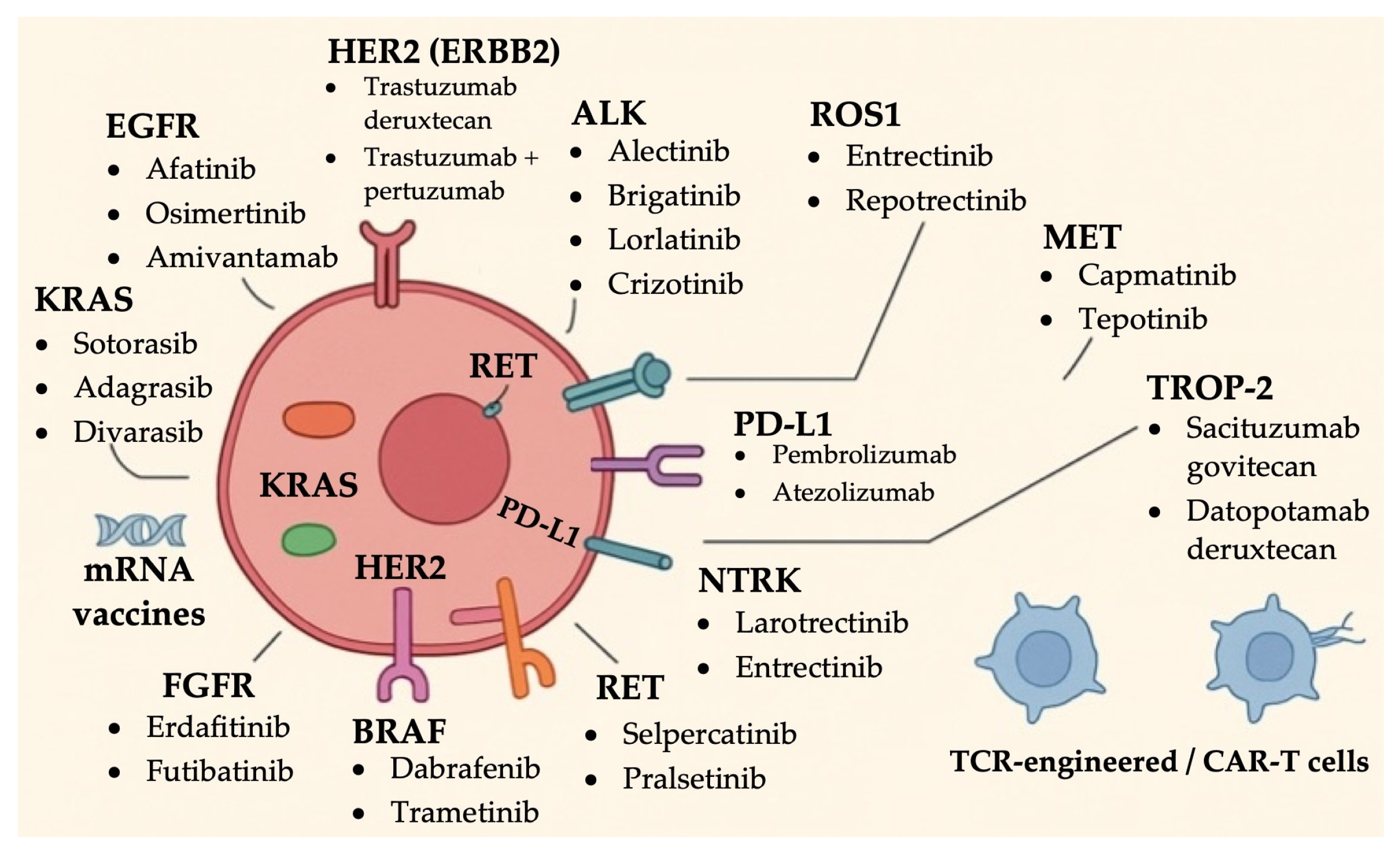
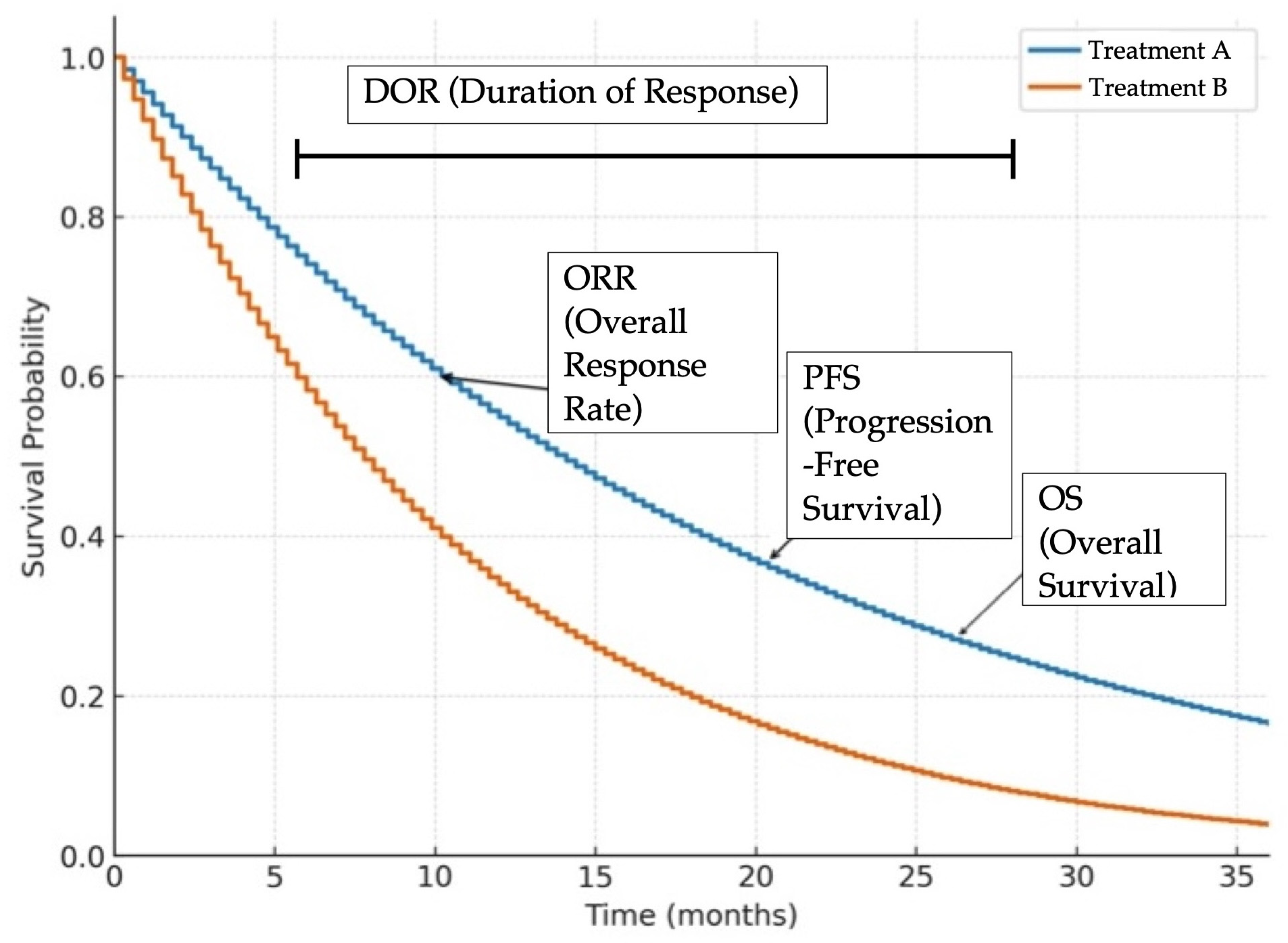
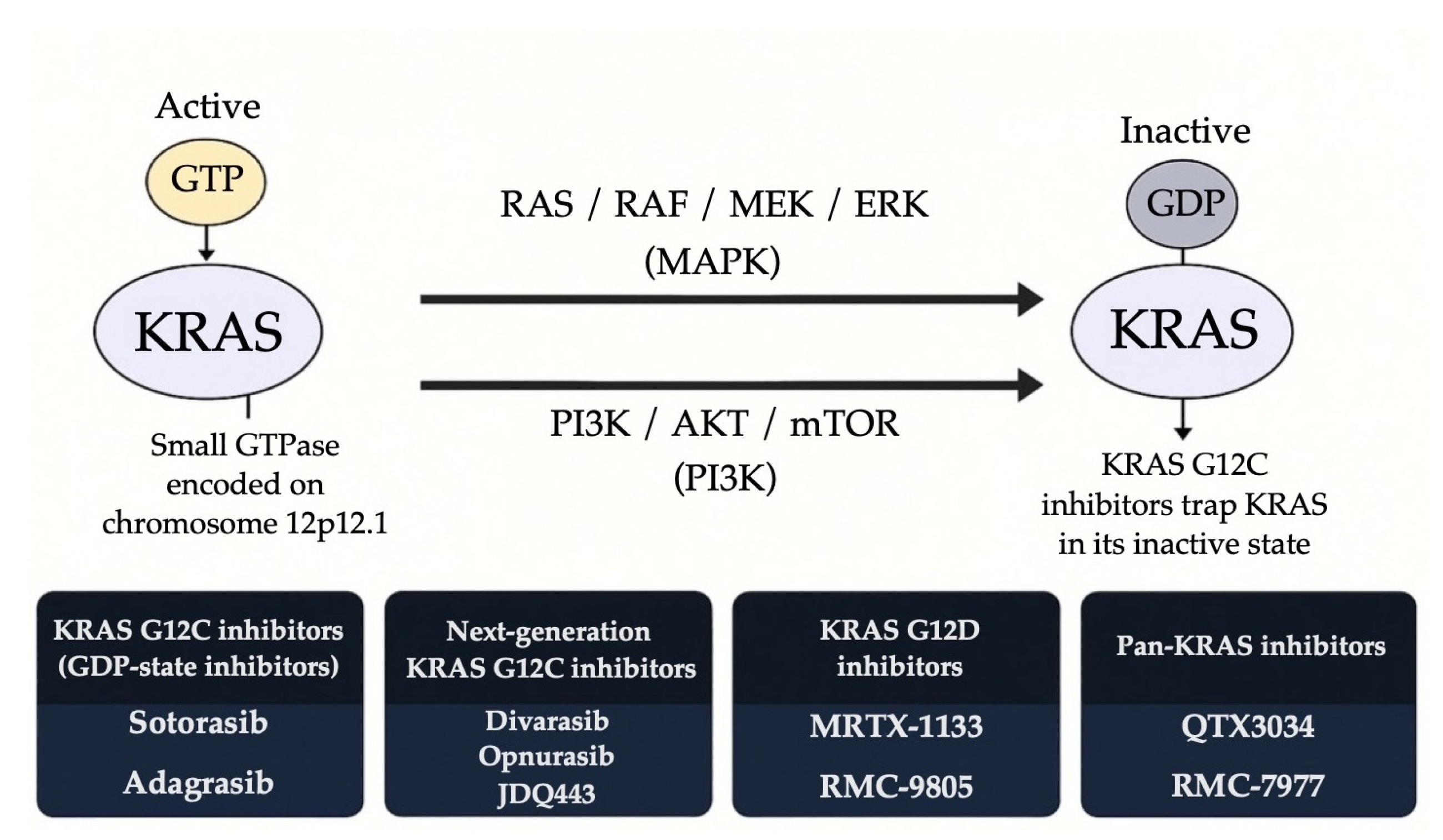
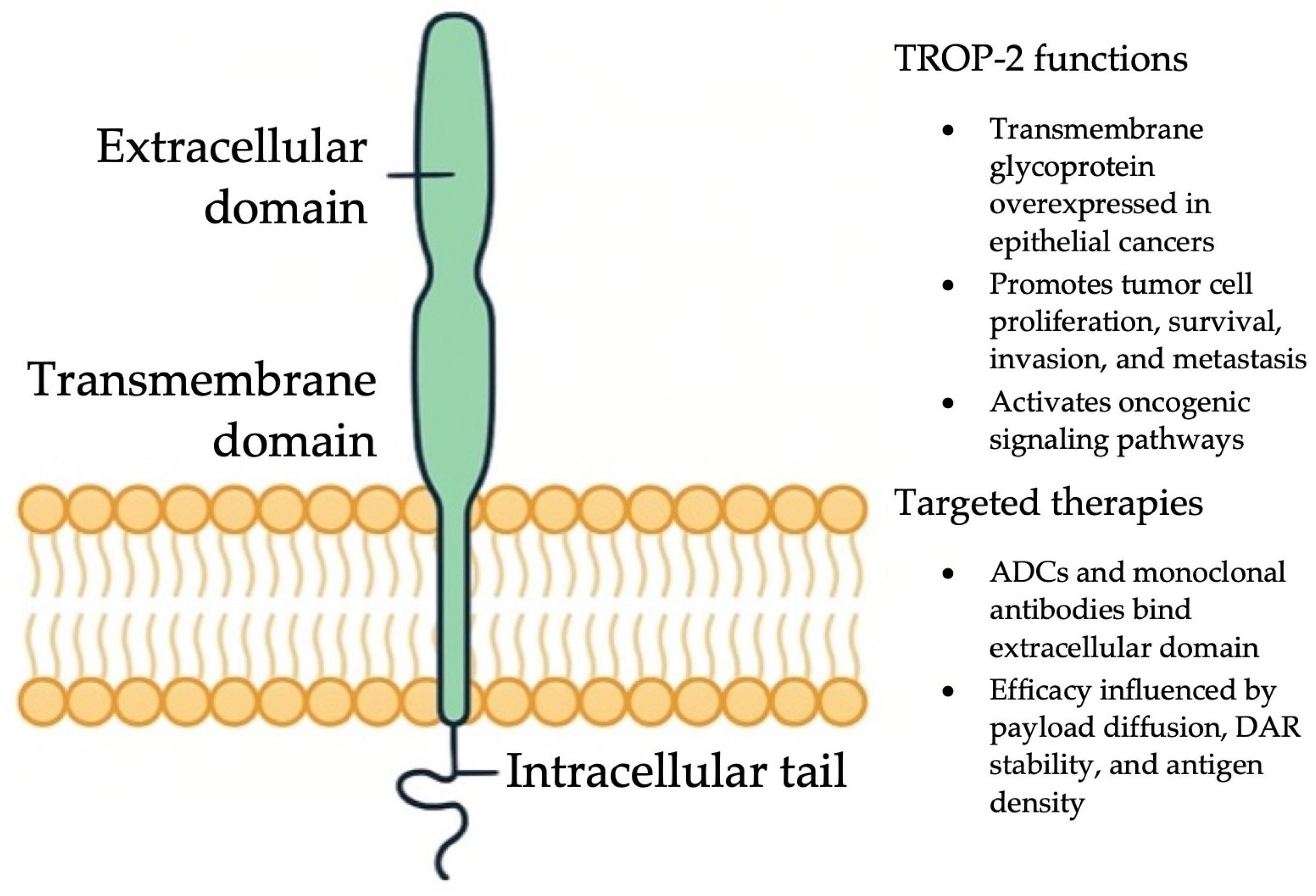
| Target | Common Alterations | Therapeutic Classes and Representative Agents | Mechanism of Action |
|---|---|---|---|
| EGFR [9] | Ex19del, L858R, T790M, Exon20ins; uncommon (G719x, L861Q, S768I, etc.) | TKIs (geftinib, erlotinib, afatinib, dacomitinib, osimertinib, furmonertinib, sunvozertinib); EGFR/MET bispecific (amivantamab ± lazertinib); HER3-ADC (patritumab deruxtecan) | TKIs: inhibit EGFR kinase domain; Amivantamab: blocks EGFR and MET receptors; HER3-ADC: internalization of ADC complex via HER3 and delivery |
| ALK [10] | Fusions (e.g., EML4-ALK) | TKIs (crizotinib, alectinib, brigatinib, ceritinib, lorlatinib; emerging deulorlatinib, NVL-655) | Inhibit ALK kinase (receptor tyrosine kinase fusion) preventing downstream MAPK/PI3K signaling |
| ROS1 [11] | Fusions | TKIs (crizotinib, enterctinib, lorlatinib, repotrectinib, taletrectinib) | Inhibit ROS1 fusion kinase to block downstream signaling (often CNS-active) |
| NTRK [12] | Fusions | TRK inhibitors (larotrectinib, entrectinib) | Inhibit TRK kinase domain, shutting downstream cascades |
| BRAF V600E [13] | V600E mutation | BRAF + MEK inhibitors (dabrafenib + trametinib) | Inhibit mutant BRAF kinase and downstream MEK to suppress MAPK signaling pathway |
| KRAS [14] | G12C, G12D, G12V | G12C inhibitors (sotorasib, adagrasib, divarasib, opunarasib); G12D inhibitors (MRTX-1133, HRS-4642); RAS-ON inhibitors (RMC-9805); degraders (ASP3082); SHP2 inhibitors (RMC-4630) | Direct RAS inhibition (nucleotide-state or switch-II pocket); degraders remove KRAS protein; SHP2 inhibitors block upstream RAS activation |
| HER2 (ERBB2) [15] | Kinase domain mutations (ex18–21, specifically exon20ins); amplification/overexpression | ADCs (trastuzumab deruxtecan; SHR-A1811); TKIs (zongertinib, BAY2927088; afatinib/dacomitinib) | ADCs: HER2 bindings leading to internalization and degradation within the cell; TKIs: inhibit HER2 kinase signaling |
| MET [16] | Exon 14 skipping; amplification; overexpression | Selective TKIs (capmatinib, tepotinib, savolitinib); EGFR/MET bispecific (amivantamab); ADCs (REGN5093-M114, telisotuzumab vedotin, ABBV-400) | TKIs: inhibit MET kinase; bispecific: block ligand/receptor and induce internalization; ADCs: receptor-mediated internalization leading to cytotoxicity |
| RET [17] | Fusions (e.g., KIF5B-RET) | Selective TKIs (selpercatinib, pralsetinib) | Inhibit RET fusion kinase to block downstream signaling |
| FGFR [18] | Fusions (FGFR2/3), mutations, amplifications (more in squamous) | FGFR inhibitors (erdafitinib, futibatinib, pemigatinib—off-label/selected cases; LOXO-435 investigational) | Inhibit FGFR kinase to block downstream signaling |
| TROP2 [19] | Overexpression | ADCs (sacituzumab govitecan, datopotamab deruxtecan) | Antibody binding → internalization → SN-38 or DXd payload-mediated damage |
| Immune checkpoints [20] | PD-L1 expression; TMB/MSI | PD-1/PD-L1 (pembrolizumab, nivolumab, atezolizumab); CTLA-4 (ipilimumab); emerging TIGIT/LAG-3/TIM-3 | Block inhibitory receptor-ligand interactions at the immune synapse to restore T-cell signaling |
| Trial Name | Phase | Drugs | Median Progression Free Survival (mPFS) | Overall Response Rate (ORR) |
|---|---|---|---|---|
| LAURA [63] | III | Osimertinib vs. placebo [64] | 39.1 months vs. 5.6 months | - |
| FLAURA 2 [65] | III | Osimertinib monotherapy or combined with platinum-based chemotherapy (pemetrexed + either cisplatin or carboplatin) [66] | 25.5 months vs. 16.7 months | 83% vs. 76% |
| MARIPOSA [67] | III | Osimertinib vs. Amivantamab and Lazertinib [68] | 16.6 months vs. 23.7 months | 85% vs. 86% |
| MARIPOSA II [69] | III | Amivantamab + chemotherapy (carboplatin + pemetrexed) vs. Amivantamab + Lazertinib + chemotherapy (with protocol modification to start Lazertinib after carboplatin) vs. Chemotherapy alone (carboplatin + pemetrexed) [70] | 6.3 months vs. 8.3 months vs. 4.2 months Median intracranial PFS 12.5 months vs. 12.8 months vs. 8.3 months | 64% vs. 63% vs. 36% |
| PALOMA 3 [71] | III | Subcutaneous Amivantamab + Lazertinib vs. IV regimen [72] | 6.1 months vs. 4.3 months | 30% vs. 33% |
| PAPILLON [73] | III | Amivantamab + chemotherapy vs. chemotherapy (carboplatin + pemetrexed) [74] | 11.4 months vs. 6.7 months | 73% vs. 47% |
| WU-KONG 1 [75] | I/II | DZD9008 (Sunvozertinib) [76] | - | 54.3% |
| WU-KONG 28 [77] | III | DZD9008 (Sunvozertinib) vs. Platinum-based doublet chemotherapy (pemetrexed + carboplatin) [78] | - | - |
| FURLONG [79] | III | Furmonertinib vs. Geftinib [80] | 20.8 months vs. 11.1 months | - |
| FURVENT/FURMO-004 [81] | III | Furmonertinib [82] | - | 78.6% |
| HERTHENA-Lung 01 [83] | II | Patritumab deruxtecan [13] | 5.5 months | 29.8% |
| HERTHENA-Lung 02 [84] | III | Patritumab deruxtecan monotherapy vs. with chemotherapy [85] | 5.5 months | 29.8% |
| Beamion-Lung 01 [86] | I | Zongertinib [87] | 12.4 months in cohort 1 | 66.7% at 120 mg and 72–78% at 120 mg and 240 mg |
| ACHILLES/TORG 1834 [88] | III | Afatinib vs. chemotherapy (cisplatin or carboplatin + pemetrexed) [89] | 10.6 months vs. 5.7 months | Afatinib 61.7%, G719X 55.8%, L861Q 72.7%, S768I 60% |
| ORIC-114 [90] | I/II | ORIC-114 [91] | - | - |
Disclaimer/Publisher’s Note: The statements, opinions and data contained in all publications are solely those of the individual author(s) and contributor(s) and not of MDPI and/or the editor(s). MDPI and/or the editor(s) disclaim responsibility for any injury to people or property resulting from any ideas, methods, instructions or products referred to in the content. |
© 2025 by the authors. Licensee MDPI, Basel, Switzerland. This article is an open access article distributed under the terms and conditions of the Creative Commons Attribution (CC BY) license (https://creativecommons.org/licenses/by/4.0/).
Share and Cite
Peshin, S.; Takrori, E.; Yazji, J.H.; Haque, J.; Dharia, A.; Mithani, M.S.; Anum, F.; Asfeen, U.; Couch, J.K.; Donovan, M.; et al. Advances in Targeted Therapy for Non-Small-Cell Lung Cancer: Current Progress and Future Directions. Int. J. Mol. Sci. 2025, 26, 11517. https://doi.org/10.3390/ijms262311517
Peshin S, Takrori E, Yazji JH, Haque J, Dharia A, Mithani MS, Anum F, Asfeen U, Couch JK, Donovan M, et al. Advances in Targeted Therapy for Non-Small-Cell Lung Cancer: Current Progress and Future Directions. International Journal of Molecular Sciences. 2025; 26(23):11517. https://doi.org/10.3390/ijms262311517
Chicago/Turabian StylePeshin, Supriya, Ehab Takrori, Joseph H. Yazji, Johum Haque, Adit Dharia, Mohammad Sajid Mithani, Fnu Anum, Ummul Asfeen, Jill Kristen Couch, Mabe Donovan, and et al. 2025. "Advances in Targeted Therapy for Non-Small-Cell Lung Cancer: Current Progress and Future Directions" International Journal of Molecular Sciences 26, no. 23: 11517. https://doi.org/10.3390/ijms262311517
APA StylePeshin, S., Takrori, E., Yazji, J. H., Haque, J., Dharia, A., Mithani, M. S., Anum, F., Asfeen, U., Couch, J. K., Donovan, M., & Singal, S. (2025). Advances in Targeted Therapy for Non-Small-Cell Lung Cancer: Current Progress and Future Directions. International Journal of Molecular Sciences, 26(23), 11517. https://doi.org/10.3390/ijms262311517

