Investigating the Epigenetic Therapeutic Potential of Natural Compounds in Cancer

Abstract
1. Introduction
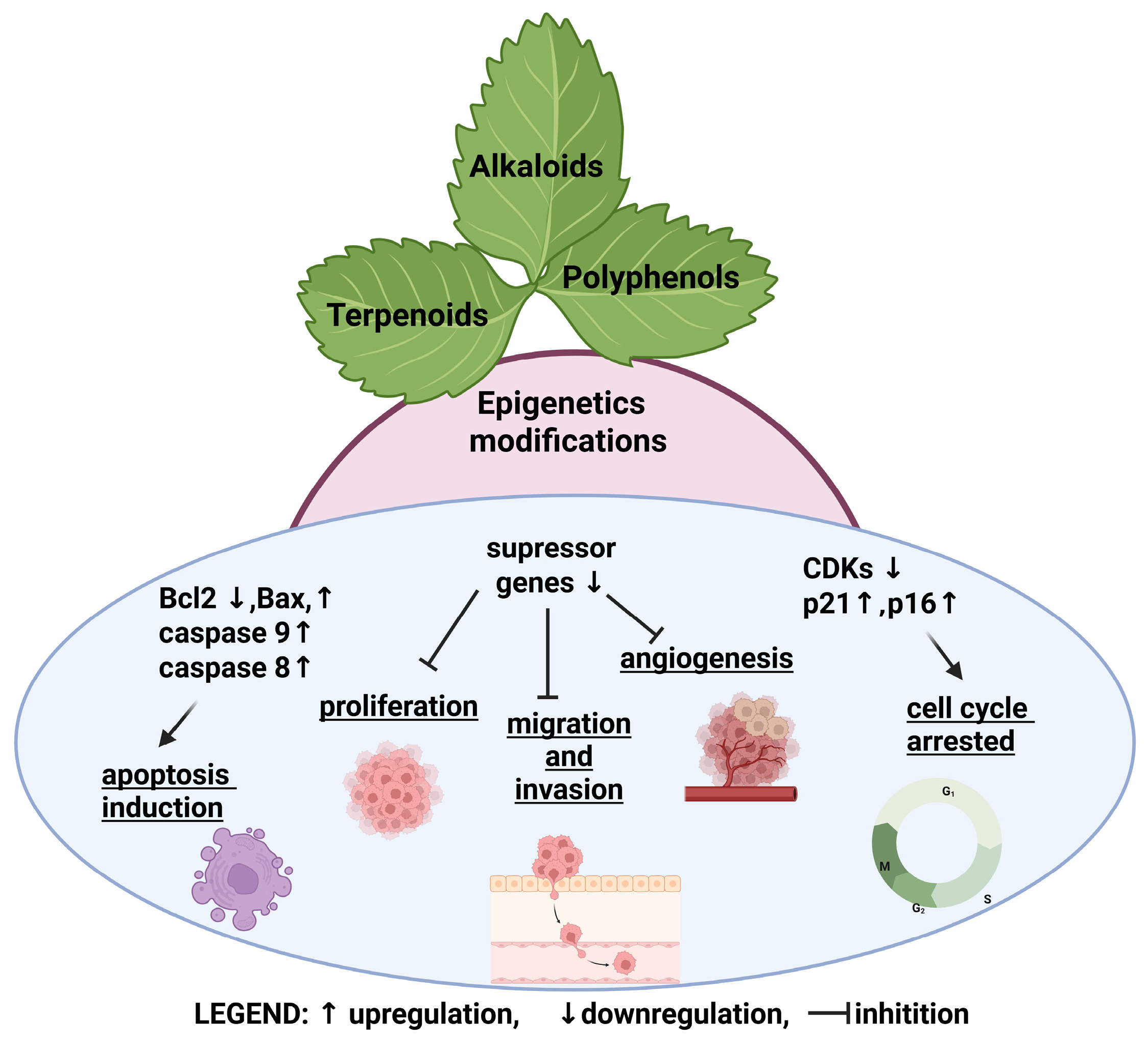
2. Epigenetic Effects of Natural Compounds: Alkaloids, Terpenes, and Polyphenols
2.1. Alkaloids
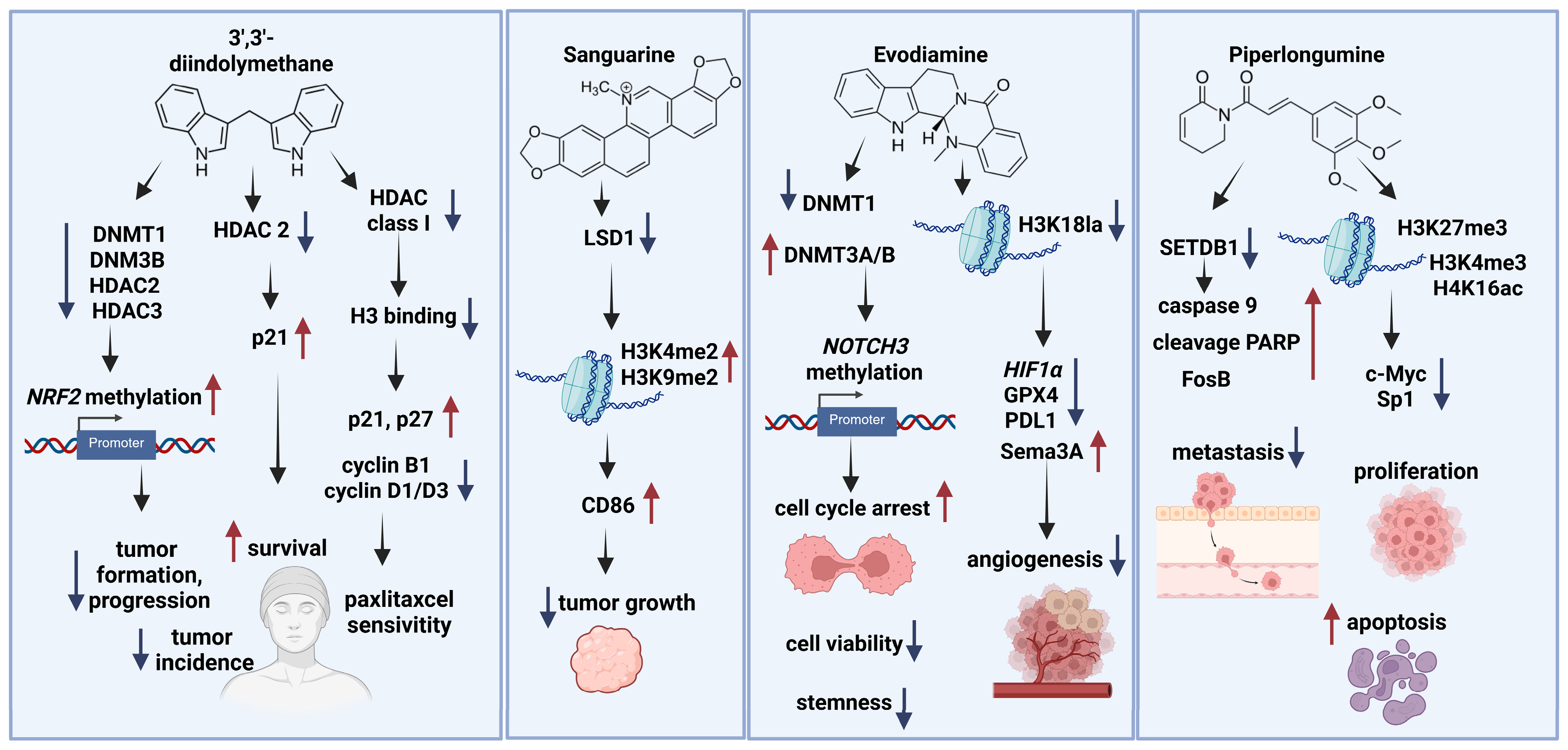
2.1.1. 3,3′-Diindolylmethane (DIM)
2.1.2. Sanguinairne
2.1.3. Evodiamine
2.1.4. Piperlongumine
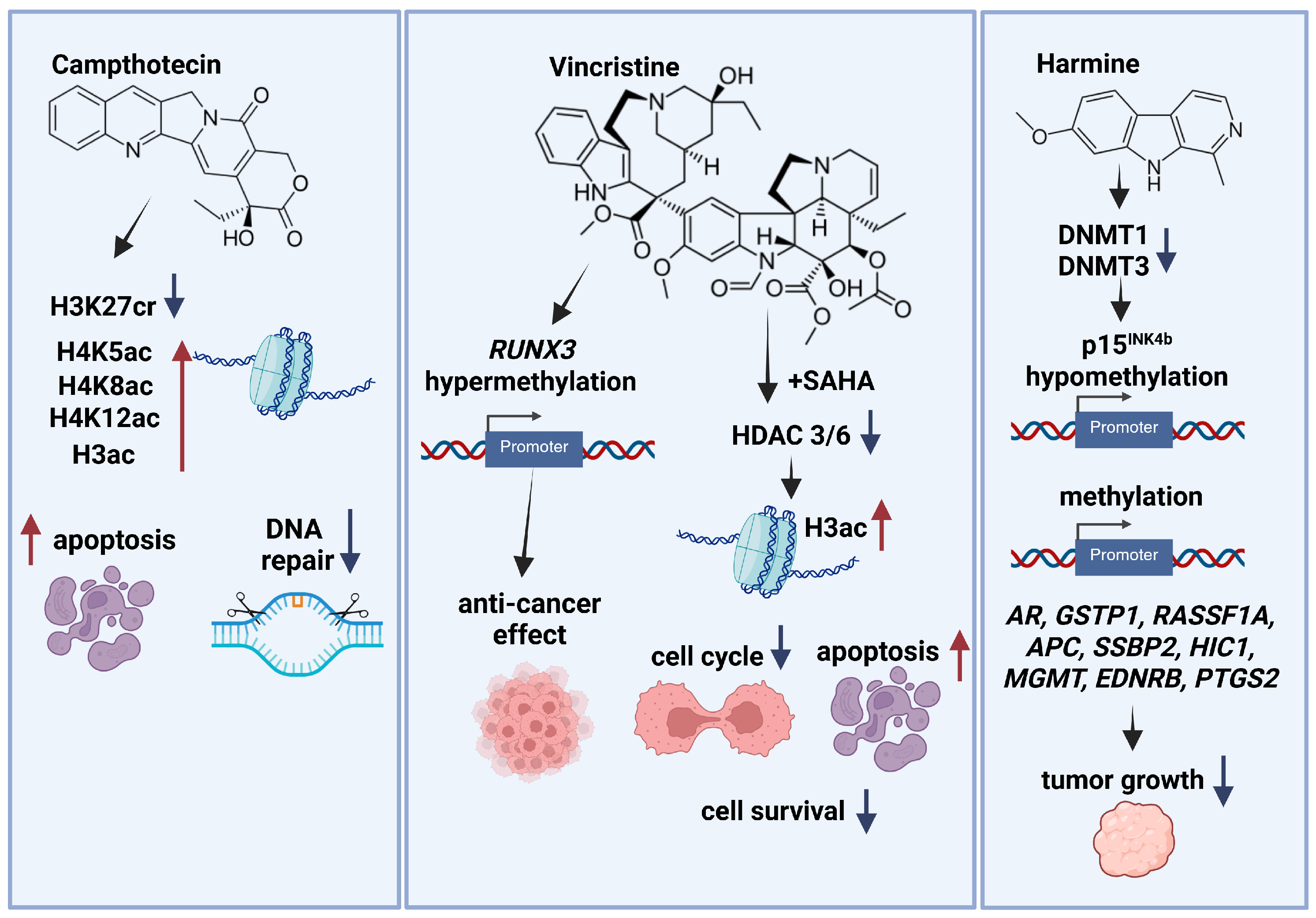
2.1.5. Campthotecin
2.1.6. Vincristine
2.1.7. Harmine
2.2. Terpenoids
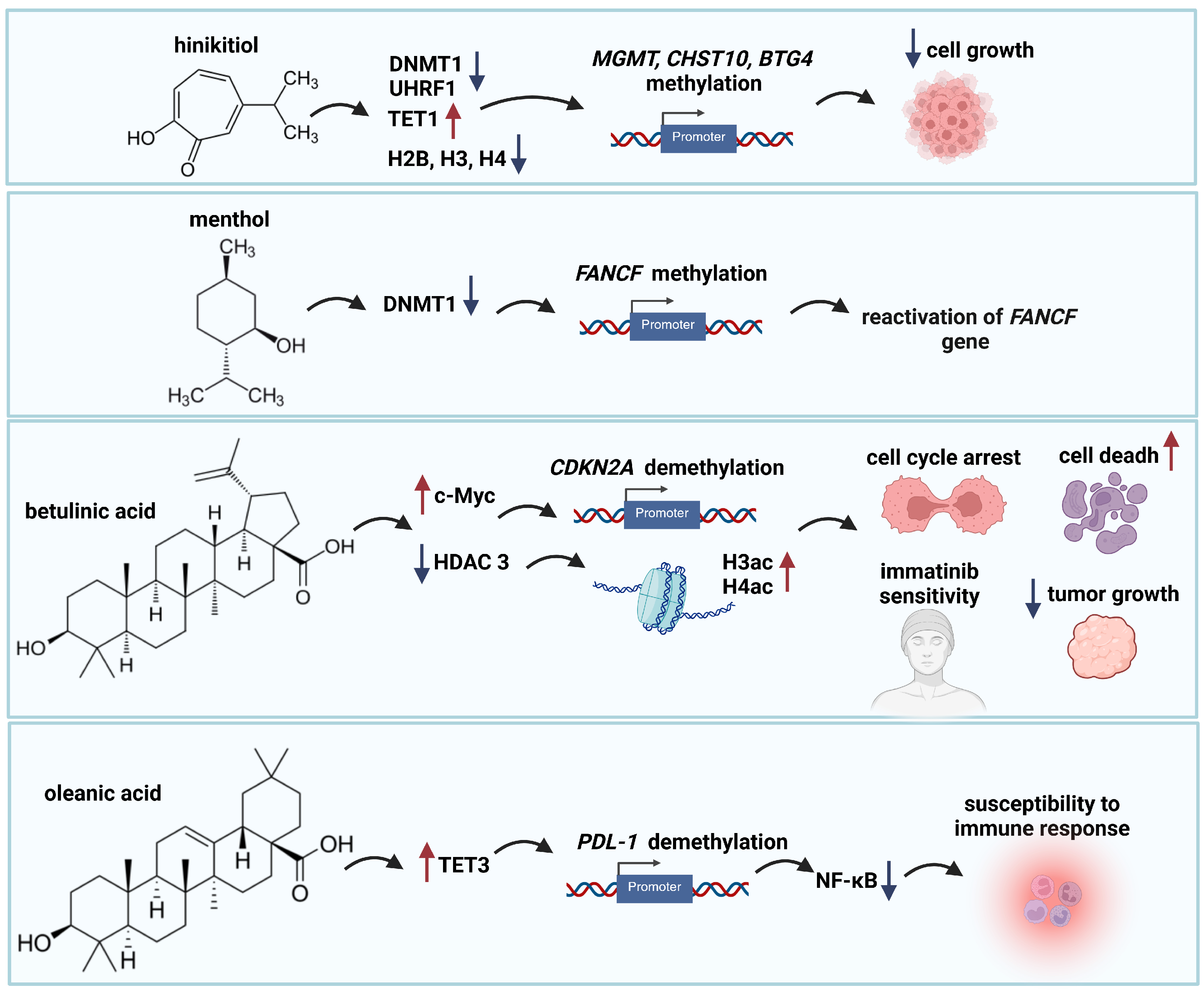
2.2.1. Hinokitiol
2.2.2. Menthol
2.2.3. Betulinic Acid
2.2.4. Oleanolic Acid
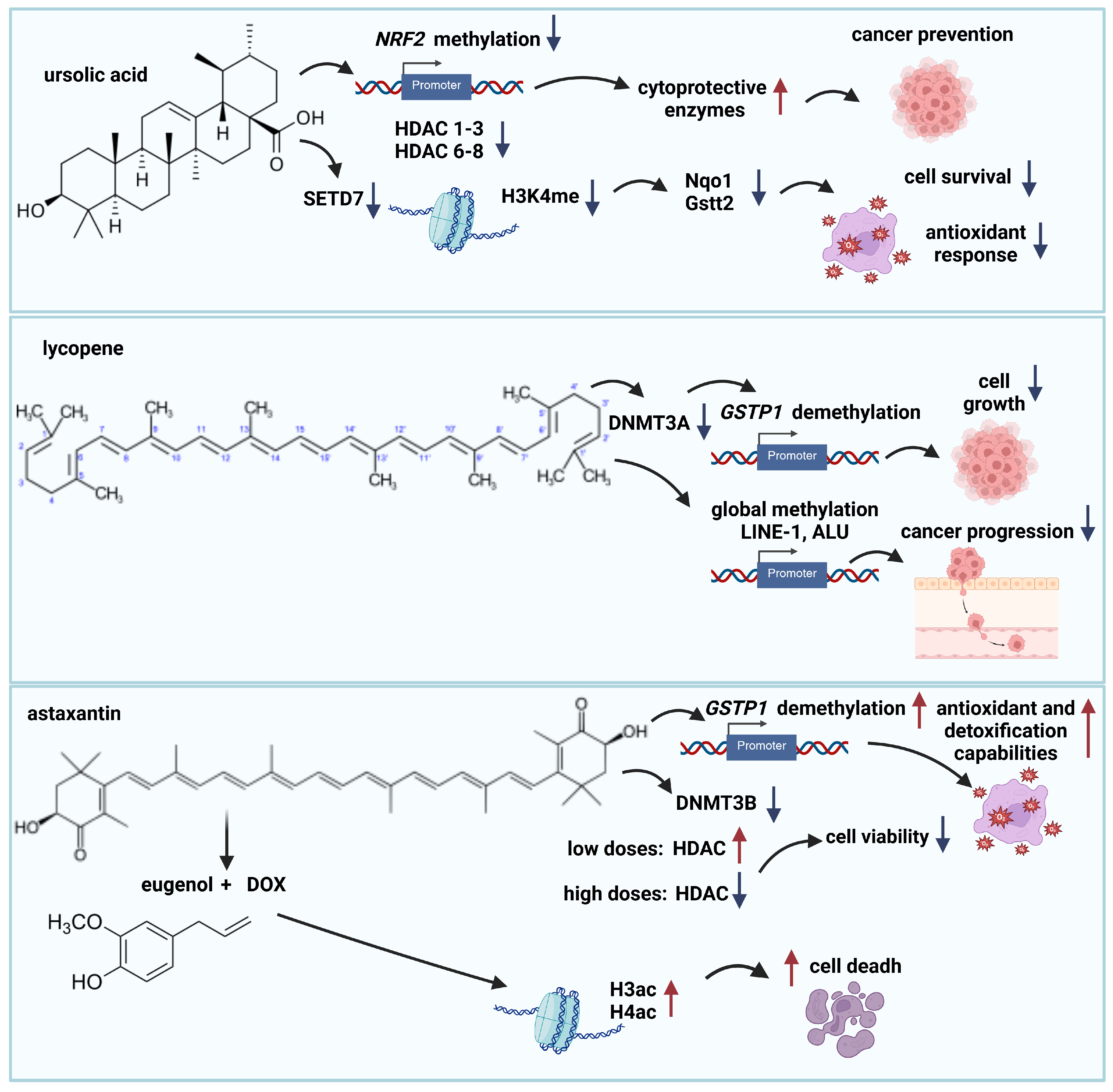
2.2.5. Ursolic Acid
2.2.6. Lycopene
2.2.7. Astaxhantin
2.2.8. Lutein
2.3. Polyphenols
2.3.1. Apigenin
2.3.2. Luteolin
2.3.3. Chrysin
2.3.4. Kaempferol
2.3.5. Myricetin
2.3.6. Fisetin
2.3.7. Rhamnetin
2.3.8. Hesperidin
2.3.9. Naringenin
2.3.10. Silibinin
2.3.11. Genistein
2.3.12. Daidzein
2.3.13. Delphinidin
2.3.14. Resveratrol
2.3.15. Pterostilbene
2.3.16. Piceatannol
2.3.17. Gallic Acid
2.3.18. Ellagic Acid
3. Bioavailability Challenges and Therapeutic Duality of Natural Compounds: Strategies for Enhancement
4. Clinical Applications
5. Conclusions and Future Directions
Author Contributions
Funding
Data Availability Statement
Conflicts of Interest
References
- Pandian, G.N.; Sugiyama, H. Strategies to modulate heritable epigenetic defects in cellular machinery: Lessons from nature. Pharmaceuticals 2012, 6, 1–24. [Google Scholar] [CrossRef] [PubMed] [PubMed Central]
- Baylin, S.B.; Esteller, M.; Rountree, M.R.; Bachman, K.E.; Schuebel, K.; Herman, J.G. Aberrant patterns of DNA methylation, chromatin formation and gene expression in cancer. Hum. Mol. Genet. 2001, 10, 687–692. [Google Scholar] [CrossRef] [PubMed]
- Číž, M.; Dvořáková, A.; Skočková, V.; Kubala, L. The Role of Dietary Phenolic Compounds in Epigenetic Modulation Involved in Inflammatory Processes. Antioxidants 2020, 9, 691. [Google Scholar] [CrossRef] [PubMed] [PubMed Central]
- Dey, P.; Kundu, A.; Kumar, A.; Gupta, M.; Lee, B.M.; Bhakta, T.; Dash, S.; Kim, H.S. Analysis of alkaloids (indole alkaloids, isoquinoline alkaloids, tropane alkaloids). In Recent Advances in Natural Products Analysis; Elsevier: Amsterdam, The Netherlands, 2020; pp. 505–567. [Google Scholar] [CrossRef] [PubMed Central]
- Khan, H.; Alam, W.; Alsharif, K.F.; Aschner, M.; Pervez, S.; Saso, L. Alkaloids and Colon Cancer: Molecular Mechanisms and Therapeutic Implications for Cell Cycle Arrest. Molecules 2022, 27, 920. [Google Scholar] [CrossRef] [PubMed] [PubMed Central]
- Alasvand, M.; Assadollahi, V.; Ambra, R.; Hedayati, E.; Kooti, W.; Peluso, I. Antiangiogenic Effect of Alkaloids. Oxid. Med. Cell. Longev. 2019, 2019, 9475908. [Google Scholar] [CrossRef] [PubMed] [PubMed Central]
- Mondal, A.; Gandhi, A.; Fimognari, C.; Atanasov, A.G.; Bishayee, A. Alkaloids for cancer prevention and therapy: Current progress and future perspectives. Eur. J. Pharmacol. 2019, 858, 172472. [Google Scholar] [CrossRef] [PubMed]
- Lin, S.R.; Chang, C.H.; Hsu, C.F.; Tsai, M.J.; Cheng, H.; Leong, M.K.; Sung, P.J.; Chen, J.C.; Weng, C.F. Natural compounds as potential adjuvants to cancer therapy: Preclinical evidence. Br. J. Pharmacol. 2020, 177, 1409–1423. [Google Scholar] [CrossRef] [PubMed] [PubMed Central]
- Wu, T.Y.; Khor, T.O.; Su, Z.Y.; Saw, C.L.; Shu, L.; Cheung, K.L.; Huang, Y.; Yu, S.; Kong, A.N. Epigenetic modifications of Nrf2 by 3,3′-diindolylmethane in vitro in TRAMP C1 cell line and in vivo TRAMP prostate tumors. AAPS J. 2013, 15, 864–874. [Google Scholar] [CrossRef] [PubMed] [PubMed Central]
- Williams, D.E. Indoles Derived from Glucobrassicin: Cancer Chemoprevention by Indole-3-Carbinol and 3,3′-Diindolylmethane. Front. Nutr. 2021, 8, 734334. [Google Scholar] [CrossRef] [PubMed] [PubMed Central]
- Li, Y.; Li, X.; Guo, B. Chemopreventive agent 3,3′-diindolylmethane selectively induces proteasomal degradation of class I histone deacetylases. Cancer Res. 2010, 70, 646–654. [Google Scholar] [CrossRef] [PubMed] [PubMed Central]
- Xiang, F.; Zhu, Z.; Zhang, M.; Wang, J.; Chen, Z.; Li, X.; Zhang, T.; Gu, Q.; Wu, R.; Kang, X. 3,3′-Diindolylmethane Enhances Paclitaxel Sensitivity by Suppressing DNMT1-Mediated KLF4 Methylation in Breast Cancer. Front. Oncol. 2021, 11, 627856. [Google Scholar] [CrossRef] [PubMed] [PubMed Central]
- Jin, Y. 3,3′-Diindolylmethane inhibits breast cancer cell growth via miR-21-mediated Cdc25A degradation. Mol. Cell. Biochem. 2011, 358, 345–354. [Google Scholar] [CrossRef] [PubMed]
- Li, Y.; VandenBoom, T.G., 2nd; Kong, D.; Wang, Z.; Ali, S.; Philip, P.A.; Sarkar, F.H. Up-regulation of miR-200 and let-7 by natural agents leads to the reversal of epithelial-to-mesenchymal transition in gemcitabine-resistant pancreatic cancer cells. Cancer Res. 2009, 69, 6704–6712. [Google Scholar] [CrossRef] [PubMed] [PubMed Central]
- Shamma, M.; Guinaudeau, H. Aporphinoid alkaloids. Nat. Prod. Rep. 1986, 3, 345–351. [Google Scholar] [CrossRef] [PubMed]
- Malikova, J.; Zdarilova, A.; Hlobilkova, A. Effects of SGR and chelerythrine on the cell cycle and apoptosis. Biomed. Pap. Med. Fac. Univ. Palacky Olomouc Czech Repub. 2006, 150, 5–12. [Google Scholar] [CrossRef] [PubMed]
- Adhami, V.M.; Aziz, M.H.; Mukhtar, H.; Ahmad, N. Activation of pro-death Bcl-2 family proteins and mitochondrial apoptosis pathway by SGR in immortalized human HaCaT keratinocytes. Clin. Cancer Res. 2003, 9, 3176–3182. [Google Scholar] [PubMed]
- Mandel, I.D. Antimicrobial mouthrinses: Overview and update. J. Am. Dent. Assoc. 1994, 125 (Suppl. S2), 2S–10S. [Google Scholar] [CrossRef] [PubMed]
- Hussain, A.R.; Al-Jomah, N.A.; Siraj, A.K.; Manogaran, R.; Al-Hussain, K.; Abubaker, J.; Platanias, L.C.; Al-Kuraya, K.S.; Uddin, S. SGR-dependent induction of apoptosis in primary effusion lymphoma cells. Cancer Res. 2007, 67, 3888–3897. [Google Scholar] [CrossRef] [PubMed]
- Qin, T.T.; Li, Z.H.; Li, L.X.; Du, K.; Yang, J.G.; Zhang, Z.Q.; Wu, X.X.; Ma, J.L. Sanguinarine, identified as a natural alkaloid LSD1 inhibitor, suppresses lung cancer cell growth and migration. Iran. J. Basic Med. Sci. 2022, 25, 781–788. [Google Scholar] [CrossRef] [PubMed] [PubMed Central]
- Ding, Q.; Zhu, W.; Zhu, S.; Zhou, X. Sanguinarine promotes apoptosis of hepatocellular carcinoma cells via regulating the miR-497-5p/CDK4 axis. Am. J. Transl. Res. 2022, 14, 8539–8551. [Google Scholar] [PubMed] [PubMed Central]
- Fan, X.; Zhu, J.Y.; Sun, Y.; Luo, L.; Yan, J.; Yang, X.; Yu, J.; Tang, W.Q.; Ma, W.; Liang, H.P. Evodiamine Inhibits Zymosan-Induced Inflammation In Vitro and In Vivo: Inactivation of NF-κB by Inhibiting IκBα Phosphorylation. Inflammation 2017, 40, 1012–1027. [Google Scholar] [CrossRef] [PubMed]
- Tan, Q.; Zhang, J. Evodiamine and its role in chronic diseases. Adv. Exp. Med. Biol 2016, 929, 315–328. [Google Scholar] [CrossRef] [PubMed]
- Huang, G.Z.; Kling, B.; Darras, F.H.; Hellmann, J.; Decker, M. Identification of a neuroprotective and selective butyrylcholinesterase inhibitor derived from the natural alkaloid evodiamine. Eur. J. Med. Chem. 2014, 81, 15–21. [Google Scholar] [CrossRef] [PubMed]
- Zhao, L.C.; Li, J.; Liao, K.; Luo, N.; Shi, Q.Q.; Feng, Z.Q.; Chen, D.L. Evodiamine Induces Apoptosis and Inhibits Migration of HCT-116 Human Colorectal Cancer Cells. Int. J. Mol. Sci. 2015, 16, 27411–27421. [Google Scholar] [CrossRef] [PubMed] [PubMed Central]
- Zhong, Z.F.; Tan, W.; Wang, S.P.; Qiang, W.A.; Wang, Y.T. Anti-proliferative activity and cell cycle arrest induced by evodiamine on paclitaxel-sensitive and -resistant human ovarian cancer cells. Sci. Rep. 2015, 5, 16415. [Google Scholar] [CrossRef] [PubMed] [PubMed Central]
- Lin, L.; Ren, L.; Wen, L.; Wang, Y.; Qi, J. Effect of evodiamine on the proliferation and apoptosis of A549 human lung cancer cells. Mol. Med. Rep. 2016, 14, 2832–2838. [Google Scholar] [CrossRef] [PubMed]
- Mohan, V.; Agarwal, R.; Singh, R.P. A novel alkaloid, evodiamine causes nuclear localization of cytochrome-c and induces apoptosis independent of p53 in human lung cancer cells. Biochem. Biophys. Res. Commun. 2016, 477, 1065–1071. [Google Scholar] [CrossRef] [PubMed]
- Ogasawara, M.; Suzuki, H. Inhibition by evodiamine of hepatocyte growth factor-induced invasion and migration of tumor cells. Biol. Pharm. Bull. 2004, 27, 578–582. [Google Scholar] [CrossRef] [PubMed]
- Yang, J.; Wu, L.J.; Tashino, S.; Onodera, S.; Ikejima, T. Reactive oxygen species and nitric oxide regulate mitochondria-dependent apoptosis and autophagy in evodiamine-treated human cervix carcinoma HeLa cells. Free Radic. Res. 2008, 42, 492–504. [Google Scholar] [CrossRef] [PubMed]
- Su, T.; Yang, X.; Deng, J.H.; Huang, Q.J.; Huang, S.C.; Zhang, Y.M.; Zheng, H.M.; Wang, Y.; Lu, L.L.; Liu, Z.Q. Evodiamine, a Novel NOTCH3 Methylation Stimulator, Significantly Suppresses Lung Carcinogenesis in Vitro and in Vivo. Front. Pharmacol. 2018, 9, 434. [Google Scholar] [CrossRef] [PubMed] [PubMed Central]
- Yu, Y.; Huang, X.; Liang, C.; Zhang, P. Evodiamine impairs HIF1A histone lactylation to inhibit Sema3A-mediated angiogenesis and PD-L1 by inducing ferroptosis in prostate cancer. Eur. J. Pharmacol. 2023, 957, 176007. [Google Scholar] [CrossRef] [PubMed]
- Liu, H.; Huang, C.; Wu, L.; Wen, B. Effect of evodiamine and berberine on miR-429 as an oncogene in human colorectal cancer. OncoTargets Ther. 2016, 9, 4121–4127. [Google Scholar] [CrossRef] [PubMed]
- Mao, M.; Zheng, X.; Sheng, Y.; Chai, J.; Ding, H. Evodiamine inhibits malignant progression of ovarian cancer cells by regulating lncRNA-NEAT1/miR-152-3p/CDK19 axis. Chem. Biol. Drug Des. 2023, 102, 101–114. [Google Scholar] [CrossRef] [PubMed]
- Park, J.A.; Na, H.H.; Jin, H.O.; Kim, K.C. Increased Expression of FosB through Reactive Oxygen Species Accumulation Functions as Pro-Apoptotic Protein in Piperlongumine Treated MCF7 Breast Cancer Cells. Mol. Cells 2019, 42, 884–892. [Google Scholar] [CrossRef] [PubMed] [PubMed Central]
- Lu, X.; Xu, C.; Xu, Z.; Lu, C.; Yang, R.; Zhang, F.; Zhang, G. Piperlongumine inhibits the growth of non-small cell lung cancer cells via the miR-34b-3p/TGFBR1 pathway. BMC Complement. Med. Ther. 2021, 21, 15. [Google Scholar] [CrossRef] [PubMed] [PubMed Central]
- Hu, Y.; Luo, X.; Zhou, J.; Chen, S.; Gong, M.; Deng, Y.; Zhang, H. Piperlongumine inhibits the progression of osteosarcoma by downregulating the SOCS3/JAK2/STAT3 pathway via miR-30d-5p. Life Sci. 2021, 277, 119501. [Google Scholar] [CrossRef] [PubMed] [PubMed Central]
- Karki, K.; Hedrick, E.; Kasiappan, R.; Jin, U.H.; Safe, S. Piperlongumine Induces Reactive Oxygen Species (ROS)-Dependent Downregulation of Specificity Protein Transcription Factors. Cancer Prev. Res. 2017, 10, 467–477. [Google Scholar] [CrossRef] [PubMed] [PubMed Central]
- Li, F.; Jiang, T.; Li, Q.; Ling, X. Camptothecin (CPT) and its derivatives are known to target topoisomerase I (Top1) as their mechanism of action: Did we miss something in CPT analogue molecular targets for treating human disease such as cancer? Am. J. Cancer Res. 2017, 7, 2350–2394. [Google Scholar] [PubMed] [PubMed Central]
- Krishnan, P.; Rajan, M.; Kumari, S.; Sakinah, S.; Priya, S.P.; Amira, F.; Danjuma, L.; Pooi Ling, M.; Fakurazi, S.; Arulselvan, P.; et al. Efficiency of newly formulated camptothecin with β-cyclodextrin-EDTA-Fe3O4 nanoparticle-conjugated nanocarriers as an anti-colon cancer (HT29) drug. Sci. Rep. 2017, 7, 10962. [Google Scholar] [CrossRef] [PubMed] [PubMed Central]
- Strasser, A.; Vaux, D.L. Cell Death in the Origin and Treatment of Cancer. Mol. Cell 2020, 78, 1045–1054. [Google Scholar] [CrossRef] [PubMed]
- Farhana, A.; Koh, A.E.; Tong, J.B.; Alsrhani, A.; Kumar Subbiah, S.; Mok, P.L. Nanoparticle-Encapsulated Camptothecin: Epigenetic Modulation in DNA Repair Mechanisms in Colon Cancer Cells. Molecules 2021, 26, 5414. [Google Scholar] [CrossRef] [PubMed] [PubMed Central]
- Liao, M.; Chu, W.; Sun, X.; Zheng, W.; Gao, S.; Li, D.; Pei, D. Reduction of H3K27cr Modification During DNA Damage in Colon Cancer. Front. Oncol. 2022, 12, 924061. [Google Scholar] [CrossRef] [PubMed] [PubMed Central]
- Baranello, L.; Bertozzi, D.; Fogli, M.V.; Pommier, Y.; Capranico, G. DNA topoisomerase I inhibition by camptothecin induces escape of RNA polymerase II from promoter-proximal pause site, antisense transcription and histone acetylation at the human HIF-1alpha gene locus. Nucleic Acids Res. 2010, 38, 159–171. [Google Scholar] [CrossRef] [PubMed] [PubMed Central]
- Johnson, S.M.; Grosshans, H.; Shingara, J.; Byrom, M.; Jarvis, R.; Cheng, A.; Labourier, E.; Reinert, K.L.; Brown, D.; Slack, F.J. RAS is regulated by the let-7 microRNA family. Cell 2005, 120, 635–647. [Google Scholar] [CrossRef] [PubMed]
- Song, W.; Xianoqian, L.; Zhhenzhong, L. Camptothecin inhibits migration, invasion and clonogenic property of liver cancer cells by modulating MicroRNa expression. Acta Pol. Pharm.-Drug Res. 2020, 77, 295–304. [Google Scholar] [CrossRef]
- Zeng, C.W.; Zhang, X.J.; Lin, K.Y.; Ye, H.; Feng, S.Y.; Zhang, H.; Chen, Y.Q. Camptothecin induces apoptosis in cancer cells via microRNA-125b-mediated mitochondrial pathways. Mol. Pharmacol. 2012, 81, 578–586. [Google Scholar] [CrossRef] [PubMed]
- Silverman, J.A.; Deitcher, S.R. Marqibo® (Vincristine Sulfate Liposome Injection) Improves the Pharmacokinetics and Pharmacodynamics of Vincristine. Cancer Chemother. Pharmacol. 2013, 71, 555–564. [Google Scholar] [CrossRef] [PubMed] [PubMed Central]
- Moon, J.W.; Lee, S.K.; Lee, J.O.; Kim, J.H.; Kim, N.; Kim, J.; Kim, H.S.; Park, S.-H. Demethylation of RUNX3 by Vincristine in Colorectal Adenocarcinoma Cells. Anticancer. Res. 2014, 34, 133–140. [Google Scholar] [PubMed]
- Chao, M.W.; Lai, M.J.; Liou, J.P.; Chang, Y.L.; Wang, J.C.; Pan, S.L.; Teng, C.M. The synergic effect of vincristine and vorinostat in leukemia in vitro and in vivo. J. Hematol. Oncol. 2015, 8, 82. [Google Scholar] [CrossRef] [PubMed] [PubMed Central]
- Haque, S.; Vaiselbuh, S.R. Vincristine and prednisone regulates cellular and exosomal miR-181a expression differently within the first time diagnosed and the relapsed leukemia B cells. Leuk. Res. Rep. 2020, 14, 100221. [Google Scholar] [CrossRef] [PubMed] [PubMed Central]
- Hu, Y.; Yu, X.; Yang, L.; Xue, G.; Wei, Q.; Han, Z.; Chen, H. Research progress on the antitumor effects of harmine. Front. Oncol. 2024, 14, 1382142. [Google Scholar] [CrossRef] [PubMed] [PubMed Central]
- Oodi, A.; Norouzi, H.; Amirizadeh, N.; Nikougoftar, M.; Vafaie, Z. Harmine, a Novel DNA Methyltransferase 1 Inhibitor in the Leukemia Cell Line. Indian J. Hematol. Blood Transfus. 2017, 33, 509–515. [Google Scholar] [CrossRef] [PubMed] [PubMed Central]
- Cho, C.C.; Lin, C.J.; Huang, H.H.; Yang, W.Z.; Fei, C.Y.; Lin, H.Y.; Lee, M.S.; Yuan, H.S. Mechanistic Insights into Harmine-Mediated Inhibition of Human DNA Methyltransferases and Prostate Cancer Cell Growth. ACS Chem. Biol. 2023, 18, 1335–1350. [Google Scholar] [CrossRef] [PubMed] [PubMed Central]
- Ludwiczuk, A.; Skalicka-Woźniak, K.; Georgiev, M.I. Terpenoids. In Pharmacognosy; Academic Press: Cambridge, MA, USA, 2017; pp. 233–266. [Google Scholar] [CrossRef]
- Kamran, S.; Sinniah, A.; Abdulghani, M.A.M.; Alshawsh, M.A. Therapeutic Potential of Certain Terpenoids as Anticancer Agents: A Scoping Review. Cancers 2022, 14, 1100. [Google Scholar] [CrossRef] [PubMed] [PubMed Central]
- Yang, H.; Dou, Q.P. Targeting apoptosis pathway with natural terpenoids: Implications for treatment of breast and prostate cancer. Curr. Drug Targets 2010, 11, 733–744. [Google Scholar] [CrossRef] [PubMed] [PubMed Central]
- Chen, H.Y.; Cheng, W.P.; Chiang, Y.F.; Hong, Y.H.; Ali, M.; Huang, T.C.; Wang, K.L.; Shieh, T.M.; Chang, H.Y.; Hsia, S.M. Hinokitiol Exhibits Antitumor Properties through Induction of ROS-Mediated Apoptosis and p53-Driven Cell-Cycle Arrest in Endometrial Cancer Cell Lines (Ishikawa, HEC-1A, KLE). Int. J. Mol. Sci. 2021, 22, 8268. [Google Scholar] [CrossRef] [PubMed] [PubMed Central]
- Seo, J.S.; Choi, Y.H.; Moon, J.W.; Kim, H.S.; Park, S.H. Hinokitiol induces DNA demethylation via DNMT1 and UHRF1 inhibition in colon cancer cells. BMC Cell Biol. 2017, 18, 14. [Google Scholar] [CrossRef] [PubMed] [PubMed Central]
- Shih, Y.H.; Chang, K.W.; Yu, C.C.; Kao, M.C.; Chen, M.Y.; Wang, T.H.; Chi, T.Y.; Cheng, Y.L.; Shieh, T.M. Hinokitiol suppressed pan-histone expression and cell growth in oral squamous cell carcinoma cells. J. Funct. Foods 2015, 15, 452–463. [Google Scholar] [CrossRef]
- Chen, S.M.; Wang, B.Y.; Lee, C.H.; Lee, H.T.; Li, J.J.; Hong, G.C.; Hung, Y.C.; Chien, P.J.; Chang, C.Y.; Hsu, L.S.; et al. Hinokitiol up-regulates miR-494-3p to suppress BMI1 expression and inhibits self-renewal of breast cancer stem/progenitor cells. Oncotarget 2017, 8, 76057–76068. [Google Scholar] [CrossRef] [PubMed] [PubMed Central]
- Oz, M.; El Nebrisi, E.G.; Yang, K.S.; Howarth, F.C.; Al Kury, L.T. Cellular and Molecular Targets of Menthol Actions. Front. Pharmacol. 2017, 8, 472. [Google Scholar] [CrossRef] [PubMed] [PubMed Central]
- Parashar, G.; Parashar, N.C.; Capalash, N. –(-) Menthol Induces Reversal of Promoter Hypermethylation and Associated Up-Regulation of the FANCF Gene in the SiHa Cell Line. Asian Pac. J. Cancer Prev. 2017, 18, 1365–1370. [Google Scholar] [CrossRef] [PubMed] [PubMed Central]
- Lou, H.; Li, H.; Zhang, S.; Lu, H.; Chen, Q. A Review on Preparation of Betulinic Acid and Its Biological Activities. Molecules 2021, 26, 5583. [Google Scholar] [CrossRef] [PubMed] [PubMed Central]
- Fadel, H.; El-Wakeel, E.; Donia, H.; Abd El Rahman, M.; EL-Esseily, H.A.; El Sewedy, T. Proposed Novel Genetic and Epigenetic Effects of Betulinic Acid Against Breast Cancer Cells: In Silico and In Vitro Study. Egypt. J. Chem. 2023, 66, 321–332. [Google Scholar] [CrossRef]
- Lu, T.; Wei, D.; Yu, K.; Ma, D.; Xiong, J.; Fang, Q.; Wang, J. Betulinic acid restores imatinib sensitivity in BCR-ABL1 kinase-independent, imatinib-resistant chronic myeloid leukemia by increasing HDAC3 ubiquitination and degradation. Ann. N. Y. Acad. Sci. 2020, 1467, 77–93. [Google Scholar] [CrossRef] [PubMed]
- Chintharlapalli, S.; Papineni, S.; Lei, P.; Pathi, S.; Safe, S. Betulinic acid inhibits colon cancer cell and tumor growth and induces proteasome-dependent and -independent downregulation of specificity proteins (Sp) transcription factors. BMC Cancer 2011, 11, 371. [Google Scholar] [CrossRef] [PubMed] [PubMed Central]
- Liu, X.; Jutooru, I.; Lei, P.; Kim, K.; Lee, S.O.; Brents, L.K.; Prather, P.L.; Safe, S. Betulinic Acid Targets YY1 and ErbB2 through Cannabinoid Receptor-Dependent Disruption of MicroRNA-27a: ZBTB10 in Breast Cancer. Mol. Cancer Ther. 2012, 11, 1421–1431. [Google Scholar] [CrossRef] [PubMed] [PubMed Central]
- Yang, J.; Qiu, B.; Li, X.; Zhang, H.; Liu, W. p53-p66shc/miR-21-Sod2 signaling is critical for the inhibitory effect of betulinic acid on hepatocellular carcinoma. Toxicol. Lett. 2015, 238, 1–10. [Google Scholar] [CrossRef] [PubMed]
- Chen, F.; Zhong, Z.; Tan, H.Y.; Guo, W.; Zhang, C.; Cheng, C.S.; Wang, N.; Ren, J.; Feng, Y. Suppression of lncRNA MALAT1 by betulinic acid inhibits hepatocellular carcinoma progression by targeting IAPs via miR-22-3p. Clin. Transl. Med. 2020, 10, e190. [Google Scholar] [CrossRef] [PubMed] [PubMed Central]
- Li, X.; Jiang, W.; Li, W.; Dong, S.; Du, Y.; Zhang, H.; Zhou, W. Betulinic acid-mediating miRNA-365 inhibited the progression of pancreatic cancer. Oncol. Res. 2023, 31, 505–514. [Google Scholar] [CrossRef] [PubMed] [PubMed Central]
- Castellano, J.M.; Ramos-Romero, S.; Perona, J.S. Oleanolic Acid: Extraction, Characterization and Biological Activity. Nutrients 2022, 14, 623. [Google Scholar] [CrossRef] [PubMed] [PubMed Central]
- Jannus, F.; Sainz, J.; Reyes-Zurita, F.J. Principal Bioactive Properties of Oleanolic Acid, Its Derivatives, and Analogues. Molecules 2024, 29, 3291. [Google Scholar] [CrossRef] [PubMed] [PubMed Central]
- Lu, X.; Li, Y.; Yang, W.; Tao, M.; Dai, Y.; Xu, J.; Xu, Q. Inhibition of NF-κB is required for oleanolic acid to downregulate PD-L1 by promoting DNA demethylation in gastric cancer cells. J. Biochem. Mol. Toxicol. 2021, 35, e22621. [Google Scholar] [CrossRef] [PubMed]
- He, Y.; Liu, X.; Huang, M.; Wei, Z.; Zhang, M.; He, M.; Zheng, Z.; Dong, H.; Liu, D. Oleanolic acid inhibits the migration and invasion of hepatocellular carcinoma cells by promoting microRNA-122 expression. Pharmazie 2021, 76, 422–427. [Google Scholar] [CrossRef] [PubMed]
- Xu, Q.F.; Peng, H.P.; Lu, X.R.; Hu, Y.; Xu, Z.H.; Xu, J.K. Oleanolic acid regulates the Treg/Th17 imbalance in gastric cancer by targeting IL-6 with miR-98-5p. Cytokine 2021, 148, 155656. [Google Scholar] [CrossRef] [PubMed]
- Xie, B.; Lai, Y.; Xu, Y.; Zhang, P. Oleanolic acid inhibits the malignant progression of CML cells through the miR-18a-5p/STK4 axis. Research Square 2023. [Google Scholar] [CrossRef]
- Ding, H.; Wang, H.; Zhu, L.; Wei, W. Ursolic Acid Ameliorates Early Brain Injury After Experimental Traumatic Brain Injury in Mice by Activating the Nrf2 Pathway. Neurochem. Res. 2017, 42, 337–346. [Google Scholar] [CrossRef] [PubMed]
- Kim, H.; Ramirez, C.N.; Su, Z.Y.; Kong, A.N. Epigenetic modifications of triterpenoid ursolic acid in activating Nrf2 and blocking cellular transformation of mouse epidermal cells. J. Nutr. Biochem. 2016, 33, 54–62. [Google Scholar] [CrossRef] [PubMed] [PubMed Central]
- Wang, C.; Shu, L.; Zhang, C.; Li, W.; Wu, R.; Guo, Y.; Yang, Y.; Kong, A.N. Histone Methyltransferase Setd7 Regulates Nrf2 Signaling Pathway by Phenethyl Isothiocyanate and Ursolic Acid in Human Prostate Cancer Cells. Mol. Nutr. Food Res. 2018, 62, e1700840. [Google Scholar] [CrossRef] [PubMed] [PubMed Central]
- Xiang, F.; Fan, Y.; Ni, Z.; Liu, Q.; Zhu, Z.; Chen, Z.; Hao, W.; Yue, H.; Wu, R.; Kang, X. Ursolic Acid Reverses the Chemoresistance of Breast Cancer Cells to Paclitaxel by Targeting MiRNA-149-5p/MyD88. Front. Oncol. 2019, 9, 501. [Google Scholar] [CrossRef] [PubMed] [PubMed Central]
- Mandal, S.; Gamit, N.; Varier, L.; Dharmarajan, A.; Warrier, S. Inhibition of breast cancer stem-like cells by a triterpenoid, ursolic acid, via activation of Wnt antagonist, sFRP4 and suppression of miRNA-499a-5p. Life Sci. 2021, 265, 118854. [Google Scholar] [CrossRef] [PubMed]
- Zhang, L.; Cai, Q.Y.; Liu, J.; Peng, J.; Chen, Y.Q.; Sferra, T.J.; Lin, J.M. Ursolic acid suppresses the invasive potential of colorectal cancer cells by regulating the TGF-β1/ZEB1/miR-200c signaling pathway. Oncol. Lett. 2019, 18, 3274–3282. [Google Scholar] [CrossRef] [PubMed] [PubMed Central]
- Fu, L.J.; Ding, Y.B.; Wu, L.X.; Wen, C.J.; Qu, Q.; Zhang, X.; Zhou, H.H. The Effects of Lycopene on the Methylation of the GSTP1 Promoter and Global Methylation in Prostatic Cancer Cell Lines PC3 and LNCaP. Int. J. Endocrinol. 2014, 2014, 620165. [Google Scholar] [CrossRef] [PubMed] [PubMed Central]
- Li, D.; Chen, L.; Zhao, W.; Hao, J.; An, R. MicroRNA-let-7f-1 is induced by lycopene and inhibits cell proliferation and triggers apoptosis in prostate cancer. Mol. Med. Rep. 2016, 13, 2708–2714. [Google Scholar] [CrossRef] [PubMed]
- Sztretye, M.; Dienes, B.; Gönczi, M.; Czirják, T.; Csernoch, L.; Dux, L.; Szentesi, P.; Keller-Pintér, A. Astaxanthin: A Potential Mitochondrial-Targeted Antioxidant Treatment in Diseases and with Aging. Oxid. Med. Cell. Longev. 2019, 2019, 3849692. [Google Scholar] [CrossRef] [PubMed] [PubMed Central]
- Sun, S.Q.; Zhao, Y.X.; Li, S.Y.; Qiang, J.W.; Ji, Y.Z. Anti-Tumor Effects of Astaxanthin by Inhibition of the Expression of STAT3 in Prostate Cancer. Mar. Drugs 2020, 18, 415. [Google Scholar] [CrossRef] [PubMed] [PubMed Central]
- Dose, J.; Matsugo, S.; Yokokawa, H.; Koshida, Y.; Okazaki, S.; Seidel, U.; Eggersdorfer, M.; Rimbach, G.; Esatbeyoglu, T. Free Radical Scavenging and Cellular Antioxidant Properties of Astaxanthin. Int. J. Mol. Sci. 2016, 17, 103. [Google Scholar] [CrossRef] [PubMed] [PubMed Central]
- Pereira, C.P.M.; Souza, A.C.R.; Vasconcelos, A.R.; Prado, P.S.; Name, J.J. Antioxidant and anti inflammatory mechanisms of action of astaxanthin in cardiovascular diseases (Review). Int. J. Mol. Med. 2021, 47, 37–48. [Google Scholar] [CrossRef] [PubMed] [PubMed Central]
- Kim, J.H.; Park, J.J.; Lee, B.J.; Joo, M.K.; Chun, H.J.; Lee, S.W.; Bak, Y.T. Astaxanthin Inhibits Proliferation of Human Gastric Cancer Cell Lines by Interrupting Cell Cycle Progression. Gut Liver 2016, 10, 369–374. [Google Scholar] [CrossRef] [PubMed] [PubMed Central]
- Hormozi, M.; Baharvand, P. Astaxanthin’s Impact on Colorectal Cancer: Examining Apoptosis, Antioxidant Enzymes, and Gene Expression. Open Biochem. J. 2024, 18, e1874091X328849. [Google Scholar] [CrossRef]
- Yang, Y.; Fuentes, F.; Shu, L.; Wang, C.; Pung, D.; Li, W.; Zhang, C.; Guo, Y.; Kong, A.N. Epigenetic CpG Methylation of the Promoter and Reactivation of the Expression of GSTP1 by Astaxanthin in Human Prostate LNCaP Cells. AAPS J. 2017, 19, 421–430. [Google Scholar] [CrossRef] [PubMed]
- Fouad, M.A.; Sayed-Ahmed, M.M.; Huwait, E.A.; Hafez, H.F.; Osman, A.M. Epigenetic immunomodulatory effect of eugenol and astaxanthin on doxorubicin cytotoxicity in hormonal positive breast Cancer cells. BMC Pharmacol. Toxicol. 2021, 22, 8. [Google Scholar] [CrossRef] [PubMed] [PubMed Central]
- Kim, H.Y.; Kim, Y.M.; Hong, S. Astaxanthin suppresses the metastasis of colon cancer by inhibiting the MYC-mediated downregulation of microRNA-29a-3p and microRNA-200a. Sci. Rep. 2019, 9, 9457. [Google Scholar] [CrossRef] [PubMed] [PubMed Central]
- Zhang, Y.; Chang, J.; Jiang, W.; Ye, X.; Zhang, S. Long non-coding RNA CASC9/microRNA-590-3p axis participates in lutein-mediated suppression of breast cancer cell proliferation. Oncol. Lett. 2021, 22, 544. [Google Scholar] [CrossRef] [PubMed] [PubMed Central]
- Sun, S.; Liu, Z.; Lin, M.; Gao, N.; Wang, X. Polyphenols in health and food processing: Antibacterial, anti-inflammatory, and antioxidant insights. Front. Nutr. 2024, 11, 1456730. [Google Scholar] [CrossRef] [PubMed] [PubMed Central]
- Vauzour, D.; Rodriguez-Mateos, A.; Corona, G.; Oruna-Concha, M.J.; Spencer, J.P. Polyphenols and human health: Prevention of disease and mechanisms of action. Nutrients 2010, 2, 1106–1131. [Google Scholar] [CrossRef] [PubMed] [PubMed Central]
- Tsao, R. Chemistry and biochemistry of dietary polyphenols. Nutrients 2010, 2, 1231–1246. [Google Scholar] [CrossRef] [PubMed] [PubMed Central]
- Lang, Y.; Gao, N.; Zang, Z.; Meng, X.; Lin, Y.; Yang, S.; Yang, Y.; Jin, Z.; Li, B. Classification and antioxidant assays of polyphenols: A review. J. Future Food 2023, 4, 193–204. [Google Scholar] [CrossRef]
- Cannataro, R.; Fazio, A.; La Torre, C.; Caroleo, M.C.; Cione, E. Polyphenols in the Mediterranean Diet: From Dietary Sources to microRNA Modulation. Antioxidants 2021, 10, 328. [Google Scholar] [CrossRef] [PubMed] [PubMed Central]
- Rahmani, A.H.; Alsahli, M.A.; Almatroudi, A.; Almogbel, M.A.; Khan, A.A.; Anwar, S.; Almatroodi, S.A. The Potential Role of Apigenin in Cancer Prevention and Treatment. Molecules 2022, 27, 6051. [Google Scholar] [CrossRef] [PubMed] [PubMed Central]
- Nimal, S.; Kumbhar, N.; Saruchi Rathore, S.; Naik, N.; Paymal, S.; Gacche, R.N. Apigenin and its combination with Vorinostat induces apoptotic-mediated cell death in TNBC by modulating the epigenetic and apoptotic regulators and related miRNAs. Sci. Rep. 2024, 14, 9540. [Google Scholar] [CrossRef] [PubMed] [PubMed Central]
- Pandey, M.; Kaur, P.; Shukla, S.; Abbas, A.; Fu, P.; Gupta, S. Plant flavone apigenin inhibits HDAC and remodels chromatin to induce growth arrest and apoptosis in human prostate cancer cells: In vitro and in vivo study. Mol. Carcinog. 2012, 51, 952–962. [Google Scholar] [CrossRef] [PubMed] [PubMed Central]
- Cheng, Y.; Han, X.; Mo, F.; Zeng, H.; Zhao, Y.; Wang, H.; Zheng, Y.; Ma, X. Apigenin inhibits the growth of colorectal cancer through down-regulation of E2F1/3 by miRNA-215-5p. Phytomedicine 2021, 89, 153603. [Google Scholar] [CrossRef] [PubMed]
- Chen, X.J.; Wu, M.Y.; Li, D.H.; You, J. Apigenin inhibits glioma cell growth through promoting microRNA-16 and suppression of BCL-2 and nuclear factor-κB/MMP 9. Mol. Med. Rep. 2016, 14, 2352–2358. [Google Scholar] [CrossRef] [PubMed]
- Gao, A.M.; Zhang, X.Y.; Ke, Z.P. Apigenin sensitizes BEL-7402/ADM cells to doxorubicin through inhibiting miR-101/Nrf2 pathway. Oncotarget 2017, 8, 82085–82091. [Google Scholar] [CrossRef] [PubMed] [PubMed Central]
- Wan, J.; Huang, M. Apigenin inhibits proliferation, migration, invasion and epithelial mesenchymal transition of glioma cells by regulating miR-103a-3p/NEED9/AKT axis. Food Sci. Technol. 2022, 42, e23022. [Google Scholar] [CrossRef]
- Lin, Y.; Shi, R.; Wang, X.; Shen, H.M. Luteolin, a flavonoid with potential for cancer prevention and therapy. Curr. Cancer Drug Targets 2008, 8, 634–646. [Google Scholar] [CrossRef] [PubMed] [PubMed Central]
- Zuo, Q.; Wu, R.; Xiao, X.; Yang, C.; Yang, Y.; Wang, C.; Lin, L.; Kong, A.N. The dietary flavone luteolin epigenetically activates the Nrf2 pathway and blocks cell transformation in human colorectal cancer HCT116 cells. J. Cell. Biochem. 2018, 119, 9573–9582. [Google Scholar] [CrossRef] [PubMed] [PubMed Central]
- Kang, K.A.; Piao, M.J.; Hyun, Y.J.; Zhen, A.X.; Cho, S.J.; Ahn, M.J.; Yi, J.M.; Hyun, J.W. Luteolin promotes apoptotic cell death via upregulation of Nrf2 expression by DNA demethylase and the interaction of Nrf2 with p53 in human colon cancer cells. Exp. Mol. Med. 2019, 51, 1–14. [Google Scholar] [CrossRef] [PubMed] [PubMed Central]
- Dong, X.; Zhang, J.; Yang, F.; Wu, J.; Cai, R.; Wang, T.; Zhang, J. Effect of luteolin on the methylation status of the OPCML gene and cell growth in breast cancer cells. Exp. Ther. Med. 2018, 16, 3186–3194. [Google Scholar] [CrossRef] [PubMed] [PubMed Central]
- Kanwal, R.; Yang, X.; Eswar, S.; Gupta, S. Luteolin selectively inhibits EZH2 and blocks H3K27 methylation in prostate cancer cells. Cancer Res. 2017, 77 (Suppl. S13), 2230. [Google Scholar] [CrossRef]
- Selvi, R.B.; Swaminathan, A.; Chatterjee, S.; Shanmugam, M.K.; Li, F.; Ramakrishnan, G.B.; Siveen, K.S.; Chinnathambi, A.; Zayed, M.E.; Alharbi, S.A.; et al. Inhibition of p300 lysine acetyltransferase activity by luteolin reduces tumor growth in head and neck squamous cell carcinoma (HNSCC) xenograft mouse model. Oncotarget 2015, 6, 43806–43818. [Google Scholar] [CrossRef] [PubMed] [PubMed Central]
- Wang, S.W.; Chen, Y.R.; Chow, J.M.; Chien, M.H.; Yang, S.F.; Wen, Y.C.; Lee, W.J.; Tseng, T.H. Stimulation of Fas/FasL-mediated apoptosis by luteolin through enhancement of histone H3 acetylation and c-Jun activation in HL-60 leukemia cells. Mol. Carcinog. 2018, 57, 866–877. [Google Scholar] [CrossRef] [PubMed]
- Wu, H.-T.; Lin, J.; Liu, Y.-E.; Chen, H.-F.; Hsu, K.-W.; Lin, S.-H.; Peng, K.-Y.; Lin, K.-J.; Hsieh, C.-C.; Chen, D.-R. Luteolin Suppresses Androgen Receptor-Positive Triple-Negative Breast Cancer Cell Proliferation and Metastasis by Epigenetic Regulation of MMP9 Expression via the AKT/mTOR Signaling Pathway. Phytomedicine 2021, 81, 153437. [Google Scholar] [CrossRef] [PubMed]
- Moeng, S.; Son, S.W.; Seo, H.A.; Lee, J.S.; Kim, C.K.; Kuh, H.J.; Park, J.K. Luteolin-regulated MicroRNA-301-3p Targets Caspase-8 and Modulates TRAIL Sensitivity in PANC-1 Cells. Anticancer Res. 2020, 40, 723–731. [Google Scholar] [CrossRef] [PubMed]
- Wang, Q.; Chen, M.; Tang, X. Luteolin Inhibits Lung Cancer Cell Migration by Negatively Regulating TWIST1 and MMP2 Through Upregulation of miR-106a-5p. Integr. Cancer Ther. 2024, 23, 15347354241247223. [Google Scholar] [CrossRef] [PubMed] [PubMed Central]
- Zhou, Y.; Ding, B.Z.; Lin, Y.P.; Wang, H.B. MiR-34a, as a suppressor, enhance the susceptibility of gastric cancer cell to luteolin by directly targeting HK1. Gene 2018, 644, 56–65. [Google Scholar] [CrossRef] [PubMed]
- Raina, R.; Almutary, A.G.; Bagabir, S.A.; Afroze, N.; Fagoonee, S.; Haque, S.; Hussain, A. Chrysin Modulates Aberrant Epigenetic Variations and Hampers Migratory Behavior of Human Cervical (HeLa) Cells. Front. Genet. 2022, 12, 768130. [Google Scholar] [CrossRef] [PubMed] [PubMed Central]
- Sun, L.P.; Chen, A.L.; Hung, H.C.; Chien, Y.H.; Huang, J.S.; Huang, C.Y.; Chen, Y.W.; Chen, C.N. Chrysin: A histone deacetylase 8 inhibitor with anticancer activity and a suitable candidate for the standardization of Chinese propolis. J. Agric. Food Chem. 2012, 60, 11748–11758. [Google Scholar] [CrossRef] [PubMed]
- Chen, T.; Liu, G.; Chen, S.; Zhang, F.; Ma, S.; Bai, Y.; Zhang, Q.; Ding, Y. Natural product mediated mesenchymal-epithelial remodeling by covalently binding ENO1 to degrade m6A modified β-catenin mRNA. Acta Pharm. Sin. B 2025, 15, 467–483. [Google Scholar] [CrossRef] [PubMed] [PubMed Central]
- Mohammadian, F.; Pilehvar-Soltanahmadi, Y.; Alipour, S.; Dadashpour, M.; Zarghami, N. Chrysin Alters microRNAs Expression Levels in Gastric Cancer Cells: Possible Molecular Mechanism. Drug Res. 2017, 67, 509–514. [Google Scholar] [CrossRef] [PubMed]
- Chen, A.Y.; Chen, Y.C. A review of the dietary flavonoid, kaempferol on human health and cancer chemoprevention. Food Chem. 2013, 138, 2099–2107. [Google Scholar] [CrossRef] [PubMed] [PubMed Central]
- Hussain, Y.; Khan, H.; Alsharif, K.F.; Hayat Khan, A.; Aschner, M.; Saso, L. The Therapeutic Potential of Kaemferol and Other Naturally Occurring Polyphenols Might Be Modulated by Nrf2-ARE Signaling Pathway: Current Status and Future Direction. Molecules 2022, 27, 4145. [Google Scholar] [CrossRef] [PubMed] [PubMed Central]
- Lee, S.Y.; Lee, H.; Kim, E.S.; Park, S.; Lee, J.; Ahn, B. WRN translocation from nucleolus to nucleoplasm is regulated by SIRT1 and required for DNA repair and the development of chemoresistance. Mutat. Res. 2015, 774, 40–48. [Google Scholar] [CrossRef] [PubMed]
- Shen, H.; Xu, J.; Zhao, S.; Shi, H.; Yao, S.; Jiang, N. ShRNA-mediated silencing of the RFC3 gene suppress ovarian tumor cells proliferation. Int. J. Clin. Exp. Pathol. 2015, 8, 8968–8975. [Google Scholar] [PubMed] [PubMed Central]
- Agarwal, S.; Amin, K.S.; Jagadeesh, S.; Baishay, G.; Rao, P.G.; Barua, N.C.; Bhattacharya, S.; Banerjee, P.P. Mahanine restores RASSF1A expression by down-regulating DNMT1 and DNMT3B in prostate cancer cells. Mol. Cancer 2013, 12, 99. [Google Scholar] [CrossRef] [PubMed] [PubMed Central]
- Qiu, W.; Lin, J.; Zhu, Y.; Zhang, J.; Zeng, L.; Su, M.; Tian, Y. Kaempferol Modulates DNA Methylation and Downregulates DNMT3B in Bladder Cancer. Cell Physiol. Biochem. 2017, 41, 1325–1335. [Google Scholar] [CrossRef] [PubMed]
- Berger, A.; Venturelli, S.; Kallnischkies, M.; Böcker, A.; Busch, C.; Weiland, T.; Noor, S.; Leischner, C.; Weiss, T.S.; Lauer, U.M.; et al. Kaempferol, a new nutrition-derived pan-inhibitor of human histone deacetylases. J. Nutr. Biochem. 2013, 24, 977–985. [Google Scholar] [CrossRef] [PubMed]
- Kim, T.W.; Lee, S.Y.; Kim, M.; Cheon, C.; Ko, S.G. Kaempferol induces autophagic cell death via IRE1-JNK-CHOP pathway and inhibition of G9a in gastric cancer cells. Cell Death Dis. 2018, 9, 875. [Google Scholar] [CrossRef] [PubMed] [PubMed Central]
- Wu, H.; Cui, M.; Li, C.; Li, H.; Dai, Y.; Cui, K.; Li, Z. Kaempferol Reverses Aerobic Glycolysis via miR-339-5p-Mediated PKM Alternative Splicing in Colon Cancer Cells. J. Agric. Food Chem. 2021, 69, 3060–3068. [Google Scholar] [CrossRef] [PubMed]
- Taheri, Y.; Suleria, H.A.R.; Martins, N.; Sytar, O.; Beyatli, A.; Yeskaliyeva, B.; Seitimova, G.; Salehi, B.; Semwal, P.; Painuli, S.; et al. Myricetin bioactive effects: Moving from preclinical evidence to potential clinical applications. BMC Complement. Med. Ther. 2020, 20, 241. [Google Scholar] [CrossRef] [PubMed] [PubMed Central]
- Semwal, D.K.; Semwal, R.B.; Combrinck, S.; Viljoen, A. Myricetin: A Dietary Molecule with Diverse Biological Activities. Nutrients 2016, 8, 90. [Google Scholar] [CrossRef] [PubMed] [PubMed Central]
- Kim, M.E.; Ha, T.K.; Yoon, J.H.; Lee, J.S. Myricetin induces cell death of human colon cancer cells via BAX/BCL2-dependent pathway. Anticancer Res. 2014, 34, 701–706. [Google Scholar] [PubMed]
- Liu, J.S.; Fang, W.K.; Yang, S.M.; Wu, M.C.; Chen, T.J.; Chen, C.M.; Lin, T.Y.; Liu, K.L.; Wu, C.M.; Chen, Y.C.; et al. Natural product myricetin is a pan-KDM4 inhibitor which with poly lactic-co-glycolic acid formulation effectively targets castration-resistant prostate cancer. J. Biomed. Sci. 2022, 29, 29. [Google Scholar] [CrossRef] [PubMed] [PubMed Central]
- Khan, N.; Syed, D.N.; Ahmad, N.; Mukhtar, H. Fisetin: A dietary antioxidant for health promotion. Antioxid. Redox Signal. 2013, 19, 151–162. [Google Scholar] [CrossRef] [PubMed] [PubMed Central]
- Ding, G.; Xu, X.; Li, D.; Chen, Y.; Wang, W.; Ping, D.; Jia, S.; Cao, L. Fisetin inhibits proliferation of pancreatic adenocarcinoma by inducing DNA damage via RFXAP/KDM4A-dependent histone H3K36 demethylation. Cell Death Dis. 2020, 11, 893. [Google Scholar] [CrossRef] [PubMed] [PubMed Central]
- Huang, C.; Zhou, S.; Zhang, C.; Jin, Y.; Xu, G.; Zhou, L.; Ding, G.; Pang, T.; Jia, S.; Cao, L. ZC3H13-mediated N6-methyladenosine modification of PHF10 is impaired by fisetin which inhibits the DNA damage response in pancreatic cancer. Cancer Lett. 2022, 530, 16–28. [Google Scholar] [CrossRef] [PubMed]
- Lee, H.; Krishnan, M.; Kim, M.; Yoon, Y.K.; Kim, Y. Rhamnetin, a Natural Flavonoid, Ameliorates Organ Damage in a Mouse Model of Carbapenem-Resistant Acinetobacter baumannii-Induced Sepsis. Int. J. Mol. Sci. 2022, 23, 12895. [Google Scholar] [CrossRef] [PubMed] [PubMed Central]
- Gregoire, F.M.; Smas, C.M.; Sul, H.S. Understanding adipocyte differentiation. Physiol. Rev. 1998, 78, 783–809. [Google Scholar] [CrossRef] [PubMed]
- Kim, Y.J. Rhamnetin attenuates melanogenesis by suppressing oxidative stress and pro-inflammatory mediators. Biol. Pharm. Bull. 2013, 36, 1341–1347. [Google Scholar] [CrossRef] [PubMed]
- Bharadwaj, K.K.; Rabha, B.; Ahmad, I.; Mathew, S.P.; Bhattacharjee, C.K.; Jaganathan, B.G.; Poddar, S.; Patel, H.; Subramaniyan, V.; Chinni, S.V.; et al. Rhamnetin, a nutraceutical flavonoid arrests cell cycle progression of human ovarian cancer (SKOV3) cells by inhibiting the histone deacetylase 2 protein. J. Biomol. Struct. Dyn. 2024, 42, 13421–13436. [Google Scholar] [CrossRef] [PubMed]
- Lan, L.; Wang, Y.; Pan, Z.; Wang, B.; Yue, Z.; Jiang, Z.; Li, L.; Wang, C.; Tang, H. Rhamnetin induces apoptosis in human breast cancer cells via the miR-34a/Notch-1 signaling pathway. Oncol. Lett. 2019, 17, 676–682. [Google Scholar] [CrossRef] [PubMed] [PubMed Central]
- Kang, J.; Kim, E.; Kim, W.; Seong, K.M.; Youn, H.; Kim, J.W.; Kim, J.; Youn, B. Rhamnetin and cirsiliol induce radiosensitization and inhibition of epithelial-mesenchymal transition (EMT) by miR-34a-mediated suppression of Notch-1 expression in non-small cell lung cancer cell lines. J. Biol. Chem. 2013, 288, 27343–27357. [Google Scholar] [CrossRef] [PubMed] [PubMed Central]
- Li, B.; Feng, F.; Jia, H.; Jiang, Q.; Cao, S.; Wei, L.; Zhang, Y.; Lu, J. Rhamnetin decelerates the elimination and enhances the antitumor effect of the molecular-targeting agent sorafenib in hepatocellular carcinoma cells via the miR-148a/PXR axis. Food Funct. 2021, 12, 2404–2417. [Google Scholar] [CrossRef] [PubMed]
- Pyrzynska, K. Hesperidin: A Review on Extraction Methods, Stability and Biological Activities. Nutrients 2022, 14, 2387. [Google Scholar] [CrossRef] [PubMed] [PubMed Central]
- Fernández-Bedmar, Z.; Anter, J.; Alonso-Moraga, A.; Martín de Las Mulas, J.; Millán-Ruiz, Y.; Guil-Luna, S. Demethylating and anti-hepatocarcinogenic potential of hesperidin, a natural polyphenol of Citrus juices. Mol. Carcinog. 2017, 56, 1653–1662. [Google Scholar] [CrossRef] [PubMed]
- Al-semelawy, A.E.; Hussein, S.A.; Ali, H.A.; EL-Senosi, Y.A.; Abdel Magid, A.D.; Mostafa, S.A. Chemopreventive, apoptotic, antiangiogenic efficacy of Hesperidin via mitigation of epigenetic alterations of global DNA methylation and targeting microRNA in a rat model of hepatocellular carcinoma. J. Adv. Vet. Res. 2024, 14, 547–552. [Google Scholar]
- Tan, S.; Dai, L.; Tan, P.; Liu, W.; Mu, Y.; Wang, J.; Huang, X.; Hou, A. Hesperidin administration suppresses the proliferation of lung cancer cells by promoting apoptosis via targeting the miR-132/ZEB2 signalling pathway. Int. J. Mol. Med. 2020, 46, 2069–2077. [Google Scholar] [CrossRef]
- Ibrahim, S.M.; Sayed, M.S.; Abo-Elmatty, D.M.; Mesbah, N.M.; Abdel-Hamed, A.R. The antitumour efficacy of hesperidin vs. cisplatin against non-small lung cancer cells A549 and H460 via targeting the miR-34a/PD-L1/NF-κB signalling pathway. Contemp. Oncol. 2024, 28, 130–148. [Google Scholar] [CrossRef] [PubMed] [PubMed Central]
- Magura, J.; Moodley, R.; Mackraj, I. The effect of hesperidin and luteolin isolated from Eriocephalus africanus on apoptosis, cell cycle and miRNA expression in MCF-7. J. Biomol. Struct. Dyn. 2022, 40, 1791–1800. [Google Scholar] [CrossRef] [PubMed]
- Latos-Brozio, M.; Masek, A.; Piotrowska, M. Novel Polymeric Biomaterial Based on Naringenin. Materials 2021, 14, 2142. [Google Scholar] [CrossRef] [PubMed] [PubMed Central]
- Wen, C.; Lu, X.; Sun, Y.; Li, Q.; Liao, J.; Li, L. Naringenin induces the cell apoptosis of acute myeloid leukemia cells by regulating the lncRNA XIST/miR-34a/HDAC1 signaling. Heliyon 2023, 9, e15826. [Google Scholar] [CrossRef] [PubMed] [PubMed Central]
- Siegel, A.B.; Stebbing, J. Milk thistle: Early seeds of potential. Lancet Oncol. 2013, 14, 929–930. [Google Scholar] [CrossRef] [PubMed] [PubMed Central]
- Ray, P.P.; Islam, M.A.; Islam, M.S.; Han, A.; Geng, P.; Aziz, M.A.; Mamun, A.A. A comprehensive evaluation of the therapeutic potential of silibinin: A ray of hope in cancer treatment. Front. Pharmacol. 2024, 15, 1349745. [Google Scholar] [CrossRef] [PubMed] [PubMed Central]
- Anestopoulos, I.; Sfakianos, A.P.; Franco, R.; Chlichlia, K.; Panayiotidis, M.I.; Kroll, D.J.; Pappa, A. A Novel Role of Silibinin as a Putative Epigenetic Modulator in Human Prostate Carcinoma. Molecules 2016, 22, 62. [Google Scholar] [CrossRef] [PubMed] [PubMed Central]
- Mateen, S.; Raina, K.; Agarwal, C.; Chan, D.; Agarwal, R. Silibinin synergizes with histone deacetylase and DNA methyltransferase inhibitors in upregulating E-cadherin expression together with inhibition of migration and invasion of human non-small cell lung cancer cells. J. Pharmacol. Exp. Ther. 2013, 345, 206–214. [Google Scholar] [CrossRef] [PubMed] [PubMed Central]
- Fernandes Veloso Borges, F.; Ribeiro ESilva, C.; Moreira Goes, W.; Ribeiro Godoy, F.; Craveiro Franco, F.; Hollanda Véras, J.; Luiz Cardoso Bailão, E.F.; de Melo ESilva, D.; Gomes Cardoso, C.; Divino da Cruz, A.; et al. Protective Effects of Silymarin and Silibinin against DNA Damage in Human Blood Cells. Biomed. Res. Int. 2018, 2018, 6056948. [Google Scholar] [CrossRef] [PubMed] [PubMed Central]
- Cui, W.; Gu, F.; Hu, K.Q. Effects and mechanisms of silibinin on human hepatocellular carcinoma xenografts in nude mice. World J. Gastroenterol. 2009, 15, 1943–1950. [Google Scholar] [CrossRef] [PubMed] [PubMed Central]
- Imai-Sumida, M.; Chiyomaru, T.; Majid, S.; Saini, S.; Nip, H.; Dahiya, R.; Tanaka, Y.; Yamamura, S. Silibinin suppresses bladder cancer through down-regulation of actin cytoskeleton and PI3K/Akt signaling pathways. Oncotarget 2017, 8, 92032–92042. [Google Scholar] [CrossRef] [PubMed] [PubMed Central]
- Zadeh, M.M.; Motamed, N.; Ranji, N.; Majidi, M.; Falahi, F. Silibinin-Induced Apoptosis and Downregulation of MicroRNA-21 and MicroRNA-155 in MCF-7 Human Breast Cancer Cells. J. Breast Cancer 2016, 19, 45–52. [Google Scholar] [CrossRef] [PubMed] [PubMed Central]
- Jahanafrooz, Z.; Motamed, N.; Bakhshandeh, B. Effects of miR-21 downregulation and silibinin treatment in breast cancer cell lines. Cytotechnology 2017, 69, 667–680. [Google Scholar] [CrossRef] [PubMed] [PubMed Central]
- Hossainzadeh, S.; Nouhi Kararoudi, A.; Mousavi Eshkelani, S.M.; Pakizehkar, S.; Naderi Sohi, A.; Najafi, F.; Ranji, N. Inhibition of Cancer Stem Cells Growth with Silibinin Encapsulated in Nanoparticles with Deregulation of miR-34a, miR-221, and miR-222. Iran. Red Crescent Med. J. (IRCMJ) 2023, 25, e2476. [Google Scholar] [CrossRef]
- Cufí, S.; Bonavia, R.; Vazquez-Martin, A.; Oliveras-Ferraros, C.; Corominas-Faja, B.; Cuyàs, E.; Martin-Castillo, B.; Barrajón-Catalán, E.; Visa, J.; Segura-Carretero, A.; et al. Silibinin suppresses EMT-driven erlotinib resistance by reversing the high miR-21/low miR-200c signature in vivo. Sci. Rep. 2013, 3, 2459. [Google Scholar] [CrossRef] [PubMed] [PubMed Central]
- Ranapour, S.; Motamed, N. Effect of Silibinin on the Expression of Mir-20b, Bcl2L11, and Erbb2 in Breast Cancer Cell Lines. Mol. Biotechnol. 2023, 65, 1979–1990. [Google Scholar] [CrossRef] [PubMed]
- Tehrani, M.H.; Ziamajidi, N.; Abbasalipourkabir, R.; Barartabar, Z.; Aslani, S. Exploring the potential of AgNPs in modulating the PI3K/ AKT/mTOR pathway via miR-133a regulation in MCF-7 breast cancer cells. Nanomed. J. 2024, 11, 52–62. [Google Scholar] [CrossRef]
- Shahinfar, P.; Motamed, N.; Birjandian Shabanpour, O. Silibinin: An Inhibitor of Mir-181a Gene Expression in Sk-Br-3 Breast Cancer Cell Line. Indian J. Pharm. Educ. Res. 2017, 51, 597–602. [Google Scholar] [CrossRef]
- Sharifi-Rad, J.; Quispe, C.; Imran, M.; Rauf, A.; Nadeem, M.; Gondal, T.A.; Ahmad, B.; Atif, M.; Mubarak, M.S.; Sytar, O.; et al. Genistein: An Integrative Overview of Its Mode of Action, Pharmacological Properties, and Health Benefits. Oxid. Med. Cell. Longev. 2021, 2021, 3268136. [Google Scholar] [CrossRef] [PubMed] [PubMed Central]
- Li, H.; Xu, W.; Huang, Y.; Huang, X.; Xu, L.; Lv, Z. Genistein demethylates the promoter of CHD5 and inhibits neuroblastoma growth in vivo. Int. J. Mol. Med. 2012, 30, 1081–1086. [Google Scholar] [CrossRef] [PubMed]
- Majid, S.; Dar, A.A.; Shahryari, V.; Hirata, H.; Ahmad, A.; Saini, S.; Tanaka, Y.; Dahiya, A.V.; Dahiya, R. Genistein reverses hypermethylation and induces active histone modifications in tumor suppressor gene B-Cell translocation gene 3 in prostate cancer. Cancer 2010, 116, 66–76. [Google Scholar] [CrossRef] [PubMed] [PubMed Central]
- Majid, S.; Kikuno, N.; Nelles, J.; Noonan, E.; Tanaka, Y.; Kawamoto, K.; Hirata, H.; Li, L.C.; Zhao, H.; Okino, S.T.; et al. Genistein induces the p21WAF1/CIP1 and p16INK4a tumor suppressor genes in prostate cancer cells by epigenetic mechanisms involving active chromatin modification. Cancer Res. 2008, 68, 2736–2744. [Google Scholar] [CrossRef] [PubMed]
- Wu, T.C.; Lin, Y.C.; Chen, H.L.; Huang, P.R.; Liu, S.Y.; Yeh, S.L. The enhancing effect of genistein on apoptosis induced by trichostatin A in lung cancer cells with wild type p53 genes is associated with upregulation of histone acetyltransferase. Toxicol. Appl. Pharmacol. 2016, 292, 94–102. [Google Scholar] [CrossRef] [PubMed]
- Xie, Q.; Bai, Q.; Zou, L.Y.; Zhang, Q.Y.; Zhou, Y.; Chang, H.; Yi, L.; Zhu, J.D.; Mi, M.T. Genistein inhibits DNA methylation and increases expression of tumor suppressor genes in human breast cancer cells. Genes Chromosom. Cancer 2014, 53, 422–431. [Google Scholar] [CrossRef] [PubMed]
- Sundaram, M.K.; Unni, S.; Somvanshi, P.; Bhardwaj, T.; Mandal, R.K.; Hussain, A.; Haque, S. Genistein Modulates Signaling Pathways and Targets Several Epigenetic Markers in HeLa Cells. Genes 2019, 10, 955. [Google Scholar] [CrossRef] [PubMed] [PubMed Central]
- Jawaid, K.; Crane, S.R.; Nowers, J.L.; Lacey, M.; Whitehead, S.A. Long-term genistein treatment of MCF-7 cells decreases acetylated histone 3 expression and alters growth responses to mitogens and histone deacetylase inhibitors. J. Steroid Biochem. Mol. Biol. 2010, 120, 164–171. [Google Scholar] [CrossRef] [PubMed]
- Wang, H.; Li, Q.; Chen, H. Genistein affects histone modifications on Dickkopf-related protein 1 (DKK1) gene in SW480 human colon cancer cell line. PLoS ONE 2012, 7, e40955. [Google Scholar] [CrossRef] [PubMed] [PubMed Central]
- Yang, Y.; Zang, A.; Jia, Y.; Shang, Y.; Zhang, Z.; Ge, K.; Zhang, J.; Fan, W.; Wang, B. Genistein inhibits A549 human lung cancer cell proliferation via miR-27a and MET signaling. Oncol. Lett. 2016, 12, 2189–2193. [Google Scholar] [CrossRef] [PubMed] [PubMed Central]
- Harahap, I.A.; Olejnik, A.; Kowalska, K.; Suliburska, J. Effects of Daidzein, Tempeh, and a Probiotic Digested in an Artificial Gastrointestinal Tract on Calcium Deposition in Human Osteoblast-like Saos-2 Cells. Int. J. Mol. Sci. 2024, 25, 1008. [Google Scholar] [CrossRef] [PubMed] [PubMed Central]
- Adolfo, L.M.; Burks, D.; Rao, X.; Alvarez-Hernandez, A.; Dixon, R.A. Evaluation of pathways to the C-glycosyl isoflavone puerarin in roots of kudzu (Pueraria montana lobata). Plant Direct 2022, 6, e442. [Google Scholar] [CrossRef] [PubMed] [PubMed Central]
- Sun, M.; Ye, Y.; Xiao, L.; Rahman, K.; Xia, W.; Zhang, H. Daidzein: A review of pharmacological effects. Afr. J. Tradit. Complement. Altern. Med. 2016, 13, 117. [Google Scholar] [CrossRef]
- Adjakly, M.; Bosviel, R.; Rabiau, N.; Boiteux, J.P.; Bignon, Y.J.; Guy, L.; Bernard-Gallon, D. DNA methylation and soy phytoestrogens: Quantitative study in DU-145 and PC-3 human prostate cancer cell lines. Epigenomics 2011, 3, 795–803. [Google Scholar] [CrossRef] [PubMed]
- Bosviel, R.; Dumollard, E.; Déchelotte, P.; Bignon, Y.J.; Bernard-Gallon, D. Can soy phytoestrogens decrease DNA methylation in BRCA1 and BRCA2 oncosuppressor genes in breast cancer? OMICS 2012, 16, 235–244. [Google Scholar] [CrossRef] [PubMed]
- Dagdemir, A.; Durif, J.; Ngollo, M.; Bignon, Y.J.; Bernard-Gallon, D. Histone lysine trimethylation or acetylation can be modulated by phytoestrogen, estrogen or anti-HDAC in breast cancer cell lines. Epigenomics 2013, 5, 51–63. [Google Scholar] [CrossRef] [PubMed]
- Chakrabarti, M.; Banik, N.L.; Ray, S.K. Abstract 4157: A role for miR-137 in enhancing efficacy of delphinidin in human glioblastoma. Cancer Res. 2013, 73 (Suppl. S8), 4157. [Google Scholar] [CrossRef]
- Sharma, A.; Choi, H.K.; Kim, Y.K.; Lee, H.J. Delphinidin and Its Glycosides’ War on Cancer: Preclinical Perspectives. Int. J. Mol. Sci. 2021, 22, 11500. [Google Scholar] [CrossRef] [PubMed] [PubMed Central]
- Kuo, H.D.; Wu, R.; Li, S.; Yang, A.Y.; Kong, A.N. Anthocyanin Delphinidin Prevents Neoplastic Transformation of Mouse Skin JB6 P+ Cells: Epigenetic Re-activation of Nrf2-ARE Pathway. AAPS J. 2019, 21, 83. [Google Scholar] [CrossRef] [PubMed] [PubMed Central]
- Han, B.; Peng, X.; Cheng, D.; Zhu, Y.; Du, J.; Li, J.; Yu, X. Delphinidin suppresses breast carcinogenesis through the HOTAIR/microRNA-34a axis. Cancer Sci. 2019, 110, 3089–3097. [Google Scholar] [CrossRef] [PubMed] [PubMed Central]
- Huang, C.C.; Hung, C.H.; Hung, T.W.; Lin, Y.C.; Wang, C.J.; Kao, S.H. Dietary delphinidin inhibits human colorectal cancer metastasis associating with upregulation of miR-204-3p and suppression of the integrin/FAK axis. Sci. Rep. 2019, 9, 18954. [Google Scholar] [CrossRef] [PubMed]
- Burns, J.; Yokota, T.; Ashihara, H.; Lean, M.E.; Crozier, A. Plant foods and herbal sources of resveratrol. J. Agric. Food Chem. 2002, 50, 3337–3340. [Google Scholar] [CrossRef] [PubMed]
- Bejenaru, L.E.; Biţă, A.; Belu, I.; Segneanu, A.-E.; Radu, A.; Dumitru, A.; Ciocîlteu, M.V.; Mogoşanu, G.D.; Bejenaru, C. Resveratrol: A Review on the Biological Activity and Applications. Appl. Sci. 2024, 14, 4534. [Google Scholar] [CrossRef]
- Kurzava Kendall, L.; Ma, Y.; Yang, T.; Lubecka, K.; Stefanska, B. Epigenetic Effects of Resveratrol on Oncogenic Signaling in Breast Cancer. Nutrients 2024, 16, 699. [Google Scholar] [CrossRef]
- Medina-Aguilar, R.; Pérez-Plasencia, C.; Marchat, L.A.; Gariglio, P.; García Mena, J.; Rodríguez Cuevas, S.; Ruíz-García, E.; Astudillo-de la Vega, H.; Hernández Juárez, J.; Flores-Pérez, A.; et al. Methylation Landscape of Human Breast Cancer Cells in Response to Dietary Compound Resveratrol. PLoS ONE 2016, 11, e0157866. [Google Scholar] [CrossRef] [PubMed] [PubMed Central]
- Chatterjee, B.; Ghosh, K.; Kanade, S.R. Resveratrol modulates epigenetic regulators of promoter histone methylation and acetylation that restores BRCA1, p53, p21CIP1 in human breast cancer cell lines. BioFactors 2019, 45, 818–829. [Google Scholar] [CrossRef] [PubMed]
- Venturelli, S.; Berger, A.; Böcker, A.; Busch, C.; Weiland, T.; Noor, S.; Leischner, C.; Schleicher, S.; Mayer, M.; Weiss, T.S.; et al. Resveratrol as a pan-HDAC inhibitor alters the acetylation status of histone [corrected] proteins in human-derived hepatoblastoma cells. PLoS ONE 2013, 8, e73097, Erratum in PLoS ONE 2013, 8, e73097. [Google Scholar] [CrossRef] [PubMed] [PubMed Central]
- Azimi, A.; Hagh, M.F.; Talebi, M.; Yousefi, B.; Feizi, A.A.H.P.; Baradaran, B.; Movassaghpour, A.A.; Shamsasenjan, K.; Khanzedeh, T.; Ghaderi, A.H.; et al. Time--and Concentration--Dependent Effects of Resveratrol on miR 15a and miR16-1 Expression and Apoptosis in the CCRF-CEM Acute Lymphoblastic Leukemia Cell Line. Asian Pac. J. Cancer Prev. 2015, 16, 6463–6468. [Google Scholar] [CrossRef] [PubMed]
- Zhou, C.; Ding, J.; Wu, Y. Resveratrol induces apoptosis of bladder cancer cells via miR 21 regulation of the Akt/Bcl 2 signaling pathway. Mol. Med. Rep. 2014, 9, 1467–1473. [Google Scholar] [CrossRef] [PubMed]
- Balci, O.; Tugce, K.C. Effect of Resveratrol on Apoptosis and MDM2, RUNX3, RB Gene Expressions in Human Acute Myeloid Leukemia Cells by Transfection of MATRA-Mediated miR-150. Int. J. Hematol. Oncol. 2018, 28, 147–153. [Google Scholar] [CrossRef]
- McCormack, D.; McFadden, D. A review of pterostilbene antioxidant activity and disease modification. Oxid. Med. Cell. Longev. 2013, 2013, 575482. [Google Scholar] [CrossRef] [PubMed] [PubMed Central]
- Beetch, M.; Boycott, C.; Harandi-Zadeh, S.; Yang, T.; Martin, B.J.E.; Dixon-McDougall, T.; Ren, K.; Gacad, A.; Dupuis, J.H.; Ullmer, M.; et al. Pterostilbene leads to DNMT3B-mediated DNA methylation and silencing of OCT1-targeted oncogenes in breast cancer cells. J. Nutr. Biochem. 2021, 98, 108815. [Google Scholar] [CrossRef] [PubMed] [PubMed Central]
- Kala, R.; Shah, H.N.; Martin, S.L.; Tollefsbol, T.O. Epigenetic-based combinatorial resveratrol and pterostilbene alters DNA damage response by affecting SIRT1 and DNMT enzyme expression, including SIRT1-dependent γ-H2AX and telomerase regulation in triple-negative breast cancer. BMC Cancer 2015, 15, 672. [Google Scholar] [CrossRef] [PubMed] [PubMed Central]
- Qian, Y.Y.; Liu, Z.S.; Yan, H.J.; Yuan, Y.F.; Levenson, A.S.; Li, K. Pterostilbene inhibits MTA1/HDAC1 complex leading to PTEN acetylation in hepatocellular carcinoma. Biomed. Pharmacother. 2018, 101, 852–859. [Google Scholar] [CrossRef] [PubMed]
- Youlin, K.; Simin, L.; Jian, K.; Li, Z. Inhibition of miR-20a by pterostilbene facilitates prostate cancer cells killed by NK cells via up-regulation of NKG2D ligands and TGF-β1down-regulation. Heliyon 2023, 9, e14957. [Google Scholar] [CrossRef] [PubMed] [PubMed Central]
- Dhar, S.; Kumar, A.; Rimando, A.M.; Zhang, X.; Levenson, A.S. Resveratrol and pterostilbene epigenetically restore PTEN expression by targeting oncomiRs of the miR-17 family in prostate cancer. Oncotarget 2015, 6, 27214–27226. [Google Scholar] [CrossRef] [PubMed] [PubMed Central]
- Qian, Y.Y.; Liu, Z.S.; Zhang, Z.; Levenson, A.S.; Li, K. Pterostilbene increases PTEN expression through the targeted downregulation of microRNA-19a in hepatocellular carcinoma. Mol. Med. Rep. 2018, 17, 5193–5201. [Google Scholar] [CrossRef] [PubMed] [PubMed Central]
- Wang, Y.L.; Shen, Y.; Xu, J.P.; Han, K.; Zhou, Y.; Yang, S.; Yin, J.Y.; Min, D.L.; Hu, H.Y. Pterostilbene suppresses human endometrial cancer cells in vitro by down-regulating miR-663b. Acta Pharmacol. Sin. 2017, 38, 1394–1400. [Google Scholar] [CrossRef] [PubMed] [PubMed Central]
- Piotrowska, H.; Kucinska, M.; Murias, M. Biological activity of piceatannol: Leaving the shadow of resveratrol. Mutat. Res. 2012, 750, 60–82. [Google Scholar] [CrossRef] [PubMed]
- Banik, K.; Ranaware, A.M.; Harsha, C.; Nitesh, T.; Girisa, S.; Deshpande, V.; Fan, L.; Nalawade, S.P.; Sethi, G.; Kunnumakkara, A.B. Piceatannol: A natural stilbene for the prevention and treatment of cancer. Pharmacol. Res. 2020, 153, 104635. [Google Scholar] [CrossRef] [PubMed]
- Zheng, M.; Wu, Y. Piceatannol suppresses proliferation and induces apoptosis by regulation of the microRNA 21/phosphatase and tensin homolog/protein kinase B signaling pathway in osteosarcoma cells. Mol. Med. Rep. 2020, 22, 3985–3993. [Google Scholar] [CrossRef] [PubMed] [PubMed Central]
- Zhang, H.; Jia, R.; Wang, C.; Hu, T.; Wang, F. Piceatannol promotes apoptosis via up-regulation of microRNA-129 expression in colorectal cancer cell lines. Biochem. Biophys. Res. Commun. 2014, 452, 775–781. [Google Scholar] [CrossRef] [PubMed]
- Zhang, Y.; Gu, Y.; Xie, J.; Hu, Y. Anti-tumor effect of piceatannol through induction of cell apoptosis via up-regulation of microRNA-125b expression on pancreatic cancer. Int. J. Clin. Exp. Med. 2017, 10, 14495–14502. [Google Scholar]
- Du, M.; Zhang, Z.; Gao, T. Piceatannol induced apoptosis through up-regulation of microRNA-181a in melanoma cells. Biol. Res. 2017, 50, 36. [Google Scholar] [CrossRef] [PubMed] [PubMed Central]
- Kalinowska, M.; Gołębiewska, E.; Świderski, G.; Męczyńska-Wielgosz, S.; Lewandowska, H.; Pietryczuk, A.; Cudowski, A.; Astel, A.; Świsłocka, R.; Samsonowicz, M.; et al. Plant-Derived and Dietary Hydroxybenzoic Acids-A Comprehensive Study of Structural, Anti-/Pro-Oxidant, Lipophilic, Antimicrobial, and Cytotoxic Activity in MDA-MB-231 and MCF-7 Cell Lines. Nutrients 2021, 13, 3107. [Google Scholar] [CrossRef] [PubMed] [PubMed Central]
- Kahkeshani, N.; Farzaei, F.; Fotouhi, M.; Alavi, S.S.; Bahramsoltani, R.; Naseri, R.; Momtaz, S.; Abbasabadi, Z.; Rahimi, R.; Farzaei, M.H.; et al. Pharmacological effects of gallic acid in health and diseases: A mechanistic review. Iran. J. Basic Med. Sci. 2019, 22, 225–237. [Google Scholar] [CrossRef] [PubMed] [PubMed Central]
- Weng, Y.P.; Hung, P.F.; Ku, W.Y.; Chang, C.Y.; Wu, B.H.; Wu, M.H.; Yao, J.Y.; Yang, J.R.; Lee, C.H. The inhibitory activity of gallic acid against DNA methylation: Application of gallic acid on epigenetic therapy of human cancers. Oncotarget 2017, 9, 361–374. [Google Scholar] [CrossRef] [PubMed] [PubMed Central]
- Liang, W.; Li, X.; Li, Y.; Li, C.; Gao, B.; Gan, H.; Li, S.; Shen, J.; Kang, J.; Ding, S.; et al. Gallic acid induces apoptosis and inhibits cell migration by upregulating miR-518b in SW1353 human chondrosarcoma cells. Int. J. Oncol. 2014, 44, 91–98. [Google Scholar] [CrossRef] [PubMed]
- Huang, C.C.; Tsai, M.C.; Wu, Y.L.; Lee, Y.J.; Yen, A.T.; Wang, C.J.; Kao, S.H. Gallic acid attenuates metastatic potential of human colorectal cancer cells through the miR-1247-3p-modulated integrin/FAK axis. Environ. Toxicol. 2024, 39, 2077–2085. [Google Scholar] [CrossRef] [PubMed]
- Paolini, A.; Curti, V.; Pasi, F.; Mazzini, G.; Nano, R.; Capelli, E. Gallic acid exerts a protective or an anti-proliferative effect on glioma T98G cells via dose-dependent epigenetic regulation mediated by miRNAs. Int. J. Oncol. 2015, 46, 1491–1497. [Google Scholar] [CrossRef] [PubMed] [PubMed Central]
- Abe, L.T.; Lajolo, F.M.; Genovese, M.I. Potential dietary sources of ellagic acid and other antioxidants among fruits consumed in Brazil: Jabuticaba (Myrciaria jaboticaba (Vell.) Berg). J. Sci. Food Agric. 2012, 92, 1679–1687. [Google Scholar] [CrossRef] [PubMed]
- Edderkaoui, M.; Odinokova, I.; Ohno, I.; Gukovsky, I.; Go, V.L.; Pandol, S.J.; Gukovskaya, A.S. Ellagic acid induces apoptosis through inhibition of nuclear factor kappa B in pancreatic cancer cells. World J. Gastroenterol. 2008, 14, 3672–3680. [Google Scholar] [CrossRef] [PubMed] [PubMed Central]
- Mandal, T.; Shukla, D.; Pattanayak, S.; Barman, R.; Ashraf, R.; Dixit, A.K.; Kumar, S.; Kumar, D.; Srivastava, A.K. Ellagic Acid Induces DNA Damage and Apoptosis in Cancer Stem-like Cells and Overcomes Cisplatin Resistance. ACS Omega 2024, 9, 48988–49000. [Google Scholar] [CrossRef] [PubMed] [PubMed Central]
- Nalla, K.; Chatterjee, B.; Poyya, J.; Swain, A.; Ghosh, K.; Pan, A.; Joshi, C.G.; Manavathi, B.; Kanade, S.R. Ellagic acid: A potential inhibitor of enhancer of zeste homolog-2 and protein arginine methyltransferase-5. bioRxiv 2024. bioRxiv:2024.05.22.595443. [Google Scholar] [CrossRef]
- Abdallah, H.M.I.; El Awdan, S.A.; Abdel-Rahman, R.F.; Farrag, A.R.H.; Allam, R.M. 1,8 Cineole and Ellagic acid inhibit hepatocarcinogenesis via upregulation of MiR-122 and suppression of TGF-β1, FSCN1, Vimentin, VEGF, and MMP-9. PLoS ONE 2022, 17, e0258998. [Google Scholar] [CrossRef] [PubMed] [PubMed Central]
- Gao, S.; Hu, M. Bioavailability challenges associated with development of anti-cancer phenolics. Mini Rev. Med. Chem. 2010, 10, 550–567. [Google Scholar] [CrossRef] [PubMed] [PubMed Central]
- Arnaud, M.J. Pharmacokinetics and metabolism of natural methylxanthines in animal and man. In Methylxanthines; Handbook of Experimental Pharmacology; Springer: Berlin/Heidelberg, Germany, 2011; pp. 33–91. [Google Scholar] [CrossRef] [PubMed]
- Gambini, J.; Inglés, M.; Olaso, G.; Lopez-Grueso, R.; Bonet-Costa, V.; Gimeno-Mallench, L.; Mas-Bargues, C.; Abdelaziz, K.M.; Gomez-Cabrera, M.C.; Vina, J.; et al. Properties of Resveratrol: In Vitro and In Vivo Studies about Metabolism, Bioavailability, and Biological Effects in Animal Models and Humans. Oxid. Med. Cell. Longev. 2015, 2015, 837042. [Google Scholar] [CrossRef] [PubMed] [PubMed Central]
- Akinwumi, B.C.; Bordun, K.M.; Anderson, H.D. Biological Activities of Stilbenoids. Int. J. Mol. Sci. 2018, 19, 792. [Google Scholar] [CrossRef] [PubMed] [PubMed Central]
- Selma, M.V.; Espín, J.C.; Tomás-Barberán, F.A. Interaction between phenolics and gut microbiota: Role in human health. J. Agric. Food Chem. 2009, 57, 6485–6501. [Google Scholar] [CrossRef] [PubMed]
- Qian, P.; Zhang, Y.B.; Yang, Y.F.; Xu, W.; Yang, X.W. Pharmacokinetics Studies of 12 Alkaloids in Rat Plasma after Oral Administration of Zuojin and Fan-Zuojin Formulas. Molecules 2017, 22, 214. [Google Scholar] [CrossRef] [PubMed] [PubMed Central]
- González-Aguilar, G.A.; Blancas-Benítez, F.J.; Sáyago-Ayerdi, S.G. Polyphenols associated with dietary fibers in plant foods. Food Res. Int. 2017, 99, 1085–1092. [Google Scholar] [CrossRef]
- Palafox-Carlos, H.; Ayala-Zavala, J.F.; González-Aguilar, G.A. The Role of Dietary Fiber in the Bioaccessibility and Bioavailability of Fruit and Vegetable Antioxidants. J. Food Sci. 2011, 76, R6–R15. [Google Scholar] [CrossRef]
- Wink, M. Biochemistry, metabolism, and toxicology of alkaloids. In Annual Plant Reviews: Biochemistry of Plant Secondary Metabolism; Wink, M., Ed.; Wiley-Blackwell: Hoboken, NJ, USA, 2010; Volume 40, pp. 130–169. [Google Scholar]
- Yang, S.; Mi, J.; Liu, Z.; Wang, B.; Xia, X.; Wang, R.; Liu, Y.; Li, Y. Pharmacokinetics, Tissue Distribution, and Elimination of Three Active Alkaloids in Rats after Oral Administration of the Effective Fraction of Alkaloids from Ramulus Mori, an Innovative Hypoglycemic Agent. Molecules 2017, 22, 1616. [Google Scholar] [CrossRef] [PubMed] [PubMed Central]
- Masyita, A.; Sari, R.M.; Astuti, A.D.; Yasir, B.; Rumata, N.R.; Emran, T.B.; Nainu, F.; Simal-Gandara, J. Terpenes and terpenoids as main bioactive compounds of essential oils, their roles in human health and potential application as natural food preservatives. Food Chem. X 2022, 13, 100217. [Google Scholar] [CrossRef]
- Walle, T. Absorption and metabolism of flavonoids. Free Radic. Biol. Med. 2004, 36, 829–837. [Google Scholar] [CrossRef] [PubMed]
- Cermak, R.; Wolffram, S. The potential of flavonoids to influence drug metabolism and pharmacokinetics by local gastrointestinal mechanisms. Curr. Drug Metab. 2006, 7, 729–744. [Google Scholar] [CrossRef]
- Casari, G.; Romaldi, B.; Scirè, A.; Minnelli, C.; Marzioni, D.; Ferretti, G.; Armeni, T. Epigenetic Properties of Compounds Contained in Functional Foods Against Cancer. Biomolecules 2025, 15, 15. [Google Scholar] [CrossRef]
- Jodynis-Liebert, J.; Kujawska, M. Biphasic Dose-Response Induced by Phytochemicals: Experimental Evidence. J. Clin. Med. 2020, 9, 718. [Google Scholar] [CrossRef] [PubMed] [PubMed Central]
- Ashrafpour, S.; Ashrafpour, M. The double-edged sword of nutraceuticals: Comprehensive review of protective agents and their hidden risks. Front. Nutr. 2025, 12, 1524627. [Google Scholar] [CrossRef] [PubMed] [PubMed Central]
- Ahmad, N.; Gupta, S.; Husain, M.M.; Heiskanen, K.M.; Mukhtar, H. Differential antiproliferative and apoptotic response of sanguinarine for cancer cells versus normal cells. Clin. Cancer Res. 2000, 6, 1524–1528. [Google Scholar] [PubMed]
- Lu, J.J.; Bao, J.L.; Chen, X.P.; Huang, M.; Wang, Y.T. Alkaloids isolated from natural herbs as the anticancer agents. Evid. Based Complement. Altern. Med. 2012, 2012, 485042. [Google Scholar] [CrossRef] [PubMed] [PubMed Central]
- Liu, C.; Yang, S.; Wang, K.; Bao, X.; Liu, Y.; Zhou, S.; Liu, H.; Qiu, Y.; Wang, T.; Yu, H. Alkaloids from Traditional Chinese Medicine against hepatocellular carcinoma. Biomed. Pharmacother. 2019, 120, 109543. [Google Scholar] [CrossRef]
- Siraj, M.A.; Islam, M.A.; Al Fahad, M.A.; Kheya, H.R.; Xiao, J.; Simal-Gandara, J. Cancer Chemopreventive Role of Dietary Terpenoids by Modulating Keap1-Nrf2-ARE Signaling System—A Comprehensive Update. Appl. Sci. 2021, 11, 10806. [Google Scholar] [CrossRef]
- Fernandes, G.F.S.; Silva, G.D.B.; Pavan, A.R.; Chiba, D.E.; Chin, C.M.; Dos Santos, J.L. Epigenetic Regulatory Mechanisms Induced by Resveratrol. Nutrients 2017, 9, 1201. [Google Scholar] [CrossRef] [PubMed] [PubMed Central]
- Carlos-Reyes, Á.; López-González, J.S.; Meneses-Flores, M.; Gallardo-Rincón, D.; Ruíz-García, E.; Marchat, L.A.; Astudillo-de la Vega, H.; Hernández de la Cruz, O.N.; López-Camarillo, C. Dietary Compounds as Epigenetic Modulating Agents in Cancer. Front. Genet. 2019, 10, 79. [Google Scholar] [CrossRef] [PubMed] [PubMed Central]
- Montgomery, M.; Srinivasan, A. Epigenetic Gene Regulation by Dietary Compounds in Cancer Prevention. Adv. Nutr. 2019, 10, 1012–1028. [Google Scholar] [CrossRef] [PubMed] [PubMed Central]
- Anand, P.; Kunnumakkara, A.B.; Newman, R.A.; Aggarwal, B.B. Bioavailability of curcumin: Problems and promises. Mol. Pharm. 2007, 4, 807–818. [Google Scholar] [CrossRef] [PubMed]
- Mödinger, Y.; Knaub, K.; Dharsono, T.; Wacker, R.; Meyrat, R.; Land, M.H.; Petraglia, A.L.; Schön, C. Enhanced Oral Bioavailability of β-Caryophyllene in Healthy Subjects Using the VESIsorb® Formulation Technology, a Novel Self-Emulsifying Drug Delivery System (SEDDS). Molecules 2022, 27, 2860. [Google Scholar] [CrossRef] [PubMed] [PubMed Central]
- Bilia, A.R.; Bergonzi, M.C.; Mazzi, G. Delivery strategies to improve the bioavailability of terpenes and essential oils. Expert Opin. Drug Deliv. 2014, 11, 1687–1700. [Google Scholar]
- Shoba, G.; Joy, D.; Joseph, T.; Majeed, M.; Rajendran, R.; Srinivas, P.S. Influence of piperine on the pharmacokinetics of curcumin in animals and human volunteers. Planta Med. 1998, 64, 353–356. [Google Scholar] [CrossRef]
- Ghasemi, M.; Nowroozzadeh, M.H.; Ghorat, F.; Iraji, A.; Hashempur, M.H. Piperine and its nanoformulations: A mechanistic review of their anti-cancer activities. Biomed. Pharmacother. 2025, 187, 118075. [Google Scholar] [CrossRef] [PubMed]
- Beutler, J.A. Natural Products as a Foundation for Drug Discovery. Curr. Protoc. Pharmacol. 2019, 86, e67. [Google Scholar] [CrossRef] [PubMed] [PubMed Central]
- Mathur, S.; Hoskins, C. Drug development: Lessons from nature (Review). Biomed. Rep. 2017, 6, 612–614. [Google Scholar] [CrossRef] [PubMed] [PubMed Central]
- Kciuk, M.; Garg, A.; Rohilla, M.; Chaudhary, R.; Dhankhar, S.; Dhiman, S.; Bansal, S.; Saini, M.; Singh, T.G.; Chauhan, S.; et al. Therapeutic Potential of Plant-Derived Compounds and Plant Extracts in Rheumatoid Arthritis—Comprehensive Review. Antioxidants 2024, 13, 775. [Google Scholar] [CrossRef] [PubMed] [PubMed Central]
- Kang, H.-M.; Kang, J.-K.; Lee, P.; Hyun, C.-G. Identification of α-Glucosidase Inhibitors and Assessment of Human Safety from 491 Native Plant Species of Jeju Island. Cosmetics 2025, 12, 40. [Google Scholar] [CrossRef]
- Chunarkar-Patil, P.; Kaleem, M.; Mishra, R.; Ray, S.; Ahmad, A.; Verma, D.; Bhayye, S.; Dubey, R.; Singh, H.N.; Kumar, S. Anticancer Drug Discovery Based on Natural Products: From Computational Approaches to Clinical Studies. Biomedicines 2024, 12, 201. [Google Scholar] [CrossRef] [PubMed] [PubMed Central]
- Seely, D.; Szczurko, O.; Cooley, K.; Fritz, H.; Aberdour, S.; Herrington, C.; Herman, P.; Rouchotas, P.; Lescheid, D.; Bradley, R.; et al. Naturopathic medicine for the prevention of cardiovascular disease: A randomized clinical trial. Can. Med. Assoc. J. 2013, 185, E409–E416, Erratum in Can. Med. Assoc. J. 2016, 188, 901. [Google Scholar] [CrossRef] [PubMed] [PubMed Central][Green Version]
- Andrade, S.; Nunes, D.; Dabur, M.; Ramalho, M.J.; Pereira, M.C.; Loureiro, J.A. Therapeutic Potential of Natural Compounds in Neurodegenerative Diseases: Insights from Clinical Trials. Pharmaceutics 2023, 15, 212. [Google Scholar] [CrossRef] [PubMed] [PubMed Central]
- Utami, A.R.; Maksum, I.P.; Deawati, Y. Berberine and Its Study as an Antidiabetic Compound. Biology 2023, 12, 973. [Google Scholar] [CrossRef] [PubMed] [PubMed Central]
- Peng, Y.; Ao, M.; Dong, B.; Jiang, Y.; Yu, L.; Chen, Z.; Hu, C.; Xu, R. Anti-Inflammatory Effects of Curcumin in the Inflammatory Diseases: Status, Limitations and Countermeasures. Drug Des. Dev. Ther. 2021, 15, 4503–4525. [Google Scholar] [CrossRef] [PubMed] [PubMed Central]
- Weber, W.J.; Hopp, D.C. National Center for Complementary and Integrative Health Perspectives on Clinical Research Involving Natural Products. Drug Metab. Dispos. 2020, 48, 963–965. [Google Scholar] [CrossRef] [PubMed] [PubMed Central]
- Castañon, A.; Tristram, A.; Mesher, D.; Powell, N.; Beer, H.; Ashman, S.; Rieck, G.; Fielder, H.; Fiander, A.; Sasieni, P. Effect of diindolylmethane supplementation on low-grade cervical cytological abnormalities: Double-blind, randomised, controlled trial. Br. J. Cancer 2012, 106, 45–52. [Google Scholar] [CrossRef] [PubMed] [PubMed Central]
- O’Brien, S.; Schiller, G.; Lister, J.; Damon, L.; Goldberg, S.; Aulitzky, W.; Ben-Yehuda, D.; Stock, W.; Coutre, S.; Douer, D.; et al. High-dose vincristine sulfate liposome injection for advanced, relapsed, and refractory adult Philadelphia chromosome-negative acute lymphoblastic leukemia. J. Clin. Oncol. 2013, 31, 676–683. [Google Scholar] [CrossRef] [PubMed] [PubMed Central]
- Silverman, J.A.; Reynolds, L.; Deitcher, S.R. Pharmacokinetics and pharmacodynamics of vincristine sulfate liposome injection (VSLI) in adults with acute lymphoblastic leukemia. J. Clin. Pharmacol. 2013, 53, 1139–1145. [Google Scholar] [CrossRef] [PubMed]
- Schiller, G.J.; Damon, L.E.; Coutre, S.E.; Hsu, P.; Bhat, G.; Douer, D. High-Dose Vincristine Sulfate Liposome Injection, for Advanced, Relapsed, or Refractory Philadelphia Chromosome-Negative Acute Lymphoblastic Leukemia in an Adolescent and Young Adult Subgroup of a Phase 2 Clinical Trial. J. Adolesc. Young Adult Oncol. 2018, 7, 546–552. [Google Scholar] [CrossRef] [PubMed]
- Bedikian, A.Y.; Silverman, J.A.; Papadopoulos, N.E.; Kim, K.B.; Hagey, A.E.; Vardeleon, A.; Hwu, W.J.; Homsi, J.; Davies, M.; Hwu, P. Pharmacokinetics and safety of Marqibo (vincristine sulfate liposomes injection) in cancer patients with impaired liver function. J. Clin. Pharmacol. 2011, 51, 1205–1212. [Google Scholar] [CrossRef] [PubMed]
- Ollila, T.; Butera, J.; Egan, P.; Reagan, J.; Thomas, A.; Yakirevich, I.; MacKinnon, K.; Margolis, J.; McMahon, J.; Rosati, V.; et al. Vincristine Sulfate Liposome Injection with Bendamustine and Rituximab as First-Line Therapy for B-Cell Lymphomas: A Phase I Study. Oncologist 2022, 27, 532-e542. [Google Scholar] [CrossRef] [PubMed] [PubMed Central]
- Jatoi, A.; Burch, P.; Hillman, D.; Vanyo, J.M.; Dakhil, S.; Nikcevich, D.; Rowland, K.; Morton, R.; Flynn, P.J.; Young, C.; et al. A tomato-based, lycopene-containing intervention for androgen-independent prostate cancer: Results of a Phase II study from the North Central Cancer Treatment Group. Urology 2007, 69, 289–294. [Google Scholar] [CrossRef] [PubMed]
- van Breemen, R.B.; Sharifi, R.; Viana, M.; Pajkovic, N.; Zhu, D.; Yuan, L.; Yang, Y.; Bowen, P.E.; Stacewicz-Sapuntzakis, M. Antioxidant effects of lycopene in African American men with prostate cancer or benign prostate hyperplasia: A randomized, controlled trial. Cancer Prev. Res. 2011, 4, 711–718. [Google Scholar] [CrossRef] [PubMed] [PubMed Central]
- Magbanua, M.J.; Richman, E.L.; Sosa, E.V.; Jones, L.W.; Simko, J.; Shinohara, K.; Haqq, C.M.; Carroll, P.R.; Chan, J.M. Physical activity and prostate gene expression in men with low-risk prostate cancer. Cancer Causes Control 2014, 25, 515–523. [Google Scholar] [CrossRef] [PubMed] [PubMed Central]
- Magbanua, M.J.; Roy, R.; Sosa, E.V.; Weinberg, V.; Federman, S.; Mattie, M.D.; Hughes-Fulford, M.; Simko, J.; Shinohara, K.; Haqq, C.M.; et al. Gene expression and biological pathways in tissue of men with prostate cancer in a randomized clinical trial of lycopene and fish oil supplementation. PLoS ONE 2011, 6, e24004. [Google Scholar] [CrossRef] [PubMed] [PubMed Central]
- Ozdemir, D.; Arslan, S.; Artac, M.; Karaarslan, F. Topical menthol for chemotherapy-induced peripheral neuropathy: A randomised controlled trial in breast cancer. BMJ Support. Palliat. Care 2024, 15, 79–86. [Google Scholar] [CrossRef] [PubMed]
- Flaig, T.W.; Gustafson, D.L.; Su, L.J.; Zirrolli, J.A.; Crighton, F.; Harrison, G.S.; Pierson, A.S.; Agarwal, R.; Glodé, L.M. A phase I and pharmacokinetic study of silybin-phytosome in prostate cancer patients. Investig. New Drugs 2007, 25, 139–146. [Google Scholar] [CrossRef] [PubMed]
- Flaig, T.W.; Glodé, M.; Gustafson, D.; van Bokhoven, A.; Tao, Y.; Wilson, S.; Su, L.J.; Li, Y.; Harrison, G.; Agarwal, R.; et al. A study of high-dose oral silybin-phytosome followed by prostatectomy in patients with localized prostate cancer. Prostate 2010, 70, 848–855. [Google Scholar] [CrossRef] [PubMed]
- Pintova, S.; Dharmupari, S.; Moshier, E.; Zubizarreta, N.; Ang, C.; Holcombe, R.F. Genistein combined with FOLFOX or FOLFOX-Bevacizumab for the treatment of metastatic colorectal cancer: Phase I/II pilot study. Cancer Chemother. Pharmacol. 2019, 84, 591–598. [Google Scholar] [CrossRef] [PubMed]
- Khan, S.A.; Chatterton, R.T.; Michel, N.; Bryk, M.; Lee, O.; Ivancic, D.; Heinz, R.; Zalles, C.M.; Helenowski, I.B.; Jovanovic, B.D.; et al. Soy isoflavone supplementation for breast cancer risk reduction: A randomized phase II trial. Cancer Prev. Res. 2012, 5, 309–319. [Google Scholar] [CrossRef] [PubMed] [PubMed Central]
- Messing, E.; Gee, J.R.; Saltzstein, D.R.; Kim, K.; diSant’Agnese, A.; Kolesar, J.; Harris, L.; Faerber, A.; Havighurst, T.; Young, J.M.; et al. A phase 2 cancer chemoprevention biomarker trial of isoflavone G-2535 (genistein) in presurgical bladder cancer patients. Cancer Prev. Res. 2012, 5, 621–630. [Google Scholar] [CrossRef] [PubMed] [PubMed Central]
- deVere White, R.W.; Hackman, R.M.; Soares, S.E.; Beckett, L.A.; Li, Y.; Sun, B. Effects of a genistein-rich extract on PSA levels in men with a history of prostate cancer. Urology 2004, 63, 259–263. [Google Scholar] [CrossRef] [PubMed]
- Simone, C.B., 2nd; Serebrenik, A.A.; Gore, E.M.; Mohindra, P.; Brown, S.L.; Wang, D.; Chetty, I.J.; Vujaskovic, Z.; Menon, S.; Thompson, J.; et al. Multicenter Phase 1b/2a Clinical Trial of Radioprotectant BIO 300 Oral Suspension for Patients with Non-Small Cell Lung Cancer Receiving Concurrent Chemoradiotherapy. Int. J. Radiat. Oncol. Biol. Phys. 2024, 118, 404–414, Erratum in Int. J. Radiat. Oncol. Biol. Phys. 2024, 119, 1029. [Google Scholar] [CrossRef] [PubMed]





| Type of Natural Compound | Type of Cancer | miRNA | Cancer Association |
|---|---|---|---|
| Alkaloids | |||
| 3,3′-diindolylmethane | breast cancer | ↑ miR-21 | ↓ Cdc25A ↓ cell cycle |
| sanguarine | pancreatic cancer | ↓ miR-221 | ↑ PTEN, ↑ p27, ↑ p57, ↑ PUMA ↓ proliferation ↓ migration |
| ↑ miR-146 | ↓ EGFR, ↓ NF-κB ↓ invasive potential | ||
| evodiamine | colorectal cancer | ↓ miR-429 | ↓ E-cadherin, ↓ Par3 ↓ proliferation ↓ migration ↑ caspase 3, ↑ PARP ↑ apoptosis |
| ovarian cancer | ↑ miR-152-3p | ↓ CDK19 ↓ proliferation ↑ apoptosis | |
| piperlongumine | lung cancer | ↑ miR-34b-3p | ↓ TGFBR1 ↓ cell growth ↓ migration ↓ invasion |
| osteosarcoma pancreatic cancer | ↓ miR-30d-5p ↓ miR-27a ↓ miR-17/20a | ↑ SOCS3 ↓ JAK/STAT3 pathway ↓ proliferation, ↑ apoptosis ↓ metastasis ↓ c-Myc ↑ ZBTB10 ↑ ZBTB4 | |
| campthotecin | hepatocellular carcinoma | ↓ miR-34b ↓ miR-222 ↑ miR-16 | ↓ cyclin D1, ↓ MMP2/9 ↑ p21, ↑ p27, ↓ TIMP1, ↓ E-cadherin |
| breast cancer | ↓ miR-125b | ↑ Bak1, ↑ Mcl-1, ↑ p53 | |
| vincristine | leukemia | ↓ miR-181a | ↑ apoptosis |
| Type of Natural Compound | Type of Cancer | miRNA | Cancer Association |
|---|---|---|---|
| Terpenoids | |||
| hinokitiol | breast cancer | ↑ miR-494-3p | ↑ BMI1 ↑ mammosphere formation |
| betulinic acid | breast and colon cancer | ↓ miR-27a | ↓ Sp1/3/4 ↑ ZBT10A ↓ tumor volume and weight |
| breast cancer | ↓ miR-20a ↓ miR-106a/b | ↓ Sp1/3/4 ↓ EZH2 ↑ ZBTB4 | |
| pancreatic cancer | ↓ miR-365 | ↑ BTG2 ↓ Il-6/AKT/Stat3 | |
| hepatocellular carcinoma | ↓ MALAT1 ↑ miR-22-3p | ↑ apoptosis | |
| oleanic acid | hepatocellular carcinoma | ↑ miR-122 | ↓ migration ↓ invasion |
| gastric cancer | ↑ miR-98-5p | ↓ Il-6 | |
| chronic myeloid leukemia | ↓ miR-18a-5p | ↑ STK4 ↓ proliferation ↑ apoptosis | |
| ursolic acid | breast cancer | ↑ miR-149-5p | ↓ MyD88 ↓ PI3K/Akt ↑ paclitaxel cell deadh |
| breast cancer | ↓ miR-499a-5p | ↓ proliferation ↓ TCF/LEF ↓ Wnt/β-catenin ↑ SFRP4, ↑ DKK1 ↓ CSC markers (CD44, ALDH1, ABCC2, ABCG2) | |
| colorectal cancer | ↑ miR-200a/c | ↓ TGF-β1 ↓ Zeb1 ↓ growth ↓ aggressiveness | |
| lycopene | prostate cancer | ↑ miR-let-7f-1 | ↓ AKT2 ↓ cell growth ↑ apoptosis |
| astaxhantin | colon cancer | ↑ miR-29a-3p ↑ miR-200a | ↓ MMP2 ↓ Zeb1 ↓ metastasis |
| lutein | breast cancer | ↑ miR-590-3p | ↓ CASC9 ↓ proliferation |
| Compound | Epigenetics Modification/ Changes in Level Enzymes Involved in Epigenetics Modifications | Molecular Changes | Cancer | Effect on Cancer Cells |
|---|---|---|---|---|
| APIGENIN | HDAC1-3 ↓ HAT ↑ DNMTs ↓ H3ac ↑ H4ac ↑ | Bax ↑, Bid ↑, Bcl-2 ↓, p21/Waf1 ↑ | breast cancer, prostate cancer | apoptosis ↑ |
| LUTEOLIN | DNMT1 ↓ DNMT3A/B ↓ HDAC 1-3 ↓ HDAC 6,7 ↓ | NRF2 ↑ | colorectal cancer | cell growth ↓ colony formation ↓ |
| TET1 ↑ | NRF2 ↑, p53 ↑, Bax ↑, caspase 9 ↑, Bcl-2 ↓ | colon cancer | apoptosis ↑ | |
| DNMT1 ↓ | Sp1 ↑, NFκB ↑, OPCML genes ↑ | breast cancer | apoptosis ↑ cell growth ↓ | |
| PRC2 ↓, EZH2 ↓, DU145 ↓ H3K27me3 ↓ | CDH1 ↑, SLIT2 ↑, TIMP3 ↑ | prostate cancer | proliferation ↓ invasiveness ↓ | |
| p300 ↓ H3K9ac ↓, H3K14ac ↓, H4ac ↓ | Ki67 ↓, Il-6 ↓, ADORA1 ↓, TENMT1 ↓ | oral cancer | tumor progression ↓ | |
| H3ac ↑ | Fas ↑, FasL ↑, caspase 8 ↑ | leukemia | apoptosis ↑ | |
| H3K56ac ↑, H3K27ac ↑ | AKT/mTOR ↓, MMP9 ↓ | breast cancer | proliferation ↓, metastasis ↓ | |
| CHRYSIN | DNMT3A/3B ↓, HDACs ↓, HAT1 ↓, EZH2 ↓, PRMT8 ↓, AURK ↓ SEDT2 ↑, ESCO2 ↑, CITA ↑ | APC ↓, BRCA1 ↓, CDH1 ↓, PTEN ↓, GSTP1 ↓, FHIT ↓, CDKN2A ↓, DAPK1 ↓, MGMT ↓, MLH1 ↓, RARβ ↓, RASSSF1 ↓, SOCS1 ↓, TIMP3 ↓, VHL ↓, WIF1 ↓ | breast cancer | proliferation ↓, metastasis ↓ |
| H3K9me3 ↓, H3K27me ↓, H3K36me ↓, H3K79me ↓, H3K4me ↓, H3K4me ↓, H3ac ↓, H4ac ↓ | - | breast cancer | proliferation ↓, metastasis ↓ | |
| TET1 ↑ 5hmC ↑ | - | gastric cancer | apoptosis ↑, migration ↓, invasion ↓, growth ↓ | |
| DNMT1 ↓ global hyperacetylation | p21 ↑, CTPS ↓ | breast cancer | growth ↓ | |
| m6A | ENO1 ↓, WNT/β-catenin ↓ | hepatocellular carcinoma | EMT ↓ | |
| KAEMPFEROL | DNA hypomethylation ↑ | WNR genes ↑ | bladder cancer | DNA repair ↓ |
| DNA hypermethylation ↑ | RCF genes ↓ | bladder cancer | growth ↓ | |
| DNMT1 ↓, DNMT3A/3B ↓ | PI3K/AKT ↓ | bladder cancer | tumor progression ↓ | |
| HDAC 2,4,7,8 ↓ H3ac ↑ | - | hepatoma, colon cancer | viability ↓ proliferation ↓ | |
| G9a ↓ H3K9me2 ↓ | - | gastric cancer | autophagy ↑ | |
| MYCERTIN | KDM4A,B,C ↓ H3K9me3 ↓ | - | prostate cancer | proliferation ↓ |
| FISETIN | KDM4A ↑ H3K36me ↓ | RFXAP ↑ | pancreatic carinoma | proliferation ↓ gemcitabine sensitivity |
| TET1 ↓ | CCNY ↓, CDK16 ↓ | renal cancer | Cell cycle progression ↓ | |
| m6A methylation | ZC3H13 ↓, PHF ↓, γH2AX ↓, RAD51 ↓ | pancreatic ductal carcinoma | DNA repair ↓ sensitive to chemiotherapy | |
| RHAMNETIN | HDAC2 ↓ | - | ovarian cancer | proliferation ↓ apoptosis ↑ |
| HESPEDRIN | global hypomethylation | LINE, ALU2 ↑ | leukemia | chemopreventive potential apoptosis ↑ angiogenesis ↓ |
| SIBILIBIN | PRC2 ↓, EZH2 ↓, SUZ11 ↓, EED ↓, DNMT ↑, HDAC1,2 ↓ | pAKT(S473) ↓ pEZH2 ↓ | prostate cancer | EMT ↓ stem cell properties ↓ |
| H3ac ↑, H4ac ↑ | - | hepatocellular carcinoma | growth ↓ | |
| H3K4me3 ↓ H3ac ↓ | KRAS ↓ | bladder cancer | proliferation ↓ invasion ↓ | |
| GENISTEIN | DNMT3B ↓ | CDH5 ↓ | neuroblastoma | growth ↓ |
| DNMT1 ↓ | MBD2 ↓ | prostate cancer | proliferation ↓ | |
| H3ac ↑, H4ac ↑, H3k4me2 ↑, H3k4me3 ↑ | BTG3 ↑ | prostate cancer | proliferation ↓ | |
| p300 ↑, PCAF ↑, CREBBP ↑, HAT1 ↑ H3ac ↑, H4ac ↑, H3K4me2 ↑ | p16 ↑,p21 ↑ | prostate cancer | growth ↓ | |
| DNMT1/3A/3B ↓, HDAC1,5,6 ↓ SEDT5-7 ↑, CITA ↑, ESCO2 ↑ | APC ↓, DAPK1 ↓, FHIT ↓, PTEN ↓, GSTP ↓, RARβ ↓, RASSSF1 ↓, CDH1 ↓, MLH1 ↓, SOCS1 ↓, TIMP3 ↓, CDH13 ↓, MGMT ↓, VHL ↓ | cervical cancer | migration ↓ angiogenesis ↓ proliferation ↓ apotosis ↑ | |
| H3ac ↓ | procaspase 9 ↑, cyclin D1 ↓ | breast cancer | proliferation ↓ apoptosis ↑ | |
| H3ac ↓ | DKK1 ↑, WNT/β-catenin ↓ | colon cancer | proliferation ↓ cell cycle arrested | |
| DAIDZEIN | methylation | BRCA1 ↓, GSTP1 ↓, EPHB2 ↓ | prostate cancer | cell cycle arrested |
| hypermethylation | BRCA1 ↓, BRCA2 ↓ | breast cancer | Cancer development | |
| p300 ↑, EZH2 ↓ H3K9me3 ↓, H3K27me ↓ H4K8ac ↑, H3K4ac ↑ | p300 ↑, EZH2 ↓ SCR ↑, BRCA1 ↑, Erα/β ↑ | breast cancer | proliferation ↓ migration ↓ invasion ↓ | |
| DELPHINIDIN | p300 ↓, EZH2 ↓ DNA methylation | NRF-2 ↓, HO-1 ↑ | skin cancer | prevents neoplastic transformation |
| RESVERATROL | hypermethylation | Notch ↓, Wnt ↓, Hedgehog ↓, TGF-β ↓, MAPK ↓, AKT ↓, GLI2 ↓, WNT4 ↓ Bcl2 ↓, Epcam ↓, CCND1 ↓, CYR61 ↓ | breast cancer | proliferation ↓ metastasis ↓ apoptosis ↑ |
| H3K27me3 ↑, H3K17ac ↓, H3K9ac ↓ | - | breast cancer | proliferation ↓ metastasis ↓ apoptosis ↑ | |
| hypomethylation hypermethylation | IGFR2R ↑, TP53 ↑, FOXO3 ↑,SOX17 ↑, SLIT3 ↑, CDO1 ↑ AURKA ↓, CCNB1 ↓, HK2 ↓ | breast cancer | progression ↓ | |
| PRTM5 ↓, EZH2 ↓ H4R3me2 ↓, H3K27me3 ↓ | - | breast cancer | proliferation ↓ | |
| HDAC ↓, KAT2A ↑, KAT3B ↑ H3K9ac ↑, H3K27ac ↑ | BRCA1 ↑, p53 ↑, p21 ↑ | breast cancer | proliferation ↓ | |
| HDAC1 ↓ H3 hypoacetylation | - | hepatoma | proliferation ↓ | |
| RESVERATROL+PTEROSTILBENE | SIRT1 ↓ | yH2AX ↓, hTERT ↓ | breast cancer | Cell cycle arrested apoptosis ↑ |
| PTEROSTILBENE | DNMT3B ↑ hypermethylation | OCT1 ↓, PRKCA ↓, DANT2 ↓, TNNT2 ↓ | breast cancer | adhesion ↓ growth ↓ apoptosis ↑ |
| MTA1 ↓, HDAC1 ↓, HAT ↑ | PTEN acetylation, pAKT ↓ | hepatocellular carcinoma | adhesion ↓ growth ↓ apoptosis ↑ invasion ↓ | |
| GALLIC ACID | DNMT3B ↓ DNMT1 ↓ | CCNE2/3 ↑, CDKN1A ↑, CCNB1 ↑ | lung and oral cancer | growth ↓ |
| ELLAGIC ACID | H3K27me3 ↓ H4R3me2 ↓ | Ki-67 ↓ | prostate cancer | proliferation ↓ |
| Type of Natural Compound | Type of Cancer | miRNA | Cancer Association |
|---|---|---|---|
| Polyphenols | |||
| apigenin | breast cancer | ↓ miR-21 ↑ miR-200b | ↑ apoptosis |
| colon cancer | ↑ miR-215-5p | ↓ E2F1 ↓ E2F3 ↓ cell cycle | |
| glioma | ↑ miR-16 | ↓ Bcl2 ↓ NF-κB ↓ MMP-9 ↓ invasive potential ↑ apoptosis | |
| liver cancer | ↓ miR-101 | ↑ NRF2 ↑ apoptosis | |
| glioma | ↑ miR-103a-3p | ↓ NEDD9 ↓ FAK/AKT ↓ cell proliferation ↓ migration ↓ invasion ↓ EMT | |
| luteolin | pancreatic cancer | ↓ miR-301-3p | ↑ caspase 8 ↑ TRAIL-induced apoptosis |
| lung cancer | ↑ miR-106a-5p | ↓ TWIST1 ↓ MMP2 | |
| gastric cancer | ↑ miR-34 | ↓ HK1 ↓ tumor growth | |
| chrysin | gastric cancer | ↑ let-7 ↑ miR-9 ↑ miR-22 ↑ miR-34 ↑ miR-126 ↓ miR-18a ↓ miR-21 ↓ miR-221 | ↓ proliferation ↓ differentiation ↓ migration ↓ invasion ↓ angiogenesis ↑ apotosis |
| kaempferol | colon cancer | ↑ miR-339-5p | ↓ hnRNPA1 ↓ PTBP1 ↓ PKM2 ↑PKM1 ↓ cell proliferation ↓ glycolisis |
| rhamnetin | breast cancer | ↑ miR-34a | ↑ caspase 3 ↑ caspase 9 ↑ p53 ↓ Notch |
| non-small-cell lung cancer | ↑ miR-34a | ↓ Notch sestitivity to radiotherapy ↑ apoptosis ↓ cell proliferation ↓ EMT | |
| hepatocellular carcinoma | ↑ miR-148a | ↓ PXR ↓ CYP3A4 ↓ P-GP ↓ Sirt1 ↑ p53 acetylation sensitivity to sorafenib | |
| hesperidin | hepatocellular carcinoma | ↓ miR-221 ↑ miR-34a | ↓ FGF-2 ↑ Nrf2 ↑ Bcl-2 ↑ caspase 3 ↓ angiogenesis ↑ apoptosis |
| non-small cell lung cancer | ↑ miR-132 | ↓ ZEB2 ↓ invasion ↓ metastasis ↑ apoptosis | |
| colon cancer | ↑ miR-34a | ↑ p53 ↓ EGFR ↓ PD-L1 | |
| breast cancer | ↑ miR-34a ↑ miR-16 ↓ miR-21 | ↓ Bcl-2 ↑ apoptosis | |
| naringenin | leukemia | ↑ miR-34a | ↓ Bcl-2 ↓ XIST ↓ HDAC1 ↑ caspase 3 |
| silibinin | breast cancer | ↓ miR-21 ↓ miR-155 | ↑ caspase 9 ↑ p53 ↑ BID |
| breast cancer | ↓ miR-21 | ↑ PDCD4, ↑ PTEN, ↑ FASL, ↑ CASP, ↑ p53 ↑ apoptosis ↓ proliferation ↓ tumor growth | |
| colorectal cancer | ↑ miR-34a ↓ miR-221 ↓ miR-222 | ↑ p53, ↑ BAX, ↑ caspase 9, ↑ caspase 3, ↑ caspase 8, ↓ Bcl-2, ↑ apoptosis | |
| non-small cell lung cancer | ↓ miR-21 ↑ miR-200c | ↓ SNAIL1 ↓ ZEB1 ↓ ZEB2 ↓ N-cadherin ↓ EMT ↓ migration erlotinib-sensitive | |
| breast cancer | ↓ miR-20b | ↑ BIM ↑ PTEN ↑ caspase 9 | |
| breast cancer | ↑ miR-133a | ↓ EGFR, ↓ PIK3C2A ↓ tumor growth | |
| genistein | lung cancer | ↑ miR-27a | ↓ MET ↓ proliferation |
| daidzein | glioblastoma | ↓ miR-137 | ↓ Akt, NF-κB, VEGF, b-FGF, EGFR, MMP-9, and MMP-2, ↓ cell survival ↓ angiogenesis |
| delphinidin | breast cancer | ↑ miR-34a | ↓ HOTAIR genes ↓ cancer progression |
| colorectal cancer | ↑ miR-204-3p | ↓ αV/β3-integrin/FAK ↓ (FAK)/Src/paxillin ↓ migration ↓ invasion | |
| resveratrol | bladder cancer | ↓ miR-21 | ↑ apoptosis ↓ Bcl-2 ↑ caspase 3 ↓ AKT activity |
| leukemia | ↑ miR-150 | ↓ MDM2 ↓ RUNX3 ↓ RB ↑ apoptosis | |
| pterostilbene | prostate cancer | ↓ miR-20a | ↑ MICA/B, ↓ TGF-β1 ↑ cytotoxicity |
| prostate cancer | ↓ miR-17 ↓ miR-20a ↓ miR-106a/b | ↑ apoptosis | |
| hepatocellular carcinoma | ↓ miR-19a | ↑ PTEN ↓ PI3K/Akt ↓ cell viability ↓ cell invasion ↑ apotosis ↑ cell arrested | |
| endometrial cancer | ↑ miR-663b | ↓ BCL2L14 ↑ apotosis | |
| piceatannol | osteocarcinoma | ↓ miR-21 | ↑ PTEN ↓ PI3K/Akt ↓ growth ↑ apotosis |
| colorectal cancer | ↑ miR-129 | ↑ Bax ↓ Bcl-2 ↑ caspase 3 ↑ apotosis | |
| pancreatic cancer | ↑ miR-125b | ↑ Bax ↓ Bcl-2 ↑ caspase 3 ↑ apotosis | |
| melanoma | ↑ miR-181a | ↑ Bax ↓ Bcl-2 ↑ caspase 3 ↑ apotosis | |
| gallic acid | chondrosarcoma | ↑ miR-518b | ↑ Bax ↓ Bcl-2 ↑ caspase 3 ↑ caspase 3 ↑ apotosis |
| colorectal cancer | ↑ miR-1247-3p | ↓ integrin αV/β3 ↓ paxillin activation | |
| liver cancer | ↑ miR-1247-3p | ↓ tumor growth ↓ integrin/FAK axis | |
| glioblastoma | ↑ miR-17-3p ↑ miR-21-5p ↑ miR-421-5 | ↓ antioxidant activity ↓ tumor growth ↓ repair cellular damage | |
| Natural Compounds | Type of Cancer | Clinical Trials Number | Phase | Status | Results |
|---|---|---|---|---|---|
| Alkaloids | |||||
| 3,3′-diindolylmethane | cervical cancer | NCT00462813 | III | completed |
|
| vincristine | acute lymphoblastic leukemia | NCT00495079 | II | completed |
|
| malignant uveal melanoma | NCT00506142 | II | completed |
| |
| B-cell lymphoma | NCT02257242 | I | completed |
| |
| Terpenoids | |||||
| lycopene | prostate cancer | NCT00006078 | I | completed | No results posted |
| NCT00068731 | II |
| |||
| NCT00416390 | not applicable |
| |||
| NCT00093561 | I | No results posted | |||
| NCT01443026 | II | No results have been fully posted. | |||
| NCT00042731 | not applicable | No results posted | |||
| NCT00178113 | I | No results posted | |||
| NCT00450749 | II | No results posted | |||
| NCT01882985 | II |
| |||
| NCT00416325 | I | No results posted | |||
| NCT01105338 | II, III | No results posted | |||
| NCT00844792 | II | No results posted | |||
| NCT00402285 | not applicable |
| |||
| NCT00744549 | II | No results posted | |||
| menthol | breast cancer | NCT05429814 | not applicable | completed |
|
| Polyphenols | |||||
| apigenin | breast cancer | NCT03139227 | not applicable | withdrawn | No results posted |
| luteolin | tongue squamous cell carcinoma | NCT03288298 | early phase I | not yet recruiting | No results posted |
| silibinin | prostate cancer | NCT00487721 | II | completed |
|
| genistein | colorectal cancer | NCT01985763 | I, II | completed |
|
| breast cancer | NCT00290758 NCT00244933 | II II | completed |
| |
| squamous cell carcinoma of the head and neck | NCT02075112 | I | completed |
| |
| melanoma and kidney cancer | NCT00276835 | early phase I | completed | No results posted | |
| bladder cancer | NCT00118040 | I | completed |
| |
| prostate cancer | NCT00269555 | not applicable | completed |
| |
| NCT00584532 | II, III | No results posted | |||
| NCT01325311 | II | No results posted | |||
| NCT00078923 | II | No results posted | |||
| non-small cell lung cancer | NCT01628471 NCT02567799 | I, II I, II | completed |
| |
| pancreatic cancer | NCT00376948 | II | completed | No results have been fully posted | |
| resveratrol | gastrointestinal tumors | NCT01476592 | not applicable | completed | No results posted |
| colon cancer | NCT00256334 NCT00433576 | I I | completed | No results posted
| |
| pterostilbene | endometrial cancer | NCT03671811 | II | active, not recruting | No results posted |
Disclaimer/Publisher’s Note: The statements, opinions and data contained in all publications are solely those of the individual author(s) and contributor(s) and not of MDPI and/or the editor(s). MDPI and/or the editor(s) disclaim responsibility for any injury to people or property resulting from any ideas, methods, instructions or products referred to in the content. |
© 2025 by the authors. Licensee MDPI, Basel, Switzerland. This article is an open access article distributed under the terms and conditions of the Creative Commons Attribution (CC BY) license (https://creativecommons.org/licenses/by/4.0/).
Share and Cite
Zaczek, A.; Rodacka, A. Investigating the Epigenetic Therapeutic Potential of Natural Compounds in Cancer. Int. J. Mol. Sci. 2025, 26, 10776. https://doi.org/10.3390/ijms262110776
Zaczek A, Rodacka A. Investigating the Epigenetic Therapeutic Potential of Natural Compounds in Cancer. International Journal of Molecular Sciences. 2025; 26(21):10776. https://doi.org/10.3390/ijms262110776
Chicago/Turabian StyleZaczek, Agnieszka, and Aleksandra Rodacka. 2025. "Investigating the Epigenetic Therapeutic Potential of Natural Compounds in Cancer" International Journal of Molecular Sciences 26, no. 21: 10776. https://doi.org/10.3390/ijms262110776
APA StyleZaczek, A., & Rodacka, A. (2025). Investigating the Epigenetic Therapeutic Potential of Natural Compounds in Cancer. International Journal of Molecular Sciences, 26(21), 10776. https://doi.org/10.3390/ijms262110776