


Qualitative and Quantitative Characteristics of Organic Acids in Monofloral and Honeydew Honeys from Poland: Is There a Varietal Pattern in Their Composition?

Abstract
1. Introduction
2. Results and Discussion
2.1. Botanical Origins of Honey Samples

| Specific Pollen Content | |||||
| Honey Variety | Min–Max (%) | Mean (%) | Standard Deviation | Coefficient of Variation (%) | Requirements of the Minimum Percentage of Pollen/Electrical Conductivity (According to PN-88/A-77626 “Miód pszczeli”, 1988 [32]) |
| Goldenrod— Solidago spp. (n = 5) | 48.0–81.0 | 67.1 | 10.3 | 15.4 | 45 * |
| Willow— Salix spp. (n = 9) | 48.0–67.0 | 56.3 | 8.5 | 15.1 | 45 ** |
| Acacia— Robinia pseudoacacia (n = 9) | 30.9–40.7 | 33.2 | 4.8 | 13.4 | 30 |
| Buckwheat— Fagopyrum esculentum (n = 14) | 49.9–90.5 | 61.2 | 12.7 | 20.7 | 45 |
| Linden—Tilia spp. (n = 23) | 20.1–49.0 | 39.3 | 9.4 | 23.9 | 20 |
| Phacelia— Phacelia tanacetifolia (n = 32) | 47.0–90.0 | 72.7 | 13.9 | 19.2 | 45 *** |
| Rape— Brassica napus (n = 29) | 69.0–96.0 | 87.1 | 7.9 | 9.1 | 45 |
| Heather— Calluna vulgaris (n = 5) | 49.0–72.0 | 64.1 | 8.0 | 12.4 | 45 |
| Electrical Conductivity (mS/cm) | |||||
| Coniferous honeydew (n = 15) | 0.95–1.45 | 1.12 | 0.14 | 12.6 | 0.95 |
| Deciduous honeydew (n = 11) | 0.80–0.93 | 0.91 | 0.07 | 7.6 | 0.80 |
2.2. HPLC-DAD Method Validation
2.3. Organic-Acid Composition of Monofloral and Honeydew Honeys
2.4. Hierarchical Clustering and PCA
3. Materials and Methods
3.1. Chemicals and Reagents
3.2. Honey Samples
3.3. HPLC-DAD Analysis
3.3.1. Instrumentation and Conditions
3.3.2. Method Validation
3.4. Statistical Analyses
4. Conclusions
Supplementary Materials
Author Contributions
Funding
Institutional Review Board Statement
Informed Consent Statement
Data Availability Statement
Acknowledgments
Conflicts of Interest
References
- Sun, J.; Zhao, H.; Wu, F.; Zhu, M.; Zhang, Y.; Cheng, N.; Xue, X.; Wu, L.; Cao, W. Molecular Mechanism of Mature Honey Formation by GC-MS- and LC-MS-Based Metabolomics. J. Agric. Food Chem. 2021, 69, 3362–3370. [Google Scholar] [CrossRef] [PubMed]
- Silva, B.; Antunes, A.C.N.; Gomes, V.V.; Dos Santos, A.C.; Schulz, M.; Seraglio, S.K.T.; Gonzaga, L.V.; Fett, R.; Costa, A.C.O. Brazilian Floral Honeys: Physicochemical, Phenolic Compounds, Organic Acids, and Mineral Characterization. Eur. Food Res. Technol. 2024, 250, 2877–2891. [Google Scholar] [CrossRef]
- Ciucure, C.T.; Geană, E.-I. Characterization And Classification of Honeys with Different Botanical Sources Based on Organic Acids and Water-Soluble Vitamins in Conjunction with Chemometric Analysis. In Proceedings of the 22nd Conference “New Cryogenic and Isotope Technologies for Energy and Environment”, Băile Govora, Romania, 24–26 October 2018. [Google Scholar]
- Machado De-Melo, A.A.; Almeida-Muradian, L.B.D.; Sancho, M.T.; Pascual-Maté, A. Composition and Properties of Apis mellifera Honey: A Review. J. Apic. Res. 2018, 57, 5–37. [Google Scholar] [CrossRef]
- Haroun, M.I.; Konar, N.; Poyrazoglu, E.S.; Hospolat, I.; Artik, N. Organic Acids Profiles and Contents of Turkish Honeydew and Floral Honeys. In Proceedings of the International Conference on Environment, Agriculture and Food Sciences (ICEAFS’2012), Phuket, Thailand, 23–24 July 2012; pp. 55–57. [Google Scholar]
- Keke, A.; Cinkmanis, I. Determination of Organic Acids in Honey Samples from Latvian Market by High-Performance Liquid Chromatography. In Proceedings of the Annual 25th International Scientific Conference ‘Research for Rural Development 2019’, Jelgava, Latvia, 15–17 May 2019; pp. 229–233. [Google Scholar]
- El Mohandes, S. Organic Acids in Different Types of Egyptian Honey. J. Plant Prot. Pathol. 2011, 2, 865–872. [Google Scholar] [CrossRef]
- Nafea, E.A.; Zidan, E.W.; Asmaa, M.F.; Sehata, I.A.A. Determination of Organic Acids in Saudian Bee Honey Types. Egypt. Acad. J. Biol. Sci. C Physiol. Mol. Biol. 2013, 5, 117–120. [Google Scholar] [CrossRef]
- Navarrete, M.; Casado, S.; Minelli, M.; Segura, A.; Bonetti, A.; Dinelli, G.; Fernández, A. Direct Determination of Aliphatic Acids in Honey by Coelectroosmotic Capillary Zone Electrophoresis. J. Apic. Res. 2005, 44, 65–70. [Google Scholar] [CrossRef]
- Pauliuc, D.; Oroian, M.; Ciursa, P. Organic Acids Content, Sugars Content and Physicochemical Parameters of Romanian Acacia Honey. Ukr. Food J. 2021, 10, 158–170. [Google Scholar] [CrossRef]
- Seraglio, S.K.T.; Bergamo, G.; Brugnerotto, P.; Gonzaga, L.V.; Fett, R.; Costa, A.C.O. Aliphatic Organic Acids as Promising Authenticity Markers of Bracatinga Honeydew Honey. Food Chem. 2021, 343, 128449. [Google Scholar] [CrossRef]
- Sun, L.; Shi, F.; He, X.; Cai, Y.; Yu, Y.; Yao, D.; Zhou, J.; Wei, X. Establishment and Application of Quantitative Method for 22 Organic Acids in Honey Based on SPE-GC–MS. Eur. Food Res. Technol. 2023, 249, 473–484. [Google Scholar] [CrossRef]
- Suto, M.; Kawashima, H.; Nakamura, Y. Determination of Organic Acids in Honey by Liquid Chromatography with Tandem Mass Spectrometry. Food Anal. Methods 2020, 13, 2249–2257. [Google Scholar] [CrossRef]
- Kang, M.J.; Kim, K.-R.; Kim, K.; Morrill, A.G.; Jung, C.; Sun, S.; Lee, D.-H.; Suh, J.H.; Sung, J. Metabolomic Analysis Reveals Linkage Between Chemical Composition and Sensory Quality of Different Floral Honey Samples. Food Res. Int. 2023, 173, 113454. [Google Scholar] [CrossRef] [PubMed]
- Almasaudi, S. The Antibacterial Activities of Honey. Saudi J. Biol. Sci. 2021, 28, 2188–2196. [Google Scholar] [CrossRef] [PubMed]
- Mato, I.; Huidobro, J.F.; Simal-Lozano, J.; Sancho, M.T. Significance of Nonaromatic Organic Acids in Honey. J. Food Prot. 2003, 66, 2371–2376. [Google Scholar] [CrossRef] [PubMed]
- Manickavasagam, G.; Saaid, M.; Lim, V. Impact of prolonged storage on quality assessment properties and constituents of honey: A Systematic Review. J. Food Sci. 2024, 89, 811–833. [Google Scholar] [CrossRef]
- Wilkins, A.L.; Lu, Y. Extractives from New Zealand Honeys. 5. Aliphatic Dicarboxylic Acids in New Zealand Rewarewa (Knightea excelsa) Honey. J. Agric. Food Chem. 1995, 43, 3021–3025. [Google Scholar] [CrossRef]
- Suárez-Luque, S.; Mato, I.; Huidobro, J.F.; Simal-Lozano, J. Solid-Phase Extraction Procedure to Remove Organic Acids from Honey. J. Chromatogr. B 2002, 770, 77–82. [Google Scholar] [CrossRef]
- Suárez-Luque, S.; Mato, I.; Huidobro, J.F.; Simal-Lozano, J.; Sancho, M.T. Rapid Determination of Minority Organic Acids in Honey by High-Performance Liquid Chromatography. J. Chromatogr. A 2002, 955, 207–214. [Google Scholar] [CrossRef]
- White, J.W. Composition of Honey. In Honey, a Comprehensive Survey; Crane, E., Ed.; Heinemann: London, UK, 1975; pp. 157–206. [Google Scholar]
- Brugnerotto, P.; Della Betta, F.; Gonzaga, L.V.; Fett, R.; Oliveira Costa, A.C. A Capillary Electrophoresis Method to Determine Aliphatic Organic Acids in Bracatinga Honeydew Honey and Floral Honey. J. Food Compos. Anal. 2019, 82, 103243. [Google Scholar] [CrossRef]
- Mato, I.; Huidobro, J.F.; Simal-Lozano, J.; Sancho, M.T. Rapid Determination of Nonaromatic Organic Acids in Honey by Capillary Zone Electrophoresis with Direct Ultraviolet Detection. J. Agric. Food Chem. 2006, 54, 1541–1550. [Google Scholar] [CrossRef]
- Mateo, F.; Tarazona, A.; Mateo, E.M. Comparative Study of Several Machine Learning Algorithms for Classification of Unifloral Honeys. Foods 2021, 10, 1543. [Google Scholar] [CrossRef]
- Bogdanov, S.; Charrière, J.-D.; Imdorf, A.; Kilchenmann, V.; Fluri, P. Determination of Residues in Honey After Treatments with Formic and Oxalic Acid under Field Conditions. Apidologie 2002, 33, 399–409. [Google Scholar] [CrossRef]
- Thurston, D.; Eccles, L.; Kempers, M.; Borges, D.; Ducsharm, K.; Ovinge, L.; Stotesbury, D.; Scarlett, R.; Kozak, P.; Petukhova, T.; et al. Efficacy and Safety of an Oxalic Acid and Glycerin Formulation for Varroa Destructor Control in Honey Bee Colonies During Summer in a Northern Climate. Pathogens 2025, 14, 724. [Google Scholar] [CrossRef] [PubMed]
- Nozal, M.J.; Bernal, J.L.; Gómez, L.A.; Higes, M.; Meana, A. Determination of Oxalic Acid and Other Organic Acids in Honey and in Some Anatomic Structures of Bees. Apidologie 2003, 34, 181–188. [Google Scholar] [CrossRef]
- Thrasyvoulou, A.; Tananaki, C.; Goras, G.; Karazafiris, E.; Dimou, M.; Liolios, V.; Kanelis, D.; Gounari, S. Legislation of Honey Criteria and Standards. J. Apic. Res. 2018, 57, 88–96. [Google Scholar] [CrossRef]
- Pasini, F.; Gardini, S.; Marcazzan, G.L.; Caboni, M.F. Buckwheat Honeys: Screening of Composition and Properties. Food Chem. 2013, 141, 2802–2811. [Google Scholar] [CrossRef]
- Karabagias, I.K.; Halatsi, E.Z.; Karabournioti, S.; Kontakos, S.; Kontominas, M.G. Impact of Physicochemical Parameters, Pollen Grains, and Phenolic Compounds on the Correct Geographical Differentiation of Fir Honeys Produced in Greece as Assessed by Multivariate Analyses. Int. J. Food Prop. 2017, 20, S520–S533. [Google Scholar] [CrossRef]
- Jaśkiewicz, K.; Szczęsna, T.; Jachuła, J. How Phenolic Compounds Profile and Antioxidant Activity Depend on Botanical Origin of Honey—A Case of Polish Varietal Honeys. Molecules 2025, 30, 360. [Google Scholar] [CrossRef]
- PN-88/A-77626; Bee Honey. Polski Komitet Normalizacyjny: Warsaw, Poland, 1988.
- Jasicka-Misiak, I.; Makowicz, E.; Stanek, N. Chromatographic Fingerprint, Antioxidant Activity, and Colour Characteristic of Polish Goldenrod (Solidago virgaurea L.) Honey and Flower. Eur. Food Res. Technol. 2018, 244, 1169–1184. [Google Scholar] [CrossRef]
- Kocsis, M.; Bodó, A.; Kőszegi, T.; Csepregi, R.; Filep, R.; Hoffmann, G.; Farkas, Á. Quality Assessment of Goldenrod, Milkweed and Multifloral Honeys Based on Botanical Origin, Antioxidant Capacity and Mineral Content. Int. J. Mol. Sci. 2022, 23, 769. [Google Scholar] [CrossRef]
- Rosłon, W.; Osińska, E.; Mazur, K.; Geszprych, A. Chemical Characteristics of European Goldenrod (Solidago virgaurea L. subsp. Virgaurea) from Natural Sitesin Central and Eastern Poland. Acta Sci. Pol. Hortorum Cultus Hortic. 2014, 13, 55–65. [Google Scholar]
- Jerković, I.; Kuś, P.M.; Tuberoso, C.I.G.; Šarolić, M. Phytochemical and Physical–Chemical Analysis of Polish Willow (Salix spp.) Honey: Identification of the Marker Compounds. Food Chem. 2014, 145, 8–14. [Google Scholar] [CrossRef] [PubMed]
- Kunat-Budzyńska, M.; Rysiak, A.; Wiater, A.; Grąz, M.; Andrejko, M.; Budzyński, M.; Bryś, M.S.; Sudziński, M.; Tomczyk, M.; Gancarz, M.; et al. Chemical Composition and Antimicrobial Activity of New Honey Varietals. Int. J. Environ. Res. Public Health 2023, 20, 2458. [Google Scholar] [CrossRef] [PubMed]
- Warakomska, Z. Miód, obnóża i pierzga z pożytku wierzbowego (Salix L.). Pszczel. Zesz. Nauk. 1987, 31, 177–187. [Google Scholar]
- Kuś, P.M.; Jerković, I.; Marijanović, Z.; Kranjac, M.; Tuberoso, C.I.G. Unlocking Phacelia Tanacetifolia Benth. Honey Characterization through Melissopalynological Analysis, Color Determination and Volatiles Chemical Profiling. Food Res. Int. 2018, 106, 243–253. [Google Scholar] [CrossRef]
- Makowicz, E.; Jasicka-Misiak, I.; Teper, D.; Kafarski, P. Botanical Origin Authentication of Polish Phacelia Honey Using the Combination of Volatile Fraction Profiling by HS-SPME and Lipophilic Fraction Profiling by HPTLC. Chromatographia 2019, 82, 1541–1553. [Google Scholar] [CrossRef]
- Stanek, N.; Teper, D.; Kafarski, P.; Jasicka-Misiak, I. Authentication of Phacelia Honeys (Phacelia tanacetifolia) Based on a Combination of HPLC and HPTLC Analyses as Well as Spectrophotometric Measurements. LWT 2019, 107, 199–207. [Google Scholar] [CrossRef]
- Çobanoğlu, D.N.; Akyıldız, İ.E.; Kızılpınar Temizer, İ.; Damarlı, E.; Çelik, Ş. Phenolic compound, organic acid, mineral, and carbohydrate profiles of pine and blossom honeys. Eur. Food Res. Technol. 2023, 249, 1503–1515. [Google Scholar] [CrossRef]
- Tezcan, F.; Kolayli, S.; Ulusoy, H.S.E.; Erim, F.B. Evaluation of Organic Acid, Saccharide Composition and Antioxidant Properties of Some Authentic Turkish Honeys. J. Food Nutr. Res. 2011, 50, 33–40. [Google Scholar]
- Moosbeckhofer, R.; Pechhacker, H.; Unterweger, H.; Bandion, F.; Heinrich-Lenz, A. Investigations on the Oxalic Acid Content of Honey from Oxalic Acid Treated and Untreated Bee Colonies. Eur. Food Res. Technol. 2003, 217, 49–52. [Google Scholar] [CrossRef]
- Hroboňová, K.; Lehotay, J.; Čižmárik, J. Determination of Quinic and Shikimic Acids in Products Derived from Bees and Their Preparates by HPLC. J. Liq. Chromatogr. Relat. Technol. 2007, 30, 2635–2644. [Google Scholar] [CrossRef]
- Del Campo, G.; Zuriarrain, J.; Zuriarrain, A.; Berregi, I. Quantitative Determination of Carboxylic Acids, Amino Acids, Carbohydrates, Ethanol and Hydroxymethylfurfural in Honey by 1H NMR. Food Chem. 2016, 196, 1031–1039. [Google Scholar] [CrossRef] [PubMed]
- Seraglio, S.K.T.; Silva, B.; Bergamo, G.; Brugnerotto, P.; Gonzaga, L.V.; Fett, R.; Costa, A.C.O. An Overview of Physicochemical Characteristics and Health-Promoting Properties of Honeydew Honey. Food Res. Int. 2019, 119, 44–66. [Google Scholar] [CrossRef] [PubMed]
- Suárez-Luque, S.; Mato, I.; Huidobro, J.F.; Simal-Lozano, J.; Sancho, M.T. Capillary Zone Electrophoresis Method for the Determination of Inorganic Anions and Formic Acid in Honey. J. Agric. Food Chem. 2006, 54, 9292–9296. [Google Scholar] [CrossRef]
- Ohmenhaeuser, M.; Monakhova, Y.B.; Kuballa, T.; Lachenmeier, D.W. Qualitative and Quantitative Control of Honeys Using NMR Spectroscopy and Chemometrics. ISRN Anal. Chem. 2013, 2013, 825318. [Google Scholar] [CrossRef]
- Bogdanov, S.; Imdorf, A.; Kilchenmann, V. Residues in Wax and Honey after Apilife VAR® Treatment. Apidologie 1998, 29, 513–524. [Google Scholar] [CrossRef]
- Bergamo, G.; Seraglio, K.T.S.; Lima, M.G.C.; Fett, R.; Costa, A.C.O. Simultaneous Determination of Aliphatic Organic Acids and Amino Acids in Floral Honey: Analytical Validation in Capillary Electrophoresis. In Proceedings of the Ciência, Tecnologia e Inovação: Do Campo à Mesa, Virtual Event, 25–27 September 2020; Instituto Internacional Despertando Vocações: Recife, Brazil, 2020. [Google Scholar] [CrossRef]
- Dhami, M.K.; Gardner-Gee, R.; Van Houtte, J.; Villas-Bôas, S.G.; Beggs, J.R. Species-specific chemical signatures in scale insect honeydew. J. Chem. Ecol. 2011, 37, 1231–1241. [Google Scholar] [CrossRef]
- Gustaw, K.; Michalak, M.; Polak-Borecka, M.; Wasko, A. Fruktofilne Bakterie Kwasu Mlekowego (FLAB)—Nowa Grupa Heterofermentatywnych Mikroorganizmów Ze Środowiska Roślinnego. Postępy Mikrobiol. 2017, 56, 56–66. [Google Scholar]
- Gustaw, K.; Michalak, M.; Polak-Berecka, M.; Waśko, A. Isolation and Characterization of a New Fructophilic Lactobacillus plantarum FPL Strain from Honeydew. Ann. Microbiol. 2018, 68, 459–470. [Google Scholar] [CrossRef]
- Vela, L.; De Lorenzo, C.; Pérez, R.A. Antioxidant Capacity of Spanish Honeys and Its Correlation with Polyphenol Content and Other Physicochemical Properties. J. Sci. Food Agric. 2007, 87, 1069–1075. [Google Scholar] [CrossRef]
- Bentabol Manzanares, A.; García, Z.H.; Galdón, B.R.; Rodríguez, E.R.; Romero, C.D. Differentiation of Blossom and Honeydew Honeys Using Multivariate Analysis on the Physicochemical Parameters and Sugar Composition. Food Chem. 2011, 126, 664–672. [Google Scholar] [CrossRef]
- Bergamo, G.; Seraglio, S.K.T.; Gonzaga, L.V.; Fett, R.; Costa, A.C.O. Physicochemical Characteristics of Bracatinga Honeydew Honey and Blossom Honey Produced in the State of Santa Catarina: An Approach to Honey Differentiation. Food Res. Int. 2019, 116, 745–754. [Google Scholar] [CrossRef] [PubMed]
- Oroian, M.; Ropciuc, S. Honey Authentication Based on Physicochemical Parameters and Phenolic Compounds. Comput. Electron. Agric. 2017, 138, 148–156. [Google Scholar] [CrossRef]
- Tomczyk, M.; Tarapatskyy, M.; Dżugan, M. The Influence of Geographical Origin on Honey Composition Studied by Polish and Slovak Honeys. Czech J. Food Sci. 2019, 37, 232–238. [Google Scholar] [CrossRef]
- Louveaux, J.; Maurizio, A.; Vorwohl, G. Methods of Melissopalynology. Bee World 1978, 59, 139–157. [Google Scholar] [CrossRef]
- Sęk, A.; Porębska, A.; Szczęsna, T. Quality of Commercially Available Manuka Honey Expressed by Pollen Composition, Diastase Activity, and Hydroxymethylfurfural Content. Foods 2023, 12, 2930. [Google Scholar] [CrossRef]
- Szczęsna, T.; Rybak-Chmielewska, H. The Temperature Correction Factor for Electrical Conductivity of Honey. J. Apic. Sci. 2004, 48, 97–102. [Google Scholar]
- Chen, M.; Zhu, P.; Xu, B.; Zhao, R.; Qiao, S.; Chen, X.; Tang, R.; Wu, D.; Song, L.; Wang, S.; et al. Determination of Nine Environmental Phenols in Urine by Ultra-High-Performance Liquid Chromatography–Tandem Mass Spectrometry. J. Anal. Toxicol. 2012, 36, 608–615. [Google Scholar] [CrossRef]
- Babicki, S.; Arndt, D.; Marcu, A.; Liang, Y.; Grant, J.R.; Maciejewski, A.; Wishart, D.S. Heatmapper: Web-Enabled Heat Mapping for All. Nucleic Acids Res. 2016, 44, W147–W153. [Google Scholar] [CrossRef]
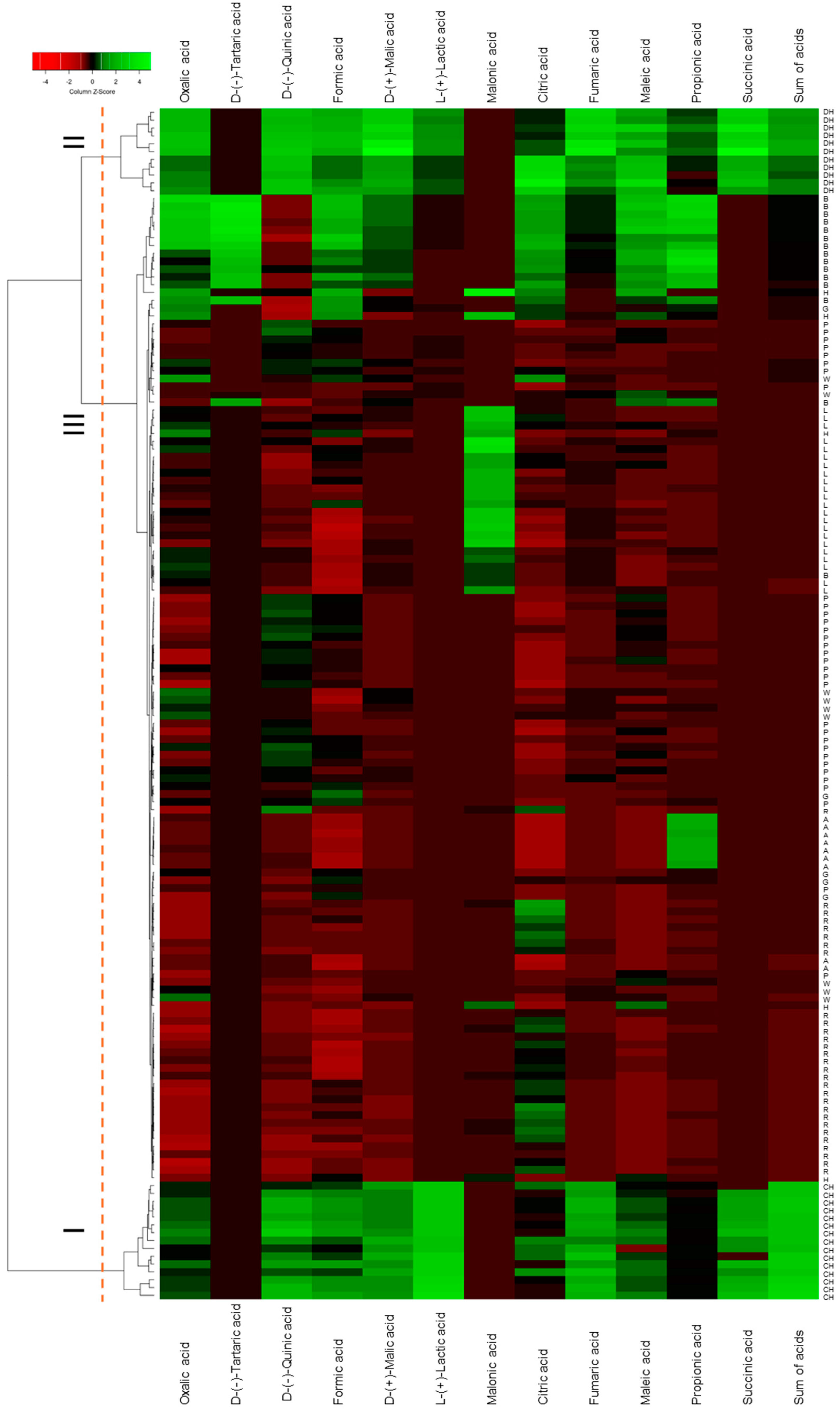
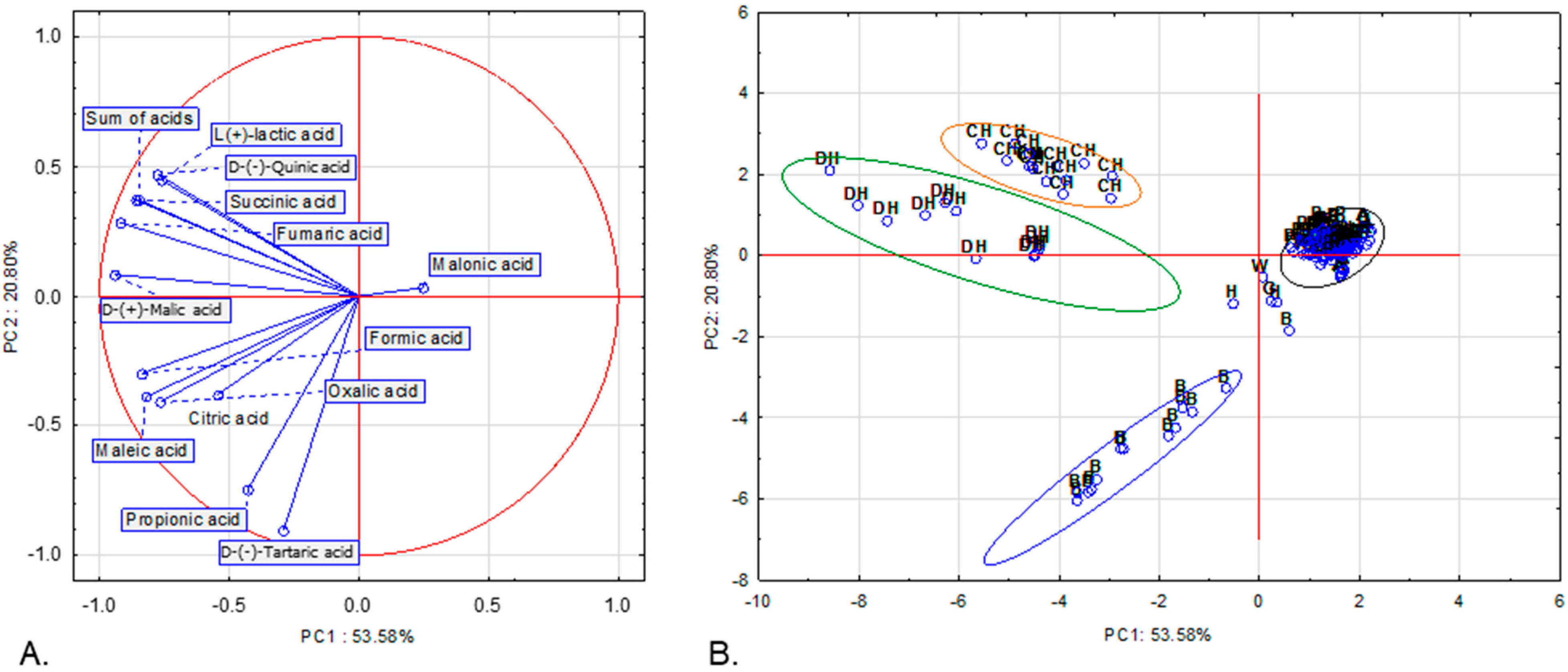
| Name of Acid | Linear Range (µg/mL) | R2 | LOD (µg/mL) | LOQ (µg/mL) | CV (%) | Recovery (%) |
|---|---|---|---|---|---|---|
| Oxalic | 1–5 | 0.9996 | 0.10 | 0.31 | 8.27 | 96.47 |
| D-(−)-tartaric | 6.25–25 | 0.9994 | 0.40 | 1.20 | 6.35 | 98.26 |
| D-(−)-quinic | 12.5–50 | 0.9998 | 1.06 | 3.20 | 5.02 | 98.45 |
| Formic | 12.5–50 | 0.9994 | 3.74 | 11.33 | 4.98 | 95.28 |
| D-(+)-malic | 12.5–50 | 1.0000 | 3.98 | 12.06 | 6.47 | 91.42 |
| Malonic | 12.5–50 | 0.9996 | 0.94 | 2.83 | 9.12 | 96.24 |
| L-(+)-lactic | 12.5–50 | 0.9997 | 2.00 | 6.07 | 6.28 | 97.56 |
| Citric | 6.25–25 | 0.9997 | 0.99 | 3.01 | 6.38 | 98.13 |
| Fumaric | 0.025–0.1 | 0.9997 | 0.03 | 0.08 | 4.69 | 92.37 |
| Succinic | 12.5–50 | 0.9994 | 2.60 | 7.89 | 4.57 | 98.68 |
| Maleic | 0.025–0.1 | 0.9995 | 0.01 | 0.03 | 3.25 | 96.56 |
| Propionic | 12.5–50 | 0.9998 | 4.45 | 13.50 | 8.24 | 95.74 |
| Honey Variety (No. of Samples) | Oxalic Acid | D-(−)- Quinic Acid | Formic Acid | Citric Acid | Propionic Acid | D-(+)- Malic Acid | L-(+)- Lactic Acid | Fumaric Acid | Maleic Acid | Malonic Acid | Succinic Acid | D-(−)- Tartaric Acid | Sum of Acids |
|---|---|---|---|---|---|---|---|---|---|---|---|---|---|
| Goldenrod (n = 5) | 18.52 ± 3.56 A (19.20%) | 41.13 ± 15.97 A (38.82%) | 72.33 ± 13.06 B (18.05%) | 14.66 ± 6.08 B (41.49%) | 10.04 ± 6.19 A (61.59%) | 21.43 ± 10.71 B (49.99%) | 47.02 ± 25.28 AB (53.77%) | 0.09 ± 0.05 A (51.77%) | 0.01 ± 0.01 A (54.74%) | all samples < LOD | all samples < LOD | all samples < LOD | 227.74 ± 54.56 A (23.69%) |
| Willow (n = 9) | 21.92 ± 3.33 AB (15.18%) | 55.48 ± 8.35 AB (15.05%) | 41.84 ± 10.97 AB (26.21%) | 14.75 ± 7.85 B (53.22%) | 5.79 ± 3.40 A (58.78%) | 29.19 ± 9.26 B (31.72%) | 43.32 ± 20.94 AB (48.33%) | 0.25 ± 0.06 B (22.08%) | 0.02 ± 0.01 A (70.51%) | all samples < LOD | all samples < LOD | all samples < LOD | 212.75 ± 42.37 A (19.91%) |
| Acacia (n = 9) | 17.13 ± 0.36 A (2.13%) | 52.97 ± 3.11 A (5.87%) | 30.48 ± 2.80 A (9.19%) | 3.77 ± 0.68 A (18.09%) | 48.24 ± 25.84 BC (53.56%) | 9.18 ± 2.09 A (22.75%) | 36.91 ± 7.77 A (21.06%) | all samples < LOD | all samples < LOD | all samples < LOD | all samples < LOD | all samples < LOD | 198.94 ± 22.86 A (11.49%) |
| Buckwheat (n = 14) | 28.76 ± 6.76 B (23.50%) | 42.47 ± 11.79 A (27.76%) | 98.03 ± 23.11 BC (23.57%) | 37.61 ± 7.38 BC (19.62%) | 82.49 ± 22.54 C (27.32%) | 86.21 ± 18.23 BC (21.15%) | 100.62 ± 41.42 B (41.17%) | 0.42 ± 0.15 BC (36.44%) | 0.08 ± 0.02 B (27.72%) | all samples < LOD | all samples < LOD | 22.17 ± 5.05 (22.80%) | 499.00 ± 103.67 B (20.78%) |
| Linden (n = 23) | 19.6 ± 1.76 AB (8.99%) | 50.62 ± 10.29 A (20.32%) | 40.09 ± 14.17 AB (35.34%) | 12.52 ± 4.34 B (34.68%) | 3.37 ± 2.53 A (75.06%) | 23.53 ± 6.43 B (27.32%) | all samples < LOD | 0.21 ± 0.04 AB (16.74%) | 0.01 ± 0.01 A (55.03%) | 63.65 ± 24.39 B (38.33%) | all samples < LOD | all samples < LOD | 213.76 ± 32.58 A (15.24%) |
| Phacelia (n = 32) | 17.4 ± 2.23 A (12.81%) | 82.61 ± 13.55 B (16.40%) | 54.65 ± 7.59 AB (13.88%) | 8.86 ± 3.39 AB (38.23%) | 3.80 ± 2.54 A (66.96%) | 17.01 ± 7.82 AB (45.98%) | 47.71 ± 27.78 AB (58.23%) | 0.12 ± 0.07 A (56.06%) | 0.02 ± 0.01 A (46.85%) | all samples < LOD | all samples < LOD | all samples < LOD | 232.58 ± 39.6 A (17.02%) |
| Rape (n = 29) | 15.31 ± 1.31 A (8.53%) | 46.81 ± 14.15 A (30.22%) | 39.80 ± 8.27 A (20.77%) | 25.55 ± 5.96 BC (23.35%) | 3.01 ± 1.85 A (61.27%) | 5.29 ± 3.82 A (72.13%) | 18.93 ± 12.37 A (65.35%) | 0.09 ± 0.03 A (37.40%) | 0.01 ± 0.01 A (40.92%) | 1.85 ± 1.10 A (59.44%) | all samples < LOD | all samples < LOD | 156.84 ± 24.73 A (15.77%) |
| Coniferous honeydew (n = 15) | 22.89 ± 4.23 B (6.43%) | 140.39 ± 33.35 C (23.56%) | 84.98 ± 15.64 BC (14.25%) | 22.52 ± 18.91 BC (31.88%) | 16.47 ± 8.58 AB (11.47%) | 135.32 ± 73.40 C (15.08%) | 2162.49 ± 678.10 D (9.35%) | 1.45 ± 0.53 C (15.71%) | 0.04 ± 0.03 AB (28.35%) | all samples < LOD | 10.82 ± 6.78 A (43.80%) | all samples < LOD | 2597.48 ± 603.39 C (8.33%) |
| Deciduous honeydew (n = 11) | 29.31 ± 3.93 B (13.40%) | 182.73 ± 10.11 C (5.53%) | 100.76 ± 15.30 C (15.19%) | 44.9 ± 22.05 C (49.11%) | 25.52 ± 11.04 B (43.24%) | 233.28 ± 81.43 C (34.91%) | 854.18 ± 208.78 C (24.44%) | 1.73 ± 0.74 C (42.94%) | 0.10 ± 0.02 B (22.54%) | all samples < LOD | 19.47 ± 5.91 A (30.35%) | all samples < LOD | 1492.09 ± 302.86 BC (20.30%) |
| Heather (n = 5) | 22.19 ± 5.37 AB (24.21%) | 47.16 ± 17.45 A (37.01%) | 75.05 ± 22.26 BC (29.66%) | 16.22 ± 10.94 B (67.42%) | 7.78 ± 4.51 A (57.91%) | all samples < LOD | 38.24 ± 24.71 A (64.62%) | 0.11 ± 0.07 A (63.92%) | 0.04 ± 0.02 AB (55.82%) | 60.38 ± 36.24 B (60.02%) | all samples < LOD | all samples < LOD | 270.78 ± 107.09 A (39.55%) |
| H | 103.866 | 112.351 | 113.049 | 113.588 | 95.757 | 129.336 | 126.972 | 113.336 | 108.888 | 42.138 | 10.540 | - | 116.789 |
| p | <0.001 | <0.001 | <0.001 | <0.001 | <0.001 | <0.001 | <0.001 | <0.001 | <0.001 | <0.001 | 0.001 | - | <0.001 |
| Feature | Characteristics |
|---|---|
| Elution mode | Isocratic |
| Column | Synergi Hydro-RP 80Ä C18 column (250 × 4,6 mm, 4 µm) (Phenomenex Inc., Torrance, CA, USA) |
| Mobile phase | 20 mM potassium phosphate (pH 2.9) |
| Analysis time | 15 min; wash/equilibration time = 15 min |
| Flow rate | 0.7 mL/min |
| Oven temperature | 25 °C |
| DAD range (UV detection) | 190 to 400 nm (220 nm) |
| Injection volume | 20 µL |
Disclaimer/Publisher’s Note: The statements, opinions and data contained in all publications are solely those of the individual author(s) and contributor(s) and not of MDPI and/or the editor(s). MDPI and/or the editor(s) disclaim responsibility for any injury to people or property resulting from any ideas, methods, instructions or products referred to in the content. |
© 2025 by the authors. Licensee MDPI, Basel, Switzerland. This article is an open access article distributed under the terms and conditions of the Creative Commons Attribution (CC BY) license (https://creativecommons.org/licenses/by/4.0/).
Share and Cite
Szczęsna, T.; Jaśkiewicz, K.; Jachuła, J. Qualitative and Quantitative Characteristics of Organic Acids in Monofloral and Honeydew Honeys from Poland: Is There a Varietal Pattern in Their Composition? Molecules 2025, 30, 4261. https://doi.org/10.3390/molecules30214261
Szczęsna T, Jaśkiewicz K, Jachuła J. Qualitative and Quantitative Characteristics of Organic Acids in Monofloral and Honeydew Honeys from Poland: Is There a Varietal Pattern in Their Composition? Molecules. 2025; 30(21):4261. https://doi.org/10.3390/molecules30214261
Chicago/Turabian StyleSzczęsna, Teresa, Katarzyna Jaśkiewicz, and Jacek Jachuła. 2025. "Qualitative and Quantitative Characteristics of Organic Acids in Monofloral and Honeydew Honeys from Poland: Is There a Varietal Pattern in Their Composition?" Molecules 30, no. 21: 4261. https://doi.org/10.3390/molecules30214261
APA StyleSzczęsna, T., Jaśkiewicz, K., & Jachuła, J. (2025). Qualitative and Quantitative Characteristics of Organic Acids in Monofloral and Honeydew Honeys from Poland: Is There a Varietal Pattern in Their Composition? Molecules, 30(21), 4261. https://doi.org/10.3390/molecules30214261

