Review

Hydrogen-Mediated Noncovalent Interactions in Solids: What Can NMR Crystallography Tell About?
National Institute for R&D of Isotopic and Molecular Technologies, 400293 Cluj, Romania
*
Author to whom correspondence should be addressed.
Molecules 2020, 25(16), 3757; https://doi.org/10.3390/molecules25163757

Submission received: 27 July 2020 / Revised: 15 August 2020 / Accepted: 16 August 2020 / Published: 18 August 2020
(This article belongs to the Special Issue Non-Covalent Interaction in Solids and Large Clusters)

Abstract

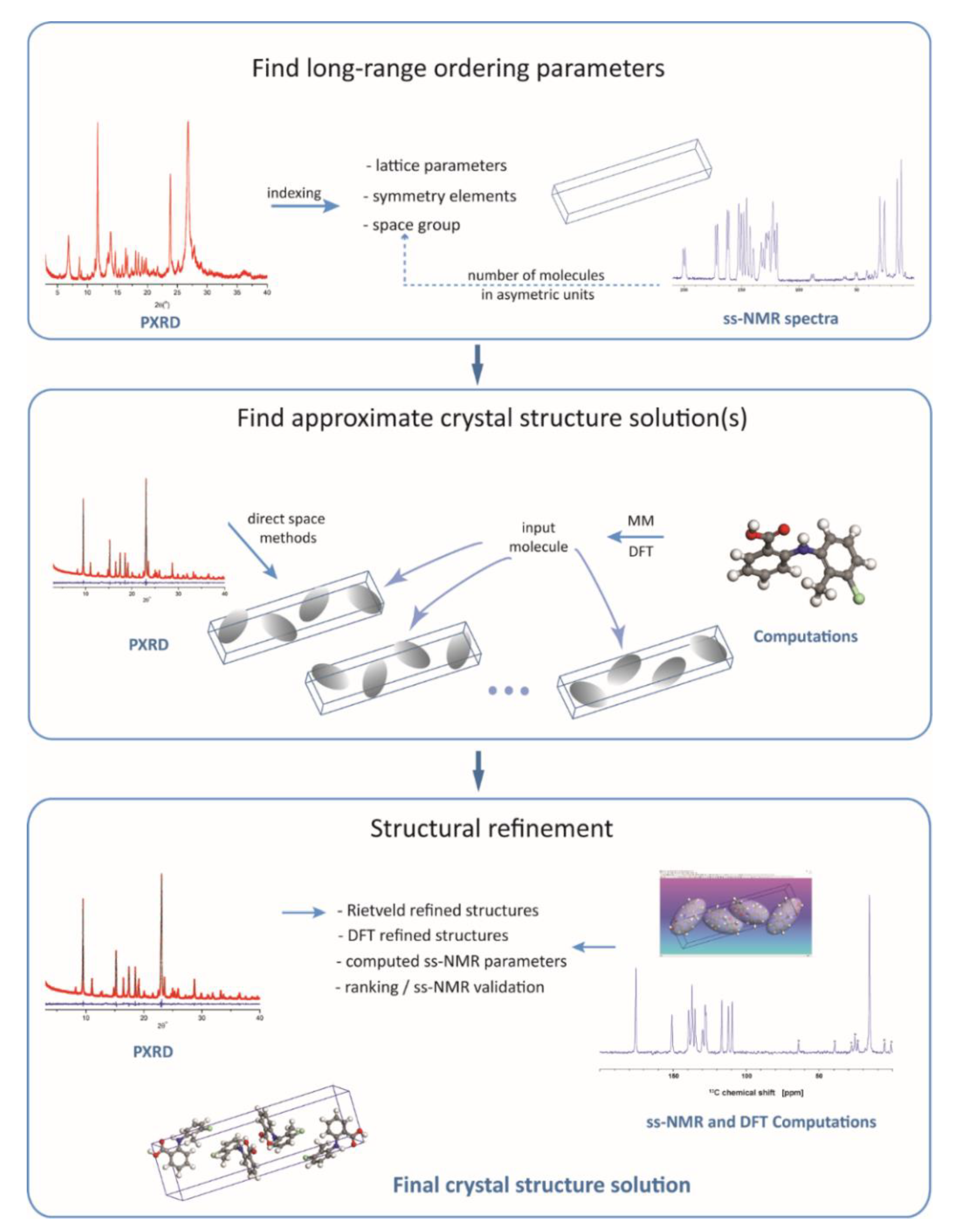
Hydrogen atoms play a crucial role in the aggregation of organic (bio)molecules through diverse number of noncovalent interactions that they mediate, such as electrostatic in proton transfer systems, hydrogen bonding, and CH–π interactions, to mention only the most prominent. To identify and adequately describe such low-energy interactions, increasingly sensitive methods have been developed over time, among which quantum chemical computations have witnessed impressive advances in recent years. For reaching the present state-of-the-art, computations had to rely on a pool of relevant experimental data, needed at least for validation, if not also for other purposes. In the case of molecular crystals, the best illustration for the synergy between computations and experiment is given by the so-called NMR crystallography approach. Originally designed to increase the confidence level in crystal structure determination of organic compounds from powders, NMR crystallography is able now to offer also a wealth of information regarding the noncovalent interactions that drive molecules to pack in a given crystalline pattern or another. This is particularly true for the noncovalent interactions which depend on the exact location of labile hydrogen atoms in the system: in such cases, NMR crystallography represents a valuable characterization tool, in some cases complementing even the standard single-crystal X-ray diffraction technique. A concise introduction in the field is made in this mini-review, which is aimed at providing a comprehensive picture with respect to the current accuracy level reached by NMR crystallography in the characterization of hydrogen-mediated noncovalent interactions in organic solids. Different types of practical applications are illustrated with the example of molecular crystals studied by our research group, but references to other representative developments reported in the literature are also made. By summarizing the major concepts and methodological progresses, the present work is also intended to be a guide to the practical potential of this relatively recent analytical tool for the scientists working in areas where crystal engineering represents the main approach for rational design of novel materials.
Keywords: NMR crystallography; noncovalent interactions; hydrogen bonds; proton transfer NMR crystallography; noncovalent interactions; hydrogen bonds; proton transfer