Article

Quantum Control by Few-Cycles Pulses: The Two-Level Problem

by
François Peyraut
1,
Frédéric Holweck
1,2 and
Stéphane Guérin
3,*
1
ICB, UMR 6303, CNRS, University Bourgogne Franche-Comté, UTBM, 90010 Belfort, France
2
Department of Mathematics and Statistics, Auburn University, Auburn, AL 36849, USA
3
ICB, UMR 6303, CNRS, University of Bourgogne, 21000 Dijon, France
*
Author to whom correspondence should be addressed.
Entropy 2023, 25(2), 212; https://doi.org/10.3390/e25020212
Submission received: 2 December 2022 / Revised: 3 January 2023 / Accepted: 10 January 2023 / Published: 22 January 2023
(This article belongs to the Special Issue Quantum Control and Quantum Computing)

Abstract

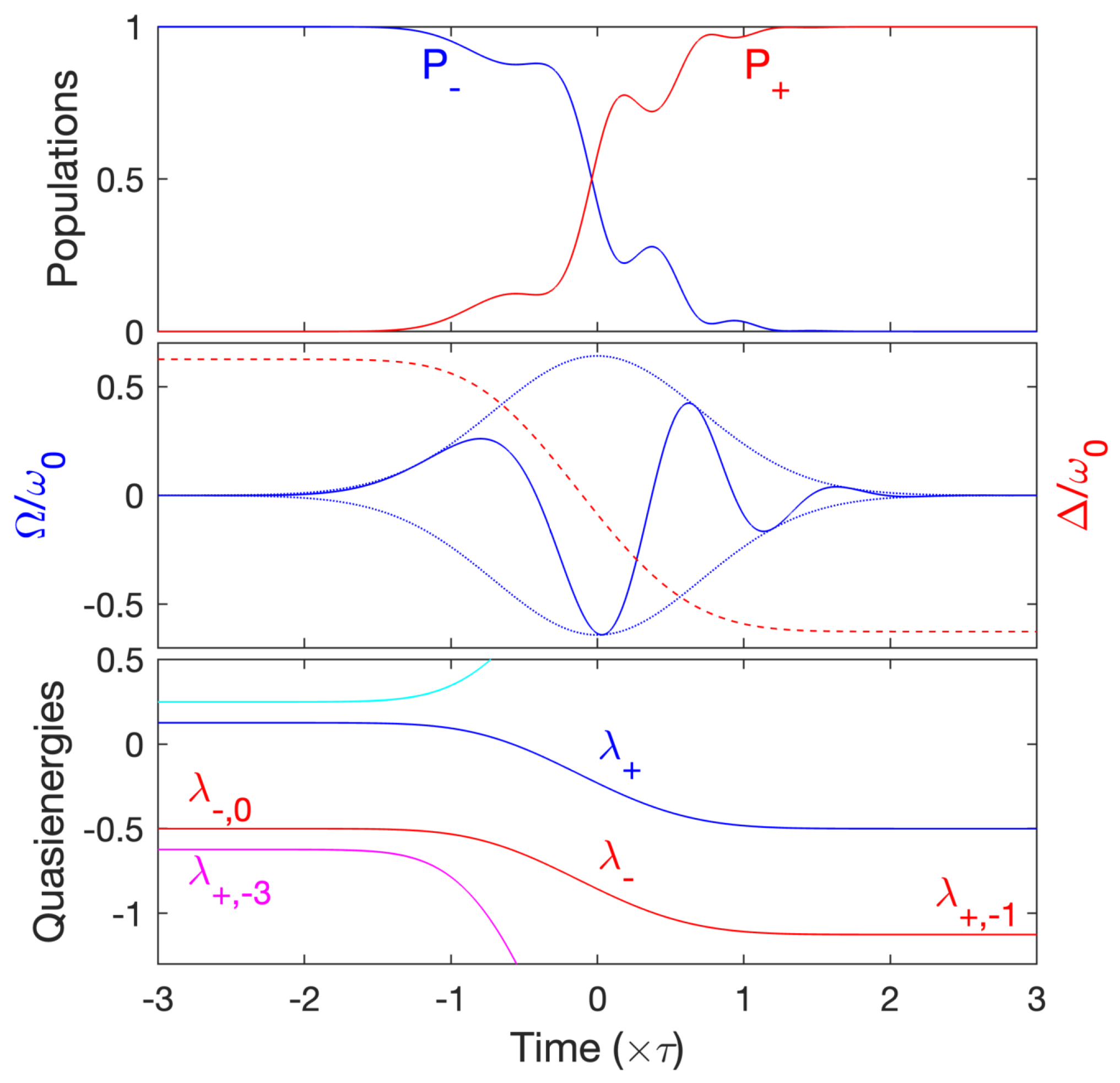
We investigate the problem of population transfer in a two-states system driven by an external electromagnetic field featuring a few cycles, until the extreme limit of two or one cycle. Taking the physical constraint of zero-area total field into account, we determine strategies leading to ultrahigh-fidelity population transfer despite the failure of the rotating wave approximation. We specifically implement adiabatic passage based on adiabatic Floquet theory for a number of cycles as low as 2.5 cycles, finding and making the dynamics follow an adiabatic trajectory connecting the initial and targeted states. Nonadiabatic strategies with shaped or chirped pulses, extending the π-pulse regime to two- or single-cycle pulses, are also derived.
Keywords: quantum control; quantum system driven by an external field; adiabatic passage; adiabatic Floquet theory quantum control; quantum system driven by an external field; adiabatic passage; adiabatic Floquet theory