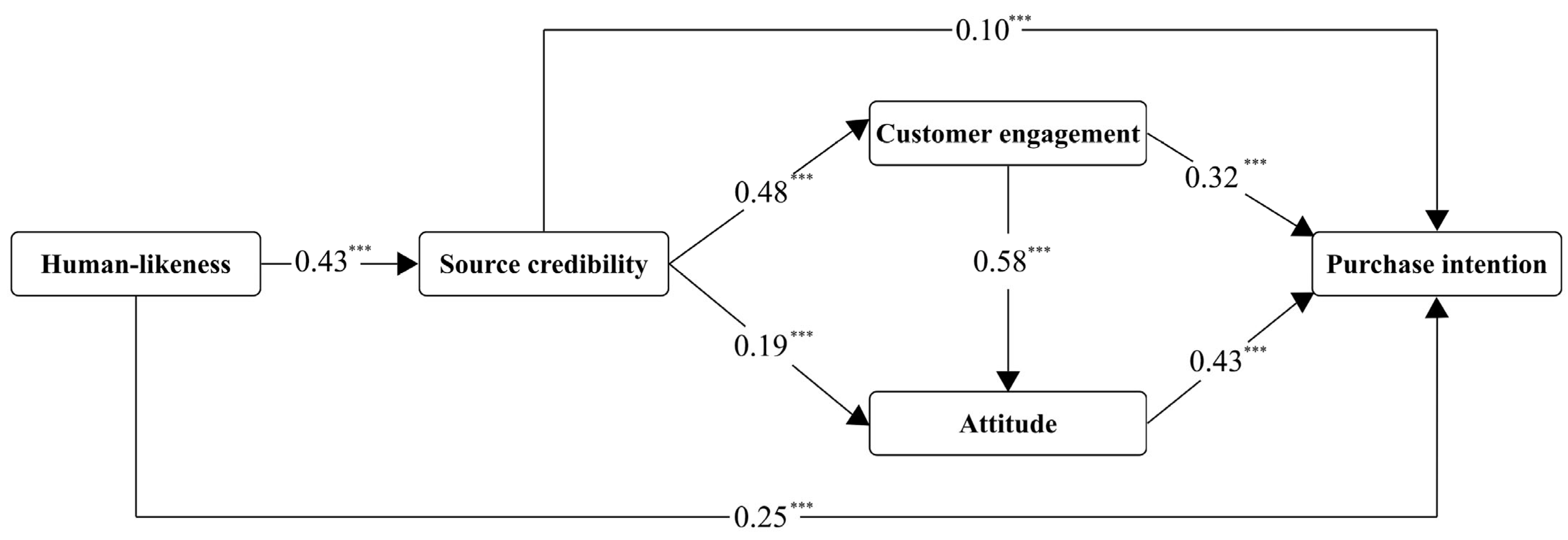

How and When Do Virtual Influencers Work? A Meta-Analysis of Mechanisms and Moderators in Digital Commerce


Abstract
1. Introduction
2. Literature Review
3. Hypothesis Development
3.1. Human-Likeness
3.2. The Mediating Role of Cognitive and Affective Mechanisms
3.3. The Moderating Effects of VIs Effectiveness
3.3.1. The Moderating Role of Virtual Influencer’s Size
3.3.2. The Moderating Role of Product Characteristics
3.3.3. The Moderating Role of Consumer Age
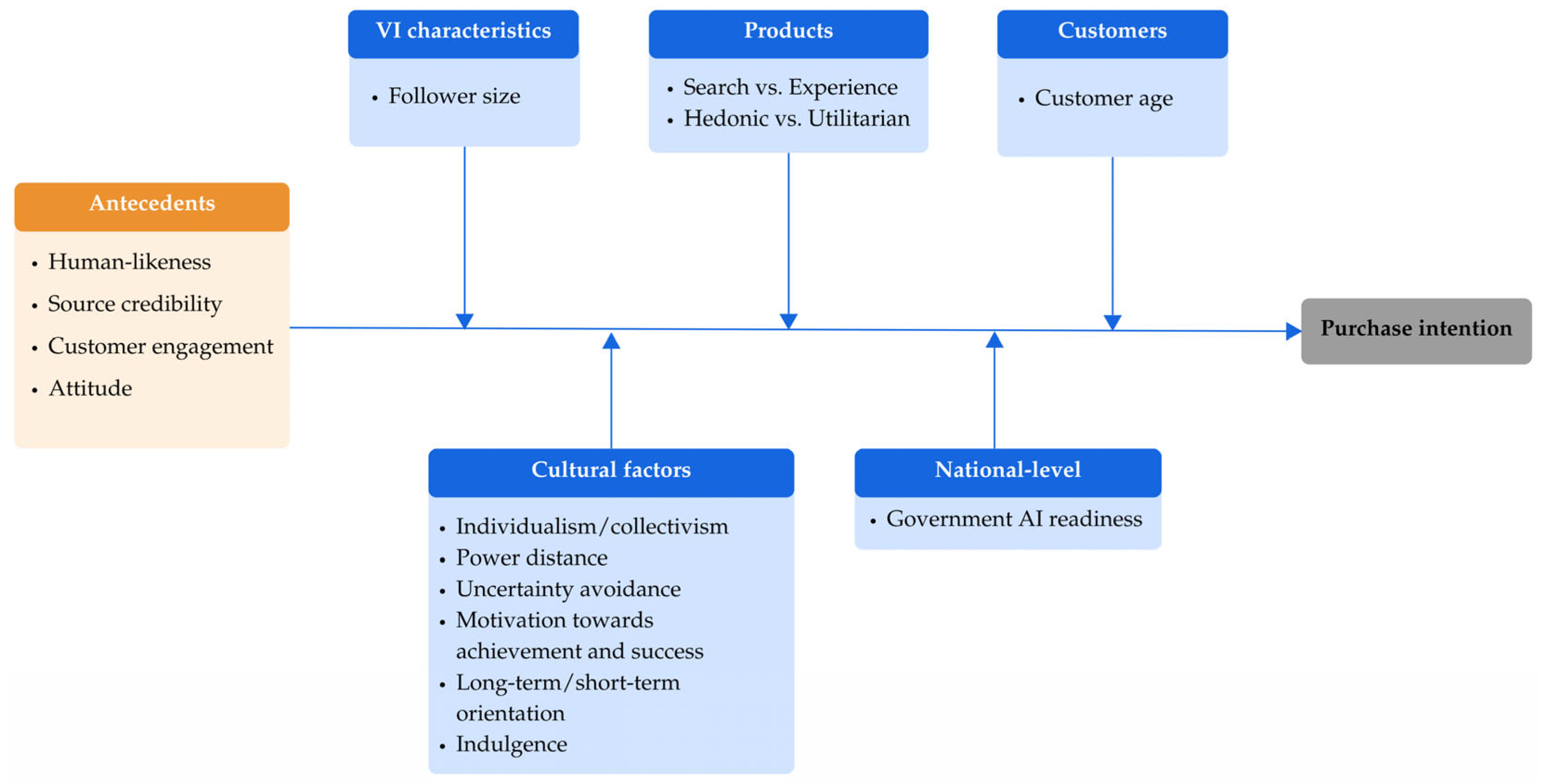
3.3.4. The Moderating Role of Cultural Factors
3.3.5. The Moderating Role of Government AI Readiness
4. Research Methods
4.1. Data Collection
4.2. Data Coding
4.3. Effect Size Integration
4.4. Meta-Analytic Structural Equation Model
4.5. Moderator Analysis
5. Results
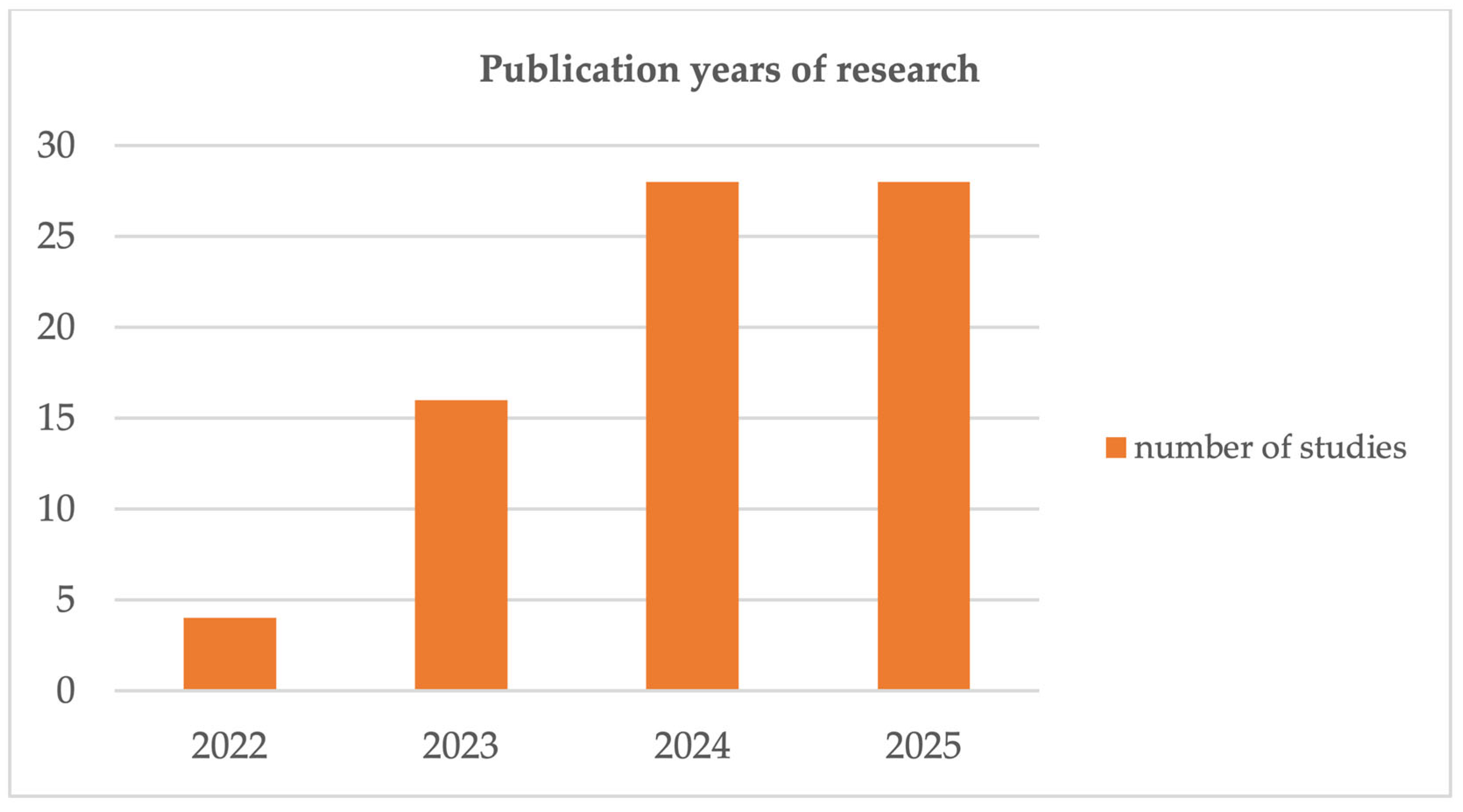
5.1. Study Characteristics
5.2. Integration of Effect Sizes
5.3. Structural Model Evaluation
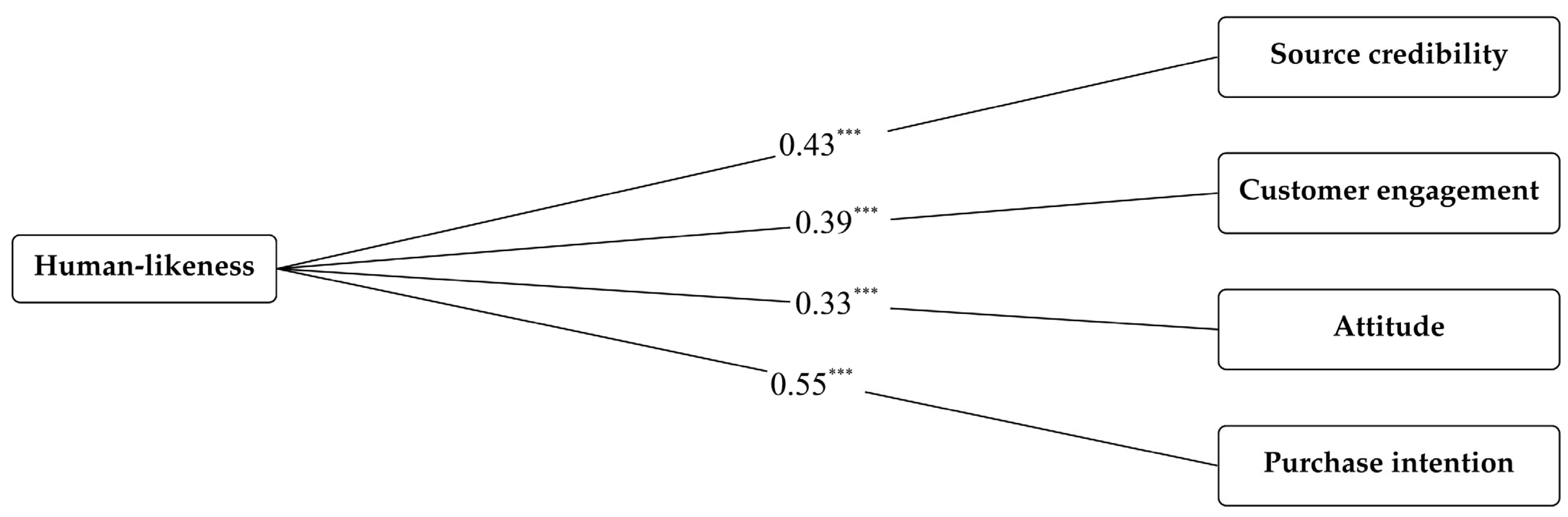
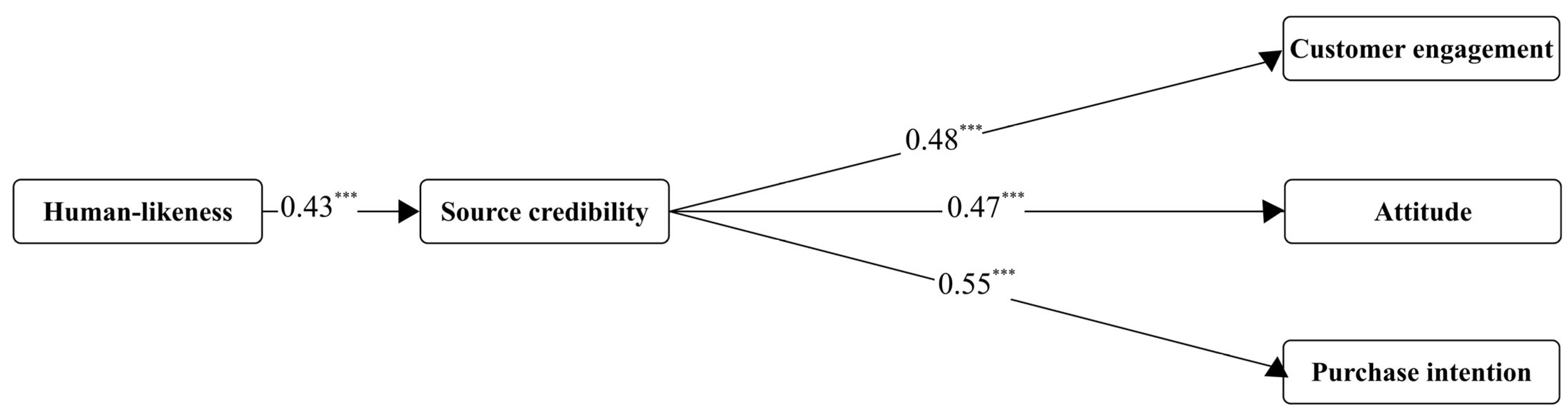
5.4. Hypothesis Testing
5.5. Results of Moderator Analysis
5.5.1. Follower Size (High vs. Low)
5.5.2. Information-Based Product Types (Search vs. Experience)
5.5.3. Motivation-Based Product Types (Hedonic vs. Utilitarian)
5.5.4. Consumer Age
5.5.5. Cultural Factors
5.5.6. AI Readiness
6. General Discussion
6.1. Theoretical Contribution
6.2. Practical Implications
6.2.1. The Importance of Human-Likeness
6.2.2. Generational Strategies in VI Marketing
6.2.3. Aligning VIs with Product Types
6.2.4. Adapting VI Strategies to Cultural Orientation
6.2.5. Emphasizing AI Quality over Follower Quantity and Government AI Readiness
7. Conclusions
8. Limitations and Future Research Directions
Author Contributions
Funding
Institutional Review Board Statement
Informed Consent Statement
Data Availability Statement
Acknowledgments
Conflicts of Interest
Abbreviations
| VI(s) | Virtual influencer(s) |
| HL | Human-likeness |
| SR | Source credibility |
| CE | Customer engagement |
| AT | Attitude |
| PI | Purchase intention |
Appendix A

| Section and Topic | Item | Checklist Item | Location Where Item Is Reported |
|---|---|---|---|
| Title | |||
| Title | 1 | Identify the report as a systematic review. | Title |
| Abstract | |||
| Abstract | 2 | See the PRISMA 2020 for Abstracts checklist. | Abstract |
| Introduction | |||
| Rationale | 3 | Describe the rationale for the review in the context of existing knowledge. | Section 1 |
| Objectives | 4 | Provide an explicit statement of the objective(s) or question(s) the review addresses. | Section 1 |
| Methods | |||
| Eligibility criteria | 5 | Specify the inclusion and exclusion criteria for the review and how studies were grouped for the syntheses. | Section 4.1 |
| Information sources | 6 | Specify all databases, registers, websites, organisations, reference lists and other sources searched or consulted to identify studies. Specify the date when each source was last searched or consulted. | Section 4.1 |
| Search strategy | 7 | Present the full search strategies for all databases, registers and websites, including any filters and limits used. | Section 4.1 |
| Selection process | 8 | Specify the methods used to decide whether a study met the inclusion criteria of the review, including how many reviewers screened each record and each report retrieved, whether they worked independently, and if applicable, details of automation tools used in the process. |
|
| Data collection process | 9 | Specify the methods used to collect data from reports, including how many reviewers collected data from each report, whether they worked independently, any processes for obtaining or confirming data from study investigators, and if applicable, details of automation tools used in the process. | Section 4.2 |
| Data items | 10a | List and define all outcomes for which data were sought. Specify whether all results that were compatible with each outcome domain in each study were sought (e.g., for all measures, time points, analyses), and if not, the methods used to decide which results to collect. |
|
| 10b | List and define all other variables for which data were sought (e.g., participant and intervention characteristics, funding sources). Describe any assumptions made about any missing or unclear information. |
| |
| Study risk of bias assessment | 11 | Specify the methods used to assess risk of bias in the included studies, including details of the tool(s) used, how many reviewers assessed each study and whether they worked independently, and if applicable, details of automation tools used in the process. | Addressed statistically via funnel plot, Egger’s test, Rosenthal’s Fail-safe N, outlier screening: Section 4.3 |
| Effect measures | 12 | Specify for each outcome the effect measure(s) (e.g., risk ratio, mean difference) used in the synthesis or presentation of results. | Section 4.3 |
| Synthesis methods | 13a | Describe the processes used to decide which studies were eligible for each synthesis (e.g., tabulating the study intervention characteristics and comparing against the planned groups for each synthesis (item #5)). |
|
| 13b | Describe any methods required to prepare the data for presentation or synthesis, such as handling of missing summary statistics, or data conversions. | Section 4.3 | |
| 13c | Describe any methods used to tabulate or visually display results of individual studies and syntheses. | Section 4.3 | |
| 13d | Describe any methods used to synthesize results and provide a rationale for the choice(s). If meta-analysis was performed, describe the model(s), method(s) to identify the presence and extent of statistical heterogeneity, and software package(s) used. | Section 4.3 and Section 4.4 | |
| 13e | Describe any methods used to explore possible causes of heterogeneity among study results (e.g., subgroup analysis, meta-regression). | Section 4.5 | |
| 13f | Describe any sensitivity analyses conducted to assess robustness of the synthesized results. | Section 4.3 | |
| Reporting bias assessment | 14 | Describe any methods used to assess risk of bias due to missing results in a synthesis (arising from reporting biases). | Section 4.3 |
| Certainty assessment | 15 | Describe any methods used to assess certainty (or confidence) in the body of evidence for an outcome. | Assessed via heterogeneity testing, sensitivity analyses, and FDR: Section 4.3 and Section 4.5 |
| Results | |||
| Study selection | 16a | Describe the results of the search and selection process, from the number of records identified in the search to the number of studies included in the review, ideally using a flow diagram. | Section 5.1 and Appendix B. |
| 16b | Cite studies that might appear to meet the inclusion criteria, but which were excluded, and explain why they were excluded. | N/A | |
| Study characteristics | 17 | Cite each included study and present its characteristics. |
|
| Risk of bias in studies | 18 | Present assessments of risk of bias for each included study. | Table 3 and Appendix H |
| Results of individual studies | 19 | For all outcomes, present, for each study: (a) summary statistics for each group (where appropriate) and (b) an effect estimate and its precision (e.g., confidence/credible interval), ideally using structured tables or plots. | Available on FigShare at https://doi.org/10.6084/m9.figshare.31316404. |
| Results of syntheses | 20a | For each synthesis, briefly summarise the characteristics and risk of bias among contributing studies. | Appendix H |
| 20b | Present results of all statistical syntheses conducted. If meta-analysis was done, present for each the summary estimate and its precision (e.g., confidence/credible interval) and measures of statistical heterogeneity. If comparing groups, describe the direction of the effect. | Section 5.2 and Table 3 | |
| 20c | Present results of all investigations of possible causes of heterogeneity among study results. | Section 5.2 and Table 3 | |
| 20d | Present results of all sensitivity analyses conducted to assess the robustness of the synthesized results. | Section 5.3, Appendix H | |
| Reporting biases | 21 | Present assessments of risk of bias due to missing results (arising from reporting biases) for each synthesis assessed. | Results for FSN, funnel plots, and Egger’s test: Section 5.2, Appendix H |
| Certainty of evidence | 22 | Present assessments of certainty (or confidence) in the body of evidence for each outcome assessed. | Reported via heterogeneity metrics (I2, Q) and FDR-adjusted levels: Table 5, Section 5.2 and Section 5.4 |
| Discussion | |||
| Discussion | 23a | Provide a general interpretation of the results in the context of other evidence. | Section 5 and Section 6.1 |
| 23b | Discuss any limitations of the evidence included in the review. | Section 8 | |
| 23c | Discuss any limitations of the review processes used. | Section 8 | |
| 23d | Discuss implications of the results for practice, policy, and future research. | Section 6.2 | |
| Other information | |||
| Registration and protocol | 24a | Provide registration information for the review, including register name and registration number, or state that the review was not registered. | The review protocol was not registered. |
| 24b | Indicate where the review protocol can be accessed, or state that a protocol was not prepared. | The review protocol was not registered. | |
| 24c | Describe and explain any amendments to information provided at registration or in the protocol. | The review protocol was not registered. | |
| Support | 25 | Describe sources of financial or non-financial support for the review, and the role of the funders or sponsors in the review. | Section “Funding” |
| Competing interests | 26 | Declare any competing interests of review authors. | Section “Conflicts of Interest” |
| Availability of data, code and other materials | 27 | Report which of the following are publicly available and where they can be found: template data collection forms; data extracted from included studies; data used for all analyses; analytic code; any other materials used in the review. | Section “Data Availability Statement” |
Appendix B
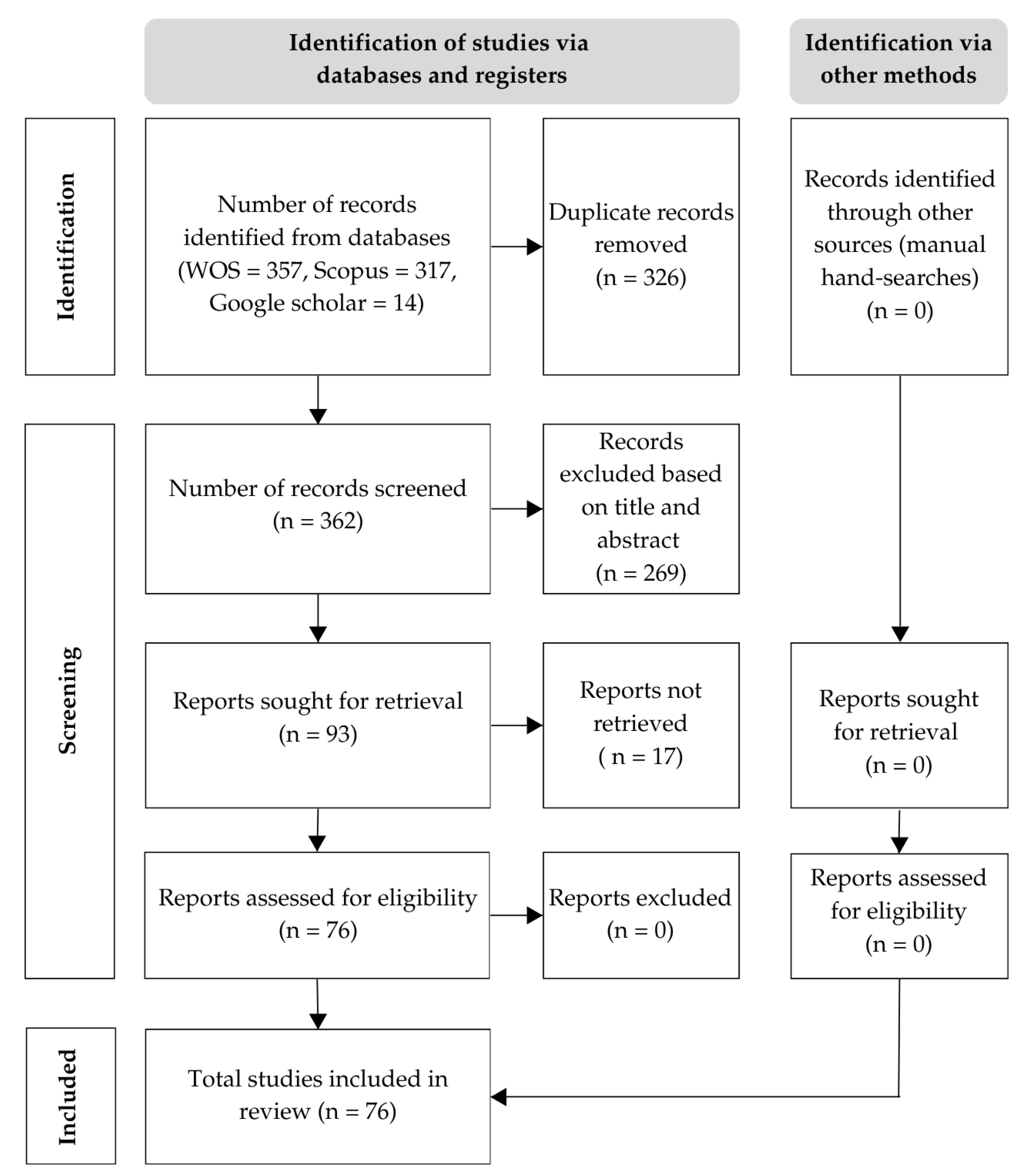
Appendix C
| No. | Author | Title |
|---|---|---|
| 1 | [102] | AI Influencers in Advertising: The Role of AI Influencer-Related Attributes in Shaping Consumer Attitudes, Consumer Trust, and Perceived Influencer‚ Product Fit |
| 2 | [103] | Alone or Mixed? The Effect of Digital Human Narrative Scenarios on Chinese Consumer Eco-Product Purchase Intention |
| 3 | [41] | Analysis of AI virtual influencer marketing strategy based on AISAS model-Taking Liu Yexi as an example |
| 4 | [104] | Anthropomorphism And Authenticity Exploring the Dynamics of Virtual Influencers in Contemporary Marketing |
| 5 | [105] | Anthropomorphism in CSR Endorsement: A Comparative Study on Humanlike vs. Cartoonlike Virtual Influencers’ Climate Change Messaging |
| 6 | [45] | Are social media robot influencers credible? A cross-continental analysis in a fashion context |
| 7 | [106] | Are they humans or are they robots? The effect of virtual influencer disclosure on brand trust |
| 8 | [107] | Artificial humanity: A multi-method exploration of user responses to AI influencer affordances in short video platform |
| 9 | [7] | Artificial Intelligence Influencers’ Credibility Effect on Consumer Engagement and Purchase Intention |
| 10 | [108] | Attractiveness vs. Similarity: How attributes of AI-based virtual influencers impact credibility, parasocial interaction and purchase intentions of social-media users |
| 11 | [109] | Beyond Visual Realism-Understanding the Role of Verbal Cues in Generating Consumer Affinity vs. Fear toward Virtual Influencers in Social Network Advertising |
| 12 | [110] | Building connections with virtual influencers: the role of friendship and psychological well-being in driving social media engagement and purchase intention |
| 13 | [111] | Can Computer Virtual Influencers Replace Human Influencers in the Future? An Empirical Investigation in the Age of Digital Transformation |
| 14 | [112] | Can virtual influencers affect purchase intentions in tourism and hospitality e-commerce live streaming? An empirical study in China |
| 15 | [113] | Color effects on AI influencers’ product recommendations |
| 16 | [114] | Consumer Perception of Virtual Influencers: A Study on Trust, Engagement, and Purchase Intention among Gen Z |
| 17 | [115] | Conveyed by Artificial Authenticity? The Impact of Virtual Influencers on Brand Trust |
| 18 | [116] | Credibility of Virtual Influencers: The Role of Design Stimuli, Knowledge Cues, and User Disposition |
| 19 | [117] | Do Virtual Influencers’ Endorsements Impact Purchase Intention at Restaurants: An Examination Using Symmetric and Asymmetric Approaches |
| 20 | [118] | Does self-congruity matter for virtual influencer’s non-fungible token (NFT) purchase intentions? The role of financial literacy |
| 21 | [119] | Exploring the Impact of Virtual Influencers on Social Media User’s Purchase Intention in Germany: An Empirical Study |
| 22 | [120] | Factors of virtual influencer marketing influencing Generation Y consumers’ purchase intention in Malaysia |
| 23 | [121] | Fashion Virtual Influencers: Antecedents Influencing Females’ Behavioral Intentions in Jordan |
| 24 | [72] | Fostering Parasocial Relationships with Virtual Influencers in the Uncanny Valley: Anthropomorphism, Autonomy, and a Multigroup Comparison |
| 25 | [122] | Green power of virtual influencer: The role of virtual influencer image, emotional appeal, and product involvement |
| 26 | [123] | How can I trust you if you’re fake? Understanding human-like virtual influencer credibility and the role of textual social cues |
| 27 | [42] | How Does Humanoid Virtual Influencers’ Appearance Convey Social Presence? The Underlying Process and Path to Purchase Intention |
| 28 | [39] | Impact of Celebrity, Micro-Celebrity, and Virtual Influencers on Chinese Gen Z’s Purchase Intention Through Social Media |
| 29 | [30] | Interactive or not? Enhancing the interactive effectiveness of virtual brand ambassadors on consumer behavior |
| 30 | [124] | Investigating the effectiveness of virtual influencers with regard to fostering customer purchasing intention: an empirical study in Ho Chi Minh City |
| 31 | [125] | Investigating the Influence of Trust, Attractiveness, Perceived Expertise, and Perceived Credibility on Attitude Toward the Influencer: The Mediating Role of Attitude Toward the Influencer and Moderating Role and Perceived Risks |
| 32 | [126] | Investigating the role of metaverse influencers’ attributes for the next generation of services |
| 33 | [127] | Maximizing the Consumer Connection: Avatars, Emotions, and Effective Virtual Influencer Advertising |
| 34 | [29] | More Realistic, More Better? How Anthropomorphic Images of Virtual Influencers Impact the Purchase Intentions of Consumers |
| 35 | [5] | Novelty vs. trust in virtual influencers: exploring the effectiveness of human-like virtual influencers and anime-like virtual influencers |
| 36 | [98] | Product-independent or product-dependent: The impact of virtual influencers’ primed identity on purchase intention |
| 37 | [128] | Promoting Customer Engagement and Brand Loyalty on Social Media: The Role of Virtual Influencers |
| 38 | [129] | Research on the influence of digital human avatar characteristics on brand fans effect |
| 39 | [130] | Revisiting the elaboration likelihood model in the context of a virtual influencer: A comparison between high- and low-involvement products |
| 40 | [131] | Significance of visual realism–eeriness, credibility, and persuasiveness of virtual influencers |
| 41 | [27] | Smile or Not Smile: The Effect of Virtual Influencers’ Emotional Expression on Brand Authenticity, Purchase Intention and Follow Intention |
| 42 | [8] | Social media presence impacts AI influencer’s endorsement: an empirical evidence |
| 43 | [132] | Social media users’ affective, attitudinal, and behavioral responses to virtual human emotions |
| 44 | [133] | Stereotyping human-like virtual influencers in retailing: Does warmth prevail over competence? |
| 45 | [134] | The “mixed” reality of virtual brand endorsers: understanding the effect of brand engagement and social cues on technological perceptions and advertising effectiveness |
| 46 | [135] | The effect of virtual endorsers on Chinese consumer’s brand attitude |
| 47 | [136] | The effect of virtual influencer attractiveness towards consumer attitudes in developing purchase intentions—A case study of Richeese factory’s virtual brand ambassador |
| 48 | [137] | The Effects of Trust and Attachment to Hyper-Realistic Virtual Influencers on Behavioral Intentions: Based on the Trust-Building Model |
| 49 | [46] | The impact of human-likeness on users’ perceptions of virtual influencers as advertising endorsers |
| 50 | [138] | The impact of the humanness of AI influencers on the success of influencer marketing |
| 51 | [139] | The Impact of Virtual Influencers’ Characteristics on Purchase Intentions Toward Fashion Products: Focusing on the Mediating Effect of Mimetic Desire |
| 52 | [140] | The influence of virtual idol characteristics on consumers’ clothing purchase intention |
| 53 | [38] | The influences of aura and anthropomorphism of virtual humans on perceived interactivity and purchase intention |
| 54 | [141] | The Interplay Between Human Likeness and Agency on Virtual Influencer Credibility |
| 55 | [142] | The next hype in social media advertising: Examining virtual influencers’ brand endorsement effectiveness |
| 56 | [143] | The positive effect of artificial intelligence technology transparency on digital endorsers: Based on the theory of mind perception |
| 57 | [144] | The power of human-like virtual-influencer-generated content: Impact on consumers’ willingness to follow and purchase intentions |
| 58 | [145] | The role of anthropomorphism and racial homophily of virtual influencers in encouraging low- versus high-cost pro-environmental behaviors |
| 59 | [40] | The role of flow experience in virtual influencer marketing: insights into aesthetic, entertainment and parasocial influences on purchase intention |
| 60 | [6] | To comply or to react, that is the question: the roles of humanness versus eeriness of AI-powered virtual influencers, loneliness, and threats to human identities in AI-driven digital transformation |
| 61 | [146] | Trust dynamics of virtual influencers: Exploring their influence on fashion purchase decisions |
| 62 | [147] | Unlocking the persuasive power of virtual influencer on brand trust and purchase intention: a parallel mediation of source credibility |
| 63 | [148] | Unlocking Trust Dynamics: An Exploration of Playfulness, Expertise, and Consumer Behavior in Virtual Influencer Marketing |
| 64 | [4] | “Virtual bonds and actual transactions”: Investigating the impact of virtual influencers’ credibility on buying behavior through virtual engagement |
| 65 | [149] | Virtual humans as social actors: Investigating user perceptions of virtual humans’ emotional expression on social media |
| 66 | [150] | Virtual Idols’ influence on Consumer’s brand attitude and purchase intention: A perspective of para-social interaction |
| 67 | [31] | Virtual influencer marketing: Evaluating the influence of virtual influencers’ form realism and behavioral realism on consumer ambivalence and marketing performance |
| 68 | [151] | Virtual Influencers and Sustainable Brand Relationships: Understanding Consumer Commitment and Behavioral Intentions in Digital Marketing for Environmental Stewardship |
| 69 | [152] | Virtual Influencers vs. Human Influencers in the Age of Digital Transformation: Which Holds Greater Influence? |
| 70 | [95] | Virtual personalities, real bonds: anthropomorphized virtual influencers’ impact on trust and engagement |
| 71 | [153] | Virtual voices in hospitality: Assessing narrative styles of digital influencers in hotel advertising |
| 72 | [3] | Virtually human: anthropomorphism in virtual influencer marketing |
| 73 | [43] | What, Was She Not Human? The Mediated Effects of Virtual Influencers’ Identity Disclosure Timing on Behavioral Intentions: Focusing on the Moderating Role of Influencer-Brand Fit |
| 74 | [154] | When digital celebrity talks to you: How human-like virtual influencers satisfy consumer’s experience through social presence on social media endorsements |
| 75 | [155] | When Virtual Influencers are Used as Endorsers: Will Match-Up and Attractiveness Affect Consumer Purchase Intention? |
| 76 | [156] | Will virtual influencers overcome the uncanny valley? The moderating role of social cues |
Appendix D
| Variables | Definition | Alias(es) | Sample Studies |
|---|---|---|---|
| Human-likeness | The extent to which a VI possesses human appearance, behavior, and emotional expressiveness. | Anthropomorphism, human-likeness; form realism, behavioral realism; emotional realism, emotion, physical cue | [29,140,156] |
| Source credibility | Perceived expertise, trustworthiness, attractiveness, similarity, familiarity, and likeability of a source. | Attractiveness, credibility, expertise, likeability, trustworthiness, trust, popularity, relevance, similarity, source credibility. | [3,39,123] |
| Customer engagement | Customer engagement refers to the development of involvement with virtual influencers, including empathy, emotional engagement, and willingness. | Affective empathy, cognitive empathy, emotional attachment, Engagement; Flow experience, Satisfaction; Search willingness, and willingness to follow. | [39,133,157] |
| Attitude | Attitude is the evaluation of an influencer, brand, and advertisement, which serves as a primary determinant of purchase intention. | Attitude toward a virtual influencer, Attitude towards a brand; Attitude toward the information; Brand attitude; Cognitive and emotional attitude | [38,143,150] |
| Purchase intention | Purchase intention indicates the likelihood that consumers will purchase a product recommended by an influencer. | Behavioral intention; Buying intention; Intention to buy; Purchase intention. | [112,158] |
Appendix E
- Study information (Authors, Title)
- Study ID Number
- Type of Publication
- Journal name
- Publication Year
- Variable information:
| Description | Independent Variable | Cronbach’s α of IV | Dependent Variable | Cronbach’s α of DV | |
| 1 | |||||
| 2 |
| Relation Tested (IV-DV) | Correlation Coefficient | Beta Coefficient | p-Value | SE | Sample Size (N) |
| 1 | |||||
| 2 |
Appendix F
| Moderator | Definitions | Classification | Coding Details |
|---|---|---|---|
| Virtual influencer | |||
| Size | Number of users who follow virtual influencers (VI) on a social media platform [47,48,49,50]. | Mega- and macro-VI: Virtual influencers have more than one hundred thousand followers. Micro- and nano-VI: Virtual influencers have less than one-hundred thousand followers. Note: If a study had more than one VI, the average number of followers was calculated. If a study had no VI, it was considered a micro-VI. | 1 = Mega- and macro- VI vs. 0 = Micro- and nano-VI |
| Product | Information about the product of a VI was endorsed in the study. Note: If a study had no information about product types, the products that a VI in the study usually endorsed were collected (e.g., clothing is considered for products endorsed by Lil Miquela because she partnered with major fashion brands). | ||
| Motivation-based | Consumers’ motivation to use a product [57]. | Hedonic: The endorsed product is hedonic if it is perceived as a pleasure, enjoyment, and sensory experience. Utilitarian: The endorsed product is utilitarian if it is perceived as practical or functional. | 1 = Hedonic vs. 0 = Utilitarian |
| Information-based | Categorization of products based on information [55]. | Search: The endorsed product can only be evaluated before consumption or use (e.g., clothing, phone). Experience: The endorsed product can only be evaluated after consumption or use. (e.g., food). | 1 = Experience vs. 0 = Search |
| Consumers | Sample description in the study. | ||
| Age | Average age | The average age of samples | Continuous variable |
| Cultural factors | Based on Hofstede’s cultural dimensions [64]. The sample description of the respondents’ countries was also collected. Note: If a study did not provide information about the country of the respondents, the country of the research authors or the survey area was collected. | ||
| Individualism/ collectivism | The extent to which people value personal goals over group goals. | Continuous variable | |
| Power distance | The extent to which individuals accept inequalities as avoidable or functional. | Continuous variable | |
| Uncertainty avoidance | The extent to which people within a culture are nervous about situations that they perceive and experience as unstructured, unclear, or unpredictable. | Continuous variable | |
| Motivation towards achievement and success | A cultural orientation representing a society’s preference for competition and achievement as a means of improving the overall quality of life. | Continuous variable | |
| Long-term/short-term orientation | Cultural dimensions indicate the extent to which people in a culture prioritize future- or present-oriented values. | Continuous variable | |
| Indulgence | How freely do people pursue pleasure? | Continuous variable | |
| Government AI readiness | Based on Government AI readiness index of Oxford insights [74]. The sample description of the respondents’ countries was collected. Note: If a study did not provide information about the country of the respondents, the country of the research authors was collected. | ||
| Government AI readiness | The Government AI Readiness Index examines a country’s AI readiness through an analysis of 40 indicators within ten dimensions, which all fall under the three key pillars: government, technology, and data and infrastructure | Continuous variable | |
Appendix G
| Human-Likeness-Source Credibility | Human-Likeness-Customer Engagement |
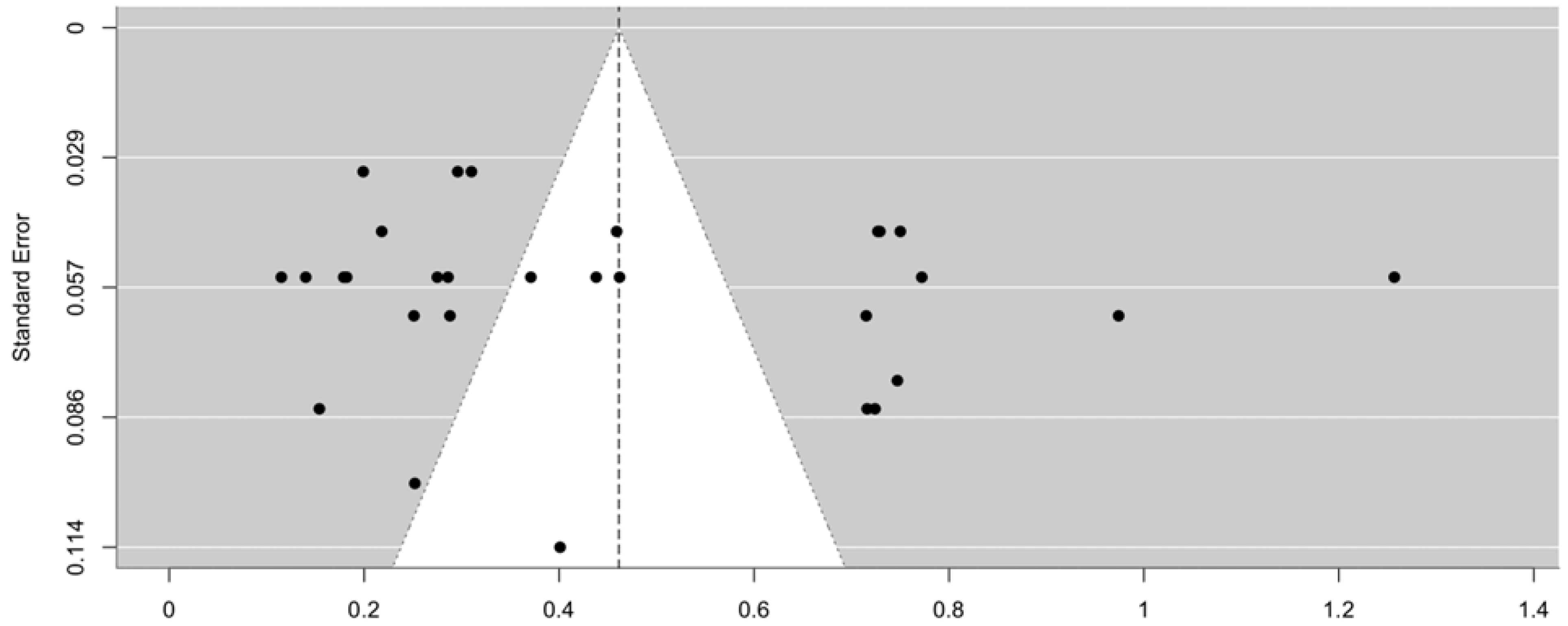 |  |
| Test for Funnel Plot Asymmetry: z = 0.382, p = 0.70 Limit Estimate: r = 0.376 (CI: 0.0407, 0.635) | Test for Funnel Plot Asymmetry: z = −0.640, p = 0.52 Limit Estimate: r = 0.549 (CI: −0.005, 0.845) |
| Human-likeness-Attitude | Human-likeness-Purchase intention |
 |  |
| Test for Funnel Plot Asymmetry: z = 1.18, p = 0.23 Limit Estimate: r = −0.173 (CI: −0.781, 0.602) | Test for Funnel Plot Asymmetry: z = −0.714, p = 0.48 Limit Estimate: r = 0.749 (CI: −0.038, 0.962) |
| Source credibility-Customer engagement | Source credibility-Attitude |
 | 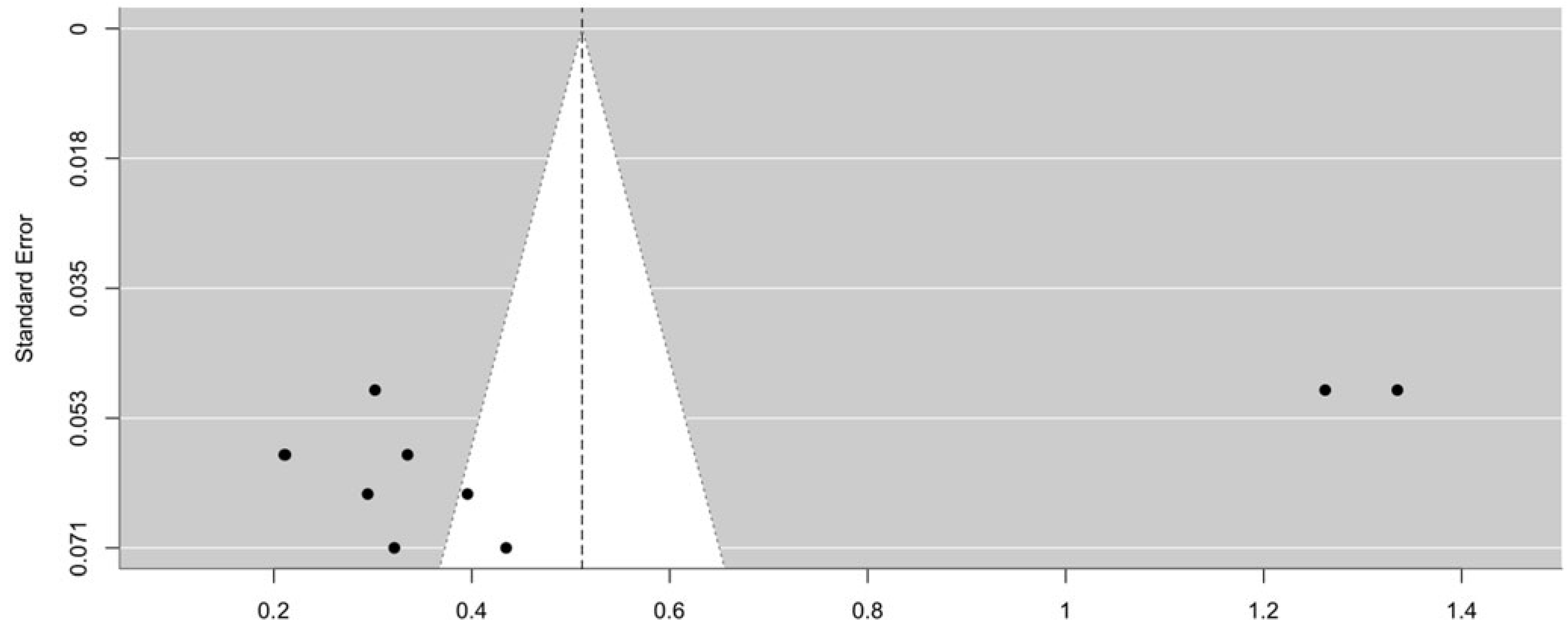 |
| Test for Funnel Plot Asymmetry: z = 1.89, p = 0.06 Limit Estimate: r = −0.350 (CI: −0.863, 0.518) | Test for Funnel Plot Asymmetry: z = −1.88, p = 0.06 Limit Estimate: r = 0.976 (CI: 0.400, 0.999) |
| Source credibility-Purchase intention | Customer engagement-Attitude |
 |  |
| Test for Funnel Plot Asymmetry: z = −0.638, p = 0.52 Limit Estimate: r = 0.708 (CI: 0.051, 0.937) | Test for Funnel Plot Asymmetry: z = −1.43, p = 0.15 Limit Estimate: r = 0.961 (CI: 0.341, 0.998) |
| Customer engagement-Purchase intention | Attitude-Purchase intention |
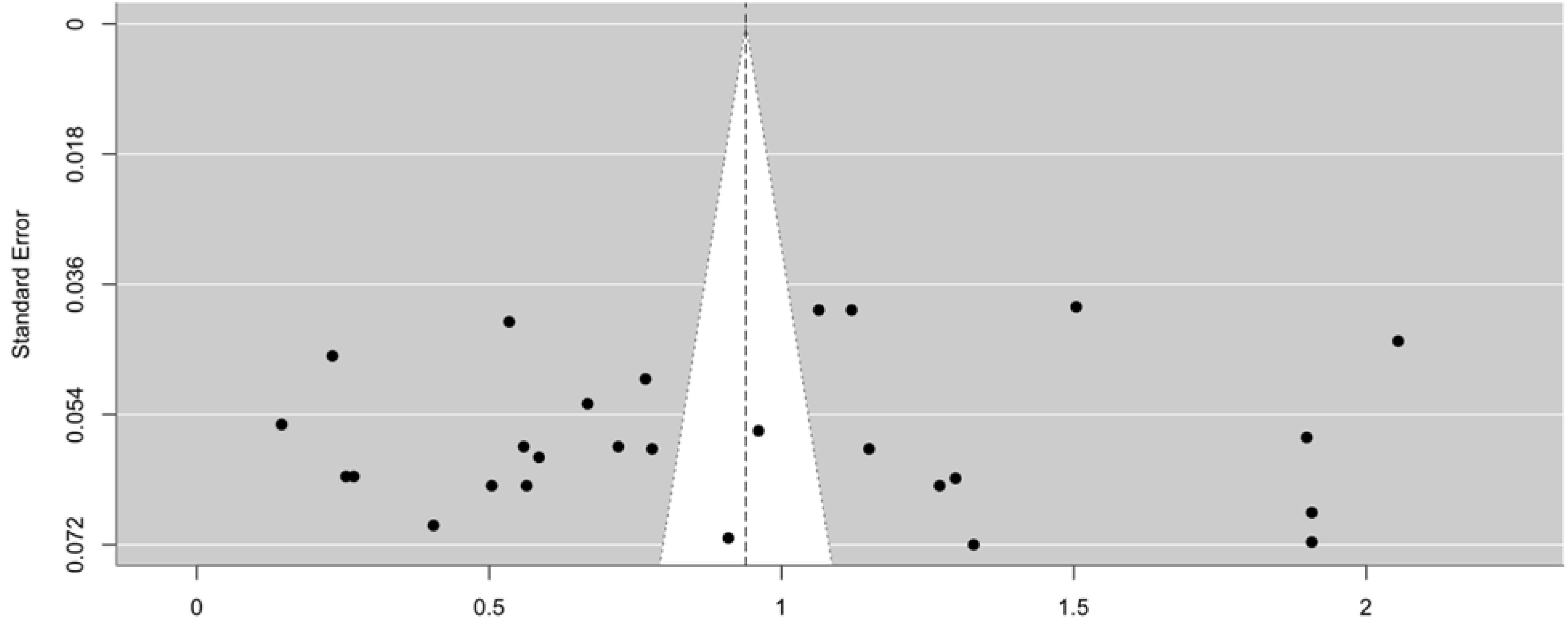 |  |
| Test for Funnel Plot Asymmetry: z = 0.023, p = 0.98 Limit Estimate: r = 0.728 (CI: −0.308, 0.974) | Test for Funnel Plot Asymmetry: z = −1.12, p = 0.26 Limit Estimate: r = 0.931 (CI: 0.412, 0.994) |
Appendix H
| With Outliers | Without Outliers | |||||
|---|---|---|---|---|---|---|
| Antecedents | k | N | rrcvw | k | N | r |
| Human-likeness-Source credibility | 29 | 10,810 | 0.43 *** | 29 | 10,810 | 0.43 *** |
| Human-likeness-Customer engagement | 5 | 2670 | 0.39 *** | 5 | 2670 | 0.39 *** |
| Human-likeness-Attitude | 12 | 3282 | 0.33 *** | 12 | 3282 | 0.33 *** |
| Human-likeness-Purchase intention | 32 | 10,858 | 0.55 *** | 31 | 10,570 | 0.50 *** |
| Source credibility-Customer engagement | 15 | 4402 | 0.48 *** | 15 | 4402 | 0.48 *** |
| Source credibility-Attitude | 10 | 3058 | 0.47 *** | 10 | 3058 | 0.47 *** |
| Source credibility-Purchase intention | 41 | 14,853 | 0.55 *** | 40 | 14,527 | 0.52 *** |
| Customer engagement-Attitude | 3 | 1208 | 0.67 *** | 3 | 1208 | 0.67 *** |
| Customer engagement-Purchase intention | 27 | 9191 | 0.74 *** | 27 | 9191 | 0.74 *** |
| Attitude-Purchase intention | 12 | 4213 | 0.75 *** | 12 | 4213 | 0.75 *** |
Appendix I


| Path | Model 1 | Model 2 | Model 3 | Model 4 | |
|---|---|---|---|---|---|
| Human-likeness → Source credibility | 0.43 *** | 0.43 *** | 0.43 *** | 0.43 *** | |
| Human-likeness → Customer engagement | 0.39 *** | — | 0.39 *** | — | |
| Human-likeness → Attitude | 0.33 *** | — | — | — | |
| Human-likeness → Purchase intention | 0.55 *** | — | — | 0.25 *** | |
| Source credibility → Customer engagement | — | 0.48 *** | — | 0.48 *** | |
| Source credibility → Attitude | — | 0.47 *** | 0.19 *** | 0.19 *** | |
| Source credibility → Purchase intention | — | 0.55 *** | — | 0.10 *** | |
| Customer engagement → Attitude | — | — | 0.58 *** | 0.58 *** | |
| Customer engagement → Purchase intention | — | — | — | 0.32 *** | |
| Attitude → Purchase intention | — | — | 0.74 *** | 0.43 *** | |
| Model Statistics | χ2 | 0 | 803.858 | 2336.25 | 217.961 |
| df | 0 | 03 | 5 | 2 | |
| RMSEA < 0.08 | 0 | 0.27 | 0.35 | 0.17 | |
| CFI > 0.90 | 1 | 0.92 | 0.75 | 0.98 | |
| SRMR < 0.08 | 0 | 0.10 | 0.17 | 0.07 | |
Appendix J
| Pairwise | Moderators | Raw p-Value | BH Critical Value |
|---|---|---|---|
| HL-PI | Experience vs. Search | 0.007 | 0.005 |
| Utilitarian vs. Hedonic | 0.014 | 0.009 | |
| Long-term/short-term orientation | 0.171 | 0.014 | |
| Consumer age | 0.313 | 0.018 | |
| Uncertainty avoidance | 0.559 | 0.023 | |
| Power distance | 0.575 | 0.027 | |
| Indulgence | 0.652 | 0.032 | |
| Government AI readiness | 0.701 | 0.036 | |
| Individualism/collectivism | 0.717 | 0.041 | |
| Follower size | 0.735 | 0.045 | |
| Motivation towards achievement and success | 0.770 | 0.05 | |
| SC-PI | Consumer age | 0.053 | 0.005 |
| Government AI readiness | 0.079 | 0.009 | |
| Motivation towards achievement and success | 0.084 | 0.014 | |
| Follower size | 0.178 | 0.018 | |
| Long-term/short-term orientation | 0.195 | 0.023 | |
| Individualism/collectivism | 0.213 | 0.027 | |
| Indulgence | 0.381 | 0.032 | |
| Uncertainty avoidance | 0.421 | 0.036 | |
| Utilitarian vs. Hedonic | 0.477 | 0.041 | |
| Experience vs. Search | 0.564 | 0.045 | |
| Power distance | 0.833 | 0.05 | |
| CE-PI | Uncertainty avoidance | 0.031 | 0.005 |
| Utilitarian vs. Hedonic | 0.194 | 0.009 | |
| Power distance | 0.395 | 0.014 | |
| Consumer age | 0.425 | 0.018 | |
| Follower size | 0.459 | 0.023 | |
| Experience vs. Search | 0.463 | 0.027 | |
| Indulgence | 0.672 | 0.032 | |
| Motivation towards achievement and success | 0.724 | 0.036 | |
| Long-term/short-term orientation | 0.731 | 0.041 | |
| Government AI readiness | 0.981 | 0.045 | |
| Individualism/collectivism | 0.992 | 0.05 | |
| ATT-PI | Long-term/short-term orientation | 0.332 | 0.005 |
| Indulgence | 0.411 | 0.009 | |
| Consumer age | 0.423 | 0.014 | |
| Uncertainty avoidance | 0.476 | 0.018 | |
| Individualism/collectivism | 0.566 | 0.023 | |
| Follower size | 0.630 | 0.027 | |
| Motivation towards achievement and success | 0.643 | 0.032 | |
| Power distance | 0.795 | 0.036 | |
| Government AI readiness | 0.858 | 0.041 | |
| Experience vs. Search | 0.946 | 0.045 | |
| Utilitarian vs. Hedonic | 0.953 | 0.05 |
References
- Morency, C. Meet Fashion’s First Computer-Generated Influencer. The Business of Fashion 2018. Available online: https://www.businessoffashion.com/articles/media/meeting-fashions-first-computer-generated-influencer-lil-miquela-sousa/ (accessed on 10 January 2026).
- Hwang, S.; Zhang, S.; Liu, X.; Srinivasan, K. Should Your Brand Hire a Virtual Influencer? Harvard Business Review 2024. Available online: https://hbr.org/2024/05/should-your-brand-hire-a-virtual-influencer (accessed on 10 January 2026).
- Dabiran, E.; Farivar, S.; Wang, F.; Grant, G. Virtually human: Anthropomorphism in virtual influencer marketing. J. Retail. Consum. Serv. 2024, 79, 103797. [Google Scholar] [CrossRef]
- Agnihotri, D.; Chaturvedi, P.; Tripathi, V. “Virtual bonds and actual transactions”: Investigating the impact of virtual influencers’ credibility on buying behavior through virtual engagement. J. Commun. Manag. 2024, 29, 35–52. [Google Scholar] [CrossRef]
- Kim, E.; Shoenberger, H.; Kim, D.; Thorson, E.; Zihang, E. Novelty vs. trust in virtual influencers: Exploring the effectiveness of human-like virtual influencers and anime-like virtual influencers. Int. J. Advert. 2025, 44, 453–483. [Google Scholar] [CrossRef]
- Jin, S.V. “To comply or to react, that is the question:” the roles of humanness versus eeriness of AI-powered virtual influencers, loneliness, and threats to human identities in AI-driven digital transformation. Comput. Hum. Behav. Artif. Hum. 2023, 1, 100011. [Google Scholar] [CrossRef]
- Jayasingh, S.; Sivakumar, A.; Vanathaiyan, A.A. Artificial Intelligence Influencers’ Credibility Effect on Consumer Engagement and Purchase Intention. J. Theor. Appl. Electron. Commer. Res. 2025, 20, 17. [Google Scholar] [CrossRef]
- Wang, S.X.; Xue, J.; Liu, M.T.; Loi, H.N. Social Media Presence Impacts AI Influencer’s Endorsement: An Empirical Evidence. In Marketing and Smart Technologies; Springer: Singapore, 2024; pp. 3–17. [Google Scholar]
- Choi, M.; Choi, Y.; Lee, H. Gen Z Travelers in the Instagram Marketplace: Trust, Influencer Type, Post Type, and Purchase Intention. J. Hosp. Tour. Res. 2024, 48, 1020–1034. [Google Scholar] [CrossRef]
- Dong, X.; Zhou, R.; Liao, J. Mega-influencer follower effect: The mediating role of sense of control in brand attitudes, purchase intentions and engagement. Eur. J. Mark. 2024. [Google Scholar] [CrossRef]
- Weismueller, J.; Harrigan, P.; Wang, S.; Soutar, G.N. Influencer Endorsements: How Advertising Disclosure and Source Credibility Affect Consumer Purchase Intention on Social Media. Australas. Mark. J. 2020, 28, 160–170. [Google Scholar] [CrossRef]
- Jin, M.; Xu, H.; Peng, H. The Moderating Role of Age in the Mechanism of the Impact of Social Presence on Purchase Intention in Live-Streaming Shopping. Int. J. Hum. Comput. Interact. 2025, 41, 3443–3454. [Google Scholar] [CrossRef]
- Rizzo, C.; Baima, G.; Janovská, K.; Bresciani, S. Navigating the uncertainty path of virtual influencers: Empirical evidence through a cultural lens. Technol. Forecast. Soc. Change 2025, 210, 123896. [Google Scholar] [CrossRef]
- Jin, J.; Lin, C.; Wang, F.; Xu, T.; Zhang, W. A study of cognitive effort involved in the framing effect of summary descriptions of online product reviews for search vs. experience products. Electron. Commer. Res. 2023, 23, 785–806. [Google Scholar] [CrossRef]
- Ali, S.; Ullah, H.; Akbar, M.; Akhtar, W.; Zahid, H. Determinants of Consumer Intentions to Purchase Energy-Saving Household Products in Pakistan. Sustainability 2019, 11, 1462. [Google Scholar] [CrossRef]
- Cruz-Cárdenas, J.; Guadalupe-Lanas, J.; Ramos-Galarza, C.; Palacio-Fierro, A. Drivers of technology readiness and motivations for consumption in explaining the tendency of consumers to use technology-based services. J. Bus. Res. 2021, 122, 217–225. [Google Scholar] [CrossRef]
- Sharma, N.; Kumar, A. The Past, Present, and Future of Virtual Influencer Marketing. Int. J. Consum. Stud. 2026, 50, e70194. [Google Scholar] [CrossRef]
- Morales-Muñoz, A.; Iniesta-Bonillo, M.Á.; Estrella-Ramón, A.; Herrada-Lores, S. Artificial Intelligence and Consumer Behaviour in Social Media: Systematic Literature Review and Future Research Agenda. Int. J. Consum. Stud. 2026, 50, e70173. [Google Scholar] [CrossRef]
- Khalfallah, D.; Keller, V. Authenticity, ethics, and transparency in virtual influencer marketing: A cross-cultural analysis of consumer trust and engagement: A systematic literature review. Acta Psychol. 2025, 260, 105573. [Google Scholar] [CrossRef]
- Tian, M.; Hu, H.; Chen, M. Virtual influencers in interactive marketing: A state-of-art review and future research directions. J. Res. Interact. Mark. 2025, 1–18. [Google Scholar] [CrossRef]
- Barari, M.M.; Eisend, M.; Jain, S.P. A meta-analysis of the effectiveness of social media influencers: Mechanisms and moderation. J. Acad. Mark. Sci. 2026, 54, 28–48. [Google Scholar] [CrossRef]
- Pushparaj, P.; Kushwaha, P.B. Social Media Influencer Marketing: A Systematic Literature Review Using TCM and ADO Framework. Int. J. Consum. Stud. 2024, 48, e13098. [Google Scholar] [CrossRef]
- Laszkiewicz, A.; Kalinska-Kula, M. Virtual influencers as an emerging marketing theory: A systematic literature review. Int. J. Consum. Stud. 2023, 47, 2479–2494. [Google Scholar] [CrossRef]
- Shah, T.R.; Purohit, S.; Das, M.; Arulsivakumar, T. Do I look real? Impact of digital human avatar influencer realism on consumer engagement and attachment. J. Consum. Mark. 2025, 42, 416–430. [Google Scholar] [CrossRef]
- Nass, C.; Steuer, J.; Tauber, E.R. Computers are social actors. In Proceedings of the SIGCHI Conference on Human Factors in Computing Systems, Boston, MA, USA, 24–28 April 1994; ACM: New York, NY, USA, 1994; pp. 72–78. [Google Scholar]
- Mehrabian, A.; Russell, J.A. An Approach to Environmental Psychology; The MIT Press: Cambridge, MA, USA, 1974. [Google Scholar]
- Jiang, K.; Qin, M.; Deng, D.; Zhou, D. Smile or Not Smile: The Effect of Virtual Influencers’ Emotional Expression on Brand Authenticity, Purchase Intention and Follow Intention. J. Consum. Behav. 2025, 24, 962–981. [Google Scholar] [CrossRef]
- Um, N. Predictors Affecting Effects of Virtual Influencer Advertising among College Students. Sustainability 2023, 15, 6388. [Google Scholar] [CrossRef]
- Pan, S.; Qin, Z.; Zhang, Y. More Realistic, More Better? How Anthropomorphic Images of Virtual Influencers Impact the Purchase Intentions of Consumers. J. Theor. Appl. Electron. Commer. Res. 2024, 19, 3229–3252. [Google Scholar] [CrossRef]
- Shen, Z. Interactive or not? Enhancing the interactive effectiveness of virtual brand ambassadors on consumer behavior. Asia Pac. J. Mark. Logist. 2025, 37, 2481–2499. [Google Scholar] [CrossRef]
- Kim, I.; Ki, C.-W.; Lee, H.; Kim, Y.-K. Virtual influencer marketing: Evaluating the influence of virtual influencers’ form realism and behavioral realism on consumer ambivalence and marketing performance. J. Bus. Res. 2024, 176, 114611. [Google Scholar] [CrossRef]
- Ohanian, R. Construction and Validation of a Scale to Measure Celebrity Endorsers’ Perceived Expertise, Trustworthiness, and Attractiveness. J. Advert. 1990, 19, 39–52. [Google Scholar] [CrossRef]
- Garg, M.; Bakshi, A. Exploring the impact of beauty vloggers’ credible attributes, parasocial interaction, and trust on consumer purchase intention in influencer marketing. Humanit. Soc. Sci. Commun. 2024, 11, 235. [Google Scholar] [CrossRef]
- Wellman, M.L. “A friend who knows what they’re talking about”: Extending source credibility theory to analyze the wellness influencer industry on Instagram. N. Media Soc. 2024, 26, 7020–7036. [Google Scholar] [CrossRef]
- Belch, G.E.; Belch, M.A. Advertising and Promotion: An Integrated Marketing Communications Perspective; Mcgraw-Hill: Columbus, OH, USA, 2018. [Google Scholar]
- Munnukka, J.; Uusitalo, O.; Toivonen, H. Credibility of a peer endorser and advertising effectiveness. J. Consum. Mark. 2016, 33, 182–192. [Google Scholar] [CrossRef]
- Stein, J.-P.; Linda Breves, P.; Anders, N. Parasocial interactions with real and virtual influencers: The role of perceived similarity and human-likeness. N. Media Soc. 2024, 26, 3433–3453. [Google Scholar] [CrossRef]
- Kim, J.; Bae, J. The influences of aura and anthropomorphism of virtual humans on perceived interactivity and purchase intention. J. Glob. Sch. Mark. Sci. 2025, 35, 162–179. [Google Scholar] [CrossRef]
- Chiu, C.L.; Ho, H.-C. Impact of Celebrity, Micro-Celebrity, and Virtual Influencers on Chinese Gen Z’s Purchase Intention Through Social Media. Sage Open 2023, 13, 21582440231164034. [Google Scholar] [CrossRef]
- Zhang, Y.; He, J.; Li, J. The role of flow experience in virtual influencer marketing: Insights into aesthetic, entertainment and parasocial influences on purchase intention. J. Fash. Mark. Manag. 2025, 29, 1109–1129. [Google Scholar] [CrossRef]
- Wang, C. Analysis of AI virtual influencer marketing strategy based on AISAS model—Taking Liu Yexi as an example. In Proceedings of the 2024 5th International Conference on Computer Science and Management Technology, Xiamen, Chian, 18–20 October 2024; pp. 611–616. [Google Scholar]
- Zourrig, H.; Park, J.; Becheur, I. How Does Humanoid Virtual Influencers’ Appearance Convey Social Presence? The Underlying Process and Path to Purchase Intention. Int. J. Consum. Stud. 2025, 49, e70013. [Google Scholar] [CrossRef]
- Lee, J.; Lim, Y.-s. What, Was She Not Human? The Mediated Effects of Virtual Influencers’ Identity Disclosure Timing on Behavioral Intentions: Focusing on the Moderating Role of Influencer-Brand Fit. Int. J. Hum. Comput. Interact. 2025, 41, 8036–8046. [Google Scholar] [CrossRef]
- Na, Y.; Kim, Y.; Lee, D. Investigating the Effect of Self-Congruity on Attitudes toward Virtual Influencers: Mediating the Effect of Emotional Attachment. Int. J. Hum. Comput. Interact. 2024, 40, 5534–5547. [Google Scholar] [CrossRef]
- Baudier, P.; de Boissieu, E. Are social media robot influencers credible? A cross-continental analysis in a fashion context. Comput. Hum. Behav. 2025, 162, 108447. [Google Scholar] [CrossRef]
- Suh, S.Y. The impact of human-likeness on users’ perceptions of virtual influencers as advertising endorsers. Commun. Res. Rep. 2025, 42, 58–67. [Google Scholar] [CrossRef]
- Haenlein, M.; Libai, B. Seeding, Referral, and Recommendation:Creating Profitable Word-of-Mouth Programs. Calif. Manag. Rev. 2017, 59, 68–91. [Google Scholar] [CrossRef]
- Conde, R.; Casais, B. Micro, macro and mega-influencers on instagram: The power of persuasion via the parasocial relationship. J. Bus. Res. 2023, 158, 113708. [Google Scholar] [CrossRef]
- Kay, S.; Mulcahy, R.; Parkinson, J. When less is more: The impact of macro and micro social media influencers’ disclosure. J. Mark. Manag. 2020, 36, 248–278. [Google Scholar] [CrossRef]
- Campbell, C.; Farrell, J.R. More than meets the eye: The functional components underlying influencer marketing. Bus. Horiz. 2020, 63, 469–479. [Google Scholar] [CrossRef]
- Yadav, J.; Misra, M.; Rana, N.P.; Singh, K. Exploring the synergy between nano-influencers and sports community: Behavior mapping through machine learning. Inf. Technol. People 2021, 35, 1829–1854. [Google Scholar] [CrossRef]
- van Reijmersdal, E.A.; Aguiar, T.D.; van Noort, G. How Is Influencer Follower Size Related to Brand Responses? J. Advert. Res. 2024, 64, 451–464. [Google Scholar] [CrossRef]
- Park, J.; Lee, J.M.; Xiong, V.Y.; Septianto, F.; Seo, Y. David and Goliath: When and Why Micro-Influencers Are More Persuasive Than Mega-Influencers. J. Advert. 2021, 50, 584–602. [Google Scholar] [CrossRef]
- Nelson, P. Information and consumer behavior. J. Political Econ. 1970, 78, 311–329. [Google Scholar] [CrossRef]
- Yang, Q.; Liu, S.; Li, Y.; Kang, H. A Matching Study on the Influence of Advertised Information Expression and Product Type on Consumer Purchase Intention. Front. Psychol. 2022, 13, 859959. [Google Scholar] [CrossRef]
- Liu, Z.; Lei, S.-H.; Guo, Y.-L.; Zhou, Z.-A. The interaction effect of online review language style and product type on consumers’ purchase intentions. Palgrave Commun. 2020, 6, 11. [Google Scholar] [CrossRef]
- Batra, R.; Ahtola, O.T. Measuring the hedonic and utilitarian sources of consumer attitudes. Mark. Lett. 1991, 2, 159–170. [Google Scholar] [CrossRef]
- Chiu, C.-M.; Wang, E.T.G.; Fang, Y.-H.; Huang, H.-Y. Understanding customers’ repeat purchase intentions in B2C e-commerce: The roles of utilitarian value, hedonic value and perceived risk. Inf. Syst. J. 2014, 24, 85–114. [Google Scholar] [CrossRef]
- Chang, Y.-W.; Hsu, P.-Y.; Chen, J.; Shiau, W.-L.; Xu, N. Utilitarian and/or hedonic shopping—Consumer motivation to purchase in smart stores. Ind. Manag. Data Syst. 2023, 123, 821–842. [Google Scholar] [CrossRef]
- Bui, H.T. Exploring and explaining older consumers’ behaviour in the boom of social media. Int. J. Consum. Stud. 2022, 46, 601–620. [Google Scholar] [CrossRef]
- Zhou, R.; Baskaran, A. Influencing mechanisms of live streaming influencer characteristics on purchase intention: The mediating role of emotional trust. PLoS ONE 2025, 20, e0322294. [Google Scholar] [CrossRef]
- Lin, Q.; Ng, S.I.; Kamal Basha, N.; Luo, X.; Li, Y. Impact of virtual influencers on customer engagement of Generation Z consumers: A presence perspective. In Young Consumers: Insight and Ideas for Responsible Marketers; Emerald Publishing Limited: Leeds, UK, 2024; Volume 25, pp. 851–868. [Google Scholar] [CrossRef]
- Jhawar, A.; Kumar, P.; Varshney, S. The emergence of virtual influencers: A shift in the influencer marketing paradigm. Young Consum. 2023, 24, 468–484. [Google Scholar] [CrossRef]
- Hofstede, G.; Bond, M.H. Hofstede’s Culture Dimensions:An Independent Validation Using Rokeach’s Value Survey. J. Cross-Cult. Psychol. 1984, 15, 417–433. [Google Scholar] [CrossRef]
- Kitirattarkarn, G.P.; Araujo, T.; Neijens, P. Challenging Traditional Culture? How Personal and National Collectivism-Individualism Moderates the Effects of Content Characteristics and Social Relationships on Consumer Engagement with Brand-Related User-Generated Content. J. Advert. 2019, 48, 197–214. [Google Scholar] [CrossRef]
- Leonhardt, J.M.; Pezzuti, T.; Namkoong, J.-E. We’re not so different: Collectivism increases perceived homophily, trust, and seeking user-generated product information. J. Bus. Res. 2020, 112, 160–169. [Google Scholar] [CrossRef]
- Yin, X.; Wang, H.; Xia, Q.; Gu, Q. How Social Interaction Affects Purchase Intention in Social Commerce: A Cultural Perspective. Sustainability 2019, 11, 2423. [Google Scholar] [CrossRef]
- Peña-García, N.; Gil-Saura, I.; Rodríguez-Orejuela, A.; Siqueira-Junior, J.R. Purchase intention and purchase behavior online: A cross-cultural approach. Heliyon 2020, 6, e04284. [Google Scholar] [CrossRef]
- Kikumori, M.; Maruyama, Y.; Ishii, R. Influencers’ Follower Numbers, Consumers’ Cultural Value Orientation, and Purchase Intention: Evidence from Japan, the United Kingdom, and Singapore. J. Int. Consum. Mark. 2025, 37, 350–361. [Google Scholar] [CrossRef]
- Lin, H.-C.; Swarna, H.; Bruning, P.F. Taking a global view on brand post popularity: Six social media brand post practices for global markets. Bus. Horiz. 2017, 60, 621–633. [Google Scholar] [CrossRef]
- Huang, S.; Crotts, J. Relationships between Hofstede’s cultural dimensions and tourist satisfaction: A cross-country cross-sample examination. Tour. Manag. 2019, 72, 232–241. [Google Scholar] [CrossRef]
- Liu, F.; Wang, R. Fostering Parasocial Relationships with Virtual Influencers in the Uncanny Valley: Anthropomorphism, Autonomy, and a Multigroup Comparison. J. Bus. Res. 2025, 186, 115024. [Google Scholar] [CrossRef]
- Gao, W.; Jiang, N.; Guo, Q. How cool virtual streamer influences customer in live-streaming commerce? An explanation of stereotype content model. J. Retail. Consum. Serv. 2025, 82, 104139. [Google Scholar] [CrossRef]
- Nettel, P.F.; Emma, H.; Richard, S.; Giulia, C.; Gonzalo, G.; Sulamaan, R.; Eddie, C. Government Al Readiness Index 2024. 2024. Available online: https://oxfordinsights.com/wp-content/uploads/2024/12/2024-Government-AI-Readiness-Index-2.pdf (accessed on 30 March 2026).
- Page, M.J.; McKenzie, J.E.; Bossuyt, P.M.; Boutron, I.; Hoffmann, T.C.; Mulrow, C.D.; Shamseer, L.; Tetzlaff, J.M.; Akl, E.A.; Brennan, S.E.; et al. The PRISMA 2020 statement: An updated guideline for reporting systematic reviews. BMJ 2021, 372, n71. [Google Scholar] [CrossRef]
- Lipsey, M.W.; Wilson, D.B. Practical Meta-Analysis; Sage Publications, Inc: Thousand Oaks, CA, US, 2001; p. ix, 247. [Google Scholar]
- Hunter, J.E.; Schmidt, F.L. Methods of Meta-Analysis: Correcting Error and Bias in Research Findings; Sage: Thousand Oaks, CA, USA, 2004. [Google Scholar]
- Rosenthal, R. The file drawer problem and tolerance for null results. Psychol. Bull. 1979, 86, 638–641. [Google Scholar] [CrossRef]
- Steel, P.; Beugelsdijk, S.; Aguinis, H. The anatomy of an award-winning meta-analysis: Recommendations for authors, reviewers, and readers of meta-analytic reviews. J. Int. Bus. Stud. 2021, 52, 23–44. [Google Scholar] [CrossRef]
- Grewal, D.; Puccinelli, N.; Monroe, K.B. Meta-analysis: Integrating accumulated knowledge. J. Acad. Mark. Sci. 2018, 46, 9–30. [Google Scholar] [CrossRef]
- Hair, J.F.; Black, W.C.; Babin, B.J.; Anderson, R.E.; Tatham, R.L. Multivariate Data Analysis, 7th ed.; Pearson: Hoboken, NJ, USA, 2010. [Google Scholar]
- Monacis, L.; Palo, V.d.; Griffiths, M.D.; Sinatra, M. Validation of the internet gaming disorder scale–short-form (IGDS9-SF) in an Italian-speaking sample. J. Behav. Addict. 2016, 5, 683–690. [Google Scholar] [CrossRef] [PubMed]
- Kenny, D.A.; Kaniskan, B.; McCoach, D.B. The Performance of RMSEA in Models With Small Degrees of Freedom. Sociol. Methods Res. 2015, 44, 486–507. [Google Scholar] [CrossRef]
- Pan, M.; Blut, M.; Ghiassaleh, A.; Lee, Z.W.Y. Influencer marketing effectiveness: A meta-analytic review. J. Acad. Mark. Sci. 2025, 53, 52–78. [Google Scholar] [CrossRef]
- Horstmeier, C.A.L.; Boer, D.; Homan, A.C.; Voelpel, S.C. The Differential Effects of Transformational Leadership on Multiple Identifications at Work: A Meta-analytic Model. Br. J. Manag. 2017, 28, 280–298. [Google Scholar] [CrossRef]
- Maricuțoiu, L.P.; Sulea, C.; Iancu, A. Work engagement or burnout: Which comes first? A meta-analysis of longitudinal evidence. Burn. Res. 2017, 5, 35–43. [Google Scholar] [CrossRef]
- Fiske, S.T.; Cuddy, A.J.C.; Glick, P.; Xu, J. A model of (often mixed) stereotype content: Competence and warmth respectively follow from perceived status and competition. J. Personal. Soc. Psychol. 2002, 82, 878–902. [Google Scholar] [CrossRef]
- Lou, C.; Kiew, S.T.J.; Chen, T.; Lee, T.Y.M.; Ong, J.E.C.; Phua, Z. Authentically fake? How consumers respond to the influence of virtual influencers. J. Advert. 2023, 52, 540–557. [Google Scholar] [CrossRef]
- Looi, J.; Kahlor, L.A. Artificial Intelligence in Influencer Marketing: A Mixed-Method Comparison of Human and Virtual Influencers on Instagram. J. Interact. Advert. 2024, 24, 107–126. [Google Scholar] [CrossRef]
- Franco, P. Older consumers and technology: A critical systematic literature review. AMS Rev. 2023, 13, 92–121. [Google Scholar] [CrossRef]
- Benson, V.; Ezingeard, J.-N.; Hand, C. An empirical study of purchase behaviour on social platforms: The role of risk, beliefs and characteristics. Inf. Technol. People 2018, 32, 876–896. [Google Scholar] [CrossRef]
- Muhammad, I.S.; Muhammad, H.; Sajjad, A.B.; Muhammad, N. The Moderating Role of Uncertainty Avoidance on Consumer Brand Engagement and Band Loyalty in Virtual Brand Communities. E3S Web Conf. 2023, 409, 06016. [Google Scholar] [CrossRef]
- Al-Hattami, H.M.; Abdullah, A.A.H.; Al-Okaily, M.; Al-Adwan, A.S.; Al-Hakimi, M.A.; Haidar, F.T. Determinants of interaction intention to purchase online in less developed countries: The moderating role of technology infrastructure. Cogent Soc. Sci. 2023, 9, 2213918. [Google Scholar] [CrossRef]
- Shah, S.K.; Tariq, Z.; Lee, J.; Lee, Y. Event-Driven Deep Learning for Edge Intelligence (EDL-EI). Sensors 2021, 21, 6023. [Google Scholar] [CrossRef]
- Goel, P.; Garg, A. Virtual personalities, real bonds: Anthropomorphised virtual influencers’ impact on trust and engagement. J. Consum. Mark. 2025, 42, 431–447. [Google Scholar] [CrossRef]
- Kim, E.; Xie, Q.; Hong, J.-W.; Kim, H.M. Prosocial Campaigns With Virtual Influencers: Stories, Messages, and Beyond. Int. J. Hum. Comput. Interact. 2025, 41, 6956–6967. [Google Scholar] [CrossRef]
- Chung, J.; Ding, Y.; Kalra, A. I Really Know You: How Influencers Can Increase Audience Engagement by Referencing Their Close Social Ties. J. Consum. Res. 2023, 50, 683–703. [Google Scholar] [CrossRef]
- Wang, X.; Zhang, Y. Product-independent or product-dependent: The impact of virtual influencers’ primed identity on purchase intention. J. Retail. Consum. Serv. 2025, 84, 104088. [Google Scholar] [CrossRef]
- Kim, H.; Jeon, G.; Chung, J.Y. Understanding the Role of Follower Size in Influencer Marketing: Examining the Perspective of Source Credibility and Attribution Theory. J. Curr. Issues Res. Advert. 2024, 45, 320–338. [Google Scholar] [CrossRef]
- Celik, F.; Koc, E.; Yildiz, S.Y.; Tarim, E.; Daryanto, A. Exploring the potential of the pratfall effect in travel influencer marketing. J. Hosp. Tour. Manag. 2026, 66, 101388. [Google Scholar] [CrossRef]
- Pritschet, L.; Powell, D.; Horne, Z. Marginally Significant Effects as Evidence for Hypotheses:Changing Attitudes Over Four Decades. Psychol. Sci. 2016, 27, 1036–1042. [Google Scholar] [CrossRef]
- Feng, Y.; Chen, H.; Xie, Q. AI Influencers in Advertising: The Role of AI Influencer-Related Attributes in Shaping Consumer Attitudes, Consumer Trust, and Perceived Influencer–Product Fit. J. Interact. Advert. 2024, 24, 26–47. [Google Scholar] [CrossRef]
- Huang, C.; Song, T.; Wang, H. Alone or Mixed? The Effect of Digital Human Narrative Scenarios on Chinese Consumer Eco-Product Purchase Intention. J. Theor. Appl. Electron. Commer. Res. 2024, 19, 1734–1755. [Google Scholar] [CrossRef]
- Claudya, W.; Gabriella, E.; Muhammad Izdihar, A.; Amalia, E.M. Anthropomorphism And Authenticity Exploring The Dynamics Of Virtual Influencers In Contemporary Marketing. Int. J. Bus. Soc. 2024, 25, 789–809. [Google Scholar] [CrossRef]
- Yang, J.; Chuenterawong, P.; Lee, H.; Chock, T.M. Anthropomorphism in CSR Endorsement: A Comparative Study on Humanlike vs. Cartoonlike Virtual Influencers’ Climate Change Messaging. J. Promot. Manag. 2023, 29, 705–734. [Google Scholar] [CrossRef]
- Muniz, F.; Stewart, K.; Magalhães, L. Are they humans or are they robots? The effect of virtual influencer disclosure on brand trust. J. Consum. Behav. 2024, 23, 1234–1250. [Google Scholar] [CrossRef]
- Lee, C.T.; Shen, Y.-C. Artificial humanity: A multi-method exploration of user responses to AI influencer affordances in short video platform. Telemat. Inform. 2025, 98, 102245. [Google Scholar] [CrossRef]
- Rehman, A.U.; Hassan, S.H.; Behera, R.K. Attractiveness vs similarity: How attributes of AI-based virtual influencers impact credibility, parasocial interaction and purchase intentions of social-media users. Asia Pac. J. Mark. Logist. 2025, 38, 205–222. [Google Scholar] [CrossRef]
- Wee, J.; Yoon, N.; Lee, Y.-J. Beyond Visual Realism-Understanding the Role of Verbal Cues in Generating Consumer Affinity vs. Fear toward Virtual Influencers in Social Network Advertising. J. Korean Soc. Cloth. Text. 2024, 48, 1194–1210. [Google Scholar] [CrossRef]
- Kim, J.; Kim, M. Building connections with virtual influencers: The role of friendship and psychological well-being in driving social media engagement and purchase intention. Mark. Intell. Plan. 2025, 44, 22–42. [Google Scholar] [CrossRef]
- Al Masri, Y.; Hamadneh, S.; Al-Dmour, R.; Al-Okaily, M. Can Computer Virtual Influencers Replace Human Influencers in the Future? An Empirical Investigation in the Age of Digital Transformation. Jordan J. Bus. Adm. 2023, 19, 498–513. [Google Scholar] [CrossRef]
- Yu, T.; Teoh, A.P.; Bian, Q.; Liao, J.; Wang, C. Can virtual influencers affect purchase intentions in tourism and hospitality e-commerce live streaming? An empirical study in China. Int. J. Contemp. Hosp. Manag. 2024, 37, 216–238. [Google Scholar] [CrossRef]
- Chan, K.W.; Septianto, F.; Kwon, J.; Kamal, R.S. Color effects on AI influencers’ product recommendations. Eur. J. Mark. 2023, 57, 2290–2315. [Google Scholar] [CrossRef]
- Xiaolu, S.; Fernandez, D. Consumer Perception of Virtual Influencers: A Study on Trust, Engagement, and Purchase Intention among Gen Z. Int. J. Acad. Res. Bus. Soc. Sci. 2025, 15, 369–384. [Google Scholar] [CrossRef]
- Märlegård, H.; Raflund, J. Conveyed by Artificial Authenticity? The Impact of Virtual Influencers on Brand Trust-A Quantitative Study on Consumer Perceptions. Master’s Thesis, University of Gothenburg, Gothenburg, Sweden, 2024. [Google Scholar]
- Cornelius, S.; Leidner, D.; Benbya, H. Credibility of virtual influencers: The role of design stimuli, knowledge cues, and user disposition. In Proceedings of the 56th Hawaii International Conference on System Sciences, Maui, HI, USA, 3–6 January 2023. [Google Scholar]
- Mohamed Jasim, K.; Sulphey, M.M. Do Virtual Influencers’ Endorsements Impact Purchase Intention at Restaurants: An Examination Using Symmetric and Asymmetric Approaches. Int. J. Hosp. Tour. Adm. 2025, 1–31. [Google Scholar] [CrossRef]
- Brahmana, R.K.; Kontesa, M. Does self-congruity matter for virtual influencer’s non-fungible token (NFT) purchase intentions? The role of financial literacy. Inf. Technol. People 2025, 39, 615–634. [Google Scholar] [CrossRef]
- Zaharia, S.; Asici, J. Exploring the Impact of Virtual Influencers on Social Media User’s Purchase Intention in Germany: An Empirical Study; Springer: Cham, Switzerland, 2024; pp. 108–126. [Google Scholar]
- Yap, Y.R.; Ismail, N. Factors of virtual influencer marketing influencing Generation Y consumers’ purchase intention in Malaysia. Int. J. Internet Mark. Advert. 2022, 17, 437–458. [Google Scholar] [CrossRef]
- Almasri, Y. Fashion Virtual Influencers: Antecedents Influencing Females’ Behavioral Intentions in Jordan. Dirasat Hum. Soc. Sci. 2023, 50, 390–402. [Google Scholar] [CrossRef]
- Jiang, K.; Zheng, J.; Luo, S. Green power of virtual influencer: The role of virtual influencer image, emotional appeal, and product involvement. J. Retail. Consum. Serv. 2024, 77, 103660. [Google Scholar] [CrossRef]
- Yoo, J.W.; Park, J.; Park, H. How can I trust you if you’re fake? Understanding human-like virtual influencer credibility and the role of textual social cues. J. Res. Interact. Mark. 2024, 19, 730–748. [Google Scholar] [CrossRef]
- Duong, B.-T.; Le, D.M.T.; Nguyen, T.T.T.; Nguyen, V.A. Investigating the effectiveness of virtual influencers with regard to fostering customer purchasing intention: An empirical study in Ho Chi Minh City. J. Glob. Bus. Adv. 2023, 16, 690–711. [Google Scholar] [CrossRef]
- Iqbal, A. Investigating the Influence of Trust, Attractiveness, Perceived Expertise, and Perceived Credibility on Attitude Toward the Influencer: The Mediating Role of Attitude Toward the Influencer and Moderating Role and Perceived Risks. KASBIT Bus. J. 2023, 16, 41–60. [Google Scholar]
- Kumar, A.; Shankar, A. Investigating the role of metaverse influencers’ attributes for the next generation of services. J. Serv. Mark. 2024, 38, 816–838. [Google Scholar] [CrossRef]
- Dondapati, A. Maximizing the Consumer Connection: Avatars, Emotions, and Effective Virtual Influencer Advertising. Rev. Mark. Sci. 2025, 23, 117–137. [Google Scholar] [CrossRef]
- Vo, T.-H.; Wei-Han Tan, G.; Pham, N.T.; Truong, T.H.-D.; Ooi, K.-B. Promoting Customer Engagement and Brand Loyalty on Social Media: The Role of Virtual Influencers. Int. J. Consum. Stud. 2025, 49, e70028. [Google Scholar] [CrossRef]
- Xie, J.; Wu, H.; Li, Z.; Ma, L.; Liu, K. Research on the influence of digital human avatar characteristics on brand fans effect. Asia Pac. J. Mark. Logist. 2024, 37, 422–440. [Google Scholar] [CrossRef]
- Park, S.; Wei, X.; Lee, H. Revisiting the elaboration likelihood model in the context of a virtual influencer: A comparison between high- and low-involvement products. J. Consum. Behav. 2024, 23, 1638–1652. [Google Scholar] [CrossRef]
- Cornelius, S.; Leidner, D.; Bina, S. Significance of Visual Realism–Eeriness, Credibility, and Persuasiveness of Virtual Influencers. In Proceedings of the 56th Hawaii International Conference on System Sciences, Maui, HI, USA, 3–6 January 2023. [Google Scholar]
- Li, S.; Ham, J.; Eastin, M.S. Social media users’ affective, attitudinal, and behavioral responses to virtual human emotions. Telemat. Inform. 2024, 87, 102084. [Google Scholar] [CrossRef]
- El Hedhli, K.; Zourrig, H.; Al Khateeb, A.; Alnawas, I. Stereotyping human-like virtual influencers in retailing: Does warmth prevail over competence? J. Retail. Consum. Serv. 2023, 75, 103459. [Google Scholar] [CrossRef]
- Ham, J.; Li, S.; Shah, P.; Eastin, M.S. The “Mixed” Reality of Virtual Brand Endorsers: Understanding the Effect of Brand Engagement and Social Cues on Technological Perceptions and Advertising Effectiveness. J. Interact. Advert. 2023, 23, 98–113. [Google Scholar] [CrossRef]
- Huang, Y.; Suo, L. The Effect of Virtual Endorsers on Chinese Consumer’s Brand Attitude. Thammasat Rev. 2023, 26, 92–113. [Google Scholar]
- Putra, H.P. The Effect of Virtual Influencer Attractiveness Towards Consumer Attitudes in Developing Purchase Intentions—A Case Study of Richeese Factory’s Virtual Brand Ambassador. Master’s Thesis, The Bandung Institute of Technology, 2025. [Google Scholar]
- Hao, J.W.; Yang, S.B.; Yoon, S.H. The Effects of Trust and Attachment to Hyper-Realistic Virtual Influencers on Behavioral Intentions: Based on the Trust-Building Model. J. Inf. Syst. 2022, 31, 75–100. [Google Scholar]
- Jang, H. The Impact of the Humanness of AI Influencers on the Success of Influencer Marketing. Master’s Thesis, The University of Texas at Austin, 2022. [Google Scholar]
- Shin, H.; Yum, M. The Impact of Virtual Influencers’ Characteristics on Purchase Intentions Toward Fashion Products: Focusing on the Mediating Effect of Mimetic Desire. Korean Fash. Text. Res. J. 2024, 26, 1–14. [Google Scholar]
- Huang, Q.-Q.; Qu, H.-J.; Li, P. The Influence of Virtual Idol Characteristics on Consumers’ Clothing Purchase Intention. Sustainability 2022, 14, 8964. [Google Scholar] [CrossRef]
- Park, S.; Sung, Y. The Interplay Between Human Likeness and Agency on Virtual Influencer Credibility. Cyberpsychology Behav. Soc. Netw. 2023, 26, 764–771. [Google Scholar] [CrossRef]
- Kim, E.; Kim, D.; Zihang, E.; Shoenberger, H. The next hype in social media advertising: Examining virtual influencers’ brand endorsement effectiveness. Front. Psychol. 2023, 14, 1089051. [Google Scholar] [CrossRef] [PubMed]
- Wang, X.; Qiu, X. The positive effect of artificial intelligence technology transparency on digital endorsers: Based on the theory of mind perception. J. Retail. Consum. Serv. 2024, 78, 103777. [Google Scholar] [CrossRef]
- Rungruangjit, W.; Mongkol, K.; Piriyakul, I.; Charoenpornpanichkul, K. The power of human-like virtual-influencer-generated content: Impact on consumers’ willingness to follow and purchase intentions. Comput. Hum. Behav. Rep. 2024, 16, 100523. [Google Scholar] [CrossRef]
- Wan, C.; Lee, D.; Ng, P. The role of anthropomorphism and racial homophily of virtual influencers in encouraging low- versus high-cost pro-environmental behaviors. Psychol Mark 2024, 41, 1833–1853. [Google Scholar] [CrossRef]
- Jha, S.; Chaudhary, R.; Shukla, B. Trust dynamics of virtual influencers: Exploring their influence on fashion purchase decisions. Innov. Mark. 2025, 21, 226. [Google Scholar] [CrossRef]
- Chaihanchanchai, P.; Anantachart, S.; Ruangthanakorn, N. Unlocking the persuasive power of virtual influencer on brand trust and purchase intention: A parallel mediation of source credibility. J. Mark. Commun. 2024, 32, 17–39. [Google Scholar] [CrossRef]
- Kim, J.; Kim, M.; Lee, S.-M. Unlocking Trust Dynamics: An Exploration of Playfulness, Expertise, and Consumer Behavior in Virtual Influencer Marketing. Int. J. Hum. Comput. Interact. 2025, 41, 378–390. [Google Scholar] [CrossRef]
- Ham, J.; Li, S.; Looi, J.; Eastin, M.S. Virtual humans as social actors: Investigating user perceptions of virtual humans’ emotional expression on social media. Comput. Hum. Behav. 2024, 155, 108161. [Google Scholar] [CrossRef]
- Yu, Y.; Bannasilp, A.; Kwong, S.C.M. Virtual Idols’ influence on Consumer’s brand attitude and purchase intention: A perspective of para-social interaction. Electron. Commer. Res. Appl. 2025, 74, 101546. [Google Scholar] [CrossRef]
- Diao, Y.; Liang, M.; Jin, C.; Woo, H. Virtual Influencers and Sustainable Brand Relationships: Understanding Consumer Commitment and Behavioral Intentions in Digital Marketing for Environmental Stewardship. Sustainability 2025, 17, 6187. [Google Scholar] [CrossRef]
- Saeed, M. Virtual Influencers vs. Human Influencers in the Age of Digital Transformation: Which Holds Greater Influence? Mu’tah Cent. Res. Stud. Humanit. Soc. Sci. Ser. 2025, 40, 53–82. [Google Scholar] [CrossRef]
- Liu, Y.; Ye, T.; Yu, C. Virtual voices in hospitality: Assessing narrative styles of digital influencers in hotel advertising. J. Hosp. Tour. Manag. 2024, 61, 281–298. [Google Scholar] [CrossRef]
- Kim, H.; Park, M. When digital celebrity talks to you: How human-like virtual influencers satisfy consumer’s experience through social presence on social media endorsements. J. Retail. Consum. Serv. 2024, 76, 103581. [Google Scholar] [CrossRef]
- Zhang, Y.; Du, D.; Ge, J. When Virtual Influencers are Used as Endorsers: Will Match-Up and Attractiveness Affect Consumer Purchase Intention? In HCI in Business, Government and Organizations; Springer: Cham, Switzerland, 2023; pp. 487–496. [Google Scholar]
- Gutuleac, R.; Baima, G.; Rizzo, C.; Bresciani, S. Will virtual influencers overcome the uncanny valley? The moderating role of social cues. Psychol. Mark. 2024, 41, 1419–1431. [Google Scholar] [CrossRef]
- Jin, D.; Abas, W.A.W.; Kamarudin, S. Instagram users’ para-social interactions with virtual influencers: The mediating role of human-likeness, perceived similarity, and wishful identification. Int. J. Bus. Technol. Manag. 2023, 5, 114–126. [Google Scholar]
- Lin, Q.; Li, Y.; Li, L.; Yu, X. Anthropomorphism effect of virtual influencers on purchase intention in social commerce: A presence perspective. Soc. Behav. Personal. Int. J. 2025, 53, e13953. [Google Scholar] [CrossRef]


| Article | Year | Method | Search Period | Total Studies | Study Purpose | Main Results |
|---|---|---|---|---|---|---|
| [17] | 2026 | Systematic literature review | ~June 2025 | 117 studies | To propose a conceptual framework. | Proposed conceptual framework and identified research gaps and suggested future research. |
| [18] | 2026 | Systematic literature review | 2020–2025 | 75 studies | To synthesize AI/generative AI applications in social media and consumer behavior. | AI enables personalization, engagement, and analytics but raises concerns about ethical risks. |
| [19] | 2025 | Systematic literature review | 2020–2025 | 51 studies | To explore VIs’ impact on trust, ethical considerations, and engagement in different cultures and regulatory environments. | Proposed conceptual framework which showed that trust is considered a mediator, and highlighted the importance of cultural differences. |
| [20] | 2025 | Systematic literature review | 2016–2024 | 88 studies | To synthesize the literature, resolve contradictions, and propose future research directions. | Identified three core dimensions (affordances, actualization, outcomes) and proposed 13 strategic research propositions. |
| [21] | 2025 | Meta-analysis | ~July 2024 | 71 studies | To assess the effectiveness, mechanisms, and moderation of human social media influencers compared to other endorsements (e.g., celebrities, virtual influencers). | SMIs outperform alternative endorsers in terms of engagement and purchase intention |
| [22] | 2024 | Systematic literature review | 2012–2023 | 106 studies | To synthesize literature on the impact of VIs on consumer decisions using the TCM framework and ADO | Examined the determinants of consumer decisions and provided key gaps and insights for future research. |
| [23] | 2023 | Systematic literature review | 2012–2023 | 35 studies | To synthesize and evaluate the literature on VIs in marketing. | Revealed the multidimensionality of the topic and proposes critical concerns for future studies. |
| This study | 2026 | Meta-analysis | 2018–2025 | 76 studies | To synthesize empirical literature and test an integrative S-O-R structural model (VI-focused framework) explaining how human-likeness drives consumer purchase intention. To identify moderators (VIs and consumer characteristics, cultural factors, and AI readiness). | Human-likeness significantly drives purchase intention through source credibility, customer engagement and attitude. Furthermore, FDR adjustments validated the specific moderating effects (e.g., follower size and product type) on VI effectiveness. |
| Variables | Numbers of Studies | Percentages of Studies |
|---|---|---|
| Human-likeness | 42 | 55.3% * |
| Source credibility | 47 | 61.8% |
| Customer engagement | 27 | 35.5% |
| Attitude | 21 | 27.6% |
| Purchase intention | 48 | 63.2% |
| Journal Name | Publisher | Publication Count |
|---|---|---|
| Journal of Retailing and Consumer Services | Elsevier | 6 |
| Computers in Human Behavior | Elsevier | 4 |
| Journal of Consumer Behavior | Wiley | 3 |
| Journal of Theoretical and Applied Electronic Commerce Research | MDPI | 3 |
| Asia Pacific Journal of Marketing and Logistics | Emerald Publishing | 3 |
| Journal of Business Research | Elsevier | 2 |
| Psychology & Marketing | Wiley | 2 |
| International Journal of Consumer Studies | Wiley | 2 |
| International Journal of Human–Computer Interaction | Taylor & Francis | 2 |
| Journal of Interactive Advertising | Taylor & Francis | 2 |
| Telematics and Informatics | Elsevier | 2 |
| Sustainability | MDPI | 2 |
| Relationship | k | N | rrcvw | CI | Q | I2 | FSN |
|---|---|---|---|---|---|---|---|
| Human-likeness → Source credibility | 29 | 10,810 | 0.43 *** | [0.34, 0.51] | 797 | 96.8 | 715 |
| Human-likeness → Customer engagement | 5 | 2670 | 0.39 *** | [0.32, 0.46] | 17.6 | 79.2 | 163 |
| Human-likeness → Attitude | 12 | 3282 | 0.33 *** | [0.16, 0.47] | 249 | 96.1 | 108 |
| Human-likeness → Purchase intention | 32 | 10,858 | 0.55 *** | [0.38, 0.68] | 4151 | 99.2 | 1410 |
| Source credibility → Customer engagement | 15 | 4402 | 0.48 *** | [0.31, 0.62] | 464 | 97.8 | 376 |
| Source credibility → Attitude | 10 | 3058 | 0.47 *** | [0.24, 0.65] | 604 | 98.1 | 314 |
| Source credibility → Purchase intention | 41 | 14,853 | 0.55 *** | [0.44, 0.64] | 2942 | 98.8 | 2015 |
| Customer engagement → Attitude | 3 | 1208 | 0.67 *** | [0.33, 0.86] | 82.6 | 98.4 | 317 |
| Customer engagement → Purchase intention | 27 | 9191 | 0.74 *** | [0.62, 0.82] | 2680 | 99.0 | 2865 |
| Attitude → Purchase intention | 12 | 4213 | 0.75 *** | [0.58, 0.86] | 1825 | 99.1 | 1581 |
| 1. | 2. | 3. | 4. | 5. | |
|---|---|---|---|---|---|
| 1. Human-likeness (HL) | [0.87] | 29 | 5 | 12 | 32 |
| 2. Source credibility (SR) | 0.43 | [0.88] | 15 | 10 | 41 |
| 3. Customer engagement (CE) | 0.39 | 0.48 | [0.88] | 3 | 27 |
| 4. Attitude (AT) | 0.33 | 0.47 | 0.67 | [0.89] | 12 |
| 5. Purchase intention (PI) | 0.55 | 0.55 | 0.74 | 0.75 | [0.88] |
| Relationships | Full Integrative Model | Reduced Model |
|---|---|---|
| Human-likeness → Credibility | 0.43 *** | 0.43 *** |
| Credibility → Engagement | 0.48 *** | 0.48 *** |
| Credibility → Attitude | 0.19 *** | 0.47 *** |
| Engagement → Attitude | 0.58 *** | – |
| Attitude → Purchase Intention | 0.43 *** | 0.46 *** |
| Engagement → Purchase Intention | 0.32 *** | 0.34 *** |
| Credibility → Purchase Intention | 0.10 *** | 0.11 *** |
| Human-likeness → Purchase Intention | 0.25 *** | 0.27 *** |
| Model Fit Indices | ||
| (df) | 218.0 (2) | 1750.4 (3) |
| CFI | 0.98 | 0.81 |
| SRMR | 0.07 | 0.16 |
| RMSEA | 0.17 | 0.39 |
| Relationships | β | S.E. | z | p |
|---|---|---|---|---|
| Human-likeness → Purchase intention | 0.25 | 0.010 | 25.44 | <0.001 |
| Source credibility → Purchase intention | 0.10 | 0.011 | 9.10 | <0.001 |
| Customer engagement → Purchase intention | 0.32 | 0.012 | 26.31 | <0.001 |
| Attitude → Purchase intention | 0.43 | 0.012 | 36.53 | <0.001 |
| Path | Direct Effect | Indirect Effect | Total Effect | VAF |
|---|---|---|---|---|
| HL → PI | 0.25 *** | 0.20 *** | 0.45 *** | 0.44 |
| SC → PI | 0.10 *** | 0.36 *** | 0.46 *** | 0.78 |
| CE → PI | 0.32 *** | 0.25 *** | 0.57 *** | 0.44 |
| AT → PI | 0.43 *** | – | 0.43 *** | 0 |
| Indirect Path | Std. Effect (β) | S.E. | z-Value | p-Value |
|---|---|---|---|---|
| HL → SC → PI | 0.04 | 0.005 | 8.75 | <0.001 |
| HL → SC → CE → PI | 0.06 | 0.004 | 17.97 | <0.001 |
| HL → SC → AT → PI | 0.04 | 0.003 | 12.37 | <0.001 |
| HL → SC → CE → AT → PI | 0.05 | 0.003 | 18.81 | <0.001 |
| Relationship | Follower Size | Product Type | |||||
|---|---|---|---|---|---|---|---|
| k | 1 = High Followers, 0 = Low Followers | k | Information Availability (1 = Experience, 0 = Search) | k | Usage (1 = Hedonic, 0 = Utilitarian) | ||
| HL → PI | r1 | 8 | 0.50 | 11 | 0.75 ** | 6 | 0.81 * |
| r0 | 24 | 0.56 | 21 | 0.40 ** | 26 | 0.46 * | |
| SC → PI | r1 | 6 | 0.69 | 13 | 0.50 | 6 | 0.45 |
| r0 | 35 | 0.52 | 28 | 0.57 | 35 | 0.56 | |
| CE → PI | r1 | 7 | 0.79 | 9 | 0.68 | 3 | 0.87 |
| r0 | 20 | 0.71 | 18 | 0.76 | 24 | 0.71 | |
| AT → PI | r1 | 6 | 0.79 | 3 | 0.75 | 1 | 0.74 |
| r0 | 6 | 0.71 | 9 | 0.76 | 11 | 0.76 | |
| Relationship | Covariate | β | SE | p | 95% CI | |
|---|---|---|---|---|---|---|
| HL → PI | IND | 0.004 | 0.011 | 0.72 | −0.017 | 0.025 |
| POW | 0.004 | 0.007 | 0.58 | −0.010 | 0.018 | |
| UNC | −0.004 | 0.007 | 0.56 | −0.017 | 0.009 | |
| MOT | 0.004 | 0.013 | 0.77 | −0.021 | 0.029 | |
| LONG | 0.009 | 0.007 | 0.17 | −0.004 | 0.022 | |
| INDU | −0.004 | 0.007 | 0.65 | −0.017 | 0.010 | |
| AIR | 0.006 | 0.016 | 0.70 | −0.025 | 0.036 | |
| AGE | 0.023 | 0.023 | 0.31 | −0.022 | 0.068 | |
| SC → PI | INDI | 0.006 | 0.005 | 0.21 | −0.003 | 0.015 |
| POW | −0.001 | 0.005 | 0.83 | −0.011 | 0.009 | |
| UNC | −0.004 | 0.005 | 0.42 | −0.013 | 0.005 | |
| MOT | 0.011 | 0.007 | 0.08 | −0.002 | 0.024 | |
| LONG | 0.005 | 0.004 | 0.20 | −0.003 | 0.013 | |
| INDU | −0.005 | 0.005 | 0.38 | −0.015 | 0.006 | |
| AIR | 0.019 | 0.011 | 0.08 | −0.002 | 0.041 | |
| AGE | 0.026 | 0.013 | 0.05 | 0.000 | 0.052 | |
| CE → PI | INDI | 7.3 × 10⁻⁵ | 0.007 | 0.99 | −0.014 | 0.014 |
| POW | −0.005 | 0.006 | 0.40 | −0.017 | 0.007 | |
| UNC | 0.016 | 0.007 | 0.03 | 0.002 | 0.031 | |
| MOT | 0.004 | 0.011 | 0.72 | −0.018 | 0.026 | |
| LONG | 0.002 | 0.007 | 0.73 | −0.012 | 0.017 | |
| INDU | 0.003 | 0.006 | 0.67 | −0.009 | 0.014 | |
| AIR | 0.000 | 0.017 | 0.98 | −0.032 | 0.033 | |
| AGE | 0.015 | 0.019 | 0.43 | −0.022 | 0.051 | |
| AT → PI | INDI | 0.005 | 0.008 | 0.57 | −0.011 | 0.020 |
| POW | −0.003 | 0.011 | 0.80 | −0.025 | 0.019 | |
| UNC | 0.005 | 0.007 | 0.48 | −0.009 | 0.018 | |
| MOT | −0.007 | 0.015 | 0.64 | −0.037 | 0.023 | |
| LONG | 0.007 | 0.007 | 0.33 | −0.007 | 0.021 | |
| INDU | −0.008 | 0.010 | 0.41 | −0.027 | 0.011 | |
| AIR | 0.003 | 0.015 | 0.86 | −0.026 | 0.032 | |
| AGE | 0.021 | 0.026 | 0.42 | −0.030 | 0.071 | |
| Relationship | Moderators | Raw p-Value | BH Critical Value | Result |
|---|---|---|---|---|
| HL → PI | Product type (Experience vs. Search) | 0.007 | 0.005 | NS * |
| Product type (Hedonic vs. Utilitarian) | 0.014 | 0.009 | NS | |
| SC → PI | Consumer age | 0.053 | 0.005 | NS |
| CE → PI | Uncertainty Avoidance | 0.031 | 0.005 | NS |
| Strategies | Context/Target | Guidelines |
|---|---|---|
| The design of human-likeness | In the context of digital commerce |
|
| Generational targeting | Older consumers |
|
| Younger consumers |
| |
| Product alignment | Hedonic & experiential products (e.g., cosmetics, fashion) |
|
| Utilitarian & search products (e.g., electronics, insurance) |
| |
| Country targeting | High uncertainty avoidance markets |
|
Disclaimer/Publisher’s Note: The statements, opinions and data contained in all publications are solely those of the individual author(s) and contributor(s) and not of MDPI and/or the editor(s). MDPI and/or the editor(s) disclaim responsibility for any injury to people or property resulting from any ideas, methods, instructions or products referred to in the content. |
© 2026 by the authors. Licensee MDPI, Basel, Switzerland. This article is an open access article distributed under the terms and conditions of the Creative Commons Attribution (CC BY) license.
Share and Cite
Nguyen, B.P.; Wu, W. How and When Do Virtual Influencers Work? A Meta-Analysis of Mechanisms and Moderators in Digital Commerce. J. Theor. Appl. Electron. Commer. Res. 2026, 21, 124. https://doi.org/10.3390/jtaer21040124
Nguyen BP, Wu W. How and When Do Virtual Influencers Work? A Meta-Analysis of Mechanisms and Moderators in Digital Commerce. Journal of Theoretical and Applied Electronic Commerce Research. 2026; 21(4):124. https://doi.org/10.3390/jtaer21040124
Chicago/Turabian StyleNguyen, Ba Phong, and Weishen Wu. 2026. "How and When Do Virtual Influencers Work? A Meta-Analysis of Mechanisms and Moderators in Digital Commerce" Journal of Theoretical and Applied Electronic Commerce Research 21, no. 4: 124. https://doi.org/10.3390/jtaer21040124
APA StyleNguyen, B. P., & Wu, W. (2026). How and When Do Virtual Influencers Work? A Meta-Analysis of Mechanisms and Moderators in Digital Commerce. Journal of Theoretical and Applied Electronic Commerce Research, 21(4), 124. https://doi.org/10.3390/jtaer21040124