
Open or Modular? The Influence of AIGC Interactive Interface on User Platform Engagement

Abstract
1. Introduction
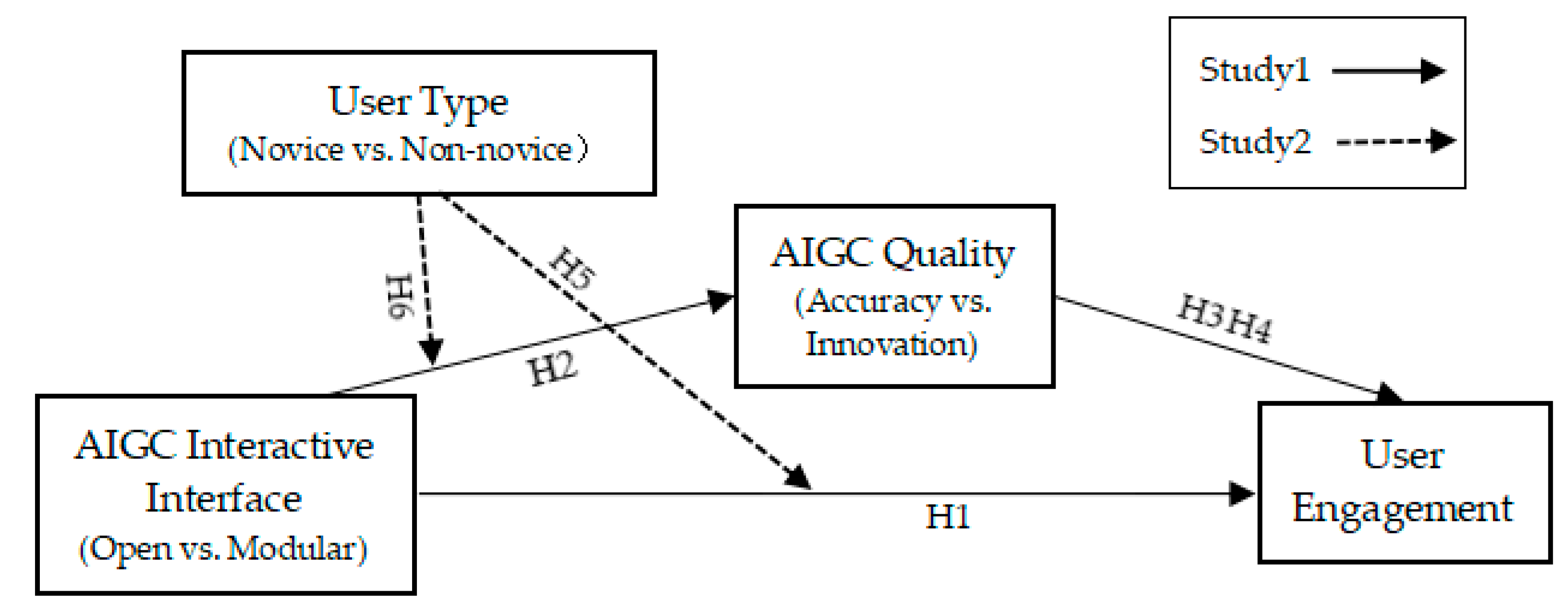
- How do AIGC interactive interfaces foster user–platform engagement?
- What mediating role does AIGC quality play, and how do user types moderate these relationships?
2. Theoretical Background and Hypothesis Development
2.1. Signaling Theory
2.2. AIGC Interactive Interface and User Engagement
2.3. The Mediating Role of AIGC Quality
2.4. The Moderating Effect of User Type
3. Study 1: The Main Effect of the AIGC Interface on User Engagement
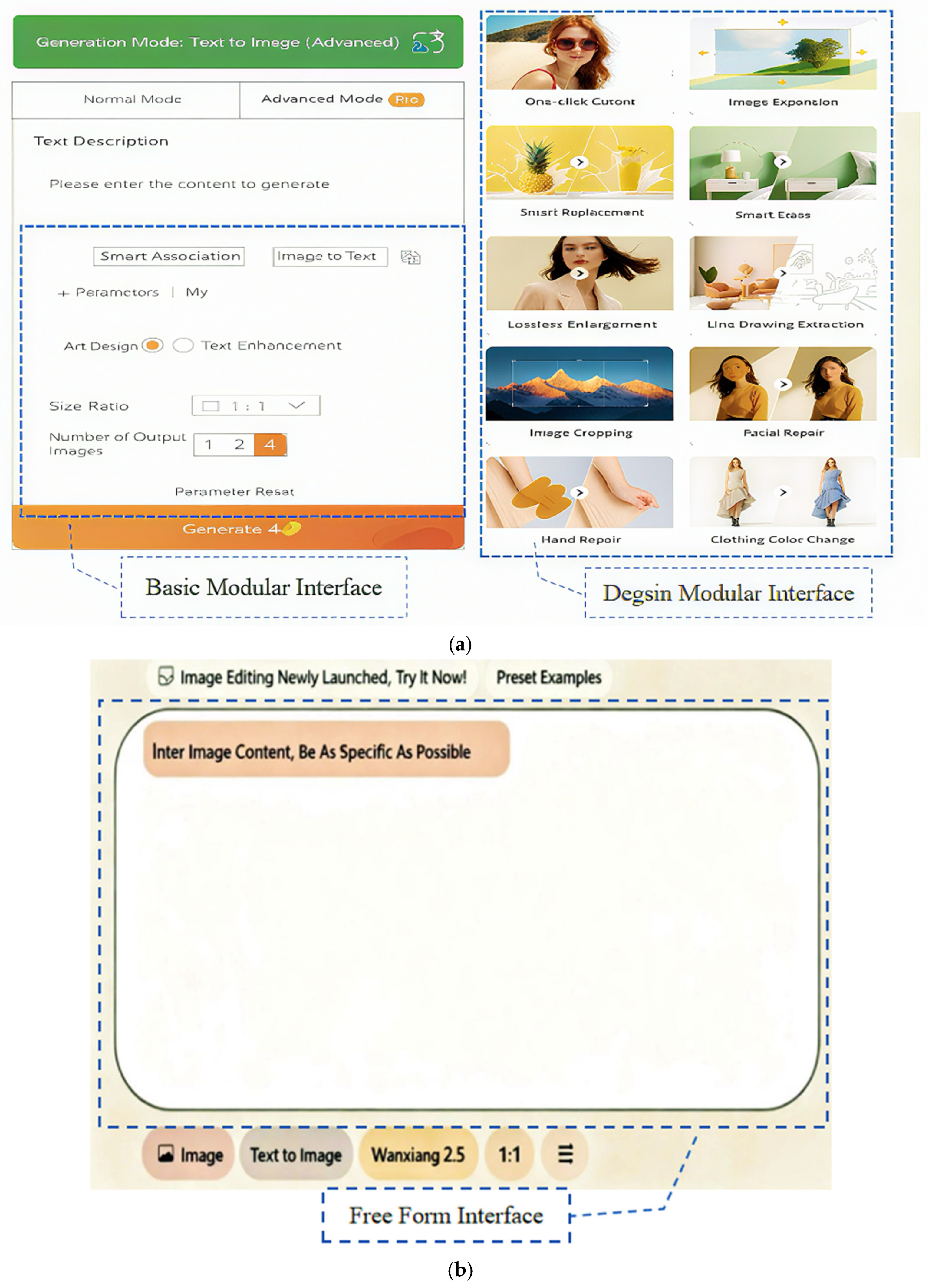
3.1. Stimuli
3.2. Experimental Design and Process
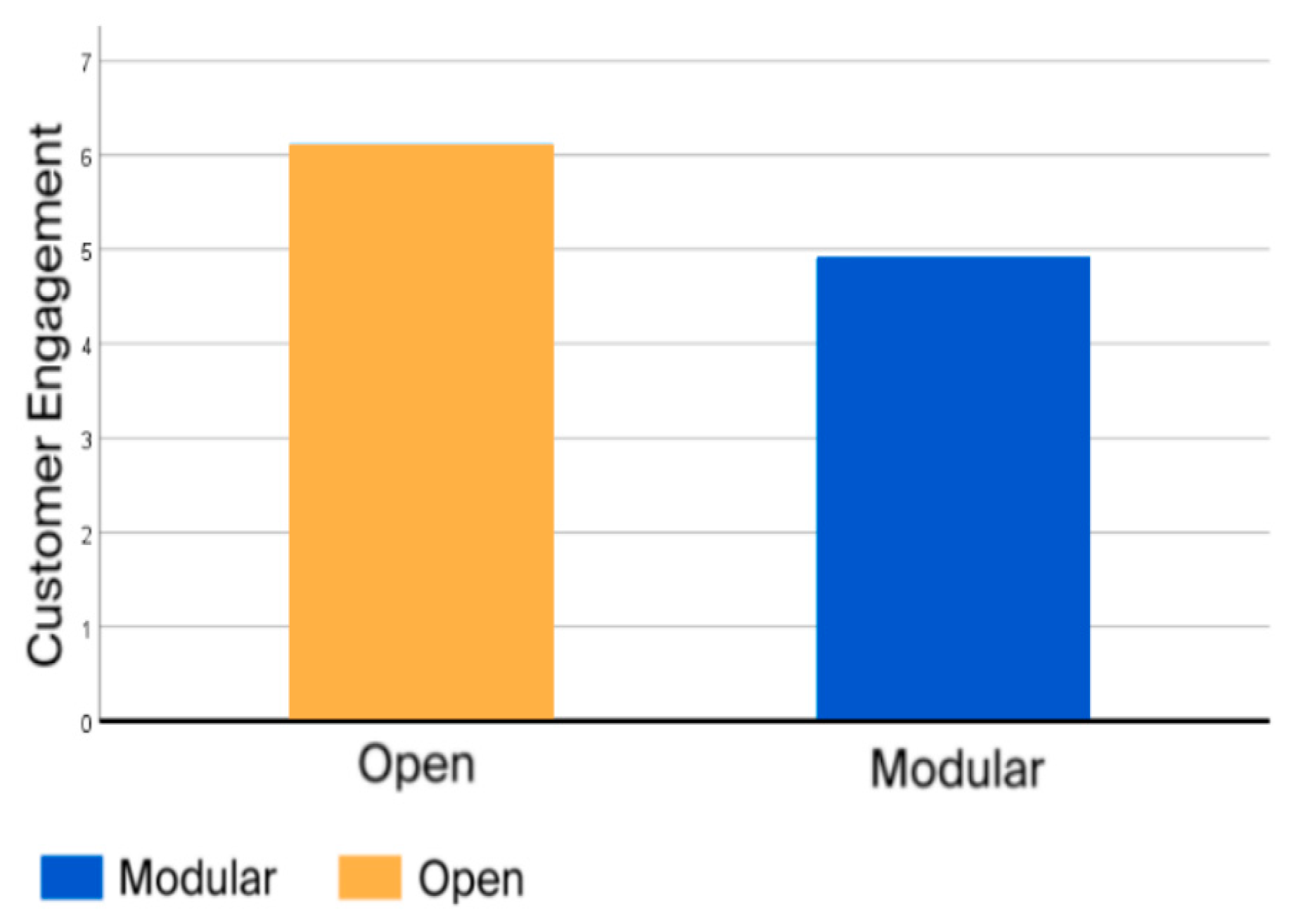
3.3. Experimental Results
4. Study 2: The Moderating Effect of User Type
4.1. Experimental Design and Process
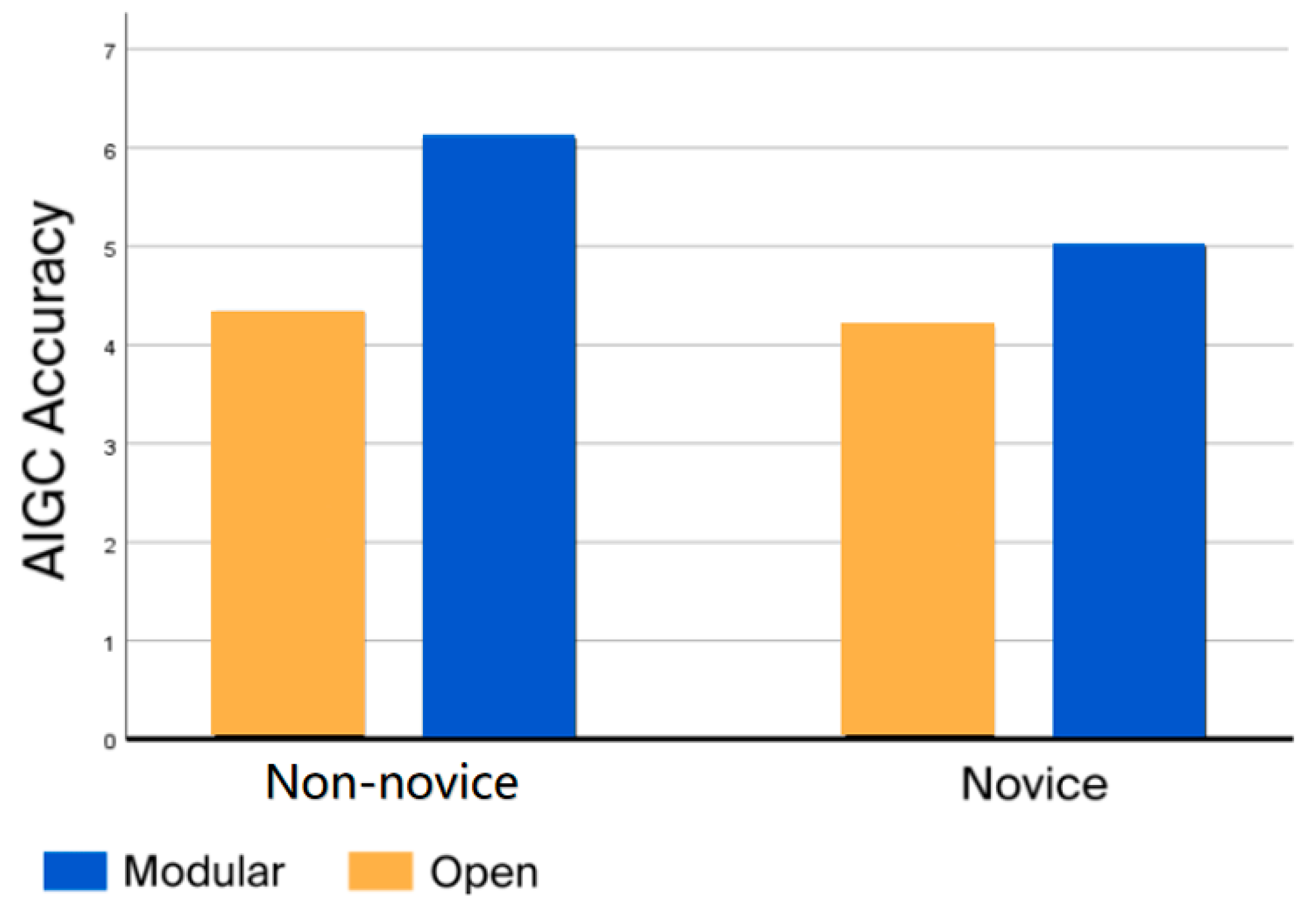
4.2. Experimental Results
5. Overall Discussion and Conclusions
5.1. Key Findings
5.2. Theoretical Contributions
5.3. Managerial Implications
5.4. Limitations and Prospects
Author Contributions
Funding
Institutional Review Board Statement
Informed Consent Statement
Data Availability Statement
Conflicts of Interest
Appendix A. Company Introduction

| Variable Code | Measurement Item | Factor Loading | Composite Reliability | Average Variance Extraction | Cronbach’s α | |
|---|---|---|---|---|---|---|
| AIGC Accuracy (QA) | QA1 | The generated content is designed according to my requirements | 0.809 | 0.894 | 0.859 | 0.894 |
| QA2 | The generated content truly expresses my thoughts | 0.890 | ||||
| QA3 | The generated content fits my needs | 0.875 | ||||
| AIGC Innovation(QI) | QI1 | The form of the design is completely new compared to what it was before | 0.702 | 0.852 | 0.770 | 0.881 |
| QI2 | Elements that have never been used before appear in the generated content | 0.796 | ||||
| QI3 | The generated content is a significant change from the general digital image | 0.797 | ||||
| QI4 | The generated content exceeded my expectations | 0.776 | ||||
| User Engagement (CE) | UE1 | I really like this form of AIGC interface | 0.857 | 0.942 | 0.855 | 0.837 |
| UE2 | I’m passionate about this AIGC interface | 0.838 | ||||
| UE3 | I will take the initiative to pay attention to the application of AIGC interface | 0.860 | ||||
| UE4 | I want to know more about the features of the AIGC interface | 0.877 | ||||
| UE5 | I like to use this AGCI interface for customization | 0.870 | ||||
| UE6 | I would introduce this form of AIGC interface to others | 0.870 | ||||
| Overall Fit Indices | χ2 = 1.25 RMSEA = 0.04 CFI = 0.99 TLI = 0.99 GFI = 0.93 SRMR = 0.05 | |||||
| Variable Code | Measurement Item | Factor Loading | Composite Reliability | Average Variance Extraction | Cronbach’s α | |
|---|---|---|---|---|---|---|
| AIGC Accuracy (QA) | QA1 | The generated content is designed according to my requirements | 0.929 | 0.955 | 0.875 | 0.963 |
| QA2 | The generated content truly expresses my thoughts | 0.937 | ||||
| QA3 | The generated content fits my needs | 0.940 | ||||
| AIGC Innovation (QI) | QI1 | The form of the design is completely new compared to what it was before | 0.970 | 0.985 | 0.944 | 0.905 |
| QI2 | Elements that have never been used before appear in the generated content | 0.971 | ||||
| QI3 | The generated content is a significant change from the general digital image | 0.973 | ||||
| QI4 | The generated content exceeded my expectations | 0.971 | ||||
| User Engagement (CE) | CE1 | I really like this form of AIGC interface | 0.953 | 0.983 | 0.910 | 0.967 |
| CE2 | I’m passionate about this AIGC interface | 0.955 | ||||
| CE3 | I will take the initiative to pay attention to the application of AIGC interface | 0.949 | ||||
| CE4 | I want to know more about the features of the AIGC interface | 0.948 | ||||
| CE5 | I like to use this AGCI interface for customization | 0.961 | ||||
| CE6 | I would introduce this form of AIGC interface to others | 0.954 | ||||
| User Type (UT) | UT1 | I have knowledge of painting design | 0.974 | 0.989 | 0.950 | 0.933 |
| UT2 | I think I know a lot about composition design | 0.978 | ||||
| UT3 | I compose and design more often than the people around me | 0.976 | ||||
| UT4 | I have a lot of ideas for character design | 0.974 | ||||
| UT5 | I am confident in my ability of composition and design | 0.971 | ||||
| Overall Fit Indices | χ2 = 1.67 RMSEA = 0.06 CFI = 0.92 TLI = 0.91 GFI = 0.93 SRMR = 0.06 | |||||
| QA | QI | CE | UT | |
|---|---|---|---|---|
| QA | 0.972 | |||
| QI | −0.2605 | 0.936 | ||
| CE | 0.0488 | 0.2749 | 0.954 | |
| UT | 0.0488 | −0.1039 | 0.0329 | 0.975 |
References
- McKinsey. The Top Trends in Tech. 2024. Available online: https://www.mckinsey.com/nl/our-insights/the-top-trends-in-tech (accessed on 5 October 2025).
- Bock, D.E.; Wolter, J.S.; Ferrell, O.C. Artificial intelligence: Disrupting what we know about services. J. Serv. Mark. 2020, 34, 317–334. [Google Scholar] [CrossRef]
- Song, C.S.; Kim, Y.K. The role of the human-robot interaction in consumers’ acceptance of humanoid retail service robots. J. Bus. Res. 2022, 146, 489–503. [Google Scholar] [CrossRef]
- Lee, S.; Choi, J. Enhancing user experience with conversational agent for movie recommendation: Effects of self-disclosure and reciprocity. J. Hum.-Comput. Stud. 2017, 103, 95–105. [Google Scholar] [CrossRef]
- Lemon, K.N.; Verhoef, P.C. Understanding customer experience throughout the customer journey. J. Mark. 2016, 80, 69–96. [Google Scholar] [CrossRef]
- Xiao, L.; Wang, S. Mobile marketing interface layout attributes that affect user aesthetic preference: An eye-tracking study. Asia Pac. J. Mark. Logist. 2023, 35, 472–492. [Google Scholar] [CrossRef]
- Jain, S.; Basu, S.; Dwivedi, Y.K.; Kaur, S. Interactive voice assistants—Does brand credibility assuage privacy risks? J. Bus. Res. 2022, 139, 701–717. [Google Scholar] [CrossRef]
- Lambrecht, A.; Tucker, C. When does retargeting work? Information specificity in online advertising. J. Mark. Res. 2013, 50, 561–576. [Google Scholar]
- Li, Y.; Yu, L.; Qiu, D. A review of cooperation models between human and artificial intelligence. Chin. J. Inf. 2020, 39, 137–143. (In Chinese) [Google Scholar]
- Kim, B.; Suh, H.; Heo, J.; Choi, Y. AI-driven interface design for intelligent tutoring system improves student engagement. arXiv 2020, arXiv:2009.08976. [Google Scholar]
- Żyminkowska, K.; Zachurzok-Srebrny, E. The Role of Artificial Intelligence in Customer Engagement and Social Media Marketing—Implications from a Systematic Review for the Tourism and Hospitality Sectors. J. Theor. Appl. Electron. Commer. Res. 2025, 20, 184. [Google Scholar] [CrossRef]
- Marinova, D.; de Ruyter, K.; Huang, M.-H.; Meuter, M.; Challagalla, G. Getting smart: Learning from technology-empowered frontline interactions. J. Serv. Res. 2017, 20, 29–42. [Google Scholar] [CrossRef]
- Riegger, A.; Klein, J.F.; Merfeld, K.; Henkel, S. Technology-enabled personalization in retail stores: Understanding drivers and barriers. J. Bus. Res. 2021, 123, 140–155. [Google Scholar] [CrossRef]
- Chandler, J.J.; Reinhard, D.; Schwarz, N. To judge a book by its weight you need to know its content: Knowledge moderates the use of embodied cues. J. Exp. Soc. Psychol. 2012, 48, 948–952. [Google Scholar] [CrossRef]
- Luangrath, A.W.; Peck, J.; Hedgcock, W.; Xu, Y. Observing product touch: The vicarious haptic effect in digital marketing and virtual reality. J. Mark. Res. 2022, 59, 306–326. [Google Scholar] [CrossRef]
- Chung, M.; Ko, E.; Joung, H.; Kim, S.J. Chatbot e-service and customer satisfaction regarding luxury brands. J. Bus. Res. 2020, 117, 587–595. [Google Scholar] [CrossRef]
- Spence, M. Job market signaling. Q. J. Econ. 1978, 87, 355–374. [Google Scholar] [CrossRef]
- Connelly, B.L.; Certo, S.T.; Ireland, R.D.; Reutzel, C.R. Signaling theory: A review and assessment. J. Manag. 2011, 37, 39–67. [Google Scholar] [CrossRef]
- Alós-Ferrer, C.; Prat, J. Job market signaling and employer learning. J. Econ. Theory 2012, 147, 1787–1817. [Google Scholar] [CrossRef]
- Basuroy, S.; Desai, K.; Talukdar, D. An empirical investigation of signaling in the motion picture industry. J. Mark. Res. 2006, 43, 287–295. [Google Scholar] [CrossRef]
- Stiglitz, J. The contributions of the economics of information to twentieth century economics. Q. J. Econ. 2000, 115, 1441–1478. [Google Scholar] [CrossRef]
- Elitzur, R.; Gavious, A. Contracting, signaling, and moral hazard: A model of entrepreneurs, ‘angels,’ and venture capitalists. J. Bus. Ventur. 2003, 18, 709–725. [Google Scholar] [CrossRef]
- Li, C.; Lin, Y.; Chen, R.; Chen, J.E. How do users adopt AI-generated content (AIGC)? An exploration of content cues and interactive cues. Technol. Soc. 2025, 81, 102830. [Google Scholar] [CrossRef]
- Sekadakis, M.; Katrakazas, C.; Clement, P.; Prueggler, A.; Yannis, G. Safety and impact assessment for seamless interactions through human-machine interfaces: Indicators and practical considerations. Transp. Res. Procedia 2023, 72, 2425–2432. [Google Scholar] [CrossRef]
- Hasani, L.M.; Santoso, H.B.; Junus, K. Designing asynchronous online discussion forum interface and interaction based on the community of inquiry framework. Int. Rev. Res. Open Distrib. Learn. 2022, 23, 191–213. [Google Scholar] [CrossRef]
- Bergner, A.S.; Hildebrand, C.; Häubl, G. Machine talk: How verbal embodiment in conversational AI shapes consumer-brand relationships. J. Consum. Res. 2023, 50, 742–764. [Google Scholar] [CrossRef]
- Wien, A.H.; Peluso, A.M. Influence of human versus AI recommenders: The roles of product type and cognitive processes. J. Bus. Res. 2021, 137, 13–27. [Google Scholar] [CrossRef]
- Holzwarth, M.; Janiszewski, C.; Neumann, M.M. The influence of avatars on online consumer shopping behavior. J. Mark. 2006, 70, 19–36. [Google Scholar] [CrossRef]
- Petrescu, M.; Krishen, A.S.; Gironda, J.T.; Fergurson, J.R. Exploring AI technology and consumer behavior in retail interactions. J. Consum. Behav. 2024, 23, 3132–3151. [Google Scholar] [CrossRef]
- Xia, Y.; Liu, Z.; Wang, S.; Huang, C.; Zhao, W. Unlocking the impact of user experience on AI-powered mobile advertising engagement. J. Knowl. Econ. 2025, 16, 4818–4854. [Google Scholar] [CrossRef]
- Sun, C.; Jiang, G.; Zhang, J.; Sun, D. What drives AIGC product users to keep coming back? Unveiling the key factors behind continuance intention. Int. J. Hum.-Comput. Interact. 2025, 41, 13059–13073. [Google Scholar] [CrossRef]
- Huang, H.; Shen, L. Research on the effects of AIGC advertisement on prosumer behavior. Econ. Manag. Innov. 2024, 1, 1–9. [Google Scholar] [CrossRef]
- Bian, Z.; Che, C. How AI overview of customer reviews influences consumer perceptions in e-commerce? J. Theor. Appl. Electron. Commer. Res. 2025, 20, 315. [Google Scholar] [CrossRef]
- Khoa, B.T. The triple helix of digital engagement: Unifying technology acceptance, trust signaling, and social contagion in generation Z’s social commerce repurchase decisions. J. Theor. Appl. Electron. Commer. Res. 2025, 20, 145. [Google Scholar] [CrossRef]
- Liu, X.; Hao, X. Do dynamic signals affect high-quality solvers’ participation behavior? evidence from the crowdsourcing platform. J. Theor. Appl. Electron. Commer. Res. 2024, 19, 561–580. [Google Scholar] [CrossRef]
- Nath, P.; McKechnie, S. Task facilitative tools, choice goals, and risk averseness: A process-view study of e-stores. J. Bus. Res. 2016, 69, 1572–1576. [Google Scholar] [CrossRef]
- Ghosh, M.; Dutta, S.; Stremersch, S. Customizing complex products: When should the vendor take control? J. Mark. Res. 2006, 43, 664–679. [Google Scholar] [CrossRef]
- Sanchez, R. Modular architectures in the marketing process. J. Mark. 1999, 63, 92–111. [Google Scholar] [CrossRef]
- Gremyr, I.; Valtakoski, A.; Witell, L. Two routes of service modularization: Advancing standardization and customization. J. Serv. Mark. 2019, 33, 73–87. [Google Scholar] [CrossRef]
- Han, E.; Yin, D.; Zhang, H. Bots with feelings: Should AI agents express positive emotion in customer service? Inf. Syst. Res. 2022, 34, 1296–1311. [Google Scholar] [CrossRef]
- Fay, S.; Mitra, D.; Wang, Q. Ask or infer? Strategic implications of alternative learning approaches in customization. Int. J. Res. Mark. 2009, 26, 136–152. [Google Scholar] [CrossRef]
- Bagozzi, R.P.; Brady, M.K.; Huang, M.-H.; Kim, T.W.; Jiang, L.; Duhachek, A.; Lee, H.; Garvey, A. Do you mind if I ask you a personal question? How AI service agents alter consumer self-disclosure. J. Serv. Res. 2022, 25, 649–666. [Google Scholar] [CrossRef]
- Wei, R.; Pardo, C. Artificial intelligence and SMEs: How can B2B SMEs leverage AI platforms to integrate AI technologies? Ind. Mark. Manag. 2022, 107, 466–483. [Google Scholar] [CrossRef]
- Longoni, C.; Bonezzi, A.; Morewedge, C.K. Resistance to medical artificial intelligence. J. Consum. Res. 2019, 46, 629–650. [Google Scholar] [CrossRef]
- Hermann, E. Anthropomorphized artificial intelligence, attachment, and consumer behavior. Mark. Lett. 2022, 33, 157–162. [Google Scholar] [CrossRef]
- Buechel, E.C.; Janiszewski, C. A lot of work or a work of art: How the structure of a customized assembly task determines the utility derived from assembly effort. J. Consum. Res. 2014, 40, 960–972. [Google Scholar] [CrossRef]
- Godey, B.; Manthiou, A.; Pederzoli, D.; Rokka, J.; Aiello, G.; Donvito, R.; Singh, R. Social media marketing efforts of luxury brands: Influence on brand equity and consumer behavior. J. Bus. Res. 2016, 69, 5833–5841. [Google Scholar] [CrossRef]
- Liu, J.; Cong, Z. The daily me versus the daily others: How do recommendation algorithms change user interests? Evidence from a knowledge-sharing platform. J. Mark. Res. 2022, 60, 224–236. [Google Scholar] [CrossRef]
- Huang, M.H.; Rust, R.T. Artificial intelligence in service. J. Serv. Res. 2018, 21, 155–172. [Google Scholar] [CrossRef]
- De Ruyter, K.; Keeling, D.I.; Yu, T. Service-sales ambidexterity: Evidence, practice, and opportunities for future research. J. Serv. Res. 2020, 23, 13–21. [Google Scholar] [CrossRef]
- Zhang, Z.; Li, C.; Sun, W.; Liu, X.; Min, X.; Zhai, G. A perceptual quality assessment exploration for AIGC images. In Proceedings of the 2023 IEEE International Conference on Multimedia and Expo Workshops (ICMEW), Brisbane, Australia, 10–14 July 2023; pp. 440–445. [Google Scholar]
- Lee, D.; Hosanagar, K.; Nair, H.S. Advertising content and consumer engagement on social media: Evidence from Facebook. Manag. Sci. 2018, 64, 5105–5131. [Google Scholar] [CrossRef]
- Fan, H.; Gao, W.; Han, B. Are AI chatbots a cure-all? The relative effectiveness of chatbot ambidexterity in crafting hedonic and cognitive smart experiences. J. Bus. Res. 2023, 156, 113526. [Google Scholar] [CrossRef]
- Moradi, M.; Dass, M. Applications of artificial intelligence in B2B marketing: Challenges and future directions. Ind. Mark. Manag. 2022, 107, 300–314. [Google Scholar] [CrossRef]
- Yun, H.; Jun, M.B.G. Immersive and interactive cyber-physical system (I2CPS) and virtual reality interface for human involved robotic manufacturing. J. Manuf. Syst. 2022, 62, 234–248. [Google Scholar] [CrossRef]
- Kim, Y.; Slotegraaf, R.J. Brand-embedded interaction: A dynamic and personalized interaction for co-creation. Mark. Lett. 2016, 27, 183–193. [Google Scholar] [CrossRef]
- Olsen, G.D.; Pracejus, J.W. Customized advertising: Allowing consumers to directly tailor messages leads to better outcomes for the brand. J. Bus. Res. 2020, 116, 245–257. [Google Scholar] [CrossRef]
- Kim, W.J.; Ryoo, Y.; Lee, S.Y.; Lee, J.A. Chatbot advertising as a double-edged sword: The roles of regulatory focus and privacy concerns. J. Advert. 2022, 52, 504–522. [Google Scholar] [CrossRef]
- Huang, M.H.; Rust, R.T. A strategic framework for artificial intelligence in marketing. J. Acad. Mark. Sci. 2021, 49, 30–50. [Google Scholar] [CrossRef]
- Chang, W. The effectiveness of AI salesperson vs. human salesperson across the buyer-seller relationship stages. J. Bus. Res. 2022, 148, 241–251. [Google Scholar]
- Shen, A. Recommendations as personalized marketing: Insights from customer experiences. J. Serv. Mark. 2014, 28, 414–427. [Google Scholar] [CrossRef]
- Lim, S.; Donkers, B.; van Dijl, P.; Dellaert, B.G.C. Digital customization of consumer investments in multiple funds: Virtual integration improves risk-return decisions. J. Acad. Mark. Sci. 2021, 49, 723–742. [Google Scholar] [CrossRef]
- Berger, J.; Milkman, K.L. What makes online content viral? J. Mark. Res. 2012, 49, 192–205. [Google Scholar] [CrossRef]
- Pallant, J.; Sands, S.; Karpen, I. Product customization: A profile of consumer demand. J. Retail. Consum. Serv. 2020, 54, 102030. [Google Scholar] [CrossRef]
- Hung, C.L.; Chou, J.C.L.; Dong, T.P. Innovations and communication through innovative users: An exploratory mechanism of social networking website. Int. J. Inf. Manag. 2011, 31, 317–326. [Google Scholar] [CrossRef]
- Li, K.J.; Zhang, J. How does customer recognition affect service provision? Int. J. Res. Mark. 2021, 38, 900–914. [Google Scholar] [CrossRef]
- Mishra, S.; Ewing, M.T.; Cooper, H.B. Artificial intelligence focus and firm performance. J. Acad. Mark. Sci. 2022, 50, 1176–1197. [Google Scholar] [CrossRef]
- Gu, L.; Li, Y. Who made the paintings: Artists or artificial intelligence? The effects of identity on liking and purchase intention. Front. Psychol. 2022, 13, 941163. [Google Scholar] [CrossRef]
- Chamberlain, R.; Mullin, C.; Scheerlinck, B.; Wagemans, J. Putting the art in artificial: Aesthetic responses to computer-generated art. Psychol. Aesthet. Creat. Arts 2018, 12, 177–192. [Google Scholar] [CrossRef]
- Schreier, M.; Prügl, R. Extending lead-user theory: Antecedents and consequences of consumers’ lead userness. J. Prod. Innov. Manag. 2008, 25, 331–346. [Google Scholar] [CrossRef]
- Wang, T.; He, H.; Zhu, F. Consumer creativity in new product development: The influence of product innovation task and consumer knowledge on consumer product creativity. Manag. World 2010, 02, 80–92. (In Chinese) [Google Scholar]
- Lee, E.J. How perceived cognitive needs fulfillment affect consumer attitudes toward the customized product: The moderating role of consumer knowledge. Comput. Hum. Behav. 2016, 64, 152–162. [Google Scholar] [CrossRef]
- Meeds, R. Cognitive and attitudinal effects of technical advertising copy: The roles of gender, self-assessed and objective consumer knowledge. Int. J. Advert. 2004, 23, 309–335. [Google Scholar] [CrossRef]
- Klesse, A.-K.; Cornil, Y.; Dahl, D.W.; Gros, N. The secret ingredient is me: Customization prompts self-image-consistent product perceptions. J. Mark. Res. 2019, 56, 879–893. [Google Scholar] [CrossRef]
- Pizzi, G.; Scarpi, D.; Pantano, E. Artificial intelligence and the new forms of interaction: Who has the control when interacting with a chatbot? J. Bus. Res. 2021, 129, 878–890. [Google Scholar] [CrossRef]
- Jacoby, J.; Troutman, T.; Kuss, A.; Mazursky, D. Experience and expertise in complex decision making. Adv. Consum. Res. 1986, 13, 469–475. [Google Scholar]
- von Walter, B.; Kremmel, D.; Jäger, B. The impact of lay beliefs about AI on adoption of algorithmic advice. Mark. Lett. 2022, 33, 143–155. [Google Scholar] [CrossRef]
- Dewan, R.; Jing, B.; Seidmann, A. Adoption of Internet-based product customization and pricing strategies. J. Manag. Inf. Syst. 2000, 17, 9–28. [Google Scholar] [CrossRef]
- Choi, D.; Seo, Y.; Septianto, F.; Ko, E. Luxury customization and self-authenticity: Implications for consumer wellbeing. J. Bus. Res. 2022, 141, 243–252. [Google Scholar] [CrossRef]
- Hildebrand, C.; Häubl, G.; Herrmann, A. Product customization via starting solutions. J. Mark. Res. 2014, 51, 707–725. [Google Scholar] [CrossRef]
- Alba, J.W.; Hutchinson, J.W. Dimensions of consumer expertise. J. Consum. Res. 1987, 13, 411–454. [Google Scholar] [CrossRef]
- Foroudi, P.; Nazarian, A.; Ziyadin, S.; Kitchen, P.; Hafeez, K.; Priporas, C.; Pantano, E. Co-creating brand image and reputation through stakeholder’s social network. J. Bus. Res. 2020, 114, 42–59. [Google Scholar] [CrossRef]
- Lee, G.; Lee, W.J. Psychological reactance to online recommendation services. Inf. Manag. 2009, 46, 448–452. [Google Scholar] [CrossRef]
- Verleye, K.; Gemmel, P.; Rangarajan, D. Managing Engagement Behaviors in a Network of Customers and Stakeholders:Evidence from the Nursing Home Sector. J. Serv. Res. 2014, 17, 68–84. [Google Scholar] [CrossRef]
- Kim, J.W.; Choi, J.; Qualls, W.; Han, K. It takes a marketplace community to raise brand commitment: The role of online communities. J. Mark. Manag. 2008, 24, 409–431. [Google Scholar] [CrossRef]



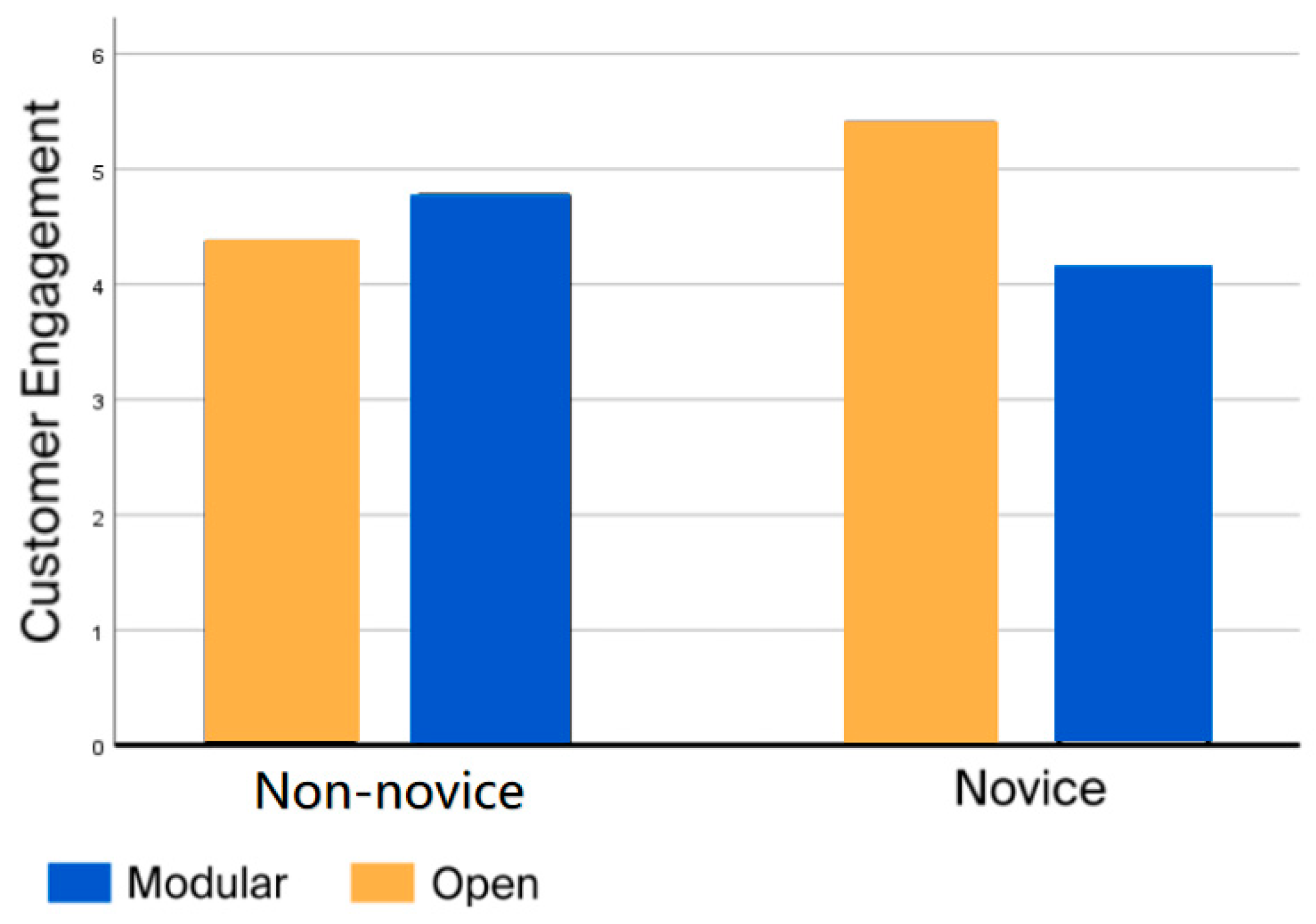
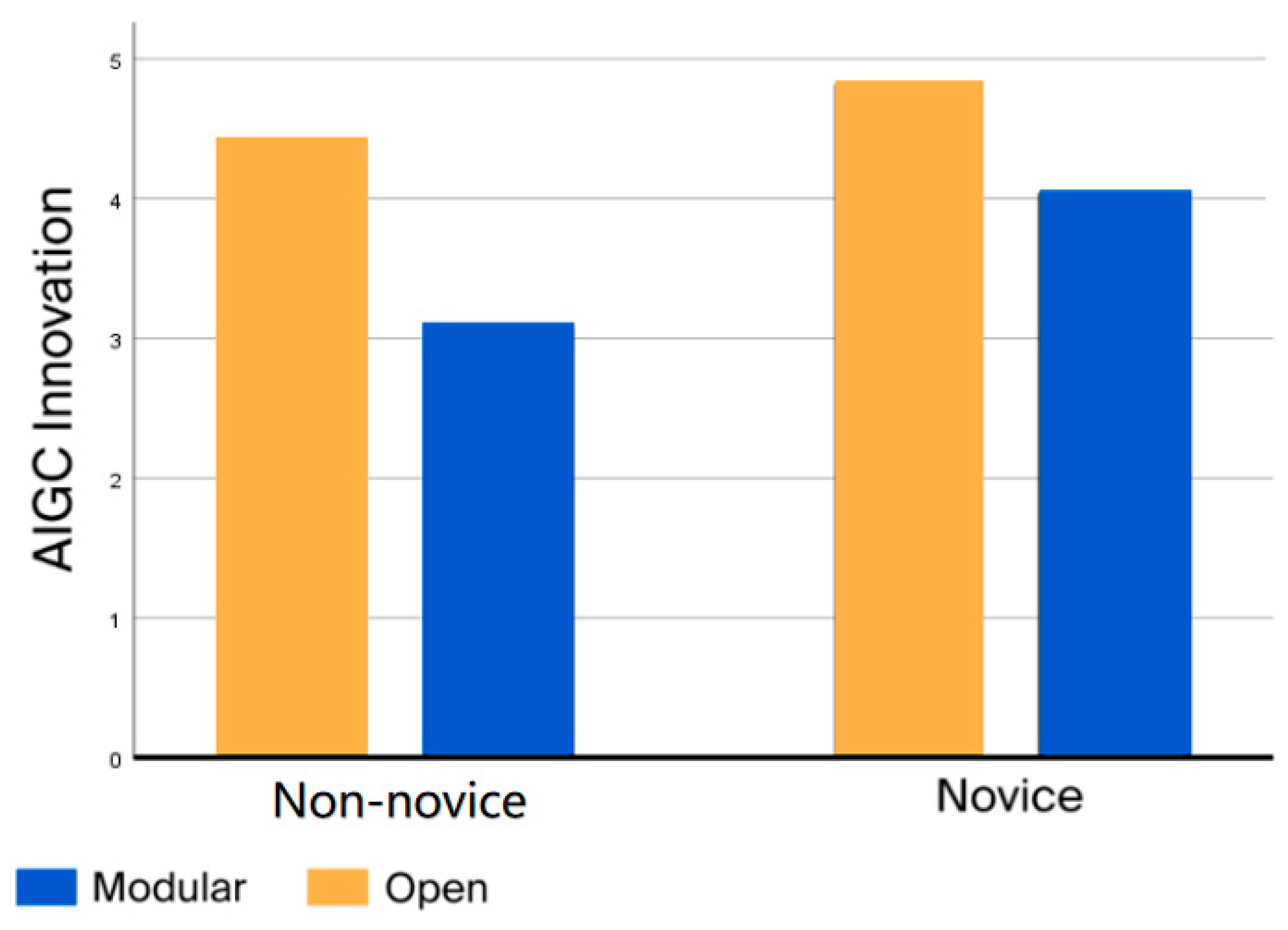

| The Signaling Theory Based on the AIGC Interface in this Study | The Technical Acceptance Model Based on Traditional AI Interfaces | |
|---|---|---|
| Theoretical core | Under the condition of information asymmetry, how does the AIGC platform convey information and how do users interpret the unobservable quality signals? | Users’ understanding and adoption of technologies and tools (perceived usefulness and ease of use) |
| Focus of Attention | Quality assessment (accuracy and innovation) | User acceptance and related behaviors |
| Premise assumption | There is information asymmetry, making it difficult for users to directly assess the true quality. | Users can easily evaluate the system functions |
| Typical application | Is the content generated by the AIGC platform reliable? | Are the AI tools user-friendly? Can they enhance efficiency? |
Disclaimer/Publisher’s Note: The statements, opinions and data contained in all publications are solely those of the individual author(s) and contributor(s) and not of MDPI and/or the editor(s). MDPI and/or the editor(s) disclaim responsibility for any injury to people or property resulting from any ideas, methods, instructions or products referred to in the content. |
© 2025 by the authors. Licensee MDPI, Basel, Switzerland. This article is an open access article distributed under the terms and conditions of the Creative Commons Attribution (CC BY) license (https://creativecommons.org/licenses/by/4.0/).
Share and Cite
Yang, Z.; Song, L.; Qiu, M. Open or Modular? The Influence of AIGC Interactive Interface on User Platform Engagement. J. Theor. Appl. Electron. Commer. Res. 2025, 20, 332. https://doi.org/10.3390/jtaer20040332
Yang Z, Song L, Qiu M. Open or Modular? The Influence of AIGC Interactive Interface on User Platform Engagement. Journal of Theoretical and Applied Electronic Commerce Research. 2025; 20(4):332. https://doi.org/10.3390/jtaer20040332
Chicago/Turabian StyleYang, Zhiyong, Lianlian Song, and Mengnan Qiu. 2025. "Open or Modular? The Influence of AIGC Interactive Interface on User Platform Engagement" Journal of Theoretical and Applied Electronic Commerce Research 20, no. 4: 332. https://doi.org/10.3390/jtaer20040332
APA StyleYang, Z., Song, L., & Qiu, M. (2025). Open or Modular? The Influence of AIGC Interactive Interface on User Platform Engagement. Journal of Theoretical and Applied Electronic Commerce Research, 20(4), 332. https://doi.org/10.3390/jtaer20040332