Topic Editors

Dr. Elisa Karkle
Grain Science and Industry, Kansas State University, Manhattan, KS 66506, USA
Department of Food, Nutrition, Dietetics and Health, Kansas State University, Manhattan, KS 66506, USA
Dr. Rosana Colussi
Center of Chemical, Pharmaceutical and Food Sciences, Pelotas Federal University, Pelotas 96010-610, RS, Brazil
Dr. Ling Sun
School of Food and Biological Engineering, Jiangsu University, Zhenjiang 212013, China

Cereal Nutrients, Bioactive Compounds, and Their Health Impact
Abstract submission deadline
31 January 2027
Manuscript submission deadline
31 March 2027
Viewed by
3829

Topic Information

Dear Colleagues,

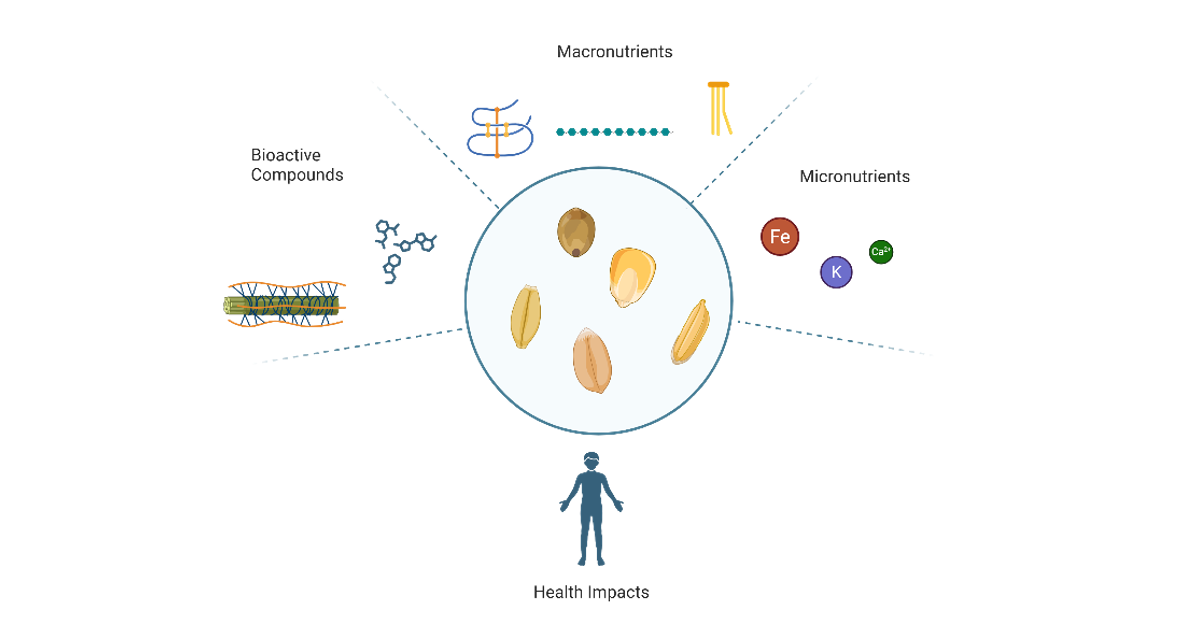
Cereals (e.g., rice, wheat, barley, and maize) have been staple foods for millennia, providing essential macro- and micronutrients and a diverse range of bioactive compounds. Their macronutrient profile includes digestible and nondigestible carbohydrates, proteins, and lipids varying in amount and structure depending on the grain and process history. Cereals are important sources of B-vitamins, iron, zinc, and magnesium, with processing also playing a key role in their bioaccessibility. Beyond nutrients, cereals contain various bioactive compounds that have antioxidant and anti-inflammatory effects. Research groups around the world are exploring additional compounds, health benefits, and responses to processing. This Topic aims to concentrate a portion of the current research on increased discoverability and impact.   

Dr. Elisa Karkle
Dr. Valentina Trinetta
Dr. Rosana Colussi
Dr. Ling Sun
Topic Editors

Keywords

  • cereal grains
  • dietary fiber
  • micronutrients
  • polyphenols
  • antioxidants
  • metabolic health
  • grain processing

Participating Journals

Journal Name Impact Factor CiteScore Launched Year First Decision (median) APC
Agriculture
agriculture
4.5 7.8 2011 17.4 Days CHF 2600 Submit
Antioxidants
antioxidants
8.2 14.7 2012 18.7 Days CHF 2900 Submit
Crops
crops
2.1 2.9 2021 20.7 Days CHF 1200 Submit
Foods
foods
6.0 10.3 2012 14.8 Days CHF 2900 Submit
Nutraceuticals
nutraceuticals
- 4.4 2021 24.9 Days CHF 1200 Submit
Nutrients
nutrients
5.8 10.2 2009 15.8 Days CHF 2900 Submit

Preprints.org is a multidisciplinary platform offering a preprint service designed to facilitate the early sharing of your research. It supports and empowers your research journey from the very beginning.

MDPI Topics is collaborating with Preprints.org and has established a direct connection between MDPI journals and the platform. Authors are encouraged to take advantage of this opportunity by posting their preprints at Preprints.org prior to publication:

  1. Share your research immediately: disseminate your ideas prior to publication and establish priority for your work.
  2. Safeguard your intellectual contribution: Protect your ideas with a time-stamped preprint that serves as proof of your research timeline.
  3. Boost visibility and impact: Increase the reach and influence of your research by making it accessible to a global audience.
  4. Gain early feedback: Receive valuable input and insights from peers before submitting to a journal.
  5. Ensure broad indexing: Web of Science (Preprint Citation Index), Google Scholar, Crossref, SHARE, PrePubMed, Scilit and Europe PMC.

Published Papers (3 papers)

Order results
Result details
Journals
Select all
Export citation of selected articles as:
20 pages, 1928 KB  
Review
Intergenerational Effects of Paternal Diets on Offspring Health and Reproduction
by Lirong Geng, Jiabin Zhang and Guitian He
Nutrients 2026, 18(18), 3008; https://doi.org/10.3390/nu18183008 - 14 Sep 2026
Viewed by 130
Abstract
Fat, protein, and micronutrients serve as essential components of human nutrition, and their balanced intake is critical for maintaining health. Chronic nutritional imbalances may adversely affect not only individual health but that of subsequent generations. Accumulating evidence indicates that paternal nutritional status before [...] Read more.
Fat, protein, and micronutrients serve as essential components of human nutrition, and their balanced intake is critical for maintaining health. Chronic nutritional imbalances may adversely affect not only individual health but that of subsequent generations. Accumulating evidence indicates that paternal nutritional status before conception contributes to offspring health through diet-induced alterations in sperm quality and epigenetic programming. The genetic integrity and physiological condition of sperm are susceptible to long-term dietary exposures, providing a potential biological basis for paternal nutritional programming. This review summarizes current evidence regarding the effects and potential molecular mechanisms by which paternal dietary patterns, including high-fat diet (HFD), low-protein diet (LPD), and folic acid (FA) intake, influence reproductive competence, embryonic development, and cognitive function in offspring. Notably, most available evidence is derived from animal models, whereas corresponding human data remain limited. Current findings suggest that paternal dietary patterns may influence reproductive, embryonic, and offspring outcomes through interconnected biological pathways involving sperm quality and epigenetic regulation, although the underlying mechanisms have not been fully elucidated. We also discuss potential intervention strategies evaluated in preclinical studies and highlight current knowledge gaps and future research priorities for understanding the intergenerational effects of paternal nutrition. Full article
Show Figures

Figure 1

19 pages, 3394 KB  
Article
Comparative Metabolomic Analysis Reveals the Varied Accumulations of Functional Nutrients in Differentially Pigmented Mung Bean Seeds
by Hubin Yan, Wei Gao, Huijun Zhu, Qian Wang, Qingting Hao, Jianjun Yan, Yaowen Zhang and Zeyan Zhang
Foods 2026, 15(17), 3020; https://doi.org/10.3390/foods15173020 - 27 Aug 2026
Viewed by 347
Abstract
Coat color is closely associated with the nutritional and functional properties of mung bean (Vigna radiata L.) seeds. However, the relationship between the coat color and efficiency in nutrients of mung bean seeds has not been clearly clarified. In this study, comparative [...] Read more.
Coat color is closely associated with the nutritional and functional properties of mung bean (Vigna radiata L.) seeds. However, the relationship between the coat color and efficiency in nutrients of mung bean seeds has not been clearly clarified. In this study, comparative metabolomic analysis, bioactive compounds’ content measurement, and antioxidant capacities’ (ABTS+, DPPH, FRAP) determinations were conducted on four distinct varieties with different seed coat colors (black: BL, yellow: YE, yellow-green: YG, green: GR). A total of 1544 metabolites were identified in these mung bean seeds, with amino acids and derivatives, flavonoids, phenolic acids, lipids, and terpenoids, as the top five classes with high relative signal abundance. BL was abundant in flavonoids (20.12%), flavonols, anthocyanins (with six anthocyanins accounting for 22.32–565.21-fold of that in other varieties), free fatty acids, and phenolic acid. YE accumulated more amino acids and derivatives (31.85%), isoflavones (with daidzein accounting for 1.97–9.34-fold of other varieties), flavones, and lignans/coumarins. Antioxidant capacity determination results showed that BL exhibited the strongest FRAP (p < 0.05), YG had the highest DPPH scavenging activity (p < 0.05), while YE showed numerically the highest ABTS+ scavenging capacity (p > 0.05). Notably, anthocyanin accumulation was positively correlated with FRAP, while isoflavone and amino acid accumulations were positively correlated with ABTS+ scavenging capacity. These findings suggested that the overall antioxidant activity of mung bean seeds was jointly regulated by multiple metabolite classes. This study elucidates seed metabolomic variations among mung bean varieties, providing insights for functional breeding and precision food development. Full article
Show Figures

Figure 1

34 pages, 2323 KB  
Review
Natural Products in the Metabolic and Endocrine Modulation of Polycystic Ovary Syndrome: Current Perspectives
by Siqi Liu, Rui Wang, Weili Yu, Chuanjing Shi, Xi Wang, Aifen Liu and Lei Zhang
Nutrients 2026, 18(6), 964; https://doi.org/10.3390/nu18060964 - 18 Mar 2026
Cited by 4 | Viewed by 2262
Abstract
Polycystic ovary syndrome (PCOS) is a prevalent endocrine and metabolic disorder, primarily characterized by reproductive dysfunction, insulin resistance (IR), and long-term metabolic complications. Current first-line pharmacological treatments, including oral contraceptives, anti-androgens, and insulin sensitizers, can alleviate clinical symptoms but often fail to fully [...] Read more.
Polycystic ovary syndrome (PCOS) is a prevalent endocrine and metabolic disorder, primarily characterized by reproductive dysfunction, insulin resistance (IR), and long-term metabolic complications. Current first-line pharmacological treatments, including oral contraceptives, anti-androgens, and insulin sensitizers, can alleviate clinical symptoms but often fail to fully address the underlying pathophysiology, and their long-term use is frequently limited by adverse effects. Natural products, owing to their multi-target regulatory properties and favorable safety profiles, have emerged a promising adjuvant therapeutic strategy. This review systematically summarizes how natural products exert beneficial effects through mechanisms such as improving metabolic homeostasis by enhancing insulin sensitivity and mitigating oxidative stress and chronic inflammation; restoring endocrine balance by modulating the hypothalamic–pituitary–gonadal axis to reduce hyperandrogenemia and promote ovulation; and utilizing emerging pathways including regulating gut microbiota homeostasis and epigenetic modifications as a novel avenue for PCOS drug development. Preclinical and clinical evidence collectively indicates that these agents hold significant translational potential to ameliorate metabolic disturbances and improve reproductive outcomes, providing a scientific foundation for future integrated intervention strategies in PCOS. Full article
Show Figures

Figure 1

Back to TopTop