You are currently viewing a new version of our website. To view the old version click .
Sensors
  • Article
  • Open Access

9 November 2022

Cybersecurity Awareness and Training (CAT) Framework for Remote Working Employees

and
1
Faculty of Computers & Information Technology, University of Tabuk, Tabuk 71491, Saudi Arabia
2
School of Computing, Ulster University, Belfast BT15 1ED, Northern Ireland, UK
*
Author to whom correspondence should be addressed.
This article belongs to the Special Issue Emerging Trends and Challenges of IoT in Smart Healthcare Systems, Smart Cities and Education

Abstract

Currently, cybersecurity plays an essential role in computing and information technology due to its direct effect on organizations’ critical assets and information. Cybersecurity is applied using integrity, availability, and confidentiality to protect organizational assets and information from various malicious attacks and vulnerabilities. The COVID-19 pandemic has generated different cybersecurity issues and challenges for businesses as employees have become accustomed to working from home. Firms are speeding up their digital transformation, making cybersecurity the current main concern. For software and hardware systems protection, organizations tend to spend an excessive amount of money procuring intrusion detection systems, antivirus software, antispyware software, and encryption mechanisms. However, these solutions are not enough, and organizations continue to suffer security risks due to the escalating list of security vulnerabilities during the COVID-19 pandemic. There is a thriving need to provide a cybersecurity awareness and training framework for remote working employees. The main objective of this research is to propose a CAT framework for cybersecurity awareness and training that will help organizations to evaluate and measure their employees’ capability in the cybersecurity domain. The proposed CAT framework will assist different organizations in effectively and efficiently managing security-related issues and challenges to protect their assets and critical information. The developed CAT framework consists of three key levels and twenty-five core practices. Case studies are conducted to evaluate the usefulness of the CAT framework in cybersecurity-based organizational settings in a real-world environment. The case studies’ results showed that the proposed CAT framework can identify employees’ capability levels and help train them to effectively overcome the cybersecurity issues and challenges faced by the organizations.

1. Introduction

Cybersecurity performs an important role nowadays by protecting government data, business, industrial information, intellectual property, and personal information from hackers and cybercriminals. Extensive use of technology is directly proportional to the increase in cybercrime. The main objective of cybersecurity is, therefore, to protect information due to the enormous increase in cyber-attacks and to lessen the possibility of global and catastrophic consequences [1]. Researchers and practitioners are developing best practices to protect computer systems, devices, networks, and software systems from unauthorized access or cyber threats.
The COVID-19 pandemic has generated different challenges for businesses as employees have become accustomed to working from home. Firms are speeding up their digital transformation, making cybersecurity the current main concern [2]. The reputational, operational, legal, and compliance consequences may be substantial if cybersecurity threats are ignored. The upsurge in remote working demands more attention regarding cybersecurity because of the larger exposure to cyber-attacks, threats, and risks, with 47% of employees and individuals experiencing an attempted phishing scam whilst working at home. Cyber-attackers and hackers perceive the COVID-19 pandemic as an opportunity to step up their illegal behaviors by manipulating the vulnerability of employees working from home. Likewise, one more significant consequence is that the average cost of a data breach caused by remote working employees is USD 137,000 [3]. Hijji and Alam [4] conducted a comprehensive multi-vocal literature review on the increasing social-engineering-based cyber-attacks and threats during the COVID-19 pandemic. They mentioned attacked organization domains, the platform used for cyber-attacks, and the types of malware used. Most of the attacks are performed by using social-engineering-based tactics to manipulate workers into opening suspicious links sent via different social platforms. Currently, awareness and training are very important for updating employees regarding the recent kinds of cyber-attacks and threats and to protect their organizations from huge financial, personal, and reputation loss.
Sibillon et al. [5] proposed a cybersecurity awareness training model (CATRAM) for cybersecurity culture awareness to support training of various organizational employees. Their model was validated through a case study in Canada. Similarly, Rajamäki et al. [6] recommended a “Proactive Resilience Educational Framework (Proresilience EF)” to facilitate cybersecurity education and training in the healthcare field. Similarly, Alshaikh et al. [7] constructed “Information Security Education Training and Awareness (SETA)” To provide sustainable behavioral change regarding cybersecurity by adopting the behavior change wheel (BCW) framework. A detailed comparison of the other relevant cybersecurity frameworks/models is shown in Table 1. However, no such model exists to provide awareness to and to train online-working-based employees.
The main objective of this research is to develop a cybersecurity awareness and training framework to support organizations in enriching and training their employees to secure the information and overall system of the organization. We studied the existing empirical literature on different published cybersecurity frameworks and models with the inclusion of the structural concept of the well-known NIST “Building an information technology security awareness and training program” [8]. We developed CAT by introducing AI concepts consisting of machine learning, natural language processing, and expert systems to make our proposed model self-adaptive and smart.
This research study is organized as follows: Section 2 comprehensively explains the related work and motivation of cybersecurity and the existing frameworks/models. The research methodology is discussed in detail in Section 3. Similarly, Section 4 represents the proposed CAT framework. Section 5 includes the case studies and evaluation of the CAT framework in the real-world industrial environment, and Section 6 reviews the post-case-study evaluation and feedback. Finally, Section 7 presents the limitations of the research study, and Section 8 presents the conclusions and future work.

3. Research Methodology

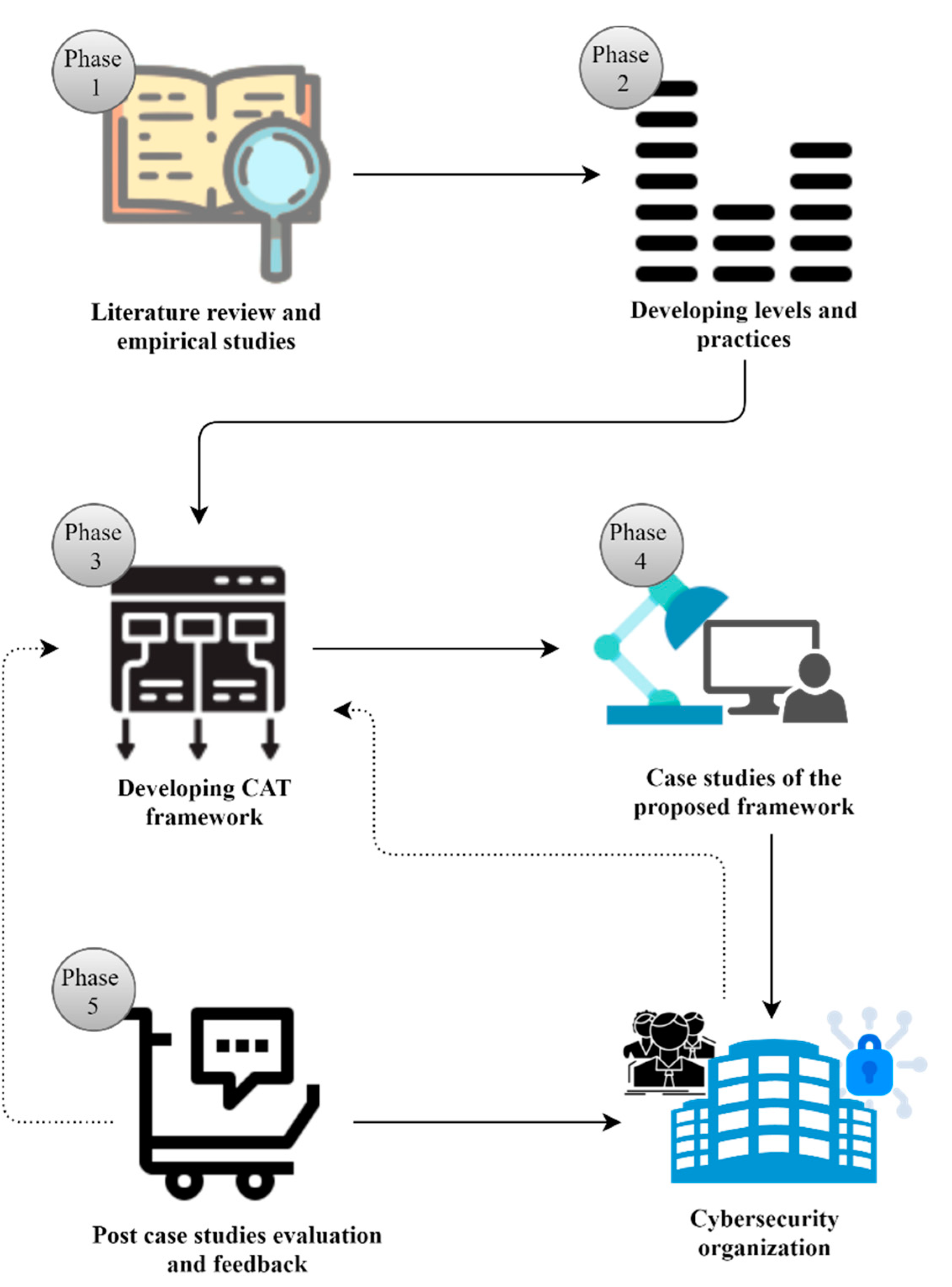
Research methodology is divided into the following five phases: literature review and empirical studies, developing CAT framework levels and practices, developing CAT framework, case studies, and, finally, post-case-study evaluation and feedback, as shown in Figure 1.
Figure 1. Proposed research methodology.

3.1. Literature Review and Empirical Studies

A comprehensive literature review was conducted in relevance to cybersecurity training and awareness. Empirical studies were also conducted to explore established frameworks/models in the cybersecurity domain. Comparison criteria such as name, reference, year, domain, and validation approaches were built to compare the identified cybersecurity awareness and training frameworks/models in different domains, such as healthcare, business, and education, as shown in Table 1.

3.2. Development CAT Framework Levels and Practices

We studied all the relevant empirical literature studies and already existing frameworks/models, including NIST (National Institute of Standards and Technology) “Building an information technology security awareness and training program” [8], to develop potential major CAT framework levels and key practices. Moreover, we interviewed security experts, engineers, testers, and developers to obtain knowledge about the development of CAT framework levels and practices.

3.3. Developing CAT Framework

An academic assessment was completed for building the proposed CAT framework related to cybersecurity training and awareness for online-working-based employees. This assessment facilitates us to build and verify the CAT framework and identify the weaknesses within it before applying the framework to the cybersecurity real-world environment for evaluation. After deep study and reviews, the proposed CAT framework was built free of flaws and errors and was ready for testing and evaluation in a real-world environment.

3.4. Case Studies of the Proposed CAT Framework

This phase includes sending the proposed developed CAT framework to the cybersecurity organizations for evaluation and measurement. It includes the extensive demonstration of the proposed CAT framework to determine whether it is suitable for application in a real-world environment, which will also lead towards further refinement of the proposed solution. The case study method was used to evaluate the CAT framework because it is a powerful evaluation tool that can provide useful real-world information [48]. A case study normally is the intersection of evidence from interviews, observation, questionnaires, and archives [49].
Next, a statistical analysis was performed to measure the proposed CAT framework and the conducted case studies. Statistical analysis is the most crucial phase because it assists with management of descriptive information; that is, numbers are assigned for every variable and their percentages that need to be described in the form of frequency graphs or tables. Frequencies are helpful in cases of comparison and contrasting among or across a group of variables by considering the four scales of data analysis, including nominal, ordinal interval, and ratio. In this research, the median is used for evaluation of our proposed CAT framework due to its ordinal scale nature.

3.5. Post-Case-Study Evaluation and Feedback

Post-case-study evaluations were completed to improve and enhance the developed CAT framework from the perspective of the real industrial environment. The framework was evaluated based on three main aspects: ease of use, CAT framework structure, and user satisfaction in order to improve it and make it more feasible for the organizations who want to use it.

4. Cybersecurity Awareness and Training (CAT) Framework

4.1. The Development Process of the CAT Framework

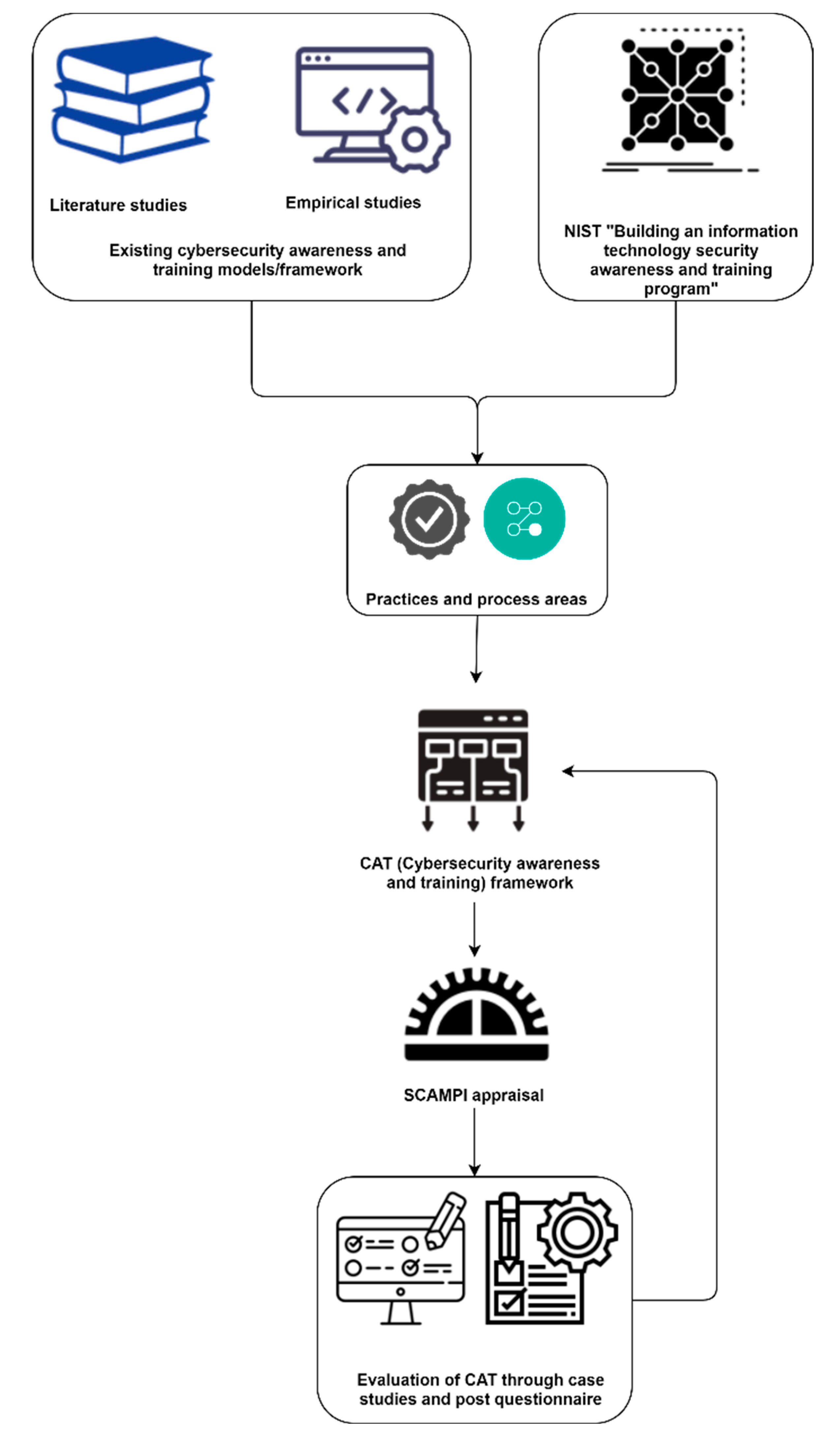
The CAT framework is primarily founded on the structural concept of the well-known NIST “Building an information technology security awareness and training program” [8]. We developed the CAT framework by introducing AI concepts consisting of machine learning, natural language processing, and expert systems to make our proposed model self-adaptive and smart. Further, we built an adaptive-based knowledge measurement module by including threshold value points. Likewise, we divided the CAT framework into three major levels: beginner (awareness), medium (training), and advanced (practical and assessment). Each level is further divided into its key practices. The levels and key practices of the CAT framework were established from the conducted literature review, relevant empirical studies, and from the NIST “Building an information technology security awareness and training program” [8].
The authors repeatedly reviewed the levels with practices and placed them in their proper position in each level of the CAT framework. Before the real-world environment case studies evaluation, a review of the CAT framework was performed many times by the researchers in an iterative manner. The complete flow of the development process of the CAT framework is shown in Figure 2.
Figure 2. Complete development process of CAT.

4.2. Structure of the CAT Framework

The structure of the CAT framework was implemented mainly from NIST (National Institute of Standards and Technology) “Building an information technology security awareness and training program”. NIST provides guidance on creating an efficient IT security program and maintaining the requirements stipulated in the Federal Information Security Management Act (FISMA) [50] and the Office of Management and Budget (OMB) [51]. Moreover, NIST states that a robust IT security program cannot be put in place when deprived of the important consideration given to “training agency IT users on security policy, procedures, and techniques, as well as the various management, operational, and technical controls necessary and available to secure IT resources”. Failure to provide attention to the domain of security training puts an organization at massive risk because “security of agency resources is as much a human issue as it is a technology issue”. Finally, NIST divides its documents into four major categories: (1) Awareness and Training Program Design, (2) Awareness and Training Material Development, (3) Program Implementation, and (4) post-Implementation. We also took key information from the various literature studies and from empirical studies to add to the proposed CAT framework. However, none of the frameworks or models have focused specifically on a cybersecurity awareness and training program for online-working-based employees during COVID-19 and onwards, hence the need for a new framework for this modern era.
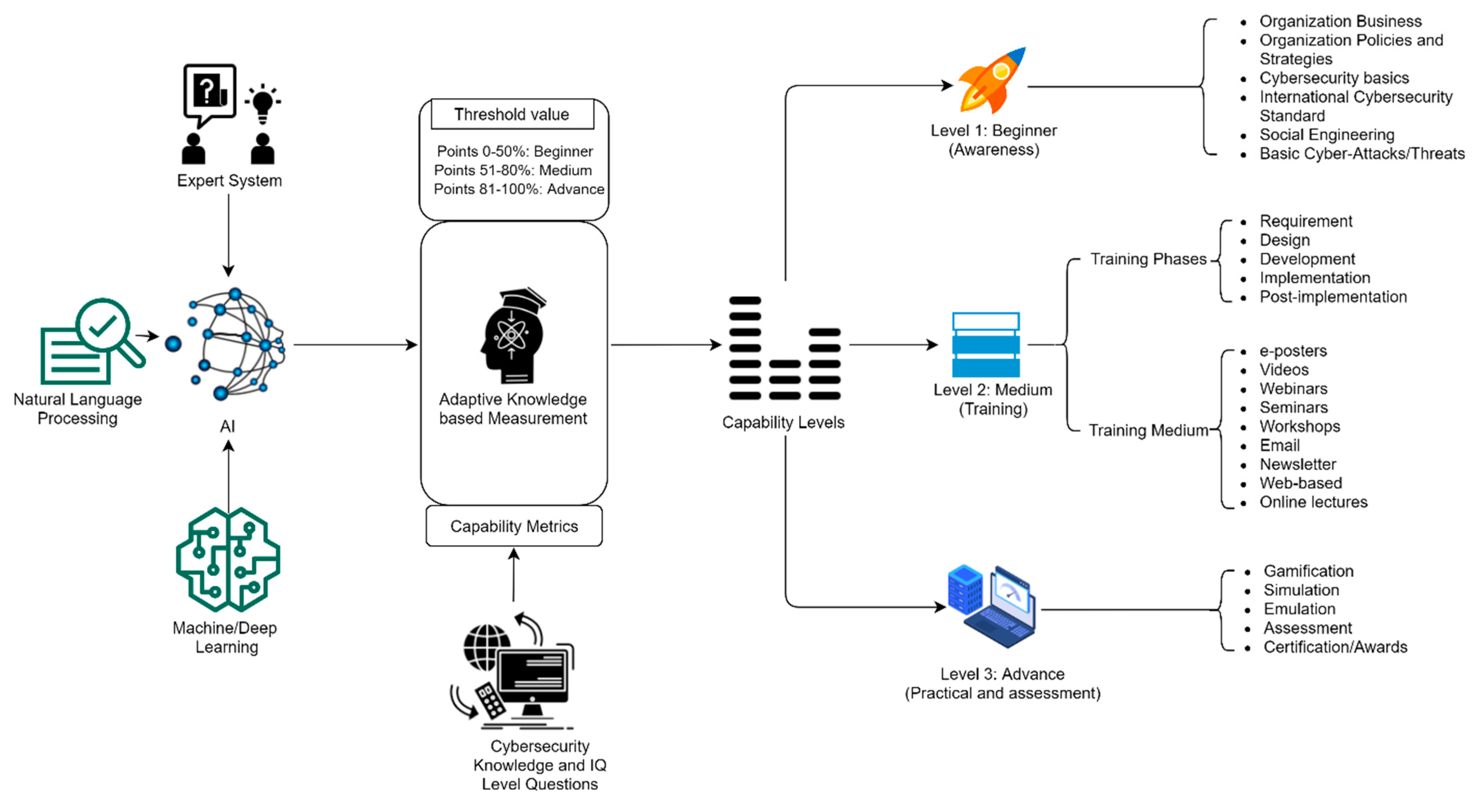
We developed the structure of the proposed CAT framework into three main modules, namely: (1) artificial intelligence (AI), (2) adaptive-knowledge-based measurement, and (3) capability levels. Figure 3 shows a detailed overview of the proposed CAT model.
Figure 3. Entire structure of the CAT framework.

4.3. AI Module

This module is further divided into three main components: machine learning (ML), natural language processing, and expert systems. When applying ML and AI techniques, we will consider and assess security for the proposed framework to avoid any compromise or generation of security risks. According to AWS security guidelines for ML, the basic security measures are data poisoning, membership inference, and model inversion [52]. Implementing these AWS basic features can help to prevent security breaches against AI and ML techniques.

4.3.1. Machine/Deep Learning

Machine and deep learning algorithms are applied for modeling and developing students’ knowledge [53]. Different machine learning and deep learning techniques are used for self-adaptive testing mechanisms. Similarly, these techniques are also applied for developing cybersecurity awareness and training and testing modules to measure trainees’ ability based on their knowledge. Based on the historical data, various machine learning and deep learning techniques are used to predict the improvement and optimization of the training program [54].

4.3.2. Natural Language Processing

Natural language processing is an artificial intelligence technique that is closely used for automated scoring self-adaptive testing systems [55]. The present work includes information gathered from the related text and speech data from natural language processing used by the educational technology and organizations, which addresses the requirements of teachers and students [56]. By using natural language processing, we can automate and improve the cybersecurity awareness and training framework to enhance the automated scoring self-adaptive testing system.

4.3.3. Expert Systems

Within the domain of artificial intelligence, an expert system looks like a computer system mimicking the decision-making ability of a human expert. It is designed to resolve complicated problems by reasoning through bodies of knowledge, characterized primarily as if–then rules. Expert systems are mainly used for educational decision-making [57]. Similarly, Hwang et al. [58] used the expert system approach by bringing into account both the affective and cognitive condition of the individual learner. By applying an expert system to the cybersecurity awareness and training program, we can improve the learning process of the trainee.

4.4. Adaptive-Knowledge-Based Measurement Module

This module has a capability metric for the proceeding three levels (beginner, medium, advanced). The threshold values specified for each level are beginner: 0–50%; medium: 51–80%; and advanced: 81–100%. This module includes cybersecurity knowledge and IQ-level questions written and quantified by the organization according to their domain and nature of system security for their online workforces.

4.5. Capability Levels Module

Capability levels are further divided into the following:

4.5.1. Beginner

This level consists of basic awareness regarding the organization’s cybersecurity. Following are the required key components of this level:
Organization business: This is the working domain of an organization, such as healthcare, finance, transportation, information technology, etc. The organization needs to define its domain and business processes explicitly for its workforces.
Organization policies and strategies: Achievement of an organization is directly associated with how the employees and overall administration perceive the objectives to be realized, and the methods were developed to attain their goals. A strategy is an act that the managers and directors undertake to achieve their organizational goals. A policy is a set of rules and guidelines prepared by the organization for reasonable decision-making. Organizations must introduce their strategies and policies clearly to the employees and other relevant people in the organization to achieve the desired goals and marketing targets.
Cybersecurity basics: This component includes basic knowledge of cybersecurity. The organization must make their employees and administration aware of the basic cybersecurity knowledge. Cybersecurity is established on three important concepts called “The CIA Triad”, which signifies the confidentiality, integrity, and availability that should be defined and conveyed to their employees. Other necessary terms need to be defined, such as: “asset management and identification, risk management, access management, threat management, security controls, disaster recovery and business continuity, incident management, security education, training, and awareness”.
International cybersecurity standard: Cybersecurity standards are collected works of the best practices established by the domain experts to defend organizations from cyber-attacks and threats. The proposed standards and frameworks are usually appropriate for all organizations, irrespective of their size and scope. The organization needs their employees and administration to be aware of the cybersecurity international standards to protect the organization’s assets from cyber-attacks and threats. The major and most well-known international cybersecurity standards include but are not limited to the following: DFARS (Defense Federal Acquisition Regulation Supplement) [59], Federal Information Security Management Act (FISMA) [60], Health Insurance Portability and Accountability Act (HIPAA) [61], ISO 22301 [62], ISO/IEC 27001, ISO/IEC 27031 [63], NIST Cybersecurity Framework (CSF) [64].
Social engineering: Social engineering (SE) is a method frequently used by hackers and cybercriminals to trick people into giving them access to a system by breaking the security practices and standards. The major social engineering cyber-attacks are accomplished through social media platforms, such as Facebook, Twitter, Instagram, Snapchat, and YouTube [4,65,66,67]. Those platforms appeal to hackers because of the public’s deficiency in awareness. The hackers use different social engineering techniques, such as phishing, smashing, vishing, pretexting, dump diving, extortion, etc. The employees of any organization need to be aware of social engineering techniques and their employed mechanism of cyber-attacks and threats.
Basic cyber-attacks and threats: A cyber-attack is a malicious act that seeks to damage data, steal data, or disrupt digital life in general. Organizations are required to train their employees and administration regarding the most common cyber-attacks and threats and to teach them how to manage and mitigate these kinds of cyber-attacks and threats. For example, cyber-attacks and threats consist of “computer viruses, data breaches, malware, spyware, phishing attacks, ransomware, zero-day exploits, advanced persistent threats, trojans, wiper attacks, intellectual property theft, theft of money, data manipulation, data destruction, man-in-the-middle attack, drive-by downloads, malvertising, rogue software, unpatched software, data center disrupted by a natural disaster, Denial of Service (DoS) attacks and other attack vectors”.

4.5.2. Medium

The medium level includes the following training phases and training platforms.
Training phases: The training phases are conducted to train and bring awareness of cybersecurity challenges, attacks, and threats to the organization’s employees. These phases are organized in a systematic structure that consists of the training requirement, design, development, implementation, and post-implementation.
Requirement: Cybersecurity awareness and training requires continuing education that provides employees significant information and an examination of their cybersecurity training and awareness by including all facets of data security and regulatory compliance. Humans are the weakest link in cybersecurity [65,68], and we need to be trained and made aware of the current cybersecurity challenges and trends. This phase is in place to determine the employee or group of employees that need training and awareness. Moreover, by selecting the appropriate medium of training, a company can organize employees’ schedule and benefits to improve learning. Furthermore, cybersecurity topics to be covered are based on the employee’s background cost of training, the scope of the training, strategies, and policies for conducting training, roles and responsibilities, training tutors, and organizers.
Design: This phase must be designed in a manner that keeps the organization’s mission and goals in mind. This phase is significant and supports the business’s needs and is related to the organization’s culture and IT infrastructure. The training design phase defined the overall training model from start to end by keeping all the essential components in mind, such as training all stockholders, seekers, and givers; timeframe; the relevant topics on cybersecurity for training; and presenting clear guidelines.
Development: This is the development and realistic structure of all the components mentioned in the requirement and design phase of the training and awareness process. Moreover, in this step, the components are refined by adding or removing certain components to achieve quality and training satisfaction.
Implementation: This is the actual implementation of the training and awareness programs for the specified online-working-based workforces, keeping in mind the supportive human and non-human resources, understandability level, and appropriate way of delivering the training to the trainee.
Post-implementation: This phase is intended to ensure that the trainees advance from beginner by conducting regular assessments, regular interactions, ensure professional growth, knowledge testing, compile their results, and support improvement. This ensures the trainee achieved the necessary competent knowledge according to their role in the organization.
Training medium: This comprises the medium for conveying the training. The use of training medium depends on the organization requirements, domain, and structure. Following are the training mediums:
  • E-posters
  • Videos
  • Webinars
  • Seminars
  • Workshops
  • Email
  • Newsletters
  • Web-based
  • Online lectures.

4.5.3. Advance

The advanced level includes the practical assessment and normally comes after completing the previous levels. The advanced level includes the following practical and assessment strategies.
Gamification: Researchers and practitioners [69,70,71,72] have been developing games for cybersecurity training because of user interest and interactive interface, offering some gaming challenges and a sharper level of thinking. Learning through gaming establishes an immersive, learner-focused experience. It is an efficient way to enact cybersecurity awareness training with a practical skill achievement for trainees from various qualifications and environment backgrounds. Several games that have already been developed for cybersecurity training are cybersecurity lab [73], zero threats [74], keep tradition secure [75], and game of threats [76,77].
Simulation/Emulation: A simulation/emulation is an animated model that mimics the operation and processes of the proposed cybersecurity system, such as cybersecurity attacks, threats, incidence response, management, and mitigation. Simulations are good for trainees because the learners can damage the actual resources at their initial level of training without presenting the actual environment. Simulation training is possible to conduct online and is less expensive than in-person training. Researchers and practitioners have already worked to provide cybersecurity training simulators [78,79,80,81]. Joseph Mayes from the Software Engineering Institute [82] mentioned that some open source tools for creating cyber simulators are TopoMojo, GreyBox, vTunnel, GHOSTS, and TopGen.
Assessment: The assessment ensures the trainee’s professional growth, knowledge testing, compiles their results, and supports improvement. The assessment checks that the trainee achieved the necessary knowledge according to their roles in the organization.
Certificates/awards: Certificates or awards are given to the employee after successful completion of the cybersecurity training and awareness program.

4.6. Capability Levels and Scoring Criteria of the CAT Framework

The CAT framework consists of three capability levels, which were adopted mainly from the NIST (National Institute of Standards and Technology) “Building an information technology security awareness and training program” and the relevant empirical studies. Following are the capability levels scoring criteria:
  • Beginner
This capability level only includes a basic awareness of cybersecurity. The qualitative point score for this capability level is between 0% and 50%.
  • Medium
This capability level includes the cybersecurity program training. The qualitative point score for this capability level is greater than 50% and less than or equal to 80%.
  • Advanced
This capability level includes the comprehensive reviews and the practical and final assessment of the cybersecurity awareness and training program. The qualitative point score for this capability level is greater than 80% and less than or equal to 100%.
The capability levels’ percentage range values can be modified by the organization according to their priorities without affecting the capability levels and the overall measurement of the proposed framework.
The CAT framework adopted the range values from the IBM (RUP) process area, and the exclusion of percentages in the IBM process area was replaced by corresponding number values beginning at 1, equal to the beginner capability level, 2 for medium, and, finally, 3 for advanced. Then, multiply the percentage values with the highest-level scale in our circumstance, which is 3, to achieve the equivalent value for each capability level. For example, 0.50 × 3 is equal to 1.5, 0.80 × 3 is equal to 2.4, and, finally, 0.100 × 3 is equal to 3. The median range has been calculated and adopted from the study conducted by Grundmann [60]. We used SCAMPI [61] for the assessment of our practice’s capability as it is commonly used to support quality scoring benchmarks. SCAMPI was utilized as an appraisal concept and structure in order to evaluate the capability of every practice and the CAT framework. Table 2 shows the value range in detail with the capability levels according to IBM (RUP).
Table 2. Scoring criteria of the CAT framework.

5. Evaluation of CAT

Two case studies were conducted to evaluate the CAT framework in a real-world environment within a reputed cybersecurity international organization. Cybersecurity experts and engineers along with their teams from the selected organizations agreed to contribute to the case studies. They showed a desire to measure the capability of the practices that are defined in the proposed CAT framework in their organizations. Our research team provided all the applicable complete documentation and guidelines for efficiently conducting the case studies to avoid any biases and mistakes. Our research team provided participants with an Excel spreadsheet containing the levels and practices that were developed in the proposed CAT framework.
The conducted case studies of two selected organizations are mentioned in Section 5.1.1 and Section 5.1.2. The main purpose of the provided Excel sheets was to take the opinions and suggestions in digits (assigned numbers) in the case studies and post-case-study surveys from the security experts. Through scripting, the Excel sheet can automatically calculate the median of the input opinions of the experts. The high-rank security experts of the specific organizations conducted case studies with their respective colleagues in a one-month time frame. Examples of the Excel sheet are shown in Appendix A.
We requested that the participants assess every practice of the CAT framework for the mentioned capability levels, assigning point values per the following:
  • If the organization did not apply the practice of the CAT framework.
  • If the organization partially applied the practice of the CAT framework.
  • If the organization completely performed applied the practice of the CAT framework.

5.1. Case Study

Case study [48] is a research approach that is commonly used by various fields, such as life sciences, social sciences, and different engineering disciplines, to validate the intended case or experiment in a practical environment. It is established on formal research, and most researchers use this method with research to be published in journals and conferences. A case study contains both qualitative and quantitative methods and is mainly used for validation purposes of theoretical and conceptual models and frameworks. A case study is typically the intersection of evidence from collection methods, such as interviews, observations, questionnaires, and archives [49].

5.1.1. Organization I

According to the demographics of organization I, it is an international private cybersecurity organization located in Pakistan, and over 60 employees are working in this organization. It delivers cybersecurity solutions, penetration testing, and consultations. The working domain in which this organization provides its services is safety-critical systems, business systems, communications, and real-time systems. The case study was conducted at the main branch of this organization. The responses for the case study were submitted by the senior cybersecurity team lead, who has more than 8 years of experience. The following levels of results were achieved from organization I.
Beginner
The median of this level of evaluation is 2, which is the awareness level of the CAT framework. This cybersecurity organization has not reached the highest capability level. If this organization wants to jump into the highest level of capability in this phase, then they must follow and implement the other practices in the beginner and medium levels. Furthermore, the organization must work on all practices except organizational policies and strategies and cybersecurity basic knowledge, which is already at the advanced capability level.
Medium
The median of this evaluation level is 2, which is the training capability level of the CAT framework. Similarly, this cybersecurity organization has not reached the highest capability level. If this organization wants to grow to the highest level of capability in cybersecurity awareness and training, then they must follow and implement the other practices that are marked as the beginner and medium levels in the case study of the proposed CAT framework. This level needs more effort with the practices in the beginner and medium levels, especially the training phases practices. Efforts are needed in all practices except email and web-based training platforms because they have achieved advanced capability level in those practices.
Advanced
The median of this evaluation level is 2, which is the practical and assessment capability level of the CAT framework, as in the other levels. If this organization wants to grow towards the highest level of capability, then it must follow and implement the other practices that are marked with beginner and medium capability levels. The practical and assessment are almost in the beginner and medium capability levels. They only had two practices at the highest capability level, which shows a clear indication and needs more work to achieve the advanced capability level.
The overall outcomes of the case study evaluation of organization I are quite near the advanced level of the CAT framework. They have achieved the medium capability level. Then again, the organization still needs to implement more practices of the overall three levels of the CAT framework because security is the most significant factor of any organization in protecting their critical assets and information. Some practices and certain levels still need to be advanced by reaching the advanced level of the CAT framework.

5.1.2. Organization II

Organization II is an international private cybersecurity organization. Its offices are located in the three major cities of Pakistan. It is an independent organization providing solutions and training in the cybersecurity domain. The case study was conducted at the main branch. More than 100 employees work in this organization, and 400-plus clients are registered worldwide. Similarly, they have trained over 1500 information security professionals. They deliver both national and multi-national services. They work in the security management, maturity assessment, security consultancy, security awareness, and assessment domains. The responses to the case study were provided by the senior information security officer, who has more than 10 years of experience. This organization case study gives us more confidence in the proposed CAT framework because it provides awareness and training programs to cybersecurity professionals.
Beginner
The median of this evaluation level is 2, which is the awareness capability level of the CAT framework. This software organization has not reached the highest capability level. In this level, only one practice achieved the beginner capability level, which is social engineering, and one practice attained the advanced level, which is cybersecurity basics. All the other practices were achieved at the medium capability.
Medium
The median of this evaluation level is also 2, which is the training capability level of the proposed CAT framework. The training development and email and web-based training platforms had a quite good evaluation and almost reached the highest advanced capability level. However, five practices had the lowest beginner capability level, specifically online lecture training platform and requirement, design, and post-implementation of training. The other remaining practices are at the medium capability level, so more effort is required to achieve the advanced capability levels.
Advanced
As with the other two levels, the median of this evaluation level is also 2, which is the medium capability level of the CAT framework. Two practices, simulation and emulation, fell at the beginner level, and one practice, known as assessment, received the medium level. However, this organization is more focused on gamification and certification/wards. If this organization wants to obtain the highest level of capability in this level, then they must follow and implement the other practices that are marked with beginner and medium capability levels.
The overall outcomes of the case study evaluation for organization II are relatively near the advanced level of the proposed CAT framework. However, the organization still needs to implement more practices of the overall three levels of the CAT framework. This organization is quite good compared to organization I because it is conducting and providing more focus to training and certification of cybersecurity professionals.

6. The Post-Case-Study Feedback Questionnaire from Case Studies Implemented by Organizations

After the completion of the case studies from both organizations, the contributors were invited to complete a post-case-study questionnaire to offer their opinion about the CAT framework structure, user satisfaction, and ease of use. The responses about the CAT framework were carefully assessed and evaluated for the goal of improvement. The tables and success criteria for each table were adopted from the published study by Mufti et al. [83].
In the first phase, we requested that the organizations evaluate the ease of use of the CAT framework, and both organizations I and II agreed and strongly agreed that the CAT framework is easy to comprehend and use. The contributors of the questionnaire have grasped the background and had important knowledge regarding cybersecurity, practices, and processes. Table 3 includes the ease-of-use evaluation.
Table 3. CAT framework ease of use evaluation from both organization I and Organization II.
In the second phase, we asked the participants about the user satisfaction of the CAT framework. The user satisfaction was measured and evaluated based on the CAT framework outcomes. Both organization I and organization II agreed and strongly agreed about the satisfaction of the CAT framework, and they suggested the CAT framework to other organizations as well. Table 4 shows the user satisfaction evaluation.
Table 4. CAT framework user satisfaction evaluation from both organization I and organization II.
In the third phase, we asked the participants about the structure of the CAT framework. Both organizations evaluated and measured the structure of the CAT framework. They provided us very positive reactions regarding the simplicity of the structure and CAT framework organization. Moreover, they most strongly agreed on the proposed levels and practices, and especially the placement position of the practices in each level of the CAT framework. Table 5 shows the MMSST structure evaluation.
Table 5. CAT framework structure evaluation from both organization I and organization II.
In the final phase, we requested that the questionnaire contributors provide successful and considerable suggestions to improve the proposed CAT framework. However, we did not receive any potential comments or suggestions from either organization I or II, which clearly revealed that the proposed CAT framework could assess the employees’ awareness and training on the perspective of cybersecurity. The post-case-study comments from both organizations I and II are shown in Table 6.
Table 6. CAT framework post-case-study responses from both organization I and organization II.

7. Study Limitations

The case study request was sent to many organizations, but most of them were reluctant to complete the case study and provide us their responses. The cause may be hesitation regarding the organization’s reputation and privacy. However, we explicitly stated in the proposed case study instructions that the information would be held in the strictest confidence. For the proposed CAT framework generalization, we are seeking a few more reputed cybersecurity-relevant organizations around the globe to contribute to the proposed case studies. The assessment results of the CAT framework were obtained from two international and reputed cybersecurity organizations.
Another potential limitation is related to the literature review process regarding that some research papers may have been overlooked. However, we believe that our results cover most of the appropriate published research studies. Further, it is probable that subjective decisions had an impact regarding collection of major research studies in the information mining stages because some of the major research studies did not utilize organized abstracts, concise descriptions in the discussion section, and clear contributions of their research work. However, to lessen this constraint, the authors endeavored to carry out the literature review process as well as possible in order to obtain rich information.

8. Conclusions and Future Work

Cybersecurity is currently an emergent research area due to a variety of cyber-attacks that precede massive financial loss to organizations’ reputations. Researchers and practitioners now consider cybersecurity critical due to different cyber threats and attacks on various organizations during the COVID-19 pandemic. Organizations are attempting to protect essential assets and information from different kinds of hackers and threat actors. The main objective of this research was to develop a CAT framework to assist different domain organizations in protecting their key assets and information from those threats. Organizations need to implement the proposed CAT framework to provide awareness to and train their employees regarding the recent social-engineering-based cyber-attacks and threats. The proposed CAT framework will help organizations to identify their cybersecurity-relevant weaknesses in their systems and measure their employees’ capability toward cyber threats, attacks, and incidence management. Moreover, implementing the categorized practices of each level of the CAT framework will improve the organization’s security infrastructure. A comprehensive literature review was conducted to point out the potential practices of the proposed framework from the perspectives of experienced researchers in the domain of cybersecurity.
The structure of the proposed CAT framework includes three main levels: beginner (awareness), medium (training), and advanced (practical and assessment). Similarly, we identified a total of 25 most important practices for achieving the developed levels. A case study was established and conducted for evaluation of the proposed CAT framework within cybersecurity organizations for validation and further improvement purposes. Case studies were implemented in two organizations only at the initial stage, and the results were achieved. The obtained results gave us more confidence in our proposed CAT framework because both organizations gained a medium level. However, they still need to implement more practices from the overall three levels of the CAT framework because security is the most crucial factor in protecting their organizational core assets and information.
In future work, we will compare our proposed CAT framework with other cybersecurity training and awareness frameworks that are already in the operational stage to obtain a more transparent view of the practical implementation by the organizations. Moreover, we will propose an automated software tool in combination with AI for the proposed CAT framework. The software tool will support organizations in easy implementation and measurement of their employees’ cybersecurity awareness and training capability in real time.

Author Contributions

Conceptualization, M.H. and G.A.; methodology, G.A.; case study conduction and validation, M.H. and G.A.; statistical analysis, G.A.; writing—original draft preparation, M.H. and G.A.; writing—review and editing, M.H. and G.A.; visualization, G.A.; supervision, M.H.; project administration, M.H.; funding acquisition, M.H. All authors have read and agreed to the published version of the manuscript.

Funding

This research received no external funding.

Institutional Review Board Statement

There is no institutional review board statement.

Data Availability Statement

The data are available upon request via corresponding author email.

Acknowledgments

The authors would like to acknowledge the support provided by the Industrial Innovation and Robotics Center at the University of Tabuk, Saudi Arabia.

Conflicts of Interest

The authors declare no conflict of interest.

Appendix A

Table A1. Case Study Excel Sheet Example of an Anonymous Organization.
Please Fill Each Rows ofTable 1, Table 2 and Table 3 with One of These Values Except the Yellow Colour Row
1If this level is Beginner applied for Awareness capability.
2If this level is Mediumapplied for training capability.
3If this level is Advanceapplied for practical and assessment capability.
Range value in % by IBMRange of Average Value for CAT frameworkCapability Level
10–50%If 0 <Avg. <= 1.5Beginner
251–80%If 1.5 <Avg. <= 2.4Medium
381–100%If 2.4 <Avg. <= 3Advance
IDLevel and PracticesAwareness Level
BeginnerMediumAdvance
Level 1Awareness123
P1.1   Organization business 3
P1.2   Organization polices and strategies 3
P1.3   Cybersecurity basics 2
P1.4   International cybersecurity standards 2
P1.5   Social engineering 2
P1.6   Basic cyber-attacks and threats 2
2
The Outcome of SCAMPI Appraisal for CAT framework awareness level practices which the organization covers is:MedianAppraisal of Organization Using SCAMPI
2Medium
IDLevel and PracticesTraining Level
UnderstandingImprovementAdvance
level 2Training123
   Training phases
P2.1   Requirements 2
P2.2   Design the peer review1
P2.3   Development 2
P2.4   Implementation 2
P2.5   Post-implementation1
   Training Medium
P 2.6   E-poster 3
P 2.7   Videos 3
P 2.8   Webinars 2
P 2.9   Seminars 2
P 2.10   Workshops1
P 2.11   Email 2
P 2.12   Newsletter 3
P 2.13   Web-based 2
P 2.14   Online lectures 2
2
The Outcome of SCAMPI Appraisal for CAT framework training level practices which the organization covers is:MedianAppraisal of Organization Using SCAMPI
2Medium
IDLevel and PracticesPractical and Assessment Level
UnderstandingImprovementAdvance
Level 3Practical and assessment123
P 3.1   Gamification 2
P 3.2   Simulation 2
P 3.3   Emulation1
P 3.4   Assessment 2
P 3.5   Certification/Awards 2
2
The Outcome of SCAMPI Apprisal for CAT framework practical and assessment level practices which the organazation covers is:MedianAppraisal of Organization Using SCAMPI
2Medium
Overall Summary Report of CAT Framework within Organization Case Study:
No.Three Levels of CAT FrameworkMedianAppraisal of Cybersecurity Organization Using SCAMPI
1   Awareness2Medium
2   Training2Medium
3   Practical and Assessment2Medium

References

  1. Kemmerer, R.A. Cybersecurity. In Proceedings of the 25th International Conference on Software Engineering, Portland, OR, USA, 3–10 May 2003; pp. 705–715. [Google Scholar] [CrossRef]
  2. Khan, F.; Zahid, M.; Gürüler, H.; Tarımer, İ.; Whangbo, T. An Efficient and Reliable Multicasting for Smart Cities. Comput. Mater. Contin. 2022, 72, 663–678. [Google Scholar] [CrossRef]
  3. Impact of COVID-19 on Cybersecurity. Deloitte Switzerland. Available online: https://www2.deloitte.com/ch/en/pages/risk/articles/impact-covid-cybersecurity.html (accessed on 3 April 2021).
  4. Hijji, M.; Alam, G. A Multivocal Literature Review on Growing Social Engineering Based Cyber-Attacks/Threats During the COVID-19 Pandemic: Challenges and Prospective Solutions. IEEE Access 2021, 9, 7152–7169. [Google Scholar] [CrossRef] [PubMed]
  5. Sabillon, R.; Serra-Ruiz, J.; Cavaller, V. An effective cybersecurity training model to support an organizational awareness program: The Cybersecurity Awareness TRAining Model (CATRAM). A Case Study in Canada. J. Cases Inf. Technol. JCIT 2019, 21, 26–39. [Google Scholar] [CrossRef]
  6. Rajamäki, J.; Nevmerzhitskaya, J.; Virág, C. Cybersecurity education and training in hospitals: Proactive resilience educational framework (Prosilience EF). In Proceedings of the 2018 IEEE Global Engineering Education Conference (EDUCON), Santa Cruz de Tenerife, Spain, 17–20 April 2018; pp. 2042–2046. [Google Scholar] [CrossRef]
  7. Toward Sustainable Behaviour Change: An Approach for Cyber Security Education Training and Awareness|Semantic Scholar. Available online: https://www.semanticscholar.org/paper/Toward-Sustainable-behaviour-Change%3A-an-Approach-Alshaikh-Naseer/35cf5519240bb2aa624a21132c762159511bb3f4 (accessed on 31 January 2021).
  8. Hash, J.; Wilson, M. Building an information technology security awareness and training program. Natl. Inst. Stand. Technol. NIST 2012, 800–850. [Google Scholar]
  9. ISO. ISO 9126/ISO, IEC (Hrsg.): International Standard ISO/IEC 9126: Information Technology-Software Product Evaluation. Qual. Charact. Guidel. Their Use 1991, 12–15. [Google Scholar]
  10. Realpe-Munoz, P.; Collazos, C.A.; Hurtado, J.; Granollers, T.; Velasco-Medina, J. An integration of usable security and user authentication into the ISO 9241-210 and ISO/IEC 25010: 2011. In Proceedings of the International Conference on Human Aspects of Information Security, Privacy, and Trust, Toronto, ON, Canada, 17–22 July 2016; pp. 65–76. [Google Scholar]
  11. McGraw, G. Software Security: Building Security; Addison-Wesley Professional: Boston, MA, USA, 2006; Volume 1. [Google Scholar]
  12. Bowen, P.; Kissel, R. Program Review for Information Security Management Assistance (PRISMA); US Department of Commerce; Technology Administration; National Institute of Standards and Technology: Gaithersburg, MD, USA, 2007.
  13. Mouratidis, H.; Giorgini, P. Security Attack Testing (SAT)—Testing the security of information systems at design time. Inf. Syst. 2007, 32, 1166–1183. [Google Scholar] [CrossRef]
  14. Dhillon, G. Principles of Information Systems Security: Texts and Cases; John Wiley & Sons Incorporated: Hoboken, NJ, USA, 2007. [Google Scholar]
  15. Al Hanaei, E.H.; Rashid, A. DF-C2M2: A capability maturity model for digital forensics organisations. In Proceedings of the 2014 IEEE Security and Privacy Workshops, San Jose, CA, USA, 17–18 May 2014; pp. 57–60. [Google Scholar]
  16. Khan, F.; Ahmad, S.; Gürüler, H.; Cetin, G.; Whangbo, T.; Kim, C.-G. An Efficient and Reliable Algorithm for Wireless Sensor Network. Sensors 2021, 21, 8355. [Google Scholar] [CrossRef]
  17. Woodhouse, S. An ISMS (Im)-Maturity Capability Model. In Proceedings of the 2008 IEEE 8th International Conference on Computer and Information Technology Workshops, Sydney, NSW, Australia, 8–11 July 2008; pp. 242–247. [Google Scholar] [CrossRef]
  18. Almuhammadi, S.; Al-Saleh, M.A. Information Security Maturity Model for Nist Cyber Security Framework. Comput. Sci. Inf. Technol. CS IT 2017, 7, 51–62. [Google Scholar] [CrossRef]
  19. Kassou, M.; Kjiri, L. SOASMM: A novel service oriented architecture Security Maturity Model. In Proceedings of the 2012 International Conference on Multimedia Computing and Systems, Tangiers, Morocco, 10–12 May 2012. [Google Scholar] [CrossRef]
  20. White, G.B. The community cyber security maturity model. In Proceedings of the 2011 IEEE International Conference on Technologies for Homeland Security (HST), Waltham, MA, USA, 15–17 November 2011. [Google Scholar] [CrossRef]
  21. Thomson, K.-L.; von Solms, R. Towards an Information Security Competence Maturity Model. Comput. Fraud Secur. 2006, 2006, 11–15. [Google Scholar] [CrossRef]
  22. Ghazvini, A.; Shukur, Z. A Framework for an Effective Information Security Awareness Program in Healthcare. Int. J. Adv. Comput. Sci. Appl. 2017, 8, 193–205. [Google Scholar] [CrossRef]
  23. Aliyu, A.; Maglaras, L.; He, Y.; Yevseyeva, I.; Boiten, E.; Cook, A.; Janicke, H. A Holistic Cybersecurity Maturity Assessment Framework for Higher Education Institutions in the United Kingdom. Appl. Sci. 2020, 10, 3660. [Google Scholar] [CrossRef]
  24. Knight, R.; Nurse, J.R. A framework for effective corporate communication after cyber security incidents. Comput. Secur. 2020, 99, 102036. [Google Scholar] [CrossRef]
  25. Hong, W.C.H.; Chi, C.; Liu, J.; Zhang, Y.; Lei, V.N.-L.; Xu, X. The influence of social education level on cybersecurity awareness and behaviour: A comparative study of university students and working graduates. Educ. Inf. Technol. 2022, 1–32. [Google Scholar] [CrossRef] [PubMed]
  26. Sabillon, R.; The Cybersecurity Awareness Training Model (CATRAM). Research Anthology on Advancements in Cybersecurity Education. 2022. Available online: https://www.igi-global.com/chapter/the-cybersecurity-awareness-training-model-catram/www.igi-global.com/chapter/the-cybersecurity-awareness-training-model-catram/292128 (accessed on 19 September 2022).
  27. Alghamdi, M.I. Determining the impact of cyber security awareness on employee behaviour: A case of Saudi Arabia. Mater. Today Proc. 2021. [Google Scholar] [CrossRef]
  28. Ungkap, P.; Daengsi, T. Cybersecurity Awareness Modeling Associated with Influential Factors Using AHP Technique: A Case of Railway Organizations in Thailand. In Proceedings of the 2022 International Conference on Decision Aid Sciences and Applications (DASA), Chiangrai, Thailand, 23–25 March 2022; pp. 1359–1362. [Google Scholar] [CrossRef]
  29. Daengsi, T.; Wuttidittachotti, P.; Pornpongtechavanich, P.; Utakrit, N. A Comparative Study of Cybersecurity Awareness on Phishing among Employees from Different Departments in an Organization. In Proceedings of the 2021 2nd International Conference on Smart Computing and Electronic Enterprise (ICSCEE), Cameron Highlands, Malaysia, 15–17 June 2021; pp. 102–106. [Google Scholar] [CrossRef]
  30. Back, S.; Guerette, R.T. Cyber Place Management and Crime Prevention: The Effectiveness of Cybersecurity Awareness Training Against Phishing Attacks. J. Contemp. Crim. Justice 2021, 37, 427–451. [Google Scholar] [CrossRef]
  31. Corallo, A.; Lazoi, M.; Lezzi, M.; Luperto, A. Cybersecurity awareness in the context of the Industrial Internet of Things: A systematic literature review. Comput. Ind. 2022, 137, 103614. [Google Scholar] [CrossRef]
  32. Zhang-Kennedy, L.; Chiasson, S. A Systematic Review of Multimedia Tools for Cybersecurity Awareness and Education. ACM Comput. Surv. 2022, 54, 1–39. [Google Scholar] [CrossRef]
  33. Bou, H. National Cyber Governance Awareness Policy and Framework. Int. J. Leg. Inf. 2019, 47, 70–89. [Google Scholar]
  34. Georgiadou, A.; Mouzakitis, S.; Bounas, K.; Askounis, D. A Cyber-Security Culture Framework for Assessing Organization Readiness. J. Comput. Inf. Syst. 2020, 62, 452–462. [Google Scholar] [CrossRef]
  35. Conceptual Model of Visual Analytics for Hands-on Cybersecurity Training-IEEE Journals & Magazine. Available online: https://ieeexplore.ieee.org/document/9018081 (accessed on 31 January 2021).
  36. Khan, F.; Tarimer, I.; Taekeun, W. Factor Model for Online Education during the COVID-19 Pandemic Using the IoT. Process 2022, 10, 1419. [Google Scholar] [CrossRef]
  37. Dash, B.; Ansari, M.F. An Effective Cybersecurity Awareness Training Model: First Defense of an Organizational Security Strategy. Int. Res. J. Eng. Technol. (IRJET) 2022, 9. [Google Scholar]
  38. Hodhod, R.; Wang, S.; Khan, S. Cybersecurity Curriculum Development Using AI and Decision Support Expert System. Int. J. Comput. Theory Eng. 2018, 10, 111–115. [Google Scholar] [CrossRef]
  39. Bahl, A.; Sharma, A.; Asghar, M.R. Vulnerability disclosure and cybersecurity awareness campaigns on twitter during COVID -19. Secur. Priv. 2021, 4, e180. [Google Scholar] [CrossRef]
  40. Marnewick, A.; Von Solms, S. The Development of Cybersecurity Awareness Measurement Model in the Water Sector. In Proceedings of the 17th International Conference on Cyber Warfare and Security, Albany, NY, USA, 17–18 March 2022; Volume 17, pp. 211–218. [Google Scholar] [CrossRef]
  41. Yusif, S.; Hafeez-Baig, A. A Conceptual Model for Cybersecurity Governance. J. Appl. Secur. Res. 2021, 16, 490–513. [Google Scholar] [CrossRef]
  42. Khader, M.; Karam, M.; Fares, H. Cybersecurity Awareness Framework for Academia. Information 2021, 12, 417. [Google Scholar] [CrossRef]
  43. Trim, P.; Lee, Y.-I. The Global Cyber Security Model: Counteracting Cyber Attacks through a Resilient Partnership Arrangement. Big Data Cogn. Comput. 2021, 5, 32. [Google Scholar] [CrossRef]
  44. Khan, F.; Khan, A.W.; Khan, S.; Qasim, I.; Habib, A. A secure core-assisted multicast routing protocol in mobile ad-hoc network. J. Internet Technol. 2020, 21, 375–383. [Google Scholar]
  45. Ahmed, S.R. Secure Software Development: Identification of Security Activities and Their Integration in Software Development Lifecycle. 2007. Available online: https://www.semanticscholar.org (accessed on 2 January 2021).
  46. Almusaher, H.; Alam, G. How Feasible Moving Target Defense is Within ICS Environment. In Proceedings of the International Petroleum Technology Conference, Dhahran, Saudi Arabia, 13–15 January 2020. [Google Scholar] [CrossRef]
  47. Abbas, S.; Abu Talib, M.; Ahmed, A.; Khan, F.; Ahmad, S.; Kim, D.-H. Blockchain-Based Authentication in Internet of Vehicles: A Survey. Sensors 2021, 21, 7927. [Google Scholar] [CrossRef]
  48. Yin, R.K. Case study research: Design and methods Sage publications. Thousand Oaks 2009, 5. [Google Scholar]
  49. Eisenhardt, K.M. Building theories from case study research. Acad. Manage. Rev. 1989, 14, 532–550. [Google Scholar] [CrossRef]
  50. Federal Information Security Management Act of 2002. Wikipedia. 2 January 2021. Available online: https://en.wikipedia.org/w/index.php?title=Federal_Information_Security_Management_Act_of_2002&oldid=997751107 (accessed on 8 March 2021).
  51. Office of Management and Budget. The White House. Available online: https://www.whitehouse.gov/omb/ (accessed on 8 March 2021).
  52. 7 Ways to Improve Security of Your Machine Learning Workflows|AWS Security Blog. 31 March 2021. Available online: https://aws.amazon.com/blogs/security/7-ways-to-improve-security-of-your-machine-learning-workflows/ (accessed on 20 September 2022).
  53. Šerbec, I.N.; Žerovnik, A.; Rugelj, J. Machine Learning Algorithms Used for Adaptive Modelling. J. Appl. Econ. Bus. 2013, 1, 5–12. [Google Scholar]
  54. CyberSift, Machine Learning Techniques Applied to Cyber Security, Medium, 10 September 2017. Available online: https://towardsdatascience.com/machine-learning-techniques-applied-to-cyber-security-d58a8995b7d7 (accessed on 9 March 2021).
  55. Madnani, N.; Aoife, C. Automated scoring: Beyond natural language processing. In Proceedings of the 27th International Conference on Computational Linguistics, Santa Fe, NM, USA, August 2018; pp. 1099–1109. [Google Scholar]
  56. Litman, D. Natural Language Processing for Enhancing Teaching and Learning. Proc. Conf. AAAI Artif. Intell. 2016, 30. Available online: https://ojs.aaai.org/index.php/AAAI/article/view/9879 (accessed on 9 March 2021). [CrossRef]
  57. Haynes, J.A.; Pilato, V.H.; Malouf, D.B. Expert Systems for Educational Decision-Making. Educ. Technol. 1987, 27, 37–42. Available online: https://www.jstor.org/stable/44424889 (accessed on 9 March 2021).
  58. Hwang, G.-J.; Sung, H.-Y.; Chang, S.-C.; Huang, X.-C. A fuzzy expert system-based adaptive learning approach to improving students’ learning performances by considering affective and cognitive factors. Comput. Educ. Artif. Intell. 2020, 1, 100003. [Google Scholar] [CrossRef]
  59. DFARS|Acquisition.GOV. Available online: https://www.acquisition.gov/dfars (accessed on 8 March 2021).
  60. Federal Information Security Modernization Act|CISA. Available online: https://www.cisa.gov/federal-information-security-modernization-act (accessed on 8 March 2021).
  61. Health Insurance Portability and Accountability Act|IT Governance USA. Available online: https://itgovernanceusa.com/hipaa (accessed on 8 March 2021).
  62. 14:00–17:00, ISO 22301:2019, ISO. Available online: https://www.iso.org/cms/render/live/en/sites/isoorg/contents/data/standard/07/51/75106.html (accessed on 8 March 2021).
  63. ISO-ISO/IEC 27001—Information Security Management. Available online: https://www.iso.org/isoiec-27001-information-security.html (accessed on 8 March 2021).
  64. NIST Cybersecurity Framework (CSF)|IT Governance USA. Available online: https://itgovernanceusa.com/nist-cybersecurity-framework (accessed on 8 March 2021).
  65. Krombholz, K.; Hobel, H.; Huber, M.; Weippl, E. Advanced social engineering attacks. J. Inf. Secur. Appl. 2015, 22, 113–122. [Google Scholar] [CrossRef]
  66. Abraham, S.; Chengalur-Smith, I. An overview of social engineering malware: Trends, tactics, and implications. Technol. Soc. 2010, 32, 183–196. [Google Scholar] [CrossRef]
  67. Irani, D.; Balduzzi, M.; Balzarotti, D.; Kirda, E.; Pu, C. Reverse social engineering attacks in online social networks. In Proceedings of the International Conference on Detection of Intrusions and Malware, and Vulnerability Assessment; Springer: Berlin/Heidelberg, Germany, 2011; pp. 55–74. [Google Scholar]
  68. Mouton, F.; Leenen, L.; Venter, H.S. Social engineering attack examples, templates and scenarios. Comput. Secur. 2016, 59, 186–209. [Google Scholar] [CrossRef]
  69. Cone, B.D.; Thompson, M.F.; Irvine, C.E.; Nguyen, T.D. Cyber Security Training and Awareness Through Game Play. In IFIP International Information Security Conference; Springer: Boston, MA, USA, 2006; Volume 201, pp. 431–436. [Google Scholar] [CrossRef]
  70. Hendrix, M.; Al-Sherbaz, A.; Bloom, V. Game Based Cyber Security Training: Are Serious Games suitable for cyber security training? Int. J. Serious Games 2016, 3, 1. [Google Scholar] [CrossRef]
  71. Cone, B.D.; Irvine, C.E.; Thompson, M.F.; Nguyen, T.D. A video game for cyber security training and awareness. Comput. Secur. 2007, 26, 63–72. [Google Scholar] [CrossRef]
  72. Shunami, B. Council Post: The Gamification of Cybersecurity Training. Forbes. Available online: https://www.forbes.com/sites/forbestechcouncil/2020/03/17/the-gamification-of-cybersecurity-training/ (accessed on 9 March 2021).
  73. Cybersecurity|NOVA Labs|PBS. Available online: https://www.pbs.org/wgbh/nova/labs/lab/cyber/ (accessed on 9 March 2021).
  74. LEO GRC Academy|Innovative Digital Learning|LEO Learning. Available online: https://leolearning.com/leo-grc-academy/ (accessed on 9 March 2021).
  75. Welcome|Keep Tradition Secure. Available online: https://keeptraditionsecure.tamu.edu/ (accessed on 9 March 2021).
  76. PricewaterhouseCoopers, Game of Threats. PwC. Available online: https://www.pwc.co.uk/issues/cyber-security-services/game-of-threats.html (accessed on 9 March 2021).
  77. Ahmad, S.; Khan, F.; Whangbo, T.K. Performance Evaluation of Topological Infrastructure in Internet-of-Things-Enabled Serious Games. Comput. Mater. Contin. 2022, 71, 2653–2666. [Google Scholar] [CrossRef]
  78. Wen, Z.A.; Lin, Z.; Chen, R.; Andersen, E. What.Hack: Engaging Anti-Phishing Training Through a Role-playing Phishing Simulation Game. In Proceedings of the Proceedings of the 2019 CHI Conference on Human Factors in Computing Systems, New York, NY, USA, 2 May 2019; pp. 1–12. [Google Scholar] [CrossRef]
  79. Jalali, M.S.; Siegel, M.; Madnick, S. Decision-making and biases in cybersecurity capability development: Evidence from a simulation game experiment. J. Strat. Inf. Syst. 2018, 28, 66–82. [Google Scholar] [CrossRef]
  80. Burris, J.; Deneke, W.; Maulding, B. Activity Simulation for Experiential Learning in Cybersecurity Workforce Development. In Proceedings of the HCI in Business, Government, and Organizations, Cham, Switzerland, 15 July 2018; pp. 17–25. [Google Scholar] [CrossRef]
  81. Mehmood, S.; Ahmad, I.; Khan, M.A.; Khan, F.; Whangbo, T. Sentiment Analysis in Social Media for Competitive Environment Using Content Analysis. Comput. Mater. Contin. 2022, 71, 5603–5618. [Google Scholar] [CrossRef]
  82. Six Free Tools for Creating a Cyber Simulator. Available online: https://insights.sei.cmu.edu/sei_blog/2019/04/six-free-tools-for-creating-a-cyber-simulator.html (accessed on 9 March 2021).
  83. Mufti, Y.; Niazi, M.; Alshayeb, M.; Mahmood, S. A Readiness Model for Security Requirements Engineering. IEEE Access 2018, 6, 28611–28631. [Google Scholar] [CrossRef]
Publisher’s Note: MDPI stays neutral with regard to jurisdictional claims in published maps and institutional affiliations.

Article Metrics

Citations

Article Access Statistics

Multiple requests from the same IP address are counted as one view.