


Disordered Eating among People with Schizophrenia Spectrum Disorders: A Systematic Review
 , , ,
, , ,
Abstract
1. Introduction
2. Materials and Methods
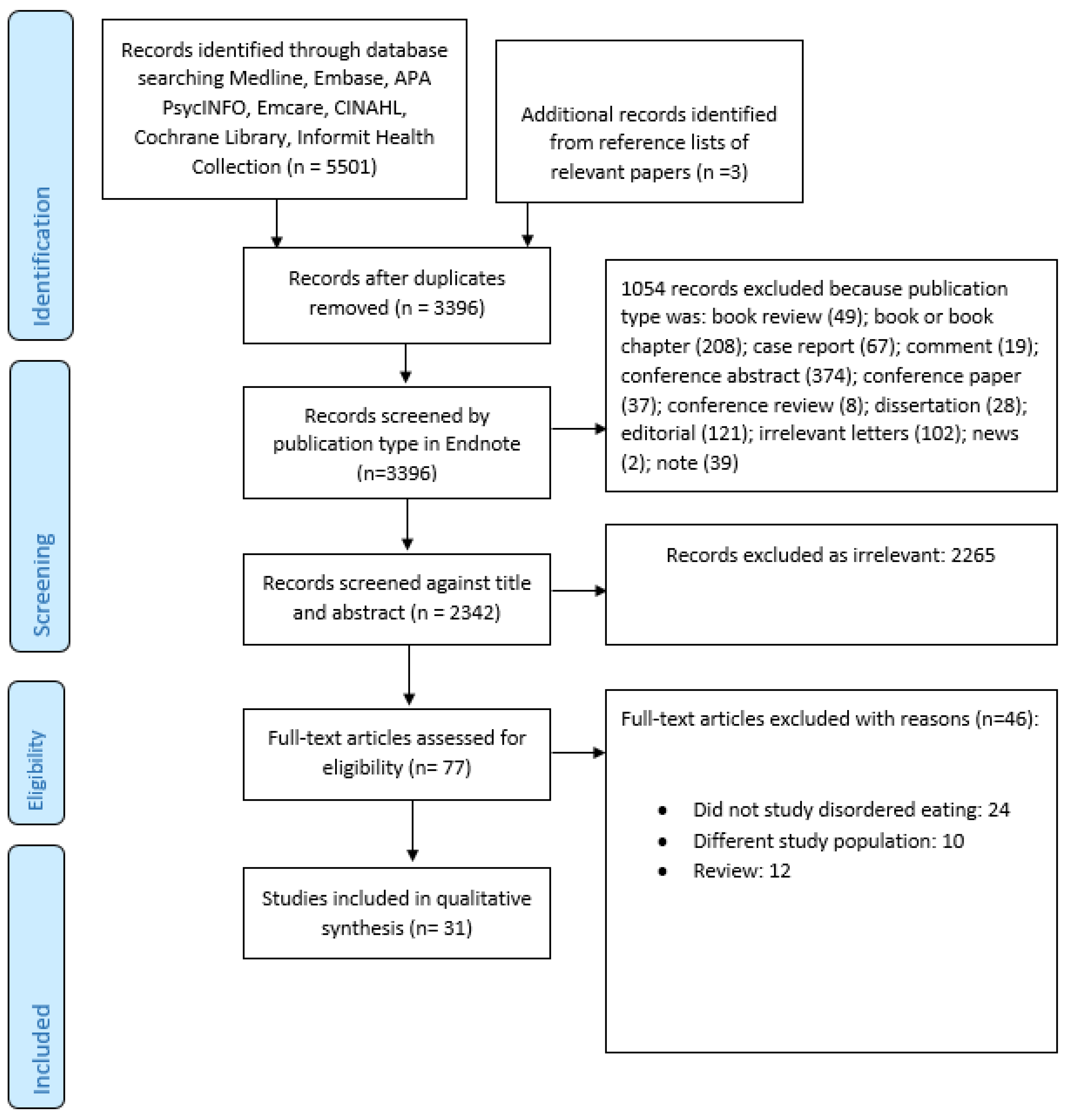
2.1. Study Selection
2.2. Quality Appraisal
2.3. Data Extraction
2.4. Data Synthesis
3. Results
3.1. Sample Characteristics
3.2. Quality Appraisal
3.3. Disordered Eating
3.3.1. Binge Eating
3.3.2. Food Cravings and FOOD Addiction
3.3.3. Night Eating
3.3.4. Other Disordered Eating Behaviors
4. Discussion
4.1. Role of Medications
4.2. Illness Related
4.3. Other Explanations
4.4. Strengths and Limitations
4.5. Clinical Implications
5. Conclusions
Author Contributions
Funding
Institutional Review Board Statement
Informed Consent Statement
Data Availability Statement
Conflicts of Interest
References
- Dipasquale, S.; Pariante, C.M.; Dazzan, P.; Aguglia, E.; McGuire, P.; Mondelli, V. The Dietary Pattern of Patients with Schizophrenia: A Systematic Review. J. Psychiatr. Res. 2013, 47, 197–207. [Google Scholar] [CrossRef]
- Vancampfort, D.; Correll, C.U.; Galling, B.; Probst, M.; De Hert, M.; Ward, P.B.; Rosenbaum, S.; Gaughran, F.; Lally, J.; Stubbs, B. Diabetes Mellitus in People with Schizophrenia, Bipolar Disorder and Major Depressive Disorder: A Systematic Review and Large Scale Meta-Analysis. World Psychiatry 2016, 15, 166–174. [Google Scholar] [CrossRef]
- Ayano, G. Co-Occurring Medical and Substance Use Disorders in Patients with Schizophrenia: A Systematic Review. Int. J. Ment. Health 2019, 48, 62–76. [Google Scholar] [CrossRef]
- Young, S.L.; Taylor, M.; Lawrie, S.M. “First Do No Harm.” A Systematic Review of the Prevalence and Management of Antipsychotic Adverse Effects. J. Psychopharmacol. 2015, 29, 353–362. [Google Scholar] [CrossRef]
- Newman, S.C.; Bland, R.C. Mortality in a Cohort of Patients with Schizophrenia: A Record Linkage Study. Can. J. Psychiatry 1991, 36, 239–245. [Google Scholar] [CrossRef] [PubMed]
- Laursen, T.M. Life Expectancy among Persons with Schizophrenia or Bipolar Affective Disorder. Schizophr. Res. 2011, 131, 101–104. [Google Scholar] [CrossRef] [PubMed]
- Bobes, J.; Arango, C.; Garcia-Garcia, M.; Rejas, J. Healthy Lifestyle Habits and 10-Year Cardiovascular Risk in Schizophrenia Spectrum Disorders: An Analysis of the Impact of Smoking Tobacco in the CLAMORS Schizophrenia Cohort. Schizophr. Res. 2010, 119, 101–109. [Google Scholar] [CrossRef]
- Weiden, P.J.; Mackell, J.A.; McDonnell, D.D. Obesity as a Risk Factor for Antipsychotic Noncompliance. Schizophr. Res. 2004, 66, 51–57. [Google Scholar] [CrossRef]
- Wirshing, D.A. Schizophrenia and Obesity: Impact of Antipsychotic Medications. J. Clin. Psychiatry 2004, 65 (Suppl. 18), 13–26. [Google Scholar]
- Kruger, J.; Bowles, H.; Jones, D.; Ainsworth, B.; Kohl, H.K., III. Health-Related Quality of Life, BMI and Physical Activity among US Adults (X18 Years): National Physical Activity and Weight Loss Survey. Int. J. Obes. 2002, 31, 321–327. [Google Scholar] [CrossRef]
- Ritsner, M.; Ponizovsky, A.; Endicott, J.; Nechamkin, Y.; Rauchverger, B.; Silver, H.; Modai, I. The Impact of Side-Effects of Antipsychotic Agents on Life Satisfaction of Schizophrenia Patients: A Naturalistic Study. Eur. Neuropsychopharmacol. 2002, 12, 31–38. [Google Scholar] [CrossRef]
- Olfson, M.; Mechanic, D.; Hansell, S.; Boyer, C.A.; Walkup, J.; Weiden, P.J. Predicting Medication Noncompliance After Hospital Discharge Among Patients with Schizophrenia. Psychiatr. Serv. 2000, 51, 216–222. [Google Scholar] [CrossRef] [PubMed]
- Archie, S.M.; Goldberg, J.O.; Akhtar-Danesh, N.; Landeen, J.; McColl, L.; McNiven, J. Psychotic Disorders, Eating Habits, and Physical Activity: Who Is Ready for Lifestyle Changes? Psychiatr. Serv. 2007, 58, 233–239. [Google Scholar] [CrossRef]
- Sharpe, J.; Stedman, T.; Byrne, N.; Wishart, C.; Hills, A. Energy Expenditure and Physical Activity In Clozapine Use: Implications For Weight Management. Aust. N. Z. J. Psychiatry 2006, 40, 810–814. [Google Scholar] [CrossRef] [PubMed]
- de Leon, J.; Diaz, F.J. A Meta-Analysis of Worldwide Studies Demonstrates an Association between Schizophrenia and Tobacco Smoking Behaviors. Schizophr. Res. 2005, 76, 135–157. [Google Scholar] [CrossRef] [PubMed]
- Grover, S.; Padmavati, R.; Sahoo, S.; Gopal, S.; Nehra, R.; Ganesh, A.; Raghavan, V.; Sankaranarayan, A. Relationship of Metabolic Syndrome and Neurocognitive Deficits in Patients with Schizophrenia. Psychiatry Res. 2019, 278, 56–64. [Google Scholar] [CrossRef]
- Khosravi, M. Biopsychosocial Factors Associated with Disordered Eating Behaviors in Schizophrenia. Ann. Gen. Psychiatry 2020, 19, 67. [Google Scholar] [CrossRef] [PubMed]
- Pignatelli, A.M.; Wampers, M.; Loriedo, C.; Biondi, M.; Vanderlinden, J. Childhood Neglect in Eating Disorders: A Systematic Review and Meta-Analysis. J. Trauma Dissociation 2017, 18, 100–115. [Google Scholar] [CrossRef]
- Food for Thought; National Center on Addiction and Substance Abuse at Columbia University: New York, NY, USA, 2003.
- Kenardy, J.; Mensch, M.; Bowen, K.; Green, B.; Walton, J.; Dalton, M. Disordered Eating Behaviours in Women with Type 2 Diabetes Mellitus. Eat. Behav. 2001, 2, 183–192. [Google Scholar] [CrossRef]
- Pinto-Bastos, A.; Ramalho, S.M.; Conceição, E.; Mitchell, J. Disordered Eating and Obesity. In Obesity; Ahmad, S.I., Imam, S.K., Eds.; Springer International Publishing: Cham, Germany, 2016; pp. 309–319. [Google Scholar] [CrossRef]
- Spinella, M.; Lyke, J. Executive Personality Traits and Eating Behavior. Int. J. Neurosci. 2004, 114, 83–93. [Google Scholar] [CrossRef] [PubMed]
- Uher, R. Brain Lesions and Eating Disorders. J. Neurol. Neurosurg. Psychiatry 2005, 76, 852–857. [Google Scholar] [CrossRef] [PubMed]
- Kraepelin, E. Dementia Praecox and Paraphrenia; Thoemmes: Bristol, UK, 2002. [Google Scholar]
- Bleuler, E. Textbook of Psychiatry; Macmillan Co.: New York, NY, USA, 1924. [Google Scholar]
- Lyketsos, G.; Paterakis, P.; Beis, A.; Lyketsos, C. Eating Disorders in Schizophrenia. Br. J. Psychiatry 1985, 146, 255–261. [Google Scholar] [CrossRef] [PubMed]
- Gebhardt, S.; Haberhausen, M.; Krieg, J.-C.; Remschmidt, H.; Heinzel-Gutenbrunner, M.; Hebebrand, J.; Theisen, F.M. Clozapine/Olanzapine-Induced Recurrence or Deterioration of Binge Eating-Related Eating Disorders. J. Neural. Transm. 2007, 114, 1091–1095. [Google Scholar] [CrossRef]
- Case, M.; Treuer, T.; Karagianis, J.; Hoffmann, V.P. The Potential Role of Appetite in Predicting Weight Changes during Treatment with Olanzapine. BMC Psychiatry 2010, 10, 72. [Google Scholar] [CrossRef]
- Fawzi, M.H.; Fawzi, M.M. Disordered Eating Attitudes in Egyptian Antipsychotic Naive Patients with Schizophrenia. Compr. Psychiatry 2012, 53, 259–268. [Google Scholar] [CrossRef] [PubMed]
- Malaspina, D.; Walsh-Messinger, J.; Brunner, A.; Rahman, N.; Corcoran, C.; Kimhy, D.; Goetz, R.R.; Goldman, S.B. Features of Schizophrenia Following Premorbid Eating Disorders. Psychiatry Res. 2019, 278, 275–280. [Google Scholar] [CrossRef] [PubMed]
- Kouidrat, Y.; Amad, A.; Lalau, J.-D.; Loas, G. Eating Disorders in Schizophrenia: Implications for Research and Management. Schizophr. Res. Treat. 2014, 2014, 1–7. [Google Scholar] [CrossRef]
- Stogios, N.; Smith, E.; Asgariroozbehani, R.; Hamel, L.; Gdanski, A.; Selby, P.; Sockalingam, S.; Graff-Guerrero, A.; Taylor, V.; Agarwal, S.; et al. Exploring Patterns of Disturbed Eating in Psychosis: A Scoping Review. Nutrients 2020, 12, 3883. [Google Scholar] [CrossRef]
- Moher, D.; Liberati, A.; Tetzlaff, J.; Altman, D.G.; The PRISMA Group. Preferred Reporting Items for Systematic Reviews and Meta-Analyses: The PRISMA Statement. BMJ 2009, 339, b2535. [Google Scholar] [CrossRef]
- Study Quality Assessment Tools | NHLBI, NIH. Available online: https://www.nhlbi.nih.gov/health-topics/study-quality-assessment-tools (accessed on 29 September 2020).
- Abbas, M.J.; Liddle, P.F. Olanzapine and Food Craving: A Case Control Study: Olanzapine and Food Craving. Hum. Psychopharmacol. Clin. Exp. 2013, 28, 97–101. [Google Scholar] [CrossRef]
- Aguiar-Bloemer, A.C.; Agliussi, R.G.; Pinho, T.M.P.; Furtado, E.F.; Diez-Garcia, R.W. Eating Behavior of Schizophrenic Patients. Rev. Nutr. 2018, 31, 13–24. [Google Scholar] [CrossRef]
- Bachmann, C.J.; Gebhardt, S.; Lehr, D.; Haberhausen, M.; Kaiser, C.; Otto, B.; Theisen, F.M. Subjective and Biological Weight-Related Parameters: In Adolescents and Young Adults with Schizophrenia Spectrum Disorder under Clozapine or Olanzapine Treatment. Z. Kinder-Jugendpsychiatrie Psychother. 2012, 40, 151–159. [Google Scholar] [CrossRef]
- de Beaurepaire, R. Binge Eating Disorders in Antipsychotic-Treated Patients With Schizophrenia. J. Clin. Psychopharmacol. 2021, 41, 114–120. [Google Scholar] [CrossRef]
- Blouin, M.; Tremblay, A.; Jalbert, M.-E.; Venables, H.; Bouchard, R.-H.; Roy, M.-A.; Alméras, N. Adiposity and Eating Behaviors in Patients Under Second Generation Antipsychotics. Obesity 2008, 16, 1780–1787. [Google Scholar] [CrossRef]
- Brömel, T.; Blum, W.F.; Ziegler, A.; Schulz, E.; Bender, M.; Fleischhaker, C.; Remschmidt, H.; Krieg, J.-C.; Hebebrand, J. Serum Leptin Levels Increase Rapidly after Initiation of Clozapine Therapy. Mol. Psychiatry 1998, 3, 76–80. [Google Scholar] [CrossRef] [PubMed]
- Garriga, M.; Mallorquí, A.; Serrano, L.; Ríos, J.; Salamero, M.; Parellada, E.; Gómez-Ramiro, M.; Oliveira, C.; Amoretti, S.; Vieta, E.; et al. Food Craving and Consumption Evolution in Patients Starting Treatment with Clozapine. Psychopharmacology 2019, 236, 3317–3327. [Google Scholar] [CrossRef] [PubMed]
- Goluza, I.; Borchard, J.; Kiarie, E.; Mullan, J.; Pai, N. Exploration of Food Addiction in People Living with Schizophrenia. Asian J. Psychiatry 2017, 27, 81–84. [Google Scholar] [CrossRef]
- Hay, P.J.; Hall, A. The Prevalence of Eating Disorders in Recently Admitted Psychiatric in-Patients. Br. J. Psychiatry 1991, 159, 562–565. [Google Scholar] [CrossRef]
- Khazaal, Y.; Frésard, E.; Zimmermann, G.; Trombert, N.; Pomini, V.; Grasset, F.; Borgeat, F.; Zullino, D. Eating and weight related cognitions in people with Schizophrenia: A case control study. Clin. Pract. Epidemiol. Ment. Health 2006, 2, 29. [Google Scholar] [CrossRef][Green Version]
- Khazaal, Y.; Billieux, J.; Fresard, E.; Huguelet, P.; Van der Linden, M.; Zullino, D. A Measure of Dysfunctional Eating-Related Cognitions In People With Psychotic Disorders. Psychiatr. Q. 2009, 81, 49–56. [Google Scholar] [CrossRef] [PubMed]
- Kluge, M.; Schuld, A.; Himmerich, H.; Dalal, M.; Schacht, A.; Wehmeier, P.M.; Hinze-Selch, D.; Kraus, T.; Dittmann, R.W.; Pollmächer, T. Clozapine and Olanzapine Are Associated with Food Craving and Binge Eating: Results From A Randomized Double-Blind Study. J. Clin. Psychopharmacol. 2007, 27, 662–666. [Google Scholar] [CrossRef]
- Knolle-Veentjer, S.; Huth, V.; Ferstl, R.; Aldenhoff, J.B.; Hinze-Selch, D. Delay of Gratification and Executive Performance in Individuals with Schizophrenia: Putative Role for Eating Behavior and Body Weight Regulation. J. Psychiatr. Res. 2008, 42, 98–105. [Google Scholar] [CrossRef]
- Kouidrat, Y.; Amad, A.; Stubbs, B.; Louhou, R.; Renard, N.; Diouf, M.; Lalau, J.-D.; Loas, G. Disordered Eating Behaviors as a Potential Obesogenic Factor in Schizophrenia. Psychiatry Res. 2018, 269, 450–454. [Google Scholar] [CrossRef]
- Küçükerdönmez, Ö.; Urhan, M.; Altın, M.; Hacıraifoğlu, Ö.; Yıldız, B. Assessment of the Relationship between Food Addiction and Nutritional Status in Schizophrenic Patients. Nutr. Neurosci. 2019, 22, 392–400. [Google Scholar] [CrossRef] [PubMed]
- Simon Kurpad, S.; George, S.; Srinivasan, K. Binge Eating and Other Eating Behaviors Among Patients On Treatment For Psychoses In India. Eat. Weight Disord.-Stud. Anorex. Bulim. Obes. 2010, 15, e136–e143. [Google Scholar] [CrossRef] [PubMed]
- Lundgren, J.D.; Rempfer, M.V.; Lent, M.R.; Foster, G.D. Perceptions of Factors Associated with Weight Management in Obese Adults with Schizophrenia. Psychiatr. Rehabil. J. 2014, 37, 304–308. [Google Scholar] [CrossRef] [PubMed]
- Palmese, L.B.; Ratliff, J.C.; Reutenauer, E.L.; Tonizzo, K.M.; Grilo, C.M.; Tek, C. Prevalence of Night Eating in Obese Individuals with Schizophrenia and Schizoaffective Disorder. Compr. Psychiatry 2013, 54, 276–281. [Google Scholar] [CrossRef]
- Ramacciotti, C.E.; Paoli, R.A.; Catena, M.; Ciapparelli, A.; Dell’Osso, L.; Schulte, F.; Garfinkel, P.E. Schizophrenia and Binge-Eating Disorders. J. Clin. Psychiatry 2004, 65, 1016–1017. [Google Scholar] [CrossRef]
- Ryu, S.; Nam, H.; Oh, S.; Park, T.; Lim, M.; Choi, J.; Baek, J.; Jang, J.; Park, H.; Kim, S.; et al. Eating-Behavior Changes Associated with Antipsychotic Medications In Patients With Schizophrenia As Measured By The Drug-Related Eating Behavior Questionnaire. J. Clin. Psychopharmacol. 2013, 33, 120–122. [Google Scholar] [CrossRef]
- Sentissi, O.; Viala, A.; Bourdel, M.C.; Kaminski, F.; Bellisle, F.; Olié, J.P.; Poirier, M.F. Impact of Antipsychotic Treatments on the Motivation to Eat: Preliminary Results in 153 Schizophrenic Patients. Int. Clin. Psychopharmacol. 2009, 24, 257–264. [Google Scholar] [CrossRef]
- Srebnik, D.; Comtois, K.; Stevenson, J.; Hoff, H.; Snowden, M.; Russo, J.; Ries, R. Eating Disorder Symptoms Among Adults with Severe and Persistent Mental Illness. Eat. Disord. 2003, 11, 27–38. [Google Scholar] [CrossRef]
- Stauffer, V.L.; Lipkovich, I.; Hoffmann, V.P.; Heinloth, A.N.; McGregor, H.S.; Kinon, B.J. Predictors and Correlates for Weight Changes in Patients Co-Treated with Olanzapine and Weight Mitigating Agents; a Post-Hoc Analysis. BMC Psychiatry 2009, 9, 12. [Google Scholar] [CrossRef] [PubMed]
- Striegel-Moore, R.; Garvin, V.; Dohm, F.; Rosenheck, R. Psychiatric Comorbidity of Eating Disorders In Men: A National Study Of Hospitalized Veterans. Int. J. Eat. Disord. 1999, 25, 399–404. [Google Scholar] [CrossRef]
- Teh, W.; Mahesh, M.; Abdin, E.; Tan, J.; Rahman, R.; Satghare, P.; Sim, K.; Basu, S.; Kandasami, G.; Gupta, B.; et al. Negative Affect Moderates the Link between Body Image Dissatisfaction and Disordered Eating among Psychiatric Outpatients in a Multiethnic Asian Setting. Singap. Med. J. 2020, 1, 19. [Google Scholar] [CrossRef] [PubMed]
- Treuer, T.; Hoffmann, V.P.; Chen, A.K.-P.; Irimia, V.; Ocampo, M.; Wang, G.; Singh, P.; Holt, S. Factors Associated with Weight Gain during Olanzapine Treatment in Patients with Schizophrenia or Bipolar Disorder: Results from a Six-Month Prospective, Multinational, Observational Study. World J. Biol. Psychiatry 2009, 10, 729–740. [Google Scholar] [CrossRef] [PubMed]
- Abbott, S.; Dindol, N.; Tahrani, A.A.; Piya, M.K. Binge Eating Disorder and Night Eating Syndrome in Adults with Type 2 Diabetes: A Systematic Review. J. Eat. Disord. 2018, 6, 36. [Google Scholar] [CrossRef] [PubMed]
- Qian, J.; Wu, Y.; Liu, F.; Zhu, Y.; Jin, H.; Zhang, H.; Wan, Y.; Li, C.; Yu, D. An Update on the Prevalence of Eating Disorders in the General Population: A Systematic Review and Meta-Analysis. Eat. Weight Disord. 2021, 8, 1–14. [Google Scholar] [CrossRef]
- Pursey, K.; Stanwell, P.; Gearhardt, A.; Collins, C.; Burrows, T. The Prevalence of Food Addiction as Assessed by the Yale Food Addiction Scale: A Systematic Review. Nutrients 2014, 6, 4552–4590. [Google Scholar] [CrossRef]
- Touchette, E.; Henegar, A.; Godart, N.T.; Pryor, L.; Falissard, B.; Tremblay, R.E.; Côté, S.M. Subclinical Eating Disorders and Their Comorbidity with Mood and Anxiety Disorders in Adolescent Girls. Psychiatry Res. 2011, 185, 185–192. [Google Scholar] [CrossRef] [PubMed]
- Fatt, S.J.; Mond, J.; Bussey, K.; Griffiths, S.; Murray, S.B.; Lonergan, A.; Hay, P.; Trompeter, N.; Mitchison, D. Help-Seeking for Body Image Problems among Adolescents with Eating Disorders: Findings from the EveryBODY Study. Eat. Weight Disord. 2020, 25, 1267–1275. [Google Scholar] [CrossRef]
- Rummel-Kluge, C.; Komossa, K.; Schwarz, S.; Hunger, H.; Schmid, F.; Lobos, C.A.; Kissling, W.; Davis, J.M.; Leucht, S. Head-to-Head Comparisons of Metabolic Side Effects of Second Generation Antipsychotics in the Treatment of Schizophrenia: A Systematic Review and Meta-Analysis. Schizophr. Res. 2010, 123, 225–233. [Google Scholar] [CrossRef]
- Theisen, F.M.; Linden, A.; König, I.R.; Martin, M.; Remschmidt, H.; Hebebrand, J. Spectrum of Binge Eating Symptomatology in Patients Treated with Clozapine and Olanzapine. J. Neural. Transm. 2003, 110, 111–121. [Google Scholar] [CrossRef] [PubMed]
- Kuikka, J.; Tammela, L.; Karhunen, L.; Rissanen, A.; Bergström, K.; Naukkarinen, H.; Vanninen, E.; Karhu, J.; Lappalainen, R.; Repo-Tiihonen, E.; et al. Reduced Serotonin Transporter Binding in Binge Eating Women. Psychopharmacology 2001, 155, 310–314. [Google Scholar] [CrossRef] [PubMed]
- Tammela, L.I.; Rissanen, A.; Kuikka, J.T.; Karhunen, L.J.; Bergström, K.A.; Repo-Tiihonen, E.; Naukkarinen, H.; Vanninen, E.; Tiihonen, J.; Uusitupa, M. Treatment Improves Serotonin Transporter Binding and Reduces Binge Eating. Psychopharmacology 2003, 170, 89–93. [Google Scholar] [CrossRef]
- McElroy, S.; Hudson, J.; Malhotra, S.; Welge, J.; Nelson, E.; Keck, P. Citalopram in The Treatment Of Binge-Eating Disorder. J. Clin. Psychiatry 2003, 64, 807–813. [Google Scholar] [CrossRef] [PubMed]
- Monteleone, P.; Tortorella, A.; Castaldo, E.; Maj, M. Association of a Functional Serotonin Transporter Gene Polymorphism with Binge Eating Disorder. Am. J. Med. Genet. 2006, 141B, 7–9. [Google Scholar] [CrossRef]
- Treuer, T.; Karagianis, J.; Hoffmann, V. Can Increased Food Intake Improve Psychosis? A Brief Review and Hypothesis. Curr. Mol. Pharmacol. 2008, 1, 270–272. [Google Scholar] [CrossRef]
- Amani, R. Is Dietary Pattern of Schizophrenia Patients Different from Healthy Subjects? BMC Psychiatry 2007, 7, 15. [Google Scholar] [CrossRef] [PubMed]
- Stokes, C.; Peet, M. Short Communication. Nutr. Neurosci. 2004, 7, 247–249. [Google Scholar] [CrossRef]
- Palacios, J.M.; Pazos, A.; Hoyer, D. A Short History of the 5-HT2C Receptor: From the Choroid Plexus to Depression, Obesity and Addiction Treatment. Psychopharmacology 2017, 234, 1395–1418. [Google Scholar] [CrossRef]
- Gendall, K.A.; Joyce, P.R.; Sullivan, P.F. Impact of Definition on Prevalence of Food Cravings in a Random Sample of Young Women. Appetite 1997, 28, 63–72. [Google Scholar] [CrossRef]
- Mamakou, V.; Thanopoulou, A.; Gonidakis, F.; Tentolouris, N.; Kontaxakis, V. Schizophrenia and Type 2 Diabetes Mellitus. Psychiatriki 2018, 29, 64–73. [Google Scholar] [CrossRef] [PubMed]
- Maudsley, H. The Pathology of Mind, 3rd ed.; Macmillan and Co.: London, UK, 1879; p. 113. [Google Scholar]
- Pillinger, T.; Beck, K.; Gobjila, C.; Donocik, J.G.; Jauhar, S.; Howes, O.D. Impaired Glucose Homeostasis in First-Episode Schizophrenia: A Systematic Review and Meta-Analysis. JAMA Psychiatry 2017, 74, 261. [Google Scholar] [CrossRef]
- Young-Hyman, D.L.; Davis, C.L. Disordered Eating Behavior in Individuals with Diabetes: Importance of Context, Evaluation, and Classification. Diabetes Care 2010, 33, 683–689. [Google Scholar] [CrossRef]
- Filippi, B.M.; Mighiu, P.I.; Lam, T.K.T. Is Insulin Action in the Brain Clinically Relevant? Diabetes 2012, 61, 773–775. [Google Scholar] [CrossRef] [PubMed]
- Robert, S.A.; Rohana, A.G.; Shah, S.A.; Chinna, K.; Wan Mohamud, W.N.; Kamaruddin, N.A. Improvement in Binge Eating in Non-Diabetic Obese Individuals after 3 Months of Treatment with Liraglutide—A Pilot Study. Obes. Res. Clin. Pract. 2015, 9, 301–304. [Google Scholar] [CrossRef]
- Yum, S. The Starved Brain: Eating Behaviors in Schizophrenia. Psychiatr. Ann. 2005, 35, 82–89. [Google Scholar] [CrossRef]
- Brandys, M.K.; de Kovel, C.G.F.; Kas, M.J.; van Elburg, A.A.; Adan, R.A.H. Overview of Genetic Research in Anorexia Nervosa: The Past, the Present and the Future: Genetic Research in Anorexia Nervosa. Int. J. Eat. Disord. 2015, 48, 814–825. [Google Scholar] [CrossRef] [PubMed]
- Adams, J.; Hillier-Brown, F.C.; Moore, H.J.; Lake, A.A.; Araujo-Soares, V.; White, M.; Summerbell, C. Searching and Synthesising ‘Grey Literature’ and ‘Grey Information’ in Public Health: Critical Reflections on Three Case Studies. Syst. Rev. 2016, 5, 164. [Google Scholar] [CrossRef]
- Milos, G.; Spindler, A.; Schnyder, U.; Fairburn, C.G. Instability of Eating Disorder Diagnoses: Prospective Study. Br. J. Psychiatry 2005, 187, 573–578. [Google Scholar] [CrossRef] [PubMed]
- Eddy, K.T.; Dorer, D.J.; Franko, D.L.; Tahilani, K.; Thompson-Brenner, H.; Herzog, D.B. Diagnostic Crossover in Anorexia Nervosa and Bulimia Nervosa: Implications for DSM-V. AJP 2008, 165, 245–250. [Google Scholar] [CrossRef]
- Stunkard, A.; Grace, W.; Wolff, H. The Night-Eating Syndrome. Am. J. Med. 1955, 19, 78–86. [Google Scholar] [CrossRef]
- Fernø, J.; Varela, L.; Skrede, S.; Vázquez, M.J.; Nogueiras, R.; Diéguez, C.; Vidal-Puig, A.; Steen, V.M.; López, M. Olanzapine-Induced Hyperphagia and Weight Gain Associate with Orexigenic Hypothalamic Neuropeptide Signaling without Concomitant AMPK Phosphorylation. PLoS ONE 2011, 6, e20571. [Google Scholar] [CrossRef]
- Andrea, K.G.; Robert, H.L. Is Fast Food Addictive? CDAR 2011, 4, 146–162. [Google Scholar] [CrossRef]
- Chiolero, A.; Wietlisbach, V.; Ruffieux, C.; Paccaud, F.; Cornuz, J. Clustering of Risk Behaviors with Cigarette Consumption: A Population-Based Survey. Prev. Med. 2006, 42, 348–353. [Google Scholar] [CrossRef]
- Anzengruber, D.; Klump, K.L.; Thornton, L.; Brandt, H.; Crawford, S.; Fichter, M.M.; Halmi, K.A.; Johnson, C.; Kaplan, A.S.; LaVia, M.; et al. Smoking in Eating Disorders. Eat. Behav. 2006, 7, 291–299. [Google Scholar] [CrossRef]
- Ruschena, D.; Mullen, P.E.; Palmer, S.; Burgess, P.; Cordner, S.M.; Drummer, O.H.; Wallace, C.; Barry-Walsh, J. Choking Deaths: The Role of Antipsychotic Medication. Br. J. Psychiatry 2003, 183, 446–450. [Google Scholar] [CrossRef] [PubMed]
- Samuels, R.; Chadwick, D.D. Predictors of Asphyxiation Risk in Adults with Intellectual Disabilities and Dysphagia. J. Intellect. Disabil. Res. 2006, 50, 362–370. [Google Scholar] [CrossRef]
- Khazaal, Y.; Fresard, E.; Rabia, S.; Chatton, A.; Rothen, S.; Pomini, V.; Grasset, F.; Borgeat, F.; Zullino, D. Cognitive Behavioural Therapy for Weight Gain Associated with Antipsychotic Drugs. Schizophr. Res. 2007, 91, 169–177. [Google Scholar] [CrossRef]
- Tek, C.; Ratliff, J.; Reutenauer, E.; Ganguli, R.; O’Malley, S.S. A Randomized, Double-Blind, Placebo-Controlled Pilot Study of Naltrexone to Counteract Antipsychotic-Associated Weight Gain: Proof of Concept. J. Clin. Psychopharmacol. 2014, 34, 608–612. [Google Scholar] [CrossRef]
- Mason, A.E.; Laraia, B.; Daubenmier, J.; Hecht, F.M.; Lustig, R.H.; Puterman, E.; Adler, N.; Dallman, M.; Kiernan, M.; Gearhardt, A.N.; et al. Putting the Brakes on the “Drive to Eat”: Pilot Effects of Naltrexone and Reward-Based Eating on Food Cravings among Obese Women. Eat. Behav. 2015, 19, 53–56. [Google Scholar] [CrossRef]
- Lyu, X.; Du, J.; Zhan, G.; Wu, Y.; Su, H.; Zhu, Y.; Jarskog, F.; Zhao, M.; Fan, X. Naltrexone and Bupropion Combination Treatment for Smoking Cessation and Weight Loss in Patients with Schizophrenia. Front. Pharmacol. 2018, 9, 181. [Google Scholar] [CrossRef]
- Urbanek, J.K.; Metzgar, C.J.; Hsiao, P.Y.; Piehowski, K.E.; Nickols-Richardson, S.M. Increase in Cognitive Eating Restraint Predicts Weight Loss and Change in Other Anthropometric Measurements in Overweight/Obese Premenopausal Women. Appetite 2015, 87, 244–250. [Google Scholar] [CrossRef] [PubMed]
- Westenhoefer, J.; Engel, D.; Holst, C.; Lorenz, J.; Peacock, M.; Stubbs, J.; Whybrow, S.; Raats, M. Cognitive and Weight-Related Correlates of Flexible and Rigid Restrained Eating Behaviour. Eat. Behav. 2013, 14, 69–72. [Google Scholar] [CrossRef]
- Tchanturia, K.; Davies, H.; Roberts, M.; Harrison, A.; Nakazato, M.; Schmidt, U.; Treasure, J.; Morris, R. Poor Cognitive Flexibility in Eating Disorders: Examining the Evidence Using the Wisconsin Card Sorting Task. PLoS ONE 2012, 7, e28331. [Google Scholar] [CrossRef]
- Miles, S.; Gnatt, I.; Phillipou, A.; Nedeljkovic, M. Cognitive Flexibility in Acute Anorexia Nervosa and after Recovery: A Systematic Review. Clin. Psychol. Rev. 2020, 81, 101905. [Google Scholar] [CrossRef]
- Lindvall Dahlgren, C.; Rø, Ø. A Systematic Review of Cognitive Remediation Therapy For Anorexia Nervosa—Development, Current State and Implications for Future Research and Clinical Practice. J. Eat. Disord. 2014, 2, 1–12. [Google Scholar] [CrossRef]
- Leppanen, J.; Adamson, J.; Tchanturia, K. Impact of Cognitive Remediation Therapy on Neurocognitive Processing in Anorexia Nervosa. Front. Psychiatry 2018, 9, 96. [Google Scholar] [CrossRef] [PubMed]
- Bowie, C.R. Cognitive Remediation for Severe Mental Illness: State of the Field and Future Directions. World Psychiatry 2019, 18, 274–275. [Google Scholar] [CrossRef] [PubMed]

|
|
|
|
|
|
|
|
|
|
|
|
|
|
|
|
|
| Inclusion Criteria | Exclusion Criteria |
|---|---|
|
|
| Author/Year/Country | Disordered Eating Studied and Instrument(s) Used | Objectives/Aims | Methods | Strengths/Limitations | Main Findings |
|---|---|---|---|---|---|
| Abbas and Liddle, 2013 UK | Measured food cravings using the food craving inventory (FCI). | To compare carbohydrate and other food cravings in people with schizophrenia versus healthy controls. | Case-control study comparing 40 people with ICD-10 diagnosis of schizophrenia (20 on olanzapine and 20 on typical antipsychotics) and 20 healthy controls | Strengths included clearly defined research question, selection criteria, control group, sample size calculation, use of validated measures, and adjustment for confounding (albeit limited). Limitations include diversity of settings that samples were drawn from, and those on typical antipsychotics were mostly on depot antipsychotics. | Mean age 39.4 (11.7) for cases, and 40.9 (11) years for controls. M: F 29:31. Patients on typical antipsychotics had higher craving scores, but this was not statistically significant. |
| Aguiar-Bloemer et al. 2018 Brazil | Measured binge eating, food craving, emotional eating, and snacking using semi-structured questionnaire, dietary record and anthropometric scores. | To assess eating behaviours, food practices, and nutritional and metabolic profile of patients with schizophrenia in a tertiary hospital. | Cross-sectional study of 33 patients with DSM IV diagnosis of schizophrenia. | Strengths included using a mixed quantitative and qualitative to study the impact of medications on eating behaviours. Limitations included small sample size, and cross-sectional nature of the study undertaken using non-validated tools. | Mean age of 41.7 (12.6) years and M:F was 24:7. In this group of patients that were predominantly overweight (~71%) and/or had metabolic syndrome (~42%), 16.1% reported sweet craving. Participants also reported emotional eating, and binge eating symptoms such as eating rapidly, eating large quantities of food (especially when unwell), and eating more frequently, and increased snacking. |
| Bachman et al. 2012 Germany | Measured dietary restraint, disinhibition, and hunger using three factor eating questionnaire (TFEQ). | To evaluate subjective eating behaviour (among other subjective parameters) in a child and adolescent psychiatric population under long-term antipsychotic treatment in a rehabilitative setting. | Cross-sectional study of 74 adolescent patients with ICD-10 diagnosis of schizophrenia (67), schizoaffective disorder (3), and other diagnosis (4) on clozapine (56) or olanzapine (18). | Only study found in child and adolescent population, with clear research question and performed using validated tools. Limitations include small sample size, poor sample description, non-adjustment for confounders, and focus on psychological concepts underlying abnormal eating behaviours rather than on disordered eating. | Mean age was 19.9 (2.3) years and there were more males (49:25). The restraint score was in the disordered eating range and an association was found between BMI and hunger scales among male patients. |
| Blouin et al. 2008 Canada | Measured dietary restraint, disinhibition, and susceptibility to hunger using TFEQ. | To explore and compare indicators of eating behaviours including dietary restraint, disinhibition, and susceptibility to hunger among 18 male patients with schizophrenia spectrum disorders (SSD) treated with second generation antipsychotics (SGA) to 20 healthy, sedentary and untreated individuals. | Case-control study of 18 male patients with DSM IV schizophrenia (15), schizoaffective disorder (2), and delusional disorder (1), compared with 20 “non-schizophrenic” healthy men. | Strengths include use of multiple validated tools, and adjustment (although limited) for confounding. Limitations include small sample size, no power calculation, limited observations to variable analysed ratio, and focus on underlying cognitive mechanisms rather than on disordered eating. | Mean age of 30.5 (7.9) years for cases and 29.5 (6.7) years for controls, and all participants were men. Patients treated with SGAs were significantly more likely to be obese and have higher cognitive restraint, disinhibition, and susceptibility to hunger triggered by internal and external cues. The higher disinhibition accounts for overconsumption of food in response to variety of stimuli, and loss of control. |
| Bromel et al. 1998 Germany | Eating behaviours using a semi-structured questionnaire. | To determine serum leptin concentrations prior to and after initiation of clozapine treatment. | Ten-week, prospective, follow-up study of 12 patients with DSM-IV schizophrenia (9) and schizoaffective disorder (3). | Strengths included clear hypothesis, prospective design, and ability to demonstrate changes that mirror clozapine prescribing in real world. Limitations included small sample size, no power calculation, and poor sample description, use of non-validated questionnaires, and not adjusting for confounders. | Mean age was 31 (7.1) years and there were 6 males and 6 females. There was significant increase in serum leptin that corresponded with increases in mean body weight, mean BMI, mean fat mass, and mean lean body mass. Nine patients reported increase in hunger and appetite and food cravings, and two (16.6%) had features of binge eating disorder (BED). |
| Case et al. 2010. Multi-site clinical trial | Food craving (with FCI) and eating inventory and other non-validated questionnaires such as eating behaviour assessment (EBA) and eating attitude scale (EAS) | To test the hypothesis that changes in appetite might be indicative of patient’s weight gain during treatment for schizophrenia. | Secondary analysis of data from 4 phase IV clinical trials of patients with SSD or BPAD (varying diagnostic criteria) on olanzapine. | Strength includes the large sample size. The authors attempted to compare results of 4 different industry sponsored trials of varying methodology, patient demographics, diagnostic criteria, medication dose, trial duration, poor sample description, and use of invalidated measures. | Mean age ranged from 35.6 (12.2) years in one trial to 43.5 (9.5) years in another one. Men comprised 55.15% of the total sample. There was a significant correlation between increase in appetite for fatty food and weight increase in trial 3, which showed greatest overall weight change. Score increases of several EBA and EAS items indicate that binge eating showed correlation with weight gain. |
| De Beaurepaire, 2021 France | Binge eating disorder (BED) and bulimia nervosa (BN) were diagnosed using DSM IV criteria. BED was classified as syndromal or sub-syndromal. Night eating (NE) was evaluated by a single question “do you get up at night to eat?” | To investigate the prevalence of eating disorders (BN, BED, and NE) in patients with schizophrenia and schizoaffective disorder chronically treated with antipsychotic monotherapy, and to investigate whether different antipsychotics or classes of antipsychotics are differentially associated with eating disorders. | Cross-sectional study of 156 outpatients with chronic schizophrenia or schizoaffective disorder on antipsychotic monotherapy for less than 8 years. | The strengths include modest sample size, clear research aims, use of standardised questions/criteria for binge eating. The limitations include poor sample description, use of single item to screen for night eating, and not adjusting for confounders. | The mean age was 41.7 years. There were 88 men and 68 women. Prevalence of BN was 0, syndromal BED was 4.4%, and sub-syndromal BED was 18.7%. Prevalence of night eating was 30%. BED spectrum and night eating was more prevalent in the clozapine/olanzapine group, and the differences were significant in women. BED spectrum disorders were more common in the first two years of treatment, but night eating was stable over time. |
| Fawzi and Fawzi, 2012 Egypt | Disordered eating attitudes were measured using eating attitudes test (EAT) 40 | To test the hypothesis that disordered eating attitudes co-occur with schizophrenia in a higher frequency and that disordered eating comorbidity would be associated with more severe schizophrenia psychopathology. | A case-control study of 50 consecutive antipsychotic naïve patients with DSM IV schizophrenia recruited from outpatient clinic, compared to 50, age, and gender matched healthy controls with no current or lifetime diagnosis of psychiatric disorder. | The strengths included sample size calculation, well-described sample and selection criteria, use of valid instruments, and adjustment for confounders. The limitation includes the study design. | The mean age of cases was 29.4 (10.2) years and that of controls was 31.1 (10.8) years. 29/50 (58%) of cases and controls were men. Disordered eating attitudes as measured by EAT 40 were two and half times more in schizophrenia than in controls (30% versus 12%). Presence of disordered eating behaviour in patients is associated with higher total PANSS scores, female gender, lower leisure time physical activity, and higher tea/coffee use. |
| Garriga et al. 2019 Spain | Food craving was measured using FCI. A semi-quantitative food frequency questionnaire was used to measure food consumption. | To describe the longitudinal evaluation of food craving in a sample of seriously mentally ill patients starting on clozapine. | An 18-week follow-up study of 34 consecutive patients with DSM IV TR diagnosis of schizophrenia (27), schizoaffective disorder (5), and bipolar disorder (2), who were commenced on clozapine. | The strengths include the prospective design, good sample description, use of validated instruments, and adjusting for confounders. Limitations include small sample size, no power calculations (for multiple analysis), and short-term follow-up. | The mean age was 36.8 (12.2) years and there were 21 men (61.8%). On adjusting for BMI, the normal weight group (at baseline) had significantly increased score for complex carbohydrate and protein food cravings, and were related to male gender, older age, tobacco use, recent onset of psychosis and higher plasma levels of nor-clozapine. The overweight/obese group had higher baseline fast food cravings. Only increments in fast food cravings were associated with weight gain on follow-up. |
| Goluza et al. 2017 Australia | Food addiction was measured using Yale food addiction scale (YFAS) | To examine the prevalence of food addiction and to explore the associations between participant characteristics and food addiction diagnosis. | Cross-sectional study of final sample of 93 outpatients with diagnosis of schizophrenia from tertiary regional hospital in NSW, Australia. | The strengths include use of valid instrument for food addiction. The authors did not describe their sample, or the diagnostic criteria used, did not adjust for confounders, or provide information about common factors associated with disordered eating. | The authors did not provide mean age. Majority of the sample was between 56 and 65 years of age. There were more males (M:F was 61:32). Most patients were on quetiapine, followed by clozapine and olanzapine. In total, 27% of the sample met criteria for food addiction and among those who did not meet the criteria, 77.4% endorsed ≥ 3 symptoms but did not report distress or impairment criteria. The most common food addiction symptoms were persistent desire or repeated attempts to cut down. |
| Hay and Hall, 1991 New Zealand | DSM III R eating disorders using Pope and Hudson Eating Questionnaire and a semi-structured interview based on DSM III R. | To assess the point prevalence of eating disorders in recently admitted psychiatric inpatients. | Cross-sectional study of final sample of 101 current psychiatric inpatients recruited over a three-month period and assessed for DSM II R eating disorders. | This early study demonstrated the presence of undetected eating disorders among psychiatric inpatients using standardised tools. Limitations include the facts that no separate information provided for schizophrenia or SSD, poor sample description, poor description of analysis, and no evidence of adjustment for confounders. | The mean age was 36 (15.4) years. There were 59 females and 42 males. In total, 18 patients (17%) had current DSM III R eating disorders (8 with BN and 10 with EDNOS). Of the 10 with EDNOS, 7 had bulimic type, and 4 of this group had SSD diagnosis. In total, 28 other patients had a variety of weight or eating concerns. |
| Khazaal et al. 2006 Switzerland | Binge eating status was assessed by using SCID for DSM IV. Participants were classified as no bingeing, binge episodes less than 2 days a week (BS), BED, and BN. | To assess binge eating symptomatology in schizophrenia patients receiving treatment and compared to a group of non-psychiatric controls. | Case-control study of 40 patients with DSM IV schizophrenia and 40 non-psychiatric controls. Both groups were divided into severely overweight (BMI > 28) and comparison sample (BMI < 28). | The strengths include clear aims, use of valid tools, and having a comparator group. Limitations include the cross-sectional design, small sample size, poor sample description, and non-adjustment for confounders. | The mean age of patient sample was 33.8 (9.1) and that of control population was 35.5 (10.8) years. There were 19 females with schizophrenia and 21 females in the control group. Patients had higher BMI than the control group. 17/40 patients and 10/40 controls had binge eating (BS or BED). Among patients with BMI > 28, 60% had binge eating symptomatology. |
| Khazaal et al. 2010 Switzerland | Authors used TFEQ and SCID-IV for AN, BN, and BED. | To study the psychometric properties of the revised Mizes anorectic cognitive questionnaire (MAC-R) in people with SSD on treatment. | Cross-sectional study of 125 patients with DSM IV schizophrenia or schizoaffective disorder recruited from outpatient, and day hospitals. | Strengths included the sample size, use of effect sizes to determine power, reasonable sample description, and use of valid instruments. Limitations included study design. The study was not undertaken to explore or describe BED. | Schizophrenia was the predominant diagnosis (93.8%) followed by schizoaffective disorder (6.2%). The mean age was 35.7 (10.9) years and 57.6% were women. In total, 30.5% of the sample had BED. MAC-R dimensions of rigid weight regulation and fear of weight gain correlated with BED and obesity. |
| Khosravi, 2020 Iran | Disordered eating behaviours (DEB) using EAT 26. | To investigate the biopsychosocial factors in DEB among schizophrenia patients. | Authors used a case-control design to compare 154 DSM 5 patients with schizophrenia (83 in active phase and 71 in remission) recruited by convenient sampling from hospital and 154 healthy controls from the same area. | Strengths included decent sample size, sample size calculation, clear selection criteria, and use of valid measures. EAT 26 is not a diagnostic instrument and therefore cannot describe the types of DEBs. | The authors did not provide mean age. Majority of those in acute phase were between 40 and 49 years and 20 and 29 years and majority of those in remission group were between 20 and 29 years and 30 and 39 years. Males formed 41.4% of cases and 54.5% of controls. DEBs (defined as score ≥ 20 on EAT 26) were seen in 41.5% of schizophrenia patients and 10.3% of the controls. The biopsychosocial associated with DEBs on multiple linear regression analysis included duration of psychosis, atypical antipsychotic prescription, high levels of anxiety and depression, severity of psychosis (higher PANSS scores), tobacco smoking, and type 2 diabetes mellitus. |
| Kluge et al. 2007 Germany | Abnormal eating behaviours were studied using a standardised binary scale capturing the presence or absence | To describe the efficacy and tolerability data from a double-blind comparison of clozapine and olanzapine, focusing on abnormal eating behaviour. | Authors recruited 30 patients with DSM IV diagnosis of schizophrenia (26), schizoaffective disorder (3), and schizophreniform (1) disorder who were enrolled in a randomised double-blind controlled trial comparing clozapine and olanzapine. Participants were followed up for 6 weeks. | The strength includes the design. Limitations include poor sample description, small sample size and no power calculation, not providing adequate information on dropouts, and limited information on the scales used. | The mean age of the clozapine group was 36.7 (13) years and for the olanzapine group was 32.8 (8.3) years. There were 18 women and 12 men. The number of patients reporting food cravings and binge eating increased significantly over time. In total, 67% of males and 61% of females reported food cravings and 33% males and 28% females reported binge eating. There were no statistically significant differences between the two antipsychotics on tendency to report food cravings or binge eating. The olanzapine group had numerically more people reporting binge eating, food craving, and weight gain. |
| Knolle-Veentjer et al., 2008 Germany | Appetite and eating behaviours were studied using FEV German Version of TFEQ and executive function using Behavioural Assessment of the dysexecutive syndrome (BADS). | To study the impact of distinct neuropsychological functions in eating behaviours in schizophrenia. | Case-control study involving 29 stable patients with DSM IV diagnosis of schizophrenia and 23 age, gender, and educational criteria matched healthy subjects. They developed a special board game paradigm for delay in gratification and also studied appetite, and eating behaviours using FEV German Version of TFEQ and executive function using Behavioural Assessment of the dysexecutive syndrome (BADS). | The strengths include clear aims, description of sample, use of validated measures, and authors developing their own board paradigm. Limitations include small sample size, not adjusting for confounders, and unknown effects of negative symptoms on results. Authors focused on cognitive mechanisms rather than disordered eating. | The mean age was 34 (10.81) years for cases and 32 (10.78) controls. There were more males in both the cases (19:10) and controls (17:6). Delay of gratification is significantly correlated with overall executive functioning and is impaired in patients compared with controls. Perceived appetite was significantly negatively correlated with delayed gratification. Higher score on dietary restraint and disinhibition was significantly negatively correlated with executive functions. BMI and restraint were positively correlated. |
| Kouidrat et al. 2018 France | Measured three factors of restraint, emotional eating, and uncontrolled eating with TFEQ-R 21. | To assess and compare eating behaviours, clinical, and biological data of a sample of schizophrenia patients with healthy controls. | Authors designed a case-control study involving 66 consecutive DSM IV outpatients with schizophrenia or schizoaffective disorder and compared them with 81 healthy controls without any psychiatric history or significant medical illness. | Strengths included clear aims, well-described sample, use of valid measures, and adjusting for potential confounders. Limitations included study design, small sample size, and non-description of type of disordered eating. | In comparison to the controls, the patients were statistically older (44 ± 11 years versus 32 ± 14 years), had more males, were more likely to be smokers, and have higher BMI (30.3 ± 8.2 versus 24 ± 3.3). Almost all patients were on antipsychotics. Schizophrenia patients had higher TFEQ scores on all three factors, which remained significant after adjusting for sex, age, BMI, and smoking status. In the control group, women had significantly higher scores for cognitive restraint and emotional eating, whereas among patients, men had significantly higher scores for emotional eating. Cognitive restraint was significantly higher for men with BMI < 25. No correlation was found for medication use or duration of psychosis. |
| Kucukerdonmez et al. 2019 Turkey | Food addiction was measured using YFAS. | To study the prevalence of food addiction among schizophrenia patients and to assess whether there is a difference between individuals with and without food addiction in terms of nutritional status and anthropometric assessments. | Cross-sectional study of 104 DSM V schizophrenia patients recruited from the local hospital. | Strengths included decent sample size, use of validated instrument, and clear research aims. Limitations included poor sample description, and no adjustment for confounders. | The average age was 39.4 (10.78) and majority were females (60.8%). In total, 67 patients were on monotherapy and 37 were on more than 2 antipsychotics. Food addiction was found in 60.6% of the sample and more in females (62.9% of females versus 57.1% of men), although this was not statistically significant. In total, 41.3% of those with food addiction were obese and 33.3% were overweight and patients who had food addiction had significantly higher dietary energy intake. |
| Kurpad et al. 2010 India | An eating behaviour questionnaire that used items of DSM IV BED and other obesogenic behaviours. They defined obesogenic behaviours as a spectrum of eating behaviours that could include inability to leave food behind on the plate, anger when people commented on their eating, cravings for food, night eating, buying snacks, and overeating. | To study the prevalence of BED among patients on treatment for psychosis and to assess the spectrum of eating behaviours and its implications on BMI. | Cross-sectional study of 73 outpatients with ICD-10 diagnosis of schizophrenia or Psychosis NOS. | Strengths included clear aims, and reasonable description of the sample studied. Limitations included small sample size, not using validated instruments, and not adjusting for confounders. Authors did not describe what cravings were present and/or the criteria used for night eating. | In total, 51/73 (69.8%) were below 40 years of age and 38/73 (52.1%) were men. The median duration of antipsychotic use was 3 years, and 51/73 (69.8%) had BMI ≥23 (defined for Indian standards as overweight). None of the patients fulfilled criteria for BED. In total, 9/73 (12%) had binge eating. Binge eating was associated with antidepressant use. In total, 18/73 (25%) reported food cravings and night eating in 4% of the sample. Participants reported eating rapidly (48%), inability to leave food on the plate (29%), eating until uncomfortably full (16%), eating when not hungry (15%), feeling guilty after eating (10%), buying snacks (48%) and overeating (44%). |
| Lundgren et al. 2014 USA | Participants were measured on weight and lifestyle inventory (WALI). | To examine the factors that are self-identified by individuals with schizophrenia as contributing to weight-regulation. | Case-control study comparing 22 obese patients (≥30 kg/m2) with DSM IV schizophrenia (18) or schizoaffective (4) disorder, and 27 obese individuals without history of serious mental illness. | The strengths included clear aims and use of valid tools. Limitations included poor description of sample, small sample size, use of different versions of WALI used by patients and controls, post hoc nature of comparisons, and unknown influence of mood symptoms or socio-demographic variables on disordered eating. | The mean age of cases was 46 (10.2) years and controls was 46.1 (10.8) years. Majority were females (54.5% of cases and 55.6% of controls). Cases were significantly less educated, less likely to be married, more likely to live alone, more likely to be current smokers, report mood problems in the past month and report lifetime physical abuse. In total, 6/22 (27.2%) reported evening hyperphagia and 11/22 (50%) reported getting up in the middle of the night to snack. Patients also reported significantly higher scores for eating in response to sight, smell, and taste, and continuing to eat because they do not feel full after a meal, eating because of physical hunger, eating when alone, and overeating at lunch. |
| Lyketsos et al. 1985 Greece | DSM III criteria for eating disorders, and schizophrenia eating disorder questionnaire (which covered items of thought, perception, deviant behaviour, eating dysfunctions, and neurotic symptoms), and EAT. | To investigate eating disorders and eating attitudes in a population of chronic schizophrenia patients and to compare them with psychotic affective disorder patients and normal controls. | Case-control study of 137 inpatients with DSM III diagnosis of chronic schizophrenia compared to 22 patients with chronic affective psychosis and 60 normal volunteers. | Strengths include the sample size, and use of valid instruments. Limitations include use of a non-validated instrument (schizophrenia eating disorder questionnaire), poor sample description, and lack of adjustment for disorders. However, this study was completed in 1985. | The median age was 49.56 (range from 21–65 years). The study had 58 men and 79 female patients with schizophrenia. Schizophrenia women were found to fulfil criteria for anorexia nervosa (AN), and bulimia nervosa (BN), engage in binge eating, and be overweight. 23 of 25 women who were bulimic symptoms were overweight. There was no loss of control over binge eating. Patients with schizophrenia reported delusions and hallucinations related to eating. |
| Malaspina et al. 2019 USA | DSM IV criteria for eating disorders: AN, BN, EDNOS | Post hoc analysis of data on groups of schizophrenia patients with and without premorbid ED. Did not describe a clear aim. | Cross-sectional study of 288 sequential inpatients with DSM IV TR schizophrenia and schizoaffective disorder to study premorbid ED symptoms. They compared premorbid ED in those on treatment versus not on treatment. | The strengths include the sample size, definitions and variables used, and the analyses performed. Limitations include poor sample description, poor aims, lack of clarity whether data were prospective or cross-sectional, and whether the differences reported were between the groups or within the same group. The study was conducted over a long period (1994–2008) and the understanding and description of eating disorders changed over that time. | There were more men than women (182:106) and the mean age of the group was 32.72 (9.32) years. Women were higher among both the groups (with and without premorbid ED). In total, 27/288 met the criteria for ED, most commonly AN, followed by BN, and EDNOS. The group with premorbid ED was significantly more psychotic (gustatory hallucinations), and had disorganisation (unusual thought content) symptoms, both during medication free and treatment phases, and higher depression scores in the treatment phase. Cases with ED had significantly higher IQ scores. |
| Palmese et al. 2013 USA | Night eating questionnaire and night eating interview. | To examine the frequency and clinical correlates of night eating syndrome (NES) in a sample of obese patients with schizophrenia. | Cross-sectional study of 100 obese/overweight patients with DSM IV TR schizophrenia or schizoaffective disorder. | The strengths included decent sample size, use of validated tools, and adjustment for confounders. Limitations include the cross-sectional design and the less than adequate description of selection criteria. | The mean age was 46.5 (10) years and there were more females (61). The mean BMI was 38.2 (7.7) and majority were African Americans (49). In total, 12% of the sample met full criteria and an additional 10% met partial criteria for NES based on the interview, while the rates with the questionnaire was 8% for full criteria and further 8% for partial criteria. A total of 32% reported little or no control over night eating and 40% reported strong urges to eat. Night eating was associated with insomnia and depression but not current psychotic symptoms, antipsychotic medication use, or substance use disorder. |
| Ramacciotti et al. 2004 Italy | SCID for DSM IV disorders and eating disorders inventory (EDI) were used. | To describe the frequency of eating disorders in a group of schizophrenia patients. | Authors describe a cross-sectional analysis of 31 outpatients with DSM IV schizophrenia and explored for BED and BN, non-purging type. | Strengths included use of valid tools and clear definition of variables studied. Limitations include small sample size, poor sample description, and not adjusting for confounders. | The mean age was 34.8 (9.2) years for men and 41 (10.1) years for women. There were 25 males and 6 females. In total, 71% were overweight and 62% were obese and all patients were on atypical antipsychotics. Five obese patients (16% of the sample) reported BED and BN non-purging type; all were males. BED group was significantly younger, more obese (non-significant), and scored positively for less drive for thinness on EDI. |
| Ryu et al. 2013 South Korea | Food craving was measured by general food craving questionnaire trait (GFCQT). Authors also used a locally developed and validated instrument called drug related eating behaviour questionnaire (DREBQ). | To investigate the extent and nature of SGA’s effects on appetite and nature of eating behaviour of schizophrenia patients and to investigate the association between the degree of eating behaviour changes and weight gain during the early phase of antipsychotic treatment. | Prospective study (12 weeks) of 45 patients with DSM IV schizophrenia who were on SGA monotherapy and after a 4-week washout period. | Despite being a brief article, the authors described clear aims, tools that were specifically developed (to capture medication induced eating behaviour changes) and validated, clear description of sample, statistical techniques used to adjust for missing scores, and confounders and the prospective design. Limitations include small sample size, uncertain generalizability (as the tools are not validated in other areas), and short follow-up time. | The mean age was 32.1 (range for 18–50 years) and the male: female ratio was 1:1. Majority of the patients were on Risperidone (24), followed by olanzapine (13). A total of 33% of the sample reported changes in hunger and cravings for sweets. BMI changed over time and overall BMI changes over 12 weeks was significantly associated with total DREBQ score, baseline BMI, and age. DREBQ total score correlated with preoccupation with food and loss of control factors. |
| Sentissi et al. 2009 France | TFEQ and Dutch eating behaviour questionnaire (DEBQ) | The aim of the study was to gain insight into the effects of different categories of antipsychotic drugs on the food attitudes of schizophrenia patients. | Cross-sectional study of 153 patients with DSM IV schizophrenia recruited from inpatient and outpatient settings. | The strengths include the sample description, clear selection criteria, use of valid tools, and adjustment for confounders. Limitations include small numbers within individual groups making it hard to compare and use self-report measures. | The mean age was 33.1 (8.7) years and there were 94 men (61.4%). The sample included 33 patients who were antipsychotic naïve. The mean BMI was 25.6 (5.5); 23.5% were overweight and 22.9% were obese. In total, 19% had metabolic syndrome and 37.3% had high waist circumference. Women had higher TFEQ restraint and disinhibition scores than men. Patients on atypical antipsychotics were more sensitive to external eating cues and have a greater tendency towards disinhibition scores. Overweight and obese patients have a higher susceptibility to hunger and disinhibition. DEBQ external eating score negatively correlated to total PANSS score and DEBQ emotional and external eating factors were higher in women compared to men. External DEBQ factor was also higher in atypical antipsychotic group compared to those on conventional antipsychotics and antipsychotic naïve group. |
| Srebnik et al. 2003 USA | EAT-26 was used to study eating disorders. A cut-off score of ≥20 was used to indicate presence of eating disorder. | This pilot study aimed to describe the prevalence of eating disorder symptoms and the clinical and demographic predictors of those symptoms among adults with severe and persisting mental illness (SPMI) receiving community mental health services. | Cross-sectional study of 149 community mental health participants with SPMI, 38% of who had a diagnosis of schizophrenia spectrum diagnosis. | The strengths include clear aims, use of valid tools, and adjustment for confounders. The limitations include poor sample description, small sample size for individual illnesses, and lack of clarity on whether there were any diagnosis specific predictors for eating disorders. | The mean age was 40.8 (9.7) years and 51% of the sample were women. In total, 13% of SSD patients had an EAT score of >20. The mean scores and proportions were lower than in bipolar disorder (33.3%) and depression (27.5%). Purging was more common in SSD, but this was not statistically significant. Female gender and BMI were significant predictors for eating behaviour for the entire sample. |
| Stauffer et al. 2009 USA | Eating behaviours were studied using eating inventory (EI), and two non-validated tools, the EBA and the visual analog scale (VAS). | To investigate patients’ characteristics and changes in their eating behaviours during treatment with olanzapine and weight mitigating agents in overweight patients. Authors hypothesised that cognitive restraint and changes in eating behaviours may be indicators of subsequent weight gain or weight loss. | Authors undertook post hoc analysis of 16-week RCT data from three industry-sponsored trials in adult patients with DSM IV TR diagnosis of schizophrenia, schizoaffective disorder, schizophreniform disorder, or bipolar disorder and evaluated the efficacy of nizatidine, amantadine, and sibutramine on weight change. | The advantages include prospective data from RCT. The limitations include poor sample description, differences between the three trials (in age, gender, ethnicity, baseline BMI, and eating behaviour measures), and use of non-validated tools. There is no information on the effects of psychotic or mood symptoms on eating scores. The study only included overweight or obese individuals, which limit generalisability. | There were 158 participants overall; the mean ages and gender distribution differed across the three trials. Higher BMI and less interest in food at baseline, decrease in appetite, carbohydrate craving, or hunger over time predicted weight loss. Patients who experienced a decrease in cognitive restraint and increase in hunger or overeating were more likely to gain weight. |
| Striegel-Moore et al. 1999 USA | Used ICD 9 criteria to diagnose AN, BN, and EDNOS. | Describe eating disorder (AN, BN, and EDNOS) comorbidity in men admitted to VA centres in USA. | Cross-sectional study of 466,590 men admitted to 155 VA centres in the USA. | Despite the large sample size, the study does not provide details of how many patients had a diagnosis of schizophrenia or SSD. The study does not have clear aims, did not describe the sample, or the analysis made, and have not adjusted for confounders. | The study does not provide age and was performed only on males. Of 466,590 men, 98 cases had an eating disorder: 25 had anorexia, 17 with BN, and 56 with EDNOS. Schizophrenia was a comorbid diagnosis in 36% of patients with AN, 18% of patients with BN, and 27% of patients with EDNOS. |
| Teh et al. 2020 Singapore | EAT-26 score of ≥20 was used to identify disordered eating | To explore potential moderating effects of depression and anxiety levels on relationship between body image disturbances and disordered eating among participants with mental illness. | Cross-sectional study of 329 outpatients with DSM IV diagnosis of SSD, depressive, and substance use disorders. | The strengths included the clear selection criteria, tools used, definitions used, and statistical techniques including adjustment for confounders. There is no separate information available for patients with SSD, and besides a generic description of disordered eating, there is no information on types or symptoms of disordered eating. | SSD formed 47% of the sample. The mean age for this group was 29.6 (5.6) years, and the mean BMI was 26.7 (6), which were greater than that for depressive and substance use disorders. In total, 51.7% of the entire sample were men; the information for SSD is not known. SSD patients scored significantly lower on depression, and anxiety scores and EAT scores. Participants with disordered eating in the entire sample had greater anxiety and depressive scores than those without disordered eating. |
| Treuer et al. 2009 Multi-site | Questionnaire to explore appetite, hunger, and eating behaviours with items that covered binge eating. | To explore which disease behavioural and lifestyle factors were associated with weight gain in patients switching or initiating treatment with olanzapine for schizophrenia or bipolar mania. | A multi-site prospective, non-interventional, industry sponsored study that recruited individuals with DSM IV TR or ICD-10 diagnosis of bipolar (93), or schizophrenia (527). | The study was well reported with sample size calculation, good sample description, multi-site recruitment, prospective 6-month follow-up study design, and adjusted for confounders. The limitations included use of self-report and non-validated questionnaire and including patients who participated in a weight control program, which limits generalisability. | A total of 622 participants were recruited from 37 sites across China, Taiwan, Romania, and Mexico. The mean age was 32.6 years and 56% were females and the mean BMI was 23.2. Bipolar group had significantly greater mean age, weight, BMI, more females, more Caucasians, and were on more concomitant medications than the schizophrenia group. After 6 months, the mean weight change was 4.1 KG and 43.9% of patients had clinically significant weight gain. Weight gain was associated with meal frequency, evening snack consumption, eating until uncomfortably full, needing an excessive amount of food to feel full and preoccupation with food. |
| Selection Bias | Detection Bias | Attrition Bias | Confounding Bias | |||||
|---|---|---|---|---|---|---|---|---|
| Author & Year | Study Design | Research Question, Aim, or Hypothesis | Sample Size or Power Calculation | Study Population Clearly Defined | Outcome Measure(s) Clearly Defined Used Valid Tools | Dropouts & Statistics | Confounders | Study score & Rating Good: 7–9 Fair: 4–6 Poor: 1–3 |
| Abbas and Liddle, 2013 | Case-control | + | + | + | + | + | + | 7 Good |
| Aguiar-Bloemer et al. 2018 | Cross-sectional | + | - | + | - | - | - | 3 Poor |
| Bachman et al. 2012 | Cross-sectional | + | - | - | + | + | - | 4 Fair |
| Blouin et al. 2008 | Case-control | + | - | + | + | + | + | 6 Fair |
| Bromel et al. 1998 | Prospective | + | - | - | - | - | - | 3 Poor |
| Case et al. 2010 | Post-hoc analysis of 4 trials | + | - | - | - | - | - | 3 Poor |
| De Beaurepaire, 2021 | Cross-sectional | + | - | - | + | + | - | 4 Fair |
| Fawzi and Fawzi, 2012 | Case-control | + | + | + | + | + | + | 7 Good |
| Garriga et al. 2019 | Cohort | + | - | + | + | + | + | 7 Good |
| Goluza et al. 2017 | Cross-sectional | + | - | - | + | + | - | 4 Fair |
| Hay and Hall, 1991 | Cross-sectional | + | - | - | + | - | - | 3 Poor |
| Khazaal et al. 2006 | Case-control | + | - | - | + | + | - | 4 Fair |
| Khazaal et al. 2010 | Cross-sectional | + | + | + | + | + | + | 7 Good |
| Khosravi, 2020 | Case-control | + | + | + | + | + | + | 7 Good |
| Kluge et al. 2007 | Data from RCTs | + | - | - | - | + | - | 5 Fair |
| Knolle-Veentjer et al. 2008 | Case-control | + | - | + | + | + | + | 6 Fair |
| Kouidrat et al. 2018 | Case-control | + | - | + | + | + | + | 6 Fair |
| Kucukerdonmez et al. 2019 | Cross-sectional | + | - | - | + | + | - | 4 Fair |
| Kurpad et al. 2010 | Cross-sectional | + | - | + | - | + | - | 4 Fair |
| Lundgren et al. 2014 | Case-control | + | - | - | + | + | - | 4 Fair |
| Lyketsos et al. 1985 | Case-control | + | - | - | + | + | - | 4 Fair |
| Malaspina et al. 2019 | Cross-sectional | - | - | - | + | + | + | 4 Fair |
| Palmese et al. 2013 | Cross-sectional | + | - | - | + | + | + | 5 Fair |
| Ramacciotti et al. 2004 | Cross-sectional | + | - | - | + | - | - | 3 Poor |
| Ryu et al. 2013 | Prospective | + | - | + | + | + | + | 7 Good |
| Sentissi et al. 2009 | Cross-sectional | + | - | + | + | + | + | 6 Fair |
| Srebnik et al. 2003 | Cross-sectional | + | - | - | + | + | - | 4 Fair |
| Stauffer et al. 2009 | RCT data | + | - | - | - | + | + | 6 Fair |
| Striegel-Moore et al. 1999 | Cross-sectional | - | - | - | + | - | - | 2 Poor |
| Teh et al. 2020 | Cross-sectional | + | + | + | + | + | + | 7 Good |
| Treuer et al. 2009 | Prospective | + | + | + | - | + | + | 7 Good |
Publisher’s Note: MDPI stays neutral with regard to jurisdictional claims in published maps and institutional affiliations. |
© 2021 by the authors. Licensee MDPI, Basel, Switzerland. This article is an open access article distributed under the terms and conditions of the Creative Commons Attribution (CC BY) license (https://creativecommons.org/licenses/by/4.0/).
Share and Cite
Sankaranarayanan, A.; Johnson, K.; Mammen, S.J.; Wilding, H.E.; Vasani, D.; Murali, V.; Mitchison, D.; Castle, D.J.; Hay, P. Disordered Eating among People with Schizophrenia Spectrum Disorders: A Systematic Review. Nutrients 2021, 13, 3820. https://doi.org/10.3390/nu13113820
Sankaranarayanan A, Johnson K, Mammen SJ, Wilding HE, Vasani D, Murali V, Mitchison D, Castle DJ, Hay P. Disordered Eating among People with Schizophrenia Spectrum Disorders: A Systematic Review. Nutrients. 2021; 13(11):3820. https://doi.org/10.3390/nu13113820
Chicago/Turabian StyleSankaranarayanan, Anoop, Karthika Johnson, Sanop J. Mammen, Helen E. Wilding, Deepali Vasani, Vijaya Murali, Deborah Mitchison, David J. Castle, and Phillipa Hay. 2021. "Disordered Eating among People with Schizophrenia Spectrum Disorders: A Systematic Review" Nutrients 13, no. 11: 3820. https://doi.org/10.3390/nu13113820
APA StyleSankaranarayanan, A., Johnson, K., Mammen, S. J., Wilding, H. E., Vasani, D., Murali, V., Mitchison, D., Castle, D. J., & Hay, P. (2021). Disordered Eating among People with Schizophrenia Spectrum Disorders: A Systematic Review. Nutrients, 13(11), 3820. https://doi.org/10.3390/nu13113820

