


Abstract
Polymer-based nanoparticles of tailored size, morphology, and surface properties have attracted increasing attention as carriers for drugs, biomolecules, and genes. By protecting the payload from degradation and maintaining sustained and controlled release of the drug, polymeric nanoparticles can reduce drug clearance, increase their cargo’s stability and solubility, prolong its half-life, and ensure optimal concentration at the target site. The inherent immunomodulatory properties of specific polymer nanoparticles, coupled with their drug encapsulation ability, have raised particular interest in vaccine delivery. This paper aims to review current and emerging drug delivery applications of both branched and linear, natural, and synthetic polymer nanostructures, focusing on their role in vaccine development.
1. Introduction
The variety and versatility of polymeric materials have drawn increasing scientific interest in their application in diversified fields [1,2,3,4]. In particular, polymer-based nanoparticles were noted to have advantageous properties for biomedical uses [5]. Features such as safety, stability, good solubility, tunable physicochemical characteristics, biocompatibility, and biodegradability have recommended polymeric nanomaterials for use as vehicles for a broad range of drugs, genes, vaccines, and biomolecules [6,7,8].
Either used alone, in blends, or combined with other types of materials, polymer-based nanoparticles can offer protection to the attached cargos, prolong their circulation time, ensure controlled and targeted release, and enhance cellular uptake efficiency [6,9,10,11,12]. Moreover, certain polymers’ innate antimicrobial, antitumor, or immunostimulant properties can amplify therapeutic outcomes of corresponding incorporated drugs and vaccines [13,14,15,16]. Thus, polymer-based nanoparticles can be employed in the prophylaxis and treatment of various infectious, chronic, or genetic diseases [17,18,19].
In this regard, the present paper aims to present the natural and synthetic polymers that are most relevant and most commonly used for delivery purposes, further reviewing the recent advances in the delivery of different cargos and focusing, in more detail, on the role of polymers in the development of vaccine formulations.
2. Polymers Used as Nanocarriers
Depending on their origin, two main categories of polymers can be distinguished: natural and synthetic polymers; a more detailed classification is provided in Figure 1. Natural polymers possess superior biocompatibility to synthetic-based materials, as they occur in nature and are fully renewable. In contrast, synthetic polymers are more appealing than natural macromolecular compounds from the reproducibility point of view. Specifically, synthetic polymeric nanomaterials can be produced with negligible inter-batch variation, being engineered with tunable chemical, mechanical, biological, and interfacial properties [11,20]. The features of the most relevant natural and synthetic polymers for delivery applications will be further discussed in more detail.
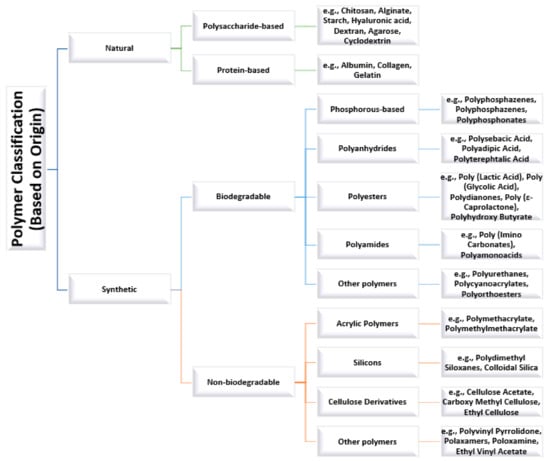
Figure 1.
Polymer classification. Created based on information from literature references [11,21,22].
2.1. Natural Polymers
2.1.1. Chitosan
Chitosan is a highly researched material for polymeric nanocarriers, being a non-toxic, biodegradable, hemocompatible, mucoadhesive polysaccharide generally recognized as safe by the Food and Drug Administration (FDA) [21,23,24,25]. The abundance of hydroxyl and amino groups from its backbone renders this material suitable for chemical modifications and targeted delivery to particular organs or cells [6,26,27]. Moreover, various techniques can be employed for fabricating chitosan drug delivery nanosystems, including ionic gelation, emulsion crosslinking, spray-drying, nanoprecipitation, emulsion solvent diffusion, and reverse micellization method [28,29].
The intrinsic antitumor and antimicrobial properties of chitosan have attracted interest in enhancing the efficacy of corresponding loaded substances [23,30]. To put the antitumor potential of this material to use, particular attention has been drawn to the delivery of a plethora of anti-cancer drugs [28] such as doxorubicin [31,32], paclitaxel [33,34,35,36], docetaxel [33,37,38], tamoxifen [39,40], curcumin [40,41,42,43], cisplatin [44,45], and mitomycin C [46,47]. The resulting nanosystems are able to reduce side toxicity while increasing treatment efficiency [28]. Besides, the antimicrobial activity of chitosan can be used in the development of novel antibacterial [48,49,50,51,52,53,54], antifungal [55,56,57,58], and antiviral [59,60,61,62] formulations.
The mucoadhesive properties of chitosan can be especially exploited for mucosal drug delivery [28]. Chitosan nanoparticles (CSNPs) are suitable for oral and nasal delivery of vaccines and drugs. They produce only small steric obstruction, protect freight therapeutics at the extracellular and intracellular level, prevent rapid clearance, and increase cargo retention time in the mucosa [6,28,63]. CSNPs can also be employed in the ocular delivery of drugs because their hydrophilic nature enhances stability, precorneal retention, and increases interaction with eye mucosa [28,64]. Furthermore, CSNPs can ensure colon-targeted delivery due to their tendency to dissolve in the acidic pH of the stomach and get swollen in the intestinal pH [28].
Nonetheless, chitosan is insoluble at physiological pH. However, this drawback can be overcome by chemical modification of the polymer to synthesize novel soluble derivatives [65]. The active functional groups from the structure of chitosan can undergo reactions such as hydroxylation, carboxylation, alkylation, acylation, and esterification that help introduce pendant groups, destroy the crystal structure, and consequently enhance the solubility of the resulted material. This possibility of facile modification expands the chitosan application range and dosage form [23,66,67].
2.1.2. Dextran
The simple and unique features of dextran make it an ideal candidate for nanomedicine carriers. Specifically, this FDA-approved biocompatible and biodegradable bacterial exopolysaccharide is very soluble in water and shows no cytotoxicity after drug delivery [6,68,69]. In contrast to other polysaccharides, dextran is not degraded by salivary amylase or malt amylase, only being broken down by dextranase found in the lumen of the large intestine, liver, spleen, and kidney. Therefore, this material is suitable for encapsulating drugs that must be protected throughout the stomach and small intestine, requiring enhanced absorption of the intestinal epithelium [70].
Dextran derivatives (e.g., diethyl aminoethyl (DEAE)-dextran or acetylated dextran (Ac-DEX)) are also promising for delivery applications, demonstrating adjuvant properties, and generating robust immune responses when used as vehicles for vaccine delivery [65,69,71].
2.1.3. Alginate
Alginates (also known as sodium-alginates) are a class of unbranched anionic polysaccharides that are attractive for transmucosal administration of drugs due to their mucoadhesive properties [6,21,72]. Moreover, alginate is an FDA-approved polymer that can be orally administered or injected due to its low toxicity, biocompatibility, and biodegradability [73]. In this context, alginate-based nanoparticles were reported as carriers for a broad range of drugs, enzymes, and genes [74].
More recently, alginate biomedical applications were extended to the field of vaccine delivery [75]. Being stable in simulated gastric fluid, alginate nanoparticles can be employed to encapsulate antigens, protecting them from enzymatic degradation and facilitating their release [73].
2.1.4. Pullulan
Pullulan is another FDA-approved polysaccharide of interest for bio-nanomedicine. It is non-toxic, non-mutagenic, non-immunogenic, and non-carcinogenic; thus, pullulan-based nanoparticles have important scientific value, receiving great research interest in designing excellent vaccine delivery systems [6,75,76,77]. In addition, pH-sensitive pullulan-based nanocarriers can be employed in anti-angiogenesis and chemotherapy against hepatocellular carcinoma, acting as targeted carriers of genes or proteins without presenting cytotoxic effects to normal cells [75].
Moreover, due to the presence of nine hydroxyl groups in its structure, pullulan can be derivatized to enhance its utility in a broad range of applications, including drug delivery, gene targeting, vaccination, medical imaging, and pharmaceutical dosages formation [75].
2.1.5. Hyaluronic Acid
Hyaluronic acid (HA) is another FDA-approved natural bioadhesive polymer that has been widely investigated for constructing various functional delivery vehicles. Especially due to its mucoadhesive properties, HA can enhance the bioavailability of carried substances through various delivery routes, such as ocular, nasal, and pulmonary administration routes [78,79]. HA-based nanoparticles or nanoconjugates are considered valuable candidates for drug delivery in cancer and atherosclerosis therapy [80]. Delivery effects can be optimized as HA NPs allow selective binding to receptors, such as CD44 and TLR4, which may trigger innate immune responses. Thus, HA site-specific drug delivery systems are valuable options for the targeted release of anticancer drugs and subunit vaccines [6,21,66]. Furthermore, HA structure benefits from ease of chemical modification, extending its application possibilities in drug delivery by conjugating and functionalizing with other molecules [78]. Particularly, their covalent conjugation with lipophilic molecules (e.g., propargylated ferulate fluorophores linked to fatty-acid residues through hexa(ethylene glycol) spacers) represents a promising path for creating self-assembled drug delivery colloidal nanosystems [81].
2.1.6. Albumin
Albumin represents an appealing protein-based macromolecular carrier due to its non-toxicity, non-immunogenicity, biocompatibility, easy incorporation of various drugs, and ability to bind with proteins [21,82,83]. Albumin nanoparticles have been shown to exhibit enhanced affinity for anti-cancer drugs, including paclitaxel [84,85,86,87] (FDA-approved nanoformulation as Abraxane®/ABI-007 (Celgene) [88]), doxorubicin [87,89,90,91,92], docetaxel [93,94,95,96], tacrolimus [87,97], and curcumin [98,99].
2.1.7. Poly(γ-Glutamic Acid) (γ-PGA)
γ-PGA is a bacterial-produced capsular exopolymer that can be degraded by γ-glutamyl transpeptidase present in the human body. Its advantageous properties, such as low toxicity, non-immunogenicity, biodegradability, and biocompatibility with tissues and cells, have recommended γ-PGA for vaccine development and pharmaceutical applications. Specifically, NPs composed of amphiphilic γ-PGA and hydrophobic amino acids are able to immobilize proteins, peptides, and chemical agents on their surfaces or encapsulate these substances inside the particles [73,100,101].
2.1.8. Other Natural Polymers
β-glucan is another FDA-approved natural polysaccharide of interest for biomedical applications [102]. Particularly, its immunostimulatory properties are appealing for antigen delivery and intensification of the immune response [103]. Moreover, β-glucan can be used as a carrier for targeted drug delivery. Due to its stability, biocompatibility, and specificity, this polymer can be successfully employed in cancer therapies, modulating body immunity in the tumor microenvironment [104,105].
Mannan is also a natural polysaccharide endowed with immunomodulatory properties. When used as a vaccine adjuvant, this polymer can enhance the immune response, especially against the human immunodeficiency virus (HIV) [103]. Other promising applications, for which mannan-based delivery systems have been investigated, include glioblastoma therapy [106], alternative medicine in lung cancer [107], and hypolipidemic medication [108].
The significant hydrophilicity and biocompatibility of cellulose are two main factors that recommend this material for biomedical applications. Recent research demonstrated that cellulose-based hydrogel has cross-sectional porous structures and viscoelastic properties, important features in designing efficient vaccine delivery systems [109]. Specifically, cellulose-based materials have been used as adjuvants for proteins, antigens, or DNA, leading to enhanced immune response [65,110]. Various forms (e.g., nanoparticles, nanowires, or nanofibers) exhibited immunomodulatory properties as they increased the secretion of pro-inflammatory cytokines [65,111,112].
Inulin is a complex natural and hydrophilic polysaccharide useful in the biomedical field, especially due to its unique and flexible structure. Investigations have demonstrated that high molecular weight inulin NPs can be employed to deliver drugs and other molecules of interest. In particular, nanoparticle adjuvants derived from inulin are able to enhance the immune response in vaccines against viruses, such as influenza and hepatitis B [6,75,113].
Other natural polymers that have attracted research interest for delivery purposes include, but are not limited to, glycogen [114,115,116], starch [114,117,118,119,120], lignin [121,122], heparin [123,124], lentinan [14,125,126], and chondroitin sulfate [127,128,129].
2.2. Synthetic Polymers
2.2.1. Polyethyleneimine (PEI)
PEI is an FDA-approved synthetic cationic homopolymer, for human medical applications, that can be used as a transfection reagent or as a material for creating NPs with high nucleic acid complexation capacity [130,131]. PEI has good aqueous solubility and intrinsic pH buffering capacity in the endosomal/lysosomal pathway [132,133]. Due to these favorable features, it can induce endosomal escape of carried agents by the “proton sponge effect”, having a potent mucosal adjuvant activity for viral subunit glycoprotein antigens and promoting antigen cross-presentation [100,130]. However, PEI presents some drawbacks that limit its clinical use. This polymer is not biodegradable, and it exerts toxic effects on cells [130,132]. The toxicity issue can be overcome by conjugating PEI to other polymers, including CS, HA, cyclodextrins, and PEG, to produce safer nanoparticles that can still facilitate endosomal escape [132].
2.2.2. Poly (Lactic Acid) (PLA)
PLA is a widely used FDA-approved synthetic polymer in biomedicine, especially for preparing tailored size and shape micro and nanoparticles [6,101,134]. Its versatility, facile synthesis from renewable resources, and biodegradability in extracellular environments have attracted considerable research interest, resulting in numerous investigations for PLA-based drug delivery vehicles [135]. Moreover, this polymer can be chemically altered through interactions with adhesive proteins that endow the material with targeting ability towards specific cells and tissues once it is placed in-situ [136].
2.2.3. Poly (Ethylene Glycol) (PEG)
Another FDA-approved synthetic polymer that gained significant interest for biomedical applications is PEG, especially due to its advantageous properties such as high solubility, non-toxicity, and excellent biocompatibility [11,133,137]. Besides its stand-alone properties, conjugation of PEG to proteins, peptides, and drug delivery systems is a widely employed method for increasing the therapeutic effects of nano-biopharmaceuticals. Known as “PEGylation”, this process endows the nanocarrier with the ability of modulated drug delivery and release [138,139]. However, clinical manifestations of PEG allergy are often severe, imposing attentive consideration concerning its administration and timely diagnosis to prevent anaphylactic reactions [140,141,142,143].
2.2.4. Poly (Lactic-co-Glycolic Acid) (PLGA)
Due to its biodegradability, biocompatibility, and favorable safety profile, PLGA has been approved by the FDA and European Medicines Agency (EMA) for various biomedical applications, including drug and vaccine delivery [65,101,130,144,145]. Moreover, the physicochemical characteristics of PLGA nanosystems can be fine-tuned extensively. This material can also be conjugated with PEG or polyetherimide to form block copolymers that are able to self-assemble into micelles that can encapsulate hydrophobic molecules and hydrophobic peptide antigens or proteins [18].
2.2.5. Poly-ε-Caprolactone (PCL)
PCL is one more FDA-approved, biocompatible, and biodegradable synthetic polymer that has attracted attention for nanobiomedicine purposes [146]. Its inexpensiveness, hydrophobicity, stability, and slow degradation pattern are several important features that recommend PCL-based nanoparticles for mucosal antigen delivery and DNA delivery [6,147]. Compared to PLGA, PCL degrades very slowly and without subsequently producing an acidic environment; thus, it is considered a promising adjuvant and carrier candidate for different vaccines [147].
2.2.6. Polystyrene (PS)
Despite not being biodegradable, polystyrene nanoparticles (PSNPs) are also attractive for biomedical purposes. PSNPs are biocompatible, do not induce inflammation, bind to a range of antigens due to their easily modifiable surface, and generate CD8+T cell responses specific to the delivered peptides [75,148]. Moreover, PS can be associated with other polymers to create amphiphilic block copolymers that are stable in aqueous media, while also being able to encapsulate hydrophobic bioactive substances [149].
2.2.7. Dendrimers
Dendrimers’ compact, well-defined, highly branched, and radial chemical structure makes this class of synthetic polymers suitable for encapsulating various drugs [6,9]. Bearing multiple surface-accessible functional groups, dendrimers can be employed in coupling with biologically relevant molecules. Moreover, their characteristic three-dimensional structure, size, and surface charge enable them to interact with, and pass through, cell membranes, making them better delivery vehicles than classical polymeric materials [6,130,150]. Nonetheless, the use of dendrimers in biological systems is hindered by their inherent toxicity, mostly attributed to the interaction of surface cationic charge of dendrimers with negatively charged biological membranes [151]. In particular, higher cytotoxicity has been observed for higher-generation dendrimers and for cationic dendrimers, such as poly(amido amine) (PAMAM) and poly(propylene imine) (PPI) [152]. To minimize their toxicity, different chemical modifications can be performed on dendrimers’ surface (e.g., PEGylation, acetylation) [151] or biocompatible molecules (e.g., maltose, maltotriose) can be used to decorate the nanosystem’s outer shell [153].
2.2.8. Other Synthetic Polymers
Phosphazenes are attractive polymers for vaccine formulations. They can induce strong and sustained antigen-specific humoral and cell-mediated immune responses, which are considered better and safer options than conventional adjuvants [75].
Polyanhydrides represent another polymer class of interest for controlled release products. These materials are biodegradable, biocompatible, safe, and approved for human use. Specifically, polyanhydrides degrade through surface erosion, releasing non-toxic and easily metabolized carboxylic by-products. Furthermore, this process of erosion that takes place only at the surface of nanoparticles contributes to the tailored and sustained release of encapsulated cargos [6,65]. Moreover, the surface of polyanhydride particles can be easily functionalized [65].
Polyelectrolytes represent a class of polymers with charged functional groups in their backbone, such as poly(allylamine hydrochloride) (PAH), poly (styrene sulfonate) (PSS), polyacrylic acid (PAA), and poly(diallyl dimethyl ammonium chloride) (PDAC) [154]. Polyelectrolytes can be employed in delivery applications, such as glucose-responsive nanocapsules for protein drug delivery [155], theranostic nanoparticles as MRI-visible drug delivery systems [156], ultrasound-sensitive nanocapsules for remote activated release of biomolecules/drugs [157], and nanocontainers for antibiotic therapy [158].
Polymersomes have attracted increasing research interest as versatile carriers due to their colloidal stability, tunable membrane properties, and capacity of encapsulating various drugs and biomolecules. These vesicles made of self-assembling synthetic block copolymers have tunable stability, degradation, and functionalization. They can deliver hydrophilic compounds by incorporating them inside the vesicle or hydrophobic cargos by membrane delivery [130].
Other synthetic polymers that have attracted research interest for delivery purposes include, but are not limited to, poly β-hydroxybutyrate [159,160], polyurethane (PU) [161,162], polyvinyl pyrrolidone (PVP) [163,164,165], poly (γ-glutamic acid) (PGA) [166,167], and polymethyl methacrylate [168,169,170].
3. Polymeric Nanoparticles Synthesis
Polymer-based NPs are one of the most commonly used forms of soft materials for nanomedicine applications not only due to their versatility and the broad spectrum of applications but also due to their facile synthesis [88]. Recent polymer chemistry progress has allowed the preparation of tailored NPs with well-controlled structures (e.g., fine-tuned size, shape, morphology) and compositions, which are essential factors in obtaining vehicles for targeted delivery and controlled cargo release [171].
In drug delivery applications, two main categories of nanoparticles can be distinguished, namely nanocapsules (reservoir systems) and nanospheres (matrix systems) (Figure 2). Nanocapsules present an inner core in which the freight is usually incorporated, surrounded by a polymeric shell, whereas nanospheres are composed of a continuous polymeric network that can entrap the drug or absorb it onto the nanoparticle’s surface [172].
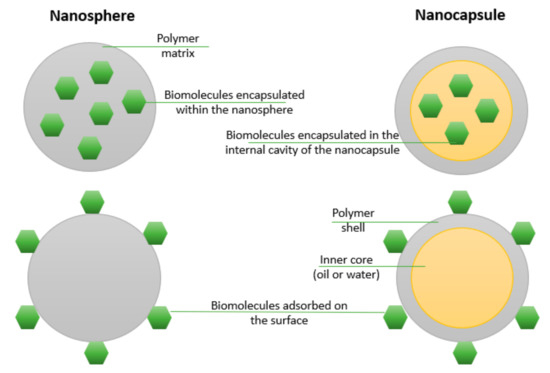
Figure 2.
Schematic representation of nanosphere and nanocapsule drug association possibilities. Created based on information from literature references [172,173,174].
Depending on the type of cargo to be delivered by the polymeric NPs and their proposed administration route, different methods can be employed in the production of nanospheres and nanocapsules [172]. The standard synthesis methods involve one of two fundamental mechanisms: kinetically driven encapsulation, during nucleation and particle growth, and thermodynamically self-assembly. Out of these possibilities, the first one has shown particular promise as it allows the encapsulation of large amounts of hydrophobic drugs while preserving a narrow size distribution [175].
The first strategy used for manufacturing polymeric NPs from a preformed polymer was the solvent evaporation method (Figure 3a), which leads to the formation of nanospheres. It assumes the preparation of an oil-in-water emulsion, starting from an organic phase (consisting of polar organic solvent, polymer, and drug) and an aqueous phase (consisting of surfactant and water). Initially, dichloromethane and chloroform have been most widely used as organic solvents, but due to toxicity considerations, they have been replaced by ethyl acetate [172,176]. For obtaining small particle size, ultrasonication or high-speed homogenization stages can be employed. This method is suitable for the encapsulation of hydrophobic drugs [177]. A similar synthesis route for nanospheres production is the emulsion/reverse salting method (Figure 3b), which mainly differs from the previous method by the emulsion composition. Specifically, the organic phase is formulated from a polymer, drug, and solvent miscible in water (e.g., acetone, ethanol), and the aqueous phase contains salting-out agents and a stabilizer [176,177]. A derived synthesis method, the emulsification/solvent diffusion technique (Figure 3c), can be used for producing both nanocapsules and nanospheres [177]. This method assumes the formation of an oil-in-water emulsion between a partially water-miscible solvent (e.g., benzyl alcohol, ethyl acetate), containing the polymer and the desired cargo, and an aqueous solution with a surfactant [172]. This method may yield particles with a high encapsulation efficiency of lipophilic and hydrophilic active substances, batch-to-batch reproducibility, narrow size distribution, and ease of scale-up production [176,177]. In contrast to the above-described methods, nanoprecipitation (also known as solvent displacement method or interfacial deposition) (Figure 3d) requires two miscible solvents. The polymer and drug are dissolved in a water-miscible solvent and further injected into an aqueous solution, resulting in a colloidal suspension. The as-such-obtained nanospheres and nanocapsules have a better-defined size, and a narrower size distribution, than the emulsification processes [172,176,177].
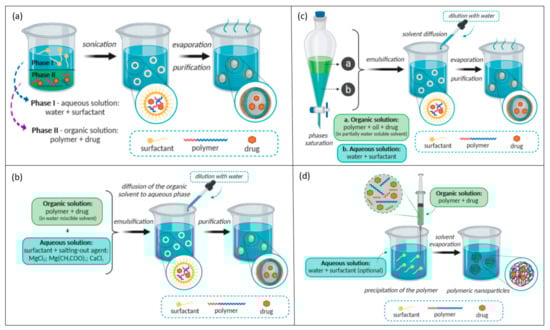
Figure 3.
Schematic representation of several polymer nanoparticles synthesis methods: (a) solvent evaporation method; (b) emulsification/reverse salting-out method; (c) emulsification/solvent diffusion method; (d) nanoprecipitation method. Reprinted from an open-access source [172].
Other chemical methods for polymeric nanoparticles manufacturing involve the polymerization of monomers, instead of nanoparticles construction, from preformed polymers. In this category, the most used techniques are emulsion polymerization and interfacial polymerization, allowing simultaneous polymer synthesis and drug encapsulation [177].
Alternatively, physical methods can be used for polymer NPs manufacturing. One such method is laser ablation, which uses a high-power laser beam to evaporate particles from a solid material source. Similarly, pulse laser deposition (PLD) can be employed; this method assumes that the target material is hit by high-power laser pulses, leading to its melting, evaporation, and ionization. Another technique that provides flexibility and control over surface parameters of the synthesized nanoparticles is electrospraying. The synthesis process starts with a solution of polymer and solvent, placed in a syringe, and the application of a high voltage to its capillary tip. The solvent is evaporated while the particles or fibers are pushed to a collector [178].
More recently, polymer-based nanoparticles started being synthesized with the aid of microfluidic devices. The small channel dimensions and the special geometry of these devices allow the synthesis of high-quality nanocarriers in shorter times and with lower consumption of reagents. Moreover, microfluidics technology brings better control over the size, size distribution, morphology, and composition of the final products. Specifically, the size, polydispersity, and drug encapsulation can be simply tailored by varying experimental parameters such as flow rates, polymer composition, and polymer concentration [179].
4. Applications of Polymer-Based Delivery Nanosystems
Either alone, in blends, or in combination with other nanomaterials, polymer-based nanoparticles can deliver a variety of cargos, including active pharmaceutical ingredients, nucleic acids, imaging agents, antigens, and other biomolecules. This section reviews the most recent advances in the development of polymer-based delivery nanosystems, depending on the carried moieties.
4.1. Drug Delivery
For a drug to be released to the targeted cell, it must be hydrophilic enough to travel through aqueous media and reach the cellular membrane but lipophilic enough to cross this barrier and pass inside the cell. Due to the broad range of available materials and the possibility of functionalization, polymeric materials can be tailored to adjust the hydrophilicity of the drug formulation and deliver the cargo at the desired site. Moreover, the versatility of polymer-based nanoparticles can ensure the delivery of encapsulated drugs through a variety of administration routes, including oral delivery, ocular delivery, nasal delivery, pulmonary delivery, buccal delivery, periodontal delivery, dermal and transdermal delivery, and vaginal delivery.
Given the wide range of possible applications, increasing research interest has been attracted to designing and testing polymer-based delivery platforms. Much effort has recently been put into developing antimicrobial delivery systems that would enhance cargo activity while overcoming drug resistance and diminishing systemic side effects [173,180,181,182,183] (Figure 4).
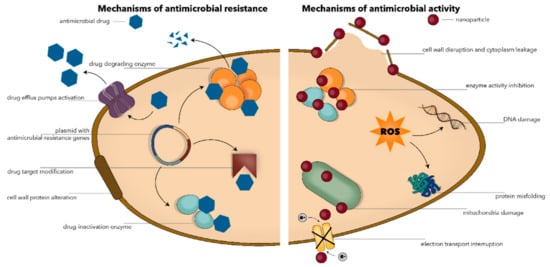
Figure 4.
Visual representation of antimicrobial resistance mechanisms (left) and antimicrobial activity of nanoparticles (right). Reprinted from an open-access source [173].
Several such novel polymer-based delivery systems are reviewed in Table 1.

Table 1.
Polymer-based delivery nanosystems for antimicrobial drugs.
As cancers remain one of the major health concerns worldwide, extensive research has been oriented to developing better therapeutics for this category of diseases. Chemotherapeutic drugs can be employed in the treatment of cancer patients, as they interfere with the cell cycle and the process of mitosis, causing a greater proportion of cell kill in tumor cells than in healthy tissues [206]. Nonetheless, large systemic doses of such aggressive drugs may lead to drug resistance and adverse effects, while their repeated administration requires a strict treatment schedule that must be adapted to the ability of healthy tissues to recover [207,208,209]. Thus, attention has been drawn to developing carrier systems that allow a controlled release at the tumor site. Due to recent findings concerning the tumor microenvironment, targeted solutions have been envisaged. Specifically, stimuli-responsive delivery systems have been created to target the acidic pH and/or hypoxic environment characteristic of tumor cells [210] (Figure 5).
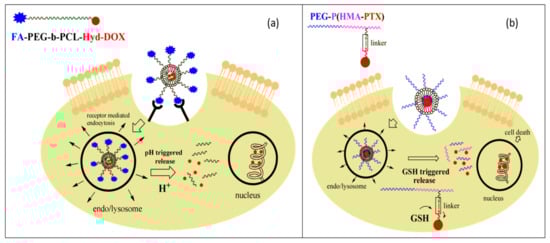
Figure 5.
(a) Mechanism of action of pH-responsive polymer NPs, decorated with targeting ligand folic acid (FA) and with doxorubicin, bound via a hydrazone bond to diblock copolymer PEG-PCL. (b) Mechanism of action of redox-responsive polymer NPs with bonded paciltaxel via a disulfide linker to diblock copolymer PEG-b-PHEMA. Adapted from an open-access source [22].
In this respect, polymeric nanoparticles have been investigated as carriers towards various tumor cells, including breast [44,211,212,213], colon [91,214,215,216,217], gastric [169,218,219,220], liver [116,221,222], bladder [46,223], skin [224,225], lung [36,92,226], prostate [94,227,228,229], and ovarian [230,231,232] cancer cells (Table 2).
Table 2.
Polymer-based delivery nanosystems for chemotherapeutic agents.
Another attractive and effective cargo for polymeric nanoparticles is represented by photosensitizer drugs and photothermal agents that can be used as adjuvant therapies (e.g., photodynamic therapy, photothermal therapy) in a wide range of diseases [237,238,239,240].
Polymer nanoparticles are also useful for delivering drugs to hard-to-reach tissues and organs. For instance, they can facilitate drug permeation to challenging anatomic structures, such as the inner ear [241,242,243,244], retina [245,246,247,248,249], brain [250,251,252,253,254], and avascular connective tissues [255,256,257].
4.2. Imaging Agent Delivery
Medical imaging is an essential part of clinical diagnosis, enhancing diagnostic accuracy, enabling a faster start of treatment, and improving survival rates in many diseases [258]. Moreover, synergistic outcomes can be obtained by combining conventional imaging techniques with nanotechnology, especially when using nanoparticles as contrast agents [259,260,261]. Nonetheless, uncoated metal-based nanoparticulate contrast agents may induce toxicological reactions through ROS generation, the release of free metal ions, and the production of aggregates that cannot be eliminated by the cells [261].
Thus, a convenient approach is to coat these NPs with biocompatible polymers. For instance, Vu-Quang et al. [262] designed a nanosystem, based on SPION core covered with a pluronic F127-folate coating, that can specifically target folate receptor-expressing cancer cells—a promising candidate as a contrast agent in MRI. Similarly, Kania et al. [263] have coated SPIONs with ultrathin layers of chitosan derivatives, obtaining suitable T2 contrast agents for liver disease diagnostic. In another study by Amendola et al. [264], bimetallic (silver-iron) nanoparticles were coated with PEG, offering promising results in terms of biopersistency and contrast efficiency.
Another promising strategy is to deliver conventional contrast agents by polymer-based vehicles. In this respect, Shao et al. [220] have proposed a carboxymethyl chitosan 4-hydroxymethyl-pinacol phenyl borate carrier encapsulated with indocyanine green and modified with RGD. Their ROS-responsive nanosystem can be employed in near-infrared imaging and photothermal therapy against gastric cancer. Another polymer-contrast agent system possibility is offered by Ponsiglione et al. [265], who have delivered Gd-DTPA with the aid of hyaluronic acid. Cheng et al. [266] have also approached Gd delivery using porous polymersomes (produced from self-assembly of polyethylene oxide-b-polybutadiene (PBdEO) and polyethylene oxide-b-polycaprolactone (PEOCL)). The Gd was conjugated to polyamidoamine (PAMAM) dendrimers via diethylenetriaminepentaacetic acid dianhydride (DTPA dianhydride) before polymersome encapsulation.
Modern medical imaging can also benefit from polymers tagged with radionuclides for molecular imaging of cancer in techniques such as positron emission tomography (PET) and single-photon emission computed tomography (SPECT) [267]. For instance, Gill et al. [268] have reported the synthesis of PLGA NPs surface conjugated to DTPA-hEGF, encapsulating the ruthenium-based DNA replication inhibitor and radiosensitizer, and labeled with 111In (Figure 6). The same radiolabel was used by Gorshkov et al. [269], who conjugated it on N-vinylpyrrolidone-N-vinylformamide copolymers. In a recent study, Huang et al. [270] have prepared 64Cu-labelled polymer that can detect small occult tumors in mice’s brain, head, neck, and breast at much higher contrast 18F-fluorodeoxyglucose.
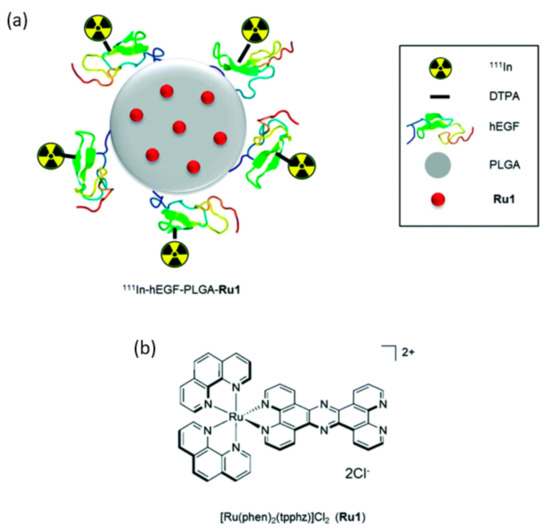
Figure 6.
(a) Schematic representation of radiolabeled nanoparticles; (b) Chemical structure of Ru1. Reprinted from an open-access source [268].
4.3. Gene Delivery
Gene therapy and immune engineering are complex tasks that hold great promise in treating various disorders. In this respect, nucleic acids can be employed for overexpressing or knocking down specific genes and can be used as adjuvants or danger signals for modulating the behavior of immune cells. Nonetheless, the direct delivery of nucleic acids has several drawbacks, as naked nucleic acids are prone to extracellular degradation, and they face difficulties in passing through the cell membrane [19,271,272].
In this context, increasing research has recently been focused on creating innovative delivery systems that can ensure efficient and targeted delivery of nucleic acids. Among the various tested materials, nanoscale polymers can embed or electrostatically absorb nucleic acids at their surface through a suitable surfactant or cationic polymer addition [6]. Specifically, cationic polymers can form electrostatic nanocomplexes with nucleic acids, which are highly negative, to facilitate their permeation into desired cells. In contrast, other hydrophobic polymers can physically entrap nucleic acids within nanoparticles [19].
Having a positively charged chemical structure, PEI-based nanoparticles are extensively used in gene delivery. However, despite its buffering capacity that can overcome intracellular barriers, PEI use is limited by its toxicity [273,274]. Poly(L-lysine) is another material that has attracted early gene delivery research, as it allows efficient binding to the cargo. Nevertheless, it faces challenges in facilitating endosomal escape and releasing the carried agents inside the cells [19].
Currently, lipid-based nanoparticles (LNPs) are the most clinically progressed nanoplatforms for delivering nucleic acids. Nonetheless, Blakney et al. [275] have compared the efficiency of LNP to that of pABOL bioreducible polymer in self-amplifying RNA (saRNA) delivery. Both tested platforms induced enhanced levels of IFN-γ, IL-12, IL-5, and TNF-α 4 h after administration. The researchers obtained a higher humoral and cellular immunity for LNPs, whereas a higher protein expression was observed for pABOL carriers. Thus, each delivery vehicle is advantageous for a different niche of saRNA applications. Specifically, LNPs are more suitable for vaccine formulations, while pABOL nanosystems may be employed in protein replacement therapies.
Another promising approach for nucleic acid delivery is employing lipid-polymer hybrid nanoparticles (LPNs) [276,277,278]. For instance, Vencken et al. [279] have tested the delivery of miR-17 to bronchial epithelial cells by LPNs, composed of PLGA and cationic lipid 1,2-dioleoyloxy-3-(trimethylammonium)propane, noting minimal cytotoxic and pro-inflammatory effects. LPNs can also be employed in gene therapy against drug-resistant glioblastoma, as investigated by Yang et al. [280]. The researchers have recently constructed LPNs loaded with CRISPR/Cas9 plasmids, targeting the MGMT gene, modified with the cRGD peptide that effectively targeted overexpressed integrin αvβ3 receptors in tumor cells, and restored the sensitivity of glioblastoma cells to temozolomide.
4.4. Vaccine Delivery
In general, vaccination represents the main method of preventing virus pathogenicity, reducing the burden of many infectious diseases. Nonetheless, traditional vaccines encounter several limitations, as they are susceptible to degradation, have a short duration of action, and may cause side effects and inflammatory reactions at the injection site [6,11]. Moreover, an important number of infectious diseases and chronic disorders (e.g., human immunodeficiency virus (HIV), healthcare-associated infections (HAIs), cytomegalovirus (CMV), respiratory syncytial virus (RSV), tuberculosis, malaria, etc.) cannot be prevented by conventional vaccines [18]. Thus, in recent years, modern bio-nanotechnology started being involved in vaccine development towards creating new-generation formulations [12,281]. In particular, the use of polymer-based nanovaccines is considered a promising approach in improving cross-presentation and enhancing vaccine potency against cancer, intracellular bacteria, and virus infection [282,283]. The main advantages of polymer-based nanovaccines are synthesized in Figure 7.
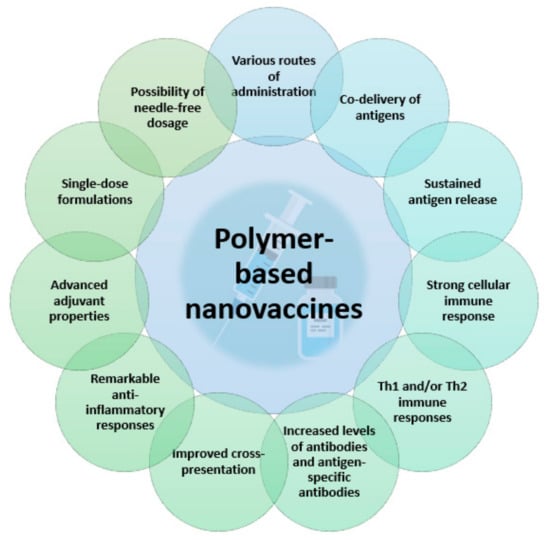
Figure 7.
Advantages of polymer-based nanovaccines. Created based on information from literature references [11,18,154,284].
One attractive approach is to employ polymer nanoparticles, in mucosal delivery of vaccines, as a strategy to overcome some of the drawbacks of conventional vaccines. Such nanovaccines can target both the mucosal and systemic immune systems, enhancing humoral and cell-mediated immune responses, ensuring a sustained release, and protecting the loaded freight against degradation [12]. In more detail, mucosal vaccine delivery may stimulate cytotoxic T-cell responses along with secreted IgA, helping the host organism identify and destroy pathogens before entering further into the body [11].
Due to their immunological activity and mucoadhesive properties, CS-based NPs have been widely investigated in developing vaccines against Clostridium botulinum type A neurotoxins, Naospora, hepatitis B virus, Newcastle disease, and more [6,285]. For instance, Zhao et al. [286] have encapsulated Newcastle disease viruses (NDV) in N-2-hydroxypropyl trimethyl ammonium chloride chitosan (N-2-HACC) nanoparticles and assessed their potential as a mucosal immune delivery carrier. The newly developed nanosystems have shown much stronger cellular, humoral, and mucosal immune responses than commercially available live attenuated NDV vaccines.
Another example is offered by Dhakal et al. [287], who have proposed an innovative vaccine delivery platform and tested it against several influenza A virus strains. The researchers evaluated the immune responses and cross-protective efficacy of intranasal administered CSNPs, encapsulated with inactivated SwIAV vaccine, in pigs. The results showed an enhanced IgG serum antibody and mucosal secretory IgA antibody responses in nasal swabs, bronchoalveolar lavage (BAL) fluids, and lung lysates that were reactive against homologous (H1N2), heterologous (H1N1), and heterosubtypic (H3N2) viral strains. Influenza vaccine formulations were also created by use of other bioadhesive polymers [6,65], such as hyaluronic acid [288,289], alginate [290], starch [291], and poly(acrylic acid) [291,292].
Another intranasal vaccine delivery system has been developed and investigated by Hamzaoui and Laraba-Djebari [293]. Their study focused on PLGA NPs, loaded with Cerastes venom for snake envenomation prevention, and their results confirmed this new nano-formulation represents a potent adjuvant system that improves humoral immune response while protecting against high lethal doses of viper venoms. A similar approach for developing an antivenom vaccine was tackled by Mirzaei et al. [294]. The researchers used CS NPs for loading Echis carinatus venom in order to stabilize it. Moreover, the obtained antivenom plasma had a considerably higher potency for neutralizing the venom than conventional delivery systems.
In an effort to prevent antibiotic-resistant pathogen infections, increasing attention has been drawn to developing antibacterial vaccines [295]. In this respect, various nanoparticle-based vaccines, against several bacteria, have shown promising results (Table 3).
Table 3.
Examples of antibacterial vaccines comprising polymers in their formulation.
5. Role of Polymer-Based NPs in Vaccine Development
Due to their extraordinary versatility, polymers play more than just transporter roles in vaccine formulations. Polymeric nanoparticles may possess the dual capability of being both the adjuvant and delivery vehicle, helping in controlled antigen release, inducing rapid and long-lived immunity, prolonging shelf-life at elevated temperatures, enhancing patient compliance, and enabling the rapid development of vaccines for newly emerging infectious disease viruses [10,65,75,310].
5.1. Vaccine Adjuvants
As many antigens are poorly immunogenic, adjuvants are added to vaccine formulations to elicit/potentiate the immune response, offer better protection against pathogens, and diminish the required antigen amount for obtaining immunity [12,100,281].
The most currently used adjuvants are aluminum-based (or alum compounds) adjuvants and Freund’s adjuvants. However, despite their relative safety and long history of use, aluminum salts may produce adverse effects, including erythema, nodules, contact hypersensitivity, and granulomas. Other drawbacks of alum adjuvants are the bias towards humoral immunity, the necessity of multiple doses, and incompatibility with many antigens. Freund’s adjuvants also present important disadvantages, as the paraffin oil used for these emulsions causes toxicity issues and produces severe local reactions [65,311,312,313]. Hence, better solutions had to be developed.
There are two main adjuvants types: antigen delivery systems (or depots) and immunostimulatory agents [130]. Some materials are even able to perform both roles simultaneously.
5.1.1. Antigen Delivery
A variety of polymeric carriers have been investigated for protecting antigens from proteolytic degradation, enhancing antigen entrapment, obtaining a desirable release profile, and targeting antigen-presenting cells (APCs) [144,147,283,314,315,316] (Figure 8).
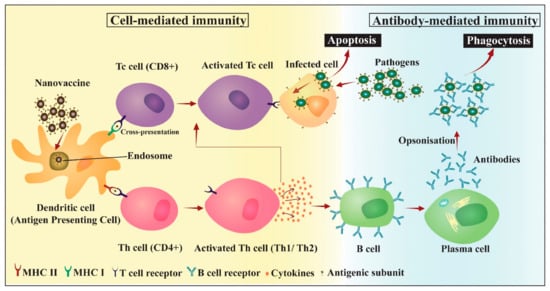
Figure 8.
Activation of adaptive immunity by nanovaccines: uptake and presentation of antigenic subunit by APCs elicit cell-mediated and antibody-mediated immune response, leading to apoptosis of infected cells and phagocytosis of antibody–pathogen complex. Reprinted from an open-access source [18].
For instance, Wusiman et al. [317] have prepared antigen delivery carriers made of CS-modified PLGA NPs, PEI-modified PLGA NPs, and ε-Poly-L-lysine (εPL)-modified PLGA NPs. The particles were loaded with AHPP and OVA, exhibiting positive charge after surface cationic polymers modification and demonstrating improved antigen loading capacity and stability (Figure 9). Moreover, these formulations allowed greater OVA adsorption capacity, leading to a significantly increased lymphocyte proliferation, improved CD4+/CD8+ T cells ratio, and secretion of cytokines (TNF-α, IFN-γ, IL-4, and IL-6), antibodies (IgG), and antibody subtypes (IgG1 and IgG2a) in immunized mice.
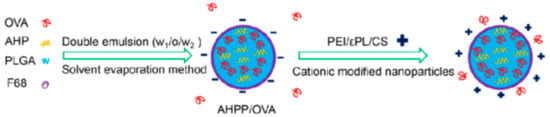
Figure 9.
Schematic representation of OVA-loaded surface cationic polymer modified AHPP/OVA nanoparticles. Reprinted from an open-access source [317].
Cruz et al. [318] have also tackled the benefits of PLGA NPs antigen encapsulation. The researchers have co-encapsulated resiquimod and tetanus toxoid peptide antigen in PLGA NPs, obtaining a prolonged controlled release in the endosome. Their findings demonstrated that the slower kinetics of antigen release is more effective for major histocompatibility complex (MHC) class II and I cross-presentation in dendritic cells, producing stronger and more durable immune responses than soluble components.
By conjugating PLGA with PEG through a peroxalate ester bond and adding PEI as a cationic adjuvant, Liang et al. [319] have synthesized an antigen delivery system that is both ROS responsive and facilitates antigen uptake while diminishing the toxicity associated with cationic adjuvants. The tested nanocarrier proved excellent loading capacity, in vitro stability when encapsulating OVA model antigen, enhanced dendritic cell maturation, improved antigen uptake, increased lysosomal escape, antigen cross-presentation, upregulation of CD4+ and CD8+ T cell proportions, and increased memory T-cell generation.
PLGA has also shown promising results in combination with inorganic materials. In particular, Saengruengrit et al. [320] have reported the successful synthesis of a delivery system based on biocompatible nanocomposite particles of PLGA and superparamagnetic iron oxide nanoparticles (SPIONs). When an external magnetic field was applied, the SPIONs-PLGA system presented superparamagnetic activity, low toxicity, and good uptake in macrophages and bone-marrow-derived primary dendritic cells (BM-DCs). Moreover, the nanodelivery platform did not induce BM-DCs secretion of TNF-α, but it upregulated MHC II, CD80, and CD86 expression and IL-12 and IFN-γ production.
Another widely studied biopolymer for antigen delivery is chitosan. In this respect, Bussio et al. [321] have developed a core-shell structure, with an oily core and a surrounding CS shell of a lower size, for transcutaneous vaccination (Figure 10). CS polymeric corona offered protection to the cargo and exhibited high stability in different storage conditions, along with a significant association of OVA as the model antigen.
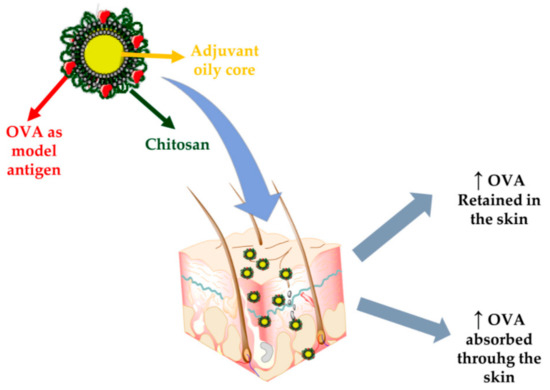
Figure 10.
Schematic representation of chitosan-based nanocapsules for transcutaneous antigen delivery. Reprinted from an open-access source [321].
Wang et al. [322] have investigated a system based on polydopamine nanoparticles (Pdop-NPs) for subcutaneous antigen delivery as a vector in cancer immunotherapy. OVA model antigen was grafted onto the nanoparticles to form a carrier system able to migrate to lymph nodes and penetrate APCs. Furthermore, OVA-encapsulated Pdop-NPs promoted the maturation of DCs, activated OVA-specific cytotoxic CD8+ T cells, and induced the production of memory CD4+ and CD8+ T cells, thus considerably suppressing tumor growth.
Another promising delivery system tested for OVA encapsulation is based on lignin nanoparticles. This adjuvant developed by Alqahtani et al. [121] was proven to be a safe stabilizer for antigen formulation during preparation and storage. Moreover, the OVA-encapsulated lignin particles showed no cytotoxicity, significantly higher antigen uptake in dendritic cells, and stronger IgG antibody response than that induced by free OVA alum-adjuvanted OVA, being a potential candidate for the induction of long-term immunity.
Lipid-polymeric hybrid delivery systems have also started to draw increasing scientific interest. For instance, Miura et al. [323] have created a cholesterol-pullulan self-assembly nanogel that they further modified by carboxylic group substitution to become negatively charged. This innovative system has been shown to target APCs and release the loaded antigen, inducing considerable adaptive immunity.
5.1.2. Immunomodulation
One way of enhancing the immune responses is to use a targeted delivery approach to immune cells [324]. In this respect, Dowling et al. [325] have encapsulated a Toll-like receptor (TLR) 8 agonist inside various poly(ethylene glycol)-bl-poly(propylene sulfide) (PEG-bl-PPS) polymer-based nanostructures, allowing direct intracellular release after selective uptake by DCs. TLR 8 agonist polymersomes led to similar newborn DC maturation profiles to those induced by BCG and stronger IL-12p70 production, holding promising potential for early-life immunization against intracellular pathogens. Following a similar strategy for stimulating cellular immunity, Rajput et al. [326] have designed an inulin acetate-based nanodelivery system to target DCs. The tested material exhibited potent vaccine adjuvant properties, activating TLR 4 on multiple immune cells to secrete various cytokines. Widmer et al. [327] proposed a novel carrier nanosystem that can ensure the targeted delivery of resiquimod to the lymph node. The researchers successfully encapsulated this TLR 7 ligand into methoxy poly(ethylene glycol)-b-poly(DL-lactic acid) (mPEG-PLA) and mixed poly(DL-lactic-co-glycolic acid) (PLGA)/mPEG-PLA nanoparticles obtaining good results in terms of cell (i.e., dendritic cells and macrophages) targeting and uptake. Moreover, the investigated particles are non-inflammatory and non-toxic on immune cells, making them promising candidates for cancer immunotherapy.
Another strategy is to take advantage of the intrinsic immunostimulatory properties of certain materials [9,154]. Several polymers, including PLGA, PS, CS, cellulose, lentinan, and dendrimers, can enhance the immune effects of vaccine formulations [14,154,328,329].
The beneficial properties of such polymers can be harnessed for improving the immune response for a broad range of vaccines. For example, inhalable polymeric particles were designed for pulmonary delivery of the hepatitis B vaccine. Thomas et al. [330] have created porous PLGA, as well as PLA NPs loaded with a specific antigen (i.e., HBsAg) that induced enhanced immune responses. Dewangan et al. [331] have also designed an HBsAg PLGA-loaded nanovaccine that demonstrated sustained release and better internalization in macrophage and MRC-5 cell lines. The researchers have tested several single-dose administration routes, obtaining the best results, in terms of immune-stimulating activity, for the intramuscular route; particularly, the nanovaccine administered in this way produced better humoral and cellular responses. An alternative intramuscular delivery system for HBsAg antigen was proposed by Liu et al. [332], who produced PLA microparticles modified with didodecyldimethylammonium bromide that absorbed hepatitis-specific antigens onto their surface. After three intramuscular injections with these particles, the level of pro-inflammatory cytokines (IL-1β, IL-6, CCL2, and CXCL1) increased at the injection site, the vaccine exhibiting ten times higher antigen-specific IgG titers than the group treated with commercial alum-adjuvanted antigen.
Another vaccine, for which polymers have been shown to potentiate the immune response, is tuberculosis (TB) vaccine. Khademi et al. [333] have combined the vaccine for this disease with chitosan and tested the novel formulation on mice. The CS-based TB vaccine demonstrated how parenteral and non-parenteral immunization lead to appropriate immune responses, inducing both protective and cell-mediated (CD4 and CD8) immune responses in the immunized animal models. Moreover, due to the mucoadhesive properties of CS, non-parenteral immunization can be considered as a more effective administration route.
Another highly researched topic is the development of an effective HIV vaccine. In this respect, Dacoba et al. [334] have investigated if the covalent attachment of a protease cleavage site (PCS) peptide to polysaccharide-based nanoparticles, together with the administration of polyinosinic:polycytidylic acid, enhanced the immune response. The study obtained promising results, with strong activation of APCs, concluding that both nanoparticle composition and the conjugation of the HIV peptide antigen contributed to the generated humoral and cellular immune responses.
5.2. COVID-19 Immunization
As severe acute respiratory syndrome-associated coronavirus 2 (SARS-CoV 2), also known as coronavirus disease of 2019 (COVID-19), has produced a public health crisis worldwide with huge human and economic losses, concerted global efforts have been employed in designing efficient vaccines [335,336,337]. As the genetic sequence of SARS-CoV 2 was made available in record time (within weeks after its discovery), the current vaccines were developed with unprecedented speed, with the clinical trials of promising candidates being completed within only a few months [17,336,338].
Nanomedicine played a tremendous role in COVID-19 vaccine development [339]. Moreover, the virus can be regarded as a functional nanomaterial, due to its nanometric size and core-shell nanostructure [340,341]. Thus, various nanoplatforms, such as lipid nanoparticles, polyplexes, dendrimers, cationic polysaccharide particles, and cationic nanoemulsions, were tested for delivering nucleic acids in vaccine formulations [17,275,338,342]. Out of the plethora of possibilities, lipid nanoparticles (LNP) are the most clinically advanced, both Pfizer/BioNTech and Moderna COVID-19 vaccines being LNP formulations [17,275].
Nonetheless, polymer-based vaccine alternatives have also shown promising results. For instance, Volpatti et al. [343] have created a subunit nanovaccine by conjugating SARS-CoV-2 Spike protein receptor-binding domain on the surface of polymersomes susceptible to oxidation. This vaccine formulation conducted to strong humoral neutralizing response to SARS-CoV-2 and robust T cell immunity.
Another strategy was adopted by Zhang et al. [344], who developed a core-shell nanostructure with a core made of PLGA and a human-cell-derived shell sourced from cells that are naturally targeted by SARS-CoV 2. The researchers demonstrated that the virus is neutralized, after incubation with these nanosponges, and can no longer infect cells.
Polyamidoamines (PAMAMs) represent another promising strategy in the treatment of COVID-19 [340], as it was demonstrated that they could prevent the cleavage of angiotensin and acute respiratory distress syndrome by binding to the ACE2 receptor [345]. Alternatively, chitin and chitosan can be used as delivery vehicles, as they have intrinsic antiviral activities and immune-boosting effects [346]. Other antiviral macromolecules of interest for COVID-19 drugs and vaccines are poly(vinylbenzoic acid), poly(vinylphosphonic acid), PVP, and cyclodextrins [347].
6. Conclusions and Future Perspectives
To summarize, a multitude of natural and synthetic polymers can be used to design useful delivery nanosystems for diverse therapeutics, imaging agents, antigens, and other biomolecules. Their versatility and property tunability can be exploited for carrying the necessary moieties to the desired site, even if the cells/tissues are challenging to reach by conventional drugs. Moreover, polymeric nanoparticles allow a targeted and controlled cargo release in response to changes in the pH, the oxygen level in the tissues, or binding with specific receptors. Therefore, polymer-based systems are suitable for many therapies against infections and chronic diseases, offering accurate diagnosis possibilities. This review also explores the role of polymers in developing novel and improved vaccines, especially mucosal administered formulations, for preventing various conditions, including envenomation, hepatitis, tuberculosis, cancer, and COVID-19 infection.
Considering the recent advances in this field, it can be expected that the particles, experimentally validated on animal models, would move to clinical trials. Nonetheless, further research is required, as a small subset of the immune-activation cascade is usually examined, while overall effects on human health may be neglected. Another challenge that has to be soon overcome is translating from the lab to scale-up synthesis of polymeric nanocarriers without compromising their quality and fine-tuned properties.
Furthermore, interesting possibilities arise at the convergence of nanotechnology with other innovative fields, such as artificial intelligence and data analytics, that are promising perspectives towards attaining personalized therapeutic and vaccine formulations.
Author Contributions
Conceptualization A.-G.N. and A.M.G.; methodology A.-G.N. and A.M.G.; investigation A.-G.N. and A.M.G.; writing—original draft preparation A.-G.N. and A.M.G.; writing—review and editing A.-G.N. and A.M.G. All authors have read and agreed to the published version of the manuscript.
Funding
This work was supported by a grant from the Romanian National Authority for Scientific Research and Innovation, UEFISCDI, project number TE 103, code: PN-III-P1-1.1-TE-2019-1450, entitled Multifunctional lab-on-a-chip microfluidic platform for the fabrication of nanoparticles.
Institutional Review Board Statement
Not applicable.
Informed Consent Statement
Not applicable.
Data Availability Statement
No new data were created or analyzed in this study. Data sharing is not applicable to this article.
Conflicts of Interest
The authors declare no conflict of interest.
References
- Valencia, G.A.; Zare, E.N.; Makvandi, P.; Gutiérrez, T.J. Self-assembled carbohydrate polymers for food applications: A review. Compr. Rev. Food Sci. Food Saf. 2019, 18, 2009–2024. [Google Scholar] [CrossRef]
- Aamir, M.; Tolouei-Rad, M.; Giasin, K.; Nosrati, A. Recent advances in drilling of carbon fiber–reinforced polymers for aerospace applications: A review. Int. J. Adv. Manuf. Technol. 2019, 105, 2289–2308. [Google Scholar] [CrossRef]
- Makvandi, P.; Iftekhar, S.; Pizzetti, F.; Zarepour, A.; Zare, E.N.; Ashrafizadeh, M.; Agarwal, T.; Padil, V.V.T.; Mohammadinejad, R.; Sillanpaa, M.; et al. Functionalization of polymers and nanomaterials for water treatment, food packaging, textile and biomedical applications: A review. Environ. Chem. Lett. 2020, 19, 583–611. [Google Scholar] [CrossRef]
- Umoren, S.A.; Solomon, M. Protective polymeric films for industrial substrates: A critical review on past and recent applications with conducting polymers and polymer composites/nanocomposites. Prog. Mater. Sci. 2019, 104, 380–450. [Google Scholar] [CrossRef]
- Wang, Y.; Feng, L.; Wang, S. Conjugated Polymer Nanoparticles for Imaging, Cell Activity Regulation, and Therapy. Adv. Funct. Mater. 2018, 29. [Google Scholar] [CrossRef]
- Guo, S.; Fu, D.; Utupova, A.; Sun, D.; Zhou, M.; Jin, Z.; Zhao, K. Applications of polymer-based nanoparticles in vaccine field. Nanotechnol. Rev. 2019, 8, 143–155. [Google Scholar] [CrossRef]
- Bastola, R.; Lee, S. Physicochemical properties of particulate vaccine adjuvants: Their pivotal role in modulating immune responses. J. Pharm. Investig. 2018, 49, 279–285. [Google Scholar] [CrossRef]
- Deirram, N.; Zhang, C.; Kermaniyan, S.S.; Johnston, A.P.R.; Such, G.K. pH-Responsive Polymer Nanoparticles for Drug Delivery. Macromol. Rapid Commun. 2019, 40, e1800917. [Google Scholar] [CrossRef]
- Kubackova, J.; Zbytovska, J.; Holas, O. Nanomaterials for direct and indirect immunomodulation: A review of applications. Eur. J. Pharm. Sci. 2019, 142, 105139. [Google Scholar] [CrossRef] [PubMed]
- Liang, E.A.J.; Zhao, X. Nanomaterial-based delivery vehicles for therapeutic cancer vaccine development. Cancer Biol. Med. 2021, 18, 352–371. [Google Scholar] [CrossRef] [PubMed]
- Chan, Y.; Ng, S.W.; Singh, S.K.; Gulati, M.; Gupta, G.; Chaudhary, S.K.; Hing, G.B.; Collet, T.; MacLoughlin, R.; Löbenberg, R.; et al. Revolutionizing polymer-based nanoparticle-linked vaccines for targeting respiratory viruses: A perspective. Life Sci. 2021, 280, 119744. [Google Scholar] [CrossRef]
- Han, J.; Zhao, D.; Li, D.; Wang, X.; Jin, Z.; Zhao, K. Polymer-Based Nanomaterials and Applications for Vaccines and Drugs. Polymers 2018, 10, 31. [Google Scholar] [CrossRef] [PubMed]
- Fong, D.; Hoemann, C.D. Chitosan immunomodulatory properties: Perspectives on the impact of structural properties and dosage. Futur. Sci. OA 2018, 4, FSO225. [Google Scholar] [CrossRef]
- Liu, Z.; He, J.; Zhu, T.; Hu, C.; Bo, R.; Wusiman, A.; Hu, Y.; Wang, D. Lentinan-Functionalized Graphene Oxide Is an Effective Antigen Delivery System That Modulates Innate Immunity and Improves Adaptive Immunity. ACS Appl. Mater. Interfaces 2020, 12, 39014–39023. [Google Scholar] [CrossRef]
- Milazzo, M.; Gallone, G.; Marcello, E.; Mariniello, M.D.; Bruschini, L.; Roy, I.; Danti, S. Biodegradable Polymeric Micro/Nano-Structures with Intrinsic Antifouling/Antimicrobial Properties: Relevance in Damaged Skin and Other Biomedical Applications. J. Funct. Biomater. 2020, 11, 60. [Google Scholar] [CrossRef] [PubMed]
- Jøraholmen, M.W.; Bhargava, A.; Julin, K.; Johannessen, M.; Škalko-Basnet, N. The Antimicrobial Properties of Chitosan Can Be Tailored by Formulation. Mar. Drugs 2020, 18, 96. [Google Scholar] [CrossRef]
- Shin, M.D.; Shukla, S.; Chung, Y.H.; Beiss, V.; Chan, S.K.; Ortega-Rivera, O.A.; Wirth, D.M.; Chen, A.; Sack, M.; Pokorski, J.K.; et al. COVID-19 vaccine development and a potential nanomaterial path forward. Nat. Nanotechnol. 2020, 15, 646–655. [Google Scholar] [CrossRef] [PubMed]
- Pippa, N.; Gazouli, M.; Pispas, S. Recent Advances and Future Perspectives in Polymer-Based Nanovaccines. Vaccines 2021, 9, 558. [Google Scholar] [CrossRef]
- Tzeng, S.Y.; Green, J.J. Polymeric nucleic acid delivery for immunoengineering. Curr. Opin. Biomed. Eng. 2018, 7, 42–50. [Google Scholar] [CrossRef]
- Fadlilah, D.R.; Endarko, E.; Ratnasari, A.; Hozairi, H.; Yusop, Z.; Syafiuddin, A. Enhancement of antibacterial properties of various polymers functionalized with silver nanoparticles. Biointerface Res. Appl. Chem. 2020, 10, 5592–5598. [Google Scholar] [CrossRef]
- Idrees, H.; Zaidi, S.Z.J.; Sabir, A.; Khan, R.U.; Zhang, X.; Hassan, S.-U. A Review of Biodegradable Natural Polymer-Based Nanoparticles for Drug Delivery Applications. Nanomaterials 2020, 10, 1970. [Google Scholar] [CrossRef] [PubMed]
- Avramović, N.; Mandić, B.; Savić-Radojević, A.; Simić, T. Polymeric Nanocarriers of Drug Delivery Systems in Cancer Therapy. Pharmaceutics 2020, 12, 298. [Google Scholar] [CrossRef]
- Zhao, D.; Yu, S.; Sun, B.; Gao, S.; Guo, S.; Zhao, K. Biomedical Applications of Chitosan and Its Derivative Nanoparticles. Polymers 2018, 10, 462. [Google Scholar] [CrossRef]
- Garg, U.; Chauhan, S.; Nagaich, U.; Jain, N. Current Advances in Chitosan Nanoparticles Based Drug Delivery and Targeting. Adv. Pharm. Bull. 2019, 9, 195–204. [Google Scholar] [CrossRef] [PubMed]
- Amanzadi, B.; Mirzaei, E.; Hassanzadeh, G.; Mandaviani, P.; Boroumand, S.; Abdollahi, M.; Abdolghaffari, A.H.; Majidi, R.F. Chitosan-based layered nanofibers loaded with herbal extract as wound-dressing materials on wound model studies. Biointerface Res. Appl. Chem. 2019, 9, 3979–3986. [Google Scholar] [CrossRef]
- Naskar, S.; Sharma, S.; Kuotsu, K. Chitosan-based nanoparticles: An overview of biomedical applications and its preparation. J. Drug Deliv. Sci. Technol. 2018, 49, 66–81. [Google Scholar] [CrossRef]
- Mallick, S.P.; Panda, S.P.; Gayatri, A.; Kunaal, Y.; Naresh, C.; Suman, D.K.; Samineni, J.; Siddiqui, N.; Singh, B.N. Chitosan Oligosaccharide Based Hydrogel: An Insight into the Mechanical, Drug Delivery, and Antimicrobial Studies. Biointerface Res. Appl. Chem. 2020, 11, 10293–10300. [Google Scholar]
- Naskar, S.; Kuotsu, K.; Sharma, S. Chitosan-based nanoparticles as drug delivery systems: A review on two decades of research. J. Drug Target. 2018, 27, 379–393. [Google Scholar] [CrossRef]
- Ullah, F.; Javed, F.; Zakaria, M.R.; Jamila, N.; Khattak, R.; Khan, A.N.; Akil, H.M. Determining the molecular-weight and interfacial properties of chitosan built nanohydrogel for controlled drug delivery applications. Biointerface Res. Appl. Chem. 2019, 9, 4452–4457. [Google Scholar] [CrossRef]
- Azmi, A.A.; Ahyat, N.; Mohamad, F.; Hamzah, S. Synthesis of silver nanoparticles: Double-green approach of using chitosan and microwave technique towards antimicrobial activity against pathogenic bacteria. Biointerface Res. Appl. Chem. 2020, 10, 5918–5922. [Google Scholar] [CrossRef]
- Joshi, B.; Kaur, J.; Khan, E.; Kumar, A.; Joshi, A. Ultrasonic atomizer driven development of doxorubicin-chitosan nanoparticles as anticancer therapeutics: Evaluation of anionic cross-linkers. J. Drug Deliv. Sci. Technol. 2020, 57, 101618. [Google Scholar] [CrossRef]
- Yana, T.; Zhua, S.; Huia, W.; Heb, J.; Liua, Z.; Chengac, J. Chitosan based pH-responsive polymeric prodrug vector for enhanced tumor targeted co-delivery of doxorubicin and siRNA. Carbohydr. Polym. 2020, 250, 116781. [Google Scholar] [CrossRef] [PubMed]
- Ashrafizadeh, M.; Ahmadi, Z.; Mohamadi, N.; Zarrabi, A.; Abasi, S.; Dehghannoudeh, G.; Tamaddondoust, R.N.; Khanbabaei, H.; Mohammadinejad, R.; Thakur, V.K. Chitosan-based advanced materials for docetaxel and paclitaxel delivery: Recent advances and future directions in cancer theranostics. Int. J. Biol. Macromol. 2020, 145, 282–300. [Google Scholar] [CrossRef]
- Du, X.; Yin, S.; Xu, L.; Ma, J.; Yu, H.; Wang, G.; Li, J. Polylysine and cysteine functionalized chitosan nanoparticle as an efficient platform for oral delivery of paclitaxel. Carbohydr. Polym. 2019, 229, 115484. [Google Scholar] [CrossRef] [PubMed]
- BaŞPinar, Y.; Akbaba, H.; Bayraktar, O. Encapsulation of paclitaxel in electrosprayed chitosan nanoparticles. J. Res. Pharm. 2019, 23, 886–896. [Google Scholar] [CrossRef]
- Jiang, J.; Liu, Y.; Wu, C.; Qiu, Y.; Xu, X.; Lv, H.; Bai, A.; Liu, X. Development of drug-loaded chitosan hollow nanoparticles for delivery of paclitaxel to human lung cancer A549 cells. Drug Dev. Ind. Pharm. 2017, 43, 1304–1313. [Google Scholar] [CrossRef] [PubMed]
- Mahmood, M.A.; Madni, A.; Rehman, M.; Rahim, M.A.; Jabar, A. Ionically Cross-Linked Chitosan Nanoparticles for Sustained Delivery of Docetaxel: Fabrication, Post-Formulation and Acute Oral Toxicity Evaluation. Int. J. Nanomed. 2019, 14, 10035–10046. [Google Scholar] [CrossRef]
- Zhang, E.; Xing, R.; Liu, S.; Li, K.; Qin, Y.; Yu, H.; Li, P. Vascular targeted chitosan-derived nanoparticles as docetaxel carriers for gastric cancer therapy. Int. J. Biol. Macromol. 2018, 126, 662–672. [Google Scholar] [CrossRef] [PubMed]
- Vivek, R.; Babu, V.N.; Thangam, R.; Subramanian, K.; Kannan, S. pH-responsive drug delivery of chitosan nanoparticles as Tamoxifen carriers for effective anti-tumor activity in breast cancer cells. Colloids Surfaces B Biointerfaces 2013, 111, 117–123. [Google Scholar] [CrossRef] [PubMed]
- Alhajamee, M.; Marai, K.; Al Abbas, S.M.N.; Tabrizi, M.H. Co-encapsulation of curcumin and tamoxifen in lipid-chitosan hybrid nanoparticles for cancer therapy. Mater. Technol. 2021, 1–12. [Google Scholar] [CrossRef]
- Nair, R.S.; Morris, A.; Billa, N.; Leong, C.-O. An Evaluation of Curcumin-Encapsulated Chitosan Nanoparticles for Transdermal Delivery. AAPS PharmSciTech 2019, 20, 69. [Google Scholar] [CrossRef]
- Hu, Q.; Luo, Y. Chitosan-based nanocarriers for encapsulation and delivery of curcumin: A review. Int. J. Biol. Macromol. 2021, 179, 125–135. [Google Scholar] [CrossRef] [PubMed]
- Almutairi, F.M.; El Rabey, H.A.; Tayel, A.A.; Alalawy, A.I.; Al-Duais, M.A.; Sakran, M.I.; Zidan, N.S. Augmented anticancer activity of curcumin loaded fungal chitosan nanoparticles. Int. J. Biol. Macromol. 2019, 155, 861–867. [Google Scholar] [CrossRef] [PubMed]
- Singh, M.; Gounden, S.; Danielw, A. Chitosan-Modified Silver Nanoparticles Enhance Cisplatin Activity in Breast Cancer Cells. Biointerface Res. Appl. Chem. 2020, 11, 10572–10584. [Google Scholar] [CrossRef]
- Siavashy, S.; Soltani, M.; Ghorbani-Bidkorbeh, F.; Fallah, N.; Farnam, G.; Mortazavi, S.A.; Shirazi, F.H.; Tehrani, M.H.H.; Hamedi, M.H. Microfluidic platform for synthesis and optimization of chitosan-coated magnetic nanoparticles in cisplatin delivery. Carbohydr. Polym. 2021, 265, 118027. [Google Scholar] [CrossRef] [PubMed]
- Manan, F.A.A.; Yusof, N.A.; Abdullah, J.; Mohammad, F.; Nurdin, A.; Yazan, L.S.; Khiste, S.K.; Al-Lohedan, H.A. Drug Release Profiles of Mitomycin C Encapsulated Quantum Dots–Chitosan Nanocarrier System for the Possible Treatment of Non-Muscle Invasive Bladder Cancer. Pharmaceutics 2021, 13, 1379. [Google Scholar] [CrossRef] [PubMed]
- Mohajeri, A.; Amigh, S. In the search of active nanocarriers for delivery of mitomycin C drug. Mater. Adv. 2020, 1, 1909–1919. [Google Scholar] [CrossRef]
- Ibrahim, H.M.; El-Bisi, M.K.; Taha, G.M.; El-Alfy, E.A. Chitosan nanoparticles loaded antibiotics as drug delivery biomaterial. J. Appl. Pharm. Sci. 2015, 5, 85–90. [Google Scholar] [CrossRef]
- Ameeduzzafar; Imam, S.S.; Bukhari, S.N.A.; Ahmad, J.; Ali, A. Formulation and optimization of levofloxacin loaded chitosan nanoparticle for ocular delivery: In-vitro characterization, ocular tolerance and antibacterial activity. Int. J. Biol. Macromol. 2018, 108, 650–659. [Google Scholar] [CrossRef] [PubMed]
- El-Alfy, E.A.; El-Bisi, M.K.; Taha, G.M.; Ibrahim, H.M. Preparation of biocompatible chitosan nanoparticles loaded by tetracycline, gentamycin and ciprofloxacin as novel drug delivery system for improvement the antibacterial properties of cellulose based fabrics. Int. J. Biol. Macromol. 2020, 161, 1247–1260. [Google Scholar] [CrossRef]
- De Andrade, L.F.; Apolinário, A.C.; Rangel-Yagui, C.O.; Stephano, M.A.; Tavares, L.C. Chitosan nanoparticles for the delivery of a new compound active against multidrug-resistant Staphylococcus aureus. J. Drug Deliv. Sci. Technol. 2019, 55, 101363. [Google Scholar] [CrossRef]
- Mohammadi, A.; Hosseini, S.M.; Hashemi, M. Emerging chitosan nanoparticles loading-system boosted the antibacterial activity of Cinnamomum zeylanicum essential oil. Ind. Crop. Prod. 2020, 155, 112824. [Google Scholar] [CrossRef]
- Kahdestani, S.A.; Shahriari, M.H.; Abdouss, M. Synthesis and characterization of chitosan nanoparticles containing teicoplanin using sol–gel. Polym. Bull. 2020, 78, 1133–1148. [Google Scholar] [CrossRef]
- Rashki, S.; Asgarpour, K.; Tarrahimofrad, H.; Hashemipour, M.; Ebrahimi, M.S.; Fathizadeh, H.; Khorshidi, A.; Khan, H.; Marzhoseyni, Z.; Salavati-Niasari, M.; et al. Chitosan-based nanoparticles against bacterial infections. Carbohydr. Polym. 2020, 251, 117108. [Google Scholar] [CrossRef]
- Hassan, Y.A.; Khedr, A.I.; Alkabli, J.; Elshaarawy, R.F.; Nasr, A.M. Co-delivery of imidazolium Zn(II)salen and Origanum Syriacum essential oil by shrimp chitosan nanoparticles for antimicrobial applications. Carbohydr. Polym. 2021, 260, 117834. [Google Scholar] [CrossRef] [PubMed]
- Nemati Shizari, L.; Mohamadpour Dounighi, N.; Bayat, M.; Mosavari, N. A New Amphotericin B-loaded Trimethyl Chitosan Nanoparticles as a Drug Delivery System and Antifungal Activity on Candida albicans Biofilm. Arch. Razi Inst. 2020, 76, 575–590. [Google Scholar]
- Sandhya, M.; Aparna, V.; Raja, B.; Jayakumar, R.; Sathianarayanan, S. Amphotericin B loaded sulfonated chitosan nanoparticles for targeting macrophages to treat intracellular Candida glabrata infections. Int. J. Biol. Macromol. 2018, 110, 133–139. [Google Scholar] [CrossRef] [PubMed]
- El Rabey, H.A.; Almutairi, F.M.; Alalawy, A.I.; Al-Duais, M.A.; Sakran, M.I.; Zidan, N.S.; Tayel, A.A. Augmented control of drug-resistant Candida spp. via fluconazole loading into fungal chitosan nanoparticles. Int. J. Biol. Macromol. 2019, 141, 511–516. [Google Scholar] [CrossRef] [PubMed]
- Loutfy, S.A.; Elberry, M.H.; Farroh, K.Y.; Mohamed, H.T.; Mohamed, A.A.; Mohamed, E.B.; Faraag, A.H.I.; Mousa, S.A. Antiviral Activity of Chitosan Nanoparticles Encapsulating Curcumin Against Hepatitis C Virus Genotype 4a in Human Hepatoma Cell Lines. Int. J. Nanomed. 2020, 15, 2699–2715. [Google Scholar] [CrossRef]
- Donalisio, M.; Leone, F.; Civra, A.; Spagnolo, R.; Ozer, O.; Lembo, D.; Cavalli, R. Acyclovir-Loaded Chitosan Nanospheres from Nano-Emulsion Templating for the Topical Treatment of Herpesviruses Infections. Pharmaceutics 2018, 10, 46. [Google Scholar] [CrossRef] [PubMed]
- Jaber, N.; Al-Remawi, M.; Al-Akayleh, F.; Al-Muhtaseb, N.; Al-Adham, I.S.I.; Collier, P.J. A review of the antiviral activity of Chitosan, including patented applications and its potential use against COVID-19. J. Appl. Microbiol. 2021, n/a. [Google Scholar] [CrossRef] [PubMed]
- Boroumand, H.; Badie, F.; Mazaheri, S.; Seyedi, Z.S.; Nahand, J.S.; Nejati, M.; Baghi, H.B.; Abbasi-Kolli, M.; Badehnoosh, B.; Ghandali, M.; et al. Chitosan-Based Nanoparticles Against Viral Infections. Front. Cell. Infect. Microbiol. 2021, 11, 175. [Google Scholar] [CrossRef]
- Liu, M.; Zhang, J.; Shan, W.; Huang, Y. Developments of mucus penetrating nanoparticles. Asian J. Pharm. Sci. 2015, 10, 275–282. [Google Scholar] [CrossRef]
- Güven, U.M.; Başaran, E. In vitro-in vivo evaluation of olopatadine incorporated chitosan nanoparticles for the treatment of ocular allergy. J. Drug Deliv. Sci. Technol. 2021, 64, 102518. [Google Scholar] [CrossRef]
- Grego, E.A.; Siddoway, A.C.; Uz, M.; Liu, L.; Christiansen, J.C.; Ross, K.A.; Kelly, S.M.; Mallapragada, S.K.; Wannemuehler, M.J.; Narasimhan, B. Polymeric Nanoparticle-Based Vaccine Adjuvants and Delivery Vehicles. In Nanoparticles for Rational Vaccine Design; Gill, H.S., Compans, R.W., Eds.; Springer International Publishing: Cham, Switzerland, 2021; pp. 29–76. [Google Scholar]
- Liu, B.; Wu, Z.; Liu, T.; Qian, R.; Wu, T.; Liu, Q.; Shen, A. Polymeric Nanoparticles Engineered as a Vaccine Adjuvant-Delivery System; IntechOpen: London, UK, 2018. [Google Scholar]
- Mikušová, V.; Mikuš, P. Advances in Chitosan-Based Nanoparticles for Drug Delivery. Int. J. Mol. Sci. 2021, 22, 9652. [Google Scholar] [CrossRef] [PubMed]
- Huang, S.; Huang, G. Design and application of dextran carrier. J. Drug Deliv. Sci. Technol. 2020, 55, 101392. [Google Scholar] [CrossRef]
- Bachelder, E.M.; Pino, E.N.; Ainslie, K.M. Acetalated Dextran: A Tunable and Acid-Labile Biopolymer with Facile Synthesis and a Range of Applications. Chem. Rev. 2017, 117, 1915–1926. [Google Scholar] [CrossRef]
- Hu, Q.; Lu, Y.; Luo, Y. Recent advances in dextran-based drug delivery systems: From fabrication strategies to applications. Carbohydr. Polym. 2021, 264, 117999. [Google Scholar] [CrossRef] [PubMed]
- Chen, N.; Johnson, M.M.; Collier, M.A.; Gallovic, M.D.; Bachelder, E.M.; Ainslie, K.M. Tunable degradation of acetalated dextran microparticles enables controlled vaccine adjuvant and antigen delivery to modulate adaptive immune responses. J. Control. Release 2018, 273, 147–159. [Google Scholar] [CrossRef] [PubMed]
- Bakil, S.N.A.; Kamal, H.; Abdullah, H.Z.; Idris, M.I. Sodium Alginate-Zinc Oxide Nanocomposite Film for Antibacterial Wound Healing Applications. Biointerface Res. Appl. Chem. 2020, 10, 6289–6296. [Google Scholar] [CrossRef]
- Jazayeri, S.D.; Lim, H.X.; Shameli, K.; Yeap, S.K.; Poh, C.L. Nano and Microparticles as Potential Oral Vaccine Carriers and Adjuvants Against Infectious Diseases. Front. Pharmacol. 2021, 12, 1399. [Google Scholar] [CrossRef] [PubMed]
- Hasnain, M.S.; Nayak, A.K.; Kurakula, M.; Hoda, M.N. Alginate nanoparticles in drug delivery. In Alginates in Drug Delivery; Nayak, A.K., Hasnain, M.S., Eds.; Academic Press: Cambridge, MA, USA, 2020; Chapter 6; pp. 129–152. [Google Scholar]
- Jin, Z.; Gao, S.; Cui, X.; Sun, D.; Zhao, K. Adjuvants and delivery systems based on polymeric nanoparticles for mucosal vaccines. Int. J. Pharm. 2019, 572, 118731. [Google Scholar] [CrossRef] [PubMed]
- Rajalekshmy, G.P.; Annie Mariya, R.; Rekha, M.R. Pullulan-based nanomaterials in drug delivery applications. In Biopolymer-Based Nanomaterials in Drug Delivery and Biomedical Applications; Bera, H., Hossain, C.M., Saha, S., Eds.; Academic Press: Cambridge, MA, USA, 2021; Chapter 16; pp. 383–404. [Google Scholar]
- Raychaudhuri, R.; Naik, S.; Shreya, A.B.; Kandpal, N.; Pandey, A.; Kalthur, G.; Mutalik, S. Pullulan based stimuli responsive and sub cellular targeted nanoplatforms for biomedical application: Synthesis, nanoformulations and toxicological perspective. Int. J. Biol. Macromol. 2020, 161, 1189–1205. [Google Scholar] [CrossRef] [PubMed]
- Vasvani, S.; Kulkarni, P.; Rawtani, D. Hyaluronic acid: A review on its biology, aspects of drug delivery, route of administrations and a special emphasis on its approved marketed products and recent clinical studies. Int. J. Biol. Macromol. 2019, 151, 1012–1029. [Google Scholar] [CrossRef]
- Arshad, R.; Tabish, T.; Kiani, M.; Ibrahim, I.; Shahnaz, G.; Rahdar, A.; Kang, M.; Pandey, S. A Hyaluronic Acid Functionalized Self-Nano-Emulsifying Drug Delivery System (SNEDDS) for Enhancement in Ciprofloxacin Targeted Delivery against Intracellular Infection. Nanomaterials 2021, 11, 1086. [Google Scholar] [CrossRef]
- Lee, G.Y.; Kim, J.-H.; Choi, K.Y.; Yoon, H.Y.; Kim, K.; Kwon, I.C.; Choi, K.; Lee, B.-H.; Park, J.H.; Kim, I.-S. Hyaluronic acid nanoparticles for active targeting atherosclerosis. Biomaterials 2015, 53, 341–348. [Google Scholar] [CrossRef] [PubMed]
- Paolino, M.; Licciardi, M.; Savoca, C.; Giammona, G.; Modica De Mohac, L.; Reale, A.; Giuliani, G.; Komber, H.; Donati, A.; Leone, G.; et al. Hyaluronan Graft Copolymers Bearing Fatty-Acid Residues as Self-Assembling Nanoparticles for Olanzapine Delivery. Pharmaceutics 2019, 11, 675. [Google Scholar] [CrossRef] [PubMed]
- Behera, S.; Behura, R.; Mohanty, P.; Sahoo, M.; Duggirala, R. Study of Interaction between Bovine Serum Albumin and Dolutegravir Intermediate: Fluorescence and Molecular Docking Analysis. Biointerface Res. Appl. Chem 2021, 11, 13102–13110. [Google Scholar]
- Borah, P.; Mattaparthi, V.S.K. Computational investigation on the role of C-Terminal of human albumin on the dimerization of A beta(1-42) peptide. Biointerface Res. Appl. Chem. 2020, 10, 4944–4955. [Google Scholar] [CrossRef]
- Hirakawa, N.; Ishima, Y.; Kinoshita, R.; Nakano, R.; Chuang, V.T.G.; Ando, H.; Shimizu, T.; Okuhira, K.; Maruyama, T.; Otagiri, M.; et al. Reduction-Responsive and Multidrug Deliverable Albumin Nanoparticles: An Antitumor Drug to Abraxane against Human Pancreatic Tumor-Bearing Mice. ACS Appl. Bio Mater. 2021, 4, 4302–4309. [Google Scholar] [CrossRef]
- Yuan, H.; Guo, H.; Luan, X.; He, M.; Li, F.; Burnett, J.; Truchan, N.; Sun, D. Albumin Nanoparticle of Paclitaxel (Abraxane) Decreases while Taxol Increases Breast Cancer Stem Cells in Treatment of Triple Negative Breast Cancer. Mol. Pharm. 2020, 17, 2275–2286. [Google Scholar] [CrossRef] [PubMed]
- Van De Sande, L.; Graversen, M.; Hubner, M.; Pocard, M.; Reymond, M.; Vaira, M.; Cosyns, S.; Willaert, W.; Ceelen, W. Intraperitoneal aerosolization of albumin-stabilized paclitaxel nanoparticles (Abraxane™) for peritoneal carcinomatosis—A phase I first-in-human study. Pleura Peritoneum 2018, 3, 20180112. [Google Scholar] [CrossRef] [PubMed]
- Youn, Y.S. Albumin-Bound Nanoparticles for Targeted Therapy. In Proceedings of the 6th International Conference on the Development of Biomedical Engineering in Vietnam (BME6), Ho Chi Minh, Vietnam, 27–29 June 2017; Springer: Singapore, 2018; pp. 801–803. [Google Scholar]
- Bobo, D.; Robinson, K.J.; Islam, J.; Thurecht, K.J.; Corrie, S.R. Nanoparticle-Based Medicines: A Review of FDA-Approved Materials and Clinical Trials to Date. Pharm. Res. 2016, 33, 2373–2387. [Google Scholar] [CrossRef]
- Onafuye, H.; Pieper, S.; Mulac, D.; Cinatl, J., Jr.; Wass, M.N.; Langer, K.; Michaelis, M. Doxorubicin-loaded human serum albumin nanoparticles overcome transporter-mediated drug resistance in drug-adapted cancer cells. Beilstein J. Nanotechnol. 2019, 10, 1707–1715. [Google Scholar] [CrossRef]
- Kim, D.; Lee, S.S.; Yoo, W.Y.; Moon, H.; Cho, A.; Park, S.Y.; Kim, Y.-S.; Kim, H.R.; Lee, H.J. Combination Therapy with Doxorubicin-Loaded Reduced Albumin Nanoparticles and Focused Ultrasound in Mouse Breast Cancer Xenografts. Pharmaceuticals 2020, 13, 235. [Google Scholar] [CrossRef] [PubMed]
- Kimura, K.; Yamasaki, K.; Nishi, K.; Taguchi, K.; Otagiri, M. Investigation of anti-tumor effect of doxorubicin-loaded human serum albumin nanoparticles prepared by a desolvation technique. Cancer Chemother. Pharmacol. 2019, 83, 1113–1120. [Google Scholar] [CrossRef]
- Chaiwaree, S.; Prapan, A.; Suwannasom, N.; Laporte, T.; Neumann, T.; Pruß, A.; Georgieva, R.; Bäumler, H. Doxorubicin–Loaded Human Serum Albumin Submicron Particles: Preparation, Characterization and In Vitro Cellular Uptake. Pharmaceutics 2020, 12, 224. [Google Scholar] [CrossRef] [PubMed]
- Qu, N.; Sun, Y.; Li, Y.; Hao, F.; Qiu, P.; Teng, L.; Xie, J.; Gao, Y. Docetaxel-loaded human serum albumin (HSA) nanoparticles: Synthesis, characterization, and evaluation. Biomed. Eng. Online 2019, 18, 11. [Google Scholar] [CrossRef] [PubMed]
- Ertugen, E.; Tunçel, A.; Yurt, F. Docetaxel loaded human serum albumin nanoparticles; synthesis, characterization, and potential of nuclear imaging of prostate cancer. J. Drug Deliv. Sci. Technol. 2020, 55, 101410. [Google Scholar] [CrossRef]
- Desale, J.P.; Swami, R.; Kushwah, V.; Katiyar, S.S.; Jain, S. Chemosensitizer and docetaxel-loaded albumin nanoparticle: Overcoming drug resistance and improving therapeutic efficacy. Nanomedicine 2018, 13, 2759–2776. [Google Scholar] [CrossRef]
- Yu, Z.; Li, X.; Duan, J.; Yang, X.-D. Targeted Treatment of Colon Cancer with Aptamer-Guided Albumin Nanoparticles Loaded with Docetaxel. Int. J. Nanomed. 2020, 15, 6737–6748. [Google Scholar] [CrossRef] [PubMed]
- Zhang, Y.; Pan, J.; Li, H.; Yu, D.; Wu, T.; Wang, L.; Wang, Y.; Zhou, L.; Zheng, S. Albumin based nanomedicine for enhancing tacrolimus safety and lymphatic targeting efficiency. J. Biomed. Nanotechnol. 2019, 15, 1313–1324. [Google Scholar] [CrossRef] [PubMed]
- Saleh, T.; Soudi, T.; Shojaosadati, S.A. Redox responsive curcumin-loaded human serum albumin nanoparticles: Preparation, characterization and in vitro evaluation. Int. J. Biol. Macromol. 2018, 114, 759–766. [Google Scholar] [CrossRef] [PubMed]
- Saleh, T.; Soudi, T.; Shojaosadati, S.A. Aptamer functionalized curcumin-loaded human serum albumin (HSA) nanoparticles for targeted delivery to HER-2 positive breast cancer cells. Int. J. Biol. Macromol. 2019, 130, 109–116. [Google Scholar] [CrossRef] [PubMed]
- Sun, B.; Xia, T. Nanomaterial-based vaccine adjuvants. J. Mater. Chem. B 2016, 4, 5496–5509. [Google Scholar] [CrossRef]
- Khalil, I.R.; Burns, A.T.H.; Radecka, I.; Kowalczuk, M.; Khalaf, T.; Adamus, G.; Johnston, B.; Khechara, M.P. Bacterial-Derived Polymer Poly-y-Glutamic Acid (y-PGA)-Based Micro/Nanoparticles as a Delivery System for Antimicrobials and Other Biomedical Applications. Int. J. Mol. Sci. 2017, 18, 313. [Google Scholar] [CrossRef]
- Jenkins, D.J.; Kendall, C.W.; Vuksan, V.; Vidgen, E.; Parker, T.; Faulkner, D.; Mehling, C.C.; Garsetti, M.; Testolin, G.; Cunnane, S.C.; et al. Soluble fiber intake at a dose approved by the US Food and Drug Administration for a claim of health benefits: Serum lipid risk factors for cardiovascular disease assessed in a randomized controlled crossover trial. Am. J. Clin. Nutr. 2002, 75, 834–839. [Google Scholar] [CrossRef] [PubMed]
- Zhang, X.; Zhang, Z.; Xia, N.; Zhao, Q. Carbohydrate-containing nanoparticles as vaccine adjuvants. Expert Rev. Vaccines 2021, 20, 797–810. [Google Scholar] [CrossRef] [PubMed]
- Su, Y.; Chen, L.; Yang, F.; Cheung, P.C.K. Beta-d-glucan-based drug delivery system and its potential application in targeting tumor associated macrophages. Carbohydr. Polym. 2021, 253, 117258. [Google Scholar] [CrossRef]
- Miyamoto, N.; Mochizuki, S.; Sakurai, K. Designing an immunocyte-targeting delivery system by use of beta-glucan. Vaccine 2018, 36, 186–189. [Google Scholar] [CrossRef] [PubMed]
- Lookian, P.P.; Zhao, D.; Medina, R.; Wang, H.; Zenka, J.; Gilbert, M.R.; Pacak, K.; Zhuang, Z. Mannan-BAM, TLR Ligands, Anti-CD40 Antibody (MBTA) Vaccine Immunotherapy: A Review of Current Evidence and Applications in Glioblastoma. Int. J. Mol. Sci. 2021, 22, 3455. [Google Scholar] [CrossRef] [PubMed]
- El-Emam, S.Z.; Abo El-Ella, D.M.; Fayez, S.M.; Asker, M.; Nazeam, J.A. Novel dandelion mannan-lipid nanoparticle: Exploring the molecular mechanism underlying the potent anticancer effect against non-small lung carcinoma. J. Funct. Foods 2021, 87, 104781. [Google Scholar] [CrossRef]
- Korolenko, T.A.; Bgatova, N.P.; Ovsyukova, M.V.; Shintyapina, A.; Vetvicka, V. Hypolipidemic Effects of β-Glucans, Mannans, and Fucoidans: Mechanism of Action and Their Prospects for Clinical Application. Molecules 2020, 25, 1819. [Google Scholar] [CrossRef] [PubMed]
- Basu, P.; Saha, N.; Saha, T.; Saha, P. Polymeric hydrogel based systems for vaccine delivery: A review. Polymer 2021, 230, 124088. [Google Scholar] [CrossRef]
- Wang, X.; Chang, C.H.; Jiang, J.; Liu, Q.; Liao, Y.; Lu, J.; Li, L.; Liu, X.; Kim, J.; Ahmed, A.; et al. The Crystallinity and Aspect Ratio of Cellulose Nanomaterials Determine Their Pro-Inflammatory and Immune Adjuvant Effects In Vitro and In Vivo. Small 2019, 15, e1901642. [Google Scholar] [CrossRef] [PubMed]
- Čolić, M.; Mihajlović, D.; Mathew, A.; Naseri, N.; Kokol, V. Cytocompatibility and immunomodulatory properties of wood based nanofibrillated cellulose. Cellulose 2015, 22, 763–778. [Google Scholar] [CrossRef]
- Tomić, S.; Kokol, V.; Mihajlović, D.; Mirčić, A.; Čolić, M. Native cellulose nanofibrills induce immune tolerance in vitro by acting on dendritic cells. Sci. Rep. 2016, 6, 31618. [Google Scholar] [CrossRef]
- Afinjuomo, F.; Abdella, S.; Youssef, S.H.; Song, Y.; Garg, S. Inulin and Its Application in Drug Delivery. Pharmaceuticals 2021, 14, 885. [Google Scholar] [CrossRef] [PubMed]
- Gopinath, V.; Saravanan, S.; Al-Maleki, A.R.; Ramesh, M.; Vadivelu, J. A review of natural polysaccharides for drug delivery applications: Special focus on cellulose, starch and glycogen. Biomed. Pharmacother. 2018, 107, 96–108. [Google Scholar] [CrossRef] [PubMed]
- Gálisová, A.; Jirátová, M.; Rabyk, M.; Sticová, E.; Hájek, M.; Hrubý, M.; Jirák, D. Glycogen as an advantageous polymer carrier in cancer theranostics: Straightforward in vivo evidence. Sci. Rep. 2020, 10, 10411. [Google Scholar] [CrossRef] [PubMed]
- Zhou, J.; Han, Y.; Yang, Y.; Zhang, L.; Wang, H.; Shen, Y.; Lai, J.; Chen, J. Phospholipid-Decorated Glycogen Nanoparticles for Stimuli-Responsive Drug Release and Synergetic Chemophotothermal Therapy of Hepatocellular Carcinoma. ACS Appl. Mater. Interfaces 2020, 12, 23311–23322. [Google Scholar] [CrossRef] [PubMed]
- Nallasamy, P.; Ramalingam, T.; Nooruddin, T.; Shanmuganathan, R.; Arivalagan, P.; Natarajan, S. Polyherbal drug loaded starch nanoparticles as promising drug delivery system: Antimicrobial, antibiofilm and neuroprotective studies. Process Biochem. 2020, 92, 355–364. [Google Scholar] [CrossRef]
- Forouzandehdel, S.; Forouzandehdel, S.; Rezghi Rami, M. Synthesis of a novel magnetic starch-alginic acid-based biomaterial for drug delivery. Carbohydr. Res. 2020, 487, 107889. [Google Scholar] [CrossRef] [PubMed]
- Marto, J.; Ribeiro, H.M.; Almeida, A.J. Starch-based nanocapsules as drug carriers for topical drug delivery. In Smart Nanocontainers; Elsevier: Amsterdam, The Netherlands, 2020; pp. 287–294. [Google Scholar]
- Odeniyi, M.A.; Omoteso, O.A.; Adepoju, A.O.; Jaiyeoba, K.T. Starch nanoparticles in drug delivery: A review. Polim. W Med. 2018, 48, 41–45. [Google Scholar] [CrossRef] [PubMed]
- Alqahtani, M.S.; Kazi, M.; Ahmad, M.Z.; Syed, R.; Alsenaidy, M.A.; Albraiki, S.A. Lignin nanoparticles as a promising vaccine adjuvant and delivery system for ovalbumin. Int. J. Biol. Macromol. 2020, 163, 1314–1322. [Google Scholar] [CrossRef] [PubMed]
- Wijaya, C.J.; Ismadji, S.; Gunawan, S. A Review of Lignocellulosic-Derived Nanoparticles for Drug Delivery Applications: Lignin Nanoparticles, Xylan Nanoparticles, and Cellulose Nanocrystals. Molecules 2021, 26, 676. [Google Scholar] [CrossRef]
- Sun, L.; Xiong, X.; Zou, Q.; Ouyang, P.; Burkhardt, C.; Krastev, R. Design of intelligent chitosan/heparin hollow microcapsules for drug delivery. J. Appl. Polym. Sci. 2017, 134, 44425. [Google Scholar] [CrossRef]
- Wang, X.; Xie, Y.; Jiang, N.; Wang, J.; Liang, H.; Liu, D.; Yang, N.; Sang, X.; Feng, Y.; Chen, R.; et al. Enhanced Antimalarial Efficacy Obtained by Targeted Delivery of Artemisinin in Heparin-Coated Magnetic Hollow Mesoporous Nanoparticles. ACS Appl. Mater. Interfaces 2021, 13, 287–297. [Google Scholar] [CrossRef] [PubMed]
- Wang, Y.; Chen, J.; Han, Q.; Luo, Q.; Zhang, H.; Wang, Y. Construction of doxorubicin-conjugated lentinan nanoparticles for enhancing the cytotoxocity effects against breast cancer cells. Colloids Surf. A Physicochem. Eng. Asp. 2019, 579, 123657. [Google Scholar] [CrossRef]
- Lin, M.; Dong, L.; Chen, Q.; Xu, H.; Han, X.; Luo, R.; Pu, X.; Qi, S.; Nie, W.; Ma, M.; et al. Lentinan-Based Oral Nanoparticle Loaded Budesonide With Macrophage-Targeting Ability for Treatment of Ulcerative Colitis. Front. Bioeng. Biotechnol. 2021, 9, 678. [Google Scholar] [CrossRef] [PubMed]
- Khan, A.R.; Yang, X.; Du, X.; Yang, H.; Liu, Y.; Khan, A.Q.; Zhai, G. Chondroitin sulfate derived theranostic and therapeutic nanocarriers for tumor-targeted drug delivery. Carbohydr. Polym. 2020, 233, 115837. [Google Scholar] [CrossRef] [PubMed]
- Khan, A.R.; Liu, Y.; Yang, H.; Yang, X.; Liu, S.; Ji, J.; Zhai, G. Chondroitin sulfate-based redox-responsive nanoparticles for melanoma-targeted drug delivery. J. Drug Deliv. Sci. Technol. 2020, 60, 102033. [Google Scholar] [CrossRef]
- Shi, X.; Yang, X.; Liu, M.; Wang, R.; Qiu, N.; Liu, Y.; Yang, H.; Ji, J.; Zhai, G. Chondroitin sulfate-based nanoparticles for enhanced chemo-photodynamic therapy overcoming multidrug resistance and lung metastasis of breast cancer. Carbohydr. Polym. 2021, 254, 117459. [Google Scholar] [CrossRef]
- Comberlato, A.; Paloja, K.; Bastings, M.M.C. Nucleic acids presenting polymer nanomaterials as vaccine adjuvants. J. Mater. Chem. B 2019, 7, 6321–6346. [Google Scholar] [CrossRef]
- Gupta, R.; Tandon, A.; Hansen, E.T.; Cebulko, T.C.; Hemmat, Y.J.; Fortune, J.A.; Klibanov, A.M.; Mohan, R.R. Rapid And Substantial Gene Delivery Into Cornea In Vivo And In Vitro With Linearized Polyethyleneimine Nanoparticles. Investig. Ophthalmol. Vis. Sci. 2011, 52, 494. [Google Scholar]
- Mainini, F.; Eccles, M.R. Lipid and Polymer-Based Nanoparticle siRNA Delivery Systems for Cancer Therapy. Molecules 2020, 25, 2692. [Google Scholar] [CrossRef] [PubMed]
- Mendes, L.P.; Sarisozen, C.; Luther, E.; Pan, J.; Torchilin, V.P. Surface-engineered polyethyleneimine-modified liposomes as novel carrier of siRNA and chemotherapeutics for combination treatment of drug-resistant cancers. Drug Deliv. 2019, 26, 443–458. [Google Scholar] [CrossRef] [PubMed]
- Horst, J.D.; De Andrade, P.P.; Duvoisin, C.A.; Vieira, R.D. Fabrication of Conductive Filaments for 3D-printing: Polymer Nanocomposites. Biointerface Res. Appl. Chem. 2020, 10, 6577–6586. [Google Scholar] [CrossRef]
- DeStefano, V.; Khan, S.; Tabada, A. Applications of PLA in modern medicine. Eng. Regen. 2020, 1, 76–87. [Google Scholar] [CrossRef]
- Narayanan, G.; Vernekar, V.N.; Kuyinu, E.L.; Laurencin, C.T. Poly (lactic acid)-based biomaterials for orthopaedic regenerative engineering. Adv. Drug Deliv. Rev. 2016, 107, 247–276. [Google Scholar] [CrossRef] [PubMed]
- Barghi, L.; Farajzadeh, A.; Jahangiri, A. Preparation and evaluation of glibenclamide binary solid dispersions prepared by fusion and solvent-fusion method. Biointerface Res. Appl. Chem. 2019, 9, 4612–4616. [Google Scholar] [CrossRef]
- Lee, H. Molecular Simulations of PEGylated Biomolecules, Liposomes, and Nanoparticles for Drug Delivery Applications. Pharmaceutics 2020, 12, 533. [Google Scholar] [CrossRef] [PubMed]
- Kozma, G.T.; Shimizu, T.; Ishida, T.; Szebeni, J. Anti-PEG antibodies: Properties, formation, testing and role in adverse immune reactions to PEGylated nano-biopharmaceuticals. Adv. Drug Deliv. Rev. 2020, 154, 163–175. [Google Scholar] [CrossRef]
- Bruusgaard-Mouritsen, M.A.; Johansen, J.D.; Garvey, L.H. Clinical manifestations and impact on daily life of allergy to polyethylene glycol (PEG) in ten patients. Clin. Exp. Allergy 2021, 51, 463–470. [Google Scholar] [CrossRef] [PubMed]
- Sellaturay, P.; Nasser, S.; Islam, S.; Gurugama, P.; Ewan, P.W. Polyethylene glycol (PEG) is a cause of anaphylaxis to the Pfizer/BioNTech mRNA COVID-19 vaccine. Clin. Exp. Allergy 2021, 51, 861–863. [Google Scholar] [CrossRef] [PubMed]
- Garvey, L.H.; Nasser, S. Anaphylaxis to the first COVID-19 vaccine: Is polyethylene glycol (PEG) the culprit? Br. J. Anaesth. 2021, 126, e106–e108. [Google Scholar] [CrossRef] [PubMed]
- Zhou, Z.-H.; Stone, C.A.; Jakubovic, B.; Phillips, E.J.; Sussman, G.; Park, J.; Hoang, U.; Kirshner, S.L.; Levin, R.; Kozlowski, S. Anti-PEG IgE in anaphylaxis associated with polyethylene glycol. J. Allergy Clin. Immunol. Pract. 2021, 9, 1731–1733.e3. [Google Scholar] [CrossRef] [PubMed]
- Al-Halifa, S.; Gauthier, L.; Arpin, D.; Bourgault, S.; Archambault, D. Nanoparticle-Based Vaccines Against Respiratory Viruses. Front. Immunol. 2019, 10, 22. [Google Scholar] [CrossRef] [PubMed]
- Arzani, H.; Adabi, M.; Mosafer, J.; Dorkoosh, F.; Khosravani, M.; Maleki, H.; Nekounam, H.; Kamali, M. Preparation of curcumin-loaded PLGA nanoparticles and investigation of its cytotoxicity effects on human glioblastoma U87MG cells. Biointerface Res. Appl. Chem. 2019, 9, 4225–4231. [Google Scholar] [CrossRef]
- Manoukian, O.S.; Arul, M.R.; Sardashti, N.; Stedman, T.; James, R.; Rudraiah, S.; Kumbar, S.G. Biodegradable Polymeric Injectable Implants for Long-Term Delivery of Contraceptive Drugs. J. Appl. Polym. Sci. 2018, 135, 46068. [Google Scholar] [CrossRef] [PubMed]
- Shakya, A.K.; Nandakumar, K.S. Applications of polymeric adjuvants in studying autoimmune responses and vaccination against infectious diseases. J. R. Soc. Interface 2013, 10, 20120536. [Google Scholar] [CrossRef]
- Tornesello, A.L.; Tagliamonte, M.; Tornesello, M.L.; Buonaguro, F.M.; Buonaguro, L. Nanoparticles to Improve the Efficacy of Peptide-Based Cancer Vaccines. Cancers 2020, 12, 1049. [Google Scholar] [CrossRef]
- Zatorska-Płachta, M.; Łazarski, G.; Maziarz, U.; Foryś, A.; Trzebicka, B.; Wnuk, D.; Chołuj, K.; Karewicz, A.; Michalik, M.; Jamróz, D.; et al. Encapsulation of Curcumin in Polystyrene-Based Nanoparticles—Drug Loading Capacity and Cytotoxicity. ACS Omega 2021, 6, 12168–12178. [Google Scholar] [CrossRef] [PubMed]
- Rasouli, R.; Zaaeri, F.; Rajabi, A.B.; Darbandi-Azar, A.; Faridi-Majidi, R.; Ardestani, M.S. 99mTc-anionic linear globular dendrimer-G2-phenylalanine conjugate: Novel brain tumor SPECT imaging. Biointerface Res. Appl. Chem. 2021, 11, 11244–11255. [Google Scholar]
- Jain, K.; Kesharwani, P.; Gupta, U.; Jain, N.K. Dendrimer toxicity: Let’s meet the challenge. Int. J. Pharm. 2010, 394, 122–142. [Google Scholar] [CrossRef] [PubMed]
- Janaszewska, A.; Lazniewska, J.; Trzepiński, P.; Marcinkowska, M.; Klajnert-Maculewicz, B. Cytotoxicity of Dendrimers. Biomolecules 2019, 9, 330. [Google Scholar] [CrossRef] [PubMed]
- Paolino, M.; Ennen, F.; Lamponi, S.; Cernescu, M.; Voit, B.; Cappelli, A.; Appelhans, D.; Komber, H. Cyclodextrin-Adamantane Host–Guest Interactions on the Surface of Biocompatible Adamantyl-Modified Glycodendrimers. Macromolecules 2013, 46, 3215–3227. [Google Scholar] [CrossRef]
- Tang, T.; Weng, T.; Jia, H.; Luo, S.; Xu, Y.; Li, L.; Zhang, P. Harnessing the layer-by-layer assembly technique to design biomaterials vaccines for immune modulation in translational applications. Biomater. Sci. 2019, 7, 715–732. [Google Scholar] [CrossRef] [PubMed]
- Guo, H.; Guo, Q.; Chu, T.; Zhang, X.; Wu, Z.; Yu, D. Glucose-sensitive polyelectrolyte nanocapsules based on layer-by-layer technique for protein drug delivery. J. Mater. Sci. Mater. Med. 2014, 25, 121–129. [Google Scholar] [CrossRef] [PubMed]
- Szczepanowicz, K.; Piechota, P.; Węglarz, W.P.; Warszyński, P. Polyelectrolyte nanocapsules containing iron oxide nanoparticles as MRI detectable drug delivery system. Colloids Surf. A Physicochem. Eng. Asp. 2017, 532, 351–356. [Google Scholar] [CrossRef]
- Anandhakumar, S.; Mahalakshmi, V.; Raichur, A.M. Silver nanoparticles modified nanocapsules for ultrasonically activated drug delivery. Mater. Sci. Eng. C 2012, 32, 2349–2355. [Google Scholar] [CrossRef]
- Belbekhouche, S.; Mansour, O.; Carbonnier, B. Promising sub-100 nm tailor made hollow chitosan/poly(acrylic acid) nanocapsules for antibiotic therapy. J. Colloid Interface Sci. 2018, 522, 183–190. [Google Scholar] [CrossRef] [PubMed]
- Mekala, M.; Suganya, K. Characterisation of drug loaded with poly-beta-hydroxyl-butyrate (PHB) nanoparticles onto the cotton gauze for tuberculosis. Afr. J. Pharm. Pharmacol. 2018, 12, 142–150. [Google Scholar] [CrossRef][Green Version]
- Roohi; Zaheer, M.R.; Kuddus, M. PHB (poly-β-hydroxybutyrate) and its enzymatic degradation. Polym. Adv. Technol. 2018, 29, 30–40. [Google Scholar] [CrossRef]
- Rocas, P.; Cusco, C.; Rocas, J.; Albericio, F. On the Importance of Polyurethane and Polyurea Nanosystems for Future Drug Delivery. Curr. Drug Deliv. 2018, 15, 37–43. [Google Scholar] [CrossRef] [PubMed]
- Gajbhiye, K.R.; Chaudhari, B.P.; Pokharkar, V.B.; Pawar, A.; Gajbhiye, V. Stimuli-responsive biodegradable polyurethane nano-constructs as a potential triggered drug delivery vehicle for cancer therapy. Int. J. Pharm. 2020, 588, 119781. [Google Scholar] [CrossRef] [PubMed]
- Franco, P.; De Marco, I. The Use of Poly(N-vinyl pyrrolidone) in the Delivery of Drugs: A Review. Polymers 2020, 12, 1114. [Google Scholar] [CrossRef] [PubMed]
- Di Capua, A.; Bejarano, A.; Adami, R.; Reverchon, E. Preparation and characterization of Chilean propolis coprecipitates using Supercritical Assisted Atomization. Chem. Eng. Res. Des. 2018, 136, 776–785. [Google Scholar] [CrossRef]
- Chhouk, K.; Wahyudiono; Kanda, H.; Kawasaki, S.-I.; Goto, M. Micronization of curcumin with biodegradable polymer by supercritical anti-solvent using micro swirl mixer. Front. Chem. Sci. Eng. 2018, 12, 184–193. [Google Scholar] [CrossRef]
- Nair, P.; Navale, G.R.; Dharne, M.S. Poly-gamma-glutamic acid biopolymer: A sleeping giant with diverse applications and unique opportunities for commercialization. Biomass Convers. Biorefinery 2021, 1–19. [Google Scholar] [CrossRef]
- Park, S.-B.; Sung, M.-H.; Uyama, H.; Han, D.K. Poly(glutamic acid): Production, composites, and medical applications of the next-generation biopolymer. Prog. Polym. Sci. 2021, 113, 101341. [Google Scholar] [CrossRef]
- Dai, L.; Si, C.-L. Cellulose-graft-poly(methyl methacrylate) nanoparticles with high biocompatibility for hydrophobic anti-cancer drug delivery. Mater. Lett. 2017, 207, 213–216. [Google Scholar] [CrossRef]
- Prabakaran, S.; Jeyaraj, M.; Nagaraj, A.; Sadasivuni, K.K.; Rajan, M. Polymethyl methacrylate–ovalbumin @ graphene oxide drug carrier system for high anti-proliferative cancer drug delivery. Appl. Nanosci. 2019, 9, 1487–1500. [Google Scholar] [CrossRef]
- Cordeiro, A.P.; Feuser, P.E.; Araújo, P.H.H.; Sayer, C. Encapsulation of Magnetic Nanoparticles and Copaíba Oil in Poly (methyl methacrylate) Nanoparticles via Miniemulsion Polymerization for Biomedical Application. In Macromolecular Symposia; Wiley-VCH: Weinheim, Germany, 2020; p. 2000112. [Google Scholar]
- Vauthier, C.; Bouchemal, K. Methods for the Preparation and Manufacture of Polymeric Nanoparticles. Pharm. Res. 2009, 26, 1025–1058. [Google Scholar] [CrossRef] [PubMed]
- Zielińska, A.; Carreiró, F.; Oliveira, A.M.; Neves, A.; Pires, B.; Venkatesh, D.N.; Durazzo, A.; Lucarini, M.; Eder, P.; Silva, A.M.; et al. Polymeric Nanoparticles: Production, Characterization, Toxicology and Ecotoxicology. Molecules 2020, 25, 3731. [Google Scholar] [CrossRef]
- Spirescu, V.; Chircov, C.; Grumezescu, A.; Andronescu, E. Polymeric Nanoparticles for Antimicrobial Therapies: An up-to-date Overview. Polymers 2021, 13, 724. [Google Scholar] [CrossRef]
- Saallah, S.; Lenggoro, I.W. Nanoparticles Carrying Biological Molecules: Recent Advances and Applications. KONA Powder Part. J. 2018, 35, 89–111. [Google Scholar] [CrossRef]
- Lee, K.H.; Yang, G.; Wyslouzil, B.E.; Winter, J.O. Electrohydrodynamic Mixing-Mediated Nanoprecipitation for Polymer Nanoparticle Synthesis. ACS Appl. Polym. Mater. 2019, 1, 691–700. [Google Scholar] [CrossRef]
- Tiruwa, R. A review on nanoparticles-preparation and evaluation parameters. Indian J. Pharm. Biol. Res. 2016, 4, 27. [Google Scholar] [CrossRef]
- Jana, U.; Pal, S.; Mohanta, G.P.; Manna, P.K.; Manavalan, R. Nanoparticles: A Potential Approach for Drug Delivery. Res. J. Pharm. Technol. 2011, 4, 1016–1019. [Google Scholar]
- Dhand, C.; Dwivedi, N.; Loh, X.J.; Ying, A.N.J.; Verma, N.K.; Beuerman, R.W.; Lakshminarayanan, R.; Ramakrishna, S. Methods and strategies for the synthesis of diverse nanoparticles and their applications: A comprehensive overview. RSC Adv. 2015, 5, 105003–105037. [Google Scholar] [CrossRef]
- Niculescu, A.-G.; Chircov, C.; Bîrcă, A.C.; Grumezescu, A.M. Nanomaterials Synthesis through Microfluidic Methods: An Updated Overview. Nanomaterials 2021, 11, 864. [Google Scholar] [CrossRef] [PubMed]
- Wang, T.; Rong, F.; Tang, Y.; Li, M.; Feng, T.; Zhou, Q.; Li, P.; Huang, W. Targeted polymer-based antibiotic delivery system: A promising option for treating bacterial infections via macromolecular approaches. Prog. Polym. Sci. 2021, 116, 101389. [Google Scholar] [CrossRef]
- Kumar, R.; Jha, D.; Panda, A.K. Antimicrobial therapeutics delivery systems based on biodegradable polylactide/polylactide-co-glycolide particles. Environ. Chem. Lett. 2019, 17, 1237–1249. [Google Scholar] [CrossRef]
- Gumustas, M.; Sengel-Turk, C.T.; Gumustas, A.; Ozkan, S.A.; Uslu, B. Effect of Polymer-Based Nanoparticles on the Assay of Antimicrobial Drug Delivery Systems. In Multifunctional Systems for Combined Delivery, Biosensing and Diagnostics; Grumezescu, A.M., Ed.; Elsevier: Amsterdam, The Netherlands, 2017; Chapter 5; pp. 67–108. [Google Scholar]
- Sadrearhami, Z.; Nguyen, T.-K.; Namivandi-Zangeneh, R.; Jung, K.; Wong, E.H.H.; Boyer, C. Recent advances in nitric oxide delivery for antimicrobial applications using polymer-based systems. J. Mater. Chem. B 2018, 6, 2945–2959. [Google Scholar] [CrossRef] [PubMed]
- Bagheri, R.; Ariaii, P.; Motamedzadegan, A. Characterization, antioxidant and antibacterial activities of chitosan nanoparticles loaded with nettle essential oil. J. Food Meas. Charact. 2021, 15, 1395–1402. [Google Scholar] [CrossRef]
- Hadidi, M.; Pouramin, S.; Adinepour, F.; Haghani, S.; Jafari, S.M. Chitosan nanoparticles loaded with clove essential oil: Characterization, antioxidant and antibacterial activities. Carbohydr. Polym. 2020, 236, 116075. [Google Scholar] [CrossRef] [PubMed]
- Alruwaili, N.K.; Zafar, A.; Imam, S.S.; Alharbi, K.S.; Alotaibi, N.H.; Alshehri, S.; Alhakamy, N.A.; Alzarea, A.I.; Afzal, M.; Elmowafy, M. Stimulus Responsive Ocular Gentamycin-Ferrying Chitosan Nanoparticles Hydrogel: Formulation Optimization, Ocular Safety and Antibacterial Assessment. Int. J. Nanomed. 2020, 15, 4717–4737. [Google Scholar] [CrossRef] [PubMed]
- Qiu, Y.; Xu, D.; Sui, G.; Wang, D.; Wu, M.; Han, L.; Mu, H.; Duan, J. Gentamicin decorated phosphatidylcholine-chitosan nanoparticles against biofilms and intracellular bacteria. Int. J. Biol. Macromol. 2020, 156, 640–647. [Google Scholar] [CrossRef]
- George, D.; Maheswari, P.U.; Begum, K.M.M.S. Chitosan-cellulose hydrogel conjugated with L-histidine and zinc oxide nanoparticles for sustained drug delivery: Kinetics and in-vitro biological studies. Carbohydr. Polym. 2020, 236, 116101. [Google Scholar] [CrossRef]
- Ciro, Y.; Rojas, J.; Oñate-Garzon, J.; Salamanca, C.H. Ciro Synthesis, Characterisation and Biological Evaluation of Ampicillin–Chitosan–Polyanion Nanoparticles Produced by Ionic Gelation and Polyelectrolyte Complexation Assisted by High-Intensity Sonication. Polymers 2019, 11, 1758. [Google Scholar] [CrossRef]
- Evangelista, T.F.; Andrade, G.R.; Nascimento, K.N.; dos Santos, S.B.; Santos, M.D.F.C.; D’Oca, C.D.R.M.; Estevam, C.D.S.; Gimenez, I.F.; Almeida, L.E. Supramolecular polyelectrolyte complexes based on cyclodextrin-grafted chitosan and carrageenan for controlled drug release. Carbohydr. Polym. 2020, 245, 116592. [Google Scholar] [CrossRef] [PubMed]
- Scolari, I.R.; Páez, P.L.; Musri, M.M.; Petiti, J.P.; Torres, A.; Granero, G.E. Rifampicin loaded in alginate/chitosan nanoparticles as a promising pulmonary carrier against Staphylococcus aureus. Drug Deliv. Transl. Res. 2020, 10, 1403–1417. [Google Scholar] [CrossRef]
- Kaur, J.; Kour, A.; Panda, J.J.; Harjai, K.; Chhibber, S. Exploring Endolysin-Loaded Alginate-Chitosan Nanoparticles as Future Remedy for Staphylococcal Infections. AAPS PharmSciTech 2020, 21, 233. [Google Scholar] [CrossRef] [PubMed]
- Rezaei, F.; Damoogh, S.; Reis, R.L.; Kundu, S.C.; Mottaghitalab, F.; Farokhi, M. Dual drug delivery system based on pH-sensitive silk fibroin/alginate nanoparticles entrapped in PNIPAM hydrogel for treating severe infected burn wound. Biofabrication 2020, 13, 015005. [Google Scholar] [CrossRef] [PubMed]
- Walvekar, P.; Gannimani, R.; Salih, M.; Makhathini, S.; Mocktar, C.; Govender, T. Self-assembled oleylamine grafted hyaluronic acid polymersomes for delivery of vancomycin against methicillin resistant Staphylococcus aureus (MRSA). Colloids Surf. B Biointerfaces 2019, 182, 110388. [Google Scholar] [CrossRef] [PubMed]
- Falciani, C.; Zevolini, F.; Brunetti, J.; Riolo, G.; Gracia, R.; Marradi, M.; Loinaz, I.; Ziemann, C.; Cossío, U.; Llop, J.; et al. Antimicrobial Peptide-Loaded Nanoparticles as Inhalation Therapy for Pseudomonas aeruginosa Infections. Int. J. Nanomed. 2020, 15, 1117–1128. [Google Scholar] [CrossRef] [PubMed]
- Li, S.; Zeng, J.; Yin, D.; Liao, P.; Ding, S.; Mao, P.; Liu, Y. Synergic fabrication of titanium dioxide incorporation into heparin-polyvinyl alcohol nanocomposite: Enhanced in vitro antibacterial activity and care of in vivo burn injury. Mater. Res. Express 2021, 8, 085012. [Google Scholar] [CrossRef]
- Vrouvaki, I.; Koutra, E.; Kornaros, M.; Avgoustakis, K.; Lamari, F.N.; Hatziantoniou, S. Polymeric Nanoparticles of Pistacia lentiscus var. chia Essential Oil for Cutaneous Applications. Pharmaceutics 2020, 12, 353. [Google Scholar] [CrossRef] [PubMed]
- Da Costa, D.; Exbrayat-Héritier, C.; Rambaud, B.; Megy, S.; Terreux, R.; Verrier, B.; Primard, C. Surface charge modulation of rifampicin-loaded PLA nanoparticles to improve antibiotic delivery in Staphylococcus aureus biofilms. J. Nanobiotechnology 2021, 19, 12. [Google Scholar] [CrossRef] [PubMed]
- Deepika, M.S.; Thangam, R.; Sundarraj, S.; Sheena, T.S.; Sivasubramanian, S.; Kulandaivel, J.; Thirumurugan, R. Co-delivery of Diverse Therapeutic Compounds Using PEG–PLGA Nanoparticle Cargo against Drug-Resistant Bacteria: An Improved Anti-biofilm Strategy. ACS Appl. Bio. Mater. 2020, 3, 385–399. [Google Scholar] [CrossRef]
- Ucak, S.; Sudagidan, M.; Borsa, B.A.; Mansuroglu, B.; Ozalp, V.C. Inhibitory effects of aptamer targeted teicoplanin encapsulated PLGA nanoparticles for Staphylococcus aureus strains. World J. Microbiol. Biotechnol. 2020, 36, 69. [Google Scholar] [CrossRef] [PubMed]
- Silva, I.S.D.M.; Gaspar, L.M.D.A.C.; Rocha, A.M.O.; Da Costa, L.P.; Tada, D.B.; Franceschi, E.; Padilha, F.F. Encapsulation of Red Propolis in Polymer Nanoparticles for the Destruction of Pathogenic Biofilms. AAPS PharmSciTech 2020, 21, 49. [Google Scholar] [CrossRef] [PubMed]
- Gürsu, B.Y. Potential antibiofilm activity of farnesol-loaded poly (DL-lactide-co-glycolide)(PLGA) nanoparticles against Candida albicans. J. Anal. Sci. Technol. 2020, 11, 1–10. [Google Scholar]
- Ozkan, G.; Franco, P.; Capanoglu, E.; De Marco, I. PVP/flavonoid coprecipitation by supercritical antisolvent process. Chem. Eng. Process. Process Intensif. 2019, 146, 107689. [Google Scholar] [CrossRef]
- Ma, X.; Lang, J.; Chen, P.; Yang, R. Silver Nanoparticles as an Effective Antimicrobial against Otitis Media Pathogens. AIChE J. 2021. [Google Scholar] [CrossRef]
- Sadrearhami, Z.; Yeow, J.; Nguyen, T.-K.; Ho, K.K.K.; Kumar, N.; Boyer, C. Biofilm dispersal using nitric oxide loaded nanoparticles fabricated by photo-PISA: Influence of morphology. Chem. Commun. 2017, 53, 12894–12897. [Google Scholar] [CrossRef] [PubMed]
- Dickens, E.; Ahmed, S. Principles of cancer treatment by chemotherapy. Surgery 2018, 36, 134–138. [Google Scholar] [CrossRef]
- Bădilă, A.E.; Rădulescu, D.M.; Niculescu, A.-G.; Grumezescu, A.M.; Rădulescu, M.; Rădulescu, A.R. Recent Advances in the Treatment of Bone Metastases and Primary Bone Tumors: An Up-to-Date Review. Cancers 2021, 13, 4229. [Google Scholar] [CrossRef] [PubMed]
- McKenna, M.T.; Weis, J.A.; Brock, A.; Quaranta, V.; Yankeelov, T.E. Precision Medicine with Imprecise Therapy: Computational Modeling for Chemotherapy in Breast Cancer. Transl. Oncol. 2018, 11, 732–742. [Google Scholar] [CrossRef] [PubMed]
- Chen, Y.-L.; Chang, M.-C.; Cheng, W.-F. Metronomic chemotherapy and immunotherapy in cancer treatment. Cancer Lett. 2017, 400, 282–292. [Google Scholar] [CrossRef] [PubMed]
- Thakkar, S.; Sharma, D.; Kalia, K.; Tekade, R.K. Tumor microenvironment targeted nanotherapeutics for cancer therapy and diagnosis: A review. Acta Biomater. 2020, 101, 43–68. [Google Scholar] [CrossRef] [PubMed]
- Grewal, I.K.; Singh, S.; Arora, S.; Sharma, N. Polymeric nanoparticles for breast cancer therapy: A comprehensive review. Biointerface Res. Appl. Chem 2021, 11, 11151–11171. [Google Scholar]
- Mariadoss, A.V.A.; Saravanakumar, K.; Sathiyaseelan, A.; Venkatachalam, K.; Wang, M.-H. Folic acid functionalized starch encapsulated green synthesized copper oxide nanoparticles for targeted drug delivery in breast cancer therapy. Int. J. Biol. Macromol. 2020, 164, 2073–2084. [Google Scholar] [CrossRef] [PubMed]
- Kolluru, L.P.; Chandran, T.; Shastri, P.N.; Rizvi, S.A.A.; D’Souza, M.J. Development and evaluation of polycaprolactone based docetaxel nanoparticle formulation for targeted breast cancer therapy. J. Nanoparticle Res. 2020, 22, 372. [Google Scholar] [CrossRef]
- Colpan, R.D.; Erdemir, A. Co-delivery of quercetin and caffeic-acid phenethyl ester by polymeric nanoparticles for improved antitumor efficacy in colon cancer cells. J. Microencapsul. 2021, 38, 381–393. [Google Scholar] [CrossRef]
- Mishra, B.; Chaurasia, S. Design of novel chemotherapeutic delivery systems for colon cancer therapy based on oral polymeric nanoparticles. Ther. Deliv. 2016, 8, 29–47. [Google Scholar] [CrossRef] [PubMed]
- Hao, Y.; Chen, Y.; He, X.; Yu, Y.; Han, R.; Li, Y.; Yang, C.; Hu, D.; Qian, Z. Polymeric Nanoparticles with ROS-Responsive Prodrug and Platinum Nanozyme for Enhanced Chemophotodynamic Therapy of Colon Cancer. Adv. Sci. 2020, 7, 2001853. [Google Scholar] [CrossRef]
- Sunoqrot, S.; Abujamous, L. pH-sensitive polymeric nanoparticles of quercetin as a potential colon cancer-targeted nanomedicine. J. Drug Deliv. Sci. Technol. 2019, 52, 670–676. [Google Scholar] [CrossRef]
- Shafabakhsh, R.; Yousefi, B.; Asemi, Z.; Nikfar, B.; Mansournia, M.A.; Hallajzadeh, J. Chitosan: A compound for drug delivery system in gastric cancer-a review. Carbohydr. Polym. 2020, 242, 116403. [Google Scholar] [CrossRef] [PubMed]
- Nagaraju, G.P.; Srivani, G.; Dariya, B.; Chalikonda, G.; Farran, B.; Behera, S.K.; Alam, A.; Kamal, M.A. Nanoparticles guided drug delivery and imaging in gastric cancer. Semin. Cancer Biol. 2021, 69, 69–76. [Google Scholar] [CrossRef] [PubMed]
- Shao, J.; Liang, R.; Ding, D.; Zheng, X.; Zhu, X.; Hu, S.; Wei, H.; Wei, B. A Smart Multifunctional Nanoparticle for Enhanced Near-Infrared Image-Guided Photothermal Therapy Against Gastric Cancer. Int J. Nanomed. 2021, 16, 2897–2915. [Google Scholar] [CrossRef] [PubMed]
- Wang, H.; Zhou, L.; Xie, K.; Wu, J.; Song, P.; Xie, H.; Zhou, L.; Liu, J.; Xu, X.; Shen, Y.; et al. Polylactide-tethered prodrugs in polymeric nanoparticles as reliable nanomedicines for the efficient eradication of patient-derived hepatocellular carcinoma. Theranostics 2018, 8, 3949–3963. [Google Scholar] [CrossRef]
- Gan, H.; Chen, L.; Sui, X.; Wu, B.; Zou, S.; Li, A.; Zhang, Y.; Liu, X.; Wang, D.; Cai, S.; et al. Enhanced delivery of sorafenib with anti-GPC3 antibody-conjugated TPGS-b-PCL/Pluronic P123 polymeric nanoparticles for targeted therapy of hepatocellular carcinoma. Mater. Sci. Eng. C 2018, 91, 395–403. [Google Scholar] [CrossRef] [PubMed]
- Zhu, G.; Wang, K.; Qin, H.; Zhao, X.; Chen, W.; Xu, L.; Cao, W.; Guo, H. Internal cross-linked polymeric nanoparticles with dual sensitivity for combination therapy of muscle-invasive bladder cancer. J. Nanobiotechnology 2020, 18, 124. [Google Scholar] [CrossRef] [PubMed]
- Sabir, F.; Barani, M.; Rahdar, A.; Bilal, M.; Nadeem, M. How to face skin cancer with nanomaterials: A review. Biointerface Res. Appl. Chem. 2021, 11, 11931–11955. [Google Scholar]
- Ferraz, L.S.; Watashi, C.M.; Colturato-Kido, C.; Pelegrino, M.T.; Paredes-Gamero, E.J.; Weller, R.B.; Seabra, A.B.; Rodrigues, T. Antitumor Potential of S-Nitrosothiol-Containing Polymeric Nanoparticles against Melanoma. Mol. Pharm. 2018, 15, 1160–1168. [Google Scholar] [CrossRef]
- Ramalingam, V.; Varunkumar, K.; Ravikumar, V.; Rajaram, R. Target delivery of doxorubicin tethered with PVP stabilized gold nanoparticles for effective treatment of lung cancer. Sci. Rep. 2018, 8, 3815. [Google Scholar] [CrossRef] [PubMed]
- Fang, Y.; Lin, S.; Yang, F.; Situ, J.; Lin, S.; Luo, Y. Aptamer-Conjugated Multifunctional Polymeric Nanoparticles as Cancer-Targeted, MRI-Ultrasensitive Drug Delivery Systems for Treatment of Castration-Resistant Prostate Cancer. BioMed Res. Int. 2020, 2020, 1–12. [Google Scholar] [CrossRef]
- Raspantini, G.L.; Luiz, M.T.; Abriata, J.P.; de Oliveira Eloy, J.; Vaidergorn, M.M.; da Silva Emery, F.; Marchetti, J.M. PCL-TPGS polymeric nanoparticles for docetaxel delivery to prostate cancer: Development, physicochemical and biological characterization. Colloids Surf. A Physicochem. Eng. Asp. 2021, 627, 127144. [Google Scholar] [CrossRef]
- Rao, S.V.; Kumar, S.S. Flutamide Loaded Polymeric Nanoparticles for prostate Cancer: A Review. Res. J. Pharm. Technol. 2021, 14, 4501–4503. [Google Scholar] [CrossRef]
- Tiwari, H.; Karki, N.; Pal, M.; Basak, S.; Verma, R.K.; Bal, R.; Kandpal, N.D.; Bisht, G.; Sahoo, N.G. Functionalized graphene oxide as a nanocarrier for dual drug delivery applications: The synergistic effect of quercetin and gefitinib against ovarian cancer cells. Colloids Surf. B Biointerfaces 2019, 178, 452–459. [Google Scholar] [CrossRef]
- Duse, L.; Agel, M.R.; Pinnapireddy, S.R.; Schäfer, J.; Selo, M.A.; Ehrhardt, C.; Bakowsky, U. Photodynamic Therapy of Ovarian Carcinoma Cells with Curcumin-Loaded Biodegradable Polymeric Nanoparticles. Pharmaceutics 2019, 11, 282. [Google Scholar] [CrossRef] [PubMed]
- Jayawardhana, A.M.D.S.; Qiu, Z.; Kempf, S.; Wang, H.; Miterko, M.; Bowers, D.J.; Zheng, Y.-R. Dual-action organoplatinum polymeric nanoparticles overcoming drug resistance in ovarian cancer. Dalton Trans. 2019, 48, 12451–12458. [Google Scholar] [CrossRef] [PubMed]
- Pourjavadi, A.; Amin, S.S.; Hosseini, S.H. Delivery of Hydrophobic Anticancer Drugs by Hydrophobically Modified Alginate Based Magnetic Nanocarrier. Ind. Eng. Chem. Res. 2018, 57, 822–832. [Google Scholar] [CrossRef]
- Ehsanimehr, S.; Najafi Moghadam, P.; Dehaen, W.; Shafiei-Irannejad, V. Synthesis of pH-sensitive nanocarriers based on polyacrylamide grafted nanocrystalline cellulose for targeted drug delivery to folate receptor in breast cancer cells. Eur. Polym. J. 2021, 150, 110398. [Google Scholar] [CrossRef]
- Lu, B.; Lv, X.; Le, Y. Chitosan-Modified PLGA Nanoparticles for Control-Released Drug Delivery. Polymers 2019, 11, 304. [Google Scholar] [CrossRef]
- Prabhuraj, R.S.; Bomb, K.; Srivastava, R.; Bandyopadhyaya, R. Dual drug delivery of curcumin and niclosamide using PLGA nanoparticles for improved therapeutic effect on breast cancer cells. J. Polym. Res. 2020, 27, 133. [Google Scholar] [CrossRef]
- Dacarro, G.; Taglietti, A.; Pallavicini, P. Prussian Blue Nanoparticles as a Versatile Photothermal Tool. Molecules 2018, 23, 1414. [Google Scholar] [CrossRef] [PubMed]
- Thakur, N.S.; Patel, G.; Kushwah, V.; Jain, S.; Banerjee, U.C. Facile development of biodegradable polymer-based nanotheranostics: Hydrophobic photosensitizers delivery, fluorescence imaging and photodynamic therapy. J. Photochem. Photobiol. B Biol. 2019, 193, 39–50. [Google Scholar] [CrossRef] [PubMed]
- Cao, Z.; Feng, L.; Zhang, G.; Wang, J.; Shen, S.; Li, D.; Yang, X. Semiconducting polymer-based nanoparticles with strong absorbance in NIR-II window for in vivo photothermal therapy and photoacoustic imaging. Biomaterials 2018, 155, 103–111. [Google Scholar] [CrossRef] [PubMed]
- Niculescu, A.-G.; Grumezescu, A.M. Photodynamic Therapy—An Up-to-Date Review. Appl. Sci. 2021, 11, 3626. [Google Scholar] [CrossRef]
- Gheorghe, D.C.; Niculescu, A.-G.; Bîrcă, A.C.; Grumezescu, A.M. Nanoparticles for the Treatment of Inner Ear Infections. Nanomaterials 2021, 11, 1311. [Google Scholar] [CrossRef]
- Szeto, B.; Chiang, H.; Valentini, C.; Yu, M.; Kysar, J.W.; Lalwani, A.K. Inner ear delivery: Challenges and opportunities. Laryngoscope Investig. Otolaryngol. 2020, 5, 122–131. [Google Scholar] [CrossRef] [PubMed]
- Leso, V.; Fontana, L.; Ercolano, M.L.; Romano, R.; Iavicoli, I. Opportunities and challenging issues of nanomaterials in otological fields: An occupational health perspective. Nanomedicine 2019, 14, 2613–2629. [Google Scholar] [CrossRef]
- Jaudoin, C.; Agnely, F.; Nguyen, Y.; Ferrary, E.; Bochot, A. Nanocarriers for drug delivery to the inner ear: Physicochemical key parameters, biodistribution, safety and efficacy. Int. J. Pharm. 2021, 592, 120038. [Google Scholar] [CrossRef] [PubMed]
- Nguyen, D.D.; Lai, J.-Y. Advancing the stimuli response of polymer-based drug delivery systems for ocular disease treatment. Polym. Chem. 2020, 11, 6988–7008. [Google Scholar] [CrossRef]
- Kim, H.M.; Woo, S.J. Ocular Drug Delivery to the Retina: Current Innovations and Future Perspectives. Pharmaceutics 2021, 13, 108. [Google Scholar] [CrossRef] [PubMed]
- Luo, Y.; Yang, L.; Feng, P.; Qiu, H.; Wu, X.; Zhou, M.; Xu, L.; Zhu, Y. Biodegradable Synthetic Polymer-Based Nano-Drug Delivery Systems and Their Applications in Ophthalmic Disease Treatment. Nanosci. Nanotechnol. Lett. 2020, 12, 575–595. [Google Scholar] [CrossRef]
- Zhou, X.; Lv, J.; Li, G.; Qian, T.; Jiang, H.; Xu, J.; Cheng, Y.; Hong, J. Rescue the retina after the ischemic injury by polymer-mediated intracellular superoxide dismutase delivery. Biomaterials 2021, 268, 120600. [Google Scholar] [CrossRef]
- Tiwari, R.; Sethiya, N.K.; Gulbake, A.S.; Mehra, N.K.; Murty, U.S.N.; Gulbake, A. A review on albumin as a biomaterial for ocular drug delivery. Int. J. Biol. Macromol. 2021, 191, 591–599. [Google Scholar] [CrossRef] [PubMed]
- Raman, S.; Mahmood, S.; Hilles, A.R.; Javed, M.N.; Azmana, M.; Al-Japairai, K.A.S. Polymeric Nanoparticles for Brain Drug Delivery—A Review. Curr. Drug Metab. 2020, 21, 649–660. [Google Scholar] [CrossRef]
- Ansari, R.; Sadati, S.M.; Mozafari, N.; Ashrafi, H.; Azadi, A. Carbohydrate polymer-based nanoparticle application in drug delivery for CNS-related disorders. Eur. Polym. J. 2020, 128, 109607. [Google Scholar] [CrossRef]
- Kempe, K.; Nicolazzo, J.A. Biodegradable Polymeric Nanoparticles for Brain-Targeted Drug Delivery. In Nanomedicines for Brain Drug Delivery; Morales, J.O., Gaillard, P.J., Eds.; Springer: New York, NY, USA, 2021; pp. 1–27. [Google Scholar]
- Ibarra, L.E.; Beaugé, L.; Arias-Ramos, N.; Rivarola, V.A.; Chesta, C.A.; López-Larrubia, P.; Palacios, R.E. Trojan horse monocyte-mediated delivery of conjugated polymer nanoparticles for improved photodynamic therapy of glioblastoma. Nanomedicine 2020, 15, 1687–1707. [Google Scholar] [CrossRef] [PubMed]
- Tosi, G.; Duskey, J.T.; Kreuter, J. Nanoparticles as carriers for drug delivery of macromolecules across the blood-brain barrier. Expert Opin. Drug Deliv. 2020, 17, 23–32. [Google Scholar] [CrossRef] [PubMed]
- Ai, X.; Duan, Y.; Zhang, Q.; Sun, D.; Fang, R.H.; Liu-Bryan, R.; Gao, W.; Zhang, L. Cartilage-targeting ultrasmall lipid-polymer hybrid nanoparticles for the prevention of cartilage degradation. Bioeng. Transl. Med. 2021, 6, e10187. [Google Scholar] [CrossRef]
- Li, X.; Dai, B.; Guo, J.; Zheng, L.; Guo, Q.; Peng, J.; Xu, J.; Qin, L. Nanoparticle–Cartilage Interaction: Pathology-Based Intra-articular Drug Delivery for Osteoarthritis Therapy. Nano-Micro Lett. 2021, 13, 149. [Google Scholar] [CrossRef] [PubMed]
- Colella, F.; Garcia, J.P.; Sorbona, M.; Lolli, A.; Antunes, B.; D’Atri, D.; Barré, F.P.Y.; Oieni, J.; Vainieri, M.L.; Zerrillo, L.; et al. Drug delivery in intervertebral disc degeneration and osteoarthritis: Selecting the optimal platform for the delivery of disease-modifying agents. J. Control. Release 2020, 328, 985–999. [Google Scholar] [CrossRef]
- Zhang, X.; Smith, N.; Webb, A. 1-Medical Imaging. In Biomedical Information Technology; Feng, D.D., Ed.; Academic Press: Burlington, MA, USA, 2008; pp. 3–27. [Google Scholar]
- Huang, W.-Y.; Davis, J.J. Multimodality and nanoparticles in medical imaging. Dalton Trans. 2011, 40, 6087–6103. [Google Scholar] [CrossRef] [PubMed]
- Naseri, N.; Ajorlou, E.; Asghari, F.; Pilehvar-Soltanahmadi, Y. An update on nanoparticle-based contrast agents in medical imaging. Artif. Cells Nanomed. Biotechnol. 2018, 46, 1111–1121. [Google Scholar] [CrossRef] [PubMed]
- Azria, D.; Blanquer, S.; Verdier, J.-M.; Belamie, E. Nanoparticles as contrast agents for brain nuclear magnetic resonance imaging in Alzheimer’s disease diagnosis. J. Mater. Chem. B 2017, 5, 7216–7237. [Google Scholar] [CrossRef] [PubMed]
- Vu-Quang, H.; Vinding, M.S.; Nielsen, T.; Ullisch, M.G.; Nielsen, N.C.; Nguyen, D.-T.; Kjems, J. Pluronic F127-Folate Coated Super Paramagenic Iron Oxide Nanoparticles as Contrast Agent for Cancer Diagnosis in Magnetic Resonance Imaging. Polymers 2019, 11, 743. [Google Scholar] [CrossRef] [PubMed]
- Kania, G.; Sternak, M.; Jasztal, A.; Chlopicki, S.; Błażejczyk, A.; Nasulewicz-Goldeman, A.; Wietrzyk, J.; Jasiński, K.; Skórka, T.; Zapotoczny, S.; et al. Uptake and bioreactivity of charged chitosan-coated superparamagnetic nanoparticles as promising contrast agents for magnetic resonance imaging. Nanomed. Nanotechnol. Biol. Med. 2018, 14, 131–140. [Google Scholar] [CrossRef] [PubMed]
- Amendola, V.; Guadagnini, A.; Agnoli, S.; Badocco, D.; Pastore, P.; Fracasso, G.; Gerosa, M.; Vurro, F.; Busato, A.; Marzola, P. Polymer-coated silver-iron nanoparticles as efficient and biodegradable MRI contrast agents. J. Colloid Interface Sci. 2021, 596, 332–341. [Google Scholar] [CrossRef]
- Ponsiglione, A.M.; Russo, M.; Torino, E. Glycosaminoglycans and Contrast Agents: The Role of Hyaluronic Acid as MRI Contrast Enhancer. Biomolecules 2020, 10, 1612. [Google Scholar] [CrossRef] [PubMed]
- Cheng, Z.; Thorek, D.L.J.; Tsourkas, A. Porous Polymersomes with Encapsulated Gd-Labeled Dendrimers as Highly Efficient MRI Contrast Agents. Adv. Funct. Mater. 2009, 19, 3753–3759. [Google Scholar] [CrossRef] [PubMed]
- Pant, K.; Sedláček, O.; Nadar, R.A.; Hrubý, M.; Stephan, H. Radiolabelled Polymeric Materials for Imaging and Treatment of Cancer: Quo Vadis? Adv. Heal. Mater. 2017, 6, 1601115. [Google Scholar] [CrossRef] [PubMed]
- Gill, M.R.; Menon, J.U.; Jarman, P.J.; Owen, J.; Skaripa-Koukelli, I.; Able, S.; Thomas, J.A.; Carlisle, R.; Vallis, K.A. 111 In-labelled polymeric nanoparticles incorporating a ruthenium-based radiosensitizer for EGFR-targeted combination therapy in oesophageal cancer cells. Nanoscale 2018, 10, 10596–10608. [Google Scholar] [CrossRef] [PubMed]
- Gorshkov, N.I.; Miroslavov, A.E.; Alekseev, I.E.; Lumpov, A.A.; Murko, A.Y.; Gavrilova, I.I.; Saprykina, N.N.; Bezrukova, M.A.; Kipper, A.I.; Krasikov, V.D.; et al. Study of N-vinylpyrrolidone-N-vinylformamide copolymers labelled with indium-113m. J. Label. Compd. Radiopharm. 2017, 60, 302–311. [Google Scholar] [CrossRef] [PubMed]
- Huang, G.; Zhao, T.; Wang, C.; Nham, K.; Xiong, Y.; Gao, X.; Wang, Y.; Hao, G.; Ge, W.-P.; Sun, X.; et al. PET imaging of occult tumours by temporal integration of tumour-acidosis signals from pH-sensitive 64Cu-labelled polymers. Nat. Biomed. Eng. 2020, 4, 314–324. [Google Scholar] [CrossRef]
- Li, B.; Zhang, X.; Dong, Y. Nanoscale platforms for messenger RNA delivery. WIREs Nanomed. Nanobiotechnology 2019, 11, e1530. [Google Scholar] [CrossRef] [PubMed]
- Meng, Z.; O’Keeffe-Ahern, J.; Lyu, J.; Pierucci, L.; Zhou, D.; Wang, W. A new developing class of gene delivery: Messenger RNA-based therapeutics. Biomater. Sci. 2017, 5, 2381–2392. [Google Scholar] [CrossRef]
- Yue, Y.; Jin, F.; Deng, R.; Cai, J.; Dai, Z.; Lin, M.C.M.; Kung, H.-F.; Mattebjerg, M.A.; Andresen, T.L.; Wu, C. Revisit complexation between DNA and polyethylenimine—Effect of length of free polycationic chains on gene transfection. J. Control. Release 2011, 152, 143–151. [Google Scholar] [CrossRef] [PubMed]
- Wei, X.; Shao, B.; He, Z.; Ye, T.; Luo, M.; Sang, Y.; Liang, X.; Wang, W.; Luo, S.; Yang, S. Cationic nanocarriers induce cell necrosis through impairment of Na+/K+-ATPase and cause subsequent inflammatory response. Cell Res. 2015, 25, 237–253. [Google Scholar] [CrossRef] [PubMed]
- Blakney, A.K.; McKay, P.F.; Hu, K.; Samnuan, K.; Jain, N.; Brown, A.; Thomas, A.; Rogers, P.; Polra, K.; Sallah, H.; et al. Polymeric and lipid nanoparticles for delivery of self-amplifying RNA vaccines. J. Control. Release 2021, 338, 201–210. [Google Scholar] [CrossRef]
- Chakraborty, C.; Sharma, A.R.; Bhattacharya, M.; Lee, S.-S. From COVID-19 to Cancer mRNA Vaccines: Moving From Bench to Clinic in the Vaccine Landscape. Front. Immunol. 2021, 12, 2648. [Google Scholar] [CrossRef]
- Rahman, M.; Alharbi, K.S.; Alruwaili, N.K.; Anfinan, N.; Almalki, W.H.; Padhy, I.; Sambamoorthy, U.; Swain, S.; Beg, S. Nucleic acid-loaded lipid-polymer nanohybrids as novel nanotherapeutics in anticancer therapy. Expert Opin. Drug Deliv. 2020, 17, 805–816. [Google Scholar] [CrossRef] [PubMed]
- Bose, R.J.C.; Ravikumar, R.; Karuppagounder, V.; Bennet, D.; Rangasamy, S.; Thandavarayan, R.A. Lipid–polymer hybrid nanoparticle-mediated therapeutics delivery: Advances and challenges. Drug Discov. Today 2017, 22, 1258–1265. [Google Scholar] [CrossRef] [PubMed]
- Vencken, S.; Foged, C.; Ramsey, J.M.; Sweeney, L.; Cryan, S.-A.; MacLoughlin, R.J.; Greene, C.M. Nebulised lipid–polymer hybrid nanoparticles for the delivery of a therapeutic anti-inflammatory microRNA to bronchial epithelial cells. ERJ Open Res. 2019, 5, 00161–02018. [Google Scholar] [CrossRef] [PubMed]
- Yang, Q.; Zhou, Y.; Chen, J.; Huang, N.; Wang, Z.; Cheng, Y. Gene Therapy for Drug-Resistant Glioblastoma via Lipid-Polymer Hybrid Nanoparticles Combined with Focused Ultrasound. Int J. Nanomed. 2021, 16, 185–199. [Google Scholar] [CrossRef] [PubMed]
- Garg, A.; Dewangan, H.K. Nanoparticles as adjuvants in vaccine delivery. Crit. Rev. Ther. Drug Carr. Syst. 2020, 37, 183–204. [Google Scholar] [CrossRef] [PubMed]
- Du, G.; Sun, X. Engineering nanoparticulate vaccines for enhancing antigen cross-presentation. Curr. Opin. Biotechnol. 2020, 66, 113–122. [Google Scholar] [CrossRef] [PubMed]
- Simón-Vázquez, R.; Peleteiro, M.; González-Fernández, Á. Polymeric nanostructure vaccines: Applications and challenges. Expert Opin. Drug Deliv. 2020, 17, 1007–1023. [Google Scholar] [CrossRef] [PubMed]
- Rodgers, A.M.; Cordeiro, A.S.; Kissenpfennig, A.; Donnelly, R.F. Microneedle arrays for vaccine delivery: The possibilities, challenges and use of nanoparticles as a combinatorial approach for enhanced vaccine immunogenicity. Expert Opin. Drug Deliv. 2018, 15, 851–867. [Google Scholar] [CrossRef] [PubMed]
- Mehrabi, M.; Montazeri, H.; Mohamadpour Dounighi, N.; Rashti, A.; Vakili-Ghartavol, R. Chitosan-based Nanoparticles in Mucosal Vaccine Delivery. Arch. Razi Inst. 2018, 73, 165–176. [Google Scholar] [CrossRef] [PubMed]
- Zhao, K.; Sun, Y.; Chen, G.; Rong, G.; Kang, H.; Jin, Z.; Wang, X. Biological evaluation of N-2-hydroxypropyl trimethyl ammonium chloride chitosan as a carrier for the delivery of live Newcastle disease vaccine. Carbohydr. Polym. 2016, 149, 28–39. [Google Scholar] [CrossRef]
- Dhakal, S.; Renu, S.; Ghimire, S.; Shaan Lakshmanappa, Y.; Hogshead, B.T.; Feliciano-Ruiz, N.; Lu, F.; HogenEsch, H.; Krakowka, S.; Lee, C.W.; et al. Mucosal Immunity and Protective Efficacy of Intranasal Inactivated Influenza Vaccine Is Improved by Chitosan Nanoparticle Delivery in Pigs. Front. Immunol. 2018, 9, 934. [Google Scholar] [CrossRef] [PubMed]
- Choi, I.-J.; Kang, A.; Ahn, M.-H.; Jun, H.; Baek, S.-K.; Park, J.-H.; Na, W.; Choi, S.-O. Insertion-responsive microneedles for rapid intradermal delivery of canine influenza vaccine. J. Control. Release 2018, 286, 460–466. [Google Scholar] [CrossRef]
- Tanishita, S.; Ukawa, M.; Tomono, T.; Yoshida, Y.; Tsujioka, T.; Miyata, K.; Tobita, E.; Uto, T.; Baba, M.; Sakuma, S. Cross-Protective Abilities of Hyaluronic Acid Modified with Tetraglycine-l-octaarginine as a Mucosal Adjuvant against Infection with Heterologous Influenza Viruses. Bioconjugate Chem. 2019, 30, 3028–3037. [Google Scholar] [CrossRef]
- Mosafer, J.; Sabbaghi, A.-H.; Badiee, A.; Dehghan, S.; Tafaghodi, M. Preparation, characterization and in vivo evaluation of alginate-coated chitosan and trimethylchitosan nanoparticles loaded with PR8 influenza virus for nasal immunization. Asian J. Pharm. Sci. 2019, 14, 216–221. [Google Scholar] [CrossRef] [PubMed]
- Coucke, D. Development of a Platform for Nasal Delivery of Peptides and Vaccines Using Powder Carriers Based on Starch/Poly (Acrylic) Acid. Ph.D. Thesis, Ghent University, Ghent, Belgium, 2009. [Google Scholar]
- Kilinc, Y.B.; Akdeste, Z.M.; Koc, R.C.; Bagirova, M.; Allahverdiyev, A. Synthesis and characterization of antigenic influenza A M2e protein peptide-poly(acrylic) acid bioconjugate and determination of toxicity in vitro. Bioengineered 2014, 5, 357–362. [Google Scholar] [CrossRef] [PubMed]
- Hamzaoui, A.; Laraba-Djebari, F. Development and evaluation of polymeric nanoparticles as a delivery system for snake envenoming prevention. Biologicals 2021, 70, 44–52. [Google Scholar] [CrossRef] [PubMed]
- Mirzaei, F.; Mohammadpour Dounighi, N.; Avadi, M.R.; Rezayat, M. A New Approach to Antivenom Preparation Using Chitosan Nanoparticles Containing EchisCarinatus Venom as A Novel Antigen Delivery System. Iran. J. Pharm Res. 2017, 16, 858–867. [Google Scholar]
- Lin, L.C.-W.; Chattopadhyay, S.; Lin, J.-C.; Hu, C.-M.J. Advances and Opportunities in Nanoparticle- and Nanomaterial-Based Vaccines against Bacterial Infections. Adv. Healthc. Mater. 2018, 7, 1701395. [Google Scholar] [CrossRef] [PubMed]
- Renu, S.; Han, Y.; Dhakal, S.; Lakshmanappa, Y.S.; Ghimire, S.; Feliciano-Ruiz, N.; Senapati, S.; Narasimhan, B.; Selvaraj, R.; Renukaradhya, G.J. Chitosan-adjuvanted Salmonella subunit nanoparticle vaccine for poultry delivered through drinking water and feed. Carbohydr. Polym. 2020, 243, 116434. [Google Scholar] [CrossRef] [PubMed]
- Renu, S.; Markazi, A.D.; Dhakal, S.; Lakshmanappa, Y.S.; Shanmugasundaram, R.; Selvaraj, R.K.; Renukaradhya, G.J. Oral Deliverable Mucoadhesive Chitosan-Salmonella Subunit Nanovaccine for Layer Chickens. Int. J. Nanomed. 2020, 15, 761–777. [Google Scholar] [CrossRef] [PubMed]
- Meena, J.; Kumar, R.; Singh, M.; Ahmed, A.; Panda, A.K. Modulation of immune response and enhanced clearance of Salmonella typhi by delivery of Vi polysaccharide conjugate using PLA nanoparticles. Eur. J. Pharm. Biopharm. 2020, 152, 270–281. [Google Scholar] [CrossRef]
- Nevagi, R.J.; Khalil, Z.G.; Hussein, W.M.; Powell, J.; Batzloff, M.R.; Capon, R.J.; Good, M.F.; Skwarczynski, M.; Toth, I. Polyglutamic acid-trimethyl chitosan-based intranasal peptide nano-vaccine induces potent immune responses against group A streptococcus. Acta Biomater. 2018, 80, 278–287. [Google Scholar] [CrossRef] [PubMed]
- Zaman, M.; Skwarczynski, M.; Malcolm, J.M.; Urbani, C.N.; Jia, Z.; Batzloff, M.R.; Good, M.F.; Monteiro, M.J.; Toth, I. Self-adjuvanting polyacrylic nanoparticulate delivery system for group A streptococcus (GAS) vaccine. Nanomed. Nanotechnol. Biol. Med. 2011, 7, 168–173. [Google Scholar] [CrossRef]
- Faruck, M.O.; Zhao, L.; Hussein, W.M.; Khalil, Z.G.; Capon, R.J.; Skwarczynski, M.; Toth, I. Polyacrylate–Peptide Antigen Conjugate as a Single-Dose Oral Vaccine against Group A Streptococcus. Vaccines 2020, 8, 23. [Google Scholar] [CrossRef]
- Zhao, L.; Jin, W.; Cruz, J.G.; Marasini, N.; Khalil, Z.G.; Capon, R.J.; Hussein, W.M.; Skwarczynski, M.; Toth, I. Development of Polyelectrolyte Complexes for the Delivery of Peptide-Based Subunit Vaccines against Group A Streptococcus. Nanomaterials 2020, 10, 823. [Google Scholar] [CrossRef] [PubMed]
- Dai, C.C.; Yang, J.; Hussein, W.M.; Zhao, L.; Wang, X.; Khalil, Z.G.; Capon, R.J.; Toth, I.; Stephenson, R.J. Polyethylenimine: An Intranasal Adjuvant for Liposomal Peptide-Based Subunit Vaccine against Group A Streptococcus. ACS Infect. Dis. 2020, 6, 2502–2512. [Google Scholar] [CrossRef]
- Tada, R.; Suzuki, H.; Ogasawara, M.; Yamanaka, D.; Adachi, Y.; Kunisawa, J.; Negishi, Y. Polymeric Caffeic Acid Acts as a Nasal Vaccine Formulation against Streptococcus pneumoniae Infections in Mice. Pharmaceutics 2021, 13, 585. [Google Scholar] [CrossRef] [PubMed]
- Liu, G.; Yin, J.; Barkema, H.W.; Chen, L.; Shahid, M.; Szenci, O.; De Buck, J.; Kastelic, J.P.; Han, B. Development of a single-dose recombinant CAMP factor entrapping poly(lactide-co-glycolide) microspheres-based vaccine against Streptococcus agalactiae. Vaccine 2017, 35, 1246–1253. [Google Scholar] [CrossRef]
- Alikhani, Z.; Salouti, M.; Ardestani, M.S. Synthesis and immunological evaluation of a nanovaccine based on PLGA nanoparticles and alginate antigen against infections caused by Pseudomonas aeruginosa. Biomed. Phys. Eng. Express 2018, 4, 045016. [Google Scholar] [CrossRef]
- Azimi, S.; Safari Zanjani, L. Immunization against Pseudomonas aeruginosa using Alg-PLGA nano-vaccine. Iran J. Basic Med. Sci. 2021, 24, 476–482. [Google Scholar] [CrossRef] [PubMed]
- Gonzaga, Z.J.C.; Merakou, C.; DiGiandomenico, A.; Priebe, G.P.; Rehm, B.H.A. A Pseudomonas aeruginosa-Derived Particulate Vaccine Protects against P. aeruginosa Infection. Vaccines 2021, 9, 803. [Google Scholar] [CrossRef]
- Crecente-Campo, J.; Lorenzo-Abalde, S.; Mora, A.; Marzoa, J.; Csaba, N.; Blanco, J.; González-Fernández, Á.; Alonso, M.J. Bilayer polymeric nanocapsules: A formulation approach for a thermostable and adjuvanted E. coli antigen vaccine. J. Control. Release 2018, 286, 20–32. [Google Scholar] [CrossRef] [PubMed]
- Kim, D.; Wu, Y.; Kim, Y.B.; Oh, Y.-K. Advances in vaccine delivery systems against viral infectious diseases. Drug Deliv. Transl. Res. 2021, 11, 1401–1419. [Google Scholar] [CrossRef] [PubMed]
- Lindblad, E.B.; Duroux, L. Mineral Adjuvants. Immunopotentiators Mod. Vaccines 2017, 347–375. [Google Scholar] [CrossRef]
- Petrovsky, N.; Aguilar, J.C. Vaccine adjuvants: Current state and future trends. Immunol. Cell Biol. 2004, 82, 488–496. [Google Scholar] [CrossRef] [PubMed]
- Young, A.J. Adjuvants: What a Difference 15 Years Makes! Vet. Clin. Food Anim. Pract. 2019, 35, 391–403. [Google Scholar] [CrossRef] [PubMed]
- Nevagi, R.J.; Skwarczynski, M.; Toth, I. Polymers for subunit vaccine delivery. Eur. Polym. J. 2019, 114, 397–410. [Google Scholar] [CrossRef]
- Calzoni, E.; Cesaretti, A.; Polchi, A.; Di Michele, A.; Tancini, B.; Emiliani, C. Biocompatible Polymer Nanoparticles for Drug Delivery Applications in Cancer and Neurodegenerative Disorder Therapies. J. Funct. Biomater. 2019, 10, 4. [Google Scholar] [CrossRef] [PubMed]
- Wen, R.; Umeano, A.C.; Kou, Y.; Xu, J.; Farooqi, A.A. Nanoparticle systems for cancer vaccine. Nanomedicine 2019, 14, 627–648. [Google Scholar] [CrossRef] [PubMed]
- Wusiman, A.; Gu, P.; Liu, Z.; Xu, S.; Zhang, Y.; Hu, Y.; Liu, J.; Wang, D.; Huang, X. Cationic polymer modified PLGA nanoparticles encapsulating Alhagi honey polysaccharides as a vaccine delivery system for ovalbumin to improve immune responses. Int. J. Nanomed. 2019, 14, 3221–3234. [Google Scholar] [CrossRef] [PubMed]
- Cruz, L.J.; Tacken, P.J.; Eich, C.; Rueda, F.; Torensma, R.; Figdor, C.G. Controlled release of antigen and Toll-like receptor ligands from PLGA nanoparticles enhances immunogenicity. Nanomedicine 2017, 12, 491–510. [Google Scholar] [CrossRef] [PubMed]
- Liang, X.; Duan, J.; Li, X.; Zhu, X.; Chen, Y.; Wang, X.; Sun, H.; Kong, D.; Li, C.; Yang, J. Improved vaccine-induced immune responses via a ROS-triggered nanoparticle-based antigen delivery system. Nanoscale 2018, 10, 9489–9503. [Google Scholar] [CrossRef] [PubMed]
- Saengruengrit, C.; Ritprajak, P.; Wanichwecharungruang, S.; Sharma, A.; Salvan, G.; Zahn, D.R.T.; Insin, N. The combined magnetic field and iron oxide-PLGA composite particles: Effective protein antigen delivery and immune stimulation in dendritic cells. J. Colloid Interface Sci. 2018, 520, 101–111. [Google Scholar] [CrossRef] [PubMed]
- Bussio, J.I.; Molina-Perea, C.; González-Aramundiz, J.V. Lower-Sized Chitosan Nanocapsules for Transcutaneous Antigen Delivery. Nanomaterials 2018, 8, 659. [Google Scholar] [CrossRef]
- Wang, N.; Yang, Y.; Wang, X.; Tian, X.; Qin, W.; Wang, X.; Liang, J.; Zhang, H.; Leng, X. Polydopamine as the Antigen Delivery Nanocarrier for Enhanced Immune Response in Tumor Immunotherapy. ACS Biomater. Sci. Eng. 2019, 5, 2330–2342. [Google Scholar] [CrossRef] [PubMed]
- Miura, R.; Sawada, S.-I.; Mukai, S.-A.; Sasaki, Y.; Akiyoshi, K. Antigen Delivery to Antigen-Presenting Cells for Adaptive Immune Response by Self-Assembled Anionic Polysaccharide Nanogel Vaccines. Biomacromolecules 2019, 21, 621–629. [Google Scholar] [CrossRef] [PubMed]
- Frey, M.; Bobbala, S.; Karabin, N.; Scott, E. Influences of nanocarrier morphology on therapeutic immunomodulation. Nanomedicine 2018, 13, 1795–1811. [Google Scholar] [CrossRef] [PubMed]
- Dowling, D.J.; Scott, E.A.; Scheid, A.; Bergelson, I.; Joshi, S.; Pietrasanta, C.; Brightman, S.; Sanchez-Schmitz, G.; Van Haren, S.D.; Ninković, J. Toll-like receptor 8 agonist nanoparticles mimic immunomodulating effects of the live BCG vaccine and enhance neonatal innate and adaptive immune responses. J. Allergy Clin. Immunol. 2017, 140, 1339–1350. [Google Scholar] [CrossRef] [PubMed]
- Rajput, M.K.S.; Kesharwani, S.S.; Kumar, S.; Muley, P.; Narisetty, S.; Tummala, H. Dendritic Cell-Targeted Nanovaccine Delivery System Prepared with an Immune-Active Polymer. ACS Appl. Mater. Interfaces 2018, 10, 27589–27602. [Google Scholar] [CrossRef] [PubMed]
- Widmer, J.; Thauvin, C.; Mottas, I.; Nguyen, V.N.; Delie, F.; Allémann, E.; Bourquin, C. Polymer-based nanoparticles loaded with a TLR7 ligand to target the lymph node for immunostimulation. Int. J. Pharm. 2018, 535, 444–451. [Google Scholar] [CrossRef]
- Chen, X.; Han, W.; Wang, G.; Zhao, X. Application prospect of polysaccharides in the development of anti-novel coronavirus drugs and vaccines. Int. J. Biol. Macromol. 2020, 164, 331–343. [Google Scholar] [CrossRef] [PubMed]
- Slütter, B.; Plapied, L.; Fievez, V.; Alonso Sande, M.; des Rieux, A.; Schneider, Y.-J.; Van Riet, E.; Jiskoot, W.; Préat, V. Mechanistic study of the adjuvant effect of biodegradable nanoparticles in mucosal vaccination. J. Control. Release 2009, 138, 113–121. [Google Scholar] [CrossRef]
- Thomas, C.; Rawat, A.; Hope-Weeks, L.; Ahsan, F. Aerosolized PLA and PLGA nanoparticles enhance humoral, mucosal and cytokine responses to hepatitis B vaccine. Mol. Pharm. 2011, 8, 405–415. [Google Scholar] [CrossRef] [PubMed]
- Dewangan, H.K.; Pandey, T.; Maurya, L.; Singh, S. Rational design and evaluation of HBsAg polymeric nanoparticles as antigen delivery carriers. Int. J. Biol. Macromol. 2018, 111, 804–812. [Google Scholar] [CrossRef]
- Liu, Q.; Chen, X.; Jia, J.; Lu, T.; Yang, T.; Wang, L. Potential hepatitis B vaccine formulation prepared by uniform-sized lipid hybrid PLA microparticles with adsorbed hepatitis B surface antigen. Mol. Pharm. 2018, 15, 5227–5235. [Google Scholar] [CrossRef] [PubMed]
- Khademi, F.; Taheri, R.-A.; Yousefi Avarvand, A.; Vaez, H.; Momtazi-Borojeni, A.A.; Soleimanpour, S. Are chitosan natural polymers suitable as adjuvant/delivery system for anti-tuberculosis vaccines? Microb. Pathog. 2018, 121, 218–223. [Google Scholar] [CrossRef] [PubMed]
- Dacoba, T.G.; Omange, R.W.; Li, H.; Crecente-Campo, J.; Luo, M.; Alonso, M.J. Polysaccharide Nanoparticles Can Efficiently Modulate the Immune Response against an HIV Peptide Antigen. ACS Nano 2019, 13, 4947–4959. [Google Scholar] [CrossRef] [PubMed]
- Jiang, X.; Li, Z.; Young, D.J.; Liu, M.; Wu, C.; Wu, Y.L.; Loh, X.J. Toward the prevention of coronavirus infection: What role can polymers play? Mater. Today Adv. 2021, 10, 100140. [Google Scholar] [CrossRef] [PubMed]
- Kisby, T.; Yilmazer, A.; Kostarelos, K. Reasons for success and lessons learnt from nanoscale vaccines against COVID-19. Nat. Nanotechnol. 2021, 16, 843–850. [Google Scholar] [CrossRef] [PubMed]
- Monajjemi, M.; Mollaamin, F.; Shojaei, S. An overview on Coronaviruses family from past to Covid-19: Introduce some inhibitors as antiviruses from Gillan’s plants. Biointerface Res. Appl. Chem. 2020, 10, 5575–5585. [Google Scholar] [CrossRef]
- Chung, J.Y.; Thone, M.N.; Kwon, Y.J. COVID-19 vaccines: The status and perspectives in delivery points of view. Adv. Drug Deliv. Rev. 2021, 170, 1–25. [Google Scholar] [CrossRef] [PubMed]
- Hadi, A.G.; Kadhom, M.; Hairunisa, N.; Yousif, E.; Mohammed, S.A. A Review on COVID-19: Origin, Spread, Symptoms, Treatment, and Prevention. Biointerface Res. Appl. Chem. 2020, 10, 7234–7242. [Google Scholar] [CrossRef]
- Vahedifard, F.; Chakravarthy, K. Nanomedicine for COVID-19: The role of nanotechnology in the treatment and diagnosis of COVID-19. Emergent Mater. 2021, 4, 75–99. [Google Scholar] [CrossRef] [PubMed]
- Ruiz-Hitzky, E.; Darder, M.; Wicklein, B.; Ruiz-Garcia, C.; Martín-Sampedro, R.; del Real, G.; Aranda, P. Nanotechnology Responses to COVID-19. Adv. Heal. Mater. 2020, 9, 2000979. [Google Scholar] [CrossRef] [PubMed]
- Khurana, A.; Allawadhi, P.; Khurana, I.; Allwadhi, S.; Weiskirchen, R.; Banothu, A.K.; Chhabra, D.; Joshi, K.; Bharani, K.K. Role of nanotechnology behind the success of mRNA vaccines for COVID-19. Nano Today 2021, 38, 101142. [Google Scholar] [CrossRef] [PubMed]
- Volpatti, L.R.; Wallace, R.P.; Cao, S.; Raczy, M.M.; Wang, R.; Gray, L.T.; Alpar, A.T.; Briquez, P.S.; Mitrousis, N.; Marchell, T.M.; et al. Polymersomes decorated with SARS-CoV-2 spike protein receptor binding domain elicit robust humoral and cellular immunity. bioRxiv 2021. [Google Scholar] [CrossRef]
- Zhang, Q.; Honko, A.; Zhou, J.; Gong, H.; Downs, S.N.; Vasquez, J.H.; Fang, R.H.; Gao, W.; Griffiths, A.; Zhang, L. Cellular Nanosponges Inhibit SARS-CoV-2 Infectivity. Nano Lett. 2020, 20, 5570–5574. [Google Scholar] [CrossRef] [PubMed]
- Sun, Y.; Guo, F.; Zou, Z.; Li, C.; Hong, X.; Zhao, Y.; Wang, C.; Wang, H.; Liu, H.; Yang, P.; et al. Cationic nanoparticles directly bind angiotensin-converting enzyme 2 and induce acute lung injury in mice. Part. Fibre Toxicol. 2015, 12, 4. [Google Scholar] [CrossRef] [PubMed]
- Safarzadeh, M.; Sadeghi, S.; Azizi, M.; Rastegari-Pouyani, M.; Pouriran, R.; Haji Molla Hoseini, M. Chitin and chitosan as tools to combat COVID-19: A triple approach. Int. J. Biol. Macromol. 2021, 183, 235–244. [Google Scholar] [CrossRef] [PubMed]
- Stojanowski, J.; Gołębiowski, T. Focus on COVID-19: Antiviral polymers in drugs and vaccines. Polim. W Med. 2020, 50, 75–78. [Google Scholar] [CrossRef] [PubMed]
Publisher’s Note: MDPI stays neutral with regard to jurisdictional claims in published maps and institutional affiliations. |
© 2021 by the authors. Licensee MDPI, Basel, Switzerland. This article is an open access article distributed under the terms and conditions of the Creative Commons Attribution (CC BY) license (https://creativecommons.org/licenses/by/4.0/).