
Skip to Content
  • 16 days
    Time to First Decision

Hydropower

Hydropower is an international, peer-reviewed, open access journal on all aspects of hydropower technology published quarterly online by MDPI.

Get Alerted

Add your email address to receive forthcoming issues of this journal.

All Articles (4)

Variable renewable generation is increasing the need for hydropower plants to provide fast and flexible grid support, which places new demands on plant-level dynamic models used for monitoring, control, and operational decision-making. This need is especially important for hydroelectric systems, where turbine and generator dynamics are strongly coupled, nonlinear, and time-varying, making accurate real-time representation difficult. To address this problem, this paper develops a digital twin (DT) framework for a synchronous generator–Kaplan turbine system using an explicit separation of slow turbine dynamics and fast generator dynamics. The turbine subsystem is represented by a six-coefficient model, whose parameters are identified offline using particle swarm optimization, while the generator subsystem is updated online through an extended Kalman filter for real-time state and parameter estimation. These models are integrated within a closed-loop simulation that includes a proportional–integral–derivative–double-derivative governor and excitation system, allowing the DT to track plant behavior under realistic operating conditions. Unlike prior studies that treat turbine and generator modeling separately or rely mainly on simulated inputs, the proposed framework is validated using real operational data from a hydropower plant. Results show that the DT reproduces terminal voltage, active power, and reactive power with a normalized root mean square error of approximately 5%. This hybrid offline–online formulation constitutes the main contribution of the work, providing an adaptive and practically deployable DT for hydropower systems with direct relevance to control improvement, performance monitoring, and grid-support applications under high renewable penetration.

8 May 2026
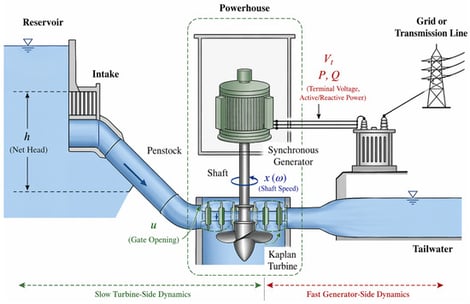
Hydropower system schematic with the main modeled components and variables. The figure shows the reservoir, intake, penstock, Kaplan turbine, shaft, synchronous generator, and grid connection, together with the variables h, u, 
  
    x
    (
    ω
    )
  
, 
  
    V
    t
  
, and 
  
    (
    P
    ,
    Q
    )
  
, and the separation between slow turbine-side and fast generator-side dynamics.

Monitoring Koyna Dam Displacements Using Persistent Scatterer Interferometry

  • Sara Zouriq,
  • Gehan Hamdy and
  • Tarik El-Salawaky
  • + 5 authors

Monitoring dam stability is critical to ensure structural safety and operational reliability. This study integrates Persistent Scatterer Interferometry (PSI) based on Sentinel-1 SAR imagery (2020–2023) with Finite Element Method (FEM) simulations to assess the behavior of the Koyna Dam in India. PSI detected crest displacements between −1.0 and −1.8 mm yr−1, while FEM simulations predicted a maximum vertical displacement of approximately −3.2 mm at the crest. Although these results represent different quantities (time-averaged displacement rates versus peak static displacement), both approaches indicate millimeter-scale deformation and a consistent pattern of settlement at the dam crest, supporting the interpretation of hydrologically driven structural response. The observed differences are primarily attributed to differences in spatial resolution and methodology between point-based FEM outputs and pixel-averaged satellite observations. The study demonstrates that combining satellite-based monitoring with numerical simulations provides a robust and cost-effective framework for dam safety assessment. This integrated approach supports improved interpretation of deformation behavior and offers practical value in extreme conditions, such as during flood events or climate-driven hydrological changes. Furthermore, continued advances in remote sensing and numerical modeling are expected to enhance the reliability of such approaches, making this methodology a transferable and sustainable solution for dam management worldwide.

7 April 2026

The aim of this study is to evaluate the technical performance and resilience of a Hybrid Renewable Energy System (HRES), designed to achieve water and energy autonomy on a Skyros Island, Greece. The system integrates renewable energy sources with multiple storage technologies. A high-resolution, 30-min simulation was developed, incorporating 10 years of historical weather data to model the operation of an HRES, which consists of wind turbines, photovoltaics, pumped hydro storage, and green hydrogen production. Reverse osmosis was used for desalination, and extended low-wind conditions were simulated to assess system resilience. Results indicate that the proposed system is, in fact, capable of meeting 89% of the annual energy demand and 99.99% of freshwater requirements by means of desalination. Wind power accounted for 53% of the total energy production, photovoltaics 2%, while pumped hydro and hydrogen storage contributed 17% and 6%, respectively. During artificially imposed windless periods, short-term deficits were addressed by the use of pumped hydro, while hydrogen ensured supply continuity in the final days, thereby demonstrating their complementary function. In this resilience stress-test, the system remained operational for 10 days during an artificial windless period, demonstrating the critical role of hybrid storage. The findings indicate that a combination of renewable energy with diversified storage and water management strategies can provide a reliable and self-sufficient water–energy nexus for remote islands. Finally, the novelty of this research work lies in the statistical analysis of calm-wind events and the development of the corresponding power-law relationship, conducted under the framework of the 30-min simulation.

15 December 2025

Hydropower, the dominant source of renewable electricity generation, is essential for the development of low-carbon, robust power systems [...]

27 October 2025

News & Conferences

Volumes

Latest Issues

Open for Submission

Editor's Choice

XFacebookLinkedIn
Hydropower - ISSN 3042-8432