Skip to Content
  • 3.8
    Impact Factor
  • 7.6
    CiteScore
  • 16 days
    Submission to First Decision
  • 3 days
    Acceptance to Publication

Viruses

Viruses is a peer-reviewed, open access journal of virology, published monthly online by MDPI. The Spanish Society for Virology (SEV), Canadian Society for Virology (CSV), Italian Society for Virology (SIV-ISV), Australasian Virology Society (AVS), Brazilian Society for Virology (BSV) and Global Virus Network (GVN) are affiliated with Viruses and their members receive a discount on the article processing charges.

Get Alerted

Add your email address to receive forthcoming issues of this journal.

All Articles (18,141)

  • Correction
  • Open Access

In the original publication [...]

Viruses

9 November 2026

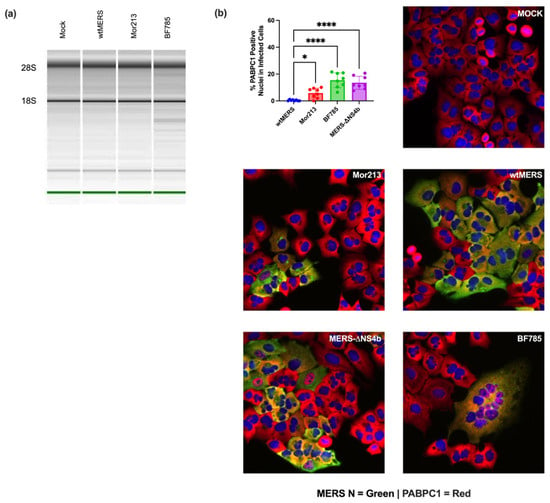
(a) A549DPP4 wild-type cells were mock-infected or infected at MOI = 0.1 PFU/cell, and total intracellular RNA was harvested at 24 hpi. The rRNA degradation was assessed on an Agilent Bioanalyzer. 28S and 18S positions are indicated. Data are from one representative of three independent experiments. (b) A549DPP4 cells were infected in duplicate at MOI = 0.5 PFU/cell with wtMERS, Mor213, BF785, and MERS-ΔNS4b; fixed at 24 hpi in 4% PFA; and stained with antibodies to detect MERS N (green) and PABPC1 (red), in addition to DAPI (blue). Images were acquired on a Nikon Eclipse Ti 2, and the percentage of nuclei in infected cells or syncytia (cells positive for MERS N) with nuclear PABPC1 determined. Eight fields of view were analyzed per condition. Data are displayed as means ± SD. Statistical significance compared to wtMERS was calculated by one-way ANOVA: * p ≤ 0.05 and **** p ≤ 0.0001. Uncropped images separated by channel appear in Supplementary Figure S2.
  • Systematic Review
  • Open Access

Background: Reticulated platelets, reported by modern hematology analyzers as the immature platelet fraction (IPF%) or the absolute immature platelet count (IPC), index thrombopoiesis and have been proposed as biomarkers in the thrombocytopenia of viral infection. Methods: This systematic review, conducted and reported following PRISMA 2020 and registered in PROSPERO (CRD420261501412), examined how these parameters have been used across viral diseases. PubMed, Scopus, and the Cochrane Library were searched from January 2000 to May 2025 for observational studies of adults with viral infection reporting IPF, IPC, or reticulated platelets, and methodological robustness was appraised with the Newcastle–Ottawa Scale. Results: Twenty-two studies were included and synthesized narratively. Applications differed by pathogen: in dengue, serial IPF increases consistently preceded platelet recovery, although proposed thresholds varied; in COVID-19, higher immature platelet parameters were associated with severity and mortality but were inconsistent after adjustment. Evidence in chronic hepatitis, HIV, hantavirus, and Crimean–Congo hemorrhagic fever was mainly pathophysiological, and data in critically ill patients were almost confined to COVID-19. Conclusions: Clinical value appears disease- and outcome-specific: serial IPF best predicts platelet recovery in dengue, whereas prognostic use in COVID-19 remains insufficiently validated. Analytical heterogeneity and the absence of transferable thresholds currently limit clinical implementation.

Viruses

8 November 2026

  • Article
  • Open Access

Milk and dairy products may be contaminated by enteric viruses along the production chain, and their high protein and fat content hinders viral concentration and molecular detection. Internationally standardized recovery protocols have been established for leafy greens, soft fruits, and bivalve mollusks, but remain unavailable for dairy matrices. Three low-cost methods were compared for pasteurized milk, namely polyethylene glycol precipitation (PEG), Tris-Glycine-Beef Extract elution (TGBE), and a modified organic flocculation (FLO) exploiting the matrix’s own casein, and three for mozzarella cheese (PEG, TGBE, and glycine buffer–chloroform extraction, GBC). Samples were spiked with murine norovirus 1 (MNV-1) and murine hepatitis virus 3 (MHV-3) as non-enveloped and enveloped surrogates, and recovery was determined by RT-qPCR. TGBE yielded the highest mean recovery in both matrices (milk: 1.5 ± 0.6% for MNV-1 and 4.3 ± 0.6% for MHV-3; cheese: 4.7 ± 3.5% and 15.1 ± 17.5%), and its superiority over PEG for MNV-1 in milk was the only difference to reach statistical significance. PEG achieved recovery comparable to that of TGBE for MNV-1 in cheese (1.1 ± 1.5%) but with greater variability, whereas GBC recovery was negligible and the protocol requires a hazardous solvent. Organic flocculation yielded lower recovery (0.28 ± 0.34% for MNV-1) but allowed for processing of one-liter volumes, a potential alternative for large-volume screening of bulk milk. TGBE therefore appears the most practical candidate for viral recovery from dairy matrices in laboratories with limited infrastructure, although a larger number of replicates and validation with naturally contaminated samples remain necessary before routine application.

Viruses

8 November 2026

  • Review
  • Open Access

Are Viruses a Cause of Urinary Tract Infections? A Narrative Review

  • Ketema Bizuwork Gebremedhin,
  • Wondwossen Amogne and
  • Tadesse Eguale
  • + 1 author

Urinary tract infections (UTIs), often associated with the lower urinary tract, are a major public health problem. Traditionally, urine has been believed to be sterile in healthy individuals, but increasing evidence shows that the urinary tract may contain a variety of viruses even in healthy populations. Bacteria remain the major etiologic agents of UTIs, but growing evidence points to viruses as emerging causes. This narrative review focuses on six viruses: adenoviruses, cytomegalovirus (CMV), BK virus (human polyomavirus), severe acute respiratory syndrome Coronavirus 2 (SARS-CoV-2), Zika virus, and West Nile virus. West Nile virus has been detected in urine without clear evidence of causing UTIs; however, the other five viruses reviewed in this narrative discussed have been associated with UTIs and may lead to various complications. Management of viral UTIs is mainly supportive, with reduced immunosuppression, symptom alleviation, prevention of complications, and monitoring of response to therapy. Key interventions include managing secondary bacterial infections, ensuring adequate hydration, using analgesics for pain and discomfort, and closely monitoring for treatment failure or recurrence. Effective prevention and control of viral infections also rely on broader public health strategies, including vaccination, sanitation, surveillance, early diagnosis, and appropriate treatment. Additional approaches may include prophylaxis, preemptive therapy, virus-specific treatments, and donor–recipient serostatus matching. Regular monitoring and careful adjustment of immunosuppressive therapy are also important, as no effective vaccine is available except for Ad4/Ad7 and SARS-CoV-2, and definitive preventive strategies are currently unavailable. Future research should focus on developing safe and effective antivirals and vaccines to prevent and treat viral UTIs and their complications.


Viruses

8 November 2026

Highly Accessed Articles

News & Conferences

Latest Issues

Open for Submission

Journal Sections

XFacebookLinkedIn
Viruses - ISSN 1999-4915