



Sustainable Practices in Bridge Construction
A special issue of Sustainability (ISSN 2071-1050). This special issue belongs to the section "Sustainable Engineering and Science".
Deadline for manuscript submissions: closed (30 November 2025) | Viewed by 6339
Special Issue Editors

Interests: structural health monitoring; bridge assessment and maintenance; dynamic bridge testing and OMA; finite element modeling; structural engineering
Special Issues, Collections and Topics in MDPI journals

Interests: structural assessment; monitoring and inspection; life cycle costs; risk and reliability; resilience and sustainability
Special Issues, Collections and Topics in MDPI journals

Interests: indirect prestressing analysis; existing prestressed concrete bridges; structural health monitoring; finite element modelling; static and dynamic bridge proof-load tests
Special Issues, Collections and Topics in MDPI journals
Special Issue Information
Dear Colleagues,
Sustainable practices in bridge construction signify a transformative shift towards environmentally conscious and socially responsible engineering. By prioritizing eco-friendly materials, energy-efficient designs, innovative construction methods and monitoring and maintenance activities, the industry seeks to minimize its environmental impact. Utilizing recycled or locally sourced materials, coupled with efficient waste management, further enhances sustainability. Beyond ecological considerations, a focus on community well-being involves stakeholder engagement, safety prioritization and minimizing disruptions during construction. This holistic approach aligns bridge construction with the principles of responsible development, emphasizing resilience, economic efficiency and societal benefits. As the engineering landscape adapts to the imperative of sustainability, the integration of these practices showcases a commitment to building a future where infrastructure not only meets transportation needs but also fosters environmental and social harmony.
This Special Issue aims to provide insights into bridge construction and maintenance, considering the importance of sustainability and achieving sustainable development for humanity. The design of new bridges and the assessment of existing ones must address the impacts of climate change given rising temperatures, more frequent extreme weather events and changing precipitation patterns. Engineers are incorporating climate projections into their processes to anticipate the challenges associated with this issue. In addition, monitoring systems play a key role in assessing bridge performance in the presence of climate-related stressors. Advanced sensor technologies, data analysis and real-time monitoring enable engineers to identify potential vulnerabilities and respond promptly to emerging problems. Continuous monitoring helps bridge authorities make informed maintenance, repair and retrofit decisions to improve the longevity and adaptability of structures.
In this Special Issue, original research articles and reviews are welcome. Research areas may include (but are not limited to) the following:
- Eco-Friendly Materials: the use of sustainable and recyclable materials in bridge construction.
- Energy-Efficient Design: the incorporation of design elements to optimize energy consumption and reduce environmental impacts.
- Local Sourcing: preferences for locally sourced materials to minimize transportation-related emissions and support regional economies.
- Innovative Construction Techniques: the adoption of advanced construction methods that reduce environmental degradation and resource consumption.
- Waste Management: the implementation of efficient waste-management strategies to minimize the environmental footprint of construction activities.
- Social Impact Assessment: consideration of the broader impacts on local communities, including stakeholder engagement and safety prioritization.
- Life Cycle Assessment: the evaluation of the environmental impact of a bridge over its entire life cycle, from construction to decommissioning.
- Biodiversity Conservation: the implementation of measures to protect and enhance local biodiversity in and around bridge construction sites.
- Sustainable Transportation Integration: designing bridges with a focus on promoting sustainable transportation options, such as pedestrian and cycling infrastructure.
- Climate-Resilient Design: the incorporation of design features to enhance bridges' ability to withstand the impacts of climate change, including extreme weather events and rising temperatures.
- Extreme Weather Preparedness: the implementation of measures to ensure bridges can withstand more intense storms, heavy precipitation and other climate-related extreme weather.
- Adaptation Strategies: the development and implementation of adaptive strategies to retrofit existing bridges for increased climate resilience.
- Sustainable Drainage Solutions: the integration of sustainable drainage systems to address changing precipitation patterns and reduce the risk of flooding.
- Climate Change Impact Assessments: comprehensive assessments of the potential impacts of climate change on existing and planned bridge infrastructure.
- Cross-Sector Collaboration: collaboration between engineers, climate scientists, policymakers and communities to develop holistic solutions that address the intersection of climate change and bridge infrastructure.
- Monitoring Systems: the installation of advanced sensor technologies for real-time monitoring of bridges to detect climate-induced stresses and vulnerabilities.
- Sensor Technologies: the use of advanced sensor technologies for real-time monitoring of structural health and performance.
- Data Analytics: the application of data analytics to interpret information collected from monitoring systems and identify trends or anomalies.
- Vibration Analysis: monitoring vibrations to assess structural stability and identify potential issues.
- Environmental Monitoring: continuous assessment of environmental conditions (temperature, humidity, etc.) that may impact a bridge's structural integrity.
- Remote Sensing: the integration of remote sensing technologies, such as satellite imagery or drones, for comprehensive bridge monitoring.
- Predictive Maintenance: the implementation of predictive maintenance models based on monitoring data to address potential issues before they become critical.
- Risk Assessment: regular assessment of the risks associated with bridge usage, environmental factors and aging infrastructure.
We look forward to receiving your contributions.
You may choose our Joint Special Issue in Infrastructures.
Dr. Vanni Nicoletti
Dr. José Campos Matos
Dr. Jakub Kralovanec
Guest Editors
Manuscript Submission Information
Manuscripts should be submitted online at www.mdpi.com by registering and logging in to this website. Once you are registered, click here to go to the submission form. Manuscripts can be submitted until the deadline. All submissions that pass pre-check are peer-reviewed. Accepted papers will be published continuously in the journal (as soon as accepted) and will be listed together on the special issue website. Research articles, review articles as well as short communications are invited. For planned papers, a title and short abstract (about 250 words) can be sent to the Editorial Office for assessment.
Submitted manuscripts should not have been published previously, nor be under consideration for publication elsewhere (except conference proceedings papers). All manuscripts are thoroughly refereed through a single-blind peer-review process. A guide for authors and other relevant information for submission of manuscripts is available on the Instructions for Authors page. Sustainability is an international peer-reviewed open access semimonthly journal published by MDPI.
Please visit the Instructions for Authors page before submitting a manuscript. The Article Processing Charge (APC) for publication in this open access journal is 2400 CHF (Swiss Francs). Submitted papers should be well formatted and use good English. Authors may use MDPI's English editing service prior to publication or during author revisions.
Keywords
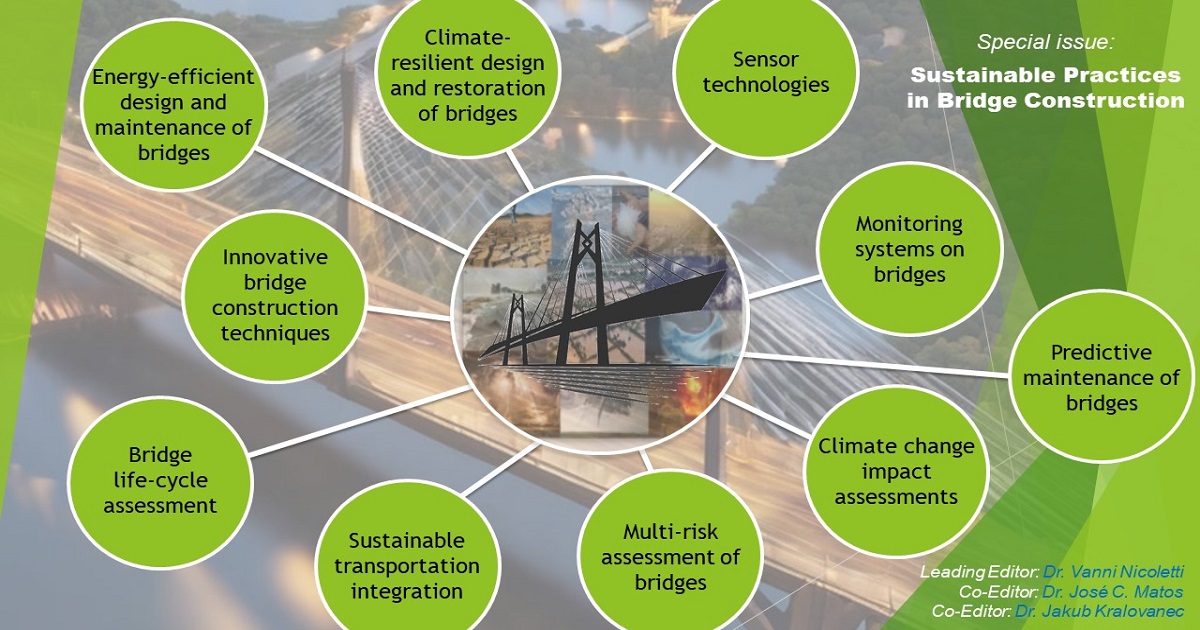
- energy-efficient design and maintenance of bridges
- innovative bridge construction techniques
- bridge life-cycle assessment
- sustainable transportation integration
- climate-resilient design and restoration of bridges
- climate change impact assessments
- monitoring systems on bridges
- sensor technologies
- predictive maintenance of bridges
- multi-risk assessment of bridges
Benefits of Publishing in a Special Issue
- Ease of navigation: Grouping papers by topic helps scholars navigate broad scope journals more efficiently.
- Greater discoverability: Special Issues support the reach and impact of scientific research. Articles in Special Issues are more discoverable and cited more frequently.
- Expansion of research network: Special Issues facilitate connections among authors, fostering scientific collaborations.
- External promotion: Articles in Special Issues are often promoted through the journal's social media, increasing their visibility.
- Reprint: MDPI Books provides the opportunity to republish successful Special Issues in book format, both online and in print.
Further information on MDPI's Special Issue policies can be found here.
