Systematic Review

A Systematic Review of the Practical Applications of Synthetic Aperture Radar (SAR) for Bridge Structural Monitoring


by
Homer Armando Buelvas Moya
1,2,
Minh Q. Tran
1,
Sergio Pereira
3,
José C. Matos
1 and
Son N. Dang
1,*
1
Department of Civil Engineering, ISISE, ARISE, University of Minho, Campus Azurem, 4800-058 Guimaraes, Portugal
2
Fundação para a Ciência e a Tecnologia (FCT), Av. D. Carlos I, No. 126, 1249-074 Lisboa, Portugal
3
Infraestruturas de Portugal, Av. Dra. Elza Maria Pires Chambel 11, 2005-356 Santarem, Portugal
*
Author to whom correspondence should be addressed.
Sustainability 2026, 18(1), 514; https://doi.org/10.3390/su18010514
Submission received: 15 November 2025 / Revised: 29 December 2025 / Accepted: 31 December 2025 / Published: 4 January 2026
(This article belongs to the Special Issue Sustainable Practices in Bridge Construction)

Abstract

Within the field of the structural monitoring of bridges, numerous technologies and methodologies have been developed. Among these, methods based on synthetic aperture radar (SAR) which utilise satellite data from missions such as Sentinel-1 (European Space Agency-ESA) and COSMO-SkyMed (Agenzia Spaziale Italiana—ASI) to capture displacements, temperature-related changes, and other geophysical measurements have gained increasing attention. However, SAR has yet to establish its value and potential fully; its broader adoption hinges on consistently demonstrating its robustness through recurrent applications, well-defined use cases, and effective strategies to address its inherent limitations. This study presents a systematic literature review (SLR) conducted in accordance with key stages of the Preferred Reporting Items for Systematic Reviews and Meta-Analyses (PRISMA) 2020 framework. An initial corpus of 1218 peer-reviewed articles was screened, and a final set of 25 studies was selected for in-depth analysis based on citation impact, keyword recurrence, and thematic relevance from the last five years. The review critically examines SAR-based techniques—including Differential Interferometric SAR (DInSAR), multi-temporal InSAR (MT-InSAR), and Persistent Scatterer Interferometry (PSI), as well as approaches to integrating SAR data with ground-based measurements and complementary digital models. Emphasis is placed on real-world case studies and persistent technical challenges, such as atmospheric artefacts, Line-of-Sight (LOS) geometry constraints, phase noise, ambiguities in displacement interpretation, and the translation of radar-derived deformations into actionable structural insights. The findings underscore SAR’s significant contribution to the structural health monitoring (SHM) of bridges, consistently delivering millimetre-level displacement accuracy and enabling engineering-relevant interpretations. While standalone SAR-based techniques offer wide-area monitoring capabilities, their full potential is realised only when integrated with complementary procedures such as thermal modelling, multi-sensor validation, and structural knowledge. Finally, this document highlights the persistent technical constraints of InSAR in bridge monitoring—including measurement ambiguities, SAR image acquisition limitations, and a lack of standardised, automated workflows—that continue to impede operational adoption but also point toward opportunities for methodological improvement.

1. Introduction

Bridges are one of the most crucial yet vulnerable components of transportation infrastructure. Continuous SHM ensures the early detection of abnormal displacements and deterioration [1,2]. With the development of sensor technologies, data collected from bridge structures are increasingly fast and accurate, ensuring a continuous data source for SHM. Conventional sensor-based SHM systems (such as strain gauges, accelerometers, GNSS, or fibre-optic networks) provide high-frequency, precise local measurements but face significant operational constraints. Sensor systems are expensive to install and maintain, requiring a considerable number of resources. Sensor coverage is limited to instrumented points. Environmental exposure, power issues, or data loss can disrupt long-term continuity [3]. Moreover, scaling these systems to hundreds or thousands of bridges within a network is often economically and logistically infeasible. SAR has emerged as a transformative technology in the field of SHM, offering an alternative to traditional ground-based sensing systems and partially solving these issues [4,5,6,7].
By generating high-resolution images of the Earth’s surface from spaceborne platforms such as satellites, SAR is an active remote sensing technology that uses satellite information to create high-resolution images to enable the detection of subtle ground deformations, environmental changes, and structural displacements over time, with significant applications in geotechnical, hydrological, and structural monitoring. This capability is particularly valuable for linear infrastructure assets, such as dams, railways, slopes, highways, and bridges, where the continuous evaluation of structural integrity is crucial for informing maintenance planning and ensuring public safety [8].
SAR employs a side-looking geometry, where the sensor acquires data at an angle, measuring slant range (LOS distance to the target) rather than ground range (horizontal distance). However, when SAR is introduced with interferometry, this exploits the phase difference between two SAR images to detect millimetre-scale displacements along the LOS. While some variations of this technology use two images to map surface deformation, others analyse time series imagery to isolate stable radar reflectors and retrieve long-term, high-precision deformation trends, mitigating atmospheric and decorrelation noise [2].
SAR-based monitoring offers a unique advantage by capturing LOS displacement measurements from multiple stable reflectors, known as persistent scatterers (PSs), distributed across a surface over successive observation periods. These time series form the basis for a comprehensive deformation analysis, enabling the identification of long-term trends and anomalous movements [8]. The growing availability of high-resolution SAR data, particularly from missions such as Sentinel-1 (a European Space Agency mission under the Copernicus Program) or COSMO SkyMed (an Italian Space Agency constellation designed for high resolution), has catalysed dedicated research into its application for monitoring transport infrastructure, combined with the refinement of advanced interferometric techniques [9].
Initial research on SAR in bridges primarily focused on validating the feasibility of detecting and measuring structural movements in bridge systems—subsequently, studies such as those by Schlögl et al. [10] identified specific methodological challenges in interpreting SAR data within the context of complex bridge dynamics, emphasising fundamental differences from conventional geotechnical applications, where displacement patterns are typically more uniform and less influenced by dynamic loading [11]. Since the early applications of SAR in ground deformation studies, significant efforts have been made to refine the technique in addressing the unique challenges posed by civil infrastructure, particularly bridges [12]. As global interest in remote sensing for civil infrastructure has grown, significant methodological advances have emerged, especially since 2018 [13,14,15,16,17,18,19,20,21,22,23,24,25,26,27,28].
Collectively, these developments have given rise to the emerging field of “Interferometry SAR for Bridges”, several methodologies that encompass a range of specialised analytical approaches designed to translate remote sensing observations into actionable structural insights. This includes methodologies like PSI, MT-InSAR, and Differential SAR Tomography (D-TomoSAR). This domain is increasingly recognised as a component of the broader paradigm of satellite-based SHM for large-scale infrastructure systems. More recently, research has shifted toward the interpretation of complex SAR time series within the context of SHM.
The advancements of these methodologies include the process of separation of thermal and permanent deformation components, as well as the integration of the InSAR process with in situ sensor measurements and engineering models to improve interpretation accuracy. For instance, studies have demonstrated the feasibility of decomposing LOS displacements into vertical and horizontal components by combining data from ascending and descending satellite passes [29].
On the side, SAR data are inherently constrained by limitations in spatial, temporal, and radiometric resolution, which can restrict the level of detail and accuracy attainable for specific structural health monitoring objectives. Consequently, the robust interpretation and validation of SAR-derived displacement measurements require integration with in situ observations and ground-based sensor data to ensure both accuracy and contextual relevance. Although SAR-based monitoring technologies offer significant capabilities, their complementary nature implies that they cannot, on their own, satisfy the full spectrum of structural health monitoring requirements; rather, they should be employed as an integral component within a multi-method monitoring framework. Finally, the continuous updating and systematic processing of satellite image archives are essential to maintain up-to-date and reliable deformation time series for effective infrastructure monitoring.
Despite these challenges, ongoing research has advanced the development of best practices for interpreting and applying SAR data in bridge monitoring. Beyond standard interferometric processing workflows, several researchers have proposed specialised analytical frameworks tailored for engineering applications. These frameworks emphasise the integration of SAR-derived measurements with numerical structural models, thermal monitoring records, and traditional surveying techniques to enhance the physical interpretability of displacement time series and support robust structural assessment [30]. Addressing these limitations is critical for fully leveraging SAR’s potential in operational infrastructure management.
A growing number of case studies demonstrate the feasibility of using SAR to monitor bridges, from large suspension bridges to shorter highway overpasses. However, the practical use of this data for engineering decision-making remains limited. The challenge lies not in measuring displacements, but in converting radar observations into actionable SHM information. To fully exploit the potential of SAR in bridge condition assessment, these issues need attention: (i) which processing and modelling methods enable the conversion of raw radar measurements into structural indices, (ii) how routine SAR collection can improve SHM performance, and (iii) what barriers currently hinder the use of automated and efficient SAR surveillance.
First, SAR provides LOS phase changes, which are indirect observations of three-dimensional displacements. Without appropriate modelling, these data cannot be directly interpreted in terms of engineering parameters such as span deflection, bearing rotation, or pier settlement. Transforming raw SAR observations into meaningful bridge monitoring parameters requires additional steps, including geometric decomposition, atmospheric correction, uncertainty quantification, and sometimes thermal or environmental normalisation. Despite advances in time series algorithms and data fusion, there is no standardised workflow for this transformation.
Second, the recent increase in SAR temporal resolution enables the recurrent monitoring of the same structures at intervals from days to weeks. Recurrent observations enable the analysis of temporal trends, the detection of anomalous behaviour, and the integration of SAR-derived indicators into digital twin or maintenance management systems. However, the degree to which recurrent SAR observations have been operationally integrated into SHM frameworks remains poorly characterised. Understanding this integration is crucial for assessing how SAR time series can support condition assessment, risk prioritisation, and intervention planning.
Ultimately, SAR has not yet evolved into a fully standalone solution for bridge monitoring. Technology still faces limitations related to collecting geometry. The problem of temporal loss of correlation in areas with vegetation or animals is also a challenge to overcome. Additionally, atmospheric turbulence and the need for ground validation via GNSS, angle reflectors, or in situ inspections have not been addressed. Differences in terminology and objectives between the remote sensing and engineering communities have hindered consistent adoption. A systematic review of these challenges can clarify the technical, methodological, or organisational shortcomings that exist and identify the necessary steps to move toward practical application.
According to the above, and to address the relations of SAR with the structural monitoring of bridges, this SLR aims to provide a systematic overview of the application of SAR in SHM. The study focuses on processing methods, data collection, and exploitation, as well as research efforts aimed at transforming SAR into practical tools for infrastructure management and decision-making. The focus is related to what methods are needed to transform raw SAR data into functional bridge monitoring parameters, the capabilities and applications of SAR for SHM, and its integration limitations and challenges to prevent SAR from being fully used on its own for bridge monitoring. Based on this, this review aims to answer the following research questions:
  • What methods are needed to transform raw SAR data into a useful bridge monitoring procedure? (Q1)
  • How does the recurrent application of SAR support SHM? (Q2)
  • What challenges prevent SAR from being fully used on its own for bridge SHM? (Q3)
In contrast to prior reviews, this SLR explicitly addresses critical gaps in the current body of work, performing a systematic review of the methods, applications, and challenges in bridge SHM. Biondi et al. [31] provided in 2020 a broad overview of SAR applications in bridge SHM but lacked a comprehensive understanding of all available methodologies and a detailed technical classification of the documentation or articles. Then, in 2022, Schlögl et al. [10] examined multiple remote sensing techniques, including SAR, LiDAR, and mobile laser scanning, yet they do not adhere to a systematic review protocol nor isolate SAR-specific methodological advances. Gagliardi et al. [8] adopted a combined perspective on satellite remote sensing and non-destructive testing for transport infrastructure but treat SAR as one of several complementary tools without an in-depth analysis of processing innovations or bridge-focused interpretability. In 2025, Banic et al. [30] focus on Earth Observation for railway infrastructure monitoring, offering a limited discussion on structural interpretation, deformation decomposition, and engineering integrations relevant to bridge SHM. Finally, also in 2025, Rakoczy et al. [14] present a general review of autonomous bridge inspection technologies in which SAR is only peripherally mentioned.
By systematically analysing these aspects, the review seeks to establish a comprehensive understanding of the current state of SAR-based bridge monitoring and to identify knowledge gaps, methodological trends, and future directions for integrating SAR into operational SHM systems. This review is structured as follows: after this introduction, Section 2 presents the identification process, including the research methodology, which is subdivided into search strategy, overview, bibliometric analysis methodology, and content analysis review. Section 3 presents the bibliometric analysis of temporal publications, relevant authors, citation analysis, keyword analysis, and nationality precedence. This part is in accordance with PRISMA Screening and Eligibility [32]. Analysis: Section 4 presents the inclusion of information. It conducts a content analysis review, focusing on capabilities, constraints, and integration, and answers the three key questions related to the methods needed for monitoring (Q1), recurrent applications (Q2), and challenges (Q3). Finally, the conclusions are presented in Section 5.

2. Methodology

This section outlines the methodological framework adopted in this study, which is based on the PRISMA 2020 guidelines for conducting systematic literature reviews. The PRISMA 2020 checklist is provided in the Supplementary Materials; however, this SLR was not registered in a prospective registry. The process consisted of four main stages: (i) defining the scope and objectives, (ii) performing a systematic search across major databases, (iii) conducting a science mapping analysis of keywords to identify thematic clusters, and (iv) analysing citation patterns to assess research influence and trends.

2.1. Overview

An SLR was conducted to assess the current state of research on the methodologies employed in the application and interpretation of SAR data for bridge monitoring, as well as their integration within SHM frameworks. This review was conducted through a systematic database search strategy, designed to ensure transparency, reproducibility, and methodological rigour in the identification, screening, and selection of relevant scholarly sources. The process involved structured queries across multiple scientific databases, guided by predefined inclusion and exclusion criteria, to ensure a comprehensive coverage of the existing literature. This systematic approach minimises selection bias, enhances the reliability of the evidence synthesis, and provides a transparent and traceable methodology for future researchers. Furthermore, it enables a critical evaluation of the current state of knowledge, supporting the identification of key research gaps, thematic trends, and emerging methodological developments in the field.
Given the evolution of SAR missions, like the operational availability of Sentinel-1 since 2014 and the emergence of robust multi-temporal InSAR techniques (such as PSI, Small Baseline Subset SBAS, and MT-InSAR) in infrastructure monitoring, this research deliberately focused our analysis on the last 5 years, including publications from 2020 to 2025 (until 13 August), a period that coincides with the maturation of InSAR as a viable tool for real-world bridge assessment and the integration with new technologies of machine learning, BIM, and digital twin (DT) concepts. This review targets the transition from research prototypes to actionable engineering practices that have increased during the last year [33].
To complement the SLR, a bibliometric and content analysis was integrated into the methodological framework—a technique increasingly utilised in contemporary scientific reviews. This component provides a quantitative and qualitative assessment of the intellectual structure of the literature, enabling the identification of key research domains, conceptual frameworks, evolutionary trajectories, and paradigmatic shifts within the field until 2025. Together, these methods constitute a robust, multi-dimensional analytical approach comprising three core stages: systematic searching, bibliometric analysis, and thematic content analysis. This integrated methodology ensures a comprehensive understanding of both the macro-level trends and the micro-level technical developments in the application of SAR to bridge infrastructure monitoring.

2.2. Systematic Search

Building upon the research questions established at the outset of this study, the search strategy was systematically structured into four sequential phases to ensure methodological rigour and reproducibility: (i) identification of relevant literature through targeted keyword queries across major academic databases; (ii) preliminary screening of retrieved records based on titles and abstracts, keywords, and citation relevance to exclude off-topic or non-conforming publications; (iii) eligibility assessment, during which full texts were evaluated against predefined inclusion and exclusion criteria to determine their methodological and thematic relevance; and (iv) final selection of studies that fully satisfied the criteria for in-depth qualitative and quantitative synthesis to answer the research questions.
This multi-stage process was implemented across three authoritative academic databases: Dimensions, Scopus, and Web of Science (WoS). These databases were selected for their comprehensive coverage of engineering, remote sensing, and infrastructure monitoring literature, as well as their high indexing standards and widespread use in scientific reviews. By leveraging these platforms, the review ensures access to peer-reviewed, high-impact research, thereby enhancing the representativeness and credibility of the analysed corpus. The transparent, stepwise methodology aligns with best practices in evidence-based research synthesis. It supports a robust foundation for identifying trends, methodological patterns, and knowledge gaps in the application of InSAR to bridge monitoring within the SHM framework [9]. The search was performed across multiple fields available on the databases, including “article title”, “abstract”, “keywords”, and “full text”. Initial exploration queries using broad search terms enabled the refinement and precise formulation of specific keywords and their hierarchical combinations. The finalised keyword sets and the corresponding search results are presented in Table 1.
The query structure was organised into four thematic groups: Group 1 focused on bridges as the primary infrastructure type; Group 2 addressed SAR and monitoring as core technological and functional terms; Group 3 introduced mission-specific filters—Sentinel-1 and COSMO-Sky Med—thereby narrowing the results to studies using operational, high-revisit satellite data; and Group 4 incorporated technical terms related to deformation analysis, displacement, and deformation, besides the terms like interferometry, multi-temporal, persistent scatterer, and digital twin, further enhancing thematic precision and yielding a coherent set of methodologically focused studies.
A total of 12 iterative query combinations were formulated as shown in Table 2, varying in specificity and logical structure, to assess the sensitivity of search outcomes across the mentioned databases: Scopus, Web of Science (WoS), and Dimensions. The initial broad groups (Bridge AND SAR) yielded extremely high result counts—up to 399,938 records in Dimensions (Query #1). However, the integration of monitoring into the process (Bridge, SAR, AND Monitoring) resulted in up to 259,658 records in Dimensions. The final search was conducted on 13 August 2025, and this cut-off date was chosen to ensure a stable and reproducible dataset for quantitative bibliometric analysis, as publications indexed after this date often lack complete metadata or citation records, which would compromise the methodological rigour of the review.
The iterative refinement of the search strategy, through the inclusion of mission-specific terms (Sentinel-1, COSMO-SkyMed) and technical descriptors related to deformation monitoring (displacement, deformation, interferometry, multi-temporal, PS, and digital twin), progressively narrowed the corpus to a thematically coherent set of 4119 records for the most targeted query, reflecting a strong methodological focus on InSAR applications in structural monitoring. The further incorporation of emerging concepts such as digital twins yielded limited results, indicating that the integration of SAR-derived data into digital twin frameworks remains an underdeveloped area, despite growing interest in advanced digital infrastructure management [30].
Notable disparities in retrieval volume across databases, particularly the substantially higher yields in Dimensions and Scopus compared to Web of Science, underscore the differences in indexing policies and highlight the necessity of multi-database searching to ensure comprehensive coverage, with access facilitated by the organisation affiliation of the authors. Additional filters were applied to include only documents published in English and classified as either original research articles or review articles, thereby excluding conference papers, editorials, book chapters, and non-scholarly outputs.
Subsequently, a set of predefined inclusion criteria was established to delimit the scope of the literature review and ensure the relevance and quality of the selected studies. These criteria were designed to enhance methodological rigour by filtering the retrieved records according to thematic, temporal, linguistic, and document-type parameters. The publication period was restricted to the years 2020 to August 2025, ensuring the inclusion of recent advancements in SAR applications for infrastructure monitoring. As the screening process progressed for all the authors, the analysis was further refined by manually focusing exclusively on peer-reviewed journal articles, prioritising high-quality, empirically grounded research with subject areas that were limited to disciplines directly relevant to the research objectives, including engineering, earth sciences, information and computing sciences, environmental sciences, geoinformatics, geomatic engineering, and built environment and design.
After the selection of different keyword combinations, 3344 documents were selected, and ultimately Table 3 shows the final corpus since 2020, which was refined to prioritise studies combining SAR observations with engineering analysis, aligning with the review’s objective of assessing the integration of InSAR within SHM frameworks. This stringent selection process ensured the coherence, scientific robustness, and thematic consistency of the final corpus, aligning with the objectives of a systematic and evidence-based literature synthesis.

2.3. Science Mapping Review of Keywords in Abstracts

A scientific mapping analysis of keywords in abstracts is a fundamental bibliometric tool used to understand and visualise the structure of a research field and to decide which studies were eligible for each synthesis. It acts as a map that reveals trends, main topics, and the connections between concepts within a body of literature. The most frequently repeated words are typically the pillars of the research and are related to research questions Q1 and Q3, reinforcing how bibliometric trends substantiate the content analysis in Section 4.
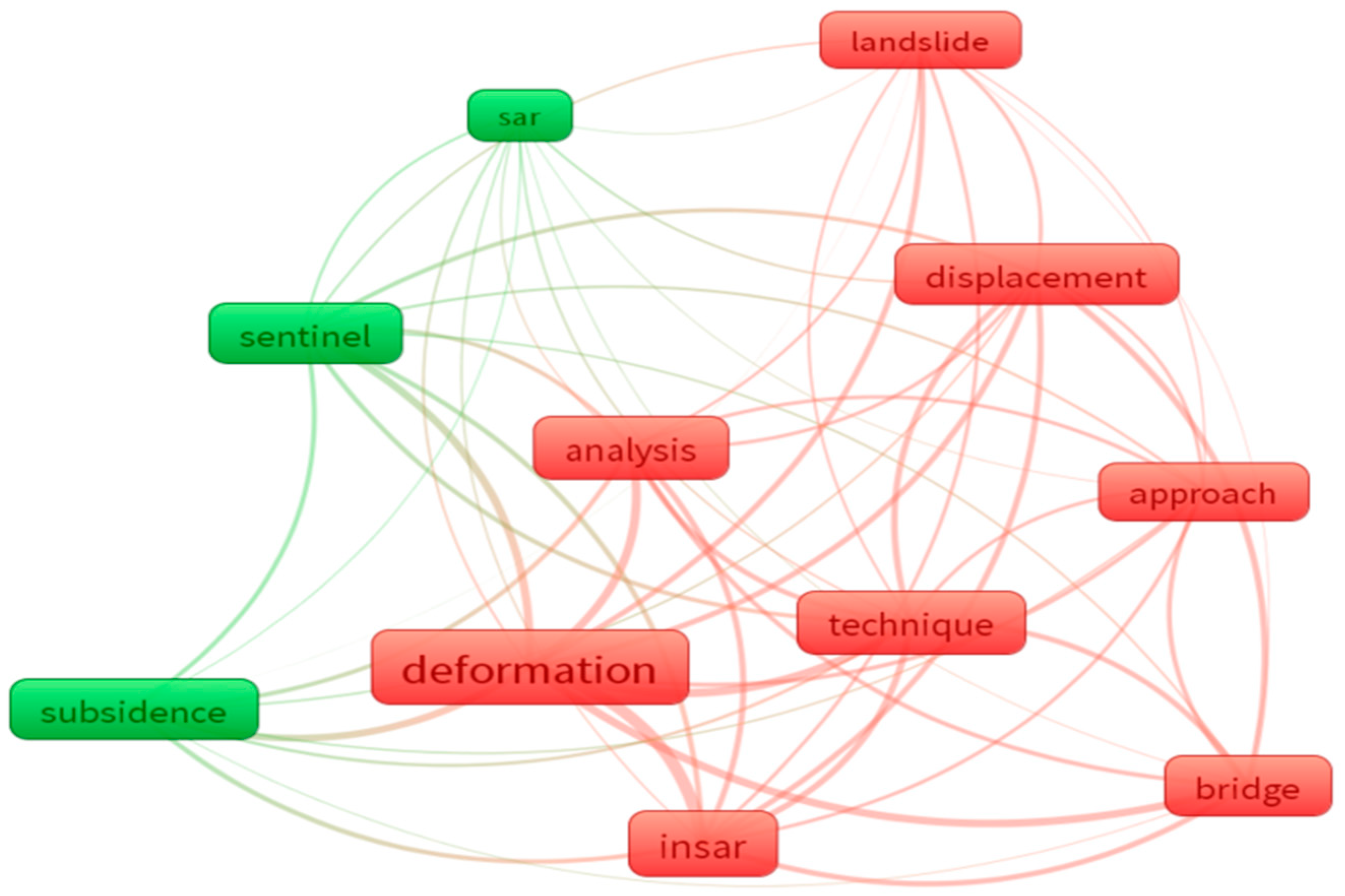
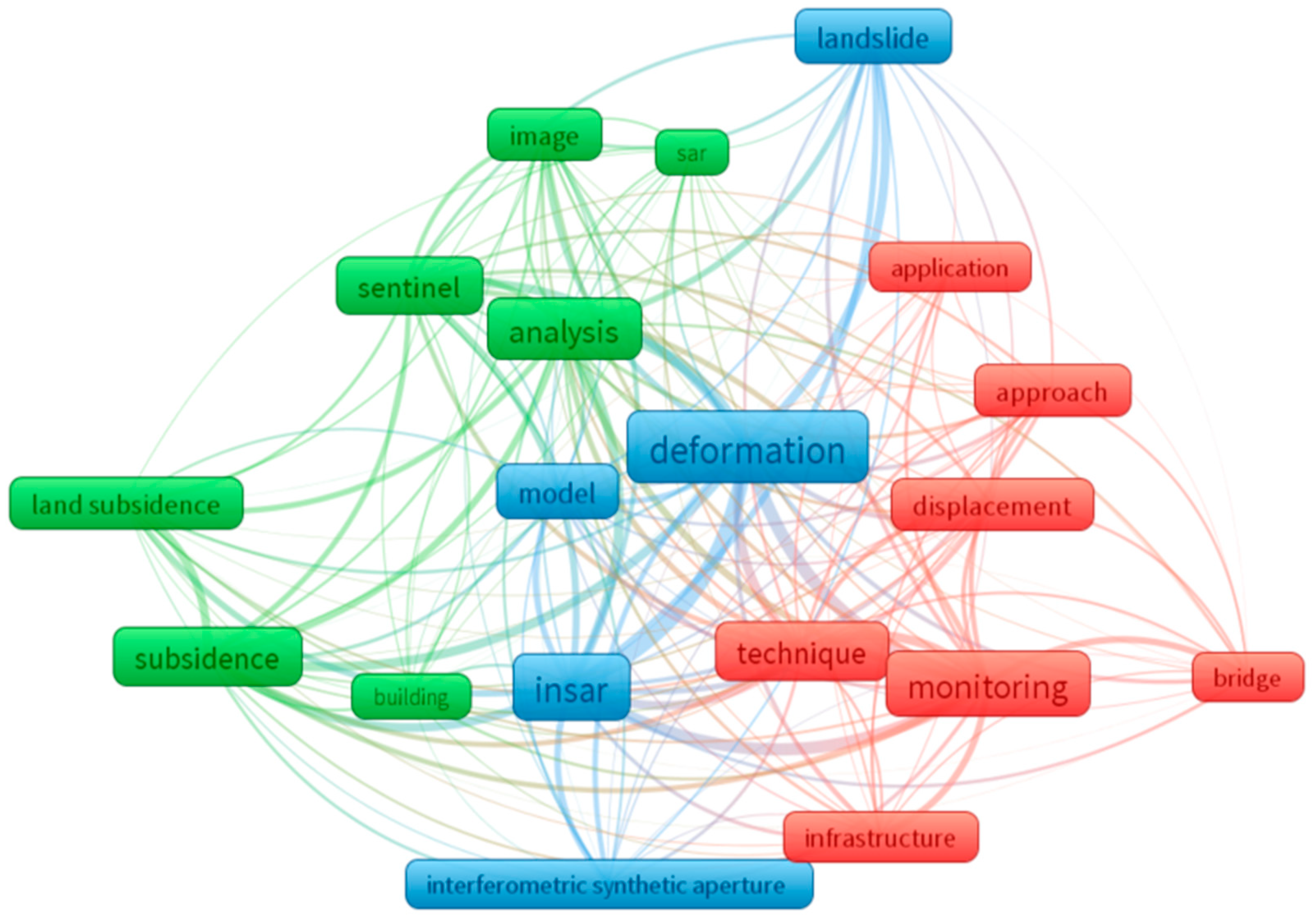
The scientific mapping of the selected literature is shown in a keyword co-occurrence word cloud (Figure 1), generated from the Dimensions database to represent the most relevant findings from the previous section. This word cloud, created using VOS viewer software (version 1.6.20), displays the 50 most frequently used keywords, which provide a foundation for more specific article searches. Consistent with the analysis in Table 2, the terms “deformation”, “InSAR”, “analysis”, and “monitoring” are the most frequent, revealing an interesting focus on using studies related to interferometry SAR monitoring related to deformations. The word cloud also shows the notable visibility of other terms such as “SAR”, “subsidence”, “sentinel”, “displacements”, and “technique”. This finding confirms the importance of clearly specifying the SAR processing technique, the meaning of sentinel data to the studies of SAR, and the relevance of the documentation applied to monitoring subsidence and displacements. Overall, the map indicates that the selected literature primarily focuses on data review and the analysis of deformation.
Similarly, the keyword co-occurrence map for the Scopus database (Figure 2), generated using VOSviewer (version 1.6.20), illustrates the interconnections between various terms within this systematic review of the literature. Strong links are observed between keywords like “deformation,” “bridge”, “subsidence”, “technique”, and “displacement”. The larger size on the map indicates a higher frequency of these terms, once again highlighting “deformation”, the same as in the Dimensions database. The prominence of this term confirms a significant number of applicable studies on monitoring deformations on bridges. This finding underscores the term’s potential relevance to this investigation on techniques related to InSAR as a keyword for studies related to subsidence and displacements, confirming the relevance of questions Q1 and Q3, as well as the introduction states.

2.4. Bibliometric Analysis of the Number of Citations

Bibliometric analysis is defined as a quantitative methodology for mapping and visualising scholarly output within a specific scientific domain [34]. It enables researchers to extract meaningful insights from large-scale publication datasets by identifying emerging research trends and collaboration networks. In the context of the rapidly expanding scientific literature in remote sensing and SHM, bibliometric techniques have become increasingly valuable for synthesising knowledge and identifying research gaps across engineering and geospatial disciplines. In this case, the use of filters for each database supports both the statistical evaluation and network-based visualisation of scientific landscapes, using author citation and keyword repetition.
In this review, bibliometric analysis, as proposed in PRISMA, is integrated into the SLR to provide a comprehensive overview of the most relevant applications of SAR in bridge structural monitoring. The study focuses on the methodological evolution, interdisciplinary collaborations, and technological integration of SAR—particularly through InSAR techniques such as PSI and SBAS—into SHM frameworks. It examines key research clusters, dominant contributors, and the trajectory of innovation in areas such as displacement measurement, integration with in situ sensors, and the mitigation of atmospheric and thermal effects.
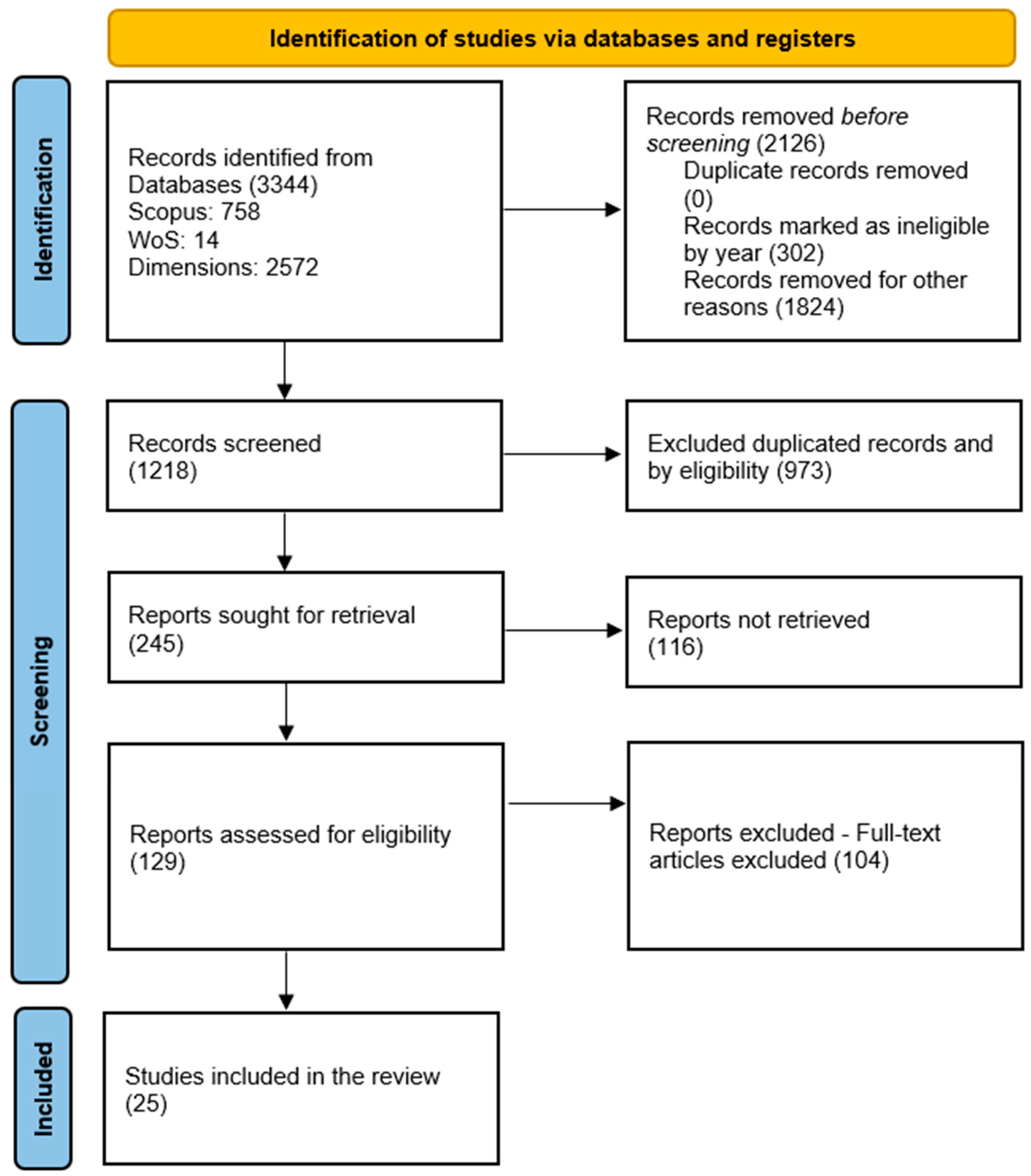
As Table 3 shows, a comprehensive database search initially yielded 1218 relevant research articles; however, to ensure the thematic relevance and methodological rigour of the selected corpus, a multi-stage refinement process was implemented. In the first stage, a preliminary screening was conducted based on document titles to exclude publications that did not directly address the use of SAR for bridge structural monitoring, explicitly focusing on the more relevant applications of SAR in bridge monitoring, resulting in 245 publications. The next stage involved identifying and removing duplicate records across databases. To maintain consistency and avoid redundancy, Dimensions was used as the primary reference database for de-duplication, ensuring that unique documents were retained [31,35,36,37,38,39,40,41,42,43,44,45,46,47,48,49,50,51,52,53,54,55,56,57,58,59,60,61,62,63,64,65,66,67,68,69,70,71,72,73,74,75,76,77,78,79,80,81,82,83,84,85,86,87,88,89,90,91,92,93,94,95,96,97,98,99,100,101,102,103,104,105,106,107,108,109,110,111,112,113,114,115,116,117,118,119,120,121,122,123,124,125,126,127,128,129,130,131,132,133,134,135,136,137,138,139]. This process resulted in a refined set of 129 non-redundant publications selected for full-text assessment (see Table 4).
An in-depth qualitative and quantitative evaluation was performed to assess both the relevance and scholarly impact of the remaining documents. Each article was examined for its direct applicability to bridge engineering, with a focus on empirical or methodological contributions to SAR-based structural monitoring. Publications from 2025 were excluded due to their recency, as they had not yet accumulated sufficient citation metrics to allow for meaningful bibliometric assessment. The final inclusion criterion emphasised studies that reported actual case applications, validated methodologies, or the integration of SAR data within engineering frameworks. Following this rigorous filtering, a final corpus of 129 peer-reviewed articles was established as the definitive dataset for analysis in this review (see Table 4).

3. Bibliometric Analysis

Bibliometric analysis is structured around two complementary methodological dimensions: (i) performance review, which quantifies scientific output through indicators such as publication volume, citation frequency, sources, and authors’ research contributions; and (ii) science mapping review, which focuses on the visualisation of intellectual and conceptual structures within a research domain through techniques such as co-authorship network analysis and keyword co-occurrence mapping [32]. While performance analysis provides insight into the productivity and impact of researchers, institutions, and countries, science mapping reveals the thematic evolution, knowledge diffusion, and interdisciplinary linkages that define the intellectual landscape. Together, these approaches facilitate a comprehensive and multidimensional understanding of the research field, enabling the identification of dominant themes, emerging trends, and underexplored areas in the application of SAR for SHM.
As illustrated in Figure 3 and in accordance with the PRISMA 2020 guidelines, the initial keyword searches across academic databases yielded a total of 3344 articles relevant to the scope of this SLR. Of these, 2126 records were excluded before screening due to ineligibility based on publication year, document type, or research field. Following a bibliometric analysis of citation metrics, summarised in Table 4, the final corpus comprised 129 documents. These were subsequently analysed in terms of publication year, source outlets, keyword co-occurrence, citation patterns, and contributions by leading authors.

3.1. Performance Review (PR)

The article selection methodology culminated in a final corpus of 129 publications that could shape the basis for this analysis. Table 5 provides a detailed summary of the general characteristics of this set, including the publication period, source journals, authorship, and citation metrics. The temporal coverage spans from 2020 to August 2025, and identifies 30 source journals in Dimensions, 18 in Scopus, and 4 in Web of Science. This variability in the number of sources per database underscores the differences in their indexing scope and, consequently, their representativeness in the global scientific landscape.
The authorship analysis revealed a total of 550 unique authors in the Dimensions database, 109 authors in Scopus, and 17 in WoS, providing evidence of the highly collaborative nature of research in this field. Upon examining the citation metrics, a direct correlation was found between the number of publications and the total number of citations received. This bibliometric pattern is consistent with the dynamics of academic dissemination, where more recent publications, particularly those from 2025, show a lower number of citations due to the inherent time lag required for their assimilation by the scientific community and for their impact to be fully quantifiable. The year-by-year change in articles was not analysed, since the publication rate has been constant from 2020 onward, as demonstrated by the subsequent figures.
The manual screening was crucial for ensuring that each included study was directly aligned with the research objectives, prioritising works that explicitly integrate the key conceptual domains under investigation. This hybrid approach not only guaranteed the quantitative robustness of the sample but also its qualitative relevance, which is fundamental for obtaining significant and reliable results in the final analysis. The integration of both methods mitigates the limitations of purely automated data mining, providing a more solid and rigorous foundation for subsequent research.

3.1.1. PR by Years

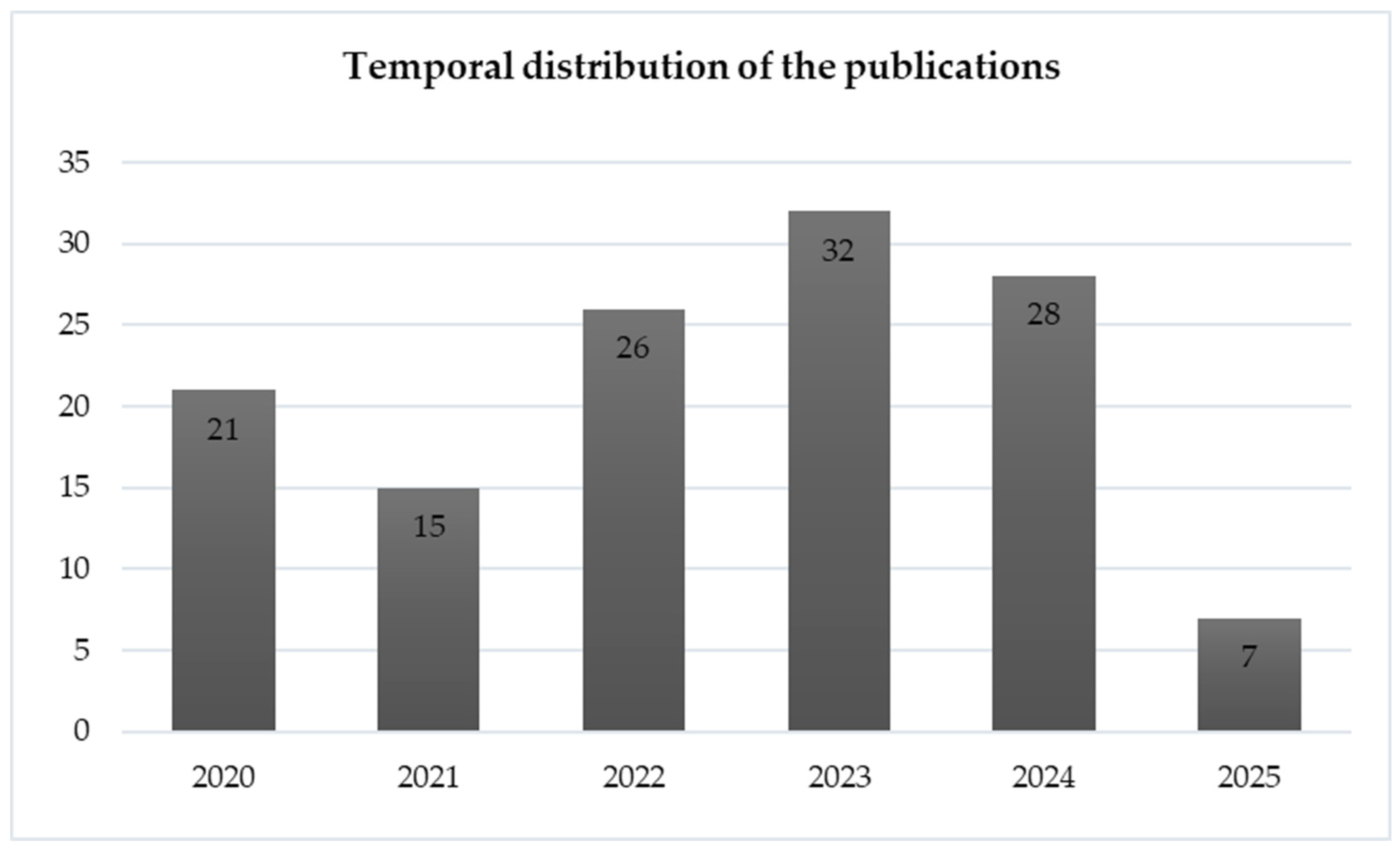
To further complement the preceding analysis, Figure 4 presents the temporal distribution of the selected publications by year of publication, revealing a steady and increasing trend in scientific output beginning in 2022. This upward trajectory is expected to consolidate further upon the completion of the 2025 publication cycle. At the time of data extraction, 2023 emerged as the most productive year, with 32 publications, reflecting the peak research activity during the observed period. The year 2025, although still ongoing, had already yielded seven selected articles, indicating sustained scholarly interest and suggesting that the annual output will likely surpass that of previous years by the end of the cycle.
In contrast, the period from 2020 to 2021 was characterised by a lower but relatively stable annual publication rate, averaging approximately 18 articles per year. The progressive increase from 2022 onward underscores a growing recognition of SAR as a key technology for the structural monitoring of bridges. This evolving publication trend reflects the field’s maturation, driven by advancements in satellite-based remote sensing, improved data accessibility (Sentinel-1), and increasing integration of SAR into SHM.

3.1.2. PR by Publication Sources

To complement the temporal analysis and reduce the risk of bias, the distribution of publications was further examined according to the most productive academic sources. This assessment identifies the 50 journals that contributed to the final corpus, highlighting a diverse publication landscape in which 33 sources are represented by a single or two articles, underscoring the dispersed nature of research output across multiple outlets. This section provides a systematic overview of the journals and publications identified within this structured literature review, including publication classification and journal indexing and quality researched by the authors.
Table 6 presents a detailed characterisation of the most influential publishing venues, specifically, the top 10 journals that published more than two articles in the field, along with their Scimago Journal and Country Rank (SJR) indicator for 2024, a widely recognised metric of journal prestige and scientific impact to achieve heterogeneity and certainty. The SJR values for these leading journals range from 0.521 to 2.397 (all with an SJR > 0.5), reflecting a mix of high-impact and mid-tier journals, with the majority classified in Q1 or Q2 according to Scimago’s quartile ranking. Notably, approximately 65% (83 out of 128) of the articles included were published in just these 10 journals, indicating a high degree of concentration in a relatively small number of core publications. It suggests that a limited set of journals plays a dominant role in disseminating research on SAR bridge monitoring and structural assessment technologies.
Among publishers, the Multidisciplinary Digital Publishing Institute (MDPI) emerges as the most prominent, contributing 42 articles, followed by the Institute of Electrical and Electronics Engineers, Inc. (IEEE) with 14, and John Wiley & Sons, Ltd. with 7. The MDPI-published journals are predominantly categorised under key thematic areas, such as Engineering, Civil Engineering, Geomatics Engineering, Sustainable Cities and Communities, Earth and Planetary Sciences, Climate Action, and Life on Land—domains that closely align with the interdisciplinary nature of remote sensing applications in infrastructure monitoring. This concentration reflects both the accessibility and rapid publication model of MDPI, as well as the thematic alignment of its journals with emerging technological and sustainability-driven research in civil infrastructure.

3.1.3. PR by Publication Citations

Among the 129 articles included in this review, 50 have accumulated more than 15 citations, indicating a notable level of scholarly engagement, and only the 21 most-cited publications were selected based on both citation prominence and 100% thematic relevance to structural deformation, inspection, SHM, and the condition assessment of bridges, transportation networks, and civil infrastructure. These are presented in Table 7, including their titles and publication years as part of the result of sensitivity selection. The most highly cited article in this subset is “Monitoring Deformations of Infrastructure Networks: A Fully Automated GIS Integration and Analysis of InSAR Time-Series” by Macchiarulo, V. et al. [5], which has received 80 citations in Scopus as of the data extraction date. This high citation count reflects both the methodological significance and broad applicability of the work in the context of large-scale infrastructure monitoring using satellite-based InSAR.
The list does not include recent and influential contributions published in 2025, such as “The Use of Earth Observation Data for Railway Infrastructure Monitoring—A Review” [30], the article called “Multi-scale Deformation Monitoring and Characterization of Large-Span Railway Bridge by Joint Satellite/Ground-Based InSAR and BDS” [140], and “Fusion of BIM and SAR for Innovative Monitoring of Urban Movement—Towards 4D Digital Twin” [33], which highlight emerging trends in multi-sensor integration and network-level monitoring. Additionally, the inclusion of the empirical case study “Remote Structural Health Monitoring of Concrete Bridge Using InSAR: A Case Study” [120] reinforces the practical applicability of SAR-based techniques in real-world structural assessment. Together (25 articles in total, as shown in Table 8), these publications represent a high-impact, thematically coherent subset that exemplifies the current state of knowledge and innovation in SAR-enabled infrastructure monitoring and are representative of the principal effects measured in this SLR, after the keyword selection, that is, the total of citations.
Over 60% of the documents from SLR related to Q1 journals [4,5,6,8,12,19,23,27,31,47,72,81,92,97,106] could have extensive confidence, rather than documents from Q2 journals, because this signifies a higher level of scholarly influence, citation impact, and stringent peer-review standards within a specific academic field.

3.1.4. PR by Publication Authors

The authors mentioned in Section 3.1.3 are the ones who have made a significant and sustained academic contribution to the field, as evidenced by the citation counts of their publications. Matthias Schlögl [10,11] has accumulated 82 citations, while Andrea Nettis and Giuseppina Uva [6] have received 87 citations each. These contributions represent approximately 8% and 9% of the total citations, respectively, of the total 25 documents analysed in this SLR, underscoring their prominence within the core literature on SAR-based structural monitoring.
As shown in Table 9, the M-index—a normalised metric defined as the H-index divided by the number of years since the first publication—provides insight into the temporal distribution and continuity of scholarly output of Schlögl, Nettis, and Uva. An M-index close to 1 indicates consistent long-term productivity, while values greater than 1 typically reflect a concentration of impactful work in recent years. For these authors, the M-index values are 0.67 and 2.0, respectively, suggesting that while one demonstrates steady academic engagement, the other exhibits a more recent surge in high-impact research output.
These researchers have played a pivotal role in advancing methodological frameworks that integrate SAR-derived displacement measurements with the structural behaviour of bridges. Therefore, the research authors in this SLR have proven their extensive confidence using Q1 and Q2 journals to publish their final research.
Their work primarily leverages advanced interferometric techniques such as PSI and the SBAS method. Key contributions include the validation of satellite-based monitoring against in situ instrumentation, the decomposition of LOS displacements into physically meaningful structural deformation modes, and the development of automated, scalable workflows for monitoring large-scale infrastructure portfolios. Collectively, their research strengthens the integration of remote sensing technologies into SHM and structural performance monitoring and management, SPMM, practices.

3.1.5. PR by Publication Keywords

To complement the science mapping review of keywords in abstracts and assess the risk of bias, there is a complementary work to check keyword references from 25 final documents. The keywords extracted from the reviewed documents represent the core thematic elements that define the scope and focus of the research corpus. These terms serve as essential metadata, enabling researchers, academic databases, and search engines to efficiently identify, classify, and retrieve the relevant literature. In this context, the keyword analysis provides valuable insight into the dominant themes, methodologies, and applications within the field of structural monitoring.
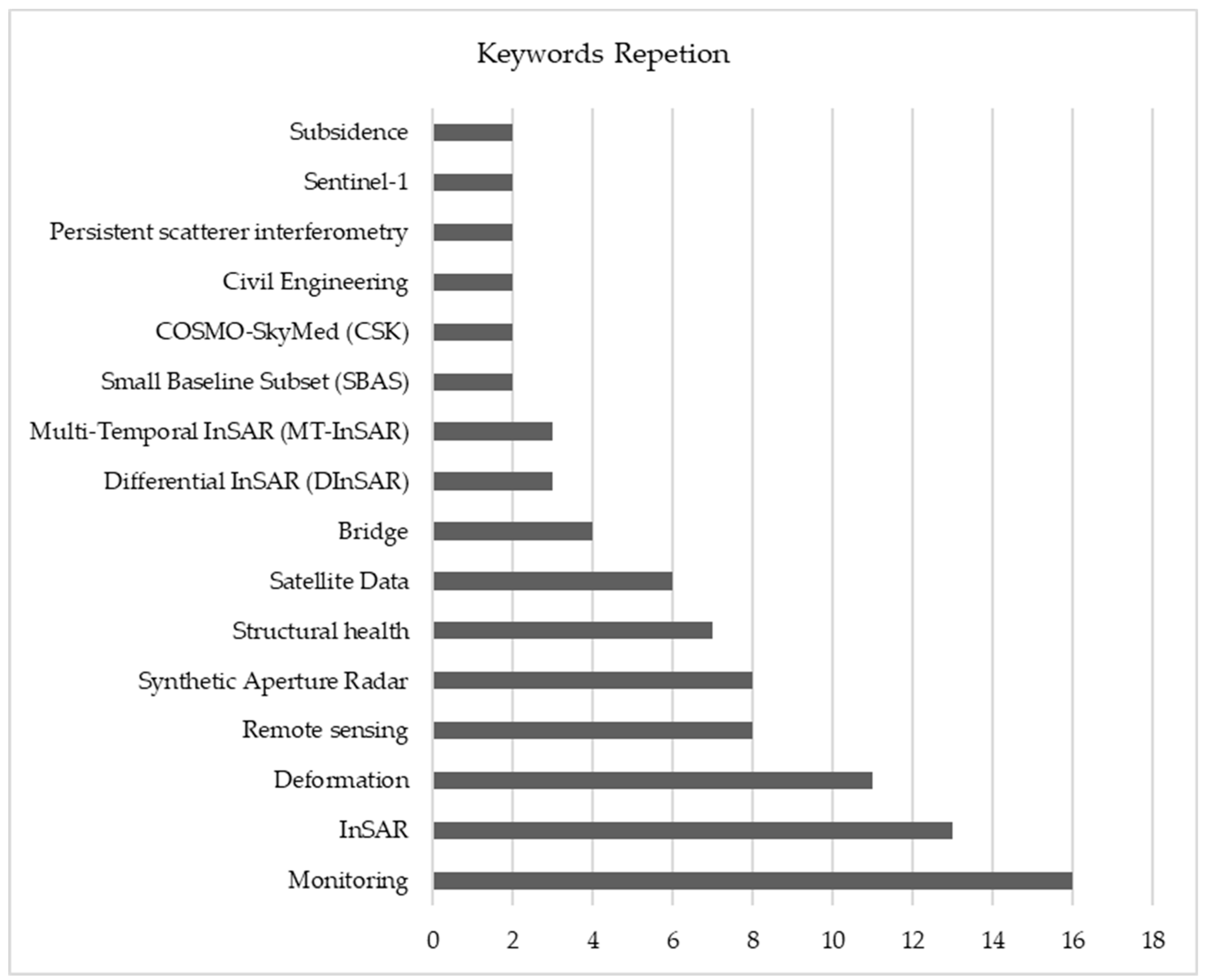
As illustrated in Figure 5, the most frequently occurring keywords, Monitoring (16 occurrences), InSAR (13 occurrences), and Deformation (11 occurrences), highlight the central research focus on the surveillance and quantification of surface or structural displacement using advanced remote sensing technologies (confirming the analysis of Section 2.3 for the last 25 documents of the SLR). The prominence of Monitoring underscores the primary objective of the studies: the systematic observation and long-term tracking of physical changes in engineered or natural systems. It is closely linked to Deformation, which refers to the measurable displacement or strain affecting infrastructure or terrain, including phenomena such as subsidence, uplift, or structural instability. The term “subsidence,” although less frequent (two occurrences), further emphasises the relevance of ground settlement within the research domain on bridges.
The high frequency of InSAR reflects its pivotal role as the principal methodological approach in the analysed studies. InSAR enables the detection of millimetre-scale surface deformations by exploiting phase differences between satellite images acquired at different times. Its recurrence confirms the reliance on satellite-based radar interferometry for precise, non-invasive monitoring. Moreover, the presence of related techniques, such as DInSAR, MT-InSAR, SBAS, and PSI, indicates a methodological emphasis on time series interferometric approaches.
From an applied perspective, keywords such as Civil Engineering, Structural Health, and Bridge reveal the practical context and domain of application. The repeated mentions of Bridge (4 occurrences) and Structural Health (7 occurrences) indicate a significant focus on the condition assessment and integrity monitoring of critical infrastructure and support the selection of the 25 documents from the initial review. It suggests that a substantial portion of the reviewed literature is oriented toward ensuring the safety, durability, and maintenance of civil structures through remote sensing technologies. Also, the inclusion of specific satellite missions, such as Sentinel-1 and COSMO-SkyMed, demonstrates that the research is grounded in real-world data from operational radar satellite constellations and can ensure heterogeneity among study results and, at the same time, can assess the robustness of the synthesised results. These platforms provide high-resolution, frequent-coverage imagery, making them instrumental in continuous monitoring applications.
The keyword analysis reflects a cohesive research trajectory centred on answering the three questions proposed in this SLR where the application of InSAR techniques for precise deformation monitoring in civil engineering contexts is relevant, particularly in bridge infrastructure (agreeing with Figure 3). The convergence of methodological, technological, and application-oriented terms illustrates a multidisciplinary approach that integrates remote sensing, geodesy, and structural engineering for addressing challenges in infrastructure resilience and risk management.
The risk of bias due to missing results in the SLR of SAR applications for bridge SHM was assessed as low. Most included studies reported complete outcome data and transparently described methodological limitations or unresolved challenges. Consequently, the likelihood of reporting bias influencing the synthesis findings is considered unlikely and has a high confidence related to the keyword’s relation to the questions to solve.

3.1.6. PR by Countries

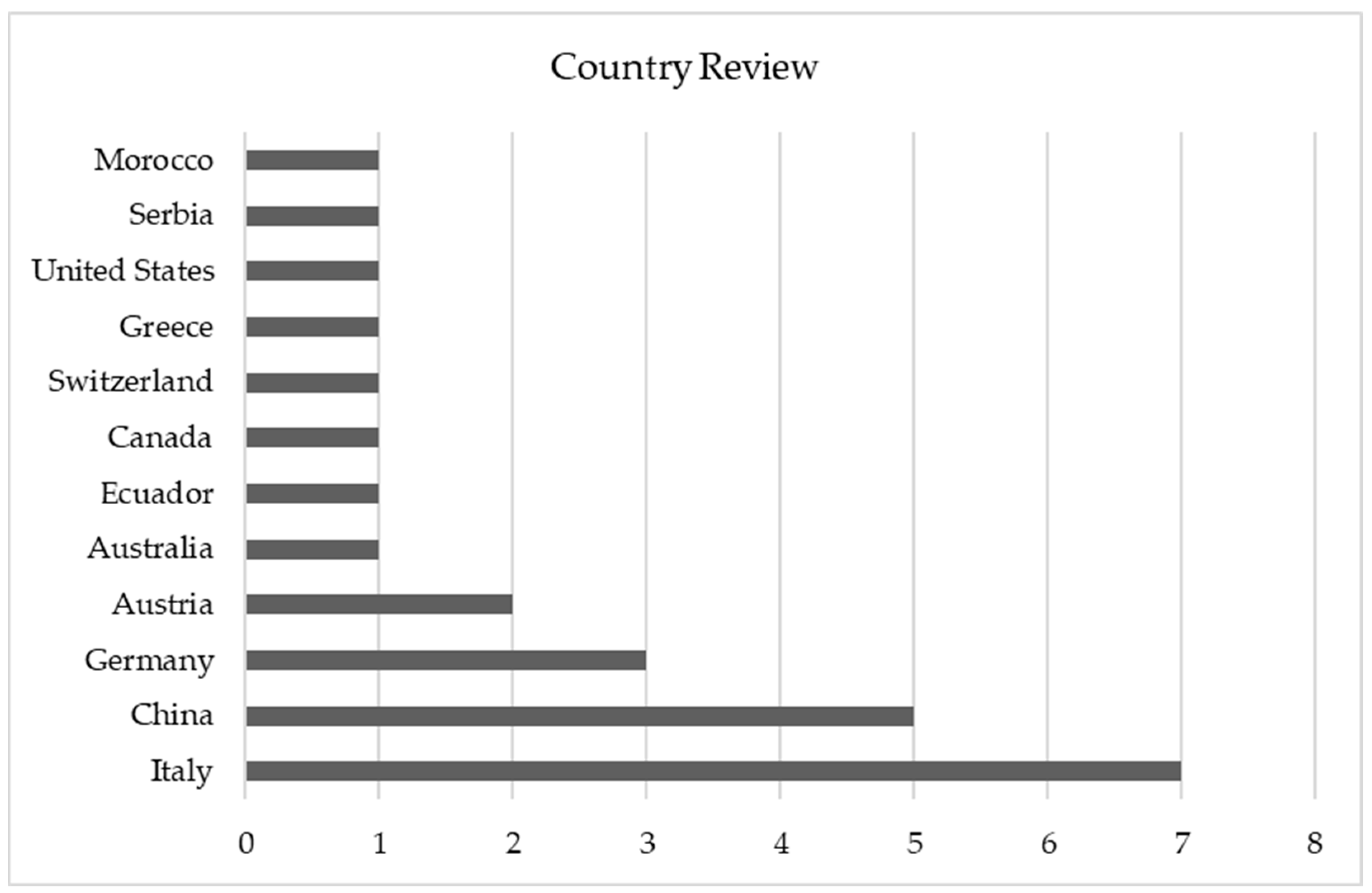
Regarding the geographical distribution of authorship, Figure 6 presents the countries with the highest number of publications included in the analysis, based on the institutional affiliation of the first authors. Italy ranks first with seven publications, indicating a strong national commitment to infrastructure monitoring and the development of satellite-based remote sensing technologies; supported by the Italian Space Agency and Telespazio Company, the Istituto per il Rilevamento Elettromagnetico dell’Ambiente, and the Research Network on Seismic Engineering (ReLUIS) national consortium, which has coordinated interdisciplinary research since the mid-2000s and standardised the use of PSI and MT-InSAR for infrastructure assessment.
China follows with five contributions, reflecting its growing investment in geospatial research and structural health monitoring, supported by the Key Laboratory of Ecological Geology and Disaster Prevention and the Institute of Space and Earth Information Science in Hong Kong. Austria and Germany are jointly positioned third, each contributing two studies, supported by the specific interest of the Department for Earth Observation and Geoinformation in Austria and the OHB Digital Services GmbH in Bremen, Germany. This distribution underscores a geographically concentrated yet internationally diverse research effort in SAR applications for bridge monitoring, particularly within nations possessing well-developed transportation networks and advanced capabilities in remote sensing technology.
Figure 6 also reveals a growing yet geographically concentrated research community dedicated to leveraging SAR technology for SHM and SPMM of bridges. These trends correspond to the increasing availability of open access SAR data, such as that from the Sentinel-1 mission, and reflect broader efforts within civil engineering to develop automated, data-driven inspection systems for infrastructure monitoring.

4. Advancing SAR-Based Bridge Structural Monitoring

This section synthesises the content analysis in SAR-based bridge SHM by addressing the main information and complementary perspectives aligned with the research questions of this review with the protocol described before. First, it analyses the methodological path through which raw SAR data are applied to bridge-relevant SHM (related to Q1). Second, it examines the operational impact of recurrent SAR observations when integrated with complementary monitoring technologies and decision support frameworks (related to Q2). Finally, it critically discusses the technical, interpretative, and institutional challenges that continue to limit the routine operational adoption of SAR for bridge health monitoring (Related to Q3).

4.1. Methodological Path: From Raw SAR Data to Bridge SHM Indicators (Q1)

4.1.1. Core InSAR Algorithms for Bridge Monitoring

InSAR represents one of the technological foundations of satellite-based bridge monitoring around the world [11,19,30,72]. InSAR enables non-contact, wide-area, and millimetre-scale observation of surface deformation over extended periods and with a reliable result configuration. Current bridge-oriented InSAR workflows are characterised by more advanced algorithms and post-processing strategies than previously achieved. These cores are designed to transform raw SAR phase measurements into time-resolved displacement products suitable for structural assessment.
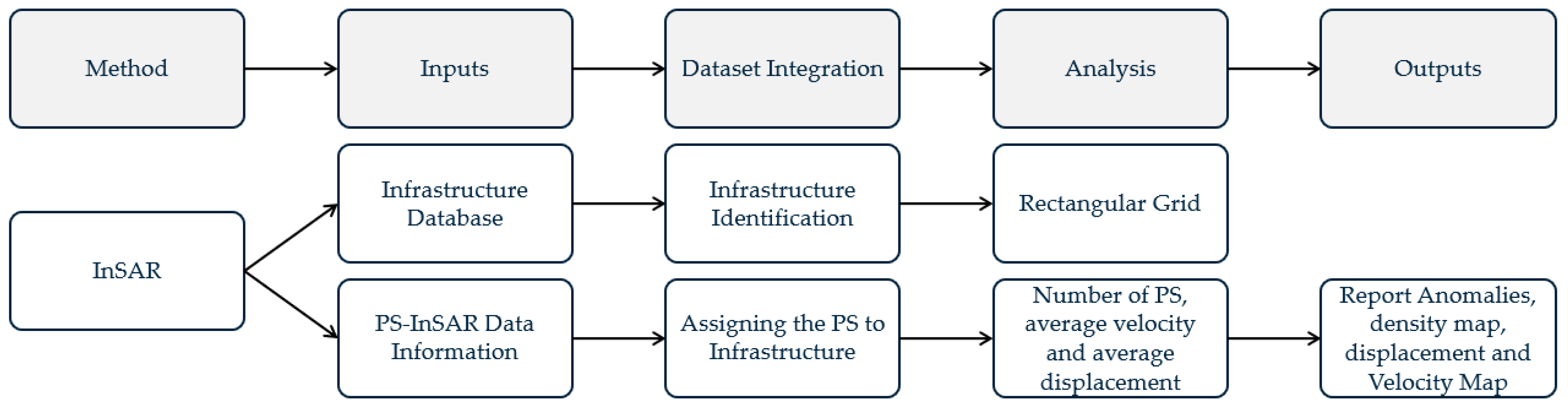
The processing path begins with the acquisition of multi-temporal SAR imagery, with the possibility of two or more images as a source of measurement. Next is the identification of coherent radar targets (PSs or distributed scatterers (DSs)) associated with man-made structural elements such as bridge decks, piers, bearings, or metallic fixtures. Interferometric processing converts phase differences between successive acquisitions into displacement time series along the satellite LOS. These LOS measurements are subsequently aggregated into deformation maps, velocity fields, density distributions, and anomaly indicators. The first level of insight into structural behaviour can be provided [58,141].
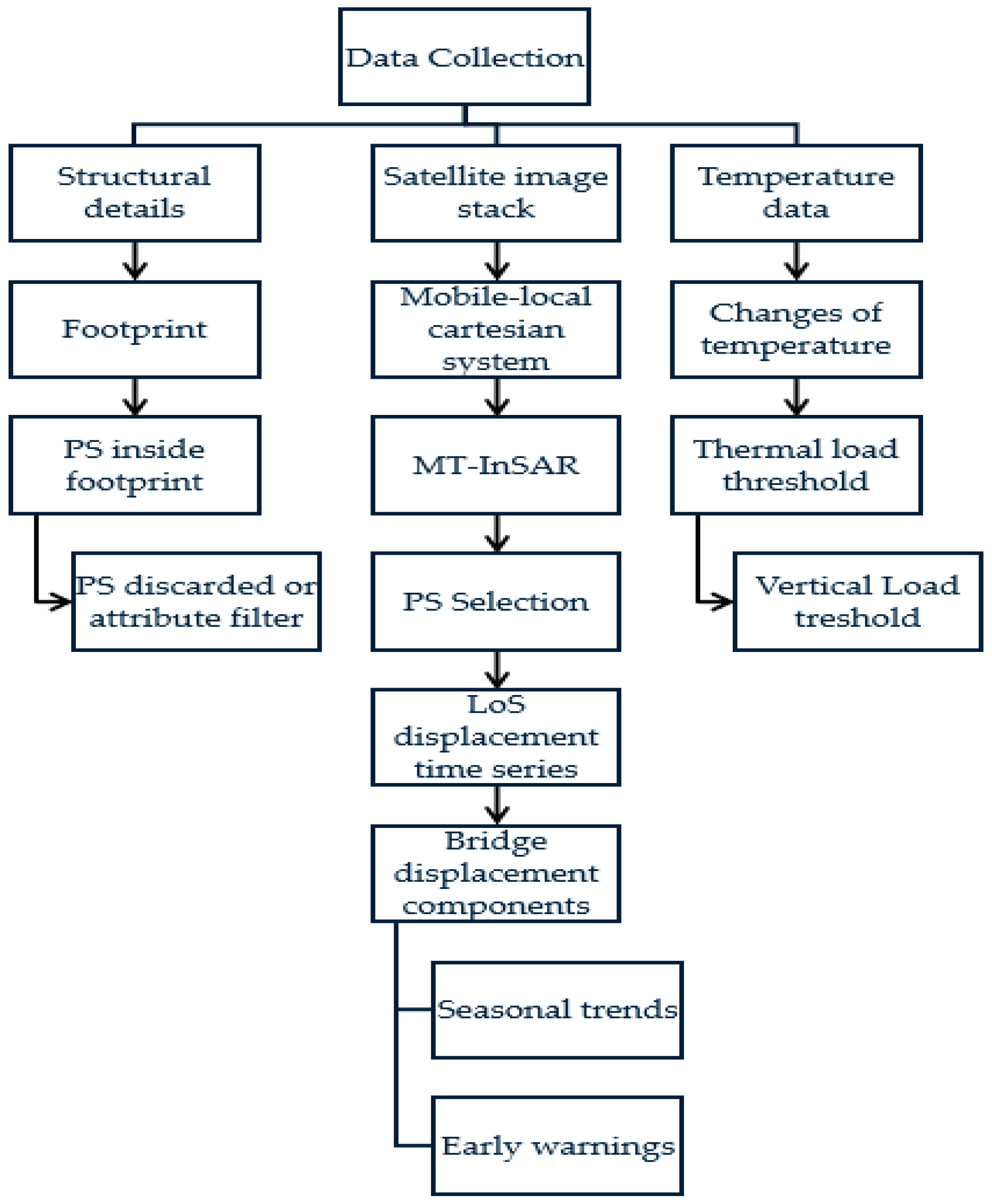
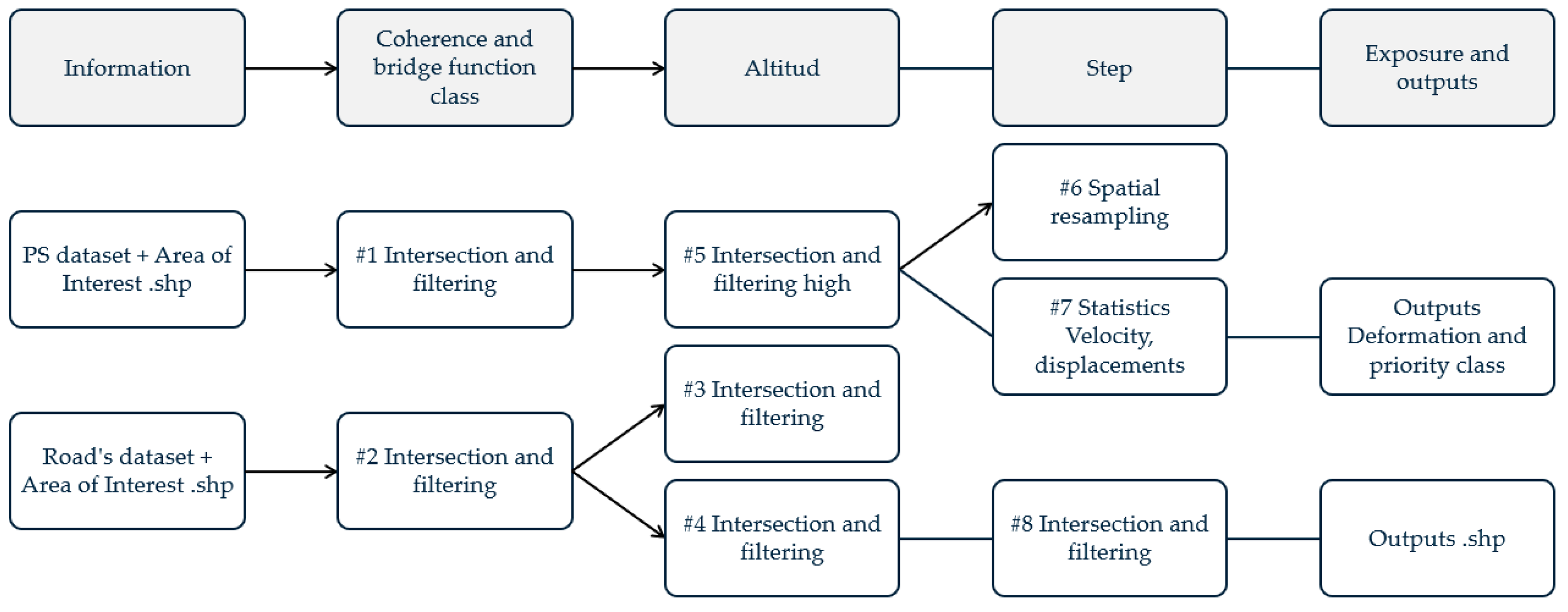
A key methodological advance lies in the integration of SAR acquisitions from ascending and descending orbits. This enhances measurement reliability and enables the partial reconstruction of two-dimensional displacement components. Equally important is the explicit incorporation of uncertainty quantification within the processing chain, which provides error bounds for millimetric measurements and supports their validation for SHM and risk detection purposes [27,141,142]. Figure 7 summarises the bridge-oriented InSAR processing workflow, illustrating the transformation from raw SAR acquisitions to LOS displacement time series suitable for structural monitoring.
In regard to the related procedure, the current state of bridge monitoring using InSAR is primarily built upon the integration of satellite-based information with complementary terrestrial systems, such as Automated Total Stations (ATSs), to enhance spatial coverage and measurement reliability. A pivotal technological advancement in this domain is the deployment of artificial corner reflectors (CRs) on critical structural elements, which generate unambiguous, high-amplitude SAR targets and effectively overcome the challenges associated with the ambiguous identification of natural scatterers in complex urban or maritime environments [19,72]. However, recent developments have further refined InSAR into a precision diagnostic tool capable of the automated, high-accuracy, and senseless monitoring of individual bridge components.

4.1.2. Advanced InSAR Techniques for Bridge Applications

Several advanced InSAR methodologies have been developed to improve the deformation monitoring of bridge structures. PSI exploits the long-term phase stability of selected radar targets to reconstruct displacement histories with millimetre accuracy over multi-year periods [74]. By processing time series of SAR imagery from satellite missions, including Envisat, COSMO-SkyMed, and Sentinel-1, PSI focused on extracting high-precision displacement histories in the satellite’s LOS, allowing for the reconstruction of continuous deformation records spanning over a decade [74]. This capability is particularly relevant for detecting progressive deformation, acceleration trends, and pre-failure signals in critical structural components.
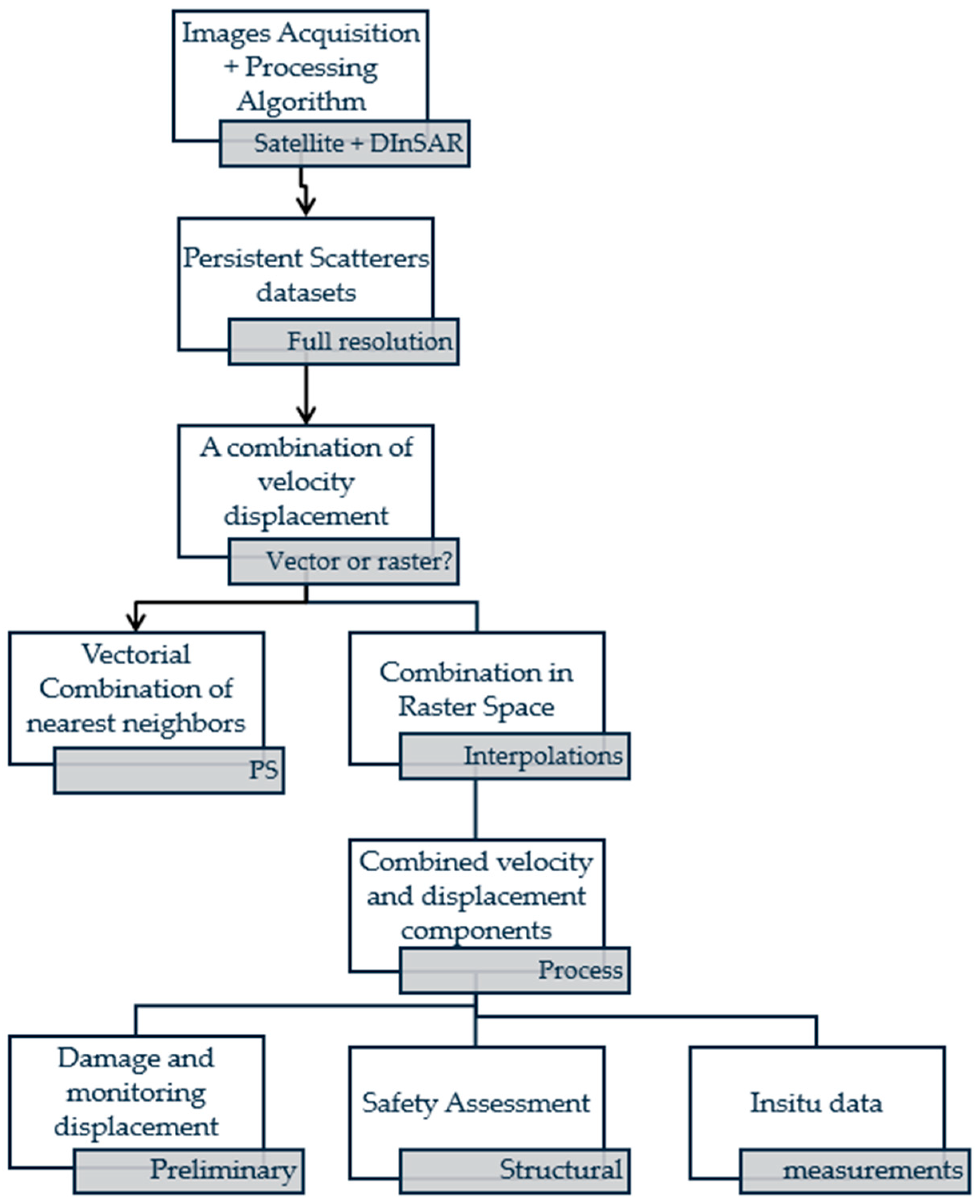
A general workflow related to data processing is shown in Figure 8. To enhance robustness and physical interpretability, PSI is increasingly integrated with complementary monitoring systems and data sources. Validation against co-located Global Navigation Satellite System (GNSS) measurements has confirmed the accuracy of PS-derived displacement time series, affirming PSI’s viability as a scalable, remote alternative to traditional in situ structural health monitoring [98]. Moreover, the fusion of PSI outputs with terrestrial surveying and sensor data strengthens the contextual understanding of observed deformations, enabling practitioners to differentiate between benign environmental effects and genuine structural degradation [31,33].
Closely related is DInSAR, which several authors highlight as a foundational technique that identifies coherent radar targets on bridge structures and focuses on phase differences between pairs of SAR acquisitions and is well-suited for detecting distributed deformation phenomena, such as ground settlement or large-scale geotechnical movements affecting bridge foundations [20]. Extensions of DInSAR into the tomographic domain (D-TomoSAR) exploit long SAR time series to simultaneously estimate motion, elevation, and thermally induced deformation components, thereby improving the physical interpretability of displacement measurements [7]. Additionally, the SBAS method plays a significant role in the structural monitoring of bridges as a multi-temporal InSAR approach, enhancing measurement stability by processing a large stack of SAR images acquired with small spatial and temporal baselines.
Alternative methodological approaches have focused on extending PSI techniques by integrating SAR imagery with multiple-temporal (MT) and complementary data sources. Among these, MT-InSAR has emerged as a prominent framework that exploits the stable radar backscatter from built infrastructure, particularly PS, to achieve millimetre-level precision in measuring surface deformation over extended time periods. Multi-temporal approaches such as Small Baseline Subset InSAR (SBAS-InSAR) process large stacks of SAR images (normally, more than 20) acquired with small spatial and temporal baselines. These methods mitigate decorrelation and atmospheric noise while enabling the reconstruction of long-term deformation time series with millimetre precision [5,6]. A notable advance obtained by MT-InSAR is the introduction of the bridge-specific structural knowledge, particularly the expected deformation behaviour of supported concrete girder bridges [81].
Other recent developments of this SLR also include model-driven and data-driven frameworks, such as temporal InSAR (TInSAR) and transformer-based InSAR approaches, which further enhance deformation monitoring by synergistically leveraging SAR-derived displacement time series alttongside ancillary data, including thermal measurements and other multi-source monitoring information, to improve the physical interpretability and accuracy of structural assessments. These frameworks combine SAR-derived displacement signals with ancillary datasets, including thermal measurements and structural information, to enhance diagnostic robustness and physical interpretability. Representative workflows for DInSAR and MT-InSAR applications in bridge monitoring are illustrated in Figure 9 and Figure 10, respectively.

4.1.3. Post-Processing and Engineering Interpretation of InSAR Measurements

The engineering relevance of InSAR for bridge SHM depends critically on post-processing procedures that translate LOS displacement measurements into physically meaningful structural indicators. A central step of the algorithms developed is the decomposition of LOS displacement into vertical and horizontal components by fusing ascending and descending SAR acquisitions. Environmental effects (particularly thermally induced expansion and contraction) represent a major source of ambiguity in InSAR time series. Ambient or surface temperature records are incorporated into models and remove reversible thermal deformation components, addressing this issue. Estimation techniques, such as Mixed Total Least Squares (MTLS), are employed to mitigate the bias arising from imperfect temperature proxies and ensure robust parameter estimation [58].
The final stage of the methodological path involves integrating refined InSAR measurements with structural mechanics models and engineering knowledge. Associating displacement patterns with specific bridge components (such as bearings, expansion joints, piers, or decks), InSAR outputs can support the early-warning detection of anomalies, the assessment of mechanical degradation, and the classification of bridges into inspection and maintenance priority tiers. Hybrid validation strategies, including the installation of artificial corner reflectors and comparison with terrestrial monitoring systems, further enhance confidence in satellite-derived diagnostics [19,72]. They enable a more comprehensive representation of structural behaviour [4,5,6,7,8,10,11,12,20,23,27,31,48,58,81,92,97,106].
Methodological advances in InSAR processing have enabled the transformation of SAR from a purely geodetic observation tool into a meaningful contributor to bridge SHM. Current workflows support the long-term, uncertainty-aware monitoring of surface deformation, providing a basis for the early detection of anomalies. Rather than focusing on the development of novel interferometric algorithms, current implementations emphasise the post-processing of MT-InSAR outputs within Geographic Information System (GIS) environments to extract engineering-relevant deformation parameters, such as displacement rates, spatial gradients, and temporal trends, that infrastructure managers can directly interpret [6].
Nevertheless, the diagnostic value of these measurements remains contingent on multi-orbit data fusion, thermal modelling, and integration with the structural engineering context. To enhance its rigour and practical relevance, the authors are urged to strengthen the discussion on uncertainty quantification in InSAR-based monitoring, clearly articulating probabilistic deformation assessment advances. Specifically, the review must incorporate and discuss two pivotal contributions: Farneti et al. [27], who benchmarks Bayesian UQ and demonstrate the propagation of displacement uncertainty into engineering risk thresholds in a real-world pre-collapse scenario; and Nettis et al. [6], who introduce a GIS-integrated framework combining PSI with stochastic error envelopes to produce probabilistic deformation maps, enabling risk-informed inspection prioritisation. Integrating these works will address a key methodological gap and reinforce the manuscript as a forward-looking, technically grounded review.

4.2. Operational Impact of Recurrent SAR Use on Bridge SHM (Q2)

4.2.1. Value of Recurrent SAR Observations

The recurrent acquisition of SAR imagery significantly enhances the contribution of satellite monitoring in bridging SHM. Unlike isolated observations, time-resolved InSAR data enable trend analysis, time series decomposition, and the detection of statistical anomalies. They allow benign environmental responses to be distinguished from damage-related deformation [8,72,74,92]. Application toolboxes of TSInSAR, such as StaMPS, GIAnT, and MintPy, continue to underpin many operational workflows, particularly in non-urban or non-bridge contexts like mining-induced subsidence. A comparative evaluation of these open source platforms highlights differences in their underlying methodologies, processing architecture, and output characteristics.
At the asset level, recurrent SAR monitoring reveals progressive settlement, changes in thermal sensitivity, and acceleration patterns that may precede structural failure. At the network level, consistent time series observations enable a comparative assessment across large bridge inventories, supporting the prioritisation of inspections and the allocation of maintenance resources.

4.2.2. Integration with Complementary Monitoring Technologies

The operational value of recurrent InSAR is significantly enhanced through integration with complementary monitoring technologies, as shown in Table 10. Non-destructive testing (NDT) methods (ultrasonic testing, impact–echo, and thermography) provide subsurface and material-level information that can corroborate the surface deformation detected by SAR [8].
Geodetic systems (such as the BeiDou Navigation Satellite System (BDS) and GNSS) provide high-precision, near-real-time three-dimensional displacement measurements that support validation and dynamic characterisation [31,73,98]. This fusion between InSAR and BDS supports condition-based maintenance (CBM), enhances damage detection in historic bridges via anomaly identification, and improves point density and reliability for complex structures like sea-crossing bridges through advanced scattering models [72]. Also, Automated Total Stations (ATSs), ground-based interferometric radar (GB-InSAR), and artificial corner reflectors (CRs) improve spatial accuracy, target identification, and cross-platform consistency [19,72].
Complementary, high-resolution geometric data from LiDAR, Airborne and Mobile Laser Scanning (ALS/MLS), and Unmanned Aerial Vehicles (UAVs) enable the precise localization of deformation and correlation with structural features, particularly in complex or ageing bridges [10,23,107,142]. Subsurface investigation using Ground-Penetrating Radar (GPR) further supports the interpretation of deformation driven by foundation or soil processes and the integration with finite element models, visualised through digital twin platforms like BRI-GITAL; these metrics support the definition of quantitative warning thresholds and facilitate proactive maintenance decisions [92]. Table 10 summarises the main complementary technologies and frameworks that enhance recurrent SAR-based bridge SHM.

4.2.3. Risk Indices, GIS, and Network-Level Decision Support

Several frameworks have been proposed to translate recurrent SAR measurements into actionable decision support tools. The Satellite-based Bridge Risk Index (SABRI) integrates PS displacement metrics within a GIS environment to classify bridges by deformation severity and prioritise inspections across large networks [6]. Statistical approaches, such as the Satellite-based Analysis for Novelty Detection (SAND) and time series decomposition methods like Extreme-point Symmetric Mode Decomposition (ESMD), further enhance interpretability by isolating abnormal deformation patterns from environmental variability [20,140]. These frameworks demonstrate how recurrent SAR data can underpin scalable, near-real-time screening systems that complement conventional inspection regimes [30]. It should be noted, however, that not all studies from this SLR contribute to this integrated vision: some focus exclusively on non-SAR hybrid sensing or general infrastructure monitoring without bridge-specific SHM frameworks [48].

4.2.4. BIM, Digital Twins, and Semantic Interpretation

Recent advances increasingly focus on integrating recurrent SAR monitoring post-processing with Building Information Modelling (BIM) and digital twins to enable semantic, component-level interpretation of deformation measurements. Machine learning-based workflows employing clustering techniques such as Uniform Manifold Approximation and Projection UMAP and Hierarchical Density-Based Spatial Clustering of Applications with Noise, HDBSCAN, associate PS displacement patterns with specific BIM components based on spatial proximity and temporal similarity [33].
This semantic linkage transforms raw LOS displacement time series into engineering-relevant indicators associated with bridge decks, piers, or joints, reducing false alarms and improving decision support. Digital twin platforms further enable visualisation, threshold-based alerts, and lifecycle-oriented asset management [33,92]. When InSAR is integrated with complementary technologies, GIS-based analytics, and semantic models, recurrent InSAR time series provide a persistent observational layer that supports prioritisation, early warning, and evidence-based asset management. This recurrent, integrated approach supports proactive maintenance and answers to Q2, improves diagnostic accuracy, and enables the scalable, near-real-time monitoring of entire bridge networks, thereby advancing SHM from reactive inspection to predictive asset management.

4.3. Remaining Challenges to Operational Adoption (Q3)

4.3.1. Physical and Measurement Limitations

A fundamental limitation of SAR-based monitoring is that displacement is measured only along the satellite LOS. SAR-based monitoring only provides a one-dimensional projection of motion. This constrains sensitivity to relative internal deformations and component-level strain, which are often critical indicators of structural distress [105]. Moreover, SAR measurements are limited to surface motion and cannot directly detect subsurface damage mechanisms such as reinforcement corrosion or internal cracking [8].
The other technical constraint of the LOS component of displacement arises because SAR captures motion only along the satellite’s viewing direction; consequently, it is fundamentally incapable of directly reconstructing the full two- or three-dimensional displacement field of a structure from a single acquisition [5,6,19,74]. Therefore, deriving physically meaningful vertical and horizontal displacement components requires the fusion of data from multiple satellite geometries, typically ascending and descending orbits, followed by complex post-processing to decompose the LOS signal [10,12,27,72,81,92].

4.3.2. Data Acquisition Constraints

Spatial resolution and temporal revisit frequency remain limiting factors, particularly for C-band missions such as Sentinel-1. Coarse spatial resolution restricts the localization of deformation to specific structural components. Revisit intervals of several days to weeks further limit the detection of rapid or transient responses and complicate thermal modelling [8,11,22]. Although higher-resolution commercial SAR data can mitigate some constraints, cost and accessibility limit operational scalability [92].
Together, these image acquisition challenges, spanning resolution, target density, revisit frequency, and data accessibility, constitute fundamental technical constraints that limit the precision, reliability, and engineering applicability of InSAR-derived deformation measurements in bridge structural health monitoring. Despite these limitations, significant progress could be made in addressing them. Nevertheless, key challenges persist in signal quality, target identification, noise due to environmental effects, and the absence of standardised frameworks.

4.3.3. Signal Quality and Environmental Noise

In complex bridge environments, limited target density degrades signal quality and continuity. Decorrelation further reduces phase stability in interferometric measurements. Phase unwrapping errors also compromise the reliability of displacement time series [72]. Atmospheric disturbances introduce phase noise that can obscure true structural deformation. Orbital inaccuracies generate additional phase errors, even when correction techniques are applied. Thermal expansion, creep, settlement, and other processes often overlap within LOS displacement time series. This overlap complicates interpretation, particularly when ambient air temperature is used as a proxy for bridge surface temperature [117].
Compounding this limitation is the sparse distribution and low density of detectable coherent targets on bridge structures. Conventional InSAR methods rely predominantly on SAR amplitude stability to identify Point-like Targets (PTs) or PSs. As a result, this approach yields a poor target density and reduced measurement accuracy, particularly for materials with low radar reflectivity or complex geometries [72].

4.3.4. Interpretation and Automation Gaps

Despite methodological progress, there is a lack of standardised and automated workflows linking InSAR outputs to bridge engineering semantics. The manual association of PS clusters with structural components is labour-intensive and non-scalable [4,20,27]. The absence of typology-specific thresholds and automated indicator extraction limits routine deployment, especially using freely available C-band data [58].

4.3.5. Institutional and Operational Barriers

Finally, operational adoption is further constrained by the limited integration of SAR-based monitoring into inspection standards, regulatory frameworks, and asset management protocols [141,143]. Insufficient interdisciplinary collaboration between remote sensing specialists and structural engineers, combined with a lack of user-friendly decision support tools, hinders the institutional uptake of automated visualisation tools, such as 3D digital twins with threshold-based alerts, which present results in an engineering-intuitive format and could be an approach for future work [92].
SAR has matured into a powerful complementary tool for bridge SHM. However, its full operational potential remains unrealized. Persistent technical limitations, interpretative ambiguity, and institutional barriers underscore the need for standardised, automated, and interdisciplinary frameworks that embed recurrent SAR monitoring within the engineering lifecycle of bridge infrastructure, directly addressing Q3.

5. Conclusions

This systematic review provides a comprehensive analysis of recent advances in the application of SAR and interferometric techniques for bridge SHM, covering studies published between 2020 and August 2025, through the PRISMA-similar-based screening of multiple databases like Web of Science, Dimensions, and Scopus. The review synthesised trends in data processing, recurrent SAR use, and operational implementation across 25 selected studies, reduced from 129 documents related to dams, roads, and other infrastructure projects.
To address Q1, SAR methodologies’ paths have indeed evolved into valuable tools for bridge monitoring, transitioning from a complementary deformation-sensing technique to a promising component of network-level bridge surveillance. Multi-temporal InSAR approaches have significantly enhanced the precision and temporal continuity of deformation tracking, and recurrent satellite acquisitions now enable the detection of both progressive and cyclic structural responses. These advances allow engineers to monitor bridge performance over time without the need for direct contact or costly in situ instrumentation. The methodologies reviewed in this SLR exemplify effective applications of SAR interferometry variations for structural monitoring, including PSI-SAR, DInSAR, MT-InSAR, the SBAS-InSAR method, and TSInSAR techniques. And, related to this, the main key conditions for SAR technologies to be considered as a valuable tool could be summarised as follows:
  • Long and dense SAR time series images from satellite missions.
  • Use of Sentinel-1 for wide coverage or use of COSMO-SkyMed for high resolutions of asset-level detail.
  • Presence of stable persistent scatterers (natural or artificial as corner reflectors).
  • Multi-orbit data (ascending + descending) to enable various types of displacement decomposition.
  • Additional data as temperature records, GNSS, or BIM.
  • Method choice should align with structural behaviour.
A promising pathway toward continuous predictive bridge monitoring lies in the synergistic integration of SAR with in situ sensors, environmental models, and digital twin platforms. This transition can be significantly accelerated by emerging high-resolution satellite constellations and cloud-based processing infrastructures. Ultimately, the operational viability of SAR in bridge structural health monitoring (SHM) will depend less on algorithmic innovation alone and more on sustained cross-disciplinary collaboration, data standardisation, and the development of robust interpretative frameworks. Question Q2 was addressed through a careful review of complementary techniques that enhance the SAR–SHM framework, including the following:
  • The integration of InSAR to correlate surface displacements with internal damage or material degradation from non-destructive testing (NDT).
  • The integration of InSAR within GIS to classify bridges by deformation severity and prioritise inspections according to the Satellite-based Bridge Risk Index (SABRI).
  • The integration of Satellite-based Analysis for Novelty Detection (SAND) with InSAR data to distinguish thermal motion from damage-induced displacements.
  • Complementary components to SAR like the BeiDou Navigation Satellite System (BDS), Automated Total Stations (ATSs), corner reflectors (CRs), ground-based SAR (GB-SAR), Light Detection and Ranging (LiDAR), Airborne and Mobile Laser Scanning (ALS/MLS), Ground-Penetrating Radar (GPR), Geographic Information System (GIS), and BRI-GITAL (3D digital twin platform).
As a complementary approach between Q1 and Q2, a monitoring approach to bridges can be formulated, as recommended by the authors of this SLR:
  • InSAR and MTLS to improve the fidelity of displacement time series and isolate structural trends from environmental noise.
  • PSI and BIM models to link PS to specific structural components, enabling component-level health assessment and anomaly detection.
  • D-TomoSAR and the Bridge-Adaptive Model to estimate motion, elevation, and thermally induced deformations, for the actual support conditions and geometry of bridges.
  • SBAS-InSAR and ESMD to decompose deformation time series into periodic and transient components.
  • MT-InSAR, thermal modelling, and bridge-specific structural knowledge to discriminate benign thermal expansion from damage-induced displacements and generate early-warning indicators for girder bridges.
However, translating these advances into operational practice remains challenging. Key technical barriers that hinder the large-scale deployment of InSAR for bridge monitoring were the goal of Q3. Addressing these challenges necessitates the development of harmonised processing workflows, robust validation frameworks, targeted training initiatives, and engineering-based decision thresholds that further limit the practical adoption of SAR-derived indicators. This SLR identifies the principal obstacles related to solving Q3 and implementing SAR within bridge SHM systems and outlines the solutions previously discussed to overcome them:
  • SAR-derived measurements capture only the absolute displacement of the entire structure along the satellite’s LOS, rendering it insensitive to relative internal deformations.
  • The spatial resolution and temporal revisit frequency of current satellite constellations are often insufficient to resolve rapid or highly localised deformations.
  • Signal quality and target identification present further challenges for the sparse distribution and low density of detectable coherent targets on bridge structures.
  • Temporal and spatial decorrelation significantly reduce measurement coherence, especially for non-metallic, vegetated, or geometrically complex bridges.
  • There is a lack of standardised, automated, and interoperable frameworks capable of bridging the gap between geodetic observations and engineering decision-making.
  • There is a difficulty in translating geodetic observations into actionable engineering insights.
  • There is a persistent difficulty in distinguishing genuine structural deformations from environmental effects, particularly thermal expansion.
  • There is a lack of integration with mechanical behaviour models or component-specific deformation thresholds.
Complementing Q3 is important to add a conclusion to Q1 and Q2, and solving some challenges is important to integrate SAR with complementary sensors and adopt physics-informed decomposition methods. However, the implementation of SAR is recommended to possibly create open, automated workflows that convert raw PS displacement time series into engineering-relevant indicators compatible with infrastructure asset monitoring systems, develop cross-SAR processing chains that harmonise data from Sentinel-1, COSMO-SkyMed, and future missions, and embed SAR outputs into new technologies; the last recommendation is to incorporate SAR-based monitoring into official bridge inspection guidelines to formalise its role in regulatory SHM frameworks.
The scope of this review is restricted to articles published between 2020 and August 2025 that were indexed in Scopus, Web of Science, and Dimensions. Quantitative comparisons and meta-analysis have been hindered by the variety of study designs, methods, and reported data to answer three key questions. Finally, because SAR technology evolves rapidly, the findings may not fully capture the most recent developments released after the search period. The classification of methodological advances involved some subjective interpretation.

Supplementary Materials

The following supporting information can be downloaded at: https://www.mdpi.com/article/10.3390/su18010514/s1, PRISMA 2020 checklist. Reference [144] are cited in the supplementary materials.

Author Contributions

Conceptualization, H.A.B.M., M.Q.T., S.P., J.C.M., and S.N.D.; methodology, H.A.B.M., J.C.M., and S.N.D.; software, H.A.B.M. and M.Q.T.; validation, H.A.B.M., M.Q.T., S.P., J.C.M., and S.N.D.; formal analysis, S.P., J.C.M., and S.N.D.; investigation, H.A.B.M., M.Q.T., and S.N.D.; resources, H.A.B.M., S.P., J.C.M., and S.N.D.; data curation, H.A.B.M., M.Q.T., and S.N.D.; writing—original draft preparation, H.A.B.M., M.Q.T., S.P., J.C.M., and S.N.D.; writing—review and editing, H.A.B.M., M.Q.T., S.P., J.C.M., and S.N.D.; visualisation, H.A.B.M., M.Q.T., and S.N.D.; supervision, S.P., J.C.M., and S.N.D.; project administration, S.P., J.C.M., and S.N.D.; funding acquisition, J.C.M. and S.N.D. All authors have read and agreed to the published version of the manuscript.

Funding

This research was funded by the Portuguese Foundation for Science and Technology (FCT), grant number 2024.04457.

Institutional Review Board Statement

Not applicable.

Informed Consent Statement

Not applicable.

Data Availability Statement

The data supporting the findings of this study are available within the article. All data points used for the quantitative meta-analysis were extracted from the primary studies, which are publicly available and fully cited in the References section of this paper.

Acknowledgments

This work was supported by FCT—Fundação para a Ciência e Tecnologia, I.P., in Concurso Bolsas de Doutoramento 2024—Linha de Candidatura Específica em Ambiente Não Académico by project reference 2024.04457.BDANA and DOI identifier https://doi.org/10.54499/UIDB/04029/2020, attributed to the first author. This work was also sup-ported by FCT/MCTES under the R&D Unit Institute for Sustainability and Innovation in Structural Engineering (ISISE), under the references UID/4029/2025 (https://doi.org/10.54499/UID/04029/2025) and UID/PRR/04029/2025 (https://doi.org/10.54499/UID/PRR/04029/2025), and under the Associate Laboratory Advanced Production and Intelligent Systems ARISE under reference LA/P/0112/2020.

Conflicts of Interest

Author Sergio Pereira was employed by the company Infraestruturas de Portugal. The remaining authors declare that the research was conducted in the absence of any commercial or financial relationships that could be construed as a potential conflict of interest.

References

  1. Tran, M.Q.; Sousa, H.S.; Ngo, T.V.; Nguyen, B.D.; Nguyen, Q.T.; Nguyen, H.X.; Baron, E.; Matos, J.; Dang, S.N. Structural Assessment Based on Vibration Measurement Test Combined with an Artificial Neural Network for the Steel Truss Bridge. Appl. Sci. 2023, 13, 7484. [Google Scholar] [CrossRef]
  2. Ribeiro, D.; Rakoczy, A.M.; Cabral, R.; Hoskere, V.; Narazaki, Y.; Santos, R.; Tondo, G.; Gonzalez, L.; Matos, J.C.; Futai, M.M.; et al. Methodologies for Remote Bridge Inspection—Review. Sensors 2025, 25, 5708. [Google Scholar] [CrossRef]
  3. Minh, T.; Van, T.N.; Nguyen, H.X.; Nguyễn, Q. Enhancing the Structural Health Monitoring (SHM) through data reconstruction: Integrating 1D convolutional neural networks (1DCNN) with bidirectional long short-term memory networks (Bi-LSTM). Eng. Struct. 2025, 340, 120767. [Google Scholar] [CrossRef]
  4. Ma, P.; Wu, Z.; Zhang, Z.; Au, F.T. SAR-Transformer-based decomposition and geophysical interpretation of InSAR time-series deformations for the Hong Kong-Zhuhai-Macao Bridge. Remote Sens. Environ. 2024, 302, 113962. [Google Scholar] [CrossRef]
  5. Macchiarulo, V.; Milillo, P.; Blenkinsopp, C.; Giardina, G. Monitoring deformations of infrastructure networks: A fully automated GIS integration and analysis of InSAR time-series. Struct. Health Monit. 2022, 21, 1849–1878. [Google Scholar] [CrossRef]
  6. Nettis, A.; Massimi, V.; Nutricato, R.; Nitti, D.O.; Samarelli, S.; Uva, G. Satellite-based interferometry for monitoring structural deformations of bridge portfolios. Autom. Constr. 2023, 147, 104707. [Google Scholar] [CrossRef]
  7. Markogiannaki, O.; Xu, H.; Chen, F.; Mitoulis, S.A.; Parcharidis, I. Monitoring of a landmark bridge using SAR interferometry coupled with engineering data and forensics. Int. J. Remote Sens. 2022, 43, 95–119. [Google Scholar] [CrossRef]
  8. Gagliardi, V.; Tosti, F.; Ciampoli, L.B.; Battagliere, M.L.; D’amato, L.; Alani, A.M.; Benedetto, A. Satellite Remote Sensing and Non-Destructive Testing Methods for Transport Infrastructure Monitoring: Advances, Challenges and Perspectives. Remote Sens. 2023, 15, 418. [Google Scholar] [CrossRef]
  9. Crosetto, M.; Monserrat, O.; Cuevas-González, M.; Devanthéry, N.; Crippa, B. Persistent Scatterer Interferometry: A review. ISPRS J. Photogramm. Remote Sens. 2016, 115, 78–89. [Google Scholar] [CrossRef]
  10. Schlögl, M.; Dorninger, P.; Kwapisz, M.; Ralbovsky, M.; Spielhofer, R. Remote Sensing Techniques for Bridge Deformation Monitoring at Millimetric Scale: Investigating the Potential of Satellite Radar Interferometry, Airborne Laser Scanning and Ground-Based Mobile Laser Scanning. PFG–J. Photogramm. Remote Sens. Geoinf. Sci. 2022, 90, 391–411. [Google Scholar] [CrossRef]
  11. Schlögl, M.; Widhalm, B.; Avian, M. Comprehensive time-series analysis of bridge deformation using differential satellite radar interferometry based on Sentinel-1. ISPRS J. Photogramm. Remote Sens. 2021, 172, 132–146. [Google Scholar] [CrossRef]
  12. Tonelli, D.; Caspani, V.F.; Valentini, A.; Rocca, A.; Torboli, R.; Vitti, A.; Perissin, D.; Zonta, D. Interpretation of Bridge Health Monitoring Data from Satellite InSAR Technology. Remote Sens. 2023, 15, 5242. [Google Scholar] [CrossRef]
  13. Song, X.; Zhang, L.; Lu, Z.; Wu, J.; Song, R.; Liang, H.; Bian, W. Toward Retrieving Discontinuous Deformation of Bridges by MTInSAR With Adaptive Segmentation. IEEE Trans. Geosci. Remote Sens. 2024, 62, 1–15. [Google Scholar] [CrossRef]
  14. Rakoczy, A.M.; Ribeiro, D.; Hoskere, V.; Narazaki, Y.; Olaszek, P.; Karwowski, W.; Cabral, R.; Guo, Y.; Futai, M.M.; Milillo, P.; et al. Technologies and Platforms for Remote and Autonomous Bridge Inspection–Review. Struct. Eng. Int. 2025, 35, 354–376. [Google Scholar] [CrossRef]
  15. Guzman-Acevedo, G.M.; Vazquez-Becerra, G.E.; Quintana-Rodriguez, J.A.; Gaxiola-Camacho, J.R.; Anaya-Diaz, M.; Mediano-Martinez, J.C.; Viramontes, F.J.C. Structural health monitoring and risk assessment of bridges integrating InSAR and a calibrated FE model. Structures 2024, 63, 106353. [Google Scholar] [CrossRef]
  16. Miano, A.; Mele, A.; Silla, M.; Bonano, M.; Striano, P.; Lanari, R.; Di Ludovico, M.; Prota, A. Space-borne DInSAR measurements exploitation for risk classification of bridge networks. J. Civ. Struct. Health Monit. 2024, 15, 731–744. [Google Scholar] [CrossRef]
  17. Farneti, E.; Cavalagli, N.; Venanzi, I.; Salvatore, W.; Ubertini, F. Residual service life prediction for bridges undergoing slow landslide-induced movements combining satellite radar interferometry and numerical collapse simulation. Eng. Struct. 2023, 293, 116628. [Google Scholar] [CrossRef]
  18. Xia, Y.; Lei, X.; Wang, P.; Sun, L. Artificial Intelligence Based Structural Assessment for Regional Short- and Medium-Span Concrete Beam Bridges with Inspection Information. Remote Sens. 2021, 13, 3687. [Google Scholar] [CrossRef]
  19. Selvakumaran, S.; Rossi, C.; Marinoni, A.; Webb, G.; Bennetts, J.; Barton, E.; Plank, S.; Middleton, C. Combined InSAR and Terrestrial Structural Monitoring of Bridges. IEEE Trans. Geosci. Remote Sens. 2020, 58, 7141–7153. [Google Scholar] [CrossRef]
  20. Giordano, P.; Turksezer, Z.; Previtali, M.; Limongelli, M. Damage detection on a historic iron bridge using satellite DInSAR data. Struct. Health Monit. 2022, 21, 2291–2311. [Google Scholar] [CrossRef]
  21. Entezami, A.; Behkamal, B.; De Michele, C.; Mariani, S. Displacement prediction for long-span bridges via limited remote sensing images: An adaptive ensemble regression method. Measurement 2025, 245, 116567. [Google Scholar] [CrossRef]
  22. Cusson, D.; Rossi, C.; Ozkan, I.F. Early warning system for the detection of unexpected bridge displacements from radar satellite data. J. Civ. Struct. Health Monit. 2021, 11, 189–204. [Google Scholar] [CrossRef]
  23. Huang, Q.; Wang, Y.; Luzi, G.; Crosetto, M.; Monserrat, O.; Jiang, J.; Zhao, H.; Ding, Y. Ground-Based Radar Interferometry for Monitoring the Dynamic Performance of a Multitrack Steel Truss High-Speed Railway Bridge. Remote Sens. 2020, 12, 2594. [Google Scholar] [CrossRef]
  24. Zhou, Y.; Hao, G.; Chen, J.; Wei, J.; Zheng, J. Long-term deformation monitoring of a steel-truss arch bridge using PSI technique refined by temperature field analysis. Eng. Struct. 2024, 311, 118164. [Google Scholar] [CrossRef]
  25. Di Carlo, F.; Giannetti, I.; Romualdi, A.; Meda, A.; Rinaldi, Z. On the DInSAR technique for the structural monitoring of modern existing bridges. Proc. Inst. Civ. Eng.-Bridg. Eng. 2025, 178, 15–26. [Google Scholar] [CrossRef]
  26. Feng, J.; Gao, K.; Wu, G.; Xu, Y.; Jiang, H. A deep learning-based interferometric synthetic aperture radar framework for abnormal displacement deformation prediction of bridges. Adv. Struct. Eng. 2023, 26, 3005–3020. [Google Scholar] [CrossRef]
  27. Farneti, E.; Cavalagli, N.; Costantini, M.; Trillo, F.; Minati, F.; Venanzi, I.; Ubertini, F. A method for structural monitoring of multispan bridges using satellite InSAR data with uncertainty quantification and its pre-collapse application to the Albiano-Magra Bridge in Italy. Struct. Health Monit. 2023, 22, 353–371. [Google Scholar] [CrossRef]
  28. Sadeghi, F.; Zhu, X.; Li, J.; Rashidi, M. A Novel Slip Sensory System for Interfacial Condition Monitoring of Steel-Concrete Composite Bridges. Remote Sens. 2021, 13, 3377. [Google Scholar] [CrossRef]
  29. Acevedo, G.M.G.; Moreno, V.T.; Rodríguez, J.A.Q.; Becerra, G.E.V.; Zamora, H.M.G.; Trujano, L.Á.M.; Figueroa, J.A.H.; Viramontes, F.G.C.; Díaz, M.A.; López, A.G.P. Implementación de InSAR Para el Monitoreo Estructural de Puentes; Comunicaciones; Secretaría de Infraestructura, Comunicaciones Y Transportes: Querétaro, México, 2023. [Google Scholar]
  30. Banic, M.; Ristic-Durrant, D.; Madic, M.; Klapper, A.; Trifunovic, M.; Simonovic, M.; Fischer, S. The Use of Earth Observation Data for Railway Infrastructure Monitoring—A Review. Infrastructures 2025, 10, 66. [Google Scholar] [CrossRef]
  31. Biondi, F.; Addabbo, P.; Ullo, S.L.; Clemente, C.; Orlando, D. Perspectives on the Structural Health Monitoring of Bridges by Synthetic Aperture Radar. Remote Sens. 2020, 12, 3852. [Google Scholar] [CrossRef]
  32. Bornmann, L.; Mutz, R. Growth rates of modern science: A bibliometric analysis based on the number of publications and cited references. J. Assoc. Inf. Sci. Technol. 2015, 66, 2215–2222. [Google Scholar] [CrossRef]
  33. Yang, C.-H.; Stemmler, C.; Wolf, N.; Koppe, M.; Rudolph, T.; Müterthies, A. Fusion of BIM and SAR for Innovative Monitoring of Urban Movement–Towards 4D Digital Twin. ISPRS-Int. Arch. Photogramm. Remote Sens. Spat. Inf. Sci. 2025, XLVIII-G-2, 1627–1632. [Google Scholar] [CrossRef]
  34. Jarneving, B. A comparison of two bibliometric methods for mapping of the research front. Scientometrics 2005, 65, 245–263. [Google Scholar] [CrossRef]
  35. Wang, Y.; Bai, Z.; Zhang, Y.; Qin, Y.; Lin, Y.; Li, Y.; Shen, W. Using TerraSAR X-Band and Sentinel-1 C-Band SAR Interferometry for Deformation Along Beijing-Tianjin Intercity Railway Analysis. IEEE J. Sel. Top. Appl. Earth Obs. Remote Sens. 2021, 14, 4832–4841. [Google Scholar] [CrossRef]
  36. Sadeghi, Z.; Wright, T.; Hooper, A.; Selvakumaran, S. Using Ray Tracing to Improve Bridge Monitoring With High-Resolution SAR Satellite Imagery. IEEE J. Sel. Top. Appl. Earth Obs. Remote Sens. 2024, 17, 1155–1166. [Google Scholar] [CrossRef]
  37. Lin, S.-Y. Urban hazards caused by ground deformation and building subsidence over fossil lake beds: A study from Taipei City. Geomat. Nat. Hazards Risk 2022, 13, 2890–2910. [Google Scholar] [CrossRef]
  38. Chang, F.; Dong, S.; Yin, H.; Ye, X.; Wu, Z.; Zhang, W.; Zhu, H. Unravelling long-term spatiotemporal deformation and hydrological triggers of slow-moving reservoir landslides with multi-platform SAR data. Int. J. Appl. Earth Obs. Geoinf. 2024, 135, 104301. [Google Scholar] [CrossRef]
  39. Liu, H.; Zhao, W.; Qin, Z.; Wang, T.; Li, G.; Zhu, M. Time-Series InSAR Deformation Monitoring of High Fill Characteristic Canal of South–North Water Diversion Project in China. Appl. Sci. 2023, 13, 6415. [Google Scholar] [CrossRef]
  40. Xiong, S.; Wang, C.; Qin, X.; Zhang, B.; Li, Q. Time-Series Analysis on Persistent Scatter-Interferometric Synthetic Aperture Radar (PS-InSAR) Derived Displacements of the Hong Kong–Zhuhai–Macao Bridge (HZMB) from Sentinel-1A Observations. Remote Sens. 2021, 13, 546. [Google Scholar] [CrossRef]
  41. Shang, J.; Wang, M.; Wang, X.; Yang, M.; Wu, Y.; Du, W. Three-dimensional surface deformation field monitoring and influencing factors analysis in mountainous areas based on SBAS-INSAR technology (Tianjin, China). Sci. Rep. 2025, 15, 25702. [Google Scholar] [CrossRef] [PubMed]
  42. Lorenz, R.; Petryna, Y.; Lubitz, C.; Lang, O.; Wegener, V. Thermal deformation monitoring of a highway bridge: Combined analysis of geodetic and satellite-based InSAR measurements with structural simulations. J. Civ. Struct. Health Monit. 2024, 14, 1237–1255. [Google Scholar] [CrossRef]
  43. Guzman-Acevedo, G.M.; Quintana-Rodriguez, J.A.; Gaxiola-Camacho, J.R.; Vazquez-Becerra, G.E.; Torres-Moreno, V.; Monjardin-Quevedo, J.G. The Structural Reliability of the Usumacinta Bridge Using InSAR Time Series of Semi-Static Displacements. Infrastructures 2023, 8, 173. [Google Scholar] [CrossRef]
  44. Wu, Z.; Zhang, W.; Cai, J.; Xiang, H.; Fan, J.; Wang, X. The Deformation Monitoring Capability of Fucheng-1 Time-Series InSAR. Sensors 2024, 24, 7604. [Google Scholar] [CrossRef]
  45. Li, H.; Li, H.; Chen, Y.; Yuan, Y.; Gao, Y.; Li, S.; Guo, G. Surface Deformation Time-Series Monitoring and Stability Analysis of Elevated Bridge Sites in a Coal Resource-Based City. Sustainability 2024, 16, 6115. [Google Scholar] [CrossRef]
  46. He, Y.; Qian, Z.; Chen, B.; Yang, W.; Hao, P. Surface Deformation of Xiamen, China Measured by Time-Series InSAR. Sensors 2024, 24, 5329. [Google Scholar] [CrossRef]
  47. Li, J.; Zhou, L.; Zhu, Z.; Qin, J.; Xian, L.; Zhang, D.; Huang, L. Surface Deformation Mechanism Analysis in Shanghai Areas Based on TS-InSAR Technology. Remote Sens. 2022, 14, 4368. [Google Scholar] [CrossRef]
  48. Behkamal, B.; Entezami, A.; De Michele, C.; Arslan, A.N. Investigation of Temperature Effects into Long-Span Bridges via Hybrid Sensing and Supervised Regression Models. Remote Sens. 2023, 15, 3503. [Google Scholar] [CrossRef]
  49. Wu, W.; Liu, W.; Hu, J.; Zhang, X.; Hu, Q.; Li, Z.; Du, Z. Investigating two-dimensional deformations of the head of the Central Route of the South–North Water Diversion Project in China with TerraSAR-X datasets. Geomat. Nat. Hazards Risk 2023, 14, 2228457. [Google Scholar] [CrossRef]
  50. He, K.; Lombardo, L.; Chang, L.; Sadhasivam, N.; Hu, X.; Fang, Z.; Dahal, A.; Fadel, I.; Luo, G.; Tanyas, H. Investigating earthquake legacy effect on hillslope deformation using InSAR-derived time series. Earth Surf. Process Landf. 2024, 49, 980–990. [Google Scholar] [CrossRef]
  51. Schlögel, R.; Owczarz, K.; Orban, A.; Havenith, H.-B. Investigating Earth surface deformation with SAR interferometry and geomodeling in the transborder Meuse–Rhine region. Front. Remote Sens. 2024, 5, 1366944. [Google Scholar] [CrossRef]
  52. D’Amico, F.; Gagliardi, V.; Bianchini Ciampoli, L.; Tosti, F. Integration of InSAR and GPR techniques for monitoring transition areas in railway bridges. NDT E Int. 2020, 115, 102291. [Google Scholar] [CrossRef]
  53. Giorgini, E.; Orellana, F.; Arratia, C.; Tavasci, L.; Montalva, G.; Moreno, M.; Gandolfi, S. InSAR Monitoring Using Persistent Scatterer Interferometry (PSI) and Small Baseline Subset (SBAS) Techniques for Ground Deformation Measurement in Metropolitan Area of Concepción, Chile. Remote Sens. 2023, 15, 5700. [Google Scholar] [CrossRef]
  54. Wang, R.; Yang, M.; Dong, J.; Liao, M. Investigating deformation along metro lines in coastal cities considering different structures with InSAR and SBM analyses. Int. J. Appl. Earth Obs. Geoinf. 2022, 115, 103099. [Google Scholar] [CrossRef]
  55. Sun, L.; Li, H.; Guo, S.; Li, X.; Chen, P.; Chen, J. Incorporating Physical Constraint in Three-Dimensional Time Series InSAR Inversion for Urban Deformation Monitoring. IEEE J. Sel. Top. Appl. Earth Obs. Remote Sens. 2025, 18, 13967–13985. [Google Scholar] [CrossRef]
  56. Sun, X.; Zimmer, A.; Mukherjee, S.; Ghuman, P.; Cheng, I. IGS-CMAES: A Two-Stage Optimization for Ground Deformation and DEM Error Estimation in Time Series InSAR Data. Remote Sens. 2021, 13, 2615. [Google Scholar] [CrossRef]
  57. Ziemer, J.; Jänichen, J.; Stein, G.; Liedel, N.; Wicker, C.; Last, K.; Denzler, J.; Schmullius, C.; Shadaydeh, M.; Dubois, C. Identifying Deformation Drivers in Dam Segments Using Combined X- and C-Band PS Time Series. Remote Sens. 2025, 17, 2629. [Google Scholar] [CrossRef]
  58. Wang, B.; Zhu, W.; Zhao, C.; Yan, B.; Liu, X.; Li, G.; Li, W.; Yang, L. Hongtang Bridge Expansion Joints InSAR Deformation Monitoring with Advanced Phase Unwrapping and Mixed Total Least Squares in Fuzhou China. Sensors 2024, 25, 144. [Google Scholar] [CrossRef] [PubMed]
  59. Han, Y.; Zou, J.; Lu, Z.; Qu, F.; Kang, Y.; Li, J. Ground Deformation of Wuhan, China, Revealed by Multi-Temporal InSAR Analysis. Remote Sens. 2020, 12, 3788. [Google Scholar] [CrossRef]
  60. Lomibao, A.L.; Leal, G.A.; Mabaquiao, L.C.; Reyes, R.B. Ground Deformation Monitoring of Reclaimed Lands Along Manila Bay Freeport Zone Using Ps-Insar Technique. ISPRS-Int. Arch. Photogramm. Remote Sens. Spat. Inf. Sci. 2024, XLVIII-4/W8-2023, 335–342. [Google Scholar] [CrossRef]
  61. Shahzad, N.; Ding, X.; Wu, S.; Liang, H. Ground Deformation and Its Causes in Abbottabad City, Pakistan from Sentinel-1A Data and MT-InSAR. Remote Sens. 2020, 12, 3442. [Google Scholar] [CrossRef]
  62. Wang, C.; Zhou, L.; Ma, J.; Shi, A.; Li, X.; Liu, L.; Zhang, Z.; Zhang, D. GB-RAR Deformation Information Estimation of High-Speed Railway Bridge in Consideration of the Effects of Colored Noise. Appl. Sci. 2022, 12, 10504. [Google Scholar] [CrossRef]
  63. Eskandari, R.; Scaioni, M. European Ground Motion Service for Bridge Monitoring: Temporal and Thermal Deformation Cross-Check Using Cosmo-Skymed Insar. ISPRS-Int. Arch. Photogramm. Remote Sens. Spat. Inf. Sci. 2023, XLVIII-1/W2-2023, 1235–1241. [Google Scholar] [CrossRef]
  64. Niraj, K.; Chatterjee, R.S.; Shukla, D.P. Estimating the period of probable landslide event using advanced D-InSAR technique for time-series deformation study of Kotrupi region. Geomat. Nat. Hazards Risk 2023, 14, 2281245. [Google Scholar] [CrossRef]
  65. Li, Y.; Zuo, X.; Yang, F.; Bu, J.; Wu, W.; Liu, X. Effectiveness evaluation of DS-InSAR method fused PS points in surface deformation monitoring: A case study of Hongta District, Yuxi City, China. Geomat. Nat. Hazards Risk 2023, 14, 2176011. [Google Scholar] [CrossRef]
  66. Yan, Y.; Wang, Y. Determining Suitable Spaceborne SAR Observations and Ground Control Points for Surface Deformation Study in Rugged Terrain With InSAR Technique. IEEE J. Sel. Top. Appl. Earth Obs. Remote Sens. 2021, 14, 11324–11334. [Google Scholar] [CrossRef]
  67. Lyu, M.; Ke, Y.; Li, X.; Zhu, L.; Guo, L.; Gong, H. Detection of Seasonal Deformation of Highway Overpasses Using the PS-InSAR Technique: A Case Study in Beijing Urban Area. Remote Sens. 2020, 12, 3071. [Google Scholar] [CrossRef]
  68. Sun, C.; Li, G.; Hu, Z.; Wang, Y.; Dong, Z.; Zeng, T. Deformation Monitoring of Truss Structure Bridge With Time-Series InSAR Analysis. IEEE J. Sel. Top. Appl. Earth Obs. Remote Sens. 2025, 18, 1982–1994. [Google Scholar] [CrossRef]
  69. Zhou, L.; Li, X.; Pan, Y.; Ma, J.; Wang, C.; Shi, A.; Chen, Y. Deformation monitoring of long-span railway bridges based on SBAS-InSAR technology. Geod. Geodyn. 2024, 15, 122–132. [Google Scholar] [CrossRef]
  70. Luo, P.; Jin, X.; Nie, D.; Liu, Y.; Wei, Y. Deformation Monitoring Based on SBAS-InSAR and Leveling Measurement: A Case Study of the Jing-Mi Diversion Canal in China. Sensors 2024, 24, 3871. [Google Scholar] [CrossRef]
  71. Wei, L.; Wang, S.; Wang, X.; Ma, Q.; Qin, X.; Ao, M.; Li, X.; Zhao, D.; Tolomei, C. Deformation and Stress Status of a Cable-Stayed Bridge Revealed by Incorporating Ascending-Descending Time Series Interferometric SAR Fusion and Finite Element Modeling. IEEE J. Sel. Top. Appl. Earth Obs. Remote Sens. 2025, 18, 13372–13387. [Google Scholar] [CrossRef]
  72. Qin, X.; Li, Q.; Ding, X.; Xie, L.; Wang, C.; Liao, M.; Zhang, L.; Zhang, B.; Xiong, S. A structure knowledge-synthetic aperture radar interferometry integration method for high-precision deformation monitoring and risk identification of sea-crossing bridges. Int. J. Appl. Earth Obs. Geoinf. 2021, 103, 102476. [Google Scholar] [CrossRef]
  73. Selvakumaran, S.; Sadeghi, Z.; Collings, M.; Rossi, C.; Wright, T.; Hooper, A. Comparison of in situ and interferometric synthetic aperture radar monitoring to assess bridge thermal expansion. Proc. Inst. Civ. Eng.-Smart Infrastruct. Constr. 2022, 175, 73–91. [Google Scholar] [CrossRef]
  74. Lanari, R.; Reale, D.; Bonano, M.; Verde, S.; Muhammad, Y.; Fornaro, G.; Casu, F.; Manunta, M. Comment on “Pre-Collapse Space Geodetic Observations of Critical Infrastructure: The Morandi Bridge, Genoa, Italy” by Milillo et al. (2019). Remote Sens. 2020, 12, 4011. [Google Scholar] [CrossRef]
  75. Mirmazloumi, S.M.; Wassie, Y.; Navarro, J.A.; Palamà, R.; Krishnakumar, V.; Barra, A.; Cuevas-González, M.; Crosetto, M.; Monserrat, O. Classification of ground deformation using sentinel-1 persistent scatterer interferometry time series. GIScience Remote Sens. 2022, 59, 374–392. [Google Scholar] [CrossRef]
  76. Zou, L.; Feng, W.; Masci, O.; Nico, G.; Alani, A.M.; Sato, M. Bridge Monitoring Strategies for Sustainable Development with Microwave Radar Interferometry. Sustainability 2024, 16, 2607. [Google Scholar] [CrossRef]
  77. Bai, Z.; Shen, C.; Wang, Y.; Lin, Y.; Li, Y.; Shen, W. Bridge Deformation Prediction Using KCC-LSTM With InSAR Time Series Data. IEEE J. Sel. Top. Appl. Earth Obs. Remote Sens. 2025, 18, 9582–9592. [Google Scholar] [CrossRef]
  78. Zhang, K.; Xiao, W.; Zhu, H.; Ning, S.; Huang, S.; Jin, D.; A, R.; Thapa, B.R. Analysis of Uneven Settlement of Long-Span Bridge Foundations Based on SBAS-InSAR. Remote Sens. 2025, 17, 248. [Google Scholar] [CrossRef]
  79. Alani, A.M.; Tosti, F.; Bianchini Ciampoli, L.; Gagliardi, V.; Benedetto, A. An integrated investigative approach in health monitoring of masonry arch bridges using GPR and InSAR technologies. NDT E Int. 2020, 115, 102288. [Google Scholar] [CrossRef]
  80. Buka-Vaivade, K.; Nicoletti, V.; Gara, F. Advancing bridge resilience: A review of monitoring technologies for flood-prone infrastructure. Open Res. Eur. 2025, 5, 26. [Google Scholar] [CrossRef]
  81. Calò, M.; Ruggieri, S.; Nettis, A.; Uva, G. A MTInSAR-Based Early Warning System to Appraise Deformations in Simply Supported Concrete Girder Bridges. Struct. Control Health Monit. 2024, 1, 8978782. [Google Scholar] [CrossRef]
  82. Ansar, A.M.H.; Din, A.H.M.; Latip, A.S.A.; Reba, M.N.M. A Short Review on Persistent Scatterer Interferometry Techniques for Surface Deformation Monitoring. ISPRS-Int. Arch. Photogramm. Remote Sens. Spat. Inf. Sci. 2022, XLVI-4/W3-2021, 23–31. [Google Scholar] [CrossRef]
  83. Li, J.; Xu, Z.; Zhang, X.; Ma, W.; He, S. A Persistent Scatterer Point Selection Method for Deformation Monitoring of Under-Construction Cross-Sea Bridges Using Statistical Theory and GMM-EM Algorithm. Remote Sens. 2024, 16, 2197. [Google Scholar] [CrossRef]
  84. Ma, J.; Xue, X.; Zhi, G.; Zheng, H.; Zhu, H. A Novel Monitoring Method of Wind-Induced Vibration and Stability of Long-Span Bridges Based on Permanent Scatterer Interferometric Synthetic Aperture Radar Technology. Sensors 2025, 25, 3316. [Google Scholar] [CrossRef]
  85. Talledo, D.A.; Saetta, A. A Multi-Level Semi-Automatic Procedure for the Monitoring of Bridges in Road Infrastructure Using MT-DInSAR Data. Remote Sens. 2025, 17, 2377. [Google Scholar] [CrossRef]
  86. Liu, J.; Li, T.; Ma, S.; Shan, Q.; Jiang, W. Study on LOS to Vertical Deformation Conversion Model on Embankment Slopes Using Multi-Satellite SAR Interferometry. ISPRS Int. J. Geo-Inf. 2024, 13, 58. [Google Scholar] [CrossRef]
  87. Farneti, E.; Meoni, A.; Natali, A.; Celati, S.; Frascella, C.; Lupi, M.C.; Cavalagli, N.; Venanzi, I.; Salvatore, W.; Ubertini, F. Structural Health Monitoring of Curved Roadway Bridges Through Satellite Radar Interferometry and Collapse Simulation. ce/papers 2023, 6, 907–916. [Google Scholar] [CrossRef]
  88. Zou, L.; Nico, G.; Alani, A.M.; Sato, M. Strategy for vertical deformation of railway bridge monitoring using polarimetric ground-based real aperture radar system. Struct. Healthy Monit. 2024, 23, 3719–3730. [Google Scholar] [CrossRef]
  89. Zhang, J.; Liu, Y.; Zhang, B.; Xiong, S.; Wang, C.; Wu, S.; Zhu, W. Spatiotemporal-grained quantitative assessment of construction-induced deformation along the MTR in Hong Kong using MT-InSAR and iterative STL-based subsidence ratio analysis. Int. J. Appl. Earth Obs. Geoinf. 2025, 136, 104342. [Google Scholar] [CrossRef]
  90. Ammirati, L.; Mondillo, N.; Rodas, R.A.; Sellers, C.; Di Martire, D. Monitoring Land Surface Deformation Associated with Gold Artisanal Mining in the Zaruma City (Ecuador). Remote Sens. 2020, 12, 2135. [Google Scholar] [CrossRef]
  91. Xing, X.; Zhang, J.; Zhu, J.; Zhang, R.; Liu, B. Slow Deformation Time-Series Monitoring for Urban Areas Based on the AWHPSPO Algorithm and TELM: A Case Study of Changsha, China. Remote Sens. 2023, 15, 1492. [Google Scholar] [CrossRef]
  92. Cusson, D.; Stewart, H. Satellite Synthetic Aperture Radar, Multispectral, and Infrared Imagery for Assessing Bridge Deformation and Structural Health—A Case Study at the Samuel de Champlain Bridge. Remote Sens. 2024, 16, 614. [Google Scholar] [CrossRef]
  93. Wang, B.; Zhao, C.; Zhang, Q.; Yang, C.; Li, W.; Li, G.; Kang, Y.; Zheng, S. SAR Interferometry Infrastructure Deformation Monitoring by the Number of Redundant Observations Optimizes Phase Unwrapping Networks. IEEE J. Sel. Top. Appl. Earth Obs. Remote Sens. 2023, 16, 7201–7212. [Google Scholar] [CrossRef]
  94. Ma, P.; Jiao, Z.; Wu, Z. Robust Time-Series InSAR Deformation Monitoring by Integrating Variational Mode Decomposition and Gated Recurrent Units. IEEE J. Sel. Top. Appl. Earth Obs. Remote Sens. 2025, 18, 3208–3221. [Google Scholar] [CrossRef]
  95. Yang, M.; Li, S.; Yu, H.; Wu, H.; Li, M. Revealing Urban Deformation Patterns through InSAR Time Series Analysis with TCN and Transfer Learning. ISPRS-Int. Arch. Photogramm. Remote Sens. Spat. Inf. Sci. 2024, XLVIII-1-2, 813–820. [Google Scholar] [CrossRef]
  96. Chen, Y.; Ding, C.; Huang, P.; Yin, B.; Tan, W.; Qi, Y.; Xu, W.; Du, S. Research on Time Series Monitoring of Surface Deformation in Tongliao Urban Area Based on SBAS-PS-DS-InSAR. Sensors 2024, 24, 1169. [Google Scholar] [CrossRef] [PubMed]
  97. Milillo, P.; Giardina, G.; Perissin, D.; Milillo, G.; Coletta, A.; Terranova, C. Reply to Lanari, R.; et al. Comment on “Pre-Collapse Space Geodetic Observations of Critical Infrastructure: The Morandi Bridge, Genoa, Italy” by Milillo et al. (2019). Remote Sens. 2020, 12, 4016. [Google Scholar] [CrossRef]
  98. Lasri, O.; Giordano, P.F.; Limongelli, M.P.; Previtali, M. Remote monitoring of a concrete bridge using PSInSAR. ce/papers 2023, 6, 893–899. [Google Scholar] [CrossRef]
  99. Quqa, S.; Palermo, A.; Ubertini, F.; Marzani, A. Regional-scale bridge condition monitoring using InSAR displacements and environmental data. Struct. Health Monit. 2025, 24, 2271–2291. [Google Scholar] [CrossRef]
  100. Quqa, S.; Lasri, O.; Delo, G.; Giordano, P.F.; Surace, C.; Marzani, A.; Limongelli, M.P. Regional-scale bridge health monitoring: Survey of current methods and roadmap for future opportunities under changing climate. Struct. Healthy Monit. 2025, 24, 2309–2337. [Google Scholar] [CrossRef]
  101. Bayramov, E.; Sydyk, N.; Nurakynov, S.; Yelisseyeva, A.; Neafie, J.; Aliyeva, S. Quantitative assessment of urban surface deformation risks from tectonic and seismic activities using multitemporal microwave satellite remote sensing: A case study of Almaty city and its surroundings in Kazakhstan. Front. Built Environ. 2024, 10, 1502403. [Google Scholar] [CrossRef]
  102. Evers, M.; Thiele, A.; Hammer, H.; Hinz, S. PSDefoPAT—Persistent Scatterer Deformation Pattern Analysis Tool. Remote Sens. 2023, 15, 4646. [Google Scholar] [CrossRef]
  103. Zhu, M.; Yu, X.; Tan, H.; Xie, S.; Yang, X.; Han, Y. Prediction Parameters for Mining Subsidence Based on Interferometric Synthetic Aperture Radar and Unmanned Aerial Vehicle Collaborative Monitoring. Appl. Sci. 2023, 13, 11128. [Google Scholar] [CrossRef]
  104. Hu, C.; Zhang, L.; Li, H.; Zhang, Y.; Yao, Y. Prediction of surface deformation time series in closed mines based on LSTM and optimization algorithms. Open Geosci. 2025, 17, 20250811. [Google Scholar] [CrossRef]
  105. Talledo, D.A.; Miano, A.; Bonano, M.; Di Carlo, F.; Lanari, R.; Manunta, M.; Meda, A.; Mele, A.; Prota, A.; Saetta, A.; et al. Satellite radar interferometry: Potential and limitations for structural assessment and monitoring. J. Build. Eng. 2022, 46, 103756. [Google Scholar] [CrossRef]
  106. Karamvasis, K.; Karathanassi, V. Performance Analysis of Open Source Time Series InSAR Methods for Deformation Monitoring over a Broader Mining Region. Remote Sens. 2020, 12, 1380. [Google Scholar] [CrossRef]
  107. Morga, M.; Calò, M.; Nettis, A.; Ruggieri, S.; Doglioni, A.; Simeone, V.; Uva, G. On the use of MTInSAR data and UAV photogrammetry to monitor the behaviour of existing bridge portfolios. Procedia Struct. Integr. 2024, 62, 924–931. [Google Scholar] [CrossRef]
  108. Nahli, A.; Simonetto, E.; Tatin, M.; Durand, S.; Morel, L.; Lamour, V. ON the Combination of Psinsar and Gnss Techniques for Long-Term Bridge Monitoring. ISPRS-Int. Arch. Photogramm. Remote Sens. Spat. Inf. Sci. 2020, XLIII-B3-2020, 325–332. [Google Scholar] [CrossRef]
  109. Afzal, Z.; Balz, T.; Asghar, A. Non-Linear PSInSAR Analysis of Deformation Patterns in Islamabad/Rawalpindi Region: Unveiling Tectonics and Earthquake-Driven Changes. Remote Sens. 2024, 16, 1194. [Google Scholar] [CrossRef]
  110. Pukanská, K.; Bartoš, K.; Bakoň, M.; Papčo, J.; Kubica, L.; Barlák, J.; Rovňák, M.; Kseňak, Ľ.; Zelenakova, M.; Savchyn, I.; et al. Multi-sensor and multi-temporal approach in monitoring of deformation zone with permanent monitoring solution and management of environmental changes: A case study of Solotvyno salt mine, Ukraine. Front. Earth Sci. 2023, 11, 1167672. [Google Scholar] [CrossRef]
  111. Dong, J.; Lai, S.; Wang, N.; Wang, Y.; Zhang, L.; Liao, M. Multi-scale deformation monitoring with Sentinel-1 InSAR analyses along the Middle Route of the South-North Water Diversion Project in China. Int. J. Appl. Earth Obs. Geoinf. 2021, 100, 102324. [Google Scholar] [CrossRef]
  112. Calò, M.; Ruggieri, S.; Nettis, A.; Uva, G. Multi source Interferometry Synthetic Aperture Radar for monitoring existing bridges: A case study. ce/papers 2023, 6, 787–793. [Google Scholar] [CrossRef]
  113. Yaşar, H.; Eronat, A.H. Monitoring the Ground Deformation Caused by Ankara M4 Subway Tunnel with SAR Images. Int. J. Environ. Geoinform. 2023, 10, 145–150. [Google Scholar] [CrossRef]
  114. Xu, X.; Zhao, D.; Ma, C.; Lian, D. Monitoring Subsidence Deformation of Suzhou Subway Using InSAR Timeseries Analysis. IEEE Access 2021, 9, 3400–3416. [Google Scholar] [CrossRef]
  115. Wu, Z.; Ellingsen, P.G. Monitoring of thermal deformation of cylindrical storage facilities with DInSAR. Remote Sens. Lett. 2025, 16, 1180–1190. [Google Scholar] [CrossRef]
  116. Bausilio, G.; Khalili, M.A.; Virelli, M.; Di Martire, D. Italian COSMO-SkyMed atlas: R-Index and the percentage of measurability of movement. GIScience Remote Sens. 2024, 61, 2312705. [Google Scholar] [CrossRef]
  117. Wang, B.; Li, W.; Zhao, C.; Zhang, Q.; Li, G.; Liu, X.; Yan, B.; Cai, X.; Zhang, J.; Zheng, S. L2-Norm Quasi 3-D Phase Unwrapping Assisted Multitemporal InSAR Deformation Dynamic Monitoring for the Cross-Sea Bridge. IEEE J. Sel. Top. Appl. Earth Obs. Remote Sens. 2024, 17, 18926–18938. [Google Scholar] [CrossRef]
  118. Ao, M.; Wang, X.; Sun, Y.; Wang, F.; Zhang, H.; Wei, L.; Liu, S.; Yang, D. Large-Scale Land Deformation Monitoring over Southern California with Multi-Path SAR Data. Remote Sens. 2022, 15, 143. [Google Scholar] [CrossRef]
  119. Kim, W.; Lee, C.; Kim, B.-K.; Kim, K.; Lee, I. Leveraging Multi-Temporal InSAR Technique for Long-Term Structural Behaviour Monitoring of High-Speed Railway Bridges. Remote Sens. 2024, 16, 3153. [Google Scholar] [CrossRef]
  120. Lasri, O.; Giordano, P.F.; Limongelli, M.P. Remote Structural Health Monitoring of Concrete Bridge Using InSAR: A Case Study. In Proceedings of the 14th International Workshop on Structural Health Monitoring: Designing SHM for Sustainability, Maintainability, and Reliability, IWSHM 2023, Stanford, CA, USA, 12–14 September 2023. [Google Scholar]
  121. Khan, R.; Zhong, Y.; Li, H.; Al-Masnay, Y.A.; Haq, I.U.; Khan, M.; Faheem, H.; Ali, R. Integration of Differential Interferometric Synthetic Aperture Radar and Persistent Scatterer Interferometric Approaches to Assess Deformation in Enshi City, Hubei, China. Front Earth Sci. 2023, 11. [Google Scholar] [CrossRef]
  122. Masciulli, C.; Guiduzzi, G.; Tiano, D.; Zocchi, M.; Guerra, F.; Mazzanti, P.; Scarascia Mugnozza, G. Interpretable Clustering of PS-InSAR Time Series for Ground Deformation Detection. Comput. Geosci. 2025, 203, 105959. [Google Scholar] [CrossRef]
  123. Halicioglu, K.; Erten, E.; Rossi, C. Monitoring deformations of Istanbul metro line stations through Sentinel-1 and levelling observations. Environ Earth Sci. 2021, 80, 361. [Google Scholar] [CrossRef]
  124. Zhu, Y.; Xu, B.; Li, Z.; Hou, J.; Wang, Q. Monitoring Bridge Vibrations Based on GBSAR and Validation by High-Rate GPS Measurements. IEEE J. Sel. Top. Appl. Earth Obs. Remote Sens. 2021, 14, 5572–5580. [Google Scholar] [CrossRef]
  125. Liu, Y.; Yang, H.; Wang, S.; Xu, L.; Peng, J. Monitoring and Stability Analysis of the Deformation in the Woda Landslide Area in Tibet, China by the DS-InSAR Method. Remote Sens. 2022, 14, 532. [Google Scholar] [CrossRef]
  126. Liu, G.; Ding, X.; Wu, S.; Fu, H.; Zhu, J. Mitigation of Atmospheric Effects in Deformation Monitoring Using Dual-Polarization MTInSAR and Improved Wavelet Correlation Analysis. IEEE J. Sel. Top. Appl. Earth Obs. Remote Sens. 2025, 18, 5704–5716. [Google Scholar] [CrossRef]
  127. Zhang, B.; Liao, X.; Zhang, J.; Xiong, S.; Wang, C.; Wu, S.; Zhu, C.; Zhu, J.; Qin, X.; Li, Q. Megalopolitan-Scale Ground Deformation along Metro Lines in the Guangdong-Hong Kong-Macao Greater Bay Area, China, Revealed by MT-InSAR. Int. J. Appl. Earth Obs. Geoinf. 2023, 122, 103432. [Google Scholar] [CrossRef]
  128. Ma, P.; Jiang, X. Mapping Vertical and Horizonal Deformation of the Newly Reclaimed Third Runway at Hong Kong International Airport with PAZ, COSMO-SkyMed, and Sentinel-1 SAR Images. Int. J. Appl. Earth Obs. Geoinf. 2024, 132, 104030. [Google Scholar] [CrossRef]
  129. Ibrahim, H.B.; Salah, M.; Zarzoura, F.H.F.; El-Mewafi, M. Mapping of Surface Deformation Associated with the 7.8 Magnitude Turkey Earthquake of 6 Feb 2023 Using Radar Interferometry. Innov. Infrastruct. Solut. 2025, 10, 49. [Google Scholar] [CrossRef]
  130. Kumalawati, R.; Ali, S.D.; Yuliarti, A.; Raharjo, J.T.; Rijanta, R.; Saputra, E.; Susanti, A.; Budiman, P.W.; Anggraini, R.N. Mapping of Land Surface Deformation Using Ps-Insar for Disaster Risk Management in the Future. J. Geogr. 2024, 16, 181–202. [Google Scholar] [CrossRef]
  131. Kalaitzis, P.; Mouratidis, A.; Vladenidis, P.; Ampatzidis, D.; Moshopoulos, G.; Domakinis, C.; Pantazopoulou, Z.; Karadimou, G.; Perivolioti, T.-M.; Terzopoulos, D.; et al. Mapping and Monitoring Subtle Ground Deformation in Sindos, Greece, with High Precision Digital Leveling. Auc Geogr. 2023, 58, 3–17. [Google Scholar] [CrossRef]
  132. Zhang, X.; Sun, Q.; Gui, R.; Hu, J.; Yang, Q.; Su, G. Long-Time Surface Deformation in Beijing, China for Three Decades by Multi-Sensor, Multi-Track and Multi-Temporal InSAR Seamless Connection. Geomat. Nat. Hazards Risk 2025, 16, 2478950. [Google Scholar] [CrossRef]
  133. Ramirez, R.; Lee, S.-R.; Kwon, T.-H. Long-Term Remote Monitoring of Ground Deformation Using Sentinel-1 Interferometric Synthetic Aperture Radar (InSAR): Applications and Insights into Geotechnical Engineering Practices. Appl. Sci. 2020, 10, 7447. [Google Scholar] [CrossRef]
  134. Giordano, P.F.; Kwapisz, M.; Miano, A.; Liuzzo, R.; Vorwagner, A.; Limongelli, M.P.; Prota, A.; Ralbovsky, M. Monitoring of a Multi-span Prestressed Concrete Bridge Using Satellite Interferometric Data and Comparison with On-site Sensor Results. Struct. Concr. 2025, 26, 5430–5453. [Google Scholar] [CrossRef]
  135. Lee, S.-J.; Yun, H.-S.; Kim, T.-Y. Monitoring of High-Speed Railway Ground Deformation Using Interferometric Synthetic Aperture Radar Image Analysis. Appl. Sci. 2025, 15, 4318. [Google Scholar] [CrossRef]
  136. Beattie, A.; Ahmed, M.; Chu, T.; Gebremichael, E.; Elshalkany, M.; Abdelrehim, R. Temporal Gravimetry, Campaign and Permanent GNSS, and Interferometric Radar Techniques: A Comparative Approach to Quantifying Land Deformation Rates in Coastal Texas. Sci. Total Environ. 2024, 956, 177280. [Google Scholar] [CrossRef]
  137. Khan, M.Y.; Saralioglu, E.; Turab, S.A.; Muhammad, S. Tracking Surface and Subsurface Deformation Associated with Groundwater Dynamics Following the 2019 Mirpur Earthquake. Geomat. Nat. Hazards Risk 2023, 14, 2195966. [Google Scholar] [CrossRef]
  138. Hu, B.; Chen, B.; Na, J.; Yao, J.; Zhang, Z.; Du, X. Urban Surface Deformation Management: Assessing Dangerous Subsidence Areas through Regional Surface Deformation, Natural Factors, and Human Activities. Sustainability 2022, 14, 10487. [Google Scholar] [CrossRef]
  139. Famiglietti, N.A.; Miele, P.; Petti, L.; Guida, D.; Guadagno, F.M.; Moschillo, R.; Vicari, A. What Have We Learned from the Past? An Analysis of Ground Deformations in Urban Areas of Palermo (Sicily, Italy) by Means of Multi-Temporal Synthetic Aperture Radar Interferometry Techniques. Geosciences 2023, 13, 298. [Google Scholar] [CrossRef]
  140. Li, X.; Zhou, L.; Ma, J.; Wang, C.; Pan, Y.; Chen, Y.; Zhang, D.; He, M. Multi-scale deformation monitoring and characterization of large-span railway bridge by joint satellite/ground-based InSAR and BDS. Measurement 2025, 256, 118199. [Google Scholar] [CrossRef]
  141. Giordano, P.F.; Kamariotis, A.; Giardina, G.; Chatzi, E.; Limongelli, M.P. Uncertainty propagation in satellite InSAR data analysis for structural health monitoring. Autom. Constr. 2025, 177, 106371. [Google Scholar] [CrossRef]
  142. Calò, M.; Ruggieri, S.; Doglioni, A.; Morga, M.; Nettis, A.; Simeone, V.; Uva, G. Probabilistic-based assessment of subsidence phenomena on the existing built heritage by combining MTInSAR data and UAV photogrammetry. Struct. Infrastruct. Eng. 2024, 8, 1–16. [Google Scholar] [CrossRef]
  143. Zhang, Z.; Wu, S.; Shi, G.; Ding, X.; Zhao, C.; Zhang, B.; Chen, L.; Lu, Z. Mapping ground deformation in the northern Yangtze River estuary using improved MT-InSAR based on ICA and non-stationary analysis. Geo-Spat. Inf. Sci. 2025, 28, 2380–2399. [Google Scholar] [CrossRef]
  144. Page, M.J.; McKenzie, J.E.; Bossuyt, P.M.; Boutron, I.; Hoffmann, T.C.; Mulrow, C.D.; Shamseer, L.; Tetzlaff, J.M.; Akl, E.A.; Brennan, S.E.; et al. The PRISMA 2020 statement: An updated guideline for reporting systematic reviews. BMJ 2021, 372, n71. [Google Scholar] [CrossRef] [PubMed]
Figure 1. Mapping for the Dimensions database.
Sustainability 18 00514 g001
Figure 2. Mapping for the Scopus database.
Sustainability 18 00514 g002
Figure 3. Flow diagram of the SLR.
Sustainability 18 00514 g003
Figure 4. Temporal distribution of the selected publications by year.
Sustainability 18 00514 g004
Figure 5. Bibliometric analysis of keyword distribution.
Sustainability 18 00514 g005
Figure 6. Bibliometric analysis of country distribution.
Sustainability 18 00514 g006
Figure 7. Bridge-oriented InSAR processing workflow from raw SAR acquisitions to displacement time series [5].
Sustainability 18 00514 g007
Figure 8. Modified process of PS-InSAR [6].
Sustainability 18 00514 g008
Figure 9. Modified process of DInSAR [105].
Sustainability 18 00514 g009
Figure 10. Modified process of MT-InSAR [81].
Sustainability 18 00514 g010
Table 1. Aggregated list of search keywords.
Keyword GroupsGroup 1Group 2Group 3Group 4
bridgeSARSentinel 1displacement
monitoringCosmo Sky Meddeformation
interferometry multi-temporal persistent Scatterer
digital twin
Table 2. Keyword search combinations and results found in search databases.
Keyword
Group 1
Keyword
Group 2
Keyword
Group 3
Keyword
Group 4
Records ScopusRecords WoSRecords DimensionsTotal Records
1BridgeSAR 18,1071651399,938419,696
2BridgeSARSentinel 1 17847435,15437,012
3BridgeSARSentinel 1 OR COSMO-SkyMed 178562824610,093
4BridgeSARSentinel 1 OR COSMO-SkyMeddisplacement OR deformation99924978810,811
5BridgeSARSentinel 1 OR COSMO-SkyMedInterferometry OR multi-temporal OR persistent scatterer6901812011909
6BridgeSARSentinel 1 OR COSMO-SkyMeddigital twin76029453021
7BridgeSAR, monitoring 5809274253,575259,658
8BridgeSAR, monitoringSentinel 1 15433631,97533,554
9BridgeSAR, monitoringSentinel 1 OR COSMO-SkyMed 158358849310,134
10BridgeSAR, monitoringSentinel 1 OR COSMO-SkyMeddisplacement OR deformation9583684939487
11BridgeSAR, monitoringSentinel 1 OR COSMO-SkyMedInterferometry OR multi-temporal OR persistent scatterer6813711791897
12BridgeSAR, monitoringSentinel 1 OR COSMO-SkyMeddigital twin72029032975
Table 3. Keyword final search combination and results found in recent years.
202020212022202320242025Total
Dimensions8498126133146125712
WoS0031217
Scopus448589959789499
Table 4. Refinement information of the documentation.
DimensionsWoSScopusTotal
Initial scanning71274991218
Records excluded by topic relations−548−3−422
More relevant documents164477245
Records excluded by citations−580−59
Citation document inclusions107418129
Table 5. Detailed summary of the general characteristics of this set.
FeatureDimensionsWoSScopus
Final timespan2020–20252022–20252020–2025
Sources inside the database30413
Documents107418
Authors55017109
Co-Authors per Doc4.53.255.06
Author keywords55342440
Citations1803199476
Table 6. Detailed summary of the source information.
JournalsRecordsSJR-2024H-INDEX
Remote Sensing321.019Q1217
IEEE Journal of Selected Topics in Applied Earth Observations and Remote Sensing101.349Q1139
Geomatics Natural Hazards and Risk61.053Q166
International Journal of Applied Earth Observation and Geoinformation62.241Q1144
Applied Sciences50.521Q2162
Sensors50.764Q2273
Journal of Civil Structural Health Monitoring41.065Q149
IEEE Transactions on Geoscience and Remote Sensing42.397Q1324
Structural Health Monitoring41.394Q1101
Structural Control and Health Monitoring31.394Q1101
Others50
Table 7. Detailed articles with more citations.
CategoriesReferenceCitationYear
1Monitoring deformations of infrastructure networks: A fully automated GIS integration and analysis of InSAR time-seriesMacchiarulo et al. [5]802022–2023
2Satellite radar interferometry: Potential and limitations for structural assessment and monitoringTalledo et al. [105]772022
3Satellite Remote Sensing and Non-Destructive Testing Methods for Transport Infrastructure Monitoring: Advances, Challenges and PerspectivesGagliardi et al. [8]772023
4Combined InSAR and Terrestrial Structural Monitoring of BridgesSelvakumaran et al. [19]722020
5Comprehensive time-series analysis of bridge deformation using differential satellite radar interferometry based on Sentinel-1Schlögl et al. [11]652021
6Early warning system for the detection of unexpected bridge displacements from radar satellite dataCusson et al. [22]622021
7Hongtang Bridge Expansion Joints InSAR Deformation Monitoring with Advanced Phase Unwrapping and Mixed Total Least Squares in Fuzhou ChinaWang et al. [58]612024
8A method for structural monitoring of multispan bridges using satellite InSAR data with uncertainty quantification and its pre-collapse application to the Albiano-Magra Bridge in ItalyFerneti et al. [27]542023
9Satellite-based interferometry for monitoring structural deformations of bridge portfoliosNettis et al. [6]492023
10Damage detection on a historic iron bridge using satellite DInSAR dataGiordano et al. [20]442022
11SAR-Transformer-based decomposition and geophysical interpretation of InSAR time-series deformations for the Hong Kong-Zhuhai-Macao BridgeMa et al. [4]432024
12A structure knowledge-synthetic aperture radar interferometry integration method for high-precision deformation monitoring and risk identification of sea-crossing bridgesQin et al. [72]422021
13Perspectives on the Structural Health Monitoring of Bridges by Synthetic Aperture RadarBiondi et al. [31]372020
14A MTInSAR-Based Early Warning System to Appraise Deformations in Simply Supported Concrete Girder BridgesCalò et al. [81]332024
15Ground-based radar interferometry for monitoring the dynamic performance of a multitrack steel truss high-speed railway bridgeHuang et al. [23]322020
16Interpretation of Bridge Health Monitoring Data from Satellite InSAR TechnologyTonelli et al. [12]302023
17Monitoring of a landmark bridge using SAR interferometry coupled with engineering data and forensicsMarkogiannaki et al. [7]252022
18Investigation of Temperature Effects into Long-Span Bridges via Hybrid Sensing and Supervised Regression ModelsBehkamal et al. [48]232023
19Performance Analysis of Open-Source Time Series InSAR Methods for Deformation Monitoring over a Broader Mining RegionKaramvasis & Karathanassi) [106]202020
20Reply to Lanari, R., et al. Comment on “Pre-Collapse Space Geodetic Observations of Critical Infrastructure: The Morandi Bridge, Genoa, Italy”Milillo et al. [97]202020
21Remote Sensing Techniques for Bridge Deformation Monitoring at Millimetric Scale: Investigating the Potential of Satellite Radar Interferometry, Airborne Laser Scanning, and Ground-Based Mobile Laser ScanningSchlögl et al. [10]172022
Table 8. Detailed articles added to the research.
CategoriesAuhorYear
22The Use of Earth Observation Data for Railway Infrastructure Monitoring—A ReviewBanic et al. [30]2025
23Multi-scale deformation monitoring and characterisation of large-span railway bridge by joint satellite/ground-based InSAR and BDSLi et al. [140]2025
24Remote Structural Health Monitoring of Concrete Bridge Using InSAR: A Case StudyLasri et al. [120]2023
25Fusion of BIM and SAR for Innovative Monitoring of Urban Movement—Towards 4D Digital TwinYang et al. [33]2025
Table 9. Publication index for recent relevant articles.
AuthorYearPublications (H)Years (n)M-Index
Schlögl, Matthias20212 (Q2,Q2)30.67
Nettis, Andrea20242 (Q1,Q2)12.00
Uva, Giuseppina20242 (Q1,Q2)12.00
Table 10. Complementary technologies and frameworks enhancing recurrent SAR-based bridge SHM.
CategoryTechnique/FrameworkContribution to Bridge SHM
ValidationATS, BDS/GNSSHigh-precision reference displacement and dynamic validation
Target enhancementCorner ReflectorsStable, high-coherence PS on critical structural components
Subsurface diagnosisNDT, GPRCorrelation between surface deformation and internal damage
Dynamic monitoringGB-InSARHigh-frequency response under operational loads
Geometry and localizationLiDAR, ALS/MLS, UAVHigh-resolution component mapping
Decision supportGIS, SABRINetwork-level screening and inspection prioritisation
Anomaly detectionSAND, ESMDSeparation of environmental and damage-induced deformation
Semantic integrationBIM, Digital TwinsComponent-level interpretation and asset management
Disclaimer/Publisher’s Note: The statements, opinions and data contained in all publications are solely those of the individual author(s) and contributor(s) and not of MDPI and/or the editor(s). MDPI and/or the editor(s) disclaim responsibility for any injury to people or property resulting from any ideas, methods, instructions or products referred to in the content.