



Advancing Sustainable Agrifood Systems: Interconnections of Energy, Emissions, and Agroecological Pathways
This special issue belongs to the section "Sustainable Agriculture".
Special Issue Information
Dear Colleagues,
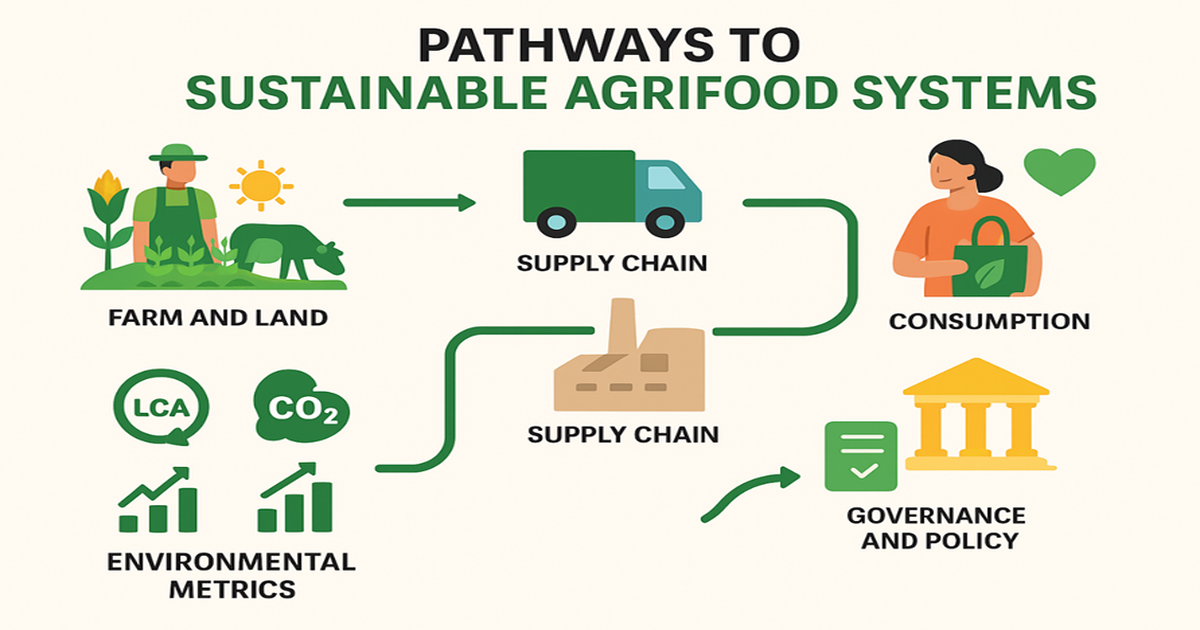
This Special Issue advances the understanding of sustainable agrifood systems by examining links between agricultural production, energy use, emissions, ecological pressures, and consumer and governance behaviours. It covers farm practices, supply chains, and policy frameworks, integrating biophysical, technological, socio-economic, and behavioural perspectives. Its purpose is to identify pathways toward resilient, low-carbon, and energy-efficient agrifood systems, emphasizing agroecological and organic practices that reduce environmental impacts while maintaining productivity and ecosystem integrity.
It complements the existing literature by addressing gaps in energy analysis within agroecological transitions, assessing emissions alongside productivity and biodiversity, and evaluating behavioural and socio-economic drivers of sustainable consumption. By uniting multidisciplinary perspectives, it provides a holistic understanding of agrifood sustainability.
Aligned with Sustainability’s aims, the issue defines and quantifies sustainability metrics, including LCA, carbon footprints, and energy balances; advances methods to monitor performance; incorporates governance, market, and behavioural dimensions; and examines integrated approaches such as agroecology, renewable energy adoption, and policy design. It supports evidence-based sustainability policies aligned with SDGs, including zero hunger, clean energy, responsible consumption, climate action, and life on land.
Topics of interest include (but are not limited to) the following:
- Life Cycle Assessment of energy use and emissions across farming systems
• Nutritional quality, safety, and environmental performance of organic and agroecological production - On-farm renewable energy technologies and energy-efficiency strategies
• Soil carbon sequestration, biodiversity conservation, and ecosystem services
• Sustainable supply chains, consumption behaviours, and food waste reduction
• Policy frameworks, governance dynamics, and socio-economic drivers
• Consumer behaviour, sustainability labels, and demand for organic and agroecological products.
This Special Issue promotes holistic, empirically grounded approaches that inform both academic debate and real-world sustainability transitions.
Dr. Matheus Koengkan
Guest Editor
Manuscript Submission Information
Manuscripts should be submitted online at www.mdpi.com by registering and logging in to this website. Once you are registered, click here to go to the submission form. Manuscripts can be submitted until the deadline. All submissions that pass pre-check are peer-reviewed. Accepted papers will be published continuously in the journal (as soon as accepted) and will be listed together on the special issue website. Research articles, review articles as well as short communications are invited. For planned papers, a title and short abstract (about 250 words) can be sent to the Editorial Office for assessment.
Submitted manuscripts should not have been published previously, nor be under consideration for publication elsewhere (except conference proceedings papers). All manuscripts are thoroughly refereed through a single-anonymized peer-review process. A guide for authors and other relevant information for submission of manuscripts is available on the Instructions for Authors page. Sustainability is an international peer-reviewed open access semimonthly journal published by MDPI.
Please visit the Instructions for Authors page before submitting a manuscript. The Article Processing Charge (APC) for publication in this open access journal is 2400 CHF (Swiss Francs). Submitted papers should be well formatted and use good English. Authors may use MDPI's English editing service prior to publication or during author revisions.
Keywords
- sustainable agrifood systems
- agroecology
- energy use in agriculture
- life cycle assessment
- climate impacts and emissions
- organic farming
- consumer behaviour and sustainability labels
- food supply chains
- biodiversity and ecosystem services
Benefits of Publishing in a Special Issue
- Ease of navigation: Grouping papers by topic helps scholars navigate broad scope journals more efficiently.
- Greater discoverability: Special Issues support the reach and impact of scientific research. Articles in Special Issues are more discoverable and cited more frequently.
- Expansion of research network: Special Issues facilitate connections among authors, fostering scientific collaborations.
- External promotion: Articles in Special Issues are often promoted through the journal's social media, increasing their visibility.
- Reprint: MDPI Books provides the opportunity to republish successful Special Issues in book format, both online and in print.
Published Papers


Sustainability - ISSN 2071-1050