Skip Content
You are currently on the new version of our website. Access the old version .

Risks

Risks is an international, scholarly, peer-reviewed, open access journal for research and studies on insurance and financial risk management.
Risks is published monthly online by MDPI. 

All Articles (1,775)

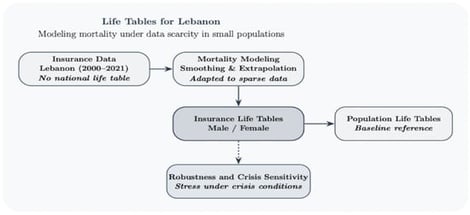
Building a Life Table for Lebanon: Towards a Deeper Understanding of Our Future

  • Natalia Bou Sakr,
  • Stéphane Loisel and
  • Yahia Salhi
  • + 1 author

Lebanon does not have a national mortality table that reflects its demographic and health conditions. Despite ongoing changes in mortality patterns driven by economic crises, political instability, and social changes, outdated foreign tables such as AM80 remain in use in the insurance and public sectors. This dependency introduces significant risks in actuarial calculations, policy design, and long-term planning. This study addresses this gap by building a mortality table specifically adapted to the Lebanese insurance context, together with a first estimation of population-level mortality. In the absence of any official mortality database, we collaborated directly with local insurance companies to access and organize internal records of insured lives. These data, which represent one of the few available structured sources of mortality information in the country, form the core of our analysis. We apply actuarial methods to estimate age-specific death rates and life expectancy and benchmark the results against national and international references to assess consistency and range. By offering a locally grounded, data-driven alternative to imported mortality assumptions, this work fills a critical statistical need. The resulting table supports more accurate forecasting, pricing, and demographic modeling, with applications across insurance, pensions, and public health planning in Lebanon.

5 February 2026
Age distribution of entries and exits in the portfolio.

This study investigates whether Corporate Social Responsibility Disclosure (CSRD) serves as a risk-mitigating or cost-inducing signal for firms’ market value in an emerging market. Utilising a panel dataset of 120 companies listed on the Tehran Stock Exchange (2015–2023) and employing content analysis alongside panel regression and System GMM models, we find that disclosure quality in social, employee, and environmental dimensions is positively associated with market value, while customer-related disclosure is not. The role of family ownership is nuanced: baseline specifications suggest no broad moderating influence, yet robust dynamic modelling reveals that family ownership significantly enhances the positive market valuation of environmental disclosure. The primary contribution is a nuanced, dimension-specific analysis of CSRD’s value relevance, challenging blanket assumptions about family firm behaviour and offering granular, methodologically informed insights for stakeholders in institutionally complex environments.

3 February 2026

  • Feature Paper
  • Article
  • Open Access

This study investigates credit unions’ expansion into non-core lending and its association with risk and financial resilience. Using US credit union call report data from 1994 to 2024, we measure the share of purchased loans, lease receivables, and loans held for sale in non-core lending. We document robust conditional, within-credit-union associations that point to a clear risk trade-off. Credit unions with higher non-core exposure grow faster in terms of loans and membership but exhibit weaker financial buffers, including lower net worth ratios and weaker economic solvency, alongside higher delinquency. Decomposition tests indicate that loans held for sale are most strongly associated with adverse buffer and asset quality patterns, while purchased loans and lease receivables display smaller and less uniform relationships. Scale interactions suggest that these associations are generally weaker for larger institutions for both membership and assets. Post-COVID estimates indicate that the baseline relationships are broadly stable, while the growth link is becoming stronger.

2 February 2026

Ecological sustainability is one of the key dimensions of sustainable development in any economy. Developing economies exhibit high-risk levels in terms of political stability and corruption, thereby inhibiting them from successfully adopting techniques for ecological sustainability. A framework that comprises a strong financial system for green financial investment, coupled with correct policy frameworks becomes fundamental in the attainment of sustainable environments. Pervasive corruption in developing nations is a formidable barrier that impedes financial development and undermines green finance initiatives’ efficacy in fostering ecological sustainability. This research takes the data of the Central African nations, which is analyzed with the ‘Methods of Moments Quantile Regression’ technique. The major results presented show that digitalization, renewable energy, and governance support ecological sustainability. Institutional quality and green finance are expected to increase ecological sustainability, but the findings show that in the Central African countries with high corruption they tend to reduce ecological sustainability. The poor institutional quality in the Central African nations, because of high corruption and political instabilities, impedes the efficacy of financial development and green finance in advancing ecological sustainability. The Central African nations can achieve sustainability by fostering digitalization and renewable energy, as well as reducing corruption and political instabilities.

2 February 2026

News & Conferences

Issues

Open for Submission

Editor's Choice

Reprints of Collections

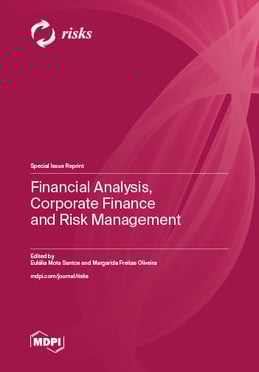
Financial Analysis, Corporate Finance and Risk Management
Reprint

Financial Analysis, Corporate Finance and Risk Management

Editors: Eulália Mota Santos, Margarida Freitas Oliveira

Get Alerted

Add your email address to receive forthcoming issues of this journal.

XFacebookLinkedIn
Risks - ISSN 2227-9091