



- 4.1Impact Factor
- 8.6CiteScore
- 25 daysTime to First Decision
Extraterrestrial Influences on Remote Sensing in the Earth’s Atmosphere
This special issue belongs to the section “Atmospheric Remote Sensing“.
Special Issue Information
Dear Colleagues,
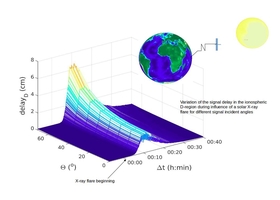
Propagation properties of the electromagnetic signals used for different kinds of remote sensing depends on the atmospheric parameters, such as the electron density and temperature. Spatial and temporal variations of these parameters affect signal propagations and, consequently, corresponding applications of the used technique such as observations and positioning. One of the most important sources of the atmospheric disturbances is solar electromagnetic and charged particles radiation. In addition, cosmic rays, including both electromagnetic and particle radiation, can provide enough intensive perturbations of the outer Earth’s layer that can affect the signal propagation path. The sources of these perturbations can be relatively close to our planet, but also can be located in the deep Universe. Perturber intensities, lengths and locations in the Earth’s atmosphere can be quite different, which can induce various signal deviations.
The aim of this Issue is to present the latest research linking events and processes in the outer space with changes in the propagation of the satellite and ground-based signals used in remote sensing. This Special issue welcomes papers that explore the following:
- Detection of the extra-terrestrial radiation and modelling of the induced atmospheric disturbances using different kinds of remote sensing techniques;
- Changes in signals used for remote sensing and the quality of their applications during influences of extra-terrestrial events;
- Influences of events from outer space on the detection of terrestrial or extra-terrestrial events and corresponding modelling, such as masking less intense perturbations with solar influences, etc.
Additionally, other papers that deal with the Earth’s atmosphere’s perturbations due to extra-terrestrial events (e.g., meteor perturbatios) that may affect signal propagation are welcome.
Dr. Aleksandra Nina
Prof. Dr. Milan Radovanović
Prof. Dr. Luka Č. Popović
Guest Editors
Manuscript Submission Information
Manuscripts should be submitted online at www.mdpi.com by registering and logging in to this website. Once you are registered, click here to go to the submission form. Manuscripts can be submitted until the deadline. All submissions that pass pre-check are peer-reviewed. Accepted papers will be published continuously in the journal (as soon as accepted) and will be listed together on the special issue website. Research articles, review articles as well as short communications are invited. For planned papers, a title and short abstract (about 250 words) can be sent to the Editorial Office for assessment.
Submitted manuscripts should not have been published previously, nor be under consideration for publication elsewhere (except conference proceedings papers). All manuscripts are thoroughly refereed through a single-blind peer-review process. A guide for authors and other relevant information for submission of manuscripts is available on the Instructions for Authors page. Remote Sensing is an international peer-reviewed open access semimonthly journal published by MDPI.
Please visit the Instructions for Authors page before submitting a manuscript. The Article Processing Charge (APC) for publication in this open access journal is 2700 CHF (Swiss Francs). Submitted papers should be well formatted and use good English. Authors may use MDPI's English editing service prior to publication or during author revisions.
Keywords
- Atmosphere
- Observations
- Signal processing
- Modelling
- Extraterrestrial radiation
- Solar radiation
- Disturbances
- Remote sensing
Benefits of Publishing in a Special Issue
- Ease of navigation: Grouping papers by topic helps scholars navigate broad scope journals more efficiently.
- Greater discoverability: Special Issues support the reach and impact of scientific research. Articles in Special Issues are more discoverable and cited more frequently.
- Expansion of research network: Special Issues facilitate connections among authors, fostering scientific collaborations.
- External promotion: Articles in Special Issues are often promoted through the journal's social media, increasing their visibility.
- Reprint: MDPI Books provides the opportunity to republish successful Special Issues in book format, both online and in print.
Published Papers
Get Alerted
Add your email address to receive forthcoming issues of this journal.


Remote Sens. - ISSN 2072-4292