



Sustainable Process Engineering for Biomass Valorization and Waste-to-Energy Technologies
A Special Issue of Processes (ISSN 2227-9717) belonging to the section "Energy Systems".
Deadline for manuscript submissions: 31 March 2027 | Viewed by 573
Editors

Interests: process modeling; process simulation; process optimization; process system engineering; life cycle assessment

Interests: hydrothermal carbonization; biomass valorization; biofuels; bioenergy; carbon materials

Special Issue Information
Dear Colleagues,
As the global transition toward a circular, low-carbon economy accelerates, integrating biomass valorization with advanced carbon mitigation strategies is paramount to replacing fossil-based footprints. This Special Issue aims to gather cutting-edge research addressing the technical, economic and environmental challenges of modern biorefineries. We welcome high-quality contributions from both experimental investigations and computational/process engineering approaches that drive the efficiency and scalability of waste-to-energy systems.
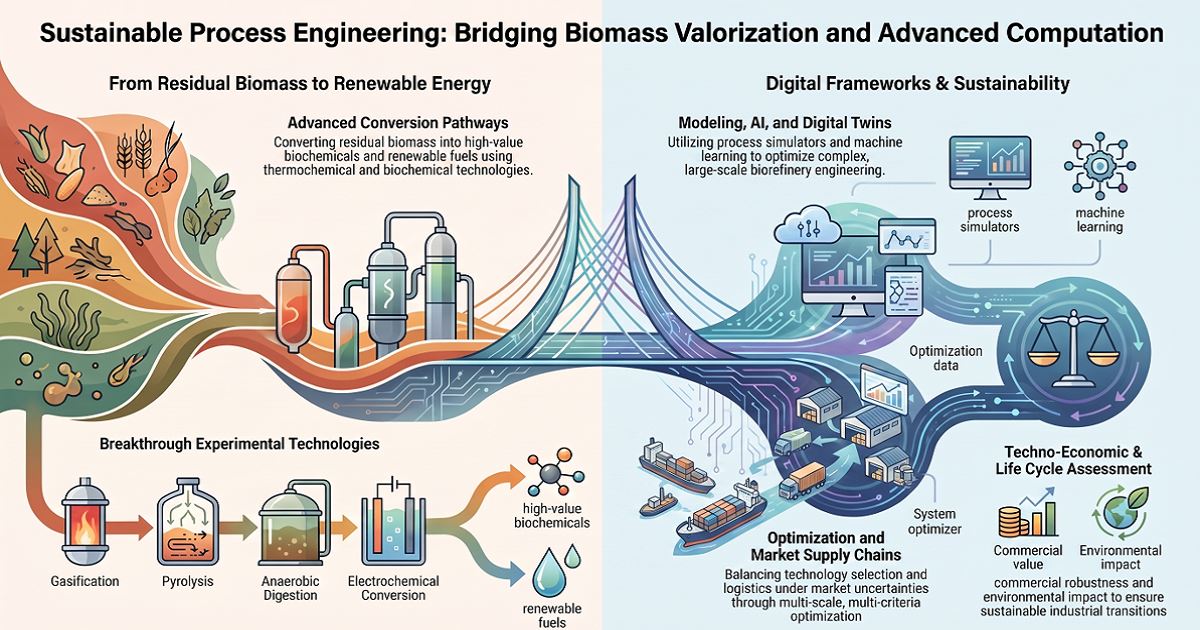
To foster a comprehensive overview, this issue focuses on innovative pathways converting residual biomass into high-value biochemicals, renewable fuels and energy.
We highly encourage submissions covering, but not limited to, the following interconnected topics present in contemporary sustainable processing:
- Thermochemical and Biochemical Conversion Technologies: Experimental breakthroughs and mechanistic insights into gasification, pyrolysis, anaerobic digestion, fermentation, hydrothermal hydrolysis and electrochemical or photocatalytic conversion.
- Process Modeling, Simulation and Digital Twins: Advanced computational frameworks utilizing process simulator tools for steady-state or dynamic simulation of integrated biorefineries.
- Multi-scale Optimization and Supply Chain Integration: Application of multi-criteria and bilevel optimization structures to balance technology selection (superstructure) and logistical supply chains under market uncertainties.
- Machine Learning and Metamodeling: Implementation of artificial intelligence, surrogate models and automated real-time optimization to mitigate computational complexity in large-scale engineering.
- Sustainability and Techno-Economic Assessments: Life cycle assessment (LCA) and cost–benefit investigations evaluating the commercial robustness and strong environmental impact of waste-to-energy technologies.
By bridging experimental validation and advanced computational tools, this Special Issue aims to highlight scalable solutions that catalyze industrial transition and global sustainability.
Dr. Lucas Bonfim-Rocha
Prof. Dr. Fabiano Bisinella Scheufele
Prof. Dr. Osvaldo Valarini Junior
Guest Editors
Manuscript Submission Information
Manuscripts should be submitted online at www.mdpi.com by registering and logging in to this website. Once you are registered, click here to go to the submission form. Manuscripts can be submitted until the deadline. All submissions that pass pre-check are peer-reviewed. Accepted papers will be published continuously in the journal (as soon as accepted) and will be listed together on the special issue website. Research articles, review articles as well as short communications are invited. For planned papers, a title and short abstract (about 250 words) can be sent to the Editorial Office for assessment.
Submitted manuscripts should not have been published previously, nor be under consideration for publication elsewhere (except conference proceedings papers). All manuscripts are thoroughly refereed through a single-anonymized peer-review process. A guide for authors and other relevant information for submission of manuscripts is available on the Instructions for Authors page. Processes is an international peer-reviewed open access semimonthly journal published by MDPI.
Please visit the Instructions for Authors page before submitting a manuscript. The Article Processing Charge (APC) for publication in this open access journal is 2400 CHF (Swiss Francs). Submitted papers should be well formatted and use good English. Authors may use MDPI's English editing service prior to publication or during author revisions.
Keywords
- process modeling
- process simulation
- process system engineering
- circular bioeconomy
- machine learning and metamodeling
- biorefinery integration
- life cycle assessment
- biofuels
- biochemicals
- energy transition
Benefits of Publishing in a Special Issue
- Ease of navigation: Grouping papers by topic helps scholars navigate broad scope journals more efficiently.
- Greater discoverability: Special Issues support the reach and impact of scientific research. Articles in Special Issues are more discoverable and cited more frequently.
- Expansion of research network: Special Issues facilitate connections among authors, fostering scientific collaborations.
- External promotion: Articles in Special Issues are often promoted through the journal's social media, increasing their visibility.
- Reprint: MDPI Books provides the opportunity to republish successful Special Issues in book format, both online and in print.
Further information on MDPI's Special Issue policies can be found here.
