
Skip to Content
  • 0.6
    Impact Factor
  • 1.4
    CiteScore

Journal of the American Podiatric Medical Association

Journal of the American Podiatric Medical Association (JAPMA) is an international, peer-reviewed, open access journal in the profession of foot and ankle medicine.
It is the official journal of the American Podiatric Medical Association (APMA) and is published bimonthly online by MDPI (since Volume 116, Issue 1 - 2026). Association members receive discounts on the article processing charges.

All Articles (11)

Background: Diabetic foot ulcers (DFUs) and lower-extremity amputations (LEAs) complicating diabetes mellitus are significant contributors to morbidity, mortality, and disease burden. There is insufficient evidence, however, linking podiatric care to mortality and healthcare resource use. There is, concurrently, inadequate access to podiatric care, particularly in Asia. This study evaluated the clinical and healthcare use outcomes of patients with DFUs who received podiatric care. Methods: A longitudinal study involving patients in Diabetic Foot in Primary and Tertiary (DEFINITE) Care followed over a period of 2 years reviewed the effectiveness of podiatric care with regard to 1-year outcomes using multiple logistic and zero-inflated negative binomial regressions, adjusting for covariates. Clinical outcomes were minor and major LEA, mortality, and LEA-free survival rates; healthcare use outcomes were the number of admissions, number of visits to clinics and emergency departments, and length of stay. Results: Eligible patients (n = 2798 [65.5%]) completed at least 12 months of follow-up. Comparisons were made with patients without access to podiatric care. The overall mean ± SD patient age was 65.7 ± 12.7 years. Most patients receiving podiatric follow-up were of Malay or Indian ethnicities and had poor diabetic control and chronic kidney disease. There were more admissions (p < 0.01) and visits to the emergency department (p < 0.01) and hospital outpatient clinics (p < 0.01), but a shorter length of stay (incidence rate ratio, 0.833; p < 0.01), without any reported differences regarding visits to public primary care clinics (p = 0.68). There were more minor LEAs (p < 0.01) but fewer deaths (p < 0.01) and greater LEA-free survival (odds ratio, 1.26; p = 0.02). Conclusions: Podiatric care improved clinical outcomes for patients with DFU, particularly in terms of LEA-free survival, with a positive impact on healthcare utilization. This is a crucial contribution to the limited evidence on podiatric care in diabetic limb salvage in Asian populations.

23 February 2026
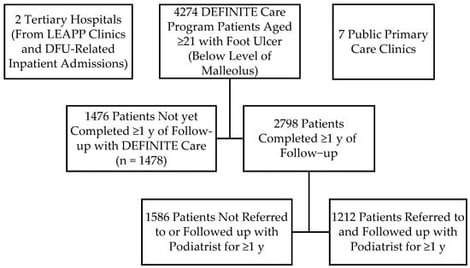
Patient selection design. DEFINITE—Diabetic Foot in Primary and Tertiary; DFU—diabetic foot ulcer; LEAPP—Lower Extremity Amputation Prevention Program.

Background: Diabetes-related foot complications are among the most common complications in individuals with type 2 diabetes mellitus. The prevention of foot problems that are at risk of developing because of type 2 diabetes mellitus should be addressed within the framework of preventive approaches prior to treatment. The aim of this study was to evaluate protective sensation in people with type 2 diabetes mellitus who have not been diagnosed with early diabetes-related foot complications and to investigate the effects of protective sensation on peripheral muscle strength, balance, and functional capacity. Methods: This study included 42 volunteer patients (56.71 ± 7.59 years) who were followed up with a diagnosis of type 2 diabetes mellitus and met the inclusion criteria. Individuals were evaluated prospectively and via face-to-face interviews. Light-touch, vibration, and discrimination sense was evaluated to determine protective sensation. Peripheral muscle strength (quadriceps femoris, biceps brachii, and hand grip) was measured and a 6 min walking test for functional capacity and balance evaluation were performed. Spearman correlation analysis was conducted using SPSS Statistics 21.0 for data analysis. Results: At least one of the components of protective sensation was moderately correlated with peripheral muscle strength, functional capacity, and balance scores. Reduced protective sensation was also observed in individuals with type 2 diabetes mellitus without neuropathy. Conclusions: In type 2 diabetes mellitus patients, decreases in light-touch, vibration, and discrimination sense are moderately associated with parameters of peripheral muscle strength, functional capacity, and balance. In patients with type 2 diabetes mellitus, early foot sole sensory examination may prevent the development of neuropathy and support clinicians in early diagnosis.

23 February 2026

Prevalence of Common Foot Conditions in Children—A Cross-Sectional Study in Danish Children Aged 6 to 16 Years

  • Camilla Hedegaard Larsen,
  • Soeren Boedtker and
  • Christian Nai En Tierp-Wong
  • + 6 authors

Background: Caregivers often seek medical assistance when their child experiences podiatric medical ailments. Podiatric medical diseases such as ingrown toenails, callosities, warts, metatarsus varus, and hallux valgus frequently occur in children and adolescents. However, treatment, prevention, and rehabilitation are often based on empirical experiences; thus, as a first endeavor, clinical and epidemiologic mapping of podiatric medical diseases in children is warranted. We describe the prevalence of common foot conditions—callosities, ingrown toenails, hallux valgus, metatarsus varus, and warts—among Danish schoolchildren aged 6 to 16 years. Methods: In this cross-sectional study, we evaluated foot conditions in children in first (aged 6–8 years), fifth (aged 10–12 years), and ninth (aged 14–16 years) grades. The clinical status of the feet was examined by teams of two podiatric physicians each. Specifically, we evaluated deformities of the foot, foot pathologies, and their anatomical localization. Results: Of 501 children (1002 extremities) evaluated, 417 had one or more of the investigated foot deformities or pathologies. We found 266 various foot pathologies among Danish schoolchildren. Metatarsus varus (53%) and callosities (46%) were the most frequently occurring foot conditions. The prevalence of foot pathologies of ingrown toenails and warts was 14% and 12%, respectively. The prevalence of ingrown toenails, metatarsus varus, and hallux valgus increased with age. Conclusions: This study found that foot pathologies such as warts and ingrown toenails and conditions such as metatarsus varus and callosities are common in Danish primary school students. These findings of high prevalences of foot pathologies and conditions motivate future research projects to clarify how this affects general health and subsequently the relation to pain, health challenges, socioeconomics, and quality of life.

21 February 2026

Effects of Strengthening the Intrinsic Muscles of the Foot in Adults with Flatfoot: A Scoping Review

  • Marta María Moreno-Fresco,
  • Pedro V. Munuera-Martínez and
  • Priscila Távara-Vidalón
  • + 2 authors

Background: Flatfoot is an alteration of the normal structure of the foot, characterized by a partial or total reduction of the medial longitudinal plantar arch, valgus deformity of the heel, and abduction of the forefoot. While treatments often include strengthening of the intrinsic foot muscles, evidence of its efficacy in adults with flatfoot remains limited. Objectives: The main objective of this review was to evaluate the effects of strengthening the plantar intrinsic muscles in adults with flatfoot. Methods: Searches were conducted in PubMed, Embase, Cochrane, PEDro, and Web of Science databases up to October 2023. The review protocol was developed and followed according to the PRISMA Extension for Scoping Reviews (PRISMA-ScR) guidelines. Studies included were those published on intrinsic muscle strengthening in adult populations. A qualitative synthesis of all included articles was performed, along with a quantitative sub-analysis of randomized controlled trials and a critical methodological assessment. Results: Eleven studies involving a total of 374 participants were selected. Most studies identified the “short foot exercise” as the optimal exercise for isolating and training the plantar intrinsic foot muscles. The most commonly analyzed variables were the Foot Posture Index and the Navicular Drop Test. Conclusions: Strengthening the plantar intrinsic muscles enhances the height of the medial longitudinal arch, improves hindfoot posture and balance, and increases hallux abductor muscle activity. This strengthening, whether achieved through short foot exercises alone or in combination with other techniques, is effective in treating adult flatfoot. Current literature suggests that a duration of 4–6 weeks may be sufficient to achieve beneficial outcomes.

20 February 2026

News & Conferences

Issues

Open for Submission

Editor's Choice

Get Alerted

Add your email address to receive forthcoming issues of this journal.

XFacebookLinkedIn
J. Am. Podiatr. Med. Assoc. - ISSN 1930-8264