Article

Podiatric Care Associated with Reduced Mortality and Enhanced Amputation-Free Survival
1
Vascular Surgery Service, Department of Surgery, Woodlands Health, Singapore 737628, Singapore
2
Health Services and Outcome Research, National Healthcare Group, Singapore 138543, Singapore
3
Department of Podiatry, Khoo Teck Puat Hospital, Singapore 768828, Singapore
4
Podiatry Service, Foot Care and Limb Design Centre, Tan Tock Seng Hospital, Singapore 308433, Singapore
5
Podiatry Service, Department of Rehabilitation, Woodlands Health, Singapore 737628, Singapore
6
National Healthcare Group Polyclinics, Singapore 308205, Singapore
7
Department of Endocrinology, Tan Tock Seng Hospital, Singapore 308433, Singapore
8
Department of General Medicine, Khoo Teck Puat Hospital, Singapore 768828, Singapore
9
Department of Endocrinology, Woodlands Health, Singapore 737628, Singapore
*
Author to whom correspondence should be addressed.
J. Am. Podiatr. Med. Assoc. 2026, 116(1), 11; https://doi.org/10.3390/japma116010011
Submission received: 25 November 2024 / Revised: 4 March 2025 / Accepted: 6 March 2025 / Published: 23 February 2026

Abstract

Background: Diabetic foot ulcers (DFUs) and lower-extremity amputations (LEAs) complicating diabetes mellitus are significant contributors to morbidity, mortality, and disease burden. There is insufficient evidence, however, linking podiatric care to mortality and healthcare resource use. There is, concurrently, inadequate access to podiatric care, particularly in Asia. This study evaluated the clinical and healthcare use outcomes of patients with DFUs who received podiatric care. Methods: A longitudinal study involving patients in Diabetic Foot in Primary and Tertiary (DEFINITE) Care followed over a period of 2 years reviewed the effectiveness of podiatric care with regard to 1-year outcomes using multiple logistic and zero-inflated negative binomial regressions, adjusting for covariates. Clinical outcomes were minor and major LEA, mortality, and LEA-free survival rates; healthcare use outcomes were the number of admissions, number of visits to clinics and emergency departments, and length of stay. Results: Eligible patients (n = 2798 [65.5%]) completed at least 12 months of follow-up. Comparisons were made with patients without access to podiatric care. The overall mean ± SD patient age was 65.7 ± 12.7 years. Most patients receiving podiatric follow-up were of Malay or Indian ethnicities and had poor diabetic control and chronic kidney disease. There were more admissions (p < 0.01) and visits to the emergency department (p < 0.01) and hospital outpatient clinics (p < 0.01), but a shorter length of stay (incidence rate ratio, 0.833; p < 0.01), without any reported differences regarding visits to public primary care clinics (p = 0.68). There were more minor LEAs (p < 0.01) but fewer deaths (p < 0.01) and greater LEA-free survival (odds ratio, 1.26; p = 0.02). Conclusions: Podiatric care improved clinical outcomes for patients with DFU, particularly in terms of LEA-free survival, with a positive impact on healthcare utilization. This is a crucial contribution to the limited evidence on podiatric care in diabetic limb salvage in Asian populations.

1. Introduction

Diabetes mellitus (DM) is a global disease with a heavy disease burden and concerning complications [1]. It was responsible for an estimated 2 million deaths in 2019 [1]. The rate of increase in DM prevalence has greatly superseded global population expansion, which represents a grave cause for concern [1,2]. As a systemic metabolic disease, poorly controlled DM can lead to an array of microvascular and macrovascular complications. The development of a diabetic foot ulcer (DFU), which can subsequently lead to a lower-extremity amputation (LEA), is one of these debilitating complications. Globally, DFU affects approximately 18.6 million people [3]. It is estimated that one in three persons with DM will develop a DFU at any one point in their lifetime, and 80% of patients with DFU will undergo an LEA [3]. Survival after an LEA was also found to be guarded [4,5]. Consequently, DFU and LEA contribute to significant healthcare resource strain and economic burden [6]. A study by Boulton et al. [7] revealed that healthcare costs were exorbitant even in the long haul, as resources also needed to be directed toward social services and home care after the acute period of illness. Patients with DFU also reported poorer quality of life [7,8].
It is noteworthy that Asia is home to the highest number of patients with DM, representing 60% of the global prevalence [9]. Although it is projected that the prevalence of DM globally will grow by 25% by 2035 [10], the number of South Asians who will have DM is estimated to grow by more than half [9]. In Singapore, the International Diabetes Federation also estimated that 14.9% of adults have DM. This figure is almost double the 2014 global average of 8.5% [11,12]. Although the rate of DM-related LEA in Singapore remained fairly stable from 2008 to 2017, it was still relatively higher than that in other countries [13]. In fact, Singapore exceeded the global estimate of major LEA three times over [14] and ranked third for age- and sex-standardized rate of major LEA among members of the Organization for Economic Co-operation and Development [15]. Furthermore, according to a 5-year longitudinal analysis conducted in Singapore by Lo et al. [16], the average patient with DFU spent up to US $30,131. These crucial statistics shed light on the need for urgent attention and intervention of DM and DFU in Asia.
Various interventions have been studied to alleviate the disease and its economic burden and to improve the prognosis for patients with DFU. In 2023, Armstrong et al. [3] found that medical care rendered by a multidisciplinary team (MDT) was associated with lower major LEA rates. Multiple studies have also purported that MDT care, which included podiatric follow-up, improved the wound healing of DFUs and reduced the rate of LEA among patients with DM [17,18,19]. Musuuza et al. [20] reported that an MDT that addressed glycemic control, wound management, peripheral artery disease (PAD), and DFU infection achieved reduction in the major LEA rate in 94% of the included studies. Hence, MDT care, which includes podiatric care for patients with DFU, has become the recommended standard model of care for DFU management [21,22]. However, podiatric involvement in DFU medical care has been studied only to a limited extent. A 2020 systematic review of 23 studies concluded that podiatric intervention by an MDT reduced the number of total and major LEAs [23]. Yet, although the Asian representation of DM is the greatest worldwide, it is notable that only three of the studies stemmed from Asia. Podiatric care in itself was also associated with an 11% reduction in the composite risk of death or major amputation and a 9% reduction in the risk of major amputation alone [23,24,25]. Thus, there is a paucity of evidence to support podiatric involvement in Asia. There is also no evidence to show a direct association between mortality rates and healthcare resource use with podiatric intervention. Therefore, we aimed to investigate how podiatric care affected clinical and healthcare use outcomes of patients with DFU in Singapore.

2. Materials and Methods

2.1. Model of Care for Patients with DFU in Singapore

The National Healthcare Group is one of three public healthcare providers in Singapore and provides medical care for 1.5 million residents of central and northern Singapore [26]. Following international guidelines, the National Healthcare Group started a multidisciplinary DFU care collaboration known as the Lower Extremity Amputation Prevention Program (LEAPP). Through the LEAPP, patients attained early access to MDT specialist care and fast-tracked intervention. This initiative met with resounding success [27,28]. Thus, it was then further expanded on in June 2020 with the Diabetic Foot in Primary and Tertiary (DEFINITE) Care program [29].
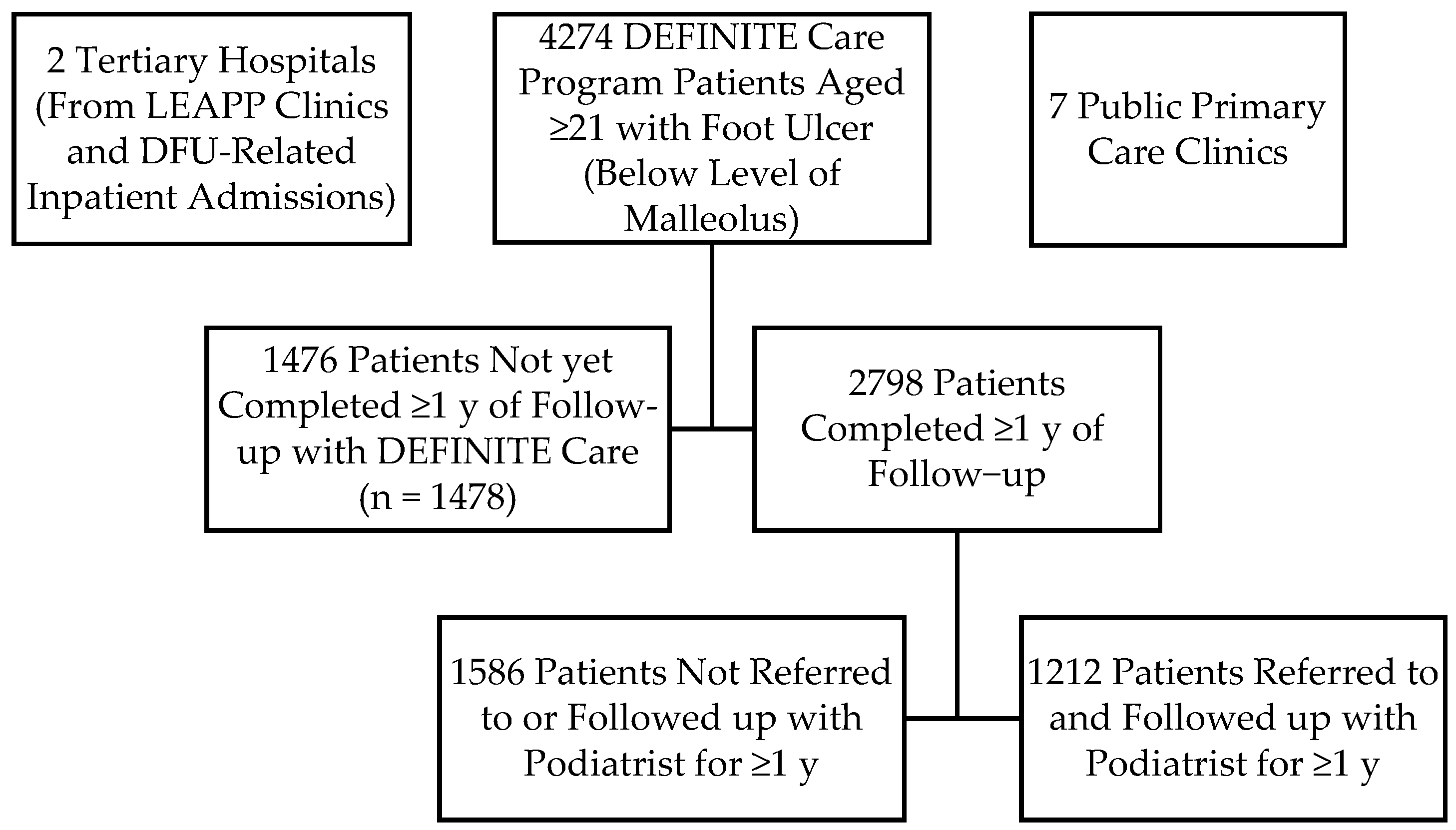
Unlike all of the LEAPP patients, who were managed in an MDT and thus had podiatric follow-up, not all of the patients in DEFINITE Care had access to podiatric care. DEFINITE Care aimed to coordinate care between the primary and tertiary care settings until the resolution of a DFU [29]. A DFU was defined as a DM-related wound situated below the level of the malleolus. To be enrolled in the DEFINITE Care program, patients had to be at least 21 years old and were required to have a foot ulcer at the time of enrolment (Figure 1). They underwent the DM Foot Screening and Surveillance, Treatment and Escalation Protocol (DM STEP) program [29]. The DM STEP program aimed for early identification and treatment of DFU and swift referral of complex cases to the LEAPP clinic, where they were to be managed by an MDT [29]. In contrast, simpler cases could be managed in the primary care setting with or without podiatry referral at the discretion of the physicians [29].

2.2. Study Design

All of the patients who were enrolled in the DEFINITE Care program from 1 June 2020 to 1 June 2022 were reviewed in this study. The data from these patients, inclusive of the relevant International Classification of Diseases, Tenth Revision diagnosis codes and Table of Surgical Procedure codes, were stored in the healthcare provider’s data registry for DM. We define the following terms for clarity: (1) minor LEA—an amputation performed below the level of the malleolus (e.g., toe ray, forefoot, midfoot, or hindfoot); (2) major LEA—an amputation performed above the level of the malleolus (e.g., below the knee or above the knee); (3) hemoglobin A1c (HbA1c)—a 3-month average reading of blood hemoglobin glucose level, formally known as glycosylated hemoglobin level; and (4) the Charlson Comorbidity Index (CCI). The CCI is a weighted score which predicts mortality risks in surgical patients based on their pre-existing medical conditions. The clinical outcomes were assessed 1 year after enrollment in the DEFINITE Care program. Therefore, only patients with at least 12 months of follow-up with the program were included in the analysis of clinical and healthcare use outcomes. The clinical outcomes were the incidence of minor and major LEA, mortality, and LEA-free survival. The healthcare use outcomes were the number of admissions to the inpatient wards and the number of day surgery cases; the number of visits to emergency departments (EDs), hospital outpatient clinics (HOCs), and public primary care clinics (PPCs); and the length of stay (LOS) in the hospital per admission. This article was written in accordance with the Strengthening the Reporting of Observational Studies in Epidemiology (STROBE) guidelines for observational studies.

2.3. Statistical Analysis

Statistical analysis was performed using Microsoft Excel 2016 software (Microsoft Corp, Redmond, WA, USA) and R, Version 3.6.1 software (The R Foundation, Vienna, Austria). Patient demographic and baseline characteristics are presented as descriptive statistics, categorical data are described using absolute values and percentages, and continuous data are given as the mean ± SD. The χ2 test was used to compare differences in binary variables and the Mann–Whitney U test was used to compare differences in continuous outcome variables between those with and without podiatric follow-up. Multiple logistic regressions were performed for the clinical outcomes, adjusting for covariates. Odds ratios (ORs) with 95% confidence intervals (CIs) are reported. Zero-inflated negative binomial regressions were performed for the healthcare use outcomes, adjusting for covariates. Incidence rate ratios (IRRs) with 95% CIs are reported. Covariates were age; sex; ethnicity; comorbidities of diabetic retinopathy, ischemic heart disease, severity of chronic kidney disease, end-stage renal failure (ESRF), and previous cerebrovascular accident; whether patients were taking antiplatelet, anticoagulant, antihypertensive, antihyperglycemic, or lipid-lowering drugs at the time of enrollment; and a history of LEA in the past year. All of the p values were two-tailed; p < 0.05 was taken to be statistically significant.

3. Results

3.1. Patient Demographics and Baseline Characteristics

From 1 June 2020, to 1 June 2022, there were 4274 patients enrolled in the DEFINITE Care program. At the time of data extraction, 2798 (65.5%) of the 4274 patients had completed at least 12 months of follow-up; thus, their data were included for analysis (Figure 1).
The included patients were studied for their baseline biodata and characteristics (Table 1). There were 1212 patients (43.3%) undergoing podiatric follow-up compared with 1586 patients (56.7%) who were not. The mean ± SD age of patients was 65.7 ± 12.7 years, without significant difference between the groups (p > 0.99). There was a disproportionately greater representation of the Indian (18.1%), Malay (17.6%), and other (8.5%) ethnicities than of the general Singaporean population (7.6% Indian, 15.1% Malay and 1.7% others) [30]. Between the groups, there were fewer Chinese and Indian patients undergoing podiatric follow-up but more Malay patients and those of other ethnicities (p < 0.01). There was, however, no difference between groups regarding sex (p = 0.07).
A history of an LEA performed within the past year and a history of previous foot ulcer at the time of recruitment were also reviewed. More patients on podiatric follow-up had at least one previous foot ulcer at recruitment (70.9%) than patients without podiatric follow-up (55.1%) (p < 0.01). However, there was no significant difference between groups in terms of whether patients had an LEA in the past 1 year (p = 0.13).
Significant comorbidities, namely the cardiovascular risk factors, were also studied. Higher proportions of patients on podiatric follow-up had ESRF (19.5% versus 15.3%) and diabetic retinopathy (46.3% versus 30.5%) (p < 0.01 for both). There were no observable differences between the two groups in terms of past diagnoses of hypertension (p = 0.11), dyslipidemia (p = 0.36), ischemic heart disease (p = 0.27), and history of previous cerebrovascular accident (p = 0.06). Patients undergoing podiatric follow-up were more commonly taking antiplatelets (64.1% versus 56.7%), anticoagulants (18.3% versus 13.9%), lipid-lowering medications (83.6% versus 75.1%), antihypertensives (74.8% versus 66.9%), and antihyperglycemic medications (88.2% versus 77.9%; p < 0.01 for all). Moreover, these patients also had a higher mean HbA1c index (8.19% versus 7.95%; p < 0.01), indicating poorer overall glycemic control. There was no difference observed between the two groups with respect to Charlson Comorbidity Index (1.75 versus 1.57; p > 0.99).

3.2. Clinical Outcomes with Podiatric Intervention

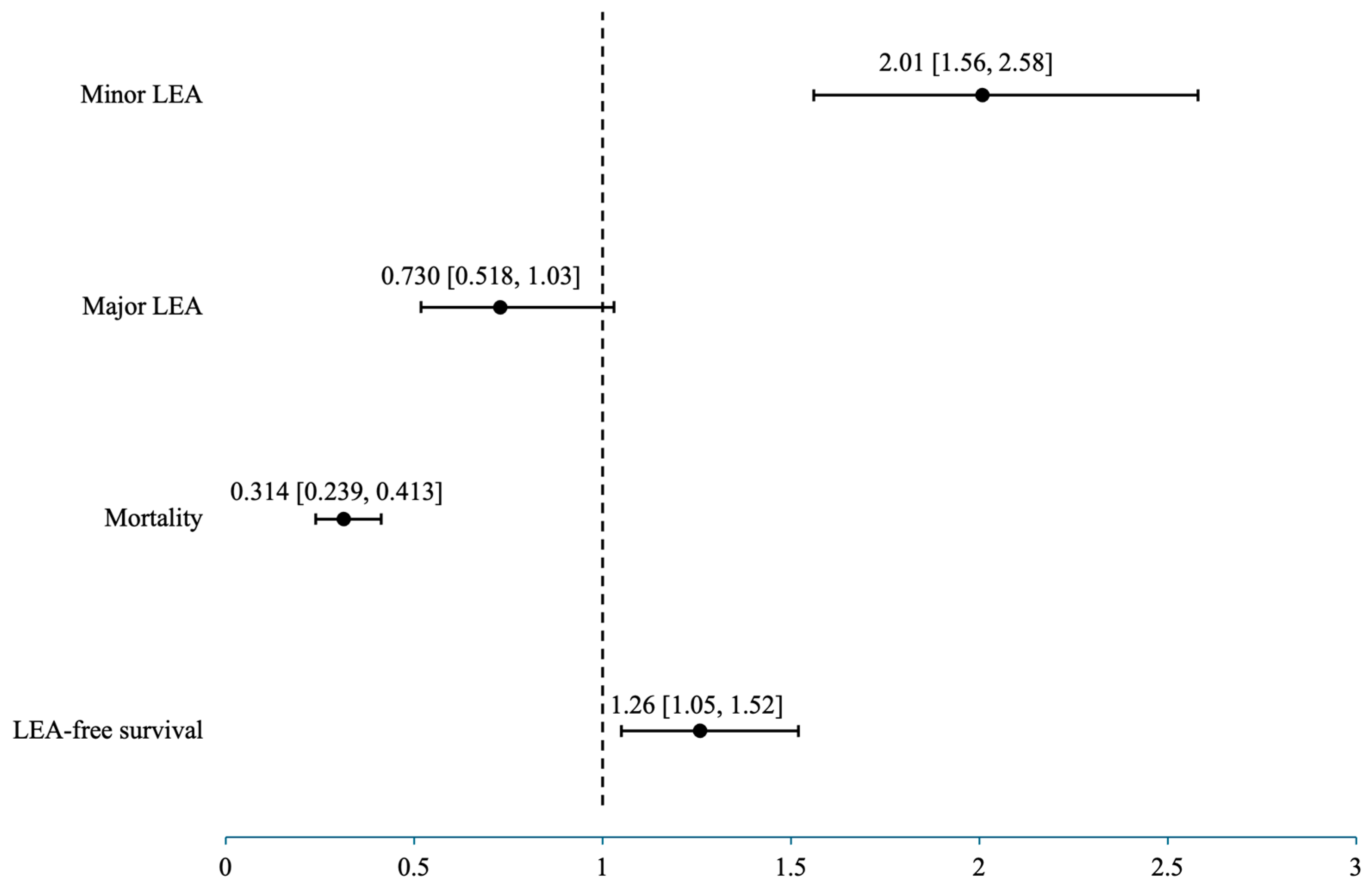
There were 317 minor LEAs, 161 major LEAs, and 399 deaths within 1 year after patient enrollment (Table 2 and Figure 2). Unadjusted analysis revealed that patients with podiatric follow-up, compared with patients without, had more frequent minor LEA (16.1% versus 7.7%; p < 0.01) but less frequent deaths (7.4% versus 19.5%; p < 0.01), although there was no difference between the cohorts in terms of the frequency of major LEA. After adjusting for covariates, the odds of a minor LEA doubled (OR, 2.01; 95% CI, 1.56–2.58; p < 0.01), and there was a 69% reduction in the odds of mortality (OR, 0.314; 95% CI, 0.239–0.413; p < 0.01) and a 26% increase in the odds of LEA-free survival (OR, 1.26; 95% CI, 1.05–1.52; p = 0.02) in the patients with podiatric follow-up compared with those without podiatric follow-up. Owing to the small sample size, the odds of a major LEA between groups were not significantly different even after accounting for covariates (OR, 0.730; p = 0.07).

3.3. Healthcare Use Outcomes with Podiatric Intervention

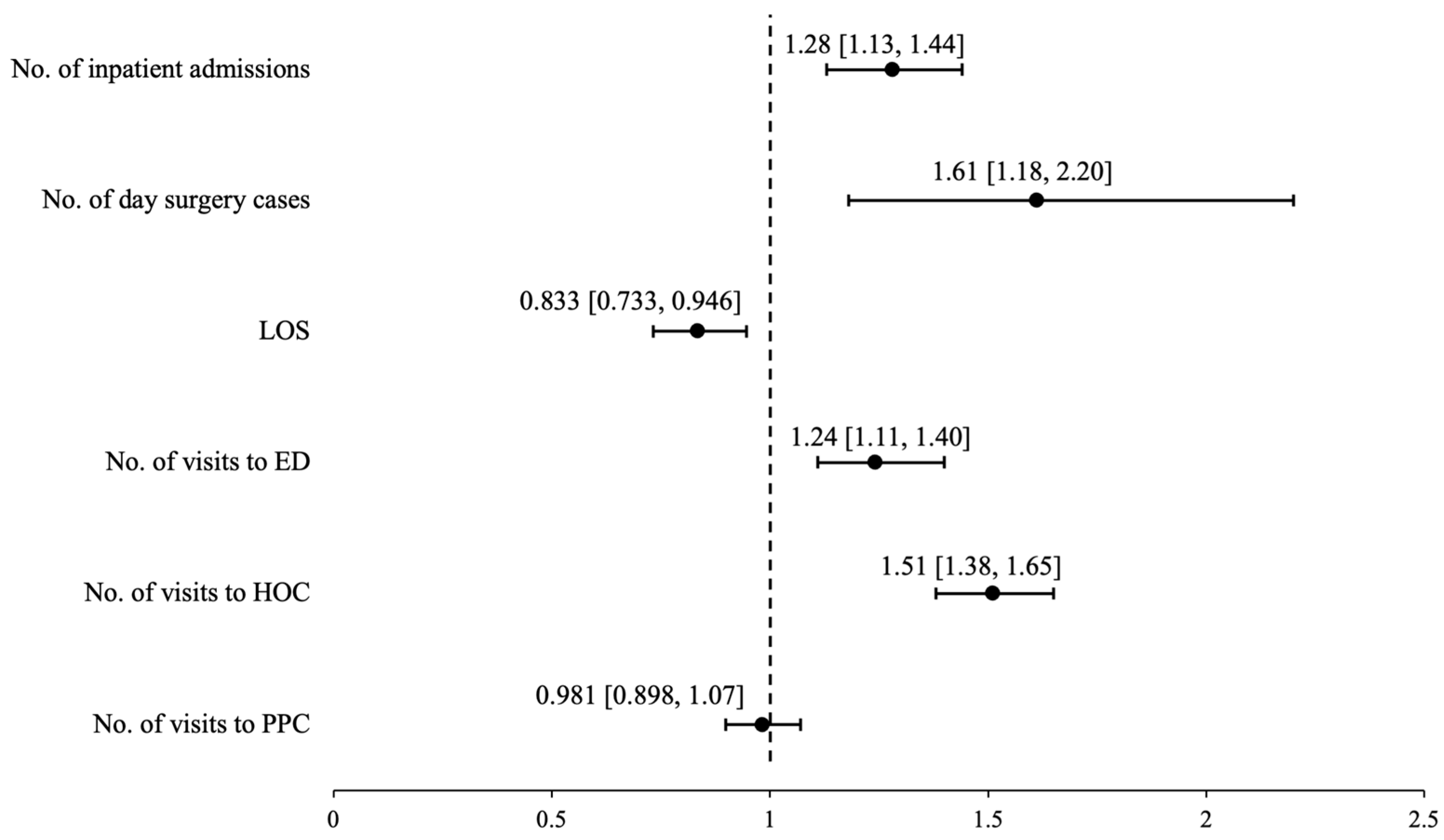
Patients were followed up with regard to their use of healthcare resources in the year after enrollment (Table 2 and Figure 3). In the unadjusted analysis, there were more frequent admissions to the inpatient ward (1.58 per patient-year versus 1.14 per patient-year; p < 0.01) and day surgery cases (0.616 per patient-year versus 0.252 per patient-year; p < 0.01) with podiatric intervention. There were also more frequent visits to the ED (1.67 per patient-year versus 1.28 per patient-year; p < 0.01) and HOC (7.92 per patient-year versus 3.82 per patient-year; p < 0.01). After adjusting for covariates, there was an associated rate increase in the number of inpatient admissions, day surgery cases, ED visits, and HOC visits by 28% (IRR, 1.28; 95% CI, 1.13–1.44), 61% (IRR, 1.61; 95% CI, 1.18–2.20), 24% (IRR, 1.24; 95% CI, 1.11–1.40), and 51% (IRR, 1.51; 95% CI, 1.38–1.65), respectively (p < 0.01 for all). Patients who were admitted were also found to have a 17% rate reduction in their average LOS (IRR, 0.833; p < 0.01). There was no significant difference in the rate of visits to the PPC (IRR, 0.98; p = 0.68).

4. Discussion

Podiatrists are biomechanical experts; they are trained in the anatomy, structure, and functions of the foot and ankle. Podiatry offers a wide range of services, including (but not limited to) foot examination, foot and callus care, and conservative and surgical management to reduce the risk of or reverse wound formation. Examples of conservative approaches include off-loading and orthoses, and surgical management includes bedside wound debridement and anatomical manipulation (e.g., tenotomy) [31].
This study demonstrated that podiatric follow-up was associated with enhanced LEA-free survival and mortality benefit despite an increase in the odds of minor LEA. Podiatric intervention was also linked to likely greater use of resources at the hospital level.

4.1. Podiatric Intervention Improves Mortality and LEA-Free Survival, Albeit with More Minor LEA

This study revealed that podiatric care was linked to a reduction in the odds of mortality and an increase in the odds of LEA-free survival for patients with DFU. On the other hand, these patients experienced more than double the odds of a minor LEA (Figure 3). An improvement in mortality and LEA-free survival rates may be explained by early podiatric intervention leading to swift identification of at-risk DFUs, following which decisive surgical and medical interventions could be implemented. For example, in the case of an infected DFU, this would be in the form of early antibiotic administration and source control (e.g., via wound debridement or minor LEA) among other types of management [22].

4.2. Early Identification of High-Risk Patients May Enhance Limb Salvage and Reduce Mortality

During this 2-year study, podiatrists reviewed more non-Chinese patients and patients who had poorer DM control and renal reserves. This was indicated by higher mean HbA1c indices, diabetic retinopathy, and diagnoses of chronic kidney disease or ESRF. Concurrently, these patients also had previous foot ulcers and were taking multiple medications to optimize cardiovascular risk factor control. Risk factors for DFU formation and LEA include diabetic neuropathy, foot deformity (including Charcot’s foot), and the presence of PAD [32,33]. An increased mortality risk in patients with DM was also linked to the presence of PAD [34]. Therefore, the ability to identify early patients with DM with at-risk lower extremities can potentially alter the disease trajectory of DFU in terms of LEA and mortality. The identified cluster of patients with these characteristics may represent the population with high-risk diabetic foot that may benefit the most from podiatric intervention. Thus, they may benefit from early podiatry referral for potential primary prevention even before the formation of a DFU. Primary prevention may take the form of, for example, routine foot examination, risk stratification, callus care, and biomechanical intervention (e.g., via off-loading or orthoses), among other methods, to reduce the risk of DFU formation [31]. Future studies can investigate patients with high-risk profiles and demographics and review whether early podiatry referral affects limb salvage and mortality rates.

4.3. Potential Increase in Healthcare Resource Demand at Tertiary Centers

Podiatric intervention may not be without its trade-offs. It was associated with more inpatient admissions and day surgery cases and more ED and HOC visits. Conversely, there was a reduction in the LOS and no significant change in the number of PPC visits (Figure 2).
The care of patients with DFUs is medically complex as patients often have multiple comorbidities and their respective complications [25]. This was also demonstrated in this study. Although many chronic diseases may still be managed in the outpatient setting (e.g., at the PPC), these patients may also require greater involvement in care from specialists in hospitals (e.g., renal physicians, cardiologists, endocrinologists, and vascular surgeons). This is especially true if they are reviewed by an MDT such as LEAPP. A 5-year longitudinal cohort study conducted by Lo and colleagues [16] in 2021 estimated that the cost of hospital DFU care was US $6,615,437 per year. It is likely that the 17% rate reduction in average LOS was outweighed by the more significant rate increase in inpatient admissions, day surgery cases, ED visits, and HOC visits. However, due to a lack of cost breakdown, no definite cost analysis was possible at the time of review.
However, the domain of healthcare financing is merely one of the many aspects of healthcare resource management. Greater demands at the tertiary level also increase demand for staffing and equipment. There is already a lack of podiatrists in Singapore; there are approximately 100 registered podiatrists serving a population of nearly 6 million people [35]. Still, there is no undergraduate podiatry training available in Singapore. Training also takes many years. These are costs that may not be well-defined and can place additional strain on the tertiary healthcare system. The Singapore healthcare system may not be prepared to take on the burden of DFUs, although podiatric care may greatly benefit patients with DM.

4.4. Limitations and Future Research

This study possessed limitations that may have affected the accuracy and reporting of the results. Although all of the LEAPP patients would have followed up with podiatry, not every patient enrolled in DEFINITE Care received podiatric follow-up. Patients in the DEFINITE Care program (who were not involved in LEAPP) were referred to podiatrists on a case-specific basis. This depended on the referring physician’s judgment in determining whether a patient needed to follow up with a podiatrist. There was no standardized criterion for patients to be referred to podiatry. The research also did not use randomization for patient selection. Altogether, more than half of DEFINITE Care patients did not have at least 1 year of podiatric follow-up.
Additional reasons why some patients may not have received 1 year of podiatric follow-up include the following:
  • Patients may have had disease progression within the year and underwent a major LEA. The task of providing wound care after a major LEA may be transferred from podiatrists to specialty nurses who specialize in wound care, such as amputation stumps.
  • Some patients may have had wound care nurses rather than podiatrists who followed up on their DFU from the beginning.
  • Patients may have opted out of podiatric care due to personal preference or financial constraints.
  • Some patients may have experienced resolution of their DFU and been subsequently discharged from podiatric follow-up and stopped visiting the foot surveillance clinics.
Furthermore, an outcome review at the 1-year mark may be premature for meaningful conclusions. According to various studies, approximately 60% of patients survive until 5 years after initial diagnosis of DFU [36,37]. One study from Australia reported 5- and 10-year mortality rates of 24.6% and 45.4%, respectively [38]. Rubio et al. [36]. reported a 20% mortality rate within the first year. Moreover, in 2020, Lin et al. [39] also reported that it took a median of 12.9 months for a major LEA to develop after the first minor LEA. Therefore, the complete effect of podiatric care may not yet be fully apparent at the 1-year juncture, and a review of longer-term outcomes is necessary. Next, this study lacked a holistic evaluation of podiatric intervention on the DFU burden. A DFU has been shown to detrimentally affect a patient’s psychological and emotional well-being [8]. This study focused on quantitative objective markers but did not look into the psychosocial and emotional effects on a patient with DFU. Last, this study identified the short-term effects of healthcare financing and challenges in management. Thus far, DEFINITE Care program has been demonstrated to be a cost-effective and robust model for DFU care in the short run [40,41]. It will be interesting to also analyze the longer-term effect on healthcare financing, as it is possible that, while expensive, early and aggressive intervention may lead to an overall reduction in the healthcare and economic burden due to there being a less severe disease burden in the longer term.
Given the previously mentioned limitations, a revision of research methods or a set criterion for referral will be necessary to mitigate selection bias. Further studies to ascertain whether the identification of patients with DM with a high-risk profile with subsequent podiatry referral leads to improved morbidity and mortality, as well as its effect on short- and long-term healthcare management, are also beneficial. It is also essential for future studies to investigate subjective markers of the aspects of psychosocial and emotional effects on patients with DFU. Adherence to treatment plans due to various psychosocial determinants has been shown to affect clinical outcomes, and thus should also be considered in future studies [42]. Crucially, healthcare costs should be made publicly available and accessible to facilitate research into healthcare financing and rationalization.

5. Conclusions

This article contributes significantly to the growing evidence for podiatric intervention in Asian populations and is also potentially the first study to reveal a direct association with mortality benefit. Hence, podiatric services are of critical value and are a cornerstone of lifesaving efforts for patients with DFUs. The early identification of at-risk diabetic feet could alter the trajectory of the disease for persons with DM. The high short-term costs may be offset by long-term benefits. More extensive research reviewing the longer-term benefits with consideration of subjective markers is necessary to promote podiatric follow-up in patients with DM, especially on a continent plagued by a heavy disease burden. Analysis of the short- and long-term costs and benefits is also greatly encouraged from a policy planning and population health perspective.

Author Contributions

Conceptualization, Z.J.L., E.T., H.L., J.H. and J.L.; methodology, Z.J.L., L.G. and W.Z.L.; validation, Z.J.L. and L.G.; formal analysis, L.G. and W.Z.L.; investigation, Z.J.L. and L.G.; resources, Z.J.L., C.L., T.C., J.A.L., E.T., H.L., J.H. and J.L.; data curation, Z.J.L. and L.G.; writing—original draft preparation, W.Z.L.; writing—review and editing, W.Z.L., Z.J.L., L.G. and H.L.; visualization, W.Z.L.; supervision, Z.J.L.; project administration, Z.J.L. All authors have read and agreed to the published version of the manuscript.

Funding

This study was supported by the following grants (ZJL is the recipient of the grants). National Medical Research Council Research Training Fellowship (grant number MOH-000764-00). National Healthcare Group Population Health Grant (grant number PHG20/S/X/1/1). Skin Research Institute of Singapore, Agency for Science, Technology and Research (A*STAR) under its Industry Alignment Fund—Pre-Positioning Program (IAF-PP) as part of Wound Care Innovation for the Tropics (WCIT) Program (grant number H17/01/a0/0Y9).

Institutional Review Board Statement

As this is a retrospective study analyzing data from patients who were anonymized and de-identified, waiver for review was granted by the National Healthcare Group Domain Specific Review Board.

Informed Consent Statement

Patient consent was waived because the study is based on anonymized patient data.

Data Availability Statement

All data is securely stored within the healthcare intranet system which is not accessible via the internet. Data may be shared upon request by contacting the corresponding author, subject to institution approval.

Acknowledgments

We are grateful for the excellent work of our colleagues from Woodlands Health, Khoo Teck Puat Hospital, Tan Tock Seng Hospital, National Healthcare Group Polyclinics and National Healthcare Group. Special appreciation goes out to all DEFINITE Care collaborators, who have been working tirelessly to keep the program running.

Conflicts of Interest

The authors declare no conflicts of interest.

References

  1. World Health Organization: Diabetes. Updated 5 April 2023. Available online: https://www.who.int/news-room/fact-sheets/detail/diabetes (accessed on 10 June 2024).
  2. Population Division of the Department of Economic and Social Affairs: Revision of World Population Prospects. United Nations. Updated 2022. Available online: https://population.un.org/wpp/ (accessed on 10 June 2024).
  3. Armstrong, D.G.; Tan, T.-W.; Boulton, A.J.M.; Bus, S.A. Diabetic foot ulcers. JAMA 2023, 330, 62. [Google Scholar] [CrossRef]
  4. Tentolouris, N.; Al-Sabbagh, S.; Walker, M.G.; Boulton, A.J.; Jude, E.B. Mortality in diabetic and nondiabetic patients after amputations performed from 1990 to 1995. Diabetes Care 2004, 27, 1598. [Google Scholar] [CrossRef]
  5. Schofield, C.J.; Libby, G.; Brennan, G.M.; MacAlpine, R.R.; Morris, A.D.; Leese, G.P. Mortality and hospitalization in patients after amputation. Diabetes Care 2006, 29, 2252. [Google Scholar] [CrossRef] [PubMed]
  6. Gordois, A.; Scuffham, P.; Shearer, A.; Oglesby, A.; Tobian, J.A. The health care costs of diabetic peripheral neuropathy in the U.S. Diabetes Care 2003, 26, 1790. [Google Scholar] [CrossRef] [PubMed]
  7. Boulton, A.J.; Vileikyte, L.; Ragnarson-Tennvall, G.; Apelqvist, J. The global burden of diabetic foot disease. Lancet 2005, 366, 1719. [Google Scholar] [CrossRef] [PubMed]
  8. Vileikyte, L. Diabetic foot ulcers: A quality of life issue. Diabetes Metab. Res. Rev. 2001, 17, 246. [Google Scholar] [CrossRef]
  9. Nanditha, A.; Ma, R.C.W.; Ramachandran, A.; Snehalatha, C.; Chan, J.C.; Chia, K.S.; Shaw, J.E.; Zimmet, P.Z. Diabetes in Asia and the Pacific: Implications for the global epidemic. Diabetes Care 2016, 39, 472. [Google Scholar] [CrossRef]
  10. Saeedi, P.; Petersohn, I.; Salpea, P.; Malanda, B.; Karuranga, S.; Unwin, N.; Colagiuri, S.; Guariguata, L.; Motala, A.A.; Ogurtsova, K.; et al. Global and regional diabetes prevalence estimates for 2019 and projections for 2030 and 2045: Results from the International Diabetes Federation Diabetes Atlas, 9th edition. Diabetes Res. Clin. Pract. 2019, 157, 107843. [Google Scholar] [CrossRef]
  11. International Diabetes Federation: Diabetes in Singapore. Available online: https://idf.org/our-network/regions-and-members/western-pacific/members/singapore/ (accessed on 11 June 2024).
  12. Sun, H.; Saeedi, P.; Karuranga, S.; Pinkepank, M.; Ogurtsova, K.; Duncan, B.B.; Stein, C.; Basit, A.; Chan, J.C.; Mbanya, J.C.; et al. IDF diabetes atlas: Global, regional and country-level diabetes prevalence estimates for 2021 and projections for 2045. Diabetes Res. Clin. Pract. 2022, 183, 109119. [Google Scholar] [CrossRef]
  13. Riandini, T.; Pang, D.; Toh, M.P.; Tan, C.H.S.; Choong, A.M.; Lo, Z.J.; Chandrasekar, S.; Tai, E.S.; Tan, K.B.; Venkataraman, K. National rates of lower extremity amputation in people with and without diabetes in a multi-ethnic Asian population: A ten year study in Singapore. Eur. J. Vasc. Endovasc. Surg. 2022, 63, 147. [Google Scholar] [CrossRef]
  14. Carinci, F.; Uccioli, L.; Benedetti, M.M.; Klazinga, N.S. An in-depth assessment of diabetes-related lower extremity amputation rates 2000–2013 delivered by twenty-one countries for the data collection 2015 of the Organization for Economic Cooperation and Development (OECD). Acta Diabetol. 2020, 57, 347. [Google Scholar] [CrossRef]
  15. Ang, Y.; Yap, C.W.; Saxena, N.; Lin, L.-K.; Heng, B.H. Diabetes-related lower extremity amputations in Singapore. Proc. Singap. Healthc. 2017, 26, 76. [Google Scholar] [CrossRef]
  16. Lo, Z.J.; Surendra, N.K.; Saxena, A.; Car, J. Clinical and economic burden of diabetic foot ulcers: A 5-year longitudinal multi-ethnic cohort study from the tropics. Int. Wound J. 2021, 18, 375. [Google Scholar] [CrossRef] [PubMed]
  17. Krishnan, S.; Nash, F.; Baker, N.; Fowler, D.; Rayman, G. Reduction in diabetic amputations over 11 years in a defined U.K. population. Diabetes Care 2008, 31, 99. [Google Scholar] [CrossRef]
  18. Almdal, T.; Nielsen, A.A.; Nielsen, K.E.; Jørgensen, M.; Rasmussen, A.; Hangaard, S.; Siersma, V.; Holstein, P. Increased healing in diabetic toe ulcers in a multidisciplinary foot clinic: An observational cohort study. Diabetes Res. Clin. Pract. 2015, 110, 315. [Google Scholar] [CrossRef]
  19. Wang, C.; Mai, L.; Yang, C.; Liu, D.; Sun, K.; Song, W.; Luo, B.; Li, Y.; Xu, M.; Zhang, S.; et al. Reducing major lower extremity amputations after the introduction of a multidisciplinary team in patient with diabetes foot ulcer. BMC Endocr. Disord. 2016, 16, 38. [Google Scholar] [CrossRef] [PubMed]
  20. Musuuza, J.; Sutherland, B.L.; Kurter, S.; Balasubramanian, P.; Bartels, C.M.; Brennan, M.B. A systematic review of multidisciplinary teams to reduce major amputations for patients with diabetic foot ulcers. J. Vasc. Surg. 2020, 71, 1433. [Google Scholar] [CrossRef]
  21. National Institute for Health and Care Excellence: Peripheral Arterial Disease: Diagnosis and Management (CG147). Available online: https://www.nice.org.uk/guidance/cg147 (accessed on 12 June 2024).
  22. Schaper, N.C.; van Netten, J.J.; Apelqvist, J.; Bus, S.A.; Hinchliffe, R.J.; Lipsky, B.A.; IWGDF Editorial Board. IWGDF practical guidelines on the prevention and management of diabetic foot disease (IWGDF 2019 update). Diabetes Metab. Res. Rev. 2020, 36, e3266. [Google Scholar] [CrossRef]
  23. Blanchette, V.; Brousseau-Foley, M.; Cloutier, L. Effect of contact with podiatry in a team approach context on diabetic foot ulcer and lower extremity amputation: Systematic review and meta-analysis. J. Foot Ankle Res. 2020, 13, 15. [Google Scholar] [CrossRef]
  24. Tan, T.-W.; Caldwell, B.; Zhang, Y.; Kshirsagar, O.; Cotter, D.J.; Brewer, T.W. Foot and ankle care by podiatrists and amputations in patients with diabetes and kidney failure. JAMA Netw. Open 2024, 7, e240801. [Google Scholar] [CrossRef]
  25. Gibson, T.B.; Driver, V.R.; Wrobel, J.S.; Christina, J.R.; Bagalman, E.; DeFrancis, R.; Garoufalis, M.G.; Carls, G.S.; Gatwood, J. Podiatrist care and outcomes for patients with diabetes and foot ulcer. Int. Wound J. 2014, 11, 641. [Google Scholar] [CrossRef] [PubMed]
  26. National Healthcare Group: Caring for Central and North Singapore. Available online: https://corp.nhg.com.sg/populationhealth/Pages/Population%20Health.aspx (accessed on 15 October 2024).
  27. Lin, J.H.X.; Ge, L.; Liew, H.; Tan, E.; Hoe, J.; Yong, E.; Loh, Z.; Chew, T.; Farhan, M.F.M.; Li, Z.; et al. Rapid access from primary care to a multidisciplinary clinic at tertiary care improves clinical outcomes for patients with diabetic foot ulcers: Results from Diabetic Foot in Primary and Tertiary (DEFINITE) Care’s Lower Extremity Amputation Prevention Program (LEAPP) Clinic. Int. J. Low. Extrem. Wounds 2024, 24, 102. [Google Scholar]
  28. Lo, Z.J.; Chandrasekar, S.; Yong, E.; Hong, Q.; Zhang, L.; Chong, L.R.C.; Tan, G.; Chan, Y.M.; Koo, H.Y.; Chew, T.; et al. Clinical and economic outcomes of a multidisciplinary team approach in a lower extremity amputation prevention programme for diabetic foot ulcer care in an Asian population: A case-control study. Int. Wound J. 2022, 19, 765. [Google Scholar] [CrossRef]
  29. Lo, Z.J.; Tan, E.; Chandrasekar, S.; Ooi, D.; Liew, H.; Ang, G.; Yong, E.; Hong, Q.; Chew, T.; Farhan, M.F.M. Diabetic Foot in Primary and Tertiary (DEFINITE) Care: A health services innovation in coordination of diabetic foot ulcer (DFU) care within a healthcare cluster: 18-month results from an observational population health cohort study. Int. Wound J. 2023, 20, 1609. [Google Scholar] [CrossRef]
  30. National Population and Talent Division: Population in Brief 2023. Available online: https://www.population.gov.sg/files/media-centre/publications/population-in-brief-2023.pdf (accessed on 13 June 2024).
  31. Kim, P.J.; Attinger, C.E.; Evans, K.K.; Steinberg, J.S. Role of the podiatrist in diabetic limb salvage. J. Vasc. Surg. 2012, 56, 1168. [Google Scholar] [CrossRef]
  32. Liu, J.; Yuan, X.; Liu, J.; Yuan, G.; Sun, Y.; Zhang, D.; Qi, X.; Li, H.; Zhang, J.; Wen, B.; et al. Risk factors for diabetic peripheral neuropathy, peripheral artery disease, and foot deformity among the population with diabetes in Beijing, China: A multicenter, cross-sectional study. Front. Endocrinol. 2022, 13, 824215. [Google Scholar] [CrossRef] [PubMed]
  33. Wang, Z.; Hazlehurst, J.; Subramanian, A.; Tahrani, A.A.; Hanif, W.; Thomas, N.; Singh, P.; Wang, J.; Sainsbury, C.; Nirantharakumar, K.; et al. Diabetic foot risk classification at the time of type 2 diabetes diagnosis and subsequent risk of mortality: A population-based cohort study. Front. Endocrinol. 2022, 13, 888924. [Google Scholar] [CrossRef]
  34. Leavitt, B.J.; Sheppard, L.; Maloney, C.; Clough, R.A.; Braxton, J.H.; Charlesworth, D.C.; Weintraub, R.M.; Hernandez, F.; Olmstead, E.M.; Nugent, W.C.; et al. Effect of diabetes and associated conditions on long-term survival after coronary artery bypass graft surgery. Circulation 2004, 110, II-41. [Google Scholar] [CrossRef]
  35. Podiatry Assocation (Singapore): Find a Podiatrist. Available online: https://www.podiatry.org.sg/find-a-podiatrist/ (accessed on 23 June 2024).
  36. Rubio, J.A.; Jiménez, S.; Lázaro-Martínez, J.L. Mortality in patients with diabetic foot ulcers: Causes, risk factors, and their association with evolution and severity of ulcer. J. Clin. Med. 2020, 9, 3009. [Google Scholar] [CrossRef] [PubMed]
  37. Rubio, J.A.; Jiménez, S.; Álvarez, J. Características clínicas y mortalidad de los pacientes atendidos en una Unidad Multidisciplinar de Pie Diabético. Endocrinol. Diabetes Nutr. 2017, 64, 241. [Google Scholar] [CrossRef]
  38. Jeyaraman, K.; Berhane, T.; Hamilton, M.; Chandra, A.P.; Falhammar, H. Mortality in patients with diabetic foot ulcer: A retrospective study of 513 cases from a single Centre in the Northern Territory of Australia. BMC Endocr. Disord. 2019, 19, 1. [Google Scholar] [CrossRef] [PubMed]
  39. Lin, J.H.; Jeon, S.Y.; Romano, P.S.; Humphries, M.D. Rates and timing of subsequent amputation after initial minor amputation. J. Vasc. Surg. 2020, 72, 268. [Google Scholar] [CrossRef]
  40. Ge, L.; Sun, Y.; Tan, E.; Liew, H.; Hoe, J.; Lin, J.; Molina, J.; Ang, G.; Zhu, X.; Low, K.Q.; et al. Outcome evaluation and cost-effectiveness analysis for an integrated multidisciplinary diabetic limb salvage program: A combined observational and simulation study. BMJ Open Diabetes Res. Care 2025, 13, e004688. [Google Scholar] [CrossRef]
  41. Leo, W.Z.; Ge, L.; Chandrasekar, S.; Tan, E.; Loh, Y.B.; Zhu, X.; Liew, H.; Yong, E.; Chew, T.; Hoe, J.; et al. Diabetic foot in primary and tertiary (DEFINITE) care: An efficacious, synergistic and cost-effective multidisciplinary team model for diabetic foot care in Singapore. Semin. Vasc. Surg. 2025, 38, 1. [Google Scholar] [CrossRef] [PubMed]
  42. Ng, G.W.; Gan, K.F.; Liew, H.; Ge, L.; Ang, G.; Molina, J.; Sun, Y.; Prakash, P.S.; Harish, K.B.; Lo, Z.; et al. A systematic review and classification of factors influencing diabetic foot ulcer treatment adherence, in accordance with the WHO Dimensions of Adherence to Long-Term Therapies. Int. J. Low. Extremity Wounds 2024, 20, 15347346241233962. [Google Scholar] [CrossRef] [PubMed]
Figure 1. Patient selection design. DEFINITE—Diabetic Foot in Primary and Tertiary; DFU—diabetic foot ulcer; LEAPP—Lower Extremity Amputation Prevention Program.
Japma 116 00011 g001
Figure 2. Associations between podiatric intervention and 1-year clinical outcomes, adjusted for covariates, as represented by their odds ratios and 95% confidence intervals. LEA indicates lower-extremity amputation.
Japma 116 00011 g002
Figure 3. Associations between podiatric intervention and 1-year healthcare use outcomes, adjusted for covariates, as represented by their incidence rate ratios and 95% confidence intervals. ED—emergency department; HOC—hospital outpatient clinic; PPC—public primary care clinic.
Japma 116 00011 g003
Table 1. Baseline characteristics of the patient groups.
CharacteristicPatients Not on Podiatric Follow-Up (n = 1586)Patients on Podiatric Follow-Up (n = 1212)p Value a
Age (mean ± SD [years])67.2 ± 12.763.8 ± 12.4>0.99
Sex (No. [%])
 Male951 (60.0)767 (63.3)0.07
 Female635 (40.0)445 (36.7)
Ethnicity (No. [%])
 Chinese940 (59.3)620 (51.2)<0.01 b
 Malay240 (15.1)253 (20.9)
 Indian292 (18.4)215 (17.7)
 Others114 (7.2)124 (10.2)
LEA in past 1 year (No. [%])35 (2.2)38 (3.1)0.13
Past foot ulcer (No. [%])874 (55.1)859 (70.9)<0.01 b
Comorbidities (No. [%])
 Hypertension1250 (78.8)985 (81.3)0.11
 Dyslipidemia1271 (80.1)988 (81.5)0.36
 IHD456 (28.8)372 (30.7)0.27
 History of CVA295 (18.6)192 (15.8)0.06
 CKD severity
  No CKD510 (32.2)317 (26.2)<0.01 b
  CKD1 and 2482 (30.4)410 (33.8)
  CKD3A and 3B373 (23.5)269 (22.2)
  CKD4 and 5221 (13.9)216 (17.8)
 ESRF 243 (15.3)236 (19.5)<0.01 b
 Diabetic retinopathy 483 (30.5)561 (46.3)<0.01 b
Medication use (No. [%])
 Antiplatelet899 (56.7)777 (64.1)<0.01 b
 Anticoagulant220 (13.9)222 (18.3)<0.01 b
 Lipid-lowering1191 (75.1)1013 (83.6)<0.01 b
 Antihypertensive1061 (66.9)907 (74.8)<0.01 b
 Antihyperglycemic1236 (77.9)1069 (88.2)<0.01 b
HbA1c (mean ± SD [%])7.95 ± 2.05 c8.19 ± 2.02 d<0.01 b
CCI (mean ± SD)2.93 ± 1.75 e2.56 ± 1.57 f>0.99
Abbreviations: CCI—Charlson Comorbidity Index; CKD—chronic kidney disease; CVA—cerebrovascular accident; ESRF—end-stage renal failure; HbA1c—hemoglobin A1c; IHD—ischemic heart disease; LEA—lower-extremity amputation. a χ2 test. b Statistically significant (p < 0.05). c n = 1314. d n = 1053. e n = 1382. f n = 1118.
Table 2. Unadjusted 1-year outcomes of the patient groups.
OutcomePatients Not on Podiatric Follow-Up (n = 1586)Patients on Podiatric Follow-Up (n = 1212)p Value
Healthcare use outcomes (mean [95% CI])
 Episodes of admissions (per patient-year)
  Ward 1.14 (1.05–1.22)1.58 (1.47–1.68)<0.01 ab
  Day surgery0.252 (0.204–0.301)0.616 (0.526–0.705)<0.01 ab
 Length of stay (days)17.8 (15.9–19.6)18.5 (16.7–20.3)0.30 a
 Episodes of visits (per patient-year)
  ED1.28 (1.19–1.38)1.67 (1.56–1.79)<0.01 ab
  HOC3.82 (3.54–4.11)7.92 (7.49–8.34)<0.01 ab
  PPC3.23 (3.05–3.42)2.66 (2.45–2.88)>0.99 a
Clinical outcomes (No. [%]) c
 Minor LEA122 (7.7)195 (16.1)<0.01 bd
 Major LEA94 (5.9)67 (5.5)0.65 d
 Mortality309 (19.5)90 (7.4)<0.01 bd
 LEA-free survival1139 (71.8)909 (75.0)0.06 d
Abbreviations: CI—confidence interval; ED—emergency department; HOC—hospital outpatient clinic; LEA—lower-extremity amputation; PPC—public primary care clinic. a Student paired t test. b Statistically significant (p < 0.05). c Only patients who experienced the respective events were included in the analyses. d χ2 test.
Disclaimer/Publisher’s Note: The statements, opinions and data contained in all publications are solely those of the individual author(s) and contributor(s) and not of MDPI and/or the editor(s). MDPI and/or the editor(s) disclaim responsibility for any injury to people or property resulting from any ideas, methods, instructions or products referred to in the content.