Article

Prevalence of Common Foot Conditions in Children—A Cross-Sectional Study in Danish Children Aged 6 to 16 Years

by
Camilla Hedegaard Larsen
1,*,
Soeren Boedtker
2,
Lisa Bomark
3,
Ales Jurca
4,5,
Mostafa Benyahia
2,
Michael Mørk Petersen
1,
Andreas Balslev-Clausen
2,
Steen Harsted
6,7,† and
Christian Nai En Tierp-Wong
1,8,†
1
Department of Orthopedic Surgery, Copenhagen University Hospital, Rigshospitalet, 2100 Copenhagen, Denmark
2
Department of Orthopedic Surgery, Hvidovre Hospital, 2650 Hvidovre, Denmark
3
Podiatry Clinic–Stevns, Østergade 4C, 4660 Store Heddinge, Denmark
4
Volumental AB, 111 21 Stockholm, Sweden
5
Jozef Stefan International Postgraduate School, 1000 Ljubljana, Slovenia
6
SDU Health Informatics and Technology, The Maersk Mc-Kinney Moller Institute, Campusvej 55, 5230 Odense, Denmark
7
Center for Muscle and Joint Health, Department of Sports Science and Clinical Biomechanics, University of Southern Denmark, Campusvej 55, 5230 Odense, Denmark
8
The Pediatric Section, Department of Orthopaedic Surgery, University Hospital, J. B. Winsløws Vej 4, 5000 Odense, Denmark
*
Author to whom correspondence should be addressed.
These authors contributed equally to this work.
J. Am. Podiatr. Med. Assoc. 2026, 116(1), 9; https://doi.org/10.3390/japma116010009
Submission received: 7 March 2024 / Revised: 13 May 2024 / Accepted: 7 October 2024 / Published: 21 February 2026

Abstract

Background: Caregivers often seek medical assistance when their child experiences podiatric medical ailments. Podiatric medical diseases such as ingrown toenails, callosities, warts, metatarsus varus, and hallux valgus frequently occur in children and adolescents. However, treatment, prevention, and rehabilitation are often based on empirical experiences; thus, as a first endeavor, clinical and epidemiologic mapping of podiatric medical diseases in children is warranted. We describe the prevalence of common foot conditions—callosities, ingrown toenails, hallux valgus, metatarsus varus, and warts—among Danish schoolchildren aged 6 to 16 years. Methods: In this cross-sectional study, we evaluated foot conditions in children in first (aged 6–8 years), fifth (aged 10–12 years), and ninth (aged 14–16 years) grades. The clinical status of the feet was examined by teams of two podiatric physicians each. Specifically, we evaluated deformities of the foot, foot pathologies, and their anatomical localization. Results: Of 501 children (1002 extremities) evaluated, 417 had one or more of the investigated foot deformities or pathologies. We found 266 various foot pathologies among Danish schoolchildren. Metatarsus varus (53%) and callosities (46%) were the most frequently occurring foot conditions. The prevalence of foot pathologies of ingrown toenails and warts was 14% and 12%, respectively. The prevalence of ingrown toenails, metatarsus varus, and hallux valgus increased with age. Conclusions: This study found that foot pathologies such as warts and ingrown toenails and conditions such as metatarsus varus and callosities are common in Danish primary school students. These findings of high prevalences of foot pathologies and conditions motivate future research projects to clarify how this affects general health and subsequently the relation to pain, health challenges, socioeconomics, and quality of life.

1. Introduction

A growing child’s foot differs from an adult’s foot in both shape and size, and pathologic changes occur as the child grows [1]. Parental concerns about the appearance of their child’s feet and podiatric medical problems of their child lead worried caregivers to seek medical assistance [2,3,4]. Therefore, pediatric foot problems are relevant in clinical podiatric medical care and merit scientific investigation. Podiatric medical diseases such as ingrown toenails, callosities, warts, metatarsus varus, and hallux valgus frequently occur in children and adolescents [2,3,4]. An ingrown toenail, also known as onychocryptosis or unguis incarnatus, occurs when the periungual skin of the lateral nail fold is traumatized by its adjacent nail plate, which can lead to a painful infection [5]. Another common skin infection in children is warts. Warts are lesions that are mostly found on the feet and hands but might be present elsewhere on the skin of the body. These are highly contagious. Nongenital cutaneous warts result from infection of epithelial cells with human papillomavirus. Warts are often asymptomatic but can be painful when localized at the soles of the feet and nails [6]. Juvenile hallux valgus is a pathology of the forefoot in children and teenagers [7]. The definition is a valgus deformity with lateral deviation of the hallux and medial deviation of the first metatarsal [8]. The most frequent symptom when seeking medical evaluation is pain when the first metatarsal collides with the shoe. The incidence in children is uncertain, but in a previous study the prevalence was estimated to be 2% to 4% [7]. Painful callosities are often the presenting symptom when seeking medical assistance for hallux valgus [7]. Callosities are defined as a thickening of the skin, which is considered an adaptive dermal change associated with foot pain. The pain is caused by pressure on the underlying nerves in the papillary layer, which subsequently affects physical function participation and choice of footwear [9]. Another common foot deformity is metatarsus varus, with a prevalence of 0.2% at birth. Metatarsus varus, also known as metatarsus adductus, is characterized by an inward deviation of the midfoot, where the midfoot points toward the midline compared with the hindfoot. This deviation of the forefoot compared with the hindfoot makes the foot appear more prominently concave medially and convex laterally [10]. As highlighted, the prevalence of these pediatric podiatric medical diseases is based on empirical knowledge and practical experience and has not been studied epidemiologically. In this study, we performed a cross-sectional clinical evaluation of children’s feet at various ages to map the prevalence of pediatric podiatric medical conditions among Danish schoolchildren.

2. Materials and Methods

2.1. Study Design

The design of this study was a cross-sectional examination of the clinical status of children’s feet and skin in the first, fifth, and ninth grades in Danish primary schools. The schools were selected randomly by their socioeconomic profiles within specific geographic areas [11,12].

2.2. Participants and Setting

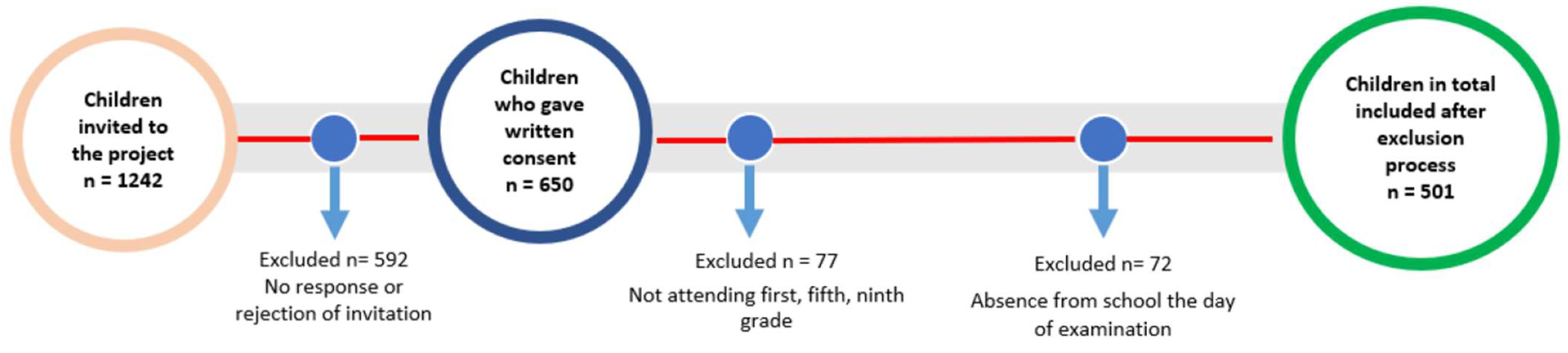
We included children from ten different primary schools. We informed the primary caregivers or legal guardians through the Danish parental–school communication channel, the Aula portal. This was compliant with the national and international General Data Protection Regulation rules and rules regarding information technology auditing. The portal provided oral and written information about the project, and the children were enrolled after informed consent and parental signed acceptance were given. A child was included as a participant if he or she was aged 6 to 16 years and attended the first, fifth, or ninth grade at a (selected) Danish primary school. We excluded a child if the caregivers on their child’s behalf had not accepted that their child participate in the study or if severe diseases such as infections or malignancies were discovered that warranted acute medical treatment. See the exclusion process in Figure 1.

2.3. Data Collection

2.3.1. Examiners and Foot Evaluations

The children were examined by three teams of two podiatric physicians, each for their clinical foot status to provide a comfortable and safe test environment. Before study initiation, we performed three formal clinical training sessions to streamline the examination procedures of the study and ensure that examiners performed the clinical evaluations similarly as well as performed a formal test–retest study. In the study, we evaluated the foot for the podiatric medical conditions of ingrown toenails, callosities, and warts and the specific deformities of metatarsus varus and hallux valgus. The anatomical localization of these pathologies was denoted. The children were examined in sessions of 30 to 40 min. The full examination is described in detail in a protocol article by Wong et al. [11].

2.3.2. Assessments of Foot Pathologies

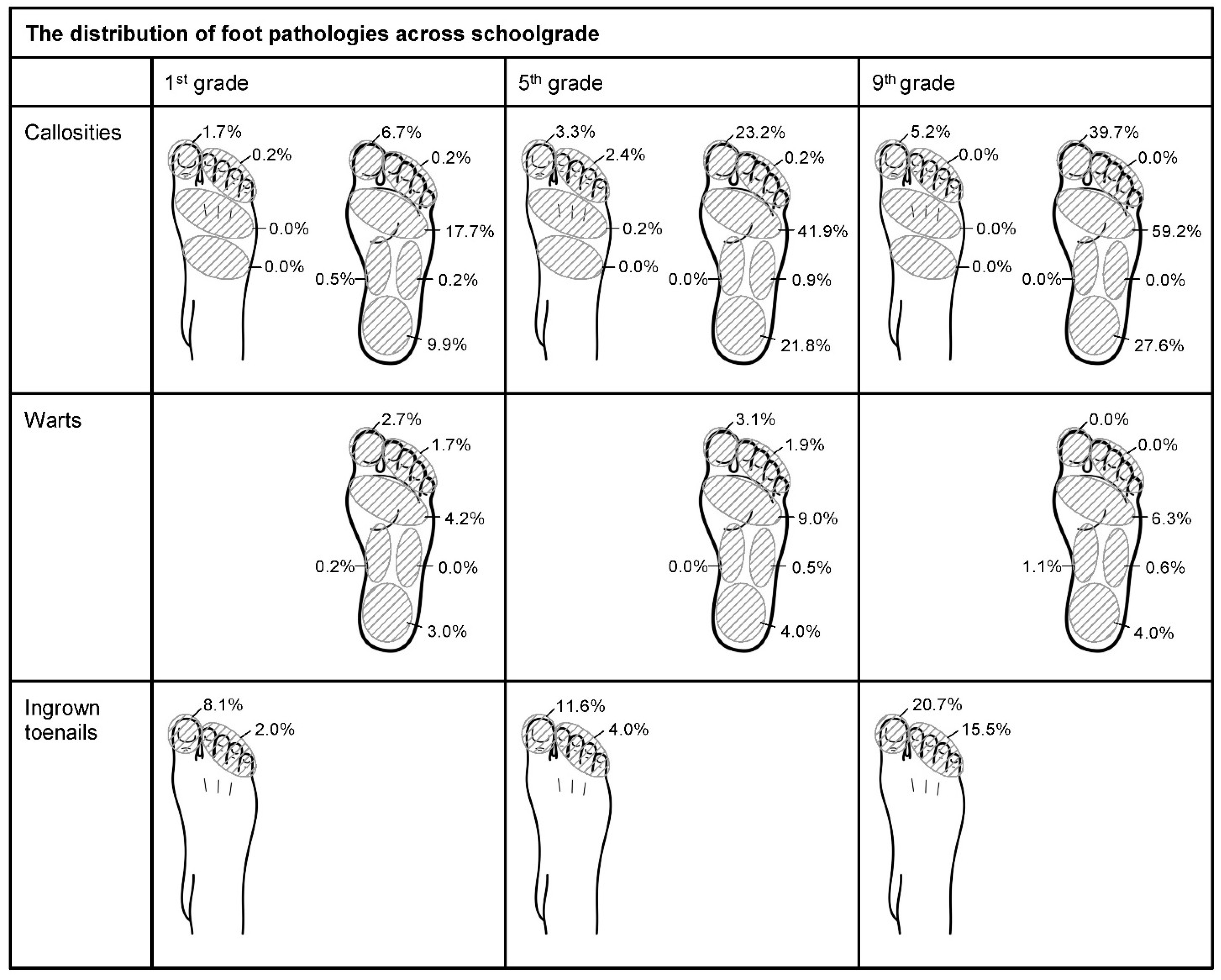
We examined and assessed the children for the previously described foot conditions and deformities by visual inspection and clinical evaluation. The forefoot deformities were measured with participants in a static, no weightbearing, prone position for metatarsus varus and in a standing position for hallux valgus. The feet were assessed for severity using the classification system by Bleck [13], which also includes an assessment for reducibility. The latter was excluded from this study. Severity is categorized as minimal, moderate, or severe, determined by a line extending from the heel through the third toe, fourth toe, or beyond. In this study, metatarsus varus was classified into mild (a line through the third toe), moderate (a line between the third and fourth toes), and severe (a line between the fourth and fifth toes). The angle of the hallux valgus was measured. This was defined as an angle between the lines of the center longitudinal axis of the first metatarsal and the axis of the hallux connecting with the first metatarsophalangeal joint [14]. If one or more of the foot conditions (warts, callosities, or ingrown toenails) was present, we noted the location in predefined zones of the foot (Figure 2).

2.4. Statistical Analysis

The distribution of all of the variables was examined graphically using density plots. All of the data were stratified according to school grade. Data on age, sex, height, and weight are presented using mean ± SD. Hallux valgus is presented using median and interquartile range (IQR). Measures of warts, callosities, ingrown toenails, and metatarsus varus are presented as count and percentage. Differences between school grades were examined using the Kruskal–Wallis rank sum test for hallux valgus and the Pearson χ2 test for the count data. The analysis was conducted using R version 4.3.2 and the R packages tidyverse and gtsummary (The R Foundation, Vienna, Austria) [15,16,17].

2.5. Ethical Considerations

Before commencement of the project, we applied to the local ethics committee for ethical approval. The study design was evaluated as a cross-sectional nonintervention study, thus not appropriate for evaluation for approval following local legal law § 2 or registration as a clinical trial. However, all of the methods and procedures of this study adhered to relevant national guidelines and regulations and the Helsinki Declaration. This included obtaining informed signed consent from all of the participants’ legal guardians. Regional registration was obtained following the procedure of the Danish Data Protection Agency, as stipulated by Danish law J.nr. 2008-41-2240.

3. Results

The total number of participants in this study was 501 children (1002 extremities), 259 boys and 242 girls, in first grade (n = 203), fifth grade (n = 211), and ninth grade (n = 87). We identified 266 different foot pathologies among the participating schoolchildren. An overview of mean ± SD height, weight, and age is available in Table 1.
Overall, 417 children (83%) had one or more of the investigated foot pathologies or deformities, and we found 1256 cases of foot pathologies among the 501 Danish schoolchildren. The most prevalent foot condition among Danish children was metatarsus varus, which was found in 53% of feet (532 of 1002). The distribution of metatarsus varus was 33% mild (335 of 1002), 17% moderate (170 of 1002), and 2.7% severe (27 of 1002). When evaluating the distribution by age, the highest prevalence of mild metatarsus varus was 38% (161 of 422) in fifth grade, and the highest prevalence of moderate/severe metatarsus varus was found in the oldest group of children in ninth grade (23% [40 of 174]; p = 0.093). When evaluating mild metatarsus varus by sex, we found the highest prevalence of both sexes in fifth grade, with a prevalence in girls of 38% (76 of 200; p = 0.5) and in boys of 38% (85 of 222; p = 0.13). In addition, the results show a difference in the prevalence of moderate/severe metatarsus varus when evaluated by sex. The highest prevalence among girls was found in first grade (22% [45 of 206]; p = 0.5). Conversely, the highest prevalence among boys was in ninth grade (26% [25 of 96]; p = 0.13). Moderate/severe metatarsus varus increased with age in boys and decreased with age in girls. Plantar callosities were found in almost half of the extremities (46% [458 of 1002]). The prevalence of callosities under the foot (plantar) was higher than that on the upper side of the foot (dorsal). Most dorsal callosities were found on the right big toe (3.0% [15 of 501]) and on the left big toe (2.6% [13 of 501]). Second, callosities on the second to fifth toes had a prevalence on the right side of 0.6% (three of 501) and on the left side of 1.2% (six of 501). Most plantar callosities were located on the big toe and forefoot. Callosities on the plantar big toe had a prevalence of 6.0% on the right side and 4.2% on the left side. Callosities on the plantar forefoot had a prevalence of 16% on the right side and 16% on the left side, and the anatomical distribution of calluses was similar among the three age groups. The prevalence increased significantly with age, and the highest prevalence was found in the oldest age group of children in the ninth grade (72% [126 of 174]; p < 0.001). When evaluating the distribution according to sex we found the highest prevalence of callosities among girls in the ninth grade (85% [66 of 78]; p < 0.0001). According to the results, the girls had a higher prevalence of callosities in all three school grades.
Ingrown toenails were present in 14% of the extremities studied (143 of 1002). The most frequent ranking among all three school grades was medial in the big toe, with 7.4% (37 of 501) on the right and 7.6% (38 of 501) on the left. Lateral ingrown toenails on the big toe were found on the right foot in 1.0% of the schoolchildren (five of 501) and on the left foot in 0.8% (four of 501). The highest prevalence was found in the oldest children (ninth grade) at 26% (45 of 174), and it increased significantly with age (p < 0.001). When evaluating the prevalence according to sex in the ninth grade, the distribution was almost equal in girls (27% [21 of 78]; p < 0.001) and boys (25% [24 of 96]; p < 0.001).
We also investigated the children’s feet for warts. We did not find any warts on the upper side of the foot (dorsal). In contrast, we did find 123 warts (12%) under the foot (plantar). In all three age groups, the most frequent localization of plantar warts was on the forefoot, and the second most frequent occurrence was on the heel. The highest prevalence of plantar warts was found in the middle age group (fifth grade) at 15% (62 of 422 feet; p = 0.14). The prevalence according to sex in the fifth grade was almost equally distributed between girls and boys at 15% (30 of 200 feet; p = 0.4) and 14% (32 of 222 feet; p = 0.3), respectively.
Overall, we found a median hallux valgus angle of 5.0° (IQR, 1.0–9.0°). In first grade, the children had a median value of 3.0° (IQR, 0–8.0°); in fifth grade, 6.0° (IQR, 2.0–10.0°); and in ninth grade, 8.0° (IQR, 2.8–10.0°; p < 0.001). When evaluating the hallux valgus angle by sex, the girls in first grade had a median angle of 2.0° (IQR, 0–8.0°); in fifth grade, 5.5° (IQR, 2.0–10.0°); and in ninth grade, 8.0° (IQR, 5.0–10.0°; p < 0.001). The boys had a median angle in first grade of 4.0° (IQR, 0–8.0°); in fifth grade, 6.0° (IQR, 2.0–10.0°); and in ninth grade, 8.0° (IQR, 2.0–10.0°; p < 0.001). An overview of the distribution of pathologies according to sex and school grades is shown in Table 2.
Interestingly, we found that the overall number of the pathologies of callosities, ingrown toenails, metatarsus varus, and hallux valgus increased with age in children, and the highest prevalence of these pathologies was seen in the oldest group. The differences in prevalence across school grades were found to be significant for callosities (p < 0.001), ingrown toenails (p < 0.001), and hallux valgus (p < 0.001). An overview of the distribution of pathologies according to school grade is shown in Figure 2.

4. Discussion

In this study, more than 83% of Danish schoolchildren had one or more of the investigated foot pathologies and conditions. The prevalences of metatarsus varus and callosities were just more than and less than half, respectively, and more than 10% for ingrown toenails and warts. Callosities were most frequently located in the plantar forefoot and under the big toe. Ingrown toenails were mostly located on the big toe, and warts were on the plantar forefoot and heel. Furthermore, it was demonstrated that the prevalence of callosities, ingrown toenails, and metatarsus varus increased with age. Ingrown toenails and warts often warrant treatment, whereas callosities, hallux valgus, and metatarsus adductus may indicate that interventions to enhance mechanics, shoe fit, or other concerns should be contemplated in applicable instances to avert potential symptom progression.
In a previous study from Turkey, male adolescents and postadolescents (aged 14–25 years) in boarding schools were examined for skin diseases and were found to have a prevalence of callosities of 3.6% (n = 682) [18]. The prevalence of callosities was considerably higher in the present study. They used a similar method as in the present study, and included participants were examined by dermatologists who had experience and training in the diagnosis of skin disease. In the present study, the children were examined by podiatric physicians, and the aim of the study was different, which may have had an effect on the different outcomes. Unlike the Turkish study, the present study included both sexes, which may also have an effect on the different results because we found the highest prevalence among the oldest girls. Another study from Thailand examined 123 Muay Thai kickboxers and found callosities to be a common foot problem (59%), and callosities were commonly found on the plantar first metatarsal (55.3%) and the big toe (33.3%). Their findings are associated with prolonged training and barefoot training [19]. Other studies have highlighted that incorrectly fitted footwear is also associated with foot callosities [3,20]. Considering that the present population wears footwear and exhibits a high prevalence of callosities, this raises concerns about the fit of the children’s footwear. The present findings on callosity locations in the foot are comparable with those of previous studies, thus seeming to justify the finding of a high prevalence, and we speculate on a possible interrelation to the children’s participation in sports activities or incorrectly fitted footwear.
A recent study examined how foot posture and plantar pressure influence the formation of plantar hyperkeratosis due to an alteration in the keratinization process in adults. The study concluded that there is an association between plantar pressure and the formation of calluses. Foot posture affects the development of hyperkeratosis through plantar pressure. Participants in that study who had hyperkeratosis exhibited foot pressure that was 32.3% higher than those without the condition [21]. These values can be considered predictive of the appearance of hyperkeratosis and should be indicative of the need for preventive treatment. Another study has similarly demonstrated such a correlation [22]. The high prevalence of calluses found in this study suggests that abnormal pressure distribution under the foot and therefore faulty biomechanics can lead to callosities in children. This podiatric medical condition may indicate the need for therapy to avert potential advancement and the onset of symptoms. From an orthopedic perspective, we consider this condition to require treatment when becoming painful. In this study, we did not evaluate the relationship between foot pain status and callosities, and based on data from this study, we were unable to determine whether the callosities reached the threshold of children seeking podiatric or other medical treatment.
In the present study, the overall prevalence of warts was 12%. Studies from other geographic parts of the world have reported variable results. The highest prevalence was found in a study from Germany at 33% among primary school students [23]. The lowest prevalence was found in a study from Romania, with a prevalence among schoolchildren of 2.78% [24]. An important effect on the results in the present study may be the smaller sample size compared with the other studies and that examinations were performed by dermatologists in the other studies. A study from Australia investigated the prevalence of common and plantar warts among 2491 children, including children aged 4 to 18 years. The study found a prevalence of warts of 6.0% [25]. In addition, in a study from Sweden, a single dermatologist examined 8298 students aged 12 to 17 years and reported a prevalence of warts of 20% [26]. The present results of prevalence of warts (12%) are within the range of previous studies (2.78–33.0%). In the latter study, they found a difference between the sexes, with a higher prevalence in girls (22.4%) versus boys (12%) [26]. In the present study, we also found a higher, but not statistically significant, prevalence in girls. A study from the Netherlands found a prevalence of warts of 20% among 1465 children aged 4 to 12 years. Environmental factors such as barefoot activities and swimming pool visits were not related to the presence of warts. They found an increased risk of the presence of warts in children with family members with warts or in school classes with a high presence of warts [27]. A study from Egypt found such an association between warts and water activities and barefoot activities among schoolchildren [28]. Several other studies highlighted factors such as socioeconomic status as having an effect on the prevalence of warts, and these studies found a higher prevalence of warts among children from rural areas, public schools, and big families [27,28,29,30]. In addition, the level of education and parental work status seem to impact the prevalence of warts [29,30].
In the present study, we found a prevalence of ingrown toenails of 14%. The highest prevalence was in the oldest group of children and for the female sex. A previous study examined 62 children aged 3 to 18 years for ingrown toenails and found 172 cases. They also found high prevalences of ingrown toenails caused by incorrect nail cutting (72.1%), trauma (36.1%), poor-fitting shoes (29.0%), and obesity (9.7%) [31]. Another study found that a dense nail consistency was more frequent in runners than in people who do no sports activity. The dense consistency seems to be directly related to ingrown toenails [32]. A large-scale epidemiologic study from South Korea studied the prevalence and incidence of ingrown toenails in 1,116,789 people from newborn to 80 years old and found that ingrown toenails were more prevalent before age 30 years in young men as opposed to after age 30 years in women [33]. Interestingly, they also found ingrown toenail associations with bone deformities, valgus and varus deformities, and flat feet [33].
In the present study, we found that more than half of the children had a high prevalence of especially mild metatarsus varus. One-third having a slightly bean-shaped foot with a not completely straight inner contour of the foot, which could be considered a normal occurrence. This is benign when pain is not present, whereas this would be considered a clinical problem if painful, which we would expect in a fraction of the 2.7% of children with severe metatarsus varus, warranting a conservative or operative intervention. We can confirm that metatarsus varus is a common foot deformity and is perceived to resolve spontaneously by 1 year of age but seems to persist in childhood [2].

4.1. Strengths and Weaknesses

There are several limitations to this study. One of the limitations is the recruitment process because only approximately half of those invited responded to the invitation, which might have influenced the findings by selection bias, that is, families may have been more likely to accept the invitation if they thought that their child had a foot condition. However, we observed that most of the dropouts were older children, which we ascribe to either the inconvenience of the 45 min examination or the “consciousness” of being examined in their underwear. In a future study, in the study invitation we would elaborate more on the purpose of the study and the investigated foot conditions and deformities examined to improve recruitment. Herein, one could have included the children’s experience of pain concerning the investigated conditions and deformities as well as evaluated the conditions and deformities for need of treatment. Furthermore, the examination is performed by visual assessment for, for example, metatarsus varus, where one could have included evaluation of reducibility of the forefoot based on the degree of abduction relative to this bisecting line, whether above, on, or below it [10].
We also acknowledge that the present evaluation of hallux valgus is limited because it relies solely on the hallux valgus angle without considering other important measurements, such as the intermetatarsal angle (between the first and second metatarsal bones) and the metatarsus adductus angle [34,35]. The hallux valgus angle is defined as the angle between the axis of the proximal phalanx of the hallux (big toe) and the axis of the first metatarsal bone. This angle is highly consistent and has been shown to have a strong correlation with the severity of hallux valgus deformity [36], which motivated the choice to use this measure. However, focusing solely on the hallux valgus angle may predominantly reflect the metatarsus primus adductus, potentially missing other aspects of the deformity.
Moreover, one would expect interrater and intrarater variation [37], which may have an effect on the findings of conditions and deformities, as the assessments may differ between podiatric physicians as well as if the evaluations were performed by other health-care professionals, such as dermatologists [24,25,26,27]. Using a cross-sectional design offers limited data in terms of the natural history of conditions, and we generalize from three different time points to reflect longitudinal changes, which a prospective study following up on the development in the foot conditions and deformities and including relevant interventions would entail, thus must be considered a limitation to the present study design.
In this study, we assessed the children’s deformities in a static nonweightbearing position or a standing position. Note that the present study provided a critical appraisal of the Root model [38], a widely used clinical approach for assessing foot function as performed in this study. The study conducted a static examination of 140 asymptomatic and self-reported healthy individuals aged 18 to 45 years [38]. Their findings were compared with the existing literature. The study found that the static examinations advocated by Root et al. [38]. failed to effectively identify foot kinematics associated with foot kinetics and raised doubt about the ability of the Root model and its associated assessment protocol to accurately assess foot deformities. However, a major strength of this study is the number of participants examined for various foot pathologies, therefore providing moderately credible overall information on many aspects concerning child and adolescent foot health. The high prevalence of callosities in this study may indicate the presence of faulty biomechanics, as previously described. This biomechanical misalignment can potentially lead to pain over time. To prevent and possibly treat this, as well as the formation of callosities in the pediatric population, it may be advisable to assess children’s foot posture and plantar pressure at an early age.

4.2. Implications

In this study, we mapped the prevalence of callosities, ingrown nails, and warts in Danish children. In general, one-fourth of the children had the ailment of warts and ingrown toenails that would benefit from podiatric medical treatment, and 83% had ailments that might need pediatric orthopedic or podiatric medical treatment. However, we are unable to determine whether these reached the threshold that the children would seek medical attention. The evaluation of the frequency of callosities, hallux valgus, and metatarsus adductus is not very useful without knowledge of which, if any, of these observations resulted in, or contributed to, complications. To best prioritize health-care resources, it is relevant to evaluate whether these foot pathologies have an effect on the children’s experiences of functional level, pain, and quality of life, or whether they are benign findings that can safely be ignored, such as metatarsus varus. A Danish study highlighted that lower-extremity pain among Danish children and adolescents is common [39], and it would be interesting to investigate the prevalence and natural history of especially the pain status and potential functional impediments among these children with foot pathologies or deformities. A Canadian study found a high prevalence of foot abnormalities, including ingrown toenails and callosities, among adolescents with type 2 diabetes [40]. Another study found a correlation between the pathologies of callosities and ingrown toenails and the interrelation to sports practice, obesity, and pain presence [31]. Because this study found a high prevalence of foot pathologies among children, future studies could investigate how these foot pathologies impact general health. Furthermore, studies are needed to assess the effect of prevention and early effective treatment and to examine the optimal time and specific prerequisites of the foot status for, for example, podiatric physician interventions. To include those factors as well as further clinical and sociodemographic characteristics of the pediatric population, a research project should be undertaken to detect and clarify the role of, for example, sports activities, interventions, and socioeconomic inequalities.

5. Conclusions

This study showed that foot pathologies and deformities such as warts and ingrown toenails and especially conditions such as metatarsus varus and callosities are common in Danish primary school students. These findings indicate that further research projects should be undertaken to clarify how the high prevalence of foot pathologies affects general health and subsequently the correlation to pain, health challenges, socioeconomics, and quality of life.

Author Contributions

Conceptualization, C.H.L. and C.N.E.T.-W.; methodology, C.H.L., S.B. and C.N.E.T.-W.; software, A.J.; validation, C.H.L., S.B. and C.N.E.T.-W.; formal analysis, C.H.L. and A.J.; investigation, C.H.L., L.B. and M.B.; resources, M.M.P. and A.B.-C.; data curation, C.H.L. and M.B.; writing—original draft preparation, C.H.L.; writing—review and editing, S.B., M.M.P., A.B.-C., S.H. and C.N.E.T.-W.; visualization, C.H.L. and A.J.; supervision, S.H. and C.N.E.T.-W.; project administration, C.H.L.; funding acquisition, C.N.E.T.-W. All authors have read and agreed to the published version of the manuscript.

Funding

This study is funded by the Association of Danish Podiatrists with an amount of DKK 610.000, whereas DKK 200.000 is allocated for the initial evaluation of the children by podiatrists, DKK 35.000 for the planning of the protocol, DKK 15.000 for programming the Redcap database and purchase of hardware, DKK 25.000 for the validation test and re-test for the examination program, and DKK 25.000 are for project management by RegionH including data analysis and publication.

Institutional Review Board Statement

Before the commencement of the project, an application for ethical approval was submitted to the Ethics Committee of the Capital Region of Denmark (journal number H-22002997). The study design was evaluated as a cross-sectional non-intervention study and was therefore not subject to approval in accordance with local legal law § 2 nor required registration as a clinical trial. The study was conducted in accordance with the Declaration of Helsinki and adhered to all relevant national guidelines and regulations. Regional registration was obtained in accordance with the Danish Data Protection Agency, as stipulated by Danish law (J.nr. 2008-41-2240).

Informed Consent Statement

Informed written consent was obtained from all subjects’ legal guardian(s) prior to participation. If subjects and/or their legal guardians declined participation, this decision was fully respected.

Data Availability Statement

The original contributions presented in this study are included in the article. Further inquiries can be directed to the corresponding authors.

Acknowledgments

Nurse Christina Ystroem Bjerge for her hard work in coordinating the collection of data.

Conflicts of Interest

The authors declare no conflicts of interest.

References

  1. Staheli, L.T.; Corbett, M.; Wyss, C.; King, H. Lower-extremity rotational problems in children. Normal values to guide management. J. Bone Joint Surg. Am. 1985, 67, 39–47. [Google Scholar] [CrossRef]
  2. Rerucha, C.M.; Dickison, C.; Baird, D.C. Lower Extremity Abnormalities in Children. Am. Fam. Physician 2017, 96, 226–233. [Google Scholar]
  3. Buldt, A.K.; Menz, H.B. Incorrectly fitted footwear, foot pain and foot disorders: A systematic search and narrative review of the literature. J. Foot Ankle Res. 2018, 11, 43. [Google Scholar] [CrossRef]
  4. Sass, P.; Hassan, G. Lower extremity abnormalities in children. Am. Fam. Physician 2003, 68, 461–468. [Google Scholar]
  5. Mayeaux, E.J.J.; Carter, C.; Murphy, T.E. Ingrown Toenail Management. Am. Fam. Physician 2019, 100, 158–164. [Google Scholar]
  6. Nordentoft, E.L.; Waldorf, F.B. Viral warts on hands and feet are often self-limiting. Ugeskr. Laeger 2013, 175, 1559–1561. [Google Scholar]
  7. Knörr, J.; Soldado, F.; Violas, P.; Sánchez, M.; Doménech, P.; de Gauzy, J.S. Treatment of hallux valgus in children and adolescents. Orthop. Traumatol. Surg. Res. 2022, 108, 103168. [Google Scholar] [CrossRef]
  8. Mahan, S.T.; Cidambi, E.O. Juvenile Hallux Valgus. Foot Ankle Clin. 2021, 26, 807–828. [Google Scholar] [CrossRef]
  9. Singh, D.; Bentley, G.; Trevino, S.G. Fortnightly review: Callosities, corns, and calluses. BMJ 1996, 312, 1403–1406. [Google Scholar] [CrossRef]
  10. Rampal, V.; Giuliano, F. Forefoot malformations, deformities and other congenital defects in children. Orthop. Traumatol. Surg. Res. 2020, 106, S115–S123. [Google Scholar] [CrossRef]
  11. Wong, C.; Bjerge, C.Y.; Jurca, A.; Petersen, M.M.; Boedtker, S.; Balslev-Clausen, A.; Harsted, S. Protocol Article: A Cross-Sectional Evaluation of Children’s Feet and Lower Extremities. Methods Protoc. 2023, 6, 115. [Google Scholar] [CrossRef]
  12. Børne- og Undervisningsministeriet. Socioøkonomisk Reference for Grundskolekarakterer. Styrelsen for Undervisning og Kvalitet. Available online: https://uvm.dk/ministeriet/statistik/grundskolen/karakterer-og-test/sociooekonomisk-reference-for-grundskolekarakterer/ (accessed on 7 March 2024).
  13. Bleck, E.E. Metatarsus adductus: Classification and relationship to outcomes of treatment. J. Pediatr. Orthop. 1983, 3, 2–9. [Google Scholar] [CrossRef]
  14. Zhou, J.; Hlavacek, P.; Xu, B.; Chen, W. Approach for measuring the angle of hallux valgus. Indian J. Orthop. 2013, 47, 278–282. [Google Scholar] [CrossRef]
  15. Wickham, H.; Averick, M.; Bryan, J.; Chang, W.; McGowan, L.D.; François, R.; Grolemund, G.; Hayes, A.; Henry, L.; Hester, J.; et al. Wlcome to the tidyverse. J. Open Source Softw. 2019, 4, 1686. [Google Scholar] [CrossRef]
  16. Sjoberg, D.; Whiting, K.; Curry, M.; Lavery, J.; Larmarange, J. Reproducible Summary Tables with the gtsummary Package. R J. 2021, 13, 570–-580. [Google Scholar] [CrossRef]
  17. R Core Team. A Language and Environment for Statistical Computing. R Foundation for Statistical Computing, Vienna. 2023. Available online: https://www.r-project.org (accessed on 7 March 2024).
  18. Tuncel, A.A.; Erbagci, Z. Prevalence of skin diseases among male adolescent and post-adolescent boarding school students in Turkey. J. Dermatol. 2005, 32, 557–564. [Google Scholar] [CrossRef]
  19. Vaseenon, T.; Intharasompan, P.; Wattanarojanapom, T.; Theeraamphon, N.; Auephanviriyakul, S.; Phisitkul, P. Foot and ankle problems in Muay Thai kickboxers. J. Med. Assoc. Thai. 2015, 98, 65–70. [Google Scholar]
  20. Puszczalowska-Lizis, E.; Zarzyczna, P.; Mikulakova, W.; Migala, M.; Jandzis, S. Influence of footwear fitting on feet morphology in 9 year old girls. BMC Pediatr. 2020, 20, 349. [Google Scholar] [CrossRef]
  21. Sánchez-Rodríguez, R.; Martínez-Quintana, R.; Martínez-Nova, A.; Martínez-Rico, M.; Pedrera-Zamorano, J.D.; Chicharro-Luna, E. Correlation between the foot pressure index and the prevalence of plantar hyperkeratosis. J. Tissue Viability 2023, 32, 401–405. [Google Scholar] [CrossRef]
  22. Findlow, A.H.; Nester, C.J.; Bowker, P. Foot kinematics in patients with two patterns of pathological plantar hyperkeratosis. J. Foot Ankle Res. 2011, 4, 7. [Google Scholar] [CrossRef]
  23. Bruggink, S.C.; Eekhof, J.A.H.; Egberts, P.F.; van Blijswijk, S.C.E.; Assendelft, W.J.J.; Gussekloo, J. Natural course of cutaneous warts among primary schoolchildren: A prospective cohort study. Ann. Fam. Med. 2013, 11, 437–441. [Google Scholar] [CrossRef]
  24. Popescu, R.; Popescu, C.M.; Williams, H.C.; Forsea, D. The prevalence of skin conditions in Romanian school children. Br. J. Dermatol. 1999, 140, 891–896. [Google Scholar] [CrossRef]
  25. Kilkenny, M.; Merlin, K.; Young, R.; Marks, R. The prevalence of common skin conditions in Australian school students: 1. Common, plane and plantar viral warts. Br. J. Dermatol. 1998, 138, 840–845. [Google Scholar] [CrossRef]
  26. Larsson, P.A.; Lidén, S. Prevalence of skin diseases among adolescents 12--16 years of age. Acta Derm. Venereol. 1980, 60, 415–423. [Google Scholar] [CrossRef]
  27. van Haalen, F.M.; Bruggink, S.C.; Gussekloo, J.; Assendelft, W.J.J.; Eekhof, J.A.H. Warts in primary schoolchildren: Prevalence and relation with environmental factors. Br. J. Dermatol. 2009, 161, 148–152. [Google Scholar] [CrossRef]
  28. Essa, N.; Saleh, M.A.; Mostafa, R.M.; Taha, E.A.; Ismail, T.A. Prevalence and factors associated with warts in primary school children in Tema District, Sohag Governorate, Egypt. J. Egypt. Public Health Assoc. 2019, 94, 6. [Google Scholar] [CrossRef]
  29. Amin, T.T.; Ali, A.; Kaliyadan, F. Skin disorders among male primary school children in Al Hassa, Saudi Arabia: Prevalence and socio-demographic correlates—A comparison of urban and rural populations. Rural Remote Health 2011, 11, 1517. [Google Scholar] [CrossRef]
  30. Chen, G.-Y.; Cheng, Y.W.; Wang, C.Y.; Hsu, T.J.; Hsu, M.M.L.; Yang, P.T.; Chen, W.C. Prevalence of skin diseases among schoolchildren in Magong, Penghu, Taiwan: A community-based clinical survey. J. Formos. Med. Assoc. 2008, 107, 21–29. [Google Scholar] [CrossRef]
  31. Arica, I.E.; Bostanci, S.; Koçyigit, P.; Arica, D.A. Clinical and Sociodemographic Characteristics of Ingrown Nails in Children. J. Am. Podiatr. Med. Assoc. 2019, 109, 272–276. [Google Scholar] [CrossRef]
  32. Pico, A.M.P.; Verjano, E.; Mayordomo, R. Relation Between Nail Consistency and Incidence of Ingrown Toenails in Young Male Runners. J. Am. Podiatr. Med. Assoc. 2017, 107, 137–143. [Google Scholar] [CrossRef]
  33. Cho, S.Y.; Kim, Y.C.; Choi, J.W. Epidemiology and bone-related comorbidities of ingrown nail: A nationwide population-based study. J. Dermatol. 2018, 45, 1418–1424. [Google Scholar] [CrossRef] [PubMed]
  34. Heineman, N.; Liu, G.; Pacicco, T.; Dessouky, R.; Wukich, D.K.; Chhabra, A. Clinical and imaging assessment and treatment of hallux valgus. Acta Radiol. 2020, 61, 56–66. [Google Scholar] [CrossRef] [PubMed]
  35. Ray, J.J.; Friedmann, A.J.; Hanselman, A.E.; Vaida, J.; Dayton, P.D.; Hatch, D.J.; Smith, B.; Santrock, R.D. Hallux Valgus. Foot Ankle Orthop. 2019, 4, 2473011419838500. [Google Scholar] [CrossRef] [PubMed]
  36. Lee, K.M.; Ahn, S.; Chung, C.Y.; Sung, K.H.; Park, M.S. Reliability and relationship of radiographic measurements in hallux valgus. Clin. Orthop. Relat. Res. 2012, 470, 2613–2621. [Google Scholar] [CrossRef]
  37. Saabye, T.; Colding-Rasmussen, T.; Balslev-Clausen, A.; Bødtker, S.; Wong, C.; Harsted, S. Test–retest reliability of clinical measurements of lower extremity joint motion and alignment in the pediatric population submitted. J. Child. Orthop. 2024. [Google Scholar]
  38. Jarvis, H.L.; Nester, C.J.; Bowden, P.D.; Jones, R.K. Challenging the foundations of the clinical model of foot function: Further evidence that the root model assessments fail to appropriately classify foot function. J. Foot Ankle Res. 2017, 10, 7. [Google Scholar] [CrossRef]
  39. Fuglkjær, S.; Hartvigsen, J.; Wedderkopp, N.; Boyle, E.; Jespersen, E.; Junge, T.; Larsen, L.R.; Hestbæk, L. Musculoskeletal extremity pain in Danish school children—How often and for how long? The CHAMPS study-DK. BMC Musculoskelet. Disord. 2017, 18, 492. [Google Scholar] [CrossRef]
  40. Chuback, J.; Embil, J.M.; Sellers, E.; Trepman, E.; Cheang, M.; Dean, H. Foot abnormalities in Canadian Aboriginal adolescents with Type 2 diabetes. Diabet. Med. 2007, 24, 747–752. [Google Scholar] [CrossRef]
Figure 1. Exclusion process. The number of children invited to the project was 1242. Consent was given by 650 children, and 501 were examined at the start of data analysis.
Japma 116 00009 g001
Figure 2. Anatomical localization of foot pathologies and distribution of the three school classes.
Japma 116 00009 g002
Table 1. Characteristics of the Study Participants by School Grade.
CharacteristicComplete Observations (No.)First Grade (n = 203)Fifth Grade (n = 211)Ninth Grade (n = 87)
Age (mean ± SD [years])5017.62 ± 0.4311.62 ± 0.4215.54 ± 0.39
Sex (No. [%])501
 Girl 103 (51)100 (47)39 (45)
 Boy 100 (49)111 (53)48 (55)
Height (mean ± SD [cm])499129 ± 5153 ± 7173 ± 8
Weight (mean ± SD [kg])49927 ± 545 ± 1064 ± 12
Table 2. Pathologies in the 1002 Study Feet by Sex and School Grade of Participants.
PathologyGirls (n = 484)Boys (n = 518)
First Grade (n = 206)Fifth Grade (n = 200)Ninth Grade (n = 78)p Value aFirst Grade (n = 200)Fifth Grade (n = 222)Ninth Grade (n = 96)p Value a
Warts 0.4 0.3
 No183 (89)170 (85)70 (90) 180 (90)190 (86)86 (90)
 Yes23 (11)30 (15)8 (10) 20 (10)32 (14)10 (10)
Calluses, plantar foot <0.001 <0.001
 No142 (69)89 (45)12 (15) 157 (79)108 (49)36 (38)
 Yes64 (31)111 (56)66 (85) 43 (22)114 (51)60 (63)
Callosities, dorsal foot 0.068 0.031
 No 203 (99)195 (98)73 (94) 195 (98)204 (92)92 (96)
 Yes3 (2)5 (3)5 (6) 5 (3)18 (8)4 (4)
Ingrown nails <0.001 <0.001
 No181 (88)180 (90)57 (73) 184 (92)185 (83)72 (75)
 Yes25 (12)20 (10)21 (27) 16 (8)37 (17)24 (25)
Metatarsus varus 0.5 0.13
 None94 (46)88 (44)39 (51) 97 (50)91 (42)42 (46)
 Mild64 (32)76 (38)23 (30) 62 (32)85 (39)25 (27)
 Moderate/severe45 (22)34 (17)15 (19) 36 (18)42 (19)25 (27)
 Missing data321 544
Hallux valgus (median [IQR] [°])2.0 (0–8.0)5.5 (2.0–10.0)8.0 (5.0–10.0)<0.0014.0 (0–8.0)6.0 (2.0–10.0)8.0 (2.0–10.0)<0.001
Note: Data are given as number (percentage) except where indicated otherwise. Data from the left and right sides are presented together. Some percentages may not sum to 100% due to rounding. a The Pearson χ2 test was used for the count data and the Kruskal–Wallis rank sum test was used for hallux valgus. Abbreviations: IQR, interquartile range; n, number of extremities.
Disclaimer/Publisher’s Note: The statements, opinions and data contained in all publications are solely those of the individual author(s) and contributor(s) and not of MDPI and/or the editor(s). MDPI and/or the editor(s) disclaim responsibility for any injury to people or property resulting from any ideas, methods, instructions or products referred to in the content.