


You are currently on the new version of our website. Access the old version .

International Journal of Environmental Research and Public Health

International Journal of Environmental Research and Public Health (IJERPH) is a transdisciplinary, peer-reviewed, open access journal that covers global health, healthcare sciences, behavioral and mental health, infectious diseases, chronic diseases and disease prevention, exercise and health related quality of life, environmental health and environmental sciences, and is published monthly online by MDPI.
The International Society Doctors for the Environment (ISDE), Italian Society of Environmental Medicine (SIMA) and Environmental Health Association of Québec (ASEQ‑EHAQ) are affiliated with IJERPH and their members receive discounts on the article processing charges.

All Articles (65,519)

Remote Indigenous communities experience persistent inequities in access to fresh and nutritious foods due to the fragility of perishable food supply chains (PFSCs). Disruptions across procurement, transportation, storage, retail, and limited local production restrict access to perishable foods, contributing to food insecurity and diet-related health risks. This scoping literature review synthesizes evidence from 84 peer-reviewed, grey, and unpublished sources across fourteen countries to map PFSC management (PFSCM) challenges affecting food access in remote Indigenous communities worldwide and to synthesize reported practices implemented to address these challenges. PFSCM challenges were identified across all supply chain levels, and five categories of reported practices emerged: PFSC redesign strategies, forecasting and decision-support models, technological innovations, collaboration and coordination mechanisms, and targeted investments. These findings informed the development of a multi-scalar conceptual framework comprising seven interconnected PFSCM clusters that organize how reported practices are associated with multiple food access dimensions, including quantity, affordability, quality, safety, variety, and cultural acceptability. This review contributes an integrative, system-oriented synthesis of PFSCM research and provides a conceptual basis to support future scholarly inquiry, comparative inquiry, and policy-relevant discussion of food access and health equity in remote Indigenous communities.

17 January 2026
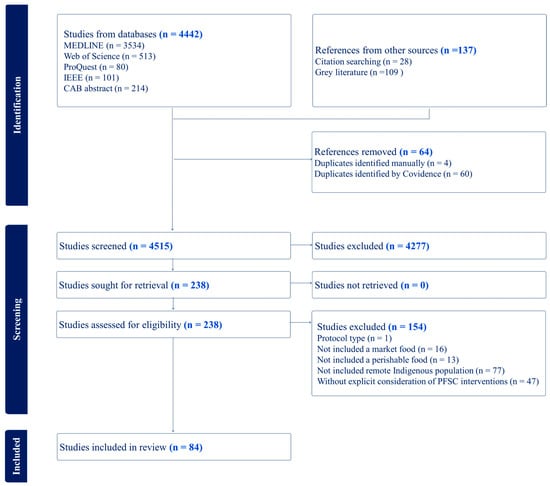
PRISMA flow chart of included and excluded articles.

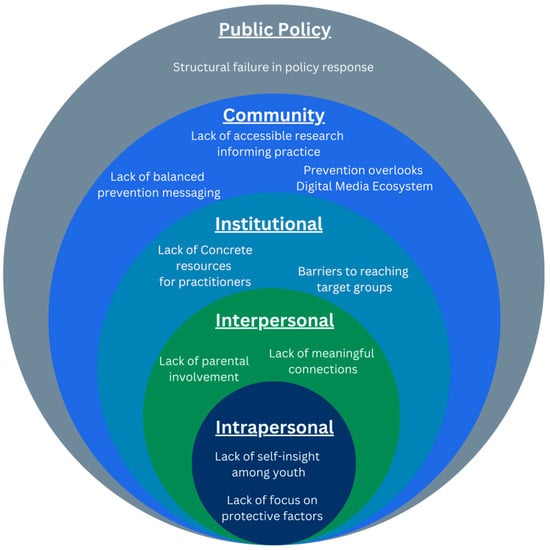
Current approaches to gaming disorder prevention remain comparatively narrow, and prevention efforts are frequently underdeveloped and fragmented. Using the socio-ecological model (SEM), this qualitative study mapped frontline practitioners’ perceived obstacles and opportunities to develop a multi-level, practice-grounded framework for policy and implementation. Semi-structured interviews were conducted with 18 prevention professionals in Flanders (Dutch-speaking Belgium), recruited via purposive and snowball sampling. A hybrid inductive–deductive analysis—iterative coding guided by Layder’s adaptive theory—organized findings across SEM levels. At the public policy level, participants highlighted insufficient sustainable funding but saw potential in coordinated frameworks moving prevention beyond substance-focused agendas. At the community level, a clear knowledge gap emerged, with opportunities in integrating gaming within broader digital well-being efforts. Institutionally, the absence of practical tools and clear referral pathways was noted, in addition to high participation barriers, whereas accessible programs with targeted outreach were viewed as promising. Interpersonally, parental disengagement was common, but early involvement and pedagogical guidance were seen as key levers. At the intrapersonal level, limited self-insight and emotion regulation impeded change, while resilience, self-confidence, and offline activities were protective. This first empirical application of the SEM to gaming disorder prevention highlights the need for a multi-level, context-sensitive framework that bridges public health and digital media perspectives.

17 January 2026

Socio-ecological framework for gaming disorder prevention. Key challenges are mapped onto the socio-ecological model, illustrating multi-level influences identified by prevention professionals.

Training and Recruitment to Implement the CASA Psychosocial Intervention in Cancer Care

  • Normarie Torres-Blasco,
  • Stephanie D. Torres-Marrero and
  • Sabrina Pérez-De Santiago
  • + 1 author

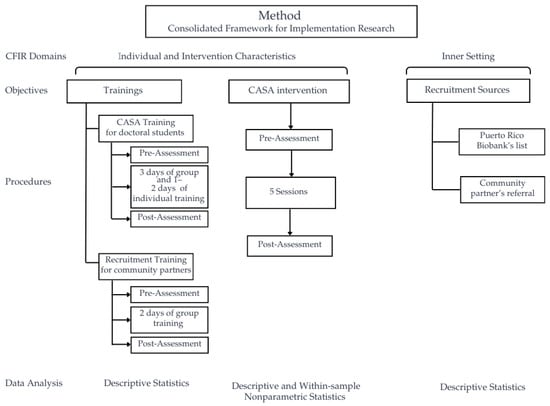
Practical training and recruitment strategies are critical for the sustainable implementation of psychosocial interventions. However, few studies have examined how to prepare community partners and doctoral students to support culturally adapted psycho-oncology interventions. This pre-pilot study aims first to evaluate two distinct training programs and recruitment procedures, and second to explore preliminary pre-post outcomes of the Caregiver-Patients Support to Cope with Advanced Cancer (CASA) intervention, using the Consolidated Framework for Implementation Research (CFIR). Three clinical psychology graduate students received CASA training, and two community partners completed Recruitment training. We present descriptive pre- and post-assessments, along with qualitative feedback, for both training and institutional (Puerto Rico Biobank) and community-based recruitment outcomes. A related-samples nonparametric analysis examined pre- and post-CASA intervention signals. Results indicated knowledge gains among doctoral students (pre-test M = 3.3; post-test M = 9.3) and community partners (pre-test M = 4.5; post-test M = 9.5). Preliminary outcomes revealed significant improvements in spiritual well-being (Z = −2.618, p = 0.009) and quality of life (Z = −2.957, p = 0.003) and a reduction in depressive (Z = −2.764, p = 0.006), anxiety (Z = −2.667, p = 0.008), and distress (Z = −2.195, p = 0.028) symptoms following CASA. Of 26 recruited dyads, institutional referrals enrolled 16 dyads (61.5%), while community partners referred 10 dyads with a 90.9% success rate. Findings support the feasibility of both training and CASA exploratory outcomes suggest meaningful psychosocial benefits for Latino dyads coping with advanced cancer. Combining institutional infrastructure with community engagement may enhance sustainability and equitable access to psycho-oncology care.

17 January 2026

Flowchart of study methods and procedures.

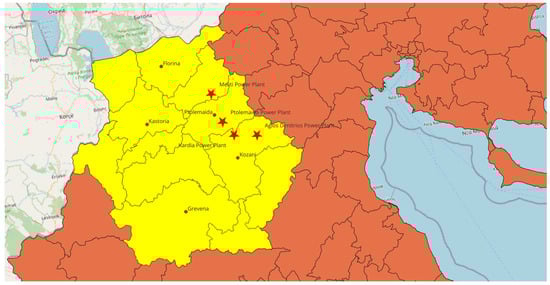
Air pollution from lignite combustion represents a major environmental and public health concern, particularly for cardiovascular disease. This study investigated the relationship between ambient air pollution and hospital admissions for Acute Coronary Syndromes (ACS) and Atrial Fibrillation (AF) in Western Macedonia, Greece—a region historically dominated by lignite mining and power generation. Air quality data for PM10, SO2, and NOx from 2011–2014 and 2021 were analyzed alongside hospital admission records from four regional hospitals (Kozani, Ptolemaida, Florina, Grevena). Spatial analyses revealed significantly higher pollutant concentrations and cardiovascular admissions in high-exposure areas near power plants compared with the control area. Temporal analyses demonstrated a pronounced decline in pollutant levels between 2014 and 2021, coinciding with lignite phase-out and accompanied by a marked reduction in ACS and AF hospitalizations, particularly in the high-exposure areas of Ptolemaida and Florina. Correlation analyses indicated modest but significant positive associations between monthly pollutant concentrations and cardiovascular admissions. These findings provide real-world evidence that reductions in air pollution following lignite decommissioning were associated with improved cardiovascular outcomes. The study underscores the medical importance of air quality improvement and highlights emission reduction as a critical strategy for cardiovascular disease prevention in transitioning energy regions.

16 January 2026

Administrative map of Western Macedonia (Greece) showing the study area, the main urban centers (Kozani, Ptolemaida, Florina, Grevena), and the location of PPC lignite-fired power plants. Source: author’s own creation.

News & Conferences

Issues

Open for Submission

Editor's Choice

Reprints of Collections

Access to Public Health Services and Challenges to Healthcare Management
Reprint

Access to Public Health Services and Challenges to Healthcare Management

Editors: Isabella Piassi Dias Godói, Carlos Podalirio Borges de Almeida

Get Alerted

Add your email address to receive forthcoming issues of this journal.

XFacebookLinkedIn
Int. J. Environ. Res. Public Health - ISSN 1660-4601