Skip to Content

Genes

Genes is a peer-reviewed, open access journal of genetics and genomics published monthly online by MDPI.
The Spanish Society for Nitrogen Fixation (SEFIN) is affiliated with Genes and its members receive discounts on the article processing charges.
Indexed in PubMed | Quartile Ranking JCR - Q2 (Genetics and Heredity)

All Articles (14,225)

Non-coding RNAs (ncRNAs) are conserved in the genome of cells across the three domains of life. They comprise a diverse group that are particularly prominent in metazoans where they provide a crucial interface between genes and proteins, participating in key cellular processes at different levels: from control of DNA transcription to modulation of messenger RNA stability to modification of protein activity. The interactions of ncRNAs with one another as well as with other RNAs, DNA and proteins form the basis of a genome-wide regulatory network (GRN). Because of the mutual influence of its components on each other, the GRN is a dynamic system. Further, the GRN imposes constraints on which genes are expressed and when, leading to specific gene-expression patterns or transcriptomes. The configurations of the activities of all gene loci represent self-stabilizing cell states, referred to as “attractor” states, each of which corresponds to a distinct cell type. The cancer cell is also an attractor state that arises from a change in the topography of the epigenetic landscape caused by dysregulation of the GRN. It is proposed that the transition to a neoplastic attractor state is caused by ncRNA alterations, while subsequent somatic mutations of oncogenes and tumor suppressor genes drive cell proliferation and clonal expansion.

2 March 2026

Pathways without (A) and with (B) feedback. Both systems are modeled in power-law format. Equations for pathway A: Ẋ = Input − E·X0.5; Ẏ = E·X0.5 − Y0.5; Ż = Y0.5 − Z0.5. For pathway B, the following equations are added: TḞ = Zp − TF0.5; Ġ = TF0.5 − G0.5; Ė = G0.5 − E0.5. (For further details, refer to Reference [60].)

Profiling Soil–Plant–Microbial Communities: DNA and Multi-Omics Techniques

  • Shunlei Li,
  • Claudia Chiodi and
  • Piergiorgio Stevanato
  • + 8 authors

Interactions among plant roots, soil, and microorganisms in the rhizosphere regulate nutrient cycling, plant health, and ecosystem resilience. Recent advances in DNA sequencing and multi-omics are contributing to a shift from primarily descriptive surveys toward more mechanistic and predictive frameworks. This review synthesizes methodological developments and conceptual insights spanning microbial ecology, functional genomics, and agricultural applications. We first summarize DNA-based approaches—marker-gene sequencing, shotgun metagenomics, and quantitative nucleic acid assays—and then complementary omics layers, including metatranscriptomics, metaproteomics, metabolomics, epigenomics, ionomics, and phenomics. We next outline computational advances in data integration, network modeling, and visualization that help represent complex multi-layered datasets as biologically interpretable systems. Applications relevant to climate resilience and sustainable agriculture are discussed, including the design of synthetic microbial communities, the identification of biomarkers for soil health and stress tolerance, and case studies in which rhizosphere multi-omics informs crop breeding and soil management strategies. Overall, these developments underscore the potential of treating microbes as functional and, to some extent, manageable components of the plant holobiont. Looking ahead, we identify key research gaps involving standardized workflows, cross-scale causal inference, and real-time monitoring pipelines that integrate molecular diagnostics with remote sensing and edge–cloud analytics. By linking ecological mechanisms with translational practice, multi-omics frameworks may support the development of more sustainable, data-driven agriculture that better aligns productivity with environmental stewardship.

2 March 2026

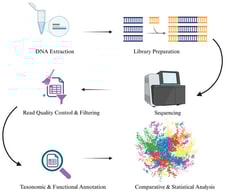
Non-targeted metagenomics analysis workflow.

Background/Objectives: Chlamydia trachomatis (CT) infection is one of the most prevalent sexually transmitted infections (STIs) worldwide and has been consistently associated with adverse reproductive outcomes, including female infertility. However, the molecular mechanisms underlying this association remain incompletely understood. This study aimed to investigate whether genes previously associated with female infertility display altered expression patterns in response to CT infection by reanalyzing publicly available transcriptomic data derived from a human in vitro infection model. Methods: An integrative in silico approach was employed. A curated list of 106 genes associated with female infertility was compiled from publicly available databases and integrated with transcriptomic data from the Gene Expression Omnibus (GEO) dataset GSE109428, which profiles primary human fallopian tube mesenchymal cells infected in vitro with CT serovar L2. Gene expression changes were evaluated at two time points (24 and 48 h post-infection) by comparing infected cells with uninfected control samples, followed by functional and phenotype enrichment analyses. Results: One female infertility-associated gene (AKAP12) was consistently dysregulated at both 24 and 48 h post-infection. In addition, fourteen genes (ANAPC4, BMP1, BNC2, BTG4, EFHD1, FBXO43, INHBB, PATL2, SCARB1, SND1, SYNE1, TRIP13, TTC28, and TUBA1C) became significantly dysregulated exclusively at 48 h post-infection, indicating a time-dependent host transcriptional response to CT infection. Functional and phenotype enrichment analyses revealed associations with biological processes related to embryonic development and meiosis, as well as phenotypes linked to female infertility. These enriched terms were supported by a small subset of genes and were therefore interpreted cautiously. Conclusions: Overall, these findings suggest that CT infection modulates the expression of several infertility-associated genes and may influence biological pathways critical for female reproductive function. While exploratory, this study provides a molecular context that aligns with previously reported associations between CT infection and female infertility.

1 March 2026

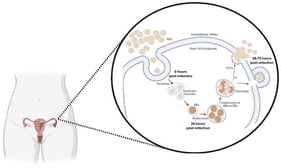
The developmental cycle of CT in the female reproductive tract. The schematic depicts the biphasic life cycle of the bacterium in the fallopian tubes. On the left, it shows in detail the transition from EBs to RBs within a membrane-bound inclusion following host cell entry. Then, RBs replicate multiple times until 24 h post-infection, and subsequently, RBs re-differentiate into EBs. Finally, there are two possible mechanisms for the extracellular EBs release: (1) lysis of the host cell or (2) extrusion, to infect other cells. The intracellular life cycle usually requires 48 to 72 h to complete. Abbreviations: EBs, elementary bodies; RBs, reticulate bodies. Figure created using BioRender—https://www.biorender.com/ (accessed on 20 January 2026).

Background/Objectives: Despite its economic importance, the genome-wide genetic diversity of sesame germplasm conserved in the Ethiopian national ex situ collection, a proposed center of origin, remains inadequately characterized. This study assessed genome-wide genetic diversity and population structure in 188 sesame accessions from six Ethiopian Agricultural Research Centers using DArTSeq-based SNP markers. Methods: After quality filtering, 5163 high-quality markers were retained from the original set of 12,302 SNPs. Mean expected heterozygosity (He = 0.201) exceeded observed heterozygosity (Ho = 0.193), reflecting sesame’s predominantly self-pollinating nature. Results: The SNPs showed a transition/transversion ratio of 1.17:1 and an uneven distribution across 16 linkage groups. STRUCTURE, PCA, DAPC, and neighbor-joining cluster analyses revealed a clear hierarchical population structure with distinct clusters and varying admixture. Accessions from Assosa (AARC) and Bako (BARC) were genetically uniform, whereas Werer (WARC) and Gambella (GaARC) were major diversity reservoirs, exhibiting high heterozygosity and gene diversity. Pairwise FST values ranged from 0.001 to 0.356, and AMOVA indicated that 30–43% of variation occurred among collections and 57–70% within collections, highlighting substantial intra-collection diversity. Conclusions: The findings highlight that specific research centers were identified as key sources of genetic variation for breeding, conservation, and association mapping to enhance the improvement in agronomic and adaptive traits in sesame for the Ethiopian sesame gene pool.

28 February 2026

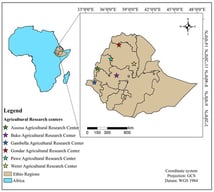
A map showing the collection areas of sesame accessions across Ethiopian research centers.

News & Conferences

Issues

Open for Submission

Editor's Choice

Reprints of Collections

RNA Interference Pathways
Reprint

RNA Interference Pathways

Editors: Tamas I. Orban
Trends and Prospects in Pig Genomics and Genetics
Reprint

Trends and Prospects in Pig Genomics and Genetics

Editors: Katarzyna Piórkowska, Katarzyna Ropka-Molik

Get Alerted

Add your email address to receive forthcoming issues of this journal.

XFacebookLinkedIn
Genes - ISSN 2073-4425