Profiling Soil–Plant–Microbial Communities: DNA and Multi-Omics Techniques
 , ,
, ,  , , and
Abstract
1. Introduction
1.1. Importance of Soil–Plant–Microbial Communities
1.2. Microbial Roles in Plant Health, Growth, and Stress Resilience
1.3. From Classical Microbiology to Multi-Omics Technologies
1.4. Objectives and Scope of the Review
2. Overview of Soil–Plant–Microbial Interactions
2.1. Rhizosphere, Endosphere, and Phyllosphere Microbiomes
2.2. Symbiotic vs. Pathogenic Relationships
2.3. Microbiome Functions in Nutrient Cycling, Disease Suppression, and Stress Tolerance
3. DNA-Based Methods for Microbial Profiling
3.1. DNA Extraction Challenges in Soil and Plant Tissues
3.2. Marker Gene Approaches (16S rRNA, ITS)
3.3. Shotgun Metagenomics
3.4. Bioinformatics Pipelines and Databases
3.5. Quantitative Approaches: qPCR and Digital PCR
4. Advancements in Multi-Omics Techniques
4.1. Metatranscriptomics: Revealing Active Microbial Gene Expression in the Rhizosphere
4.2. Metaproteomics: Protein-Level Insights into Community Function
4.3. Metabolomics: Microbial Metabolite Interactions with Plants
4.4. Epigenomics and Microbial Influence on Host Gene Regulation
4.5. Ionomics and Nutrient Flux in Plant–Microbe Systems
4.6. Phenomics and Interactomics in Host–Microbe Interaction Mapping
5. Data Integration and Systems Biology Approaches
5.1. Challenges in Multidisciplinary Integration
5.2. Computational Tools and Statistical Models
5.3. Network Analysis and Functional Annotation
5.4. Visualization Platforms for Omics Integration
6. Applications in Climate Resilience and Sustainable Agriculture
6.1. Microbiome Engineering and Synthetic Communities
6.2. Microbial Biomarkers for Plant Stress and Soil Health
6.3. Case Studies: Climate-Resilient Crops and Soil Management
6.4. Transformative Potential of Agricultural Ecosystems
7. Future Directions and Research Gaps
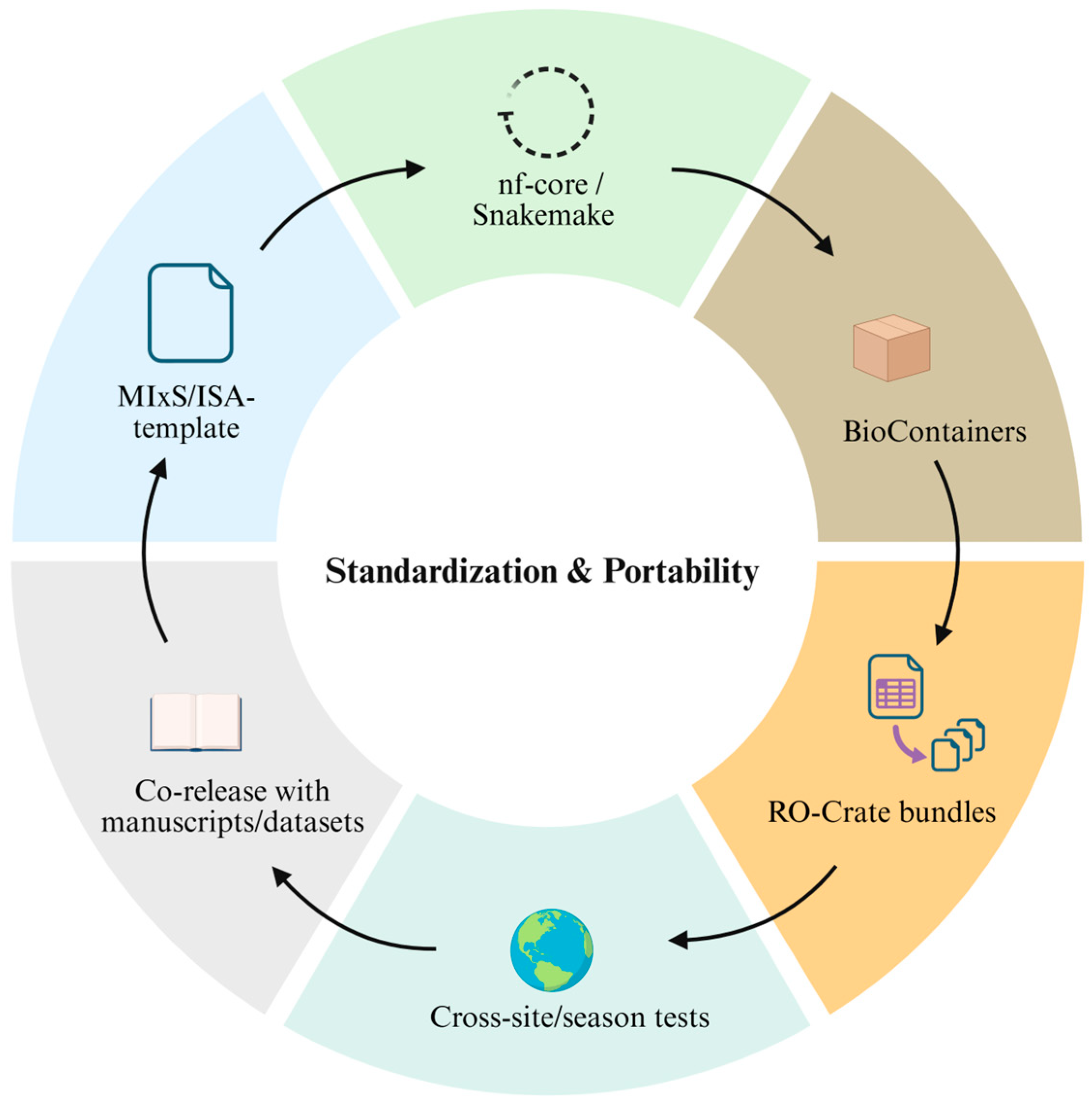
7.1. Standardization of Multi-Omics Workflows
7.2. Linking Microbiome Data to Plant Phenotypes
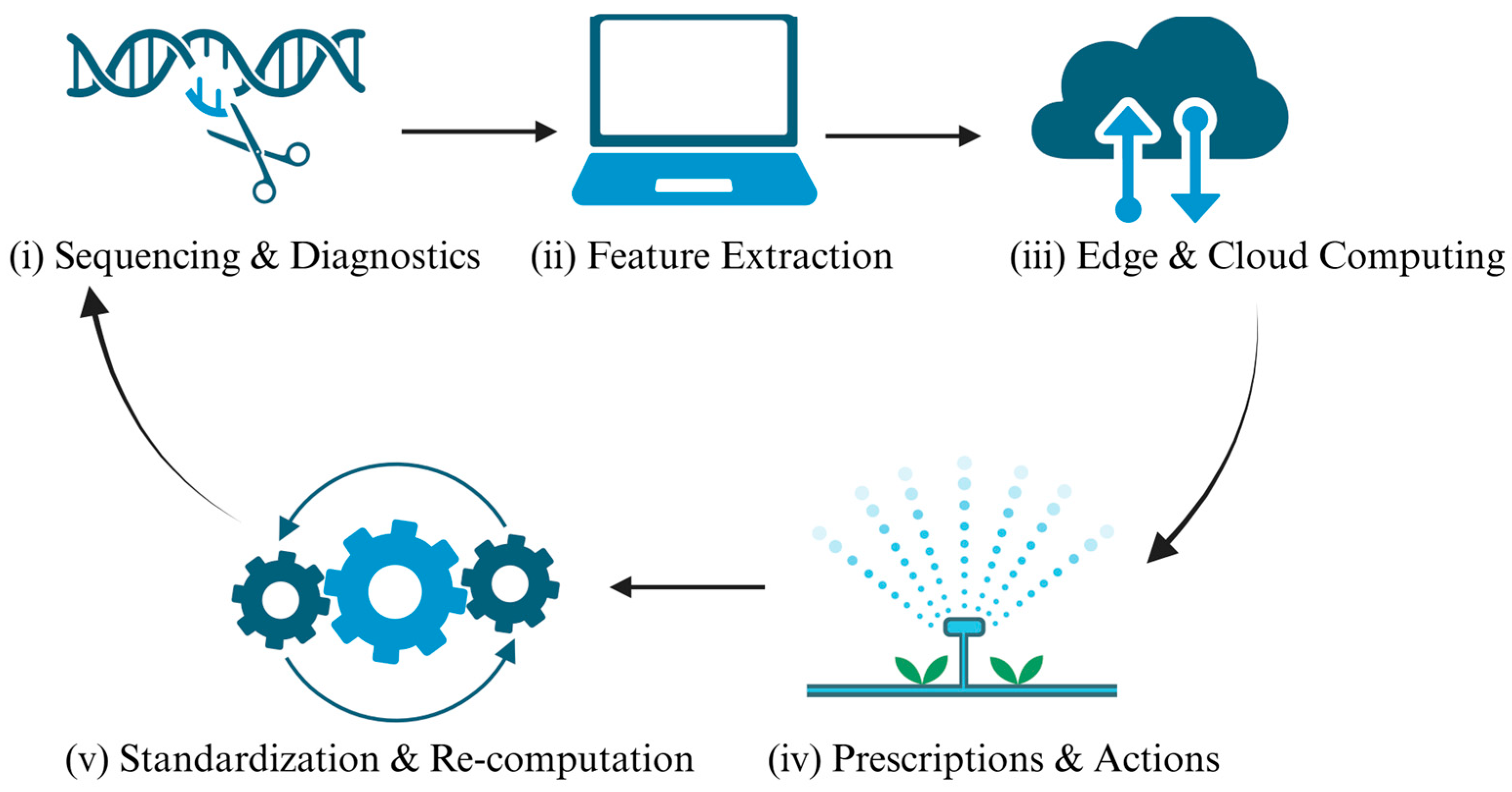
7.3. Real-Time Monitoring and Prospects for Precision Agriculture
8. Conclusions
Author Contributions
Funding
Institutional Review Board Statement
Informed Consent Statement
Data Availability Statement
Conflicts of Interest
Abbreviations
| 16S rRNA | 16S ribosomal RNA |
| 2D-GE | two-dimensional gel electrophoresis |
| ABC | ATP-binding cassette |
| ACC | 1-aminocyclopropane-1-carboxylic acid |
| ABA | abscisic acid |
| AMF | arbuscular mycorrhizal fungi |
| ARGs | antibiotic resistance genes |
| ASVs | Amplicon Sequence Variants |
| AutoML | automated machine learning |
| CI | continuous integration |
| CCA | canonical correlation analysis |
| CRISPR | clustered regularly interspaced short palindromic repeats |
| CRISPR-Cas | clustered regularly interspaced short palindromic repeats–CRISPR-associated systems |
| Ct | cycle threshold |
| DADA2 | Divisive Amplicon Denoising Algorithm 2 |
| DCL | Dicer-like protein |
| ddPCR | droplet digital PCR |
| DIABLO | Data Integration Analysis for Biomarker discovery using Latent cOmponents |
| dPCR | digital PCR |
| eggNOG | evolutionary genealogy of genes: Non-supervised Orthologous Groups |
| ET | ethylene |
| FAIR | Findable, Accessible, Interoperable and Reusable |
| GNNs | graph neural networks |
| GO | Gene Ontology |
| GRNs | gene regulatory networks |
| GTDB | Genome Taxonomy Database |
| HTS | high-throughput sequencing |
| HSI | hyperspectral imaging |
| IAA | indole-3-acetic acid |
| ISA | Investigation/Study/Assay |
| ISR | induced systemic resistance |
| ITS | internal transcribed spacer |
| JA | jasmonic acid |
| JFA | joint factor analysis |
| KEGG | Kyoto Encyclopedia of Genes and Genomes |
| LAI | leaf area index |
| LFQ | label-free quantification |
| LUPINE | LongitUdinal modelling with Partial least squares regression for NEtwork inference |
| MetaCyc | MetaCyc metabolic pathway database |
| MetaPhlAn | Metagenomic Phylogenetic Analysis |
| MIAME | Minimum Information About a Microarray Experiment |
| MIAPE | Minimum Information About a Proteomics Experiment |
| MIQE | Minimum Information for Publication of Quantitative Real-Time PCR Experiments |
| MIMARKS | Minimum Information about a Marker Gene Sequence |
| MIxS | Minimum Information about any (x) Sequence |
| MOFA | Multi-Omics Factor Analysis |
| narG | nitrate reductase alpha subunit gene (nitrate reduction) |
| NCBI | National Center for Biotechnology Information |
| nifH | nitrogenase iron protein gene (nitrogen fixation) |
| PCR | polymerase chain reaction |
| PCA | principal component analysis |
| PGPMs | plant growth-promoting microbes |
| PGPR | plant growth-promoting rhizobacteria |
| PlantTFDB | Plant Transcription Factor Database |
| PLS | partial least squares |
| PLS-DA | partial least squares discriminant analysis |
| POD | peroxidase |
| PSFs | plant–soil feedbacks |
| qPCR | quantitative real-time PCR |
| QIIME 2 | Quantitative Insights Into Microbial Ecology 2 |
| QTLs | quantitative trait loci |
| RDP | Ribosomal Database Project |
| RefSeq | NCBI Reference Sequence (RefSeq) database |
| RO-Crate | Research Object Crate (for packaging research data) |
| RTL | RefSeq Targeted Loci |
| SA | salicylic acid |
| SAR | systemic acquired resistance |
| scRNA-seq | single-cell RNA sequencing |
| SILVA | SILVA rRNA gene database |
| siRNAs | small interfering RNAs |
| SOD | superoxide dismutase |
| SynComs | synthetic microbial communities |
| UAV | unmanned aerial vehicle |
| UNITE | UNITE database for molecular identification of fungi |
| VOCs | volatile organic compounds |
| WGCNA | Weighted Gene Co-expression Network Analysis |
References
- Zhang, N.; Nunan, N.; Hirsch, P.R.; Sun, B.; Zhou, J.; Liang, Y. Theory of microbial coexistence in promoting soil–plant ecosystem health. Biol. Fertil. Soils 2021, 57, 897–911. [Google Scholar] [CrossRef]
- Rudgers, J.A.; Afkhami, M.E.; Bell-Dereske, L.; Chung, Y.A.; Crawford, K.M.; Kivlin, S.N.; Mann, M.A.; Nuñez, M.A. Climate disruption of plant–microbe interactions. Annu. Rev. Ecol. Evol. Syst. 2020, 51, 561–586. [Google Scholar] [CrossRef]
- Sharma, B.; Singh, B.N.; Dwivedi, P.; Rajawat, M.V.S. Interference of climate change on plant–microbe interaction: Present and Future Prospects. Front. Agron. 2022, 3, 725804. [Google Scholar] [CrossRef]
- Pugnaire, F.I.; Morillo, J.A.; Peñuelas, J.; Reich, P.B.; Bardgett, R.D.; Gaxiola, A.; Wardle, D.A.; van der Putten, W.H. Climate change effects on plant–soil feedbacks and consequences for biodiversity and functioning of terrestrial ecosystems. Sci. Adv. 2019, 5, eaaz1834. [Google Scholar] [CrossRef]
- Silva, L.C.R.; Lambers, H. Soil–plant–atmosphere interactions: Structure, function, and predictive scaling for climate change mitigation. Plant Soil 2021, 461, 5–27. [Google Scholar] [CrossRef]
- Yan, X.; Levine, J.M.; Kandlikar, G.S. A quantitative synthesis of soil microbial effects on plant species coexistence. Proc. Natl. Acad. Sci. USA 2022, 119, e2122088119. [Google Scholar] [CrossRef]
- Reynolds, H.L.; Packer, A.; Bever, J.D.; Clay, K. Grassroots ecology: Plant–microbe–soil interactions as drivers of plant community structure and dynamics. Ecology 2003, 84, 2281–2291. [Google Scholar] [CrossRef]
- Xi, N.; Long, J.R.D.; Davison, J.; Kardol, P.; Forero, L.E.; Zobel, M.; Semchenko, M. Plant–soil microbial interactions as modulators of species coexistence and productivity. Trends Ecol. Evol. 2025, 40, 673–686. [Google Scholar] [CrossRef] [PubMed]
- Hassani, M.A.; Durán, P.; Hacquard, S. Microbial interactions within the plant holobiont. Microbiome 2018, 6, 58. [Google Scholar] [CrossRef] [PubMed]
- Berg, G.; Rybakova, D.; Grube, M.; Köberl, M. The plant microbiome explored: Implications for experimental botany. J. Exp. Bot. 2016, 67, 995–1002. [Google Scholar] [CrossRef]
- Noman, M.; Ahmed, T.; Ijaz, U.; Shahid, M.; Azizullah; Li, D.; Manzoor, I.; Song, F. Plant–microbiome crosstalk: Dawning from composition and assembly of microbial community to improvement of disease resilience in plants. Int. J. Mol. Sci. 2021, 22, 6852. [Google Scholar] [CrossRef]
- Chauhan, P.; Sharma, N.; Tapwal, A.; Kumar, A.; Verma, G.S.; Meena, M.; Seth, C.S.; Swapnil, P. Soil microbiome: Diversity, benefits, and interactions with plants. Sustainability 2023, 15, 14643. [Google Scholar] [CrossRef]
- Zhang, J.; Cook, J.; Nearing, J.T.; Zhang, J.; Raudonis, R.; Glick, B.R.; Langille, M.G.; Cheng, Z. Harnessing the plant microbiome to promote the growth of agricultural crops. Microbiol. Res. 2021, 245, 126690. [Google Scholar] [CrossRef] [PubMed]
- Shade, A.; Jacques, M.-A.; Barret, M. Ecological patterns of seed microbiome diversity, transmission, and assembly. Curr. Opin. Microbiol. 2017, 37, 15–22. [Google Scholar] [CrossRef] [PubMed]
- Zhu, Y.-G.; Xiong, C.; Wei, Z.; Chen, Q.-L.; Ma, B.; Zhou, S.; Tan, J.; Zhang, L.; Cui, H.; Duan, G. Impacts of global change on the phyllosphere microbiome. New Phytol. 2022, 234, 1977–1986. [Google Scholar] [CrossRef] [PubMed]
- Debray, R.; Socolar, Y.; Kaulbach, G.; Guzman, A.; Hernandez, C.A.; Curley, R.; Dhond, A.; Bowles, T.; Koskella, B. Water stress and disruption of mycorrhizas induce parallel shifts in phyllosphere microbiome composition. New Phytol. 2022, 234, 2018–2031. [Google Scholar] [CrossRef]
- Trivedi, P.; Batista, B.D.; Bazany, K.E.; Singh, B.K. Plant–microbiome interactions under a changing world: Responses, consequences, and perspectives. New Phytol. 2022, 234, 1951–1959. [Google Scholar] [CrossRef] [PubMed]
- Vannier, N.; Mony, C.; Bittebière, A.-K.; Vandenkoornhuyse, P. Epigenetic mechanisms and microbiota as a toolbox for plant phenotypic adjustment to environment. Front. Plant Sci. 2015, 6, 1159. [Google Scholar] [CrossRef]
- Panke-Buisse, K.; Poole, A.C.; Goodrich, J.K.; Ley, R.E.; Kao-Kniffin, J. Selection on soil microbiomes reveals reproducible impacts on plant function. ISME J. 2015, 9, 980–989. [Google Scholar] [CrossRef]
- Liu, H.; Brettell, L.E.; Qiu, Z.; Singh, B.K. Microbiome-mediated stress resistance in plants. Trends Plant Sci. 2020, 25, 733–743. [Google Scholar] [CrossRef]
- Lloyd, K.G.; Steen, A.D.; Ladau, J.; Yin, J.; Crosby, L. Phylogenetically novel uncultured microbial cells dominate Earth microbiomes. mSystems 2018, 3, e00055-18. [Google Scholar] [CrossRef]
- Li, M.; Wen, J. Recent progress in the application of omics technologies in the study of bio-mining microorganisms from extreme environments. Microb. Cell Factories 2021, 20, 178. [Google Scholar] [CrossRef] [PubMed]
- Zhou, J.; He, Z.; Yang, Y.; Deng, Y.; Tringe, S.G.; Alvarez-Cohen, L. High-throughput metagenomic technologies for complex microbial community analysis: Open and closed formats. mBio 2015, 6, e02288-14. [Google Scholar] [CrossRef]
- Douglas, G.M.; Maffei, V.J.; Zaneveld, J.R.; Yurgel, S.N.; Brown, J.R.; Taylor, C.M.; Huttenhower, C.; Langille, M.G.I. PICRUSt2 for prediction of metagenome functions. Nat. Biotechnol. 2020, 38, 685–688. [Google Scholar] [CrossRef] [PubMed]
- Louca, S.; Parfrey, L.W.; Doebeli, M. Decoupling function and taxonomy in the global ocean microbiome. Science 2016, 353, 1272–1277. [Google Scholar] [CrossRef]
- Knight, R.; Vrbanac, A.; Taylor, B.C.; Aksenov, A.; Callewaert, C.; Debelius, J.; Gonzalez, A.; Kosciolek, T.; McCall, L.-I.; McDonald, D.; et al. Best practices for analysing microbiomes. Nat. Rev. Microbiol. 2018, 16, 410–422. [Google Scholar] [CrossRef] [PubMed]
- Chappell, L.; Russell, A.J.C.; Voet, T. Single-cell (multi)omics technologies. Annu. Rev. Genom. Hum. Genet. 2018, 19, 15–41. [Google Scholar] [CrossRef]
- Hasin, Y.; Seldin, M.; Lusis, A. Multi-omics approaches to disease. Genome Biol. 2017, 18, 83. [Google Scholar] [CrossRef]
- Xu, Y.-J.; Wu, X. Foodomics in microbiological investigations. Curr. Opin. Food Sci. 2015, 4, 51–55. [Google Scholar] [CrossRef]
- Noorbakhsh, F.; Aminian, A.; Power, C. Application of “omics” technologies for diagnosis and pathogenesis of neurological infections. Curr. Neurol. Neurosci. Rep. 2015, 15, 58. [Google Scholar] [CrossRef]
- Ezaouine, A.; Nouadi, B.; Sbaoui, Y.; Salam, M.R.; Anachad, O.; Saadoune, C.; El Messal, M.; Chegdani, F.; Bennis, F. Metagenomic characterization of the soil microbiota–Satureja nepeta axis and impact of edaphic factors. J. Plant Growth Regul. 2025, 44, 4304–4315. [Google Scholar] [CrossRef]
- Chen, Q.; Song, Y.; An, Y.; Lu, Y.; Zhong, G. Mechanisms and impact of rhizosphere microbial metabolites on crop health, traits, functional components: A comprehensive review. Molecules 2024, 29, 5922. [Google Scholar] [CrossRef] [PubMed]
- Liu, H.; Carvalhais, L.C.; Crawford, M.; Singh, E.; Dennis, P.G.; Pieterse, C.M.J.; Schenk, P.M. Inner plant values: Diversity, colonization, and benefits from endophytic bacteria. Front. Microbiol. 2017, 8, 2552. [Google Scholar] [CrossRef]
- Tariq, A.; Guo, S.; Farhat, F.; Shen, X. Engineering synthetic microbial communities: Diversity and applications in soil for plant resilience. Agronomy 2025, 15, 513. [Google Scholar] [CrossRef]
- Tang, Z.; Tan, W.; Li, R.; Weng, L.; Chen, X.; Xi, B.; Lv, D. Advances in rhizosphere microbiome and rhizosphere immunity effect: A review. J. Agric. Food Chem. 2025, 73, 14707–14721. [Google Scholar] [CrossRef]
- Ansabayeva, A.; Makhambetov, M.; Rebouh, N.Y.; Abdelkader, M.; Saudy, H.S.; Hassan, K.M.; Nasser, M.A.; Ali, M.A.A.; Ebrahim, M. Plant growth-promoting microbes for resilient farming systems: Mitigating environmental stressors and boosting crops productivity—A review. Horticulturae 2025, 11, 260. [Google Scholar] [CrossRef]
- Berendsen, R.L.; Pieterse, C.M.J.; Bakker, P.A.H.M. The rhizosphere microbiome and plant health. Trends Plant Sci. 2012, 17, 478–486. [Google Scholar] [CrossRef]
- Fierer, N. Embracing the unknown: Disentangling the complexities of the soil microbiome. Nat. Rev. Microbiol. 2017, 15, 579–590. [Google Scholar] [CrossRef]
- Wydro, U. Soil microbiome study based on DNA extraction: A review. Water 2022, 14, 3999. [Google Scholar] [CrossRef]
- Chiodi, C.; Moro, M.; Squartini, A.; Concheri, G.; Occhi, F.; Fornasier, F.; Cagnin, M.; Bertoldo, G.; Broccanello, C.; Stevanato, P. High-Throughput Isolation of Nucleic Acids from Soil. Soil Syst. 2020, 4, 3. [Google Scholar] [CrossRef]
- Pollock, J.; Glendinning, L.; Wisedchanwet, T.; Watson, M. The madness of microbiome: Attempting to find consensus “best practice” for 16S microbiome studies. Appl. Environ. Microbiol. 2018, 84, e02627-17. [Google Scholar] [CrossRef]
- Callahan, B.J.; McMurdie, P.J.; Rosen, M.J.; Han, A.W.; Johnson, A.J.A.; Holmes, S.P. DADA2: High-resolution sample inference from Illumina amplicon data. Nat. Methods 2016, 13, 581–583. [Google Scholar] [CrossRef]
- Ihrmark, K.; Bödeker, I.T.M.; Cruz-Martinez, K.; Friberg, H.; Kubartova, A.; Schenck, J.; Strid, Y.; Stenlid, J.; Brandström-Durling, M.; Clemmensen, K.E.; et al. New primers to amplify the fungal ITS2 region—Evaluation by 454-sequencing of artificial and natural communities. FEMS Microbiol. Ecol. 2012, 82, 666–677. [Google Scholar] [CrossRef]
- Quince, C.; Walker, A.W.; Simpson, J.T.; Loman, N.J.; Segata, N. Shotgun metagenomics, from sampling to analysis. Nat. Biotechnol. 2017, 35, 833–844. [Google Scholar] [CrossRef]
- Almeida, A.; Nayfach, S.; Boland, M.; Strozzi, F.; Beracochea, M.; Shi, Z.J.; Pollard, K.S.; Sakharova, E.; Parks, D.H.; Hugenholtz, P.; et al. A unified catalog of 204,938 reference genomes from the human gut microbiome. Nat. Biotechnol. 2021, 39, 105–114. [Google Scholar] [CrossRef] [PubMed]
- Bolyen, E.; Rideout, J.R.; Dillon, M.R.; Bokulich, N.A.; Abnet, C.C.; Al-Ghalith, G.A.; Alexander, H.; Alm, E.J.; Arumugam, M.; Asnicar, F.; et al. Reproducible, interactive, scalable and extensible microbiome data science using QIIME 2. Nat. Biotechnol. 2019, 37, 852–857. [Google Scholar] [CrossRef] [PubMed]
- Wood, D.E.; Lu, J.; Langmead, B. Improved metagenomic analysis with Kraken 2. Genome Biol. 2019, 20, 257. [Google Scholar] [CrossRef] [PubMed]
- Lu, J.; Breitwieser, F.P.; Thielen, P.; Salzberg, S.L. Bracken: Estimating species abundance in metagenomics data. PeerJ Comput. Sci. 2017, 3, e104. [Google Scholar] [CrossRef] [PubMed]
- Bustin, S.A.; Benes, V.; Garson, J.A.; Hellemans, J.; Huggett, J.; Kubista, M.; Mueller, R.; Nolan, T.; Pfaffl, M.W.; Shipley, G.L.; et al. The MIQE Guidelines: Minimum information for publication of quantitative real-time PCR experiments. Clin. Chem. 2009, 55, 611–622. [Google Scholar] [CrossRef]
- Hindson, B.J.; Ness, K.D.; Masquelier, D.A.; Belgrader, P.; Heredia, N.J.; Makarewicz, A.J.; Bright, I.J.; Lucero, M.Y.; Hiddessen, A.L.; Legler, T.C.; et al. High-throughput droplet digital PCR system for absolute quantitation of DNA copy number. Anal. Chem. 2011, 83, 8604–8610. [Google Scholar] [CrossRef] [PubMed]
- Sidstedt, M.; Rådström, P.; Hedman, J. PCR inhibition in qPCR, dPCR and MPS—Mechanisms and solutions. Anal. Bioanal. Chem. 2020, 412, 2009–2023. [Google Scholar] [CrossRef]
- de la Cruz Barron, M.; Kneis, D.; Elena, A.X.; Bagra, K.; Berendonk, T.U.; Klümper, U. Quantification of the mobility potential of antibiotic resistance genes through multiplexed ddPCR linkage analysis. FEMS Microbiol. Ecol. 2023, 99, fiad031. [Google Scholar] [CrossRef] [PubMed]
- Urich, T.; Lanzén, A.; Qi, J.; Huson, D.H.; Schleper, C.; Schuster, S.C. Simultaneous assessment of soil microbial community structure and function through analysis of the meta-transcriptome. PLoS ONE 2008, 3, e2527. [Google Scholar] [CrossRef]
- Turner, T.R.; Ramakrishnan, K.; Walshaw, J.; Heavens, D.; Alston, M.; Swarbreck, D.; Osbourn, A.; Grant, A.; Poole, P.S. Comparative metatranscriptomics reveals kingdom-level changes in the rhizosphere microbiome of plants. ISME J. 2013, 7, 2248–2258. [Google Scholar] [CrossRef] [PubMed]
- Khoiri, A.N.; Duangfoo, T.; Kusonmano, K.; Kittichotirat, W.; Laomettachit, T.; Cheevadhanarak, S.; Prommeenate, P.; Jirakkakul, J. Inoculation with a rhizobacteria synthetic community enhances sugarcane stress resilience through targeted modulation of plant-microbe interactions. Rhizosphere 2025, 35, 101142. [Google Scholar] [CrossRef]
- Tebele, S.M.; Marks, R.A.; Farrant, J.M. Microbial survival strategies in desiccated roots of Myrothamnus flabellifolia. Front. Microbiol. 2025, 16, 1560114. [Google Scholar] [CrossRef]
- Collin, A.; Pacwa-Plociniczak, M.; Plociniczak, T.; Novak, Ô.; Marzec, M.; Guo, W.; Simpson, C.G.; Daszkowska-Golec, A. Hormonal and transcriptomic regulation of drought adaptation in barley roots and leaves. Sci. Rep. 2025, 15, 16368. [Google Scholar] [CrossRef]
- Cheng, Z.; He, Y.; Wang, N.; Wu, L.; Xu, J.; Shi, J. Uncovering soil amendment-induced genomic and functional divergence in soybean rhizosphere microbiomes during cadmium-contaminated soil remediation: Novel insights from field multi-omics. Environ. Pollut. 2025, 368, 125787. [Google Scholar] [CrossRef]
- Noviana, Z.; Antonius, S.; Gafur, A. Rhizosphere meta-transcriptomics. In Plant Microbiome Engineering; Dharumadurai, D., Narayanan, A.S., Eds.; Springer: New York, NY, USA, 2025; pp. 367–375. [Google Scholar] [CrossRef]
- Tamrakar, K.; Miller, P.W.; Dolan, M.C.; Wijeratne, A.J. Assessment of rhizosphere microbial activity using optimized RNA extraction coupled with universal ribosomal RNA depletion techniques. BMC Methods 2025, 2, 7. [Google Scholar] [CrossRef]
- Zhang, Y.; Thompson, K.N.; Branck, T.; Yan, Y.; Nguyen, L.H.; Franzosa, E.A.; Huttenhower, C. Metatranscriptomics for the human microbiome and microbial community functional profiling. Annu. Rev. Biomed. Data Sci. 2021, 4, 279–311. [Google Scholar] [CrossRef]
- von Bergen, M.; Jehmlich, N.; Taubert, M.; Vogt, C.; Bastida, F.; Herbst, F.-A.; Schmidt, F.; Richnow, H.H.; Seifert, J. Insights from quantitative metaproteomics and protein-stable isotope probing into microbial ecology. ISME J. 2013, 7, 1877–1885. [Google Scholar] [CrossRef]
- Lin, W.; Wu, L.; Lin, S.; Zhang, A.; Zhou, M.; Lin, R.; Wang, H.; Chen, J.; Zhang, Z.; Lin, R. Metaproteomic analysis of ratoon sugarcane rhizospheric soil. BMC Microbiol. 2013, 13, 135. [Google Scholar] [CrossRef]
- Rana, D.; Pradhan, S.; Jadon, V.S. Tools and techniques to explore rhizomicrobiomes. In Rhizomicrobiome in Sustainable Agriculture and Environment; Bharati, B., Meena, R.S., Mishra, P.K., Bisht, J.K., Eds.; Elsevier: Amsterdam, The Netherlands, 2025; pp. 75–92. [Google Scholar] [CrossRef]
- Chukwuneme, C.F.; Babalola, O.O. Microbial diversity and function in the rhizosphere microbiome: Driving forces and monitoring approaches. Agrosyst. Geosci. Environ. 2025, 8, e70169. [Google Scholar] [CrossRef]
- Liu, S.; Ishfaq, M.; Yang, S.; Guo, Y.; Wang, Y.; Wang, Q.; Song, B. Boron-efficient varieties promote the green production of sugarbeets in boron-deficient environments by recruiting beneficial rhizosphere soil microorganisms via root exudates. Plant Physiol. Biochem. 2025, 229, 110322. [Google Scholar] [CrossRef] [PubMed]
- Wen, T.; Zhao, M.; Yuan, J.; Kowalchuk, G.A.; Shen, Q. Root exudates mediate plant defense against foliar pathogens by recruiting beneficial microbes. Soil Ecol. Lett. 2021, 3, 42–51. [Google Scholar] [CrossRef]
- Hafner, B.D.; Pietz, O.; King, W.L.; Scharfetter, J.B.; Bauerle, T.L. Early developmental shifts in root exudation profiles of five Zea mays L. genotypes. Plant Sci. 2025, 354, 112439. [Google Scholar] [CrossRef]
- Fracchia, F.; Guinet, F.; Engle, N.L.; Tschaplinski, T.J.; Veneault-Fourrey, C. Microbial colonisation rewires the composition and content of poplar root exudates, root and shoot metabolomes. Microbiome 2024, 12, 173. [Google Scholar] [CrossRef]
- He, D.; Singh, S.K.; Peng, L.; Kaushal, R.; Vílchez, J.I.; Shao, C.; Wu, X.; Zheng, S.; Morcillo, R.J.L.; Paré, P.W.; et al. Flavonoid-attracted Aeromonas sp. from the Arabidopsis root microbiome enhances plant dehydration resistance. ISME J. 2022, 16, 2622–2632. [Google Scholar] [CrossRef]
- Sánchez, A.L.; Stassen, J.H.M.; Furci, L.; Smith, L.M.; Ton, J. The role of DNA (de)methylation in immune responsiveness of Arabidopsis. Plant J. 2016, 88, 361–374. [Google Scholar] [CrossRef]
- Furci, L.; Jain, R.; Stassen, J.; Berkowitz, O.; Whelan, J.; Roquis, D.; Baillet, V.; Colot, V.; Johannes, F.; Ton, J. Identification and characterisation of hypomethylated DNA loci controlling quantitative resistance in Arabidopsis. eLife 2019, 8, e40655. [Google Scholar] [CrossRef] [PubMed]
- Alvarez, M.E.; Nota, F.; Cambiagno, D.A. Epigenetic control of plant immunity. Mol. Plant Pathol. 2010, 11, 563–576. [Google Scholar] [CrossRef]
- Annacondia, M.L.; Magerøy, M.H.; Martinez, G. Stress response regulation by epigenetic mechanisms: Changing of the guards. Physiol. Plant. 2018, 162, 239–250. [Google Scholar] [CrossRef]
- Kaushal, R.; Peng, L.; Singh, S.K.; Zhang, M.; Zhang, X.; Vílchez, J.I.; Wang, Z.; He, D.; Yang, Y.; Lv, S.; et al. Dicer-like proteins influence Arabidopsis root microbiota independent of RNA-directed DNA methylation. Microbiome 2021, 9, 57. [Google Scholar] [CrossRef]
- Wang, C.; Tai, H.; Chen, Y.; Zhai, Z.; Zhang, L.; Pu, Z.; Zhang, M.; Li, C.; Xie, Z. Soil microbiota modulates root transcriptome with divergent effects on maize growth under low and high phosphorus inputs. Plant Cell Environ. 2025, 48, 2132–2144. [Google Scholar] [CrossRef]
- Kaspari, M. The seventh macronutrient: How sodium shortfall ramifies through populations, food webs, and ecosystems. Ecol. Lett. 2020, 23, 1153–1168. [Google Scholar] [CrossRef]
- Martos, S.; Busoms, S.; Pérez-Martín, L.; Llugany, M.; Cabot, C.; Poschenrieder, C. Identifying the specific root microbiome of the hyperaccumulator Noccaea brachypetala growing in non-metalliferous soils. Front. Microbiol. 2021, 12, 639997. [Google Scholar] [CrossRef] [PubMed]
- Zeng, H.; Hu, W.; Liu, G.; Xu, H.; Wei, Y.; Zhang, J.; Shi, H. Microbiome-wide association studies between phyllosphere microbiota and ionome highlight the beneficial symbiosis of Lactococcus lactis in alleviating aluminium in cassava. Plant Physiol. Biochem. 2022, 171, 66–74. [Google Scholar] [CrossRef]
- Harbort, C.J.; Hashimoto, M.; Inoue, H.; Niu, Y.; Guan, R.; Rombolà, A.D.; Kopriva, S.; Voges, M.J.; Sattely, E.S.; Garrido-Oter, R.; et al. Root-secreted coumarins and the microbiota interact to improve iron nutrition in Arabidopsis. Cell Host Microbe 2020, 28, 825–837.e6. [Google Scholar] [CrossRef] [PubMed]
- Awada, L.; Phillips, P.W.B.; Bodan, A.M. The evolution of plant phenomics: Global insights, trends, and collaborations (2000–2021). Front. Plant Sci. 2024, 15, 1410738. [Google Scholar] [CrossRef]
- Jangra, S.; Chaudhary, V.; Yadav, R.C.; Yadav, N.R. High-throughput phenotyping: A platform to accelerate crop improvement. Phenomics 2021, 1, 31–53. [Google Scholar] [CrossRef]
- Zhang, Y.; Gao, P.; Yuan, J.S. Plant protein–protein interaction network and interactome. Curr. Genom. 2010, 11, 40–46. [Google Scholar] [CrossRef] [PubMed]
- McCormack, M.E.; Lopez, J.A.; Crocker, T.H.; Mukhtar, M.S. Making the right connections: Network biology and plant immune system dynamics. Curr. Plant Biol. 2016, 5, 2–12. [Google Scholar] [CrossRef]
- Ji, B.; Nielsen, J. From Next-Generation Sequencing to Systematic Modeling of the Gut Microbiome. Front. Genet. 2015, 6, 219. [Google Scholar] [CrossRef]
- Xu, L.; Pierroz, G.; Wipf, H.M.-L.; Gao, C.; Taylor, J.W.; Lemaux, P.G.; Coleman-Derr, D. Holo-omics for deciphering plant–microbiome interactions. Microbiome 2021, 9, 69. [Google Scholar] [CrossRef] [PubMed]
- Daniel, B.B.J.; Steiger, Y.; Sintsova, A.; Field, C.M.; Nguyen, B.D.; Schubert, C.; Cherrak, Y.; Sunagawa, S.; Hardt, W.-D.; Vorholt, J.A. Assessing microbiome population dynamics using wild-type isogenic standardized hybrid (WISH)-tags. Nat. Microbiol. 2024, 9, 1103–1116. [Google Scholar] [CrossRef] [PubMed]
- Mohapatra, B.; Pattnaik, S.; Gupta, A. New-Age genomic measures for uncovering plant–microbiome interactions: Tools, pipelines, and guidance map for genomic data mining. In Advances in Agricultural and Industrial Microbiology: Volume 2—Applications of Microbes for Sustainable Agriculture and In-Silico Strategies; Nayak, S.K., Baliyarsingh, B., Singh, A., Mannazzu, I., Mishra, B.B., Eds.; Springer Nature: Singapore, 2022; pp. 207–232. [Google Scholar] [CrossRef]
- Weßling, R.; Epple, P.; Altmann, S.; He, Y.; Yang, L.; Henz, S.R.; McDonald, N.; Wiley, K.; Bader, K.C.; Gläßer, C.; et al. Convergent targeting of a common host protein-network by pathogen effectors from three kingdoms of life. Cell Host Microbe 2014, 16, 364–375. [Google Scholar] [CrossRef]
- Fan, B.-L.; Chen, L.-H.; Chen, L.-L.; Guo, H. Integrative multi-omics approaches for identifying and characterizing biological elements in crop traits: Current progress and future prospects. Int. J. Mol. Sci. 2025, 26, 1466. [Google Scholar] [CrossRef]
- Wilkinson, M.D.; Dumontier, M.; Aalbersberg, I.J.J.; Appleton, G.; Axton, M.; Baak, A.; Blomberg, N.; Boiten, J.W.; da Silva Santos, L.B.; Bourne, P.E.; et al. The FAIR Guiding Principles for scientific data management and stewardship. Sci. Data 2016, 3, 160018. [Google Scholar] [CrossRef]
- Brazma, A.; Hingamp, P.; Quackenbush, J.; Sherlock, G.; Spellman, P.; Stoeckert, C.; Aach, J.; Ansorge, W.; Ball, C.A.; Causton, H.C.; et al. Minimum information about a microarray experiment (MIAME)—Toward standards for microarray data. Nat. Genet. 2001, 29, 365–371. [Google Scholar] [CrossRef]
- Taylor, C.F.; Paton, N.W.; Lilley, K.S.; Binz, P.-A.; Julian, R.K.; Jones, A.; Zhu, W.; Apweiler, R.; Aebersold, R.; Deutsch, E.; et al. The minimum information about a proteomics experiment (MIAPE). Nat. Biotechnol. 2007, 25, 887–893. [Google Scholar] [CrossRef]
- Yilmaz, P.; Kottmann, R.; Field, D.; Knight, R.; Cole, J.R.; Amaral-Zettler, L.; Gilbert, J.A.; Karsch-Mizrachi, I.; Johnston, A.; Cochrane, G.; et al. Minimum information about a marker gene sequence (MIMARKS) and minimum information about any (x) sequence (MIxS) specifications. Nat. Biotechnol. 2011, 29, 415–420. [Google Scholar] [CrossRef]
- Misra, B.B.; Langefeld, C.; Olivier, M.; Cox, L.A. Integrated omics: Tools, advances and future approaches. J. Mol. Endocrinol. 2019, 62, R21–R45. [Google Scholar] [CrossRef]
- Cembrowska-Lech, D.; Krzemińska, A.; Miller, T.; Nowakowska, A.; Adamski, C.; Radaczyńska, M.; Mikiciuk, G.; Mikiciuk, M. An integrated multi-omics and artificial intelligence framework for advanced plant phenotyping in horticulture. Biology 2023, 12, 1298. [Google Scholar] [CrossRef] [PubMed]
- Nguyen, T.; Tagett, R.; Diaz, D.; Draghici, S. A novel approach for data integration and disease subtyping. Genome Res. 2017, 27, 2025–2039. [Google Scholar] [CrossRef] [PubMed]
- Rohart, F.; Gautier, B.; Singh, A.; Lê Cao, K.-A. mixOmics: An R package for ‘omics feature selection and multiple data integration. PLoS Comput. Biol. 2017, 13, e1005752. [Google Scholar] [CrossRef]
- Argelaguet, R.; Velten, B.; Arnol, D.; Dietrich, S.; Zenz, T.; Marioni, J.C.; Buettner, F.; Huber, W.; Stegle, O. Multi-Omics Factor Analysis—a framework for unsupervised integration of multi-omics data sets. Mol. Syst. Biol. 2018, 14, e8124. [Google Scholar] [CrossRef]
- Dugourd, A.; Kuppe, C.; Sciacovelli, M.; Gjerga, E.; Gabor, A.; Emdal, K.B.; Vieira, V.; Bekker-Jensen, D.B.; Kranz, J.; Bindels, E.; et al. Causal integration of multi-omics data with prior knowledge to generate mechanistic hypotheses. Mol. Syst. Biol. 2021, 17, e9730. [Google Scholar] [CrossRef] [PubMed]
- Langfelder, P.; Horvath, S. WGCNA: An R package for weighted correlation network analysis. BMC Bioinform. 2008, 9, 559. [Google Scholar] [CrossRef]
- Jamil, I.N.; Remali, J.; Azizan, K.A.; Nor Muhammad, N.A.; Arita, M.; Goh, H.-H.; Aizat, W.M. Systematic multi-omics integration (MOI) approach in plant systems biology. Front. Plant Sci. 2020, 11, 944. [Google Scholar] [CrossRef]
- Yuan, J.; Zhao, J.; Wen, T.; Zhao, M.; Li, R.; Goossens, P.; Huang, Q.; Bai, Y.; Vivanco, J.M.; Kowalchuk, G.A.; et al. Root exudates drive the soil-borne legacy of aboveground pathogen infection. Microbiome 2018, 6, 156. [Google Scholar] [CrossRef]
- Rai, S.; Omar, A.F.; Rehan, M.; Al-Turki, A.; Sagar, A.; Ilyas, N.; Sayyed, R.Z.; Hasanuzzaman, M. Crop microbiome: Their role and advances in molecular and omic techniques for the sustenance of agriculture. Planta 2022, 257, 27. [Google Scholar] [CrossRef] [PubMed]
- Sawant, S.B.; Mitra, D.; Raju, R.S.; Nandulal, I.S.; Prabhukarthikeyan, S.R.; Dhole, A.; Singh, P.; Bhargava, P.; Dev, D.; Patil, S.; et al. Microbiome: What if the next green revolution is microbial? Physiol. Mol. Plant Pathol. 2025, 139, 102789. [Google Scholar] [CrossRef]
- Li, X.; Xiao, R.; Tao, Y. Enhancing plant stress resilience and agricultural sustainability through rhizosphere microbiome optimization. Plant Soil 2025, 513, 1711–1723. [Google Scholar] [CrossRef]
- Srikanth, P.; Sivakumar, D.; Sharma, A.; Kaushik, N. Recent developments in omics techniques for improving plant abiotic stress using microbes. Int. J. Environ. Sci. Technol. 2025, 22, 3787–3810. [Google Scholar] [CrossRef]
- Sahoo, A.; Yadav, G.; Mehta, T.; Meena, M.; Swapnil, P. Omics-driven insights into plant growth-promoting microorganisms for sustainable agriculture. Discov. Sustain. 2025, 6, 659. [Google Scholar] [CrossRef]
- Kumar, U.; Raj, S.; Sreenikethanam, A.; Maddheshiya, R.; Kumari, S.; Han, S.; Kapoor, K.K.; Bhaskar, R.; Bajhaiya, A.K.; Gahlot, D.K. Multi-omics approaches in plant–microbe interactions hold enormous promise for sustainable agriculture. Agronomy 2023, 13, 1804. [Google Scholar] [CrossRef]
- Srivastava, A.K.; Riaz, A.; Jiang, J.; Li, X.; Uzair, M.; Mishra, P.; Zeb, A.; Zhang, J.; Singh, R.P.; Luo, L.; et al. Advancing climate-resilient sorghum: The synergistic role of plant biotechnology and microbial interactions. Rice 2025, 18, 41. [Google Scholar] [CrossRef]
- Dwivedi, S.L.; Vetukuri, R.R.; Kelbessa, B.G.; Gepts, P.; Heslop-Harrison, P.; Araujo, A.S.; Sharma, S.; Ortiz, R. Exploitation of rhizosphere microbiome biodiversity in plant breeding. Trends Plant Sci. 2025, 30, 1033–1045. [Google Scholar] [CrossRef]
- Raza, A.; Khare, T.; Zhang, X.; Rahman, Md. M.; Hussain, M.; Gill, S.S.; Chen, Z.-H.; Zhou, M.; Hu, Z.; Varshney, R.K. Novel strategies for designing climate-smart crops to ensure sustainable agriculture and future food security. J. Sustain. Agric. Environ. 2025, 4, e70048. [Google Scholar] [CrossRef]
- Pandey, K.; Saharan, B.S. Soil microbiomes: A promising strategy for boosting crop yield and advancing sustainable agriculture. Discov. Agric. 2025, 3, 54. [Google Scholar] [CrossRef]
- Verma, S.K.; Dave, A.; Israr, J.; Singh, D.; Misra, S. Rhizosphere engineering for agriculture and ecological sustainability. In Plant-Microbiome Interactions for Climate-Resilient Agriculture; Pankaj, U., Babele, P., Singh, A.K., Eds.; Springer Nature: Singapore, 2025; pp. 259–279. [Google Scholar] [CrossRef]
- Rocca-Serra, P.; Brandizi, M.; Maguire, E.; Sklyar, N.; Taylor, C.; Begley, K.; Field, D.; Harris, S.; Hide, W.; Hofmann, O.; et al. ISA software suite: Supporting standards-compliant experimental annotation and enabling curation at the community level. Bioinformatics 2010, 26, 2354–2356. [Google Scholar] [CrossRef]
- Köster, J.; Rahmann, S. Snakemake—A scalable bioinformatics workflow engine. Bioinformatics 2012, 28, 2520–2522. [Google Scholar] [CrossRef]
- da Veiga Leprevost, F.; Grüning, B.A.; Aflitos, S.A.; Röst, H.L.; Uszkoreit, J.; Barsnes, H.; Vaudel, M.; Moreno, P.; Gatto, L.; Weber, J.; et al. BioContainers: An open-source and community-driven framework for software standardization. Bioinformatics 2017, 33, 2580–2582. [Google Scholar] [CrossRef]
- Ewels, P.A.; Peltzer, A.; Fillinger, S.; Patel, H.; Alneberg, J.; Wilm, A.; Garcia, M.U.; Di Tommaso, P.; Nahnsen, S. The nf-core framework for community-curated bioinformatics pipelines. Nat. Biotechnol. 2020, 38, 276–278. [Google Scholar] [CrossRef]
- Soiland-Reyes, S.; Sefton, P.; Crosas, M.; Castro, L.J.; Coppens, F.; Fernández, J.M.; Garijo, D.; Grüning, B.; La Rosa, M.; Leo, S.; et al. Packaging research artefacts with RO-Crate. Data Sci. 2022, 5, 97–138. [Google Scholar] [CrossRef]
- Kodikara, S.; Lê Cao, K.-A. Microbial network inference for longitudinal microbiome studies with LUPINE. Microbiome 2025, 13, 64. [Google Scholar] [CrossRef]
- Walters, W.A.; Jin, Z.; Youngblut, N.; Wallace, J.G.; Sutter, J.; Zhang, W.; González-Peña, A.; Peiffer, J.; Koren, O.; Shi, Q.; et al. Large-scale replicated field study of maize rhizosphere identifies heritable microbes. Proc. Natl. Acad. Sci. USA 2018, 115, 7368–7373. [Google Scholar] [CrossRef]
- Peiffer, J.A.; Spor, A.; Koren, O.; Jin, Z.; Tringe, S.G.; Dangl, J.L.; Buckler, E.S.; Ley, R.E. Diversity and heritability of the maize rhizosphere microbiome under field conditions. Proc. Natl. Acad. Sci. USA 2013, 110, 6548–6553. [Google Scholar] [CrossRef]
- Deng, S.; Caddell, D.F.; Xu, G.; Dahlen, L.; Washington, L.; Yang, J.; Coleman-Derr, D. Genome-wide association study reveals plant loci controlling heritability of the rhizosphere microbiome. ISME J. 2021, 15, 3181–3194. [Google Scholar] [CrossRef]
- Meier, M.A.; Xu, G.; Lopez-Guerrero, M.G.; Li, G.; Smith, C.; Sigmon, B.; Herr, J.R.; Alfano, J.R.; Ge, Y.; Schnable, J.C.; et al. Association analyses of host genetics, root-colonizing microbes, and plant phenotypes under different nitrogen conditions in maize. eLife 2022, 11, e75790. [Google Scholar] [CrossRef] [PubMed]
- Zhang, J.; Liu, W.; Bu, J.; Lin, Y.; Bai, Y. Host genetics regulate the plant microbiome. Curr. Opin. Microbiol. 2023, 72, 102268. [Google Scholar] [CrossRef] [PubMed]
- Brachi, B.; Filiault, D.; Whitehurst, H.; Darme, P.; Le Gars, P.; Le Mentec, M.; Morton, T.C.; Kerdaffrec, E.; Rabanal, F.; Anastasio, A.; et al. Plant genetic effects on microbial hubs impact host fitness in repeated field trials. Proc. Natl. Acad. Sci. USA 2022, 119, e2201285119. [Google Scholar] [CrossRef]
- Marschmann, G.L.; Tang, J.; Zhalnina, K.; Karaoz, U.; Cho, H.; Le, B.; Pett-Ridge, J.; Brodie, E.L. Predictions of rhizosphere microbiome dynamics with a genome-informed and trait-based energy budget model. Nat. Microbiol. 2024, 9, 421–433. [Google Scholar] [CrossRef]
- Boykin, L.M.; Sseruwagi, P.; Alicai, T.; Ateka, E.; Mohammed, I.U.; Stanton, J.-A.L.; Kayuki, C.; Mark, D.; Fute, T.; Erasto, J.; et al. Tree Lab: Portable genomics for early detection of plant viruses and pests in Sub-Saharan Africa. Genes 2019, 10, 632. [Google Scholar] [CrossRef]
- Tyler, A.D.; McAllister, J.; Stapleton, H.; Gauci, P.; Antonation, K.; Thirkettle-Watts, D.; Corbett, C.R. Field-based detection of bacteria using nanopore sequencing: Method evaluation for biothreat detection in complex samples. PLoS ONE 2023, 18, e0295028. [Google Scholar] [CrossRef] [PubMed]
- Pecman, A.; Adams, I.; Gutiérrez-Aguirre, I.; Fox, A.; Boonham, N.; Ravnikar, M.; Kutnjak, D. Systematic comparison of nanopore and Illumina sequencing for the detection of plant viruses and viroids using total RNA sequencing approach. Front. Microbiol. 2022, 13, 883921. [Google Scholar] [CrossRef]
- Wang, Y.; Zhao, Y.; Bollas, A.; Wang, Y.; Au, K.F. Nanopore sequencing technology, bioinformatics and applications. Nat. Biotechnol. 2021, 39, 1348–1365. [Google Scholar] [CrossRef]
- Hak, H.; Ostendorp, S.; Reza, A.; Ishgur Greenberg, S.; Pines, G.; Kehr, J.; Spiegelman, Z. Rapid on-site detection of crop RNA viruses using CRISPR/Cas13a. J. Exp. Bot. 2024, 75, 1604–1616. [Google Scholar] [CrossRef]
- Tanny, T.; Sallam, M.; Soda, N.; Nguyen, N.-T.; Alam, M.; Shiddiky, M.J.A. CRISPR/Cas-based diagnostics in agricultural applications. J. Agric. Food Chem. 2023, 71, 11765–11788. [Google Scholar] [CrossRef]
- Chakhvashvili, E.; Machwitz, M.; Antala, M.; Rozenstein, O.; Prikaziuk, E.; Schlerf, M.; Naethe, P.; Wan, Q.; Komárek, J.; Klouek, T.; et al. Crop stress detection from UAVs: Best practices and lessons learned for exploiting sensor synergies. Precis. Agric. 2024, 25, 2614–2642. [Google Scholar] [CrossRef]
- Ram, B.G.; Oduor, P.; Igathinathane, C.; Howatt, K.; Sun, X. A systematic review of hyperspectral imaging in precision agriculture: Analysis of its current state and future prospects. Comput. Electron. Agric. 2024, 222, 109037. [Google Scholar] [CrossRef]
- Matese, A.; Czarnecki, J.M.P.; Samiappan, S.; Moorhead, R. Are unmanned aerial vehicle-based hyperspectral imaging and machine learning advancing crop science? Trends Plant Sci. 2024, 29, 196–209. [Google Scholar] [CrossRef] [PubMed]



| Kit | Sample Amount | Lysis Method | Suitable Samples | Targets | Applications |
|---|---|---|---|---|---|
| MoBio PowerSoil® | 0.25 g | Bead-beating | Soil, fecal, stool, biosolid | Bacteria, fungi, algae, actinomycetes, nematodes | PCR/qPCR/NGS |
| E.Z.N.A.® Soil DNA | 1.00 g | Bead-beating | Clay, sandy, peaty, chalky, loamy soils | Bacteria, fungi, yeast, algae | PCR/Southern blot/NGS |
| Qiagen DNeasy PowerSoil Pro | 0.25 g | Bead tube + chemical | Compost, clay, topsoil | Bacteria, fungi | PCR/qPCR/NGS |
| MP Biomedicals FastDNA Spin | 0.50 g | Bead-beating + chemical | Soil, sediment, sludge, compost, manure, rhizosphere | Bacteria, fungi, algae, nematodes | PCR/qPCR/NGS |
| Norgen Soil DNA | 0.25 g | Bead tube + chemical | Soil with humic acids | Bacteria, fungi, algae | PCR |
| Automated magnetic bead workflow | 0.40 g | Bead-beating + magnetic beads | Agricultural soils with varying textures and organic matter | Bacteria, fungi, archaea | PCR/qPCR/NGS; high-throughput screening |
Disclaimer/Publisher’s Note: The statements, opinions and data contained in all publications are solely those of the individual author(s) and contributor(s) and not of MDPI and/or the editor(s). MDPI and/or the editor(s) disclaim responsibility for any injury to people or property resulting from any ideas, methods, instructions or products referred to in the content. |
© 2026 by the authors. Licensee MDPI, Basel, Switzerland. This article is an open access article distributed under the terms and conditions of the Creative Commons Attribution (CC BY) license.
Share and Cite
Li, S.; Chiodi, C.; Maucieri, C.; Della Lucia, M.C.; Zardinoni, G.; Ravi, S.; Squartini, A.; Concheri, G.; Geng, G.; Wang, Y.; et al. Profiling Soil–Plant–Microbial Communities: DNA and Multi-Omics Techniques. Genes 2026, 17, 303. https://doi.org/10.3390/genes17030303
Li S, Chiodi C, Maucieri C, Della Lucia MC, Zardinoni G, Ravi S, Squartini A, Concheri G, Geng G, Wang Y, et al. Profiling Soil–Plant–Microbial Communities: DNA and Multi-Omics Techniques. Genes. 2026; 17(3):303. https://doi.org/10.3390/genes17030303
Chicago/Turabian StyleLi, Shunlei, Claudia Chiodi, Carmelo Maucieri, Maria Cristina Della Lucia, Giulia Zardinoni, Samathmika Ravi, Andrea Squartini, Giuseppe Concheri, Gui Geng, Yuguang Wang, and et al. 2026. "Profiling Soil–Plant–Microbial Communities: DNA and Multi-Omics Techniques" Genes 17, no. 3: 303. https://doi.org/10.3390/genes17030303
APA StyleLi, S., Chiodi, C., Maucieri, C., Della Lucia, M. C., Zardinoni, G., Ravi, S., Squartini, A., Concheri, G., Geng, G., Wang, Y., & Stevanato, P. (2026). Profiling Soil–Plant–Microbial Communities: DNA and Multi-Omics Techniques. Genes, 17(3), 303. https://doi.org/10.3390/genes17030303