

- Article

Unveiling Place-Based Effects at Scale: A Multiscale Geographically Weighted Regression of Food Deserts and Cardiovascular Risk in Chile
- Francisco Vergara-Perucich,
- Leslie Landaeta-Díaz and
- Carlos Aguirre-Nuñez
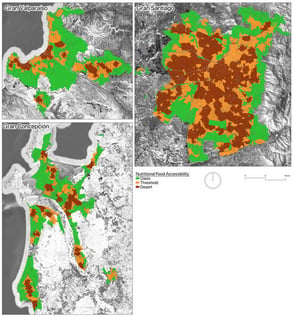
Background/Objectives: Cardiovascular diseases (CVD) in Chile are profoundly shaped by place-based determinants of diet. This study examines the association between food deserts—areas with structurally limited access to nutritious, affordable food—and population-level cardiovascular risk across Chile’s three largest metropolitan areas (Santiago, Valparaíso, Concepción). Methods: We constructed a geospatial food desert index combining OpenStreetMap-derived retail accessibility with census information, and linked it to georeferenced cardiovascular health records. To overcome the limitations of global models that assume spatial stationarity, we applied Multiscale Geographically Weighted Regression (MGWR) to allow coefficients to vary across space and to recover variable-specific process scales. Results: The MGWR results indicate pronounced spatial non-stationarity in the food desert–CVD association. The relationship is predominantly positive across Gran Valparaíso, predominantly negative in Gran Concepción, and highly mixed within Gran Santiago, evidencing divergent local mechanisms rather than a single national pattern. Conclusions: The observed heterogeneity undermines “one-size-fits-all” national interventions and supports place-sensitive, equity-oriented strategies. Policy implications include territorially tailored food-retail regulation and primary-care outreach, co-designed with local actors, with MGWR providing a critical analytic basis for actionable, context-specific public health planning.
10 March 2026