



The Ecology of University Teaching: Reframing Academic Practice Through Systems, Metaphors, and Relational Meaning-Making
A Special Issue of Education Sciences (ISSN 2227-7102) belonging to the section "Higher Education".
Deadline for manuscript submissions: 30 April 2027 | Viewed by 223
Editors

Interests: university pedagogy and the professional development of university academics; neoliberal university governance and the move towards an ecological university
Special Issues, Collections and Topics in MDPI journals

Interests: university pedagogy and the professional development of university academics; neoliberal university governance and the move towards an ecological university; academic development and institutional transformation in higher education; threshold concepts, liminality, relationality and epistemic transformation; concept mapping, knowledge representation and meaningful learning in science education
Special Issue Information
Dear Colleagues,
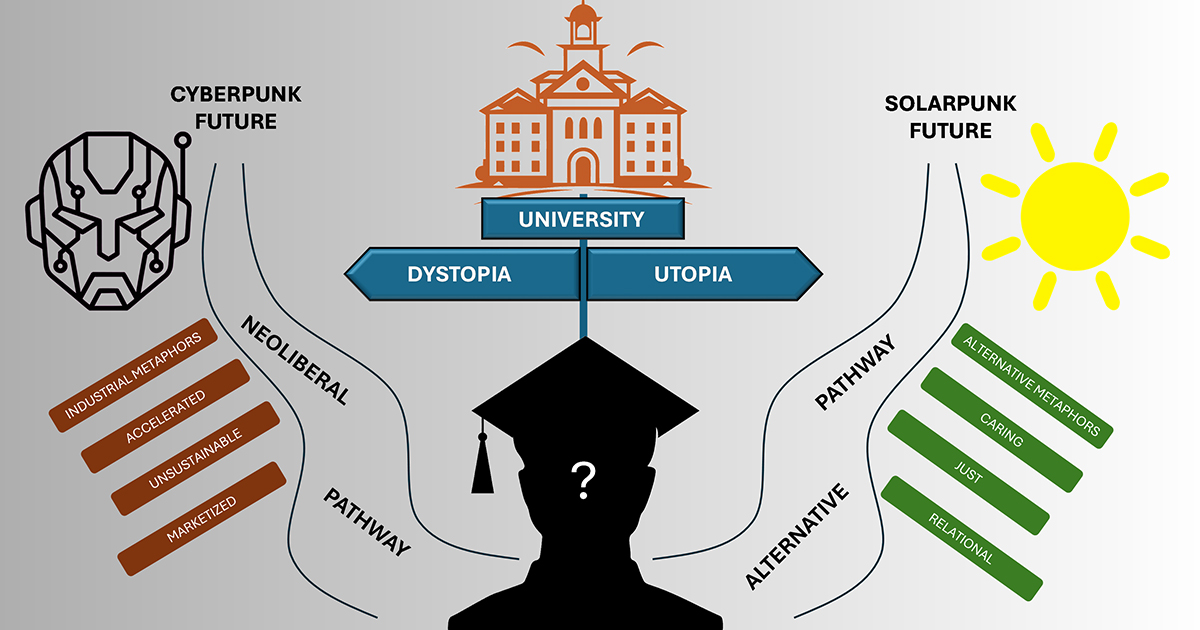
The future of the university has become a site of profound anxiety. Across many national systems, higher education is framed through the logics of competition, marketisation, and perpetual crisis. This has produced a dominant imaginary that resembles a neoliberal, cyberpunk, landscape: technologically saturated yet socially precarious, hyper-efficient yet structurally brittle, innovative in rhetoric yet extractive in practice. Within this imaginary, the university is cast as a malevolent corporate actor. Such imaginaries inhibit what institutions believe is possible, desirable, or inevitable.
If higher education is to meet the demands of the present and the responsibilities of the future, it must abandon the illusion that it can innovate its way out of crisis while clinging to the industrial metaphors that helped produce today’s neoliberal dystopia. Moving forward requires new metaphors: conceptual devices that disrupt entrenched imaginaries and open space for alternative ways of thinking beyond the managerial status quo. Metaphors are not decorative; they are world‑making. The narrow industrial frames that dominate universities cast students as consumers, teachers as content providers, and knowledge as a commodity to be packaged and sold. Incremental reform is no longer enough. The crises shaping our century (ecological collapse, democratic fragility, widening inequality) demand institutions capable of imagining and enacting different ways of living, learning, and relating.
This Special Issue aims to present and disseminate the most recent advances related to the application of critical university studies and the emergence of emancipatory metaphors that offer a more positive future for higher education. We consider contributions addressing key elements of more sustainable futures from the standpoint of university teaching, university governance and also disciplinary perspectives.
Topics of interest for publication include, but are not limited to, the following:
- The ecological university
- Relational pedagogies
- Distributed leadership
- Ecological metaphors
- Utopia as method
- Solarpunk narratives
- Speculative approaches
- Epistemological pluralism
- Escape from neoliberalism
- Slow scholarship
Prof. Dr. Ian Kinchin
Dr. Paulo Correia
Guest Editors
Manuscript Submission Information
Manuscripts should be submitted online at www.mdpi.com by registering and logging in to this website. Once you are registered, click here to go to the submission form. Manuscripts can be submitted until the deadline. All submissions that pass pre-check are peer-reviewed. Accepted papers will be published continuously in the journal (as soon as accepted) and will be listed together on the special issue website. Research articles, review articles as well as short communications are invited. For planned papers, a title and short abstract (about 250 words) can be sent to the Editorial Office for assessment.
Submitted manuscripts should not have been published previously, nor be under consideration for publication elsewhere (except conference proceedings papers). All manuscripts are thoroughly refereed through a double-anonymized peer-review process. A guide for authors and other relevant information for submission of manuscripts is available on the Instructions for Authors page. Education Sciences is an international peer-reviewed open access monthly journal published by MDPI.
Please visit the Instructions for Authors page before submitting a manuscript. The Article Processing Charge (APC) for publication in this open access journal is 2000 CHF (Swiss Francs). Submitted papers should be well formatted and use good English. Authors may use MDPI's English editing service prior to publication or during author revisions.
Keywords
- critical university studies
- ecological metaphors
- neoliberalism
- relational pedagogy
- utopia as method
- solarpunk narratives
- speculative approaches
Benefits of Publishing in a Special Issue
- Ease of navigation: Grouping papers by topic helps scholars navigate broad scope journals more efficiently.
- Greater discoverability: Special Issues support the reach and impact of scientific research. Articles in Special Issues are more discoverable and cited more frequently.
- Expansion of research network: Special Issues facilitate connections among authors, fostering scientific collaborations.
- External promotion: Articles in Special Issues are often promoted through the journal's social media, increasing their visibility.
- Reprint: MDPI Books provides the opportunity to republish successful Special Issues in book format, both online and in print.
Further information on MDPI's Special Issue policies can be found here.
