



Emerging Trends in Educational Leadership: Crisis-Resilience and Future Proofing Schooling
Special Issue Information
Dear Colleagues,
We invite you to be a part of an educational leadership 2025 Special Issue in the journal of Education Sciences which will be guest edited by Dr. Christine Cunningham and Dr. Michelle Striepe from Edith Cowan University in Australia.
The Special Issue’s theme is crisis-resilience and future-proofing schooling. The conceptual lens that will bind the Special Issue is Striepe and Cunningham’s Crises Leadership Framework (2022), which recognizes six characteristics to help keep schooling functioning in troubled times.
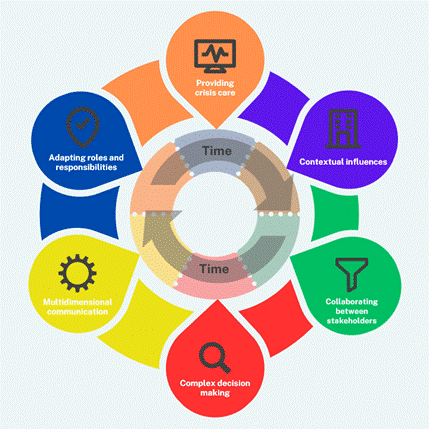
We will be pleased to receive submissions that cover diverse aspects of crisis management in education research, from innovative leadership practices to policy adaptations and technological innovations that maintain learning even during conflicts and crisis situations.
Join us for what will be an interesting and significant research compilation.
Aim and Scope
The aim of this Special Issue is to showcase research that explores how educational leaders build resilience and adaptability into their school communities to ensure continuity and quality in education amidst unforeseen catastrophic challenges. The scope of the Special Issue is hoped to include the latest research and analysis of crisis leadership frameworks, theories and practices that assist educational leaders in future proofing their institutions from the risks of climate, health and human-inflicted crises.
Suggested Themes
We invite submissions addressing, but not limited to, the following themes:
- Case studies of successful crisis management in education;
- Theoretical frameworks for crisis-resilient leadership;
- Policy adaptations and their impact on educational continuity;
- The role of technology in crisis-proofing education access;
- Lessons learned from leading during a crisis or multiple crises.
We look forward to your contributions, which we hope will help shape a resilient future for education and its leaders. Please submit your manuscripts according to the guidelines on the Education Sciences website: Education Sciences | Instructions for Authors (mdpi.com)
Sincerely,
Dr. Christine Cunningham
Dr. Michelle Striepe
Guest Editors
Manuscript Submission Information
Manuscripts should be submitted online at www.mdpi.com by registering and logging in to this website. Once you are registered, click here to go to the submission form. Manuscripts can be submitted until the deadline. All submissions that pass pre-check are peer-reviewed. Accepted papers will be published continuously in the journal (as soon as accepted) and will be listed together on the special issue website. Research articles, review articles as well as short communications are invited. For planned papers, a title and short abstract (about 250 words) can be sent to the Editorial Office for assessment.
Submitted manuscripts should not have been published previously, nor be under consideration for publication elsewhere (except conference proceedings papers). All manuscripts are thoroughly refereed through a double-anonymized peer-review process. A guide for authors and other relevant information for submission of manuscripts is available on the Instructions for Authors page. Education Sciences is an international peer-reviewed open access monthly journal published by MDPI.
Please visit the Instructions for Authors page before submitting a manuscript. The Article Processing Charge (APC) for publication in this open access journal is 2000 CHF (Swiss Francs). Submitted papers should be well formatted and use good English. Authors may use MDPI's English editing service prior to publication or during author revisions.
Keywords
- educational leadership
- crisis-resilience
- future proofing schooling
Benefits of Publishing in a Special Issue
- Ease of navigation: Grouping papers by topic helps scholars navigate broad scope journals more efficiently.
- Greater discoverability: Special Issues support the reach and impact of scientific research. Articles in Special Issues are more discoverable and cited more frequently.
- Expansion of research network: Special Issues facilitate connections among authors, fostering scientific collaborations.
- External promotion: Articles in Special Issues are often promoted through the journal's social media, increasing their visibility.
- Reprint: MDPI Books provides the opportunity to republish successful Special Issues in book format, both online and in print.
Published Papers


Educ. Sci. - ISSN 2227-7102