
Heterocycles in Drug Discovery

Editors


E-Mail Website
Collection Editor
Univ Rouen Normandie, INSA Rouen Normandie, CNRS, Institut CARMeN UMR 6064, F-76000 Rouen, France
Interests: chemistry of heterocyclic compounds; microwave-assisted chemistry; sustainable methodologies; green chemistry applied to bioactive compounds: kinase inhibitors; Alzheimer's disease; Down syndrome; cancer
Special Issues, Collections and Topics in MDPI journals

E-Mail Website
Collection Editor
1. CNRS, ICR UMR 7273, Team Pharmaco-Chimie Radicalaire, Faculté de Pharmacie, Aix Marseille University, 27 Boulevard Jean Moulin, CS30064, CEDEX 05, 13385 Marseille, France
2. APHM, Pharmacy Department, Service Central de la Qualité et de l'Information Pharmaceutiques, 147 Bd Baille, 13005 Marseille, France
Interests: medicinal chemistry; heterocyclic chemistry; Plasmodium; Leishmania; Trypanosoma; nitroheterocycles
Special Issues, Collections and Topics in MDPI journals

E-Mail Website
Collection Editor
Formerly Head of the Department of Organic Chemistry (FS), University of Mons-UMONS, 7000 Mons, Belgium
Interests: heterocycles; medicinal chemistry; green chemistry; microwave-induced synthesis
Special Issues, Collections and Topics in MDPI journals

Topical Collection Information

Dear Colleagues,

Heterocycles are crucial in drug discovery due to their high prevalence in biologically active compounds and pharmaceuticals. These ring structures, containing at least one atom other than carbon (commonly nitrogen, oxygen, or sulfur), constitute a unique opportunity to modulate  diverse chemical and physical properties that enhance the interaction with biological targets. Their versatility allows for the design of molecules with improved potency, selectivity, and pharmacokinetic profiles. Many drugs, including antibiotics, antivirals, anticancer agents, and CNS drugs, feature heterocyclic moiety, underscoring their importance in the drug discovery process for developing effective and innovative therapeutics.

Prof. Dr. Thierry Besson
Dr. Nicolas Primas
Dr. Jean Jacques Vanden Eynde
Collection Editors

Manuscript Submission Information

Manuscripts should be submitted online at www.mdpi.com by registering and logging in to this website. Once you are registered, click here to go to the submission form. All submissions that pass pre-check are peer-reviewed. Accepted papers will be published continuously in the journal (as soon as accepted) and will be listed together on the collection website. Research articles, review articles as well as short communications are invited. For planned papers, a title and short abstract (about 250 words) can be sent to the Editorial Office for assessment.

Submitted manuscripts should not have been published previously, nor be under consideration for publication elsewhere (except conference proceedings papers). All manuscripts are thoroughly refereed through a single-blind peer-review process. A guide for authors and other relevant information for submission of manuscripts is available on the Instructions for Authors page. Drugs and Drug Candidates is an international peer-reviewed open access quarterly journal published by MDPI.

Please visit the Instructions for Authors page before submitting a manuscript. The Article Processing Charge (APC) for publication in this open access journal is 1000 CHF (Swiss Francs). Submitted papers should be well formatted and use good English. Authors may use MDPI's English editing service prior to publication or during author revisions.

Keywords

  • drug discovery
  • heterocycles
  • medicinal chemistry
  • bioisosteres
  • physicochemical properties
  • ADMET
  • pharmacophore
  • drug design

Published Papers (1 paper)

2026

23 pages, 2093 KB  
Article
Adjuvant Activity and Resistance-Modifying Capacity of a Novel Heterocyclic Hydrazone Derived from the Drug Hydralazine in NorA and MepA Efflux Pumps of Staphylococcus aureus
by Milena Oliveira Andrade Moreira, Karla Susanna Tavares Grangeiro Belém, Janaina Esmeraldo Rocha, Davi Ramalho Furtado, Gildenia Alves de Araújo, Ana Joyce Morais Bento, Jessica Bezerra Maciel, Jesyka Macêdo Guedes, Jaiza Maria Lima Dias, Henrique Douglas Melo Coutinho, Francisco das Chagas Lima Pinto, Emmanuel Silva Marinho, Marcia Machado Marinho, Alexandre Magno Rodrigues Teixeira, Walter José Peláez and Hélcio S. dos Santos
Drugs Drug Candidates 2026, 5(1), 23; https://doi.org/10.3390/ddc5010023 - 12 Mar 2026
Viewed by 487
Abstract
Background/Objectives: Hydrazones are organic compounds with the general structure R2C=NNHR1, distinguished by their versatility and modifiability, and are widely used in various applications due to their physicochemical and biological properties. They exhibit anticancer, anti-inflammatory, antibiofilm, and antibacterial activities. Antibiotic-resistant [...] Read more.
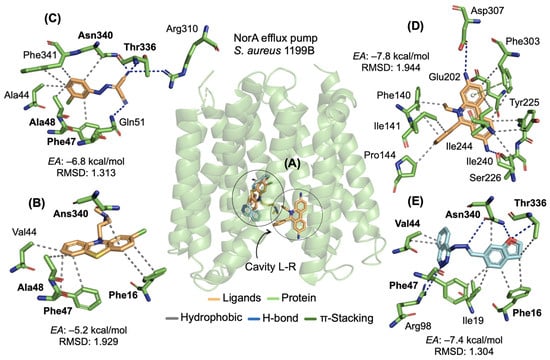
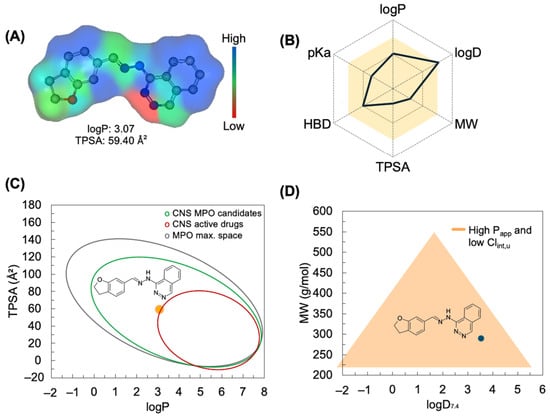
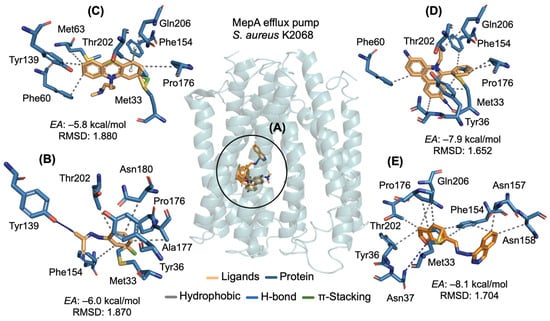
Background/Objectives: Hydrazones are organic compounds with the general structure R2C=NNHR1, distinguished by their versatility and modifiability, and are widely used in various applications due to their physicochemical and biological properties. They exhibit anticancer, anti-inflammatory, antibiofilm, and antibacterial activities. Antibiotic-resistant bacteria pose a serious public health threat, employing mechanisms such as enzymatic inactivation and efflux pumps. This study evaluated the antibacterial activity of the hydrazone HDZH1,4BENZ, a hydralazine-derived compound, as well as its potential adjuvant effect in combination with antibiotics against Staphylococcus aureus strains expressing efflux pumps. Methods: The strains used were 1199B (NorA efflux pump-expressing) and K2068 (MepA efflux pump-expressing). All assays were conducted using the broth microdilution method in Brain Heart Infusion (BHI) medium. Initially, the intrinsic antibacterial activity of the compound was determined. Subsequently, modulation assays were performed to evaluate its potential effect on efflux pump activity, with a standard efflux pump inhibitor included as a positive control. Results: Although HDZH1,4BENZ did not demonstrate significant direct antibacterial activity, the results indicate that this hydrazone exerts a notable inhibitory effect on the NorA (Norfloxacin resistance efflux pump A) and MepA (Multidrug efflux protein A) efflux pumps in S. aureus, thereby enhancing the efficacy of antibacterial agents. Conclusions: The activity of the hydrazone was comparable to that of chlorpromazine, suggesting that it may represent a promising alternative in the fight against antibiotic-resistant bacterial infections. Full article
Show Figures

Figure 1

Back to TopTop