




Journal Menu
► ▼ Journal Menu-
- Brain Sciences Home
- Aims & Scope
- Editorial Board
- Reviewer Board
- Topical Advisory Panel
- Instructions for Authors
- Special Issues
- Topics
- Sections & Collections
- Article Processing Charge
- Indexing & Archiving
- Editor’s Choice Articles
- Most Cited & Viewed
- Journal Statistics
- Journal History
- Journal Awards
- Society Collaborations
- Conferences
- Editorial Office
Journal Browser
► ▼ Journal BrowserNeed Help?
Announcements
21 May 2026
Interview with Prof. Dr. Mario Zuccarello—Section Editor-in-Chief of Brain Sciences
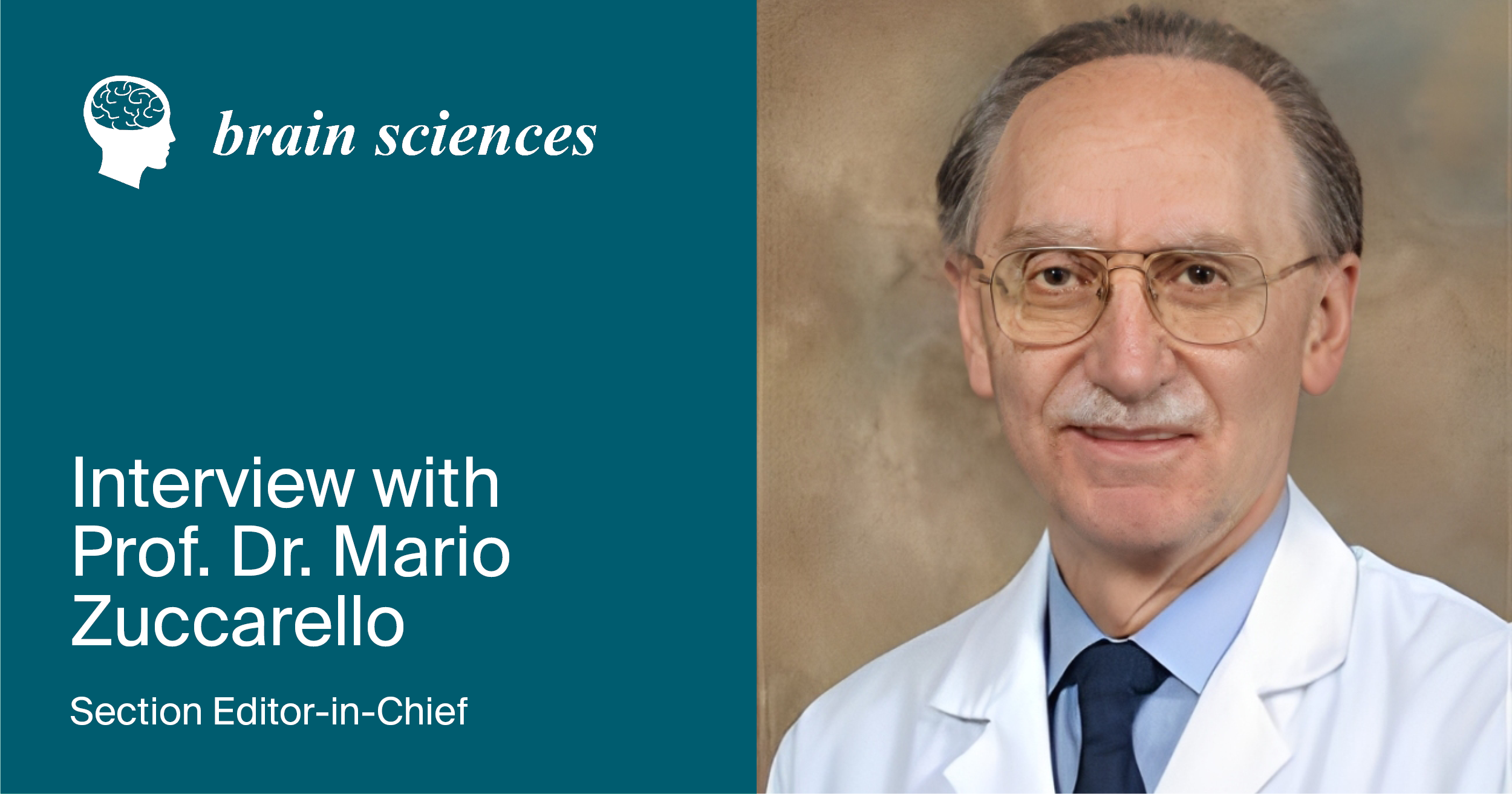
The following is an interview with Prof. Dr. Mario Zuccarello:
Prof. Dr. Mario Zuccarello is a Full Professor at the Division of Pediatric Neurosurgery, Department of Neurosurgery, Cincinnati Children’s Hospital Medical Center, University of Cincinnati College of Medicine, USA. His main research areas are intracranial aneurysms, brain tumors, aneurysms, carotid artery disease, cerebral vascular malformations, pituitary tumors, moyamoya disease, and Chiari malformation.
1. Could you briefly introduce your main research areas and achievements?
My main interest has been cerebro-vascular disease and skull base surgery, with particular emphasis on brain tumors located on the skull base area. My basic science research has been the pathogenesis and treatment of post-SAH cerebral vasospasm. I started my lab research in the early 80s. I developed a rabbit model of SAH and vasospasm, and I studied the involvement of Endothelin-1 and NO in the development of vasospasms. My work has been extensively published in peer review journals and presented at national and international meetings.
In the course of my career, I was the Director of Cerebro-Vascular Disease, Director of the Brain Tumor center, and Chairman of the Department of Neurosurgery. All positions were at the University of Cincinnati.
2. What about the journal made you want to take on the role of Section Editor-in-Chief?
My interest in your journal is that the author of a research article or book has the ability to publish his/her research in very accessible way to the widest possible audience.
3. What is your vision for the journal and the Section?
My vision is to advance the understanding of neuroscience/neurosurgery topics by serving the Journal as a trusted, authoritative, timely, and free venue for publishing high-impact research. My vision is to foster the publication of scholar papers, and to ensure that there will be a global dissemination of knowledge to experts, and maybe to the public. This can be accomplished only via Open Access publishing.
4. What do you think of the development of open access in the publishing field?
Open access (OA) publishing has become the dominant model for scholarly communication. OA allows free, immediate online availability of research output of articles and books. The future is in the hands of OA because OA content is open to all with no access fees.
