
Skip Content
You are currently on the new version of our website. Access the old version .

Animals

Animals is an international, peer-reviewed, open access journal devoted entirely to animals, including zoology and veterinary sciences, and is published semimonthly online by MDPI.
Indexed in PubMed | Quartile Ranking JCR - Q1 (Veterinary Sciences | Agriculture, Dairy and Animal Science)

All Articles (23,308)

In this narrative review, we provide an overview of morphology-based body composition measurement techniques and introduce evaluation methods relevant to veterinary practice. We specifically focus on previous work on the feline body mass index and body composition assessment methods using ultrasonography, creating new figures and tables from previously reported data. Based on these modalities, we introduce an objective, easy-to-use method for estimating obesity and assessing body composition. We highlight that adiposity and muscularity evaluation via the feline body mass index and ultrasonography appropriately reflects the total fat mass, fat percentage, and lean body mass assessed using dual-energy X-ray absorptiometry. The proposed method objectively assesses obesity and can be easily and stably used in clinical veterinary practice.

7 February 2026
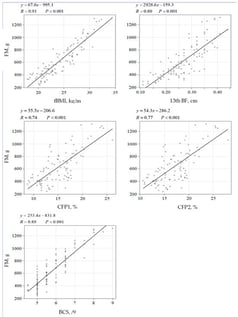
Relationships between fat mass (g) and various parameters in cats. The regression coefficient (R), formula, and p-value are presented along with individual data points and the respective regression line. FM (g) was considered the dependent variable. The other parameters were set as independent variables. A regression was considered statistically significant at p < 0.05. FM, total fat mass; fBMI, feline body mass index; 13th BF, back fat thickness at the 13th rib; CFP, calculated fat percentage; BCS, body condition score.

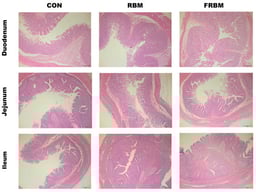
Due to the lack of corn and soybean meal in animal feeding, rice bran meal (RBM) has been proposed as a beneficial substitute for these feedstocks’ ingredients. Its fermentation by using diverse microbes has been adopted as a beneficial technique. In this study, 18 five-month-old finishing pigs (castrated Duroc × Landrace × Large White) were assigned to three dietary groups with six replicates in each group, designated as the control (CON), unfermented RBM (RBM), and fermented RBM (FRBM) groups. RBM was fermented with a mixture of Lactobacillus johnsonii L63 and hydrolytic enzymes at 37 °C and pH 4.8 for 60 h. The results indicated that incorporating 30% fermented or unfermented rice bran meal into the diets of finishing pigs had no significant effect on growth performance. Regarding serum biochemical parameters, most indicators, including alanine aminotransferase, aspartate aminotransferase, alkaline phosphatase, and triglycerides, showed no significant alterations. However, in both the unfermented and fermented rice bran meal groups, the concentrations of serum total protein, albumin, globulin, cholesterol, and blood urea nitrogen were significantly decreased (p < 0.05), whereas serum nitric oxide levels were significantly increased (p < 0.05). The FRBM group improved intestinal morphology and the digestibility of nutrients (crude protein, ether extract, crude fiber, and gross energy) by altering the mTORC1 pathway and upregulating the relative expression of amino acid and peptide transporter genes in the jejunum. However, the dry matter digestibility decreased compared to the CON group. The RBM group reduced nutrient digestibility, along with alterations in hepatic gene expression related to amino acid metabolism and transport. Therefore, fermented rice bran meal may offer a potential substitute feed ingredient for use in swine diets when conventional ingredients like corn and soybean meal are in short supply.

7 February 2026

Effect of RBM and FRBM on intestinal morphology in pigs (HE staining, scale bar: 500 μm, n = 6). CON = corn soybean meal diet (basal diet), RBM = basal diet with 30% RBM, FRBM = basal diet with 30% FRBM.

Fungal exposure is strongly implicated in the pathogenesis of asthma in horses, but the importance of specific fungi is unknown. Geographic variation in equine asthmatic endotypes is suspected and might be related to different fungal exposures due to different climatological and geographical conditions. This study had two objectives: evaluate the effect of the ecoregion upon BALF inflammatory cells and fungal community composition in horses with asthma and evaluate the effect of BALF fungal community composition upon the likelihood of neutrophilic, mastocytic and eosinophilic inflammation in these horses. Differential cytology counts were obtained from 916 BALF samples submitted from horses with poor performance and/or clinical signs of respiratory disease from five ecoregions. The effect of the ecoregion upon BALF inflammatory cell proportions was modeled using generalized linear models. Seventy banked BALF samples were subjected to sequencing of the internal transcribed spacer regions of fungal DNA. Diversity analysis was performed in QIIME, including alpha diversity metrics and the Bray–Curtis dissimilarity metric. After taxonomy was assigned, differential abundances between ecoregions and inflammatory phenotypes were estimated by generalized linear models in DESeq2. BALF neutrophil (p < 0.0001) and eosinophil (p < 0.0001) proportions varied by ecoregion, while mast cell proportions did not (p = 0.18). Alternaria, Aspergillus, Cladosporium and Epicoccum spp. were found to differ in abundance between regions. These geographical variations in fungal exposure might be responsible for differences in BALF neutrophil and eosinophil proportions between ecoregions.

7 February 2026

Level I ecological regions of North America [27]. Commission for Environmental Cooperation (CEC). 2021. “North American Environmental Atlas-Terrestrial Ecoregions: Level I”. Agriculture and Agri-Food Canada, U.S. Environmental Protection Agency (EPA), Instituto Nacional de Estadística y Geografía (INEGI). Ed. 2.0, Vector digital data [1:10,000,000]. Available at https://www.cec.org/north-american-environmental-atlas/terrestrial-ecoregions-level-i/ (accessed on 18 January 2026).

Analysis of Transcriptome and Differentially Expressed Genes in Chicken Primordial Germ Cells

  • Anastasiia I. Azovtseva,
  • Anna E. Ryabova and
  • Tatiana A. Larkina
  • + 6 authors

Achieving successful primordial germ cell (PGC)-based genome editing requires a deep understanding of their molecular identity. For the first time, a comparative transcriptomic analysis of chicken PGCs and adult liver cells to define their specific gene expression signature was performed. PGCs were isolated from Rhode Island Red chicken embryos, cultured, and subjected to RNA sequencing alongside liver tissue. Differential expression analysis with Benjamini–Hochberg correction identified 1909 differentially expressed genes (DEGs). Functional annotation revealed that PGCs possess a unique transcriptional landscape, characterized not only by enhanced proliferation and metabolic activity but also by a profound molecular convergence with neural crest cells. This is evidenced by the upregulation of gene modules governing long-range migration, neuronal signaling, and specialized “neuro-lipid” metabolism (e.g., sphingolipid and plasmalogen pathways). Additionally, we identified unannotated transcripts linked to immune pathways and ciliary signaling. Our study expands the functional annotation of avian PGCs and reveals an unexpected evolutionary recruitment of conserved morphogenetic programs, providing a refined molecular foundation for advanced germline editing technologies.

6 February 2026

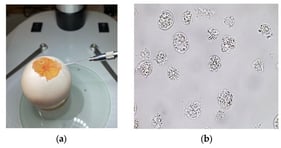
Blood sample collection for PGC extraction via microinjector (a) and PGC culture at 21st day of cultivation (b).

News & Conferences

Issues

Open for Submission

Editor's Choice

Reprints of Collections

Sustainable Feed Ingredients in Freshwater Aquaculture
Reprint

Sustainable Feed Ingredients in Freshwater Aquaculture

Editors: Zsuzsanna Sandor, Csaba Hancz
Feed Additives in Pig Feeding
Reprint

Feed Additives in Pig Feeding

2nd Edition
Editors: Małgorzata Kasprowicz-Potocka

Get Alerted

Add your email address to receive forthcoming issues of this journal.

XFacebookLinkedIn
Animals - ISSN 2076-2615