



Regulation of Stress and Defense Responses in Horticultural Plants
A special issue of Agronomy (ISSN 2073-4395). This special issue belongs to the section "Horticultural and Floricultural Crops".
Deadline for manuscript submissions: 25 February 2027 | Viewed by 84
Editors

Interests: plant abiotic and biotic stress biology; disease-susceptible gene mining; functional characterization
Interests: plant immunity; plant–pathogens interaction; molecular mechanism of crop disease resistance; disease-resistant breeding of potato and pepper
Special Issues, Collections and Topics in MDPI journals
Special Issue Information
Dear Colleagues,
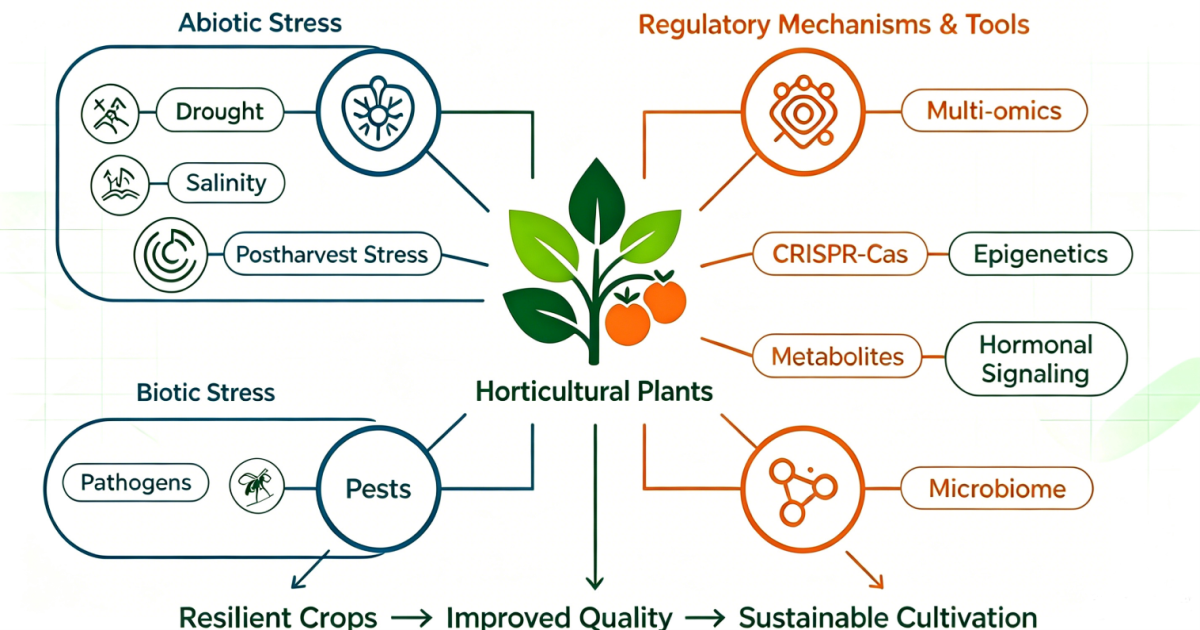
Horticultural plants (fruits, vegetables, ornamentals, medicinal herbs) are vital for global food security, economic growth and environmental sustainability, yet their yield and quality are severely threatened by biotic (pathogens, pests) and abiotic (drought, salinity, extreme temperatures, heavy metals) stresses intensified by climate change. Research on plant stress responses has evolved from physiological observations to molecular investigations: early studies focused on stress symptoms and basic adaptations, mid-20th century identified phytohormones as core regulators, and modern research uses omics, CRISPR-Cas and advanced imaging to decode stress regulatory networks. Unlike staple crops, horticultural plants prioritize quality alongside survival, making research on their unique stress response mechanisms critical for sustainable production.
This Special Issue aims to compile innovative research and reviews advancing our understanding of stress and defense response regulation in horticultural plants, linking fundamental research to practical crop improvement. We highlight cutting-edge progress in key areas: multi-omics for stress regulatory networks, epigenetic and non-coding RNA-mediated stress memory, hormonal crosstalk, microbiome-mediated tolerance, and biotechnological strategies for stress resilience. Its scope includes stress perception and signal transduction, combined/multiple stress responses, genetic basis of resistance, pre-and post-harvest stress management, and sustainable cultivation with stress-resistant genotypes.
We welcome original research, reviews, short communications and perspectives advancing stress regulation research on horticultural plants. Accepted topics include functional analysis of stress-related genes/proteins/metabolites, genetic mapping of stress resistance loci, physiological adaptation mechanisms, field stress management trials, and translational breeding, biotechnology or precision agriculture studies. All manuscripts will undergo strict single-anonymized peer review.
Dr. Kaile Sun
Prof. Dr. Yu Du
Guest Editors
Manuscript Submission Information
Manuscripts should be submitted online at www.mdpi.com by registering and logging in to this website. Once you are registered, click here to go to the submission form. Manuscripts can be submitted until the deadline. All submissions that pass pre-check are peer-reviewed. Accepted papers will be published continuously in the journal (as soon as accepted) and will be listed together on the special issue website. Research articles, review articles as well as short communications are invited. For planned papers, a title and short abstract (about 250 words) can be sent to the Editorial Office for assessment.
Submitted manuscripts should not have been published previously, nor be under consideration for publication elsewhere (except conference proceedings papers). All manuscripts are thoroughly refereed through a single-anonymized peer-review process. A guide for authors and other relevant information for submission of manuscripts is available on the Instructions for Authors page. Agronomy is an international peer-reviewed open access semimonthly journal published by MDPI.
Please visit the Instructions for Authors page before submitting a manuscript. The Article Processing Charge (APC) for publication in this open access journal is 2600 CHF (Swiss Francs). Submitted papers should be well formatted and use good English. Authors may use MDPI's English editing service prior to publication or during author revisions.
Keywords
- horticultural plants
- stress responses
- defense responses
- molecular regulation
- abiotic stress
- biotic stress
- hormonal crosstalk
- multi-omics
- crop resilience
- post-harvest stress
Benefits of Publishing in a Special Issue
- Ease of navigation: Grouping papers by topic helps scholars navigate broad scope journals more efficiently.
- Greater discoverability: Special Issues support the reach and impact of scientific research. Articles in Special Issues are more discoverable and cited more frequently.
- Expansion of research network: Special Issues facilitate connections among authors, fostering scientific collaborations.
- External promotion: Articles in Special Issues are often promoted through the journal's social media, increasing their visibility.
- Reprint: MDPI Books provides the opportunity to republish successful Special Issues in book format, both online and in print.
Further information on MDPI's Special Issue policies can be found here.
