


Abstract
Pyranoquinolinones synthesized from citral were used for Cu-catalyzed N-arylation with a wide range of arylboric acids. The reaction proceeded well with a broad substrate scope, providing a direct way to access highly functional pyranoquinolinone core structure derivatives in yields of up to 80%. Compared to citral, the compounds we obtained have a much better inhibitory effect on HeLa cervical cancer cells, and compound 3p has an IC50 value of 4.6 μM, lower than cisplatin’s 5.9 μM.
1. Introduction
As a naturally occurring monoterpenoid, citral has been commonly considered to be a promising antimicrobial compound due to its strong antibacterial and antifungal activities [1,2,3,4]. It is particularly noteworthy that citral treatment (24 h incubation) could significantly decrease the percentage of cell viability in HeLa cells, and a 500 µg/mL (IC50) concentration of citral was required for the good inhibition of HeLa cells [1d]. However, compared with many commercially available fungicides, citral still has the disadvantages of low antibacterial activity, strong volatility and low chemical stability. Thus, in recent years, citral has been converted into a series of derivatives in order to afford compounds with better biological activity [5,6,7].
Pyranoquinolinone alkaloids have a variety of interesting biological activities and are widely distributed in nature [8,9,10,11,12,13,14,15,16]. These molecules could be used as the synthetic precursors of polyheterocycles and dimeric quinoline alkaloids [17,18,19,20,21]. Thus, a variety of synthetic approaches to afford pyranoquinolinone derivatives have been reported [22,23,24,25,26]. Ytterbium (III)-catalyzed transformations of 4-hydroxy-1H-quinolin-2-ones and enals into pyranoquinolinones were previously reported by Lee and coworkers [27]. However, the yields of pyranoquinolinones were unsatisfactory. Again, they developed a methodology for the synthesis of pyranoquinolinones in good yield by the formal [3 + 3] cycloaddition of 2,4-dihydroxyquinoline and varied α,β-unsaturated aldehydes [28]. It was a convenient and efficient way to produce pyranoquinolinone derivatives with a variety of substituents on the 2H-pyranyl rings. However, there are no efficient and general methods for preparing those pyranoquinolinones with various substituents on the quinoline ring.
Transition-metal-catalyzed C(aryl)-N bond formation reaction is an important tool in organic synthesis [29,30,31,32]. Over the past few years, varied synthetic methods have been developed for the N-arylation of heterocycles. Among them, the classic copper-catalyzed Ullmann reaction has the shortcomings of the requirement of stoichiometric amounts of copper reagents, high temperatures, long reaction time and low yields [33,34,35]. Similarly, Pd-catalyzed Buchwald–Hartwig coupling has the disadvantages of high temperature, strong base and need for an expensive Pd/ligand combination [36,37]. Notably, copper-promoted Chan–Lam coupling for O- and N-arylation with boronic acids became a good choice in for carbon–heteroatom transformation [38,39,40,41,42]. This Chan–Lam type of coupling received attention from various organic chemists over the years for its advantages of mild reaction conditions, room temperature, weak base and ambient atmosphere [43,44,45,46,47,48,49,50,51,52,53,54,55,56,57,58,59,60].
Prompted by the advantages of the importance of pyranoquinolinone alkaloids and inspired by what was mentioned about citral above, we envisioned that the Chan–Lam coupling of N-arylation with arylboronic acids could provide the desired pyranoquinolinone derivatives with a variety of substituents on the quinoline ring.
2. Results and Discussion
Firstly, we used citral to synthesize pyranoquinolinone compound 1 (Scheme 1).
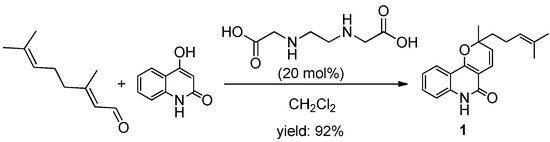
Scheme 1.
Synthesis of pyranoquinolinone compound 1 starting from 2,4-dihydroxyquinoline and citral.
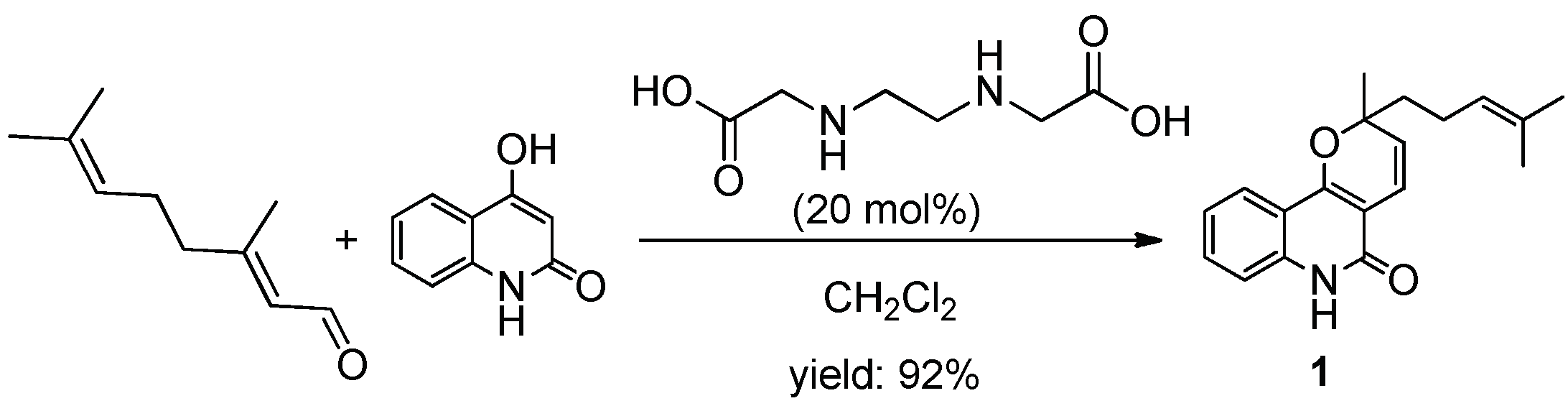
Applying the reaction conditions described in ref. [13] (Cu(OTf)2, 1,10-Phen, DMSO), our investigation started with the reactions of 2-methyl-2-(4-methylpent-3-en-1-yl)-2H-pyrano[3,2-c]quinolin-5(6H)-one (1) and phenylboronic acid (2a), and the desired product (3a) could only be afforded in trace amounts (entry 1, Table 1). When this reaction was catalyzed by Cu(OAc)2 in DMSO with 1,10-Phen as the ligand, the desired product (3a) was isolated only in 5% yield (entry 2, Table 1). Increasing the amount of 1,10-Phen to 200 mol% had a positive impact on the isolated yield, giving the desired product (3a) in 10% yield (entry 3, Table 1). Thus, we considered that 1,10-Phen acted as a base rather than a ligand to promote the reaction. When we shifted to using pyridine instead of 1,10-Phen, a better change was observed in the product yield, with 16% (entry 4, Table 1). Encouraged by these results, we performed the transformation with K2CO3 and Et3N (2.0 equiv) as the bases with a catalytic amount of Cu(OAc)2 (20 mol%) in DMSO, and the desired product yields were 19% and 25%, respectively (entries 5–6, Table 1). Therefore, we took Et3N as the best choice, and other solvents (DCM, DCE, DMF, MeCN, DMAc, MeOH, EtOAc) were surveyed. However, none of them was more efficient than DMSO for this reaction (entries 7–15, Table 1). When Et3N and 1,10-Phen are used together to promote this reaction [61], the desired product yield will not be improved (entry 8, Table 1). When the amount of Cu(OAc)2 was increased to 100 mol%, the reaction did not occur (entry 9, Table 1). To find a suitable catalytic system for the N-arylation of pyranoquinolinones, more Cu catalysts were evaluated in detail (CuCl, CuBr, CuI, CuO, CuSO4, Cu(acac)2, CuF2), and the use of CuI improved the yield to 76% (entries 16–22, Table 1). We discovered that the reaction worked more efficiently under this open-air condition when Cu+ was used as a catalyst instead of Cu2+, and the desired product (3a) was afforded in yields of 36%, 42%, 76% and 18% (entries 16–19, Table 1). In order to enhance the yield, the reaction was carried out with other solvents such as DCM and MeCN with CuI as the catalyst; however, the product was furnished in trace amounts (entries 23–24, Table 1). Therefore, DMSO was the best choice. Increasing the CuI loading to 50 mol% resulted in a lower 19% yield (entry 25, Table 1). Further increasing the Cu-catalyst loading to 100 mol% had a negative effect on the yield of the product, forming 3a only in a 9% yield (entry 26, Table 1). Finally, we tried to raise the temperature to increase the yield. However, increasing the temperature to 40 °C reduced the product yield to 19%, and increasing the temperature to above 60 °C afforded the product (3a) in trace amounts (entries 27–29, Table 1).

Table 1.
Optimization of the reaction conditions [a].
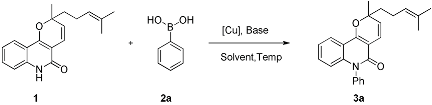
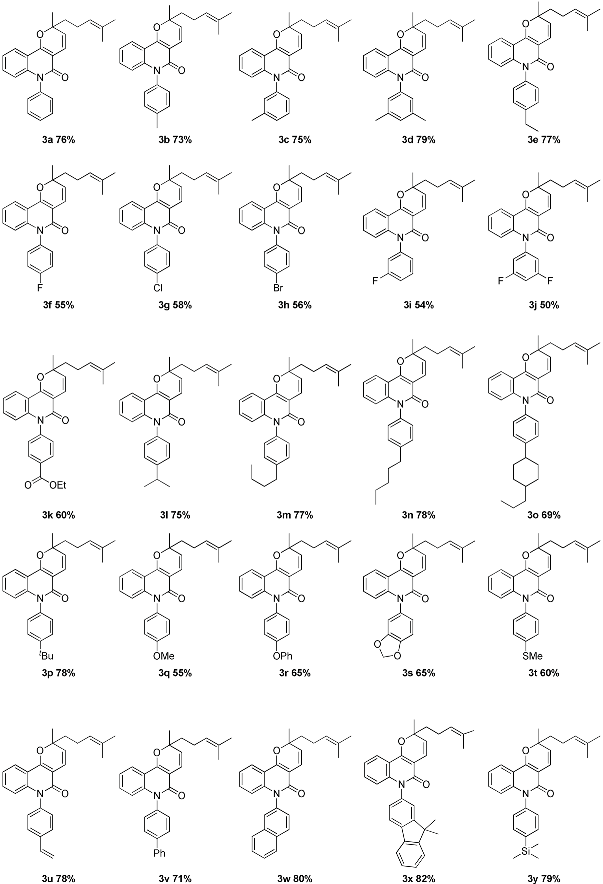
With the optimal reaction conditions in hand (1 (0.5 mmol), 2 (0.6 mmol), CuI (0.2 equiv.), Et3N (2.0 equiv.), DMSO (5.0 mL), rt under air, 12 h), we started to investigate the scope of this reaction. Various arylboronic acids (2) were employed in the Cu-catalyzed reactions (Table 2). For a wide range of arylboronic acids with either electron-rich or electron-poor aryl groups, the corresponding coupling with compound 1 proceeded smoothly, giving the desired N-arylation pyranoquinolinone derivatives (3) with high efficiency and regio-selectivity (N-arylation not O-arylation). The efficiency of the reaction was sensitive to the substituents on the aromatic rings in different arylboronic acids (3a–3k, Table 2).
Table 2.
Substrate exploration [a].
Arylboronic acids with an electron-donating group on the aromatic ring gave a yield comparable to that of those bearing an electron-withdrawing group on the aromatic ring. For example, arylboronic acids with an electron-donating group, such as CH3 or CH3CH2, on the phenyl ring reacted with compound 1 to afford the corresponding products in 73–77% yields (3a–3e, Table 2). When arylboronic acids with an electron-withdrawing group (F, Cl, Br or COOEt) on the phenyl ring reacted with compound 1, yields of about 50–60% of the desired products were obtained (3f–3k, Table 2). Noteworthily, the reaction tolerates a variety of substituents in the para position. For instance, the compounds 2l–2p could react smoothly to afford the desired compound with 69–78% yields, respectively, which were comparable to those of the products 3a–3k (3l–3p, Table 2). Oddly enough, when arylboronic acids with a CH3O on the phenyl ring were reacted with compound 1, a yield of only 55% of the desired products was afforded (3q, Table 2). Other electron-donating groups such as PhO and CH3S did not affect the reaction yield, giving the desired N-arylation derivatives with 60–65% yield (3r–3t, Table 2). Other arylboronic acids containing the conjugated group substituents were very compatible in the reactions, with 71–82% yields (3u–3x, Table 2). Si-substituted arylboronic acid was also tolerant in this reaction and showed a good yield of 79% (3y, Table 2). We chose o-tolylboronic acid and (2-fluorophenyl)boronic acid to test the tolerance of the reaction to steric hindrance. However, the reaction results were not good, giving no desired products. Except for steric hindrance, we do not know how to explain this reaction phenomenon.
The IC50 values of 25 citral pyranoquinolinone derivatives on HeLa cervical cancer cells were preliminarily measured using the WST-8 method to evaluate their inhibitory activities against tumor cells (Table 3). The IC50 values of these derivatives on HeLa cervical cancer cells ranged from 4.6 μM to 40.5 μM, with compound 3p having an IC50 value of 4.6 μM, lower than cisplatin’s 5.9 μM. This compound is expected to be used for further research on tumor inhibition activity.
Table 3.
Inhibitory activities of citral pyranoquinolinone derivatives against HeLa cervical cancer cells.
3. Materials and Methods
3.1. General Information
Unless otherwise noted, all of the reagents were purchased from Shanghai Aladdin Bio-Chem Technology Co., Ltd. (Shanghai, China) and used without purification. Purification of products was conducted by flash chromatography on silica gel (200–300 mesh). Nuclear magnetic resonance (NMR) spectra were measured on a Bruker Avance III 400 (Bruker, Billerica, MA, USA). The 1H-NMR (400 MHz) chemical shifts were obtained relative to CDCl3 as the internal reference (CDCl3: δ 7.26 ppm). The 13C-NMR (100 MHz) chemical shifts were obtained using CDCl3 as the internal standard (CDCl3: δ 77.16 ppm). Chemical shifts are reported in ppm using tetramethylsilane as the internal standard (s = singlet, d = doublet, t = triplet, q = quartet, dd = doublet of doublets, m = multiplet). HR-MS data were obtained on a VG ZAB-HS mass spectrometer and a Bruker Apex IV FTMS spectrometer.
3.2. General Procedure for the N-Arylation of Pyranoquinolinones with Boronic Acids
Pyranoquinolinone (0.6 mmol), arylboronic acid 2 (0.6 mmol), CuI (20 mmol%), Et3N (2.0 equiv) and DMSO (5.0 mL) were added to a sealed tube. Then, the mixture was stirred at room temperature in the air for 12 h. After the disappearance of the substrate as indicated by the TLC, the mixture was concentrated in vacuo, and the resulting crude product was purified by column chromatography to afford the products 3.
3.3. Characterization Data for Products 3a–3y
2-methyl-2-(4-methylpent-3-en-1-yl)-6-phenyl-2,6-dihydro-5H-pyrano[3,2-c]quinolin-5-one (3a). 1H NMR (400 MHz, CDCl3) δ 7.97 (dd, J = 8.0, 1.2 Hz, 1H), 7.61–7.54 (m, 2H), 7.53–7.47 (m, 1H), 7.33–7.26 (m, 3H), 7.21–7.15 (m, 1H), 6.78 (d, J = 10.0 Hz, 1H), 6.61 (d, J = 8.4 Hz, 1H), 5.51 (d, J = 10.0 Hz, 1H), 5.13 (ddd, J = 7.2, 6.0, 1.2 Hz, 1H), 2.19 (q, J = 7.6 Hz, 2H), 1.96–1.85 (m, 1H), 1.83–1.76 (m, 1H), 1.65 (s, 3H), 1.58 (s, 3H), 1.53 (s, 3H). 13C NMR (100 MHz, CDCl3) δ 161.1, 156.1, 140.4, 137.9, 132.0, 130.4, 130.1, 129.2, 128.7, 125.2, 123.8, 122.8, 121.9, 118.2, 115.9, 115.7, 105.6, 81.7, 41.7, 27.2, 25.7, 22.7, 17.7. HRMS (ESI): m/z [M + H]+ Calcd for C25H26NO2+: 372.1958, found: 372.1956. Figure S1 in the Supplementary Materials.
2-methyl-2-(4-methylpent-3-en-1-yl)-6-(p-tolyl)-2,6-dihydro-5H-pyrano[3,2-c]quinolin-5-one (3b). 1H NMR (400 MHz, CDCl3) δ 7.96 (d, J = 7.6 Hz, 1H), 7.36 (d, J = 7.6 Hz, 2H), 7.32–7.25 (m, 1H), 7.19–7.12 (m, 3H), 6.78 (d, J = 10.0 Hz, 1H), 6.65 (d, J = 8.5 Hz, 1H), 5.50 (d, J = 10.0 Hz, 1H), 5.13 (t, J = 7.2 Hz, 1H), 2.45 (s, 3H), 2.19 (q, J = 7.6 Hz, 2H), 1.94–1.87 (m, 1H), 1.82–1.76 (m, 1H), 1.64 (s, 3H), 1.58 (s, 3H), 1.52 (s, 3H). 13C NMR (100 MHz, CDCl3) δ 161.2, 156.0, 140.6, 138.6, 135.2, 132.0, 130.7, 130.3, 128.8, 125.2, 123.8, 122.7, 121.9, 118.3, 116.0, 115.7, 105.6, 81.6, 41.7, 27.2, 25.6, 22.7, 21.3, 17.7. HRMS (ESI): m/z [M + H]+ Calcd for C26H28NO2+: 386.2115, found: 386.2113. Figure S2 in the Supplementary Materials.
2-methyl-2-(4-methylpent-3-en-1-yl)-6-(m-tolyl)-2,6-dihydro-5H-pyrano[3,2-c]quinolin-5-one (3c). 1H NMR (400 MHz, CDCl3) δ 7.96 (dd, J = 8.0, 1.6 Hz, 1H), 7.45 (t, J = 7.6 Hz, 1H), 7.33–7.27 (m, 2H), 7.21–7.15 (m, 1H), 7.10–7.04 (m, 2H), 6.78 (d, J = 10.0 Hz, 1H), 6.63 (d, J = 8.4 Hz, 1H), 5.50 (d, J = 10.0 Hz, 1H), 5.20–5.05 (m, 1H), 2.41 (s, 3H), 2.19 (q, J = 7.6 Hz, 2H), 1.95–1.86 (m, 1H), 1.82–1.74 (m, 1H), 1.65 (s, 3H), 1.58 (s, 3H), 1.53 (s, 3H). 13C NMR (100 MHz, CDCl3) δ 161.1, 156.0, 140.5, 140.1, 137.8, 132.0, 130.3, 129.8, 129.7, 129.5, 126.1, 125.2, 123.8, 122.7, 121.9, 118.3, 116.0, 115.7, 105.6, 81.6, 41.7, 27.2, 25.6, 22.7, 21.4, 17.7. HRMS (ESI): m/z [M + H]+ Calcd for C26H28NO2+: 386.2115, found: 386.2113. Figure S3 in the Supplementary Materials.
6-(3,5-dimethylphenyl)-2-methyl-2-(4-methylpent-3-en-1-yl)-2,6-dihydro-5H-pyrano[3,2-c]quinolin-5-one (3d). 1H NMR (400 MHz, CDCl3) δ 7.95 (dd, J = 8.0, 1.6 Hz, 1H), 7.30 (ddd, J = 8.4, 6.8, 1.6 Hz, 1H), 7.17 (ddd, J = 8.0, 7.2, 0.8 Hz, 1H), 7.11 (s, 1H), 6.90–6.85 (m, 2H), 6.78 (d, J = 10.0 Hz, 1H), 6.65 (d, J = 8.4 Hz, 1H), 5.49 (d, J = 10.0 Hz, 1H), 5.13 (t, J = 7.2 Hz, 1H), 2.37 (s, 6H), 2.18 (q, J = 7.6 Hz, 2H), 1.93–1.85 (m, 1H), 1.82–1.74 (m, 1H), 1.65 (s, 3H), 1.58 (s, 3H), 1.52 (s, 3H). 13C NMR (100 MHz, CDCl3) δ 161.2, 155.9, 140.5, 139.8, 137.7, 132.0, 130.4, 130.3, 126.6, 125.2, 123.8, 122.6, 121.8, 118.3, 116.1, 115.7, 105.7, 81.6, 41.7, 27.2, 25.6, 22.6, 21.3, 17.6. HRMS (ESI): m/z [M + H]+ Calcd for C27H30NO2+: 400.2271, found: 400.2273. Figure S4 in the Supplementary Materials.
6-(4-ethylphenyl)-2-methyl-2-(4-methylpent-3-en-1-yl)-2,6-dihydro-5H-pyrano[3,2-c]quinolin-5-one (3e). 1H NMR (400 MHz, CDCl3) δ 7.75 (dd, J = 8.0, 1.2 Hz, 1H), 7.20–7.14 (m, 2H), 7.11–7.05 (m, 1H), 6.99–6.92 (m, 3H), 6.57 (d, J = 10.0 Hz, 1H), 6.44 (d, J = 8.4 Hz, 1H), 5.28 (d, J = 10.0 Hz, 1H), 4.92 (t, J = 7.2 Hz, 1H), 2.54 (q, J = 7.6 Hz, 2H), 1.98 (q, J = 7.6 Hz, 2H), 1.74–1.64 (m, 1H), 1.62–1.53 (m, 1H), 1.43 (s, 3H), 1.37 (s, 3H), 1.31 (s, 3H), 1.10 (t, J = 7.6 Hz, 3H). 13C NMR (100 MHz, CDCl3) δ 161.2, 156.0, 144.7, 140.6, 135.4, 132.0, 130.3, 129.5, 128.9, 125.2, 123.8, 122.7, 121.8, 118.3, 116.0, 115.8, 105.6, 81.6, 41.7, 28.6, 27.2, 25.6, 22.7, 17.6, 15.3. HRMS (ESI): m/z [M + H]+ Calcd for C27H30NO2+: 400.2271, found: 400.2273. Figure S5 in the Supplementary Materials.
6-(4-fluorophenyl)-2-methyl-2-(4-methylpent-3-en-1-yl)-2,6-dihydro-5H-pyrano[3,2-c]quinolin-5-one (3f). 1H NMR (400 MHz, CDCl3) δ 7.98 (dd, J = 8.0, 1.2 Hz, 1H), 7.35–7.29 (m, 1H), 7.27–7.23 (m, 4H), 7.23–7.18 (m, 1H), 6.76 (d, J = 10.0 Hz, 1H), 6.62 (d, J = 8.4 Hz, 1H), 5.51 (d, J = 10.0 Hz, 1H), 5.16–5.08 (m, 1H), 2.19 (q, J = 7.6 Hz, 2H), 1.94–1.86 (m, 1H), 1.83–1.75 (m, 1H), 1.64 (s, 3H), 1.58 (s, 3H), 1.53 (s, 3H). 13C NMR (100 MHz, CDCl3) δ 162.5, 161.3, 156.3, 140.4, 133.7, 130.9, 130.5, 125.4, 123.7, 122.9, 122.2, 118.0, 117.1, 116.2, 116.1, 115.8, 105.5, 81.8, 41.7, 27.3, 25.6, 22.6, 17.6. HRMS (ESI): m/z [M + H]+ Calcd for C25H25FNO2+: 390.1864, found: 390.1869. Figure S6 in the Supplementary Materials.
6-(4-chlorophenyl)-2-methyl-2-(4-methylpent-3-en-1-yl)-2,6-dihydro-5H-pyrano[3,2-c]quinolin-5-one (3g). 1H NMR (400 MHz, CDCl3) δ 7.98 (dd, J = 8.0, 1.6 Hz, 1H), 7.57–7.50 (m, 2H), 7.35–7.29 (m, 1H), 7.25–7.17 (m, 3H), 6.75 (d, J = 10.0 Hz, 1H), 6.62 (d, J = 8.4 Hz, 1H), 5.51 (d, J = 10.0 Hz, 1H), 5.17–5.07 (m, 1H), 2.18 (q, J = 7.6 Hz, 2H), 1.95–1.86 (m, 1H), 1.83–1.74 (m, 1H), 1.64 (s, 3H), 1.58 (s, 3H), 1.53 (s, 3H). 13C NMR (100 MHz, CDCl3) δ 161.1, 156.3, 140.1, 136.3, 134.7, 132.1, 130.7, 130.6, 130.3, 125.4, 123.7, 122.9, 122.2, 118.0, 116.7, 115.8, 105.4, 81.9, 41.7, 27.3, 25.6, 22.6, 17.6. HRMS (ESI): m/z [M + H]+ Calcd for C25H25ClNO2+: 406.1568, found: 406.1563. Figure S7 in the Supplementary Materials.
6-(4-bromophenyl)-2-methyl-2-(4-methylpent-3-en-1-yl)-2,6-dihydro-5H-pyrano[3,2-c]quinolin-5-one (3h). 1H NMR (400 MHz, CDCl3) δ 7.98 (dd, J = 8.0, 1.6 Hz, 1H), 7.71–7.67 (m, 2H), 7.33 (ddd, J = 8.8, 7.2, 1.6 Hz, 1H), 7.25–7.19 (m, 1H), 7.18–7.14 (m, 2H), 6.75 (d, J = 10.0 Hz, 1H), 6.65–6.56 (m, 1H), 5.51 (d, J = 10.0 Hz, 1H), 5.16–5.07 (m, 1H), 2.18 (q, J = 7.6 Hz, 2H), 1.94–1.86 (m, 1H), 1.83–1.76 (m, 1H), 1.64 (s, 3H), 1.58 (s, 3H), 1.53 (s, 3H). 13C NMR (100 MHz, CDCl3) δ 161.1, 156.5, 140.0, 136.8, 133.4, 132.1, 131.0, 130.6, 125.5, 123.7, 123.0, 122.9, 122.3, 117.9, 117.3, 115.8, 105.4, 81.9, 41.7, 27.3, 25.6, 22.6, 17.7. HRMS (ESI): m/z [M + H]+ Calcd for C2H25BrNO2+: 450.1063, found: 450.1060. Figure S8 in the Supplementary Materials.
6-(3-fluorophenyl)-2-methyl-2-(4-methylpent-3-en-1-yl)-2H-pyrano[3,2-c]quinolin-5(6H)-one (3i). 1H NMR (400 MHz, CDCl3) δ 7.98 (dd, J = 8.0, 1.3 Hz, 1H), 7.54 (dd, J = 14.4, 8.1 Hz, 1H), 7.33 (ddd, J = 8.6, 7.2, 1.5 Hz, 1H), 7.27–7.17 (m, 2H), 7.09 (d, J = 7.8 Hz, 1H), 7.03 (ddd, J = 9.0, 4.3, 2.2 Hz, 1H), 6.76 (d, J = 10.1 Hz, 1H), 6.62 (d, J = 8.4 Hz, 1H), 5.51 (d, J = 10.1 Hz, 1H), 5.17–5.08 (m, 1H), 2.19 (dd, J = 15.6, 7.7 Hz, 2H), 1.96–1.85 (m, 1H), 1.84–1.74 (m, 1H), 1.65 (s, 3H), 1.58 (s, 3H), 1.53 (s, 3H). 13C NMR (100 MHz, CDCl3) δ 164.7, 162.3, 160.9, 156.3, 140.0, 139.2, 130.5, 125.4, 125.1, 123.7, 122.9, 122.2, 117.9, 116.8, 115.9, 115.7, 113.6, 105.3, 104.8, 82.0, 41.7, 27.3, 25.6, 22.6, 17.6. HRMS (ESI): m/z [M + H]+ Calcd for C25H25FNO2+: 390.1864, found: 390.1868. Figure S9 in the Supplementary Materials.
6-(3,5-difluorophenyl)-2-methyl-2-(4-methylpent-3-en-1-yl)-2,6-dihydro-5H-pyrano[3,2-c]quinolin-5-one (3j). 1H NMR (400 MHz, CDCl3) δ 7.98 (dd, J = 8.0, 1.2 Hz, 1H), 7.36 (ddd, J = 8.8, 7.2, 1.6 Hz, 1H), 7.25–7.20 (m, 1H), 6.98 (tt, J = 8.8, 2.4 Hz, 1H), 6.90–6.83 (m, 2H), 6.74 (d, J = 10.0 Hz, 1H), 6.64 (d, J = 8.4 Hz, 1H), 5.52 (d, J = 10.0 Hz, 1H), 5.12 (ddd, J = 7.2, 6.0, 1.2 Hz, 1H), 2.18 (q, J = 7.6 Hz, 2H), 1.96–1.86 (m, 1H), 1.83–1.74 (m, 1H), 1.64 (s, 3H), 1.59–1.57 (m, 3H), 1.53 (s, 3H). 13C NMR (100 MHz, CDCl3) δ 163.8, 163.7, 160.7, 156.4, 139.6, 132.1, 130.7, 125.5, 123.7, 123.1, 122.5, 117.8, 115.8, 115.3, 113.2, 105.3, 104.8, 82.0, 41.7, 27.3, 25.6, 22.6, 17.6. HRMS (ESI): m/z [M + H]+ Calcd for C25H24F2NO2+: 408.1770, found: 408.1779. Figure S10 in the Supplementary Materials.
ethyl4-(2-methyl-2-(4-methylpent-3-en-1-yl)-5-oxo-2H-pyrano[3,2-c]quinolin-6(5H)-yl)benzoate (3k). 1H NMR (400 MHz, CDCl3) δ 8.26 (d, J = 8.8 Hz, 2H), 7.98 (dd, J = 8.0, 1.2 Hz, 1H), 7.37 (d, J = 7.2 Hz, 2H), 7.33–7.28 (m, 1H), 7.20 (t, J = 7.6 Hz, 1H), 6.76 (d, J = 10.0 Hz, 1H), 6.57 (d, J = 8.4 Hz, 1H), 5.51 (d, J = 10.0 Hz, 1H), 5.13 (t, J = 7.2 Hz, 1H), 4.43 (q, J = 7.2 Hz, 2H), 2.19 (q, J = 7.6 Hz, 2H), 1.96–1.86 (m, 1H), 1.83–1.75 (m, 1H), 1.65 (s, 3H), 1.58 (s, 3H), 1.54 (s, 3H), 1.43 (t, J = 7.2 Hz, 3H). 13C NMR (100 MHz, CDCl3) δ 165.9, 160.9, 156.3, 142.1, 139.9, 132.1, 131.4, 130.9, 130.5, 129.5, 125.4, 123.7, 122.9, 122.2, 118.0, 115.8, 115.5, 105.5, 81.8, 61.3, 41.7, 27.2, 25.6, 22.6, 17.6, 14.3. HRMS (ESI): m/z [M + H]+ Calcd for C28H30NO4+: 444.2169, found: 444.2168. Figure S11 in the Supplementary Materials.
6-(4-isopropylphenyl)-2-methyl-2-(4-methylpent-3-en-1-yl)-2,6-dihydro-5H-pyrano[3,2-c]quinolin-5-one (3l). 1H NMR (400 MHz, CDCl3) δ 7.96 (dd, J = 8.0, 1.2 Hz, 1H), 7.44–7.38 (m, 2H), 7.30 (ddd, J = 8.8, 7.2, 1.6 Hz, 1H), 7.21–7.14 (m, 3H), 6.78 (d, J = 10.0 Hz, 1H), 6.65 (d, J = 8.0 Hz, 1H), 5.49 (d, J = 10.0 Hz, 1H), 5.17–5.09 (m, 1H), 3.06–2.96 (m, 1H), 2.19 (q, J = 7.6 Hz, 2H), 1.96–1.85 (m, 1H), 1.84–1.74 (m, 1H), 1.65 (s, 3H), 1.58 (s, 3H), 1.53 (s, 3H), 1.33 (s, 3H), 1.31 (s, 3H). 13C NMR (100 MHz, CDCl3) δ 161.2, 156.0, 149.3, 140.6, 135.4, 132.0, 130.3, 128.8, 128.1, 125.2, 123.8, 122.7, 121.9, 118.3, 116.0, 115.8, 105.6, 81.6, 41.7, 34.0, 27.2, 25.6, 24.0, 22.7, 17.7. HRMS (ESI): m/z [M + H]+ Calcd for C28H32NO2+: 414.2428, found: 414.2425. Figure S12 in the Supplementary Materials.
6-(4-butylphenyl)-2-methyl-2-(4-methylpent-3-en-1-yl)-2,6-dihydro-5H-pyrano[3,2-c]quinolin-5-one (3m). 1H NMR (400 MHz, CDCl3) δ 7.96 (dd, J = 8.0, 1.2 Hz, 1H), 7.39–7.33 (m, 2H), 7.32–7.26 (m, 1H), 7.19–7.12 (m, 3H), 6.78 (d, J = 10.0 Hz, 1H), 6.64 (d, J = 8.4 Hz, 1H), 5.49 (d, J = 10.0 Hz, 1H), 5.17–5.09 (m, 1H), 2.75–2.64 (m, 2H), 2.19 (q, J = 7.6 Hz, 2H), 1.94–1.86 (m, 1H), 1.83–1.75 (m, 1H), 1.72–1.65 (m, 2H), 1.64 (s, 3H), 1.58 (s, 3H), 1.52 (s, 3H), 1.45–1.39 (m, 2H), 0.97 (t, J = 7.2 Hz, 3H). 13C NMR (100 MHz, CDCl3) δ 161.2, 156.0, 143.5, 140.6, 135.4, 132.0, 130.3, 130.0, 128.8, 125.2, 123.8, 122.7, 121.8, 118.3, 116.0, 115.8, 105.6, 81.6, 41.7, 35.4, 33.4, 27.2, 25.6, 22.7, 22.4, 17.6, 14.0. HRMS (ESI): m/z [M + H]+ calcd for C29H34NO2+: 428.2584, found: 428.2580. Figure S13 in the Supplementary Materials.
2-methyl-2-(4-methylpent-3-en-1-yl)-6-(4-pentylphenyl)-2,6-dihydro-5H-pyrano[3,2-c]quinolin-5-one (3n). 1H NMR (400 MHz, CDCl3) δ 7.96 (dd, J = 8.0, 1.2 Hz, 1H), 7.39–7.33 (m, 2H), 7.32–7.26 (m, 1H), 7.20–7.13 (m, 3H), 6.78 (d, J = 10.0 Hz, 1H), 6.65 (d, J = 8.4 Hz, 1H), 5.49 (d, J = 10.0 Hz, 1H), 5.13 (t, J = 7.2 Hz, 1H), 2.75–2.64 (m, 2H), 2.19 (q, J = 7.6 Hz, 2H), 1.94–1.85 (m, 1H), 1.83–1.76 (m, 1H), 1.72–1.67 (m, 2H), 1.64 (s, 3H), 1.58 (s, 3H), 1.52 (s, 3H), 1.41–1.34 (m, 4H), 0.92 (t, J = 7.2 Hz, 3H). 13C NMR (100 MHz, CDCl3) δ 161.2, 156.0, 143.5, 140.6, 135.4, 132.0, 130.3, 130.0, 128.8, 125.1, 123.8, 122.7, 121.8, 118.3, 116.0, 115.8, 105.6, 81.6, 41.7, 35.7, 31.6, 31.0, 27.2, 25.6, 22.7, 22.6, 17.6, 14.0. HRMS (ESI): m/z [M + H]+ Calcd for C30H36NO2+: 442.2741, found: 442.2743. Figure S14 in the Supplementary Materials.
2-methyl-2-(4-methylpent-3-en-1-yl)-6-(4-(4-propylcyclohexyl)phenyl)-2,6-dihydro-5H-pyrano[3,2-c]quinolin-5-one (3o). 1H NMR (400 MHz, CDCl3) δ 7.96 (dd, J = 8.0, 1.2 Hz, 1H), 7.42–7.36 (m, 2H), 7.31–7.26 (m, 1H), 7.19–7.14 (m, 3H), 6.77 (d, J = 10.0 Hz, 1H), 6.64 (d, J = 8.4 Hz, 1H), 5.49 (d, J = 10.0 Hz, 1H), 5.17–5.05 (m, 1H), 2.56 (tt, J = 7.6, 3.2 Hz, 1H), 2.19 (q, J = 7.6 Hz, 2H), 2.03–1.95 (m, 2H), 1.93–1.86 (m, 3H), 1.82–1.75 (m, 1H), 1.64 (s, 3H), 1.58 (s, 3H), 1.52 (s, 3H), 1.52–1.44 (m, 2H), 1.40–1.33 (m, 3H), 1.25–1.19 (m, 2H), 1.14–1.03 (m, 2H), 0.91 (t, J = 7.2 Hz, 3H). 13C NMR (100 MHz, CDCl3) δ 161.2, 156.0, 148.3, 140.6, 135.4, 132.0, 130.3, 128.8, 128.4, 125.1, 123.8, 122.7, 121.8, 118.3, 116.0, 115.7, 105.6, 81.6, 44.4, 41.7, 39.7, 37.1, 34.4, 33.6, 27.2, 25.6, 22.7, 20.0, 17.7, 14.4. HRMS (ESI): m/z [M + H]+ Calcd for C34H42NO2+: 496.3210, found: 496.3216. Figure S15 in the Supplementary Materials.
6-(4-(tert-butyl)phenyl)-2-methyl-2-(4-methylpent-3-en-1-yl)-2,6-dihydro-5H-pyrano[3,2-c]quinolin-5-one (3p). 1H NMR (400 MHz, CDCl3) δ 7.96 (dd, J = 8.0, 1.2 Hz, 1H), 7.62–7.52 (m, 2H), 7.30 (ddd, J = 8.8, 7.2, 1.6 Hz, 1H), 7.21–7.14 (m, 3H), 6.78 (d, J = 10.0 Hz, 1H), 6.65 (d, J = 8.4 Hz, 1H), 5.49 (d, J = 10.0 Hz, 1H), 5.13 (ddd, J = 7.2, 6.0, 1.2 Hz, 1H), 2.19 (q, J = 7.6 Hz, 2H), 1.95–1.85 (m, 1H), 1.83–1.73 (m, 1H), 1.64 (s, 3H), 1.58 (s, 3H), 1.53 (s, 3H), 1.39 (s, 9H). 13C NMR (100 MHz, CDCl3) δ 161.2, 156.0, 151.6, 140.6, 135.1, 132.0, 130.3, 128.5, 127.0, 125.2, 123.8, 122.7, 121.8, 118.3, 116.0, 115.8, 105.6, 81.6, 41.7, 34.8, 31.4, 27.2, 25.6, 22.7, 17.7. HRMS (ESI): m/z [M + H]+ Calcd for C29H34NO2+: 428.2584, found: 428.2589. Figure S16 in the Supplementary Materials.
6-(4-methoxyphenyl)-2-methyl-2-(4-methylpent-3-en-1-yl)-2,6-dihydro-5H-pyrano[3,2-c]quinolin-5-one (3q). 1H NMR (400 MHz, CDCl3) δ 7.96 (dd, J = 8.0, 1.2 Hz, 1H), 7.30 (ddd, J = 8.4, 7.2, 1.2 Hz, 1H), 7.21–7.14 (m, 3H), 7.11–7.03 (m, 2H), 6.77 (d, J = 10.0 Hz, 1H), 6.67 (d, J = 8.4 Hz, 1H), 5.50 (d, J = 10.0 Hz, 1H), 5.13 (ddd, J = 7.2, 6.0, 1.2 Hz, 1H), 3.88 (s, 3H), 2.18 (q, J = 7.6 Hz, 2H), 1.95–1.85 (m, 1H), 1.83–1.73 (m, 1H), 1.64 (s, 3H), 1.58 (s, 3H), 1.52 (s, 3H). 13C NMR (100 MHz, CDCl3) δ 161.4, 159.6, 156.0, 140.8, 132.0, 130.5, 130.3, 130.1, 125.2, 123.8, 122.7, 121.8, 118.3, 115.9, 115.8, 115.3, 105.6, 81.6, 55.5, 41.7, 27.2, 25.6, 22.6, 17.6. HRMS (ESI): m/z [M + H]+ Calcd for C26H28NO3+: 402.2064, found: 402.2069. Figure S17 in the Supplementary Materials.
2-methyl-2-(4-methylpent-3-en-1-yl)-6-(4-phenoxyphenyl)-2,6-dihydro-5H-pyrano[3,2-c]quinolin-5-one (3r). 1H NMR (400 MHz, CDCl3) δ 7.97 (dd, J = 8.0, 1.2 Hz, 1H), 7.42–7.36 (m, 2H), 7.36–7.30 (m, 1H), 7.24–7.11 (m, 8H), 6.77 (d, J = 10.0 Hz, 1H), 6.70 (d, J = 8.4 Hz, 1H), 5.50 (d, J = 10.0 Hz, 1H), 5.13 (t, J = 7.2 Hz, 1H), 2.19 (q, J = 7.6 Hz, 2H), 1.96–1.85 (m, 1H), 1.83–1.74 (m, 1H), 1.64 (s, 3H), 1.58 (s, 3H), 1.53 (s, 3H). 13C NMR (100 MHz, CDCl3) δ 161.3, 157.7, 156.5, 156.1, 140.6, 132.5, 132.0, 130.5, 130.4, 129.9, 125.2, 123.9, 123.8, 122.8, 122.0, 119.7, 119.6, 118.2, 115.8, 115.8, 105.6, 81.7, 41.7, 27.2, 25.6, 22.7, 17.6. HRMS (ESI): m/z [M + H]+ Calcd for C31H30NO3+: 464.2220, found: 464.2225. Figure S18 in the Supplementary Materials.
6-(3,5-dimethylphenyl)-2-methyl-2-(4-methylpent-3-en-1-yl)-2,6-dihydro-5H-pyrano[3,2-c]quinolin-5-one (3s). 1H NMR (400 MHz, CDCl3) δ 7.96 (dd, J = 8.0, 1.2 Hz, 1H), 7.33 (ddd, J = 8.6, 7.2, 1.2 Hz, 1H), 7.19 (ddd, J = 8.0, 7.2, 0.8 Hz, 1H), 6.99–6.94 (m, 1H), 6.79–6.70 (m, 4H), 6.12–6.01 (m, 2H), 5.50 (d, J = 10.4 Hz, 1H), 5.12 (t, J = 7.2 Hz, 1H), 2.18 (q, J = 7.6 Hz, 2H), 1.94–1.86 (m, 1H), 1.83–1.74 (m, 1H), 1.64 (s, 3H), 1.58 (s, 3H), 1.52 (s, 3H). 13C NMR (100 MHz, CDCl3) δ 161.3, 156.1, 148.9, 147.9, 140.6, 132.0, 131.4, 130.4, 125.2, 123.8, 122.8, 122.4, 122.0, 118.2, 115.9, 115.8, 110.0, 109.1, 105.5, 101.9, 81.7, 41.7, 27.2, 25.6, 22.6, 17.6. HRMS (ESI): m/z [M + H]+ Calcd for C26H26NO4+: 416.1856, found: 416.1858. Figure S19 in the Supplementary Materials.
2-methyl-2-(4-methylpent-3-en-1-yl)-6-(4-(methylthio)phenyl)-2,6-dihydro-5H-pyrano[3,2-c]quinolin-5-one (3t). 1H NMR (400 MHz, CDCl3) δ 7.96 (dd, J = 8.0, 1.2 Hz, 1H), 7.46–7.40 (m, 2H), 7.33–7.28 (m, 1H), 7.21–7.15 (m, 3H), 6.77 (d, J = 10.0 Hz, 1H), 6.66 (d, J = 8.4 Hz, 1H), 5.50 (d, J = 10.0 Hz, 1H), 5.13 (t, J = 7.2 Hz, 1H), 2.55 (s, 3H), 2.18 (q, J = 7.6 Hz, 2H), 1.94–1.85 (m, 1H), 1.83–1.74 (m, 1H), 1.65 (s, 3H), 1.58 (s, 3H), 1.53 (s, 3H). 13C NMR (100 MHz, CDCl3) δ 161.2, 156.1, 140.4, 139.5, 134.8, 132.0, 130.4, 129.5, 127.8, 125.2, 123.8, 122.8, 122.0, 118.2, 115.8, 115.8, 105.6, 81.7, 41.7, 27.2, 25.6, 22.6, 17.6, 15.8. HRMS (ESI): m/z [M + H]+ Calcd for C26H28NO2S+: 418.1835, found: 418.1839. Figure S20 in the Supplementary Materials.
2-methyl-2-(4-methylpent-3-en-1-yl)-6-(4-vinylphenyl)-2,6-dihydro-5H-pyrano[3,2-c]quinolin-5-one (3u). 1H NMR (400 MHz, CDCl3) δ 7.97 (dd, J = 8.0, 1.6 Hz, 1H), 7.63–7.56 (m, 2H), 7.32–7.26 (m, 1H), 7.25–7.21 (m, 2H), 7.18 (t, J = 7.6 Hz, 1H), 6.84–6.74 (m, 2H), 6.66 (d, J = 8.4 Hz, 1H), 5.82 (d, J = 17.6 Hz, 1H), 5.50 (d, J = 10.0 Hz, 1H), 5.34 (d, J = 10.8 Hz, 1H), 5.13 (t, J = 7.2 Hz, 1H), 2.19 (q, J = 7.6 Hz, 2H), 1.96–1.85 (m, 1H), 1.84–1.77 (m, 1H), 1.64 (s, 3H), 1.58 (s, 3H), 1.53 (s, 3H). 13C NMR (100 MHz, CDCl3) δ 161.1, 156.1, 140.4, 138.1, 137.3, 136.1, 132.0, 130.4, 129.32 (d, J = 2.1 Hz), 127.8, 125.2, 123.8, 122.8, 122.0, 118.2, 115.9, 115.8, 115.1, 105.6, 81.7, 41.7, 27.2, 25.6, 22.7, 17.7. HRMS (ESI): m/z [M + H]+ Calcd for C27H28NO2+: 398.2115, found: 398.2118. Figure S21 in the Supplementary Materials.
6-([1,1′-biphenyl]-4-yl)-2-methyl-2-(4-methylpent-3-en-1-yl)-2,6-dihydro-5H-pyrano[3,2-c]quinolin-5-one (3v). 1H NMR (400 MHz, CDCl3) δ 7.99 (dd, J = 8.0, 1.2 Hz, 1H), 7.80–7.75 (m, 2H), 7.68–7.62 (m, 2H), 7.47 (t, J = 7.6 Hz, 2H), 7.40–7.36 (m, 1H), 7.36–7.30 (m, 3H), 7.20 (t, J = 7.6 Hz, 1H), 6.80 (d, J = 10.0 Hz, 1H), 6.73 (d, J = 8.4 Hz, 1H), 5.51 (d, J = 10.0 Hz, 1H), 5.14 (t, J = 7.2 Hz, 1H), 2.20 (q, J = 7.6 Hz, 2H), 1.97–1.86 (m, 1H), 1.85–1.75 (m, 1H), 1.65 (s, 3H), 1.59 (s, 3H), 1.54 (s, 3H). 13C NMR (100 MHz, CDCl3) δ 161.2, 156.2, 141.7, 140.4, 137.0, 132.0, 130.5, 129.5, 129.4, 128.9, 128.8, 127.7, 127.3, 125.3, 123.8, 122.8, 122.0, 118.2, 115.9, 115.8, 105.6, 81.7, 41.8, 27.2, 25.6, 22.7, 17.7. HRMS (ESI): m/z [M + H]+ Calcd for C31H30NO2+: 448.2271, found: 448.2273. Figure S22 in the Supplementary Materials.
2-methyl-2-(4-methylpent-3-en-1-yl)-6-(naphthalen-2-yl)-2,6-dihydro-5H-pyrano[3,2-c]quinolin-5-one (3w). 1H NMR (400 MHz, CDCl3) δ 8.04 (d, J = 8.6 Hz, 1H), 7.99 (dd, J = 7.9, 1.4 Hz, 1H), 7.94 (d, J = 7.8 Hz, 1H), 7.86 (d, J = 7.9 Hz, 1H), 7.80 (s, 1H), 7.55 (pd, J = 7.2, 1.2 Hz, 2H), 7.35 (dt, J = 8.4, 2.0 Hz, 1H), 7.29–7.24 (m, 1H), 7.22–7.15 (m, 1H), 6.80 (d, J = 10.0 Hz, 1H), 6.64 (d, J = 8.4 Hz, 1H), 5.52 (d, J = 10.0 Hz, 1H), 5.14 (t, J = 7.2 Hz, 1H), 2.21 (q, J = 7.6 Hz, 2H), 1.97–1.87 (m, 1H), 1.85–1.75 (m, 1H), 1.66 (s, 3H), 1.60 (s, 3H), 1.55 (s, 3H). 13C NMR (100 MHz, CDCl3) δ 161.3, 156.2, 140.5, 135.3, 134.0, 133.2, 132.0, 130.4, 130.1, 128.2, 128.1, 127.9, 126.8, 126.7, 126.6, 125.3, 123.8, 122.8, 122.0, 118.2, 116.0, 115.8, 105.7, 81.7, 41.7, 27.2, 25.6, 22.7, 17.7. HRMS (ESI): m/z [M + H]+ Calcd for C29H28NO2+: 422.2115, found: 422.2118. Figure S23 in the Supplementary Materials.
6-(9,9-dimethyl-9H-fluoren-2-yl)-2-methyl-2-(4-methylpent-3-en-1-yl)-2,6-dihydro-5H-pyrano[3,2-c]quinolin-5-one (3x). 1H NMR (400 MHz, CDCl3) δ 7.99 (dd, J = 8.0, 1.2 Hz, 1H), 7.89 (d, J = 8.0 Hz, 1H), 7.77 (dd, J = 6.0, 2.4 Hz, 1H), 7.48–7.43 (m, 1H), 7.39–7.33 (m, 3H), 7.32–7.27 (m, 1H), 7.23 (dt, J = 8.0, 2.4 Hz, 1H), 7.21–7.16 (m, 1H), 6.81 (d, J = 10.0 Hz, 1H), 6.69 (d, J = 8.4 Hz, 1H), 5.51 (dd, J = 10.0, 1.6 Hz, 1H), 5.20–5.08 (m, 1H), 2.20 (q, J = 7.6 Hz, 2H), 1.96–1.87 (m, 1H), 1.85–1.75 (m, 1H), 1.66 (s, 3H), 1.60 (s, 3H), 1.54 (d, J = 4.0 Hz, 3H), 1.52 (s, 3H), 1.50 (s, 3H). 13C NMR (100 MHz, CDCl3) δ 161.3, 156.1, 155.5, 154.0, 140.8, 139.7, 138.4, 136.9, 132.0, 130.4, 127.9, 127.7, 127.2, 125.3, 123.8, 123.6, 122.8, 122.7, 121.9, 121.3, 120.3, 118.3, 116.0, 115.9, 105.7, 81.7, 47.2, 41.7, 27.2, 27.1, 27.0, 25.7, 22.6, 17.7. HRMS (ESI): m/z [M + H]+ Calcd for C34H34NO2+: 488.2584, found: 488.2588. Figure S24 in the Supplementary Materials.
2-methyl-2-(4-methylpent-3-en-1-yl)-6-(4-(trimethylsilyl)phenyl)-2,6-dihydro-5H-pyrano[3,2-c]quinolin-5-one (3y). 1H NMR (400 MHz, CDCl3) δ 7.75 (dd, J = 8.0, 1.2 Hz, 1H), 7.53–7.45 (m, 2H), 7.10–7.06 (m, 1H), 7.05–7.02 (m, 2H), 7.00–6.93 (m, 1H), 6.56 (d, J = 10.0 Hz, 1H), 6.43 (d, J = 8.4 Hz, 1H), 5.28 (d, J = 10.0 Hz, 1H), 4.91 (t, J = 7.2 Hz, 1H), 1.97 (q, J = 7.6 Hz, 2H), 1.73–1.64 (m, 1H), 1.62–1.52 (m, 1H), 1.43 (s, 3H), 1.37 (s, 3H), 1.31 (s, 3H), 0.11 (s, 9H). 13C NMR (100 MHz, CDCl3) δ 162.2, 157.2, 142.4, 141.5, 139.4, 136.1, 135.8, 133.1, 131.4, 129.4, 126.3, 124.9, 123.8, 123.0, 119.3, 117.1, 116.8, 116.1, 106.7, 82.8, 42.8, 28.3, 26.7, 23.8, 18.7. HRMS (ESI): m/z [M + H]+ Calcd for C28H34NO2Si+: 444.2353, found: 444.2358. Figure S25 in the Supplementary Materials.
4. Conclusions
In summary, we have developed an efficient Cu-catalyzed protocol for the N-arylation of pyranoquinolinone, which is synthesized from citral. This “open-flask” chemistry can be carried out at room temperature under ligand-free conditions. This chemistry was general, and the reaction conditions were mild compared to Ullmann cross-coupling and Buchwald–Hartwig cross-coupling reactions, thus offering an alternative to these approaches. This article briefly evaluated the inhibitory activity of 25 compounds obtained on tumor cells. Compared to citral, the compounds we obtained have a much better inhibitory effect on HeLa cervical cancer cells. Further studies on the mechanism and synthetic applications are ongoing in our laboratory.
Supplementary Materials
The following supporting information can be downloaded at: https://www.mdpi.com/article/10.3390/catal13071060/s1, Figure S1. 13C NMR and 1H NMR (CDCl3) spectrum of compound 3a; Figure S2. 13C NMR and 1H NMR (CDCl3) spectrum of compound 3b; Figure S3. 13C NMR and 1H NMR (CDCl3) spectrum of compound 3c; Figure S4. 13C NMR and 1H NMR (CDCl3) spectrum of compound 3d; Figure S5. 13C NMR and 1H NMR (CDCl3) spectrum of compound 3e; Figure S6. 13C NMR and 1H NMR (CDCl3) spectrum of compound 3f; Figure S7. 13C NMR and 1H NMR (CDCl3) spectrum of compound 3g; Figure S8. 13C NMR and 1H NMR (CDCl3) spectrum of compound 3h; Figure S9. 13C NMR and 1H NMR (CDCl3) spectrum of compound 3i; Figure S10. 13C NMR and 1H NMR (CDCl3) spectrum of compound 3j; Figure S11. 13C NMR and 1H NMR (CDCl3) spectrum of compound 3k; Figure S12. 13C NMR and 1H NMR (CDCl3) spectrum of compound 3l; Figure S13. 13C NMR and 1H NMR (CDCl3) spectrum of compound 3m; Figure S14. 13C NMR and 1H NMR (CDCl3) spectrum of compound 3n; Figure S15. 13C NMR and 1H NMR (CDCl3) spectrum of compound 3o; Figure S16. 13C NMR and 1H NMR (CDCl3) spectrum of compound 3p; Figure S17. 13C NMR and 1H NMR (CDCl3) spectrum of compound 3q; Figure S18. 13C NMR and 1H NMR (CDCl3) spectrum of compound 3r; Figure S19. 13C NMR and 1H NMR (CDCl3) spectrum of compound 3s; Figure S20. 13C NMR and 1H NMR (CDCl3) spectrum of compound 3t; Figure S21. 13C NMR and 1H NMR (CDCl3) spectrum of compound 3u; Figure S22. 13C NMR and 1H NMR (CDCl3) spectrum of compound 3v; Figure S23. 13C NMR and 1H NMR (CDCl3) spectrum of compound 3w; Figure S24. 13C NMR and 1H NMR (CDCl3) spectrum of compound 3x; Figure S25. 13C NMR and 1H NMR (CDCl3) spectrum of compound 3y.
Author Contributions
Conceptualization, W.G. and Y.H.; methodology, H.Y.; validation, F.G., Z.W. and Y.H.; writing—original draft preparation, F.G.; writing—review and editing, W.G.; supervision, Y.H. All authors have read and agreed to the published version of the manuscript.
Funding
This research was funded by the Training Program for Academic and Technical Leaders of Major Discipline in Jiangxi Province-Young Talent Project (20212bcj23013), the Key R & D Program of Jiangxi Science and Technology Department (20212bbf63046), the development and commercialization of the camphor tree essential oil source (i) (2020-05-02), and the synthesis of heterocyclic derivatives and their inhibitory activities against anthracnose of Camellia (innovation project 2022: 26).
Data Availability Statement
Not applicable.
Conflicts of Interest
The authors declare no conflict of interest.
References
- Kamle, M.; Mahato, D.K.M.; Lee, K.E.; Bajpai, V.K.; Gajurel, P.R.; Gu, K.S.; Kumar, P. Ethnopharmacological properties and medicinal uses of litsea cubeba. Plants 2019, 8, 150. [Google Scholar] [CrossRef] [PubMed]
- Ma, H.H.; Zhao, Y.; Lu, Z.J.; Xing, R.L.; Yao, X.M.; Jin, Z.X.; Wang, Y.Y.; Yu, F. Citral-loaded chitosan/carboxymethyl cellulose copolymer hydrogel microspheres with improved antimicrobial effects for plant protection. Int. J. Biol. Macromol. 2020, 164, 986–993. [Google Scholar] [CrossRef] [PubMed]
- Zheng, S.J.; Jing, G.X.; Wang, X.; Ouyang, Q.L.; Jia, L.; Tao, N.G. Citral exerts its antifungal activity against Penicillium digitatum by affecting the mitochondrial morphology and function. Food Chem. 2015, 178, 76–81. [Google Scholar] [CrossRef] [PubMed]
- Ghosh, K. Anticancer effect of lemograss oil and citral on cervical cancer cell lines. Pharmacogn. Commun. 2013, 3, 41–48. [Google Scholar]
- Yun, H.; Xiu, W.; Wengui, D.; Guishan, L.; Bo, C.; Fuhou, L. Synthesis and antifungal activity of citral-based 1,2,3-triazole compounds. Fine Chem. 2021, 38, 640–648. [Google Scholar]
- Jin, X.X.; Wang, J.T.; Bai, J. Synthesis and antibacterial activity of schiff base from chitosan and citral. Chem. Ind. Eng. Prog. 2009, 28, 2014–2018. [Google Scholar]
- Narasimhan, S.; Ravi, S.; Vijayakumar, B. Synthesis and antibacterial activities of citral derivatives. Int. J. Chem. Appl. 2011, 3, 229–235. [Google Scholar]
- Grundon, M.F. The Alkaloids: Quinoline Alkaloids Related to Anthranilic Acid; Academic Press: London, UK, 1988; Volume 32, p. 341. [Google Scholar]
- Ulubelen, A.; Mericli, A.H.; Mericli, F.; Kaya, Ü. An alkaloid and lignans from Haplophyllum telephioides. Phytochemistry 1994, 35, 1600–1601. [Google Scholar] [CrossRef]
- Campbell, W.E.; Davidowitz, B.; Jackson, G.E. Quinolinone alkaloids from an agathosma species. Phytochemistry 1990, 29, 1303–1306. [Google Scholar] [CrossRef]
- Khalid, S.A.; Waterman, P.G. Alkaloids from stem barks of Oricia renieri and Oricia gabonensis. Phytochemistry 1981, 20, 2761–2763. [Google Scholar] [CrossRef]
- Hifnawy, M.S.; Vaquette, J.; Sévenet, T.; Pousset, J.-L.; Cavé, A. Produits neutres et alcaloides de Myrtopsis macrocarpa, M. myrtoidea, M. novae-caledoniae et M. sellingii. Phytochemistry 1977, 16, 1035–1039. [Google Scholar] [CrossRef]
- Stermitz, F.R.; Sharifi, I.A. Alkaloids of Zanthoxylum monophyllum and Z. punctatum. Phytochemistry 1977, 16, 2003–2006. [Google Scholar] [CrossRef]
- Michael, J.P. Quinoline, quinazoline and acridone alkaloids. Nat. Prod. Rep. 1995, 12, 77–89. [Google Scholar] [CrossRef]
- Michael, J.P. Quinoline, quinazoline and acridone alkaloids. Nat. Prod. Rep. 1999, 16, 697–709. [Google Scholar] [CrossRef] [PubMed]
- Chen, I.-S.; Wu, S.-J.; Tsai, I.J.; Wu, T.-S.; Pezzuto, J.M.; Lu, M.C.; Chai, H.; Suh, N.; Teng, C.-M. Chemical and bioactive constituents from Zanthoxylum simulans. J. Nat. Prod. 1994, 57, 1206–1211. [Google Scholar] [CrossRef] [PubMed]
- Barr, S.A.; Neville, C.F.; Grundon, M.F.; Boyd, D.R.; Malone, J.F.; Evans, T.A. ChemInform abstract: Quinolinone cycloaddition as a potential synthetic route to dimeric quinoline alkaloids. J. Chem. Soc. Perkin Trans. 1 1995, 445–452. [Google Scholar] [CrossRef]
- Asherson, J.L.; Young, D.W. Cheminform abstract: A general and practicable synthesis of polycyclic heteroaromatic compounds. part 1. use of a putative quinolone-quinone-methide in the synthesis of polycyclic heteroaromatic compounds. J. Chem. Soc. Perkin Trans. 1 1980, 512–521. [Google Scholar] [CrossRef]
- Ngadjui, B.T.; Ayafor, J.F.; Bilon, A.E.N.; Sondengam, B.L.; Connolly, J.D.; Rycroft, D.S. Synthesis of veprisine dimers and the formation of a novel cyclic tetramer from precocene I. Tetrahedron 1992, 48, 8711–8724. [Google Scholar] [CrossRef]
- Clark, E.A.; Grundon, M.F. The synthesis of lunasia alkaloids. part I. (±)-Lunacridine and (±)-lunacrine. J. Chem. Soc. 1964, 438–445. [Google Scholar] [CrossRef]
- Grundon, M.F. The biosynthesis of aromatic hemiterpenes. Tetrahedron 1978, 34, 143–161. [Google Scholar] [CrossRef]
- Ramesh, M.; Mohan, P.S.; Shanmugam, P. A convenient synthesis of flindersine, atanine and their analogues. Tetrahedron 1984, 40, 4041–4049. [Google Scholar] [CrossRef]
- Reisch, J.; Bathe, A.; Rosenthal, B.H.W.; Salehi-Artimani, R.A. Acetylenchemie. 4 mitt. synthese von haplophyllin und N-methylflindersin, zwei wege zu N-funktio-nalisierten pyrano[3,2-c]chinolin-alkaloiden. J. Heterocycl. Chem. 1987, 24, 869–872. [Google Scholar] [CrossRef]
- Majumdar, K.C.; Choudhury, P.K. Regioselective synthesis of flindersine analogues. Synth. Commun. 1993, 23, 1087–1100. [Google Scholar] [CrossRef]
- Huffman, J.W.; Hsu, T.M. A one step synthesis of flindersine. Tetrahedron Lett. 1972, 13, 141–143. [Google Scholar] [CrossRef]
- Ye, J.-H.; Ling, K.-Q.; Zhang, Y.; Li, N.; Xu, J.-H. Syntheses of 2-hydroxypyrano[3,2-c]quinolin-5-ones from 4-hydroxyquinolin-2-ones by tandem knoevenagel condensation with aldehyde and Michael addition of enamine with the quinone methide-thermo- and photochemical approaches. J. Chem. Soc. Perkin Trans. 1 1999, 2017–2024. [Google Scholar] [CrossRef]
- Lee, Y.R.; Kweon, H.I.; Koh, W.S.; Min, K.R.; Kim, Y.; Lee, S.H. One-pot preparation of pyranoquinolinones by Ytterbium(III) trifluoromethanesulfonate-catalyzed reactions: Efficient synthesis of flindersine, N-methylflindersine, and zanthosimuline natural products. Synthesis 2001, 2001, 1851–1855. [Google Scholar] [CrossRef]
- Wang, X.; Lee, Y.R. Efficient synthesis of substituted pyranoquinolinones from 2,4-dihydroxyquinoline: Total synthesis of zanthosimuline, cis-3′,4′-Dihydroxy-3′,4′-dihydroflindersine, and orixalone D. Synthesis 2007, 19, 3044–3050. [Google Scholar]
- Beletskaya, I.P.; Cheprakov, A.V. The complementary competitors: Palladium and copper in C-N cross-coupling reactions. Organometallics 2012, 31, 7753–7808. [Google Scholar] [CrossRef]
- Bariwal, J.; Eycken, E.V. C-N bond forming cross-coupling reactions: An overview. Chem. Soc. Rev. 2013, 42, 9283–9303. [Google Scholar] [CrossRef]
- Fisher, C.; Koenig, B. Palladium- and copper-mediated N-aryl bond formation reactions for the synthesis of biological active compounds. Beilstein J. Org. Chem. 2011, 7, 59–74. [Google Scholar] [CrossRef]
- Sadig, J.E.R.; Willis, M.C. Palladium- and copper-catalyzed aryl halide amination, etherification and thioetherification reactions in the synthesis of aromatic heterocycles. Synthesis 2011, 2011, 1–22. [Google Scholar] [CrossRef]
- Ley, S.V.; Thomas, A.W. Modern synthetic methods for copper-mediated C(aryl)-O, C(aryl)-N, and C(aryl)-S bond formation. Angew. Chem. Int. Ed. 2003, 42, 5400–5449. [Google Scholar] [CrossRef] [PubMed]
- Monnier, F.; Taillefer, M. Catalytic C-C, C-N, and C-O Ullmann-type coupling reactions. Angew. Chem. Int. Ed. 2009, 48, 6954–6971. [Google Scholar] [CrossRef] [PubMed]
- Sambiago, C.; Marsden, S.P.; Blacker, A.J.; McGowan, P.C. Copper catalysed Ullmann type chemistry: From mechanistic aspects to modern development. Chem. Soc. Rev. 2014, 43, 3525–3550. [Google Scholar] [CrossRef] [PubMed]
- Hartwig, J.F. Evolution of a fourth generation catalyst for the amination and thioetherification of aryl halides. Acc. Chem. Res. 2008, 41, 1534–1544. [Google Scholar] [CrossRef] [PubMed]
- Surry, D.S.; Buchwald, S.L. Dialkylbiaryl phosphines in Pd-catalyzed amination: A user’s guide. Chem. Sci. 2011, 2, 27–50. [Google Scholar] [CrossRef] [PubMed]
- Chan, D.M.T.; Monaco, K.L.; Wang, R.-P.; Winters, M.P. New N- and O-arylations with phenylboronic acids and cupric acetate. Tetrahedron Lett. 1998, 39, 2933–2936. [Google Scholar] [CrossRef]
- Evans, D.A.; Katz, J.L.; West, T.R. Synthesis of diaryl ethers through the copper-promoted arylation of phenols with arylboronic acids. an expedient synthesis of thyroxine. Tetrahedron Lett. 1998, 39, 2937–2940. [Google Scholar] [CrossRef]
- Lam, P.Y.S.; Clark, C.G.; Saubern, S.; Adams, J.; Winters, M.P.; Chan, D.M.T.; Combs, A. New aryl/heteroaryl C-N bond cross-coupling reactions via arylboronic acid/cupric acetate arylation. Tetrahedron Lett. 1998, 39, 2941–2944. [Google Scholar] [CrossRef]
- Qiao, J.X.; Lam, P.Y.S. Copper-promoted carbon-heteroatom bond cross-coupling with boronic acids and derivatives. Synthesis 2011, 2011, 829–856. [Google Scholar] [CrossRef]
- Sanjeeva Rao, K.; Wu, T.-S. Chan-Lam coupling reactions: Synthesis of heterocycle. Tetrahedron 2012, 68, 7735–7754. [Google Scholar] [CrossRef]
- Yoo, W.-J.; Tsukamoto, T.; Kobayashi, S. Visible-light-mediated Chan-Lam coupling reactions of aryl boronic acids and aniline derivatives. Angew. Chem. Int. Ed. 2015, 54, 6587–6590. [Google Scholar] [CrossRef]
- Moon, S.-Y.; Kim, U.B.; Sung, D.-B.; Kim, W.-S. A synthetic approach to N-aryl carbamates via copper-catalyzed Chan-Lam coupling at room temperature. J. Org. Chem. 2015, 80, 1856–1865. [Google Scholar] [CrossRef] [PubMed]
- Onaka, T.; Umemoto, H.; Miki, Y.; Nakamura, A.; Maegawa, T. [Cu(OH)(TMEDA)]2Cl2-catalyzed regioselective 2-arylation of 5-substituted tetrazoles with boronic acids under mild conditions. J. Org. Chem. 2014, 79, 6073–6707. [Google Scholar] [CrossRef]
- Liu, C.-Y.; Li, Y.; Ding, J.-Y.; Dong, D.-W.; Han, F.-S. The development of copper-catalyzed aerobic oxidative coupling of H-tetrazoles with boronic acids and an insight into the reaction mechanism. Chem. Eur. J. 2014, 20, 2373–2381. [Google Scholar] [CrossRef] [PubMed]
- El Khatib, M.; Molander, G.A. Copper(II)-mediated O-arylation of protected serines and threonines. Org. Lett. 2014, 16, 4944–4947. [Google Scholar] [CrossRef]
- Huang, F.; Quach, T.D.; Batey, R.A. Copper-catalyzed nondecarboxylative cross coupling of alkenyltrifluoroborate salts with carboxylic acids or carboxylates: Synthesis of enol esters. Org. Lett. 2013, 15, 3150–3153. [Google Scholar] [CrossRef] [PubMed]
- Racine, E.; Monnier, F.; Vors, J.-P.; Taillefer, M. Direct N-cyclopropylation of secondary acyclic amides promoted by copper. Chem. Commun. 2013, 49, 7412–7414. [Google Scholar] [CrossRef]
- Li, J.; Neuville, L. Copper-catalyzed oxidative three-component synthesis of N, N′,N″-trisubstituted guanidines. Org. Lett. 2013, 15, 6124–6127. [Google Scholar] [CrossRef]
- Raghuvanshi, D.S.; Gupta, A.K.; Singh, K.N. Nickel-mediated N-arylation with arylboronic acids: An avenue to Chan-Lam coupling. Org. Lett. 2012, 14, 4326–4329. [Google Scholar] [CrossRef]
- Rossi, S.A.; Shimkin, K.W.; Xu, Q.; Mori-Quiroz, L.M.; Watson, D.A. Selective formation of secondary amides via the copper-catalyzed cross-coupling of alkylboronic acids with primary amides. Org. Lett. 2013, 15, 2314–2317. [Google Scholar] [CrossRef] [PubMed]
- Sueki, S.; Kuninobu, Y. Copper-catalyzed N- and O-alkylation of amines and phenols using alkylborane reagents. Org. Lett. 2013, 15, 1544–1547. [Google Scholar] [CrossRef] [PubMed]
- Sun, N.; Che, L.; Mo, W.; Hu, B.; Shen, Z.; Hu, X. A mild copper-catalyzed aerobic oxidative thiocyanation of arylboronic acids with TMSNCS. Org. Biomol. Chem. 2015, 13, 691–696. [Google Scholar] [CrossRef] [PubMed]
- Rasheed, S.; Rao, D.N.; Das, P. Copper-catalyzed inter- and intramolecular C-N bond formation: Synthesis of benzimidazole-fused heterocycles. J. Org. Chem. 2015, 80, 9321–9327. [Google Scholar] [CrossRef] [PubMed]
- Rao, D.N.; Rasheed, S.; Vishwakarma, R.A.; Das, P. Copper-catalyzed sequential N-arylation of C-amino-NH-azoles. Chem. Commun. 2014, 50, 12911–12914. [Google Scholar]
- Anil Kumar, K.; Kannaboina, P.; Dhaked, D.K.; Vishwakarma, R.A.; Bharatam, P.V.; Das, P. Cu-catalyzed arylation of the amino group in the indazole ring: Regioselective synthesis of pyrazolo-carbazoles. Org. Biomol. Chem. 2015, 13, 1481–1491. [Google Scholar] [CrossRef]
- Rasheed, S.; Rao, D.N.; Ranjith Kumar, K.; Aravinda, S.; Vishwakarma, R.A.; Das, P. C-N bond formation via Cu-catalyzed cross-coupling with boronic acids leading to methyl carbazole-3-carboxylate: Synthesis of carbazole alkaloids. RSC Adv. 2014, 4, 4960–4969. [Google Scholar] [CrossRef]
- Rao, D.N.; Rasheed, S.; Aravinda, S.; Vishwakarma, R.A.; Das, P. Base and ligand free copper-catalyzed N-arylation of 2-amino-N-heterocycles with boronic acids in air. RSC Adv. 2013, 3, 11472–11475. [Google Scholar] [CrossRef]
- Kumar, K.A.; Kannaboina, P.; Jaladanki, C.K.; Bharatam, P.V.; Das, P. Copper-catalyzed N-arylation of tautomerizable heterocycles with boronic acids and its application to synthesis of oxygenated carbazoles. ChemistrySelect 2016, 3, 601–607. [Google Scholar] [CrossRef]
- Mederski, W.W.K.R.; Lefort, M.; Germann, M.; Kux, D. N-aryl heterocycles via coupling reactions with arylboronic acids. Tetrahedron 1999, 55, 12757–12770. [Google Scholar] [CrossRef]
Disclaimer/Publisher’s Note: The statements, opinions and data contained in all publications are solely those of the individual author(s) and contributor(s) and not of MDPI and/or the editor(s). MDPI and/or the editor(s) disclaim responsibility for any injury to people or property resulting from any ideas, methods, instructions or products referred to in the content. |
© 2023 by the authors. Licensee MDPI, Basel, Switzerland. This article is an open access article distributed under the terms and conditions of the Creative Commons Attribution (CC BY) license (https://creativecommons.org/licenses/by/4.0/).