

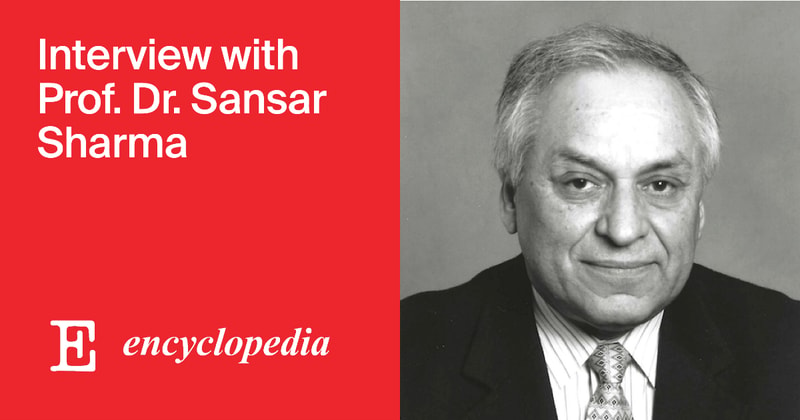
Encyclopedia | Interview with the Section Editor-in-Chief of Section “Medicine & Pharmacology”—Prof. Dr. Sansar Sharma
We are pleased to share the following interview with Prof. Dr. Sansar Sharma, Section Editor-in-Chief of Section “Medicine & Pharmacology” in Encyclopedia (ISSN: 2673-8392).
Neural specificity and plasticity in the formation of nerve connections have been the central themes for studies in Prof. Dr. Sharma’s laboratory. Earlier in his career, with Michael Gaze at Edinburgh University, Prof. Dr. Sharma discovered neural plasticity in the formation of regenerating optic nerve connections to the adult brain centers in lower vertebrates. In subsequent studies, the extent of this phenomenon was explored in higher vertebrates, specifically in experimental glaucoma in rats and pigs. Since there is selective cell death of ganglion cells in glaucoma, the fate of the remaining cells was explored with the anatomical, pharmacological, electrophysiological, and behavioral aspects. These ongoing studies gave further credence to the phenomenon of neural plasticity.
Education:
- Post-Doctoral Fellow: Dr. Viktor Hamburger and Rita Levi-Montalcini, Washington University, St. Louis, Mo, USA;
- Doctoral: Physiology, University of Edinburgh, School of Medicine, U.K. Professor R.M. Gaze and Professor David Whitteridge, UK.
Present research:
- Fate of retinal ganglion cells in transgenically induced microphthalmia in mice;
- Exosome-dependent navigational cues at the chiasm for developing retinal ganglion cell axons.
The following is a short Q&A with Prof. Dr. Nilanjana Maulik, who shared her vision for the journal with us:
1. What appealed to you about the journal that made you want to become its Section Editor-in-Chief?
A few articles in a review format with extensive background, present status of the topic at hand, and future direction of the topic make it worthwhile; instead of looking at a detailed method and just tackling a very small sub topic is mostly annoying, and it is directed at a very small audience. Encyclopedia has the capability to overcome such limitations. Hence my interests.
2. Looking at the current landscape of the “Medicine & Pharmacology” Section, what emerging topics or technologies do you believe are most ripe for comprehensive Encyclopedia entries?
Improving therapeutic specificity and immunotherapy, neuropharmacology, and neurodegeneration (e.g., Alzheimer's, Parkinsons): Regenerative pharmacology using drugs to facilitate tissue repair: AI powered drug discoveries, CRISP-CAS9 gene therapies’ based therapies: Targeting drug conjugates are some of the emerging topics that should be encouraged for Encyclopedia entries.
3. What part do you think our journal Encyclopedia will play in this research field?
Any article invited should include studies that provide extensive overviews of a specific topic, ending with future directions. Readers would benefit the most by searching for varied literature to understand the topic.
4. What is your vision for the “Medicine & Pharmacology” Section?
I hope we can persuade leading authorities to contribute to defining reviews of their topics to set the standard of academic excellence.
5. Do you have a message you would like to share with the current Board Members of the “Medicine & Pharmacology” Section in the Encyclopedia?
I urge each medicine and pharmacology board member to write an overview of their topic. After establishing the standard, they should urge their colleagues to submit work to the journal.
6. What advice can you give to young researchers who have just started in this field?
Before embarking on independent research, young researchers usually write their dissertations about chosen topics. This also includes residents in all medical fields. I would encourage them to write their versions for this journal so they can get evaluations and learn further how to prepare the findings for publications.