

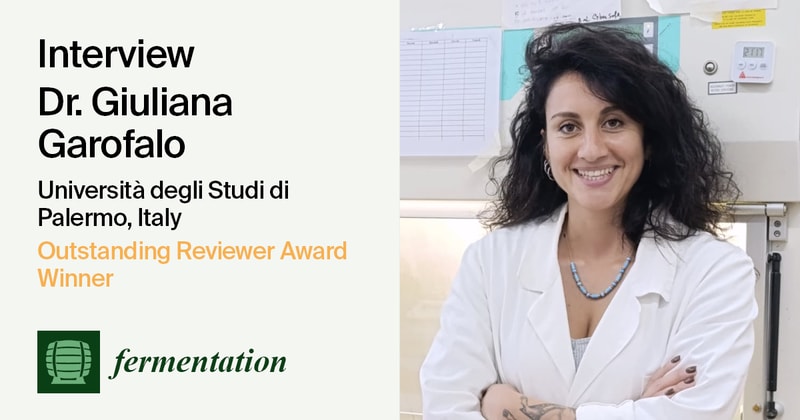
Interview with Dr. Giuliana Garofalo—Winner of the Fermentation Outstanding Reviewer Award
- How does receiving this award resonate with you, and what does it mean for your journey in peer review?
I honestly didn’t expect to receive this award, so it came as a real surprise. I’m very happy and quite excited about it. It means a lot to me because I always try to take peer review seriously and do it with care. Being recognized for that is really rewarding and encourages me to keep contributing in the same way.
- What key aspects do you prioritize when evaluating a manuscript?
When evaluating a manuscript, I mainly focus on the scientific soundness of the study, the clarity of its structure, and the logical flow of the work. I look at whether the objectives are clearly defined, if the methodology is appropriate, and whether the results support the conclusions. I also pay attention to how clearly the work is written, since good organization and readability are essential for communicating the research effectively.
- What common weaknesses do you see in academic writing, and how can authors improve the reviewability of their manuscripts?
One common weakness in academic writing is a lack of clarity and logical organization. Sometimes the objectives are not clearly stated, or the link between results and conclusions is not strong enough. In some cases, the discussion is also not well connected to the results or to existing literature.
- How has reviewing others’ work informed or shaped your own research?
Reviewing others’ work has made me more critical, especially regarding study design, clarity of objectives, and the consistency between results and conclusions. By observing recurring issues in manuscripts, I have become more careful in my own writing, paying greater attention to clarity, methodological details, and the overall structure of the paper. It has also encouraged me to explore my results more deeply and discuss them more thoroughly. At the same time, it has given me useful ideas and inspiration, particularly in terms of logical organization, when approaching similar studies.
- With AI-assisted writing and detection tools on the rise, how do you envision the future of peer review?
With the increasing use of AI-assisted writing and detection tools, I believe that peer review can benefit significantly if these technologies are used in a thoughtful and responsible way. They can support reviewers and authors by improving clarity, checking consistency, and speeding up some aspects of the process. However, I also think that relying on them without proper human oversight could be problematic. Scientific work always requires critical thinking, contextual understanding, and interpretation, which cannot be fully replaced by automated tools.