

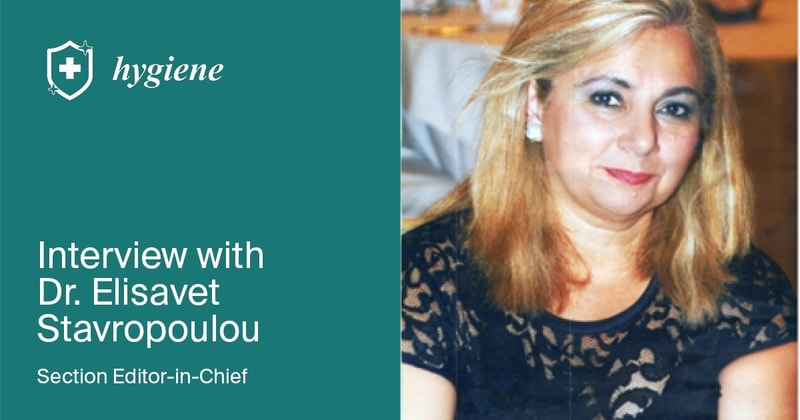
Interview with Prof. Dr. Eugenia Bezirtzoglou—Section Editor-in-Chief of the “Environmental Health” Section of Hygiene
We are pleased to share the following interview with Prof. Dr. Eugenia Bezirtzoglou, Section Editor-in-Chief of the “Environmental Health” Section of Hygiene (ISSN: 2673-947X).
Name: Prof. Dr. Eugenia Bezirtzoglou
Affiliation: Laboratory of Hygiene and Environmental Protection, Department of Medicine, Democritus University of Thrace, 68100 Alexandroupolis, Greece
Interests: microbiome; antimicrobials; antibiotics; biofilms
Prof. Dr. Eugenia Bezirtzoglou attended biochemistry at the University of Lille (France), hematology and parasitology at the Medical School of Lille (France). She continued her education by obtaining a medical degree, a PhD (Universite Paris-Sud) and a habilitation degree (Universite Paris-Sud). As medical doctor she is specialized in microbiology (Biopathology), as well as in clinical chemistry and in public health. Furthermore, she completed her scientific knowledge by post-education studies in the Laboratory of Gastrointestinal Microbial Ecology at Karolinska Institutet and at the Reference Laboratory of Anaerobic Bacteria at UCLA, Los Angeles, USA. She has published more than 200 international publications, 15 chapters in books and 6 books. She is often invited to participate in International Committees (ECDC section enteric pathogens, European evaluation programs, PhD Thesis). She was Ass professor in Microbiology at the Medical School of the University of Ioannina, Greece following by a position as full Professor in microbiology at the Faculty of Agricultural Development, Department of Food Science and Technology, and Director of the Laboratories of (1) Microbiology, Biotechnology and Hygiene, (2) Food Processing, (3) Chemistry and Biochemistry of Foods, Greece and since 2018-2026 Full Professor in Microbiology at the Medical School of Democritus University of Thrace. She served as Chairman of the Faculty of Agricultural Development, Department of Food Science and Technology for 5 years. Actually, she is a member of the Supreme Council Hellenic Authority for Higher Education (HAHE), Greece and President of National Documentation Center (EKT), Greece.
1. What initially attracted you to take on this editorial leadership role for this particular Section? How does it align with your own expertise and research interests in “Environmental Health”?
I was particularly attracted to this editorial leadership role because “Environmental Health” is a highly interdisciplinary and rapidly evolving field that directly influences public health, disease prevention, and quality of life. Throughout my academic and research career, I have focused on microbiome research, antimicrobial resistance, antibiotics, one health and biofilm formation, all of which are closely connected to environmental and hygienic conditions affecting human health.
Although my primary expertise is in environmental microbiology and medical hygiene, these topics are also highly relevant to oral and dental hygiene, especially regarding oral microbiota, biofilm-associated infections, and the growing challenge of antimicrobial resistance in dental practice. Serving as Section Editor-in-Chief allows me to contribute to the advancement of innovative and scientifically rigorous research that bridges environmental health, microbiology, preventive medicine, and hygiene sciences.
2. From your vantage point as Section Editor-in-Chief, what are the most exciting and promising emerging trends or “hot topics” currently emerging within the environmental health field?
Several exciting trends are currently shaping the future of oral and dental hygiene research. One major area is the study of the oral microbiome and its relationship with systemic diseases, including cardiovascular disease, diabetes, gastrointestinal disorders, and neurodegenerative conditions. Researchers are increasingly recognizing the oral cavity as a key component of overall human health.
Another important trend is the development of novel antimicrobial strategies to combat resistant oral pathogens and biofilm-associated infections. This includes probiotics, postbiotics, natural antimicrobial compounds, nanotechnology-based therapies, and precision oral care approaches.
Additionally, there is growing interest in personalized medicine and artificial intelligence applications in dentistry, as well as the environmental sustainability of dental materials and clinical practices. Preventive oral hygiene, especially among vulnerable populations and aging societies, also remains a highly significant research priority.
3. As the Section Editor-in-Chief of Hygiene, what qualities do you consider essential for high‑impact manuscripts in your Section?
High-impact manuscripts should demonstrate scientific originality, methodological rigor, and clear relevance to public health, one health and hygiene. I particularly value studies that provide innovative insights, interdisciplinary perspectives, and practical implications for disease prevention and health promotion.
Strong manuscripts should present robust experimental design, appropriate statistical analysis, and well-structured discussion supported by the current literature. Transparency, ethical integrity, and reproducibility are also essential.
Importantly, I encourage submissions that address global challenges such as antimicrobial resistance, environmental contamination, emerging pathogens, microbiome research, and preventive healthcare strategies. Manuscripts that connect basic science with clinical or public health applications are especially valuable for our readership.
4. Looking ahead, what developments or collaborations would you like to see within the Hygiene community to further strengthen the journal’s impact and visibility?
I believe that international and interdisciplinary collaborations will play a central role in strengthening both the Hygiene community and the journal’s scientific impact. We need closer cooperation among microbiologists, clinicians, environmental scientists, epidemiologists, public health experts, and policymakers to address complex global health challenges.
I would also like to see greater participation from early-career researchers and more multinational research initiatives focused on environmental health, microbiome science, infection prevention, and antimicrobial stewardship.
In addition, Special Issues dedicated to emerging topics, collaborative academic networks, and increased engagement with scientific societies can significantly enhance the journal’s visibility and influence. Encouraging open scientific dialogue and promoting high-quality evidence-based research will remain essential for the journal’s continued growth.
5. What suggestions do you have for young scholars in related fields?
My advice to young scholars is to remain curious, persistent, and open to interdisciplinary collaboration. Science evolves rapidly, and continuous learning is essential. Young researchers should focus not only on technical expertise but also on developing critical thinking, communication skills, and international networking opportunities.
I also encourage them to pursue research questions that have meaningful societal impact, particularly in areas related to public health, microbiome science, antimicrobial resistance, and preventive medicine. Ethical research conduct and scientific integrity should always remain priorities.
Finally, I would emphasize the importance of resilience. Research often involves challenges and setbacks, but dedication, collaboration, and passion for discovery are key elements for a successful scientific career.