

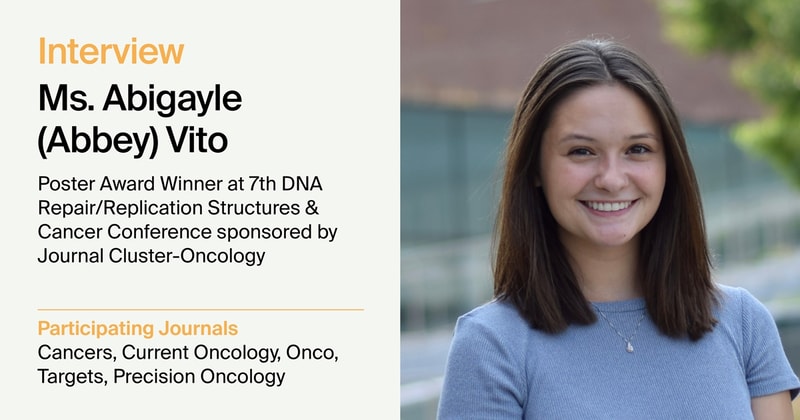
Journal Cluster of Oncology | Interview with Abigayle (Abbey) Vito—Poster Award Winner at 7th DNA Repair/Replication Structures & Cancer Conference
Ms. Abigayle (Abbey) Vito, a third-year graduate student in Dr. Bret Freudenthal’s lab at the University of Kansas Medical Center, won the poster award at the 7th DNA Repair/Replication Structures & Cancer Conference, sponsored by the Journal Cluster of Oncology, and we had the privilege of speaking with her. Below, she shares insights into her academic journey, research focus, and the motivation behind her landmark study.
1. Could you briefly introduce yourself and your main research focus within the broad area of DNA repair, replication structures, or cancer biology?
My name is Abigayle (Abbey) Vito, and I am a third-year graduate student in Dr. Bret Freudenthal’s lab at the University of Kansas Medical Center. My research focuses on understanding how DNA repair occurs within the complex chromatin environment of human cells. Much of the biochemical work that has laid the foundation for our knowledge of DNA repair has been performed on short DNA oligonucleotides. However, DNA in human cells is much more complex and is condensed into chromatin through the fundamental unit known as the nucleosome. My research goal is to understand how DNA repair, specifically base excision repair (BER), operates within chromatin. To address this goal, I utilize the nucleosome as a model system and use structural biology to elucidate the molecular mechanism that BER enzymes use to engage their substrates. This work fundamentally enhances our understanding of how DNA repair is carried out within human cells.
2. What do you think made your poster stand out—the scientific novelty, the clarity of the story, the visual presentation, or something else?
It was an incredible experience to attend a conference with so many structural biologists, from trainees to experts in the field. Based on the feedback I received during the poster session, I believe that my poster stood out for its clarity and the number of novel structures presented. I think, as structural biologists, we get very excited to see new structures from other researchers in the field because they can provide a lot of new insight into proteins that we are invested in understanding.
3. Any advice for early career researchers preparing their first poster?
The most important piece of advice that I have received about making a poster is that it is not necessary to present every piece of data that you have collected. It is much more impactful to have a visually appealing poster with a logical flow and only share the most important aspects of your story. Getting to the central point of your story quickly allows time for more meaningful conversations with audience members, which can lead to new perspectives on your research or experiments you may be struggling with.
4. Looking beyond the poster, what are the next steps for this research? Are you planning to follow up with a full paper?
This poster was only the beginning of a very exciting project! Along with structural data showing how BER enzymes engage their substrates, I am very interested in understanding how these enzymes locate their substrates to begin with. The nucleus of human cells contains over 3 billion base pairs of DNA, and these proteins face the extraordinarily difficult task of finding the specific lesion that they need to process. We are excited to use a single-molecule approach to investigate the mechanisms used by BER proteins to search for DNA damage. Looking further ahead, we hope to translate this into human cells to better understand how these enzymes protect against DNA-damaging agents that drive cancer.
5. Our journal has always been committed to promoting high-quality research in DNA repair/replication and cancer biology. Would you be interested in working with us? What kind of support would be most helpful for you in that process?
I would absolutely be interested in working with the journal! As my project develops, I hope to submit a research article encompassing both the structural and single-molecule findings from this work. Having a journal with a strong commitment to DNA repair and cancer biology would be a great fit for this story. As for support, having guidance through the submission and revision process would be most helpful. In particular, workshops that address the technical aspects of manuscript submission and the editorial/peer review process would be very beneficial for early-career researchers like myself.