

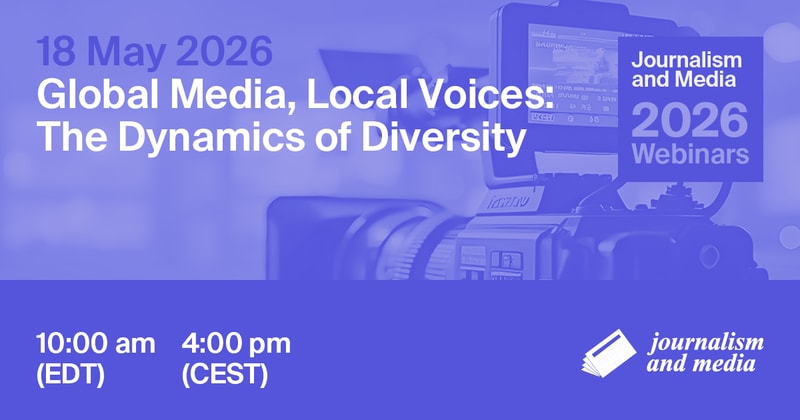
Journalism and Media Webinar | Global Media, Local Voices: The Dynamics of Diversity, 18 May 2026
On the one hand, there is no substitute for the formal and informal interactions that occur when folks are physically together; on the other, this virtual interaction enables the formation of a connection between people living at great distances from one another, geographically and financially.
Nowadays, we often hear that the golden age of journalism has now passed, dispatched to history by the winds of technology and the political economy. It is definitely not a golden age for recent graduates from journalism programs in the Global North who expect to work for a thing called a newspaper for the next thirty years.
But two hundred years ago, only 12% of the world’s population was literate; forty-five years ago, this figure was 68%—today, it is 86%. More people are able to read and write than ever before, in their own languages and others. And when they can do so, they read and write about current affairs: weather, fashion, geopolitics, sports, the environment, religion, housing prices, and so on. So, we are definitely in the golden age of reading and writing about the world.
The problem we face is that media outlets in wealthy countries are increasingly owned by far-right oligarchs rather than centrist liberals. Investigative journalism has lost its 70s fetish and journalists are increasingly subject to intimidation and massacres. Statistically, the image of the Global North reporter shot in a war zone is a minor part of that problem. In the recent past Gaza, as well as Colombia and Mexico in decades prior, are prominent examples of places where reporters have been routinely killed.
The challenge for researchers and journalists is not only how to bridge the gap between the better aspects of the putative golden age and the realities of today but also how to do so from a perspective that is not rooted in Anglo conventions, anxieties, and shibboleths.
Date: 18 May 2026 at 4:00 p.m. CEST | 10:00 a.m. EDT
Webinar ID: 834 6873 1794
Register now for free!

|
Speaker/Presentation |
Time in CEST |
Time in EDT |
|
Prof. Dr. Toby Miller |
4:00–4:10 p.m. |
10:00–10:10 a.m. |
|
Dr. Sharon Coen |
4:10–4:30 p.m. |
10:10–10:30 a.m. |
|
Q&A Session |
4:30–4:35 p.m. |
10:30–10:35 a.m. |
|
Prof. Dr. Stina Bengtsson |
4:35–4:55 p.m. |
10:35–10:55 a.m. |
|
Q&A Session |
4:55–5:00 p.m. |
10:55–11:00 a.m. |
|
Dr. Emiliano Treré |
5:00–5:20 p.m. |
11:00–11:20 a.m. |
|
Q&A Session |
5:20–5:25 p.m. |
11:20–11:25 a.m. |
|
Prof. Dr. Cristina Pulido Rodríguez |
5:25–5:45 p.m. |
11:25–11:45 a.m. |
|
Q&A Session |
5:45–5:50 p.m. |
11:45–11:50 a.m. |
|
Prof. Dr. Toby Miller |
5:50–6:00 p.m. |
11:50–12:00 p.m. |
After registering, you will receive a confirmation email containing the necessary information on how to join the webinar.
Registrations with academic institutional email addresses will be prioritized.
Unable to attend? Register anyway and we will let you know when the recording is available to watch at your convenience.
Webinar Chairs and Keynote Speakers:
- Prof. Dr. Toby Miller, Instituto Tecnológico de Monterrey, Mexico;
- Dr. Sharon Coen, School of Health and Society, Media Psychology Team, The University of Salford, UK;
- Prof. Dr. Stina Bengtsson, Media and Communication Studies, Södertörn University, Stockholm, Sweden and the Centre for Research in Applied Communication, Culture, and New Technologies (CICANT), Lusófona University, Portugal;
- Dr. Emiliano Treré, ATRAE Distinguished Researcher, University of Santiago de Compostela, Spain and the Data Agency and Media Ecologies, Cardiff University, UK;
- Prof. Dr. Cristina Pulido Rodríguez, Department of Journalism and Communication Sciences, Autonomous University of Barcelona, Spain.
Relevant Special Issue:
“Global Media, Local Voices: The Dynamics of Diversity”
Guest Editor: Prof. Dr. Toby Miller
Abstract submission deadline: 31 July 2026