

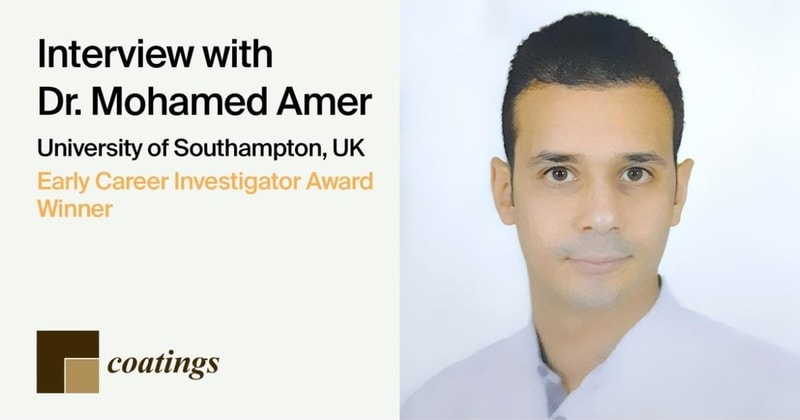
Interview with Dr. Mohamed Amer—Winner of the Coatings Early Career Investigator Award
Coatings (ISSN: 2079-6412) is pleased to present the second-place winner of the Coatings Early Career Investigator Award—Dr. Mohamed Amer!
Dr. Mohamed Amer is a materials researcher and mechanical engineer with expertise in materials testing and characterization, coatings, sheet metal forming, and finite element modeling. He completed his PhD in materials science at Coventry University, UK, where his research focused on cracking behavior in thermal barrier coatings under thermal and mechanical loading, supported by image-based modeling. Dr. Mohamed Amer also holds an MSc in mechanical engineering, where he investigated ductile damage prediction in aluminum alloys, and a BSc in mechanical engineering from Helwan University, Egypt.
Dr. Mohamed Amer’s current research focuses on the development and performance evaluation of high-temperature metallic alloys, particularly austenitic steels operating in the 500–600 °C range. His work addresses the limitations of traditional trial-and-error alloy development by integrating combinatorial experimentation with thermodynamic calculations to design new compositions with improved phase stability. He employs high-throughput bulk processing techniques to enable parallel testing and efficient characterization of multiple alloy variants.
We welcome you to read our interview with Dr. Mohamed Amer below.
1. Could you briefly introduce yourself, including your current affiliation and main research areas?
I am Dr. Mohamed Amer, a Research Fellow at the University of Southampton, UK, working on an EPSRC-funded project focused on accelerated design and qualification of high-temperature austenitic steels for creep–fatigue environments. My background is in materials science and mechanical engineering, with research spanning thermal barrier coatings, high-temperature alloys, advanced materials characterization, and finite element modelling. My work combines experimental testing, microscopy-based analysis, and computational modelling to understand material degradation and to develop more durable materials for aerospace, energy, and nuclear applications.
2. What inspired you to pursue research in the field of coatings and alloy design?
I have always been motivated by the challenge of understanding how materials behave under extreme conditions and how engineering design can improve their performance. Coatings and alloy systems are essential in enabling safer and more efficient technologies, particularly in high- temperature environments such as turbines and power plants. The opportunity to combine scientific discovery with practical industrial impact inspired me to pursue this field.
3. What challenges have you encountered during your research journey, particularly as a young investigator? Do you have anything to say to your fellow scholars?
One of the main challenges in my research journey has been integrating experimental testing, computational modelling, and data-driven analysis into a unified framework to solve complex materials science problems. For example, in my PhD research on the cracking behaviour of thermal barrier coatings, I combined in situ experimental testing, advanced microscopy, image-based finite element modelling, and machine learning-assisted crack detection to better understand crack initiation and propagation in different coating systems and to improve the capabilities of the in situ testing. Bringing these approaches together required developing expertise across multiple methodologies and interpreting results in a consistent scientific framework. As a young investigator, building confidence and independence while adapting to new research environments has also been demanding, particularly when working across multidisciplinary teams and taking on greater research responsibility. My advice to fellow scholars is to remain persistent, embrace interdisciplinary collaboration, and see setbacks as part of the research process. Many challenges ultimately lead to the most meaningful scientific insights and personal growth.
4. Which emerging topics in coatings and alloy design do you believe will critically influence the academic community in the coming years?
Different emerging topics can be considered to significantly shape the future of coatings and alloy design. High-throughput materials discovery is considered a promising topic, where combinatorial experimentation is combined with computational thermodynamics and rapid characterisation to accelerate the development of new alloys and coating systems far beyond traditional trial-and-error approaches. Additionally, AI-assisted materials design enables researchers to predict compositions, optimise processing parameters, and identify performance trends more efficiently using data-driven models.
In the coatings field, there is growing interest in nanostructured and nanoparticle-reinforced coatings, which offer enhanced hardness, wear resistance, and scratch resistance for harsh operating environments. High-entropy alloy (HEA) coatings are also attracting major attention because of their corrosion resistance, thermal stability, and mechanical performance under harsh conditions. Another promising area is the development of multilayer and functionally graded coatings, which allow tailored thermal and mechanical properties across interfaces to improve durability and reduce failure.
In addition, advanced evaluation and characterisation methods, such as in-situ mechanical and thermal testing combined with real-time microscopy and digital image analysis, are becoming increasingly important, as they provide direct insight into crack initiation, deformation, and degradation mechanisms under realistic service conditions.
5. What would you consider to be the most important qualities for young scholars to possess?Curiosity, resilience, adaptability, and scientific integrity are essential. Young researchers should also develop strong communication and collaborative skills, as modern research increasingly depends on interdisciplinary teamwork and knowledge exchange.
6. As the winner of this award, is there something you want to express or someone you’d most like to thank?
I am deeply honoured to receive this award. I would like to express my sincere gratitude to my PhD supervisors, Dr. Mingwen Bai, Dr. Vit Janik, and Prof. Xiang Zhang, for their invaluable guidance and continuous support throughout my research journey. I am also highly grateful to CN Tech Ltd, specifically Jon Nottingham and Clive Nottingham, for funding my PhD project and supporting this collaborative work. I would like to thank all my collaborators and colleagues whose advice and encouragement have contributed greatly to my development. I am equally thankful to my mentors at Coventry University and the University of Southampton, whose mentorship has played a significant role in shaping me as a researcher. Finally, I extend my heartfelt gratitude to my family for their constant encouragement and unwavering support.
7. Do you have any other suggestions for how journals and publishers can further support young researchers and the academic community?
Journals can further support early-career researchers by creating more mentoring opportunities in peer review, offering recognition for emerging reviewers, and organising workshops on scientific writing and publishing. Increased visibility for early-career work through interviews, featured articles, and awards can also greatly encourage young scientists and strengthen the research community.