


Abstract
Many plants produce secondary metabolites (PSMs) with antiviral activities. Among the antiviral PSMs, lipophilic terpenoids in essential oils can disturb the lipid envelope of viruses. Phenols and polyphenols (flavonoids, rosmarinic acid and tannins) attack viral proteins present in the viral membrane or inside the virus particle. Both phenolics and essential oils are active against free viral particles but not—or to a lesser degree—after a virus has entered a host cell. Another group of PSMs is directed against DNA or RNA. These are DNA intercalators such as sanguinarine, berberine, emetine and other isoquinoline alkaloids, ß-carboline, and quinoline alkaloids such as quinine, cinchonine, dictamine and skimmianine. The DNA intercalators stabilize double-stranded nucleic acids and inhibit the replication, transcription, and translation of genetic material. These alkaloids can inhibit viral development and viral replication in cells, as shown for SARS-CoV-1 and other viruses. Since chloroquine (which is also a DNA intercalator and a chemical derivative of the alkaloid quinine) is apparently clinically helpful against severe acute respiratory syndrome coronavirus 2 (SARS-CoV-2) infections, it is assumed that intercalating alkaloids, or the medicinal plants producing them, may be interesting candidates for the development of new antiviral drugs for the treatment of coronavirus disease 2019 (COVID-19).
2. Antiviral PSM
The structure of viral particles is quite simple when compared to prokaryotic or eukaryotic cells (Figure 1). Many viruses consist of a nucleic acid as the genetic base, which can be RNA or DNA (Table 1). The genetic material is often complexed by nucleic-acid-binding proteins, forming a nucleocapsid. This capsid is surrounded by a membrane envelope derived from the endoplasmic reticulum (ER) of a host cell. Several viral proteins reside in this membrane, which help the viral particle to attach to the cellular receptors of potential host cells in order to be taken up. As an example of the structure of a virus, Figure 1 schematically illustrates the structure of SARS-CoV-2 [14,15].
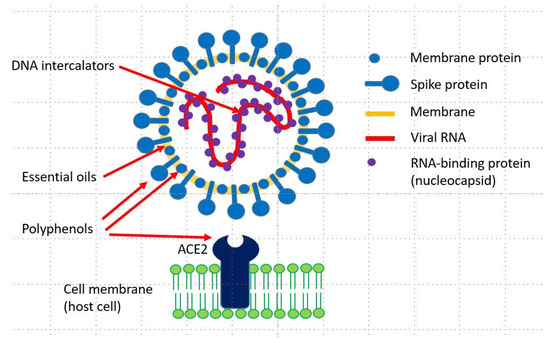
Figure 1.
A simplified and schematic structure of severe acute respiratory syndrome coronavirus 2 (SARS-CoV-2), which can bind to a cellular receptor (ACE2) of a host cell with its spike proteins. Targets for antiviral drugs (essential oils, polyphenols and DNA intercalators) are indicated by red arrows.

Table 1.
Nucleic acids of main groups of viruses and related health disorders [6,16].
2.1. Evidence for the Antiviral Activity of PSMs
In most instances, antiviral activities have been described from extracts of medicinal plants or isolated PSMs [6,7,8,9,10,11,12]. In general, antiviral activity has been determined in vitro, using sensitive cell culture systems (Table 2 and Table 3). In the design of such studies, it is important to understand the protocol. Antiviral PSMs can directly interfere with viruses if both are incubated together before they are added to the cells. If cells are already infected, PSMs need to be absorbed by the cell before they can attack viruses intracellularly. Because many PSMs (polyphenols) are polar molecules, which cannot pass biomembranes freely, their absorption into cells is low. Most publications show that extracts with essential oils or phenolics can inhibit free viral particles, but are rather inactive against infected cells [6]. Tannins with many phenolic hydroxyl groups are especially active towards free viral particles, as they can effectively bind to proteins (Table 2). Consequently, most instances of antiviral activity have been recorded when PSMs and viruses are co-incubated, and far less when the cells are already infected. A selection of PSMs or essential oils with antiviral activities is documented in Table 2 and Table 3; for more examples and details, see the reviews in [6,7,8,9,10,11,12].
Table 2.
Antiviral activity of selected plant extracts or plant secondary metabolites (PSMs) [6,7]. For DNA-intercalating alkaloids, see Table 3.
2.2. Mode of Action
Considering the potential targets to attack a viral particle with a drug, we can distinguish between proteins (membrane proteins, capsid proteins), the envelope membrane and the nucleic acids (Figure 1). In addition, there may be specific targets such as integrase, proteases (needed to trim the viral proteins), RNA-dependent RNA polymerase (RdRp), reverse transcriptases (in the case of retroviruses), proteins of the membrane envelope or the ACE2 receptor on host cells [6,7,8,9,10,11,12,14,15].
Medicinal chemistry usually searches for specific inhibitors of enzymes, receptors and other proteins, or nucleic acids and associated processes. For example, analogues of DNA bases (nucleoside analogues) can inhibit the successful viral replication and translation. These compounds are synthetic and hardly found in nature. They are presently being used to treat patients with COVID-19 [15]. In contrast, most of the PSMs with antiviral properties are less-specific inhibitors, which does not rule out their potential utility.
2.2.1. Lipophilic Terpenoids (Essential Oils)
Among the antiviral PSMs, lipophilic terpenoids, as found in the essential oils of many plants [13], are interesting candidates (Table 2). These lipophilic compounds most likely nonspecifically intercalate into the lipid double layer of the viral envelope. Consequently, the fluidity of the membrane is changed and, at a higher concentration, the membrane is even lysed [6]. The same effect can be achieved with lipophilic solvents such as chloroform, which have been used to inactivate viruses in blood products. This interaction can only occur when the viral particle is intact, that is, before it enters a host cell. Once inside a cell, these lipophilic compounds no longer work [6]. As can be seen from Table 2, essential oils from many aromatic plants exhibit antiviral activity in vitro [6,7,8,9,10,11,12].
2.2.2. Phenolics and Polyphenols
Phenolic compounds and polyphenols are PSMs with aromatic rings that contain one or several hydroxyl groups. The name is derived from phenol, a simple aromatic phenyl ring with a single hydroxyl group. The phenols have an important chemical property, in that their hydroxyl group can dissociate under physiological conditions. It forms a phenolate ion with a negative charge (and other resonance structures). Polyphenols such as flavonoids, rosmarinic acid and tannins carry several such phenolic OH groups. These OH groups can form hydrogen and ion bonds with the outer groups of proteins, such as the positively charged amino groups. If a tannin and a protein are incubated together, the polyphenols form several hydrogen and ion bonds, which will influence the 3D structure of a protein or inhibit its activity [18]. Consequently, tannins are known as very potent protein inactivators, and are also antiviral. This activity is also seen when phenols or tannins are incubated with viruses (Table 2 and Table 3): polyphenols bind to viral proteins in the envelope, which often prevents the docking of a virus to its host cells. Thus, many polyphenols are antiviral as long as virus particles are intact and have not been taken up by a host cell [6]. Most polyphenols are polar molecules, and their absorption into cells is low.
2.2.3. DNA and RNA–DNA Alkylation and DNA Intercalation
The genetic material of a virus is an important target, be it DNA or RNA (Table 1). Several PSMs are known to attack nucleic acids [13]. We distinguish between DNA-alkylating substances and DNA intercalators.
Typical DNA-alkylating PSMs include pyrrolizidine alkaloids, aristolochic acid, cycasin, macrozamin, furanocoumarins and PSMs with aldehyde or epoxide functional groups [13,18]. These compounds lead to mutations and cell death and can even cause cancer. Therefore, alkylating PSMs or plant extracts are not used in phytotherapy, even if they may be active against viruses.
Intercalating PSMs are usually lipophilic and planar aromatic multi-ring structures that can insert between the stacked DNA base pairs of the DNA helix or paired regions of RNAs. Depending on the concentration and affinity, such DNA intercalators stabilize the DNA double helix in such a way that replication is reduced or even impossible. Consequently, a cell will die (usually via apoptosis) [18,19]. At lower concentrations, intercalators can induce deletions, strand breaks and frame-shift mutations.
Among the intercalating PSMs, alkaloids of the isoquinoline, quinoline and β-carboline type provide several powerful antiviral compounds [18,19,20,21,22]. For example, sanguinarine, which occurs in Sanguinaria canadensis, Macleaya cordata, Bocconia frutescens, Eschscholzia californica, and Chelidonium majus, is a very strong DNA intercalator with pronounced cytotoxic, antibacterial and antiviral properties. Additionally, the protoberberine alkaloid berberine and related derivatives, which occur in many species of the Berberidaceae and Papaveraceae, are known intercalators with antibacterial and antiviral properties (Table 3).
Table 3.
Selected alkaloids, which intercalate nucleic acids and inhibit viral replication [19,20,21,22].
Table 3.
Selected alkaloids, which intercalate nucleic acids and inhibit viral replication [19,20,21,22].
| PSM | Type | Occurrence | Activity | Anti-Viral Activity | Ref. |
|---|---|---|---|---|---|
| Sanguinarine, chelerythrine, chelidonine | Isoquinoline alkaloids | Papaveraceae | Very strong DNA intercalator | HSV, HIV, HIV, influenza | [23,24] |
| Berberine, berbamine, berberrubine, coptisine, dicentrine, jatrorrhizine, palmatine | Isoquinoline alkaloids | Berberidaceae, Papaveraceae | Strong DNA intercalator | SARS-CoV, HSV, CHIKV, hepatitis C | [25,26,27,28,29] |
| Tetrandrine, fangcholine, cepharanthine | Isoquinoline alkaloids | Menispermaceae | DNA intercalator | SARS-CoV | [30] |
| Quinine, quinidine, cinchonine, cinchonidine | Quinoline alkaloids | Rubiaceae | DNA intercalation, inhibition of DNA polymerase | HSV, influenza, DENV | [31] |
| Emetine | Quinoline alkaloids | Rubiaceae | DNA intercalation, inhibition of DNA polymerase, Topoisomerase, Reverse transcriptase, protein synthesis | HIV, HSV, Inhibits pseudorabies Semliki Forest | [27,32,33] |
| Dictamine, ellipticine, evolitrine, fagarine, skimmianine | Quinoline alkaloids | Rutaceae | DNA intercalation | [13] | |
| Cryptolepine | Quinoline alkaloids | Apocynaceae | DNA intercalation | Antimicrobial | [13] |
| Harmine, harmaline | β-Carboline alkaloids | Zygophyllaceae | DNA intercalation, inhibition of DNA polymerase, Topoisomerase, Reverse transcriptase | HSV, MCMV, influenza | [33] |
Intercalating compounds not only inhibit DNA replication, but also DNA polymerase, reverse transcriptase and potentially RNA polymerases and ribosomal protein biosynthesis. The stronger the intercalation, the higher the inhibition of polymerases and protein synthesis [19,20,21,22]. As these processes are important for viral replication, intercalating alkaloids have antiviral properties (Table 3).
Most of these alkaloids are readily absorbed into cells and could influence the replication and transcription of a virus within its host cell. Sanguinarine and berberine show low human toxicity [13,24,34] and might be good candidates against viral infections. They would be active against DNA viruses and RNA viruses if the RNA exists in a double helix or forms partial helical structures.
3. Relevance for Coronavirus SARS-CoV-2 and COVID-19
SARS-CoV-2 is a member of Coronaviridae [14,15]. The viral genome is a single-stranded RNA (+ sense), which can function directly as an mRNA. The mRNA is complexed by binding proteins, forming the nucleocapsid. SARS-CoV-2 is a virus with a membrane envelope, which is derived from the endoplasmic reticulum of the host cell. It carries several proteins—a spike protein which binds to the cellular receptor ACE2, as well as membrane and envelope proteins (Figure 1). Once the virus particle has entered a host cell, the viral genome is released. The mRNA is copied by a viral polymerase, which makes several new copies of the viral mRNA. These mRNA copies are translated at ribosomes attached to the endoplasmic reticulum so that the translated proteins (spike protein, a membrane and an envelope protein) become embedded into the ER membrane. Golgi vesicles are generated, which are finally released by exocytosis. The nucleocapsid proteins are translated at cytoplasmic ribosomes and bind to mRNA. The nucleocapsid is internalized into the ER/Golgi vesicle [14,15].
When the last SARS epidemic (SARS-CoV-1) was active [15], many research teams screened PSMs and medicinal plants against SARS infection [15,25,35,36,37,38,39,40,41]. A selection of active drugs are shown in Table 4. As SARS-CoV-2 is a closely related virus, it would be a good idea to check if the findings from SARS-CoV-1 also apply to SARS-CoV-2.
Table 4.
Examples of plant extracts active against SARS [17,23,24,25,26,27,28].
Traditional Chinese medicine (TCM) has a long tradition, and TCM formulae have been used to treat viral infections with positive results (examples in [15]). Presently, more than 15 clinical studies with complex TCM drugs against COVID-19 are ongoing in China, of which some are already in clinical phase 4 [15]. The traditional approach has its merits, but we could also try a more rational target-orientated approach by studying isolated PSMs with antiviral properties, especially those which inhibit viral replication (Figure 1).
5. Conclusions
Antiviral secondary metabolites can target viral proteins (polyphenols), the lipid envelope (essential oils and other lipophilic PSMs) and viral nucleic acids (intercalating alkaloids). DNA-intercalating drugs inhibit DNA and RNA polymerases and protein biosynthesis, and consequently, viral replication. Whereas essential oils and polyphenols are active against the free virus, the intercalators can also inhibit the viral replication inside the host cell. The intercalating alkaloids sanguinarine, chelidonine, chelerythrine, berberine, coptisine, jatrorrhizine, palmatine, tetrandrine, cepharanthine, quinine, cinchonine, harmine and emetine (Table 3 and Table 4) represent interesting candidates for direct clinical studies or as lead compounds for the synthesis of synthetic antiviral drugs. Alternatively, extracts from medicinal plants [13] which produce these alkaloids, such as Bocconia frutescens, Chelidonium majus, Cinchona sp., Eschscholzia californica, Berberis sp., Coptis chinensis, Jateorhiza palmata, Hydrastis canadensis, Macleaya cordata, Phellodendron amurense, Psychotria ipecacuanha, Sanguinaria canadensis, Stephania tetrandra and others summarized in [34] may be more easily available than the isolated alkaloids. They might be useful as adjunctive therapeutics in the treatment of viral infections such as SARS-CoV-2 but need to be investigated in more detail.
Acknowledgments
The author thanks his former co-workers B. Latz-Brüning, T. Schmeller, B. Wetterauer, and Tamer Mahmoud who had analyzed PSMs with DNA-intercalating activities.
Conflicts of Interest
The author is the Editor-in-Chief of Diversity.
References
- Wink, M. Evolution of the Angiosperms and co-Evolution of Secondary Metabolites, Especially of Alkaloids. In Co-Evolution of Secondary Metabolites; Mérillon, J.M., Ramawat, K.G., Eds.; Springer: Heidelberg, Germany, 2020; pp. 1–24. [Google Scholar] [CrossRef]
- Harborne, J.B. Introduction to Ecological Biochemistry, 4th ed.; Academic Press: New York, NY, USA, 1993. [Google Scholar]
- Wink, M. Plant breeding: Importance of plant secondary metabolites for protection against pathogens and herbivores. Theor. Appl. Genetics 1988, 75, 225–233. [Google Scholar] [CrossRef]
- Wink, M. Evolution of secondary metabolites from an ecological and molecular phylogenetic perspective. Phytochemistry 2003, 64, 3–19. [Google Scholar] [CrossRef]
- Wink, M. Biochemistry of Plant Secondary Metabolism; Annual Plant Reviews; Wiley-Blackwell: Oxford, GB, USA, 2010; Volume 40. [Google Scholar]
- Reichling, J. Plant—Microbe Interactions and Secondary Metabolites with Antibacterial, Antifungal and Antiviral Properties. In Functions and Biotechnology of Plant Secondary Metabolites; Annual Plant Reviews 39; Wink, M., Ed.; Wiley-Blackwell: Oxford, GB, USA, 2010; pp. 214–347. [Google Scholar]
- Lin, L.-T.; Hsu, W.-C.; Lin, C.-C. Antiviral natural products and herbal medicines. J. Trad. Complement. Med. 2014, 4, 124–135. [Google Scholar] [CrossRef]
- Mukhtar, M.; Arshad, M.; Ahmad, M.; Pomerantz, R.J.; Wigdahl, B.; Parveen, Z. Antiviral potentials of medicinal plants. Virus Res. 2008, 131, 111–120. [Google Scholar] [CrossRef] [PubMed]
- Li, T.; Peng, T. Traditional Chinese herbal medicine as a source of molecules with antiviral activity. Antivir. Res. 2013, 97, 1–9. [Google Scholar] [CrossRef] [PubMed]
- Akram, M.; Tahir, I.M.; Shah, S.M.A.; Mahmood, Z.; Altaf, A.; Ahmad, K.; Munir, N.; Daniyal, M.; Nasir, S.; Mehboob, H. Antiviral potential of medicinal plants against HIV, HSV, influenza, hepatitis, and coxsackievirus: A systematic review. Phytother. Res. 2018, 32, 811–822. [Google Scholar] [CrossRef]
- Dhama, K.; Karthik, K.; Khandia, R.; Munjal, A.; Tiwari, R.; Rana, R.; Khurana, S.K.; Sana, U.; Khan, R.U.; Alagawany, M.; et al. Medicinal and therapeutic potential of herbs and plant metabolites/extracts countering viral pathogens—Current knowledge and future prospects. Curr. Drug. Metab. 2018, 19, 236–263. [Google Scholar] [CrossRef]
- Ben-Shabat, S.; Yarmolinsky, L.; Porat, D.; Dahan, A. Antiviral effect of phytochemicals from medicinal plants: Applications and drug delivery strategies. Drug Deliv. Transl. Res. 2020, 10, 354–367. [Google Scholar] [CrossRef]
- Van Wyk, B.-E.; Wink, M. Medicinal Plants of the World, 2nd ed.; CABI: Wallingford, UK, 2017. [Google Scholar]
- Tok, T.T.; Tatar, G. Structures and functions of coronavirus proteins: Molecular modeling of viral nucleoprotein. Int. J. Virol. Infect. Dis. 2017, 2, 1–7. [Google Scholar]
- Yang, Y.; Sahidul Islam, M.; Wang, J.; Li, Y.; Chen, X. Traditional Chinese Medicine in the treatment of patients infected with 2019-New Coronavirus (SARS-CoV-2): A review and perspective. Int. J. Biol. Sci. 2020, 16, 1708–1717. [Google Scholar] [CrossRef]
- Alberts, B. Molecular Biology of the Cell, 6th ed.; Garland Science: New York, NY, USA, 2015. [Google Scholar]
- Herrmann, F.; Romero, M.R.; Blazquez, A.G.; Kahl, S.; Kaufmann, D.; Marin, J.J.G.; Efferth, T.; Wink, M. Cytotoxicity and antiviral screening of 82 plants from Chinese and European phytomedicine. Diversity 2015, 3, 547–580. [Google Scholar] [CrossRef]
- Wink, M. Modes of action of herbal medicines and plant secondary metabolites. Medicines 2015, 2, 251–286. [Google Scholar] [CrossRef] [PubMed]
- Wink, M. Molecular modes of action of cytotoxic alkaloids- From DNA intercalation, spindle poisoning, topoisomerase inhibition to apoptosis and multiple drug resistance. Alkaloids 2007, 64, 1–48. [Google Scholar] [PubMed]
- Wink, M.; Schmeller, T.; Latz-Brüning, B. Modes of action of allelochemical alkaloids: Interaction with neuroreceptors, DNA and other molecular targets. J. Chem. Ecol. 1998, 24, 1881–1937. [Google Scholar] [CrossRef]
- Wink, M.; Schimmer, O. Molecular Modes of Action of Defensive Secondary Metabolites. In Functions and Biotechnology of Plant Secondary Metabolites; Annual Plant Reviews 39; Wink, M., Ed.; Wiley-Blackwell: Oxford, UK, 2010; pp. 21–161. [Google Scholar]
- Schmeller, T.; Latz-Brüning, B.; Wink, M. Biochemical activities of berberine, palmatine and sanguinarine mediating chemical defence against microorganisms and herbivores. Phytochemistry 1997, 44, 257–266. [Google Scholar] [CrossRef]
- Bombardelli, E.; Fontana, G.; Morazzoni, P.; Riva, A.; Ronchi, M. Formulations with Sanguinarine, Chelerythrine or Chelidonine for the Treatment of Warts, Verrucas and Psoriatic Plaques. Canada Patent CA2718384A1, 17 September 2009. [Google Scholar]
- Croaker, A.; King, G.J.; Pyne, J.H.; Anoopkumar-Dukie, S.; Liu, L. Sanguinaria canadensis: Traditional medicine, phytochemical composition, biological activities and current uses. Int. J. Mol. Sci. 2016, 17, 1414. [Google Scholar] [CrossRef]
- Kim, H.J.; Shin, H.S.; Park, H.; Kim, Y.C.; Yun, J.G.; Park, S.; Shin, H.J.; Kim, K. In vitro inhibition of coronavirus replications by the traditionally used medicinal herbal extracts, Cimicifuga rhizoma, Meliae cortex, Coptidis rhizoma, and Phellodendron cortex. J. Clin. Virol. 2008, 41, 122–128. [Google Scholar] [CrossRef]
- Chin, L.W.; Cheng, Y.; Lin, S. Anti-herpes simplex virus effects of berberine from Coptidis rhizoma, a major component of a Chinese herbal medicine, Ching-Wei-San. Arch. Virol. 2010, 155, 1933–1941. [Google Scholar] [CrossRef]
- Varghese, F.S.; Kaukinen, P.; Gläsker, S.; Bespalov, M.; Hanski, L.; Wennerberg, K.; Kümmerer, B.M.; Ahola, T. Discovery of berberine, abamectin and ivermectin as antivirals against chikungunya and other alphaviruses. Antiviral Res. 2016, 126, 117–124. [Google Scholar] [CrossRef]
- Wu, Y.; Li, J.Q.; Kim, Y.J.; Wu, J.; Wang, Q.; Hao, Y. In vivo and in vitro antiviral effects of berberine on influenza virus. Chin. J. Integr. Med. 2011, 17, 444–452. [Google Scholar] [CrossRef] [PubMed]
- Hung, T.C.; Jassey, A.; Liu, C.H.; Lin, C.J.; Lin, C.C.; Wong, S.H.; Wang, J.Y.; Yen, M.H.; Lin, L.T. Berberine inhibits hepatitis C virus entry by targeting the viral E2 glycoprotein. Phytomedicine 2019, 53, 62–69. [Google Scholar] [CrossRef] [PubMed]
- Kim, D.E.; Min, J.S.; Jang, M.S.; Lee, J.Y.; Shin, Y.S.; Song, J.H. Natural bis-benzylisoquinoline alkaloids—Tetrandrine, fangchinoline, and cepharanthine, inhibit human coronavirus OC43 infection of MRC-5 human lung cells. Biomolecules 2019, 9, 696. [Google Scholar] [CrossRef] [PubMed]
- D’Alessandro, S.; Scaccabarozzi, D.; Signorini, L.; Perego, F.; Ilboudo, D.P.; Ferrante, P.; Delbue, S. The use of antimalarial drugs against viral infection. Microorganisms 2020, 8, 85. [Google Scholar] [CrossRef]
- Bleasel, M.D.; Peterson, G.M. Emetine, ipecac, ipecac alkaloids and analogues as potential antiviral agents for coronaviruses. Pharmaceuticals 2020, 13, 51. [Google Scholar] [CrossRef]
- Perez, R.M. Antiviral activity of compounds isolated from plants. Pharm. Biol. 2003, 41, 107–157. [Google Scholar] [CrossRef]
- Wink, M.; Van Wyk, B.E. Mind-Altering and Poisonous Plants of the World; Briza Press: Pretoria, South Africa, 2008. [Google Scholar]
- Li, S.Y.; Chen, C.; Zhang, H.Q.; Guo, H.Y.; Wang, H. Identification of natural compounds with antiviral activities against SARS-associated coronavirus. Antivir. Res. 2005, 67, 18–23. [Google Scholar] [CrossRef]
- Chen, C.N.; Lin, C.P.C.; Huang, K.K.; Chen, W.C.; Hsieh, H.P.; Liang, P.H.; Hsu, J.T.H. Inhibition of SARS-CoV 3C-like protease activity by theaflavin-3,3’-digallate (TF3). Evid.-Based Complement. Altern. Med. 2005. [Google Scholar] [CrossRef]
- Wen, C.C.; Shyur, L.F.; Jan, J.T.; Liang, P.H.; Arulselvan, P.; Wu, J.B.; Kuo, S.C.; Yang, N.S. Traditional Chinese medicine herbal extracts of Cibotium barometz, Gentiana scabra, Dioscorea batatas, Cassia tora, and Taxillus chinensis inhibit SARS-CoV replication. J. Trad. Complement. Med. 2011, 1, 41–50. [Google Scholar] [CrossRef]
- Ryu, Y.B.; Jeong, H.J.; Kim, J.H.; Kim, Y.M.; Park, J.Y. Biflavonoids from Torreya nucifera displaying SARS-CoV 3CL (pro) inhibition. Bioorg. Med. Chem. 2010, 18, 7940–7947. [Google Scholar] [CrossRef]
- Cheng, P.W.; Ng, L.T.; Chiang, L.C.; Lin, C.C. Antiviral effects of saikosaponins on human coronavirus 229E in vitro. Clin. Exp. Pharmacol. Physiol. 2006, 33, 612–616. [Google Scholar] [CrossRef] [PubMed]
- Loizzo, M.R.; Saab, A.M.; Tundis, R.; Statti, G.A.; Menichini, F.; Lampronti, I.; Gambari, R.; Cinatl, J.; Doerr, H.W. Phytochemical analysis and in vitro antiviral activities of the essential oils of seven Lebanon species. Chem. Biodivers. 2008, 5, 461–470. [Google Scholar] [CrossRef] [PubMed]
- Chen, C.J.; Michaelis, M.; Hsu, H.K.; Tsai, C.C.; Yang, K.D.; Wu, Y.C.; Cinatl, J.; Doerr, H.W. Toona sinensis Roem tender leaf extract inhibits SARS coronavirus replication. J. Ethnopharmacol. 2008, 30, 108–111. [Google Scholar] [CrossRef] [PubMed]
- Jia, F.; Zou, G.; Fan, J.; Yuan, Z. Identification of palmatine as an inhibitor of West Nile virus. Arch. Virol. 2010, 155, 1325–1329. [Google Scholar] [CrossRef]
- Ho, Y.J.; Lu, J.W.; Huang, J.L.; Lai, Z.Z. Palmatine inhibits Zika virus infection by disrupting virus binding, entry, and stability. Biochem. Biophys. Res. Commun. 2019, 518, 732–738. [Google Scholar] [CrossRef] [PubMed]
© 2020 by the author. Licensee MDPI, Basel, Switzerland. This article is an open access article distributed under the terms and conditions of the Creative Commons Attribution (CC BY) license (http://creativecommons.org/licenses/by/4.0/).