


Abstract
In globalized markets, traditional Chinese furniture must strike a balance between cultural authenticity and modern consumer appeal. This study introduced the first comprehensive scale to measure Confucian–Daoist value expressions in Ming-style chair design for marketing applications. Through surveys conducted across 31 Chinese provinces (pilot sample size = 85; formal sample size = 440) and extensive literature analysis, six key cultural dimensions influencing consumer preferences were identified: respect for tradition, face, familism, respect for authority, the doctrine of the mean, and the nature/non-action. Building on these findings, this study proposes the first multidimensional framework for assessing Confucian and Daoist values in Ming-style chair design, offering an 18-item scale as a quantifiable tool to support the sustainable innovation of cultural heritage. The scale enables marketers and designers to detect regional and historical variations in cultural value preferences, thereby facilitating targeted positioning strategies that preserve authentic cultural expression while resonating with specific consumer segments.
1. Introduction
The accelerating globalization of design practices has aggravated the tension between cultural homogenization and heritage preservation [1,2]. While global market forces have fostered a tendency to standardize design aesthetics—often at the expense of local identities—heritage preservation emphasizes safeguarding traditional design elements and narratives [3,4]. In response, designers face the growing challenge of reconciling global consumer expectations with the need to protect and revitalize cultural heritage [5]. Within this context, culturally embedded design elements—particularly those reflecting national symbolism—have become crucial for enhancing product differentiation, emotional resonance, and identity expression in the contemporary markets [6,7]. Among heritage artifacts, Ming-style chairs stand as quintessential symbols of Chinese cultural meaning [8], distinguished not only by functionality and aesthetics, but also by embodiment of Confucian and Daoist philosophical principles—values that continue to shape Chinese cultural identity [9].
On one hand, existing studies primarily explore the influence of Confucian and Daoist culture on the design of Ming-style chairs from a qualitative perspective, providing valuable insights into the interplay between traditional culture and furniture design [10,11,12]. Confucianism, for instance, influences the structural hierarchy and balance evident in Ming-style furniture, with core values such as “people-oriented,” “harmony,” and the “balance of substance and form” are manifested through simple, elegant shapes, moderate proportions, and symmetrical configurations. These features enhance user comfort while conveying a sense of order and stability, thus reinforcing Confucian ideals through aesthetic expression [13,14]. In contrast, Taoism emphasizes “the unity of heaven and humanity” and reverence for nature—ideals reflected in Ming-style furniture through the use of natural materials such as wood and through smooth, flowing lines [15]. Building on this perspective, Cai delved into the application of the Daoist philosophy of “Naturalness and Wu Wei (non-action)” in Ming-style furniture design and highlighted the Confucian concept of “Body and Function” a mediating framework linking functional utility and form of furniture [16].
Although cultural value scales are widely adopted in international consumer research, most existing frameworks—particularly those derived from Hofstede’s cultural dimensions—are grounded in Western epistemology and thus inadequate for capturing the nuanced philosophical foundations of Chinese culture. While these macro-level constructs have proven effective in explaining cross-national differences in willingness to pay and sustainable consumption behaviors [17,18], they fail to align with indigenous value systems shaped by Confucian and Daoist thought. In China, attempts to develop culturally relevant scales incorporating concepts such as the Doctrine of the Mean, Face, Confucian collectivism, and Daoist values [19,20] have advanced context-specific measurement. However, these tools remain predominantly behavior-focused and do not address how cultural philosophy is materially expressed in design. Research on traditional cultural symbols shows that metaphorical cues influence consumer experience and perceived value, yet rarely translates philosophical meaning into measurable design attributes for heritage products [21]. Similarly, studies on individual cultural value orientation elucidate their impact on consumer judgment but provide limited understanding of how cultural meaning becomes physically embodied in product form [5].
Therefore, these limitations reveal a critical gap: current cultural value frameworks—whether international or Chinese—lack the capacity to evaluate how Confucian–Daoist principles are expressed and perceived through the design features of heritage artifacts. To address this gap, this study develops a design-oriented cultural value scale that translates Confucian–Daoist values into measurable attributes of Ming-style chair design and assesses how consumers perceive these features. This scale establishes a quantitative foundation for analyzing culturally embedded design features and supporting the examination of how traditional philosophical values operate within contemporary design contexts.
2. Literature Review
2.1. Cultural Values: Confucian, Daoist, and Their Distinctions
“Confucian–Daoist values” refer to the core ethical principles and value pursuits derived from Confucianism and Daoism. Despite their theoretical disparities, both philosophies have profoundly shaped Chinese culture and societal norms. Confucianism emphasizes “benevolence, righteousness, propriety, wisdom, and trustworthiness,” advocating for social harmony through self-cultivation, family order, and good governance, —values reflected in the functional utility and ceremonial aspects of Ming-style chairs [22,23]. In contrast, Daoism, centered on the principles of “Wu Wei (non-action)” and “the Way of Nature,” prioritizes harmony with nature, influencing the simplicity and use of natural materials in Ming-style chairs [24,25]. Together, these traditions converge in design concepts such as the “unity of heaven and humanity,” harmonious balance, and an aesthetic of simplicity and authenticity aligned with natural order.
The terms Confucian values, Daoist values, and Chinese traditional culture are frequently treated as interchangeable, despite differences in their conceptual scope and emphases. Confucian values focus on ethical conduct and the maintenance of social order, highlighting moral duties and role-based responsibilities in interpersonal and societal relationships—such as benevolence, loyalty, and filial piety [26]. Daoist values, by contrast, emphasize naturalism and individual self-cultivation, advocating principles such as Wu Wei (non-action) and harmonious coexistence with nature, with a focus on personal freedom and inner equilibrium [27]. Chinese traditional culture functions as an overarching framework that integrates multiple philosophical traditions—including Confucianism, Daoism, and Buddhism—within which Confucian and Daoist values serves as complementary yet distinct components, collectively contributing to the coherence and richness of the cultural system [16].
2.2. Design Implications of Confucian and Daoist Values in Ming-Style Chairs
Ming-style chair design embodies an integrated Confucian–Daoist value system in which ethical moderation, natural principles, and functional rationality converge through form. Rather than functioning as a purely utilitarian object, furniture is conceptualized through the principle of the “Unity of Heaven and Humanity” as a mediator between human use and the natural world. Empirical studies show that ergonomic proportions, fluid contours, and restrained structures not only satisfy functional requirements but also emulate natural forms, thereby embedding philosophical ideals into both perceptual and practical dimensions of design [28]. This integration is further reinforced through deliberate material selection and balanced composition, enabling Ming-style furniture to convey cultural meaning and environmental values [9,15,29,30].
Within this framework, Confucian values—particularly the Doctrine of the Mean—emphasize moderation and proportional control; symmetry, geometric order, and simplified lines translate moral restraint into a balanced relationship between form and function [16,26,31,32]. However, this Confucian logic is not complete in isolation. Complementarily, Daoist principles foreground natural alignment and minimal intervention. The idea that “the Way Follows Nature” is reflected in minimalist forms and smooth, fluid lines that enhance comfort and convey simplicity and harmony [33,34,35,36], while Wu Wei (non-action) further guides design toward structural efficiency and clarity through restrained craftsmanship rather than deliberate complexity [31,37,38]. Collectively, these studies indicate that Confucian–Daoist values operate as an integrated cultural logic shaping aesthetic judgment and consumer emotional responses.
2.3. Consumer Decision-Making Influenced by Confucian and Daoist Values
The application of Confucian and Daoist values in Ming-style chair design can significantly influence the decision-making process of consumers. This is achieved by shaping their perceptions of cultural authenticity, aesthetic preference, and product value. Hofstede’s cultural dimensions offer a foundational framework for understanding how national and regional cultural values affect consumer attitudes and behaviors. In particular, dimensions such as long-term versus short-term orientation, collectivism, and power distance help explain how Confucian values, including perseverance, harmony, and reciprocity, guide consumer evaluations and purchasing intentions [39,40,41,42]. Recent studies have shown that cultural values affect consumers’ interpretation of explicit and implicit design cues, thereby influencing their perceived and actual monetary value of the product [5,21,43].
Measurement scales developed for Confucian values, such as the Confucian Traditional Value Scale, capture multidimensional aspects including familism, modesty, face consciousness, unity, and diligence, and have been linked to consumer attitudes and workplace behavior [44,45,46,47]. Daoist values, operationalized through dimensions such as alignment with natural flow, minimal desire, dialectical thinking, and contentment, further inform consumer preferences for simplicity, natural aesthetics, and holistic well-being [45,46]. Increasingly, research has explored how Confucian and Daoist values jointly influence consumption decisions, highlighting their complementary roles in shaping perceptions of product authenticity, harmony with nature, and cultural meaning [17,18,19,26].
In consumer behavior studies, integrated scales such as CCVAL integrate Confucian and Daoist principles to capture context-specific consumer value orientations, including practical rationality, moderation, and aesthetic appreciation [19]. Hierarchical models incorporating Confucian collectivism and Daoist values have been applied to predict willingness to pay and purchase intention for culturally significant products, illustrating how traditional philosophical values can bridge cultural theory and contemporary consumer decision-making [20]. These findings underscore the relevance of value-based frameworks in explaining the mechanisms by which traditional cultural principles are internalized and enacted in modern consumption contexts.
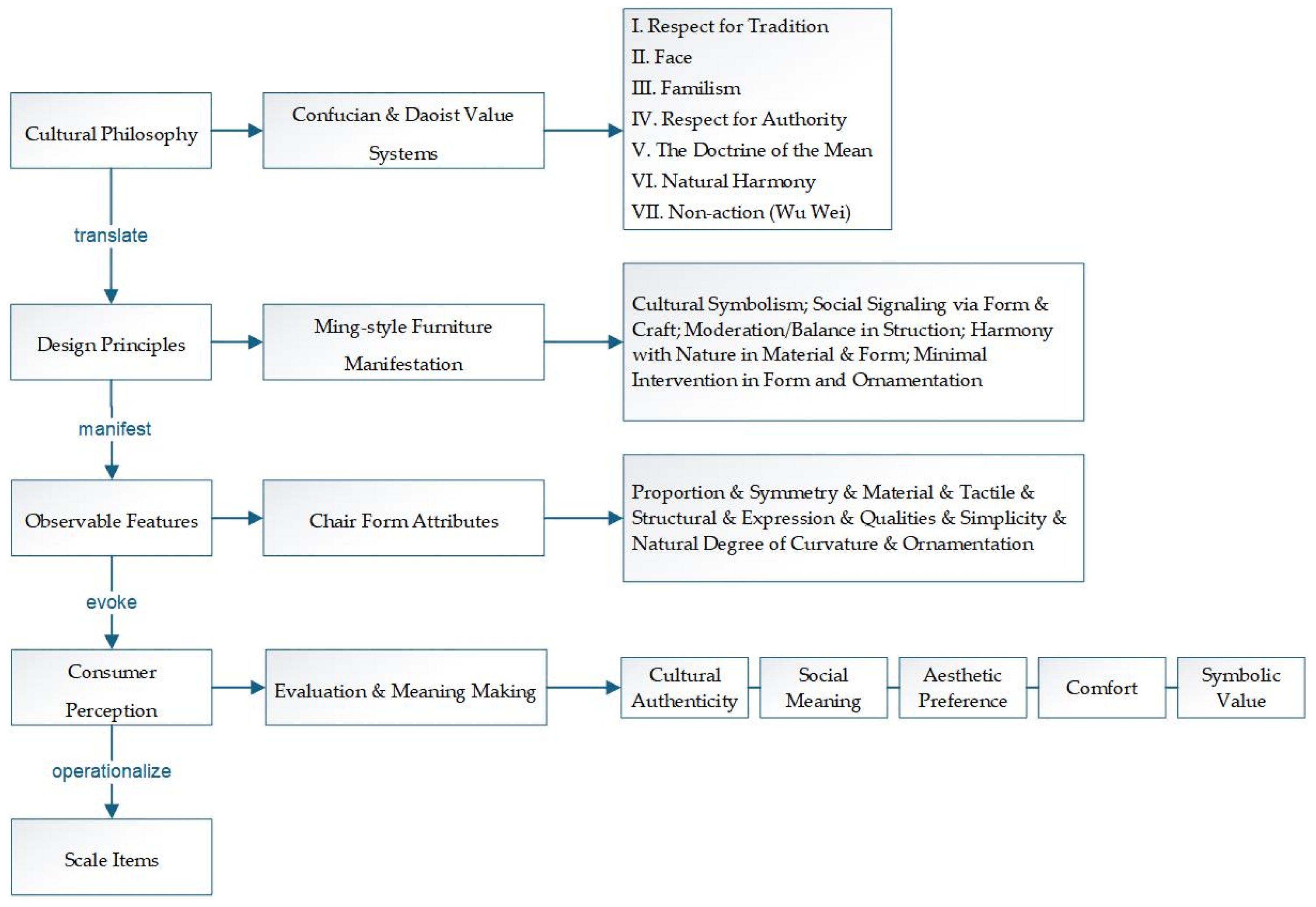
Overall, prior studies have shifted from single-method surveys to integrated qualitative–quantitative approaches (e.g., interviews, expert evaluation, and factor analysis), thereby strengthening the rigor of cultural value measurement. More importantly, the literature converges on a clear mechanism whereby Confucian–Daoist philosophies inform design principles, these principles are materialized in observable furniture features (e.g., proportion, symmetry, materials, structure, and ornamentation), and such features subsequently shape consumer perceptions, providing a direct basis for operationalizing measurable scale items. Therefore, this study has constructed a theoretical framework (Figure 1) that provides a solid theoretical and methodological basis for developing a Confucian–Daoist value scale.
Figure 1.
Research theoretical framework.
3. Scale Development
Following Churchill’s (1979) [48] scale development procedures and Hinkin’s (1995) [49] guidelines, this study conducted a multistage research process to develop and validate a scale measuring Confucian–Daoist values in Ming-style chair innovation design. The initial items were generated through literature review and content analysis [50]. Then, the initial item pool was preliminarily reviewed and refined through expert scoring. Finally, two rounds of data collection were conducted to purify the scale using (a) exploratory factor analysis, (b) confirmatory factor analysis, and (c) reliability and validity analysis.
3.1. Initial Item Pool Generation
Item Generation Based on Literature Research. Building on the literature review of Confucian and Daoist influences on Ming-style chair design, items from existing scales related to cultural values and design features were extracted, consolidated, and adapted (Table 1).
Table 1.
Research Status of Scales Related to Confucian and Daoist Values.
Based on the preliminary work in dimension identification and item formulation, this study established an initial item pool for the Ming-style chair innovation design scale, reflecting Confucian and Daoist values. The pool comprised 9 dimensions and 45 items, derived through inductive reasoning and thematic synthesis. To ensure content validity and refine the wording for linguistic clarity and appropriateness [56], two doctoral students and three professors specializing in furniture design and cultural studies independently reviewed each item. The expert panel was purposefully assembled to ensure a balanced representation of theoretical knowledge, practical design experience, and methodological expertise.
Experts were first briefed on the theoretical framework and research objectives, and then provided with the preliminary items and their corresponding dimension descriptions. They evaluated each item in terms of conceptual accuracy, cultural relevance, clarity, and applicability for the intended respondents. Items were revised or deleted following expert consensus, with removal criteria focused on insufficient representation of the intended construct, ambiguity, or redundancy. Following this evaluation, the scale was refined to 7 dimensions, each containing 8 items, resulting in a preliminary item pool of 56 items (Table 2).
Table 2.
Scale Items Based on Literature Research.
3.2. Exploratory Factor Analysis
3.2.1. Initial Questionnaire Sample
A small-scale pilot test was conducted to assess the reliability and validity of the questionnaire prior to full-scale administration. The questionnaire was randomly distributed via Credamo online platform (https://www.credamo.com, accessed on 15 March 2025) using a random sampling approach to recruit participants on 28 January 2025, and remained open for one week. A total of 106 responses were collected, with all items measured on a 5-point Likert scale (1 = Strongly Disagree, 5 = Strongly Agree). To ensure data quality, 21 invalid responses were excluded based on two criteria: uniform responses across all items and a completion time of fewer than 100 s—a threshold identified in prior research [57] as indicative of inattentive or non-serious responding. This yielded 85 valid responses for analysis. The sample covered 21 provinces in China, with a gender distribution of 39 males (45.9%) and 46 females (54.1%). Age distribution was as follows: 0–20 years old (7.1%), 21–30 years old (48.2%), 31–40 years old (35.3%), 41–50 years old (3.5%), and 51–60 years old (5.9%). In terms of educational background, the majority held a bachelor’s degree (63.5%), followed by 17.6% with a master’s degree and 7.1% with a high school, vocational, or technical school diploma. The largest occupational groups were students (25.9%) and employees of private enterprises (42.4%).
3.2.2. Item Purification
To ensure internal consistency, the corrected item-total correlation (CITC) and Cronbach’s α were employed [58]. Items with a CITC values below 0.5 and those whose deletion increased in Cronbach’s α were removed from the scale [59] (p. 123). This process led to the removal of 6 items, as their exclusion improved the overall reliability of the scale. The final scale consists of 50 items, demonstrating enhanced coherence in measuring the underlying constructs (Table 3).
Table 3.
Initial Scale Internal Consistency Test Results.
To maintain theoretical consistency during dimensional reduction, principal component analysis (PCA) with varimax rotation was conducted to identify the underlying factor structure and verify that merged constructs remained conceptually aligned with Confucian and Daoist values. The Kaiser Meyer-Olkin measure (KMO = 0.71) and Bartlett’s test of sphericity (χ2 = 3117.567, p < 0.001) confirmed the data were suitable for factor analysis [60]. PCA with varimax rotation extracted seven factors, retaining items with factor loadings above 0.5 [61]. According to Comrey’s (1988) [62] criteria, items with factor loadings above 0.5, no cross-loadings, and convergence within their intended dimensions exhibit strong reliability and should be retained in the final scale. In particular, EFA results showed that RT8, FC5, FM7, NH1, and NH8 had factor loadings below 0.5, while FC2, FC8, NH4, NH6, WW2, WW4, WW6, and WW7 failed to load onto their designated dimensions, and NH7 exhibited cross-loadings. Consequently, these 14 items were removed. After deletion, the cumulative variance explained increased from 60.846% to 64.662%, enhancing both interpretability and parsimony of the factor structure. Additionally, NH2, NH5, WW1, WW3, and WW8 converged into a single factor, prompting the merger of two dimensions into a unified “Natural and Wu Wei” dimension. Beyond convergence in the statistical sense, “Natural Harmony” and “Wu Wei” are theoretically inseparable in Daoist philosophy: both emphasize respect for nature, minimal intervention, and spontaneous balance. Their core meanings and intuitive expressions coincide to a large extent, providing a strong theoretical basis for their fusion into a unified “Natural and Wu Wei” construct. Ultimately, a 36-item scale was developed, with each retained item demonstrating a factor loading above 0.53 on its respective factor (Table 4).
Table 4.
EFA Results (N = 85).
3.3. Confirmatory Factor Analysis and Reliability-Validity Assessment
3.3.1. Formal Sample Collection
To validate the stability and construct validity of the factor structure, a secondary survey was administered. The questionnaire was divided into two sections: (1) demographic information—gender, age, education, occupation, professional background, familiarity with Ming-style chairs, and prior usage experience; and (2) the scale items. Given that the Face dimension exhibited reduced Cronbach’s Alpha in EFA but remains theoretically significant, three new items and one reverse-coded item were added, resulting in a 40-item scale.
The formal survey was administered via Credamo (https://www.credamo.com, accessed on 15 March 2025) using a random sampling approach 4–10 February 2025, yielding 520 completed responses. The screening was based on data quality—excluding responses with patterned answering, inconsistencies in reverse-coded elements, and turnaround times of less than 100 s [57]—440 valid responses were retained. The sample is mainly composed of participants aged 21–40 with relatively high educational backgrounds, which is appropriate for design-oriented cultural-perception research, as this group represents the main consumer group of contemporary furniture, typically possessing a solid aesthetic literacy and being able to clearly express their perception of cultural and design characteristics. Moreover, individuals in this demographic are frequent users of online survey platforms and can reliably provide the nuanced evaluations required for this study. Table 5 presents the demographic characteristics of the sample, which spans 31 provinces in China.
Table 5.
Demographic Characteristics of the Sample (N = 440).
A Confirmatory Factor Analysis (CFA) was conducted using AMOS 26.0 statistical software, with Maximum Likelihood Estimation. The initial scale, containing 39 items (after removal of one reverse-coded item), was used for model fitting. Due to the unsatisfactory fit indices, such as the Goodness of Fit Index (GFI) (Table 6), it was necessary to revise the original scale to achieve a better fit. The paths with lower coefficient values (<0.686) were sequentially deleted, including RT2 (0.552), RT3 (0.631), RT4 (0.617), and RT5 (0.542); FC4 (0.618), FC7 (0.532), and FCnew3 (0.618); RA1 (0.624), RA3 (0.644), RA5 (0.674), and RA8 (0.598); DM2 (0.594), DM3 (0.548), DM6 (0.533), and DM8 (0.589); FM2 (0.654), FM3 (0.635) and FM4 (0.649); as well as NH5 (0.683) and WW1 (0.621) and those with large standardized residuals (RA2, standardized residual = 0.60). Then the model fitting reached an acceptable standard.
Table 6.
The Model Fit Results of the Original and Adjusted Models.
3.3.2. Scale Reliability and Validity Analysis
Table 7 displays standardized factor loadings (standardized regression weights using AMOS terminology). Unless otherwise specified, all reported loading estimates refer to standardized values. The lowest loading is 0.686, linking the construct functional commitment (FC) to items of FCnew1 and FCnew2, these items were designed to more accurately capture the social and cultural nuances involved in maintaining face in the context of Ming-style chair consumption, which were not fully represented in the original scale. One additional loading (NH2) falls slightly below the conventional 0.7 threshold. The reliability and convergent validity of the adjusted scale are demonstrated in Table 7. Construct reliabilities range from 0.747 (RA) to 0.836 (DM), all surpassing the recommended threshold of 0.7, indicating adequate internal consistency. The average variance extracted (AVE) values range from 0.508 (NW) to 0.61 (RT), all exceeding the 0.50 benchmark [63] (p. 619). Collectively, these results support the convergent validity of the measurement model.
Table 7.
The Reliability and Convergent Validity Test Results of the Adjusted Scale.
To strengthen the transparency in item retention, we followed a systematic decision hierarchy. First, we ensured that each item contributed positively to Cronbach’s α. Second, factor loadings were examined, and items with loadings below 0.7 were only considered for removal if they also had a negative impact on reliability or model fit. In this analysis, despite two loadings being slightly below 0.7, their retention does not significantly compromise the entire model. Therefore, all items are retained, providing robust evidence of convergent validity.
3.3.3. Discriminant Validity
Discriminant validity assessed the extent to which a particular construct in the model is empirically distinct from the other constructs [63] (p. 620). It was evaluated by comparing the square root of the AVE for each construct with its correlations to other latent variables. As shown in Table 8, the diagonal elements (square roots of AVE) exceed the off-diagonal elements (inter-construct correlations), confirming discriminant validity [64]. In addition, the construct Face (FC) exhibited a relatively low mean (mean = 3.65) but a comparatively high standard deviation (SD = 0.835), suggesting substantial variability in respondents’ perceived evaluations related to face.
Table 8.
The Results of Discriminant Validity.
4. Discussion
4.1. Theoretical and Methodological Advancements over Existing Cultural Value Scales
This study advances the study of cultural values by applying the principles of Confucianism and Taoism to the design of Ming style chairs. Fundamental concepts such as the Doctrine of the Mean and Wu Wei were translated into measurable design attributes—including proportional balance, organic form, and natural material use—thus combining philosophical values with specific aesthetic and functional characteristics. Unlike existing scales that focus primarily on psychological traits [45] or consumption tendencies [17], the proposed framework directly targets design expressions related to cultural values.
Previous cultural scales often integrated elements of Confucian and Daoist elements into generalized dimensions [19], while this study clearly distinguishes their design implications: Confucian balance is manifested in proportional harmony, whereas Daoist non-action is reflected in minimal structural intervention and natural materiality. This distinction not only aligns with Qiu’s [29] qualitative observations but also provides quantifiable metrics suitable for empirical analysis and future cross-cultural comparisons.
Methodologically, the use of a national sample that covers the diversity of geographic and demographic characteristics (440 respondents in 31 provinces) has significantly improved ecological validity compared to prior studies relying on narrow student samples [41,42]. This strengthens the robustness of the scale and supports its applicability to broader consumer populations, offering a more reliable foundation for examining how cultural values shape design perception and user preferences.
4.2. The Cultural Foundations of Consumer Preferences
Building on the theoretical foundation developed earlier, the consumer-preference analysis clarifies how Confucian and Daoist value orientations shape evaluations of Ming-style chairs. Respect for Tradition (RT) and the Doctrine of the Mean (DM) become the primary organizing schemas (RT, DM: highest means), indicating that purchasers appraise Ming-style chairs through dual lenses of cultural continuity and proportional harmony. This model is consistent with scholastic ideas that Chinese aesthetic judgements derive from Confucian norms of balance and social continuity [19,46], and shows these norms do not exist only as abstract attitudes, but function as heuristics of perception that give priority to symmetry, moderate decoration and elements that have a historical resonance in the judgement of the consumer on the authenticity and applicability of the objects.
A focused reading of the Ming-style chair case reveals the cognitive and affective mechanisms through which cultural cues translate to preference. Proportional balance and restrained ornamentation—design features that operationalize the Doctrine of the Mean—serve as fluency signals: they simplify aesthetic processing, convey cultural sophistication, and enhance perceptions of trustworthiness and enduring value. Simultaneously, Daoist-inspired features (natural materials, organic curvature—captured by NW) function as affective regulators, eliciting tranquility and perceived compatibility with domestic environments [31]. In essence, Confucian cues primarily guide judgments of cultural appropriateness and formal correctness, while Daoist cues influence emotional resonance and perceived experiential comfort; together, these dual pathways shape overall preference for Ming-style chairs.
These theoretical connections suggest actionable guidance for designers and marketers. Design teams should treat cultural values not only as constraints but also as sources of creative affordance: Employing disciplined proportion systems and restrained decorative details can effectively signal tradition and cultural authenticity, while integrating sustainable, texturally rich materials with gently flowing forms can communicate harmony with nature and everyday livability. From a marketing standpoint, narratives emphasizing craftsmanship, heritage, and material provenance are likely to activate tradition-based decision heuristics, whereas experiential demonstrations (e.g., in-showroom seating trials, VR visualizations) will effectively convey the embodied comfort associated with Daoist aesthetics. Importantly, because family influence (FM) and authority recognition (RA) remain relevant—though subordinate to RT and DM—communication efforts should incorporate family-centered contexts and credible third-party endorsements to reduce resistance and facilitate adoption in household purchasing decisions [17,65].
4.3. The Evolving Role of Social Status in Furniture Consumption
One of the most subtle findings of this study is the role of social status considerations (FC, Mean = 3.65) in consumer behavior. While traditional Confucian values, such as filial piety and social harmony, continue to influence consumer behavior [19], younger generations in China are increasingly favoring personal expression over purchases based on social status in furniture consumption. This shift is particularly evident in the declining importance of the “face” in the purchase of high-end furniture, where the uniqueness and level of craftsmanship are today more important than the prestige of the brand. Two major survey items illustrate this shift. The first, “Avoiding mass-market designs can maintain face” (FCnew1, std. = 0.686), suggests that consumers are increasingly associating social prestige with uniqueness, rather than simply buying expensive items.
The second, “Choosing expensive chairs beyond one’s financial means is for the sake of maintaining face” (FCnew2, std. = 0.744), shows that, although some consumers continue to consume on the basis of social status, this behaviour is not as widespread as previously thought. These results challenge earlier studies that emphasized luxury spending as the primary form of social signage [20,51]. On the contrary, our results show that consumers today value craftsmanship, cultural authenticity and uniqueness of design more than price and brand prestige. Furthermore, the relatively low standard deviations for traditional values (RT = 0.572) and the Doctrine of the Mean (DM = 0.588) suggest a high level of consensus among respondents regarding the importance of these Confucian principles. In contrast, the higher standard deviation for face-consideration (FC = 0.835) indicates more variation in how consumers perceive the role of social status in purchasing decisions [47]. For designers and marketers, this means a shift in strategy from simply promoting luxury brands to creating customizable and unique products that allow consumers to express their cultural identity and personal tastes.
4.4. Demographic Insights: Understanding the Target Market
Demographic patterns provide a better understanding of the consumer segments that fuel the demand for Ming-style chairs. Women account for the majority of decision-makers in household furniture purchases (63.2%), consistent with previous studies that have found that female consumers generally place greater emphasis on aesthetic coordination and cultural symbolism [17]. This aligns with the elevated ratings for Respect for Tradition (RT = 4.41) and the Doctrine of the Mean (DM = 4.42), suggesting that female consumers are largely shaping the demand for designs that combine cultural storytelling with visual balance. Moreover, the predominance of respondents aged 21–40 (86.8%) corroborates earlier research indicating that younger generations increasingly embrace cultural aesthetics and value contemporary reinterpretations of heritage-based design [19]. These demographic trends suggest that design strategies should focus on cultural storytelling, improved ergonomics and the integration of styles to appeal to female consumers and young adults.
Although participants generally had a positive attitude towards traditional aesthetics, 62% of participants reported never having used a Ming-style chair. This discrepancy between cultural appreciation and actual purchasing behavior supports Hofstede and Bond’s thesis that long-term–oriented cultures tend to display a symbolic valuation but are not accompanied by corresponding consumption actions [41]. For practitioners, this indicates that aesthetic and cultural appeal alone are insufficient to stimulate market uptake. Bridging this gap requires enhancing functional adaptability to modern living environments, improving consumer usability education, and adopting experiential marketing methods—such as immersive visualizations or live presentations—to reduce perceived barriers to daily use.
Beyond these insights, the scale also offers clear practical value as an integrated decision-support tool. Furniture companies, design brands, museums, cultural institutions, and heritage preservation organizations can use it to assess whether design results are a tangible representation of Confucian and Daoist values and to guide product development, public segmentation and heritage communication efforts. At the retail level, the scale can further help identify culturally inclined consumers and optimize design narrative and marketing content, translating abstract philosophical principles into more encompassing and appealing design language.
From an intercultural point of view, the differences observed in this study between appreciation and behaviour may also manifest themselves in other heritage-oriented societies, where traditional objects have cultural value but face practical constraints in contemporary lifestyles. Future applications of the proposed scale should therefore distinguish between cultural appreciation and behavioral adoption, in order to ensure accurate interpretation of consumer responses in different cultural contexts.
5. Conclusions
This study developed and validated a measurement scale (Appendix A) that translates Confucian and Daoist philosophical principles into measurable dimensions for evaluating Ming-style chair design. By operationalizing abstract cultural philosophies into observable design attributes, the study provides a systematic framework for analyzing culturally grounded design and advances empirical research on the evaluation of traditional furniture.
From a practical perspective, the proposed scale serves as an evidence-based tool for designers, manufacturers, and cultural-heritage stakeholders to assess how effectively design outcomes convey philosophical values that resonate with contemporary users. It supports design refinement, product development, and cultural positioning by clarifying the relationship between cultural meaning, formal expression, and consumer perception.
Looking ahead, the scale offers a methodological foundation for future research on cultural products and heritage-oriented design. It may be extended to other categories of traditional artifacts, applied across different cultural contexts, and combined with behavioral or immersive research methods to further examine how philosophical values embedded in design are perceived and experienced.
6. Limitations and Future Research Directions
Although this study offers valuable insights into how Confucian and Daoist principles shape cognitive aspects of design, several limitations remain to be noted. First, the sample consisted primarily of young and well-educated respondents, with 88% working in design-related professions and 62% having no prior experience with Ming-style chairs. This demographic structure may introduce response biases and limit the generalizability of the findings to older, less educated or more traditional consumer groups. Future studies may consider adopting stratified or quota sampling strategies to cover broader age and gender groups and to validate the validity of the scale in more diverse groups. At the same time, future research may further refine and extend the validation of the proposed measurement scale across different samples and usage contexts, in order to examine its consistency and applicability in varied settings and to strengthen the cumulative robustness and external validity of the measurement framework.
Second, the focus on Chinese consumers restricts cross-cultural applicability of the proposed scale. With a growing global interest in Chinese aesthetics, future research should examine how non- Chinese consumers interpret and prioritize Confucian and Daoist design principles. Comparative studies across countries or between different cultural regions of China will provide valuable information on the universality and cultural specificity of the identified dimensions of value.
Third, while the study found a gap between cultural appreciation and actual adoption of Ming-style furniture, it did not examine the underlying constraints that contributed to this gap through empirical studies. Future work could investigate factors such as affordability, living-space limitations, maintenance needs, and compatibility with contemporary interiors, in order to clarify the specific circumstances under which traditional furniture can fit into modern life.
Finally, an extension of research methods could further strengthen the framework proposed in this study. Applying the scale to other traditional artifacts could help assess its domain generality, and incorporating behavioral measures such as eye-tracking, VR-based interaction, or neuro-design techniques may deepen understanding of how philosophical values manifest in perceptive and experiential responses.
Author Contributions
Conceptualization, T.G. and I.S.M.Y.; methodology, T.G.; software, T.G.; validation, T.G. and I.S.M.Y.; formal analysis, T.G. and I.S.M.Y.; investigation, T.G.; resources, T.G.; data curation, T.G.; writing—original draft preparation, T.G.; writing—review and editing, T.G., I.S.M.Y. and R.C.M.; visualization, T.G.; supervision, I.S.M.Y. and R.C.M.; project administration, T.G. and I.S.M.Y.; funding acquisition, T.G. and I.S.M.Y. All authors have read and agreed to the published version of the manuscript.
Funding
This research was funded by the National College Student Innovation and Entrepreneurship Training Program (2024) for the project Innovative Chair Form Design Based on Eye-Tracking Technology (Project No. 20241134902), and by the Guangdong Provincial Young Innovative Talent Program (2025) for the project A Study on the Emotional Preferences of Generation Z Toward the Forms of Ming-Style Chairs Made of Rosewood and Carbon Fiber Based on Eye-Tracking (Project No. 2025WQNCX066).
Institutional Review Board Statement
The studies involving human participants were reviewed and approved by Universiti Putra Malaysia Institutional Review Board (JKEUPM-2025-170, date of approval: 30 April 2025).
Informed Consent Statement
Informed consent was obtained from all subjects involved in the study.
Data Availability Statement
The data that support the findings of this study are available from the corresponding author upon reasonable request.
Conflicts of Interest
The authors declare no conflicts of interest.
Appendix A. Ming-Style Chair Innovative Design Scale for Confucian and Daoist Values
1. The traditional chairs are an important carrier of cultural heritage.
2. Traditional chairs carry the memory and emotion of history.
3. The carvings and patterns on traditional chairs tell historical stories.
4. High-end chairs can showcase a sense of achievement.
5. Avoiding mass-market designs can maintain face.
6. Choosing expensive chairs beyond one’s financial means is for the sake of maintaining face.
7. If a chair brand is recommended by experts or authoritative institutions, I trust it more.
8. If a chair brand is featured in reputable magazines or websites, I am more willing to choose it.
9. I trust chair brands that have cooperated with well-known institutions or large projects.
10. Chair design should balance function and aesthetics.
11. Chair design should strike a balance between tradition and modernity.
12. Chair design should coordinate with other furniture.
13. Family members’ opinions play a key role in chair selection.
14. There is a preference for chairs that promote interaction among family members.
15. Chair designs should reflect the warmth and closeness of the family.
16. The size and function of the chair should be natural and harmonious.
17. Chair design should apply natural principles and structures, minimizing unnecessary supports.
18. Chair design should convey a natural and comfortable lifestyle.
References
- Amin, T. Globalization and Cultural Homogenization: A Critical Examination. Kashf J. Multidiscip. Res. 2024, 1, 10–20. [Google Scholar]
- Hiswara, A.; Aziz, A.M.; Pujowati, Y.; Ade, N.; Sari, R. Cultural Preservation in a Globalized World: Strategies for Sustaining Heritage. West Sci. Soc. Humanit. Stud. 2023, 1, 98–106. [Google Scholar] [CrossRef] [Scilit]
- Auernhammer, J.; Roth, B.; Verganti, R.; Dell’era, C.; Swan, K.S. The Origin and Evolution of Stanford University’s Design Thinking: From Product Design to Design Thinking in Innovation Management. J. Prod. Innov. Manag. 2021, 38, 623–644. [Google Scholar] [CrossRef] [Scilit]
- Anand, K. Media as a Catalyst of Cultural Homogenization: A Threat to Diversity of Culture in the Era of Globalization. J. East-West Thought 2024, 14, 218–228. Available online: https://erp.bharati.du.ac.in/smartprof/file_uploads/tmpFile/85/proofOfArticle_1751789012.pdf (accessed on 15 July 2025).
- Liu, L.; Hongxia, Z. Research on Consumers’ Purchase Intention of Cultural and Creative Products—Metaphor Design Based on Traditional Cultural Symbols. PLoS ONE 2024, 19, e0301678. [Google Scholar] [CrossRef] [Scilit]
- Chen, H.; Azwan, H.; Mahdzir, A.; Ayn, N.; Sayuti, A. Inheritance and Innovation of Chinese Traditional Furniture Culture from the Contemporary Furniture Design Styles—Focus on Ming Dynasty Chair Furniture. Pak. J. Life Soc. Sci 2025, 23, 2545. Available online: http://TUENGR.COM/V16/16A1E.pdf (accessed on 15 July 2025).
- Zajda, J.I.; Majhanovich, S. Globalization, Cultural Identity and Nation-Building: The Changing Paradigms; Springer: Berlin, Germany, 2021; Available online: https://link.springer.com/book/10.1007/978-94-024-2014-2 (accessed on 15 July 2025).
- Xue, G.; Chen, J.; Lin, Z. Cultural Sustainable Development Strategies of Chinese Traditional Furniture: Taking Ming-Style Furniture for Example. Sustainability 2024, 16, 7443. [Google Scholar] [CrossRef] [Scilit]
- Yao, J. The Creation Concept of Ming-Style Furniture; Central Academy of Fine Arts: Beijing, China, 2014. [Google Scholar]
- Gan, S.; Halabi, K.N.M. Promoting Contemporary Ming Furniture Design Through Sustainable Development. In Proceedings of the 2023 5th International Conference on Literature, Art and Human Development (ICLAHD 2023); Atlantis Press: Paris, France, 2023; pp. 95–102. [Google Scholar] [CrossRef] [Scilit]
- Ke, M. From the Perspectives of Scholars and Artisans: A Study on the Forms and Aesthetics of Ming-Style Furniture. Highlights Art Des. 2025, 9, 24–27. [Google Scholar] [CrossRef] [Scilit]
- Wang, Q.; Liu, M.; Dai, M. Aesthetic Analysis and Innovative Design of Ming and Qing Furniture. Innov. Humanit. Soc. Sci. Res. 2022, 2, 178–187. Available online: https://www.shanghaimuseum.net/mu/frontend/pg/article/id/CI00000291 (accessed on 15 July 2025).
- Hu, X.; Chandhasa, R. The Study of Ming and Qing Dynasty Furniture Styles Using Analysis of the Principles of Furniture Design. J. Namib. Stud. Hist. Politics Cult. 2023, 33, 1531–1548. [Google Scholar] [CrossRef] [Scilit]
- Kang, S.; Xia, L.; Yuan, J. On the Impact of Jiangnan Furniture Market on Ming-Style Furniture in Ming Dynasty. Furnit. Inter. Des. 2023, 30, 52–55. [Google Scholar] [CrossRef]
- Niu, X. Seeking the Roots of Craftsmanship: Analysis and Reflection on the Ontology Beauty of Ming-Style Furniture. Art Des. Res. 2022, 3, 81–86. [Google Scholar] [CrossRef]
- Cai, J. Study on the Functional Adaptability of Ming-Style Furniture and the “Body & Function” Theory in Its Design. Furnit. Inter. Des. 2022, 29, 48–53. [Google Scholar] [CrossRef]
- Le Monkhouse, L.; Barnes, B.R.; Hanh Pham, T.S. Measuring Confucian Values Among East Asian Consumers: A Four-Country Study. Asia Pac. Bus. Rev. 2013, 19, 320–336. [Google Scholar] [CrossRef] [Scilit]
- Khan, O.; Varaksina, N.; Hinterhuber, A. The Influence of Cultural Differences on Consumers’ Willingness to Pay More for Sustainable Fashion. J. Clean. Prod. 2024, 442, 141024. [Google Scholar] [CrossRef] [Scilit]
- Pan, Y.; Gao, L.; Zhang, X.; Wan, Y. Research on Consumer Values under the Chinese Cultural Context—Scale Development and Comparison. Manag. World 2014, 4, 90–106. [Google Scholar] [CrossRef]
- Wang, Y.; Chung, T.; Lai, P.C. Go Sustainability—Willingness to Pay for Eco-Agricultural Innovation: Understanding Chinese Traditional Cultural Values and Label Trust Using a VAB Hierarchy Model. Sustainability 2023, 15, 751. [Google Scholar] [CrossRef] [Scilit]
- Kikumori, M.; Maruyama, Y.; Ishii, R. Influencers’ Follower Numbers, Consumers’ Cultural Value Orientation, and Purchase Intention: Evidence from Japan, the United Kingdom, and Singapore. J. Int. Consum. Mark. 2025, 37, 350–361. [Google Scholar] [CrossRef] [Scilit]
- Xue, G.; Chen, J. Strategies for Applying Shape Grammar to Wooden Furniture Design: Taking Traditional Chinese Ming-Style Recessed-Leg Table as an Example. BioResources 2024, 19, 1707–1727. [Google Scholar] [CrossRef] [Scilit]
- Confucius. The Analects; China Book Company: Beijing, China, 2006.
- Du, Y. Fun and Principles: Furniture Design Under the Collaboration of Literati and Craftsmen in the Late Ming Dynasty. Ph.D. Thesis, Nanjing University of the Arts, Nanjing, China, 2016. [Google Scholar]
- Laozi. Dao De Jing (Tao Te Ching); Zhonghua Book Company: Beijing, China, 2000. [Google Scholar]
- Yang, Y. Ming-Style Furniture Research, 2nd ed.; China Architecture & Building Press: Beijing, China, 2002. [Google Scholar]
- Lin, L.H.; Ho, Y.L.; Lin, W.H.E. Confucian and Daoist Work Values: An Exploratory Study of the Chinese Transformational Leadership Behavior. J. Bus. Ethics 2013, 113, 91–103. [Google Scholar] [CrossRef] [Scilit]
- Zhang, Y.; Yang, D. The Cognitive Psychotherapy According to Taoism: A Technical Brief Introduction. Chin. Ment. Health J. 1998, 12, 188–190. [Google Scholar]
- Qiu, Z. A Study on the Scientific Aspects and Cultural Values of Ming-Style Furniture. Doctoral Dissertation, Nanjing Forestry University, Nanjing, China, 2006. [Google Scholar]
- Yuan, J. Research on Ming-Style Furniture System. Doctoral Dissertation, Northeast Forestry University, Harbin, China, 2018. [Google Scholar]
- Sun, C.; Zheng, Q. A Study on the Aesthetic Characteristics of Ming-Style Furniture. Furnit. Inter. Des. 2021, 264, 9–11. [Google Scholar] [CrossRef]
- Zhang, Y.; Wang, W. Application of Moulding Type in Modeling of Ming Style Furniture. China Wood Ind. 2001, 15, 17–18. [Google Scholar] [CrossRef]
- Song, Y. Research of Space Composition Modality on Chairs of the Ming-Style Chair. Doctoral Dissertation, Northeast Forestry University, Harbin, China, 2010. Available online: https://kns.cnki.net/KCMS/detail/detail.aspx?dbname=CMFD2011&filename=2010242319.nh (accessed on 15 July 2025).
- Zhou, L. Study on Form Design of Ming-Style Chair. Doctoral Dissertation, Suzhou University, Suzhou, China, 2006. [Google Scholar]
- Xiao, X. A Study on the Design of Ming-Style Armchairs. Master’s Thesis, Northeast Forestry University, Harbin, China, 2008. [Google Scholar]
- Sun, M. The Research on the Traditional Aesthetic Connotations of the Ming-Style Furniture. Doctoral Dissertation, Northeast Forestry University, Harbin, China, 2008. [Google Scholar]
- Jia, T.; Niu, X. Analysis on the Image of Ming-Style Chair Based on Eye Movement Tracking Technique. Packag. Eng. 2018, 39, 208–214. [Google Scholar] [CrossRef]
- Guan, J.; Wu, Z. The Structural Aesthetics and Cultural Images of Chinese Ming-style Furniture. Furnit. Inter. Des. 2012, 09, 16–19. [Google Scholar] [CrossRef]
- Xia, W. Study on the Artistic Form of Ming-Style Furniture. Doctoral Dissertation, Shenyang Jianzhu University, Shenyang, China, 2011. [Google Scholar]
- Hofstede, G. National Cultures in Four Dimensions: A Research-Based Theory of Cultural Differences Among Nations. Int. Stud. Manag. Organ. 1983, 13, 46–74. [Google Scholar] [CrossRef] [Scilit]
- Connection, C.C. Chinese Values and the Search for Culture-Free Dimensions of Culture. J. Cross-Cult. Psychol. 1987, 18, 43–164. [Google Scholar]
- Hofstede, G.; Bond, M.H. The Confucius Connection: From Cultural Roots to Economic Growth. Organ. Dyn. 1988, 16, 5–21. [Google Scholar] [CrossRef] [Scilit]
- Hofstede, G.; Minkov, M. Long- versus Short-Term Orientation: New Perspectives. Asia Pac. Bus. Rev. 2010, 16, 493–504. [Google Scholar] [CrossRef] [Scilit]
- Khan, F.M.; Rasul, T.; Ahmed, S.S.; Ladeira, W.J.; Santini, F.d.O.; Azhar, M.; Khan, M. Cultural Values in Consumer-Centric Research: A Hybrid Review Exploring Trends, Structure, and Future Research Trajectories. Glob. Bus. Organ. Excel. 2025, 0, 1–43. [Google Scholar] [CrossRef] [Scilit]
- Yang, G. The Psychology and Behavior of the Chinese People: Indigenous Research; Renmin University of China Press: Beijing, China, 2004. [Google Scholar]
- Zhang, J. A Tentative Research into the Correlation Between College Students’ Confucianism & Taoism Values and Their Mental Health. Doctoral Dissertation, Jilin University, Changchun, China, 2009. [Google Scholar]
- Zhang, Y. A Study on the Moderating Effects of the Confucian and Daoist Value on the Relationship Between Life Events and Mental Health. Doctoral Dissertation, Beijing Forestry University, Beijing, China, 2015. [Google Scholar]
- Churchill, G.A. Measure and Construct Validity Studies. J. Mark. Res. 1979, 16, 64–73. [Google Scholar] [CrossRef] [Scilit]
- Hinkin, T.R. A Review of Scale Development Practices in the Study of Organizations. J. Manag. 1995, 21, 967–988. [Google Scholar] [CrossRef]
- Prentice, C.; Han, X.Y.; Li, Y.Q. Customer Empowerment to Co-Create Service Designs and Delivery: Scale Development and Validation. Serv. Mark. Q. 2016, 37, 36–51. [Google Scholar] [CrossRef] [Scilit]
- Yau, O.H.M. Chinese Cultural Values: Their Dimensions and Marketing Implications. Eur. J. Mark. 1988, 22, 44–57. [Google Scholar] [CrossRef] [Scilit]
- Zhang, M. A Study on the Cultural Values Motivation of Chinese Consumer Purchasing Behavior; Science Press: Beijing, China, 2010. [Google Scholar]
- Wang, X.; Zhang, J. Confucian Traditional Values in the Workplace: Theory, Measurement, and Validity Testing. Nankai Bus. Rev. 2012, 15, 66–79. [Google Scholar]
- Cho, Y.N.; Thyroff, A.; Rapert, M.I.; Park, S.Y.; Lee, H.J. To Be or Not to Be Green: Exploring Individualism and Collectivism as Antecedents of Environmental Behavior. J. Bus. Res. 2013, 66, 1052–1059. [Google Scholar] [CrossRef] [Scilit]
- Hennig, A. Daoism in Management. Philos. Manag. 2017, 16, 161–182. [Google Scholar] [CrossRef] [Scilit]
- DeVellis, R.F.; Thorpe, C.T. Scale Development: Theory and Applications, 5th ed.; SAGE Publications: Thousand Oaks, CA, USA, 2021; Available online: https://books.google.com.my/books?id=FX0_EAAAQBAJ (accessed on 15 July 2025).
- Pan, L.; Zhang, M.; Gursoy, D.; Lu, L. Development and Validation of a Destination Personality Scale for Mainland Chinese Travelers. Tour. Manag. 2017, 59, 338–348. [Google Scholar] [CrossRef] [Scilit]
- Chen, X.; Shen, W. Empirical Methods in Organizational and Management Research, 3rd ed.; Peking University Press: Beijing, China, 2014. [Google Scholar]
- Hair, J.F. Multivariate Data Analysis, 7th ed.; Pearson: London, UK, 2009; p. 123. [Google Scholar]
- Kaiser, H.F. An Index of Factorial Simplicity. Psychometrika 1974, 39, 31–36. [Google Scholar] [CrossRef] [Scilit]
- Bradley, G.T.; Wang, W. Development and Validation of a Casino Service Quality Scale: A Holistic Approach. Tour. Manag. 2022, 88, 104419. [Google Scholar] [CrossRef] [Scilit]
- Comrey, A.L. Factor-Analytic Methods of Scale Development in Personality and Clinical Psychology. J. Consult. Clin. Psychol. 1988, 56, 754–761. [Google Scholar] [CrossRef] [PubMed]
- Hair, J.F.; Black, W.C.; Babin, B.J.; Anderson, R.E. Multivariate Data Analysis, 7th ed.; Pearson: London, UK, 2014; pp. 619–620. [Google Scholar]
- Fornell, C.; Larcker, D.F. Evaluating Structural Equation Models with Unobservable Variables and Measurement Error. J. Mark. Res. 1981, 18, 39. [Google Scholar] [CrossRef] [Scilit]
- Li, J. Study on the Idea of Creation in Ming-style Furniture Design. Packag. Eng. 2018, 39, 214–219. [Google Scholar] [CrossRef]

Disclaimer/Publisher’s Note: The statements, opinions and data contained in all publications are solely those of the individual author(s) and contributor(s) and not of MDPI and/or the editor(s). MDPI and/or the editor(s) disclaim responsibility for any injury to people or property resulting from any ideas, methods, instructions or products referred to in the content. |
© 2026 by the authors. Licensee MDPI, Basel, Switzerland. This article is an open access article distributed under the terms and conditions of the Creative Commons Attribution (CC BY) license.