
Brief Report

DEA 1 Prevalence and Theoretical Transfusion Mismatch Estimates in Dogs from Southeastern Mexico


by
Carlos Antonio Arcos-Roa
1,
Luis Arturo Ortíz-Carbajal
1,*,
Jose Luis Bravo-Ramos
1,*,
María Guadalupe Sánchez-Otero
1,
Sokani Sánchez-Montes
2,
Aarón Bustos-Baena
1,
Carolina Palmeros-Exsome
3,
Sashenka Bonilla-Rojas
1 and
Beatriz Agame-Lagunes
1
1
Facultad de Bioanálisis, Región Veracruz, Universidad Veracruzana, Veracruz 91700, Mexico
2
Facultad de Ciencias Biológicas y Agropecuarias, Universidad Veracruzana, Veracruz 92870, Mexico
3
Facultad de Nutrición, Región Veracruz, Universidad Veracruzana, Veracruz 91700, Mexico
*
Authors to whom correspondence should be addressed.
Submission received: 15 November 2025 / Revised: 15 December 2025 / Accepted: 17 December 2025 / Published: 18 December 2025

Abstract

Ensuring blood group compatibility is essential in canine transfusion medicine, and Dog Erythrocyte Antigen (DEA) 1 is the most clinically relevant erythrocyte antigen due to its immunogenicity. However, information on its prevalence in Mexico is scarce. This study assessed the distribution of DEA 1 in client-owned dogs from Veracruz–Boca del Río, southeastern Mexico, and applied antigen frequencies to generate theoretical incompatibility scenarios in untyped populations. A cross-sectional study was conducted using blood samples from 192 clinically healthy dogs. DEA 1 typing was performed using a commercial immunochromatographicassay. Frequencies were compared using chi-square or Fisher’s exact test, and 95% confidence intervals were calculated with the Wilson method. Of all dogs sampled, 60.9% (95% CI: 53.6–67.8) were DEA 1-positive. No statistically significant differences were observed by sex or municipality (p > 0.05). Although frequencies varied among breeds, no significant association between breed and DEA 1 status was detected (p > 0.05). Based on observed antigen proportions, mathematical estimations were calculated to illustrate how DEA 1 distribution alone may contribute to potential donor–recipient mismatching when typing is not performed. These estimations are theoretical values and do not represent clinically documented sensitization or transfusion reactions. This study provides the first report of DEA 1 distribution in southeastern Mexico and establishes baseline information that may support future research on canine transfusion practices and donor selection.

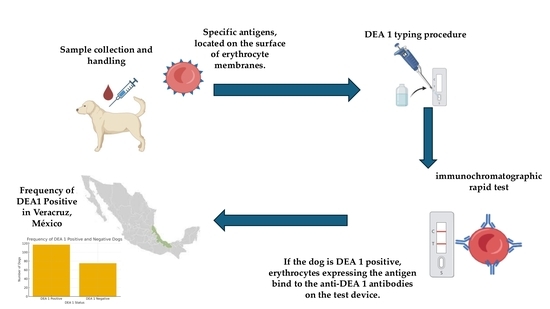
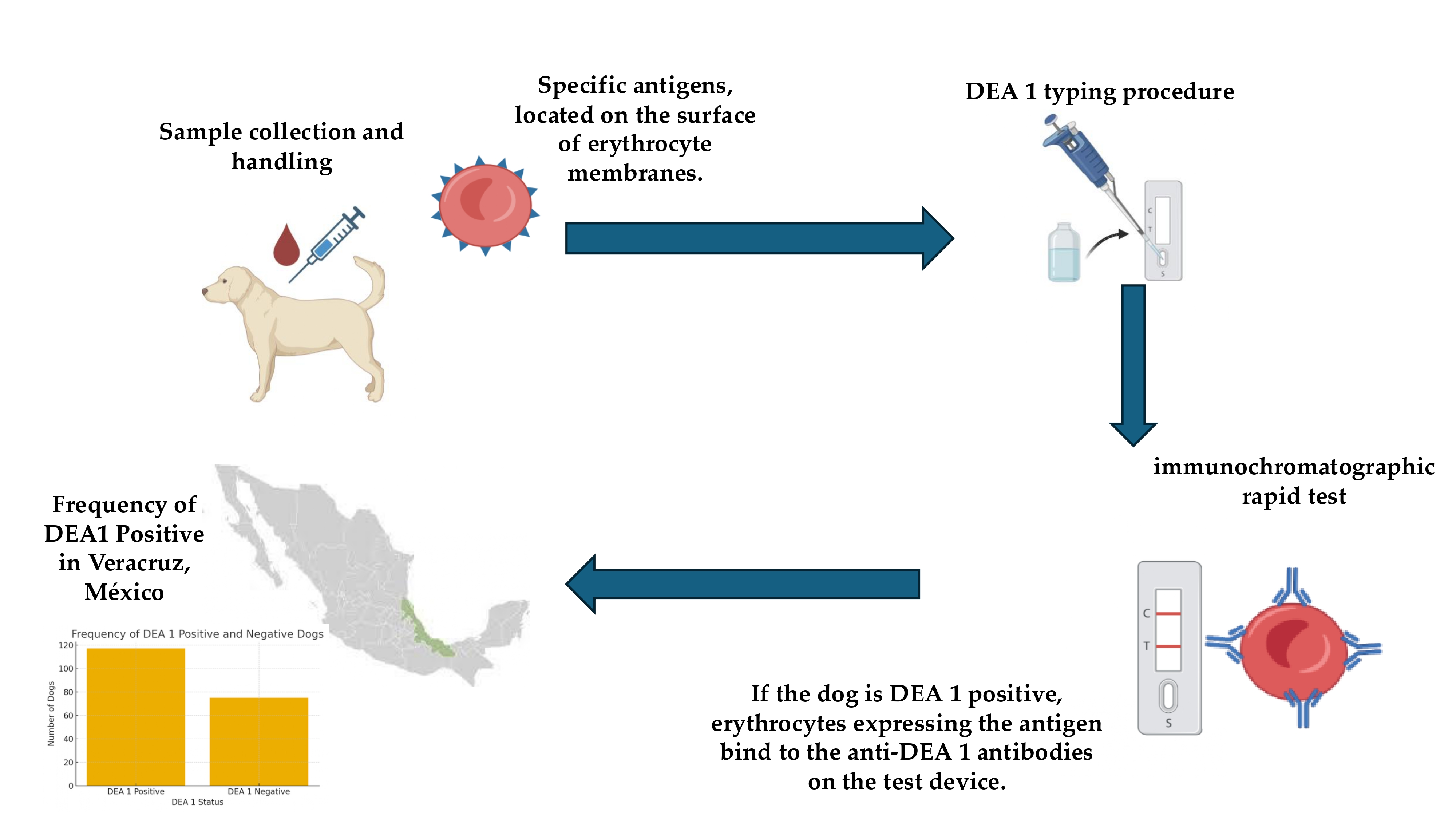
Graphical Abstract

1. Introduction

Blood groups in domestic animals are defined by specific antigens, mainly glycoproteins and glycolipids, located on the surface of erythrocyte membranes. In dogs, the Dog Erythrocyte Antigen (DEA) system is the most extensively characterized, comprising several internationally recognized types, including DEA 1, 3, 4, 5, 6, 7, and 8. These classifications were originally established using alloantibodies from transfused dogs, later refined through monoclonal antibody technology to improve diagnostic specificity and reproducibility [1,2]. Among these antigens, DEA 1 is considered the most clinically important, as its high antigenicity can trigger acute hemolytic transfusion reactions (AHTRs) in previously sensitized dogs. Early classifications distinguished DEA 1.1, 1.2, and 1.3 subtypes, but current evidence suggests that they represent a continuum of antigenic expression rather than discrete categories [3]. Dogs that are DEA 1-negative may develop potent alloantibodies following exposure to DEA 1-positive red cells, making accurate blood typing essential before any transfusion procedure [4,5]. Recent advances in transfusion medicine have expanded the availability of canine blood-typing methods, including card-based assays, gel column techniques, and immunochromatographic strip tests. The latter have gained popularity in clinical practice due to their ease of use, rapid results, and high diagnostic accuracy [6,7,8]. Nevertheless, access to these reagents remains limited in many countries, including Mexico, where most veterinary transfusions are still performed without prior blood typing or cross-matching. This practice increases the likelihood of alloimmunization and adverse transfusion outcomes. Canine transfusion medicine is an emerging field in Mexico, driven by the growing number of companion animals and the increasing demand for advanced veterinary care. According to recent reports, the Mexican pet population is among the largest in Latin America, yet reliable data on the prevalence of canine blood groups are lacking [9,10]. Understanding local DEA frequencies is crucial for enhancing transfusion safety, selecting suitable blood donors, and developing effective regional donor registries. We hypothesized that the prevalence of DEA 1-positive dogs in southeastern Mexico would be similar to global estimates (50–65%) and would not differ significantly by sex or geographic location. For this reason, this study aimed to determine the local distribution of DEA 1 and estimate the potential risk of sensitization and acute hemolytic transfusion reactions in untyped canine transfusions.

2. Materials and Methods

2.1. Study Design and Population

The study followed a cross-sectional observational design aimed at determining the prevalence of DEA 1 positivity in dogs from southeastern Mexico. Dogs were recruited using a non-probabilistic convenience sampling strategy based on their presentation to participating veterinary clinics during the study period. No restrictions were applied regarding breed, age, or sex. Dogs showing marked dehydration, poor peripheral perfusion, or any condition that could compromise sample quality were excluded.

2.2. Ethical Considerations and Owner Consent

Owner consent was obtained before sample collection. The study protocol was reviewed and approved by the institutional ethics committee (protocol No. 03/UV, 2022), and all procedures complied with national animal welfare regulations.

2.3. Sample Collection and Handling

Blood samples (0.5–1 mL) were obtained through cephalic or saphenous venipuncture using 22–25G needles (BD, Franklin Lakes, NJ, USA) and collected into EDTA tubes (BD Vacutainer®, Franklin Lakes, NJ, USA). All samples were processed within 30 min of collection to ensure optimal test performance and to minimize the risk of hemolysis or degradation of erythrocyte antigens.

2.4. DEA 1 Typing Procedure

DEA 1 typing was performed using a validated immunochromatographic rapid test (Lab Test DEA 1, Alvedia, Limonest, France). Testing was conducted according to the manufacturer’s instructions. Each card contained an internal control line to confirm proper reagent performance and flow. After the sample application, the cards were left to develop for 2 min, and the results were visually interpreted under standardized lighting conditions. All participating veterinarians received brief standardized training in sample handling and interpretation before study initiation.

2.5. Quality Control and Data Recording

Any cassette showing weak or ambiguous band intensity was repeated immediately using a new blood sample from the same dog. Only clearly visible bands were considered interpretable, and no DEA 1 status was assigned when results remained ambiguous after repetition. For each dog, the following variables were recorded: age, sex, breed (as reported by the owner), municipality of origin, and DEA 1 result. Breed classification for mixed-breed dogs relied on owner information; therefore, a degree of misclassification cannot be excluded.

2.6. Prevalence-Based Estimation of Incompatibility Scenarios

Theoretical estimates derived from the antigen distribution were calculated to illustrate the probability of potential donor–recipient incompatibility. The probability of a mismatched first transfusion was calculated by multiplying the observed prevalence of DEA 1-negative dogs by that of DEA 1-positive dogs, assuming random donor–recipient pairing in an untyped population. The probability of a subsequent mismatched transfusion was estimated by multiplying the probability of an initial mismatch by the prevalence of DEA 1-negative dogs. These values represent theoretical probabilities derived solely from antigen prevalence and do not reflect observed clinical outcomes [11].

2.7. Statistical Analysis

Statistical analyses were performed using BM SPSS Statistics version 30.0 (IBM Corp., Armonk, NY, USA). Categorical variables were summarized as frequencies and percentages. Group comparisons were conducted using the chi-square test when all expected cell counts were 5 or greater. For 2 × 2 contingency tables with expected counts <5, Fisher’s exact test was used to ensure statistical validity; exact p-values were generated using the SPSS Exact Tests module (Monte Carlo method, 10,000 iterations). For contingency tables with multiple categories, such as the distribution of DEA 1 by breed, Fisher’s test was not applicable due to table size, and the likelihood-ratio chi-square test was used instead. Confidence intervals for the estimated probabilities of sensitization and acute hemolytic transfusion reactions were calculated using the Wilson method, which provides reliable estimates for small to moderate proportions [12]. All statistical tests were two-tailed, and significance was set at α = 0.05. Exact p-values are reported throughout the manuscript.

3. Results

3.1. Overall Frequency of DEA 1

A total of 192 clinically healthy dogs were included in the study, comprising 116 males (60.4%) and 76 females (39.6%). Of these, 117 (60.9%; 95% CI: 53.6–67.8) were DEA 1-positive and 75 (39.1%; 95% CI: 32.2–46.4) were DEA 1-negative. No statistically significant differences were detected in DEA 1 distribution by sex (χ2 = 2.91, p = 0.088) or sampling municipality (χ2 = 1.46, p = 0.226). Detailed data are presented in Table 1.

3.2. Distribution by Sex and Municipality

No statistically significant differences in DEA 1 distribution were observed between sexes or between municipalities, indicating a relatively homogeneous antigen distribution within the studied population (Table 1).

3.3. Distribution by Breed

Although variability in DEA 1 positivity was observed among breeds, no statistically significant association between breed and DEA 1 status was detected (Table 2).

3.4. Theoretical Estimates Derived from Antigen Prevalence

Prevalence values were used to generate theoretical estimates illustrating how DEA 1 antigen distribution alone could lead to incompatible donor–recipient matches when no blood typing is performed. These values are mathematical probabilities only and do not reflect observed clinical sensitization or transfusion reactions (Table 3).

4. Discussion

This study presents the first account of the distribution of Dog Erythrocyte Antigen (DEA) 1 in dogs from southeastern Mexico. The breeds represented in the sample reflect the typical demographic profile of patients commonly seen in regional veterinary clinics, as well as the broader canine population within the municipalities included in the study. Blood typing is essential for transfusion safety regardless of whether whole blood or red cell-containing products are used.
It is well known that canine blood group frequencies vary among breeds and geographic regions. In our study, 60.93% of dogs were DEA 1-positive, a figure that matches the international range of 50–65% reported in the literature. At present, however, comparisons with other regions of Mexico cannot be made since no additional published data from the country are available. Variations in DEA 1 frequency among nations are generally attributed to differences in sampling populations and to genetic drift influenced by local breeding practices. In this study, privately owned dogs were recruited from several veterinary hospitals, providing a diverse representation suitable for DEA 1 typing. Because blood type is inherited, it may also serve as a useful genetic marker that offers insight into the hybrid origin of breeds and contributes to national and international databases focused on canine genetic diversity and breed development [13,14].
A high proportion of DEA 1-positive dogs was observed among Rottweilers and Golden Retrievers, consistent with previous findings [15,16,17]. Knowing the prevalence of DEA 1 positivity in these breeds is clinically relevant, as both are well suited for use as blood donors: they generally meet recommended bodyweight requirements and possess temperaments that allow for safe, repeatable blood collection [18].
No meaningful differences in DEA 1 frequency were detected between males and females. The distribution observed in this population is consistent with previous reports from other North American regions, where DEA 1 frequencies range between 55% and 65% [16,19]. Additionally, earlier work demonstrated that the DEA 1 blood group system is inherited as an autosomal trait, meaning that both sexes may be DEA 1-negative or express varying degrees of DEA 1 positivity [19,20,21].
Based on antigen prevalence alone, the theoretical probability of an initial mismatched transfusion in an untyped population was estimated at 24.9%. This value reflects the likelihood that a DEA 1-negative recipient could receive DEA 1-positive blood if no typing is performed. By incorporating the prevalence of DEA 1-negative dogs once more, a second theoretical estimate of 6.21% was calculated, representing the probability that a previously mismatched DEA 1-negative dog could receive another incompatible transfusion. These estimates are mathematical projections derived solely from antigen distribution and do not represent clinically documented sensitization or transfusion reactions. Similar prevalence-based calculations have been reported in other regions to illustrate how antigen distribution alone may lead to incompatible transfusion scenarios when typing is not performed. For example, studies in Switzerland and South Africa calculated theoretical sensitization frequencies ranging from 20% to 28% and possible subsequent mismatch estimates between 5% and 8%, based solely on the proportional distribution of DEA 1− and DEA 1+ dogs [15,16]. Several limitations must be acknowledged. The study was confined to the Veracruz–Boca del Río region. Although the number of dogs tested was reported to estimate local prevalence, it cannot be considered representative of the entire country. Only one blood-typing method was used; although the Alvedia immunochromatographic assay is well validated and widely used in clinical settings, molecular confirmation was not performed. Additionally, this study did not evaluate crossmatching, alloantibody formation, or transfusion outcomes; therefore, no clinical sensitization or transfusion risk can be inferred from the prevalence data reported.

5. Conclusions

This study provides the first report of DEA 1 prevalence in dogs from southeastern Mexico, showing that approximately six out of ten individuals in this region are DEA 1-positive. The distribution observed aligns with values documented in other parts of North America and contributes baseline epidemiological information that may support future investigations in canine transfusion medicine and breed-related genetic diversity. Although theoretical estimates were calculated to illustrate potential incompatibility scenarios in untyped transfusions, these values are mathematical projections derived solely from antigen frequency and do not represent clinically observed sensitization or transfusion reactions. Further research incorporating larger regional samples, molecular confirmation of typing results, serological crossmatching, and documented transfusion outcomes is necessary to determine whether blood group distribution translates into clinically relevant incompatibility in veterinary practice. Expanding this work across Mexico would provide a more comprehensive understanding of canine blood group variation nationwide and strengthen the foundation for future donor registries or transfusion programs.

Author Contributions

Conceptualization, methodology, investigation, C.A.A.-R.; Conceptualization, methodology, investigation, formal analysis, supervision, resources, L.A.O.-C.; writing—review and editing, J.L.B.-R.; investigation, M.G.S.-O.; data curation, S.S.-M.; writing—original draft preparation, A.B.-B.; visualization, C.P.-E., investigation; S.B.-R.; supervision, B.A.-L. All authors have read and agreed to the published version of the manuscript.

Funding

This research received no external funding.

Institutional Review Board Statement

The ethical approval date for the study was 16 April 2022, corresponding to the approval granted by the Institutional Ethics Committee of Veracruzana University (protocol No. 03/UV, 2022).

Informed Consent Statement

Informed consent was obtained from the owner of the dogs involved in the study.

Data Availability Statement

The original contributions presented in this study are included in the article. Further inquiries can be directed to the corresponding author(s).

Acknowledgments

We thank the dog’s owners for their cooperation.

Conflicts of Interest

The authors declare no conflicts of interest.

Correction Statement

This article has been republished with a minor correction to the Institutional Review Board Statement. This change does not affect the scientific content of the article.

References

  1. Ferreira, R.R.; Gopegui, R.R.; Matos, A.J. Frequency of dog erythrocyte antigen 1.1 expression in dogs from Portugal. Vet. Clin. Pathol. 2011, 40, 198–201. [Google Scholar] [CrossRef] [PubMed]
  2. Polak, K.; Acierno, M.M.; Raj, K.; Mizukami, K.; Siegel, D.L.; Giger, U. Dog erythrocyte antigen 1: Mode of inheritance and initial characterization. Vet. Clin. Pathol. 2015, 44, 369–379. [Google Scholar] [CrossRef] [PubMed]
  3. Acierno, M.M.; Raj, K.; Giger, U. DEA 1 expression on dog erythrocytes analyzed by immunochromatographic and flow cytometric techniques. J. Vet. Intern. Med. 2014, 28, 592–598. [Google Scholar] [CrossRef] [PubMed]
  4. Mesa, C.L.C.; Gottschalk, M.; Lacouture, S.; Blais, M.C. Production and characterization of a murine anti-Dal monoclonal antibody for blood typing in dogs. Vet. Immunol. Immunopathol. 2022, 254, 110516. [Google Scholar] [CrossRef] [PubMed]
  5. Zaremba, R.; Brooks, A.; Thomovsky, E. Transfusion medicine: An update on antigens, antibodies and serologic testing in dogs and cats. Top. Companion Anim. Med. 2019, 34, 36–46. [Google Scholar] [CrossRef] [PubMed]
  6. Giger, U.; Gelens, C.J.; Callan, M.B.; Oakley, D.A. An acute hemolytic transfusion reaction caused by dog erythrocyte antigen 1.1 incompatibility in a previously sensitized dog. J. Am. Vet. Med. Assoc. 1995, 206, 1358–1362. [Google Scholar] [CrossRef] [PubMed]
  7. Moulds, J.M. Future of molecular testing for red blood cell antigens. Clin. Lab. Med. 2010, 30, 419–429. [Google Scholar] [CrossRef] [PubMed]
  8. Seth, M.; Jackson, K.V.; Winzelberg, S.; Giger, U. Comparison of gel column, card, and cartridge techniques for dog erythrocyte antigen 1.1 blood typing. Am. J. Vet. Res. 2012, 73, 213–219. [Google Scholar] [CrossRef] [PubMed]
  9. Mota-Rojas, D.; Strappini, A.; Whittaker, A.L.; Ghezzi, M.; Titto, C.G.; Calderón-Maldonado, N.; Orihuela, A. Controversial topics in animal welfare in Latin America: A focus on the legislation surrounding the human–companion animal relationship and animals used for recreational practices. Animals 2023, 13, 1463. [Google Scholar] [CrossRef] [PubMed]
  10. Marshall, H.; Blois, S.L.; Abrams-Ogg, A.C.; Bersenas, A.M.; Ruotsalo, K.; Monteith, G. Accuracy of point-of-care crossmatching methods and crossmatch incompatibility in critically ill dogs. J. Vet. Intern. Med. 2021, 35, 245–251. [Google Scholar] [CrossRef] [PubMed]
  11. Novais, A.A.; Santana, A.E.; Vicentin, L.A. Prevalence of DEA 1 canine blood group system in dogs (Canis familiaris, Linnaeus, 1758) reared in Brazil. Braz. J. Vet. Res. Anim. Sci. 1999, 36, 23–27. [Google Scholar] [CrossRef]
  12. Brown, L.D.; Cai, T.T.; DasGupta, A. Interval Estimation for a Binomial Proportion. Stat. Sci. 2001, 16, 101–133. [Google Scholar] [CrossRef]
  13. Mangiaterra, S.; Rossi, G.; Antognoni, M.T.; Cerquetella, M.; Marchegiani, A.; Miglio, A.; Gavazza, A. Canine blood group prevalence and geographical distribution around the world: An updated systematic review. Animals 2021, 11, 342. [Google Scholar] [CrossRef] [PubMed]
  14. Parker, H.G.; Dreger, D.L.; Rimbault, M.; Davis, B.W.; Mullen, A.B.; Carpintero-Ramirez, G.; Ostrander, E.A. Genomic analyses reveal the influence of geographic origin, migration, and hybridization on modern dog breed development. Cell Rep. 2017, 19, 697–708. [Google Scholar] [CrossRef] [PubMed]
  15. van der Merwe, L.L.; Jacobson, L.S.; Pretorius, G.J. The breed prevalence of Dog Erythrocyte Antigen 1.1 in the Onderstepoort area of South Africa and its significance in selection of canine blood donors. J. S. Afr. Vet. Assoc. 2002, 73, 53–56. [Google Scholar] [CrossRef] [PubMed]
  16. Riond, B.; Schuler, E.; Rogg, E.; Hofmann-Lehmann, R.; Lutz, H. Prevalence of dog erythrocyte antigen 1.1 in dogs in Switzerland evaluated with the gel column technique. Schweiz. Arch. Tierheilkd. 2011, 153, 369–374. [Google Scholar] [CrossRef] [PubMed]
  17. Silvestre-Ferreira, A.C.; Vilhena, H.; Oliveira, A.C.; Mendoza, J.R.; Aura, M.G.; Pastor, J. Dog Blood Type DEA 1 in Two Municipalities of Luanda Province of Angola (Sub-Saharan Africa). Vet. Sci. 2024, 11, 449. [Google Scholar] [CrossRef] [PubMed]
  18. Abrams-Ogg, A.C.; Blois, S.L. Principles of canine and feline blood collection, processing, and storage. In Schalm’s Veterinary Hematology; Wiley-Blackwell: Hoboken, NJ, USA, 2022; pp. 898–907. [Google Scholar] [CrossRef]
  19. Dhliwayo, S.; Makonese, T.A.; Whittall, B.; Chikerema, S.M.; Pfukenyi, D.M.; Tivapasi, M.T. A study on the prevalence of dog erythrocyte antigen 1.1 and detection of canine Babesia by polymerase chain reaction in apparently healthy dogs in a selected rural community in Zimbabwe. J. S. Afr. Vet. Assoc. 2016, 87, a1409. [Google Scholar] [CrossRef] [PubMed]
  20. Blais, M.C.; Rozanski, E.A.; Hale, A.S.; Shaw, S.P.; Cotter, S.M. Lack of evidence of pregnancy-induced alloantibodies in dogs. J. Vet. Intern. Med. 2009, 23, 462–465. [Google Scholar] [CrossRef] [PubMed]
  21. Hale, A.S.; Werfelmann, J. Incidence of canine serum antibody to known dog erythrocyte antigens in a potential donor population. J. Vet. Intern. Med. 2006, 20, 768–769. [Google Scholar]

Table 1. Distribution of DEA 1 status by sex and municipality in dogs from Veracruz–Boca del Río, Mexico.
VariablenDEA 1-Positive n (%) [95% CI]DEA 1-Negative n (%) [95% CI]χ2 (p-Value)
Sex
Male11663 (54.3%) [45.1–63.2]53 (45.7%) [36.8–54.9]2.91 (0.088)
Female7654 (71.1%) [59.7–80.5]22 (28.9%) [19.5–40.3]
Municipality
Veracruz10762 (57.9%) [48.2–67.1]45 (42.1%) [32.9–51.8]1.46 (0.226)
Boca del Río8555 (64.7%) [53.7–74.5]30 (35.3%) [25.5–46.3]
Total192117 (60.9%) [53.6–67.8]75 (39.1%) [32.2–46.4]
Confidence intervals (95% CI) were calculated using the Wilson method for binomial proportions. The first p-value corresponds to the comparison of DEA 1-positive and DEA 1-negative dogs by sex, whereas the second p-value corresponds to the comparison by municipality.
Table 2. Distribution of DEA 1 status by breed. Breeds with ≥10 sampled animals are listed individually; remaining dogs are grouped as “Other breeds”.
BreednDEA 1-Positive n (%) [95% CI]DEA 1-Negative n (%) [95% CI]
Mixed6548 (73.8%) [61.9–83.0]17 (26.2%) [17.0–38.1]
Chihuahua148 (57.1%) [32.6–78.6]6 (42.9%) [21.4–67.4]
Poodle166 (37.5%) [18.0–61.6]10 (62.5%) [38.4–82.0]
Boxer1512 (80.0%) [54.8–93.0]3 (20.0%) [7.0–45.2]
French Bulldog1311 (84.6%) [57.8–95.7]2 (15.4%) [4.3–42.2]
Pug156 (40.0%) [19.8–64.3]9 (60.0%) [35.7–80.2]
Rottweiler107 (70.0%) [34.8–91.0]3 (30.0%) [9.0–65.2]
Labrador Retriever128 (66.7%) [35.4–88.7]4 (33.3%) [11.3–64.6]
German Shepherd1110 (90.9%) [58.7–98.5]1 (9.1%) [1.5–41.3]
Beagle134 (30.8%) [12.7–58.2]9 (69.2%) [41.8–87.3]
Other breeds87 (87.5%) [46.7–99.3]1 (12.5%) [0.7–53.3]
Total192117 (60.9%) [53.6–67.8]75 (39.1%) [32.2–46.4]
No statistically significant differences were detected between DEA 1+ and DEA 1− dogs within any breed (p > 0.05). In addition, no significant association was found between breed and DEA 1 status (p > 0.05).
Table 3. Prevalence-based theoretical estimates illustrating potential DEA 1 incompatibility in untyped canine transfusions.
Theoretical ScenarioCalculation Based on Observed PrevalenceEstimated Value
Possible mismatched transfusion in an untyped population(% DEA 1− × % DEA 1+)24.9% (95% CI: 18.9–31.9)
Subsequent mismatched transfusion in the same (previously mismatched) DEA 1− dog(% DEA 1− × % mismatching)6.21% (95% CI: 3.5–10.7).
Disclaimer/Publisher’s Note: The statements, opinions and data contained in all publications are solely those of the individual author(s) and contributor(s) and not of MDPI and/or the editor(s). MDPI and/or the editor(s) disclaim responsibility for any injury to people or property resulting from any ideas, methods, instructions or products referred to in the content.