
Article

Effect of a Supplement Containing Probiotics, Prebiotics, and Yeast Extract on Gut Inflammation, Microbiota, and Cytokines in Healthy Dogs

1
PetLab Group Limited (DBA PetLabCo.), London EC3N 3DQ, UK
2
Gastrointestinal Laboratory, Department of Small Animal Clinical Sciences, Texas A&M University, College Station, TX 77843, USA
*
Author to whom correspondence should be addressed.
Submission received: 17 October 2025 / Revised: 25 November 2025 / Accepted: 10 December 2025 / Published: 4 January 2026

Abstract

Probiotics, prebiotics, and postbiotics are of interest for their potential gastrointestinal and immunological benefits in pet health. This study aimed to assess whether a unique blend of Bacillus subtilis, Bacillus clausii, Bacillus coagulans (Weizmannia coagulans), FOS, GOS, and a postbiotic yeast extract could provide beneficial gut and immunological effects when fed to healthy, adult dogs. Twenty-four healthy adult beagle dogs (mean age 5.17 yrs) were fed the probiotic, prebiotic, and yeast chew (PPYC) or control chew (CC) supplement for 31 days, accompanied by fecal and blood sampling. Following 31 days, PPYC fed dogs had decreased (p < 0.05) fecal calprotectin concentration, a biomarker indicative of reduced intestinal inflammation, compared with dogs receiving the CC. In the PPYC group, blood C-reactive protein levels, an indicator of tissue inflammation, tended (p = 0.11) to be reduced. In addition, dogs receiving the PPYC supplement showed an increase in the IL-17a cytokine (p < 0.05). Despite dogs being in a clinically healthy state, changes in some dysbiosis-related bacterial strains were observed. There was an increase (p < 0.05) in the % of total bacteria of Blautia in the PPYC group by the end of the study, as well as an increase in the percent change from Day 0 of C. hiranosis (p < 0.05). Increased alpha diversity, a measure related to the resilience to environmental change, was observed in the PPYC group (p < 0.05). These results suggest that after consuming a supplement containing probiotics, prebiotics and a postbiotic yeast extract, markers of gut and systemic health were improved in otherwise healthy dogs.

1. Introduction

Dogs have been cherished companions of humans for centuries, with dog ownership rising significantly in recent decades. Their positive impact on the lives of owners is profound—ranging from improved physical health to mental and emotional well-being [1]. In turn, pet owners are increasingly prioritizing their dog’s health and seeking supplemental solutions to support their pets’ quality of life [2].
One crucial factor in canine health is the gut microbiome, a key regulator of immune function and metabolism [3]. The gastrointestinal (GI) tract contains a wide variety of microbes that make up the gut microbiome. These microbes are essential for maintaining intestinal balance by supporting nutrient availability, digestion, and absorption [3]. They have also been shown to contribute to improving the gut barrier and modulating the immune system [4]. Disturbances in the microbiota are termed dysbiosis, and can be characterized by reduced diversity or microbiota imbalance [5]. Intestinal dysbiosis has been closely linked to various GI disorders, such as inflammatory bowel disease (IBD), Crohn’s colitis for humans, and irritable bowel syndrome. In less severe cases of dysbiosis, clinical signs such as diarrhea or constipation may be present [5]. Nutritional interventions such as diet modifications and prebiotic and/or probiotic supplementation have been extensively researched and recommended as an approach to manage clinical signs of dysbiosis as well as general management of a healthy GI tract [6,7,8,9,10].
Probiotic supplements, comprised of bacteria or yeast, have been shown to elicit benefits leading to overall health by supporting digestion, healthy metabolism, and even immune function. These live cultures of microbes are added to the diet and they work to restore the gut microbiome as well as provide enhanced resistance to pathogen colonization, among other benefits [11,12]. Some common bacterial strains ingested as probiotics include Lactobacillus, Bacillus, and Bifidobacterium. Bacillus subtilis, Bacillus clausii, Bacillus coagulans (Weizmannia coagulans) are all spore formers, making them more stable during production and for shelf life [13]. Their potential for high stability, paired with studies on efficacy in both humans and dogs, makes them an advantageous option for probiotic supplementation. B. coagulans has been shown to produce desirable effects on stool quality and abdominal discomfort in the management of irritable bowel syndrome in adults, as well as in those with acute diarrhea [14,15]. Dog research on B. coagulans has yielded desirable results such as improved nutrient digestibility and when supplemented with B. subtilits, resulted in higher immunoglobulin levels and reductions in C-reactive protein levels, as well as improved stool consistency, reduced fecal E. coli, and elevated short-chain fatty acid levels in another study [16,17,18]. B. subtilis has been extensively researched in dogs and resulted in positive effects on oxidative stress markers, gut bacterial diversity, fecal score and odor, and increased short-chain fatty acids [19,20,21,22,23]. To our knowledge, there is virtually no research conducted with B. clausii on dogs, however, the novel spore-forming probiotic has been recently researched for its gut health, immunomodulatory, and antioxidant properties in many human studies as well as with in in vitro research [24,25,26].
Prebiotics, on the other hand, are defined as “a non-digestible food ingredient that beneficially affects the host by selectively stimulating the growth and/or activity of one or a limited number of bacteria in the colon” [27]. Products containing both probiotics and prebiotics are known as synbiotics. It has been observed that prebiotics may stimulate the positive effects of probiotics when taken together [28]. Specifically, a recent study found that the combination of probiotic strains and prebiotic dietary fiber resulted in favorable effects on the immunity of dogs shown by the increase in fecal IgA, as well as favorable effects on the gut microbiota, with increases in certain beneficial species, while maintaining good stool quality [29]. Currently, fructooligosaccharides (FOS) are one of the most commonly studied prebiotics due to their stability and perceived efficacy [30]. Repeated consumption of FOS has been shown to increase the amount of short-chain fatty acids produced by intestinal microbes, which then lowers the pH of the gastrointestinal environment, suppressing pathogenic bacteria proliferation and creating a favorable environment for beneficial bacteria such as Bifidobacteria [31,32,33]. Other commonly studied prebiotics include galactooligosaccharides (GOS), mannanoligosaccharides (MOS), yeast cell wall, inulin, and beta-glucans [30,34]. More recently, postbiotics (inanimate microorganisms and/or their components) are being explored for similar immune and GI benefits in dogs, as their components still possess biological benefits even after being deemed non-viable (e.g., yeast extracts) [35,36]. This preparation includes the potential advantage of a longer shelf-life than probiotics [37,38].
While existing research lays a strong foundation for the use of -biotics in canine health, additional insights into the effects of unique combinations are still needed. The purpose of the present study reported here was to assess whether a unique blend of Bacillus subtilis, Bacillus clausii, Bacillus coagulans (Weizmannia coagulans), FOS, GOS, and postbiotic yeast extract could provide beneficial gut and immunological effects when fed to healthy, adult dogs.

2. Materials and Methods

2.1. Animals and Treatment

All animal procedures were approved by Summit Ridge Farms’ Institutional Animal Care and Use Committee prior to experimentation (IACUC #PLBEFFC00124). A total of 24 healthy adult beagle dogs (mean body weight (BW): 9.3 kg; mean age: 5.17 yrs) were used in a double-blinded, randomized, placebo-controlled study. All dogs were individually housed in a temperature-controlled facility at Summit Ridge Farms, Susquehanna, PA. Animals were manually randomized into two groups based on sex, body weight, and age, respectively, until dogs were evenly allocated to the two study groups.
All dogs had free access to fresh water at all times. Dogs were fed a commercial dry extruded complete and balanced basal diet (Dog Chow Complete Adult with Real Chicken, Purina, St. Louis, MO, USA) to maintain body weight and ideal body condition. Dogs were offered their once-daily ration of the basal diet, which was available for a minimum of one hour. Dogs in one group received the CC (n = 12) and dogs in the other group received the PPYC (n = 12) for a minimum of one hour just prior to receiving the basal diet.
The PPYC chew was a commercial product produced by PetLabCo. and was comprised of the following active ingredients: A commercial blend of probiotics (500 million CFU Bacillus subtilis, 1 billion CFU Bacillus clausii, 1.5 billion CFU Bacillus coagulans (Weizmannia coagulans)), 100 mg fructooligosaccharide, 100 mg galactooligosaccharide, and 75 mg heat-treated yeast extract per 4 g chew. The inactive ingredients within the 4 g chew included: sweet potato, brewer’s yeast, salmon hydrolysate, rosemary extract (Roseen™), apple cider vinegar, coconut oil, coconut glycerin, sunflower lecithin, hickory smoke flavor, and maltodextrin (PetLabCo. Probiotic Chew, New York City, NY, USA). The CC was the same as the PPYC except that all active ingredients were removed and substituted with brewer’s yeast. Because this was a commercial product, the dose was pre-determined to be generally in line with other commercial chew products and further supported by literature review of these strains. Further, bacterial enumeration was analyzed and triplicate measurements met the expected final levels of 3.0 × 10⁹ CFU/4 g.

2.2. Biometrical Measurements and Food Intake

Chews were offered based on weekly body weights (<11.3 kg—1 chew; 11.3 kg–22.7 kg—2 chews). Dogs were evaluated daily for any adverse reactions or clinical signs, such as vomiting, diarrhea, and rejection of food. The amount of diet offered to start the study was calculated based on the metabolizable energy of the diet and each individual animal’s initial body weight (1.8 × 70 (BW kg) 0.75). After the first week, the amount of diet offered was adjusted weekly, if necessary, to maintain each animal’s body weight and body condition. Physical examinations (including body condition score (BCS)) were performed prior to study start. Additionally, BCS were recorded upon study completion. Weekly body weights (kg), daily food intake, daily treat intake, and any adverse reactions or clinical signs were recorded throughout the study. Animals were deemed apparently healthy animals due to being of optimal body weight and body condition, having passed a veterinary physical examination, baseline hematology, and clinical chemistry 9 days prior to the start of the test period.

2.3. Experimental Design and Sample Collection

The study was conducted over a 31 day period. On Day 0 (day prior to feeding the chew), the dogs were given the basal diet and blood and fecal samples were collected for initial assessments. Beginning on Day 1, 24 dogs were split evenly into 2 groups (12 dogs per group).
Blood collections for cortisol and C-reactive protein (CRP) were performed on all dogs on Day 0, Day 14 (±2 days), and upon study completion. A total of 20 milliliters of blood per dog was collected and used for analysis prior to study initiation and upon study completion. Blood was collected via jugular venipuncture in sterile syringes. Samples were divided into three tubes: two 8 mL red-top serum separator tubes, and a 5 mL red-top serum separator tube. Red-top tubes were allowed to clot and then spun in a centrifuge to separate the serum from the blood cells. Serum was removed from the blood cells and distributed into five 2.0 mL cryotubes. One cryotube containing a minimum of 0.75 mL of serum was packaged and sent priority-overnight for blood cortisol analysis to Antech Diagnostics, Oak Brook, IL. One cryotube containing a minimum of 1.0 mL of serum was frozen and stored at −80 °C until shipment to the University of Illinois Urbana-Champaign for CRP analysis. Additionally, 2.0 mL serum samples were frozen and stored at −80 °C until shipment to the Cytokine Reference Laboratory of the University of Minnesota Twin Cities for cytokine analysis.
Fresh fecal collections were performed on Day 0, Day 14 (±3 days), and Day 27 (±3 days), for calprotectin, immunoglobulin A (IgA), and microbiome analyses. Collections consisted of 3 days of monitoring during the hours of 6:30 am to 2:30 pm EST in an attempt to obtain one fresh sample per dog immediately after defecation. Samples were split into 2 cryotubes and stored at −80 °C until shipment on dry ice to the Gastrointestinal Laboratory of Texas A&M University, for calprotectin, IgA, and microbiome analyses. The samples were further delivered to Diversigen, Inc., New Brighton, MN, USA for metagenomics by shallow DNA shotgun sequencing.

2.4. Inflammatory/Immune Analysis

Circulating serum CRP concentrations were measured using a commercial canine-specific enzyme-linked immunosorbent assay (ELISA) kit (#DRP49-K01, Eagle Biosciences, Nashua, NH, USA) according to the manufacturer’s instructions.
Circulating serum cortisol concentrations were measured using an internally validated cortisol reagent kit (Antech Diagnostics, Oak Brook, IL, USA). A competitive homogeneous enzyme immunoassay was used, in which free cortisol in the sample competes with cortisol conjugated with a glucose-6-phosphate dehydrogenase enzyme for antibody binding sites. The more cortisol present in the sample, the more it binds to and takes up binding sites on the antibody, leaving the conjugated cortisol unbound. Antibody-bound cortisol conjugated with glucose-6-phosphate dehydrogenase inhibits the conjugated glucose-6-phosphate from catalyzing a NAD+ to NADH reaction. The more NAD+ is converted to NADH, the more there is a change in absorbance which is measured at 340 nm.
Fecal calprotectin concentrations were measured using a commercial particle-enhanced turbidimetric immunoassay (PETIA) kit, BÜHLMANN fCAL® turbo (B-KCAL-RSET, BÜHLMANN Diagnostics, Schönenbuch, Switzerland) according to the manufacturer’s instructions, and previously validated for dogs [39]. This was run on Beckman AU480 Chemistry analyzer (reference interval < 133 μg/g).
Fecal IgA concentrations were measured using a commercial canine-specific ELISA kit (#E44-104, Bethyl Laboratories, Montgomery, TX, USA) according to the manufacturer’s instructions.
Additionally, various cytokines were measured using serum samples with commercial kits according to the respective manufacturer’s instructions. Canine-specific IL-6, IL-10, IL-18, and TNFa were measured using a commercial kit run on the Luminex and done as a 4-plex (#CCYTOMAG-90K, EMD Millipore, St. Charles, MO, USA). Serum samples were analyzed for canine-specific IgE using a commercial ELISA kit (#CGE41-K01, Eagle Biosciences, Amherst, NH, USA). Serum samples were analyzed for canine-specific IL-1 β, IL-4, and IL-17A using a commercial ELISA kit as well (#ELC-IL1B; #ELC-IL4; #ELC-IL17A, RayBiotech Life Inc., Peachtree Corners, GA, USA). Serum samples were analyzed for canine-specific calprotectin & TNF- β using a commercial ELISA kit (#MBS2605589; #MBS7606888, MyBioSource, San Diego, CA, USA). Lastly, serum samples were analyzed for canine-specific IL-31 using a commercial ELISA kit (#NBP3-42870, MyBioSource, San Diego, CA, USA).

2.5. Microbiome Analysis

Microbial DNA was extracted from 100 mg of each fecal sample using the DNeasy PowerSoil Pro Kit (QIAGEN Inc., Germantown, MD, USA) according to the manufacturer’s protocol. DNA concentrations were quantified on a NanoDrop 2000 spectrophotometer (Thermo Scientific, Waltham, MA, USA). Sequencing libraries were prepared with a Nextera XT DNA Library Preparation Kit (Illumina Inc., San Diego, CA, USA), pooled, denatured with NaOH, diluted, and spiked with 2% PhiX. Libraries were sequenced on an Illumina NovaSeq6000 with a 2 × 150 flow cell to obtain a median of 2 million read pairs (Diversigen Laboratory, New Brighton, MN, USA). Raw reads were filtered to remove low-quality (Q-score < 30) and short-length (<50) sequences, adapters were trimmed, and remaining reads were shortened to a maximum length of 100 base pairs before alignment. Taxonomic assignment was performed by aligning FASTA sequences to a curated database containing representative prokaryotic genomes from the NCBI RefSeq collection plus additional manually curated strains. Processed data tables were imported into QIIME2 (v. 2024.2) for downstream analysis, where samples were rarefied to 520,000 features prior to diversity analysis [40,41,42,43,44,45,46,47,48,49].
For the dysbiosis index (DI), DNA was extracted from 100 to 120 mg of fecal material using the MoBio Power soil DNA isolation kit. Total bacteria, Blautia, Clostridium (Peptacetobacter) hiranonis, Escherichia coli, Faecalibacterium, Fusobacterium, Streptococcus, and Turicibacter were quantified by quantitative polymerase chain reaction (qPCR) assay as previously described [40]. The DI was then calculated based on the results of the qPCR assays using the established algorithm described in AlShawaqfeh et al., 2017 [41].

2.6. Statistical Analysis

Data (not including microbial diversity and additional taxonomy) were analyzed using JMP version 18.2.0 (JMP Statistical Discovery LLC.; Cary, NC, USA) and are displayed in Figure 1 and Table 1, Table 2 and Table 3. For each parameter, descriptive statistics (number of dogs, mean, standard deviation, minimum, median and maximum values) were presented for Day 0 (the initial value) and Day 31 (final timepoint). The changes and percent changes from the initial to final timepoint were calculated and descriptive statistics were presented. Repeated measures analysis of variance (ANOVA) modeling was employed to evaluate the final timepoint independent of the initial value. The model included fixed effects of chew, day, and chew-by-day interaction and dog nested within chew as the random effect. Least squares mean (LSM) values, standard error of the mean (SEM), LSM differences and p-values (for difference between CC and PPYC at each timepoint) were obtained from this model. For the changes and percent changes from the initial value, differences between chews were assessed by repeated measures analysis of covariance (ANCOVA). The model included fixed effects of chew, day and chew-by-day interaction with the initial value as a covariate and dog nested within chew as a random effect. LSM values, SEM, LSM differences and p-values were obtained from this model. For each model, the distribution of CC and PPYC data were assessed for normality using the Shapiro-Wilk test. If the p-value of the Shapiro-Wilk test was <0.01 for either chew then all the values were ranked prior to performing the ANOVA/ANCOVA analysis. Note that in such cases the LSM values were obtained from the model based on unranked data while the p-values for the chew comparison were obtained from the model based on ranked data.
Simple linear regression analyses were performed in JMP version 18.2.0 for each study group (i.e., CC and PPYC) employing mean (averaged across 12 dogs) food consumption per kg body weight as the continuous response variable vs. study day as the continuous explanatory variable. p-values for the slope term of each model were obtained. Additionally, repeated measures analysis of variance (ANOVA) modeling of food consumption per kg body weight was also employed to evaluate the effect of day and chew and repeated food consumption measurements for each dog within each study group across the different study days. This model included fixed effects of chew, day, and chew-by-day interaction and dog nested within chew as a random effect. p-values associated with chew, day, and chew-by-day interaction terms were obtained from this model.
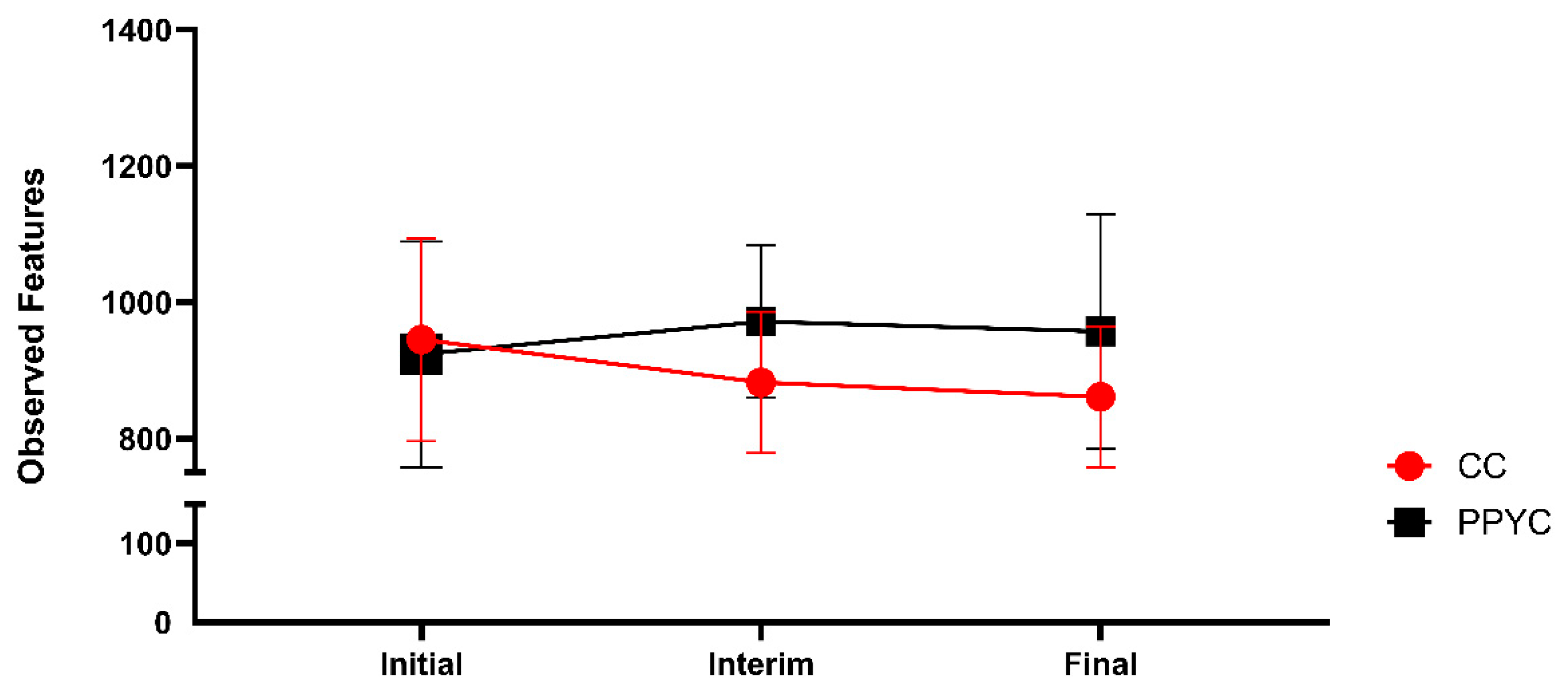
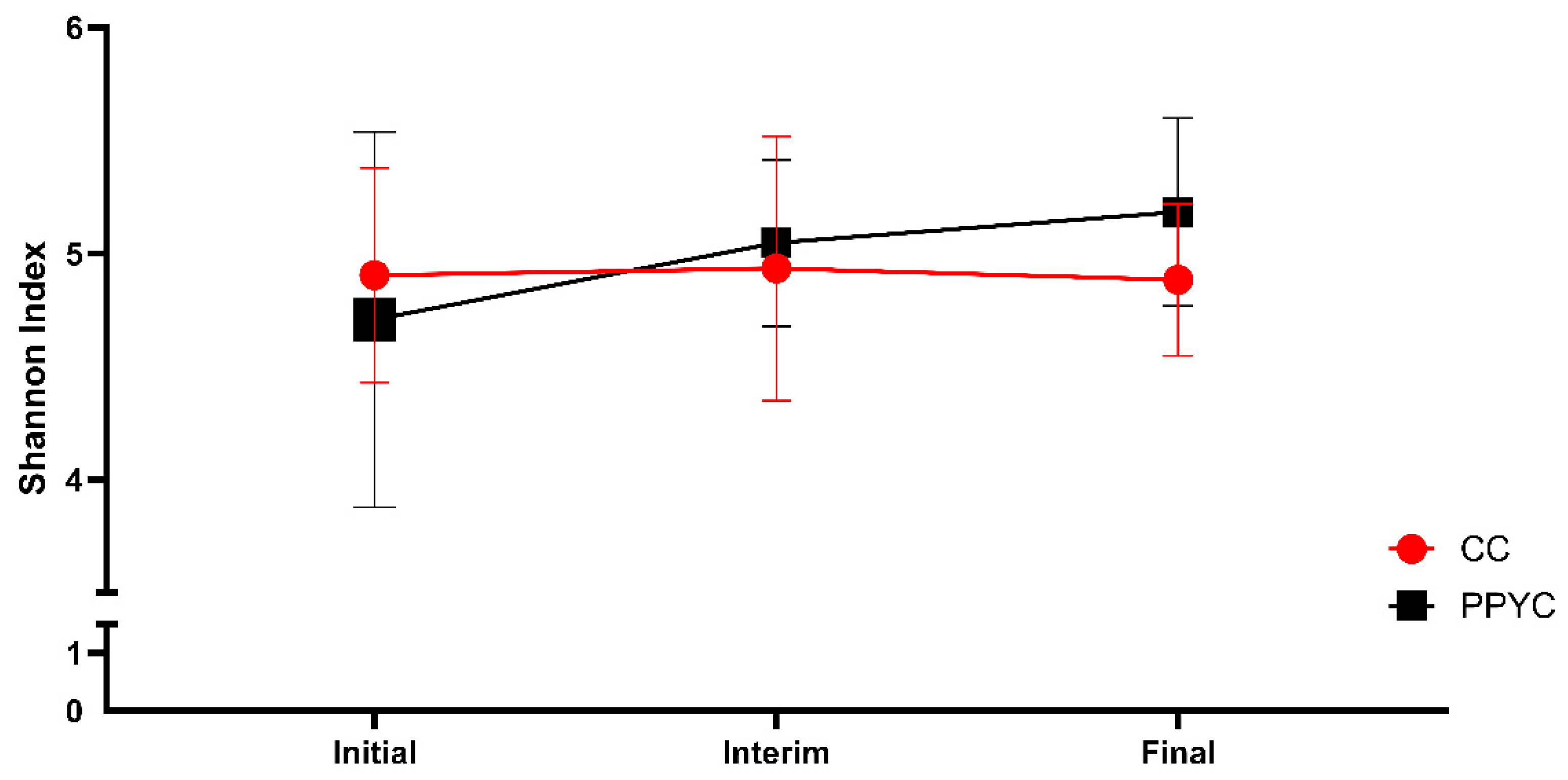
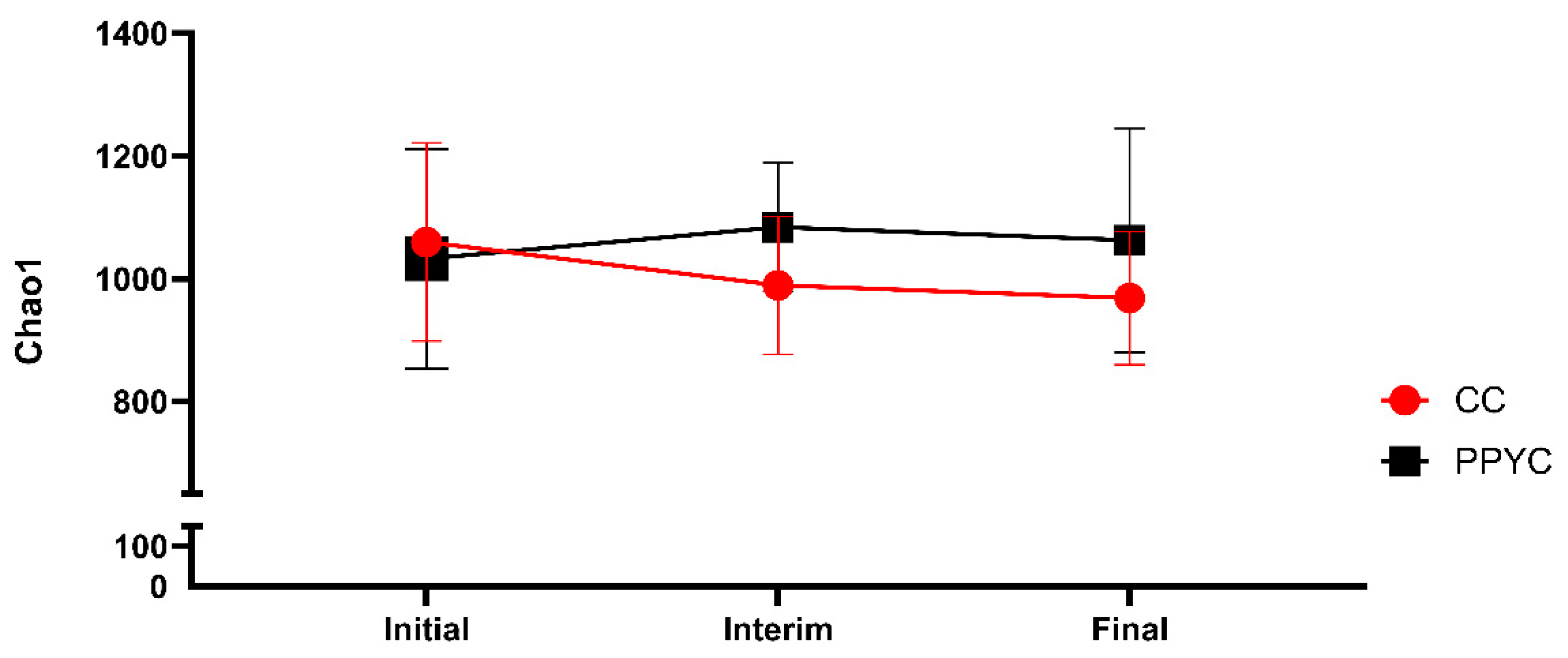
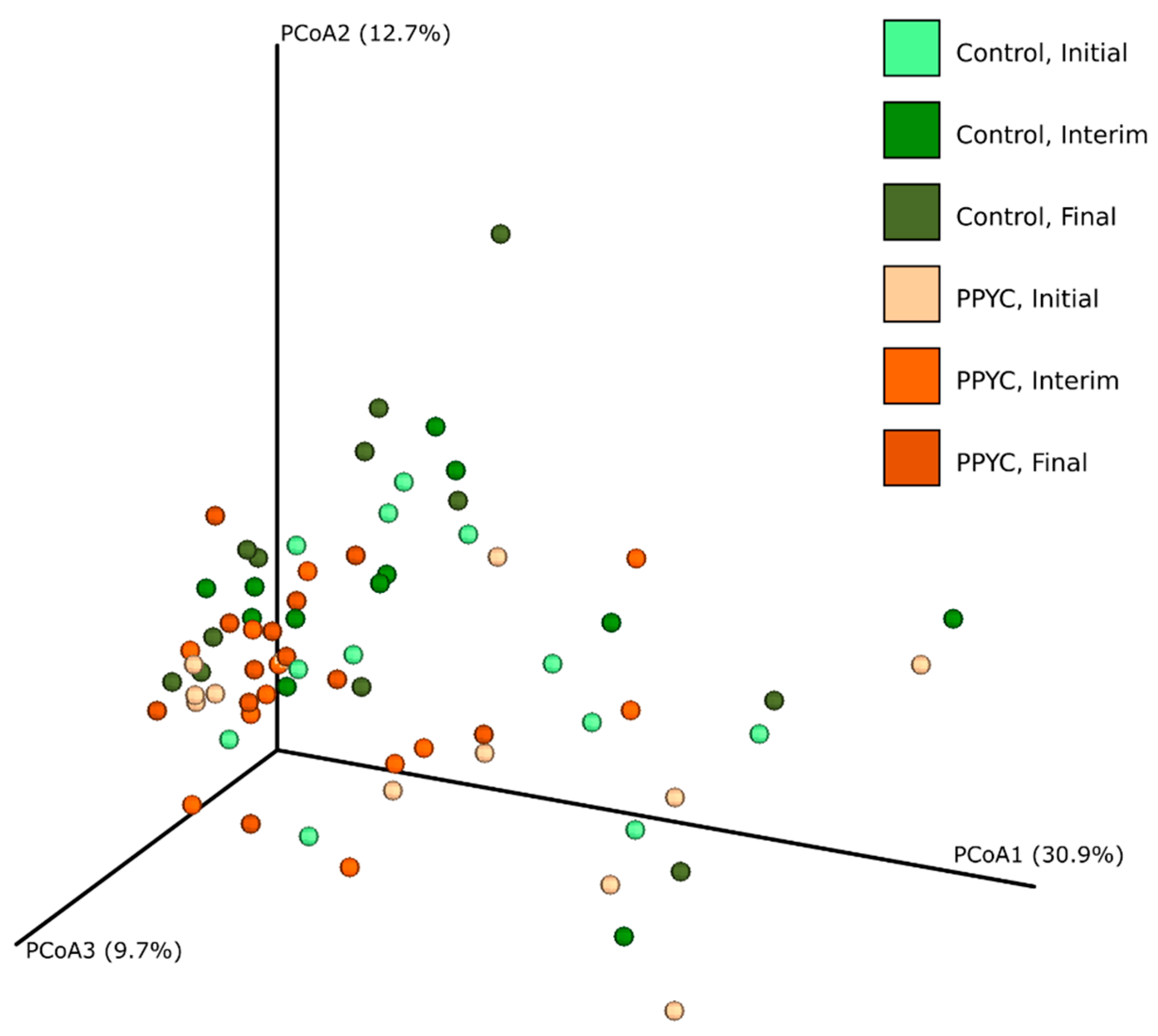
Samples were rarefied to 520,000 features prior to computing diversity measures within QIIME2. For alpha diversity, Shannon’s diversity, Chao1, and Observed Features were calculated. Statistics on the microbial diversity indices were obtained using a mixed-effects model to account for treatment effect and timepoint variability with GraphPad Prism 10.2.3 (GraphPad Software Inc., La Jolla, CA, USA). Šídák’s multiple comparisons test was used to determine differences between the treatment and control groups at each timepoint. Dunnett’s test was then performed to compare the change in the alpha diversity indices relative to the baseline within each group. Beta diversity was evaluated with the Bray–Curtis dissimilarity metric. At each timepoint, the Bray–Curtis distance was used to quantify the compositional dissimilarity between the treatment and control groups using ANOSIM (analysis of similarities) calculated with 999 permutations [50]. To assess clustering between groups, a principal coordinate analysis (PCoA) of the Bray–Curtis dissimilarity matrix was visualized.

3. Results

These study results will largely focus on the initial and final timepoints, as the interim data points were transitional in nature and did not conflict with the final timepoints, unless otherwise discussed.

3.1. Biometrical Measurements and Food Intake Data

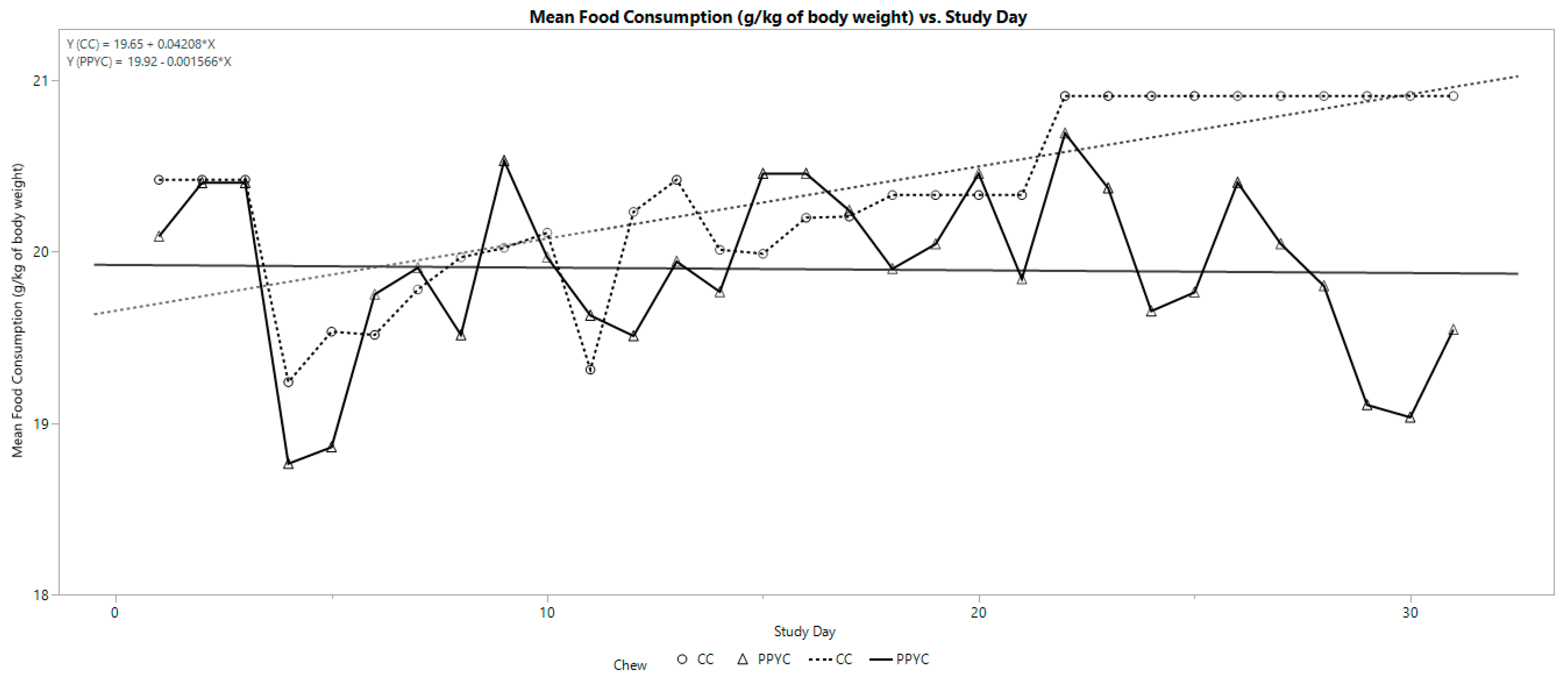
No serious adverse events were reported. A total of five instances of vomit occurred in the probiotic treated group (twice in one dog) vs. one instance in the control group throughout the entire study. Additionally, three episodes of loose stool were observed in the CC group, while four episodes of loose stool were observed in the PPYC group throughout the entirety of the study. Food consumption per kg of body weight (as the slope of a regression line) increased from Day 0 (p < 0.05) in the CC group whereas the slope was not significantly different from Day 0 in the PPYC group (Figure 1 and Figure S1). This difference in slopes is also supported by the repeated measures ANOVA analysis (Figure 1 and Figure S1) where the intercepts (i.e., initial values) of CC and PPYC groups were not statistically different (p = 0.73) but the slopes were (p = 0.0008).
Figure 1. Mean food consumption as expressed per unit of body weight held constant for PPYC but increased for CC. Note: There was a significant difference between the slopes (p < 0.01) but not at time 0 (p > 0.20). Further, the slope of CC was significantly different (p < 0.05) from Time 0 but not for PPYC.
Pets 03 00001 g001

3.2. Inflammatory/Immune Markers

On the final timepoint, fecal calprotectin (fCal) levels were reduced (p < 0.05) in PPYC compared with CC (Table 1). There was no significant difference in mean fCal change from Day 0 to final in either PPYC or CC (p = 0.17) (Table 1).
There was no significant difference in blood CRP values at the final timepoint in either PPYC or CC (Table 1). The mean change of blood CRP from Day 0 to final tended to decrease (p = 0.11) in PPYC compared with CC (Table 1).
Table 1. Fecal Calprotectin (fCal) and Blood C-Reactive Protein (CRP) Responses.
Day 0: Beginning of StudyDay 14: Interim ResultsFinal: End of Study Results
Mean ValuesLS Mean ValuesLS Mean Change from Day 0LS Mean Change from Day 0 (%)LS Mean ValuesLS Mean Change from Day 0LS Mean Change from Day 0 (%)
MetaboliteCC (SEM)PPYC (SEM)p-Value Within Time-PointCC (SEM)PPYC (SEM)p-Value Within Time-PointCC (SEM)PPYC (SEM)p-Value Within Time-PointCC (SEM)PPYC (SEM)p-Value Within Time-PointCC (SEM)PPYC (SEM)p-Value Within Time-PointCC (SEM)PPYC (SEM)p-Value Within Time-PointCC (SEM)PPYC (SEM)p-Value Within Time-Point
fCal (μg/g)82.5 (39.1)106.8 (45.0)0.98 (r)41.8 (38.3)47.4 (38.3)0.97 (r)−48.3 (35.4)−51.8 (35.4)0.89 (r)21.8 (640.7)44.1
(640.7)
0.96 (r)100.5 (38.3)64.0 (38.30)0.02 (r)10.4 (35.4)−35.2 (35.4)0.17 (r)1199.7 (640.70)437.4 (640.70)0.09 (r)
Blood CRP (ng/mL)4687.9 (1337.5)4272.1 (713.8)0.70 (r)2341.6 (616.5)3191.2 (616.5)0.34−2176.6 (592.7)−1250.7 (592.73)0.64 (r)−29.8 (37.6)1.37 (37.57)0.79 (r)3063.6 (616.5)2284.2 (616.5)0.38−1454.6 (592.7)−2157.7 (592.7)0.11 (r)28.03 (37.57)−35.3 (37.57)0.38 (r)
(r) indicates values were ranked prior to ANOVA/ANCOVA.
There were no significant changes in blood cortisol levels in CC or PPYC (PPYC = 2.2 on Day 0; 2.1 at the final timepoint and CC = 2.8 on Day 0; 2.4 at the final timepoint).
There were no significant changes in IgA levels between CC and PPYC. (Day 0: 8.8 CC vs. 6.2 PPYC; Final timepoint: 10.8 CC vs. 6.0 PPYC).
IL-17a tended to increase in PPYC compared with CC (p = 0.06) at the end of the study and a significant difference (p = 0.03) was observed between PPYC and CC at the end of the study (Table 2). IL-18 tended (p = 0.07) to have higher expression in PPYC compared with CC at the end of the study (Table 2).
Table 2. Cytokine Responses.
Day 0: Beginning of Study Day 14: Interim Results Final: End of Study Results
Mean Values (mg/g) LS Mean Values (mg/g) LS Mean Change from Day 0 (D mg/g) LS Mean Change from Day 0 (%) LS Mean Values (mg/g) LS Mean Change from Day 0 (D mg/g) LS Mean Change from Day 0 (%)
MetaboliteCC
(SEM)
PPYC
(SEM)
p-Value Within Time-Point CC
(SEM)
PPYC
(SEM)
p-Value Within Time-Point CC
(SEM)
PPYC
(SEM)
p-Value Within Time-PointCC
(SEM)
PPYC
(SEM)
p-Value Within Time-Point CC
(SEM)
PPYC
(SEM)
p-Value Within Time-PointCC
(SEM)
PPYC
(SEM)
p-Value ChangeLS Mean Change % CC
(SEM)
LS Mean Change % PPYC
(SEM)
p-Value Change %
IL-6 (pg/mL) 280.4
(151.9)
784.0
(497.9)
0.48 (r)143.3
(237.7)
245.2
(227.6)
0.40 (r)−375
(70.3)
−340
(67.2)
0.82 (r)−20.9
(14.9)
−26.5
(14.2)
0.79132.3
(284.4)
216.0 (227.6)0.49 (r)−389.3
(71.7)
−369.5
(67.2)
0.90 (r)−16.0
(15.3)
−26.8
(14.2)
0.32 (r)
IL-10 (pg/mL) 229.8 (139.9)107.3 (30.8)0.75 (r)173.2 (78.5)86.9 (62.8)0.76 (r)−36.4 (35.1)−37.9 (31.6)0.98−8.1
(27.4)
−17.1 (24.6)0.82146.1 (81.4)75.8 (62.8)0.81 (r)−64.5 (36.9)−50.5 (31.6)0.79−16.8 (28.4)−13.2 (24.6)0.93
IL-18 (pg/mL) 550.9 (282.8)1311.9 (643.7)0.16 (r)340.4 (336.1)729.4 (336.1)0.11 (r)−461 (134.5)−332 (134.5)0.82 (r)−22.7
(11.4)
−21.0 (11.4)0.92308.6
(336.1)
686.6 (336.1)0.07 (r)−492.8 (134.5)−374.8 (134.5)0.99 (r)−27.1 (11.4)−19.1 (11.4)0.63
TNF-a (pg/mL) 214.6 (117.7)418.7 (257.8)0.86112.9 (148.5)153.2 (128.6)0.55 (r)−197 (49.5)−193 (42.8)0.60 (r)−26.7 (16.06)−25.1 (13.9)0.94115.3 (156.2)146.6 (128.6)0.84 (r)−205.4 (50.8)−199.7 (42.8)1.00 (r)−26.2 (16.7)−24.9 (13.9)0.65 (r)
Calprotectin (ng/mL) 72.1 (6.1)61.1 (4.3)0.1669.9 (4.7)61.1 (4.7)0.190.228 (3.3)−2.40 (3.3)0.583.88 (5.6)0.60 (5.6)0.6869.1 (4.71)64.8 (4.71)0.52−0.63 (3.3)1.31 (3.3)0.680.65 (5.60)4.85 (5.60)0.60
IgE (ng/mL) 11338 (4549)10701 (3199)0.89 (r)10029 (4069)9611 (4069)0.44 (r)−1304 (1501)−1095 (1501)0.84 (r)−0.65 (9.8)−6.60 (9.8)0.6713414.1 (4069)9365.0 (4069)0.59 (r)2081.7 (1501)−1341.8 (1501)0.36 (r)7.71 (9.78)−6.16 (9.78)0.32
IL-17A (ng/mL) 0.282 (0.0)0.681 (0.4)0.62 (r)0.185 (0.26)0.618 (0.26)0.19 (r)−0.090 (0.06)−0.069 (0.06)0.81−38.7 (44.7)16.2 (44.7)0.10 (r)0.17 (0.26)0.76 (0.26)0.03 (r)−0.10 (0.06)0.07 (0.06)0.06 (r)−10.6 (44.7)104.3 (44.7)0.14 (r)
IL-1b (pg/mL) 758 (393.1)289
(94.2)
0.24461.5 (202.4)169.6 (205.6)0.32−97.7 (120.4)−178.7 (113.1)0.64−31.5 (17.2)−16.7 (16.2)0.55366.6 (213.1)149.8 (202.4)0.47−239.6 (125.0)−196.6 (113.1)0.73 (r)−35.0 (20.3)−29.0 (16.2)0.82
IL-4 (ng/mL) 2.98 (1.0)2.03 (0.9)0.601.66 (0.72)2.19 (0.72)0.39 (r)−1.15 (0.48)−0.45 (0.48)0.3114.3 (70.0)63.6 (69.8)0.622.15 (0.76)1.65 (0.72)0.99 (r)−0.60 (0.48)−0.74 (0.51)0.8455.7 (69.7)110.8 (74.5)0.72 (r)
TNF-b (pg/mL) 142.6 (119.6)470.1 (258.2)0.04151.2 (186.2)425.7 (185.9)0.35 (r)3.33 (39.7)−30.20 (37.3)0.08 (r)196.7 (95.0)−9.0 (86.7)0.12 (r)131.0 (186.2)451.8 (186.2)0.61 (r)−22.4 (39.7)−2.14 (37.3)0.72104.8 (95.0)−18.2 (89.1)0.36
(r) indicates values were ranked prior to ANOVA/ANCOVA.

3.3. Microbiome Data

3.3.1. Dysbiosis

Microbiome analyses included bacteria associated with the DI. (Blautia, Clostridium hiranonis, Faecalibacterium, Fusobacterium, Turicibacter, E.coli, and Streptococcus). A DI was then calculated [51].
At the final timepoint, the DI was numerically similar (p > 0.20) between CC and PPYC (Table 3). The mean percent change from day 0 of the DI for PPYC tended (p = 0.13) to decrease compared with the CC (Table 3).
Blautia mean value at the final timepoint significantly increased (p < 0.05) in PPYC compared with CC (Table 3). The mean value change from Day 0 of Blautia was higher (p < 0.05) in PPYC compared with CC (Table 3). Mean value changes from Day 0 tended to be higher for C. hiranonis (p = 0.09) and Bacteroides (p = 0.07) in PPYC compared with CC (Table 3). The mean value percent change from Day 0 to the final timepoint for C. hiranonis was higher (p = 0.02) in PPYC compared with CC. The mean value at the final timepoint for Bifidobacterium tended to be higher (p = 0.12) in PPYC compared with CC at the end of the study, but no significant difference occurred with Change or Change percent (Table 3). The mean value of Turicibacter was significantly lower (p < 0.05) at the final timepoint in PPYC compared with CC.
Interim dysbiosis and other taxa results generally followed those of the final timepoint. However, Faecalibacterium and Bifidobacterium exhibited interim changes that were countered at the final timepoint. In both cases, by the end of the study, results were commensurate with reduced dysbiosis. These results may indicate transitional changes in these strains.
Table 3. Dysbiosis Index Bacterial Strains and Two Additional Bacterial Strains Results (% of Total Bacteria).
Day 0: Beginning of StudyDay 14: Interim ResultsFinal: End of Study Results
Mean ValuesLS Mean ValuesLS Mean Change from Day 0LS Mean Change from Day 0 (%)LS Mean Values (mg/g)LS Mean Change from Day 0LS Mean Change from Day 0 (%)
Strain/IndexCC (SEM)PPYC (SEM)p-Value Within Time-PointCC (SEM)PPYC (SEM)p-Value Within Time-PointCC (SEM)PPYC (SEM)p-Value Within Time-PointCC (SEM)PPYC (SEM)p-Value Within Time-PointCC (SEM)PPYC (SEM)p-Value Within Time-PointCC (SEM)PPYC (SEM)p-Value ChangeLS Mean Change % CC (SEM)LS Mean Change % PPYC (SEM)p-Value Change %
Index:
Dysbiosis Index−0.01 (0.37)−0.20 (0.66)0.80−0.57 (0.56)−1.13 (0.56)0.49−0.51 (0.53)−0.99 (0.53)0.53197.2 (192.8)−156.2 (192.8)0.56 (r)−1.25 (0.56)−1.48 (0.56)0.78−1.19 (0.53)−1.34 (0.53)0.84235.2 (192.8)−197.5 (192.8)0.13 (r)
Strains (% of total bacteria):
Faecalibacterium0.0003
(0.00007)
0.00014
(0.00005)
0.050.000095
(0.0002)
0.00027
(0.0002)
0.10−0.0002
(0.0002)
0.000013
(0.0002)
0.0215.19
(161.7)
423.91
(161.7)
0.050.00014
(0.0002)
0.00042
(0.0002)
0.59−0.00015
(0.0002)
0.00028
(0.0002)
0.3028.8
(161.7)
170.7
(161.7)
0.27
Turicibacter0.20
(0.05)
0.10
(0.03)
0.090.29
(0.05)
0.15
(0.05)
0.070.134
(0.0591)
0.0074
(0.0591)
0.151521.8
(772.0)
833.4
(772.0)
0.260.32
(0.0524)
0.16
(0.0524)
0.03
(0.0002)
0.17
(0.06)
0.02
(0.06)
0.091421.7
(772.0)
852.5
(772.0)
0.20
Streptococcus0.07 (0.02)0.05 (0.03)0.340.031 (0.013)0.032 (0.013)0.89−0.025 (0.013)−0.024 (0.013)0.9943.98 (123.0)−1.99 (123.0)0.850.034 (0.013)0.013 (0.013)0.75−0.021 (0.013)−0.044 (0.013)0.2118.5 (123.0)133.5 (123.0)0.70
E. coli0.00046 (0.0003)0.0055 (0.005)0.770.00064 (0.002)0.00043 (0.002)0.85−0.0023 (0.0007)−0.0026 (0.0007)0.812189.3 (2703)98.5 (2703)0.620.00058 (0.002)0.0014 (0.002)0.94−0.0024 (0.0006)−0.0016 (0.0006)0.975257.8 (2703)3020.2 (2703)0.93
Blautia19.19 (2.47)18.73 (2.70)0.9014.20 (2.55)22.50 (2.55)0.03−4.85 (2.36)3.63 (2.36)0.02−20.13 (49.4)102.60 (49.4)0.00215.62 (2.56)24.35 (2.56)0.009−3.43 (2.36)5.48 (2.36)0.01−5.1 (49.4)102.0 (49.4)0.02
Fusobacterium0.074 (0.03)0.17 (0.07)0.360.035 (0.05)0.039 (0.05)0.34−0.086 (0.04)−0.080 (0.04)0.66−22.15 (324.6)80.7 (324.6)0.460.074 (0.05)0.10 (0.05)0.47−0.047 (0.04)−0.017 (0.04)0.28125.38 (324.6)627.07 (324.6)0.44
C. hiranonis0.0020 (0.0003)0.0022 (0.0005)0.680.0021 (0.0004)0.0028 (0.0004)0.180.000025 (0.0003)0.000658 (0.0003)0.2011.25 (122.0)229.93 (122.0)0.140.0021 (0.0004)0.003 (0.0004)0.080.00003 (0.0003)0.0009 (0.0003)0.095.59 (122.0)307.8 (122.0)0.019
Bifidobacterium0.000003 (0.0000023)0.00014 (0.00014)0.560.00006 (0.0003)0.000002 (0.0003)0.170.00014 (0.0002)−0.00023 (0.0002)0.0098974.9 (6526)368.5 (6526)0.020.00001 (0.0003)0.0008 (0.0003)0.120.00001 (0.0002)0.00053 (0.0002)0.90158.4 (6526)16492.9 (6526)0.39
Bacteroides0.00013 (0.00005)0.00013 (0.00005)0.860.00004 (0.00006)0.00015(0.00006)0.05−0.00009 (0.00006)0.000016(0.00006)0.0623.47 (188.6)257.21 (188.6)0.130.00009 (0.00006)0.00018 (0.00006)0.21−0.00004 (0.00006)0.000055 (0.00006)0.07157.0 (188.6)436.3 (188.6)0.24
(r) indicates values were ranked prior to ANOVA/ANCOVA.

3.3.2. Diversity

In Figure 2, Figure 3, Figure 4 and Figure 5, results of the microbiome diversity assessment are portrayed.
Observed alpha diversity did not change significantly over time between the CC and PPYC groups (Shannon p = 0.42, Chao1 p = 0.31, Observed Features p = 0.25). However, within the PPYC group, alpha diversity (assessed by the Shannon Diversity Index) was increased 10% over the study (p < 0.05), whereas CC diversity slightly declined 0.4% (p > 0.20) over the study (Figure 2 and Figure S2). This significance was not observed in the other indices (Chao1 p = 0.76, Observed Features p = 0.68). There were no significant changes within the CC group (Figure 2 and Figure S2).
Diversity within an animal’s microbiome as assessed by observed features (richness) tended (p = 0.12) to decline 8.9% during the study in the CC group whereas the PPYC group numerically increased 3.6% (p > 0.20) at the final timepoint from Day 0 (Figure 3 and Figure S3).
The Chao1 aspect of alpha diversity tended (p = 0.11) to decline 8.7% from Day 0 to final in the CC group, whereas the PPYC group numerically increased 2.9% (p > 0.20) (Figure 4 and Figure S4).
Beta diversity (assessed by the Bray-Curtis diversity comparison, ANOSIM, the diversity between animals’ fecal microbiomes) reveals no significant clustering. However, the overall treatment effect tended to differ (p = 0.13) (Figure 5 and Figure S5).

3.3.3. Additional Taxonomy

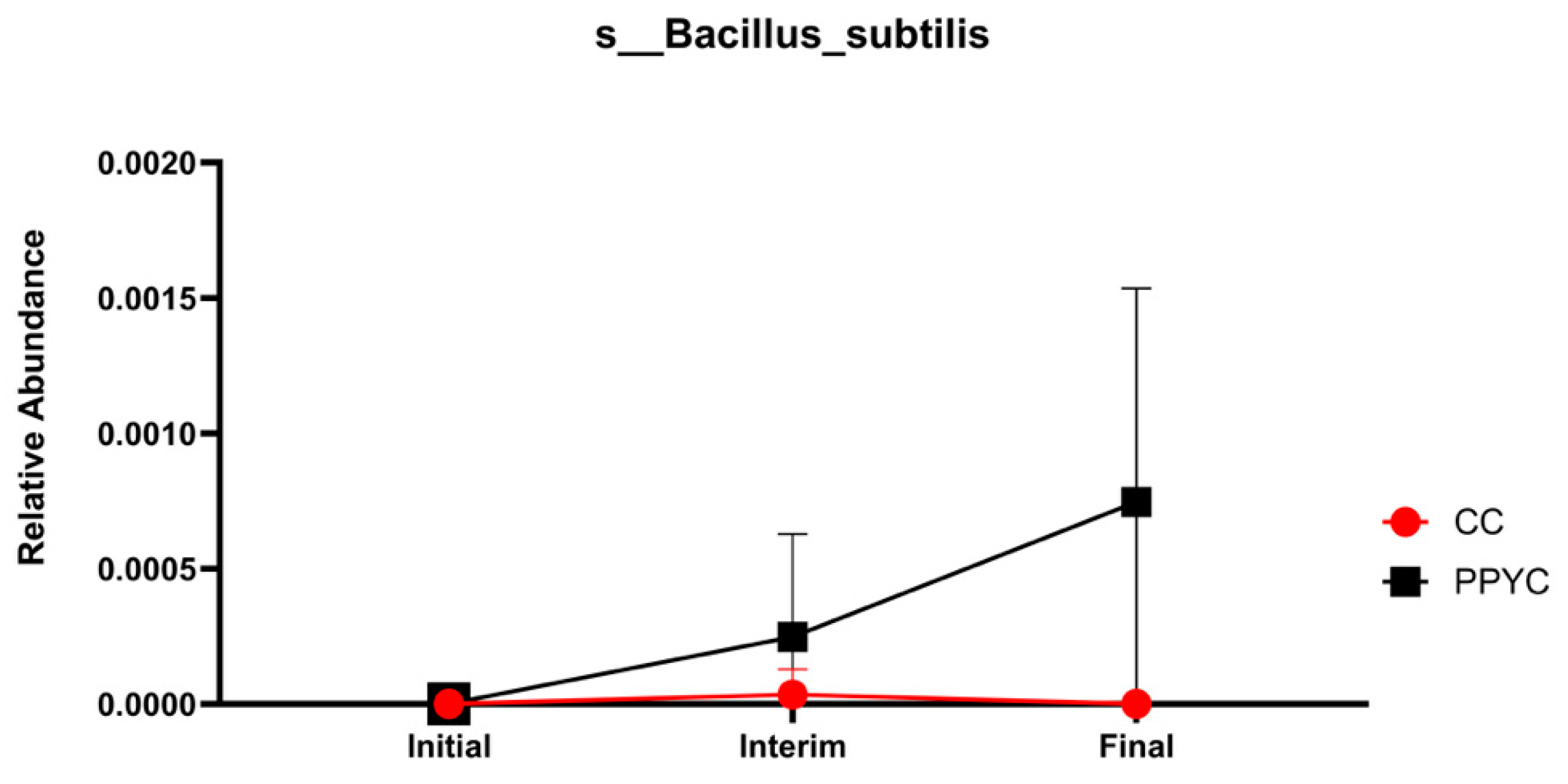
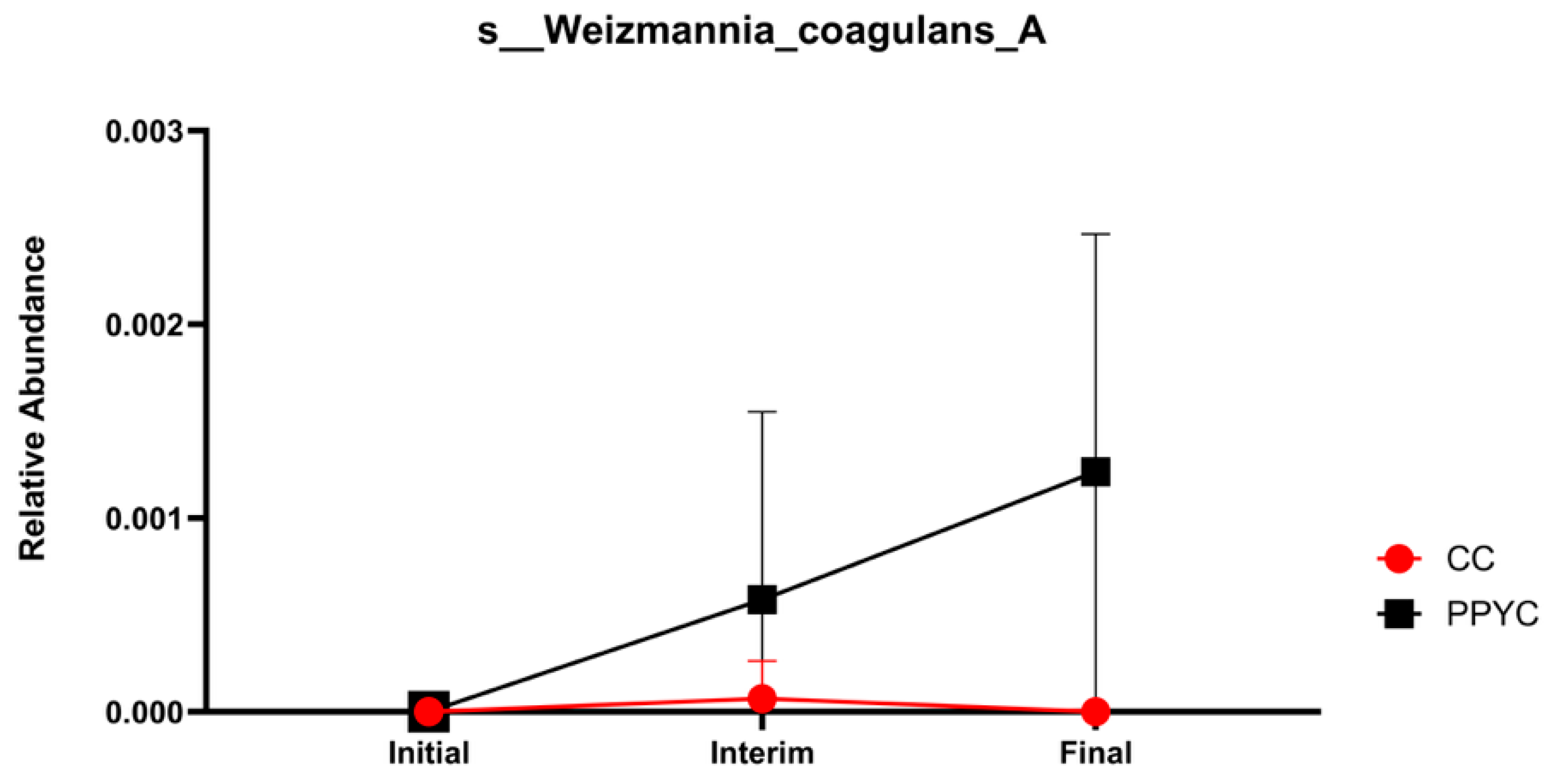
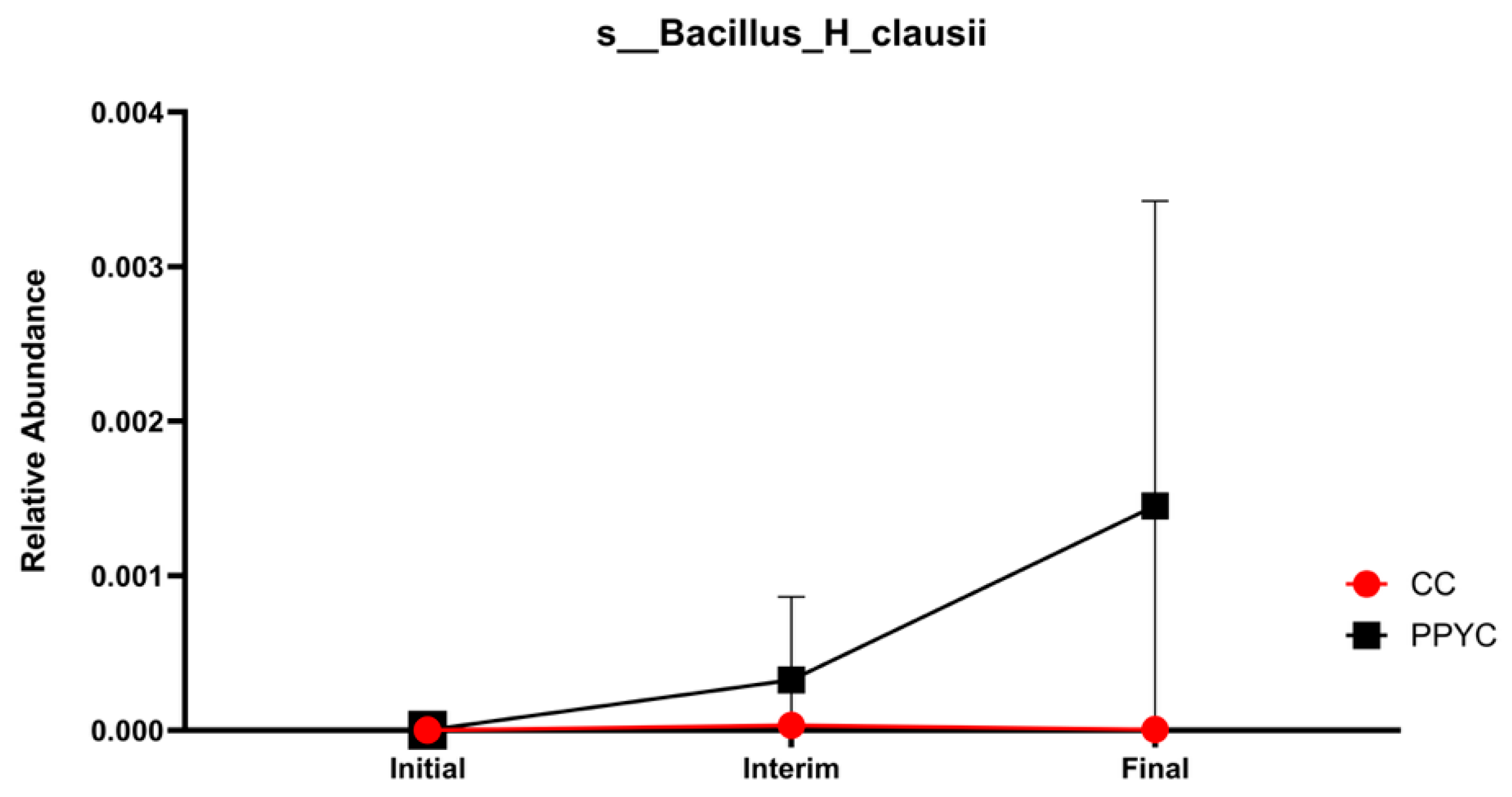
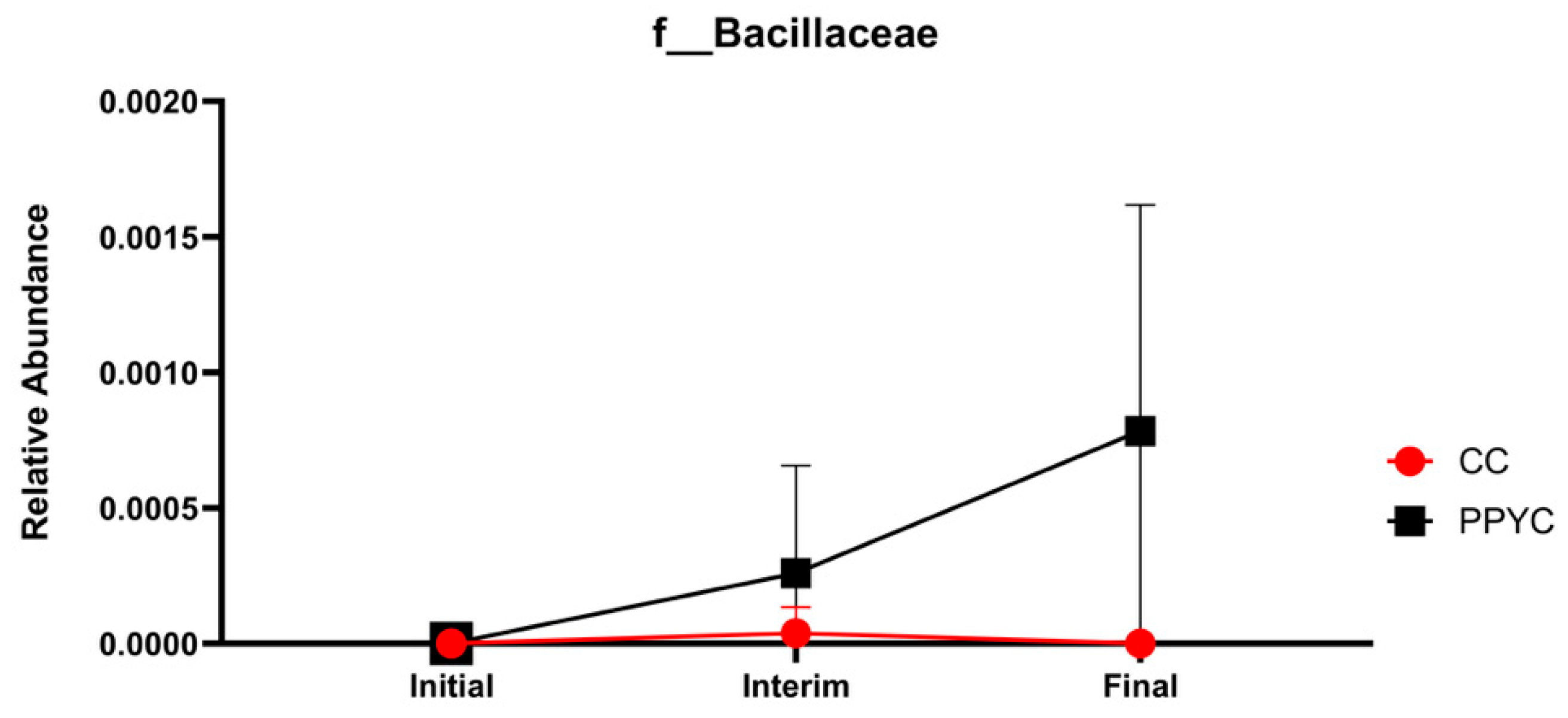
There was a significant change from baseline increase (p < 0.05) of Bacillus subtilis, Bacillus coagulans (Weizmannia coagulans), and Bacillus clausii to the final timepoint in PPYC compared with CC (Figure 6, Figure 7 and Figure 8, respectively; Supplementary Figure S6, Figure S7 and Figure S8, respectively). Additionally, a significant change from baseline increase (p < 0.05) of family Bacillaceae was observed at the final timepoint in PPYC compared with CC (Figure 9 and Figure S9).

4. Discussion

Probiotics, prebiotics, and more recently, postbiotics, are known to have a beneficial influence on gastrointestinal and immunological function in humans, livestock, and companion animals. Biotics are increasingly being studied using healthy models, in addition to those with manifest disease. To provide further research in this area, this study explored the benefits of a commercial chew for dogs containing a proprietary blend of probiotics, prebiotics, and yeast extract. The supplement was generally well-tolerated, with only mild, transient events occurring in both study groups. Stomach upset accompanied by vomit and runny stool can be expected when introducing a new dietary intervention of any kind. As seen in this study, the vomit subsided quickly and did not reoccur except in one dog that vomited twice. There were overall no adverse effects observed among the treatment nor the control animals.
Food consumption during the study increased in the control group, whereas the PPYC group food consumption remained constant. This indicates increased food consumption in the control group was necessary to maintain BW, whereas the probiotic group was able to maintain their BW without increasing food intake. These findings indicate improved food efficiency in the group fed the combination of probiotics, prebiotics and yeast extract. Similar to the observations in this study, one study found that a probiotic, L. sakei, increased weight gain in healthy dogs, implying improved food efficiency [52]. In contrast, another study found that a probiotic, B. subtilis, decreased diet digestibility [53]. Studies have found that feeding various probiotics, prebiotics, and postbiotics resulted in observations such as reduced body weight, BCS, and body fat in obese dogs or dogs challenged with a high-fat diet [54,55,56,57]. The current study observed improved feed efficiency in dogs at a healthy weight over a relatively short period of time (31 days), however, it would be of interest to look at its effects over a longer period of time or in a challenge (high-fat) model of obesity.
Altered gut microbiota have been observed in dogs and cats with intestinal inflammation [4,58,59,60]. Given these observations, inflammatory markers are often measured in tandem with microbiota analysis to assess overall host health in dogs supplemented with probiotics. In this study, no changes were observed in the hormone cortisol. As part of the stress response, the adrenocorticotropic hormone is released, thereby stimulating the adrenal glands to secrete glucocorticoids, such as cortisol, the primary stress hormone [61]. McGowan, et al., 2018, reported that supplementing dogs with B. longum for six weeks reduced salivary cortisol levels as well as symptoms of anxious behavior [62]. It has also been reported in a 2024 study that there was a positive correlation between increased gut Lactobacilli and salivary cortisol levels in dogs [63]. Cortisol is reportedly variable in individuals over a 24-h period, as well as between individuals [64]. It is also plausible that this natural variability might explain the lack of statistically different results between control and treatment. Furthermore, it can be noted that these animals did not undergo any stress challenge, in which a larger difference or pattern could have potentially been observed.
Under the case of greater intestinal distress (i.e., disease), perhaps we would have observed an increase in IgA levels as well. In either case of IgA or cortisol, a longer study (60 or 90 days) with additional repeated observations could have resulted in an effect of the probiotic chew on these biomarkers of stress and intestinal immune response. Literature reviewing dogs that were fed various gut actives (FOS, GOS, individual strains of probiotics, various dietary fibers, and blends thereof) have indicated that fecal IgA was increased [65,66,67,68]. One study reported a trend for IgA to increase [29] and four indicated that fecal IgA level was not affected by treatment [69,70,71,72]. Thus, our findings of fecal IgA not being affected by our combination of gut actives do not appear unusual.
Fecal calprotectin (fCal) is indicative of intestinal inflammation [39]. Activated neutrophils, macrophages, and epithelial cells can express calprotectin, which is found in cells throughout the intestine [73,74]. In a study comparing dogs with chronic inflammatory enteropathy with normal, healthy dogs, calprotectin was found at over twice the level in both the duodenum and colon in diseased animals [73]. In our study, we found calprotectin levels decreased after 31 days of consuming the test product. Similarly, another study reported that labrador retrievers with a history of loose stools were supplemented with torula yeast and had reduced calprotectin levels and improved protein digestibility [35]. Reduced levels of fecal calprotectin over time in healthy adult dogs supplemented with S. boulardii were reported; however, these decreased levels did not statistically differ from control (non-supplemented) dogs [75]. Other studies containing similar types of gut actives did not see changes in fecal calprotectin levels [76,77]. Blood CRP, another biomarker of tissue inflammation, tended (p = 0.11) to be reduced in PPYC compared to CC. C-reactive protein is an acute phase protein originally developed as a diagnostic of heart trauma but has more recently been viewed as general marker of tissue trauma and thus whole body inflammation [78]. Taken together with fCal, this may indicate that lessening intestinal inflammation is tied to lessening systemic inflammation.
Out of 10 additional cytokines and inflammatory biomarkers, only two revealed a minor response. Overall, the response to the test product was relatively muted with the exception of IL-17a and IL-18. IL-17a is considered a pro-inflammatory cytokine. It helps coordinate immune responses against infections, helps maintain gut mucosa immunity, aids tissue repair, and can aid the immune system in fighting tumors [79,80]. Research measuring IL-17a in dogs is scarce. Because of its pro-inflammatory nature, inhibiting IL-17a has been considered as a therapy for inhibiting inflammation-related diseases such as psoriasis or rheumatoid arthritis [80]. In this realm, researchers indicated that both IL-26 and IL-17a cytokines are associated with allergen sensitization among children [81]. IL-18 is considered a pro-inflammatory cytokine and is involved with boosting interferon-γ, has anti-viral immune effects, works synergistically with IL-12 and, when over-expressed, can be associated with auto-immune disorders [82]. Our results indicated a trend (p = 0.07) for increased expression of IL-18 with the test compared with the control product at study completion. IL-18 has been shown to be present at higher levels in dogs with immune-mediated hemolytic anemia and the acute phase of tick-borne disease babesiosis [83,84]. Additionally, higher levels of IL-18 along with IFN-γ and IL-2 were associated with a protective effect against canine leishmaniosis in the Ibizan Hound breed compared to the Boxer as a susceptible breed [85]. Taken together, these results could be viewed as a positive response of the immune system to addressing these conditions. Overall, it appears that the mode of action for the test product to impact the inflammation response is partially through these pro-inflammatory cytokines of the immune system. It is not surprising that a minor response was detected in the present study, as the dogs were clinically healthy and unchallenged.
Other than immunological changes, observing changes in the GI microbiome is a major indication of host health. A DI has been developed previously [86]. The DI was developed to give guidance to clinicians related to diagnosing intestinal disease but is increasingly being used to compare potential interventions in clinical research trials with diseased animals. At the end of the study, the DI was similar between CC and PPYC. Given that the animals were relatively healthy, it is unsurprising that the results for both CC and PPYC for DI fell within a healthy “diagnostic” DI level. However, there was a trend for improvement in the percent change of the DI for PPYC compared with the CC, as it was slightly lower in the PPYC group. The modest change was perhaps due to the animals being in a normal, healthy state. The decrease in the DI was driven by modest changes in taxa moving in a direction away from dysbiosis with Blautia and C. hiranonis resulting in significant improvement.
The individual bacteria representing the DI results were expressed as a percent of the total bacteria (Universal DNA) present. Upon inspection of the individual DI bacteria results, improvement was evident for Blautia and C. hiranonis, with only Turicibacter reversing improvement levels with PPYC compared with CC. There was also an improvement for Bifidobacterium (taxon not used to calculate DI in dogs) when comparing Day 0 and final, however, the interim timepoint (Day 14), revealed a discrepancy. Bifidobacterium tended (p = 0.12) to decrease in the PPYC group compared with the CC group, whereas at the end of the study, Bifidobacterium levels were increased in the PPYC group compared with the CC group. While it is difficult to explain the divergent results, it is possible that the interim timepoint reflects transitioning bacterial populations. Overall, the trend for DI improvement taken together with the changes in individual DI bacterial taxa indicates that the PPYC favored a healthier intestinal environment regarding bacterial taxa known to be changed during intestinal dysbiosis.
Diversity of the gut microbiota has been related to disease presences and risks. Because of this, diverse microbiomes are believed to be more resistant to infection, which results in avoidance of disease and is associated with better health [86]. Gut dysbiosis is associated with lower microbial diversity [86,87]. In humans, decreased microbial diversity is associated with increased C. difficile infection and inflammatory bowel disease, as well as reduced cognition [88,89,90]. In this study, the treatment did not significantly impact the overall composition of the microbiota greatly, however, some changes were observed. The results in this study indicate that alpha diversity (within sample) was improved with the PPYC and the richness, or number of different organisms present in each animal’s microbiome, of the PPYC group numerically increased 3.6% over the study. The alpha-diversity and Chao1 results indicate that over the course of the study, the CC group tended to lose the number of different organisms whereas the PPYC helped maintain, and actually bolstered the number of different organisms. Bray-Curtis diversity comparison was calculated to assess the diversity between animals’ fecal microbiomes. The overall treatment effect tended to be significant.
Within this study, many changes to species, genera, and families of microorganisms were observed and discussed. The composition of the microbiota helps understand what phylogenetic changes are occurring in the lumen of the intestine. Modern techniques like the shotgun DNA analysis, which was used in this study, are able to cross-reference all known bacterial taxa available to a common reference library. In some cases, a reference library may consist of over a million known bacterial species. Because this is a DNA-based assay, it does not distinguish between viable versus non-viable bacteria. However, DNA-based techniques have become the procedure of choice for characterizing microbiota populations [5,60,91].
This probiotic chew was formulated to contain Bacillus subtilis, Bacillus coagulans (Weizmannia coagulans), and Bacillus clausii. The successful establishment of these species was confirmed by the significant increase of all three species post-supplementation. These results clearly indicate that the probiotic chew is impacting the microbiota population that is present. The Bacillaceae family in the PPYC group increased similarly to the previously discussed species. Thus, the PPYC group is improving a population of bacteria that is considered health-promoting in the gut.
There are a few limitations of the present study to address. First, the dogs used in this study were clinically healthy. Therefore, this study only addresses the slight changes observed in immune and gut microbiota that may be seen in healthy individuals. The effects of the test product may be more or less pronounced in animals with severe gastrointestinal or immune system distress. While the study was adequately powered to detect several statistically significant differences between groups, the relatively small sample size (n = 12 per group) may have limited the ability to detect more subtle effects, particularly in variables with high inter-individual variability such as cytokine levels and microbiome composition. Future studies with larger cohorts would help confirm these findings and provide greater statistical power to potentially biologically meaningful changes. Furthermore, the study period was 31 days, which was enough to observe change, however, more robust results could potentially be observed if the study period was longer. For future direction, it would be interesting to see this combination of active ingredients evaluated in challenged models such as dogs with IBD or animals with immune dysfunction, such as those with allergies.

5. Conclusions

Overall, the results of this study indicate that Bacillus subtilis, Bacillus coagulans (Weizmannia coagulans), and Bacillus clausii can be successfully incorporated into a chew for dogs, survive transit through the gastrointestinal tract, and populate the colon. These data also suggest that the combination of probiotic bacteria, prebiotics, and postbiotic yeast extract may have the potential to enhance intestinal health and improve immune function in dogs. Evidence observed in this study indicates that dogs fed the probiotic-enriched chew had less inflammation, improved levels of bacteria associated with a healthier intestinal environment, and enhanced nutrient utilization from the dogs’ food. A longer period of evaluation along with other possible biomarkers of stress and immune function would be interesting to evaluate with the PPYC. Another approach of interest would be a consumer-related study with dogs experiencing gastrointestinal distress and time to resolution with the PPYC.

Supplementary Materials

The following supporting information can be downloaded at https://www.mdpi.com/article/10.3390/pets3010001/s1, Supplementary Table S1: Inclusion/exclusion criteria; Supplementary Figure S1: Food consumption effect summary; Supplementary Figure S2: Shannon Diversity Index effect summary; Supplementary Figure S3: Observed features effect summary; Supplementary Figure S4: Chao1 effect summary; Supplementary Figure S5: ANOSIM Bray–Curtis effect summary; Supplementary Figure S6: Bacillus subtilis effect summary; Supplementary Figure S7: Bacillus (Weizmannia) coagulans effect summary; Supplementary Figure S8: Bacillus clausii effect summary; Supplementary Figure S9: Bacillaceae effect summary; Supplementary File S1: Additional taxonomy results and discussion [92,93,94,95,96,97,98,99,100,101,102,103,104,105,106,107,108,109].

Author Contributions

J.F. provided company support for this study. G.D.S. and M.K.S. designed the research; J.B. and A.S. coordinated sample analyses; T.S. from TAMU analyzed the data for microbial diversity and additional taxonomy; T.C. analyzed the remaining data; G.D.S. initially interpreted the results; G.D.S. and A.Z. jointly wrote the first manuscript draft. All authors have read and agreed to the published version of the manuscript.

Funding

This research was funded by PetLab Group Limited (DBA PetLabCo.).

Institutional Review Board Statement

The protocol for this study was reviewed and approved by the Summit Ridge Farms’ Institutional Animal Care and Use Committee (IACUC) and was in compliance with the Animal Welfare Act (protocol #PLBEFFC00124; date of approval: 16 December 2023).

Informed Consent Statement

This study was conducted using research facility-managed animals, not client-owned animals, so no informed consent was required beyond IACUC approval.

Data Availability Statement

The original contributions presented in this study are included in the article/Supplementary Material. Further inquiries can be directed to the corresponding author.

Acknowledgments

The authors wish to thank Texas A&M GI Lab, the University of Minnesota, the University of Illinois, and Antech Diagnostics for their efforts in sample analyses.

Conflicts of Interest

Authors A.Z., M.K.S., T.C., J.B., A.S., J.F., and G.D.S. are employed within the Clinical Science and Research Science departments of PetLabCo. A.Z. is a Research Scientist who primarily provides literature support and leads technical in vitro projects within PetLabCo. J.B. and A.S. work within the Clinical Science department, primarily leading clinical trials using client-owned animals. J.F. leads both the Clinical Research and R&D departments. Specifically, M.K.S., T.C., and G.D.S. are consultants for PetLabCo. M.K.S, who is a DVM, primarily provides support to technical research projects and co-writes the clinical trial protocols for PetLabCo. T.C. provides statistical work for PetLabCo. G.D.S.; primarily provides nutritional and formulation knowledge to support PetLabCo. research and products. T.S. is affiliated with the Gastrointestinal Laboratory, Texas A&M University, which offers gastrointestinal assays on a fee-for-service basis. PetLabCo. funded the study and was involved in the writing and the revision of the manuscript. The paper reflects the views of the scientists and not those of PetLabCo.

Abbreviations

The following abbreviations are used in this manuscript:
CCControl Chew
PPYCProbiotic Prebiotic Yeast Chew
GIGastrointestinal
BWBody Weight
BCSBody Condition Score
FOSFructooligosaccharides
GOSGalactooligosaccharides
MOSMannanoligosaccharides
fCalFecal Calprotectin
CRPC-reactive Protein
IgAImmunoglobulin A
DIDysbiosis Index
ANOSIMAnalysis of similarities
SEMStandard Error of the Mean

References

  1. Gee, N.R.; Rodriguez, K.E.; Fine, A.H.; Trammell, J.P. Dogs Supporting Human Health and Well-Being: A Biopsychosocial Approach. Front. Vet. Sci. 2021, 8, 630465. [Google Scholar] [CrossRef]
  2. Cleaver, L. U.S. Pet Supplement Market Surpasses $2.7B, Driven by Health and Wellness Trends. PetfoodIndustry. 2024. Available online: https://www.petfoodindustry.com/nutrition/pet-food-additives-supplements/news/15684592/us-pet-supplement-market-surpasses-27b-driven-by-health-and-wellness-trends (accessed on 4 September 2025).
  3. Pilla, R.; Suchodolski, J.S. The Gut Microbiome of Dogs and Cats, and the Influence of Diet. The Veterinary Clinics of North America. Small Anim. Pract. 2021, 51, 605–621. [Google Scholar] [CrossRef] [PubMed]
  4. Wernimont, S.M.; Radosevich, J.; Jackson, M.I.; Ephraim, E.; Badri, D.V.; MacLeay, J.M.; Jewell, D.E.; Suchodolski, J.S. The Effects of Nutrition on the Gastrointestinal Microbiome of Cats and Dogs: Impact on Health and Disease. Front. Microbiol. 2020, 11, 1266. [Google Scholar] [CrossRef] [PubMed]
  5. Suchodolski, J.S. Diagnosis and interpretation of intestinal dysbiosis in dogs and cats. Vet. J. 2016, 215, 30–37. [Google Scholar] [CrossRef] [PubMed]
  6. Ducatelle, R.; Eeckhaut, V.; Haesebrouck, F.; Van Immerseel, F. A review on prebiotics and probiotics for the control of dysbiosis: Present status and future perspectives. Animal 2015, 9, 43–48. [Google Scholar] [CrossRef]
  7. Schmitz, S.S. Evidence-based use of biotics in the management of gastrointestinal disorders in dogs and cats. Vet. Rec. 2024, 195, 26–32. [Google Scholar] [CrossRef]
  8. Gramenzi, A.; Clerico, L.; Belà, B.; Di Leonardo, M.; Fusaro, I.; Pignataro, G. Modulation of Canine Gut Microbiota by Prebiotic and Probiotic Supplements: A Long-Term In Vitro Study Using a Novel Colonic Fermentation Model. Animal 2024, 14, 3342. [Google Scholar] [CrossRef]
  9. Wilson, S.M.; Swanson, K.S. The influence of “biotics” on the gut microbiome of dogs and cats. Vet. Rec. 2024, 195, 2–12. [Google Scholar] [CrossRef]
  10. Xia, J.; Cui, Y.; Guo, Y.; Liu, Y.; Deng, B.; Han, S. The Function of Probiotics and Prebiotics on Canine Intestinal Health and Their Evaluation Criteria. Microorganisms 2024, 12, 1248. [Google Scholar] [CrossRef]
  11. Ding, S.; Yan, W.; Ma, Y.; Fang, J. The impact of probiotics on gut health via alternation of immune status of monogastric animals. Anim. Nutr. 2021, 7, 24–30. [Google Scholar] [CrossRef]
  12. Yan, F.; Polk, D.B. Probiotics and Probiotic-Derived Functional Factors—Mechanistic Insights Into Applications for Intestinal Homeostasis. Front. Immunol. 2020, 11, 1428. [Google Scholar] [CrossRef] [PubMed]
  13. Soares, M.B.; Almada, C.N.; Pereira, E.P.R.; Ferreira, B.M.; Balthazar, C.F.; Khorshidian, N.; Rocha, R.S.; Xavier-Santos, D.; Cruz, A.G.; Ranadheera, C.S.; et al. Review—Sporeforming probiotic bacteria: Characteristics, health benefits, and technological aspects for their applications in foods and beverages. Trends Food Sci. Technol. 2023, 138, 453–469. [Google Scholar] [CrossRef]
  14. Madempudi, R.S.; Ahire, J.J.; Neelamraju, J.; Tripathi, A.; Nanal, S. Randomized clinical trial: The effect of probiotic Bacillus coagulans Unique IS2 vs. placebo on the symptoms management of irritable bowel syndrome in adults. Sci. Rep. 2019, 9, 12210. [Google Scholar] [CrossRef] [PubMed]
  15. Maity, C.; Gupta, A.K. A prospective, interventional, randomized, double-blind, placebo-controlled clinical study to evaluate the efficacy and safety of Bacillus coagulans LBSC in the treatment of acute diarrhea with abdominal discomfort. Eur. J. Clin. Pharmacol. 2019, 75, 21–31. [Google Scholar] [CrossRef]
  16. Acuff, H.L.; Aldrich, C.G. Evaluation of graded levels of Bacillus coagulans GBI-30, 6086 on apparent nutrient digestibility, stool quality, and intestinal health indicators in healthy adult dogs. J. Anim. Sci. 2021, 99, skab137. [Google Scholar] [CrossRef]
  17. Khosravi, M.; Avizeh, R.; Zayerzadeh, A.; Gharibi, D.; Razijalali, M. Effect of Bacillus subtilis and Bacillus coagulans spores on induced allergic contact dermatitis in dogs. Vet. Med. Sci. 2024, 10, e1410. [Google Scholar] [CrossRef]
  18. Mounika, B.; Kumar, B.A.; Reddy, A.G.; Kumar, D.A.; Madhuri, D.G. Effect of probiotic formulation containing Bacillus spp. on diarrhoea in dogs. Pharma. Innov. J. 2019, 8, 81–85. [Google Scholar]
  19. Allenspach, K.; Sung, C.-H.; Ceron, J.J.; Peres Rubio, C.; Bourgois-Mochel, A.; Suchodolski, J.S.; Yuan, L.; Kundu, D.; Colom Comas, J.; Rea, K.; et al. Effect of the Probiotic Bacillus subtilis DE-CA9TM on Fecal Scores, Serum Oxidative Stress Markers and Fecal and Serum Metabolome in Healthy Dogs. Vet. Sci. 2023, 10, 566. [Google Scholar] [CrossRef]
  20. de Lima, D.C.; Souza, C.M.M.; Nakamura, N.; Mesa, D.; de Oliveira, S.G.; Félix, A.P. Dietary supplementation with Bacillus subtilis C-3102 improves gut health indicators and fecal microbiota of dogs. Anim. Feed Sci. Technol. 2020, 270, 114672. [Google Scholar] [CrossRef]
  21. Félix, A.P.; Netto, M.V.T.; Murakami, F.Y.; de Brito, C.B.M.; de Oliveira, S.G.; Maiorka, A. Digestibility and fecal characteristics of dogs fed with Bacillus subtilis in diet. Ciênc. Rural 2010, 40, 2169–2173. [Google Scholar] [CrossRef]
  22. Schauf, S.; Nakamura, N.; Castrillo, C. Effect of Calsporin® (Bacillus subtilis C-3102) addition to the diet on faecal quality and nutrient digestibility in healthy adult dogs. J. Appl. Anim. Nutr. 2019, 7, e3. [Google Scholar] [CrossRef]
  23. Kahraman, O.; Gurbuz, E.; Inal, F.; Arık, H.D.; Alatas, M.S.; Inanc, Z.S.; Ahmed, I. Effects of Bacillus subtilis C-3102 addition on nutrient digestibility, faecal characteristics, blood chemistry and faecal Lactobacilli spp., Enterococci spp., and Escherichia coli in healthy dogs. Ital. J. Anim. Sci. 2023, 22, 568–577. [Google Scholar] [CrossRef]
  24. Sadrimovahed, M.; Ulusoy, B.H. Bacillus clausii: A Review into Story of Its Probiotic Success and Potential Food Applications. Fermentation 2024, 10, 522. [Google Scholar] [CrossRef]
  25. Ghelardi, E.; Abreu y Abreu, A.T.; Marzet, C.B.; Álvarez Calatayud, G.; Perez, M.; Moschione Castro, A.P. Current Progress and Future Perspectives on the Use of Bacillus clausii. Microorganisms 2022, 10, 1246. [Google Scholar] [CrossRef]
  26. Khokhlova, E.; Colom, J.; Simon, A.; Mazhar, S.; García-Lainez, G.; Llopis, S.; Gonzalez, N.; Enrique-López, M.; Álvarez, B.; Martorell, P.; et al. Immunomodulatory and Antioxidant Properties of a Novel Potential Probiotic Bacillus clausii CSI08. Microorganisms 2023, 11, 240. [Google Scholar] [CrossRef]
  27. Jensen, A.P.; Bjørnvad, C.R. Clinical effect of probiotics in prevention or treatment of gastrointestinal disease in dogs: A systematic review. J. Vet. Intern. Med. 2019, 33, 1849–1864. [Google Scholar] [CrossRef]
  28. Pinna, C.; Biagi, G. The Utilisation of Prebiotics and Synbiotics in Dogs. Ital. J. Anim. Sci. 2014, 13, 3107. [Google Scholar] [CrossRef]
  29. Montserrat-Malagarriga, M.; Castillejos, L.; Salas-Mani, A.; Torre, C.; Martín-Orúe, S.M. Use of Different Synbiotic Strategies to Improve Gut Health in Dogs. Animals 2024, 14, 3366. [Google Scholar] [CrossRef]
  30. Perini, M.P.; Pedrinelli, V.; Marchi, P.H.; Henríquez, L.B.F.; Zafalon, R.V.A.; Vendramini, T.H.A.; Balieiro, J.C.d.C.; Brunetto, M.A. Potential Effects of Prebiotics on Gastrointestinal and Immunological Modulation in the Feeding of Healthy Dogs: A Review. Fermentation 2023, 9, 693. [Google Scholar] [CrossRef]
  31. Pinna, C.; Vecchiato, C.G.; Zaghini, G.; Grandi, M.; Nannoni, E.; Stefanelli, C.; Biagi, G. In vitro influence of dietary protein and fructooligosaccharides on metabolism of canine fecal microbiota. BMC Vet. Res. 2016, 12, 53. [Google Scholar] [CrossRef]
  32. Swanson, K.S.; Grieshop, C.M.; Flickinger, E.A.; Bauer, L.L.; Healy, H.-P.; Dawson, K.A.; Merchen, N.R.; Fahey, G.C. Supplemental Fructooligosaccharides and Mannanoligosaccharides Influence Immune Function, Ileal and Total Tract Nutrient Digestibilities, Microbial Populations and Concentrations of Protein Catabolites in the Large Bowel of Dogs. J. Nutr. 2002, 132, 980–989. [Google Scholar] [CrossRef] [PubMed]
  33. Gibson, G.R.; Beatty, E.R.; Wang, X.; Cummings, J.H. Selective stimulation of bifidobacteria in the human colon by oligofructose and inulin. Gastroenterology 1995, 108, 975–982. [Google Scholar] [CrossRef] [PubMed]
  34. Kumari, T.; Bag, K.K.; Das, A.B.; Deka, S.C. Synergistic role of prebiotics and probiotics in gut microbiome health: Mechanisms and clinical applications. Food Bioeng. 2024, 3, 407–424. [Google Scholar] [CrossRef]
  35. Timlin, C.L.; Dickerson, S.M.; Fowler, J.W.; Mccracken, F.B.; Skaggs, P.M.; Ekmay, R.; Coon, C.N. The effects of torula yeast as a protein source on apparent total tract digestibility, inflammatory markers, and fecal microbiota dysbiosis index in Labrador Retrievers with chronically poor stool quality. J. Anim. Sci. 2024, 102, skae013. [Google Scholar] [CrossRef]
  36. Duysburgh, C.; Nicolas, C.; Van den Broeck, M.; Lloret, F.; Monginoux, P.; Rème, C.; Marzorati, M. A specific blend of prebiotics and postbiotics improved the gut microbiome of dogs with soft stools in the in vitro Simulator of the Canine Intestinal Microbial Ecosystem. J. Anim. Sci. 2025, 103, skaf056. [Google Scholar] [CrossRef]
  37. Li, H.-Y.; Zhou, D.-D.; Gan, R.-Y.; Huang, S.-Y.; Zhao, C.-N.; Shang, A.; Xu, X.-Y.; Li, H.-B. Effects and Mechanisms of Probiotics, Prebiotics, Synbiotics, and Postbiotics on Metabolic Diseases Targeting Gut Microbiota: A Narrative Review. Nutrients 2021, 13, 3211. [Google Scholar] [CrossRef]
  38. Salminen, S.; Collado, M.C.; Endo, A.; Hill, C.; Lebeer, S.; Quigley, E.M.M.; Sanders, M.E.; Shamir, R.; Swann, J.R.; Szajewska, H.; et al. The International Scientific Association of Probiotics and Prebiotics (ISAPP) consensus statement on the definition and scope of postbiotics. Nat. Rev. Gastroenterol. Hepatol. 2021, 18, 649–667. [Google Scholar] [CrossRef]
  39. Enderle, L.L.; Köller, G.; Heilmann, R.M. Verification of the fCAL turbo immunoturbidimetric assay for measurement of the fecal calprotectin concentration in dogs and cats. J. Vet. Diagn. Investig. 2022, 34, 813–824. [Google Scholar] [CrossRef]
  40. Sung, C.-H.; Pilla, R.; Chen, C.-C.; Ishii, P.E.; Toresson, L.; Allenspach-Jorn, K.; Jergens, A.E.; Summers, S.; Swanson, K.S.; Volk, H.; et al. Correlation between Targeted qPCR Assays and Untargeted DNA Shotgun Metagenomic Sequencing for Assessing the Fecal Microbiota in Dogs. Animals 2023, 13, 2597. [Google Scholar] [CrossRef]
  41. AlShawaqfeh, M.K.; Wajid, B.; Minamoto, Y.; Markel, M.; Lidbury, J.A.; Steiner, J.M.; Serpedin, E.; Suchodolski, J.S. A dysbiosis index to assess microbial changes in fecal samples of dogs with chronic inflammatory enteropathy. FEMS Microbiol. Ecol. 2017, 93, fix136. [Google Scholar] [CrossRef]
  42. Tolbert, M.K.; Darrow, J.; Grubb, L.; Fitzgerald, S.; Bergee, R.; Price, J.; Mariano, M.; Hong, M.; Sung, C.-H.; Hill, T.; et al. Pre-clinical enteropathy in healthy soft-coated wheaten terriers. J. Vet. Intern. Med. 2025, 39, e17293. [Google Scholar] [CrossRef] [PubMed]
  43. Bolyen, E.; Rideout, J.R.; Dillon, M.R.; Bokulich, N.A.; Abnet, C.C.; Al-Ghalith, G.A.; Alexander, H.; Alm, E.J.; Arumugam, M.; Asnicar, F.; et al. Reproducible, interactive, scalable and extensible microbiome data science using QIIME 2. Nat. Biotechnol. 2019, 37, 852–857. [Google Scholar] [CrossRef]
  44. Sung, C.-H.; Marsilio, S.; Pilla, R.; Wu, Y.-A.; Cavasin, J.P.; Hong, M.-P.; Suchodolski, J.S. Temporal Variability of the Dominant Fecal Microbiota in Healthy Adult Cats. Vet. Sci. 2024, 11, 31. [Google Scholar] [CrossRef] [PubMed]
  45. Nye, A.K.; Suchodolski, J.; Hong, M.-P.; Park, S.Y.; Thieman Mankin, K.M. Pilot clinical trial: Propidium mono-azide PCR quantifies reduction of the viable bacterial load after antiseptic preparation of canine oral mucosa. Am. J. Vet. Res. 2023, 84, ajvr.23.02.0029. [Google Scholar] [CrossRef] [PubMed]
  46. McMurdie, P.J.; Holmes, S. phyloseq: An R package for reproducible interactive analysis and graphics of microbiome census data. PLoS ONE 2013, 8, e61217. [Google Scholar] [CrossRef]
  47. Mallick, H.; Rahnavard, A.; McIver, L.J.; Ma, S.; Zhang, Y.; Nguyen, L.H.; Tickle, T.L.; Weingart, G.; Ren, B.; Schwager, E.H.; et al. Multivariable association discovery in population-scale meta-omics studies. PLoS Comput. Biol. 2021, 17, e1009442. [Google Scholar] [CrossRef]
  48. Lin, H.; Peddada, S.D. Multigroup analysis of compositions of microbiomes with covariate adjustments and re-peated measures. Nat. Methods 2024, 21, 83–91. [Google Scholar] [CrossRef]
  49. Ginestet, C. ggplot2: Elegant Graphics for Data Analysis. J. R. Stat. Soc. Ser. A Stat. Soc. 2011, 174, 245–246. [Google Scholar] [CrossRef]
  50. Anderson, M.J. A new method for non-parametric multivariate analysis of variance. Austral Ecol. 2001, 26, 32–46. [Google Scholar] [CrossRef]
  51. Suchodolski, J.S. Analysis of the gut microbiome in dogs and cats. Vet. Clin. Pathol. 2022, 50, 6–17. [Google Scholar] [CrossRef]
  52. Wang, L.; Zhang, Z.; Zhu, X.; Zhao, Y.; Iqbal, M.; Lin, Z.; Nawaz, S.; Xu, M.; Hu, M.; Bhutto, Z.A.; et al. The Effect of Lactobacillus sakei on Growth Performance and Intestinal Health in Dogs: Gut Microbiota and Metabolism Study. Probiotics Antimicrob. Proteins 2024, 16, 2116–2131. [Google Scholar] [CrossRef] [PubMed]
  53. Oba, P.M.; Swanson, O.R.; Kang, Y.; Mioto, J.C.; Menton, J.F.; Vinay, E.; Millette, M.; Kelly, M.R.; Swanson, K.S. Effects of Bacillus subtilis ATCC PTA-122264 on apparent total tract macronutrient digestibility and fecal characteristics, metabolites, and microbiota of healthy adult dogs. J. Anim. Sci. 2025, 103, skaf038. [Google Scholar] [CrossRef] [PubMed]
  54. Lu, X.; Jing, Y.; Li, Y.; Zhang, N.; Zhang, W.; Cao, Y. The differential modulatory effects of Eurotium cristatum on the gut microbiota of obese dogs and mice are associated with improvements in metabolic disturbances. Food Funct. 2021, 12, 12812–12825. [Google Scholar] [CrossRef] [PubMed]
  55. Lee, H.-J.; Cho, J.H.; Cho, W.-J.; Gang, S.-H.; Park, S.-H.; Jung, B.-J.; Kim, H.B.; Song, K.H. Effects of Synbiotic Preparation Containing Lactobacillus gasseri BNR17 on Body Fat in Obese Dogs: A Pilot Study. Animals 2022, 12, 642. [Google Scholar] [CrossRef]
  56. Hong, M.-G.; Lee, Y.; Chung, W.-S.; Seo, J.-G.; Lee, S.-N. Supplementation with heat-killed Akkermansia muciniphila EB-AMDK19 counteracts diet-induced overweight in beagles. Arch. Anim. Nutr. 2024, 78, 254–272. [Google Scholar] [CrossRef]
  57. Choi, J.; Son, D.; An, S.; Cho, E.; Lim, S.; Lee, H.-J. Effects of Lactiplantibacillus plantarum CBT LP3 and Bifidobacterium breve CBT BR3 supplementation on weight loss and gut microbiota of overweight dogs. Sci. Rep. 2024, 14, 25446. [Google Scholar] [CrossRef]
  58. Huang, Z.; Pan, Z.; Yang, R.; Bi, Y.; Xiong, X. The canine gastrointestinal microbiota: Early studies and research frontiers. Gut Microbes 2020, 11, 635–654. [Google Scholar] [CrossRef]
  59. Rhimi, S.; Kriaa, A.; Mariaule, V.; Saidi, A.; Drut, A.; Jablaoui, A.; Akermi, N.; Maguin, E.; Hernandez, J.; Rhimi, M. The Nexus of Diet, Gut Microbiota and Inflammatory Bowel Diseases in Dogs. Metabolites 2022, 12, 1176. [Google Scholar] [CrossRef]
  60. Schmitz, S.; Suchodolski, J. Understanding the canine intestinal microbiota and its modification by pro-, pre- and synbiotics—What is the evidence? Vet. Med. Sci. 2016, 2, 71–94. [Google Scholar] [CrossRef]
  61. Srivastava, K.K.; Kumar, R. Stress, oxidative injury and disease. Indian J. Clin. Biochem. 2015, 30, 3–10. [Google Scholar] [CrossRef]
  62. McGowan, R.T.S.; Barnett, H.R.; Czarnecki-Maulden, G.; Si, X.; Perez-Camargo, G.; Martin, F. Tapping into Those ‘Gut Feelings’: Impact of BL999 (Bifidobacterium longum) on Anxiety in Dogs. PetCourses. Co. 2018. Available online: https://www.fearfree.com/wp-content/uploads/2024/07/Ragen-McGowan-2018-VBS-Abstract.pdf (accessed on 11 August 2025).
  63. Fernández-Pinteño, A.; Pilla, R.; Suchodolski, J.; Apper, E.; Torre, C.; Salas-Mani, A.; Manteca, X. Age-Related Changes in Gut Health and Behavioral Biomarkers in a Beagle Dog Population. Animals 2025, 15, 234. [Google Scholar] [CrossRef]
  64. Lee, D.Y.; Kim, E.; Choi, M.H. Technical and clinical aspects of cortisol as a biochemical marker of chronic stress. BMB Rep. 2015, 48, 209–216. [Google Scholar] [CrossRef] [PubMed]
  65. Panasevich, M.R.; Daristotle, L.; Quesnell, R.; Reinhart, G.A.; Frantz, N.Z. Altered fecal microbiota, IgA, and fermentative end-products in adult dogs fed prebiotics and a nonviable Lactobacillus acidophilus. J. Anim. Sci. 2021, 99, skab347. [Google Scholar] [CrossRef] [PubMed]
  66. Mao, A.; Chen, X.; Zhao, W.; Nan, W.; Huang, Y.; Sun, Y.; Zhang, H.; Xu, C. Bacterial Community Influences the Effects of Lactobacillus acidophilus on Lipid Metabolism, Immune Response, and Antioxidant Capacity in Dogs. Animals 2024, 14, 1257. [Google Scholar] [CrossRef] [PubMed]
  67. Rossi, G.; Pengo, G.; Galosi, L.; Berardi, S.; Tambella, A.M.; Attili, A.R.; Gavazza, A.; Cerquetella, M.; Jergens, A.E.; Guard, B.C.; et al. Effects of the Probiotic Mixture Slab51® (SivoMixx®) as Food Supplement in Healthy Dogs: Evaluation of Fecal Microbiota, Clinical Parameters and Immune Function. Front. Vet. Sci. 2020, 7, 613. [Google Scholar] [CrossRef]
  68. Alonge, S.; Aiudi, G.G.; Lacalandra, G.M.; Leoci, R.; Melandri, M. Pre- and Probiotics to Increase the Immune Power of Colostrum in Dogs. Front. Vet. Sci. 2020, 7, 570414. [Google Scholar] [CrossRef]
  69. Wilson, S.M.; Kang, Y.; Marshall, K.; Swanson, K.S. Effects of dietary fiber and biotic supplementation on apparent total tract macronutrient digestibility and the fecal characteristics, metabolites, and microbiota of healthy adult dogs. J. Anim. Sci. 2024, 102, skae138. [Google Scholar] [CrossRef]
  70. Rentas, M.F.; Pedreira, R.S.; Perini, M.P.; Risolia, L.W.; Zafalon, R.V.A.; Alvarenga, I.C.; Vendramini, T.H.A.; Balieiro, J.C.C.; Pontieri, C.F.F.; Brunetto, M.A. Galactoligosaccharide and a prebiotic blend improve colonic health and immunity of adult dogs. PLoS ONE 2020, 15, e0238006. [Google Scholar] [CrossRef]
  71. Panja, K.; Areerat, S.; Chundang, P.; Palaseweenun, P.; Akrimajirachoote, N.; Sitdhipol, J.; Thaveethaptaikul, P.; Chon-Pathompikunlert, P.; Niwasabutra, K.; Phapugrangkul, P.; et al. Influence of dietary supplementation with new Lactobacillus strains on hematology, serum biochemistry, nutritional status, digestibility, enzyme activities, and immunity in dogs. Vet. World 2023, 16, 834–843. [Google Scholar] [CrossRef]
  72. Gaspardo, A.; Zannoni, A.; Turroni, S.; Barone, M.; Sabetti, M.C.; Zanoni, R.G.; Forni, M.; Brigidi, P.; Pietra, M. Influence of Lactobacillus kefiri on Intestinal Microbiota and Fecal IgA Content of Healthy Dogs. Front. Vet. Sci. 2020, 7, 146. [Google Scholar] [CrossRef]
  73. Nestler, J.; Syrjä, P.; Kilpinen, S.; Moniz, C.A.; Spillmann, T.; Hanifeh, M.; Heilmann, R.M. Duodenal and colonic mucosal S100A8/A9 (calprotectin) expression is increased and correlates with the severity of select histologic lesions in dogs with chronic inflammatory enteropathy. BMC Vet. Res. 2024, 20, 393. [Google Scholar] [CrossRef] [PubMed]
  74. Oliveira, I.M.; Ribeiro, R.R.; Cardoso Cysneiros, M.E.; Torres, L.B.; Moraes, V.R.; Ferreira, L.R.; Rodrigues da Silva, W.P.; Rodrigues de Souza, M.; Lopes Xavier, R.A.; Renato Dos Santos Costa, P.; et al. Intestinal Bi-omarkers and Their Importance in Canine Enteropathies. Vet. Med. Int. 2024, 2024, 7409482. [Google Scholar] [CrossRef] [PubMed]
  75. Meineri, G.; Martello, E.; Atuahene, D.; Miretti, S.; Stefanon, B.; Sandri, M.; Biasato, I.; Corvaglia, M.R.; Ferrocino, I.; Cocolin, L.S. Effects of Saccharomyces boulardii Supplementation on Nutritional Status, Fecal Parameters, Microbiota, and Mycobiota in Breeding Adult Dogs. Vet. Sci. 2022, 9, 389. [Google Scholar] [CrossRef] [PubMed]
  76. Herstad, K.M.V.; Vinje, H.; Skancke, E.; Næverdal, T.; Corral, F.; Llarena, A.-K.; Heilmann, R.M.; Suchodolski, J.S.; Steiner, J.M.; Nyquist, N.F. Effects of Canine-Obtained Lactic-Acid Bacteria on the Fecal Microbiota and Inflammatory Markers in Dogs Receiving Non-Steroidal Anti-Inflammatory Treatment. Animals 2022, 12, 2519. [Google Scholar] [CrossRef]
  77. Lin, C.-Y.; Carroll, M.Q.; Miller, M.J.; Rabot, R.; Swanson, K.S. Supplementation of Yeast Cell Wall Fraction Tends to Improve Intestinal Health in Adult Dogs Undergoing an Abrupt Diet Transition. Front. Vet. Sci. 2020, 7, 597939. [Google Scholar] [CrossRef]
  78. Malin, K.; Witkowska-Piłaszewicz, O. C-Reactive Protein as a Diagnostic Marker in Dogs: A Review. Animals 2022, 12, 2888. [Google Scholar] [CrossRef]
  79. Rex, D.A.B.; Dagamajalu, S.; Gouda, M.M.; Suchitha, G.P.; Chanderasekaran, J.; Raju, R.; Prasad, T.S.K.; Bhandary, Y.P. A comprehensive network map of IL-17A signaling pathway. J. Cell Commun. Signal. 2023, 17, 209–215. [Google Scholar] [CrossRef]
  80. Lahiri, A.; Bhowmick, S.; Sharif, S.; Mallick, A.I. Pre-treatment with chicken IL-17A secreted by bioengineered LAB vector protects chicken embryo fibroblasts against Influenza Type A Virus (IAV) infection. Mol. Immunol. 2021, 140, 106–119. [Google Scholar] [CrossRef]
  81. Kovach, M.A.; Käck, U.; Che, K.F.; Brundin, B.; Konradsen, J.R.; Lindén, A. Systemic IL-26 correlates with im-proved asthma control in children sensitized to dog allergen. Respir. Res. 2024, 25, 163. [Google Scholar] [CrossRef]
  82. Yasuda, K.; Nakanishi, K.; Tsutsui, H. Interleukin-18 in Health and Disease. Int. J. Mol. Sci. 2019, 20, 649. [Google Scholar] [CrossRef]
  83. Kjelgaard-Hansen, M.; Goggs, R.; Wiinberg, B.; Chan, D.L. Use of Serum Concentrations of Interleukin-18 and Monocyte Chemoattractant Protein-1 as Prognostic Indicators in Primary Immune-Mediated Hemolytic Anemia in Dogs. J. Vet. Intern. Med. 2011, 25, 76–82. [Google Scholar] [CrossRef]
  84. Goddard, A.; Leisewitz, A.L.; Kjelgaard-Hansen, M.; Kristensen, A.T.; Schoeman, J.P. Excessive Pro-Inflammatory Serum Cytokine Concentrations in Virulent Canine Babesiosis. PLoS ONE 2016, 11, e0150113. [Google Scholar] [CrossRef]
  85. Macià, M.; Marín-García, P.-J.; Ahuir-Baraja, A.-E.; Llobat, L. Immunological profile of two canine breeds in an endemic region of Leishmania infantum. Vet. Parasitol. Reg. Stud. Rep. 2023, 40, 100861. [Google Scholar] [CrossRef] [PubMed]
  86. Carding, S.; Verbeke, K.; Vipond, D.T.; Corfe, B.M.; Owen, L.J. Dysbiosis of the gut microbiota in disease. Microb. Ecol. Health Dis. 2015, 26, 26191. [Google Scholar] [CrossRef] [PubMed]
  87. Kriss, M.; Hazleton, K.Z.; Nusbacher, N.M.; Martin, C.G.; Lozupone, C.A. Low diversity gut microbiota dysbiosis: Drivers, functional implications and recovery. Curr. Opin. Microbiol. 2018, 44, 34–40. [Google Scholar] [CrossRef]
  88. Chang, J.Y.; Antonopoulos, D.A.; Kalra, A.; Tonelli, A.; Khalife, W.T.; Schmidt, T.M.; Young, V.B. Decreased diversity of the fecal Microbiome in recurrent Clostridium difficile-associated diarrhea. J. Infect. Dis. 2008, 197, 435–438. [Google Scholar] [CrossRef] [PubMed]
  89. Willing, B.P.; Dicksved, J.; Halfvarson, J.; Andersson, A.F.; Lucio, M.; Zheng, Z.; Järnerot, G.; Tysk, C.; Jansson, J.K.; Engstrand, L. A pyrosequencing study in twins shows that gastrointestinal microbial profiles vary with inflammatory bowel disease phenotypes. Gastroenterology 2010, 139, 1844–1854.e1. [Google Scholar] [CrossRef]
  90. Canipe, L.G.; Sioda, M.; Cheatham, C.L. Diversity of the gut-microbiome related to cognitive behavioral outcomes in healthy older adults. Arch. Gerontol. Geriatr. 2021, 96, 104464. [Google Scholar] [CrossRef]
  91. Swanson, K.S.; Dowd, S.E.; Suchodolski, J.S.; Middelbos, I.S.; Vester, B.M.; Barry, K.A.; Nelson, K.E.; Torralba, M.; Hen-Rissat, B.; Coutinho, P.M.; et al. Phylogenetic and gene-centric metagenomics of the canine intestinal microbiome reveals similarities with humans and mice. ISME J. 2011, 5, 639–649. [Google Scholar] [CrossRef]
  92. Lin, C.-Y.; Jha, A.R.; Oba, P.M.; Yotis, S.M.; Shmalberg, J.; Honaker, R.W.; Swanson, K.S. Longitudinal fecal microbiome and metabolite data demonstrate rapid shifts and subsequent stabilization after an abrupt dietary change in healthy adult dogs. Anim. Microbiome 2022, 4, 46. [Google Scholar] [CrossRef]
  93. Garcia-Mazcorro, J.F.; Dowd, S.E.; Poulsen, J.; Steiner, J.M.; Suchodolski, J.S. Abundance and short-term temporal variability of fecal microbiota in healthy dogs. MicrobiologyOpen 2012, 1, 340–347. [Google Scholar] [CrossRef] [PubMed]
  94. Bjerrum, L.; Engberg, R.M.; Leser, T.D.; Jensen, B.B.; Finster, K.; Pedersen, K. Microbial community composition of the ileum and cecum of broiler chickens as revealed by molecular and culture-based techniques. Poult. Sci. 2006, 85, 1151–1164. [Google Scholar] [CrossRef] [PubMed]
  95. Sokol, H.; Pigneur, B.; Watterlot, L.; Lakhdari, O.; Bermúdez-Humarán, L.G.; Gratadoux, J.-J.; Blugeon, S.; Bridonneau, C.; Furet, J.-P.; Corthier, G.; et al. Faecalibacterium prausnitzii is an anti-inflammatory commensal bacterium identified by gut mi-crobiota analysis of Crohn disease patients. Proc. Natl. Acad. Sci. USA 2008, 105, 16731–16736. [Google Scholar] [CrossRef] [PubMed]
  96. Díaz-Regañón, D.; García-Sancho, M.; Villaescusa, A.; Sainz, Á.; Agulla, B.; Reyes-Prieto, M.; Rodríguez-Bertos, A.; Rodríguez-Franco, F. Characterization of the Fecal and Mucosa-Associated Microbiota in Dogs with Chronic Inflammatory Enteropathy. Animals 2023, 13, 326. [Google Scholar] [CrossRef]
  97. Konikoff, T.; Gophna, U. Oscillospira: A Central, Enigmatic Component of the Human Gut Microbiota. Trends Microbiol. 2016, 24, 523–524. [Google Scholar] [CrossRef]
  98. Zhang, J.; Song, L.; Wang, Y.; Liu, C.; Zhang, L.; Zhu, S.; Liu, S.; Duan, L. Beneficial effect of butyrate-producing Lachnospiraceae on stress-induced visceral hypersensitivity in rats. J. Gastroenterol. Hepatol. 2019, 34, 1368–1376. [Google Scholar] [CrossRef]
  99. Rostaher, A.; Morsy, Y.; Favrot, C.; Unterer, S.; Schnyder, M.; Scharl, M.; Fischer, N.M. Comparison of the Gut Microbiome between Atopic and Healthy Dogs-Preliminary Data. Animals 2022, 12, 2377. [Google Scholar] [CrossRef]
  100. Perez-Perez, G.I.; Blaser, M.J. Campylobacter and Helicobacter. In Medical Microbiology, 4th ed.; Baron, S., Ed.; University of Texas Medical Branch at Galveston: Galveston, TX, USA, 1996. Available online: http://www.ncbi.nlm.nih.gov/books/NBK8417/ (accessed on 28 July 2025).
  101. Rampacci, E.; Sforna, M.; Dentini, A.; Di Matteo, I.; Lidano, P.; Capucci, C.; Passamonti, F. Paenibacillus amylolyticus osteomyelitis in a Poodle dog: Case report and literature review. J. Vet. Diagn. Investig. 2022, 34, 703–708. [Google Scholar] [CrossRef]
  102. Ling, Q.; Zhang, J.; Zhong, L.; Li, X.; Sun, T.; Xiang, H.; Manyande, A.; Zhao, G.; Shi, Y.; Zhu, Q. The role of gut microbiota in chronic restraint stress-induced cognitive deficits in mice. BMC Microbiol. 2024, 24, 289. [Google Scholar] [CrossRef]
  103. Shi, K.; Liu, X.; Duan, Y.; Jiang, X.; Li, N.; Du, Y.; Li, D.; Feng, C. Dynamic Changes in Intestinal Gene Expression and Microbiota across Chicken Egg-Laying Stages. Animals 2024, 14, 1529. [Google Scholar] [CrossRef]
  104. Mancabelli, L.; Milani, C.; Lugli, G.A.; Turroni, F.; Cocconi, D.; van Sinderen, D.; Ventura, M. Identification of universal gut microbial biomarkers of common human intestinal diseases by meta-analysis. FEMS Microbiol. Ecol. 2017, 93, fix153. [Google Scholar] [CrossRef]
  105. Wang, B.; Wang, X.-L. Species diversity of fecal microbial flora in Canis lupus familiaris infected with canine parvovirus. Vet. Microbiol. 2019, 237, 108390. [Google Scholar] [CrossRef]
  106. Soonthornsit, J.; Ngamwongsatit, N.; Sangsuriya, P.; Arya, N. The alterations of fecal microbiota in dogs with acute diarrhea, Thailand. Thai J. Vet. Med. 2021, 51, 683–690. [Google Scholar] [CrossRef]
  107. Guo, P.; Zhang, K.; Ma, X.; He, P. Clostridium species as probiotics: Potentials and challenges. J. Anim. Sci. Biotechnol. 2020, 11, 24. [Google Scholar] [CrossRef]
  108. Handl, S.; German, A.J.; Holden, S.L.; Dowd, S.E.; Steiner, J.M.; Heilmann, R.M.; Grant, R.W.; Swanson, K.S.; Suchodolski, J.S. Faecal microbiota in lean and obese dogs. FEMS Microbiol. Ecol. 2013, 84, 332–343. [Google Scholar] [CrossRef]
  109. Tamanai-Shacoori, Z.; Smida, I.; Bousarghin, L.; Loreal, O.; Meuric, V.; Fong, S.B.; Bonnaure-Mallet, M.; Jolivet-Gougeon, A. Roseburia spp.: A marker of health? Future Microbiol. 2017, 12, 157–170. [Google Scholar] [CrossRef]
Figure 2. Microbial diversity within an animal’s fecal micro-biome as assessed by the Shannon Diversity Index increased from initial to final in the PPYC group.
Pets 03 00001 g002
Figure 3. Microbial diversity within an animal’s fecal micro-biome as assessed by observed features (richness) was not different between groups.
Pets 03 00001 g003
Figure 4. Microbial diversity within an animal’s fecal microbiome as assessed by Chao1 (non-parametric estimator of species richness) was not different between groups.
Pets 03 00001 g004
Figure 5. Microbial diversity within an animal’s fecal microbiome using analysis of similarity (ANOSIM) for Bray–Curtis determination indicated the overall treatment effect tended to differ.
Pets 03 00001 g005
Figure 6. The relative abundance of Bacillus subtilis increased in the PPYC group compared to the CC group over the course of the experiment.
Pets 03 00001 g006
Figure 7. The relative abundance of Bacillus (Weizmannia) coagulans increased in the PPYC group compared to the CC group over the course of the experiment.
Pets 03 00001 g007
Figure 8. The relative abundance of Bacillus clausii increased in the PPYC group compared to the CC group over the course of the experiment.
Pets 03 00001 g008
Figure 9. The relative abundance of the family of Bacillaceae increased in the PPYC group compared to the CC group over the course of the experiment.
Pets 03 00001 g009
Disclaimer/Publisher’s Note: The statements, opinions and data contained in all publications are solely those of the individual author(s) and contributor(s) and not of MDPI and/or the editor(s). MDPI and/or the editor(s) disclaim responsibility for any injury to people or property resulting from any ideas, methods, instructions or products referred to in the content.