


Abstract
Plastic pollution has received unprecedented attention globally, and there are increasing calls to control it. Despite this, the uptrends of plastic consumption and mismanaged plastic waste show little sign of reversal. This review aims to examine the attitudes of various societal groups towards plastics to identify the behavioral barriers to reduce plastic pollution and synthesize effective countermeasures. It achieved the aim through content analysis of the most recent literature related to attitudes and behaviors towards plastic pollution, consumption and management, as well as an important emerging theme on plastics recycling ecosystem and economy. It reveals the general negative attitudes of the participants in the studies reviewed towards plastic pollution and their willing attitude to act against it by supporting campaigns, paying for environmentally friendly alternatives and supporting solution-based interventions from governments including policies, regulations and guidelines. Inconvenience due to limited options for plastic items and habits are two main barriers to behavioral changes. This underscores the crucial roles of governments to tap into these attitudes to lead and intensify plastic pollution control through a multi-pronged approach that facilitates systematic substitution of conventional plastics with environmentally friendly alternatives as well as the stepping-up of the circular plastic economy and industrial symbiosis. This review deems that progressively regulated capping of conventional plastic production and consumption could help the transition, and the public could complement government endeavors through education, mutual influence and awareness-raising which could also be driven by governmental policies and programs.
1. Introduction
Plastic pollution has been receiving unprecedented attention as plastic litter becomes a serious environmental problem, and microplastics permeate every part of the world. Voluminous literature on the occurrence, prevalence and characteristics of microplastics has been published, and there are innumerable solutions proposed to reduce plastic pollutions [1,2,3,4]. Plastic substitutes and circular economy constitute two major components of the potential solutions, where the former focuses on inventing biodegradable and environmentally friendly materials which can replace conventional plastics, and the latter centers on the recycling and upcycling of plastics into useful materials or materials of higher value [5,6]. While these two components may appear as separate themes in the extant literature addressing plastic pollution, plastic substitution is, in fact, a subset of circular economy. Circular plastic economy generally focuses on the reduction of plastic waste production and plastic pollution by tackling the plastic value chain encompassing plastic design, production, use and end-of-life. Plastic substitutes can be perceived as an avenue to reduce the reliance on conventional plastics, hence their production and use [7], and decouple plastic consumption from petroleum and conventional plastic economy [8]. Due to their crucial role in minimizing conventional plastic waste generation, they have often received separate attention in research, particularly in the development of substitutes with desirable properties [9]. Another important strategy for circular plastic economy emphasizes the design phase to design products using less plastics, products incorporating recycled plastics, or those with enhanced recyclability [7]. Despite the broadcasting of plastic pollution and the calls to reduce it, individuals seem to respond differently to the calls. The establishment of a systemic approach such as the circular economy might positively affect how people respond to plastic pollution.
The use of plastics still sustains an uptrend. Global plastics production hit 460 million tons in 2019. In comparison to the production of 3 million tons in 1950, the increase was phenomenal [10]. It is likely that plastics production will continue to increase in line with the increasing demand for plastic items. Among the global plastics producers, China alone contributed 32% of global production as of 2021 and is churning out plastic items at a rate of 6–8 million tons per month currently [10]. As the scientific community has been publishing about plastic pollution and the potential measures to alleviate it, the statistics of plastics production seem to go on a different path, showing higher demand and production. It is unlikely that the world could wean from petroleum-based plastics any time soon without interventions, and it raises the question of how people perceive and react to the issue of plastic pollution [11]. With plastic items inseparable from our daily lives, individual efforts to avoid or reduce plastics use could be extremely challenging, and this might deter such efforts. Understanding people’s perception of plastic pollution provides an important indication of how the public would generally respond to initiatives in addressing the plastic problem and contribute to collective efforts in reducing plastic pollution. A study showed that the public in Australia perceived plastic pollution to be alarming, particularly plastics in the ocean. Plastic waste production and disposal was also deemed a pressing problem [12]. Furthermore, most European respondents in another study were aware of the impacts of plastic waste on environment and human health. It is of interest to know whether these perception and awareness about plastic pollution are translated into attitudes and even behaviors to counter plastic pollution [13].
Attitudes are often considered an important determinant of behaviors because they affect one’s intention to act or even one’s actions. They reflect the tendency of a person in evaluating things comprising people, items, issues or events, and such evaluations could be positive or negative [14]. It has also been pointed out that attitudes may not always lead to behaviors since behaviors are affected by many other factors [15]. This is particularly true in light of the incongruence between plastics production and the negative perceptions of some individuals towards plastics and plastic pollution [16]. It is worth mentioning that perception is related to attitude, but they are fundamentally different. Perception precedes attitude in the sense that it is how a person organizes and interprets sensory data without evaluating the data. An attitude is developed once the person evaluates the data with a certain inclination [14]. However, in some instances, the distinctions are not clearly articulated, and they are used interchangeably in studies concerning plastic pollution [12,17]. This review focuses mainly on the attitudinal aspect rather than the perceptual one. Attention was also paid to studies reporting behaviors towards plastics since behaviors are outward expressions of one’s attitudes though attitudes may not always result in behaviors [18]. In addition, attitudes and behaviors are sometimes not clearly differentiated, though they are fundamentally different [19,20]. Currently, very few reviews are devoted to this topic though there are multiple regional studies on the attitudes of various groups of people such as consumers, farmers and students towards different aspects of plastics, particularly plastic packaging, plastic pollution and single-use plastics [21,22,23]. A study is devoted to gauging public attitudes on the implementation of plastics-related legislation [24].
With attitudinal studies conducted among different segments of society in different regions on plastic pollution and plastic waste management, it is crucial to identify the general patterns in their attitudes towards different facets of plastics in order to identify the barriers to curbing plastic pollution at individual level. As mentioned, studies have pointed to people’s awareness of the deleterious impacts of plastics and microplastics on the environment [25]. However, there are factors working against the efforts to address these impacts among individuals. This review, therefore, aims to systematically present the attitudes of different societal groups towards plastics usage, management and their impacts by examining the existing literature in this domain. Through this, it also aims to identify the barriers to individual actions against plastic pollution and synthesize feasible mitigations to plastic pollution from the attitudinal implications. It has the novelty of addressing plastic pollution from the social aspect, especially in terms of attitude in the hope that the attitude-behavior gap could be better understood to enable actions that bridge the gap and bring positive changes. With the current bottleneck in controlling plastic pollution as reflected by increasing plastic consumption and stalling plastics recycling rate, addressing the underlying attitudinal and behavioral barriers could be highly beneficial to a breakthrough in curbing plastic pollution. Despite this, this area has not been sufficiently probed in the extant literature.
This article reviews the relevant scholarly papers published in the past 10 years to achieve the aims of systematically presenting the attitudes towards plastic pollution, identify the barriers to individual actions against plastic pollution and synthesize feasible mitigations based on the attitudes presented. The selection criteria consisted of the following: (1) The articles must be related to attitudes and behaviors towards plastic pollution, not just perceptions. The reason is that some articles do not seem to make a clear distinction between attitudes and behaviors, and including articles with both elements ensures better comprehensiveness of the review. (2) Articles capturing behavioral aspects in response to attitudes are also included to understand whether the attitudes progress to behaviors. (3) Only peer-reviewed scholarly papers published in the past 10 years are included. The search was conducted with keywords comprising attitudes, behaviors, plastics, microplastics, plastic pollution or a combination of the keywords such as attitudes towards plastics/microplastics/plastic pollution. Scholarly databases comprising ScienceDirect, Scopus and Web of Science were used in the search. Together with the literature search on an important and interesting theme arising from this review (refer Section 4 for the description on the sourcing and screening of relevant articles), a total of 118 papers were retrieved from the databases. After screening, only 26 articles qualified for full review while the remaining 28 articles were auxiliary, serving mainly to support discussion and background-setting.
2. Attitudes towards Plastics
Studies on the attitudes towards plastics, including microplastics, have been conducted on different groups of people, particularly students [19,26] and the public in different countries such as China [17], Greece [24] and Indonesia [27] (Table 1). The studies are predominantly quantitative surveys [20,28,29] though other forms of studies in this genre such as qualitative surveys [30], implicit and explicit attitudes measurement [21] and evaluation of applications of different polymers aiming to change attitudes [31] were also conducted (Table 1).
These studies revealed that the respondents generally have negative attitudes towards different aspects of plastics, namely plastics pollution [26], impacts of plastics on human health [17,28], plastic packaging, microplastics and plastic waste [21], inappropriate disposal of plastic waste [27] as well as products containing microplastics [32]. While numerous studies were dedicated to students, due probably to the interest in identifying the current shortcomings and the potential effects of education on their attitudes towards plastic pollution [19,20,26], there was also increasing attention on farmers’ attitudes towards microplastics as plastic materials such as plastic mulch films and nettings are increasingly used in the agricultural sector [23,33,34]. A study revealed that most of the participating farmers (88.3%) showed apprehension on the extensive use of plastics for farming, and 67.6% of them associated plastics with negative words such as dirty, waste and eyesore [23].
The popularization of biobased biodegradable plastics globally as a substitute for conventional plastics has resulted in the increasing entry of these plastics into anaerobic digestion (AD) facilities, which may not be entirely welcome by the stakeholders of such facilities. This was reflected in the negative attitude of the stakeholders participating in a qualitative survey who expressed the difficulty in distinguishing these plastics from other plastic types [30]. When distinction was made between explicit attitudes characterized by deliberate attitudes a person is conscious of and implicit attitudes that are automatic and shown unconsciously, negativity towards plastic packaging, plastic waste and microplastics was found to differ among German participants [21]. They showed more negative implicit attitudes towards plastic packaging and plastic waste than microplastics and more negative explicit attitudes towards plastic waste and microplastics than plastic packaging [21]. The attitudes of the public towards environmental and human health impacts of microplastics were generally negative [28], but there was greater negativity towards the environmental impacts of microplastics than their human health impacts in terms of risk perception in a German survey [32].
There was generally a positive attitude towards the control of plastic pollution. Students reported that they were willing to use biodegradable bags for shopping, reject plastic bags while shopping, raise awareness about plastic pollution, fund environmental campaigns and initiate such campaigns, reuse plastic products, and use single-use plastics sparingly [19,20,26]. Similarly, the public in Shanghai (approx. 68.7%) expressed their willingness to reuse plastic bags, for instance, as garbage bags despite the fact that 75% of them admitted buying plastic bags at relatively high frequency when shopping (a current manifestation of behavior contrasted by a positive attitude towards reusing plastic bags) [17], whereas those in Greece (>80%) were receptive to the taxing of single-use plastics and the banning of products containing microplastics [24].
Some attitudinal studies also sought to test out certain established psychological theories such as the Theory of Planned Behavior associating behaviors to the intention of engaging in the behaviors which is in turn determined by attitudes, subjective norms and perceived behavioral control in new settings [14]. A study among 606 public members in New South Wales Australia found environmental concern to significantly influence attitudes, subjective norms, perceived behavioral control and intentions in pro-environmental plastics consumption while health concern significantly influenced attitudes, subjective norms and intentions [28]. Knowledge is linked to attitude through the knowledge, attitude, practice (KAP) theory, which promulgates knowledge as a determinant of attitude, and attitude subsequently influences behavioral change [35]. It is frequently added to the Theory of Planned Behavior as in the study of Borriello et al. [28]. The study revealed knowledge to positively affect environmental concern, health concern and intention, but it only has a partial positive correlation with attitudes. The study highlighted habits as an important determinant of behaviors. Salazar et al. studied the KAP of fourth grade elementary school children and their parents towards plastics and showed a lack of correlation of knowledge and attitudes of the children to the reuse of lunchbox materials [29]. Higher knowledge among the children was linked to lower plastics consumption and, surprisingly, a lower willingness in recycling, thus, implicating their preference for reducing over recycling [29].
An evaluation of the environmental performances of polymers revealed that most of the plastics currently produced are the most economical polymers and have low global warming potential, especially polypropylene when used for producing textiles, machinery and appliances; polystyrene when used for heating and ventilation; as well as polylactide when used for packaging [31]. It aims to impart a new paradigm and attitude in plastics selection for different purposes through considering their environmental performances [31]. Specialized studies such as that among the stakeholders of AD facilities highlighted de-packaging as an important operational barrier to anaerobically digest biobased biodegradable plastics and that the attitude towards the prospect of increasing methane yield with AD of these plastics was generally positive [30].

Table 1.
Attitudes/behaviors of different societal groups towards plastics.
Table 1.
Attitudes/behaviors of different societal groups towards plastics.
| Study Type | Sample Size | Attitude/Behavior towards Plastics | Implication | References |
|---|---|---|---|---|
| A survey among grade eight students in Lalitpur District, Nepal | Not reported |
|
| [26] |
| A survey among secondary school students in Sharjah City, UAE | 400 |
|
| [19] |
| Face-to-face interviews among random participants in four administrative districts of Shanghai | 437 |
|
| [17] |
| A survey among random participants | 508 |
|
| [22] |
| Implicit and explicit measurements of the attitudes of participants sourced from social media, flyers given out in a German university and university email lists towards the valence and risks of plastic packaging, plastic waste and microplastics. | 208 |
|
| [21] |
| A survey among the general public from 53 Greek towns | 374 |
|
| [24] |
| A qualitative survey among stakeholders consisting of plant operators and government officers sourced from a conference | 19 |
|
| [30] |
| A survey among random participants from 33 Indonesian provinces | 751 |
|
| [27] |
| Secondary analysis of data obtained from the China Rural Development Survey conducted by the International Ecosystem Management Partnership of the United Nations Environment Program, among smallholder farmers in 5 provinces of China | 2025 |
|
| [33] |
| A survey among students in education institutions in India | 220 |
|
| [20] |
| A survey among fourth-grade elementary school children and their parents | 1521 |
|
| [29] |
| An evaluation of the common applications of polymers in terms of their environmental performances, cradle-to-grave inventory and end-of-life parameters | Not available |
|
| [31] |
| An online survey among respondents in New South Wales, Australia | 606 |
|
| [28] |
| A survey among the resident population in Germany | 1027 |
|
| [32] |
| Collection of more than 200,000 comments and posts on a Chinese social media | More than 200,000 comments/posts |
|
| [36] |
| A descriptive mixed-method survey among farmers in Ireland | 430 |
|
| [23] |
3. Implications of the Current Attitudinal Research towards Curbing Plastic Pollution
Association has been drawn between knowledge and attitude through KAP theory, and this is resonated by the studies of Ferdous and Das [26], Deng et al. [17], Dowarah et al. [20], Salazar et al. [29], Borriello et al. [28] and King et al. [23] (Table 1). These studies generally call for education or better-designed education, publicity and awareness raising to impart the desirable attitudes towards plastics consumption and disposal, thus placing the role on educators, parents or governments. Ferdous and Das asserted that knowledge is important but is insufficient to effectively influence attitude and behavior [26]. Charitou et al. differentiated experience from non-experiential knowledge and stated that the former is better in shaping pro-environmental attitudes [24]. It is echoed by Salazar et al. that when certain practices of parents became easily observable by and closely related to their children, there were greater positive influences on the children’s attitudes and practices [29].
Deng et al. warned of the counteraction of convenience and habits on the positive effects of knowledge of environmental microplastics and their health impacts on the willingness to reduce microplastics [17]. Habits as a reason behind the incongruence between high negative attitudes and plastics consumption, in addition to low perceived behavioral control, were also highlighted by Menzel et al. [21]. The perception that reducing plastics consumption is difficult due to the presence of plastics in many items used in daily life probably contributed to the low perceived behavioral control. Borriello et al. incorporated habits into the Theory of Planned Behavior and found habits to significantly determine behaviors, specifically in checking if a product contained microplastics [28]. The respondents were reported to habitually not checking the microplastics contents, and this brings to attention that breaking habits is crucial since habits are barriers to behavioral changes [17,28,37]. With fewer barriers and the availability of feasible alternatives, such as substitution or removal of plastics contents in necessary items, behavioral changes are more likely to align with the negative attitudes towards plastics [17,21]. This was also reflected in the substantial preference of secondary school students in UAE for eco-friendly products and awareness campaigns to reduce plastic pollution [19]. Government intervention seems important to address the influence of habits, such as through campaigns and certification of microplastics-free products [17,28].
At the individual level, socioeconomic factors are at play in deciding whether to pay for plastics-free products or clean-up activities. For instance, buying power could affect one’s willingness to pay for plastics-free products [24] while young, educated and environmentally conscious respondents were more willing to pay for clean-up activities [27]. However, the influences of socioeconomic factors vary with studies; for instance, willingness to pay to control plastic pollution was affected by buying power which correlated positively with age in one study but was found to be more prevalent among young people in another. Inconsistency in the effect of education level on the attitudes towards plastics was also observed with some studies reporting insignificant effect while others found it significant [17,20,27]. There was a greater consensus that females are generally more environmentally conscious and more willing to control plastic pollution than males [17,20,24,29]. Borriello et al. observed a lower intention to purchase microplastics-free products among female respondents and those with lower income, confirming the positive effect of buying power on paying to control plastics pollution but contrasting the higher willingness of females to act [28]. Targeting socioeconomic factors to positively alter attitudes towards acting against plastic pollution and impart negative attitudes towards plastic pollution is challenging due to inconsistent findings such as those on education level and the complexity of addressing factors such as buying power, which relates to multiple factors at different levels such as economic conditions and policies, minimum wages, cost of living, prices, etc. [38]. Furthermore, improving education level is not equivalent to imparting awareness and changing attitudes through education because there is a nexus of factors at play in raising education level such as economy, education policies and income [39]. Social factors, particularly social pressure, might be beneficial in influencing one’s plastics consumption provided that negative attitudes towards plastic pollution have become a norm [28]. This pressure, together with one’s awareness, cognition and attitudes could be transformed into evaluative reactions such as guilt to promote pro-environmental behaviors [22].
An important message that emerges from the studies reviewed is that government intervention is necessary because it is too challenging to act at individual level against plastic pollution, particularly when feasible alternatives are not available and multiple barriers are present. While education and social pressure could contribute to desirable attitudes and behaviors, they are somehow linked to government policies. Policymaking and regulations of plastics have been mentioned in multiple studies, particularly the banning of conventional plastics, enforcement of laws to reduce plastics consumption and, hence, pollution, a regulatory approach to switch to biobased biodegradable plastics for food packaging, as well as establishing guidelines for the use and reuse of plastics and standards for packaging materials sent to AD [19,20,21,22,23,24,30,36]. It has been emphasized that plastics prohibition should come hand-in-hand with enforcement and monitoring without which such prohibition is prone to failure. This was evident in Africa where legislative bans on the use, manufacture and sale of plastic bags yielded low effectiveness due to a lack of enforcement, proper implementation and coordination [40]. In relation to farming, government policies to monitor and assess the levels of plastics and microplastics in soil as well as those on the economic and practical feasibilities of plastic substitutes comprising biobased, biodegradable and compostable plastics have been proposed to characterize the extents of plastics pollution and ameliorate the pollution [23]. Sun et al. placed the role to reduce the environmental impacts of plastic substitutes on governments because governments have the power to equip or push for the equipping of existing facilities for treatment of biodegradable plastics [36]. As for the public in Germany, there was a general willingness to support plastics-regulating policies [21]. This implies a greater tendency for the public to comply and support law enforcement if they support the regulatory approach.
Studies also highlighted the role of governments in raising awareness and changing attitudes through government and community regulations besides publicity among farmers on proper disposal of plastic mulch films and continual efforts to educate the public on plastic pollution [32,33]. Studies indicated a shared responsibility of awareness-raising and attitude-changing among educators [26,29]; the public—for instance via publicly funded mitigation of marine plastic pollution and campaigns [27,28]; and the media [20,36]. Another important message is the creation of an ecosystem of plastics consumption and disposal by governments [19,30,36]. Such an ecosystem has the potential to drive the roll-out and disposal of plastic substitutes, the supply and demand of preferred packaging, the eco-informed selection of polymers used for different applications and recycling or disposal of the polymers, as well as the provision of facilities to treat biobased and biodegradable plastics. Considering these implications, potential approaches to controlling plastic pollution are presented in Figure 1. These approaches seem to rely heavily on governments, and their implementation, to some extent, requires the involvement of operators and manufacturers. Actions by the public could be hampered by multiple barriers unless there are government interventions to remove those barriers.
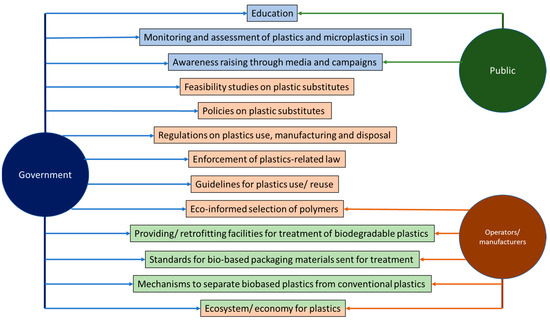
Figure 1.
Potential approaches to control plastic pollution (Note: Blue color indicates imparting of knowledge and awareness including the severity and risk of plastic pollution; red color indicates policymaking and regulations; green color indicates development of plastic substitutes industry; mixed color indicates mixed approaches).
An ecosystem or economy for plastics have been mentioned in a few studies, and governments were deemed to play a crucial role in developing it [19,36]. In fact, the existing approaches to plastic pollution give a hint of such an ecosystem where a market for plastic substitutes is established through policies, regulation and education to promote their uses and control the consumption of conventional plastics. Furthermore, the ecosystem also includes using and reusing plastics. This subsequently spurs the sectors related to plastic substitutes such as collection, segregation and disposal. Concurrently, the market for recycling of conventional plastics thrives (Figure 1).
4. Probing the Emerging Concept of ‘Plastics Recycling Ecosystem/Economy’
In view of the emergence of an important and interesting theme on plastics recycling ecosystem and economy from the review of attitudes towards plastics, this review was extended to probe the concept further. The reason that this concept has received interest is because it aligns with an emerging approach of managing plastic pollution, namely circular economy which integrates the concept of industrial ecology [41,42]. The theme emerged from a survey among secondary students in the UEA and an analysis of the comments on social media in China on the approaches to manage plastics [19,36]. To probe the theme of plastics recycling ecosystem and economy further, a search in scholarly databases with a combination of keywords comprising plastics, recycling, ecosystem, economy such as plastic economy, recycling ecosystem and plastics recycling ecosystem was conducted. The articles retrieved were screened with the following criteria to ensure that they align with the concept of plastics recycling ecosystem and economy: (1) The articles must present and explore the overarching concept of economy and ecosystem, not just the recycling of plastics; (2) The articles must be peer-reviewed and published in the past 5 years; (3) The articles must be related to the overarching management of plastics and plastic waste and are not overly focused on or limited to specific technologies such as gasification, pyrolysis, mechanical recycling, etc. (4) The articles must ideally present the different facets of the overarching plastics ecosystem/economy.
The literature search and screening yielded articles bearing the phrase ‘circular economy’. Circular economy seems to be the buzzword used in many experimental studies and reviews related to the treatment and recycling of plastics [43,44], and few actually focus on exploring the framework, concept and implementation of circular economy as a whole. Circular economy has become a trend, and the most popular definition is probably that of Ellen MacArthur Foundation which calls circular economy a substitute of the ‘end-of-life’ concept characterized by innovative design, production and business models to incorporate renewable energy, reuse and eliminate waste [45].
Multiple studies have pointed to the shift of plastic economy from a linear to a circular one as an important solution to plastic pollution. Subsequent to literature screening, a summary of eight different study types related to circular economy shows that all these studies base their definition of circular economy on that of promoting the reduction, reuse, recycling and recovery of plastic waste through a lifecycle approach from the design to the disposal of plastic items [43,46,47,48] (Table 2). There was a significantly greater interest in the management of plastic waste, particularly its reuse, treatment and recycling [43,47,49], in comparison to the design and production of plastics for circularity [48] (Table 2). Other than those on technical advances of plastic waste treatment, recycling and valorization [50], the studies on circular plastic economy are also extended to identifying the barriers to specific aspects of the economy such as digital innovation [46] and challenges of the circular economy as a whole [48], examining the relevant policies and policy instruments [7,47], as well as developing frameworks and models for its implementation [49,51] (Table 2).
These studies highlight the importance of policies, mechanisms and regulations to hold plastic producers responsible for plastic waste reduction and treatment, of addressing the entire plastics value chain rather than banning single-use plastics, as well as incorporating industrial symbiosis and cradle-to-cradle approach to realize circular plastic economy [7,47,51] (Table 2). Currently, some countries have passed and enforced bans on single-use plastics, such as the Single-use and Other Plastic Products (Waste Avoidance) Act 2020 of Australia, EU’s Directive on single-use plastics, as well as Plastic and Related Products Regulations 2022 of New Zealand. Attempts to shift to and promote circular economy have also been made, for instance, through the EU’s new circular economy action plan adopted in March 2020 [7,52]. Infrastructural and technological development to more efficiently segregate waste, recycle and valorize plastics was also emphasized [43,48,49,53]. The role of governments in these endeavors towards circular plastic economy has been reiterated [43,46,47,53]. Digital innovation and data analytics have been brought into the context to spur the circular plastic economy [46,49]. The acceptance of digital innovation for circular plastic economy among the public, however, could be challenging, if they still struggle to grasp the concept of circular economy. While governments are perceived to have an extensive role in circular plastic economy, it has been underscored that collaboration between governments and industrial players is crucial to garner commitment, propel technological innovation and ensure its success [47,53].
Table 2.
Examples of studies related to circular plastic economy.
Table 2.
Examples of studies related to circular plastic economy.
| Study Type | Feature of Circular Plastic Economy | Finding | Implication | References |
|---|---|---|---|---|
| A survey among 33 digital innovators and 1475 public members in 5 African countries | Management and reduction of conventional plastics through their lifecycle from design and production to use and disposal. | Socio-cultural, institutional and infrastructural factors constrained digital innovation among digital innovators. For the public, the understanding and ease of use of technologies determined their adoption of digital innovation in this area. | Understanding of circular plastic economy among the public is important to ensure their responses were not merely on acceptance of digital innovation generally. Government investment in capacity-building to adopt digital innovation is pivotal, provided that there is already an emerging circular plastic economy. | [46] |
| A qualitative survey among 36 participants in Thailand | Incentivization of sectors that use secondary raw materials, recycle waste and adopt or transition to clean production. Reduce and recycle plastic waste to achieve ‘zero plastic waste’. | There was a lack of mechanism to oblige plastic producers for plastic waste treatment, partly attributed to regional political setting. Polluting industries overpower political effort in circular activities. Waste segregation is hampered by the lack of infrastructure, public awareness and education campaigns. | Private businesses could facilitate the circular transition by increasing the recycled contents in their products and increase their recyclability. There is a need to improve law enforcement and regulation of the circular economy. | [47] |
| A review of the environmental impacts of post-consumer plastic waste and its treatment methods | Recycling, reusing and reducing of post-consumer plastic waste; upcycling of plastic waste. | Pyrolysis, plasma gasification, valorization of plastic waste and photocatalytic degradation are regarded as sustainable approaches to dispose plastic waste. | Improvement of the sustainable approaches is needed before they can become viable. Governments’ role in executing circular economy is important. | [43] |
| A review of the design, production, use, end-of-life management and value chain of plastics | Recovery of plastic waste for polymer production, recycling of plastic waste for plastic product manufacturing, reusing of plastic materials and segregation of plastic waste for reuse. | Most of the existing articles in this area focus on waste management phase of plastics, instead of their design, production and use. Plastic waste is often contaminated and plastic products are often made of composite materials, making recycling difficult. There is a lack of holistic approach to identify and solve the challenges in the plastic value chain. | Potential solutions to the challenges are design for recycling, increasing the use of recycled materials in manufacturing processes and, hence, their demand, reducing plastics consumption and developing recycling technologies. | [48] |
| Development of machine learning to evaluate the recyclability of plastic waste | Increase of plastic waste recycling to minimize the consumption of new plastics. | A Pinch Analysis framework showed polyethylene terephthalate, polyethylene and polypropylene to have 38%, 100% and 92% maximum recyclability, respectively. | Computerization and big data analytics are the future trends of plastic economy. | [49] |
| A review of international regulations which contribute towards circular economy | Minimization of plastic waste production and its environmental impacts from design to end-of-life management. | There is an emerging transition of plastics regulation from legislative bans to circular economy, though bans are still more prevalent. Market-based instruments such as fees are increasingly adopted. Certain areas of plastics production are not adequately regulated. | Policies need to move beyond single-use products to the whole plastics value chain. There is a need for more diverse instruments to address plastics pollution and propel circular plastic economy. | [7] |
| Development of linear single-objective optimization models to improve the circularity of European plastic waste supply chains | Reuse, recycling and recovery of plastics to minimize material and energy losses. | Environmental impacts can be avoided by industrial symbiosis. Increasing recycling efficiencies is crucial to realizing circular economy. Incorporation of improved recycling and industrial symbiosis to the management of bio-based biodegradable plastic waste is beneficial. Bio-based biodegradable plastics contribute to circular plastic economy. | Better strategies of circular economy through improved recycling, increased practices of industrial symbiosis and cradle-to-cradle approach are instrumental to achieving the European Green Deal vision. | [51] |
| An analysis of plastic waste emission data of Japan’s manufacturing sector between 2004 and 2018 | In line with European Union’s definition of circular plastic economy targeting at innovation in the design, use, production and recycling of plastic products. | The plastic waste in Japan has been decreasing due mainly to policymaking for instance through emission taxes. This has driven voluntary action among polluting firms in Japan to reduce plastic waste. Improvement in production techniques also helps reduce plastic pollution. | Cooperation between the government and industrial association is crucial to drive technological innovation, when the law on reducing plastics in industrial waste is lacking. | [53] |
5. Merging Circular Economy with the Approaches to Control Plastic Pollution from Attitudinal Research
The concept of circular economy generally fits into the idea of recycling ecosystem/economy mentioned in the attitudinal studies [19,36]. It was mentioned that recycling of plastics could be enhanced by improving cognition whereas the effective execution of circular economy by incorporating government and community regulations could improve cognition [33]. A study among elementary school children revealed that knowledgeable children preferred reduction over recycling, and a reason given was that they might perceive recycling as less impactful to control marine plastic solution than reducing plastic use altogether because plastics are still generated and could eventually enter the environment [29]. In fact, the low global plastics recycling rate (9% as of 2019) and the increasing number of mismanaged plastics entering the environment (22% as of 2019) indicate that the circular plastic economy is still at its infancy [54]. The need of a multi-pronged approach to combat plastic pollution is necessary, and this is captured in the study of Karayilan et al.—that embedding the use of bio-based biodegradation plastics and industrial symbiosis into circular economy is desirable [51]. The idea of industrial symbiosis is in line with the positive attitude among AD plant stakeholders on the prospect of increasing methane yield from biobased biodegradable plastics if the problems of segregating them from other plastics can be solved [30].
Tapping into the willing attitude of the public to support policies and laws related to controlling plastic pollution [21,24] and their positive attitude towards contributing to reduce plastic pollution [20,27,36], it is crucial to reduce the barriers they encounter currently in acting against plastic pollution. This involves providing and popularizing alternatives for conventional plastics such as biobased biodegradable plastics and stepping up circular economy by designing plastic items that facilitate reuse and recycling. This review therefore calls for a multi-pronged approach that moves towards a progressive replacement of conventional plastics by biobased biodegradable plastics through stage-by-stage capping of the proportion of conventional plastics in the market, akin to the capping of carbon emissions. This permits circular plastic economy to be executed on the proportion of conventional plastics and a simultaneous shift to the economy or circular economy of biobased biodegradable plastics. Governments play a pivotal role in such efforts by providing the policies, regulations, enforcement, guidelines and awareness. The awareness could be subsequently enhanced through public efforts. It is clear that a lack of options and habits overpower negative attitudes towards plastic pollution and, hence, behavioral change. It is unlikely that there will be significant reduction in plastic waste generation and plastic pollution without government intervention and a paradigm shift in the plastic economy.
6. Conclusions
This article highlights that there is a prevailing negative attitude among the participants of the studies reviewed towards plastic pollution, and there is a willing attitude among them to contribute to reducing the pollution. However, the willing attitude has not effectively moved on to behavioral changes due mainly to inconvenience as a result of the lack of options for the commonly used plastics-containing items in daily life as well as habits. A clear consensus drawn from the studies reviewed is the role of governments in making policies, laws and guidelines related to plastics consumption and plastic waste management. These studies have unveiled the positive attitudes of the public to support solution-based interventions of governments such as plastics-regulating policies and legislation and guidelines on the use and reuse of plastic items, in addition to willingly pay for more environmentally friendly plastic substitutes and support awareness-raising campaigns. Governments could tap into these positive attitudes to drive the substitution of conventional plastics with biobased biodegradable plastics and other environmentally friendly plastic substitutes, as well as the circular plastic economy which facilitates the end-of-life management of plastic items through innovating the stages in their lifecycles. The review of attitudinal literature shows the alignment of the emerging theme of plastics recycling ecosystem/economy to circular economy. Circular plastic economy forms an important solution to plastic pollution, but there seems to be more attention on recycling than other aspects of the economy. With low recycling rate and increasing mismanaged plastic waste, there is an impetus to tap into all facets of circular plastic economy by stepping up the development and use of environmentally friendly plastic substitutes and incorporating industrial symbiosis, such as valorizing plastic waste and turning biobased biodegradable plastics into compost or biogas. In view of the positive attitudes of the general public towards the control of plastic pollution and the obvious barriers such as a lack of plastic substitutes and recycling infrastructure, habits, wide presence of plastic materials and inconvenience preventing individual endeavors, this review deems that a multi-pronged approach to address the issue is necessary. The approach comprises government intervention via policy-setting, regulations and enforcement on plastic waste management and transition to plastic substitutes, as well as government–private sector collaboration through incentivization of infrastructure development, retrofitting of facilities and establishing mechanisms for segregation and treatment of biodegradable plastics. The approach also includes education, awareness-raising and tracking of plastic pollution severity by multiple parties. It involves government-spearheaded capping of conventional plastics production, progressive shift to environmentally friendly plastics and circular plastic economy. It promulgates a more holistic carbon economy that steers away from polluting energy sources towards cleaner renewable energy sources. The approach is foreseen to contribute to a more well-rounded solution or framework of solution to plastic pollution. Further studies can be devoted to establishing frameworks for circular plastic economy to support policymaking and implementation.
Funding
This research received no external funding.
Institutional Review Board Statement
Not applicable.
Informed Consent Statement
Not applicable.
Data Availability Statement
Data sharing not applicable.
Acknowledgments
The author wishes to thank the University of Arizona for the support given in completing the review.
Conflicts of Interest
The author declares no conflict of interest.
References
- Geyer, R.; Jambeck, J.R.; Law, K.L. Production, use, and fate of all plastics ever made. Sci. Adv. 2017, 3, e1700782. [Google Scholar] [CrossRef]
- Shen, M.; Song, B.; Zeng, G.; Zhang, Y.; Huang, W.; Wen, X.; Tang, W. Are biodegradable plastics a promising solution to solve the global plastic pollution? Environ. Pollut. 2020, 263, 114469. [Google Scholar] [CrossRef] [PubMed]
- Liong, R.M.Y.; Hadibarata, T.; Yuniarto, A.; Tang, K.H.D.; Khamidun, M.H. Microplastic Occurrence in the Water and Sediment of Miri River Estuary, Borneo Island. Water Air Soil Pollut. 2021, 232, 342. [Google Scholar] [CrossRef]
- Zhao, X.; Zhou, Y.; Liang, C.; Song, J.; Yu, S.; Liao, G.; Zou, P.; Tang, K.H.D.; Wu, C. Airborne microplastics: Occurrence, sources, fate, risks and mitigation. Sci. Total Environ. 2023, 858, 159943. [Google Scholar] [CrossRef]
- Bhagwat, G.; Gray, K.; Wilson, S.P.; Muniyasamy, S.; Vincent, S.G.T.; Bush, R.; Palanisami, T. Benchmarking Bioplastics: A Natural Step Towards a Sustainable Future. J. Polym. Environ. 2020, 28, 3055–3075. [Google Scholar] [CrossRef]
- Chen, A.; Yang, M.-Q.; Wang, S.; Qian, Q. Recent Advancements in Photocatalytic Valorization of Plastic Waste to Chemicals and Fuels. Front. Nanotechnol. 2021, 3, 723120. [Google Scholar] [CrossRef]
- Syberg, K.; Nielsen, M.B.; Westergaard Clausen, L.P.; van Calster, G.; van Wezel, A.; Rochman, C.; Koelmans, A.A.; Cronin, R.; Pahl, S.; Hansen, S.F. Regulation of plastic from a circular economy perspective. Curr. Opin. Green Sustain. Chem. 2021, 29, 100462. [Google Scholar] [CrossRef]
- Bening, C.R.; Pruess, J.T.; Blum, N.U. Towards a circular plastics economy: Interacting barriers and contested solutions for flexible packaging recycling. J. Clean. Prod. 2021, 302, 126966. [Google Scholar] [CrossRef]
- Chen, X.; Yan, N. A brief overview of renewable plastics. Mater. Today Sustain. 2020, 7–8, 100031. [Google Scholar] [CrossRef]
- Ritchie, H.; Roser, M. Plastic Pollution. Available online: https://ourworldindata.org/plastic-pollution (accessed on 20 April 2023).
- Soares, J.; Miguel, I.; Venâncio, C.; Lopes, I.; Oliveira, M. Public views on plastic pollution: Knowledge, perceived impacts, and pro-environmental behaviours. J. Hazard. Mater. 2021, 412, 125227. [Google Scholar] [CrossRef]
- Dilkes-Hoffman, L.S.; Pratt, S.; Laycock, B.; Ashworth, P.; Lant, P.A. Public attitudes towards plastics. Resour. Conserv. Recycl. 2019, 147, 227–235. [Google Scholar] [CrossRef]
- Filho, W.L.; Salvia, A.L.; Bonoli, A.; Saari, U.A.; Voronova, V.; Klõga, M.; Kumbhar, S.S.; Olszewski, K.; De Quevedo, D.M.; Barbir, J. An assessment of attitudes towards plastics and bioplastics in Europe. Sci. Total Environ. 2021, 755, 142732. [Google Scholar] [CrossRef] [PubMed]
- Fischer, A.R.H. Perception, Attitudes, Intentions, Decisions and Actual Behavior BT—Consumer Perception of Product Risks and Benefits; Emilien, G., Weitkunat, R., Lüdicke, F., Eds.; Springer International Publishing: Cham, Switzerland, 2017; pp. 303–317. [Google Scholar] [CrossRef]
- Tang, K.H.D. A model of behavioral climate change education for higher educational institutions. Environ. Adv. 2022, 9, 100305. [Google Scholar] [CrossRef]
- Pahl, S.; Richter, I.; Wyles, K. Human Perceptions and Behaviour Determine Aquatic Plastic Pollution BT—Plastics in the Aquatic Environment—Part II: Stakeholders’ Role Against Pollution; Stock, F., Reifferscheid, G., Brennholt, N., Kostianaia, E., Eds.; Springer International Publishing: Cham, Switzerland, 2022; pp. 13–38. [Google Scholar] [CrossRef]
- Deng, L.; Cai, L.; Sun, F.; Li, G.; Che, Y. Public attitudes towards microplastics: Perceptions, behaviors and policy implications. Resour. Conserv. Recycl. 2020, 163, 105096. [Google Scholar] [CrossRef]
- Tang, K.H.D. Climate change education in China: A pioneering case of its implementation in tertiary education and its effects on students’ beliefs and attitudes. Int. J. Sustain. High. Educ. 2022; ahead-of-print. [Google Scholar] [CrossRef]
- Hammami, M.B.A.; Mohammed, E.Q.; Hashem, A.M.; Al-Khafaji, M.A.; Alqahtani, F.; Alzaabi, S.; Dash, N. Survey on awareness and attitudes of secondary school students regarding plastic pollution: Implications for environmental education and public health in Sharjah city, UAE. Environ. Sci. Pollut. Res. 2017, 24, 20626–20633. [Google Scholar] [CrossRef]
- Dowarah, K.; Duarah, H.; Devipriya, S.P. A preliminary survey to assess the awareness, attitudes/behaviours, and opinions pertaining to plastic and microplastic pollution among students in India. Mar. Policy 2022, 144, 105220. [Google Scholar] [CrossRef]
- Menzel, C.; Brom, J.; Heidbreder, L.M. Explicitly and implicitly measured valence and risk attitudes towards plastic packaging, plastic waste, and microplastic in a German sample. Sustain. Prod. Consum. 2021, 28, 1422–1432. [Google Scholar] [CrossRef]
- Zwicker, M.V.; Nohlen, H.U.; Dalege, J.; Gruter, G.-J.M.; van Harreveld, F. Applying an attitude network approach to consumer behaviour towards plastic. J. Environ. Psychol. 2020, 69, 101433. [Google Scholar] [CrossRef]
- King, C.D.; Stephens, C.G.; Lynch, J.P.; Jordan, S.N. Farmers’ attitudes towards agricultural plastics—Management and disposal, awareness and perceptions of the environmental impacts. Sci. Total Environ. 2023, 864, 160955. [Google Scholar] [CrossRef] [PubMed]
- Charitou, A.; Naasan Aga-Spyridopoulou, R.; Mylona, Z.; Beck, R.; McLellan, F.; Addamo, A.M. Investigating the knowledge and attitude of the Greek public towards marine plastic pollution and the EU Single-Use Plastics Directive. Mar. Pollut. Bull. 2021, 166, 112182. [Google Scholar] [CrossRef]
- Heidbreder, L.M.; Bablok, I.; Drews, S.; Menzel, C. Tackling the plastic problem: A review on perceptions, behaviors, and interventions. Sci. Total Environ. 2019, 668, 1077–1093. [Google Scholar] [CrossRef] [PubMed]
- Ferdous, T.; Das, T. A Study about the Attitude of Grade Eight Students for the Use of Plastic in Gwarko, Balkumari, Lalitpur District. Procedia-Soc. Behav. Sci. 2014, 116, 3754–3759. [Google Scholar] [CrossRef]
- Tyllianakis, E.; Ferrini, S. Personal attitudes and beliefs and willingness to pay to reduce marine plastic pollution in Indonesia. Mar. Pollut. Bull. 2021, 173, 113120. [Google Scholar] [CrossRef]
- Borriello, A.; Massey, G.; Rose, J.M. Extending the theory of planned behaviour to investigate the issue of microplastics in the marine environment. Mar. Pollut. Bull. 2022, 179, 113689. [Google Scholar] [CrossRef]
- Salazar, C.; Jaime, M.; Leiva, M.; González, N. From theory to action: Explaining the process of knowledge attitudes and practices regarding the use and disposal of plastic among school children. J. Environ. Psychol. 2022, 80, 101777. [Google Scholar] [CrossRef]
- Kakadellis, S.; Woods, J.; Harris, Z.M. Friend or foe: Stakeholder attitudes towards biodegradable plastic packaging in food waste anaerobic digestion. Resour. Conserv. Recycl. 2021, 169, 105529. [Google Scholar] [CrossRef]
- Jones, M.P.; Archodoulaki, V.-M.; Köck, B.-M. The power of good decisions: Promoting eco-informed design attitudes in plastic selection and use. Resour. Conserv. Recycl. 2022, 182, 106324. [Google Scholar] [CrossRef]
- Kramm, J.; Steinhoff, S.; Werschmöller, S.; Völker, B.; Völker, C. Explaining risk perception of microplastics: Results from a representative survey in Germany. Glob. Environ. Chang. 2022, 73, 102485. [Google Scholar] [CrossRef]
- Xue, Y.; Guo, J.; Li, C.; Xu, X.; Sun, Z.; Xu, Z.; Feng, L.; Zhang, L. Influencing factors of farmers’ cognition on agricultural mulch film pollution in rural China. Sci. Total Environ. 2021, 787, 147702. [Google Scholar] [CrossRef]
- Tang, K.H.D. Microplastics in agricultural soils in China: Sources, impacts and solutions. Environ. Pollut. 2023, 322, 121235. [Google Scholar] [CrossRef] [PubMed]
- Khanam, N.; Wagh, V.; Gaidhane, A.M.; Quazi, S.Z. Knowledge, attitude and practice on uses of plastic products, their disposal and environmental pollution: A study among school-going adolescents. J. Datta Meghe Inst. Med. Sci. Univ. 2019, 14, 57. [Google Scholar] [CrossRef]
- Sun, Y.; Wang, D.; Li, X.; Chen, Y.; Guo, H. Public attitudes toward the whole life cycle management of plastics: A text-mining study in China. Sci. Total Environ. 2023, 859, 159981. [Google Scholar] [CrossRef]
- Tang, K.H.D.; Hadibarata, T. What are stopping university students from acting against climate change? Community Engagem. High. Educ. 2022, 1, 1–13. [Google Scholar]
- Wu, J.-L.; Cheng, S.-Y.; Hou, H. Further evidence on purchasing power parity and country characteristics. Int. Rev. Econ. Financ. 2011, 20, 257–266. [Google Scholar] [CrossRef]
- Arshed, N.; Anwar, A.; Hassan, M.S.; Bukhari, S. Education stock and its implication for income inequality: The case of Asian economies. Rev. Dev. Econ. 2019, 23, 1050–1066. [Google Scholar] [CrossRef]
- Nwafor, N.; Walker, T.R. Plastic Bags Prohibition Bill: A developing story of crass legalism aiming to reduce plastic marine pollution in Nigeria. Mar. Policy 2020, 120, 104160. [Google Scholar] [CrossRef]
- Schwarz, A.E.; Ligthart, T.N.; Godoi Bizarro, D.; De Wild, P.; Vreugdenhil, B.; van Harmelen, T. Plastic recycling in a circular economy; determining environmental performance through an LCA matrix model approach. Waste Manag. 2021, 121, 331–342. [Google Scholar] [CrossRef]
- Saavedra, Y.M.B.; Iritani, D.R.; Pavan, A.L.R.; Ometto, A.R. Theoretical contribution of industrial ecology to circular economy. J. Clean. Prod. 2018, 170, 1514–1522. [Google Scholar] [CrossRef]
- Chawla, S.; Varghese, B.S.; Chithra, A.; Hussain, C.G.; Keçili, R.; Hussain, C.M. Environmental impacts of post-consumer plastic wastes: Treatment technologies towards eco-sustainability and circular economy. Chemosphere 2022, 308, 135867. [Google Scholar] [CrossRef]
- Wang, C.; Han, H.; Wu, Y.; Astruc, D. Nanocatalyzed upcycling of the plastic wastes for a circular economy. Coord. Chem. Rev. 2022, 458, 214422. [Google Scholar] [CrossRef]
- MacArthur, E. Towards the circular economy. J. Ind. Ecol. 2013, 2, 23–44. [Google Scholar]
- Kolade, O.; Odumuyiwa, V.; Abolfathi, S.; Schröder, P.; Wakunuma, K.; Akanmu, I.; Whitehead, T.; Tijani, B.; Oyinlola, M. Technology acceptance and readiness of stakeholders for transitioning to a circular plastic economy in Africa. Technol. Forecast. Soc. Chang. 2022, 183, 121954. [Google Scholar] [CrossRef]
- Marks, D.; Miller, M.A.; Vassanadumrongdee, S. Closing the loop or widening the gap? The unequal politics of Thailand’s circular economy in addressing marine plastic pollution. J. Clean. Prod. 2023, 391, 136218. [Google Scholar] [CrossRef]
- Johansen, M.R.; Christensen, T.B.; Ramos, T.M.; Syberg, K. A review of the plastic value chain from a circular economy perspective. J. Environ. Manag. 2022, 302, 113975. [Google Scholar] [CrossRef]
- Chin, H.H.; Varbanov, P.S.; You, F.; Sher, F.; Klemeš, J.J. Plastic Circular Economy Framework using Hybrid Machine Learning and Pinch Analysis. Resour. Conserv. Recycl. 2022, 184, 106387. [Google Scholar] [CrossRef]
- Tang, K.H.D. Valorization of Plastic Waste through Incorporation into Construction Materials. Civ. Sustain. Urban Eng. 2022, 2, 96–109. [Google Scholar] [CrossRef]
- Karayılan, S.; Yılmaz, Ö.; Uysal, Ç.; Naneci, S. Prospective evaluation of circular economy practices within plastic packaging value chain through optimization of lifeIn Proceedings of the cycle impacts and circularity. Resour. Conserv. Recycl. 2021, 173, 105691. [Google Scholar] [CrossRef]
- Ministry for the Environment. Plastic and Related Products Regulations. 2022. Available online: https://environment.govt.nz/acts-and-regulations/regulations/plastic-and-related-products-regulations-2022/#:~:text=Theregulationsprohibitthesale,-to-recycleplasticitems (accessed on 19 May 2023).
- Yamamoto, M.; Eva, S.N. What activities reduce plastic waste the most?—The path to a circular economy for Japan’s manufacturing industry. Waste Manag. 2022, 151, 205–213. [Google Scholar] [CrossRef] [PubMed]
- OECD. Plastic Pollution is Growing Relentlessly as Waste Management and Recycling Fall Short, Says OECD. Available online: https://www.oecd.org/newsroom/plastic-pollution-is-growing-relentlessly-as-waste-management-and-recycling-fall-short.htm (accessed on 18 June 2022).
Disclaimer/Publisher’s Note: The statements, opinions and data contained in all publications are solely those of the individual author(s) and contributor(s) and not of MDPI and/or the editor(s). MDPI and/or the editor(s) disclaim responsibility for any injury to people or property resulting from any ideas, methods, instructions or products referred to in the content. |
© 2023 by the author. Licensee MDPI, Basel, Switzerland. This article is an open access article distributed under the terms and conditions of the Creative Commons Attribution (CC BY) license (https://creativecommons.org/licenses/by/4.0/).