


Abstract
A sustainable economy and the drive to reduce agro-industrial waste worldwide motivate the increased interest in alternative uses of traditionally cultivated plants such as tobacco. Tobacco seeds are an underutilized resource with enormous potential for application in various areas of human life. The present study aims to characterize the phytochemical composition and nutritional potential of Oriental tobacco seeds grown in Bulgaria, in order to support their possible application in areas outside the tobacco industry. Two Oriental tobacco varieties (“Krumovgrad 90” and “Krumovgrad 58”) from three production regions were explored and comparatively evaluated in terms of their physical and chemical indicators, determined by standardized methods. The results showed high protein (22.57–23.84%) and energy content (482–531 kcal/100 g), combined with relatively low carbohydrate levels (3.79–4.03%) and the presence of bioactive compounds, such as polyphenols (288–357 mg GAE/100 g). The seeds contained significant amount of oil (36.31–39.24%), of which the fatty acid profile included 16 identified components, with linoleic (72.0–74.4%), oleic (11.2–13.5%), palmitic (9.6–10.2%), and stearic (1.8–2.5%) acids taking the greatest share. The sterol fraction was dominated by β-sitosterol (43.5–46.8%), followed by sitostanol, campesterol and stigmasterol, with a stable distribution between the samples. The main tocol was γ-tocotrienol (56.5–61.4%), with α-tocotrienol being detected only in one of the varieties (“Krumovgrad 58”, 13.3%). The phospholipid fraction showed variations between the samples, with a dominant presence of phosphatidylinositol (18.0–20.4%). The results from the study confirmed the tangible potential of tobacco seeds as a source of biologically active substances in the development of functional foods and dietary supplements.
1. Introduction
The past two decades have witnessed an increasing interest in the use of natural, plant-based products in almost every aspect of human life, including nutrition, medicine, cosmetics, agriculture, and others [1,2,3,4]. The commercial applicability of those products is based on the wide spectrum of biological activities exhibited by them—antimicrobial, antioxidant, antiviral, antitumor, etc. This encourages intensive multidisciplinary research aimed at characterizing the metabolic profile of various plant sources (including primary and secondary metabolites) and assessing their functional value. Of particular interest here are the possibilities for finding new, alternative uses of known plant raw materials and their processing by-products, with a view to providing novel functional products with nutritional or pharmacological value, as well as to reducing agricultural waste and improving the sustainability of agroecosystems [1,2].
In this context, tobacco undoubtedly stands out with a potential for alternative use outside the tobacco industry. In addition to being an important industrial crop, the plant has been used in modern biotechnology as a host system for the production of vaccines, biopharmaceuticals, enzymes, and biodegradable materials [5,6]. Due to its rapid growth, short vegetation period, the high seed oil content and its fatty acid composition, and other features, nowadays tobacco is a valuable model for bioengineering and applied developments in the context of the circular economy and the sustainable use of bioresources [7].
Demographic and climate challenges are placing increasing pressure on the global food system, including the production and access to vegetable oils [8,9,10,11,12]. The increased imports of oilseeds in many countries are causing economic burdens and highlighting the need for sustainable alternatives [13]. Tobacco seeds, until recently considered a waste product of tobacco leaf production, are more and more often being identified as a valuable resource with potential for application in the bio-based industry [14,15,16]. They have the advantage to originate from an industrial crop, i.e., their utilization does not compete with the production of food crops, and they are available in large quantities worldwide. Tobacco plants generally yield about 1200–1500 kg seeds per hectare, but yields reaching up to 5000–6000 kg per hectare have been achieved by certain varieties and hybrids [17]. The oil extracted from tobacco seeds has been described as rich in unsaturated fatty acids and with significant technological and nutritional potential. The yield of glyceride oil from tobacco seeds reaches 30–40% of seed dry weight [17,18,19], and in some European countries the refined oil is already used in the food industry [20]. Its nutritional value is comparable to or even superior to some traditional oils, such as peanut and cottonseed, and is close to that of safflower oil [14].
The chemical composition of tobacco seeds varies depending on the variety and geographical origin, with protein content 18–41% and fiber content 3.7–21.8% [20,21,22,23]. Studies on some Italian varieties (Bright Italia, Kentucky 104, Bright V) have shown significant differences in lipid, protein, fiber, and sterol content [18]. The presence of nicotine and other toxic alkaloids in tobacco seeds and in tobacco seed oil was investigated as early as the beginning of the 20th century, and there is evidence that mature seeds are practically free of nicotine [22,24,25]. After extraction or pressing, the residual meal (seedcake) retains a high nutritional value—it contains amino acids, minerals, and other bioactive substances without the presence of tobacco alkaloids, making it a potential component for animal feed [22,25,26,27]. In this line, tobacco seed meal is considered a strategic link between biodiesel production and sustainable food solutions, contributing to a circular economy and reduction in agro-industrial waste [22,28,29].
Along with the significant content of linoleic and oleic acids, the ratio between unsaturated and saturated fatty acids in tobacco oil indicates a favorable lipid profile, similar to that of established edible oils. This positions tobacco seed oil as a promising functional lipid source in the food and cosmetic industries [17,30]. The presence of biologically active compounds such as tocopherols, especially γ-tocopherol, contributes to the stability of the oil and its antioxidant activity, further enhancing the interest in it as a natural preservative and nutraceutical component. As already stated, studies have highlighted the absence of toxic alkaloids, such as nicotine, in the purified oil fraction, which expands the possibilities for direct application in the food industry [18,22]. The technological characteristics of the oil, including good oxidative stability, mild taste and suitable texture, allow its use in the production of mayonnaise, salad dressings, margarines and functional oils, as well as in cosmetic formulations (as a base oil with dermatological application) [17]. The potential of tobacco seed oil is complemented by the ecological value of the resource—the use of this by-product of tobacco production contributes to the utilization of agro-industrial waste, reduction in the carbon footprint and transition to a circular economy [2,15,29]. All these arguments, although briefly stated, show that tobacco seed oil represents not only an alternative lipid source, but also a strategic resource with economic, environmental and health value [7].
Bulgaria has long-standing traditions in the cultivation of Oriental tobacco, which still is a strategic agricultural crop of economic importance for a number of regions in the country. However, tobacco seeds remain a largely unused by-product, treated primarily as waste. In the context of national and international anti-smoking policies, as well as considering the environmental challenges associated with tobacco cultivation, the development of approaches for the utilization of tobacco raw material is becoming increasingly relevant. The use of tobacco seeds as a source of bioactive substances with potential in nutraceuticals and functional foods, in particular, could represent a sustainable and innovative economic alternative [18]. In this regard, the aim of the present study was to characterize the phytochemical composition and to evaluate the nutritional properties of Oriental tobacco seeds grown in Bulgaria, with a view to their possible application in areas outside the tobacco industry. Although previous studies have already defined some chemical and other indicators of Bulgarian tobacco seeds and the extracted seed oil [4,16,26,27,31,32,33,34], there is still the need of additional data on the variation in these indicators (nutrients, bioactive compounds) depending on the plant material investigated. Most of these studies regarded experimental (pot) trials, while the seeds in the current study were farmer-produced in real production conditions. We hypothesized that the comparative assessment of the waste seeds from two Oriental tobacco varieties in different production regions could add valuable details to existing knowledge, thus providing new arguments in favor of tobacco seed valorization.
2. Materials and Methods
The study was carried out with tobacco seeds, Nicotiana tabacum L., representing two Oriental tobacco varieties of the Krumovgrad ecotype—“Krumovgrad 90” and “Krumovgrad 58” varieties, grown commercially by farmers in the Gotse Delchev region, southwestern Bulgaria, all from harvest 2023. The seeds were provided by producers in the respective microregions and were labeled as samples with the indices: NT 1—variety “Krumovgrad 90” from microregion Hadzhi Dimovo; NT 2—variety “Krumovgrad 58” from microregion Kornitsa and NT 3—variety “Krumovgrad 58” from microregion Godeshevo. The choice of the raw material in the study was driven by two major considerations, the first one being the current dominant position of the two varieties in Oriental tobacco production in Bulgaria, and the second—the representation of the major topographic sub-areas of the region (valley and mountain slopes).
In compliance with study objective, the collected tobacco seeds were not intended for planting; they were waste taken from plants before their destruction, after leaf harvesting.
The seeds were dried at room temperature (22 °C) in the shade and stored in tightly closed glass jars at a temperature of 5–8 °C until their processing. A part of each seed sample was ground to particle size depending on the requirements of the respective analysis. The determination of the physical and chemical indicators of tobacco seed samples was carried out using standardized methods.
2.1. Physical Indicators of Tobacco Seeds
Tobacco seeds were characterized in terms of:
- Absolute weight (g/1000 pcs.)—randomly selected 1000 seeds were weighed with an electronic balance (KERN PLS 1200-3DA, Kern & Sohn GmbH, Balingen-Frommern, Germany; ±0.001 g).
- Moisture content (%)—according to BDS 15437:1982 [35].
- Water activity (aw)—according to ISO 18787:2019 [36]. Measurements were made with a HygroPalm apparatus (HP23-AW-A, Rotronic, Bassersdorf, Switzerland) at a temperature of 20 °C.
2.2. Chemical Analyses of Tobacco Seeds
The following indicators of the studied tobacco seeds were determined, applying standardized methods, unless otherwise stated: protein (%)—according to BDS 14431:1978 [37]; carbohydrates (incl. reducing sugars, %)—according to BDS 6191:1974 [38]; ash (%)—according to BDS 7646:1982 [39]; carotene (μg/100 g)—according to ISO 6558-2:1992 [40]; polyphenols (mg GAE/100 g)—according to the procedure described by Singleton and Rossi (1965) [41].
The energy value of tobacco seeds (kJ/g; kcal/g) was calculated according to Regulation No. 1169/2011 of the EU, using the conversion factors specified in Annex XIV, as follows: protein—4 kcal/g, 17 kJ/g; carbohydrates—4 kcal/g, 17 kJ/g; fat—9 kcal/g, 37 kJ/g [42].
2.3. Chemical Analyses of the Lipid Fraction of Tobacco Seeds
The glyceride oil (%, w/w) of tobacco seeds was isolated by Soxhlet extraction with n-hexane for 8 h (ISO 659:2009) [43]. The extraction was carried out at 70 °C in an extractor in order to prevent the degradation of the thermolabile components. The obtained lipid fraction was characterized in terms of composition and properties, as follows:
Fatty acid (FA) composition of triacylglycerols. The determination was performed according to ISO 12966-1:2014 [44] and ISO 12966-2:2017 [45]. The extracted glyceride oil (100 mg) was esterified with 5 mL of methanol with the presence of sulfuric acid and boiled for 2 h. After that the obtained fatty acid methyl esters (FAMEs) were extracted with hexane and the remaining solvent was evaporated on a rotary vacuum evaporator. The residue was dissolved in 1 mL of petroleum ether and 1 μL was injected in the gas chromatograph. For the GC analysis, an Agilent 8860 gas chromatograph (Santa Clara, CA, USA) with a flame ionization detector and a DB-Fast FAME capillary column (length 30 m and diameter 0.25 mm) was used under the following conditions: column temperature 70 °C (retention 1 min), increase by 5 °C/min to 250 °C (retention 3 min); injector and detector temperatures 270 °C and 300 °C; carrier gas nitrogen at a rate of 25 cm3/min. FAs were identified by comparing the retention times with those of methyl esters of individually pure FAs.
Sterols. The unsaponifiable fraction was separated after saponification of the glyceride oil and extraction with n-hexane, according to ISO 18609:2000 [46]. Sterols were identified by comparing the retention times of a standard mixture of sterols (Across Organics, Fair Lawn, NJ, USA), according to ISO 12228:1999 [47]. An HP 5890 apparatus with a flame ionization detector and a DB-5 capillary column (length 25 m and diameter 0.25 mm) was used for the GC analysis, under the following conditions: column temperature 90 °C (retention 2 min), increase by 15 °C/min to 290 °C, then by 4 °C/min to 310 °C (retention 10 min); injector temperature 300 °C, detector temperature 320 °C, carrier gas hydrogen at a rate of 20 cm3/min.
Tocopherols. Tocopherol composition was determined directly by liquid chromatography on a Merck-Hitachi apparatus equipped with a fluorescence detector and a 25 × 0.4 cm column, with a Nucleosyl Si 50-5 stationary phase. The mobile phase was a mixture of n-hexane:dioxane (96:4), operated at a speed of 1.5 cm3/min and a pressure of 50 bar. A standard solution of a mixture of individually pure tocopherols (α-, β-, γ- and δ-) with an accurate concentration for each tocopherol was used, and their retention times were determined. Tocopherols were identified by comparing the retention times of individual pure compounds (Merck, Darmstadt, Germany), according to ISO 9936:2006 [48].
Phospholipids. The phospholipid contents were determined spectrophotometrically by measuring the phosphorus content at a wavelength of 700 nm, after mineralization of the lipid fraction in a mixture of perchloric acid and sulfuric acid (1:1; v/v), according to ISO 10540-1:2003 [49].
Acid value. The index was determined titrimetrically, according to ISO 660:2020 [50], and the results were presented as mg KOH/g. Briefly, 3–5 g of the seed oil were dissolved in a mixture of ethanol and diethyl ether (2:1, v/v) which was neutralized beforehand. The titration was carried out with 0.1 N KOH. The following formula was applied for the calculation of the acid value:
where V is the volume of KOH used, mL; F is the factor of the KOH solution; and m is the weight of the oil sample, g.
Acid value = (V × F × 5.611)/m
Peroxide value (mEqO2/kg). The analysis was conducted according to ISO 3960:2017 [51]. Briefly, 100 mg of the oil were precisely measured and dissolved in 5 mL of chloroform, 2.5 mL of acetic acid and 1 mL of 50% KI. Then, the sample was placed in darkness for 5 min. After that, 20 mL of water were added, as well as indicator (1% solution of starch). The titration was carried out with 0.02 N Na2S2O3. A blank sample was also prepared and titrated. The following formula was used for the calculation of the results:
where V1 is the volume of Na2S2O3 solution used for the sample titration (mL); V0—the volume of Na2S2O3 solution used for the blank titration (mL); N—normality of the Na2S2O3 solution; and m—the weight of the oil sample.
Peroxide value = [(V1 − V0) × N × 1000]/m
All data concerning the chemical composition of tobacco seeds were presented on a dry weight basis.
The reagents used were selected according to the requirements of the respective methods and with the necessary purity, therefore they were not subjected to additional purification.
2.4. Statistics
The measurements of seed physical characteristics were performed in five replicates, and those of the chemical indices—in triplicates. The results were presented as the mean value with the corresponding standard deviation (SD). Statistical tools such as ANOVA and Duncan’s multiple range test were applied, and significant differences were assessed with 95% confidence (p < 0.05). The data were processed with the Statistica and Excel 2010 software tools.
3. Results and Discussion
3.1. Physical Characteristics of Tobacco Seeds
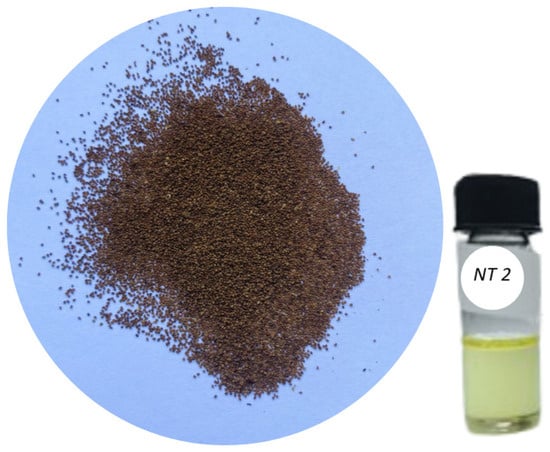
The main physical indicators of the Oriental tobacco seeds regarded in the study (as illustrated on Figure 1) are presented in Table 1.
Figure 1.
Photographs of tobacco seeds (left) and the extracted tobacco seed oil (right).
Table 1.
Physical characteristics of tobacco seeds.
The absolute weight of tobacco seeds (the total weight of 1000 seeds) varied from 0.072 g (NT 1) to 0.080 and 0.084 g (NT 2 and NT 3), which suggested differentiation between the two varieties. No significant differences were observed between the samples in terms of seed moisture content (4.52–4.65%). The data were close to those reported in previous studies for seeds from Bulgarian, Italian and Chinese tobaccos [16,18,19,32,33]. Water activity is a particularly important indicator for the microbiological stability of raw materials and products, as it is the main parameter responsible for modulating the microbial response and determining the type of microorganisms found in food [52]. Microorganisms can grow in a very wide range of water activity (aw), from 0.62 to 0.99, and depending on their adaptation they are divided into different categories—xerophytic, 0.62–0.75; mesophytic, 0.75–0.85; hydrophytic, 0.85–0.99 [53,54,55]. The tobacco seeds tested, regardless of variety, had low water activity (0.50–0.57), which indicated that the environmental conditions were suitable for the development of primarily xerophytic microorganisms, such as fungi of the genus Aspergillus, osmotolerant yeasts, and halotolerant bacteria. The data show that the water activity values of the three samples of Oriental tobacco seeds were below 0.60, and could therefore be considered potentially safe in terms of the development of pathogenic microorganisms [56].
3.2. Chemical Characteristics of Tobacco Seeds
The data on the main indicators of the chemical composition and energy value of the studied Oriental tobacco seeds are presented in Table 2, and a brief comparison with other seeds—in Table 3.
Table 2.
Chemical indicators and energy value of tobacco seeds.
Table 3.
Comparison of the key indicators of tobacco and other seeds.
The data confirmed that the studied tobacco seeds contained significant amounts of glyceride oil (36.31–39.24%), with sample NT 2 having the highest content. The results obtained were very close to the published data on the oil content in tobacco seeds from other origin; Kazakhstan, 36.75% [17]; Italy, 30–40% [18]; Turkey, 24.33–47.0% [14]; Pakistan, 40.6% [59], and Iraq, 22–45% [21]. At the same time, oil content values were significantly higher than those reported for tobacco seeds from Indonesia, 23.38% [60]; Iran, 13.7% [61] and Serbia, 27.8–31.1% [62,63]. Current data were also higher than those for seeds of other Oriental tobaccos grown in Bulgaria—30.9%; 32.1% [32,33]. All these deviations could easily be explained by genetic (tobacco type, ecotype or variety) and climatic factors. The oil content of the studied Oriental tobacco seeds was higher than that of some of the common oilseed crops, such as corn (3–5%), cotton (16%), soybean (18%), and very close to that of winter mustard (37–39%), rapeseed (37–41%), sunflower (25–47%), safflower (38–48%), and camelina (30–49%) [64,65,66,67,68,69], which proves the potential of tobacco seeds valorization as a source of glyceride oil.
The protein content of the examined tobacco seeds varied within a very narrow range, from 22.57% (NT 3) to 23.84% (NT 1). It was significantly higher than that of edible pumpkin seeds, but lower than that of sunflower seeds [3]; the data were close to the lower limit of the reported protein content of camelina seeds, 24–31% [64]. These results were in full agreement with the data on the protein content in the seeds of 10 tobacco genotypes grown in Iraq, 20.861–23.872% [21]. The values for the carbohydrate content of the seeds were also very close, 3.79–4.03%, i.e., there was no difference between the tobacco samples in this indicator. The data were significantly lower than those reported in a previous study of Bulgarian Oriental tobacco seeds, 27.6% [33]; sunflower seeds, 21.25% [58] and pumpkin seeds, 27.86% [57]. Regarding the mineral matter, the differences were also insignificant, with the highest ash content in sample NT 2 (6.10%), and the lowest in sample NT 1 (3.80%). Numerically, the results obtained were higher than those reported for sunflower seeds [58], while the ash content of sample NT 2 was very close to that of pumpkin seeds [57]. Seed carotene content varied insignificantly, in a very narrow range; from 0.05 μg/100 g (NT 1 and NT 2) to 0.06 μg/100 g (NT 3). The highest total polyphenol content was found in sample NT 3 (357 mg GAE/100 g), and the lowest in sample NT 2 (288 mg GAE/100 g). Tobacco seeds showed considerably high energy content (482–531 kcal/100 g; 20.17–22.22 kJ/g); the values were higher than those for corn (437.36 kcal/100 g) and chickpeas (423.54 kcal/100 g), but lower than other oil-containing seeds; sunflower (626.28 kcal/100 g), pumpkin (591.20 kcal/100 g) and watermelon seeds (585.89 kcal/100 g) [3]. Energy content, together with moisture and energy assimilation efficiency, were pointed out as the three key parameters in calculating the appropriate food intake rate (FIR) and exposure for birds and mammals, emphasizing that the higher energy content of oilseeds (avg. 24.3 kJ/g) compared to that of cereal seeds (avg. 18.4 kJ/g) would result in lower FIR, which should be taken into consideration in animal nutrition [70].
Based on the results obtained, no significant differentiation can be made between the studied seeds of the two Oriental tobacco varieties (“Krumovgrad 90” and “Krumovgrad 58”), as well as between the production sites (microregions). It could be anticipated that, similar to other plant materials, factors like crop year and larger regions should have much more pronounced influence in forming Oriental tobacco chemical composition.
3.3. Characteristics of Tobacco Seed Oil—Content and Composition
Table 4 presents the results of the analysis of the total composition of the glyceride oil in the studied tobacco seeds.
Table 4.
Bioactive substances and indices of tobacco seed oil.
The content of unsaponifiables in tobacco seed oil varied from 2.3–2.6% in samples NT 1 and NT 2 to 5.6% in NT 3. Value range did not differ substantially from the results reported in previous studies on seeds of Oriental tobaccos grown in our country [32,33], but the variations still confirmed the influence of variety and tobacco growing conditions.
The phospholipid content (1.4–1.9%) was higher than previously determined for seed oils of another Bulgarian Oriental tobacco variety (“Plovdiv 7”, 0.3%) [32] and Iraqi tobacco, 0.453–1.167% [21].
Sterols contribute to lower plasma cholesterol and LDL cholesterol levels, which is why they are considered a strategic natural product in preventive diets [32]. Their content in the oils studied (0.9–1.6%) was significantly higher than that reported for tobacco seed oil from Iraq (0.2–0.373%) [21] and the Bulgarian “Plovdiv 7” variety (0.48%) [32], which could be explained by genetic and production differences. On the other hand, the sterol content in a previous study of Bulgarian Oriental tobacco seed oil (0.8%) was very close to that of sample NT 3 (“Krumovgrad 58” variety) in the current study [71]. The results obtained were close to those reported for corn, sunflower and safflower oils, in which the sterol content typically was about 0.4–0.9% [66].
The total amount of biologically active tocopherols in the three tobacco seed oils varied in the range of 90 mg/kg (NT 3) to 123 mg/kg (NT 1). This was lower than that reported for tobacco seed oil from Iraq [21] and Bulgaria [71], and significantly lower than that of sunflower oil (870–950 mg/kg) [72].
The acid value indicates the quantity of KOH required to neutralize the free fatty acids in the oil (mg KOH/g). The maximum and minimum values determined in this study were 9.7 mg KOH/g (NT 3) and 4.2 mg KOH/g (NT 2), respectively. The values were significantly higher than those observed for Zimbabwean tobaccos (2.75–2.77 mg KOH/g) or linseed oil (2.34 mg KOH/g) [73]. They also exceeded the recommended level for shea butter in toothpaste production (0.421 mg KOH/g), but the maximum value (9.7 mg KOH/g; NT 3) was close to that of shea butter used in soaps (10.3 mg KOH/g) [73].
The peroxide value is an indicator of the degree of lipid oxidation, which leads to undesirable oil flavor and loss of fat-soluble vitamins. The peroxide value of the oils from the studied tobacco seeds varied over a relatively wide range, from 7.7 and 10.5 mEqO2/kg (NT 2 and NT 1, respectively) to 18.4 mEqO2/kg (NT 3). The high peroxide values obtained indicate that the tobacco seed oil may be susceptible to oxidative rancidity. Those results were higher than the data reported for Zimbabwean tobaccos (2.5–3.5 mEqO2/kg) [73], sunflower (2.0–3.5 mEqO2/kg) and palm oil (2.25–6.5 mEqO2/kg) [74]. The relatively high peroxide values observed, especially in sample NT 3, might be due to several reasons. First, even though the solvent extraction was conducted under mild conditions, the ground seeds could still be exposed to ambient oxygen during processing. Moreover, the lack of an inert atmosphere during extraction might have accelerated initial oxidation. On the other hand, sample NT 3 possesses higher levels of linoleic acid (74.4%) and polyunsaturated FAs (75.2%), respectively, which are more susceptible to reactive oxygen species. And in the last place, the high peroxide value may also be a reflection of the specific genotypic (intrinsic) differences in the examined samples.
Plant seed oils are a valuable part of a healthy diet, thanks to their high content of ω-3, ω-6 and ω-9 fatty acids (FAs). These compounds contribute to cardiovascular health and support cognitive function, having a positive impact on overall health. In addition, these oils contain a significant amount of lipids, making them a source of FAs and various phytochemicals that are beneficial to the body [1]. The FA composition of the glyceride oils from the studied tobacco seeds is presented in Table 5.
Table 5.
Fatty acid (FA) composition of the glyceride oil from Oriental tobacco seeds.
In the composition of glyceride oils, 16 FAs were determined, among which linoleic (C18:2), oleic (C18:1), palmitic (C16:0), and stearic (C18:0) constituted nearly 100%. Their range of variation in the three oil samples was 72.0–74.4%, 11.2–13.5%, 9.6–10.2% and 1.8–2.5%, respectively. The obtained results for the concentration and distribution of FAs were comparable to previous studies of tobacco seeds from Bulgaria [32,33] and from the Almaty region of Kazakhstan [17]. The data were fully consistent with the findings for tobacco seeds from the Aegean region of Turkey—73% linoleic acid, 13% oleic acid, 9% palmitic acid, and 3% stearic acid [75]. The results were also close to those reported for tobacco seed oil from Indonesia [60]—linoleic (54.10%), oleic (8.18%), palmitic (7.92%), and stearic (2.10%). In comparison with the data on the predominant FAs in the oils of other types of tobacco specified in the literature, certain differences were observed. The main FAs in a study of tobacco seed oil from Macedonia and Pakistan were linoleic, oleic and palmitic, with contents of 72%, 14% and 9–10%, respectively [23,59]. A similar distribution, although with higher variation ranges, was also reported in a previous study of tobacco seed oil from Turkey—linoleic (13.92–75.04%), oleic (0.46–17.80%), palmitic (5.55–19.11%), and butyric (0.33–64.98%) [14]. The observed differences confirm the influence of variety, climatic conditions and other factors on the biochemical content of Nicotiana species seeds [17,18,21,23,32,33,59,60].
The proportion of nutritionally valuable monounsaturated FAs in the oils of the studied tobacco seeds was almost 5 times lower than that of polyunsaturated ones, which determines the good oxidative stability of the oil. Similar observations have been reported frequently in tobacco seed oils, regardless of their species, type or variety [34]. The overall ratio of unsaturated to saturated FAs was approximately 6:1. Due to the high content of unsaturated FAs (87.0%), tobacco seed oil demonstrates potential antioxidant, antiviral, immunostimulant, and wound healing activity [17]. This also determines the beneficial effect on the lipid profile, including a decrease in total and LDL-cholesterol, which may contribute to the prevention of atherosclerosis and cardiovascular diseases [34,76].
Linoleic acid is an essential polyunsaturated FA that is not synthesized in the human body and must be supplied through food. It is a major component of vegetable oils, with one of the highest concentrations found in the oil extracted from tobacco seeds. The high content of linoleic acid determines its wide potential for application in the cosmetic and food industries, as well as a raw material in the production of bio-based chemicals [14,17,20,30,60]. Its linoleic acid content is approximately 1.5 times higher than that of soybean oil and significantly exceeds that of olive oil, which is less than 5%, highlighting its potential as a dietary source of essential FAs [17]. It is also significantly higher than that reported for okra seed oil (up to 50.65%), although linoleic acid constitutes the majority of its content [77]. In terms of FA profile, tobacco seed oil was comparable to oils obtained from alternative plant sources such as grape seed, watermelon and poppy seeds [66]. Tobacco seed oils have been found to contain high amounts of the saturated palmitic acid, which is close to the levels in other oils, such as olive oil and corn oil [31,78,79]. Significant presence of palmitic (C16:0) and stearic (C18:0) acids, as well as of the unsaturated oleic (C18:1), linoleic (C18:2, ω-6) and α-linolenic (C18:3, ω-3) acids have also been found in cold-pressed blackberry, black raspberry and blueberry seed oils [80]. The ratio between ω-6 and ω-3 FAs (1.49–3.86) in those oils, however, was much more favorable compared to that of the tobacco seed oils examined in the present study.
Table 6 presents the individual sterol composition of the studied tobacco seed oils.
Table 6.
Individual composition of the sterol fraction of Oriental tobacco seed oil (% of total sterols).
The main component in the sterol fraction of the oils was β-sitosterol (43.5–46.8%), followed by sitostanol (20.2–21.7%), campesterol (14.0–15.1%) and stigmasterol (9.5–13.1%). A study of different plant seed oils in Poland—anise (Pimpinella anisum L.), coriander (Coriandrum sativum L.), caraway (Carum carvi L.), white mustard (Sinapis alba L.), and nutmeg (Myristica fragrans), also found that the main component in the oils was β-sitosterol [81]. The distribution of complementary sterols did not differ between the tobacco seed oil samples, with the exception of Δ7-stigmasterol, which was not identified in one of the oils (NT 1; variety “Krumovgrad 90”). The share of cholesterol, an atypical plant lipid sterol, in the oils was highest in NT 3 (7.6%), while the other two samples had similar levels (5.3%). As a percentage of total sterols, it was close to that reported for white mustard and nutmeg oils (2.8–10.14%) [81], but significantly higher than that in other vegetable oils, such as cottonseed, soybean, safflower, sunflower, and corn (below 2.3%) [72]. That finding was consistent with previous reports of relatively high cholesterol levels in Nicotiana tabacum L. seed oils [27,32]. There were some variations in the total and individual sterol composition between the current and previous data on Bulgarian Oriental tobacco [32], and those could be attributed to the different varieties and environmental conditions in tobacco cultivation.
It is well-known that seeds and plant processing by-products are a valuable source of edible oils rich in tocopherols and tocotrienols. These compounds, also known as tocols, exhibit strong antioxidant activity and contribute to the stability of unsaturated fatty acids, while being associated with potential health benefits, including a reduced risk of cardiovascular and cancer diseases [82]. The content of tocopherols and tocotrienols (% of the total content) in the oils obtained from the studied tobacco seeds is presented in Table 7.
Table 7.
Tocols (tocopherols and tocotrienols) in Oriental tobacco seed oil (% of total).
The results showed that γ-tocotrienol predominated in all tobacco seed oils, with NT 2 having the highest content (61.4%) and NT 1 having the lowest content (56.5%). γ-Tocotrienol has been identified as the main lipophilic antioxidant in palm oil, the leading vegetable oil in the world [82]. The content of γ-tocopherol in tobacco seed oil was also significant, varying from 27.1% (NT 3) to 43.5% (NT 1). γ-Tocopherol has been reported to be the most abundant homologue in guava, melon, pumpkin, and tomato seed oils [82]. Among the three most consumed edible oils, γ-tocotrienol is the most prominent tocol in palm oil, while γ-tocopherol is dominant in soybean and rapeseed oils. Due to the higher intake of soybean and corn oil, γ-tocopherol is the main tocopherol source in the American diet [32]. The seed oil of sample NT 3 (“Krumovgrad 58” variety) was the only one found to contain α-tocotrienol. Our results for γ-tocopherol and γ-tocotrienol proportions differ from those reported for tobacco seed oils from Macedonia [23] and from another Bulgarian Oriental variety [32]. Existing data suggest that in lipid matrices, γ-tocotrienol generally exhibits stronger antioxidant activity than α-tocotrienol, and tocotrienols are generally superior to their corresponding tocopherols in inhibiting lipid peroxidation. However, the availability of data on the content of tocotrienols in new plant sources is limited, highlighting the need for targeted research to fill this scientific gap worldwide [82].
Table 8 presents the individual composition of the phospholipid fraction in the studied tobacco seed oils.
Table 8.
Phospholipid composition of tobacco seed oil.
Phospholipids are a valuable by-product that can be used as a dietary supplement [83]. They are widely represented in various edible oils, with soybean oil being a common source. In crude vegetable oils, the phospholipid content is about 0.1–1.8% (1000–18,000 mg/kg or ppm) of the total amount of extracted lipids. However, studies on their characterization in vegetable oils are rather scarce [84]. Our results showed a dominant presence of phosphatidylinositol (PI) in the studied tobacco seed oils, constituting from 18.0% to 20.4% of the phospholipid fraction. Some differences were observed both in the composition and in the levels of the identified phospholipids between the individual samples. Lysophosphatidylcholine (LPC) was not found in the phospholipid fraction of sample NT 3, while sphingomyelin (SM) was not identified in the oil of the other two tobacco seed samples. The components following the predominant phospholipid (PI) in the individual samples showed some variation: NT 1—phosphatidylethanolamine (PE, 13.3%), diphosphatidylglycerol (DPG, 12.0%) and phosphatidic acids (PA, 12.0%); NT 2—phosphatidylcholine (PC, 14.0%) and diphosphatidylglycerol (DPG, 12.9%); NT 3—phosphatidylcholine (PC, 14.8%) and phosphatidylserine (PS, 13.4%). A previous study of glyceride oils from Bulgarian large-leaf tobaccos indicated higher levels of the main phospholipids—PC (247–405 g/kg), PI (215–276 g/kg) and PE (143–320 g/kg) [27]. Significantly higher phospholipid contents have also been reported in rapeseed oil [85] and black cumin [86].
As a general observation, the results discussed above suggested interesting variations in the indices of the tobacco seed oils (e.g., in the phospholipid, tocol and sterol contents), especially in the comparison between the two samples representing one and the same variety (“Krumovgrad 58”; samples NT 2 and NT 3). Although the main factor in that parallel should be the general influence of production site characteristics, some of the observed differences could also be related to individual farmers. The seed samples were indeed provided by established tobacco producers of the variety in question, but there are inevitable variations in the applied agrotechnical practices and personal traditions in tobacco cultivation and processing, which could be examined in future studies.
4. Conclusions
The study presents new data on the phytochemical composition of the seeds of two varieties of Krumovgrad tobacco—the commercially most important Oriental tobacco ecotype in Bulgaria. Those findings could be helpful in developing strategies for valorization of agricultural by-products, since tobacco seeds have so far been considered mainly as waste. We hope that the provision of information to producers about specific production areas could help them find new income alternatives, or even consider growing tobacco for seeds.
The results show that Oriental tobacco seeds are associated with high protein content and energy value, at relatively low carbohydrate levels. The content of glyceride oil in the seeds is significant, 36.31–39.24%, and the oil is rich in biologically active components, including polyunsaturated fatty acids, sterols, tocopherols, and phospholipids. Fatty acid profile analysis shows a dominant presence of linoleic acid (72.0–74.4%), followed by oleic (11.2–13.5%) and palmitic acid (9.6–10.2%). The ratio between unsaturated and saturated fatty acids is definitely in favor of the former, 87.0–87.6% versus 12.4–13.0%, respectively. The sterol profile of the compared tobacco seed oils shows a relatively stable distribution between the samples, dominated by β-sitosterol (43.5–46.8%) and sitostanol (20.2–21.7%). γ-Tocotrienol was the dominant tocol in the three tobacco seed oil samples, with a content in the range of 56.5–61.4%. The composition of the phospholipid fraction demonstrates some variability, most expressive in terms of LPC and SM distribution. The observed levels of bioactive compounds, evaluated in a comparison with other oilseed crops, are high enough to support the assumed functional and dietary relevance of the studied tobacco seeds and the extracted seed oil, respectively.
The obtained results prove the significant potential of Oriental tobacco seeds as a source of biologically active substances, with potential for application in functional foods development.
Author Contributions
Conceptualization, V.N. and T.P.; methodology, V.N. and V.P.; validation, Z.P. and N.N.; formal analysis, M.R. and O.T.; investigation, N.N., Z.P., O.T. and M.R.; resources, N.N.; writing—original draft preparation, V.N. and V.P.; writing—review and editing, V.N., T.P. and V.P.; visualization, V.P. and N.N.; supervision, V.N. and T.P.; project administration, V.N. All authors have read and agreed to the published version of the manuscript.
Funding
This research received no external funding.
Data Availability Statement
The original contributions presented in this study are included in the article. Further inquiries can be directed to the authors.
Acknowledgments
The authors acknowledge the administrative and technical support by the Institute of Food Preservation and Quality (Plovdiv) at the Agricultural Academy (Sofia) within the implementation of Project TN 23/2024 “Study of phytonutrients from waste plant materials and autochthonous microorganisms for application in food”.
Conflicts of Interest
The authors declare no conflicts of interest.
References
- Rahim, M.A.; Ayub, H.; Sehrish, A.; Ambreen, S.; Khan, F.A.; Itrat, N.; Nazir, A.; Shoukat, A.; Shoukat, A.; Ejaz, A.; et al. Essential components from plant source oils: A review on extraction, detection, identification, and quantification. Molecules 2023, 28, 6881. [Google Scholar] [CrossRef] [Scilit] [PubMed]
- Kumar, P.; Raj, A.; Kumar, V.A. Approach to reduce agricultural waste via sustainable agricultural practices. In Valorization of Biomass Wastes for Environmental Sustainability: Green Practices for the Rural Circular Economy; Srivastav, A.L., Bhardwaj, A.K., Kumar, M., Eds.; Springer Nature: Cham, Switzerland, 2024; pp. 21–50. [Google Scholar] [CrossRef] [Scilit]
- Saad, S.; Elmabsout, A.; Alshukri, A.; El-Mani, S.; Al Mesmary, E.; Alkuwafi, I.; Almabrouk, O.; Buhagar, S. Approximate composition analysis and nutritive values of different varieties of edible seeds. Asian J. Med. Sci. 2021, 12, 101–108. [Google Scholar] [CrossRef] [Scilit]
- Stoyanova, L.; Angelova-Romova, M.; Docheva, M.; Kirkova, D. Total phenolic content and antioxidant activity of extracts obtained from tobacco waste seeds, grown under organic production. Int. J. Second. Metab. 2024, 11, 408–420. [Google Scholar] [CrossRef] [Scilit]
- Gupta, A.; Chaphalkar, S.R. Exploring the immunogenicity potential of plant viruses used as vaccine antigen: Tobacco plant. J. Int. Res. Med. Pharm. Sci. 2015, 4, 118–127. [Google Scholar]
- Mathew, M.; Thomas, J. Tobacco-based vaccines, hopes, and concerns: A systematic review. Mol. Biotechnol. 2023, 65, 1023–1051. [Google Scholar] [CrossRef] [Scilit] [PubMed]
- Naeem, M.; Han, R.; Ahmad, N.; Zhao, W.; Zhao, L. Tobacco as green bioreactor for therapeutic protein production: Latest breakthroughs and optimization strategies. Plant Growth Regul. 2024, 103, 227–241. [Google Scholar] [CrossRef] [Scilit]
- Hussain, A.N.; Geuens, J.; Vermoesen, A.; Munir, M.; Iamonico, D.; Marzio, P.D.; Fortini, P. Characterization of seed oil from six in situ collected wild Amaranthus species. Diversity 2023, 15, 237. [Google Scholar] [CrossRef] [Scilit]
- Frankowski, J.; Przybylska-Balcerek, A.; Graczyk, M.; Niedziela, G.; Sieracka, D.; Stuper-Szablewska, K. The effect of mineral fertilization on the content of bioactive compounds in hemp seeds and oil. Molecules 2023, 28, 4870. [Google Scholar] [CrossRef] [Scilit]
- Przybylska-Balcerek, A.; Frankowski, J.; Graczyk, M.; Niedziela, G.; Sieracka, D.; Wacławek, S.; Sázavská, T.H.; Buśko, M.; Szwajkowska-Michałek, L.; Stuper-Szablewska, K. Profile of polyphenols, fatty acids, and terpenes in Henola hemp seeds depending on the method of fertilization. Molecules 2024, 29, 4178. [Google Scholar] [CrossRef] [Scilit]
- Ng, M.C.H.; Tran, V.H.; Duke, R.K.; Offord, C.A.; Meagher, P.F.; Cui, P.H.; Duke, C.C. Lipid profile of fresh and aged Wollemia nobilis seeds: Omega-3 epoxylipid in older stored seeds. Lipidology 2024, 1, 92–104. [Google Scholar] [CrossRef] [Scilit]
- Gimeno-Martínez, D.; Igual, M.; García-Segovia, P.; Martínez-Monzó, J.; Navarro-Rocha, J. Characterisation of the fat profile of different varieties of hemp seeds (Cannabis sativa L.) for food use. Biol. Life Sci. Forum 2023, 26, 89. [Google Scholar] [CrossRef] [Scilit]
- Ahmad, M.; Waraich, E.A.; Hafeez, M.B.; Zulfiqar, U.; Ahmad, Z.; Iqbal, M.A.; Raza, A.; Slam, M.S.; Rehman, A.; Younis, U.; et al. Changing climate scenario: Perspectives of Camelina sativa as low-input biofuel and oilseed crop. In Global Agricultural Production: Resilience to Climate Change; Springer: Cham, Switzerland, 2023; pp. 197–236. [Google Scholar] [CrossRef] [Scilit]
- Camlica, M.; Yaldiz, G. Analyses and evaluation of the main chemical components in different tobacco (Nicotiana tabacum L.) genotypes. Grasas Aceites 2021, 72, e389. [Google Scholar] [CrossRef] [Scilit]
- Banožić, M.; Babić, J.; Jokić, S. Recent advances in extraction of bioactive compounds from tobacco industrial waste—A review. Ind. Crops Prod. 2020, 144, 112009. [Google Scholar] [CrossRef] [Scilit]
- Lazarov, L.; Toshkov, N.; Ivanova, T.; Popova, V.; Menkov, N. Sorption isotherms of tobacco (Nicotiana tabacum L.) seeds. E3S Web Conf. 2020, 207, 01018. [Google Scholar] [CrossRef] [Scilit]
- Ashirov, M.Z.; Datkhayev, U.M.; Myrzakozha, D.A.; Sato, H.; Zhakipbekov, K.S.; Rakhymbayev, N.A.; Sadykov, B.N. Study of cold-pressed tobacco seed oil properties by gas chromatography method. Sci. World J. 2020, 2020, 8852724. [Google Scholar] [CrossRef] [Scilit]
- Grisan, S.; Polizzotto, R.; Raiola, P.; Cristiani, S.; Ventura, F.; Di Lucia, F.; Zuin, M.; Tommasini, S.; Morbidelli, R.; Damiani, F.; et al. Alternative use of tobacco as a sustainable crop for seed oil, biofuel, and biomass. Agron. Sustain. Dev. 2016, 36, 55. [Google Scholar] [CrossRef] [Scilit]
- Lin, Y.; Kong, D.; Wang, Z.; Chen, Y.; Yang, Z.; Wu, C.; Yang, H.; Chen, L. Nitrogen application modifies the seed and oil yields and fatty acid composition of Nicotiana tabacum. HortScience 2020, 55, 1898–1902. [Google Scholar] [CrossRef] [Scilit]
- Ali, M.; Sayeed, M.; Roy, R.; Yeasmin, S.; Khan, A. Comparative study on characteristics of seed oils and nutritional composition of seeds from different varieties of tobacco (Nicotiana tabacum L.) cultivated in Bangladesh. Asian J. Biochem. 2008, 3, 203–212. [Google Scholar] [CrossRef] [Scilit]
- Mohammad, M.T.; Tahir, N. Evaluation of chemical compositions of tobacco (Nicotiana tabacum L.) genotypes seeds. Annu. Res. Rev. Biol. 2014, 4, 1480–1489. [Google Scholar] [CrossRef] [Scilit]
- Rossi, L.; Fusi, E.; Baldi, G.; Fogher, C.; Cheli, F.; Baldi, A.; Dell’Orto, V. Tobacco seeds by-product as protein source for piglets. Open J. Vet. Med. 2013, 3, 73–78. [Google Scholar] [CrossRef]
- Srbinoska, M.; Najdenova, V.; Rafajlovska, V.; Lisickov, K. Karakterizacija ulja semena duvana i semene pogace. Zb. Rad. Teh. Fak. Leskov. 2005, 14, 53–64. [Google Scholar]
- Abdoh, Y.; Pirelahi, H. Alkaloid content of tobacco seeds. Nature 1964, 204, 791–792. [Google Scholar] [CrossRef] [Scilit]
- Faugno, S.; del Piano, L.; Crimaldi, M.; Ricciardiello, G.; Sannino, M. Mechanical oil extraction of Nicotiana tabacum L. seeds: Analysis of main extraction parameters on oil yield. J. Agric. Eng. 2016, 47, 142–147. [Google Scholar] [CrossRef] [Scilit]
- Zlatanov, M.; Angelova, M.; Antova, G. Composition of tobacco seed oils. Sci. Agric. Bohem. 2007, 38, 69–72. [Google Scholar]
- Zlatanov, M.; Angelova, M.; Antova, G. Lipid composition of tobacco seeds. Bulg. J. Agric. Sci. 2007, 13, 539–544. [Google Scholar]
- Rajan, A.G.; Sivasubramanian, M.; Gowthaman, S.; Ramkumar, P. Investigation of physical and chemical properties of tobacco seed oil fatty acid methyl ester for biodiesel production. Mater. Today Proc. 2021, 46, 7670–7675. [Google Scholar] [CrossRef] [Scilit]
- Wu, S.; Gao, C.; Pan, H.; Wei, K.; Li, D.; Cai, K.; Zhang, H. Advancements in tobacco (Nicotiana tabacum L.) seed oils for biodiesel production. Front. Chem. 2022, 9, 834936. [Google Scholar] [CrossRef] [Scilit] [PubMed]
- Gu, J.; Zhang, X.; Song, B.; Zhou, D.; Niu, Y.; Cheng, G.; Zheng, Y.; Wang, Y. Chemical composition of tobacco seed oils and their antioxidant, anti-inflammatory, and whitening activities. Molecules 2022, 27, 8516. [Google Scholar] [CrossRef] [Scilit]
- Zlatanov, M.; Antova, G.; Angelova-Romova, M.; Damyanova, B.; Momchilova, S.; Marekov, I. Comparative characterization of vegetable oils from Bulgarian varieties of sunflower. Food Process. Ind. Mag. 2008, 57, 45–47. (In Bulgarian) [Google Scholar]
- Popova, V.; Petkova, Z.; Ivanova, T.; Stoyanova, M.; Lazarov, L.; Stoyanova, A.; Hristeva, T.; Docheva, M.; Nikolova, V.; Nikolov, N.; et al. Biologically active components in seeds of three Nicotiana species. Ind. Crops Prod. 2018, 117, 375–381. [Google Scholar] [CrossRef] [Scilit]
- Stoyanova, L.; Angelova-Romova, M. Bioactive compounds and nutritive composition of waste seeds from Nicotiana tobacum L. (Solanaceae). Curr. Res. Nutr. Food Sci. J. 2024, 12, 374–383. [Google Scholar] [CrossRef] [Scilit]
- Kirkova, S.; Srbinoska, M.; Ivanova, S.; Georgieva, A. Determination of fatty acid composition of seed of oriental tobacco. Tobacco/Tutun 2016, 66, 53–58. [Google Scholar]
- BDS 15437:1982; Tinned Meat and Meat-Vegetable Tins. Method for Determination of Moisture Content. Bulgarian Institute for Standardization: Sofia, Bulgaria, 1982.
- ISO 18787:2019; Foodstuffs—Determination of Water Activity. International Organization for Standardization: Geneva, Switzerland, 2019.
- BDS 14431:1978; Canned Fruits Vegetables and Blended Meat and Vegetables. Determination of the Protein Content. Bulgarian Institute for Standardization: Sofia, Bulgaria, 1978.
- BDS 6191:1974; Milk and Milk’s Products. Methods for Determination of Sugar Content. Bulgarian Institute for Standardization: Sofia, Bulgaria, 1974.
- BDS 7646:1982; Processed Fruit and Vegetable Products. Methods for the Determination of Ash and Its Alkalinity. Bulgarian Institute for Standardization: Sofia, Bulgaria, 1982.
- ISO 6558-2:1992; Fruits, Vegetables and Derived Products—Determination of Carotene Content. Part 2: Routine Methods. International Organization for Standardization: Geneva, Switzerland, 1992.
- Singleton, V.L.; Rossi, J.A. Colorimetry of total phenolics with phosphomolybdic-phosphotungstic acid reagents. Am. J. Enol. Vitic. 1965, 16, 144–158. [Google Scholar] [CrossRef] [Scilit]
- Regulation (EU) No 1169/2011 of the European Parliament and of the Council of 25 October 2011 on the Provision of Food Information to Consumers, Chapter IV, Section 3, article 31, Annex XIV. Off. J. Eur. Union 2011, L304, 62. Available online: https://eur-lex.europa.eu/eli/reg/2011/1169/oj (accessed on 1 August 2025).
- ISO 659:2009; Oilseeds—Determination of Oil Content (Reference Method). International Organization for Standardization: Geneva, Switzerland, 2009.
- ISO 12966-1:2014; Animal and Vegetable Fats and Oils. Gas Chromatography of Fatty Acid Methyl Esters—Part 1: Guidelines on Modern Gas Chromatography of Fatty Acid Methyl Esters. International Organization for Standardization: Geneva, Switzerland, 2014.
- ISO 12966-2:2017; Animal and Vegetable Fat and Oils. Gas Chromatography of Fatty Acid Methyl Esters—Part 2: Preparation of Methyl Esters of Fatty Acids. International Organization for Standardization: Geneva, Switzerland, 2017.
- ISO 18609:2000; Animal and Vegetable Fats and Oils. Determination of Unsaponifiable Matter. Method Using Hexane Extraction. International Organization for Standardization: Geneva, Switzerland, 2000.
- ISO 12228:1999; Animal and Vegetable Fats and Oils. Determination of Individual and Total Sterols Contents—Gas Chromatographic Method. International Organization for Standardization: Geneva, Switzerland, 1999.
- ISO 9936:2006; Animal and Vegetable Fats and Oils. Determination of Tocopherols and Tocotrienols Contents. Method Using High-Performance Liquid Chromatography. International Organization for Standardization: Geneva, Switzerland, 2006.
- ISO 10540-1:2003; Animal and Vegetable Fats and Oils. Determination of Phosphorus Content—Part 1: Colorimetric Method. International Organization for Standardization: Geneva, Switzerland, 2003; p. 10.
- ISO 660:2020; Animal and Vegetable Fats and Oils. Determination of Acid Value and Acidity. International Organization for Standardization: Geneva, Switzerland, 2020.
- ISO 3960:2017; Animal and Vegetable Fats and Oils. Determination of Peroxide Value. Iodometric (Visual) Endpoint Determination. International Organization for Standardization: Geneva, Switzerland, 2017.
- Tapia, M.S.; Alzamora, S.M.; Chirife, J. Effects of water activity (aw) on microbial stability as a hurdle in food preservation. In Water Activity in Foods: Fundamentals and Applications, 2nd ed.; Barbosa-Cánovas, G.V., Fontana, A.J., Schmidt, S.J., Labuza, T.P., Eds.; Wiley: Hoboken, NJ, USA, 2020; pp. 323–355. [Google Scholar] [CrossRef] [Scilit]
- Beuchat, L.R. Microbial stability as affected by water activity. Cereal Foods World 1981, 26, 345–349. [Google Scholar]
- Fontana, A.J. Understanding the importance of water activity in food. Cereal Foods World 2000, 45, 7–10. [Google Scholar]
- Garces-Vega, F.J.; Ryser, E.T.; Marks, B.P. Relationships of water activity and moisture content to the thermal inactivation kinetics of Salmonella in low-moisture foods. J. Food Prot. 2019, 82, 963–970. [Google Scholar] [CrossRef] [Scilit]
- López-Malo, A.; Alzamora, S.M. Water activity and microorganism control: Past and future. In Water Stress in Biological, Chemical, Pharmaceutical and Food Systems; Gutiérrez-López, G., Alamilla-Beltrán, L., del Pilar Buera, M., Welti-Chanes, J., Parada-Arias, E., Barbosa-Cánovas, G., Eds.; Food Engineering Series; Springer: New York, NY, USA, 2015; pp. 245–262. [Google Scholar] [CrossRef] [Scilit]
- Devi, N.M.; Prasad, R.; Palmei, G. Physico-chemical characterisation of pumpkin seeds. Int. J. Chem. Stud. 2018, 6, 828–831. [Google Scholar]
- Tenyang, N.; Ponka, R.; Tiencheu, B.; Tonfack Djikeng, F.; Womeni, H.M. Effect of boiling and oven roasting on some physicochemical properties of sunflower seeds produced in Far North, Cameroon. Food Sci. Nutr. 2022, 10, 402–411. [Google Scholar] [CrossRef] [Scilit]
- Mukhtar, A.; Ullah, H.; Mukhtar, H. Extraction and characterization of tobacco seed oil. Asian J. Chem. 2006, 18, 20–24. [Google Scholar]
- Nasrudin, M.; Mas’ud, Z.; Khotib, M. Quality of tobacco seed oil from Voor-oogst variety using Ultrasonic-assisted extraction. Mater. Sci. Forum 2022, 1061, 129–136. [Google Scholar] [CrossRef] [Scilit]
- Majdi, S.; Barzegar, M.; Jabbari, A.; Agha Alikhani, M. Supercritical fluid extraction of tobacco seed oil and its comparison with solvent extraction methods. J. Agric. Sci. Technol. 2012, 14, 1043–1051. [Google Scholar]
- Stanisavljević, I.; Lazić, M.; Veljković, V. Ultrasonic extraction of oil from tobacco (Nicotiana tabacum L.) seeds. Ultrason. Sonochemistry 2007, 14, 646–652. [Google Scholar] [CrossRef] [Scilit]
- Stanisavljević, I.; Lakićević, S.; Veličković, D.; Lazić, M.; Veljković, V. The extraction of oil from tobacco (Nicotiana tabacum L.) seeds. Chem. Ind. Chem. Eng. Q. 2007, 13, 41–50. [Google Scholar] [CrossRef] [Scilit]
- Mondor, M.; Hernández-Álvarez, A.J. Camelina sativa composition, attributes, and applications: A review. Eur. J. Lipid Sci. Technol. 2022, 124, 2100035. [Google Scholar] [CrossRef] [Scilit]
- Gunstone, F.; Harwood, J.; Padley, F. The Lipid Handbook, 3rd ed.; Chapman & Hall: London, UK, 1994. [Google Scholar]
- Popov, A.; Ilinov, P. Chemistry of Lipids; Nauka i Izkustvo: Sofia, Bulgaria, 1986; p. 290. (In Bulgarian) [Google Scholar]
- Zheljazkov, V.; Vick, B.; Baldwin, B.; Buehring, N.; Coker, C.; Astatkie, T.; Johnson, B. Oil productivity and composition of sunflower as a function of hybrid and planting date. Ind. Crops Prod. 2011, 33, 537–543. [Google Scholar] [CrossRef] [Scilit]
- Zheljazkov, V.; Vick, B.; Ebelhar, M.; Buehring, N.; Astatkie, T. Nitrogen applications modify seed and oil yields and fatty acid composition of winter mustard. Ind. Crops Prod. 2012, 36, 28–32. [Google Scholar] [CrossRef] [Scilit]
- Zheljazkov, V.; Vick, B.; Ebelhar, W.; Buehring, N.; Astatkie, T. Effect of N on yield and chemical profile of winter canola in Mississippi. J. Oleo Sci. 2013, 62, 453–458. [Google Scholar] [CrossRef] [Scilit]
- Gutiérrez-Expósito, C.; Russ, A.; Sainz-Elipe, R.; Wolf, C.; Kragten, S. Energy content, moisture content, and energy assimilation efficiency by birds and mammals of oil-containing seeds and implications for seed treatment risk assessments for birds and mammals. Environ. Toxicol. Chem. 2024, 43, 2080–2085. [Google Scholar] [CrossRef] [Scilit]
- Lazova-Borisova, I.; Ivanova, P.; Taxin, N. Opportunities for the use of tobacco flour in organic flour for diabetic bread. J. Mt. Agric. Balk. 2020, 23, 240–247. [Google Scholar]
- CODEX-STAN 210; Standard for Named Vegetable Oils. FAO/WHO: Geneva, Switzerland, 1999; Adopted in 1999; Amended 2005, 2011, 2013, 2015, 2019, 2021, 2022, 2023, 2024.
- Musuna-Garwe, C.; Mudyawabikwa, B.; Dimbi, S.; Garwe, D. Evaluation of Zimbabwean tobacco varieties for potential as a source of tobacco seed oil (TSO). Afr. J. Agric. Res. 2023, 19, 654–661. [Google Scholar] [CrossRef] [Scilit]
- Paunović, D.; Demin, M.; Petrović, T.; Marković, J.; Vujasinović, V.; Rabrenović, B. Quality parameters of sunflower oil and palm olein during multiple frying. J. Agric. Sci. 2020, 65, 61–68. [Google Scholar] [CrossRef] [Scilit]
- Yemiş, F.; Alp, H.; Ay, E.; Tepe, M.; Ay, K. Phenolic compounds, fatty acid contents, and antibacterial properties of ozonated and non-ozonated tobacco seed oils. Ozone-Sci. Eng. 2024, 46, 592–607. [Google Scholar] [CrossRef] [Scilit]
- Ibanez, C.; Mouhid, L.; Reglero, G.; Ramirez de Molina, A. Lipidomics insights in health and nutritional intervention studies. J. Agric. Food Chem. 2017, 65, 7827–7842. [Google Scholar] [CrossRef] [Scilit]
- Jarret, R.L.; Wang, M.L.; Levy, I.J. Seed oil and fatty acid content in okra (Abelmoschus esculentus) and related species. J. Agric. Food Chem. 2011, 59, 4019–4024. [Google Scholar] [CrossRef] [Scilit]
- O’Brien, R.D.; Farr, W.E.; Wan, P.J. Introduction to Fats and Oils Technology, 2nd ed.; AOCS Press: Champaign, IL, USA, 2000; 618p. [Google Scholar]
- Zdremtan, M.; Zdremtan, D. The tobacco oil A and its qualities. Bull. Univ. Agric. Sci. Vet. Med. Cluj-Napoca 2006, 63, 1–4. [Google Scholar]
- Li, Q.; Wang, J.; Shahidi, F. Chemical characteristics of cold-pressed blackberry, black raspberry, and blueberry seed oils and the role of the minor components in their oxidative stability. J. Agric. Food Chem. 2016, 64, 5410–5416. [Google Scholar] [CrossRef] [Scilit] [PubMed]
- Kozłowska, M.; Gruczyńska, E.; Ścibisz, I.; Rudzińska, M. Fatty acids and sterols composition, and antioxidant activity of oils extracted from plant seeds. Food Chem. 2016, 213, 450–456. [Google Scholar] [CrossRef] [Scilit] [PubMed]
- Shahidi, F.; De Camargo, A.C. Tocopherols and tocotrienols in common and emerging dietary sources: Occurrence, applications, and health benefits. Int. J. Mol. Sci. 2016, 17, 1745. [Google Scholar] [CrossRef] [Scilit] [PubMed]
- Meng, X.; Pan, Q.; Ding, Y.; Jiang, L. Rapid determination of phospholipid content of vegetable oils by FTIR spectroscopy combined with partial least-square regression. Food Chem. 2014, 147, 272–278. [Google Scholar] [CrossRef] [Scilit] [PubMed]
- Criado-Navarro, I.; Mena-Bravo, A.; Calderón-Santiago, M.; Priego-Capote, F. Determination of glycerophospholipids in vegetable edible oils: Proof of concept to discriminate olive oil categories. Food Chem. 2019, 299, 125136. [Google Scholar] [CrossRef] [Scilit] [PubMed]
- Ambrosewicz-Walacik, M.; Tańska, M.; Rotkiewicz, D. Effect of heat treatment of rapeseed and methods of oil extraction on the content of phosphorus and profile of phospholipids. Pol. J. Natur. Sci. 2015, 30, 123–136. [Google Scholar]
- Ramadan, M.F.; Mörsel, J.T. Characterization of phospholipid composition of black cumin (Nigella sativa L.) seed oil. Food/Nahrung 2002, 46, 240–244. [Google Scholar] [CrossRef] [Scilit] [PubMed]

Disclaimer/Publisher’s Note: The statements, opinions and data contained in all publications are solely those of the individual author(s) and contributor(s) and not of MDPI and/or the editor(s). MDPI and/or the editor(s) disclaim responsibility for any injury to people or property resulting from any ideas, methods, instructions or products referred to in the content. |
© 2025 by the authors. Licensee MDPI, Basel, Switzerland. This article is an open access article distributed under the terms and conditions of the Creative Commons Attribution (CC BY) license (https://creativecommons.org/licenses/by/4.0/).