


Abstract
The standard ΛCDM model is reasonably successful in describing the universe, and is the most widely acceptable model in cosmology. However, there are several theoretical issues, such as the initial singularity, the cosmological constant problem, the particle nature of dark matter, the existence of anomalies in the cosmic microwave background radiation and on small scales, the predictions and tests of the inflationary scenario and whether general relativity is valid on the largest possible scales. Hence, there is growing interest in looking at modified theories. In this presentation, a reconstruction is made of the Friedmann–Lemaitre–Robertson–Walker models with a dynamic cosmological parameter in f(R,T) modified gravity. This theory has a number of pleasing features, such as the avoidance of the initial Big Bang singularity and a variable cosmological parameter. A dynamic cosmological parameter, which arises naturally in this theory, can solve the cosmological constant problem, and it is also a candidate for dark energy. In addition, a variable cosmological parameter fits observations better than the standard ΛCDM model. The model exhibits a transition from deceleration to acceleration. The time evolution of the physical parameters such as energy density, pressure and equation of state are analyzed.
1. Introduction
The most widely accepted theory to study the evolution of the universe is undoubtedly Einstein’s general theory of relativity, which predicts that the universe was condensed into a very small, hot and dense state initially, and then it expanded. In recent times, observations of Type Ia supernovae indicate that the current rate of expansion of the universe is accelerating. After this, many observations have supported the idea of an accelerated expansion [1,2,3,4]. In order to explain this acceleration, a new form of energy has been postulated that has a repulsive effect called dark energy (DE) [5,6,7]. According to the Planck mission team’s best estimate [6], the universe is made up of three forms of matter/energy, viz., DE, dark matter (DM) and only baryonic matter.
The most favored explanation for DE is Einstein’s cosmological constant which is obtained by adding a cosmological constant to the equations of Einstein’s standard Friedmann–Lemaitre–Robertson–Walker (FLRW) equations and leads to the model [6]. This has a solution that includes accelerated expansion. Despite the fine tuning and coincidence problems in the model, it is widely accepted as the best solution to the DE problem [8]. While this DE is constant, another consideration is a changing field, in which the equation of state (EOS) varies, viz., quintessence, phantom DE and scalar field models. For excellent reviews of DE, we refer to the works in [8,9].
In another direction, the reason for the acceleration of the universe can be sought in modified theories of gravitation. One of these is gravity [10], where R is the Ricci scalar and T is the trace of the energy momentum tensor. This theory allows for an explanation of accelerated expansion without DE and the avoidance of the initial singularity. A very interesting feature of the theory is that, in some sense, it may be thought of as general relativity with a modified matter part, thus allowing for a dynamic cosmological parameter [11]. This allows for the possibility of solving the cosmological constant problem. In this paper, we reconstruct the Friedman–Lemaitre–Robertson–Walker (FLRW) model in theory, focussing on a variable cosmological parameter. This correspondence has not been fully studied. We find a model that exhibits a transition from deceleration in the past, to current acceleration. The behavior of the physical parameters is analyzed, as are the energy conditions. The cosmological parameter varies, being large at early times and decreasing to a small value today.
2. Basic Equations
In gravity, the action is:
We choose [10]
i.e., a sum of two independent functions of R and T, respectively. With this condition, Equation (1) can be written as
where is the D’Alembertian operator. The tensor is defined as
A prime denotes a derivative with respect to its argument.
In particular [12], we assume the forms
where and are arbitrary coupling constants of gravity. We take the matter content in the universe to be a perfect fluid with energy momentum tensor:
where and p are energy density and pressure of the fluid, respectively, and is four velocity vector satisfying the condition . Then, Equation (4) yields:
Note that this equation reduces to the general relativistic limit when we put , .
Now, in the general theory of relativity, the Einstein field equations with cosmological constant are (in units ):
We notice a similarity between Equations (8) and (9). Hence, we may set:
which leads naturally to a varying cosmological parameter as a function of T. Evaluating the trace T from Equation (6), we obtain:
We consider the flat FLRW metric:
where is the scale factor. The Hubble and deceleration parameters are defined by, respectively:
We obtain the energy density and pressure from the above two equations as
and, then, the cosmological parameter from Equation (10) as:
The equation of state parameter () is given by
3. Solution to Field Equations
To solve the field equations, we assume the following condition for q [13]:
where is a constant. From the definitions of H and q, Equation (13), we can write the solution as:
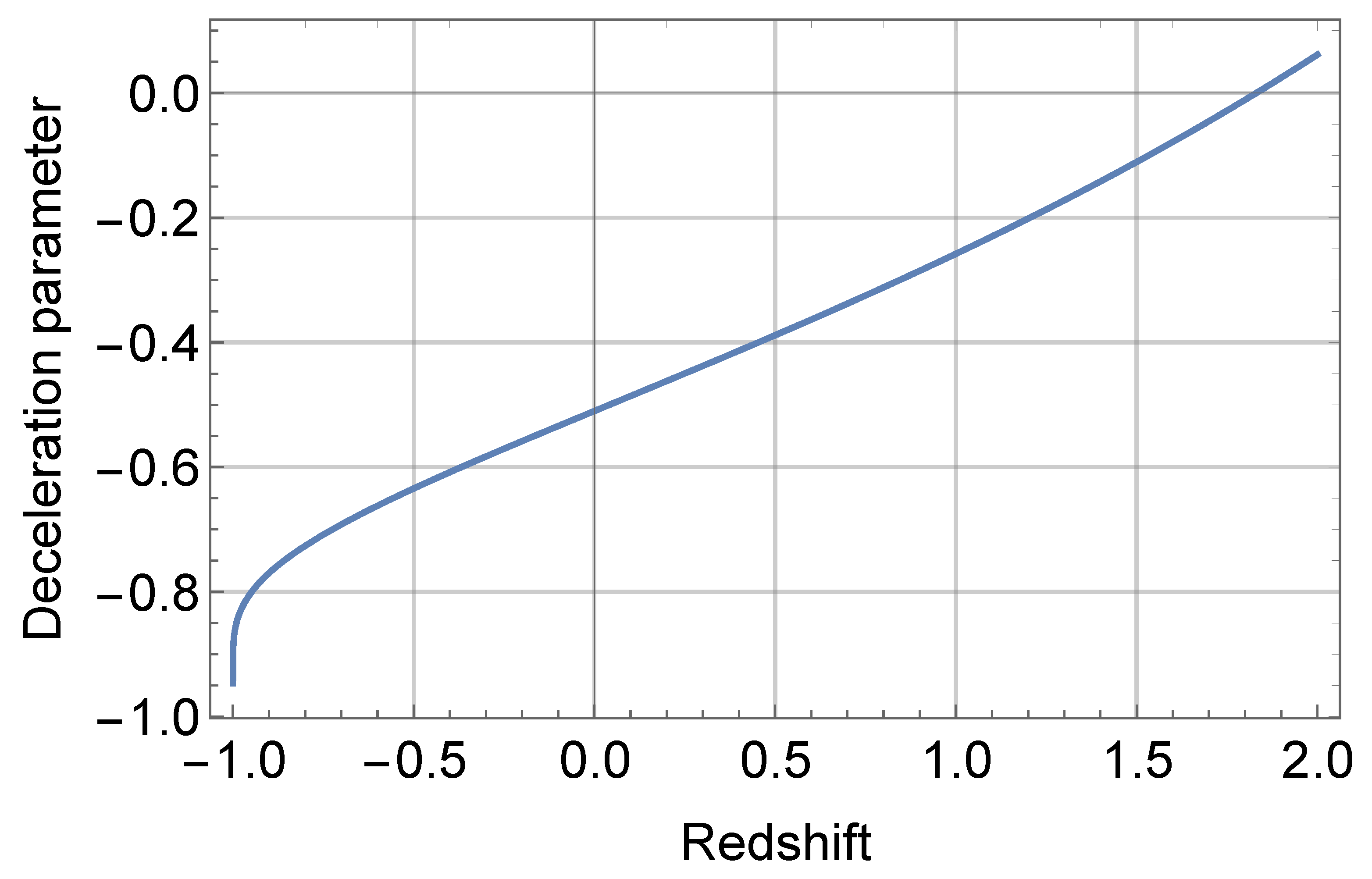
We note from Equation (21) that q is positive at early times, corresponding to deceleration, and negative at late times, corresponding to acceleration.
We now use observations to estimate the values of the constant and the integration constant k. If we evaluate Equation (20) at the present time, we have
Observations tell us that [14] and that [15]. Substituting these values into Equation (22), we get . From Equation (21), we then get the value of k as . Now, how do we select appropriate values for and ? Since the general relativistic limit is given by , we choose and to plot all subsequent figures. These values of , k, and are used in plotting all figures.
From the observational point of view, it is more useful to express the parameters in term of redshift z. The average scale factor a in terms of redshift is given by
Hence, the Hubble and deceleration parameters in terms of redshift are as follows:
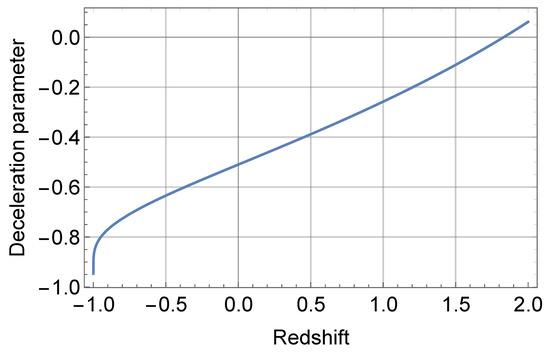
Figure 1.
Deceleration parameter q against redshift z.
Using the relationship, we get the energy density, pressure, cosmological parameter and equation of state parameters as follows:
and
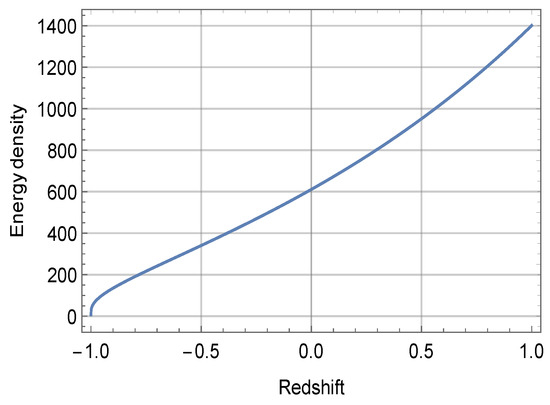
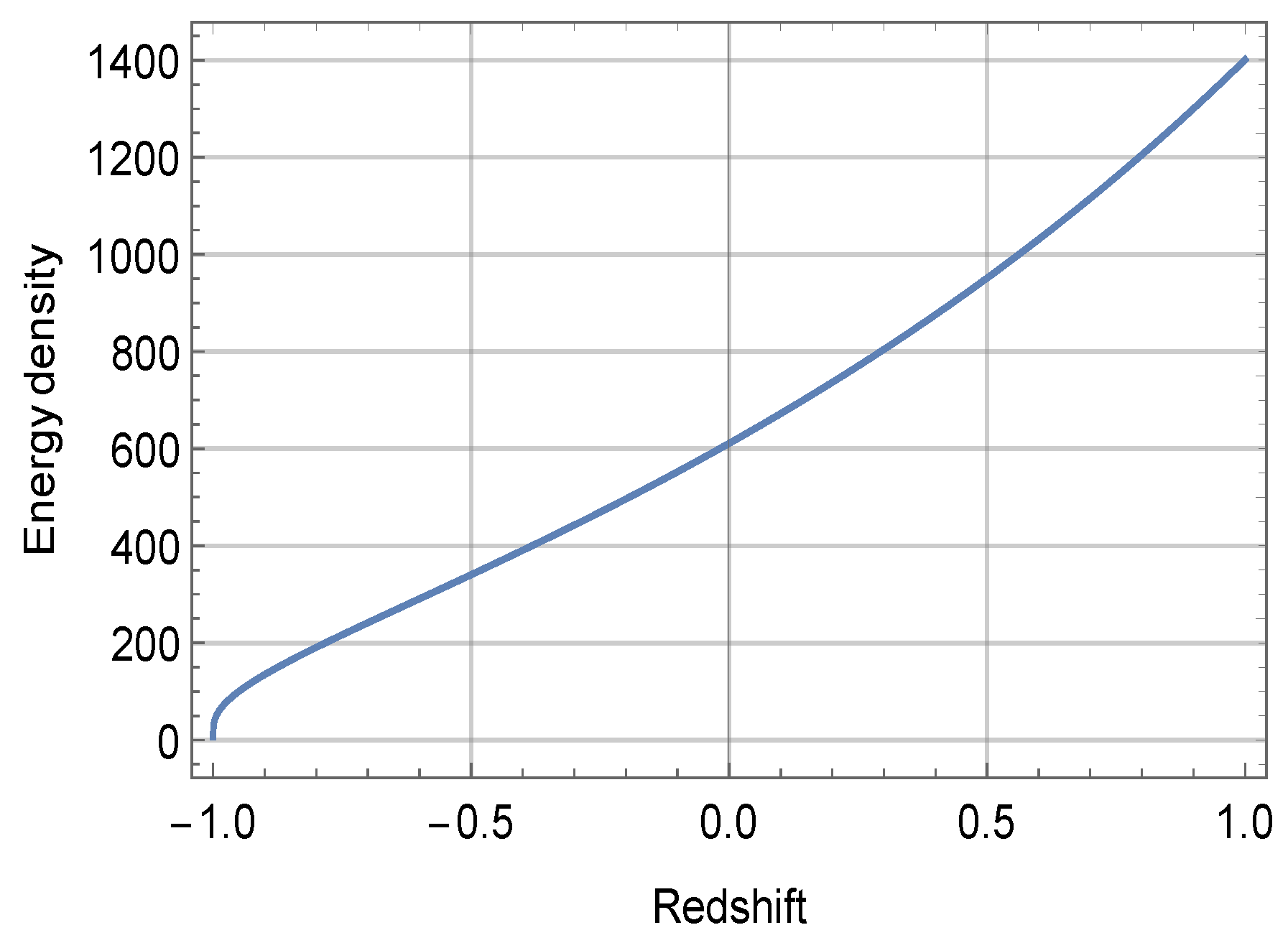
Figure 2.
Energy density against redshift z.
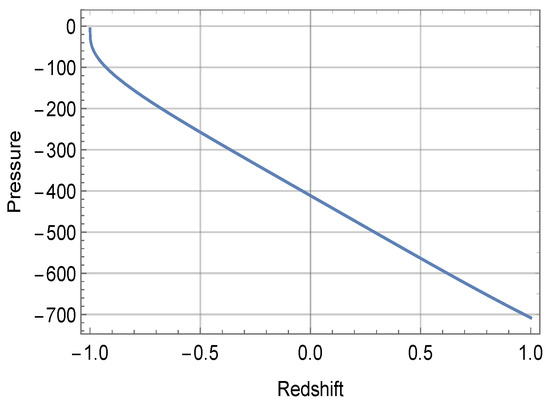
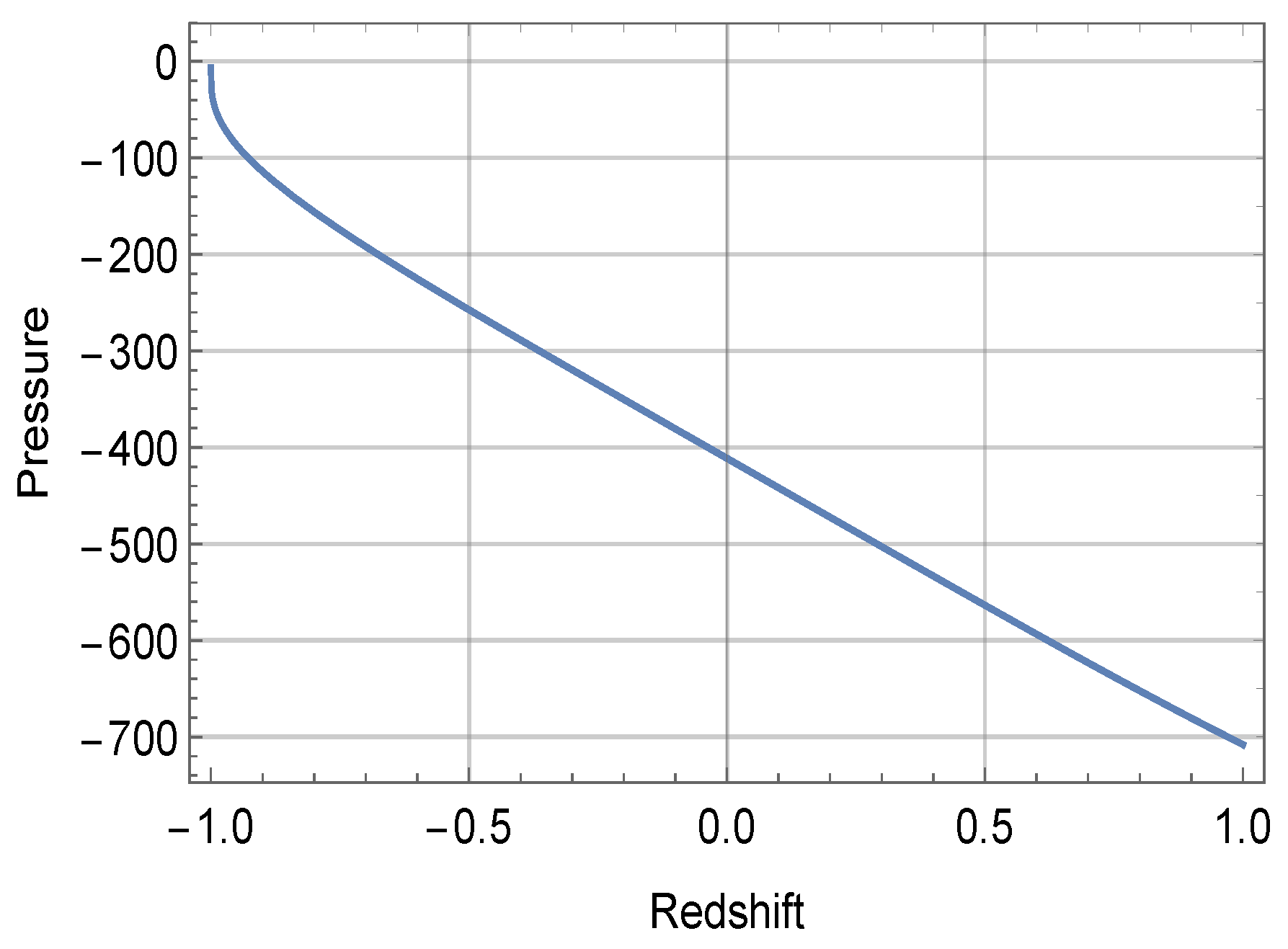
Figure 3.
Pressure against redshift z.
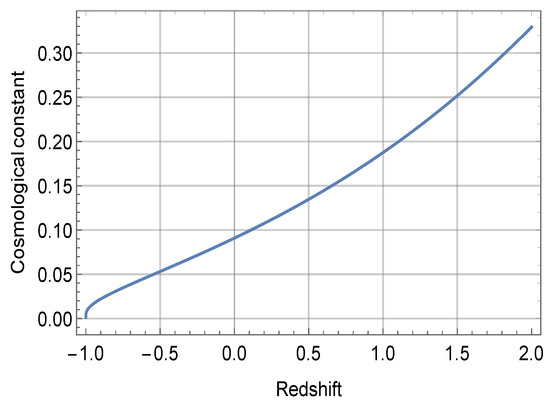
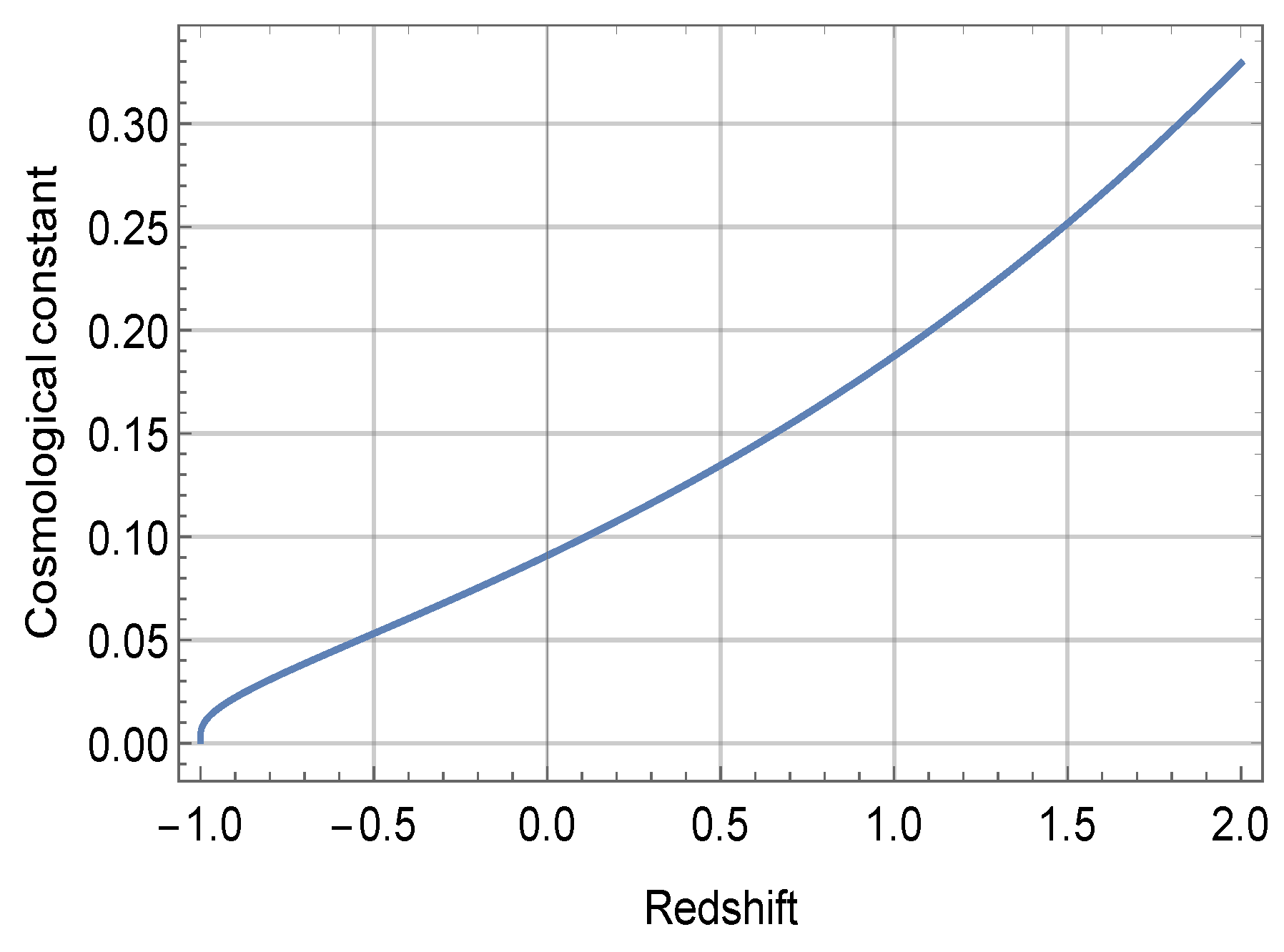
Figure 4.
Cosmological parameter against redshift z.
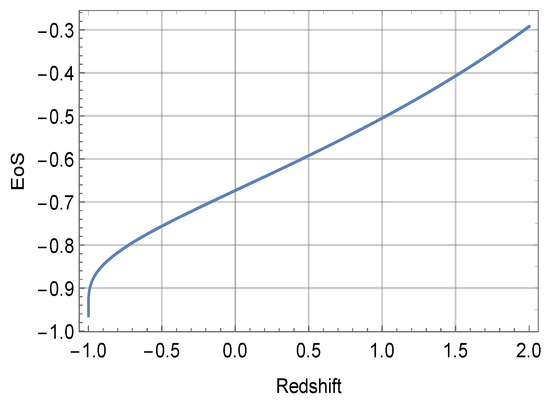
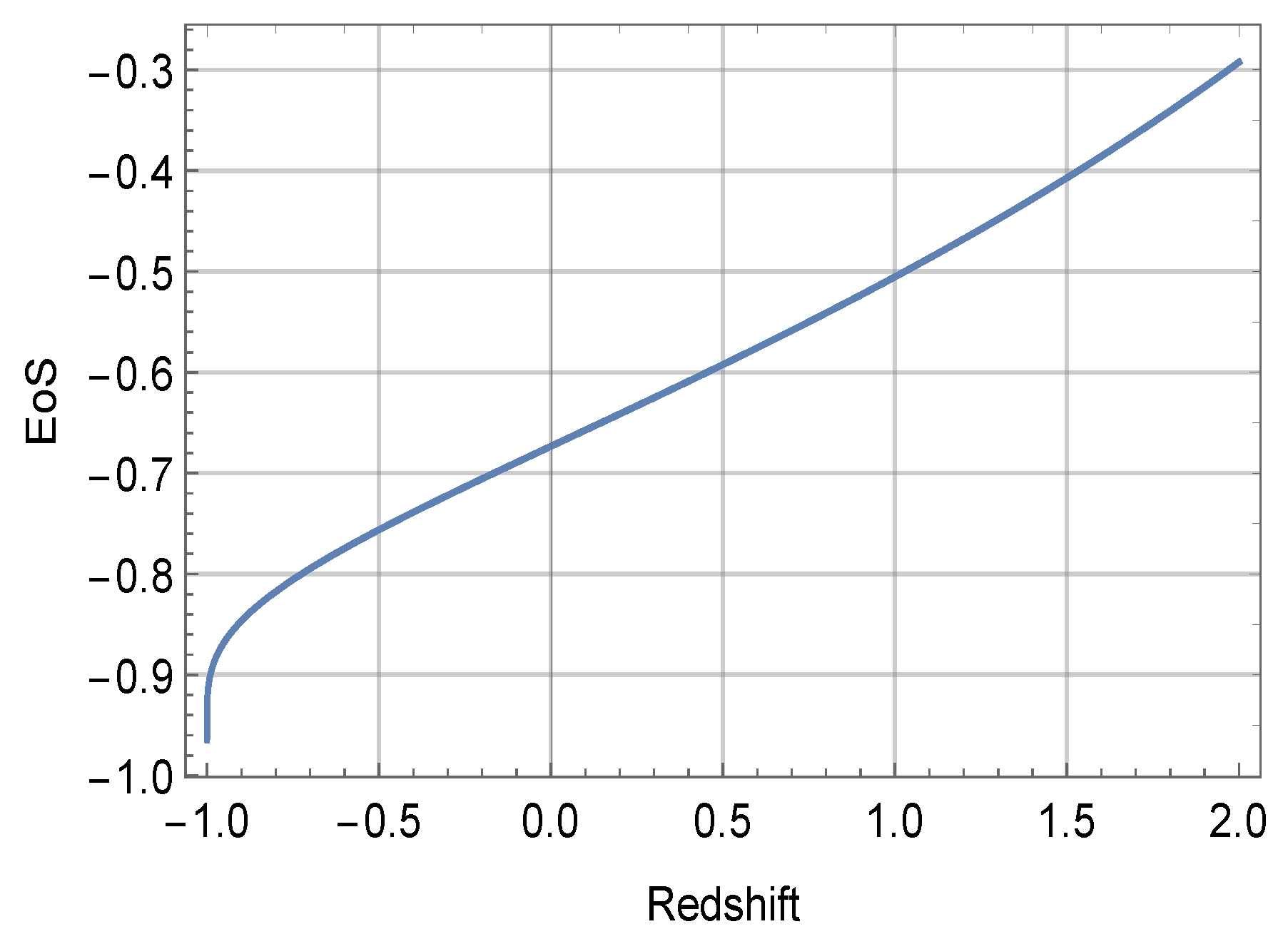
Figure 5.
EOS parameter against redshift z.
4. Conclusions
In this paper, we analyze a model with a variable cosmological parameter in flat FLRW space-time in theory. We graph the various physical parameters against redshift. The vital characteristics of our model are the following. Our model presents decelerating in the past and current accelerating, as shown in Figure 1. The behavior of the parameters and are illustrated in Figure 2, Figure 3, Figure 4 and Figure 5. We have a variable cosmological parameter, which is large initially and decreases with time. This could help in resolving the cosmological constant problem.
Author Contributions
Conceptualization, R.K.T., A.B. and B.K.S.; methodology, R.K.T.; software, A.B. and B.K.S.; validation, R.K.T., A.B. and B.K.S.; formal analysis, R.K.T., A.B. and B.K.S.; investigation, R.K.T., A.B. and B.K.S.; resources, R.K.T. and B.K.S.; data curation, B.K.S.; writing—original draft preparation, R.K.T. and B.K.S.; writing—review and editing, R.K.T., A.B. and B.K.S.; visualization, R.K.T., A.B. and B.K.S.; supervision, R.K.T. and A.B.; project administration, R.K.T.; funding acquisition, A.B. All authors have read and agreed to the published version of the manuscript.
Funding
This work was based on the research supported wholly/in part by the National Research Foundation of South Africa (Grant Numbers: 118511).
Conflicts of Interest
The authors declare no conflict of interest. The funders had no role in the design of the study; in the collection, analyses, or interpretation of data; in the writing of the manuscript, or in the decision to publish the results.
References
- Perlmutter, S.; Aldering, G.; Goldhaber, G.; Knop, R.A.; Nugent, P.; Castro, P.G.; Deustua, S.; Fabbro, S.; Goobar, A.; Groom, D.E.; et al. Measurements of Ω and Λ from 42 High-Redshift Supernovae. Astrophys. J. 1999, 517, 565–586. [Google Scholar] [CrossRef]
- Riess, A.G.; Filippenko, A.V.; Challis, P.; Clocchiatti, A.; Diercks, A.; Garnavich, P.M.; Gilliland, R.L.; Hogan, C.J.; Jha, S.; Kirshner, R.P.; et al. Observational Evidence from Supernovae for an Accelerating Universe and a Cosmological Constant. Astron. J. 1998, 116, 1009–1038. [Google Scholar] [CrossRef] [Green Version]
- Percival, W.J.; Baugh, C.M.; Bland-Hawthorn, J.; Bridges, T.; Cannon, R.; Cole, S.; Colless, M.; Collins, C.; Couch, W.; Dalton, G.; et al. The 2dF Galaxy Redshift Survey: The power spectrum and the matter content of the universe. Mon. Not. R. Astron. Soc. 2001, 327, 1297–1306. [Google Scholar] [CrossRef]
- Suwa, M.; Kobayashi, K.; Oshima, H. The Interacting Generalized Ricci Dark Energy Model in Non-Flat Universe. J. Cosmol. Astropart. Phys. 2010, 1002, 008. [Google Scholar] [CrossRef] [Green Version]
- Spergel, D.N.; Verde, L.; Peiris, H.V.; Komatsu, E.; Nolta, M.R.; Bennett, C.L.; Halpern, M.; Hinshaw, G.; Jarosik, N.; Kogut, A.; et al. First Year Wilkinson Microwave Anisotropy Probe (WMAP) Observations: Determination of Cosmological Parameters. Astrophys. J. Suppl. 2003, 148, 175–194. [Google Scholar] [CrossRef] [Green Version]
- Aghanim, N.; Akrami, Y.; Ashdown, M.; Aumont, J.; Baccigalupi, C.; Ballardini, M.; Banday, A.J.; Barreiro, R.B.; Bartolo, N.; Basak, S.; et al. Planck 2018 results VI. Cosmological parameters. Astron. Astrophys. 2020, 641, A6. [Google Scholar]
- Eisenstein, D.J.; Zehavi, I.; Hogg, D.W.; Scoccimarro, R.; Blanton, M.R.; Nichol, R.C.; Scranton, R.; Seo, H.J.; Tegmark, M.; Zheng, Z.; et al. Detection of the Baryon Acoustic Peak in the Large-Scale Correlation Function of SDSS Luminous Red Galaxies. Astrophys. J. 2005, 633, 560–574. [Google Scholar] [CrossRef]
- Bull, P.; Akrami, Y.; Adamek, J.; Baker, T.; Bellini, E.; Jimenez, J.B.; Bentivegna, E.; Camera, S.; Clesse, S.; Davis, J.H.; et al. Beyond ΛCDM: Problems, solutions, and the road ahead. Phys. Dark Univ. 2016, 12, 56–99. [Google Scholar] [CrossRef] [Green Version]
- Durrer, R.; Maartens, R. Dark Energy and Dark Gravity. Gen. Relativ. Grav. 2008, 40, 301–328. [Google Scholar] [CrossRef] [Green Version]
- Harko, T.; Lobo, F.S.N.; Nokiri, S.; Odintsov, S.D. f(R,T) gravity. Phys. Rev. D 2011, 84, 024020. [Google Scholar] [CrossRef] [Green Version]
- Tiwari, R.K.; Beesham, A. Anisotropic model with decaying cosmological term. Astrophys. Space Sci. 2018, 363, 234. [Google Scholar] [CrossRef]
- Pasqua, A.; Chattopadhyay, S.; Khomenko, I. A reconstruction of modified holographic Ricci dark energy in f(R,T) gravity. Can. J. Phys. 2013, 91, 632–638. [Google Scholar] [CrossRef] [Green Version]
- Tiwari, R.K.; Singh, R.; Shukla, B.K. A Cosmological Model with Variable Deceleration Parameter. Afr. Rev. Phys. 2015, 10, 48. [Google Scholar] [CrossRef]
- Jusus, J.F. Gaussian process estimation of transition redshift. J. Cosmol. Astropart. Phys. 2020, 4, 053. [Google Scholar] [CrossRef]
- Camarena, D.; Marra, V. Local determination of the Hubble constant and the deceleration parameter. Phys. Rev. Res. 2020, 2, 013028. [Google Scholar] [CrossRef] [Green Version]
Publisher’s Note: MDPI stays neutral with regard to jurisdictional claims in published maps and institutional affiliations. |
© 2021 by the authors. Licensee MDPI, Basel, Switzerland. This article is an open access article distributed under the terms and conditions of the Creative Commons Attribution (CC BY) license (https://creativecommons.org/licenses/by/4.0/).