Skip to Content
AppliedMathAppliedMath
  • Article
  • Open Access

9 February 2026

The Chain Rule for Fractional-Order Derivatives: Theories, Challenges, and Unifying Directions


,
,
and
1
Engineering Mathematics Department, Faculty of Engineering, Cairo University, Giza 12613, Egypt
2
Compumacy for Artificial Intelligence Solutions, Cairo 12511, Egypt
3
School of Engineering and Applied Sciences, Nile University, Giza 12677, Egypt
*
Author to whom correspondence should be addressed.

Abstract

The chain rule is a foundational concept in calculus, critical for differentiating composite functions, especially those appearing in modern AI techniques. Its extension to fractional calculus presents challenges due to the integral-based nature and intrinsic memory effects of these fractional operators. This survey provides a review of chain-rule formulations across major known FDs, including Riemann-Liouville (RL), Caputo, Caputo-Fabrizio (CF), Atangana-Baleanu-Riemann (ABR), Atangana-Baleanu-Caputo (ABC), and Caputo-Fabrizio with Gaussian kernel (CFG). The main contribution here is the introduction of a unified criterion, denoted as C , which synthesizes and extends previous classification frameworks for systematically formulating the chain rule across different operators. Each chain rule is examined in terms of its derivation, operator structure, and scope of applicability. In addition, the survey analyzes series-based approximations that appear in computing these derivatives, highlighting the minimum number of terms required to achieve acceptable mean absolute error (MAE). By consolidating theoretical developments, derivation methods, and numerical strategies, this paper provides a comprehensive resource for researchers and practitioners working with fractional-order models.

1. Introduction

Fractional calculus (FC) has become an indispensable mathematical tool for modeling complex systems that exhibit memory effects, non-locality, and anomalous behavior. Its origin dates back to 1695, when L’Hôpital posed the idea of differentiating to a non-integer order in a letter to Leibniz. Although initially a theoretical curiosity, FC has evolved into a robust framework with applications in modern AI techniques [1], physics, engineering, biology, finance, and control theory [2,3].
Early contributions by Liouville and Riemann established integral-based definitions for fractional derivatives, later refined through the work of Grünwald, Letnikov, and Marchaud [4,5,6]. These foundational definitions—collectively known as the classical fractional operators—incorporate memory effects, making them particularly well-suited to describing systems with long memory. Over time, a variety of FD formulations have emerged to address specialized requirements, for instance, to improve regularity conditions, manage initial values more effectively, or avoid singular kernels.
Local fractional derivatives, often termed “fractional” but defined through pointwise limits, have been shown to degenerate into integer-order derivatives or vanish entirely for certain classes of differentiable functions [7]. Consequently, they fail to capture the essential long-memory behavior characteristic of genuine fractional operators [8]. This theoretical drawback renders local FDs effectively destructive for many applications, as they overlook the broader historical or spatial context inherent to non-integer differentiation. In contrast, non-local fractional derivatives preserve the integral-based structure that underpins memory effects, making them more suitable for accurately modeling a wide range of real-world processes [4]. Therefore, the primary focus of this survey is on non-local FDs, which align more closely with the foundational principles and intended scope of fractional calculus.
A distinctive feature of FDs is their integral-based structure, which captures the history or entire domain of a function rather than relying solely on local pointwise information. While this property extends the modeling capabilities of FC, it also complicates fundamental calculus rules, such as the product rule and chain rule. Classical versions of these rules (e.g., the product and chain rules) do not directly translate to fractional operators [9]. In particular, Tarasov [10,11,12] noted that generalizing the chain rule to fractional derivatives is non-trivial and depends on the specific kernel and integral form.
Recent works have proposed fractional derivatives with exponentially decaying or Gaussian kernels, such as the Caputo-Fabrizio (CF), Atangana-Baleanu (ABR, ABC), and Caputo-Fabrizio with Gaussian kernel (CFG) operators [13]. Although these definitions offer enhanced regularity or improved modeling of memory effects, their distinct structures require chain-rule formulations tailored to each operator. Attempting to impose a single chain-rule expression (e.g., the Riemann-Liouville chain rule) on all definitions can lead to inconsistencies and inaccuracies.
In addition to these areas, chain-rule formulations play a pivotal role in computational frameworks that rely on gradient-based optimization. For instance, in neural networks with fractional-order components, accurate chain rules underpin the backpropagation algorithm, directly influencing training stability and convergence speed [14]. These advanced architectures, sometimes referred to as fractional neural networks, are being explored in the literature for improved memory retention and generalized modeling capabilities. Hence, a deeper understanding of the chain rule in fractional operators has the potential to enhance both modeling accuracy and computational efficiency across various scientific and engineering disciplines.

This survey focuses on reviewing chain-rule formulations across widely adopted FDs and introduces a unified criterion, C , that extends and consolidates prior classification frameworks [15,16,17,18]. We further investigate series-based approximations, analyzing how many terms must be retained to minimize the mean absolute error (MAE) in numerical applications. Figure 1 provides a timeline that underscores the historical evolution of fractional derivatives, from 19th-century foundations to modern innovations.
Figure 1. Timeline of Fractional derivatives [15,16,17,18,19,20,21,22,23,24,25,26,27].
The main contributions of the current survey are as follows:
  • Historical and Conceptual Overview: A concise overview of how fractional derivatives evolved from classical to modern formulations, highlighting their key mathematical principles.
  • Unified Classification Criterion: A criterion, C , that builds upon previous schemes (e.g., C 1 C 4 ) to systematically guide the derivation of chain rules across different FDs.
  • Survey of Chain Rule Formulations: A comprehensive review of major fractional operators (RL, Caputo, CF, ABR, ABC, CFG), detailing how their kernel structures influence the corresponding chain rules.
  • Approximation and MAE Analysis: A quantitative study of series-based approximations for chain rules, examining the trade-off between truncation depth and computational accuracy.
  • Application-Oriented Perspectives: Illustrative examples that highlight how these chain rules are deployed in practical models, illuminating both strengths and limitations.
The remainder of this survey is organized as follows. Section 2 classifies popular FD operators and outlines their mathematical definitions. Section 3 introduces the unified criterion C for FDs and discusses generalized Leibniz formulations that underpin the chain rule. Section 4 focuses on chain-rule derivations for selected operators and summarizes the main formulas in a unified table. Section 5 addresses the truncation of chain-rule series in numerical implementations. Section 6 demonstrates examples that validate these formulations, and Section 7 presents concluding remarks and suggestions for future research.

2. Classification and Definitions of FDs

This section presents a unified classification of commonly used fractional derivatives (FDs), organized according to their mathematical formulation and kernel structure. In the context of fractional calculus, these derivatives can be grouped into three primary categories:
  • (FD1) Classical definitions based on integral or series formulations,
  • (FD2) Modified forms that extend classical operators to address specific analytical challenges, and
  • (FD3) Operators that employ non-singular kernels to overcome limitations posed by singular kernel behavior.
The first category (FD1) includes classical and foundational operators such as the Grünwald-Letnikov (GL), Riemann-Liouville (RL), and Caputo derivatives. These stem from the historical development of fractional calculus (FC), beginning with Liouville’s early integral formulations and later refined through Grünwald and Letnikov’s series-based approach [19,20]. Specifically, the GL derivative generalizes integer-order differentiation using discrete convolution-type series, while RL and Caputo are integral-based, relying on singular kernels ( x τ ) α . These formulations are essential both for theoretical investigations and for modeling memory-dependent processes in various scientific fields.
The second category (FD2) encompasses modified operators, which adapt or augment classical definitions to tackle issues related to initial conditions, weak singularities, or solution regularity. One example is the Canavati derivative, offering a hybrid structure that bridges the Caputo and RL approaches for more robust handling of certain boundary-value problems [21,22,23]. Such modifications address the recognized challenges of classical operators, improving their applicability in real-world scenarios.
The third category (FD3) comprises fractional derivatives with non-singular kernels, a significant advancement in recent FC research. By replacing classical singular kernels with exponential or Gaussian-decaying functions, these definitions enhance regularity and simplify numerical schemes. Examples include the Caputo-Fabrizio (CF) derivative, which employs an exponential kernel, the Caputo-Fabrizio-Gaussian (CFG) derivative with a Gaussian kernel, and the Atangana-Baleanu derivatives in both the Riemann-Liouville (ABR) and Caputo (ABC) senses, which incorporate Mittag-Leffler kernels to capture long-memory effects without singularities [24,25,26]. Table 1 summarizes the core formulations of these fractional derivatives, categorized by kernel type and integral structure. This classification lays the groundwork for the subsequent analysis of chain-rule derivations in Section 3 and beyond. In Table 1, the function M ( α ) is a normalization function, E α is the Mittag-Leffler function with parameter α , and B ( α ) satisfies B ( 0 ) = B ( 1 ) = 1 .
Table 1. Commonly Used Classical, Modified, and Non-Singular Kernel Formulations of FDs (FD1, FD2 and FD3 Classes).

3. A Unified Criterion for FD Operators

To establish a consistent theoretical framework for analyzing fractional derivatives, we propose a single, integrated set of conditions that merges core elements from prior classification schemes introduced by Ross, Ortigueira-Machado, Kiryakova, and Podlubny [15,16,17,18]. Many earlier works applied a single chain rule (often the Riemann-Liouville one) to all fractional derivatives, overlooking the specific integral kernels involved. In contrast, we emphasize that each derivative demands a tailored chain rule suited to its kernel and integral form. Table 2 outlines the main conditions that collectively form this unified criterion. These include linearity, zeroth-order consistency, integer-order compliance, the property that a constant’s fractional derivative is zero, a suitable exponent law, and a generalized Leibniz rule. The latter is especially crucial: integral-based operators cannot rely on the classical product rule alone, so the generalized Leibniz form is needed to derive correct chain rules. Table 3 illustrates how major FD operators meet—or partially meet—these conditions, highlighting structural differences. Table 4 presents specific versions of the generalized Leibniz rule for each operator surveyed. This integrated perspective clarifies both the theoretical requirements for defining a consistent fractional derivative and the practical necessity of operator-specific chain-rule formulas. In summary, these conditions and rules illustrate the structural nuances that distinguish fractional derivatives. They also provide a systematic basis for deriving and comparing operator-specific chain-rule formulas in the sections that follow.
Table 2. Unified Criterion ( C ) Core Properties for FD Operators.
Table 3. Criterion Satisfaction Across Major FD Operators.
Table 4. Generalized Leibniz Rule Formulations for FD Operators.

4. Analysis of the Chain Rule for FDs

This section focuses on analyzing the chain rule for fractional derivatives (FDs), which is central to their correct application in models involving memory and hereditary effects. Extending the chain rule from classical calculus to fractional calculus requires careful attention to operator structure, particularly due to the integral-based nature of FDs and their use of singular or non-singular kernels. We begin by outlining the theoretical background, including the generalized Leibniz rule and the Faà di Bruno formula. These tools provide the foundation for deriving the chain rule across various non-local formulations. We then present detailed derivations for selected operators with both singular and non-singular kernels. Finally, we summarize the results in a unified table that offers a practical reference for applying the chain rule across FD models.

4.1. Theoretical Background on FDs

The Leibniz rule is a fundamental principle in calculus used for differentiating the product of two functions. For integer-order derivative of order n, it is expressed as [27]:
d n d x n ( f g ) ( x ) = k = 0 n ( n k ) f ( k ) ( x ) g ( n k ) ( x )
In the context of FC, this rule can be extended to FDs, specifically the RL FD. The extension involves replacing the integer-order parameter n with a real-valued parameter α . Consequently, for the function g ( x ) , the integer-order derivative g ( n k ) ( x ) is replaced by the GL fractional-order derivative D α k g ( x ) . The resulting fractional Leibniz rule is formulated as:
D α ( f g ) ( x ) = k = 0 ( α k ) f ( k ) ( x )   D α k g ( x )
This rule is particularly useful for evaluating the FDs of a product of functions, where one of the functions has a known FD. Ref. [27] shows that this extended Leibniz rule converges and provides a comprehensive framework for fractional differentiation.
In fractional calculus, the unit step function, denoted as H ( x a ) where a > 0 , plays a crucial role in the analysis and derivation of fractional derivatives, particularly for fractional derivatives. The fractional derivative of the unit step function under the Riemann-Liouville (RL) formulation is essential for understanding how fractional differentiation operates over discontinuities and for deriving the chain rule in the fractional domain [4].
For the RL definition, the FD of the unit step function H ( x a ) is given by:
D α H ( x a ) =   ( x a ) α Γ ( 1 α ) ,   ( x > a ) .
The k t h order derivative of a composite function ( f g ) ( x ) can be evaluated using the Faà di Bruno formula, which is an extension of the chain rule for higher-order derivatives. The formula is given by [27]:
d k d x k ( f g ) ( x ) = k ! m = 1 k f ( m ) ( g ( x ) )   r = 1 k 1 a r ! ( g ( r ) ( x ) r ! ) a r ,
where the sum extends over all combinations of non-negative integer values of a 1 , a 2 , , a k such that
r = 1 k r a r = k   and   r = 1 k a r = m .

4.2. Derivation of the Chain Rule for FDs with Singular and Non-Singular Kernels

This section derives the chain rule for fractional derivatives (FDs), focusing on examples with both singular and non-singular kernels. By detailing the derivation for one singular and one non-singular kernel, we establish a methodology that can be extended to other FDs. The derived chain rule formulas for various definitions are summarized in Table 5, providing a comprehensive framework for their application.
Table 5. Chain Rule Formulas for Fractional Derivatives.
(1) 
Riemann-Liouville FD
The RL fractional derivative is crucial in FC due to its ability to account for the entire history of a function through its integral formulation. This characteristic makes the RL derivative a powerful tool for modeling processes with memory effects in various scientific fields. The next section presents the derivation of the chain rule for the RL definition, ensuring the preservation and effective application of its integral nature.
The Leibniz rule for the RL fractional derivative takes the form:
D α R L ( φ f ) ( x ) = k = 0 ( α k ) φ ( k ) ( x )   D x α k f ( x )
Let us consider an analytic function φ ( x ) and f ( x ) = H ( x a ) , where H ( x ) denotes the unit step function. By applying the Leibniz rule and using the formula for the fractional differentiation of the Heaviside function, we can derive the following expression:
D α R L ( φ ( x ) H ( x a ) ) = D α R L ( φ ( x ) ) = k = 0 ( α k ) φ ( k ) ( x ) D x α k a H ( x a ) = k = 0 ( α k ) φ ( k ) ( x ) ( x a ) k α Γ ( k α + 1 ) = ( x a ) α Γ ( 1 α ) φ ( x ) + k = 1 ( α k ) φ ( k ) ( x ) ( x a ) k α Γ ( k α + 1 ) ,
Now let us suppose that φ ( x ) is a composite function:
φ ( x ) = ( f g ) ( x ) .
For all x , α , a C , where g is smooth and ( f g ) ( x ) is a function of the form x λ η ( x ) with R e ( λ ) > 1 and η analytic on a domain R C containing a . By utilizing the Faà di Bruno formula in Equation (4), we can express the fractional derivative of the composite function f ( g ( x ) ) using the RL definition as follows:
D α R L ( f g ) ( x ) = ( x a ) α Γ ( 1 α ) ( f g ) ( x ) + k = 1 [ ( α k ) k ! ( x a ) k α Γ ( k α + 1 )   ( m = 1 k f ( m ) ( g ( x ) )   r = 1 k 1 a r ! ( g ( r ) ( x ) r ! ) a r ) ] ,
Simplify, and let a = 0 ,
D α R L ( f g ) ( x ) = ( x ) α Γ ( 1 α ) ( f g ) ( x ) + k = 1 [ Γ ( α + 1 ) ( x ) k α Γ ( α k + 1 ) Γ ( k α + 1 )   ( m = 1 k f ( m ) ( g ( x ) )   r = 1 k 1 a r ! ( g ( r ) ( x ) r ! ) a r ) ] .
The chain rule formula for the Riemann-Liouville FD has been theoretically discussed in [27].
(2) 
Atangana-Baleanu Riemann-Liouville FD (ABR):
The ABR fractional derivative is defined as:
D α A B R f ( x ) = B ( α ) 1 α d d x 0 x f ( τ ) E α ( α ( x τ ) α 1 α ) d τ , x > 0 .
The product rule for the ABR fractional derivative is:
D α A B R ( f g ) ( x ) = B ( α ) 1 α m = 0 [ ( α 1 α ) m   ( k = 0 ( α m k ) f ( k ) ( x )   I α m + k g ( x ) ) ] ,
For a composite function:
D α A B R ( ( f g ) ( x ) H ( x ) ) = B ( α ) 1 α m = 0 [ ( α 1 α ) m   ( k = 0 ( α m k ) f ( k ) ( g ( x ) )   I α m + k H ( x ) ) ] ,
Given that:
I α m + k [ H ( x ) ] = x α m + k Γ ( α m + k + 1 ) ,
We can write:
D α A B R ( ( f g ) ( x ) H ( x ) ) = B ( α ) 1 α m = 0 [ ( α 1 α ) m   ( k = 0 ( α m k ) f ( k ) ( g ( x ) ) x α m + k Γ ( α m + k + 1 ) ) ] ,
Simplifying further, we obtain:
D α A B R ( f g ) ( x ) = B ( α ) 1 α m = 0 [ ( α 1 α ) m   ( x α m Γ ( α m + 1 ) f ( g ( x ) ) +   k = 1 ( α m k ) f ( k ) ( g ( x ) ) x α m + k Γ ( α m + k + 1 ) ) ]
Recalling Equation (4), We can rewrite the expression as:
D α A B R ( f g ) ( x ) = B ( α ) 1 α m = 0 [ ( α 1 α ) m   ( x α m Γ ( α m + 1 ) f ( g ( x ) ) + k = 1 ( α m k ) k !   x α m + k Γ ( α m + k + 1 )     [ n = 1 k f ( n ) ( g ( x ) )   r = 1 k 1 a r ! ( g ( r ) ( x ) r ! ) a r ] ) ]
Since in [1] (p. 86)
( α m k ) = ( 1 ) k Γ ( α m + k ) k ! Γ ( α m ) ,
We have:
D α A B R ( f g ) ( x ) = B ( α ) 1 α m = 0 [ ( α 1 α ) m   ( x α m Γ ( α m + 1 ) f ( g ( x ) ) + k = 1 ( 1 ) k x α m + k ( α m + k ) Γ ( α m )     [ n = 1 k f ( n ) ( g ( x ) )   r = 1 k 1 a r ! ( g ( r ) ( x ) r ! ) a r ] ) ]
Thus, using the Mittag-Leffler function:
E α ( x ) : = m = 0 x m Γ ( 1 + α m ) .
We get:
D α A B R ( f g ) ( x ) = B ( α ) 1 α E α ( α 1 α x α ) f ( g ( x ) ) + B ( α ) 1 α m = 0 [ k = 1 ( 1 ) k ( α 1 α ) m x α m + k ( α m + k ) Γ ( α m )     [ n = 1 k f ( n ) ( g ( x ) )   r = 1 k 1 a r ! ( g ( r ) ( x ) r ! ) a r ] ] .

4.3. Unified Chain Rule Formulas

Table 5 consolidates the chain-rule expressions for the main FDs surveyed. In each case, the integral kernel and corresponding product rule dictate how f ( g ( x ) ) is expanded. For FDs not explicitly listed, one can use the generalized Leibniz rule (Table 4) and the Faà di Bruno approach to derive operator-specific formulas.

5. Number of Terms in Chain Rule for Fractional Derivatives

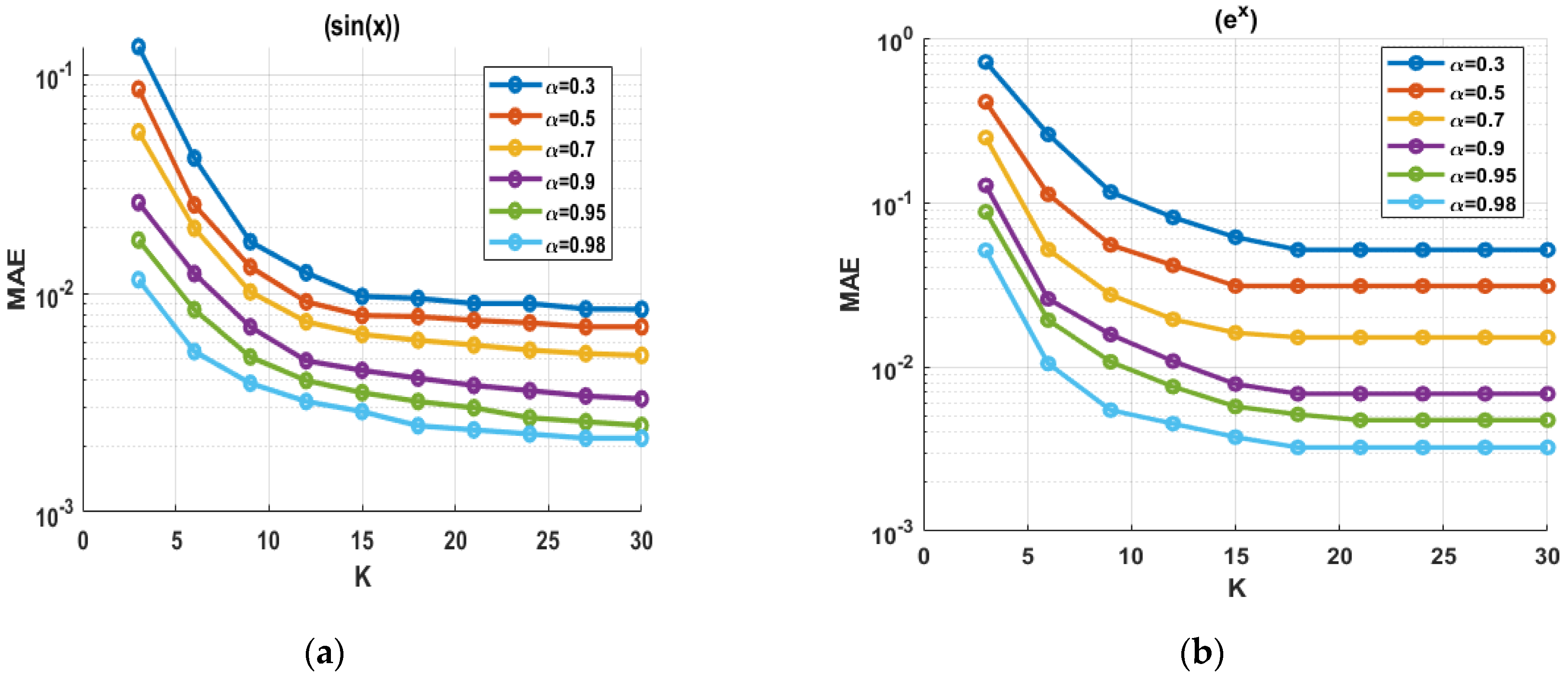
In the context of FC, determining the appropriate number of terms K is crucial for minimizing the MAE between the FD of a composite function using the chain rule and FD definition itself. By plotting the MAE, we aim to identify the number of terms K that provide the highest accuracy and performance. This involves comparing the FD of ( f g ) ( x ) , derived using the chain rule formula, with its FD obtained using the definition itself over various values of K and different fractional orders α . The goal is to minimize the error, thus ensuring a more precise application of the chain rule in FDs. The MAE can be expressed as:
M A E = M e a n | D α d e f i n i t i o n ( f g ) ( x ) D α C h a i n ( f g ) ( x ) | .
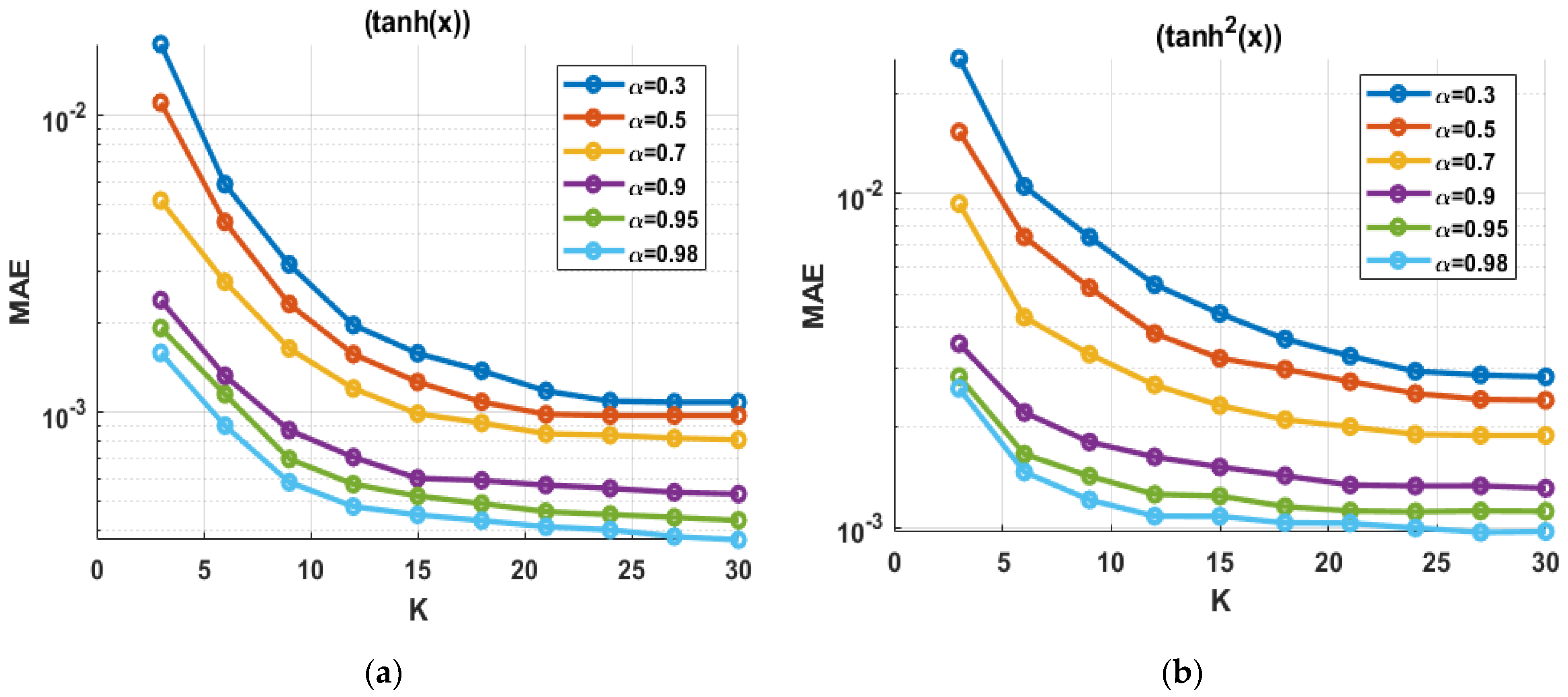
By leveraging MAE, we can systematically identify the appropriate number of terms K for minimizing the error in the application of the chain rule in FDs. This enhances the precision and reliability of FC methods in various scientific and engineering applications. By changing the step size of approximation, we conclude that the MAE depends on the step size used in the approximation. Similar to the Euler method, the relationship between MAE and step size is linear, with an order of 1. The analysis of MAE versus the number of terms K for different composite functions using the RLgl2 method and the RL-Chain rule is illustrated in Figure 2 and Figure 3. These figures show the behavior of the MAE at various fractional orders α ( 0.3 , 0.5 , 0.7 , 0.9 , 0.95 , a n d   0.98 ) .
Figure 2. MAE versus the number of terms K for two cases: (a) f ( x ) = x and g ( x ) = s i n ( x ) , (b) f ( x ) = x and g ( x ) = e x .
Figure 3. MAE versus the number of terms K for two cases: (a) f ( x ) = x and g ( x ) = t a n h ( x ) , (b) f ( x ) = x 2 and g ( x ) = t a n h ( x ) .
Figure 2 presents two cases: (a) where f ( x ) = x and g ( x ) = s i n ( x ) , (b) where f ( x ) = x and g ( x ) = e x . The MAE is plotted against K , demonstrating how the error changes with the number of terms included in the approximation. Figure 3 shows two different cases: (a) where f ( x ) = x and g ( x ) = t a n h ( x ) , (b) where f ( x ) = x 2 and g ( x ) = t a n h ( x ) . Similar to Figure 2, the MAE is plotted against K for various values of α, providing a comparison between the RL definition and the RL-Chain rule formula. The plots illustrate the MAE versus K and highlight the differences between the two methods at different fractional orders. From the analysis of these figures, it is evident that the optimal K to minimize the MAE for all cases lies between 25 and 30. This range ensures minimal error and provides a balance between accuracy and computational efficiency, thereby validating the robustness of the chain rule in FDs.
From these results, a truncation level of K 25 30 generally offers a good balance between accuracy and computation time. However, the exact number of terms may also depend on factors such as the complexity of the composite function ( f g ) ( x ) and the chosen fractional order α . In practice, these findings serve as a useful starting point: one can begin with K in this range and then adjust based on error tolerances or performance requirements specific to the application.

6. Examples

This section presents a series of examples to validate the derived chain rule formulas for fractional derivatives. The examples focus on verifying theoretical identities under specific function compositions and analyzing the behavior of fractional derivatives (FDs) across different definitions and values of α .
Example 1.
To verify the new identity of RL definition, consider  a = 0 , f ( x ) = x  and  g ( x ) = e x  so that  ( f g ) ( x ) = e x . The  m t h  derivative of  ( f g ) ( x )  with respect to  g ( x )  is  1  if  m = 1 , and 0 if  m > 1 . For  k = 1 , we have  ( a 1 ) = ( 1 ) ; for  k = 2 , we have  ( a 1 , a 2 ) = ( 0,1 ) ; and in general, for any  K  we have  ( a 1 , , a k ) = ( 0 , , 0,1 ) Therefore,
[ m = 1 k f ( m ) ( g ( x ) )   r = 1 k 1 a r ! ( g ( r ) ( x ) r ! ) a r ] = g ( k ) ( x ) k ! ,
Then
D α R L ( f g ) ( x ) = ( x ) α Γ ( 1 α ) ( f g ) ( x ) + k = 1 [ ( α k ) k ! ( x ) k α Γ ( k α + 1 ) ( m = 1 k f ( m ) ( g ( x ) )   r = 1 k 1 a r ! ( g ( r ) ( x ) r ! ) a r ) ] = ( x ) α Γ ( 1 α ) e x + k = 1 [ ( α k ) k ! ( x ) k α Γ ( k α + 1 ) g ( k ) ( x ) k ! ] = ( x ) α Γ ( 1 α ) e x + k = 1 [ ( α k ) ( x ) k α Γ ( k α + 1 ) g ( k ) ( x ) ] = k = 0 [ ( α k ) ( x ) k α Γ ( k α + 1 ) g ( k ) ( x ) ] .
This matches the fractional derivative of f ( g ( x ) ) using the RL fractional derivative, defined as [20,28]:
D x α R L g ( x ) = m = 0 [ ( α m ) ( x ) m α Γ ( m α + 1 ) g ( m ) ( x ) ] .
Example 2.
To verify this new identity of ABR definition, consider  a = 0 , f ( x ) = x 2  and  g ( x ) = e x  so that  ( f g ) ( x ) = e 2 x . The  k  th derivative of  ( f g ) ( x )  with respect to  g ( x )  is  2 e x  if  k = 1 , 2  if  k = 2 , and 0 if  k > 2 .
For k = 1 , we have ( a 1 , , a k ) = ( 0 , , 0,1 ) and therefore,
r = 1 k r a r ! ( r ! ) a r ( g ( r ) ( x ) ) a r = r = 1 k r 1 ! ( k ! ) 1 ( e x ) 1 = e x ,
For k = 2 , we must have either a r = a k r = 1 for some r k 2 and all other a r = 0 (case 1) or (if k is even) a k / 2 = 2 and all other a r = 0 (case 2).
In the first case,
r = 1 k r a r ! ( r ! ) a r ( g ( r ) ( x ) ) a r = r = 1 k r ( 1 ! ) 2 r ! ( k r ) ! ( e x ) 1 ( e x ) 1 = ( k r ) e 2 x ,
while in the second case,
r = 1 k r a r ! ( r ! ) a r ( g ( r ) ( x ) ) a r = r = 1 k r 2 ! ( k 2 ! ) 2 ( e x ) 2 = 1 2 ( k k / 2 ) e 2 x ,
using Equation (21) to get
D α A B R ( e x ) 2 = B ( α ) 1 α [ E α ( α 1 α x α ) e 2 x + m = 0 k = 1 [ ( α 1 α ) m ( m α k ) x k + m α Γ ( k + m α + 1 ) ( ( 2 e x ) e x + ( 2 ) r = 1 k / 2 ( k r ) e 2 x + ( k k / 2 ) e 2 x ) ] ] ,
where the last term is present only if k is even. This simplifies to
D α A B R ( f g ) ( x ) = B ( α ) 1 α [ E α ( α 1 α x α ) e 2 x + m = 0 k = 1 [ ( α 1 α ) m ( m α k ) x k + m α Γ ( k + m α + 1 ) r = 0 k ( k r ) e 2 x ] ] = B ( α ) 1 α [ m = 0 ( α 1 α ) m x α m Γ ( α m + 1 ) e 2 x + m = 0 k = 1 [ ( α 1 α ) m ( m α k ) x k + m α Γ ( k + m α + 1 ) r = 0 k ( k r ) e 2 x ] ] = B ( α ) 1 α m = 0 k = 0 ( α 1 α ) m ( m α k ) x k + m α Γ ( k + m α + 1 ) 2 k e 2 x .
which is exactly the formula for D α A B R e 2 x , where,
D α A B R ( f g ) ( x ) = B ( α ) 1 α m = 0 [ ( α 1 α ) m I α m R L f ( g ( x ) ) ] .
Using the product rule of RL fraction integral [1]:
I α R L [ u ( x ) v ( x ) ] =   k = 0 ( α k ) I x α + k R L u ( x ) d k d x k   v ( x ) .
Now let u ( x ) = H ( x ) and v ( x ) = ( f g ) ( x ) , Then,
D α A B R e 2 x = B ( α ) 1 α m = 0 [ ( α 1 α ) m [ k = 0 ( α m k ) x k + m α Γ ( k + m α + 1 ) 2 k e 2 x ] ] = B ( α ) 1 α m = 0 k = 0 ( α 1 α ) m ( m α k ) x k + m α Γ ( k + m α + 1 ) 2 k e 2 x .
Example 3.
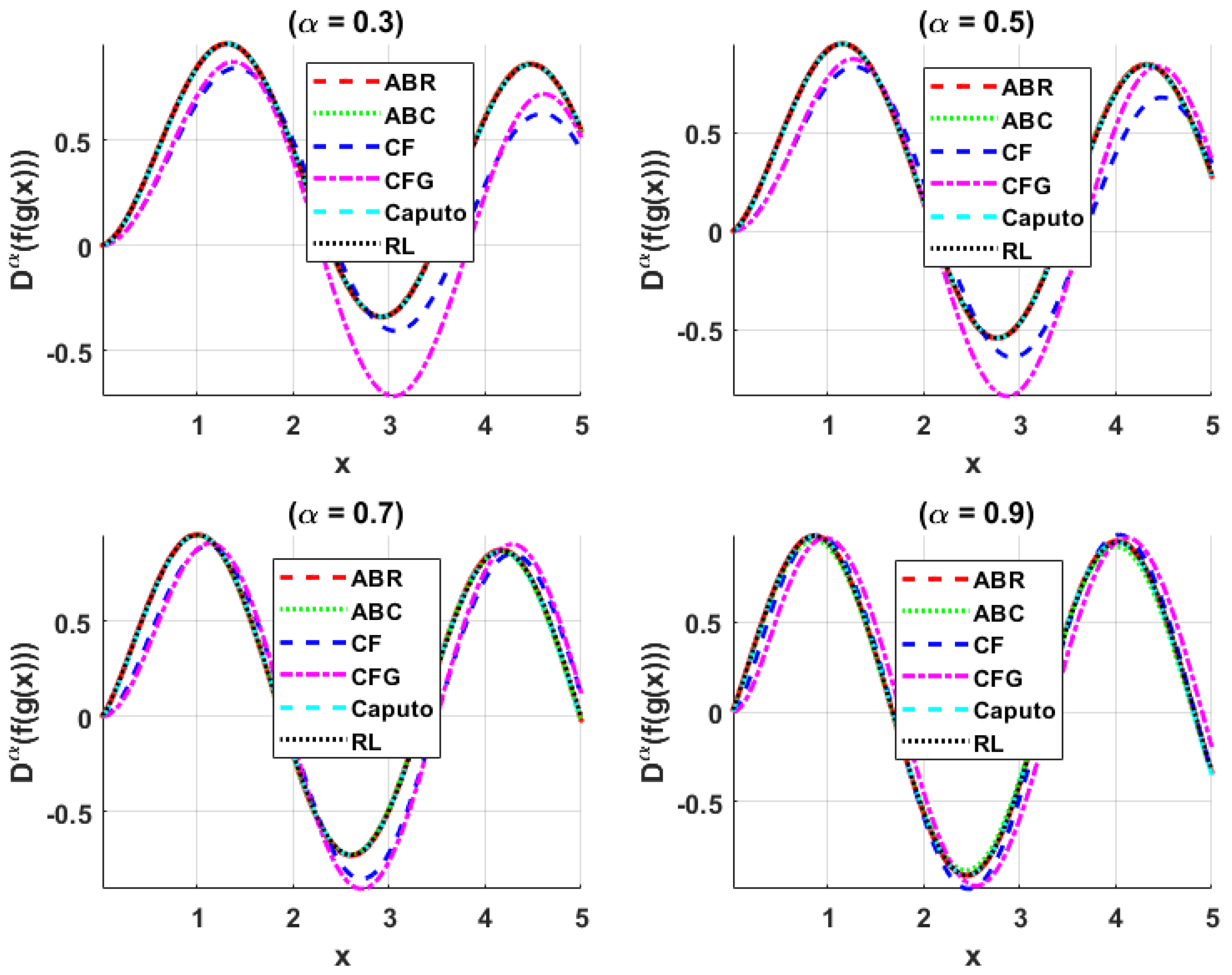
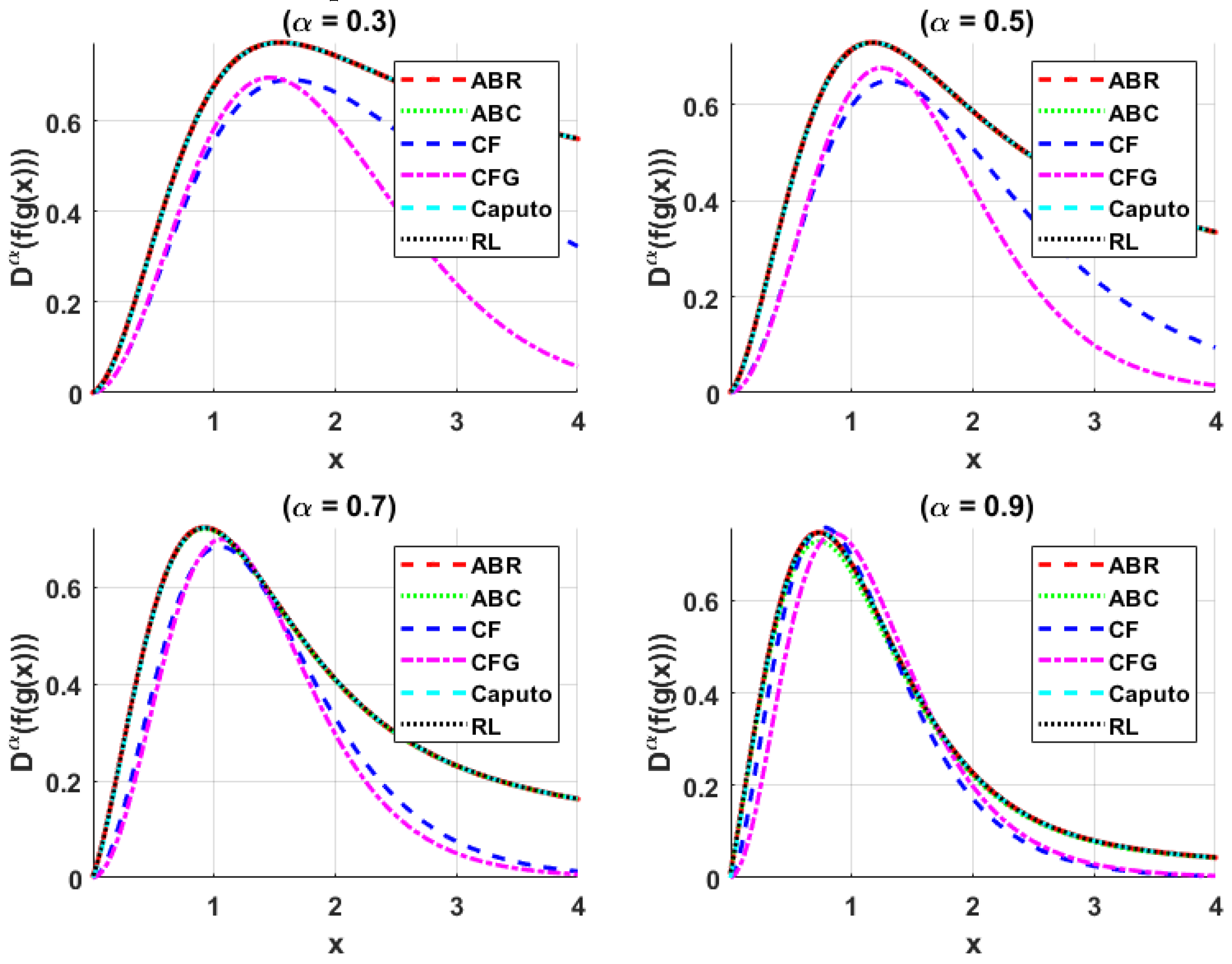
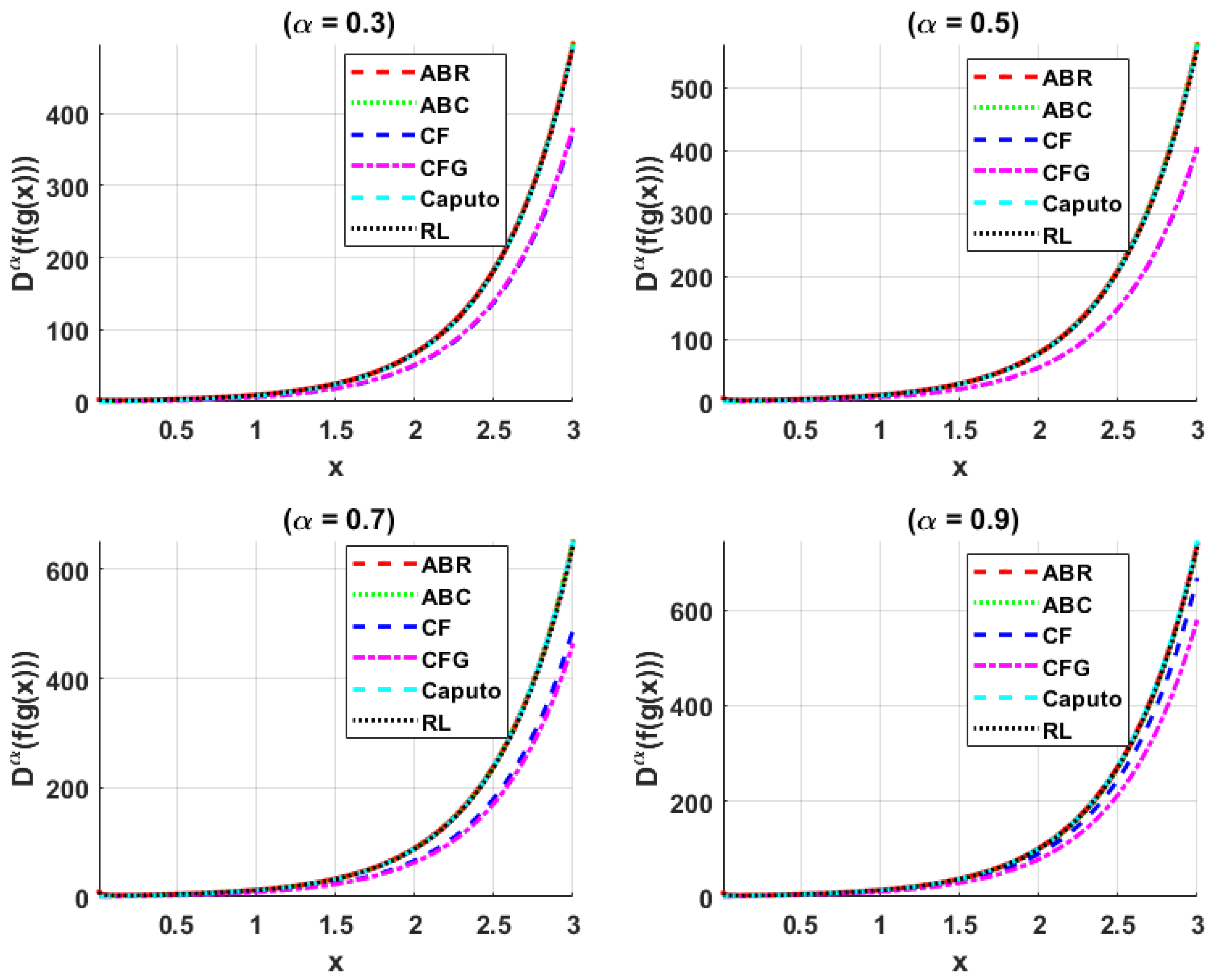
Figure 4Figure 5 and Figure 6 illustrate the FDs of the composite function  ( f g ) ( x )  for different combinations of  f  and  g  using the chain rule formula of six definitions mentioned in. In Figure 4, the function  f ( x )   =   x 2  and  g ( x ) = s i n ( x )  are used. The FD is plotted at various values of  α   (0.3, 0.5, 0.7, and 0.9). The plots demonstrate the differences and similarities between the chain rule formulas of the six definitions for these specific functions. Figure 5 presents the FD for  f ( x )   =   x 2  and  g ( x ) = t a n h ( x ) . Similar to Figure 4, the FD is computed and plotted for different values of α\alphaα. This comparison provides insights into the behavior of the chain rule formulas across different fractional orders for another set of functions. In Figure 6, the functions  f ( x )   =   x 2  and  g ( x ) = e x  are considered. The FD is again plotted for  α  values of 0.3, 0.5, 0.7, and 0.9, showcasing how the chain rule formulas adapt to the exponential function as the inner function  g ( x ) .
Figure 4. FD of ( f g ) ( x ) where f ( x ) = x 2 and g ( x ) = s i n ( x ) , computed using six chain rule formulas at multiple values of α .
Figure 5. FD of f ( g ( x ) ) where f ( x ) = x 2 and g ( x ) = t a n h ( x ) , computed using six chain rule formulas at multiple values of α .
Figure 6. FD of f ( g ( x ) ) where f ( x ) = x 2 and g ( x ) = e x , computed using six chain rule formulas at multiple values of α .

7. Conclusions and Future Work

This survey offers a comprehensive overview of chain-rule formulations for fractional derivatives (FDs). We demonstrate that each FD operator—characterized by its distinct integral kernel—necessitates a tailored chain rule. Applying a uniform chain rule across all definitions (e.g., the Riemann-Liouville) is mathematically unfounded and often yields erroneous results.
  • Key Findings Include:
    • Operator-Specific Chain Rules: We derived and validated explicit chain rules for major FDs (RL, Caputo, CF, ABR, ABC, CFG), highlighting their dependence on kernel properties and generalized Leibniz expansions.
    • Unified Criterion  C : A cohesive framework, extending prior classifications, which emphasizes the crucial role of the Generalized Leibniz Rule in non-local contexts.
    • Optimal Series Truncation: Numerical evidence suggests that retaining 25–30 terms typically minimize MAE, balancing computational cost and accuracy.
    • Misconceptions and Boundaries: The widely assumed “RL universal chain rule” does not hold for all operators. Instead, each operator’s unique structure must be accounted for.
  • Challenges
    • Analytical Complexity: Derivations often involve nested sums, gamma functions, or special functions (e.g., Mittag-Leffler), complicating closed-form solutions.
    • Truncation Sensitivity: Selecting K  for series truncation is problem-dependent; although the range 25 K 30 performs well, certain functions or fractional orders may require adjustments.
    • Mixed-Criteria Validation: While the proposed criterion C is comprehensive, real-world models can introduce nonlinearities, discontinuities, or distributed-order operators requiring further development.
  • Future Work
    • Simplified Expressions & Error Bounds: Focus on reducing the complexity of chain-rule formulas and establishing rigorous error bounds for truncated expansions.
    • Operator Comparison Studies: Systematic evaluations that compare CF, ABR, ABC, and CFG in multi-dimensional or large-scale problems may reveal practical advantages in speed or numerical stability.
    • Real-World Model Integration: Applying these chain rules to engineering, biological, or financial models would demonstrate practical relevance and clarify how operator selection impacts predictive accuracy.
    • Generalized Chain Rule Approaches: Developing a more universal framework that unifies chain-rule approximations under assumptions common to most FDs could further streamline analysis.
By advancing along these directions, future research can strengthen both the theoretical underpinnings and the computational feasibility of fractional calculus, ensuring robust applications in fields where non-local behavior is paramount.

Author Contributions

Conceptualization, S.M.E. and M.E.F.; methodology, S.M.E.; software, S.M.E.; validation, M.E.F., M.A.E.-B. and A.G.R.; formal analysis, M.E.F.; investigation, M.A.E.-B. and A.G.R.; resources, M.A.E.-B.; data curation, M.E.F.; writing—original draft preparation, S.M.E.; writing—review and editing, M.E.F. and A.G.R.; visualization, S.M.E. and A.G.R.; supervision, M.A.E.-B. and A.G.R.; project administration, M.A.E.-B. and A.G.R.; funding acquisition, M.A.E.-B. and M.E.F. All authors have read and agreed to the published version of the manuscript.

Funding

This paper is based upon work supported by Science, Technology & Innovation Funding Authority (STDF) under Basic Sciences grant (Project ID 50925).

Data Availability Statement

The original contributions presented in this study are included in the article. Further inquiries can be directed to the corresponding author.

Conflicts of Interest

Author Mohammed E. Fouda was employed by the Compumacy for Artificial Intelligence Solutions. The remaining authors declare that the research was conducted in the absence of any commercial or financial relationships that could be construed as a potential conflict of interest.

References

  1. Zhou, X.; Zhao, C.; Huang, Y.; Zhou, C.; Ye, J. Improved fractional-order gradient descent method based on multilayer perceptron. Neural Netw. 2025, 172, 106199. [Google Scholar] [CrossRef] [PubMed]
  2. Machado, J.T.; Kiryakova, V.; Mainardi, F. Recent history of fractional calculus. Commun. Nonlinear Sci. Numer. Simul. 2011, 16, 1140–1153. [Google Scholar] [CrossRef]
  3. Azar, T.; Radwan, A.G.; Vaidyanathan, S. Mathematical Techniques of Fractional Order Systems; Elsevier: Amsterdam, The Netherlands, 2018. [Google Scholar]
  4. Oldham, K.; Spanier, J. The Fractional Calculus Theory and Applications of Differentiation and Integration to Arbitrary Order; Elsevier: Amsterdam, The Netherlands, 1974. [Google Scholar]
  5. Kopczyński, K.; Piasecki, M. Some theoretical results on fractional-order continuous information measures. Ann. Univ. Paedagog. Cracoviensis Stud. Math. 2024, 24, 7–24. [Google Scholar]
  6. Rogosin, S.; Dubatovskaya, M. Letnikov vs. Marchaud: A survey on two prominent constructions of fractional derivatives. Mathematics 2017, 6, 3. [Google Scholar] [CrossRef]
  7. Tarasov, V.E. Local fractional derivatives of differentiable functions are integer-order derivatives or zero. Int. J. Appl. Comput. Math. 2016, 2, 195–201. [Google Scholar] [CrossRef]
  8. El-Ajou, A. A modification to the Conformable fractional calculus with some applications. Alex. Eng. J. 2020, 59, 2239–2249. [Google Scholar] [CrossRef]
  9. Teodoro, G.S.; Machado, J.A.T.; De Oliveira, E.C. A review of definitions of fractional derivatives and other operators. J. Comput. Phys. 2019, 388, 195–208. [Google Scholar] [CrossRef]
  10. Tarasov, V.E. No nonlocality. No fractional derivative. Commun. Nonlinear Sci. Numer. Simul. 2018, 62, 157–163. [Google Scholar] [CrossRef]
  11. Tarasov, V.E. No violation of the Leibniz rule. No fractional derivative. Commun. Nonlinear Sci. Numer. Simul. 2013, 18, 2945–2948. [Google Scholar] [CrossRef]
  12. Tarasov, V.E. On chain rule for fractional derivatives. Commun. Nonlinear Sci. Numer. Simul. 2016, 30, 1–4. [Google Scholar] [CrossRef]
  13. Mainardi, F. Fractional Calculus and Waves in Linear Viscoelasticity: An Introduction to Mathematical Models; World Scientific: Singapore, 2022. [Google Scholar]
  14. Candan, M.; Çubukçu, M. Implementation of Caputo type fractional derivative chain rule on back propagation algorithm. Appl. Soft Comput. 2024, 155, 111475. [Google Scholar] [CrossRef]
  15. Ross, B. A brief history and exposition of the fundamental theory of fractional calculus. In Fractional Calculus and Its Applications; Springer: Berlin/Heidelberg, Germany, 1975. [Google Scholar]
  16. Ortigueira, M.D.; Machado, J.A.T. What is a fractional derivative? J. Comput. Phys. 2015, 293, 4–13. [Google Scholar] [CrossRef]
  17. Valério, D.; Ortigueira, M.D.; Lopes, A.M. How many fractional derivatives are there? Mathematics 2022, 10, 737. [Google Scholar] [CrossRef]
  18. De Oliveira, E.C.; Machado, J.A.T. A review of definitions for fractional derivatives and integral. Math. Probl. Eng. 2014, 2014, 238459. [Google Scholar] [CrossRef]
  19. Ortigueira, M.D. A coherent approach to non-integer order derivatives. Signal Process. 2006, 86, 2505–2515. [Google Scholar] [CrossRef]
  20. Samko, S.G.; Kilbas, A.A.; Marichev, O.I. Fractional Integrals and Derivatives: Theory and Applications; Gordon and Breach: London, UK, 1993. [Google Scholar]
  21. Hilfer, R. Applications of Fractional Calculus in Physics; World Scientific: Singapore, 2000. [Google Scholar]
  22. Jumarie, G. Table of some basic fractional calculus formulae derived from a modified Riemann-Liouville derivative for non-differentiable functions. Appl. Math. Lett. 2009, 22, 378–385. [Google Scholar] [CrossRef]
  23. Oliveira, S.; De Oliveira, E.C. Hilfer-Katugampola fractional derivatives. Comput. Appl. Math. 2018, 37, 3672–3690. [Google Scholar] [CrossRef]
  24. Yang, X.J.; Srivastava, H.M.; Machado, J.A. A new fractional derivative without singular kernel: Application to the modelling of the steady heat flow. arXiv 2015, arXiv:1601.01623. [Google Scholar] [CrossRef]
  25. Atangana, A.; Baleanu, D. New fractional derivatives with nonlocal and non-singular kernel: Theory and application to heat transfer model. arXiv 2016, arXiv:1602.03408. [Google Scholar] [CrossRef]
  26. Ortigueira, M.D.; Machado, J.T. A critical analysis of the Caputo-Fabrizio operator. Commun. Nonlinear Sci. Numer. Simul. 2018, 59, 608–611. [Google Scholar] [CrossRef]
  27. Podlubny, I. Fractional Differential Equations: An Introduction to Fractional Derivatives, Fractional Differential Equations, to Methods of Their Solution and Some of Their Applications; Elsevier: Amsterdam, The Netherlands, 1998. [Google Scholar]
  28. Gladkina, A. Realizing Fractional Derivatives of Elementary and Composite Functions through the Generalized Euler’s Integral Transform and Integer Derivative Series: Building the Mathematical Framework to Model the Fractional Schrödinger Equation in Fractional Spacetime. Master’s Thesis, Colorado School of Mines, Golden, CO, USA, 2018. [Google Scholar]
Disclaimer/Publisher’s Note: The statements, opinions and data contained in all publications are solely those of the individual author(s) and contributor(s) and not of MDPI and/or the editor(s). MDPI and/or the editor(s) disclaim responsibility for any injury to people or property resulting from any ideas, methods, instructions or products referred to in the content.

Article Metrics

Citations

Article Access Statistics

Multiple requests from the same IP address are counted as one view.