1. Introduction
The Quantum Approximate Optimization Algorithm [
1] (QAOA) is one of the most studied hybrid quantum-classical approaches for combinatorial optimization, but its performance at low depth is often limited by structural effects such as locality and symmetry protection effects [
2], as well as by the challenges of classical parameter optimization [
3]. These limitations have motivated two complementary research directions. One focuses on improving the ansatz, often through problem-tailored mixer design. The other embeds shallow circuits into recursive hybrid workflows that progressively simplify the problem instance.
One of the earliest examples of the second direction is the Recursive Quantum Approximate Optimization Algorithm [
2] (RQAOA), which uses correlations extracted from an optimized low-depth QAOA state to impose relations between variables and iteratively contract the original instance. Building on this idea, Quantum-Informed Recursive Optimization [
4] (QIRO) generalizes the recursion by leveraging both one-point and two-point observables,
and
, and by applying problem-specific classical simplification rules until the instance becomes trivial. In this framework, the quantum circuit serves as a source of correlation information that drives the classical reduction. Consequently, the overall effectiveness of QIRO depends critically on the quality and structure of the correlation matrix produced during the inference stage.
In parallel, the Quantum Alternating Operator Ansatz [
5] (QAOAnsatz) extends the QAOA framework by allowing more general families of alternating operators and by emphasizing that the mixer should be tailored to the feasible set of a constrained problem. By employing constraint-preserving mixers, the evolution can be restricted to the subspace of feasible configurations, which can alter the parameter optimization landscape and, in turn, the correlation structure induced by the variational state. This observation suggests a natural but underexplored question: to what extent can mixer design improve the quantum inference stage of recursive methods such as QIRO?
In this work, we study this question for the Minimum Vertex Cover (MVC) problem by integrating a constraint-preserving (bit-flip) mixer, motivated by the QAOAnsatz framework, into the QAOA circuit used within QIRO. This circuit is used both to prepare the variational state and to extract correlations, and we compare its performance against the conventional X-mixer. We evaluate QAOA and QIRO on a benchmark of Erdös-Renyi graphs spanning multiple sizes and edge densities, and we examine how circuit depth () and mixer choice influence the number of instances for which the optimal MVC is found.
To ensure a rigorous reference, each quantum output is validated as a feasible cover and compared against the optimal MVC size obtained with the classical solver Gurobi. Our results quantify how constraint-preserving mixers affect correlation-driven recursion in QIRO and reveal that performance can saturate or even degrade as circuit depth increases in this benchmark.
2. Background
This section summarizes the minimum background and notation required to describe our methodology. We briefly introduce QAOA as the quantum subroutine used for state preparation and correlation extraction, the QAOAnsatz perspective on constraint-preserving mixers, and the recursive correlation-driven ideas underlying RQAOA and QIRO. The discussion is intentionally concise and focused on the elements needed to interpret the role of mixer design in QIRO’s inference stage.
2.1. Quantum Approximate Optimization Algorithm (QAOA)
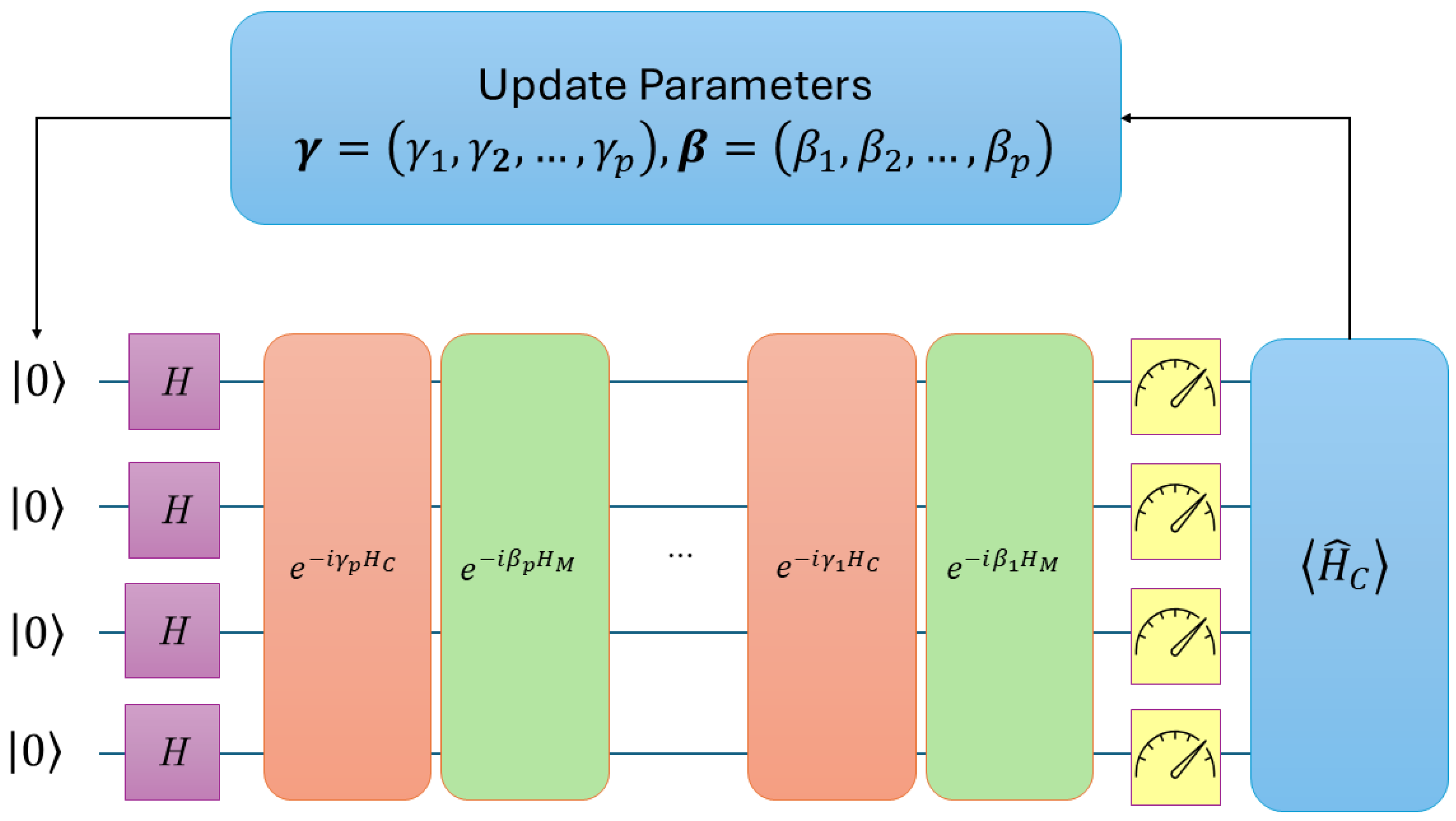
QAOA is a hybrid quantum-classical algorithm designed to solve combinatorial optimization problems on quantum processors. Originally proposed by Farhi et al. [
1], its general workflow proceeds as shown in
Figure 1.
Given a combinatorial optimization problem defined by a cost function over binary variables , the algorithm constructs the following two fundamental Hamiltonians:
The cost Hamiltonian, , which encodes the objective function of the problem into an Ising Hamiltonian.
The mixer Hamiltonian, , where is the Pauli- matrix applied to qubit j.
Starting from the initial state of the system,
, which is obtained by applying a Hadamard gate to each qubit, we then prepare a quantum state by alternating the application of the unitary operators
and
, which depend on the cost and mixer Hamiltonians,
and
, as well as on the variational parameters
and
.
The number of parameter pairs
determines the depth of the algorithm, denoted by
p. The expected value of the cost Hamiltonian over the prepared state is then computed,
A classical optimizer adjusts the parameters
in order to minimize (or maximize, depending on the problem) the expected value of
. The workflow of the QAOA algorithm is represented in
Figure 1.
2.2. Quantum-Informed Recursive Optimization (QIRO)
In 2024, J.R.Finžgar et al. [
4] introduced Quantum-Informed Recursive Optimization (QIRO), a family of hybrid algorithms for solving combinatorial optimization problems. QIRO is inspired by RQAOA, but extends its framework by exploiting both one-point correlations
and two-point correlations
, which are used within a problem-specific update routine.
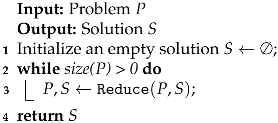
The central routine, Reduce, is shown in Algorithm 1. It takes as input a problem instance P and a partial solution S, and returns a simplified problem together with an updated partial solution .
| Algorithm 1: Reduce |
 |
The routine prepares a low-energy quantum state and extracts the relevant correlations from quantum resources, which are stored in a matrix , referred to as the correlation matrix. The problem P, the partial solution S, and the matrix M are passed to the Simplify routine, which applies the problem-specific simplification rules and updates the solution. The main algorithm is shown in Algorithm 2, where at each iteration, as long as the problem is nontrivial, the Reduce routine is applied to simplify the instance and update the solution.
| Algorithm 2: QIRO |
 |
QIRO supports different methods for quantum state preparation, such as QAOA or adiabatic protocols, being a versatile template for the development of hybrid algorithms, adaptable to different classes of combinatorial problems.
2.3. Quantum Alternating Operator Ansatz
In 2019, Hadfield et al. [
5] proposed a generalization of the QAOA algorithm known as the Quantum Alternating Operator Ansatz (QAOAnsatz). In this approach, state preparation is also carried out through an alternating sequence of parametrized unitary operators that depend on a phase-separation operator,
, and a mixing operator,
.
This formulation allows the design of mixing operators specifically tailored to the constraints of the problem, in contrast to the global
mixer used in QAOA. For the
MVC case, a bit-flip mixer can be employed, whose Hamiltonian takes the form
where
is the set of vertices of the graph
G;
(The degree
of a vertex
i denotes the number of edges incident to that node.) is the degree of
j; and
(The neighborhood
of a vertex
i is the set of all nodes adjacent to it.) is its set of neighbors. The operators
and
correspond to the Pauli-
and Pauli-
matrices applied to vertex
i, respectively, and
denotes the identity operator.
This mixing operator allows the exploration of only the subspace of configurations compatible with the problem constraints, rather than the entire configuration space, thereby eliminating the need to include penalty terms in the cost Hamiltonian. By restricting the search to the space of feasible solutions, the cost function is simplified and takes the form
where the goal is to find the minimum value of the expected value
.
3. Problem Definition
3.1. Minimum Vertex Cover (MVC)
Let
be an undirected graph. A
vertex cover is a subset
such that for every edge
, at least one endpoint belongs to
C. The
Minimum Vertex Cover (MVC) problem consists in finding a vertex cover of minimum cardinality,
3.2. QUBO Formulation
We introduce a binary variable for each vertex
,
where
indicates that vertex
i is included in the vertex cover. Let
be defined as
which counts the number of selected vertices. The MVC problem can then be written as the following constrained optimization problem:
Equation (
9) ensures that each edge
is covered by at least one of its endpoints, while objective Equation (
8) minimizes the number of selected vertices. To obtain an unconstrained binary quadratic model, the constraints can be embedded into the objective function through a penalty term [
6]:
where the penalty factor
assigns a positive penalty to uncovered edges. Equation (
10) is known as the QUBO formulation of the MVC problem. A more convenient QUBO cost function for this problem can be expressed following Lucas [
7]
where the first term penalizes uncovered edges, i.e., assignments with
for some
, and the second term counts the selected vertices. Choosing
A sufficiently larger than
B enforces feasibility by ensuring that solutions with uncovered edges incur a larger objective function value. Hence, optimal solutions of
correspond to Minimum Vertex Covers.
3.3. Ising Formulation
The QUBO objective can be mapped to an Ising cost Hamiltonian by the standard variable transformation
, where
is the Pauli-
Z operator acting on qubit
i [
7]. This yields
Any additive constant in shifts all energies uniformly and contributes only a global phase in the QAOA unitary ; therefore, it does not affect measurement statistics.
3.4. Simplification Rules
The simplification rules designed for the MVC problem are defined as follows:
MVC-1: If , the node with the highest degree among i and j is added to the cover and removed from the graph.
MVC-2: If , both nodes i and j are added to the cover and removed from the graph.
MVC-3: If , all neighbors of node i are added to the cover, and node i is removed from the graph.
MVC-4: If , node i is added to the cover and removed from the graph.
These rules are applied iteratively within the Reduce routine (1) to simplify the graph while preserving feasibility of the vertex cover constraint, and at each step the entry of the correlation matrix M with the largest absolute value is selected as the most informative signal for deciding the simplification rule.
3.4.1. Interpretation of One-Point Correlations
Using the standard binary mapping , a negative expectation value indicates a tendency toward , i.e., selecting vertex i in the cover. In this case, rule MVC-4 adds vertex i to the cover, which cannot uncover edges. Conversely, if , the state favors , corresponding to excluding vertex i. To maintain the cover constraint, all neighbors of i must then be selected, which motivates rule MVC-3.
3.4.2. Interpretation of Two-Point Correlations
For an edge , the configuration does not satisfy the cover constraint. In the Ising representation, this corresponds to and is penalized by the cost Hamiltonian. A nonnegative correlation indicates a tendency toward aligned assignments. Since joint exclusion does not satisfy the cover constraint, rule MVC-2 selects both endpoints. In contrast, a negative correlation indicates anti alignment, which is consistent with selecting exactly one endpoint. Rule MVC-1 therefore adds one of to the cover, choosing the endpoint with a higher degree as a heuristic criterion to cover more incident edges in that step.
3.4.3. Role of the QAOAnsatz Mixer Within QIRO
In QIRO, the reduction step is guided by the correlation matrix extracted from the variational state. In the QAOAnsatz setting considered here, the bit flip mixer restricts the search to the feasible subspace induced by the cover constraint. Although the cost Hamiltonian is expressed in terms of one-body operators, the mixer includes projector terms acting on neighboring vertices, which introduce multi-body products. As a result, the variational state exhibits nontrivial one-point and two-point correlations that capture local graph structure and are shaped by the cover constraint, providing informative entries in M for applying the simplification rules.
4. Methodology
A set of 495 Erdös-Renyi graphs was generated using the Python library
networkX [
8]. The sample covers values of
n in the range
; for each value of
n, different connection probabilities
were considered, ensuring that the sample includes graphs with various edge densities. For each combination of
n and
, nine different graphs were generated using the seeds
. To avoid isolated vertices, the graph generation process included a connectivity check at the vertex level.
For the experimental evaluation, we considered three computational approaches applied to the graph sample: an exact classical solver, QAOA, and QIRO. The classical solution was obtained by solving the MVC using the Gurobi solver, which is widely used in the optimization literature as a reference method for obtaining exact solutions. The resulting optimum defines the reference value for each instance.
In the case of QAOA and QIRO, different configurations were explored by varying the type of mixer (
X-mixer and bit-flip mixer) and the circuit depth (
). These configurations were systematically applied to all graphs in the sample to ensure comparability across algorithms. In the evaluation, a quantum solution was counted as successful only if it formed a valid vertex cover and its cardinality
exactly matched the optimal value
. To quantify solution quality, we define the metric
cover ratio as
Accordingly, the primary performance metric used in this work is the success rate, defined as the percentage of graph instances for which an algorithm produces a solution that satisfies this criterion.
Experimental Setup
All experiments were performed on a local workstation equipped with an Intel Core i7 with 2.80 GHz CPU and 16 GB RAM. The software stack was Python 3.12.10, PennyLane 0.42.3 [
9], SciPy 1.16.1, CVXPY 1.7.2 [
10], and gurobipy 13.0.0 [
11]. Quantum circuits were simulated using the PennyLane
lightning.qubit backend in a noiseless setting.
For QAOA, we used shots = 5000 in all experiments. The variational parameters were optimized with COBYLA using tol = and maxiter = 100, with a single optimization run per instance without restarts. Initial parameters were sampled uniformly at random from , with all values drawn independently from . No fixed pseudo-random seed was enforced for this initialization, and therefore exact bit-level replication of the optimized parameters across independent runs is not guaranteed. After optimization, the circuit was executed again with the optimized parameters to obtain measurement counts. From the measurement counts, we selected the most frequent bitstring and mapped it to the corresponding vertex set .
For QIRO, the state preparation stage used the same QAOA optimization configuration as above with shots = 5000. Correlation estimation was performed using exact expectation values (shots = None) to avoid sampling noise in the one- and two-point correlators used by the simplification rules.
5. Results
This section reports the results obtained for the MVC problem on the benchmark of 495 Erdös-Renyi graph instances described in the previous section.
5.1. QAOA Results
This section reports the results obtained with the QAOA algorithm on the benchmark graph set for different circuit depths and mixer choices.
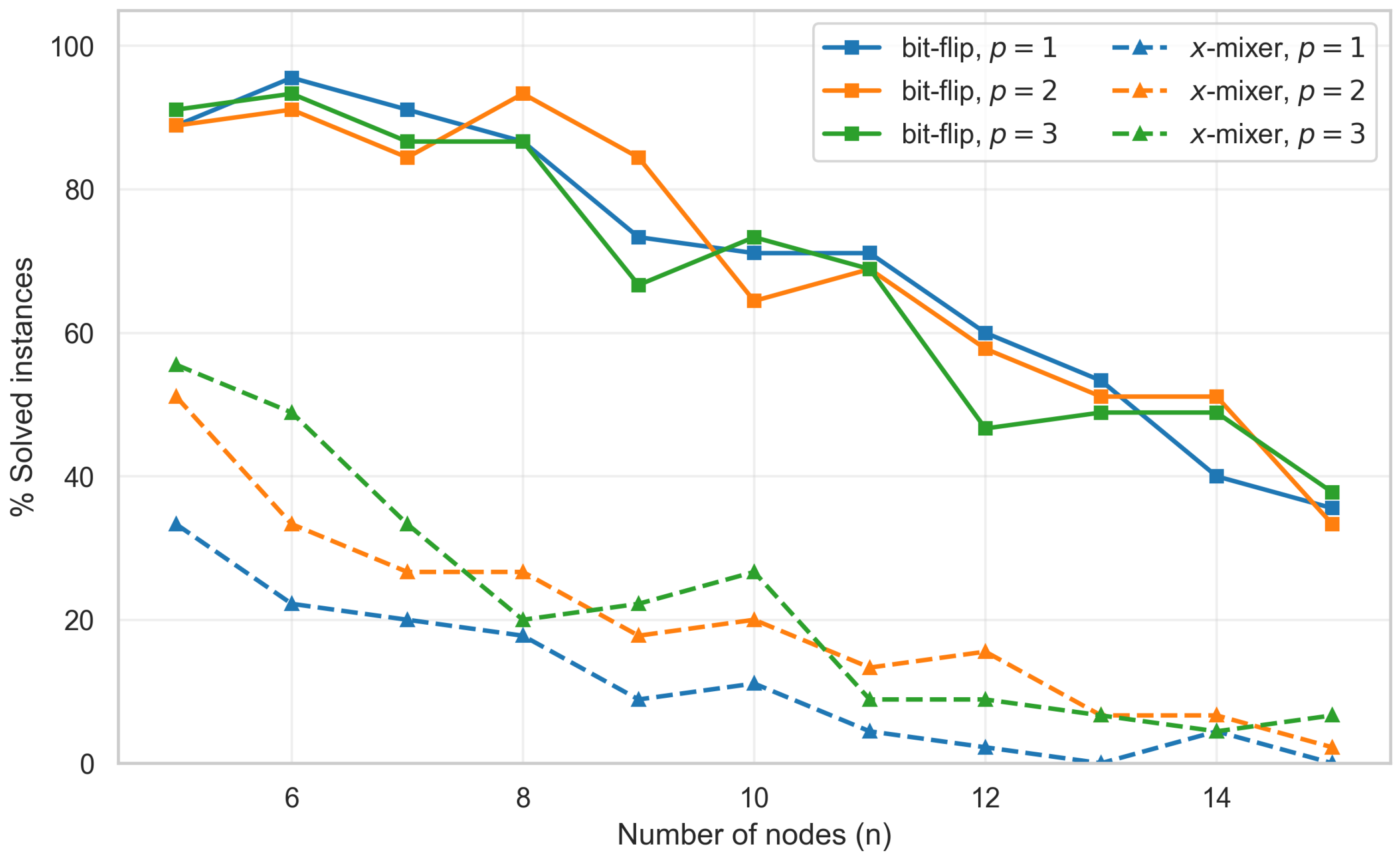
Figure 2 shows the number of successfully solved instances as a function of the number of nodes
n, grouped by circuit depth. For both mixers, the number of solved instances decreases as the graph size increases. Increasing the circuit depth generally leads to a higher number of solved instances, particularly for small and intermediate graph sizes. This effect is more pronounced when the X-mixer is used.
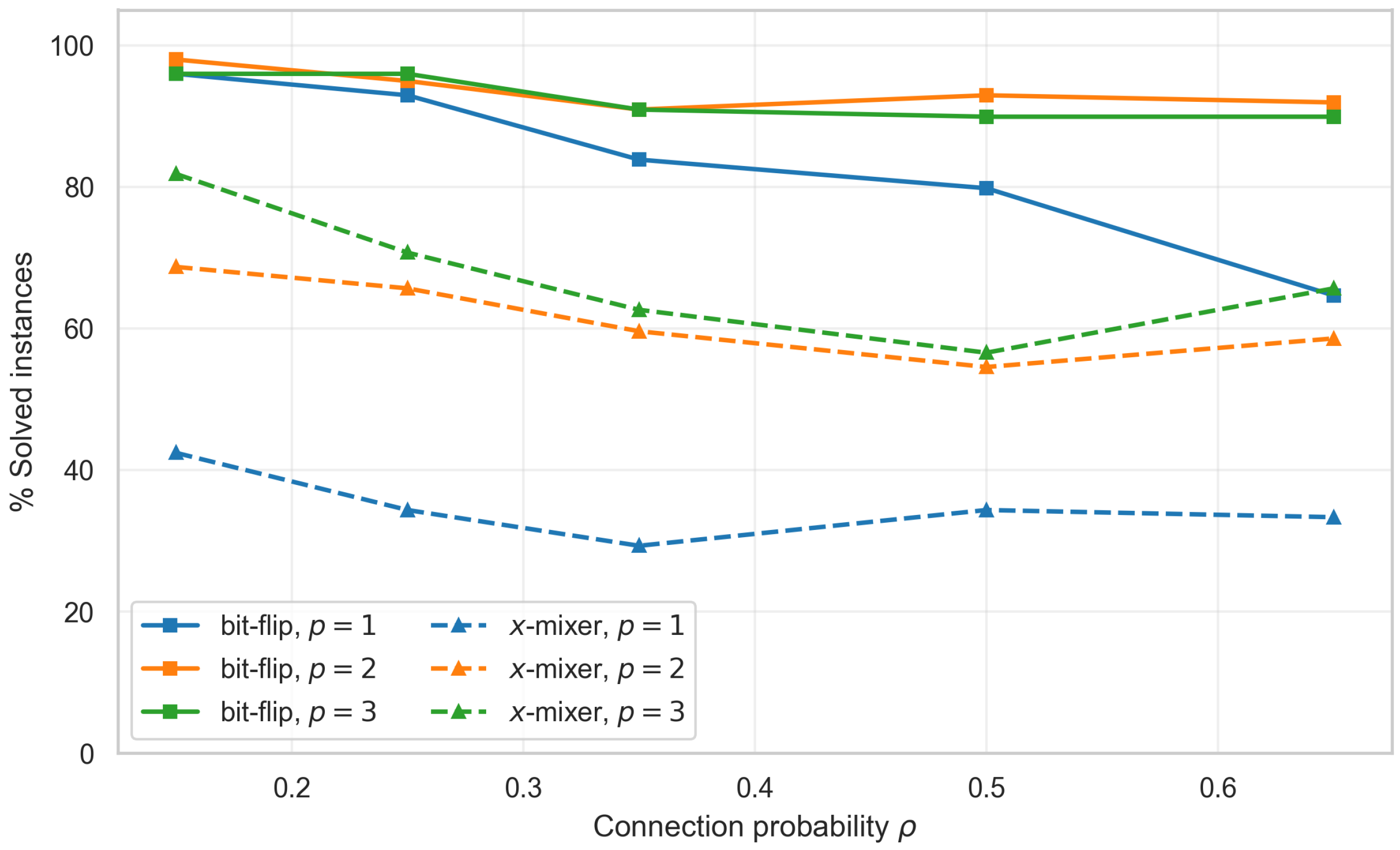
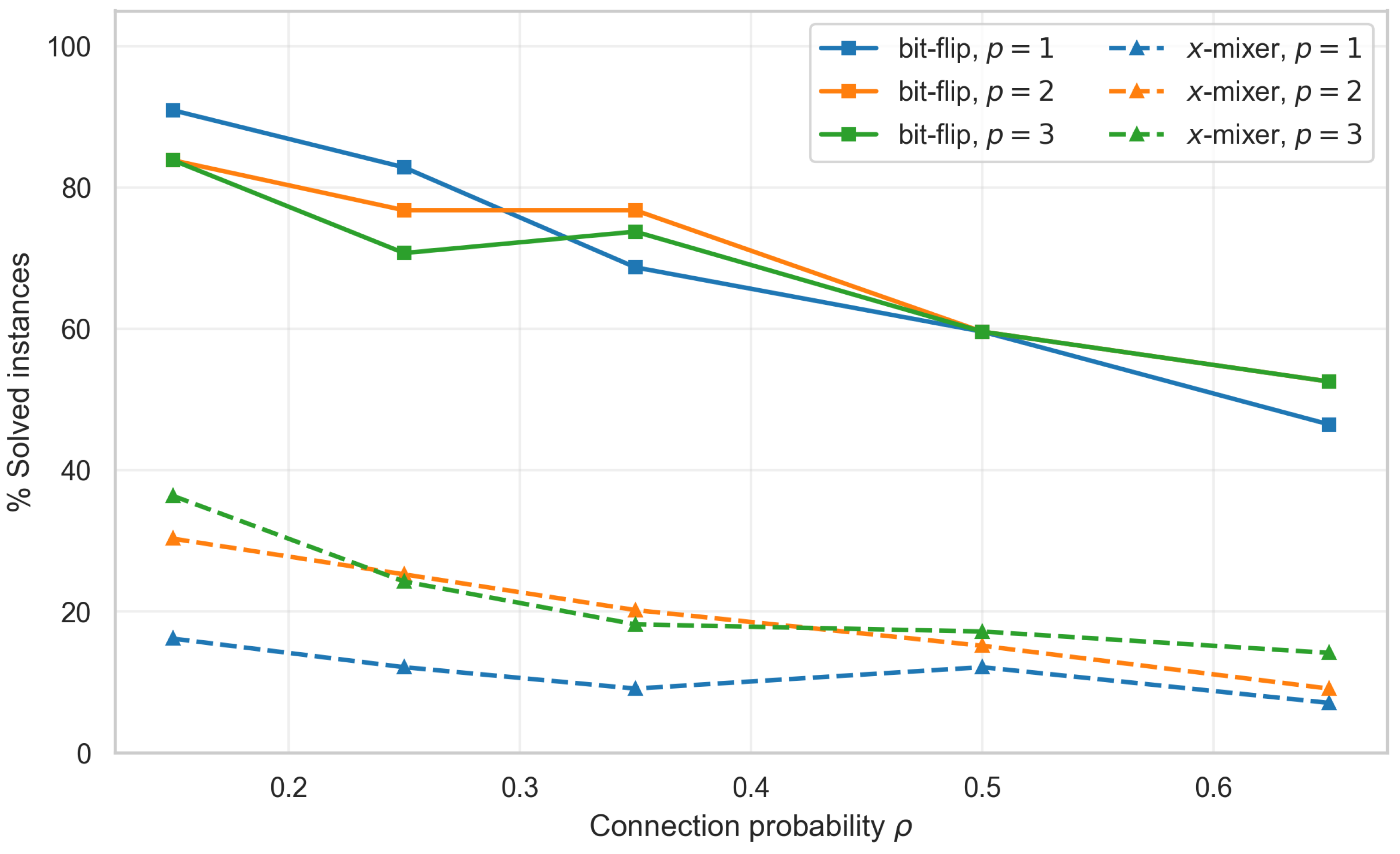
Figure 3 reports the results grouped by the connection probability
. For both mixers, a decreasing trend in the number of solved instances is observed as the graph density increases. The X-mixer benefits more clearly from increasing the circuit depth, whereas for the bit-flip mixer the number of solved instances shows limited variation across depths for the graph set considered.
Taken together, these results show that both mixer choice and circuit depth affect the behavior of QAOA on the Minimum Vertex Cover problem, with the bit-flip mixer yielding a larger number of solved instances across the explored parameter range.
5.2. QIRO Results
This section reports the results obtained by applying the QIRO algorithm to the same benchmark graph set.
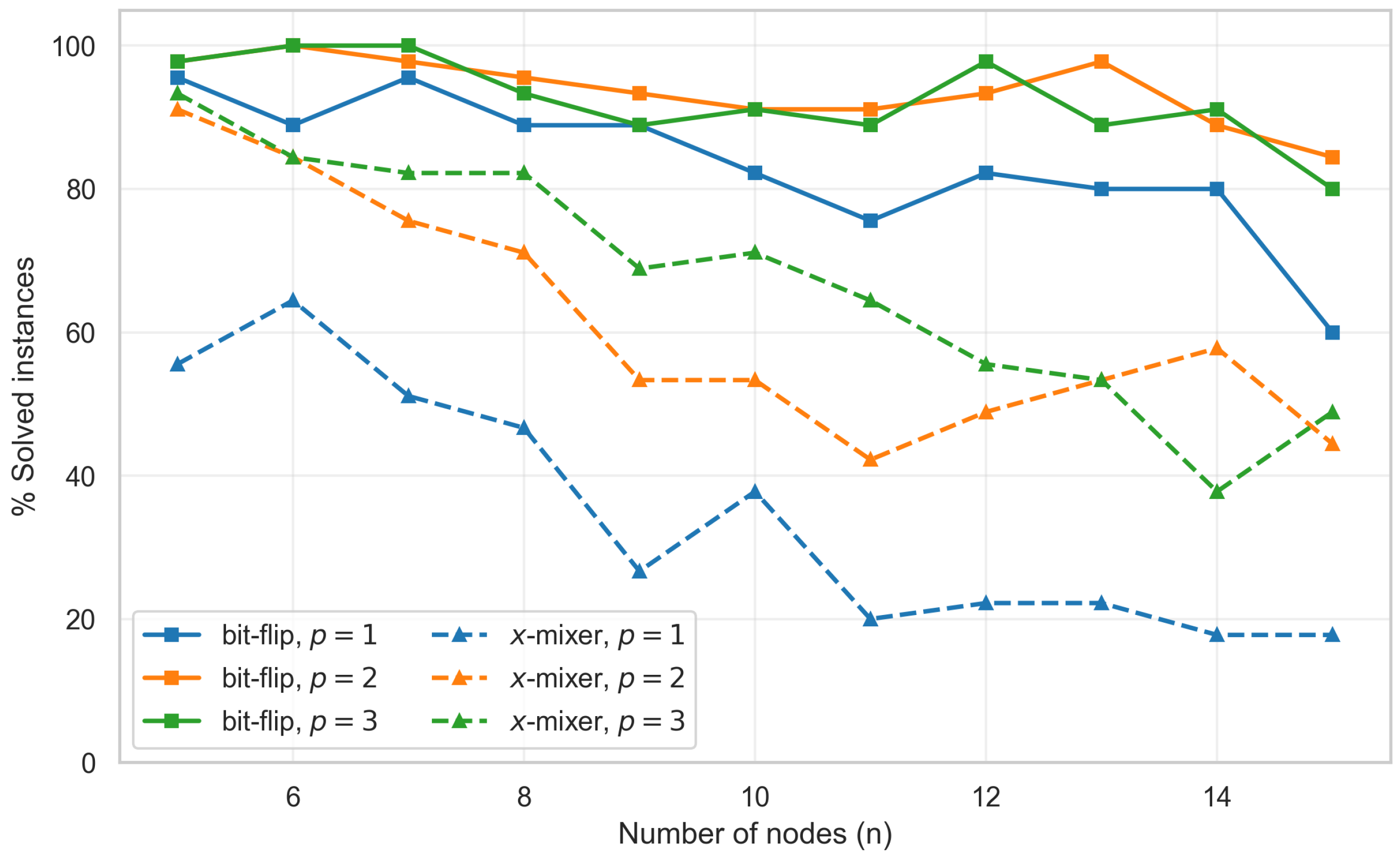
Figure 4 shows the number of successfully solved instances as a function of the number of nodes
n, grouped by circuit depth and mixer choice. When the X-mixer is used, the number of solved instances decreases as the graph size increases. Increasing the circuit depth leads to a higher number of solved instances across most graph sizes.
In contrast, when the bit-flip mixer is employed, QIRO exhibits a different dependence on circuit depth. The number of solved instances increases when moving from one to two layers, while a reduction is observed when the depth is further increased to three layers. Despite this non-monotonic behavior with respect to depth, the number of solved instances remains relatively stable as the graph size grows.
Figure 5 reports the number of solved instances grouped by the connection probability
. For both mixers, the number of solved instances decreases as the graph density increases. Increasing the circuit depth is more beneficial for the X-mixer, whereas for the bit-flip mixer the improvement from one to two layers is not sustained at depth three.
Overall, these results show that within the QIRO framework both mixer choice and circuit depth affect the number of solved instances.
5.3. Comparison Between QAOA and QIRO
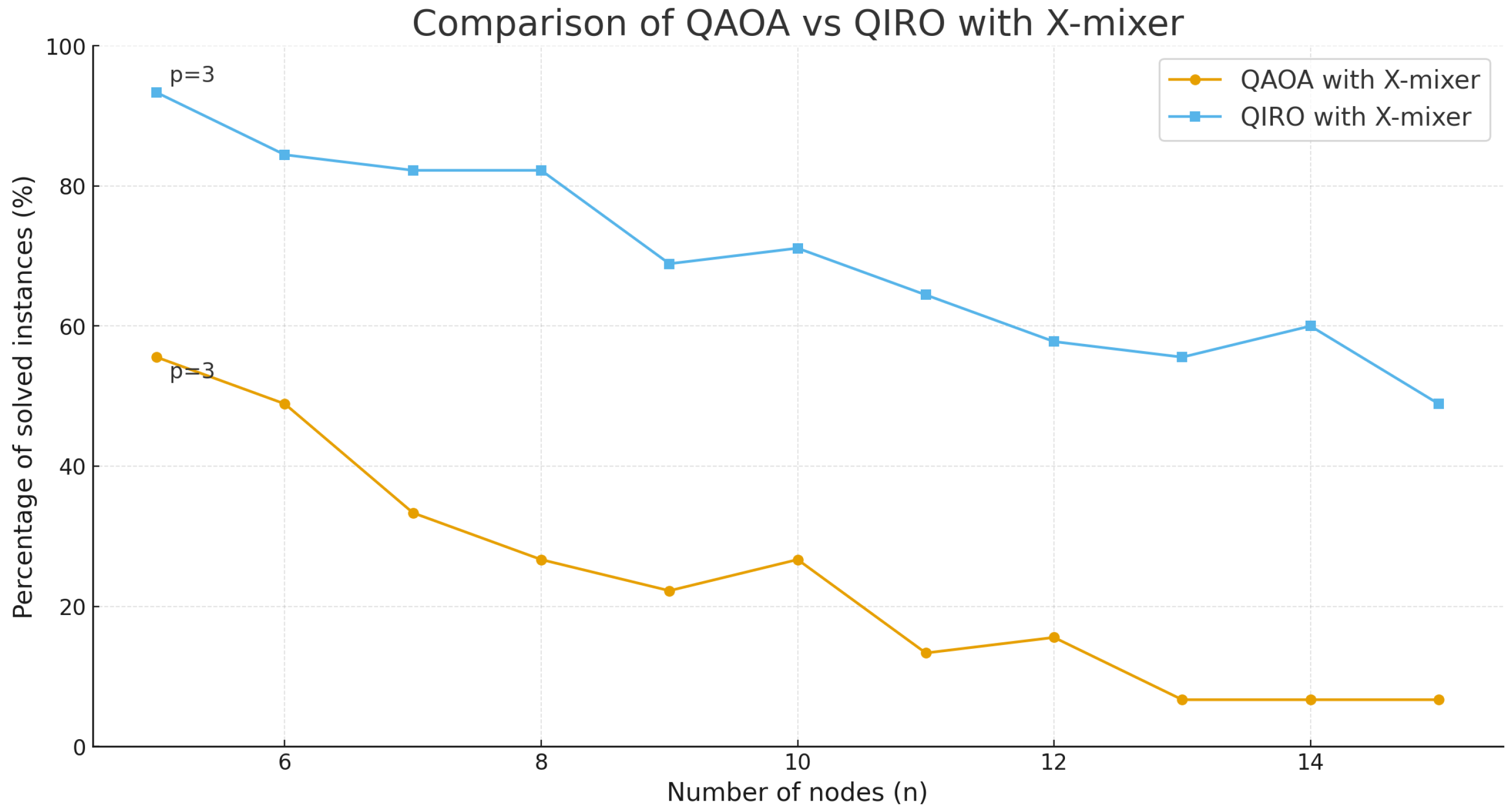
We now compare the results obtained by QAOA and QIRO on the full benchmark of graph instances. The comparison is performed under matched conditions, considering the same set of graphs and evaluating performance in terms of the number of successfully solved instances, as defined in the Methodology.
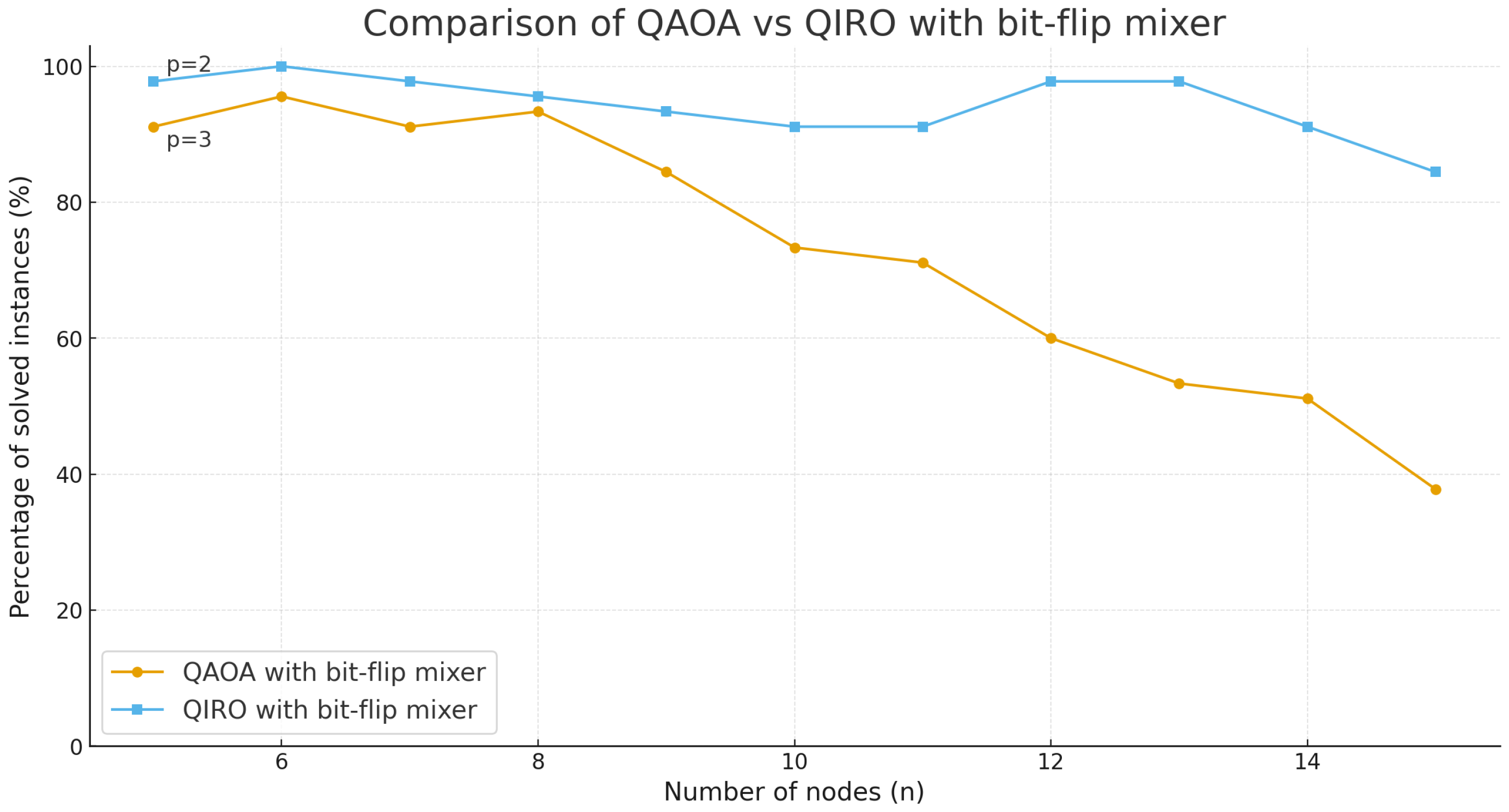
Figure 6 reports the comparison between QAOA and QIRO when the X-mixer is used. For both algorithms, performance decreases as the graph size increases. However, across the explored range of graph sizes, QIRO achieves a higher number of solved instances than QAOA. In this case, the best performing configurations for both algorithms correspond to a circuit depth of
.
Figure 7 shows the corresponding comparison when the bit-flip mixer is employed. QIRO again achieves a larger number of solved instances than QAOA across the benchmark. In this setting, QIRO reaches its highest number of solved instances at a depth of
, whereas increasing the depth to
does not lead to further improvement. By contrast, QAOA exhibits a more pronounced decrease in the number of solved instances as the graph size increases.
Taken together, these results show that QIRO consistently solves a larger number of instances than QAOA for both mixer choices on the considered benchmark. The dependence on circuit depth differs between the two algorithms, particularly when the bit-flip mixer is used, highlighting distinct depth-related behaviors that are examined further in the subsequent analysis.
To assess whether the observed differences are statistically meaningful, we next perform a formal statistical analysis based on paired outcomes.
5.4. Statistical Analysis
Statistical comparisons were performed on paired binary outcomes over the same benchmark of 495 graph instances. Pairwise differences between two configurations were assessed using McNemar’s exact test, which is appropriate for matched binary data. For each comparison, we report the discordant counts and , where denotes the number of instances solved by configuration A but not by configuration B, and denotes the number of instances solved by B but not by A.
For all McNemar tests considered in this section, the null hypothesis is that both configurations perform equally well on the benchmark, meaning that the probabilities of the two types of discordant outcomes are equal,
Rejection of this hypothesis indicates a systematic difference in success rates between the compared configurations. Statistical significance is evaluated at the significance level . Accordingly, a difference is considered statistically significant when the corresponding p-value is smaller than .
We first compared QAOA and QIRO at fixed circuit depth for each mixer. Under the X-mixer, QIRO solves a significantly larger number of instances than QAOA for
, as evidenced by the strong imbalance between
and
in
Table 1 and the associated
p-values well below
. The same conclusion holds under the bit-flip mixer, where QIRO again outperforms QAOA at all considered depths (
Table 2).
We then analyzed the effect of increasing circuit depth from
to
within each algorithm. Under the X-mixer, no statistically significant difference is observed for QAOA, whereas the improvement observed for QIRO is statistically significant (
Table 1). In contrast, under the bit-flip mixer, the differences between depths
and
are not statistically significant for either QAOA or QIRO (
Table 2).
6. Discussion
The results reported in this work show systematic differences between QAOA and QIRO when applied to the Minimum Vertex Cover problem, as well as a clear dependence on the choice of mixer and circuit depth. Across the considered benchmark, QIRO solves a larger number of instances than QAOA, indicating that the recursive reduction mechanism is able to exploit information extracted from the variational state in a consistent manner.
Differences in behavior as a function of circuit depth are observed between the two mixers. When the bit-flip mixer is used, both algorithms improve when increasing the depth from to , while no further improvement is observed at . In contrast, when using the X mixer, the number of solved instances increases more steadily with depth, particularly in the case of QIRO. This suggests that the constraints imposed by the mixer influence how information encoded in the variational state is distributed and subsequently used during the reduction process.
The degradation observed at depth in some configurations can be interpreted in terms of the structure of the feasible subspace explored by the QAOAnsatz mixer. At low circuit depths, the variational state tends to remain localized in structured regions of the feasible space, giving rise to correlation patterns that are informative for guiding the reduction step in QIRO. As the depth increases, the state explores the feasible subspace more uniformly, which leads to smoother correlation profiles and reduces their usefulness for driving simplification decisions.
Limitations and Future Work
This study is subject to several limitations. First, the analysis is restricted to Erdös-Renyi graphs of moderate size, which limits conclusions regarding scalability and performance on structured graphs or graph families arising from specific applications. Second, the evaluation relies on a strict optimality criterion, counting only solutions that exactly match the classical optimum, which may underestimate the relevance of near-optimal solutions in larger instances. Third, the performance of the considered algorithms depends on the variational optimization procedure, which has not been analyzed in detail in this work.
Future work could extend the present analysis to larger instances and to other classes of graphs, as well as to executions on NISQ hardware. In addition to the Minimum Vertex Cover problem considered here, it would be of interest to investigate the behavior of QIRO on other combinatorial optimization problems beyond those previously studied, such as Maximum Independent Set and Max-2-SAT. In particular, problems with different constraint structures or cost-function landscapes could help to clarify the generality of the recursive reduction mechanism. Further directions include the exploration of alternative mixers and adaptive circuit constructions, as well as a more detailed analysis of the computational cost of the classical components involved in QIRO.
Author Contributions
Conceptualization, P.R.-R., A.M.F.-J., J.E.R.-R. and I.J.-M.; methodology, P.R.-R.; software, P.R.-R.; validation, P.R.-R.; formal analysis, P.R.-R.; investigation, P.R.-R.; writing—original draft, P.R.-R., A.M.F.-J., J.E.R.-R. and I.J.-M.; writing—review and editing, P.R.-R., A.M.F.-J., J.E.R.-R. and I.J.-M.; visualization, P.R.-R., J.E.R.-R. and I.J.-M.; supervision, P.R.-R. and A.M.F.-J. All authors have read and agreed to the published version of the manuscript.
Funding
This research received no external funding.
Data Availability Statement
The raw data supporting the conclusions of this article will be made available by the authors on request.
Conflicts of Interest
The authors declare no conflicts of interest.
References
- Farhi, E.; Goldstone, J.; Gutmann, S. A Quantum Approximate Optimization Algorithm. arXiv 2014, arXiv:1411.4028. [Google Scholar] [CrossRef] [Scilit]
- Bravyi, S.; Kliesch, A.; Koenig, R.; Tang, E. Obstacles to Variational Quantum Optimization from Symmetry Protection. Phys. Rev. Lett. 2020, 125, 260505. [Google Scholar] [CrossRef] [Scilit] [PubMed]
- Blekos, K.; Brand, D.; Ceschini, A.; Chou, C.H.; Li, R.H.; Pandya, K.; Summer, A. A review on Quantum Approximate Optimization Algorithm and its variants. Phys. Rep. 2024, 1068, 1–66. [Google Scholar] [CrossRef] [Scilit]
- Finžgar, J.R.; Kerschbaumer, A.; Schuetz, M.J.; Mendl, C.B.; Katzgraber, H.G. Quantum-Informed Recursive Optimization Algorithms. PRX Quantum 2024, 5, 020327. [Google Scholar] [CrossRef] [Scilit]
- Hadfield, S.; Wang, Z.; O’Gorman, B.; Rieffel, E.G.; Venturelli, D.; Biswas, R. From the Quantum Approximate Optimization Algorithm to a Quantum Alternating Operator Ansatz. Algorithms 2019, 12, 34. [Google Scholar] [CrossRef] [Scilit]
- Glover, F.; Kochenberger, G.; Hennig, R.; Du, Y. Quantum Bridge Analytics I: A tutorial on formulating and using QUBO models. Ann. Oper. Res. 2022, 314, 141–183. [Google Scholar] [CrossRef] [Scilit]
- Lucas, A. Ising formulations of many NP problems. arXiv 2013, arXiv:1302.5843. [Google Scholar] [CrossRef] [Scilit]
- Hagberg, A.A.; Schult, D.A.; Swart, P.J. Exploring Network Structure, Dynamics, and Function using NetworkX. Python Sci. Conf. 2008. [Google Scholar] [CrossRef] [Scilit]
- Bergholm, V.; Izaac, J.; Schuld, M.; Gogolin, C.; Ahmed, S.; Ajith, V.; Alam, M.S.; Alonso-Linaje, G.; AkashNarayanan, B.; Asadi, A.; et al. PennyLane: Automatic differentiation of hybrid quantum-classical computations. arXiv 2022, arXiv:1811.04968. [Google Scholar]
- Diamond, S.; Boyd, S. CVXPY: A Python-embedded modeling language for convex optimization. J. Mach. Learn. Res. 2016, 17, 1–5. [Google Scholar]
- Gurobi Optimization, LLC. Gurobi Optimizer Reference Manual; Gurobi Optimization, LLC: Beaverton, OR, USA, 2025. [Google Scholar]
| Disclaimer/Publisher’s Note: The statements, opinions and data contained in all publications are solely those of the individual author(s) and contributor(s) and not of MDPI and/or the editor(s). MDPI and/or the editor(s) disclaim responsibility for any injury to people or property resulting from any ideas, methods, instructions or products referred to in the content. |



 ,
,