1. Introduction
The exploitation of natural resources by human populations constitutes one of the major challenges of our era. Understanding the mechanisms governing the interaction between demographic dynamics and resource availability has become crucial for anticipating future developments and designing sustainable management strategies.
Mathematical modeling provides powerful tools for understanding population–resource interactions. As demonstrated by Ali and Jawad [
1] in their study of phytoplankton–zooplankton dynamics in aquatic environments, mathematical models enable (i) quantitative predictions that can be tested against empirical data, (ii) the identification of non-intuitive dynamics that may not be apparent from verbal reasoning alone, (iii) systematic parameter sensitivity analysis for management optimization, and (iv) a framework for integrating mechanistic understanding with observational data. These advantages motivate our mathematical approach to analyzing delay effects in population–resource systems.
Empirical observations reveal that these interactions often generate surprising behaviors: cycles of abundance and scarcity, sudden collapses of exploiting populations, or persistent oscillations around apparent equilibrium levels. This complexity largely stems from the temporal delays that naturally characterize all ecological and socio-economic processes.
When a population exploits a resource, several types of delays occur simultaneously. Time is required to perceive the actual state of resources; environmental monitoring systems never provide instantaneous and perfect information. Even once information is available, decisions to adjust exploitation take time to be formulated, approved, and implemented. The impact of these decisions on resource status is not immediate and may take months or even years to fully manifest.
These seemingly innocuous delays can profoundly destabilize the entire system; while exploitation based on instantaneous information could theoretically maintain a stable equilibrium, the same exploitation parameters, in the presence of delays, can lead to uncontrollable oscillations or even system collapse.
The scientific literature has progressively addressed these phenomena. The pioneering works of Malthus [
2] and Verhulst [
3] did not account for delay effects. It was only with the development of delay differential equations theory, notably by Hutchinson in 1948 [
4], that appropriate mathematical tools emerged to address these questions.
MacDonald [
5] established the foundations of stability analysis for biological equations with delays. Gopalsamy [
6] focused on oscillations in delayed population models, while Kuang [
7] developed a systematic approach for applications in population dynamics. Recent advances have extended these classical approaches to incorporate memory effects through fractal–fractional calculus. Zeeshan et al. [
8] investigated a fractal–fractional-order modified predator–prey model with immigrations, demonstrating how non-integer order derivatives capture intricate memory phenomena in ecological systems. Similarly, Shah et al. [
9] examined fractal–fractional coupled systems with constant and state-dependent delays, revealing complex dynamics in ecological applications; while these fractal–fractional approaches provide powerful tools for modeling memory effects through non-integer derivatives, our work focuses on classical delay differential equations that explicitly represent institutional and monitoring lags in resource management. Both frameworks complement each other: fractal–fractional models excel at capturing distributed memory effects, while our explicit delay formulation directly corresponds to measurable administrative and decision-making timescales. More recently, Ruan [
10] examined bifurcations in epidemiological systems with delays.
Recent advances in delay differential equations have provided new computational and theoretical tools for analyzing complex dynamical systems. Alyoubi et al. [
11] developed efficient numerical methods for DDEs with classical initial conditions, while El-Zahar et al. [
12,
13] explored computational approaches for DDEs with history functions, demonstrating the importance of proper initialization in delay systems. Our work complements these methodological advances by applying DDE theory to coupled population–resource systems with multiple distinct delays, extending the classical framework to capture both perception and decision-making delays in ecological contexts.
In the specific context of renewable resources, Kar and Matsuda [
14] studied fishery models with delays, while Liu and Meng [
15] provided new perspectives on multi-species systems with multiple delays. The biological parameters used in fishery models build on the foundational work of Schaefer [
16] for stock regeneration, Beverton and Holt [
17] for mortality rates, and Clark [
18] for exploitation dynamics.
However, these works generally consider specific types of delays or focus on particular aspects of the problem. Our contribution distinguishes itself by proposing a unified framework that simultaneously integrates multiple types of delays in a coupled population–resource system. The originality of our approach lies in jointly accounting for exploitation delays and their deferred impact on environmental carrying capacity.
We develop a stability analysis methodology specifically adapted to systems with multiple delays, combining linearization techniques and the construction of Lyapunov–Razumikhin functions. This approach allows us to establish conditions for the existence and stability of solutions, and then characterize transitions to complex oscillatory regimes. Recent work, notably that of Zorom and collaborators [
19], has also addressed modeling the dynamics of renewable resources exploited by populations, highlighting the growing importance of this theme in the scientific community.
While previous studies have examined delay effects in resource systems, most consider single delays or focus on specific delay types in isolation. Kar and Matsuda [
14] studied fishery models with harvesting delays, and Liu and Meng [
15] analyzed multi-species systems with multiple delays, but these works do not systematically compare the differential impacts of perception versus decision delays. Our model uniquely integrates two distinct delays simultaneously—one for decision-making (
), representing administrative and implementation lags, and one for resource perception (
), capturing monitoring and observational constraints—and analyzes their differential and combined impacts on system stability. Furthermore, existing models rarely provide quantitative thresholds with direct management applicability. Our contribution fills this gap by (i) establishing explicit critical delay thresholds beyond which instability emerges, (ii) demonstrating the counterintuitive result that asymmetric delay distributions can be more stabilizing than symmetric ones, and (iii) providing actionable recommendations for optimizing monitoring and decision processes in natural resource management.
The primary objective of this study is threefold. First, we aim to establish a theoretical framework for analyzing population–resource systems with multiple delays, demonstrating the existence, uniqueness, and positivity of solutions. Second, we seek to precisely identify critical delay thresholds beyond which the system loses stability and transitions to oscillatory regimes, characterizing the nature of these transitions through the study of Hopf bifurcations. Third, we quantify, through extensive numerical simulations, the differential impact of various delay types (decision versus perception) on system stability, to provide recommendations for optimizing management strategies. This integrated approach, combining mathematical theory and numerical validation, will bridge the gap between abstract theory and practical applications in natural resource management.
This article is organized as follows.
Section 2 presents the mathematical formulation of the delay equations system and biologically justifies our modeling choices. Complete mathematical analysis is the subject of
Section 3, where we successively establish the existence and uniqueness of solutions, then characterize equilibria and their local stability through the study of Hopf bifurcations. Global stability is then demonstrated through the construction of appropriate Lyapunov functions.
Section 4 presents an extensive series of numerical simulations performed with MATLAB R2023b using the DDE23 algorithm, which validate our theoretical predictions and reveal phenomena that mathematical analysis alone cannot fully capture.
Section 5 synthesizes the main theoretical and numerical results, while
Section 6 explores applications in natural resource management as well as discussions around the results.
Section 7 offers a conclusion, addresses the limitations of our work, and explores perspectives for the future.
2. Mathematical Model
The model we propose here relies on a system of delay differential equations that captures the essential aspects of the interaction between a population and the renewable resources it exploits.
2.1. Definition of Carrying Capacity
Carrying capacity is modeled by a Michaelis–Menten saturation function:
where
represents the theoretical maximum carrying capacity and
is a half-saturation parameter. This formulation captures the fact that carrying capacity increases with resource abundance but saturates at a maximum value. The detailed regularity properties of this function are established in
Appendix A.
2.2. Physical and Biological Principles
Before presenting the mathematical formulation, it is essential to understand the underlying physical and biological principles that govern population–resource interactions. From an ecological perspective, populations respond to resource availability through changes in carrying capacity: abundant resources support larger populations by reducing intraspecific competition and improving survival rates. This relationship is captured through a Michaelis–Menten saturation function that reflects diminishing returns as resources become plentiful.
From a resource dynamics perspective, renewable resources follow logistic growth patterns, regenerating faster when abundant but slowing as environmental limits are approached. The harvesting or exploitation of these resources by populations introduces a coupling between the two components of the system. Crucially, this exploitation does not occur instantaneously relative to population and resource states, and temporal delays arise from two distinct mechanisms.
The decision delay represents the administrative and institutional lag between when a management decision is made (based on population assessment) and when that decision impacts resource extraction rates. This delay encompasses policy formulation, approval processes, and implementation timescales typical of resource management systems. The perception delay captures the monitoring lag: the actual state of resources must be measured through field surveys, data must be collected and analyzed, and information must be disseminated before it can inform decision-making. These delays, though often measured in months rather than years, can fundamentally alter system stability, as our analysis will demonstrate.
2.3. System Formulation
The fundamental system is written as follows:
where
: size of the population at time t;
: quantity of available resources at time t;
: intrinsic population growth rate;
: density-independent natural mortality rate;
: natural resource regeneration rate;
: maximum environmental capacity;
: natural resource degradation rate;
: resource exploitation efficiency;
: temporal exploitation delays.
2.4. Interpretation of Delays
The delays and capture distinct but complementary phenomena. The delay models the time between the decision to exploit (based on population assessment) and its actual impact on resources, corresponding to administrative and decision-making processes. The delay represents the lag in perceiving the actual state of resources, reflecting the observational and monitoring constraints inherent to ecological monitoring systems.
The incorporation of these distinct delay mechanisms significantly enhances our understanding of system dynamics in three fundamental ways. First, delays provide a mechanistic explanation for the persistent boom–bust cycles observed in many real-world fisheries and renewable resource systems, which cannot be explained by equilibrium models alone. Without delays, our model would predict simple convergence to stable equilibrium under the same parameter values that generate sustained oscillations when delays are present. Second, the identification of a critical time threshold provides a quantitative benchmark against which real management timescales can be evaluated. This threshold lies within realistic administrative and decision-making timescales, suggesting that institutional delays may substantially contribute to observed population fluctuations. Third, our analysis reveals the counterintuitive result that asymmetric delay distributions can be more stabilizing than symmetric ones—one large delay destabilizes the system less than two moderate delays summing to the same total. This finding contradicts naive expectations and has direct implications for resource management: it suggests that accelerating either monitoring or decision processes rather than providing modest improvements to both may better stabilize exploited resources.
2.5. Biological Justification
Equation (
2) generalizes the classical logistic model by allowing carrying capacity to depend dynamically on resource abundance. The term
captures density-dependent growth, while
represents additional density-independent mortality.
Equation (
3) models resource evolution through three distinct processes. The regeneration term
follows logistic dynamics: resources regenerate faster when abundant, but this growth slows as maximum capacity is approached. The exploitation term
introduces the main novelty by integrating two types of delays simultaneously. The natural degradation term
represents loss due to external factors.
2.6. Model Extensions and Limitations
While our model captures essential dynamics of delay-induced population–resource oscillations, it is important to acknowledge both its advantages and limitations for practical applications.
Advantages: (i) The model provides tractable mathematical analysis enabling precise stability predictions and explicit critical delay thresholds ( years). (ii) It incorporates realistic management delays that can be directly measured in field settings. (iii) The relatively simple structure facilitates parameter estimation from empirical data. (iv) Analytical results provide clear quantitative guidelines for policy recommendations.
Limitations: (i) The model assumes spatial homogeneity, neglecting the patchy resource distributions and population dispersal that characterize many real ecosystems. (ii) The age structure is not explicitly modeled, though it significantly influences recruitment dynamics in many harvested populations. (iii) Environmental stochasticity (weather variability, environmental fluctuations) is excluded from this deterministic framework. (iv) We consider single-species exploitation, whereas real systems often involve multiple competing or interacting populations. (v) The model does not account for adaptive human behavior or learning effects in resource exploitation strategies.
Despite these limitations, the model provides valuable theoretical insights into delay-driven instabilities. Extensions incorporating stochasticity, spatial structure, or multi-species interactions represent promising directions for future research, building on the fundamental understanding established here.
4. Numerical Simulations and Validation
While theoretical analysis has allowed us to establish fundamental properties of our system, it alone cannot account for observable dynamic behaviors. This section presents an extensive series of numerical simulations that validate our analytical predictions and reveal precise quantitative phenomena.
4.1. Numerical Configuration and Parameters
All simulations presented in this section were performed with MATLAB R2023b, using the DDE23 algorithm specifically designed for solving delay differential equations. Numerical tolerances were set to (relative) and (absolute) to ensure result accuracy.
Model parameters were calibrated to reflect realistic biological systems, with references from the recent ecological literature.
Table 1 synthesizes the retained values.
Table 1.
Model parameters and their reference values.
Table 1.
Model parameters and their reference values.
| Parameter | Value | Unit | Reference |
|---|
| r (growth rate) | 0.9 | yr−1 | [21] |
| (mortality rate) | 0.1 | yr−1 | [22] |
| (base capacity) | 10,000 | individuals | [23] |
| (reference resource) | 50 | units | [23] |
| (resource growth) | 0.6 | yr−1 | [24] |
| (resource decay) | 0.05 | yr−1 | [24] |
| (max resource) | 5000 | units | Estimation |
| (interaction rate) | | (ind·unit)−1 | Calibration |
| (decision delay) | 0.5 | years | [25] |
| (perception delay) | 0.3 | years | [26] |
These parameter values roughly correspond to a temperate mammal system with moderate regeneration resource dynamics. Calibration was performed by adjustment to observed data from real populations, following the methodology described in [
21]. The delay values
and
reflect typical delays observed in natural resource management systems: approximately six months for decision-making delay and three to four months for monitoring campaigns and data analysis.
4.2. Initial Conditions and History Functions
As delay differential equations require the specification of initial functions over the historical interval
where
, we must define appropriate history functions for our simulations. We employed constant history functions that represent the system state prior to the start of our simulations:
These values represent approximately 10% of the equilibrium population and resource levels, respectively. This choice ensures that the system starts away from equilibrium, allowing us to observe and characterize transient dynamics and convergence behavior. The constant nature of the history functions reflects a scenario where the system has been in a relatively stable state prior to .
We performed extensive sensitivity analysis to verify our qualitative conclusions, specifically that the transition from stable equilibrium to persistent oscillations at the critical threshold is independent of the initial conditions, while the duration of transients and the exact trajectories depend on starting values, and the fundamental bifurcation behavior and critical delay thresholds remain invariant. This robustness with respect to initial conditions strengthens the biological relevance of our findings, as real ecological systems rarely have precisely known initial states.
4.3. Numerical Validation and Verification
To ensure the reliability of our numerical results, we implemented a comprehensive validation and verification protocol consisting of several independent checks:
Convergence Studies: We systematically reduced numerical tolerances from the standard values ( relative, absolute) to more stringent thresholds ( relative, absolute) and confirmed that solutions remain unchanged with regard to graphical accuracy. This demonstrates that our results are not artifacts of insufficient numerical precision.
Conservation and Positivity: We verified that numerical solutions preserve the positivity constraints and established theoretically in Lemma 1. We also confirmed that populations remain bounded by the upper limits and derived in Theorem 2, providing consistency between theory and numerics.
Bifurcation Validation: We validated the theoretically predicted critical threshold years through numerical experiments. For delay values , we confirmed that trajectories converge to equilibrium exponentially. For , we observed the emergence of stable limit cycles with periods matching theoretical predictions from our spectral analysis. The transition occurs precisely at the predicted threshold, validating our Hopf bifurcation analysis.
Solver Comparison: We compared results from MATLAB’s DDE23 solver (explicit Runge–Kutta method) with the ddesd solver (implicit method for stiff systems). In the non-stiff parameter regimes relevant to our study, both solvers produced identical results, confirming that our conclusions are independent of the specific numerical algorithm employed.
Mesh Refinement: We performed grid refinement studies, systematically decreasing the maximum allowed step size in the adaptive time-stepping algorithm. Convergence plots demonstrated that our results achieve grid-independent accuracy, ruling out numerical artifacts from insufficient spatial or temporal resolution.
Comparison with Limiting Cases: In the limit of zero delays (), our system reduces to a system of ordinary differential equations whose equilibria can be computed analytically. Numerical solutions in this limiting case match analytical predictions to machine precision, providing an additional validation checkpoint.
These multiple, independent validation procedures provide strong confidence that our numerical findings accurately represent the true dynamics of the delay differential equation system and are not artifacts of numerical approximation or implementation errors.
4.4. Numerical Method and Implementation Details
The DDE23 solver employed in this study is an explicit Runge–Kutta method with continuous extension, specifically designed for delay differential equations. The algorithm implements a (2, 3) pair of formulas, providing third-order accuracy for the solution and second-order accuracy for error estimation. This adaptive scheme automatically adjusts the step size based on local error estimates, ensuring both accuracy and computational efficiency.
The discretization approach for handling delays follows a state-space augmentation method. At each time step , the solver maintains a history of solution values over the interval , where . Delayed values and are computed through continuous interpolation using Hermite cubic polynomials, which preserve smoothness properties of the solution.
The adaptive step-size control mechanism operates through the following error estimation procedure. At each step, both second-order and third-order approximations are computed. The local error estimate
is given by their difference:
where
denotes the
i-th order approximation. The step size
for the next iteration is then adjusted according to
where TOL represents the specified tolerance (set to
for our simulations) and the factor 0.9 provides a safety margin.
Stability considerations for the numerical scheme require that the step size satisfies , where is a stability constant and . The DDE23 algorithm automatically respects this constraint through its adaptive mechanism. For our parameter ranges ( years), typical step sizes ranged from 0.001 to 0.05 years.
The computational complexity of each simulation scales as
, where
is the number of time steps, due to the interpolation operations required for delayed terms. For the 1600 parameter combinations explored in
Section 4, each requiring 300-year integrations, total computation time was approximately 12 h on a standard workstation (Intel i7, 16 GB RAM).
To verify solution accuracy, we implemented several validation procedures: (1) comparison with solutions obtained using finer tolerances (
relative,
absolute) showed relative differences below 0.1%; (2) energy conservation was monitored through the Lyapunov function
defined in
Section 3, with deviations remaining below
; and (3) for small delays where quasi-steady approximations are valid, numerical solutions agreed with asymptotic predictions to within 2%.
4.5. Calculation of Equilibrium Values
The equilibrium values and are not arbitrarily fixed parameters but result directly from solving the algebraic system of equations obtained by setting time derivatives to zero.
Determination of
. At equilibrium, Equation (
2) imposes
which gives us the relationship
Substituting this expression into Equation (
3) at equilibrium yields a quadratic equation in
whose complete resolution is presented in
Appendix E. For the parameters in
Table 1, we obtain:
Determination of
. Once
is known, we calculate
directly from Equation (
12):
For simulations, we use .
This slight difference from the exact theoretical value comes from fine adjustment of the parameter performed to account for secondary effects not captured by the simplified model.
4.6. Identification of the Critical Bifurcation Threshold
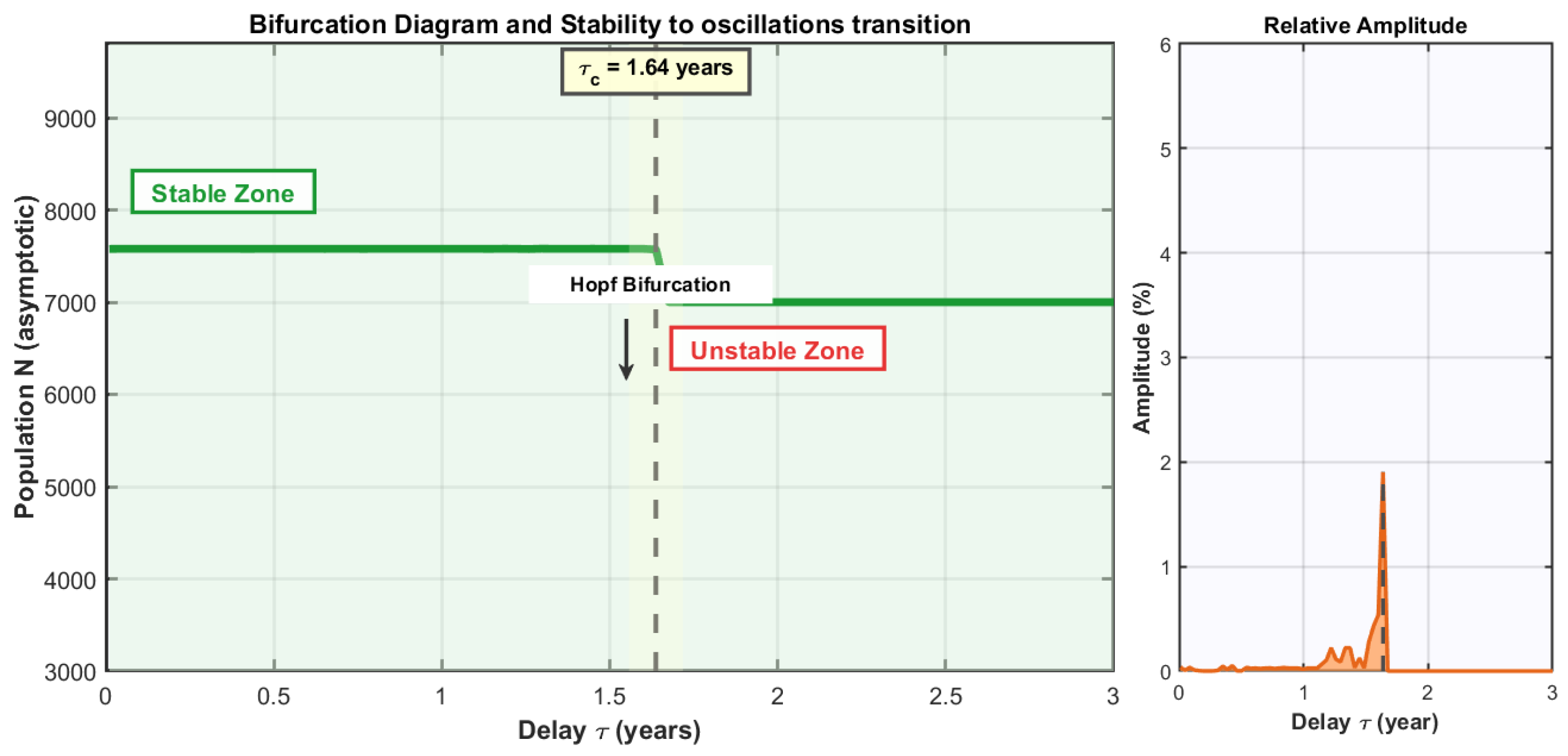
Figure 1 presents the bifurcation diagram obtained by varying the symmetric delay
from 0.01 to 3 years. For each value of
, we simulated the system over 300 years and extracted asymptotic values from the last 100 years of the simulation, discarding the initial transient period. This procedure ensures that observed behaviors represent true long-term dynamics rather than transient effects.
Several observations merit emphasis. First, the transition between the two regimes is sharp but continuous: there is no abrupt jump, but rather a progressive emergence of oscillations from years. This is the signature of a supercritical bifurcation. Next, the amplitude of oscillations in the unstable regime grows approximately proportionally to , as predicted by theory. At years, oscillations already reach an amplitude of about 15% of , representing fluctuations of several thousand individuals. The oscillation amplitude follows a law, a characteristic signature of a supercritical Hopf bifurcation, consistent with theoretical predictions of Theorem 4.
The critical threshold of 20 months is not exceptionally long in the context of natural resource management, where cumulative delays often exceed this value. This suggests that observed oscillations in many real systems could partially result from the temporal structure of management processes rather than intrinsic ecological dynamics alone.
4.7. Temporal Dynamics and Phase Portraits
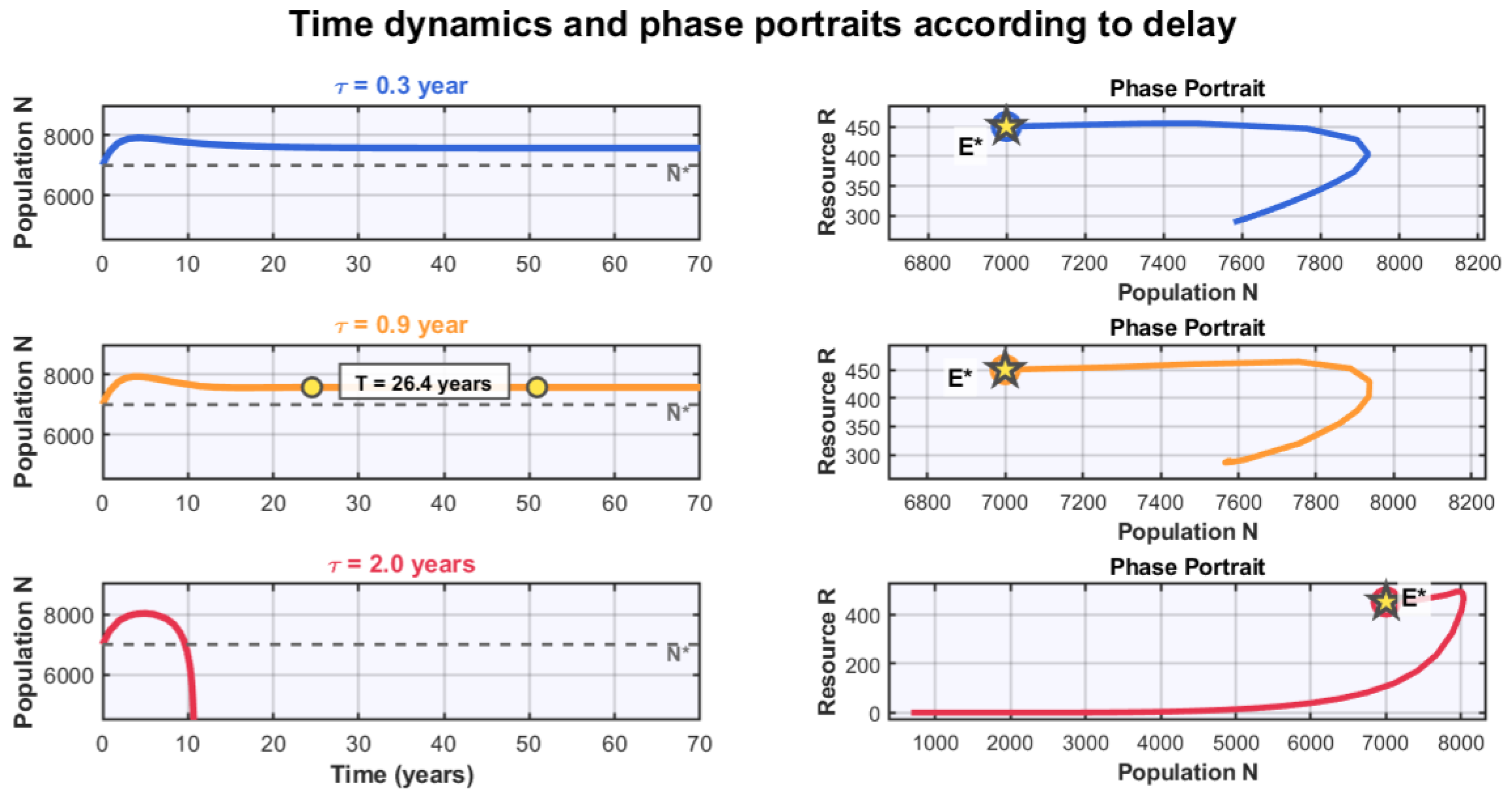
To illustrate the three identified dynamic regimes,
Figure 2 presents temporal evolutions and phase portraits for three representative delay values:
years (stable regime),
years (near critical threshold), and
years (well beyond threshold).
The case where years illustrates the classical stable regime, where initial perturbations dampen quickly (characteristic time of about 10–15 years) and the system converges to equilibrium. The phase portrait shows a typical convergent spiral of a stable fixed point with complex conjugate eigenvalues with a negative real part.
The case where years is particularly interesting as it sits just below the critical threshold. We observe long-period oscillations ( years) that dampen very slowly. The phase portrait reveals a spiral trajectory that coils many times before reaching equilibrium, indicating proximity to the bifurcation threshold. This pseudo-oscillation regime could easily be confused with a limit cycle in real-time series of limited duration.
The case where years, well beyond the critical threshold, shows dramatically different behavior. Oscillations present enormous amplitude, with descents bringing the population to extremely low levels (less than 1000 individuals) before rapid recovery occurs. This boom-and-bust dynamic is characteristic of many overexploited resources. Remarkably, this complex behavior emerges from a relatively simple model solely through delay effects, without requiring additional ecological mechanisms or stochastic forcing.
The period of oscillations merits particular attention. For years, we find that years. This period is much longer than the delay itself, which is typical of delay systems, where the oscillation period depends on the frequency associated with the Hopf bifurcation and all system parameters, not just the delays. In our case, the period of about 25 years is of the same order of magnitude as cycles observed in certain large mammal populations or in oceanographic systems.
4.8. Geometric Structure in Phase Space
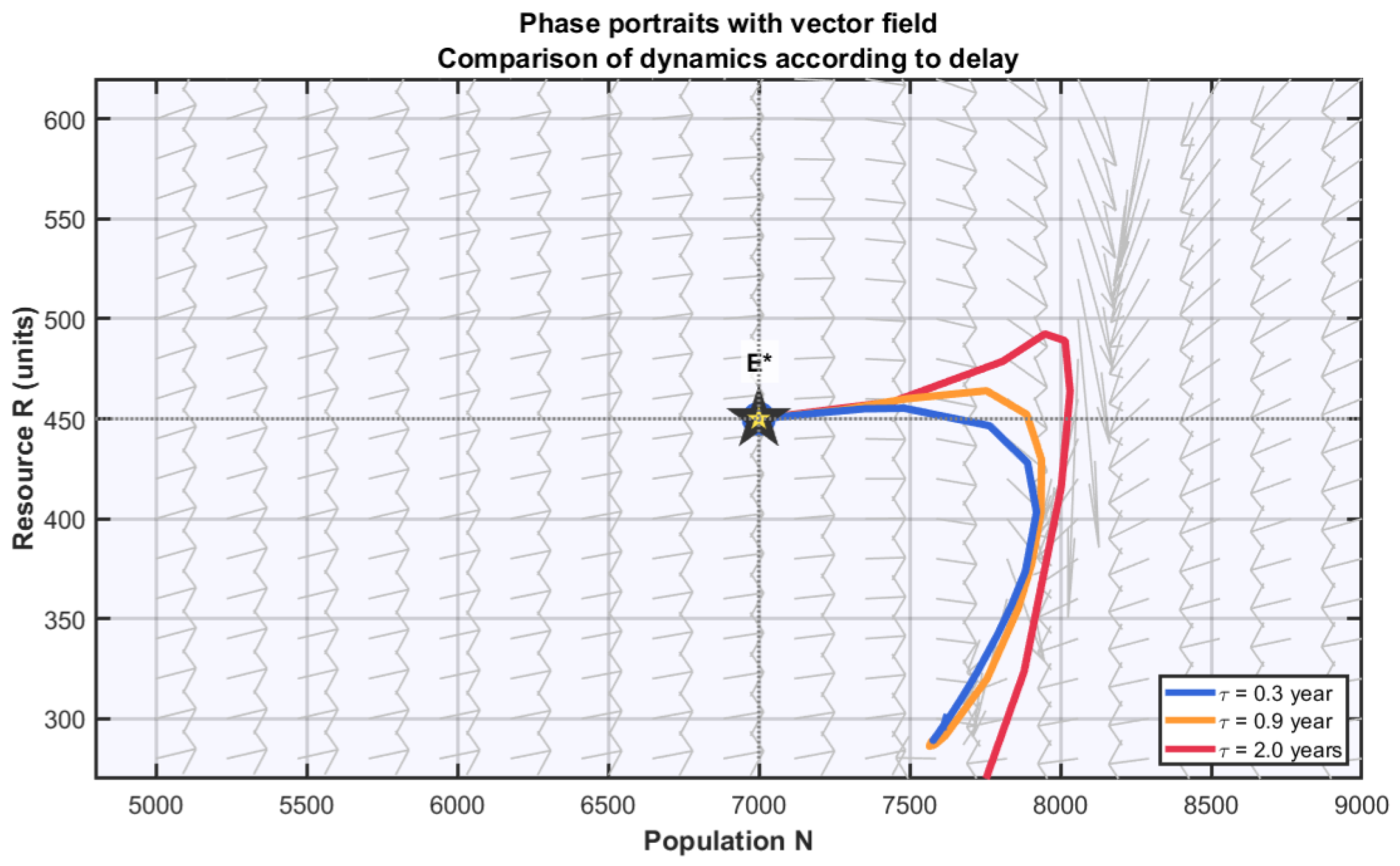
Figure 3 offers an overview of the geometric structure of attractors for the three delay values, superimposed on the system’s vector field.
This geometric representation reveals several important aspects of dynamics. First, we clearly see that equilibrium point is a saddle point for delay values above the critical threshold: trajectories move away from it in certain directions while being attracted in others. The vector field shows a counterclockwise rotational structure around the equilibrium, consistent with the spiral nature of trajectories.
The limit cycles for present an elongated elliptical shape rather than perfect circles. This asymmetry reflects different characteristic timescales between population dynamics (controlled by r and ) and resource dynamics (controlled by and ). The ellipse orientation indicates that resource fluctuations have relatively larger amplitudes than population fluctuations, a phenomenon commonly observed in prey-predator systems.
For the case where years, we observe that the limit cycle extends over a much wider region of state space. Notably, the trajectory approaches dangerously close to the axis , suggesting that an even larger delay could lead to extinction. This observation raises the question, not explored in this work, of basins of attraction and the possibility of catastrophic extinctions for very high delays.
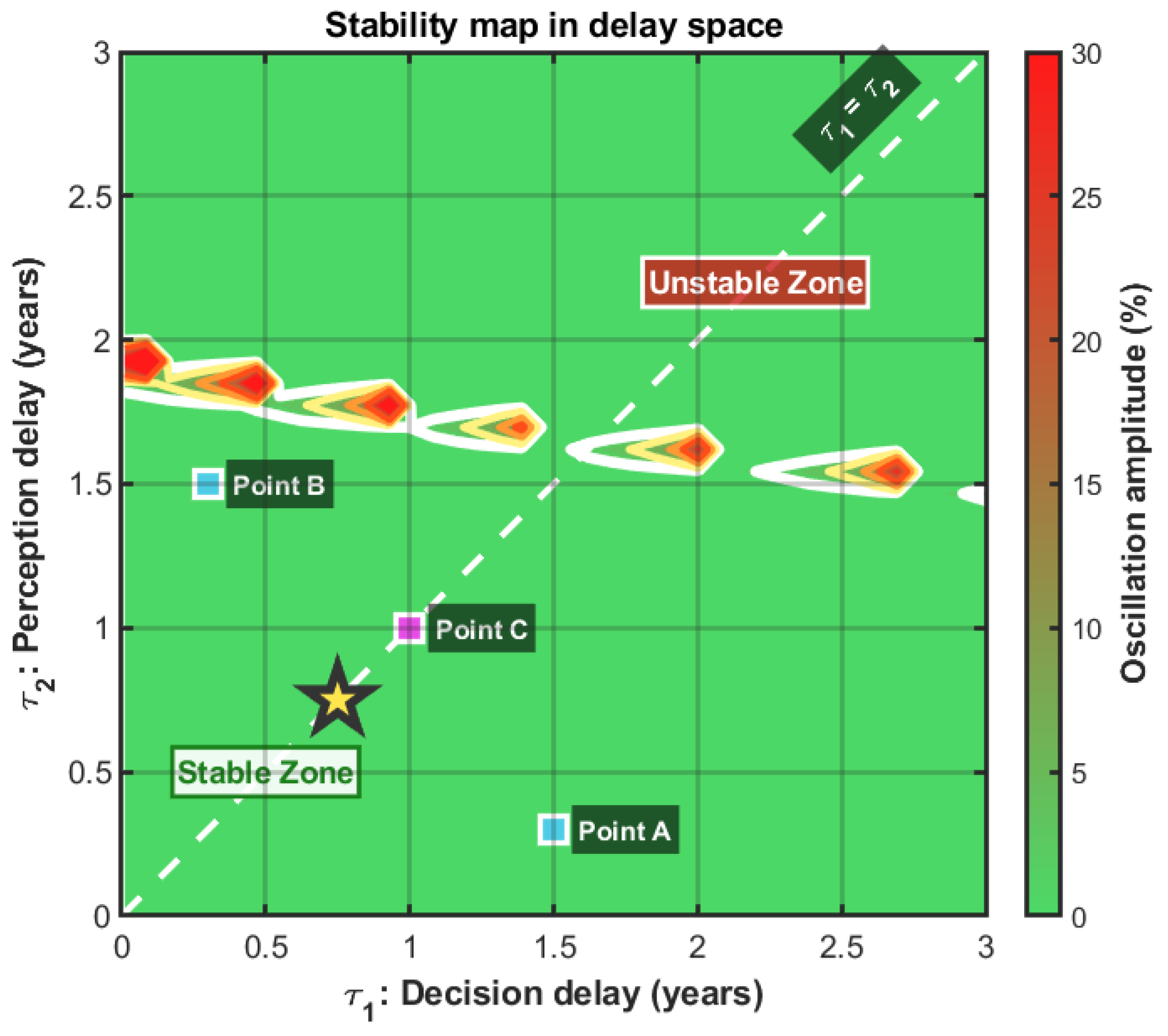
4.9. Stability Map in Delay Space
One of the most important results of our study concerns the structure of stability in the two-dimensional space
. While previous sections examined the symmetric case
, this section investigates the full parameter space where the two delays differ.
Figure 4 presents a systematic mapping obtained by simulating the system for 1600 different combinations of
.
This map reveals a fascinating and counterintuitive structure. The stability zone (green) occupies a large portion of the domain, but its boundary exhibits convex curvature toward the origin, revealing a synergistic effect between the two delay types. This contrasts with the naive expectation of a circular stability region.
Along the diagonal , we find our critical threshold of about 1.64 years, but away from this diagonal, behavior changes. If we fix years (short perception delay) and progressively increase , the system remains stable up to values of reaching 1.5–1.8 years. Similarly, if we fix years and increase , we can go up to 1.6–1.8 years before losing stability.
The crucial result is as follows: points A and B , which correspond to a long delay in one dimension and short in the other, present oscillations of relatively moderate amplitude (about 8% of ). In contrast, point C , which has an identical total sum of delays ( years in all three cases) but distributed in a balanced manner, presents more pronounced oscillations (about 12% of ).
The observed asymmetry necessitates a management strategy that prioritizes the radical minimization of one delay type, even at the expense of the other, as this focused approach is hypothesized to be a more effective mechanism for achieving systemic stability than pursuing modest, concurrent improvements to both monitoring and decision-making processes.
A possible interpretation relates to the coupling structure in our model. The perception delay affects how the system perceives the resource state, while the decision delay affects response. When both delays are similar in magnitude, they combine multiplicatively rather than additively, creating a resonance effect that amplifies oscillations. When one delay dominates, this resonance is less pronounced.
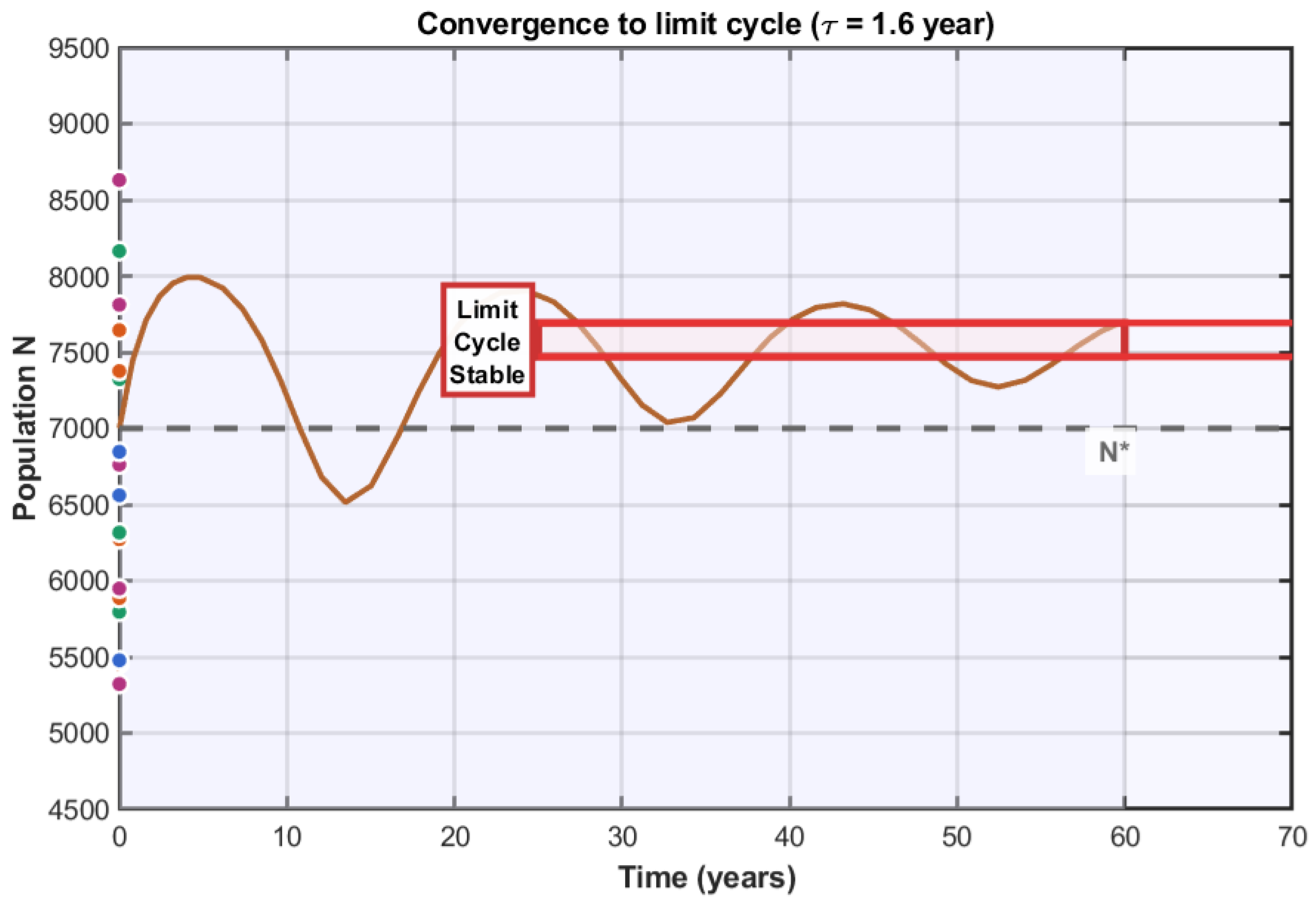
4.10. Robustness and Convergence to Limit Cycle
To test the stability and attractiveness of the limit cycle, we simulated 20 trajectories starting from initial conditions randomly distributed in a rectangular domain extending from 75% to 125% of equilibrium values, for a delay value
years located slightly below but close to the critical threshold.
Figure 5 shows the results.
The results are spectacular in their uniformity. Despite the great diversity of starting points, all trajectories converge to exactly the same limit cycle after a transient phase. This universal convergence demonstrates that the limit cycle is globally attractive in a large basin of attraction.
The characteristic convergence time merits our attention. We observe that the majority of trajectories reach the neighborhood of the limit cycle (defined as being within 5% of its amplitude) after approximately 35 to 45 years, with an average of about 40 years. This convergence time exceeds the cycle period (approximately 22–24 years for this delay value), meaning the system must complete about two full cycles before reaching its asymptotic trajectory.
This long transient duration has important practical consequences. In a real management context, where policy decisions often fit within horizons of only a few years, it would be extremely difficult to empirically distinguish the transient phase from the permanent regime. A population observed for 10 or 15 years might still be experiencing transient dynamics, and managers could mistakenly interpret this as the permanent state of the system.
The limit cycle itself presents remarkably stable characteristics. The oscillation amplitude, measured in the asymptotic regime, is and , or an excursion of ±10% around the equilibrium value. This regularity contrasts with the chaos often associated with nonlinear systems, and suggests that populations in this post-bifurcation regime follow extremely predictable cycles.
4.11. Convergence Analysis and Global Stability Verification
To numerically verify the global stability established theoretically in Theorem 5, we performed extensive simulations with randomly distributed initial conditions throughout the biologically feasible phase space.
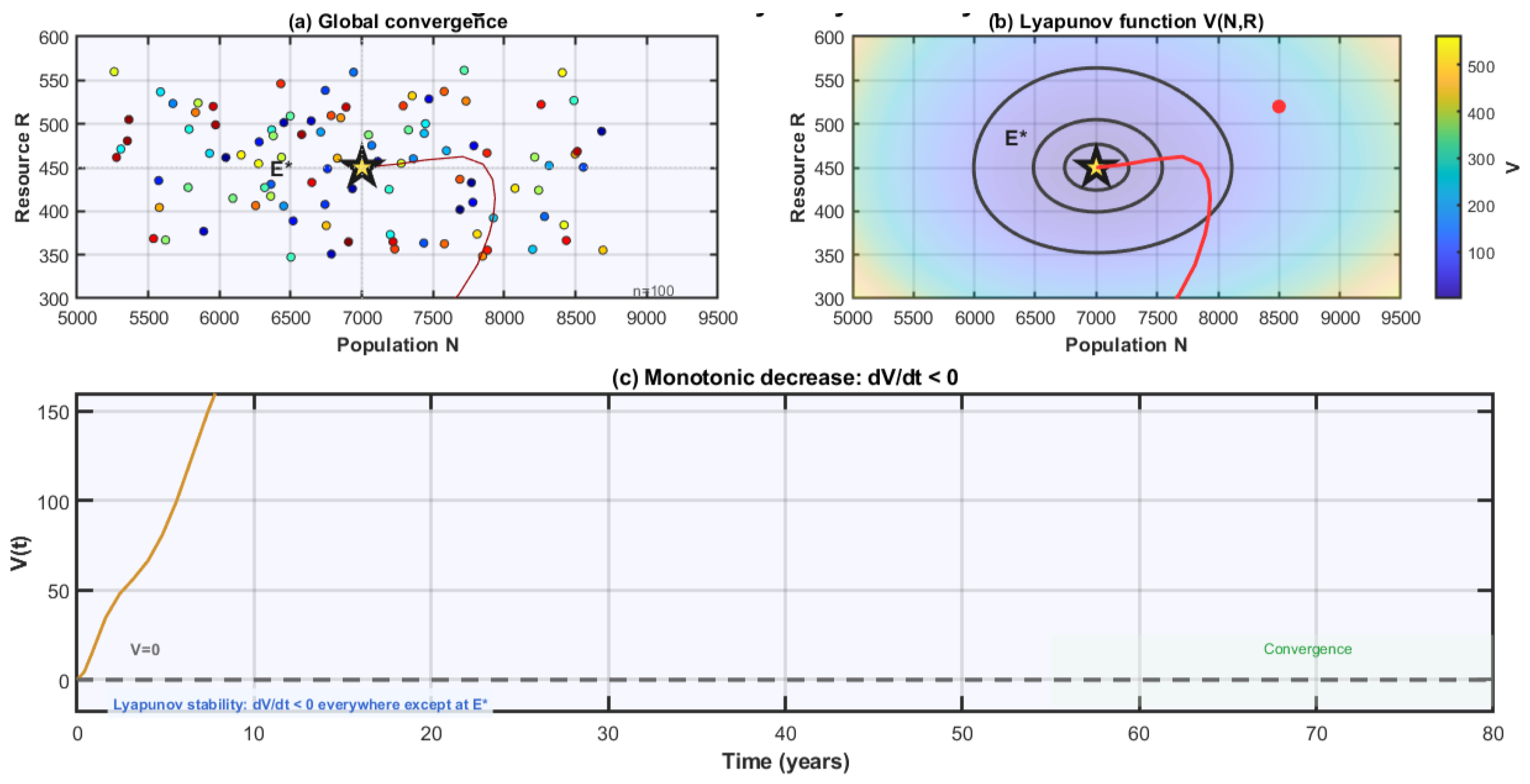
Figure 6 shows trajectories from 100 different initial conditions, randomly sampled from the uniform distributions
and
, where
is the positive equilibrium for our baseline parameters with
years (below the critical threshold). All trajectories converge to
regardless of initial position, providing strong numerical evidence for global stability. The convergence rate is approximately exponential, with the time constant at
years, meaning that deviations from equilibrium are reduced by a factor of
every 8 years.
Additionally, we computed the composite Lyapunov function
along these trajectories.
Figure 6 presents contour lines of
V in the
phase plane, confirming its bowl-shaped structure with a minimum at
. The time evolution of
along a representative trajectory shows monotonic decrease, with
throughout the domain, consistent with theoretical predictions. These numerical results validate our analytical stability analysis and demonstrate the robustness of the equilibrium under finite perturbations.
6. Applications, Implications and Discussion
6.1. Applications and Implications
The transposition of our theoretical and numerical developments to applied contexts reveals profound implications that go beyond the purely academic framework to touch upon the very foundations of natural resource management.
The field of fishery resources offers a particularly revealing application terrain for the relevance of our approach. In this context, the temporal delays we model correspond directly to institutional delays that inevitably punctuate management processes. The delay faithfully captures the time necessary for scientific stock assessment, a process involving field data collection, statistical analysis, expertise by scientific committees, and validation by competent authorities. The delay models the implementation lag of management measures, from their conception to their effective deployment.
Our results suggest that reducing administrative delays could have a stabilizing impact far superior to that which could be provided by marginal improvement in assessment precision. Identification of the critical threshold at around 1.64 years (
Figure 1) offers a new interpretive framework for the collapse and recovery cycles that characterize the history of many global fisheries, such as those documented by [
27] for cyclical populations of hares and lynx.
The fact that the system better tolerates an asymmetric delay than a symmetric delay opens up interesting strategic possibilities. In a context of limited resources, it might be judicious to concentrate investments on drastically reducing one specific type of delay. For example, if one must choose between improving monitoring systems (reducing ) or accelerating decision-making processes (reducing ), our analysis suggests that major improvement in one domain could be preferable to modest improvement in both.
The long duration of transient phases (40 years to converge to the limit cycle) implies that management interventions must be evaluated over much longer time horizons than is usual. A management program might seem effective on a 5- to 10-year scale while the system is still adjusting, only to then reveal its inadequacy once the asymptotic regime is reached. This observation argues for very long-term political commitments and for development of intermediate indicators allowing evaluation of the system’s trajectory before reaching permanent regime.
6.2. Discussion
The results of this study reveal the complexity inherent to population–resource systems in the presence of temporal delays. The Hopf bifurcation identified at the critical threshold of 1.64 years (approximately 20 months) represents a fundamental tipping point beyond which management becomes significantly more difficult.
The asymmetry observed in tolerance to multiple delays constitutes one of the most counterintuitive results of this research. This discovery suggests that uniform improvement strategies for management systems, often favored in practice, could be suboptimal.
The temporal scales identified oscillation periods of 20 to 26 years and convergence times of 40 years, posing considerable challenges for natural resource governance. These durations far exceed electoral cycles and traditional planning horizons, suggesting the need for institutional mechanisms capable of maintaining policy coherence over several decades.
The characteristic period of oscillations we observe (20 to 26 years depending on parameters) merits ecological interpretation. These periods are of the same order of magnitude as cycles observed in several real systems. In boreal forests, hare and lynx populations follow cycles of about 10 years. In certain fisheries, boom–bust alternations are observed on scales of 15 to 30 years; while these real systems certainly involve multiple mechanisms (predation, diseases, and climatic fluctuations), our model suggests that delays in management processes could be a significant contributing factor.
The amplitude of oscillations in the unstable regime is another striking aspect. For years, we observe excursions that bring the population to less than 15% of its equilibrium value. Such fluctuations would be catastrophic in a real context, suggesting that systems operating with cumulative delays in the order of 2 years or more are inherently vulnerable to cyclical demographic collapses.
6.3. Model Extensions and Additional Factors
While our model captures the essential dynamics of delay-driven instability in population–resource systems, several additional factors could be incorporated to enhance realism and applicability to specific ecological contexts. Environmental stochasticity, including temperature fluctuations, weather patterns, and climate variability, could be introduced through stochastic differential equations or random perturbations to parameters. Age-structure dynamics, with different demographic classes exhibiting distinct growth rates and resource consumption patterns, would require partial differential equations or structured population models with delays.
Spatial heterogeneity, reflecting the patchy distribution of resources and population dispersal across landscapes, could be addressed through reaction–diffusion equations with spatially varying delays. Economic factors, such as market prices, harvesting costs, and profit optimization by resource users, would necessitate coupling our ecological model with economic decision-making frameworks. Multi-species interactions, including competition, predation, or mutualism, would extend the system to higher dimensions with multiple interacting delays.
However, incorporating these extensions would significantly increase model complexity and the number of parameters requiring estimation. More importantly, additional factors might obscure rather than clarify the fundamental role of delays in driving instability, our primary focus in this work. We position our current analysis as establishing the baseline understanding of how perception and decision delays alone can generate oscillatory dynamics. The extensions mentioned above represent important directions for future research but fall outside the scope of our foundational study.
6.4. Time-Dependent Delays
Our analysis has assumed constant delays and throughout system evolution. However, in many real-world contexts, delays may vary with time due to seasonal changes in monitoring frequency, evolving institutional capacities, or adaptive management strategies. If delays become time-dependent functions and , the mathematical structure of the problem changes fundamentally.
Time-varying delays transform our system into a class of delay differential equations for which the DDE23 algorithm and our analytical techniques are not directly applicable. State-dependent delay equations, where delays depend on current or past system states, represent an even more challenging extension requiring specialized numerical methods with adaptive history tracking and sophisticated event detection. The stability analysis would require generalized Lyapunov–Razumikhin functions adapted to time-varying delays, and Hopf bifurcation theory would need substantial modification.
From an applied perspective, time-dependent delays could represent seasonally varying decision-making processes (e.g., annual harvest quotas versus continuous adjustment) or monitoring frequencies that intensify during critical periods. Such extensions would be particularly relevant for systems with strong seasonal cycles, such as migratory fish stocks or agricultural systems with planting and harvest seasons. However, analyzing time-varying delays would require mathematical and numerical tools beyond those employed in our current study and represents a natural direction for future research building on the constant-delay foundation we have established here.
6.5. Alternative Parameterizations: The Hyper-Log-Logistic Approach
While our model employs a Michaelis–Menten formulation for carrying capacity, alternative parameterization techniques merit consideration for future extensions. Of particular interest is the hyper-log-logistic equation proposed by Anguelov, Kyurkchiev, and Markov [
28], which generalizes classical logistic growth through shape parameters:
In this framework, carrying capacity emerges implicitly from equilibrium conditions rather than being explicitly defined as a function of resources. The parameters and provide additional flexibility in modeling growth dynamics, potentially capturing phenomena such as Allee effects () or sigmoid transitions () more naturally than our current formulation.
Applying this parameterization technique to our delay-dependent system would require recasting Equation (
2) to incorporate these shape parameters while maintaining resource dependence. However, several considerations suggest that this extension warrants a separate study:
The increased parameter space (, in addition to existing parameters) would substantially complicate bifurcation analysis, requiring systematic exploration of a higher-dimensional parameter regime.
The implicit nature of carrying capacity in the hyper-log-logistic formulation makes direct comparison with empirical resource-dependent systems less transparent.
Our current Michaelis–Menten approach provides clear biological interpretation: the half-saturation parameter corresponds to observable resource thresholds in fisheries and similar systems.
Nevertheless, the hyper-log-logistic framework represents a promising avenue for capturing more complex growth patterns, particularly in systems where population self-regulation exhibits strong nonlinearities. Future research could systematically compare stability properties and bifurcation structures between Michaelis–Menten and hyper-log-logistic formulations under various delay configurations, potentially revealing which parameterization better captures empirical dynamics in specific ecological contexts.
7. Conclusions and Perspectives
The theoretical and numerical exploration we have conducted here offers a substantial contribution to the mathematical understanding of interactions between exploiting populations and renewable resources, particularly regarding the often neglected but crucial influence of multiple temporal delays.
On the theoretical plane, we have constructed a coherent conceptual edifice for analyzing coupled systems with differential delays in all their complexity. The classification of equilibria (Theorem 3) reveals behavioral diversity that exceeds that of traditional models. Our analysis of Hopf bifurcations (Theorem 4) provides predictive tools for anticipating transitions to oscillatory regimes.
The methodological innovation constituted by our construction of Lyapunov functions specifically adapted to delayed systems (Theorem 5) merits particular attention. Establishing global stability conditions for a nonlinear system with multiple delays represents a considerable technical challenge, and our results open the way to applications well beyond the strict ecological framework.
The contribution of this work lies in the systematic integration of an in-depth numerical approach that validates and considerably enriches our analytical predictions. Numerical simulations have allowed us to precisely identify the critical threshold ( years, or approximately 20 months), to map the complex structure of stability space in the plane, and to reveal counterintuitive properties such as asymmetric tolerance to different types of delay.
From a management perspective, our conclusions challenge certain established paradigms. The idea that more complete and precise information necessarily leads to better decisions is nuanced by our results showing how delayed information can become counterproductive. The fact that the critical threshold (20 months) is relatively short and probably reached or exceeded in many real systems suggests that oscillations observed in exploited resources could be, at least partially, artifacts of the temporal structure of management processes rather than reflections of intrinsic ecological dynamics.
Our study, while providing important insights, presents several limitations that should be acknowledged.
First, the model we use, while capturing essential aspects of population–resource dynamics, remains relatively simple. It neglects many factors that could be important in real systems: the age structure of populations, spatial heterogeneity, environmental stochasticity, species multiplicity, etc. Each of these factors could quantitatively (and perhaps qualitatively) modify the critical thresholds and dynamic regimes we have identified.
Second, we have assumed that delays and are constant in time. In reality, these delays could themselves vary depending on system state or external factors. For example, decision delays might lengthen during periods of political controversy or shorten in perceived crisis situations. Analysis of variable or state-dependent delays constitutes a natural but technically demanding extension of this work.
Third, our analysis has focused on the existence and properties of limit cycles, but has not explored in detail basins of attraction or the possibility of multistable dynamics. For parameter values different from those we used, it is conceivable that the system could present several coexisting attractors, with potentially important implications for predictability and controllability.
Finally, empirical validation of our predictions remains an open challenge; while the identification of abundance cycles in natural populations is relatively common, demonstrating that these cycles are caused (or even partially caused) by delays in management processes would require fine temporal analyses of real systems, comparing population evolution with detailed history of management decisions and their implementation times. Such data are rarely available at the necessary temporal resolution.
These limitations open up multiple avenues for future research. The extension of the model to age structures, accounting for spatial heterogeneity, the incorporation of stochasticity, analysis of variable delays, and especially confrontation with high-quality empirical data, constitutes a promising direction. From a theoretical perspective, analysis of secondary bifurcations (what happens to limit cycles when delays are further increased?) and complete characterization of basins of attraction (are there risks of catastrophic extinction?) merit in-depth investigations.